
In short
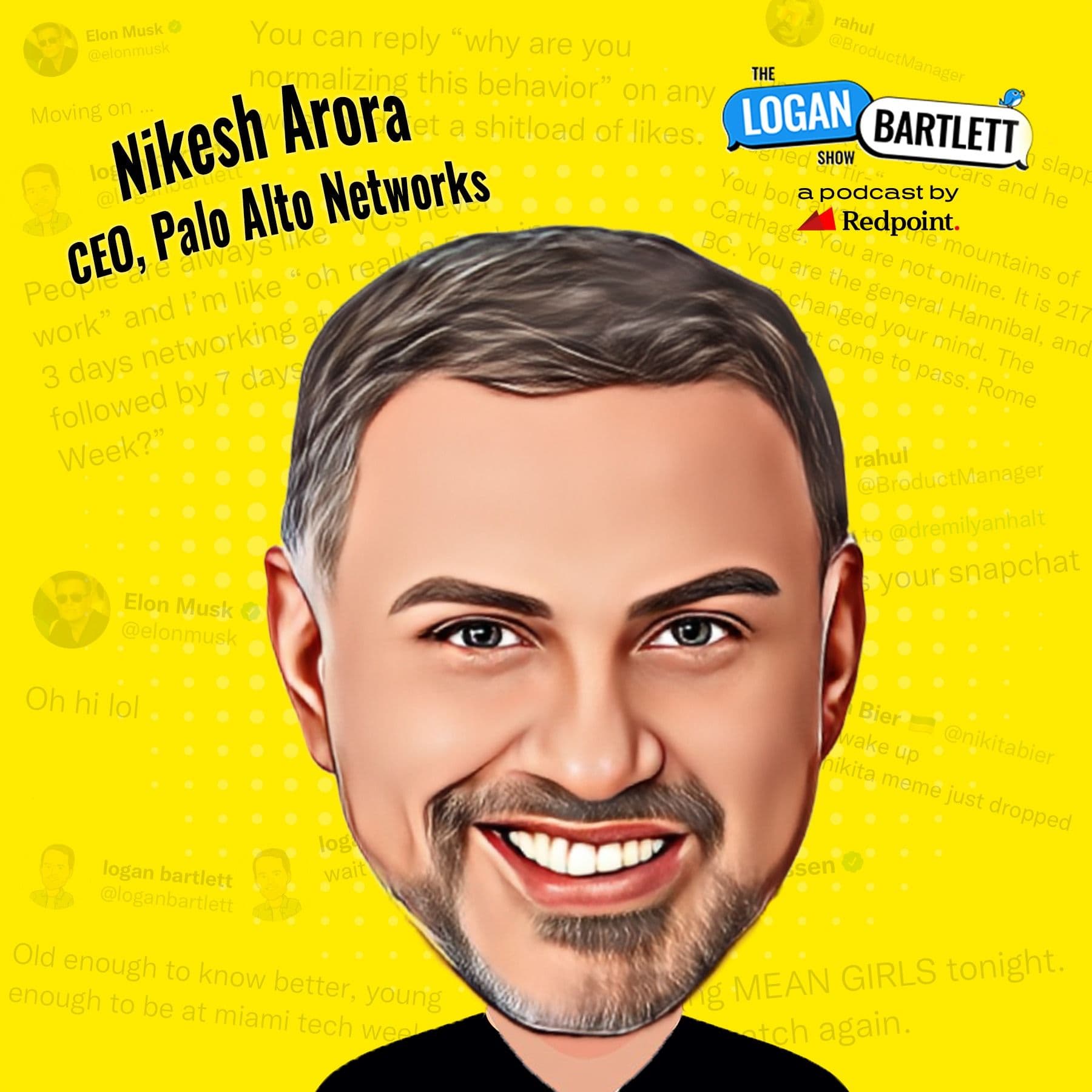
Podcast Summary: The Logan Bartlett Show - EP 88: Nikesh Arora (CEO, Palo Alto Networks)
Overview In this episode of *The Logan Bartlett Show*, host Logan Bartlett speaks with Nikesh Arora, the CEO of Palo Alto Networks. Arora discusses his journey from lacking cybersecurity expertise to leading a company that grew from $18 billion to nearly $100 billion in less than six years. The conversation delves into his approach to leadership, mergers and acquisitions (M&A), marketing, and career choices.
Key Points
- The Benefits of Being a Generalist
- Arora emphasizes the advantages of approaching new industries with fresh eyes.
- He believes that entering a field without prior expertise can lead to innovative perspectives and solutions.
- Acquiring Domain Expertise
- Transitioning into Palo Alto Networks without cybersecurity knowledge posed challenges, but Arora leaned on existing expertise within the company.
- He engaged with co-founders and absorbed information through conversations and presentations to learn about the field.
- M&A Strategy
- Under Arora's leadership, Palo Alto Networks has completed 19 acquisitions.
- His three rules for successful M&A include:
- Principal Negotiation: He prefers to negotiate directly with the founders to establish rapport and alignment.
- Leadership Integration: Acquired founders are integrated as leaders within the company, ensuring their vision is retained.
- Cultural Fit: Ensuring that acquired companies align with Palo Alto’s culture and mission.
- Marketing and Storytelling in Technology
- Arora discusses the critical role of effective storytelling and marketing in tech, drawing contrasts between product-driven companies like Google and those that rely heavily on marketing.
- He shares insights from his experience as CMO of T-Mobile and emphasizes the need for balance between product excellence and compelling marketing.
- Leadership and Management
- Arora shares lessons learned from managing a large organization, highlighting the importance of clear communication, simplicity, and cultural consistency.
- He advocates for creating a supportive environment where employees feel secure and valued.
- Navigating Career Transitions
- Arora reflects on his diverse career path, emphasizing the importance of adapting to new roles and industries.
- He suggests that individuals should strive for roles that align with their passions and strengths rather than merely following a linear career path.
- Artificial Intelligence's Impact
- The conversation addresses the growing influence of AI in cybersecurity and business, distinguishing between precision AI and generative AI.
- Arora is actively engaging his leadership team in understanding AI's implications for their industry.
- Mission-Driven Work in Cybersecurity
- Arora expresses a sense of purpose in cybersecurity, viewing it as a mission to protect businesses from cyber threats.
- He recounts experiences where Palo Alto Networks provided critical assistance to businesses and governments during crises.
- Romanticizing the Past
- The discussion touches on the human tendency to romanticize past experiences, suggesting that it can lead to greater happiness in life.
Conclusion Nikesh Arora's journey from a generalist to a successful CEO showcases the importance of adaptability, continuous learning, and the value of a strong company culture. His insights into M&A, marketing, and leadership provide valuable lessons for current and aspiring entrepreneurs, highlighting the need for a balance between product excellence and effective storytelling in the tech industry.
Executive Production Team
- Produced by: Rashad Assir & Leah Clapper
- Mixed and Edited by: Justin Hrabovsky
- Executive Producer: Josh Machiz
Listen to the Episode
- [Apple Podcasts](https://podcasts.apple.com/us/podcast/the-logan-bartlett-show/id1606770839)
- [Spotify](https://open.spotify.com/show/5WqBqDb4br3LlyVrdqOYYb?si=3076e6c1b5c94d63&nd=1)
- [Google Podcasts](https://podcasts.google.com/feed/aHR0cHM6Ly9mZWVkcy5zaW1wbGVjYXN0LmNvbS9zb0hJZkhWbg)
Follow The Logan Bartlett Show
- [Instagram](https://www.instagram.com/theloganbartlettshow)
- [Twitter](https://twitter.com/loganbartshow)
- [TikTok](https://www.tiktok.com/@theloganbartlettshow)
Written by AI. May contain mistakes. Listen to the episode to check what was said.
Transcript
Automatic transcript. May contain errors.0:05Welcome to the Logan Bartlett Show. On this episode, what you're going to hear is a conversation I have with Nikesh Arora. Now, Nikesh is the CEO of Palo Alto Networks, a business most recently valued at about$85 billion. Before that, he served as the COO of SoftBank, working with Masa to make investments. And before that, he served as the chief business officer of Google. Nikesh and I talk about a bunch of different things, including the benefits of being a generalist in entering a new field, as he was not familiar with cybersecurity or enterprise when he joined Palo Alto Networks as their CEO.
0:37We also talk about M &A and how Palo Alto Networks has used that as a strategy in acquiring 19 different companies and lessons learned from growing Palo Alto Networks from an$18 billion company to an$85 billion one over the course of the last five and a half years. Finally, we discuss his growing up in India, immigrating to the United States, his path to becoming the CMO of T-Mobile prior to his Google journey. A really interesting conversation with one of the more thoughtful executives at a high-performing public company. You'll hear that conversation with Nikesh now. Nikesh, thanks for doing this.
1:11My pleasure. So I want to talk a little bit about domain expertise and the knowledge of a given sector before you go into it. So you had never done advertising when you started at Google, right? No. You had never done investing or at least professional when you started at SoftBank. Actually, that's not true. I used to be a buy-side analyst at Putnam. Oh, interesting. Okay, I missed that. You had never done cybersecurity or enterprise before joining Palo Alto Network. So what do you think the benefits are of people coming in without knowledge in a given domain with fresh eyes? That's an interesting conversation, right?
1:46We all started life somewhere without any domain expertise. My first job out of college was with no domain expertise. So I think it's a bit of a fallacy that we don't learn on the job. The question is, what skills are needed for the job? What proportion do you bring with you? And what do you learn in the job? Now, understand, you're not going to put somebody in a plane and go figure out how to fly a plane. But I think if you're not learning in your job, if you're not picking stuff up, you're not intellectually curious, I think it makes it a horrible career. How do you go about acquiring domain expertise?
2:21Like when you started at Palo Alto Networks, how did you go about learning about cybersecurity or enterprise? And again, Palo Alto is a phenomenal organization. When I walked in, there was a phenomenally good culture. The company was doing well. It had sort of gone from being a startup to about an$18,$20 billion public company. And people had gotten there because of all the good stuff that had happened before. And when I talked to the board, their point of view was that we have 5 ,000 plus people who understand cybersecurity. So we don't need more cybersecurity expertise. We need somebody to sit down with the management team, figure out where we need to go, what we need to do next, how do we win.
3:01So you bring some of that knowledge from, whether it's from your investing life, some of it from analyzing companies, some of it from running a large part of Google. You bring all of that expertise to bear. And you say, okay, let's understand the field. Let's understand the market. Let's understand the domain and see where the market's going. So you do that. Now, I was privileged, I am privileged, because Nir Zook, our founder, was still around when I started. So was Rajiv, who was one of the co-founders, and Lee Clarich, who's the chief product officer. They'd been there from the beginning. So I sort of get on my phone on my drive over and ask a lot of stupid questions to Lee.
3:37And on the way back, I asked a lot of questions to Nir, and then I'd call again the next morning and ask Lee what Nir said and ask Nir what Lee said. So between them, I got sort of some version of what I needed to understand. And then I spent a lot of time staring at a lot of presentations, and a lot of stuff on the internet trying to figure out what it means. And, you know, slowly and steadily, you see it again and again, eventually sort of parse through it and see what makes sense. And so it does make sense. How long did it take you to get up to speed, do you think? I'd say I'm still learning.
4:05It's been five and a half years. There's always a new thing. The fascinating part of cybersecurity is it is a constantly changing field because it follows technology. Now, you know, guess what the conversation now is? How do you protect AI? How do you make sure that when people are accessing LLMs that you can't contaminate them? How do you make sure that data doesn't get extracted from LLMs? So I'm going to have a whole new conversation around how do you secure AI from hackers. So there's always a new technology out there, which you have got to figure out how to protect. And the best way to protect this is to secure it by design.
4:42So you're constantly learning. I don't think the learning is ever done as it relates to either technology or cybersecurity. Was there a point of domain or understanding that you sort of said, okay, I understand up to this point, you're not in there writing code, and there's some things you're going to rely on near for? So was there a point that said, okay, now I've sort of rounded out my domain here? Yeah, I guess domain is a big word. I think you start by understanding industry. What are the parameters of industry? And if you looked at it six years ago, cybersecurity was about$130,$140 billion industry revenue per year.
5:16And the largest market share was 1.5%. I don't need to be a cybersecurity expert to figure out, you know, what the hell. There's a 1.5 % market share with the largest player, which makes it the most fragmented subsector of technology. So why is that? Why is it that no company has reached critical mass and gone to 5%, 10%, 15 % in some cases, you know, like some of the other big players in consumer? And you have like a winner-takes-all scenario. So why is it that at one end of technology and the consumer end, you have winner-takes-all. On the other end, you've got such a fragmented marketplace that you're fighting for one and a half percent market share.
5:51And you sit there and say, that's interesting because, A, it's the most innovative industry in the world. There's constantly new attack, new way to solve the problem. B, when somebody figures out what the next cool thing is, they spend their life trying to get hundreds of thousands of people to buy that. In the meantime, the new technology shows up. Somebody's cracked the core in the new stuff, and they're busy selling the new stuff. And the first company never invested in innovation, never paid attention to where the buck was going. And here, lo and behold, you get another flash in the pan, 1.5 % market share leader.
6:19So there are so many cybersecurity companies in the$1 to$5 billion market cap, a few in the$10 to$15, and possibly two or three in the close to$20 billion range. And that was the largest. You just didn't say, there is something fundamentally wrong in the way these companies are run, managed, and constructed, that none of them ends up being an evergreen cybersecurity company. So you bring all your business knowledge to bear and say, well, how do I crack the code? How do you take that? How do you flip it? Then you've got to go back into domain and say, all right, what drives cybersecurity demand?
6:49Cybersecurity demand is driven by the evolution of technology. Instead of saying, well, I don't need to be a cybersecurity expert to understand what the next evolution of technology is, having spent 10 years at Google or trying to invest in software. I guess, you know, my plastics moment is cloud and AI. And I came to Palo Alto five and a half years ago. So the first napkin said cloud and AI. And they said, well, we've got to secure the enterprise, secure the cloud, secure AI. And then you realize, you know, over the years you learn things. And look, it's much easier to build something for the future than go under the past.
7:21So you then say, how do we pivot this company and put it in a course where we are the number one in cloud security and all the impacts that are going to happen because of cloud security? So in that context, then you get into DomainX. But you say, okay, what does that mean? What does securing the cloud mean? So he's kind of parsed it out into small parts to try and understand what needs to happen. Then he said, what does the competitive landscape look like? They can't say, oh, there's so many companies doing so many things. They said, well, now you're back to a business decision. Do you buy or do you build?
7:48Yeah, I want to get into that in a second. But as that 1.5 % versus$130 billion, was that something that the board recognized in recruiting you on the way in? Because I'm curious what the unique set of circumstances are for the Palo Alto Network's board to say at$18,$20 billion, we're going to go hire someone from outside the cyber industry and bring them in. Was that their thesis or was that something you figured out on the way in? No, that was their thesis. And I still sort of wonder, having been on about 15 to 17 boards in my life, I still wonder how that conversation went because I was in the room.
8:24because most boards are taught to be down the middle, look for experience, try and not rock the boat. And in general, boards are risk minimizers. They're not risk takers. Boards are designed because of all the governance we have in place, all the fiduciary stuff that kicks in. You're actually risk minimizing all the time. So it was a pretty unique board at Palo Alto which made the decision to go multiple standard deviations away from the norm. And they did have people down the middle. They interviewed a bunch of people in this space. It was an$18 billion company. It was a well-run company. It had a great culture.
8:56It was doing well. So there were people who wanted the job. They sat there and said, well, if we hire some of these people, we're going to end up getting more of the same. We need something different. Now, you know, I joke like, you know, let's find a guy who's never done enterprise, never done cybersecurity, never been a public company CEO. Sounds like a perfect fit. It's worked out okay. It's worked out okay for everyone, yes. Yeah. So the M &A point and, I guess, the buy versus build. So how many companies have you now purchased since you've been here? 17 plus two. Two are on the way to closing.
9:29Okay, so 19 acquisitions in the sector. And the M &A strategy, was that something, I guess, as you sort of, as the board talked about the$1.5 to$130 billion and figuring out the federation or fragmentation of it, did they know that M &A was going to need to be a part of it? Or was that something you realized once you got here? Well, look, the board's job, as I always say, is to hire and fire management. It's management's job to come back with a strategy. So that strategy was built by the leadership team here. We sat down and said, well, how do we go and win in all these new areas that need to be won?
10:07And then you sit down and say, well, let's make a list of our assets and our liabilities. Our assets are a 5 ,000-people company. We have$4 billion of cash in the balance sheet. We have a good brand. We have a bunch of people on the field. Our liabilities are, for 5 ,000 people who are a large company, we're not great at innovating as fast as some of the startups out there. And we don't have the people who are scrappy, who are going to go make great things happen with limited resource. So how do we take that opportunity and find people who do that really well, ingest them to Palo Alto, yet not make the mistakes that are traditionally made by larger companies when they do M &A?
10:44And that was kind of the opportunity and both the challenge. So we sat down, we figured out, and say, listen, there are spaces in cloud where we could win, but we're two, three years late to the party. We saw there was a whole bunch of startups in that space. So we sat down and said, well, you've got to first have a point of view. What's going to be important from a customer perspective? So you kind of figured out where the product market fit needed to be. And you sit down and say, well, who do we want to be in business with? You look at it culturally, make sure these people fit apart. You look at it and say, do they have the right product?
11:15Is it aligned with our product vision? You go figure that out. and then you go buy the best. I think very often the biggest mistakes companies make at M &A is one, you somehow end up thinking, well, guess what? It's a simple matter of programming. I can take a small team, which is less expensive than the best of the market, and I'll make it work because I'm so much smarter than everybody else. Well, it doesn't work out like that. There is a reason somebody is number one and best, and you just don't give enough credit for it. I joke, and I was like, my innovation is genius, and your innovation is a mistake or a fluke.
11:43So it's like, no, there is a reason those people are successful. You buy that. The second thing is, in our space, it's important to get the innovation right. We'll do the go-to-market. We have 5 ,000 salespeople. We have a sales methodology. We have customers. So people end up paying a lot more for customers, which we haven't. We've won 19 companies. We usually look for anybody who's got anywhere from 15 to 50 customers, which means there is product market fit. 15 customers are, most startups end up getting 15 customers somehow. 50, you start to pay attention. and say, wait, 50 means that somebody actually made a bet and chose your product over other people.
12:19Once you get to 500, then you end up paying for the extra 450 at a multiple of revenue, which I don't like to do. So you find the right company, you find the right price, you find the right team. But what is unique in our approach is what we do after that. First of all, we don't use anybody else. It's me and our management team negotiates the deal directly because you're negotiating with principals who started the company with blood, sweat, and tears. You've got to make sure they understand you think it's as important as they think it is. We don't send our M &A team or our corporate dev team. We don't have bankers.
12:49We directly talk to principals. And in fact, if somebody else gets in the middle, we ask them to stay aside. So that's kind of rule number one. Rule number two is in all 19 cases, the people we acquire end up becoming the bosses of people who work at Power Offer because they beat our teams. So it's not like they come, like we have to work for a senior vice president of crypto or blockchain. those people have to work for them because they beat us out fair and square with limited resources faster, with more agility, and they have a better product vision than we do. So I'd say 70 % of our product team today is run by acquired founders or their teams, which allows you to create that cultural transformation.
13:30And the only other thing we do is we actually align our product roadmap and org structures before we close the deal. We sit down with the founders saying, here's how it's going to work, here's where it's going to fit, here's what we're going to build together, And we've had 100 cases where we didn't align, we didn't do the deals. So you start with an early emerging category, it seems like. And then you go identify who the winners are. You're doing outreach or networking your way into those, figuring out who is the best cultural alignment and all that. One of the interesting things, I guess in convincing a founder that they would be better a part of Palo Alto than going alone, what is that pitch?
14:05Because oftentimes from a VC's perspective, I'm like, no, no, no, much better on your own, right? Well, of course, because the moment you find more people who want one of your businesses, that means you've smelled success. That's right. If they give it a little more, you might make out better. So I understand your perspective. In fact, almost every one of those 19 cases, there were VCs involved on the other side. I think it's fair to say in a large proportion of those, the VCs were saying, keep going. You guys are doing great. So I think part of it, look, not every founder is a seller. We've discovered that.
14:36But also, you know, the math is against them, right? Think about it. In cybersecurity, there's thousands, 2 ,000, 3 ,000 startups out there. We bought 19. I'd say the average price paid is between$300 to$400 million, which is a great outcome because there are 19 winners in 19 categories. There are possibly 10 other players in each of those categories. So there's 190 companies who could have been considered just for what we bought. We looked at 600 to get there. So A, you've got to be really good at what you're doing. And usually when we're buying them, we're looking at their product vision for the next two years out and believing that what they're going to do is going to make sense.
15:08So that whole conversation with these founders is, listen, if you truly want to make a difference in this space and you want to build the best outcome for customers out there, many of them are inclined. They're like, I want to change this space. I want to own the outcome in this category. He says, you've done the hard part. The hard part is building the product, having a point of view, having a vision. The harder part is not relying on 500 people to go out and sell your vision. And most technically oriented founders are great product guys. struggle at the go-to-market part because go-to-market is rinse and repeat.
15:42You've got to go suck up to a lot of people, sell really hard. You've got to convince them, and not everything is logical. It's not like, oh, my product is better than yours, hence I will win. There are so many other factors that go into it, and that's what we're good at. We're good at integrating this stuff. We're good at making sure the customer relies on Palo Alto. We're going to run for a long time. We have customer support processes in place. We have salespeople in place. So we tell them, listen, you can come in, be part of the team, Now you demonstrate, like we acquired a company, Bridge Crew, right?
16:11We started six months in, they had 150 customers with us, right? Because we made them part of our bundle. We let them, we activated their product. The founder's like, oh my God, I got 150 customers in six months that are taking me five years to do this outside of Palo Alto. And then these people become our ambassadors. The founders we've acquired go back and tell their community to other people in the space, listen, if you want to be part of the largest cybersecurity team, I would choose Palo Alto. It seems like you're paying a high revenue multiple, but a low absolute valuation for these. Remind me when I try and buy one of your companies.
16:43Yeah, exactly. Well, the incentive alignment, by the way, if a VC invested in a company at 250 post, and you're coming in at 300 or 400 after it, but the founder owns 20 to 50 % of the business, right? The founder could be walking away from 60 to 80 up to 150,$200 million among a few founders, which is very material to any individual. Actually, it's even better than that. So in our case, what has happened to many of the founders, what we do is when we acquire the company, we tell the founders, you're locked in for two years. You can't extract your money out. We even give them an incentive of more shares on top of what they already own to stick around a third year.
17:18In most of those cases, their founders, literally one walked up to me last week and says, I don't like you. I'm like, what did I do to you? He's like, well, I know this other guy, you locked him for three years. Me, you let me sell some. I should have stayed and bought a lot of stocks. So it's not just what they're walking away from. Some of them have made 4x their initial money. So the two to three year period is an important one. And then is that the point that the businesses can operate as standalone business units and are less potentially beholden to the founder's vision and you can reintegrate them in some way?
17:50We want to make sure that the founders stay as motivated to execute on their original vision because we're acquiring them at a point where they're two, three, three and a half years into a product. And I think it takes four to seven years to build a great tech product in the world. You pick your category, you pick your space. It's taken four to seven years to build great products, whether it's an Uber or a WhatsApp or a YouTube or Google search. These things take four to seven years because you have so many ideas. You have to test them in the market. You've got to keep building, keep building until it becomes somewhat a wholesome proposition.
18:22So having the founder around for the first four to five years of a company is very important because they're executing in their product vision. Now, after that, one or two things will happen. Either the founder will stay motivated, be relaxed, want to be there, or they'll miss their roots of going and starting something afresh because the upside is a lot more, at least in their mind, because they've smelled success the first time. So then it becomes a discussion with them about what they believe is the right thing for themselves. But by that time, we've integrated the product, the product is part of our portfolio, we have people who can sell it, it's part of our fabric, then it's a lot less risky for us to potentially lose that scrappy founder than it is when we acquire a company.
19:00Because typically when you're acquiring these companies, acquiring not just a product, you're actually acquiring a team that works well, is cohesive, and has a differentiated product vision in the market. How do you think about the brand? You mentioned Bridge Crew. It sounds like that's survived as a standalone brand right now. No, it's not. No, it's just a company you bought. No. Look, at the end of the day, we're acquiring product categories. They have their early names. At the end, I don't believe in sustaining multiple individual brands, eventually it has to be about our network products. We have our brands, Strada, Cortex, and Prisma.
19:33Brands get integrated or products get integrated into those brands. Our brands now have been around for six years. That is way longer lasting than anybody else has had. Cyber security brands in those spaces. And these are all product companies. I mean, it's like 25 customers, 15 customers. They didn't buy those products because of the brand. They bought the products because of their products being really good. And if we can... translate that really good product into our portfolio, make sure we can reflect the capabilities and the benefits of products, I think the brand doesn't matter. On the brand point, I heard you say at one point that Silicon Valley spends way too much time overemphasizing product and not thinking about marketing and storytelling.
20:13Can you expound on that? Yeah, one of my many iterations of my life, I was chief marketing officer of T-Mobile. And I also spent time at Google. Now, I think if you look at the two different sort of extremes, Google got to be a really successful company, went public, without spending a dollar on marketing. The product was the brand. The product trial was what got you hooked. You tried to do a search, and you found the answer, and then you went back to all the search. I didn't have to explain search to you. The product was so simple. It cost you nothing. There was no friction. And you go to Michael Porter, he'll tell you there's product promotion, placement, and price.
20:51Well, guess what? In Google, there was no price, there was no placement, there was no promotion. It was just product. So you're focused singularly on the product, and you don't have to worry about anything else. Now, that's great if you can get some of that virality and get people to go experience their product. Otherwise, people spend a lot of time and money, spending money, trying to figure out how to get you to experience the product, and then the product kind of works in itself. Now, if you take the other extreme, and say, okay, that's great, but you've got to build a great product. Well, there are products which are commoditized, but yet you have a slightly different spin.
21:22and it's hard to understand when you work in the tech universe that there is something called a commoditized product but take the case of water Evian it's a brand of water Pellegrino is a brand of water there is no product differentiation I did this in a 600 people marketing conference in T-Mobile I was 33 years old we had 6 glasses of water you had to taste them and figure out which brand was which they're horrible, nobody could tell the difference on purpose. And the point is, the entire perception that's created in your brain is which one is better. And there's a whole art to being able to market.
21:59There's a whole art to storytelling, to building a positioning around it. Like you take the old campaign from Verizon which says, can you hear me now? They figured out the problem in mobile and telephony was nobody cared about all the cool shit. People said my network doesn't work everywhere I go. They'll spend two years sending one message. Can you hear me now? everybody believes that their network was better because they told a story, stuck to it, repeated the hell out of it. So I think there's a balance you have to strike when you're trying to break into a market in terms of what part of your product is differentiated, what product is so good that if you can just get people to experience it, they're going to love it, or where are you slightly differentiated and you're trying to create a distinct space for yourselves, in which case you have to worry about marketing.
Read the full transcript
22:47Where does enterprise fall on that spectrum there? Do we overemphasize the product within enterprise and software? Or is it, where does that line fall? Enterprise, to say. I think enterprise is not, it's kind of interesting. You go back in history, most tech products were created for enterprise first. Like, I remember not having a laptop. The laptop was something I got at work. I remember not having office productivity tools or anything to do word processing or write anything. Everything happened for work. You had Windows for work and stuff like that. I think the pivot happened when, I think in the early 2000s, when we all started getting computers and started doing stuff at home.
23:32I started having connectivity when Google's of the world came about. And now it's like everything's built for the consumer when mobile phones come about. And we all have apps. And you said, holy shit, why don't I have apps at work? I have these clunky old software products that work, which are not as cool as consumer products. I think we've gone through a phase where enterprise was where things were, and now consumer is where things were. And enterprise is the old clunky world, and consumer is the cool world. Look at all the apps that are out there, all the AI tools that are being built. They're built for the consumer.
24:01So enterprise is, I'd say, clunkier products, if you will. They're not as beautiful and as elegant that we've designed them for consumers. Funnily, it's the same people. You know, it's you and I on our mobile phones and our apps, and it's you and I at work using clunkier enterprise products. You know, try using some of the CRM products or some of the ERM products and the ERP products out there. They're complicated. They're not as easy as simple to use. And that's why once in a while you'll see an enterprise company which comes out with a slick UI and a slick product. You say, oh, my God, that is so cool.
24:31Why didn't we do that? So I think enterprise will go there slowly. I think it's not there yet because it's still a lot cumbersome to move those things around. And I think enterprise overemphasizes engineering aspects of product development than the coolness and slickness and nice, the prettiness of consumer products. But hopefully we'll see that change. How many people has Palo Alto on Alex now? About 15 ,000. 15 ,000 people. So you're managing and leading a big group. What have you learned about managing and leading a big group of people that maybe you wished you knew when you started your career?
25:13You know, I heard a podcast on these things where Eric Schmidt was asked the same question, what have you learned in your life? And I think his answer, which was glib, but it's kind of interesting. It's like, I wish I'd made my better decisions faster. So yes, if I could go back and do things really well, it's going to differently be the things that I did. I'm doing well now, which I wish I'd done better. And again, I think it's part of the evolution, part of the learning journey. I think you learn as you manage larger and larger groups of people is that you have to keep things simple. You have to communicate a lot more.
25:49You have to be consistent. So it is kind of very interesting. If you look at companies over the long term, the company culture becomes very consistent with the leadership. And if you look at Facebook, if you look at Google, if you look at Uber, if you go out there and look at companies where CEOs and founders have been there for a long time, you'll notice if you work there long enough or if you know them well enough as a board member, a lot of the company's values become somewhat consistent with the founder values and founder behaviors. So as much as we don't realize it, people model behavior of leadership.
26:27It's not just what you say, it's what you do. So you suddenly realize that if there is a gap between what you say and what you do, people will suss it out a lot faster than you think. And one of the things I learned, and I think, to me, it came to me in spades in the pandemic. Before the pandemic, I'd say I probably spent less time thinking about what you and I are talking about. But as the pandemic hit, we brought in a bunch of external people, a bunch of speakers, a bunch of people to understand how the world operates. And it's kind of like, it hit you in the face saying, the first thing I was told by this behavioral psychologist was saying, listen, and that was the best piece of advice I got.
27:06I was like, people are going to go through tremendous amounts of uncertainty because of pandemic. You have to become the island of certainty. And I just like, that's an interesting thought. So we pivoted our behavior saying let's create certainty for employees. We said nobody's going to get fired. Literally we were like 10 days after Apple said people have to go home and work from home. We said you can work from home but nobody's going to get fired. And we stuck to it. And slowly and steadily realized that people want simple things and the more comfortable the more secure the more trusting you can make people of yourself and the environment they do the best work.
27:46I feel like nobody comes to work to screw up when we make someone say oh my god I'm going to go to work and do a shitty job so they say well why do some people get perceived as not doing as good a job as the other person if you believe you hired the right set of people you realize a lot of that is in your culture a lot of that is in your communication a lot of that is how they feel about the company how they feel about you if you can clear out all those things structurally as a company then you can figure out if it's a competence issue or not but a lot of the problems happen to be there because culturally we're not consistent or our values are not equally deflected and understood by everybody.
28:23What have you learned about goal setting and expectations around managing a company, especially in the public markets since you've become the CEO of Palo Alto Network? Are you goal setting to the public markets or internally? Neither, I guess, but I was more thinking internal, like of galvanizing the group and marching towards something. Do you review on a quarterly basis? Do you do it annually? Do you set five-year targets or three-year targets? What's a point in the future to think about? You have to have a longer-term view about where you think the business needs to be. And you have to have at least some sense of the art of the possible that has ever been done.
28:58What would it take to get it done? What does it take for something to scale? You just can't just hope and pray. You've got to have something. If you're going to sell$100 million this year, you're going to sell$500 next year. It takes a certain number of resources. And you've got to get ahead of that. So you've got to have enough resources. So you have to have a plan in your head in terms of what you're going to do. But having said that, you also have to have agility and nimbleness to make sure that if plan A doesn't work out, there's a plan B and a plan C, and you can pivot and you can keep looking and saying, let's go feed your winners and starve your losers.
29:28Because when we launched, we came out and said, we're going to have three product categories. We had no products. We didn't have a product in cloud. We didn't have a product in AI. We just set out, so here's our three-year vision to the market and to a lot of people internally. So we set set of goals for ourselves and in the market, but we didn't actually know how we're going to get there. Our job was to make sure we had some reasonable line of sight as to what the different irons in the fire were to see if some of them worked, we'd get there. And then you've got to go back and translate that to your people.
29:59And so, look, these are our big bets, but you've got to be nimble. You've got to watch and you've got to keep monitoring to see, are we headed in the right direction? And we have to course correct. So the way I sort of kind of describe it, our job is to set the North Star for the teams in the company. They have to have some meat around how they were going to get to the North Star. They have to communicate around them. And our job is to give them the resources and monitor progress. So you do that. You do that across every category. You teach your management and your leadership how everybody needs to do that.
30:28And then you review that on some periodic basis. But, I mean, there's no three-month or six-month business. We're reviewing every week, like on certain cases. Like, you know, the biggest topic is AI. So we're sitting and reviewing where we are on a weekly basis because the market changes every week. You've got to figure out, was your decision that you made last week still good enough today? I want to go to AI in a second. But on the operating point, so bringing on a new candidate, if you're interviewing for an executive to come onto your team, what are you typically looking for in a first meeting with someone?
31:02I think it's fair to say a lot of the hiring for many of us who worked at Google got influenced by how Google hired people. And you've got to start with competence. You have to find people who are competent and smart. When I interviewed at Google with Eric, I was in Europe. I met Larry and Sergey there. I met Umid Kordestani, who hired me to Google. But then I was first supposed to come and meet Eric and a bunch of people. So I was walking around campus with Eric. Like, it was my first interview. And he turned to me and said, well, it's really exciting that you're here. I love your experience.
31:37You worked at T-Mobile. You worked at Platinum. You worked at Fidelity. You understand the markets and all this stuff. But I do know we're looking for a head of Europe. And the primary role is to sell advertising. And he never sold advertising before. And I said, oh, shit. Yeah, it's kind of like the Palo Alto story. and I'm like, so does this mean I should just like pack my bags and head back over because why waste my next two days over here talking to 11 more people? And Eric turned around at me and said, listen, the business model of Google and possibly the tech world is going to change multiple times in your career.
32:12So I'm not insistent on looking for somebody who's done this before for a long period of time. I want to make sure that somebody who's intellectually curious and I think capable enough of rolling with the punches and smart enough to figure out what the right thing to do is. And that stuck with me. So the first thing I look for is, is the person you're looking at capable? Are they able to roll with the punches so they understand how to act in adversity? And they're fun-only smart. So you start there. How do you tease that out, by the way? Is it just an intuition from the conversation? Or are there specific things you'll drill down into in their resume and trying to get them to explain it in more and more detail?
32:48This is where I think experience helps. You already get to spend more time with lots of people and you have a bit of a gut instinct and you get to talk to people. And of course, then you make sure they talk to multiple other people and there are domain specialists who will quiz them on domain specifics. Just like Google over here, we don't just accept and you say, hey, Logan interviewed the guy and he was really smart. Say, hey, Logan, what did you ask him? That told you that this person was really smart. Then you have to tell us what you asked him. Say, wow, that's smart. Well, that's not really smart.
33:15So actually, you will test across multiple attributes from a competence and smartness perspective. You obviously will do the airport test, which is, I don't want to like this person, I want to hang out with this person. But the other one which we add or I add over there is what I call the passion test. And the way the passion test works out is you got to find out, if this person sitting across from you, have they done so well at something that they had to sacrifice other things? And it's kind of like, you know, many years ago I heard the world knitting champion. I'm like, well, what does the world knitting champion have to do with being at Google?
33:49Or Matt Britton, who runs Google Europe, is an Olympic rower. And he said, what does the Olympic rower have to do with running Google Europe? Well, he woke up every morning at 4 o 'clock under every condition, went out there, sat in the water, rode for two hours, three hours in the morning, sacrificed going out the night before not drinking when he was in college because he was mission-driven. That's what he wanted to be really good at. He understood to be really good at this, I have to not be able to do this other stuff. So people who can understand how to prioritize, how to get stuff done, what sacrifices need to be made, they end up being really good leaders.
34:28Competence and passion, are those the two characteristics that you've seen people have the most success early in their career? I think competence, passion, and ability to relate to people, right? Because eventually, as you get into leadership, as you get into managing lots of people, you have to understand people. If you don't understand people, you can't get 20 of them to chase you up the mountain as you're trying to win something. Having competence and having passion doesn't help because the corporate structures are set up that we have to motivate and activate a large number of people. So I've got to motivate and activate 15 ,000 people.
35:04I can't do any of this alone. If I can't activate them, I can't motivate them. I can be as smart and as passionate as I want, but if I can't get 15 ,000 people to follow me, we've got a problem. A lot of companies struggle with, especially when they're on their growth curve, and I imagine you guys have had this in spades, of you've had someone that's been great in getting you to where you are, but there's the question of, is that the person that's going to take you to where you're going? Have you figured out a framework of how to think about that transition and at what point to think about up-leveling?
35:35That's a tough one, right? Because we all rise to our level of incompetence. So Peter Principle applies at some level, and you don't know it until somebody's tried it. So it's very hard to say, I'm so smart, I've figured it out. You're not going to go any further. Try having that conversation. You've been really successful, but I have made a decision that you can't make it past this point because I have this amazing insight and gut that you're not going to make it. That's not something that works normally. People do really well up to a point. I think what you've got to watch out for in that, But I think, you know, what are the two reasons, two things that could change?
36:08One, the breadth changes. So you've got to do more. If you can manage 1 ,000 people, you could possibly manage 2 ,000 people. But if you have to go from managing one product to three products, then the question is, can you manage the expansion of scope, right, and scale? It goes back to the conversation where we started right at the beginning. It's like, do you believe that that person has enough skills that are required in the next role that they're going to bring with them? And are they nimble enough and intellectually curious enough to learn the other half of it? I've seen so many scenarios where, for example, people get tired of being head of sales.
36:47They're like, I'm done. I don't want to be head of sales anymore. I want to do something different. And the boss says, you've done such a good job selling. Why didn't you become head of strategy? Well, different skill sets, right? Sales is a phenomenal execution job. It's a people-oriented job. So you've got to watch out. You've got to be careful about just putting people from one box to the other because I find it's my job when somebody takes a role to make sure that I understand how they're going to be successful. It's my job to work with them to make them successful where they are. Because the more people I can make successful and work for me, the more successful I will be.
37:18So if I don't believe that that person is going to be successful in the role, be very careful in giving them that role. Now, there's lots of scalability and scope conversations that happen in corporate life with many, many, many people. And I've had people who self-selected out. They've been self-aware, saying, no, that's not me. That's not what I'd like to do. That's not what I can do. I've had people pound on the table, say, I'd like to do that. Give me a shot at it. In which case, then you have to decide you want to give them a shot at it. So I honestly think there's no, I don't think there's a sort of magic wand or a silver bullet on that topic.
37:53I think this is something that gets figured out on an individual by individual basis. But there are some obvious pitfalls you can avoid. I've heard you say you never had a career path or like a plan of what you were going to do. Don't have one yet, yes. Well, it's worked out. How did you think about at what point to pop your head up and look around for different opportunities then? For the most part, it depends on how much you're enjoying what you're doing. You see yourself doing that for a long period of time. And you believe that you've reached a point where you stop learning, you're just doing.
38:32And different times, different things. And I was a by-side analyst for two years. Market was at, like, in 1999, the last internet bubble. And everything just kept going up to the right. I said, I can't make sense. This doesn't make any sense. and it was too passive. I need to get involved and do something. I said, oh, I need to go do something. So I was talking to a few CEOs. One of them said, come work for me. And lo and behold, I said, what am I going to do? I said, I don't know, some strategies, some M &A, some acquisitions. So I went off to T-Mobile. I got enrolled in a team that acquired VoiceStream at that point in time, which is now T-Mobile USA.
39:02So I moved my life from Boston to Bonn. In hindsight, holy shit, just moved from nice Boston to Germany. And then I was like, oh, I can't do this forever. I was like, I'm not enjoying flying to Germany five days a week. I was in London, so I'm going to leave and go do something of my own. And then as I started something of my own, my friend said, and it's a small company in Silicon Valley trying to hire a head of sales. It's not too small for me. You should go talk to these guys. So that was Google. I was stuck around there for 10 years. And then Masa came about and said, hey, do you want to come do something different?
39:35So it's kind of serendipitous to some degree, but it's not impulsive. Not having a career plan doesn't mean I was impossible. It meant that I sat and thought through what does it take to succeed. There are many times where people walked up and said, come try this. And I said, no, I don't know what to do with it. There are some very big CEO jobs in the world which walked up and said, do you want to do something? I don't know. I don't know how to make it successful. I don't think it's going to work. So I decided not to take them. Is there career advice in that for people? or is that just a bull by randomness that's worked out for Nikesh versus?
40:16No, look, the career advice, there are aspects of career advice. Like, look, just make sure what you take on as a role is something you can see yourself doing for a long period of time, right? Which is an interesting one, by the way, because people will take jobs and then be like, well, if I do this, then I can go do this. Oh, that's the worst thing. You know, we'll suss you out. We'll suss you out very quickly. I've had people come saying, well, I'm here because this was the only open opportunity. In fact, we're hiring somebody, and that person applied for a certain job in our team. And after two hours of talking to her, I said, listen, I really like you.
40:47But talking to you gives me a sense that this is not what you're real passionate about. She's like, yeah, but this is the job that you advertise for. I'm like, yeah, but once you get it, do you see yourself being successful five years in it? And I don't see it. How do you see it? It's like, yeah, but I'm hoping that I show myself in the first year or two I can do something different. And she was so good that I sat down with our team and said, you know what? Let's carve out this new role for her. She's going to do that. So that's what she does, this new role. Because I can see her being successful.
41:19I can see us being successful with her in that role. So I think part of it is being truthful to yourselves. I always joke, like, getting a job is a lot easier than keeping it. Because, look, if you're smart, if you're affable, if you have a good track record, and you can't fool four people for four hours and convince them to hire you, then you're probably not good at anything. So getting a job is easier. The question is, can you do that on a consistent basis for five years and prove that you're really good and deliver outcomes? And you've got to figure it out and say, well, what does it take to deliver outcomes?
41:49Do I understand what it takes to deliver in this certain environment? And a lot of us make a mistake because I've seen so many people say, ah, I know, my friend took a job. He didn't work out for him, but I'm so much better. I'm just different. Like, you're not different. Look at the circumstances. The circumstances have not changed. So do you see yourself in that role in being successful? I think you have to be truthful to yourself because I'll tell you, the hardest thing to do is pick yourself up. If you go take a job, it doesn't work out. You're there for an year or two, and it says, oh, my God, I've got to get out of here, and then you start making the wrong choices.
42:23So I think being truthful to yourself, understanding what you're going to enjoy, what your skills are, what do you bring to the table, can you make something really good out of it? Because I don't want to sound like a cliche, but people who walk into roles and do a really good job end up getting more responsibility. So you've got to figure out, how can I do a really good job there? That's way more important than saying, I'm just taking this because this is the next step. And I'm just looking forward to the step after this. Yeah, it's interesting. I found that pushing on the decision point of people switching from one job to the next shows an element of how thoughtful they are.
42:58because it's the single decision you can make professionally that has the most consequence. And if you're not going to take your own job super seriously in terms of your movement, what are you going to do when I task you with something that's much lower on the diligence priority side of things? Yeah, I think sometimes people get emotional. Yes. I remember the generations before us, possibly my parents or maybe yours or your grandparents, they just had one job in life. They never actually changed careers every two to five years. Now you have people who want to move every three to five years. So it's a different world, but just got to make sure that you are able to look back and say, I made good decisions.
43:37Because if you look back and you made two missteps, then it's not going to be fun. Yeah. Artificial intelligence. So what are you paying most attention to right now with an AI? Well, I told you five and a half years ago when I came here, I said cloud and AI. And I said AI because I Googled. At Google, they were all about AI, even then. So I figured it was going to have a significant impact on our life. And I think, you know, I think Chad GPD became the iPhone moment. And I think Jensen said that. And I said that I was on my way to India on a plane to go speak at my alma mater at the graduation.
44:15And I read about it at Tried at Dubai Airport. And I sort of said, oh, my God, this is going to be big. And I think what I did then was I decided to make myself the unannounced chief AI officer of Paul to networks. I said, well, if I could learn cybersecurity, I can learn enough AI to be dangerous. So I set about trying to learn. But we did it slightly differently. We took 200 of our leaders down into one of those training rooms, and we had all kinds of people come speak about it, from NVIDIA, Google, IBM, Microsoft, Amazon, or five startups, et cetera. And we've been doing that now for the last seven months, where we talk about different things, bring different people.
44:57So I think we've learned a lot. Is it a weekly thing? We bring 150 people together about a month, once every month. But I do five to six hours of AI reviews every week. And interestingly, at least in our parlance, in our mind, there are two parts of it. We try and separate it, one set we call precision AI. The other set we call generative AI. And precision AI, I think the best example I've given is like, you know, I don't want my Tesla to be on generative AI. I want it to be precise. It needs to know where the next turn is. It needs to turn the indicator on or off. You don't want it hallucinating.
45:34That's right. Oops, sorry, I just thought that was a tree. No, that's not a good idea. So I think that's kind of, in cybersecurity, you can't afford to hallucinate. You can't afford to be wrong. You want to make sure there are no false positives, right? So you go ahead and design machine learning algorithms, neural networks, get precision in play. We've been doing machine learning as possibly every company that has been doing it for the last 10 years. But obviously the impetus and the focus has become higher given what's going on in the market. And there, I think the biggest problem we all have in the world is contaminated data.
46:09We need better data to get that right. And we're all working on it. I think it's fair to say that any company awards at Salt should be working really hard on getting their data right. Everywhere from anything you do in customer support, everywhere in the company, you've got to get the data right. You've got to be able to tag it, label it, figure it out right. That's kind of on the precision AI side. On the generative AI side, I think we've seen what it's been able to do in the early days on the creative side. I can make pictures, I can make movies, I can make all kinds of stuff. I can summarize documents.
46:40I usually say generative AI works really well when there are many possible answers and it's a matter of opinion and choice what is the right answer. You can like a bluebird and a white background, a different one. I can like a different bluebird and a white background. It doesn't make yours wrong or mine right. It's just different. So when you have multiple options that could be right, I think it's a phenomenal use case for generative AI. I can choose which one I like. And every model out there, whether it's BARD or it's OpenAI or ChatGPD, they've all figured out to give me two or three options.
47:11I'll pick one. I can keep working on it. I can make it better. I can make it better. So I think that's going to be a phenomenal use case on the creative side, and you'll see all that change the world of publishing, the world of content creation. There is obviously a phenomenal summarization use case. The one which intrigues me the most is the conversational use case. And if you sort of abstract it at two levels, society and technology, society, we all learn languages, right, to express ourselves. and they all spend time trying to understand somebody else's language because they're not able to communicate.
47:46And Google Translate and all these others do the same version of it. And maybe LLMs will do that for us in the future. But if you look at technology, what is the role of product development? Product development spends a lot of time building UI against large engineering data sets. And my favorite example is, which we can all understand, is travel, right? We all have learned how to fill out that form with 14 variables to figure out how to buy an airline ticket from point A to point B. And we can all imagine a world where we can type into some sort of natural language interface or even talk to it and say, book me a ticket to New York.
48:22And all those forms go away. Well, some poor product managers spend a lot of time trying to put out that form and say, how do users react? Where do they click? And then the whole process of redoing the form. But if you expand that notion to so many different products that have been created, whether it's an enterprise or a consumer, Why couldn't I interact in the future with my product with a natural language interface? 50 % of it. Because I'm pretty sure, as in every use case, there are 50 % of the UI is used less than 10 % of time. But we spend as much time building that UI as we spend the other 50%, purely.
48:57So you could eliminate 50 % of UI generation with natural language and we'd never miss it. My phone is so complicated. when I got my new Google Pixel, I had to literally go Google how do I shut off the phone. And it popped up the button, right? Because I couldn't figure out where in the UI it was hidden. But imagine if 50 % of the obscure long tail use cases in every product could end up not being created in the future. It could just be like natural language interactions. How does that manifest itself most within cybersecurity? Or what are the implications of that for Palo Alto Networks? Like cybersecurity is a complicated topic, right?
49:34and it's kind of, I don't care about something until I care. Oh, I'm being breached. Guess what? Most people get away hopefully without being breached. One day you get breached and say, oh, my God, I've seen error 4562. And there's possibly some document manual which tells you what error 4562 is and it's on screen 7, tab 4. Well, I've never had to look for it because it never happened before. Guess what? You could go and ask using a natural language interface, what is error 4562 and how do I fix it? I have to go look into a manual. It's kind of the search use case. And if I'm smart enough, I say, wait, error 4562 is actually, here, let me pull up the UI where it's relevant, or let me not even have a UI for until here's what it means, and here's how you fix it.
50:14So there are very many long-tail examples in cybersecurity where I think the world is inefficient today because we spent a lot of time designing where should I stick that in the UI, where should I make it easier to represent to the end user. If I could take all of that complexity out by using some sort of translation layer between generative AI and a bunch of API calls or a bunch of automation playbooks and much better knowledge-based articles, I could possibly build a much better set of products. It sounds like you're kind of leading from the front, so to speak, with regard to AI and kind of being on the front lines of doing this yourself.
50:49Do you think that's important for all CEOs? And where does the applicability exist with Google back in the internet days from your experience? I was privy to a conversation which Larry had with Steve Jobs, and Steve was a sort of singularly focused, great iPhone product kind of a guy, and Larry was presided over Google, which had so many different irons of fire and so many different products going on. And there are different philosophies. Like, you know, Steve told Larry, Larry, stop doing so many things, try and do a few things well. And Larry said, well, if I do a lot of things, a lot of them will work.
51:25Some of them won't work. So there are different philosophies, but there was one consistency. and unfortunately in my career Larry made sure I knew about it he says listen no tech company became great because of a great business guy they became great because of great product people so I think product obsession is extremely important especially in tech when you're in a leadership role and even in enterprise it goes through cycles the first set of CEOs are product focused and they go ahead and build a great product and then the sales people go out and sell the hell out of them But then you hit an inflection point in the industry.
52:00And in the meantime, they've taken the product guy and replaced that with the sales leader in enterprise because that's what matters for a while. But then you hit an inflection point. Oh, my God, I need the product guys back. And you look at the history of tech. If you look at enterprise companies, a lot of transitions and resuscitation or resurgence has been associated with the product guy coming back as a leader. If you look at consumer, primarily the leaders are product-oriented CEOs. So to be a good tech CEO, you've got to be domain aware, domain savvy. You've got to have business chops to make sure how do you take that domain savviness and couple that with code and market capability.
52:36So I think it's important. It's very important to lead from the front, understand the technology, understand where it's going, understand the domain, and have a point of view about it. You may not have to code. We kind of dove into a bunch of the different lessons, but if we go all the way back, so you grew up in India and then moved to the United States at$22,$200, two suitcases. I think one was filled with pots and pans or something. Yes, you needed essentials, right? Yeah, you needed essentials. So one clothes and one pots and pans. Can you take me through childhood up to that point in time?
53:07Yeah, look, my father was in the Indian Air Force, and he was a lawyer and accountant. My mother was a master's in math and Sanskrit, so I had both sides of my family. And we had a great upbringing. We were sort of lower middle class Indian family, and my dad was a great provider, instilled all the values that are important in growing up. Education is inexpensive in India. I was able to go to a wonderful school. I went to IIT, BHU. And in the early days, I ended up getting some sort of national scholarship, so they paid whatever else that I had to pay. So it was a great life. Graduated from engineering school, didn't really want to turn on and off power plants, which is what electrical engineers did.
53:51In 1989, I had a few courses in computer science, so I decided I wanted to go to business school. It was hard getting into business school in India, very competitive. So it was much easier to get to Northeastern. So I applied to a few schools here, and you got$100 from the Indian government you could take to apply to business school. So you had to choose universities that had no application fees. So you found a bunch of, in those days they called them$0 universities, not because of the fact that they required$0 to apply. and then you hoped that one of them would pay your tuition, and Northeastern chose to pay my tuition.
54:27I had to come teach computer science. I had to spend a summer back in India brushing up my computer science skills, but I came here. I taught computer science 40 hours a week and studied 20 hours a week and worked another few here and there to make sure I had enough to do my bills. How did you stumble into computer science as something that was interesting? Obviously, it's benefited you. In 1989, it's going far back, so dating myself, but I think 1989 was the first computer science batch in India in university school. I remember in 85, you used to have these things called PCs with no storage. You had no hard drives at that time.
55:08So those were the old days. So at that point in time, computer science was an up-and-coming field. The pool emerging. Yes, so you took a few courses. You're not sure you want to put all your eggs in that basket. So you learned enough of that, and you came here, and you're one of the few people who knew it. So you graduated from Northeastern, and then what took you through the T-Bowl? We touched on Putnam and all that. Yeah, I graduated from Northeastern. I tried to apply for jobs. It was 1992, one of the last recessions in the United States. I wrote 450 letters to apply for jobs. I went to the alumni book and wrote to everyone, sometimes nine people in the same company.
55:45They were very good. They sent me really phenomenal form letters back saying, sorry, not interested. I still have them somewhere. And I ended up getting a job at Fidelity, but most of Wall Street said, you don't know how to finance. So thanks, but no thanks. So I figured I need to go learn a finance. So I decided to get a CFA at night. I read through it and took the exams and went back to Boston College and got a master's in finance. And I was teaching a CFA level three class I said to a bunch of portfolio managers who looked at me and said, oh, you work at Fidelity. You must know all these cool people who work on the money management side.
56:22Oh, no, I don't work on money management. I do financial analysis for corporate side. And two days later, I was interviewing at Putnam to go join the buy side. And then I ended up being a buy side analyst for two, two and a half years covering tech and telecom. We touched on what that world was like at the time, unable to make sense of. Oh, those were amazing times. I think AOL went public and it was worth hundreds of billions of dollars. And then Terra and Lycos, there used to be a company for search. It was like this explosion of valuation, which happened in 1998 and 99. And in becoming the CMO of T-Mobile, nothing in that background you just listed sounds marketing-oriented.
57:04That's right. So how did you end up in marketing? I also had a product over there, by the way. So I ended up going to Germany, working on a bit of strategy. And in 2000, I started a company to do mobile data apps. So I thought apps were going to be big. You went wrong. Timing might have been off. Timing might have been very off, yes. I think the only phones that were there was something called a WAP phone, where you had to write 160 characters per screen. And if you weren't 61 characters, the phone would crash. So we spent a lot of time building an app company, which used to show you the news.
57:39You could look at the news on your mobile phone, imagine, in 2000. We built that, and then it was a subsidiary of Deutsche Telekom, so then they decided to merge it back into the parent company called T-Mobile because they became an international company. And so we'll have you build that product for everybody. So they're becoming head of product. And I said, well, product and marketing should go together. So I ended up becoming head of product and marketing when I was 34. And then the Google journey, we touched on a little bit your conversations with Eric and Larry in the early days, but you ultimately ended up being the chief business officer, but you were also the first outside hire VP there.
58:19From that experience, and there's obviously a lot of talented people that were at that level. We've had Claire Hughes Johnson on before, among many others, I guess, that were your peers there. What have you most taken from the Google experience that you still use today? Google was a phenomenal part of my life. I spent 10 years there. I was lucky enough to be hired as one of the first people that went outside for it because they were trying to hire somebody to run Europe. And I still remember those colonizations. And Europe was very smart. It was 20-some percent of Google at that point in time.
58:55Google's revenue, 80 % of it came from elsewhere. And part of the aspiration was to scale Europe to its own large business and find somebody who could manage that. And I was lucky enough to end up getting that role. It was all about scaling. The product worked beautifully, right? We had business in Austria where people were searching and using their credit cards, U.S. dollar-denominated credit cards, to try and pay for advertising. So the product market fit was phenomenal. One's job was execution, execution, execution to scale. We ended up going from, I think, 800 employees to 5 ,000 employees in five years.
59:33In Europe, opening 26 offices, that was an experience of a lifetime. It's kind of like the product juggernaut was so strong, the economic model was so strong, and you had so much more sort of opportunity there. So my job was to make sure that we were scaling, putting people in place, creating people who were responsible, would take accountability and build a business. We ended up taking Europe to almost as big as the U.S. In the first five years I was there, and at that point in time, my peers were Cheryl. Cheryl used to run online. Tim Armstrong used to run North America. and then Cheryl went off to Facebook and Tim went off to be CEO of AOL.
1:00:09So I was kind of the last man standing. Homie said, I'm done, I want to retire. He says, do you want to move? Eric called me and said, do you want to move from Europe to be chief business officer of Google? And as I was moving, my friend Jonathan Rosenberg, who ran product, said, well, I also run marketing and it's kind of like, I haven't done that before. You've done it before. Why don't you come run marketing and sales? So I asked Lorraine, who used to work with me in Google Europe, and she came along, and she became head of marketing. And Philip Schindler used to run Google Northern Europe.
1:00:42He came and became CEO of sales, who's now currently chief business officer. Dennis Woodside used to run UK. He became head of North America. So we had a bunch of amazing people who were phenomenal business leaders out there in the world. And we were lucky to have had the opportunity of growing up together, working well together. So Masa came knocking. You went to SoftBank as COO with a path of becoming the CEO. This was kind of all the pre-WeWork stuff. So you made a great investment in Coupang, right? Yes, I did Coupang. I did Ola. Ola, south of$500 million valuation. I did Oyo at$175 million pre.
1:01:27I did Snapdeal, which didn't quite work out, but that time was an early investment. What did you find most interesting about the venture world and kind of operating on the investing side?
1:01:42It's a great lifestyle choice. You can have podcasts. You can have a podcast hanging out with cool people. Yeah, exactly. It's different. It's kind of the way I described it that an operating role has both brain and brawn. You can avoid the broad part in an investing role because somebody else is responsible for the execution. And that's great because you have a different job compared to people who have operating roles. I think that's one part of it. I don't think it's any easier. I think you have to have a point of view about various industries, have a point of view about execution capability people.
1:02:17I'll tell you a story in a second, but it was fascinating. It's fascinating because if you're a student of business, you get to watch so many different business scenarios and you get to decide which one is more likely to succeed. Is it sort of an industry issue? Is it a product issue? Is it an execution issue? Is it a leader issue? You have to be able to parse all the execution parts to see which one is a risk here, which one can you manage and adapt and fix, and which one can you not. And I think if you spend enough time in business and you like to think about business, it's a great opportunity.
1:02:50I think those are wonderful times. If you want to be in the investment business, you want to hang out with Masa because there are no investment committees. It's a phone call. I used to talk to him two, three hours a day on the phone. You could chat with each other and deploy billions of dollars, and that's cool. It's much harder with you guys. You just have to have a governance and committee and large presentations. LPs and all that stuff. Now, the flip side of that was Masa could also go and say, let's do this, right? So there's always the, you know, you get both sides of it, but I have to tell you, it was a phenomenal learning experience.
1:03:21Was it just the diversity of businesses that you got exposed to and the different founders and all that? What was the learning experience? The good news is that you want to drink from an intellectual fire hose, that's the place to be. And Masa is a legendary individual. He's extremely charismatic, extremely prone to take lots of risk, interesting. So a lot of founders want to spend time with him. It's like of all the places, he lives in Tokyo. And you can see there's a steady stream of founders from every part of the world who will make the pilgrimage to go and get massive interest in their business.
1:03:57So there was no dearth of supply. And we had a strong enough balance sheet. And with this investment in Alibaba that he'd made in the stock was at$250 a share. You had enough firepower in your balance sheet without even getting into the whole vision fund situation. So you had one of the hardest things in running a fund. It's getting your LPs to give you money and finding people to invest it in and make sure to make the right choices. Well, we didn't have a problem with supply of deals. We didn't have a problem with supply of capital. Now the question is, could we make some great decisions? I think if we didn't make some great decisions, then I was gone before the Vision Fund was in play.
1:04:34But I don't think we made that many bad. I think we made more good decisions than we did bad. What motivates you today? You've presumably done very well financially with Google and SoftBank and now Palo Alto Networks, all of those things, I assume, have been beneficial from a financial standpoint. A lot more than$200. Yes, a lot more than$200. I think it'll probably be more than you can spend, I would guess. That's definitely the case. What keeps you going and waking up every morning?
1:05:06What are the options? Well, I like doing this. I enjoy it. I enjoy building businesses, understanding businesses. I enjoy being able to get my hands dirty and make things happen. So what better place than being at the helm of a technology company, which is, I think, still one of the hottest spaces in the world. I think the good news is there will be never any boredom or lack of innovation because every time we think we've cracked the last code, the bad guy is going to figure out a new way to entering businesses. There will be next technological evolution. So if you want to stay intellectually curious, intellectually in the right technical or technological space, this is a great place to be.
1:05:53I had never thought of cybersecurity as kind of mission-driven, but I heard you speak about that. I think that's an interesting thread to pull on. How do you think about cybersecurity being a more mission-driven? Look, you're fighting the good fight. You're protecting businesses from bad actors. You're trying to make sure that businesses can go on and do what they need to do. I was, a month and a half ago, I got a phone call from a prime minister of a country. I'd met him at Davos. He calls me and says, Nikesh, we need help. I said, what's, I said, you got it. He's like, what do I need to do? I said nothing.
1:06:31Just have your CIO call. I called the CIO. The whole country was down. There was no access to anything. We got engaged. We sent people. They brought the company back up and running. The country. Country. Plane's going to land. The weekend, four days, our team went and got the country back up and running. I got an email from a friend of mine from the UK saying, I've been attacked. Can you please help? We sent two people over there. He sent me the nicest handwritten note and saying, thank you for coming to our rescue. So those are amazing things to be able to go out and tell your team. We're not just selling some piece of technology.
1:07:06You're actually making a difference to somebody's business by being there for them. And then you go back there and it creates lifetime friendships. And it also creates a good feeling to all the people who get involved. It's like, oh my God, I actually made a difference. One thing interesting I heard you say is something to the effect of the human condition is to romanticize the past. Yes. Can you elaborate on that? It sounds very profound. You know, it's kind of like, when you wake up in the morning, you smile. When you wake up in the morning or you got hurt last time skiing, get back in your skis, or something happens in your life.
1:07:45It's like, when you live a long life, there is sometimes that things are going to go wrong. It's just going to happen, right? You can't always end up on the right side of an equation. Now, if you give equal weight to the bad shit in life, you're going to end up an unhappy person. For worse, you end up in the middle. So what happens over time is all of us end up romanticizing the past because it was a long time ago. And over time, you say, well, I wasn't that bad. Because guess what? We're all happy. We're surviving and doing well. So you take bad things in your life and you sort of dull their impact.
1:08:21You romanticize them. you make it out to be, it wasn't that bad. We all do that consciously. I think it makes for a happier life. And people ask, what's the worst thing that happened? What do you wish you'd done differently? And we all struggle. Like, it's not just me. It's like, we all struggle. It's like, oh my God, I wish this hadn't happened. I wish we hadn't done that the other way. Like, ask me, what would you have done differently? I'm like, well, I don't dwell on it. Because the more you dwell on it, you end up in a very bad place in life. So we all have a natural human tendency to figure out a way of romanticizing it, eliminating it, making it less relevant, less important in our life because it allows us to move forward and enjoy the rest of our lives.
1:09:01It's a good thing. Interesting. Nikesh, thanks for doing this. Thank you for having me.
1:09:20Thank you.
From the publisher
Nikesh Arora became the CEO of Palo Alto Networks with no cybersecurity domain expertise and has grown the company from $18B to nearly $100B in under 6 years. In the episode, we discuss some of the greatest learnings from revolutionizing Palo Alto Networks into a powerhouse, his celebrated M&A strategy, and stories from his wide-ranging career path.
Prior to Palo Alto Networks, Nikesh was Chairman and COO of Softbank, working alongside Masa to make investments. Before that, he spent time scaling T-Mobile in Europe as CMO then spent a decade at Google as CBO. Hear how Nikesh has consistently succeeded in each new role and built a prolific career across industries.
(0:00) Intro
(1:13) The Benefits of Being a Generalist
(2:20) Acquiring Domain Expertise
(4:05) The Constant Learning Curve in Cybersecurity
(5:07) Understanding the Cybersecurity Industry
(9:19) Nikesh's 3 Rules For M&A
(20:04) The Role of Marketing and Storytelling in Tech
(24:57) Leadership and Management in Large Companies
(35:49) The Challenge of Scaling and Managing People
(36:43) Transitioning Roles and the Importance of Skill Sets
(38:01) The Art of Making Successful Career Choices
(38:36) The Journey from Analyst to Tech Entrepreneur
(43:44) The Impact of Artificial Intelligence in Business
(50:43) The Importance of Product Obsession in Tech Leadership
(52:52) The Journey from India to the U.S. and the Pursuit of Education
(1:01:04) Venturing into the World of Investment and Venture Capital
(1:05:54) The Mission-Driven Aspect of Cybersecurity
(1:07:21) Romanticizing the Past: A Perspective on Life and Career
Produced: Rashad Assir & Leah Clapper
Mixed and edited: Justin Hrabovsky
Executive Producer: Josh Machiz
🎙 Listen to the show
Apple Podcasts: https://podcasts.apple.com/us/podcast/the-logan-bartlett-show/id1606770839
Spotify: https://open.spotify.com/show/5WqBqDb4br3LlyVrdqOYYb?si=3076e6c1b5c94d63&nd=1
Google Podcasts: https://podcasts.google.com/feed/aHR0cHM6Ly9mZWVkcy5zaW1wbGVjYXN0LmNvbS9zb0hJZkhWbg
🎥 Subscribe on YouTube: https://www.youtube.com/channel/UCugS0jD5IAdoqzjaNYzns7w?sub_confirmation=1
Follow on Socials
📸 Instagram - https://www.instagram.com/theloganbartlettshow
🐦 Twitter - https://twitter.com/loganbartshow
🎬 Clips on TikTok - https://www.tiktok.com/@theloganbartlettshow
About the Show
Logan Bartlett is a Software Investor at Redpoint Ventures - a Silicon Valley-based VC with $6B AUM and investments in Snowflake, DraftKings, Twilio, and Netflix. In each episode, Logan goes behind the scenes with world-class entrepreneurs and investors. If you're interested in the real inside baseball of tech, entrepreneurship, and start-up investing, tune in every Friday for new episodes.
Executive Producer: Rashad Assir
Producer: Leah Clapper
Mixing and editing: Justin Hrabovsky
Check out Unsupervised Learning, Redpoint's AI Podcast: https://www.youtube.com/@UCUl-s_Vp-Kkk_XVyDylNwLA
🎥 Subscribe on YouTube: https://www.youtube.com/channel/UCugS0jD5IAdoqzjaNYzns7w?sub_confirmation=1
Follow on Socials
📸 Instagram - https://www.instagram.com/theloganbartlettshow
📱 X - https://twitter.com/loganbartshow
🎬 Clips on TikTok - https://www.tiktok.com/@theloganbartlettshow
About the Show
Logan Bartlett is a Software Investor at Redpoint Ventures - a Silicon Valley-based VC with $6B AUM and investments in Snowflake, DraftKings, Twilio, and Netflix. In each episode of The Logan Bartlett Show, we sit down with the people behind today’s most important startups and extract the tactics, lessons, and frameworks they’ve learned the hard way. Conversations span hiring to GTM, product, growth, fundraising and everything in between - collectively forming the ultimate playbook to make you a better CEO, investor or board member.
Tap follow and enable notifications to stay ahead of the game.