
In short
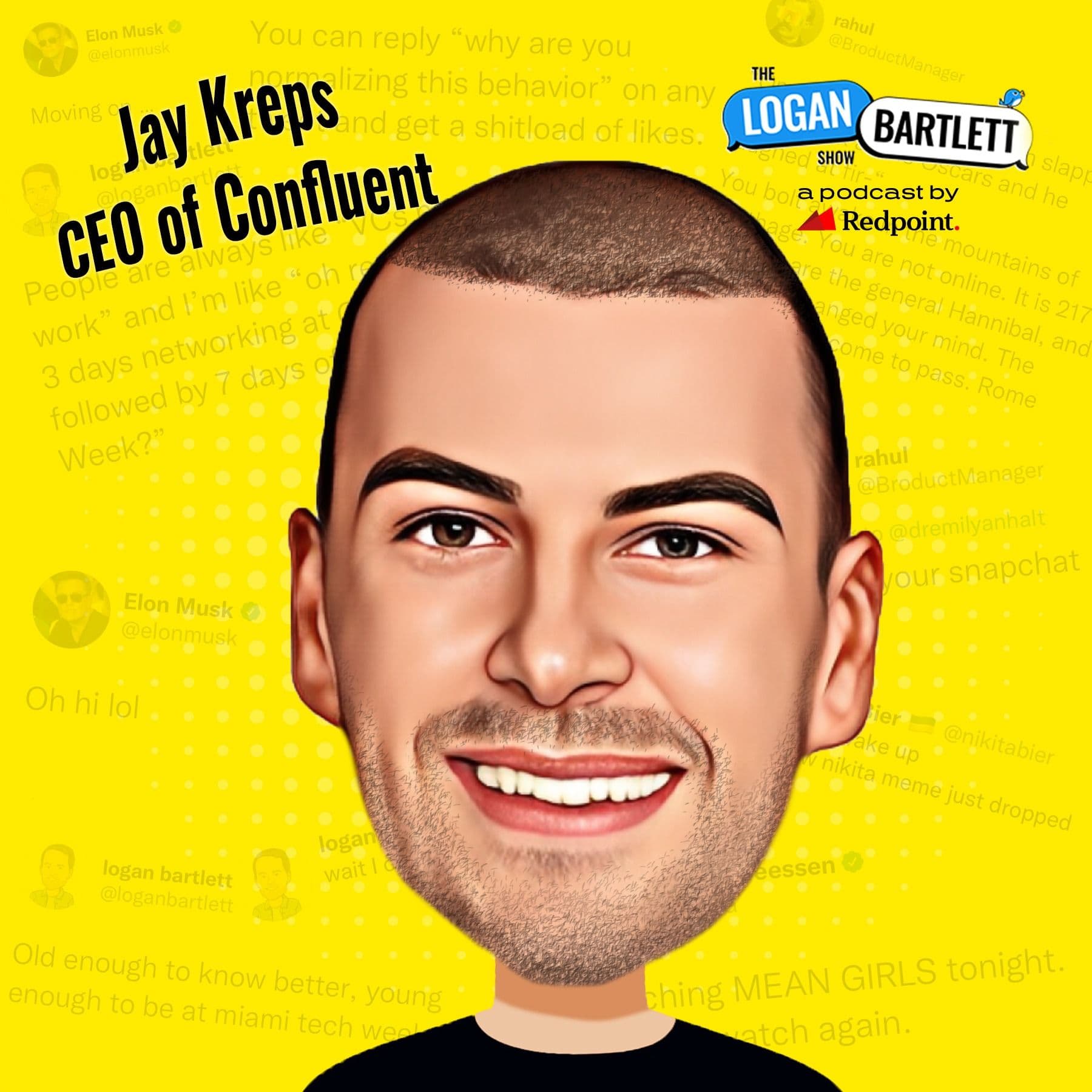
Podcast Episode Notes: The Logan Bartlett Show - EP 89: Jay Kreps (CEO, Confluent)
Episode Overview In this episode, Jay Kreps, CEO of Confluent, discusses the company's journey from a LinkedIn spin-out to a publicly traded software company. He shares insights on challenges faced while transitioning from an open-source project to a commercial venture, the decision-making process involved in product development, and his unique perspectives on leadership.
Key Takeaways
- The Importance of Communication in Leadership
- Jay attributes some of his effective leadership skills to his background as a writer, emphasizing that communication is vital for a CEO.
- He highlights the value of live presentations and direct conversations over lengthy written communications.
- Building a Management Team
- The initial team at Confluent consisted of engineers who lacked enterprise software experience.
- Jay learned to trust his instincts and refine his gut feelings about hiring.
- He emphasized the importance of continuously improving hiring practices and understanding the needs of different roles.
- The Role of Titles in Organizations
- Jay believes titles can foster a sense of progress and recognition among employees.
- He mentions a cultural divide within the company regarding title importance between engineering and other departments.
- Navigating Challenges in Company Growth
- He shares his experience in transitioning from a product-focused to a growth-focused approach, particularly needing to balance cloud-based and on-premise offerings.
- Confluent's struggle with scaling its cloud offerings while maintaining enterprise success is discussed.
- Reflections on Open Source
- Jay discusses the evolution of open source from being a clone of existing technologies to a space for innovation.
- He describes the significance of open source in gaining traction for new ideas and technologies in the market.
- Artificial Intelligence and Future Implications
- Jay expresses excitement about the evolving landscape of AI and its potential to transform industries.
- He acknowledges the unpredictability surrounding future capabilities of AI systems.
Detailed Discussion Points
Transition to CEO Role
- Awareness of Weaknesses: Jay describes the jarring transition from individual contributor to CEO, acknowledging his initial lack of expertise in business operations.
- Learning from Mistakes: He reflects on the importance of being open to feedback and recognizing early warning signs in hiring and decision-making processes.
Company Culture and Remote Work
- Jay discusses how Confluent adopted remote work early on, leveraging the distributed nature of their open-source community to hire talent globally.
- He emphasizes the need for strong communication and clear strategic direction in a remote work environment.
Decision Theory and Risk Management
- Poker Analogy: Jay uses a poker analogy to explain how making good decisions doesn't always lead to immediate positive outcomes, highlighting the importance of separating decision-making from the outcomes.
- Learning from Outcomes: He suggests evaluating decisions based on the quality of the choices made rather than the results, promoting a growth mindset.
Financial Strategy and Valuation
- Jay discusses how understanding DCF (Discounted Cash Flow) can guide business construction and decision-making.
- He notes that while revenue multiples are useful for investors, entrepreneurs should focus on long-term cash flow generation.
Reflections on Open Source Evolution
- Standardization vs. Innovation: Jay discusses the tension between maintaining open-source standards while innovating new products and services.
- He posits that the evolution of open-source technologies has led to greater opportunities for companies to thrive by building on established standards.
Conclusion Jay Kreps shares valuable insights into the challenges and strategies for leading a rapidly growing tech company. His perspectives on communication, decision-making, and the evolution of open-source technologies provide a playbook for aspiring entrepreneurs and established leaders alike.
---
For more episodes and insights from The Logan Bartlett Show, check out the links below:
- [Apple Podcasts](https://podcasts.apple.com/us/podcast/the-logan-bartlett-show/id1606770839)
- [Spotify](https://open.spotify.com/show/5WqBqDb4br3LlyVrdqOYYb?si=3076e6c1b5c94d63&nd=1)
- [Google Podcasts](https://podcasts.google.com/feed/aHR0cHM6Ly9mZWVkcy5zaW1wbGVjYXN0LmNvbS9zb0hJZkhWbg)
Follow The Logan Bartlett Show on social media
- [Instagram](https://www.instagram.com/theloganbartlettshow)
- [Twitter](https://twitter.com/loganbartshow)
- [YouTube](https://www.youtube.com/channel/UCugS0jD5IAdoqzjaNYzns7w?sub_confirmation=1)
Written by AI. May contain mistakes. Listen to the episode to check what was said.
Transcript
Automatic transcript. May contain errors.0:28Welcome to the Logan Bartlett Show. you'll hear that conversation with Jay here now. Jay, thanks for doing this. Yeah, I'm excited to be here. So once upon a time, you wanted to be a writer. This is true. Novelist. Yeah. You settled for public company CEO. That's right. I've read some of your blog posts before, and you're still a very talented communicator. Like the original Kafka paper, it's very elegantly laid out. Like the vision for it, the structure, all that stuff's very impressive. How do you think having aspired to be a writer has benefited you as a CEO? Yeah, maybe in two ways. I mean, first of all, I wanted to be a writer.
1:07I also at some point wanted to be a firefighter and an astronaut and 12 other things. But more seriously, a writer. And I do think, you know, if you think about what a CEO's job is, you're kind of putting together a lot of things. And so a little bit of diversity and interest helps. And then, you know, any senior job in a company, a lot of it is communication. You know, you're ultimately trying to get some big group of people to do something together, which means convincing them to believe in it and take it on and work together and be excited. And that's a communication thing. Have you oriented around like pre-reads before meetings or anything like that?
1:46Yeah, we do that. Although I actually think a lot, for CEOs, a lot of it is live. It's not so much sending long emails. It's talking to people directly. And so a lot of, I would say, when I was an engineer, I was writing a lot of design documents. And then a lot of CEO stuff is live presentation. And that was part of the learning was how to do that well. One of your board members told me that you're one of the best he's ever worked with at building out a management team. How did you go about gaining both the confidence and the competence in bringing in people that was outside of your core domain?
2:27Yeah, I mean, nothing smart at all. Like when we started Confluent, it was three engineers who had effectively never worked in an enterprise software company, really. We'd worked at LinkedIn, which was an enterprise software company, but didn't know it. and um you know so we just the set of things we didn't know was very long you know i remember when we were first meeting with investors uh somebody asked me what's your strategy around services and i just assumed they meant web services i was like oh yeah we're gonna have those pro i'm pro web services yeah and i didn't realize they meant professional services because i didn't know what that was so in terms of the level of like things we didn't know is very high And yet, because when we were starting the company, we actually had a very popular open source product.
3:19We were not that far from a product we could go and sell. The result was we were kind of taking on go-to-market pretty quickly for an early company. And that meant we needed to kind of scale up and do it. We were ready to do that. There was interest in what we were doing. And so it immediately became like, okay, go try and figure out how to build this and hire executives and really do the company pretty quickly. and you know at least when we were starting it was um it was a totally unappealing proposition you know i think no matter what executive in a very small company that has minimal success so far is kind of a lukewarm proposition and then this was a company with an open source thing that was very hard to explain around real-time streaming data and so just getting good people who wanted to do that was a big challenge.
4:08And so I just kind of made it my full-time job to try and figure out, okay, what do these people do and how is this kind of company structured and what is it that we need and try and get some good people in? I think it made all the difference. And then just that kind of progressive refinement each time there's an opportunity or somebody's leaving or whatever, trying to just really stretch on who would be the best possible person for this role we could get and kind of go all in on that. And so there's no, you know, I didn't think there was any real art to hiring. I think it's kind of a grind. You know, the only big takeaway I had was, and I think this advice, you know, it's the kind of advice you maybe want to listen to and maybe don't, is that I do think people develop like a pretty good gut instinct for other people.
4:57And I think you have to like really listen to that and refine it and spend enough time for that to kind of kick in when you're making a decision. I always find people try and be more logical. And a lot of the things that end up mattering, it's not as much a logical equation. It's something you figure out almost subliminally and then trying to figure out how to express why is a big part of it. So when you're hiring people in the early days, how were you thinking about how long that person would do the job? Yeah, certainly I didn't have, I wasn't coming into it with a, oh, this is the right person for this amount of time.
5:34One to five million versus nine. Yeah, yeah. I think if you have been involved in a lot of startups and seen that, you kind of have a very clear picture of, oh, this is what this executive looks like at this stage, and this is how long that person is going to be effective in the organization for. I, of course, had none of that. I was just really trying to figure out, what does a CMO do or what does a head of sales do, and is this person going to be a good one? and how do I tell? And that I think is inherently one of the challenges for CEOs. Whether you're founding the company or stepping in, you probably haven't run all these functions.
6:13So you somehow have to pick that up as quickly as possible and make good decisions. And it was really compressed for Confluent because we were kind of ready to go pretty quickly. So it was like, okay, let's put together that full team and go do it as quickly as possible, but also don't make any mistakes. Did you have someone you turned to either on the board or an advisor that was kind of your go-to confidant on calibration? Yeah. I think we were lucky to have really awesome venture investors. So Eric Vistria did the Series A at Benchmark, Mike Volpe at Index Ventures. I would say both of those are, they're both very good at assessing people.
6:54And I think I leaned pretty heavily on that. And I think that was a huge, that was a huge asset. I guess just because you bring it up and Eric is a friend and we've collaborated together. You were his first investment. Yeah. What was it? Yeah, we were both pretty green. I don't know if you would describe it that way, but you know, I think he'd really kind of been on the job for just a few weeks and you know, I think wasn't really necessarily expecting to do something right away. He had actually had some interaction with the open source project Kafka, which was kind of founded around. So he kind of knew what it was.
7:31And so he actually had a bit of a headstart on some of the other people we were talking to. And we hit it off really well. So was that just a personal dynamic feeling thing back to the earlier point about sometimes it's a gut thing because taking a chance on a first time venture investor? Yeah. Yeah. Well, you know, yeah, I think it was a number of things. You know, I think part of it was just building trust. You know, at least our assessment was like, hey, we should try and get, you know, a good financial deal and a good firm and then really get somebody we can kind of trust to be part of it.
8:05And that last bit's kind of the hardest to assess. And it's like, sometimes you don't get there with somebody. It doesn't mean you wouldn't eventually, but you just aren't sure. And, you know, I think that was probably the thing that did it was just kind of walked out of it with the most confidence. Were there certain mistakes that you made in the early days from a hiring standpoint that you wish you could go back and tell yourself like, hey, don't touch that stove? Yeah, yeah. You know, this is maybe a little back to what I was saying on the kind of gut instinct. I always think that people, it's shocking the degree to which the problem that's going to be a big problem later is visible in some small way early on in the interactions.
8:46and kind of not paying attention to that, there's always things that will go wrong that you don't foresee. But the thing that you're just, it's a little nagging worry going in and then turns into a really big issue later. I think that kind of like, you know, having the confidence to listen to that and be like, okay, I want to spend another hour on that one subject with that one person and really put that to rest before we move any further forward. I think that's really important for these big hires. And I do think that's one of the things that tends to go wrong in executive hiring is you just have so many stakeholders.
9:24There's board members and there's the people on their team who's going to report to them and there's the other management team. And pretty soon it gets very kind of diffuse and spread out. There's a lot of people talking to a lot of people and there's not really depth from any one person. And then it kind of turns into some kind of listening to a lot of feedback from a lot of people. versus really kind of going deep and gaining a lot of confidence that this is going to work. There's the potential for the lowest common denominator or whatever, just like the person that's least offensive to everyone of the constituents rather than the - That's right.
9:57That's right. I think CEOs, like early CEOs are often, I think, susceptible to that because you actually have not done that job. And so you're going to listen to the marketing people and you're going to listen to the people on the board who have seen it more than you have. And yet you're the person who's probably spent the most time with that individual. And those, I think, are the avoidable ones where you're like, oh, I saw it and I didn't act on it. What is your goal in an interview? Is there something that you're trying to tease out in the initial conversation with someone? Yeah. Initially, I actually just try and get a feel for what they're about.
10:34um you know over time i'm actually kind of crazy structured about it where i just literally write down like a theory of why this is going to be great or fail just in a very structured way and then try and assess that with each person they talk to i um you know i don't try and go into it i like to talk to each person and be very busy and like i want to know everything they're worried about or excited about with the person and then kind of just factor that in and then i just try and prove the good things are good and get comfortable with the worries. And so I just do that through a progression of conversations.
11:12And I think it's actually been helpful for me. It's a little bit, it's probably overkill for certain types of hiring, but I think the executive hiring ends up mattering so much. If you can get a really great executive team that works really well together, a lot of the problems of running the company are solved. And if you can't, then that's going to be the big problem. So I think going a little crazy on that side helps. Have you done retrospectives on those docs? No, yeah. No, not in like a formal way. Maybe that would be the right thing, right? Like some kind of investment hypothesis. Post-mortem.
11:47No, no, I just agonize about it all the time. Do you have a favorite interview question to ask? No, you know, I always just kind of go where, you know, where the conversation takes you. I think you want to, you know, the important thing I always think is just get people's guard down and, you know, get a real sense for how they do things and how they've done things in the past and who they've hired and what they think is good and get them involved enough in what's happening in the company that they can start to talk about that to you. You know, so I see it as more a progression than like, you know, the interview question, I think, is always when you're trying to fit something into 45 minutes and you're going to ask these three questions and grade everybody versus this kind of, hey, we're going to keep digging till we get there approach, which just takes more time.
12:32But, you know, but I think it's worth it. And for these kind of roles, there's two competing concepts or philosophies in Silicon Valley. One is that titles are very expensive and one that titles are very inexpensive. And so if we're to Confluent fall on that spectrum. Yeah, yeah, a little bit. You know, we're a little bit split brain where our, you know, our engineering team has always wanted to give themselves the lowest possible titles because they feel that just really hardly anybody deserves to be an engineer at Confluent. And if anything, it's really just a software engineer with, you know, very little else.
13:05And everywhere else in the company, I think it's kind of a more normal, the average of all companies is roughly where we're at. and we've tried to square it, but it's like a deeply held belief on each side. And so there still is a little bit of a schism between the two areas where, you know, my personal philosophy is, yeah, the titles are not that expensive compared to money, but I think it's important that teams kind of hold that. The most important thing is the team really believes in that system. You know, in an early company, it doesn't matter at all, but as you start to have a slightly bigger organization, you know, humans just love progress.
13:39And so having some notion of seniority, I think it's really important. In theory, people work for money. But I think in practice, they work for honor, which is often captured by money. But the honor of, I have achieved this and this recognition, it really matters. So if you debase that or it's not strongly held in the team, I think it totally doesn't work. And the human nature is always people will look at the least deserving person at that level and just fixate on it. Like if they're a senior director, then I should be VP. There's a fairness. In reality, that's the one big mistake you made. They're just literally comparing themselves to the failure of the system.
14:26And so I do think that's where you kind of need the team to really internalize the system and care about it. Otherwise, there's no real honor in achieving the thing. Past a certain level of Maslow's hierarchy of needs and some baseline salary, I found that people just lose their mind over fairness. If they feel like it was treated unfairly to the ends of the earth. And you see partnerships in BC break up over it. You see co-founders get into fights. It's the most human nature thing that it's treated unfair. And it's funny the degree to which you see this in little kids. You know, they don't care if they got enough cookie.
15:06They just care that they got the same amount as their sister. And like, if that was not the case, you know, if one person got more cookie, it's like not good. And so it's, yeah, it's a funny thing. I think the modern society has kind of absorbed this economics worldview where everything is just kind of ultimately about money, like maximizing utility. And then you look at how people act, and it's actually a little bit of that. but also like a bunch of other stuff. Well, if you look at like, and this is a little meta or even outside of, but if you look at like how quality of life improvements have happened over the course of the last 50 years and like longevity and, you know, access to healthcare, all these things like keep going up and up.
15:48But as social media has proliferated, people are even more miserable because they're comparing themselves to the optimal state of famous people. And it's just like, it's led to this discontent, I think that's a structural issue. Yeah, that's the downside of it. And then the plus side of it is I think people really like honor. They want to be honored by their peers. So it's like people I respect respect me. And I think Napoleon is supposed to have said that men will die for scraps of ribbon. And so it's kind of very dismissive, that quote. But it's actually interesting to think about. So if you think about what's the motivational system for the bayonet charge, it's not like bonus.
16:34It's not like, oh, I'm going to get a good bonus. It's not your stock compensation. It's an honor thing. And so I think in HR, there's a little bit of acknowledgement of that, but not as much as you would think. And I think it actually drives people a lot. They want to do great things and be recognized for having done it. I want to back up a bit. So you grew up where? I grew up mostly, I was born in North Carolina, but I grew up mostly in California, in Sonoma County, in what's now wine country, but was, I think at that time, more like cow country. What did your parents do for a living? They did a bunch of things.
17:19So, you know, the people there, they were both kind of maybe a little bit counterculture and then a little bit blue collar. So somewhere in between those two, I think my dad lived on houseboats and was a fisherman and then a kind of carpenter construction worker type. And my mom lived on the Russian River and made quilts and then cleaned houses and then ran a nonprofit at different times. So just kind of a sequence of things, not real career-oriented type things. So definitely part of having no idea what I wanted to do was it was actually just to really have a very clear picture of what people did for work.
18:07And it wasn't necessarily the biggest focus. So I felt like, oh, I want to do something great, but I have no idea what. It's an interesting upbringing. You don't hear that often. And how did that influence you most in terms of like who you are now as a CEO, a leader of a public company? I'm sure there's a bunch of derivative things from that. Yeah, yeah. I think, yeah, you know, it's actually not that uncommon in this area as a background. It's not that uncommon for tech people just because I think of what the California Bay Area was and who came here, you know, back in the day. I think it was probably helpful in that there was a lot of freedom.
18:48I wasn't really expected. There was no expectation that I go to college. My parents hadn't gone to college. There was no, you know, I could kind of do whatever. I actually, I only went to one year of high school because I was convinced it was like an inefficient way of learning. So it was a lot of freedom. Now, of course, as a teenager, you know, whether or not you know how to take advantage of that, probably not, right? That's why teenagers usually are put on these tracks of everything they have to do. but at least it gives you some confidence after you've kind of worked through things of what, you know, what you want to do.
19:22So, so you did one year of high school, you kind of dropped out to teach yourself among your friends. Yeah. Yeah. Yeah. So, you know, uh, some people who did one year of high school is cause they were just so smart. Some people it's cause they were like, so not successful at school. It was somewhere in between the two. Normally it's one or the other, right? You get sent away to some like rehab facility or you like are placing out. Yeah. Yeah. So I think, um, you know, I was, I was probably a little headstrong and I was just convinced this is like a very inefficient way of learning. Which is probably true.
19:52It's just you maybe not self-directed teaching. It's 100 % true. Now, I would say in retrospect, there's probably some value in going through high school. And there's, you know, it's probably it's harder than I thought to teach yourself chemistry. So what did you actually do? So did you need to convince your parents or your parents like sure do what you want? I convinced my parents and, you know, also some of my friends who did the same thing. And, you know, our plan was to just like teach ourselves the things you would learn in high school. It turns out you don't have to have gone to high school to go to college.
20:24People don't realize that. But basically, you can either like pass a test or have good SAT score. There's a whole bunch of ways to get into college. And so that was our plan. Now, it turns out it's a little harder to just teach yourself everything. So I would say there's still a few holes in what basic high school education, you know, So some areas I probably over-indexed and some I probably did less than I should. So you took, was it three years that you actually did this? Yeah, yeah. I did it for a couple of years and then took junior college classes and then went to UC Santa Cruz just really without having gone to most of high school.
21:03Do you feel like that experience, it sounds like maybe some of the stuff in chemistry or whatever, you probably need some more structure or products or whatever it is to learn. Yeah, I think the challenge for teenagers, you kind of study what you're interested in. So I did a lot of math and English and a little history, and then some other subjects I was a little weaker in. And then I caught up on it in college to the extent I could. And so how did you, your parents didn't go to college. How did you make the decision that you wanted to go to junior college, go to college? Yeah, it was a little bit process of elimination.
21:39I was interested in biology. I was interested in writing. Um, and then I, but I didn't really know what any of the academic subjects were really about. And then I realized, oh, you know, if you study English, they're not like training you to be a writer. They're training you to analyze other people's writing and kind of critique it. And I was not as interested in that. So I, and, um, you know, in school I hung out with a bunch of, um, more science oriented people. And so I was like, okay, I think I want to do that. and um you know just almost by process of elimination a little bit which tracks i could actually get all the classes done in i was like okay i'll do computer science that seems interesting i was interested in uh artificial intelligence in in kind of a weird way like the you know what what i hadn't realized that i kind of became aware of was um digital music and so you know at least the way i came into it i was like wow that's really interesting if you could just take sound and turn it into something digital and then manipulate that with a computer, you could probably do that with anything.
22:45You could do that with all kinds of things in reality, and there's a computational version of a lot of things. I was like, okay, this is fascinating. Is there a reason this AI stuff can't work that we know of, or is it just anything that an animal or a person can do, a computer could do? I was like, okay, that's really interesting. I'll study that. Um, and, but I had no background really in computers or programming or anything like that. You got your first computer in college? Yeah, in college. Yeah. It was not, I was not like a early computer prodigy or anything like that. So then I worked really hard the last few years to get all that done.
23:23So how did you, how did you take to it? I assume you didn't have the, the, the grounding that maybe some of your peers did within like, I mean, simple sort of stuff I would, I would assume within computer science. Yeah, that's right. Yeah. I mean, I think it's true of computer science even now is it's a mixture of people who have spent a lot of time learning to program and doing that with people who are just kind of starting in the curriculum. And it's harder if you're just starting. And so, yeah, I had to work real, real hard at it. But I was, you know, I was interested. I actually think, you know, this is probably less true now.
24:00but um you know i think at that time maybe computer science was somewhere in between you know kind of a professional training and an academic subject you know where it was a little bit more intellectual than like accounting but not as intellectual as like biology but i actually think you know there's a lot in computer science it's actually really interesting about computation and how the world works. And I think that's expanded a lot with the machine learning and AI stuff where it's all about reasoning. So I thought that was fascinating. And then I actually got good at programming almost in a very roundabout way where I probably took the least practical computer science classes that you could and still get a degree.
24:53but you know by by the end of it i did uh i worked on this music sharing site for my friends and so i really learned a lot more about programming from that uh and it was this fun thing where you could all share you could share songs and comment on them of course it was totally illegal so then the problem was they were all inviting their friends and i had to eventually turn it off but um you know really doing that i think i learned more about programming than you know from the class assignments. Is it weird to see artificial intelligence blow up like it is right now and to have been studying it 20 plus years ago?
25:28Yeah, I think it's awesome. You know, I stayed on and I was in a PhD program for machine learning. I left after the master's degree. And, you know, the reasoning at the time, I was like, hey, this is, it's a fascinating subject. You know, at that time, machine learning had probably five paradigms for how to think about learning, all of which kind of worked, but not very well. And that's kind of a fascinating thing where it's like, hey, you get to the same result via thinking from a statistical or probabilistic background, like a information theory background, like a geometric kind of worldview.
26:06There's neural networks, which are more kind of like whatever biology inspired. And then you kind of all end up sort of in a similar place. But at the time, I was like, hey, this is not going to make any progress till we have a firmer grounding in what learning is. It's a little bit like being a physicist before Newton, where somebody is going to come in, and they're going to figure all this out, and all the other stuff is going to get thrown away. And all we're doing is just kind of hacking. And so I was like, okay, this is not a good way to spend your time. But actually, know that hacking got us pretty far.
26:43We still have no underlying theory of what learning is, and it's gotten a lot better. Yeah. It's interesting. I mean, you studied this from a longitudinal perspective, but it kind of plateaued for a while in terms of the progress of machine learning or artificial intelligence. At the time I was doing it, it was very much in that state where nothing was really getting better for academic subjects like that. That means it gets very math heavy. So there's a lot of support vector machines and complicated math around it. But in practice, nothing was working better than it had 10 years ago, really. And that's kind of a sad state, you know, from a practical point of view.
Read the full transcript
27:22And so, yeah, it's, you know, it's funny that my prediction of how it would get out of that was just dead wrong, just totally wrong. But intellectually, I remain just totally fascinated by that area. And I, it's probably the area I've just kind of read the most and spent the most time on. When I left school, that was my goal was, okay, I thought, hey, look, with the internet, there's all this data. This is going to be a big thing. I want to get a job where I can kind of use some of this stuff. Even if it's hacky, at least you can do something with it. And that was how I eventually ended up at LinkedIn.
28:02I just thought, oh, these social networks are going to have really great data. Well, so you downselected, you wanted to go join a social network, right? And so you nixed Facebook because MySpace had already won the market. Yeah, yeah, yeah. So in terms of bad calls, I was like, yeah, it just seems like it's really hard to come from behind. And then it was also written in PHP. And I was just like, yeah, that's probably not very serious technology. And so yeah, that was probably not totally right. But yeah, that's a good question. You know, I joined LinkedIn in 2007. So I probably talked to Facebook, I don't know, probably a year before then, something around that.
28:41So you end up hitting it off with LinkedIn in some way, and you were there for seven years? Yeah, yeah. And so what was your role initially, and it evolved to what? Yeah, I joined as a software engineer, and that was basically what I did. I ran some small engineering teams and really focused originally on the kind of use of data. So I joined, and the first project I had was trying to recommend news articles to people based on whatever they had in their LinkedIn profile, which we did a terrible job of. And I guess somehow I kind of was aiming at this more use of data, but ended up working on infrastructure.
29:22because for a growing social network, you just weren't going to do anything interesting or predictive until you had that problem solved. And so that was how I ended up working on some of the open source infrastructure there. We built a live database for serving the site and built Kafka, the open source project, as kind of this real-time layer and some of the backend data lake stuff that was all really just trying to get some basis for using data.
29:53I wanted to take a quick break from the episode to let you know that Redpoint's AI podcast, Unsupervised Learning, now has its own YouTube channel. We have an incredible set of guests really at the forefront of the AI revolution. So if you're interested in what's happening in AI, what it means for businesses in the world, definitely subscribe. Now back to the show. And the purpose of open sourcing this, as you were thinking about it at the time, you're working on these projects for LinkedIn's benefit, right? Yeah, yeah. And you make the decision to open source these because, I guess, how do those conversations play out internally within LinkedIn?
30:27Yeah, you know, I think there was a couple goals. I mean, you know, for me, I just wanted to make something great. You know, I just thought it was really cool that there was these, you know, there's these layers in the stack. And they just come from somewhere. And, you know, when I was in school, I really admired Linux. that somebody would just come make something that would be this foundational layer everything would go around on. So I thought that was like, I wanted to do that. And then as a practical thing for a company like LinkedIn is these kind of very fundamental layers, they're not really the basis of competition.
31:04Your user base and your data and the whole service, that's kind of how you're competing. It's not like the better key value store is going to be the thing. and um you know to make those things uh be really good you have to somehow be able to attract people who want to do that and so it was a weird time you know at that time there was no like cloud services you could get the commercial products were not targeting kind of large-scale data infrastructure uh and so it was really kind of do it in house or do nothing right and so it was you know yahoo or google had built these internal infrastructure layers that everything ran on and the other companies just didn't have it.
31:42So the question was, hey, how can you get that if you're some smaller tech company? You've got to somehow attract people and piece something together. And that's going to be a combination of trying to find things that are open source that we can use or building things and trying to make them catch on and attract people to work on it. And I think that became more prevalent. And now it's probably the opposite where there's all these products and cloud services. Nobody needs to build foundational infrastructure just to have a social network or whatever the next app is. But at least at that time, there wasn't that many other ways.
32:14So you launched a handful of these different projects, Project Foldenmore, Project Kafka. And so Kafka, what does Kafka do? And can you take me through the problem you were looking to solve internally and then what happened after the launch? Yeah. So yeah, you know, Kafka probably had the biggest idea behind it, which was just, you know, in the world of data, everything's kind of been about storage. You have these databases or file systems that some pile of data that's stored somewhere, you can look up little bits of it. It was really targeted at how do I build one application? But you look at a big system like LinkedIn or any company now, it's a bunch of pieces of software and they all have their own little piles of data.
32:57Somehow it all has to come together and all the parts have to react as one thing. And so the idea was focus on that part of the problem. Like how does not just the kind of data at rest, but the data in motion, like how does it move around? How do we react if somebody joins the site? How do the 15 things that have to trigger off that and happen, happen? And, you know, you can view that in different ways, but one way to view it is taking, you know, some of the processing of data that's traditionally happened, like in batch, like the end of the day, some big thing kicks off and turns through data and spits out some results.
33:33Taking that from something that happens periodically to something that happens continuously, so that you're just processing data as it occurs and reacting to it as it happens. That was an idea that was very appealing to us. We were doing a lot of work to scrape data out of different systems and put it into search indexes and social graphs or into some kind of data warehouse or data lake. Then all the most sophisticated use of data was something that would happen at the end of the day. And by then, the user's gone. They've moved on to something else. There's only so much you can do. And so that was kind of the inspiration for it.
34:12There'd been a lot of ideas in the computer science literature about this kind of real-time processing of streams of data that was almost kind of a natural generalization of database ideas. But it was seen as almost kind of very researchy and not that practical. And so our idea was, yeah, let's just try and turn all the data sources into some kind of stream anything can get. And, you know, that was a project first internally at LinkedIn. And then as we open sourced it kind of out the rest of the world. Was there a why now, as you look back and think that this was possible or that it took off in the way it did?
34:47Yeah. Yeah. I think the, you know, if you think about the problem LinkedIn was solving versus maybe the, you know, step back 10 years from that, the problem a company was solving with software. The way software came into a company was there's little bits here and there. It's like, oh, we got this app for this team. And it's really kind of UI-centric. They're going to type their things into the CRM and it's going to show them the things they typed in in different ways. It's kind of its own island. And if you think about these kind of tech companies, it's not an island. Everything's connected, right?
35:19It's a continent, right? And that's like a different problem. And in many ways, a lot of the problems in software architecture are this, how do you build a giant connected system? You know, how do you have all these different services? How do you orchestrate them? All the cloud computing layers are kind of oriented around how you put all the parts together now. That's one of the biggest challenges. And we were trying to do that for data. And so, yeah, I think it was, you know, a little bit, people had made progress on distributed systems and how to do this kind of stuff. And a little bit, just the problem itself had changed and the need was different.
35:54So you launched it into open source and did it take off right away or what? Yeah, no, it was originally a bit of a flop. Like our key value store was very popular. And this like Kafka thing, nobody had any idea what we were talking about, you know, which was an interesting experience for me because I thought it was much more exciting. And I didn't realize the degree to which, you know, latching on to like a category that people already understand helps. So if you're like, hey, we have a database. People are like, I know what that is. I know what it's for. How is your database? Good. I'm still with you.
36:26Yeah. And then you can answer that question and they'll use it, right? If you're like, hey, we have some kind of distributed streaming platform. They're like, okay, I don't know what that is. How did you solve that? You know, we were excited about it. So we were like, well, we'll go and try and explain it to people. And over time, the explanations got better and they got shorter. and it's one of the things I've developed a real appreciation for is kind of product marketing. You know, the difficulty of compressing an idea down to something that like catches and will transmit, you know, from one person to the other.
37:05It's a little harder than it sounds. And so the, you know, as we were, you know, we went around and first just kind of did some tech talks and tried to explain this to people. And I think that worked, you know, given an hour with somebody was like, okay, we can explain why we did this. We're like, basically, instead of having 15 ways of shipping data around and a bunch of batch processing, we're going to try and just have everything be a real-time stream that you can react to as it occurs. And this is how that plays out for feeding your data warehouse, and this is how it plays out for applications driven off this, and people would be like, okay, that's great.
37:37And then, yeah, we tried to write it down in a blog post, and we were like, hey, if we can get people excited about this. And so the blog post is like 23 pages or something, So it breaks every blog post rule. But, you know, at least our thinking at the time was like, hey, if we can get the people excited about this, maybe there's something here and we should go follow this and, you know, try and make it succeed in the world. If we can't, you know, maybe not. And yeah, sure enough, that blog post develops like a real kind of cult following and how to think about data and how to structure around it.
38:12And so we thought, hey, this is great. And it brought us into contact with a lot of companies kind of outside the core tech people we already knew. And that was interesting for me just to realize like, okay, you know, these ideas that sounded pretty advanced are in some ways like equally applicable in like a bank or an insurance company or a retailer. And so the kind of market for this is actually quite broad. It's not just like a tech company thing. At what point in that did you start thinking like, all right, there might be a company behind it? Like when you were iterating on these different open source projects, did you think, oh, maybe one of them will take off and I can go be the CEO of a company around it?
38:51Yeah. You know, maybe in a very vague way. You know, I think one of the cool things about LinkedIn, I had a very entrepreneurial culture. I would credit Reid Hoffman for that. And so I think everybody inside of LinkedIn, and especially in this data area, had a whole set of ideas for startups and concepts. And so, you know, and then for me, I thought, hey, this is like one of the biggest paradigm shifts in data and just how it's used. This idea of going from something where you're processing static fixed data to something that's continuous, that's like a very fundamental change and nobody else is doing that.
39:30So that's a good one to go after. If you can get people interested and get that change happening in the world, that's a big enough area that could turn into a really significant data platform. And so I think early on it was more just, hey, can we get anybody excited about that? There wasn't a detailed plan. But then, yeah, over time, it did seem like, okay, yeah, this could be potentially some kind of business. There's certainly going to be a lot of value around this. Was there a point at which you thought to yourself, okay, now it's crossed the tipping point that I need to go step outside the walls of LinkedIn and turn this into a business?
40:07Yeah, there was. I think at one point, I forget what the organization was. I think it was somebody from ESPN or something had tracked us down and called us. And they were like, we need this Kafka thing, but we need all these security features and other stuff. And can you do that? And we were like, no. We're just running this for LinkedIn. We're not doing stuff for you. But we were like, but you should get that stuff. And that was enough of a kind of brand name that was far enough afield that we're like, oh, that's real. And at that point, it was kind of clear. It was like, hey, look, this is a team of like six people in the basement of a social network.
40:52We're probably not going to totally revolutionize how people think about data just throwing something out on GitHub kind of in our spare time. It's going to take a focused effort to make that happen. And yeah, I think that's a little bit how it came about. I want to talk about the transition from, you were an individual contributor within LinkedIn. Did you have a team? Yeah, yeah. I also managed a team. And then I guess I was in kind of a lead architect role for a while too, where I kind of had some broader responsibility. But yeah, it was totally different from being a CEO. So what was that transition that occurred?
41:25Was it you step outside the four walls, you raise money, and what happened? Yeah, that was right. Yeah, it was awful. um the uh you know i i really underestimated actually how jarring it was going to be to be in a totally different job um in in a whole bunch of ways i think part of it was you know if you start in one career you're like not very good at it and then you learn and then you get very comfortable being good and at least for me i'd kind of mastered a lot of the kind of engineering leadership, technical system design, programming. So I felt good. And so you're just kind of in your comfort zone.
42:03You're doing a bunch of things where you're just good at all the parts. And you can kind of hone your craft and try and get better, but it's basically very comfortable. And then you do something totally different with a totally different skill set. But, and, you know, the early part of a company, you know, it's always kind of, you know, valorized or idealized. But, you know, it's actually pretty hard. You're pitching kind of an idea to people. It's definitely kind of whether you're trying to get customers or people to join the company. It's kind of a sales role as much as anything. And the reception is often not that great.
42:41I mean, several people, I think, took us aside as we were starting the company. and we're like, this is not a very good idea and you should not do this. And we were like, oh, that's not, that's not good. So, and you know, so that made it hard. And then if you think about who, who's a good CEO, you know, I don't know, maybe it's Steve Jobs or whoever it is, right? There's some list, you know, you're pretty far down that totem pole in your five person startup. with zero customers and no product yet. And so it was just pretty humbling. If your day job is being told no, the skillset that you built is not that useful for the thing you're trying to do.
43:27And your kind of peer set is vastly better and more accomplished. I think startup CEO is a very humbling role. That's interesting. Was there a particular functional area that you found more daunting than others? Yeah, I think part of why it was harder for me was we basically had this very successful open source project and we had three technical co-founders. We were able to hire good engineers. So we were kind of making progress. What we needed to do was go figure out how to turn that into a product and sell it. So the go-to-market came very early and we had zero expertise in how to do that. So there was a lot of just bumbling around and trying to figure it out.
44:10you know, probably in the best of circumstances, because people are excited about what we were doing, but just not, you know, not in a put together way. If someone's listening to this and debating if they can or should or want to be a founder CEO, are there questions you would advise them to ask themselves or things that you wished you would go back and tell Jay leaving LinkedIn, like, hey, you should really validate that you enjoy this because that's going to be a large portion of the job? Yeah, I think it's a good question. I mean, I think, what is it? This is not quite the question you're answering, but somebody described parenting.
44:47They said, oh, you know, when you ask parents, they're actually less happy than people who don't have kids, but they're more satisfied. And so I thought, oh, that's interesting. I think it's similar. if you start a company, you'll probably be less happy, but more satisfied. Is that what you want? And it may be, right? I wouldn't take it back. I don't know. I think it's very hard to predict who's going to be good at it or who's going to enjoy it. I do think there's a lot of hyping up of entrepreneurship and of entrepreneurs, which is sort of helpful. It creates an environment where people try stuff, but it can be a little misleading where maybe people may not know exactly what they're getting into as a result.
45:39So yeah, I don't know. It was certainly a growth experience. I always feel like whenever you try and do something hard that you're not good at is when you learn the most. And I think that was really good for me, and I certainly benefited from it. You can't say now, but is there a point in time other than that, that you look back with most nostalgia on over the course of, I mean, you guys have had a fairly serendipitous run, I would say, at least for starting in 2014, went public in 2021. That's a pretty fast path. But is there a point in that journey that you look back with, with some level of fondness?
46:14Yeah, you know, I think a lot of the early parts of a company are really cool. You know, I think with probably the first time we did a user conference, we were just really worried no one was going to show up. And there was like 800 people and we were so pumped. Your first user conference, 800 people. Yeah. And it went really well. And it was just very energizing. The company had people kind of all over, so everybody got together. It was like a big high-energy thing. So that was a big deal. And then, yeah, I mean, to some extent, all these companies from the outside, it looks good. But of course, yeah, there's lots of ups and downs within it.
46:57So whether it's serendipitous or not, I don't know. I'm sure you would dispute the moments along the way. But from the outside in, it was at least in a rarefied air of startup journey, at least from my perspective of success, at least the metrics, valuation, you know, all of that stuff. So I guess on the flip side of that coin, you made a few strategic decisions, I think mostly around cloud that were real fork in the road kind of considerations. And when we were talking before, you said one of them, I think they've ultimately worked out, but one you described as almost killing the company. Can you go back to these decisions and what were the layout for people, the different consideration sets?
47:40And then how did you go about making the decision? Yeah. You know, one of the big challenges for us was, okay, we didn't really have a complete solution around streaming. As we started, we just had this one popular open source thing. So we needed to kind of complete that package and make it usable. But we were also in a time where we were 100 % sure as we were starting the company that cloud was going to be the way people consumed this type of infrastructure over time. But the market wasn't quite there yet. Amazon was successful. It was unclear that there would be other successful cloud providers.
48:16And there was no examples of a third-party company selling you operational cloud infrastructure. and a lot of resistance. This is 2014, 15, 16 in that timeframe. Yeah. And so the people who were able to succeed early on, I think it was like, you know, if you're Snowflake, kind of analytics, that's maybe further away, you can kind of get there. But these kind of operational databases, real-time streaming, that was like a little bit harder. And so that was the dilemma for us, is how do you square that? And so for people's benefit that aren't infrastructure wonks, you basically have one, you have this open source product that now you've built a, or you have this open source project that now you've built a product around, but it's not cloud.
49:02The core initial product was not cloud. And so it was existing beyond your own firewall. Yeah. And even, even before we started that, like as we started the company, we basically were very torn about whether to do like a SaaS offering in the cloud first, for which there wasn't much of a market, but we were like, that could be very good over time. Or should we do a software product or should we try new both? And, you know, we kind of made the call as we were starting the company, we'll do both. We'll start with a software product. We have a bunch of people who will pay us now for that. We'll add the cloud offering.
49:33You know, I think probably the, whatever we pitched benchmark, it was probably all in the first year. We're like, hey, we're going to do this, this, this, and this. And of course, you know, it took us many years, but yeah. So as we were starting, then we just felt this pressure of like, okay, you have to, we have to get this cloud thing going. So we started it, I think, maybe it was a year and a half or two years into the company. We said, okay, we're going to build a little team of people. They'll build a cloud offering in AWS first, but we'll take it to the other clouds over time. And the challenge is it's really hard to do that.
50:08And we got feedback from people. So one of the cloud companies, somebody there told me directly, there are zero examples of a company that has an on-premise product creating a cloud offering. This was at that time. And really succeeding with it, you will 100 % fail. If you talk to anybody who knows anything about startups, I'll tell you, do not try and do a second product when you have one thing working. That's just such a terrible idea. And yet we kind of knew we had to get this right? And so the challenge was how to do it. So we started building a product and what happened was it was the side product and it just wasn't that good.
50:52Like we had a mediocre offering. And as we were doing this, we started to hear rumors that Amazon was going to launch a, you know, something around the open source Kafka in our space. And we're like, okay, this is a big problem, right? Like it's their, you know, this is like their grocery store that we have shelf space in. Our product is okay, but it's not great. How are we going to be successful at this? And there was a big debate at the time about whether to just kind of pull back and get the enterprise business really working, kind of double down on that, make the big customer successful, come back at this later.
51:29We went the other way, which was just put the whole team on the cloud thing. It was very difficult to do because of course you've built a fast growing business already off the software offering. Um, but we thought it was just really important. We thought like, look, the way we're going to be successful is kind of cover all the environments these big companies work in, you know, since ultimately our area is about tying all the parts together, you have to be in all the places and that's going to be the big differentiator, you know, against any of the competitors that doesn't have it. Um, but of course, uh, it was very difficult to do.
52:02And the, you know, the challenge is basically kind of sustaining the momentum in that core business as you're kind of building out the second thing. And then, you know, what we didn't really understand at the time was just the degree to which kind of a SaaS cloud go-to-market was different from selling on-premise infrastructure and how much effort would be involved in really kind of digesting that and getting to the point. What were the learnings of that? Like, why is it so different to sell SaaS versus on-prem? Yeah, the people are different. The kind of security and networking requirements are very different.
52:40The buyers are the people, in this case, are the sellers. Yeah, all of it. All of it. So the target customers, just what your sales team has done, the process by which it works, there's much more of a try and then buy with kind of a cloud SaaS offering. The fundamental business model is different. Like they have a kind of usage model where you pay as you use it and you may commit to some amount. So effectively, everything is changing. And for me, at least, it seemed very logical. I was like, okay, it's kind of similar things at the very high level. Of course, we can sell both of these. And of course, the reality of getting a second thing going is much, much harder than that.
53:22And so, yeah, that was a huge stress point. I think it was a topic of discussion in the press how Amazon was going to crush all these startups. So literally any of the news about us was like another startup destroyed by AWS. My mom at one point called me and she read some article and she was like, I pretty much heard you're going out of business. And I was like, well, we're not dead yet, mom. Hang in there. but of course that makes it very hard because your employees are like they're either why are we doing this cloud thing or why are we not succeeding your customers for the cloud offering don't exist yet you have a bunch of customers for the other thing who have a long list of desires and just the kind of enthusiasm among people you would hire there's just kind of an open question so really kind of getting that working was a big deal for the company just kind of grinding it out there was nothing I don't know that we did any of the individual steps perfectly, but we just kind of stuck it out until we had something really good technically and kind of could sell it.
54:32And I think that was a big thing. I think if I look at the peer companies at that time, it's maybe about a 30 % success rate of kind of getting, if you had a good open source thing, getting to a high quality cloud SaaS offering that can be like 50 % of the business or a substantial portion of the business. Was that just a strategic decision that you made and felt the conviction around? Did you decide by consensus? Because I assume there's some sample bias or some survivorship elements of like, well, no, all our customers are telling us this is great. Yeah, but you don't know the customers that we're not seeing in the future that won't want this.
55:15I think it helped that we had, you know, our job at LinkedIn had been running this system. And so we understood like, hey, the delivery of it is just a really deep problem that you could create a lot of value in. So I think that helped. But what really helped was actually, you know, we realized the world was kind of moving. Like these cloud providers were going to have streaming offerings of different sorts. So we were either going to like really commit and do it now or we were going to give that up. And so we were like, hey, if you give it up, you know, is that even a company you want? let's say you win in just the on-premise thing, is that even the company you want to have?
55:56And it was like, no. And so then it was like, well, even if we were just kind of failing at the cloud thing, but we knew like, okay, you'd rather fail at the company you want to be than end up with some niche part of the problem. And so then that's kind of liberating. I think whenever you're like, well, well, at least we're going to go down the way we want it. We're going to go down with honor. Then it's easier. So then we really jumped on it. And I think that was very helpful. I do think always for companies that if you can have, you don't want to do it too often, but those kind of burn the boats moments, it's just very clear what has to be done.
56:40And so for everybody in the company, it's very clear, okay, we're going to do this. And so we did that for the engineering team. And we're like, okay, look, everybody now works on the cloud thing. Everything will get released there first. We are going to lead with that as we sell. Effectively, nothing was quite set up for it, but at least it was clear that we were 100 % committed. The open source project, you were in the early days of what the second generation of open source businesses were after Red Hat and the stuff that they did. Um, did you feel, was there tension internally between people that joined because they were zealots of the Kafka open source project and they just wanted to work on that and were totally, Hey, why do we want to build this business?
57:28This is going cloud first is going to shut off access to different people that might otherwise want the product or. Yeah, there really wasn't a lot. You know, the challenge we had was more external, which is, you know, there was kind of a real trough of excitement about anything related to open source from an investor point of view. Roughly as we were starting the company, I think Cloudera had been very exciting and was kind of not doing as well. And literally nobody wanted any part of any open source thing for about four more years until really the cloud models, I think, started to show success.
58:03And then people were like, okay, that makes sense. Um, you know, so there was an external problem internally. I think we benefited, you know, the early open source, um, things were almost a little bit religious in how they approached it. You know, it was kind of a alternative to capitalism in some ways. Right. And I think that did tend to create these companies that were just very divided in what it was they wanted to do. And, um, I think we were more clear in, you know, how both things could be successful. And I think starting that way made it easier to kind of keep the alignment internally that everybody's kind of rowing and we're all trying to make something great.
58:41How many people does Kafka have today? It's about 2 ,700. 2 ,700. Yeah. What's something unintuitive that you've learned about operating a business at that scale, leading that many people, managing? Yeah, you know, there's nothing shocking. I think a lot of it's communication. education i think the you know a lot of problems just get a little bit more abstract over time but at the end of the day it's still kind of a bunch of people stuff the same as it was with a small company which is you know hey do we have the right person running each thing you know do we have a way of kind of measuring what's happening there um the you know i think the biggest change is it does become a little more difficult for senior people to get quick unfiltered information about everything because there's a couple hops and it becomes easier to not be aware of what's going on.
59:33And I think kind of building that sensory system that keeps you informed about all the important things, I think for me, but also for everybody on the leadership team, I think that ends up being really important. Did you set up any structure like skip level meetings or anything? Yeah. Yeah. I think it's all of that. Right. So I think, you know, you, you need to have some kind of idea of what metrics matter in some way of measuring things from without. And that will tell you, like just empirically, things are not going well. It won't tell you why, right? And it's often a lagging indicator. And then, you know, some way of getting truth out of people and a culture where people have some interest in speaking up about things, you know, I think that's kind of the other side of it.
1:00:14And you have to kind of, I think, push on both of that, both sides of that. the nature of any company, but I think particularly as the company gets bigger, there's always hesitancy to bring bad news, right? So you have to somehow really make that normal. Otherwise, people stop giving the bad news until it's quite apparent. And that's usually, at that point, it's a little hard to fix. Have you set up certain processes or hiring structures or anything to keep the talent bar high? Yeah. You know, I think the, yeah, there's, there's definitely a set of processes. I think the most important thing is actually, you know, the training of managers.
1:00:57You know, this is something that it's not taken very seriously, I think, in Silicon Valley. I think because the tenure of employees is so short that it's like, well, how much can we invest? But, um, you know, I think it's very easy in a fast growing company for managers to get really lazy and kind of take what comes their way. And it's like, I'm too busy to hire, you know, I'm too busy to stretch. And so I think just really, really, you know, getting people to value the quality of hiring. And, um, you know, I, I, I try to, you know really take our you know the executive team and lay down everything we do for hiring our most critical hires i would say 20 of that doesn't apply because it's really about executive hiring but about 80 of it is what you should do hiring anybody and you want to be like a little bit more crazy about it than seems normal and put more time into it and um you know i think if you can get people to take that on and value it it's just very valuable for them like if you want to succeed as a manager, you succeed by having a good team.
1:02:03And, you know, a big part of that has to be hiring great people. And so figuring out how to get people to put that time in. And I think there's just no substitute, you know, no matter how talented your recruiting team is, they can't fill in for, you know, passive or lackluster managers that aren't really out there trying to find great talent or convince people to join. So I think that will side of it really matters. And then a ton of just techniques and stuff. But yeah, I think that's a big deal. I think the other side of it is the expectations on performance. I do think over the last few years, that's one of the things that fell to the wayside.
1:02:45The thing everybody sees is the inflation in comp in tech. But one way of giving the comp is, of course, promotions and rewards and what is really expected of people. And that all came out of just having a human capital shortage relative to the number of companies that people wanted to have and the headcount that was available. And so I do think it's also the case that a lot of companies just got lazy about performance management and having high expectations and where the bar is for the people who have been hired. And I think that's getting corrected, but it's almost like a whole learning thing for people who built a management career just in that time period.
1:03:24They may have been very sloppy about how they were hiring. They may have been very sloppy about what the bar was internally. Making sure people are good at that, I think, is one of the most important things. As the market shifted, you all went public in 2021. The public markets definitely have moved value more, profitability or efficiency metrics versus growth. both. How has that belt tightening and maybe it alludes to the performance management point that you were just making as well. How do you think about that as you sit here today versus, you know, the learnings? Yeah, it's been a huge project.
1:04:02I mean, you know, it's hard to know in retrospect, like we went public in 2021. We were probably a little green as we were going public, but it was a good time to go public. And then of course the stock went way up and then the stock went way down and then it went up and then it's gone down. So it's been like a real roller coaster for the whole employee base. And so the question, of course, is like, hey, did we do this at the right time? Did we do it right? One of the things we had to do was get a lot more efficient. And one of the questions you could ask yourself is, well, maybe we should have been more efficient to start with.
1:04:39But we were definitely going after it as we started the company. I think each year we were like, okay, we will plan to grow aggressively. We will invest heavily. We will go after it. We had a set of early competitors that we just out-executed. And so I think to some extent, it made sense that we were just kind of pushing. But then, yeah, that put us in a position where really coming into this year, we had to get significantly more efficient. And so over the last six quarters, we will have improved operating margins by about 40 points, which is quite significant. If you just think about, hey, for every dollar that we spend, we're getting 40 % more out of it.
1:05:23So yeah, it's a pretty significant retooling of how the company works and totally not valued by Silicon Valley, which is very growth-oriented, of course, even now. But it's a huge accomplishment. and it's a whole set of things of just like, hey, what are people doing? What is all this software we bought? Which go-to-market tactics actually work? To what extent are we hiring in different locations? There's just a whole list of things that roll up into it. And so it's been an interesting thing. I think for a lot of the leadership folks just to learn how to do that. Some of them had done a lot of this before, some hadn't.
1:06:03But certainly a lot of newer managers just hadn't dealt with this. I hadn't looked at the business with this lens at all. And I think it's a healthy thing. I think it's a very healthy thing for the business. I think on the whole, the operations is probably better as a result. I think we're definitely getting more per dollar spent. So yeah, it's been an interesting exercise, but it was definitely important, I think, for us to do that because we were on the far side of leaning in and spend as we went public in 21. and we just did not want to be in that position the rest of this year. Were there any specific things you all did in that?
1:06:41It sounds like a lot of lead bullets and no silver bullet, but anything you did, if someone was listening to this saying, well, my company really should have another 20 basis points of operation improvement. And did you issue a mandate? Hey, let's find the dollars in the couch cushions that we can or how to do that? Yeah, I mean, it was the set of things you would expect, right? We had about an 8 % layoff at the beginning of the year. And then a lot of structural things, you know, the obvious ones are just kind of zero-based budget planning where you really look at the existing money and where's that going?
1:07:20And is this working? You know, having, I think, a higher expectation for programs that are new to kind of prove themselves at small scale before they, you know, go any further in scaling up the, you know, a real kind of stack ranking on the go to market side of what's working and what's not working and a significant shifting of investment between segments that were performing and not, you know, those were all big things. And then, yeah, if you look, you know, um, uh, another CEO that had been through this recommended me effectively a private equity playbook. And it sounds like a funny thing, but there's a whole group of people that buy inefficient companies and make them more efficient.
1:08:02And so it was like, well, you should probably know what they do. And it's exactly what you would expect. Basically look at areas where every function has built some analytics team and see, would it be possible to share the analytics team? Or look at where we've bought the same piece of software 10 times. And so you can kind of just literally take that and be like, yeah, half this stuff doesn't apply to us because we're just a younger business. But half of the stuff is stuff we probably should have done, but we were moving really quick and didn't. And it's just kind of healthy cleanup. So yeah, it is very much that kind of lead bullets, not silver bullets.
1:08:38But I think it's a good muscle for... If you think about what the demands on an HR or finance team have been in the last year, it's very different than the years before in looking at this stuff and kind of driving efficiency. Remote work. You all have always done it, which has moved from contrarian to mainstream to contrarian again. How do you think about remote work? Yeah, yeah. We're kind of sticking it out like we started, I think for the first probably three months, and we were like, oh, we're all going to be in office. That's what we've done. But then we were like, well, okay, we ran this open source project, which was quite distributed.
1:09:16The people enthusiastic about the open source project are all over. the field sales team is going to be where the customers are. So it's like, well, if the engineering team and the sales team is going to be all spread out, then how much value do you get out of centralizing the G &A functions, a few other things? Probably not that much. And so from pretty early on, we kind of built the company that way. And it was interesting, as we were kind of entering the pandemic, there was all this enthusiasm about remote work. And we were like, well, it does have some drawbacks. And then now there's a bunch of people who are just like, oh, this is trash.
1:09:51It doesn't work. And we're like, well, you know, it can work. So I think it's probably neither as good or bad as people say. I mean, the advantage is basically the fundamental ingredient, like the input to an enterprise company is people. And so having access to a much larger market of people all over the world, you know, um, it's just better. Like you're, you're going to have access to more talent, um, or, uh, better cost, you know, either better talent for the same cost or lower cost for the same talent, depending on how you think about it. Right. But I think any company, as you get to scale, you have to look at where you're hiring because there are great people in the Bay area, but there's great people in India and there's great people in Europe.
1:10:37And you have to figure out some strategy that allows you access to different pools of talent, no matter what. and then you have to figure out how do those people all communicate and work effectively together. And I think to some extent, many of the things that you have to do in a larger company where you're very clear on what the strategy is, what are we trying to do this quarter, et cetera, those are kind of the things you have to do to make a remote company work effectively, plus some tactical stuff and how people communicate and work asynchronously. But And it's been interesting. I think that that big advantage people kind of lost.
1:11:13I think part of the reason is most of the advantages of remote work are about individual contributors. It's about how do you hire the best people or how can those people kind of sit and do programming and be very effective. The engineers never liked working in a big open plan office. The salespeople were never that much in the office anyway. and most of the disadvantages kind of fall on managers where it's about coordination or how do I get, you know, how do I get things done across? And so I think you see a lot of the friction there where one, one group wants one thing and the other group wants the other thing.
1:11:48Anyone that's not an IC always says I'm more productive at home or anyone that is an IC. And it's like, yeah, of course you're more productive at home. It's not about your productivity. It's about the company's productivity. Yeah. Yeah. So I think, so there's no question that like remote work is a worse technology for coordination than having everybody in the same place, but you get access to then better people. And so, you know, if you can make, if you can compensate for the deficiencies, then that's great. Then you get kind of the best of both worlds. You touched on this though. How have you guys compensated for the deficiencies?
1:12:21Any tactical things? Yeah, there's a ton of tactical things. I mean, I think what people are trying to do now is kind of this 50-50 thing, which I think is not great, right? Like you basically like, well, people will work remote a lot, but they'll come into the office one or two days a week. It's kind of like then you have this very half-assed in-office culture and a very half-assed remote culture. And you still probably have to eventually build out international presence all over and figure out how those parts come together. So it's kind of the worst of all worlds. I think at this point, it's pretty well known how to do it.
1:12:54It's mostly you've got to have a good culture of people writing stuff down and some ability to work asynchronously so everything doesn't turn into some Zoom meeting. People have to get together, and those get-togethers have to be high quality. You have to build a sense of belonging and team and et cetera, and that has to carry through the day-to-day work. So those periodic offsites or get-togethers, there's different things we do at each level of the company. I think those become really essential in a way that they wouldn't be if you were all in the same building the rest of the time. I think those are the biggest things.
1:13:30And then a bunch of little minor kind of tooling and practice stuff. Politics at work was a topic. It has been a topic over the course of the last couple of years. You've seen Brian Armstrong, Toby Lukey, a bunch of people kind of come out on, hey, we're going to no social justice issues are inbounds within the workplace. Where have you guys landed on? Yeah, we were always probably a little bit on that side. I think starting in 2014, you kind of are right immediately into a Trump presidency and every other issue. I think maybe in part because we early on had people geographically all over, it was just clear.
1:14:08It was like, hey, what's the company's position on Brexit going to be? I guess we're opposed to it because it's really inconvenient for us. But other than that, we're not weighing in on each thing. I think that's worked out fine. We tried to do it in a low-key way just so that that doesn't become the brand of the company itself. But I think it's actually probably the best thing. Certainly, the challenge, I think, has been, especially for a global company, if you're very centered around what I would call California's political orientation, it's kind of weirdly alienating for people who are in other places.
1:14:49You're in India. It's just not the same concerns. It's whatever the thing that happened in the Bay Area. It's just not the immediate thing. And you feel like you're not really part of it. and it becomes a big distraction. So I think it's served us well. I think it's becoming more mainstream where it can be okay. And in fact, it's important that the employees participate in the political system. Like we live in a democracy. A lot of these questions are really important. It's just actually kind of lazy to try and do it at work. Like convincing your coworkers is just not the fast path to success at these things.
1:15:25It's not what the company is really set up to do. And so I think separating those two things, I think is probably a good tune-up that I think now a lot of companies are doing, you know, whether explicitly or implicitly. How do you think about equity compensation? Yeah, it's become a bigger topic. I've thought a lot more about it since we went public because, you know, I kind of love it and hate it. You know, I think people forget in Silicon Valley how awesome it is, that to some extent, the entire company is on the same page in making the company successful. Like a lot of the management labor tension that you have in many industries, it comes out of the fact that if you're in a car company, it can be totally rational for all the employees to unionize and try and freeze in place the way the car is made to use the most labor.
1:16:18And they don't really need to care if that sets the company up to be successful with electronic, you know, electric vehicles or whatever, because that's not their problem. And that puts then management in a position of trying to, you know, squeeze and bully the most out. And it becomes this very adversarial thing where nobody can really progress. And I think the degree to which tech companies kind of skirted that with equity is actually awesome, right? Like, you know, the employees, of course, everybody wants more money and less work. But when you think about it, you're like, yeah, I want this to be a great company.
1:16:49I want it to be a good business. I want it to be successful. And there's a direct incentive to that. But the flip side is to get that, especially for a public company, you now have people's compensation tied to a stock market that's been incredibly volatile. And it turns out a lot of people don't like that. They don't like the stock price going down. They don't want to bear the risk of something that can go up and down like that. It's very uncertain. And so it's interesting. I don't know what the right answer is. You know, I think for Confluent, the right answer is follow the market, right? Like you ultimately have to pay competitively in line with everybody else.
1:17:24Play the game on the field. Yeah. Yeah. For Silicon Valley, I'm not sure. You know, like people loved equity compensation in tech companies when it was going up, up, up. People didn't like it as much when it went down, but that was kind of the point was you're kind of bearing some of the risk of the company. I don't know if there's a magical solution that fixes it. And my hope is we don't throw the baby out with the bathwater. There's something really nice about having everybody kind of rowing in the same direction and being able to hang on to that even later in life. I do think there was an extent in which it was ignored to some extent in the valuation of companies.
1:18:06And we're kind of working that through the system where like, yeah, okay, it's ultimately money if you're giving people equity. but the uh um you know i hope we end up in a place that still keeps the good part of it i actually think it's something that should probably go a little bit more mainstream where maybe a you know a small portion of people's compensation you know in many roles at many levels of the hierarchy in many companies in many industries should have some ownership in that thing and there's probably no immediate payoff from doing that versus paying them in cash but i feel like over time that alignment matters a lot where everybody kind of ultimately wants the company to be successful in creating an environment where that's important and maintaining it even when the company goes from like a small rowboat where it's like very clear if it tips over like you're not going to cross the river to like some large container ship where you can kind of forget that you're on a ship at all right that's where you kind of need that alignment of incentives have you developed any guidance for employees on stock price and checking versus not anything like that?
1:19:09Or is it just human nature and you just, you just try to guide people? Yeah. I mean, you can, you can tell people not to look at it. People are going to look at it. The, you know, we've had huge ups and downs. And so I think there it's kind of back to the communication. Like people need to know how the company is going to be successful over time. It's a lot easier in a private company. Like that setup is much easier where you're like, Hey, you know, you own a portion of this thing. You don't really know what it's worth, but this is the big thing we're going to go do. It's definitely harder when every day somebody is telling you something about what that's worth.
1:19:41And it does matter over time, like the day-to-day movements, maybe not as much, but over time, building the equity value of the company, that's a pretty good measurement of what you've done. But the challenge is getting people who are in the business and know all the good and bad things and all the opportunities to value that knowledge equally with whatever happened today in the stock market, which is not that easy to do, right? Because one is kind of a vague sense and the other is a crisp thing. And I think on the whole, it's probably good. We've had big ups and downs and each one comes with some pain.
1:20:21The ups and the downs as well, both. Also, what's a pain on an up versus a down? Yeah. You know, I think it's a hard thing. You know, what happened to us as we went public was, you know, the stock price shot way up. And it wasn't like the company from the time it went public to like six months later had gotten dramatically better. But of course, if the stock price goes up, everybody feels like, yeah, we earned, you know, 100%. We did that, right? And we hadn't done anything. Like nothing had really changed. You know, we delivered what we said we were going to deliver, but it wasn't, you know, some sea change in what the business was or the opportunity or anything like that.
1:20:58And I think if you, you know, if you anchor to that on the way up, then of course, if it goes away, you feel very bad. Um, and you know, you don't, you don't want people, um, you know, you don't want people treating that as the sense of self worth or accomplishment of the company. And it's, I think it's very hard not to on the way up or the way down. Right. And I think the way up tends to make you, uh, overly confident and whatever. on the way down tends to make you, you know, everybody's more unhappy or there's more infighting or there's more whatever. You know, the combination is probably okay.
1:21:32I do think it kind of builds a certain type of resilience. I always feel like the companies where there's some harder things or there's a little bit of chaos, I think over time they kind of end up better. I always think about maybe early Amazon versus early Google, where Google just kind of nailed it in such a way that it almost kind of grew up as the rich kid in tech. And Amazon just had such a brutal upbringing where you're in retail and you're just fighting for this thin margin and you compete with Walmart, which is a BMF, and your stock drops. your public in through the dot-com bubble and your huge stock drop and layoffs.
1:22:16And then the, you know, the, there's plenty of things not to like about Amazon, but there's a certain kind of grittiness to it that, um, I think serves them. Like if you just look at how they approached the cloud business, the willingness to just kind of keep pushing on something that was probably very natural and hard, but obviously could be successful. Um, you know, I think that comes from having done some harder stuff. So I don't know, you know, I think it's probably okay. I think it's probably similar to people where you want enough small traumas that you end up, you know, kind of resilient and capable, but not such big ones that you end up, you know, in therapy and unable to function.
1:22:55And it's just kind of figuring out what's too much. Yeah, I think about, it's like the childhood actor syndrome when things come so easily to you in the early days. I think of Twitter as like a canonical example of like the product market fit from day one was just so strong. And they ever built a culture of iteration and, you know, learning and talking to users and all that. And now it's manifested itself in a bunch of different ways. So you went public in 2021. What was that process like? Were you able to actually go on a physical roadshow traveling around or was it Zoom? No, it was all Zoom with investors.
1:23:31You know, we did actually go and stand on the roof of the NASDAQ. they wouldn't let us inside but it was actually pretty cool on the roof so it was it was an amazing process i thought it was um you know it's one of the few moments in the company that was just kind of like unadulterated like yeah we did it um and not for any i mean it's a financing event so there's many reasons that that shouldn't be the case but um but i thought it was super exciting and, um, uh, but obviously kind of a weird, a weird way of doing it. Uh, so, so yeah. And then, you know, as I said, in retrospect, a really bizarre time company public at a market level.
1:24:12Yeah. That's right. That's right. And I, you know, again, I, I don't know, I don't know if it's better now to be a early public company like we are, or a late stage private company, like both have their challenges. You know, we're, we're both just all kind of working through the environment. Yeah, I think public, probably the dynamic stock price and the resiliency by which you're building. And there's no, I mean, sunlight's the best disinfectant in some ways. And I just, I just think that the - I think that's probably right. I mean, that's what we're telling ourselves anyway, is like all the efficiency work and the whatever and the ups and downs are, you know, making us better.
1:24:47But obviously, I, you know, the friends I have running public companies, it's like, they just say, you know, don't worry. Companies worth exactly the same amount. It's only these crappy companies that have gone down. Sure, sure. They can get away with that. That's a binge. We get to put it in a jar and forget about it. So all our companies are worth what we say. Um, transitioning from a private company to a public company, was there anything that you all do now as a public business that you wished you had started earlier or done differently as a private company? You know, I, I, I didn't think that many things changed.
1:25:21Um, you know, there, I, I, as we were doing this, I talked to a bunch of CEOs and got just like wildly different feedback on how much of a burden and how much process was in it. And yeah, I think there's some unfortunate things where there's areas where you can't be quite as transparent internally, which I think is a drag. But on the whole, it's not a huge systemic change in how the company operates. Other than these moments where there's big swings in the stock price where suddenly you're going to spend a day talking to people about that one. I want to talk through some different philosophies now.
1:26:01Now, one of the things that we discussed prior to this was the concept of DCF valuations as a framework for thinking about business construction. Can you elaborate on that? Yeah, yeah. I think this is an interesting one, or at least it was for me. Like, I didn't go to business school, so I had actually not really thought much about what the value of companies was until we were literally, like, fundraising. And it was like, where do these numbers come from? The error is the answer, at least with VC. Yeah, that's right. Well, to some extent, right? But, you know, so for me, I thought it was helpful really learning, you know, this kind of GCF framework that, you know, if we knew what the future cash flow of the company was going to be and how many shares there were going to be, we would actually more or less agree on what it would be worth.
1:26:49Bonds, as an example, are fairly easy to value because of future cash flow. It's just this very logical model where it's like, hey, if you, right now, maybe you're an early startup, you're not making any money. In the future, at some point, you're going to make money. And you're going to hopefully continue growing and making more money over time. And this is how you would value that flow of cash. And the reason, when you hear about that, you mostly hear about it from an investor point of view. Like, hey, this is how to take a P &L and turn it into a value. But what I think isn't talked about is the interest from the entrepreneur side.
1:27:22So you'll hear all these really interesting pieces of advice where people will tell you, oh, investors don't like a lot of services. The reality is I think that's not really true. So for a fixed amount of revenue, if you then learn, oh, half of it was professional services revenue, then of course the company is worth less because professional services is not generating any free cash flow at all. But those things are not independent, right? It's not like you start with a certain amount of money and then some is taken away by professional services. To the extent that you can grow the kind of core product business, you should be very happy to add professional services.
1:28:01To the extent that it doesn't grow the core product business, it's not adding much to the market capitalization of the company because it generates no free cash flow. I think similar trade-offs between the investments that are going to produce efficiency or gross margin, which tend to be very important for this kind of cloud infrastructure, which has real cost associated with it and growth. How would you think about that? How much should you value that? I think it actually gives a very clear picture, which decouples from the kind of whims or thoughts or trends in your industry. If you're just like, hey, over time, how are we going to build something on the go-to-market side and something on the product side that can generate a lot of dollars of free cash flow?
1:28:52That's going to require us to have some kind of moat that defends us from competition and lets us keep a price point. It's going to force us to create efficiency to capture that. And then it's going to be per share. So we've got to think about how many shares we're issuing. And I think, you know, at least like having a model of that, I think is actually kind of clarifying when you're going through a planning process or just trying to think. It's not like you're going to calculate your way through these because there's a lot of uncertainties. But when you think about product design questions, when you think about pricing questions, there's often a lot of things that just really don't matter or that matter quite a lot where having some kind of true north of what's important is, you know, will totally change things.
1:29:35Yeah, it's interesting. I mean, to your earlier point on the recurring revenue of the cash or the future cash flows, one of the big components of that is the recurrence of the cash flows as well. And so when you talk about professional services, the margin structure is often different. The recurrence is often different. Therefore, the cash flow is often different, or at least the predictability of the cash flow is often different. And so it gets valued differently. You're right. Like the deconstruction of all of these components. Once upon a time, there was one big open source company and it was Red Hat.
1:30:15And there were only a handful of SaaS companies and there were Salesforce and there was Adobe and there was ServiceNow. There weren't a lot of. Um, and so everything was kind of thought from a first principle standpoint, right? Because it was like, well, what is this worth? And that often happens with consumer companies and how to think about XYZ marketplace when the take rates different and the recurrence of purchase is different and all that. But for SAS, we sort of got circular in our, in our benchmarks against one another and not first principles of why we do it. And so when you are like, well, you could answer this question as snowflakes gross margin are 65%.
1:30:50And therefore that's a good target. Or you could say, well, actually, here's what the cost to serve is. Here's the amount of gross margin it takes. Here's what. Yeah, I think that's exactly right. And so for as a practical method for valuing companies, it's probably better just to go with revenue multiples and put them in categories because you don't want to make like 57 assumptions. But the, you know, if you're running the business, there's no assumptions like you kind of. I mean, there are assumptions, but there's no hidden information. You have a clear idea of what things are going to play out as, you know, so it clarified a lot of things for us in terms of how should we approach the cloud product, the on-premise product, the relationship between those two?
1:31:31How would we approach the associated infrastructure cost? Does it matter whether those costs are borne by the customer or by us? A lot of things become much simpler when you have some kind of underlying reality versus versus what you see people talk about is trying to satisfy a shorter-term version of that, which they think will make the business look good, but actually will not play out over time. And you see that with some of these kind of, I would call it fake cloud products, where it's kind of like, or fake ARR. It looks like it's going to recur, but it doesn't really at the rate that you hope.
1:32:17Or it looks kind of like a SaaS product, but it's not really, and it's not going to have the attributes of that over time. And I think, yeah, in a very short time duration, that may work. But over any longer period of time, it's not going to fulfill the expectations that are set around that. So it really doesn't help you much. I always find it interesting when people talk about revenue multiples. And I was just thinking about this as we were talking, but I feel like growth rate is probably the biggest one that like looking at a trailing multiple, some companies going 2%, some companies going 200%, it's going to be very different.
1:32:51And then the free cashflow profile or the operating income to your point earlier about increasing 40 basis points. And I was trying to think about the third one, I guess maybe the recurrence of the revenue, like the net retention or something, just because that gives the future predictability of what the go fetches to sustain that growth rate. I think those are probably the three that I would pick in terms of how to not just look at a revenue multiple and be like, all right, this is what it is. Like there's different characteristics on businesses. Yeah. Yeah. I think it's, I mean, that's why I think the framework is actually more interesting for, it's more useful for entrepreneurs because you're constructing the things and you have full information about the business and no incentive to lie to yourself.
1:33:34Whereas, you know, Something communicated to investors, the investor always has to worry like, okay, sure, they say it's going to – they say this, but is that really true? And that's where I think trying to sketch out that construction of the business over time, I think it's actually just a clarifying way of thinking and one that can kind of help the team get clarity about what matters and doesn't matter. and you know these these kind of questions come up internally all the time about trade-offs between efficiency and growth and smaller number of customers at higher price or larger number of customers you know and this gives you a way of kind of answering all those questions without saying like oh yes we you know it's all about uh whatever breadth of customers or it's all about whatever you know you can actually have something that gives you like a trade-off between three or four different things.
1:34:28It's interesting. How do you think about the opportunity for artificial intelligence today? I think it's exciting. You know, I like, yeah, yeah, yeah. Probably like everybody else. I, you know, I, I think we're at kind of an interesting time where one of the things that makes it possible to reason about tech is having a really good mental model of what's possible to do and what's not possible to do. I always think about this with product managers, what makes it really possible to be a not super technical product manager for a SaaS web app type company is it's really easy to have a mental model of what you can do with a database and a piece of software and turning it into a web interface.
1:35:09And so you can imagine all the possibilities. And that was even quite true for the early machine learning efforts where if you've worked in that domain, you could say, yeah, this is the kind of thing we can build a model for. This is what it will predict accurately and this is what it won't. And then what's happened in the last few years is actually a lot of those limits have kind of fallen apart. And now we don't really know what you're going to be able to do. And it's not really an expertise thing. It's actually just, it is unclear where things are going to be in five years. and the most optimistic version of that is so far afield from the current state that you can imagine all kinds of possibilities and uh it's it's very unclear what the possibility what that means internally for you know the construction of a company like a enterprise software company that has a lot of humans doing stuff like how efficient can those be um and where can it have impact um you know it's very unknown what that will mean for the customer base and the adoption So it's just a, you know, I think it makes it exciting.
1:36:19But I do think we're kind of at a, you know, we don't know stage where, you know, the cool things that people have done with LLMs, there's several more leaps of imagination to get everything people are imagining. You know, there's other innovation that has to happen, but there's a lot of people working on it. And we just recently made a bunch of big jumps. So you can't say we won't make more. Yeah. And it's unclear how much you can get out of scale, and people debate it. And so what that means is just like where the ceiling on what you could do with a database and a web app was just very well understood.
1:36:55Like it can do X and it can't do Y. The ceiling on this stuff is just not at all understood. The current state is kind of understood, but where that will be in a few years isn't. So I think that leaves everybody in a tizzy. I think there'll be a lot of wasted investment, both internally in companies and buying things and companies trying to productize things and so on. But I think there's clearly a lot of value. So it's an exciting time. I think it's cool to see it. I think it's also just intellectually cool to see it. But if you think about the limits of computation and what computers can do, we kind of stalled out for a while there.
1:37:40If you read the writing from an Alan Turing or a von Neumann, they were imagining a lot more progress in this area much quicker. And then that would come back. Every 10 or 20 years, people would think, oh, my God, we're going to be able to solve all these problems. Vision will be a solved problem, and this will be a solved problem. And we kind of didn't get it. And now we're kind of starting to get it. And that's pretty cool. That's amazing. So yeah, we'll see what it turns into. Open source. We talked a little bit about this earlier. But there's been this evolution, I think, that you all were a part of.
1:38:18Initially, maybe it was easier tech that was open sourced. And now it's harder tech. I don't know if that's a fair characterization. but how you sort of think about the evolution of open source. Yeah, you know, I would characterize it a little differently. I would say the early open source projects were clones. And so like, you know, Linux was a clone of Unix kernel and the tools around Linux that comprised a lot of the operating system were a clone of those tools. And MySQL and Postgres were clones of Oracle. And so there was, you know, there was like innovation. It was effectively like a software development and a go-to-market innovation, but it was not a technical innovation.
1:39:02No technical innovation was happening. It was a worse version for less money. And what happened was people realized, oh, if you want to get something out in the world, that's a good way to start. That's a good way to get people to try it and get attention. And so it became something where innovation was happening there and new technical products were being developed there. And I think it was really helpful for that because it's much harder to stop an open source thing from getting adoption than it is to stop a commercial product. A lot of people have to agree to buy something, but to adopt something that's not bought can often go through many routes in an organization.
1:39:49And so that was a very important thing for us with Kafka, where you have kind of a very new idea about data. And just if you imagine Confluent in a purely closed source way, it would be very difficult. We'd be, I don't know, knocking on the doors of CIOs and trying to evangelize some new way of thinking about data. And that hops from even convincing that person of that to some practical project. I mean, it's just many leaps of imagination before you would get there versus something that can kind of find its way out there in the world organically and connect to something real that's happening. And I think that's not unusual.
1:40:30You know, I think the other really interesting aspect with open source is kind of the use of commodification. Like anything that is open source is almost by definition a kind of commodity, right? like it's a standardized good. And so I do think the computer industry, it likes to build around these standard layers, whether it's like x86, which is not open source or something like Linux, which is. And so I think open source became this way of kind of creating a standard. And I do think it's good to be a standard. You want to be Linux, not Solaris or whatever the thing everybody's betting on. And so it then becomes an interesting dynamic for the companies where you want to have differentiation, you want to have something better, but you also want to build against a standard that everybody's betting on.
1:41:24And I think that's where you're seeing kind of the models for this type of company evolve, where there's kind of a lot of innovation in these cloud services and how it works, but that kind of front-facing thing people are building against is this very standard thing. And I think the independent companies have kind of evolved towards that. in many ways, the cloud providers have evolved towards that. It kind of seems to be the thing that makes sense. And I think it kind of makes sense from the customer's point of view as well, right? So on one hand, you want something that's a commodity where you're not stuck or locked in like you were with Oracle.
1:41:59But then on the other hand, you also want innovation and differentiation if you're going to buy something. So those two things have to find a balancing point where there's enough differentiation and innovation, but there's not so much that you're completely locked in and stuck forever. And so I think that's a little bit what's happened in this area is that kind of maybe the first iteration of data technologies like Oracle, they could do something that was just all lock in. And then the customers are smart. So then after that, there's a little bit of resistance to that. And you kind of find some intermediate balance between kind of innovation and differentiation and something that's kind of a standard that is widely available and you have alternatives.
1:42:40And I think that's a little bit what's happened in these kind of core infrastructure layers that are so important in cloud computing. You've discussed the shift from companies in a variety of industries, not just tech, going from using software to becoming software. Can you talk about the practical implications of this or how you think about it? Yeah. I touched on this a little bit, But maybe the early days of adoption of software was, you know, the company is really kind of a collection of people and maybe documents. That's kind of the flow of work is, you know, I do some work and I send you some document and then you do some work or I call you and you do your part.
1:43:17And then, you know, the early adoption of software is like, oh, this application will help this little group of people here and it'll help this little group of people here. But the kind of superstructure is still people talking to each other. And there's really no software modeling of it. I think what that's turning into is now something where, okay, now all the parts are kind of connected, right? Like there's some flow. These systems all connect in some way. When this happens here, it triggers a bunch of action. Some of that's happening purely in software. Some of it's happening out in the real world with people.
1:43:49But there's some modeling of that process in the digital world as well. And so you could kind of think of it being the idea that there's like a people in real world version of a company and then little bits of software appear. And eventually you have kind of the full exoskeleton in software that's right there with it. And I think the implication of that is like a fewfold. So like one, if you look at where the kind of new innovations in the kind of software infrastructure world are, they're a lot about putting things together. So it's like Kubernetes is a framework for running many applications, right?
1:44:28Not one, you know, Kafka and streaming is about connecting data between many things, not, you know, a database that's a backend for one application. The kind of Terraform and HashiCorp is about orchestrating and deploying lots of stuff. You know, it's all about putting all the parts together, not about how to build one part. And, you know, that's kind of the impact on the technology. And then for companies, I think you finally get the full benefit of some of the digitalization. You know, the weak version of this is like, yeah, I type my stuff into documents. I send the document to you. It's digital, right?
1:45:09But it's like, well, how much better was it than the paper version where, you know, you You had pretty large bureaucracies that ran pretty effectively, very complicated problems that were just run with paper. You don't really have a huge benefit just because you had Microsoft Office. And then as you start to have more of these processes built in software, as you start to have technology that kind of closes the loop in some of them, you're really kind of getting more of the efficiency benefit of it. And, you know, you're kind of seeing that in companies where, you know, big parts of kind of the drive train of, you know, many companies, whether it's the customer interaction, like how people buy things from you, the kind of support and how you get help, the like actual delivery or manufacturer of the thing.
1:45:55There's now a significant software component kind of through all of that in a way that there probably wasn't 20 years ago. I want to read a quote that I heard attributed to you. The goal of a poker player is to make good moves. Sometimes you lose a hand because you got bad cards. How does this apply to how you operate confluent or think about the world? Yeah, I think it's an idea that's become more commonplace. When I was in school, I was just very interested in decision theory and probability, maybe back to that kind of AI and machine learning interest, just because it's a model for thinking.
1:46:31And, you know, I think it's helpful. It was helpful for me as I was transitioning from an engineer to a CEO. Because, you know, as a software engineer, you're often making decisions where all the inputs are kind of knowable. Like we know how computers work. We know what the performance characteristics are. It may be a very hard problem to solve. But to some degree, if you like gather all the input and think really hard, you'll get to the right answer. and then a lot of business decisions are just a bunch of vague stuff where you just don't know and uh the early days of the company of course those decisions are really pivotal like it's just the whole direction the company will be set based on some of your choices and so um you know so how can you kind of make peace with that uh you know i think that ability to separate out like hey what's the information i have what makes sense based on that that allows you to like kind of move a little faster with less hesitation and regret than you would if you were just agonizing over the resulting uncertainty.
1:47:36And it also allows you to kind of grade yourself in a way that's a little bit independent of the specific outcome in that time period. And I think that's really important. I think one of the things I've observed, anybody who went through, anybody who's running a company or investing in companies through 2021 and beyond, kind of felt this, you get the glory in these boom times where everything's really good. Everybody will tell you, oh, you're such a genius. This is such an amazing company. Everything is so great. You kind of earn the glory in the bad times. Something is not so good. It's like, okay, it looks like the company's not going to make it, you know, that cloud transition point where it's like, okay, we're, you know, we're putting all our resources into something that may or may not succeed.
1:48:29You know, those are kind of the things where, um, uh, you actually get no positive feedback. Nobody's telling you this is good. The, um, but the, you're kind of in many ways doing your best work and maybe later people will think it's great. Yeah. Maybe not. But the, you know, I think if you have that idea that like, hey, you know, kind of making the right moves off of what I know now, I'm going to be able to say I kind of played this as well as I could have. Then that gives me maybe enough peace of mind to do it. And then also some way of kind of decoupling from just the ups and downs that are external, you know, external to me that are basically either luck or the environment or whatever it is, things outside of, you know, the direct control that you have.
1:49:14Is there a book that you've read that's particularly impacted your thinking on decision theory or business operations or some of these things that you would recommend for people? Yeah. You know, I don't know. I came into this kind of, you know, just through stats. I think there's been some business books that kind of dive into this. The book I actually really love is a little bit more. it's a little bit more math heavy, but it's called, I think it's called Rational Decisions. And it's basically this guy who's an academic who's walking through a little bit of how decision theory works and how to think about it.
1:49:58And then also where it does not work and why you can't just calculate your way to everything. And it's a very entertaining and short book. I don't know if it would be for everybody, but I, I, I think it's delightful. Um, and yeah, I think that's a good one. I think about the, the score takes care of itself is the one that, uh, the Bill Walsh book about like focusing on inputs and not, and the output will be what I think that's probably right. I haven't read that book, but I, I've, you know, the sports teams have the worst version of this, you know, especially, um, football, you know, I think basketball is like statistically significant.
1:50:34there's so many points and there's so many games and you know it's tournaments not one-off things whereas football is just like there's 17 games it's basically a lot of luck you can do everything right and still do this cool jay thank you for doing this yeah i'm really happy to do it this is great really fun
1:51:04you
From the publisher
In the episode, Confluent CEO Jay Kreps dives into Confluent's transformation from a LinkedIn spin-out to a publicly traded company. He discusses the challenges of turning an open-source project into a thriving commercial venture and the bold decision to launch a second product while the first was thriving. Additionally, Jay opens up about his transition into the role of CEO, how he only went to one year of high school, and his unique philosophies about steering startups to success.
(0:00) Intro
(1:26) How being a writer benefited Jay as a CEO
(3:05) Building a management team
(13:28) The Role of Titles in a Company
(17:54) Only Going To One Year of High School
(23:02) The Decision to Pursue Computer Science
(31:05) The Birth of Project Kafka
(34:32) Reflections on the Success of Kafka
(36:47) Launching an Open Source Project
(37:43) The Power of Product Marketing
(39:35) Should You Be A Founder?
(42:00) The Transition from Individual Contributor to CEO
(47:51) Navigating the Public Markets
(1:09:46) What's Wrong With Hybrid Work
(1:14:27) Navigating Politics in the Workplace
(1:17:36) Why Fairness Matters
(1:26:51) The Evolution of Open Source
(1:35:22) The Future of Artificial Intelligence
(1:43:41) The Shift from Using Software to Becoming Software
Produced: Rashad Assir & Leah Clapper
Mixed and edited: Justin Hrabovsky
Executive Producer: Josh Machiz
🎙 Listen to the show
Apple Podcasts: https://podcasts.apple.com/us/podcast/the-logan-bartlett-show/id1606770839
Spotify: https://open.spotify.com/show/5WqBqDb4br3LlyVrdqOYYb?si=3076e6c1b5c94d63&nd=1
Google Podcasts: https://podcasts.google.com/feed/aHR0cHM6Ly9mZWVkcy5zaW1wbGVjYXN0LmNvbS9zb0hJZkhWbg
🎥 Subscribe on YouTube: https://www.youtube.com/channel/UCugS0jD5IAdoqzjaNYzns7w?sub_confirmation=1
Follow on Socials
📸 Instagram - https://www.instagram.com/theloganbartlettshow
🐦 Twitter - https://twitter.com/loganbartshow
🎬 Clips on TikTok - https://www.tiktok.com/@theloganbartlettshow
About the Show
Logan Bartlett is a Software Investor at Redpoint Ventures - a Silicon Valley-based VC with $6B AUM and investments in Snowflake, DraftKings, Twilio, and Netflix. In each episode, Logan goes behind the scenes with world-class entrepreneurs and investors. If you're interested in the real inside baseball of tech, entrepreneurship, and start-up investing, tune in every Friday for new episodes.
Executive Producer: Rashad Assir
Producer: Leah Clapper
Mixing and editing: Justin Hrabovsky
Check out Unsupervised Learning, Redpoint's AI Podcast: https://www.youtube.com/@UCUl-s_Vp-Kkk_XVyDylNwLA
🎥 Subscribe on YouTube: https://www.youtube.com/channel/UCugS0jD5IAdoqzjaNYzns7w?sub_confirmation=1
Follow on Socials
📸 Instagram - https://www.instagram.com/theloganbartlettshow
📱 X - https://twitter.com/loganbartshow
🎬 Clips on TikTok - https://www.tiktok.com/@theloganbartlettshow
About the Show
Logan Bartlett is a Software Investor at Redpoint Ventures - a Silicon Valley-based VC with $6B AUM and investments in Snowflake, DraftKings, Twilio, and Netflix. In each episode of The Logan Bartlett Show, we sit down with the people behind today’s most important startups and extract the tactics, lessons, and frameworks they’ve learned the hard way. Conversations span hiring to GTM, product, growth, fundraising and everything in between - collectively forming the ultimate playbook to make you a better CEO, investor or board member.
Tap follow and enable notifications to stay ahead of the game.