
In short
The Logan Bartlett Show - Episode 94 Summary
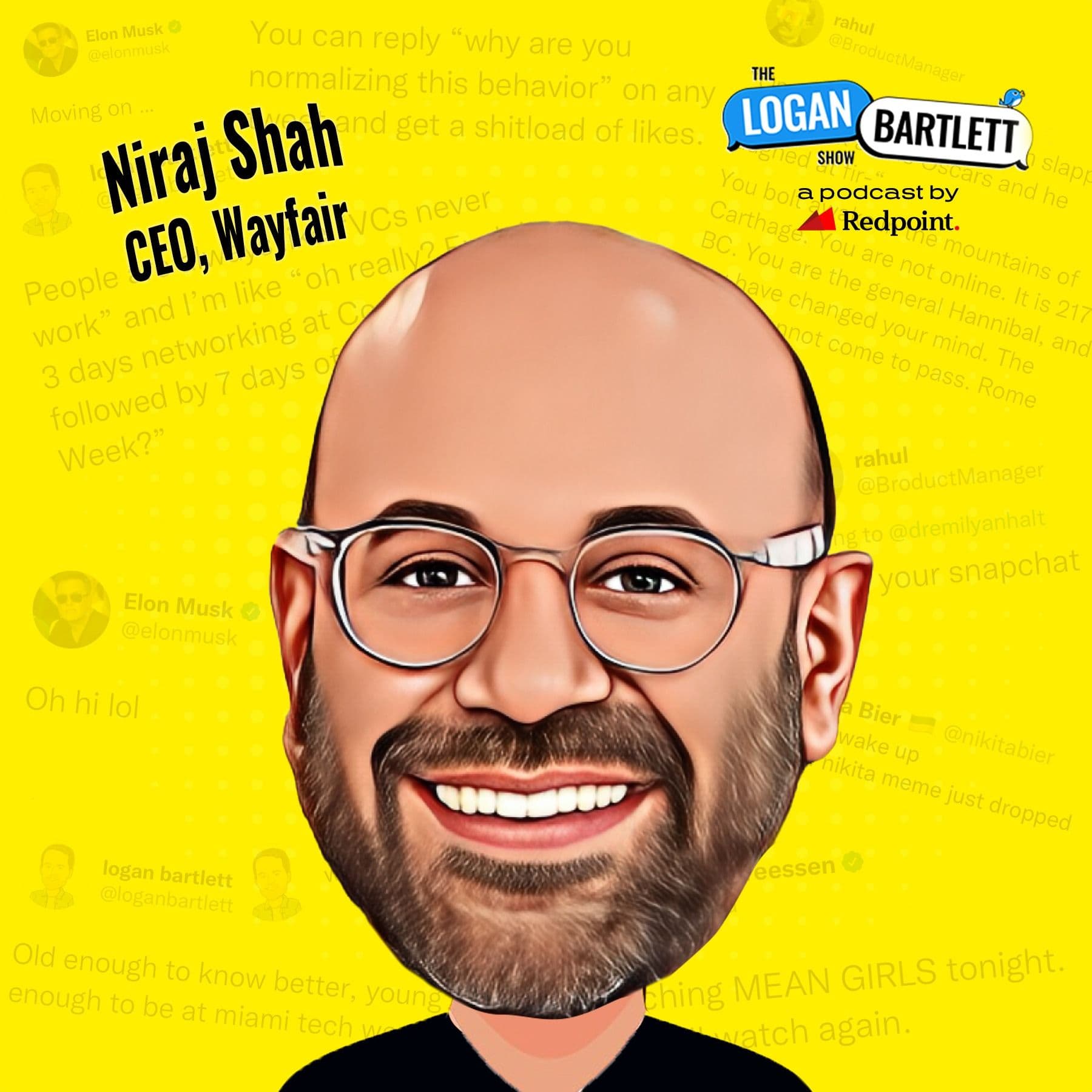
Overview In Episode 94 of The Logan Bartlett Show, Logan interviews Niraj Shah, Co-founder and CEO of Wayfair, who discusses Wayfair's evolution from a collection of niche e-commerce sites to a major player in home goods and furniture, achieving over $10 billion in revenue. They cover various aspects of the company's journey, including challenges, branding strategies, and the importance of understanding customer needs.
Key Themes and Discussions
- Wayfair's Origin and Growth
- Founding: Started in 2002 as CSN Stores with a focus on niche products.
- Initial Strategy: Acquired small e-commerce sites and grew through niche market focus. Key early sites included racksandstands.com.
- Revenue Growth: Achieved $500 million in revenue by 2012 across 250 sites.
- Market Understanding and Strategy
- Market Research: Emphasized the importance of understanding market dynamics and customer needs.
- E-commerce Evolution: Transition from separate niche sites to a unified brand (Wayfair) to capitalize on growing e-commerce trends.
- Challenges Faced
- Inventory and Supply Chain: Managing a complex supply chain with over 7 million products and ensuring inventory management.
- Rebranding Difficulties: Transitioning from CSN Stores to Wayfair led to initial traffic drops which required troubleshooting and adjustment.
- Branding and Marketing
- Rebranding Decision: Aim to create a cohesive brand identity to enhance customer recognition and loyalty.
- Customer Loyalty: Strategies to improve repeat purchase rates from 20% to 40% and beyond through branding and marketing efforts.
- Advertising Investment: Discussed the importance of investing in advertising to build brand awareness, which now surpasses $1 billion annually.
- Logistics and Delivery
- Importance of Logistics: Developed proprietary logistics systems to manage delivery of bulky items, which account for 30% of shipments.
- Final Mile Delivery: Addressed complexities in final-mile logistics and the importance of building an effective delivery network.
- Technology and Innovation
- Generative AI: Exploring the use of generative AI for improving customer experience and internal efficiencies.
- High-Quality Imagery: Importance of high-quality images for customer confidence in purchasing online, moving towards 3D modeling and rendering for product imagery.
- Company Culture and Hiring
- Culture of Incremental Improvements: Emphasized a culture focused on continuous improvement and data-driven decision-making.
- Hiring Process: Focused on traits like intelligence, hard work, analytical thinking, and teamwork during the hiring process.
- Navigating Challenges
- Dealing with Misinformation: Shared experiences with handling misinformation and maintaining public trust.
- Market Positioning: Stressed the importance of focusing on customer needs rather than competitors, especially in dynamic market conditions.
- Future Perspectives
- Long-Term Vision: Emphasized a long-term approach to business growth and adaptability in a changing market.
- Advice for Entrepreneurs: Importance of passion for the business, understanding customer needs, and maintaining a disciplined approach to growth.
Conclusion Niraj Shah’s insights provide a detailed look into the strategies and challenges associated with building Wayfair into a leading e-commerce platform. The conversation highlights the significance of understanding customer needs, strategic branding, effective logistics, and nurturing a strong company culture to drive long-term success.
Key Takeaways:
- Focus on customer needs over competitor actions.
- Build a strong brand identity for customer loyalty.
- Invest in logistics for a seamless customer experience.
- Embrace technology and continuous improvement as core business strategies.
---
Episode Credits
- Executive Producer: Rashad Assir
- Producer: Leah Clapper
- Mixing and Editing: Justin Hrabovsky
Follow the Show
- [Instagram](https://www.instagram.com/theloganbartlettshow)
- [Twitter](https://twitter.com/loganbartshow)
- [TikTok](https://www.tiktok.com/@theloganbartlettshow)
Written by AI. May contain mistakes. Listen to the episode to check what was said.
Transcript
Automatic transcript. May contain errors.0:05Welcome to the Logan Bartlett Show. On this episode, what you're going to hear is a conversation I have with Neeraj Shah. Neeraj is the co-founder and CEO of Wayfair, a business doing over$10 billion selling home goods and furniture online. Now, Wayfair had a very interesting story, bootstrapping its way to$500 million in revenue across 250 different sites before they raised outside capital and rebranded the company from CSN Storrs to Wayfair. We go into a bunch of different directions here about managing a company that has over 10 ,000 employees, what he looks for and talent, the complexity of e-commerce and supply chain, which includes having over 7 million SKUs on the Wayfair site, and their decision to rebrand from 250 discrete stores to the Wayfair brand that we know today.
0:50A really interesting conversation with Neeraj that you'll hear now. All right, Neeraj, thanks for doing this. Welcome to my apartment, our makeshift studio we have here. Thank you for having me. It's great to be here. We cleaned it up decently for you. My wife was not thrilled this morning when we woke up. Well, you told me there's coffee tables from Wafer. Yeah. That's exciting right there. I know. Product placement right there. Yeah. We'll list it in the show notes where you can get the link back. Well, thanks for doing this. I normally don't try to tell a story in a linear fashion of the company's journey, but I think the foundation of Wafer is such an interesting story and genesis of how it all came to be.
1:26So maybe we can go back in time. 2002? 2002. You and Steve. Yep. You guys were college classmates. You knew each other even going into Cornell, right? Yeah, we met at Cornell in the summer of 1990 at a summer program for high school students that they had. Were you guys accepted both at the time or no? No, it was between our junior and senior years. Wow. Then we ended up each unknown to the other applying early. We both got in and then randomly ended up three doors apart on our freshman year floor. So friends - This fall of 91. Friends all the way through. You started two companies together prior to Wayfair.
2:02Exactly. So it's 2002, and you're looking for a business idea? Is that fair to say? Yes. I think that's very fair. And so did you stumble on racksandstands.com? Was it an independent operating entity? How did the kernel of idea come to be? Yeah. So one of the things we were doing as we were trying to think of an idea is we were poking around it, businesses that were out there that were, the operators were looking to sell them, but they were small and they were seemingly doing well. And what we realized there was all these small e-commerce companies that were, you know, there's a woman selling birdhouses and that's the one that I remember the most, but there's dozens of these and it was just growing fast, but it was like more than she could handle, you know, shipping these out of her garage or whatever.
2:45And so we ended up coming up with this thesis that niche e-commerce was a real opportunity. we then sort of researched it and we we basically came up with an approach on how to find categories that could be good and tv stands and speaker stands were both two of the top hundred search words on on yahoo on some of these shopping comparison sites at the time so we created racks and stands oh you did okay wait and was there was no acquisition you started it from scratch well what you're probably thinking of is we bought a thing called smart tech toys We bought it, very little money, but we bought it basically, it was up and running.
3:21We bought it to see how it was operating. They were drop shipping all the goods from suppliers. So we bought that. We then built the technology to kind of let us track the ad spend, let us track the order flow, manage the customer service. And on the back of building that, the first website we launched from scratch was Raxistands.com. And so the moment in time that allowed this to happen was basically Google Search kind of popping up in e-commerce and all of that. Like what was the wine now of 2002? Yeah. So Search obviously had been around and Search, you know, internet was growing fast. But I'd say the now was that Google AdWords was brand new and Yahoo was using a third-party product called Overture, which was effectively the same thing as Google AdWords.
4:07And so you were able to advertise in a very targeted way on these kind of high intent words. That was quite new. And so in 2002, you see this. And how do you actually get in touch with the business owners to figure out, do they have contact information on their websites when you're sort of poking around and trying to figure out what's working? There was a website at the time. It was called, I think it was called bizbuysell.com, something like that. and it listed these like, you know, it lists business, you can pay to list your business for sale. And then the person you contact would be the, you know, the operator, you just chat with them.
4:43And at first we were thinking, Hey, you know, we could buy these, put them on a technology platform, streamline things. But what we realized is there was no inherent value in what you were buying. There was no, there was no equity value. There wasn't a repeat customer base. There was no brand, you know, there's nuance to all these categories. So the truth was we're better off coming up with our own approach to figure out, you know, we bought one. And then what we learned through Raxist is better off coming up with our own approach. How do you pick a category, get into it, and kind of build that way?
5:09Maybe explain dropshipping and how that works. Because you actually, people weren't taking inventory at the time, right? It was all these things were, for the most part, they were dropshipping businesses? Well, actually, most of them, ironically, were taking inventory. And that was one of their limiters. Got it. So the woman was making the birdhouses in her garage and shipping them herself? Either making them or I think she was buying them. And so that was always a challenge in growing these businesses. You had to manage your inventory. The idea of dropshipping, most suppliers and manufacturers weren't set up to ship one at a time.
5:44And so they were not keen on doing that. And e-commerce was far from a proven thing at the time. This is pretty fresh after the dot-com crash. There's a lot of negative press about e-commerce and what its potential was said to be versus what it turned out to be. You know, if you remember, there's a lot of skepticism that Amazon was going to be successful. I mean, it was not a boom time. There were some magazine headlines very dismissive of Jeff Bezos at the time that I don't think have stood up over the last couple of years. E-commerce has worked out okay and Amazon has done fantastically well.
6:14It seems like it was fine. So it was a contrarian, though, take at the time. And so you go to these suppliers and they're used to selling to traditional retailers. Like they have TV stands or whatever it is, microphones. And how do you go about convincing them that they should be doing one-off shipping to individuals? I mean, you'd basically approach them. You'd try to explain what the opportunity was. And honestly, the way it worked was that so that first website racks and stands, we basically, you know, we probably started with maybe a third of the selection we would have six months later. Because you could only, only so many of the folks would say that they were interested and whatnot.
6:51But that was enough to actually have a very good selection relative to others. Then we'd advertise the site. We'd track it really quantitatively. We'd do a great job on pricing, on service, on fast shipping. And that would get us better conversion than others. So we became quite fast growing. And then what happens is the suppliers notice that you're growing. So then those suppliers are like, hey, I remember we launched it at the very end of August, I think like August 31st. And in the month of December, I think that month we did$250 ,000. And so these suppliers were like, geez, you kind of came out of nowhere, but it's unbelievable how fast you're growing.
7:27And all of a sudden, they want to do more business with you. So some of them would say, oh, hey, some of the other online guys sell more of my beds than my TV stands. There's different guys sell more of my desks than my TV stands. So what happened was two different things at the same time. One is we would approach all the other folks who had TV stands, speaker stands that we wanted that we hadn't been able to get, talk to them about how things were going, and have them look at the site. And one by one, they would say yes. So over time, we were able to really build up that selection. That's one of the things that's a real advantage on driving conversion, attracting customers.
7:57The second thing is we started learning about what the next category was to go into from our suppliers. So our whole approach initially was like, hey, we're gonna be super quantitative, we'll pick all these niches that are unrelated. That a little bit fell by the wayside, because we found this incredible source of insight, which are all these suppliers. and they were generally not just in one category. They were in some adjacent categories and they had a great set of data because they knew exactly what was happening. And you didn't have to start cold with, if you went after whatever it was, lighting, and that shows up really well as a search term, but you don't have any supplier relationships.
8:31Now you have supplier relationships and you say, okay, can we sell your other stuff? So we ended up doing a hybrid. So we ended up working our way across furniture, a lot of which was related. But then as we were doing that, we clearly wanted to get into core. So then when you wanted to go into rugs or you wanted to go into lighting, for example, we had to approach a whole new set of suppliers because the furniture folks didn't do those categories. So we ended up doing both. But by that point, we had realized that home was a really attractive, very large, very fragmented market, difficult service, difficult logistics.
8:57So we became quite enamored with the opportunity to focus on home because there were no real national retailers there. And it was just a – it was rife with challenges. And so that's kind of kept people away. But our view is, hey, that could be the opportunity. Get good at them. That's the moat. But this is an interesting thing to go into. So e-commerce in general, right? There's kind of the commodity goods as well. There's fashion. Yep. There's home. Can you break down like the different components of it and why home didn't have a big brand that was out there? Totally. So the simple math, I think the thing about it is if you think about the physical goods retail market, X automobiles.
9:33So automobiles, one market, kind of unlike the rest of physical goods. Inside physical goods, it's basically 60, 20, 10, and 10. And what that is is start with the 20. 20 is grocery. Everyone buys grocery once or twice a week. Everyone knows what grocery is. Because it's so competitive, high frequency, it's low margin. Well, sitting next to the 20 is the 60 that's general merchandise. And general merchandise, think of all the stuff you buy at a Walmart or Target or Costco. And what you'll think about about the three I just mentioned is you'll say, oh, they all sell a lot of grocery too. In fact, it's their biggest category.
10:05Well, the reason is in the 80s, what they realized is the way I can sell more general merchandise is to get into grocery. So they all got into grocery. And over time, they've become the biggest grocers in the country. That's like a loss leading or whatever, a low margin, tough business, because people were coming in with frequency and then go buy our paper towels or whatever. If you need AA batteries, you either need them on an emergent basis, so you buy them right around the corner, or frankly, you just pick them up while you're buying your groceries. So it's like All those other categories can get added on, but you don't seek out the dish soap.
10:36You don't seek out the paper towels. And so the idea was like, hey, where are you going anyways constantly? Grocery. So that 60 and 20 are very different when you think about the logistics and the margins, but they sit side by side for the reason I just described. So the two that are both large and super different, the 10 and the 10 are fashion and home. And they're really different for a few reasons. One is fashion. It's branded. The seasonal cycles are short. You don't want to wear the same exact stuff as someone else. It's an expression of who you are. It's your identity. So you're going to find these places you love.
11:10And maybe it used to be department stores, and now it's more brands you love, and you go to those brands, and maybe there's ways you discover new brands that you might love, and that sort of fashion. The 10 % that's home, these are, again, people don't want to have the same items in their house as someone else. It's an expression of their identity. They want to be comfortable. They want to be proud. There, the challenges are these items are often big and bulky. They're bought infrequently. It's hard to know how to pick the right item. So there's a lot of endemic challenges in home, and there's no national brands there, really.
11:44There's very few. And so it's sort of like as a consumer, hey, who's going to present me with a good selection, and help me pick the right item, be there if I have a problem. And so neither fashion nor home really fit into that 60, and obviously they don't fit into the 20. So they kind of sit on the outside, and that's why there's a real opportunity. And if you look in Europe with Zalando as a platform for fashion, or in the U.S., a lot of the brands have gone direct once Zappos sort of ceased to be a platform for that. And then what we're doing in Europe and North America's home, they just don't fit into the mousetraps of, you know, think of a Walmart or a Target or an Amazon that well.
12:22And so once upon a time, I would go around the corner to buy my couch to the retailer that could give me the opinion. It was close. So the logistics were easy, drop off all that stuff. And I could build a trusted relationship with this person. As you moved online, there was an opportunity both because of the complexity of the logistics, as well as people are looking for personalized things and, you know, all the things that benefit e-commerce. Well, so I think the first thing that ended up making e-commerce sort of interesting for the consumer was access to selection. Because the one problem you have going around the corner is there's just not a lot to pick from there.
12:57And your neighbors might have it or whatever. So generally you want more. So actually, even today, if you go visit a furniture store, you'll typically find there's five, six in close proximity or even maybe eight to ten. And the reason is the average consumer wants to visit multiple. so as a as a retailer you're better off being near the others than being the one that's far away because you want to be in the mix that they visit because obviously you're counting hey we do a better job with merchandising our sales force is better our pricing's better uh merchandise you know whatever it is and so we're going to convince you to buy from us but if we're not in the mix how do we get you here right that's sort of the reality how that worked and that you amass selection by going to a number of places now all of a sudden you know it could be you know whatever time of day and you could browse and see a selection that's many, many times what you'd get by then spending all of your Saturday going from store to store to store to store.
13:43So that was like the first draw. Now, obviously, that doesn't necessarily solve for, as you said, how do you get confidence? How do you solve ease of delivery? How do you solve problems? And that comes into all the challenges I mentioned that we did solve through having our own customer service, ultimately building our own logistics capability and delivery capability, building our own brands that we curate. Those other problems are real problems. But the initial draw in the early, early days, kind of where you are right now in the story is selection. And so this selection problem exists and you find a bunch of discrete opportunities, some from your suppliers, some you go direct on yourself.
14:22Any other acquisitions or was it all organic that you built up? So that's really organic. The only acquisitions sort of subsequent to that in our history, at one point we bought a brand called Dwell Studio. And at another point We had a JV in Australia, which we bought and ultimately later divested. Got it. We divested both of those. And by 2012, you have 250-ish independent operating websites? Exactly. We peaked at like 250. Do you remember what the first couple ones were after racks and stands? We did an outdoor furniture one called T-Quicker and More. We had one called BedroomFurnitureDirect.com.
14:58um we did one called csnofficefurniture.com allbarstools.com the initial ones were all furniture you didn't do birdhouses we did have one i think that came later when we were doing decor i think it was everybirdhouse.com but i don't i wonder if all these i assume they still link back uh to wayfarer if there's any birdhouse.com uh loyalists uh now they're now they're the Wayfair site. So 2012, you built a business of 500 million in revenue, and you make the decision that you're going to consolidate all this stuff together into the Wayfair brand. Exactly. So we started thinking about it in 2008, 2009, we were trying to grow our repeat base, and we had some success growing it, but we were hitting a ceiling, and it was due to folks not really understanding all these different sites and how they work together.
15:50And so then that led us to deciding that we wanted to launch a brand. We actually launched it in 2011. 2011. And so you had a centralized database of all your customers, but they didn't know that the same person making the birdhouse thing also sold TVs. So we made the header on every site very similar, you know, the same. We said part of CSN stores and the emails we started talking about the other sites. The problem is it just wasn't intuitive to folks and not everyone's going to read anything, everything you send them, you know, that's just not the reality in the world. So a lot of things need to be intuitive and simple.
16:20And if I'm in a home store and I see barstools, but I look at the header and it's got all the furniture categories and, you know, the taglines, a zillion things home. And, you know, I'm going to think one thing about it. If I'm in a site called allbarstools.com, you know, I'm thinking this is a great place for barstools. Yeah. So CSN Stores was the hold co. It was a amalgamation, I guess, of what, Steve, Shaw, Neeraj, Conine, all those things together. And you purposely picked a boring name. I think it's fair to call CSN source, not the sexiest of names, to appeal to suppliers. Exactly. I mean, in those days, when you'd go to a trade show, you'd go to like the high point market, and you want to approach suppliers and talk to them about selling their goods.
17:02They weren't interested in e-commerce folks. They've heard about this Jeff Bezos guy. That was a big crash market. There's a bunch of – the early incarnation of furniture.com ramped and then went bankrupt during this period. There were some other folks that did that too that raised a lot of money during the dot-com boom and basically ultimately went bankrupt. So these suppliers, conservative folks, they decided like, hey, this just doesn't make sense. And so the best way to kind of build a relationship is to start to get into a conversation and let it be 15, 20 minutes into it. by the time they realize that you're selling online.
17:38And by that point, and this is the piece that Steve did for years was getting our new suppliers, is then they're like, well, the kind of business for them is like, hey, this guy sounds pretty bright, but he's selling this stuff online. But maybe he'll figure something out. You're hoping for that. Otherwise, they were just like, hey, I don't want to deal with that. And the cashflow dynamics are interesting that you were able to bootstrap to 500 million, right? And so maybe talk through the dynamics of taking cash up front and then the ability to pay net out to your suppliers. So what's standard with suppliers is that they give you terms.
18:13It might be 30, 60, 90 days, depending. You're a larger and larger retailer. Typically, they'll give you bigger, longer terms. Until you have to pay them for – Until you have to pay them for the goods. So from the time they ship an item, they want to be paid on whatever those net terms are, number of days later. So standard is 30 days. So we would get 30-day terms. But when a customer orders something from you, they pay with a credit card. So you get that money two or three days later. So effectively, for that 27 days, you're holding the float. And so that basically, as you're growing, if you had to buy inventory ahead of time, that consumes capital.
18:47But if you are not having to buy the inventory until after you've sold it, it's generating capital. The benefits of drop shipping, among other logistical complexities that you didn't have to deal with is that the working capital cycles were better for you to be able to bootstrap. Versus if you're taking inventory, not only did you need to store it somewhere, but you had to buy it upfront to be able to send it. Right. So the working capital cycle also, you know, access to selection, there's no way we'd be able to inventory that breadth of selection. So you're accessing sort of this huge inventory pool.
19:18So you get to 500 million, you probably have, are VCs reaching out to you across, like, do they know CSN Stores is this big entity that owns all these independent businesses? Yeah. So by that point, they did. Because along the way, we had some competitors. I mean, most notably would be one that was called NetShops at one point, later renamed Hayneedle. And they had raised capital from some top tier venture firms. And so they had done that. A couple others had raised money. And so it became a category. It became well understood. We were a leader in the category, the only one that hadn't taken an outside capital.
19:52So some folks over the years had approached us. So you're getting phone calls. And the impetus at that point to go all in on Wayfair was you saw trying to drive more repeat purchases and actually build a brand that people trusted. So our repeat rate, sort of generously defined back then, went from 20 % before we really focused on it to 40%. And we just couldn't get it above 40 % because just folks weren't paying enough attention. And even to the 40 % wasn't really like year after year growing the way we wanted. Our theory was that with a brand, we could better tell the story. We could draw in traffic outside of just paying for the transactional traffic online, which was getting more expensive as the years went by.
20:33And we could really create a repeat base, which is sort of the lifeblood of any retailer. And so that was why we did it. So your pitch, you called, I guess, or maybe got called on by my old boss, mentor, Anira Jaggerwal, who you also went to Cornell with. So there was some trust there, I guess. Yeah, we knew each other a little bit at Cornell. And then we'd known each other over the years in Boston. Yeah, in Boston. And so, but the pitch to these folks was, hey, we're going to pivot the business in some way. We're going to go after this brand opportunity and change what we're doing. And it was a big, how much equity did you end up taking in at that time?
21:09So we took in$165 million from Battery, Neeraj, Spark, Great Hill, and HarborVest. And right after that, the business tanks because you're not – maybe you disagree with the tanks characterization, but it was a scary six months or nine months or 12 months because all your backlinks and all the work you had done to build up all barstools and all these different things fell off pretty precipitously. Yeah, so we'd been working towards the launch of Wayfair. And we launched it probably within six months roughly after we had taken in the capital. The capital, a big chunk of it was the reason we did that fundraise.
21:51It was earmarked to build the brand, to build the brand Wayfair, because we knew we couldn't fund that out of cash flow. But as we were doing the redirects of these independent sites into the Wayfair domain, the traffic was falling off far more than we had thought it would. Because you're changing all the links and the headers. And so Google SEO is punishing you for the newness and that they don't want to misrepresent things. and you have to build up trust again with the sites, right? That was a piece of it. We also, in front of what happened, we realized some technical aspects of how the site was built that were causing problems.
22:26So it was a combination of things. And so once we figured out the technical issues, that caused traffic to recover to the level we thought it would come to. We didn't expect it to jump up, but we didn't expect it to go down as much. We started to come down a little bit. The technical issues got us back to that level. How long did that take, by the way, to figure out the technical? thing? Well, you know, it felt like about a hundred years at the time. But I think it probably took, it took many months, approaching a year. Was, I mean, what's your feeling at that? I can only imagine you've built this company that was cash flowing and doing really well to 500 million in revenue.
23:03And now you change all this stuff around in pursuit of optimization. And it's totally looks different like did you did you doubt it moments of time when you were up late at night or did you know you would just be pushing through we felt like we were going to figure it out and um you know in that sense we felt like we were going to figure it out but definitely nerve-wracking yeah i can imagine uh so that took how long until you you got back it was a couple months on the technical side and then there's a technical piece then there was all the things we're doing to make the site experience better to really optimize it because remember we again had really optimized these independent sites that were just category specific.
23:40So when you have a home store like what we have today, what do you put on the homepage? How do you merchandise the whole thing? I'd say that continues to get better as the years go by, but it probably took two years before we got to the point where that money that we had raised, that we had earmarked to build a brand, it took two years before we were willing to start the TV advertising because we finally felt like we'd gotten it to a point where it was worth starting to invest in the brand building. And so what is a brand in your mind? Like as you're sort of thinking about this, is it a place that people trust to make purchase decisions?
Read the full transcript
24:15Like how did you sort of think about success of being a brand? So the first level of brand is just they have awareness. So they know what you are. So if they see an ad for Wayfair, they're like, oh, that's that home store. So that right there gives you a leftover not knowing who you are. But then really what you want it to be is someone really understands what you do. They understand the real benefits you provide versus others. Through the process of that, it creates trust and confidence. And so brands that really do all of that, that's a very strong moat because for a customer, part of what you're trying to do is make a good decision and not have a problem.
24:49So there's all these goals you have. Going to a trusted source is generally one of the things you want to do if you can. So you had a plan for it. It sounds like it was measured initially that you were going to take in this capital and not do TV right away, not big, splashy television advertisements off the bat. How did you think about building the brand and the different ways you were going to go about doing it? Well, so the very first piece of it was simply we knew how to get traffic that was high intent for certain products. If we bring a customer into a place that is a home store, if all our communications with them are about being a home store, how do we start just optimizing the repeat there?
25:25because we're getting a lot of folks who are clicking on our emails, coming back. How do we drive the lifetime value that way? That was sort of one piece. Second is, hey, now we have a whole new surface for merchandising. How do we do more with that to tell the story? Because now we don't just have traffic that's high intent for a very narrow thing. We actually have this kind of secondary set of traffic. One of the things we launched, and it was probably three years after we first launched the Wayfair brand, was kind of a concept that was just regular sale events. The idea of just sort of giving folks a reason to kind of, you know, we modeled it after the old brick and mortar, you know, this is going to date me as being way too old.
26:05But in the Sunday newspaper tucked in the middle used to be all these circulars and you get the circular and you'd see what, you know, Target or whomever was running on sale that week. And you might see some items you expected and oh, wow, that's a good price for that item. And then you may see some other items, you know, but that actually, we could use that. and it would be a reason to go to that store. In some cases, you actually had to cut out coupons, which most of the circulars didn't have, but that was on some of them. So the idea was like, hey, how do you give someone that type of content, which piques curiosity, gives them a reason to open email.
26:32So there's a set of things that we were doing that were sort of improving the experience. Another thing was around faster and faster delivery. In 2015, we started opening our own warehouses, targeting just talking to suppliers about putting their most popular items in there off a fast delivery promise. That item would then get a badge online about the fast delivery. lifts conversion. And to this day, faster delivery items have much faster, higher conversion than slower delivery items. So it's an interesting theme. And this is maybe in the minutia of supply chain, but it's super interesting. So 30 % roughly of items that you guys shipped were too big to be shipped by FedEx and UPS.
27:08Do I have that roughly right? That's right. And so how do you go about solving that? So there was Castlegate and then the Wayfair delivery network, right? So in the early years, we were picking transportation carriers that we thought could do a good job, sometimes by geography. And then we would have folks who would just try to work with them and manage that to make sure that we optimize as best as we could. Then as we got bigger, we were able to say, hey, let's build our own transportation network. The problem with the transportation network is you need a certain amount of scale. Because without scale, your trucks are running empty.
27:40I mean, it's prohibitively expensive. So today what we've built, what we call the way for a delivery network is basically for those bulky items, we move all of them through our own transportation, line haul, which is like trucks picking it up from the supplier, all the work to make sure the item is packaged well, doesn't get damaged, et cetera, and deliver it to the delivery agent who's going to deliver it. And then what we did is we started in the popular markets building our own delivery terminals. So we in the US and Canada, we have 40 delivery terminals. So, for example, we're in New York City right now in Linden, New Jersey.
28:13We have a building. It's probably a 100 ,000-square-foot building, and it's just every day items come in, and every morning, whatever, maybe 100 trucks with two folks on it go out and do a whole set of deliveries, each of these large, bulky items. But it's all our items. All our folks run the way we want, deliver the way we want. And you picked originally two locations, right, because you could reach some high percentage of the U.S. through those locations? Those two locations were for warehouses, for our fulfillment centers. And that was really focused on the items we could give to a carrier, like to a FedEx, for delivery.
28:47And so those were – yeah, we picked Utah and Kentucky because they covered the bulk of the U.S. with two-day delivery. And that's when we proved out the value of speed. Then what we've done over time is build out a number of these fulfillment centers. So we have a lot of one-day coverage and far more two-day coverage. but for the large items, we were still tendering them to these other carriers, then taking that over, which is what the Wayfair Delivery Network is really up to the quality service level. Hey, Logan jumping in here just with a brief request. If you're enjoying this episode or you have a favorite episode, we'd love for you to share that with anyone that you think would benefit from it.
29:26Anyone that is trying to be a better founder, a better operator, a better board member, a better investor. We'd love for you to share any episode that you think makes sense with them. We're trying to get the word out, continue to share with people in the ecosystem. And so that would be really, really helpful. Now back to our conversation. So in some of those examples, you're actually not taking, I don't know the technical term, but you're not taking consignment of the item itself or are you in those facilities? So if you think of sort of what comes out of our fulfillment centers, obviously we're handling the transportation, whether we're tending it to like a FedEx or handling it ourselves.
30:02If it's what you'd think of as dropships, so coming out of a supplier network, their warehouse, their fulfillment center, either we tell them which carrier to give it to, you know, give this to FedEx, or we tell them we're going to pick it up and we'll pick it up. And we do pickups all over the country every day, pull it into our transportation network, and we'll move it all the way to the destination. What did you find about speed? You talked about this. I assume that was a big driver of repeat purchase and building out all this logistics around is a decent sized moat, it seems like, of complexity around this.
30:36But what was the insight of speed? Obviously, people get it faster, they buy more, I assume. Yeah. So people love fast delivery, right? So that's a clear insight. I think what the insight of logistics is, though, the irony of logistics is that as you optimize it, You actually get a few benefits all at once. So speed goes up, which obviously people like. The second is by the way you handle things, damage can go down, which obviously helps customers be happy and takes out cost. And the third thing is your transportation costs actually go down because your really expensive transportation leg is the final mile leg.
31:09Now, if you can forward position it from wherever the thing is made, forward position it into that region from the get-go, that final mile leg, there's a little more cost on the way in, but it pales in comparison to the savings on the way out. So all of a sudden you can hit lower retails for customers. So they love that. Faster speed for customers. They love that. Both of those drive up conversion. While at the same time you're reducing damage, reducing your operating costs. So it's a real win. And it's impossible to do just through third parties alone. Why is the final mile so difficult? Shopify bought Deliverer and then I think spun it back out to Flexport.
31:44And it seems like that's been a really difficult situation to figure out like this last mile of logistics and all that. I mean, it makes sense that getting from a warehouse to someone's house is a bunch of complexity in there. But why is it so uniquely hard? Well, so I think first is you need to have enough volume to have the density to make it economical. So if you have enough volume and the density, then to take it on, the trick is you can neither approach it as sort of a pure software sort of solution, kind of a purist on that side, nor can you just do a great job just through physical operations without good technology support.
32:19So it's the intersection of the two. And I just think most companies who are great at building technology are not also great at the physical operations. And you end up needing to care enough about both to really get it going. And there's a lot of companies who either try to be like a software overlay on other physical operations. Or there's folks who are in the physical operations business, which are a lot of these 3PLs. But they've never really built the technology to add a lot of finesse. So in building a brand, now you spend over a billion dollars a year on advertising marketing? Is that? Yes, we do.
32:52I can't imagine there's too many people listening that have built a brand at the scale and is purposeful of a way. It wasn't like accidental. You guys actually set out to do this. So what have you learned that's interesting about marketing or generalizable things about building a brand for people? As an engineer, the idea of building a brand felt like a very foreign idea to me. as I've learned more about it over the years, a lot of it does fit the same way you'd think about solving other problems, which is, you know, you want this to stand for something. How do you help people understand what associations you want?
33:24Then help them understand what the things you stand for are. They need to be true things because customers then validate it with their own experience that then drives the loyalty back. Then there's these really powerful things like word of mouth and these other things that you sort of know exist. But, you know, I guess one of the things that sometimes folks are challenged by is like they're harder to quantify. And so people tend to like things they can quantify a little more easy, but sometimes the most valuable things are a little harder to quantify. But so what we found is like the power of having a brand is very substantial in what you can do with that earned trust and how you can then kind of keep building it over time.
33:56I'd say Wayfair today is a household brand. Everyone knows who Wayfair is. We still have a lot of opportunity though to build up a lot of understanding of some of the nuanced things we do to drive a lot more preference. And so it's also a journey that it's not sort of get known and you're done. It's like you can actually keep building value into the brand by whatever the next thing you do is. I mean, a great example would be Apple, you know, and everyone would say, oh, Apple has such a powerful brand. It's one of the most loved, most valuable brands of the world. And so, yeah. And we say, okay, so now think about what their journey has been on the, you know, the glasses, on the, you know, AR, VR product, headset.
34:32And, you know, they obviously waited a long time to release the one they did. They're very thoughtful about how are they going to, They have a very large user base. How are they going to keep driving increased loyalty and cover more ground with their base? They don't want to release something too early, but they don't necessarily want to leave that space for someone else. They know where they sit in the market as a premium product. They have a strong point of view on what people care about there. I think building a brand, your journey is never done. If you think about what I just said, the brand, it's not just the marketing aspect of it.
35:02It's how it ties into everything you do. In doing that, you have some independent brands still today. Outside of Wayfair.com, how many other brands are there? We have five retail brands. We have Wayfair, which is the mass platform. We have three specialty retail brands, all modern, Jocelyn Main and Birch Lane. They'd be at the very high end of what you could consider the mass platform really being good at. They sit above it. They would compete with specialty retailers. Then we have a luxury platform called Paragold. These are all the brands you would find in the design center that typically sell through the entire designers and the trade that are kind of premium products.
35:40And how did you think about where the demarcation exists? What would go back to Wayfair versus what would have its own standalone brand? Because you were building this all purposefully, right? Some people fall into this and they buy something and they need to keep the brand around. The truth is they're different segments of the market. And one of the easiest ways to think about that is if you list who the competitors are for each one, you wouldn't list the same competitors in each of those lists. And so there's, you know, you could say, hey, we're going to do all of this in one place, but it'd be very hard to do that because the customers get to know you for one thing.
36:14That's their association. They're saying, oh, and I also do this other thing. They're not necessarily going to kind of view that as like sensible or it won't feel right to the customers who are looking for that, that this is the place to come to. And it's mostly, I guess, price point is one big distinction, it sounds like. Are there any other ones that you think about, about where things slot into? So price point is important. You can use it as a proxy for quality, but it isn't always a proxy for quality. So as I say, quality really is maybe the main demarcation, which tends to carry over into price point.
36:48And then in the specialty retail brands, there's also a big access on style. because especially retail brand, by definition, is pretty tightly curated for a very specific aesthetic look lifestyle. And so by definition, it can't cater to sort of everybody, even in that price band and quality band. It needs to pick that audience. But for that audience who says, well, hey, I either don't want to, or I'm not great at curating, and that's my look. And they want to go there and just immerse themselves in that environment, pick out their item. There's, I'm sure a million things that you've learned about building confidence and trust in purchasing a product online with individual customers.
37:25One that there's a Harvard Business School case study on is the image catalog and how you go about scaling that. So once upon a time, you had maybe still, maybe it's more, 7 million SKUs across the platforms? And we probably have more than that today. More than that today. And all these things needed high quality images for confidence in purchasing, right? Is that a fair characterization? Yeah. I mean, you're telling the story of the item online. So you think about visual imagery, critical. Critical. And so you had to make that there was a debate of, do you go take all the pictures yourselves?
37:58Because these suppliers don't have the competency of building out high quality photographs or trying to use technology to recreate elements of AR, I guess, and these items. Is that a fair characterization? Yeah. So what it was, it was like the early day of rendering imagery off a 3D model. And what we found was that you could much more economically render the imagery than doing the classical photo studio shoots. What's happened since is I would say that's become much more widespread. But now the real value is the model can power certainly anything you're doing in augmented reality or virtual reality.
38:36But then the other thing is like if you have an item and it's selling well and you just think about what's happening with generative AI, you know, you can start generating lots of imagery, very bespoke for a person for virtually no cost. But you need to have, you know, a certain set of information about the item to do that. And that's kind of what these three models were effectively capturing. Was that the one you picked in the case study? They leave it open-ended at the end. They don't tell you which one you ultimately pick. They give you this option of do they do it all in their studio or do they use the rendering?
39:06This was many years ago now. That's 10 years ago. We really pursued, yeah, the rendering, the modeling. That was my answer. That's good. Yeah, that's what I was going to – I guess I would have passed that class as well. I guess just because you touched on generative AI, where does that fit into your perspective on Wayfair as a business and the opportunity for you guys? so you know i mean today we're you know 12 billion in revenue and you know 10 000 plus people so there's a lot of areas where we have a lot of people doing things that we can enable them to do a much better job with generative ai so that type of productivity increase is is kind of what we have in production today what we were the first use cases that we tackled a lot of internal operations related stuff absolutely whether you're talking about tagging merchandising content onto items or whether you're talking about helping the customer service folks with the best response for a customer.
40:02These types of things are where you can go from sort of a pilot into production quite quickly with significant benefits for the customer, for the company. Where we're doing R &D and where we think the real interesting potential is, the biggest challenge customers have in our category is like, how do I find that perfect item? And customers are generally, they can only describe what they want to a certain degree. And sometimes they can describe it with some pictures or adjectives or likes and dislikes. And the holy grail is make it easy for them to intuitively and quickly get onto a journey where they start seeing super exciting things for themselves.
40:43And so if you think about our catalog of items and all the data we have on these items and all the millions and millions of people that come through and what their experience has been, all that data, how do you then use what the power of generative AI is to basically facilitate that. And whether you're generating additional imagery along the way, or a lot of what you're doing is, you know, creating kind of a bespoke shopping experience. There's a real, there's a real opportunity there, but I would say that that's still early days. Part of Wayfair success in my mind has been building a culture of just incremental improvements, thousands, probably millions of lead bullets that you've just made things a little bit better, right?
41:22Everything from the SEO in the early days to the brand, to the website optimization, to the email marketing copy and all that stuff. How do you go about building a culture of like those incremental wins that really maybe only moved the needle 0.2%, but 0.2 % on 10 billion revenue is a big, big delta, right? I think, you know, what we've always had is just amazing people who are ambitious and driven, hardworking, they're collaborative, they're, you know, They're always very bright. They're quantitative, analytic. And so as a result, when you give folks ownership over a set of activities or an area of the business, they're excited to kind of use the data to inform hypotheses to then go out and try things and unlock those gains.
42:08And, you know, always think about what the customer wants and then kind of how do I do that better? Or, you know, obviously in retail, you always want to have low retail prices. So how do I take out any inefficiency that just allows us to be sharper? You know, that's in the ethos of the culture of the place. And so I don't know that we do anything to like tell them, oh, you should go do this. I think it's the nature of kind of we're always working on that. And that's sort of there's an old adage, you know, retail is a business of details. And it's just, it's true. There's no one thing that makes retail work.
42:40You need to really, you know, we use technology to kind of force enable, you know, really us to do a great job in all these areas, but there's still thousands of things. And unless you have a culture that's like not excited to just leave the status quo, but rather excited to keep making it better, I don't think you'll unlock those gains rapidly. conversely and the reason I think it works for us is if you do have that culture you know it's just happening all around you I'm sure the answer is different for a bunch of different problems as they present themselves but how do you balance the um the autonomy of empowering people to go make the changes they need to with the the shared framework and fabric of the business and so hey you can't go switch our cloud hosting provider or our back-end infrastructure just because you think it's a little bit better to do that how do you sort of empower people in that way?
43:32Well, so what you try to do is you try to have as big an area as possible owned by like a single team and single individuals so that you create less kind of interaction points where you have to negotiate or priorities may differ. Obviously, as you have a lot of people, you still have a lot of those points. Then the second thing we do is every six months, we do a company-wide prioritization cycle. That's for the next six months where teams talk about what they want to do. And in that process is what are their dependencies on other teams. And that sort of hashes things out to make sure teams are on the same page with priorities.
44:08And if there's any that are in contention, we debate those. We decide what we want to do. And that's whether it's a priority or not a priority, as well as if there's a debate about direction. And so that's kind of, it's sort of like to try it. The goal isn't to say that there's never going to be conflict, but the goal is to try to sort it out in the right answer fairly quickly. How many people come to those six-month things? What's the end? It's broken up into 95 areas. Each of the 95 areas kind of creates a plan. And then we do effectively 20-minute meetings on each of these. Every six months?
44:42Every six months. And that was something I had heard you say at one point that there was this sprawling, kind of conflicting cadence of meetings that just kind of got out of hand from an operational standpoint, was this the outgrowth of that, that everyone was kind of marching to their own drum and timeline? So this was the outgrowth of two different things. So it was outgrowth that kind of the confluence of the two sort of made it obvious that we needed to kind of redesign how we operated. One was that. The second was that, you know, and by that, what I mean is what you were describing is that certain teams, you'd meet with them quarterly, other teams, you meet with them twice a year, and not necessarily during the same months, you know, it might be, you know, and the second problem, which was an outgrowth of that first problem is that each team was creating their plan of what they want to do embedded in that was assumptions of what all these other teams that they worked with needed to do to further their initiative.
45:29But then the other team meantime has created their own plan and their plan maybe didn't sync up with this plan. They're like, oh, hey, we're tied up for the next four months with a plan we have. We can talk about it after that, but I'm not sure whether that's our priority or not. So we both decided you needed to be on the same time cycle and then you needed a way to sort out where there were conflicts and priorities. What is the time horizon that you think about? There's the six-month increments of like revisiting things in general. And then I assume there's some point in the future that you are aiming to as well.
45:59How do you think about the appropriate scoping? So it varies by area, but a lot of, I would say generally, there's a pretty good vision that goes out, maybe a reasonably tight version of it that goes out maybe a couple years, then it gets fuzzier after that. And then, so on these six months, a lot of times that initiative continues into the next one, but it's a point to say, how's it going? What progress have we made? What are we hoping to do in the next six months? So on and so forth. But it varies by area. And so we try not to be dogmatic on, you need to have a three-year vision, you need to have a five-year vision.
46:31We were for a little while and we found that that just forces unnatural activity because in some cases you're like, hey, we know we need to get this done. And as we figure that out, we know we'll know what to do next. And in other areas, it's like, well, hey, it's pretty obvious what we need to do for the next N number of years. So writing that up, do we need to write that up in great detail? Interesting. So building a culture of, I guess, the accountability around all these things, I think inherently forces you to accept failure in some ways or failing to make progress towards goals. How do you go about setting an expectation of excellence for people to succeed, but also being willing to accept the failures of different projects, because that's a function of innovation, right, is continuing to have both of those.
47:21Yeah, I mean, what you try to do is separate input and output metrics. And generally, you're judging the success or failure by the output metrics. What you want is you want a well-thought-out plan with clear input metrics. You want to see that you did get that done. Now, whether or not it fully achieves your output goals is a separate thing. And generally, you learn along the way. If it's not, you learn some new things that cause you to have a different plan, right? and you keep evolving it and you want to evolve it rapidly. If you have teams that are cycle after cycle struggling to get their input goals done, then you're like, hey, why is this?
47:52Are the plans never really that well thought through? Is the execution not that well managed? But you're never going to get to your output goals if you're not getting done whatever you think the right plan is. You've gone through cycles of building this business, and I'm sure the culture has changed over the course of, you know, whatever the 22 some odd years you've been doing this. Recently, there was an email, I don't know if it was actually released or leaked, but about getting back to some of the grittiness and ambition of the early days of Wayfair. How do you go about like, recalibrating people into obviously an email, you tell people that, but like, you can do it on podcast if anyone's listening.
48:36Yeah. But, you know, the irony on that email, that one was an internal email to kind of the corporate team that was leaked. The irony on that email is, you know, basically during COVID, we had all these like supply chain congestion and there's inflation. We had all these curveballs thrown at us that had caused our operation to just our flywheel to stop flying so well. And we figured that out in the summer of 2022. And by the end of that year, we'd gotten it flying again and we were taking market share nicely. So the email I sent at the end of last year was like, we'd been now doing that for over a year.
49:11Things were humming again. You know, we were back to kind of like doing a great job that we'd done for, you know, decades before. And so it was more saying like, hey, we just need to keep at it. Like we're, we're in the beginning, you know, we're saying like, hey, you know, we've a little bit lost our way. We need to get going. And by the end of last year, we're like, hey, it's like mission accomplished on, you know, just, you know, we're now on a good trajectory. Just keep going on that trajectory. And so I think, you know, that's what I was attempting to communicate. I don't know. You know, internally, I think it was well received.
49:41I think, you know, what some of the comments in the press, I think, misconstrued what I was trying to say. Yeah, got it. I mean, the point of it, though, and I get I'll get yelled at oftentimes if when these things get cut up and they get posted on different social platforms and people get upset when you imply things about hard work or that, you know, I think once upon a time working hard was something that people collectively valued and recognize that that often led to success. But it seems like that's not something that people are quite as willing to say in earnest, which was one of the themes, I guess, of the message that you sent out.
50:24What have you found about hard work in general and, I guess, that point you were trying to make? Well, I guess it goes back to what I was saying about culture. I mean, I think the thing that we really value about the Wayfair team, when I talked about the folks we have, they're hardworking, they're collaborative, they're bright, they're analytic. And these are ambitious, driven people. They are hardworking. And so we've just had that in the culture. These folks, you know, that's why we succeed. I think it's why they've succeeded. It's been very productive. So I think we have that. You know, I can't speak for every company out there, but I think, you know, every company has its own culture.
51:02And I think, but I think culture is a big determinant of how successful you are over time. When it comes to hiring and managing large scale teams and all that, if you could go back and tell your 2002 self as you're getting going, is there anything that stands out as particularly interesting lessons that you've learned kind of throughout all these processes? Well, not to be too repetitive, but I think what I was talking about a minute ago, I think does hold around culture really matters. So figure out what your culture is. And that is something you want to make sure that you communicate to folks.
51:34it needs to be what they want to join and you need to make sure that they're a fit for that. That leads to, you know, when it's not a fit, it generally doesn't work out. It doesn't mean the person won't be successful elsewhere, but it's unlikely it'll be a great fit together. So I think that matters a lot. And then I'd say over the years, you know, we've tried to think about, hey, can you, you know, what matters more, like someone's background of exactly where they were or the traits. And I think coming to the conclusion, the traits really matter. And so what exactly they've done and where they've done it, you know, sometimes can be a signal to support that they have those traits.
52:09But honestly, you're better off just focusing on the traits because you can find those folks from any kind of background. I want to ask about the traits in a second. But one of the things I heard is you actually have two different groups internally for potential hires, one that manages, I guess, competency or skill and one that manages the culture fit. Is that still true? And how does that actually play out? I think the way it manifests today is in an interview process. and I think it's like more so as you're interviewing at the kind of mid to senior levels, you'll assign the different folks on the interview panel, the different topics and specifically to vet for.
52:41And so they'll do a general, you know, they'll, they'll be asking whatever their general questions are, but you'll be asking them, you know, you want this person particularly to vet for this specific skill fit, or you want this person specifically to vet for this question around culture fit. And, and so, so, so, sort of, people have like a side assignment in the, in the interview and together the interviewers, you know, that, that set of panel, uh, results gets shared with all of them. And then they discuss the candidate. I heard the four traits that you hire for our intelligence, hard work, analytical thinker and teamwork were the things that collaborative, collaborative, uh, how do you go about assessing those things?
53:23I think they all make sense in process, but have you found any particularly good interview questions when you're assessing these traits or things that you ask around when interviewing? You know, I think this is also why we typically have multiple people interview someone is that everyone sort of approaches trying to get a feel for the candidate in different ways. I think we're very open around like our people principles. Like today we have a series of principles that we've articulated on our website that kind of take those old traits because I think that is something I probably talked about years ago and kind of fleshed it out more into more detail.
53:58So we're trying to tell candidates what our culture is about and what helps someone be successful here. Because, you know, you don't want to waste a candidate's time if they're like, that's not a fit for me. At the same time, that's what we're vetting for. I don't know that we have a standard way to do that, though. I heard you mention being a lifelong learner is actually like a really beneficial trait in employees. Is that something that you're able to feel out by pursuits outside of work? Or how do you sort of think about? Another way to think about someone being a lifelong learner is kind of how curious they are.
54:34Curiosity is a great trait. The danger often is if someone has done something for a long period of time, they feel like they know how to do it, and their goal is to just keep doing it the same way over and over again. The risk you run is that if there's a better way to do it, that might not be something that that person is pursuing. If you have someone who's always curious, what we found is like being curious is like a general trait people tend to have. they then apply it in most things they're doing because they're sort of, you know, they're trying to do things better. They're curious what might be next.
55:04They're curious about the thing that's adjacent. And so we want those types of folks. And our view is that the world, whether it's obvious on the service or not, it's always fast changing. There's, you know, our market's going to be fast changing. The customer desires will be fast changing. The ability to provide enhancements will be fast changing. And even though it might not be like super, super, super fast, if you're not looking for it constantly, you won't necessarily be able to be at the top of your game. I heard also, I guess, on a similar vein, but you said something to the effect of ambitious people aren't just ambitious in one element of their life.
55:38It usually manifests across a bunch of different range of things. I think so. Yeah, it's interesting. Those are two, I don't know what the way to suss that out is, but I tend to find that iterative learning one of the best traits in founders because the experience is going to change so much. I mean, your business in 2002 looks vastly different than in 2024. And if you're not the fastest learning person around the table, you probably get lapped. Totally agree. What altitude do you try to operate in as a CEO of a big company? Like what details are you getting in versus, yeah, sort of staying out of?
56:17So, you know, as you can imagine over, you know, we're now in our 22nd year. So, you know, it started with two of us. Now there's whatever, 11 ,000, 12 ,000 of us. So it's changed a lot over time. What I've found is what we try to do now is those twice a year business reviews, that's a good way to get up to speed on sort of the breadth of what we're doing and the goals and priorities and what's working well and what's not at a high level, not just for myself but for a much broader group of senior leaders. Then what I personally do is we're a big enough business. you need folks who are leaders owning their areas, really driving them forward.
56:54Because if they're counting on you to kind of always be there with them, the truth is you're probably not going to be there often enough with them to really make it work well. You need to really bet on them to do that. And so then what I typically do is I tend to focus on just a handful of areas that are either new and I want to just help them get going in a certain direction or trying to do something substantially different. And I have maybe some of it in my head. And so I try to kind of get involved with a few initiatives and generally just for a period of time until they're sort of trajectory-wise headed the way we want and that there's a team around it and a leader around it who's going to you know keep it going and i find that that when you couple that with the related travel it seems like there's an infinite amount of travel i could do that would be productive for the business um and then other kind of corporate responsibilities you know we obviously we do earnings calls quarterly we mentioned the twice a year a business review process board meetings you know, it tends to add up to being a lot of time.
57:49Those individual projects you go into, is it a short, a small number of people around the table? Like, are you sort of getting back to some entrepreneurial level of like being? It can be if it's super early. And then there's usually a phase where there's a core team on it, but it's early enough. You're still like meeting with them monthly or every three weeks, but you're no longer like on the inner circle of that team, but you're close enough that you can really stay abreast and you can help them. You all have been fairly, I guess, on the side of in-person work. Is that a fair characterization?
58:18Well, I mean, we worked from home for a decent amount of time, I think, relative to certain other parts of the country or headquartered in Boston. But what we started doing in the summer of 22 is we started trying to get folks back in three days a week. And so today we have a hybrid schedule. It's either three or four days a week in person. and then the remainder has flexibility. But that's worked well for us, getting people back together. What do you think the benefit of getting people back together is? Where have you sort of seen it play out? Communication, for sure. We get a lot of feedback on the old classic whiteboarding session, the creativity that ensues from that, and figuring things out quicker and sometimes more novel solutions, really good.
59:04And then one of the things that happened during COVID we noticed is that the team got more senior on average because it was harder to hire junior team members and ramp them up and really get them kind of being a fully going member of the team. And we want to reconstitute that. And so one of the other obvious things is like most, I think most businesses out there, this is true, but I think in most areas of our business, there's an apprenticeship model to how you learn. And I think you can learn a lot more if you're sitting next to folks that you're working with, you're overhearing conversations or you ask them quick questions.
59:36versus everything having to be scheduled, you know, Google Meet calls. Yeah, it's interesting. I've sort of found that any individual is probably more productive working from home, plus or minus, depending on how cross-departmental your job is. But that doesn't mean the business is more productive because of that, right? It's like easier to do tasks when you don't have people stopping by all the time, but it's harder to collaborate if you're not alongside your colleagues, it feels like. Absolutely. And then if you think about your business, Like how do you bring the next generation up and through?
1:00:07Because a lot of it, when they start, they don't necessarily know how to do their job. Yeah. So how are you going to, you know, all the nuance that you're trying to impart to them. Some they'll learn through their own experiences, but some they'll learn from their colleagues. And that's a lot easier in person. Yeah, there's a lot of soft diplomacy or whatever, like lessons just that you intuit from being around someone on a physically around someone that you don't. We found the hybrid model works really well because there's days where everyone's together and you get a lot of exactly what we're talking about.
1:00:34It was always there historically. But now by knowing what time is not necessarily together, it lets you schedule things in a way that maximizes the time you're together and makes your schedule more fluid. So managing people and I guess hiring and then managing people out, is there anything you've learned about the managing out process that you would impart to different leaders of organizations of how that plays out? So I think the biggest thing, and I think it's the hardest thing to teach relatively new managers, is you need to always be giving feedback. And so don't expect that everything is always going to go perfectly, but be transparent, honest, and open.
1:01:19Be giving that feedback. That allows that person to get better at what they're doing to the degree that it's not going to be a fit. But also, it's important to have that conversation because you don't want that person spending years somewhere where they're not going to ultimately be successful and nor is it helping the business. And so I think it starts by giving great feedback. And then the next piece is in those cases where it's ultimately not going to be a fit, it's like having that conversation rather than avoiding it is important. You were caught up in this very weird vortex of social media and conspiracy theories.
1:01:53and I guess what's it like to be in the eye of the storm of something with so much misinformation, disinformation and like fringe internet cult thing? I assume it's a very weird experience. Well, I think that the promise of the internet is that all this information is available to you at your fingertips. And I think the downside of that is disinformation can spread like wildfire. and in this case, there's no truth to it. I'd say a learning we had is that you can't ignore things like that at first because just because you thought it was so far-fetched, it didn't make sense. It's important to pay attention to these things right away.
1:02:34I wouldn't have guessed at the very beginning that this was something that we would have to both explain wasn't true and have it debunked, fully debunked and proven to not be true, but ultimately we did. And so I would say being cognizant of the fact that information flies around the internet, it's not necessarily true, is an important learning lesson. And just getting out in front of it and saying like stamping, because you're giving oxygen to it in some ways to say it's not true. In some ways, it's like validating that this is out there, but you're also cutting it off at the pass. And so I don't know if there's any insight around that, because other companies go through, I'm sure we'll have countless other examples of this.
1:03:11And you guys happen to be on an early one. I don't know if there's a perfect example or perfect answer, because it's very situation specific. But I would say what we learned is you need to take these things seriously from the get-go because you just don't know what is going to somehow gain oxygen from whatever source. Totally. And especially now, I mean, we talk about artificial intelligence, but the amount of disinformation with generative AI in some ways, it feels like we're on the precipice of like a real snowball of some of these things that now we can be sitting here and someone can dub what we're saying to each other, right?
1:03:48And take that video. And now it looks like Neurage and Logan are validating this conspiracy theory or something. And it's, I think we're headed to a really weird world of that stuff. And I guess you guys caught an early version of it. Obviously we can, you know, cause you've seen it with some of these generative AI, some of these movies that have been made. So yeah, I mean, obviously it's a challenging world. Yes. Yes. Yes. I, I, in a weird way, we need validators, uh, more than ever in a time that all this stuff is kind of fraying and there's concerns about media bias and all that stuff, like having the stamp, we're moving to a world that we almost need the validation to be able to say, no, the, you know, wall street journal, I'm sure wrote a story of debunking conspiracy theory in New York times.
1:04:33I'm sure wrote a story debunking the conspiracy. You need those points of, uh, aggregators almost to validate the things that aren't true. I think having ways for people to know what content is true is really important. Yeah. Very important. Yeah. Um, so there's this big company, uh, Amazon that, um, that I guess, I mean, they're not a hundred percent in your category, uh, but there's elements of, of overlap. And I think that you said something about watching competitors and being aware of them, but not focused on them. How do you think about like for entrepreneurs or executives listening in? Like, how do you think about, you know?
1:05:15So being cognizant of what your competitors are doing, I think is really important. But generally, the best plans you're going to create come out of thinking about your customers. You know, what do they need? what's not going well, what's going well, what are their pain spots, what haven't you gone into, what are the other opportunities. Start with your customer and then figure out what you want to do. That's generally, and then obviously execute it very well. That's generally going to be the strategy that has you win. Whether a competitor does something or doesn't do something, it doesn't necessarily make it right or wrong.
1:05:47Understand what your customer wants and doing the right thing. That's really how you're going to determine what's smart. So you can learn great ideas from anywhere, including from your competitors. So that's part of why you want to pay attention. But I think some companies get obsessed with their competitors. And so then their goal is to keep, you know, do whatever their competitor does. And what's missing in there is then there's an implicit assumption that that competitor understands your joint customer population better than you do. I think that's a, you don't want to get there. Did you feel that temptation?
1:06:16We talked about earlier, some of the competitors that were venture funded that you were going after in the early days when you guys were bootstrapped. Did you feel a temptation of pursuing that sort of orthogonal path when they were, I'm sure burning lots of money and trying to do different paths around that? No. And I mean, in hindsight, I think by not raising capital, it sort of forces, say, discipline and frugal. We didn't focus on what the competitors were doing. We focused on what our customers wanted. I think ultimately that is a piece of why we ultimately succeeded. Can you elaborate on that?
1:06:50That's bad for my business if not being VC backed is good for good for people, but there's constraints. I will say, if you look at some of the biggest companies ever created, oftentimes they worked right off the bat and they didn't consume a ton of capital. It's like if you go down the list of Amazon and Microsoft, Wayfair, Atlassian, Salesforce ServiceNow, all these big companies, did you find constraints as a real benefit to you guys that you couldn't pursue all those different paths in the early days? I think it is. And I think one thing that we subsequently had to learn is we had access to a lot more capital and made some of the same mistakes that others do is we had to learn how to create our own constraints so that we stay focused and we stay very disciplined and that, you know, access to money doesn't make it smarter to spend it.
1:07:36The ability to have a bigger team doesn't make it smarter to have a bigger team. On a self-discipline basis, that's, you know, you need to come up with a real way to do it. That's not necessarily the easiest thing to do because everyone wants those resources on their team and everyone wants to do those things. Having that constraint just by the nature that we were self-funding, bootstrapping the business, I think helped us. And so now how do you set the dials for people on constraint versus – because you do have access to capital as needed, and I'm sure your balance sheet looks way better than it did in 2003.
1:08:13So how do you sort of set those expectations and goals for people? I think it took us going through a journey where we didn't have as good discipline to kind of learn those lessons. And so now we've created a framework. And we're not the only one. There's a lot of other companies in the world that have figured this out. So what we did is we learned a lot from them. And so some of it is before we viewed budgets as an anathema because we viewed budgets as artificially they're either going to be too small or too large in any given area. What we learned is budget is just a mechanism to create a constraint to then get the team to focus on the execution.
1:08:50Same with the joint planning. We'd say, well, priorities means that you're not going to yearn to do more. Well, I think we've corrected that to say priorities are just getting everyone organized around what the most important things are. So I think we took some of the things that we didn't like that worked really well when we were much smaller because we could hands-on manage everything that broke down as we got bigger. and we didn't have self kind of put upon constraints. And we've created a new set of things to basically drive us forward. When you couple that with the same culture we've had the whole time of these really bright, talented folks who really are ambitious, driven and go after it, you know, that's worked really well.
1:09:28So that's kind of how we got it all back. Has being public, I'm sure stock price volatility and earnings calls, those two probably aren't your favorite thing. Maybe you love earnings calls, I don't know. But there's a lot of stuff that goes into the day-to-day of being a public company and I'm sure has added a lot of complexity to the business in some ways. I don't know if that's a fair representation. I'd say we're big enough that it hasn't added that much because the incremental amount of resource to tackle that's not very large in the scheme of things. And what we've always done externally is said that we're still going to take the long view and here's how we're going to tackle things.
1:10:06Here we're going to prioritize things. the two largest shareholders in the company are myself and Steve. So, you know, our interests are fully aligned with that of the other shareholders. So I think we've got a very good setup. But I think the reason we have it is from the beginning of going public 10 years ago, we've been very clear around what we're trying to accomplish, what the goals are, how we think about success. And then we've tried to update that for folks. And so that they can kind of have what would really be good transparency into what we're thinking. So you've started three businesses, first two with Steve as well.
1:10:42And now Wayfair is obviously the biggest and has been the biggest success of them. If you zoom all the way out and think back on your entrepreneurial journey to where you are today, and you're an entrepreneur listening to this, is there anything that you would say to that person that's maybe thinking about pursuing an opportunity or already on the journey about picking markets or finding product market fit or anything around that that you wished you had known way back when? Well, I think, look, first, you got to love what you're going to do. You can't just do it out of like, logically, this is a good market.
1:11:23And so I should go to, if you're not going to enjoy it, you know, no business is really always up to the right. There's kind of rough patches in there. And so you need to really believe in what you're doing. You need to love it because that's going to be, that's going to give you that drive. Did you kind of learn to love this stuff though? It was, uh, what is Steve's mom, a, like in the furniture sales business or something? She, um, she had two, uh, stores in New Jersey that were sold outdoor furniture. Oh, interesting. So it was in his blood. It wasn't in your, uh, I don't know if the, the, the home goods category, maybe it was in his blood.
1:11:57I don't know if it was in our blood per se. This type of business, like retail, which is a customer-driven business, details, real opportunity with technology, that was very exciting. I would say the category is very addictive. So now that I've been in it for so long, I just love it. But I think the type of business it is, the traits of the business really fit us very well. I think there's other business models that could be very good models that wouldn't fit us as well. So it'd be harder to be so excited about. Yes. So learning or loving the thing you're doing, and it doesn't necessarily need to be the day one mission.
1:12:39Like you can really enjoy the process. I'm sure you love the infinite canvas that you get to paint on with all the operational complexity and the logistics and all that stuff. I assume that's something that you enjoy. So learning to love or loving what the market you're in is obviously an important one. Is there anything else? Well, I think that's one key thing. I think another key thing is the quicker you can really focus on spending time understanding what the customers of your product want and then what they think related to it. That's where I think you get all the ahas from. How did you do that at scale?
1:13:16Were you calling up people in the early days to ask where they were purchasing? or it feels easier with like a B2B software company where you have a finite universe of potential buyers. You have an infinite universe of potential buyers. You do. I mean, there's certain things though, obviously things on the internet are very measurable. So the A-B tests and other things, you can do different things. Yeah, interesting.
1:13:51you
From the publisher
Niraj Shah is the Co-founder and CEO of Wayfair. In this episode, Niraj shares Wayfair’s journey from a collection of 250 sites generating $500 million in revenue to a single, unified brand achieving over $10 billion in online sales of home goods and furniture.
He explains the challenges of overseeing a vast e-commerce platform with more than 10,000 employees, managing a complex supply chain with over 7 million products, and maintaining relationships with suppliers. The conversation offers detailed insights into Wayfair's strategic growth, effective talent acquisition practices, and the pivotal rebranding effort that propelled the company forward.
(00:00) Intro
(00:13) The Journey of Wayfair
(01:02) Understanding the Market and Competition
(01:45) The Genesis of Wayfair
(03:11) The Strategy Behind Niche E-commerce
(05:40) The Challenges of Inventory Management
(06:18) The Evolution of E-commerce
(07:26) The Growth and Expansion of Wayfair
(09:59) Understanding the Retail Market
(15:53) The Decision to Rebrand
(18:24) The Challenges of Rebranding
(20:22) Building the Wayfair Brand
(25:22) The Importance of Logistics and Delivery
(32:10) The Complexity of Final Mile Delivery
(33:17) Investing in Advertising and Marketing
(33:23) Building a Brand: Lessons and Insights
(33:56) The Power of Branding and Customer Loyalty
(34:47) The Journey of Building a Brand: The Apple Example
(35:36) The Role of Independent Brands in Business
(37:56) The Importance of High-Quality Images in Online Retail
(39:49) The Role of Generative AI in Business
(41:41) Building a Culture of Incremental Improvements
(44:52) The Importance of Hiring for Specific Traits
(01:02:19) Navigating Public Misinformation and Conspiracy Theories
(01:05:47) Competing in the Market: A Focus on the Customer
(01:11:08) Reflections on the Entrepreneurial Journey
Executive Producer: Rashad Assir
Producer: Leah Clapper
Mixing and editing: Justin Hrabovsky
Check out Unsupervised Learning, Redpoint's AI Podcast: https://www.youtube.com/@UCUl-s_Vp-Kkk_XVyDylNwLA
🎥 Subscribe on YouTube: https://www.youtube.com/channel/UCugS0jD5IAdoqzjaNYzns7w?sub_confirmation=1
Follow on Socials
📸 Instagram - https://www.instagram.com/theloganbartlettshow
📱 X - https://twitter.com/loganbartshow
🎬 Clips on TikTok - https://www.tiktok.com/@theloganbartlettshow
About the Show
Logan Bartlett is a Software Investor at Redpoint Ventures - a Silicon Valley-based VC with $6B AUM and investments in Snowflake, DraftKings, Twilio, and Netflix. In each episode of The Logan Bartlett Show, we sit down with the people behind today’s most important startups and extract the tactics, lessons, and frameworks they’ve learned the hard way. Conversations span hiring to GTM, product, growth, fundraising and everything in between - collectively forming the ultimate playbook to make you a better CEO, investor or board member.
Tap follow and enable notifications to stay ahead of the game.