
In short
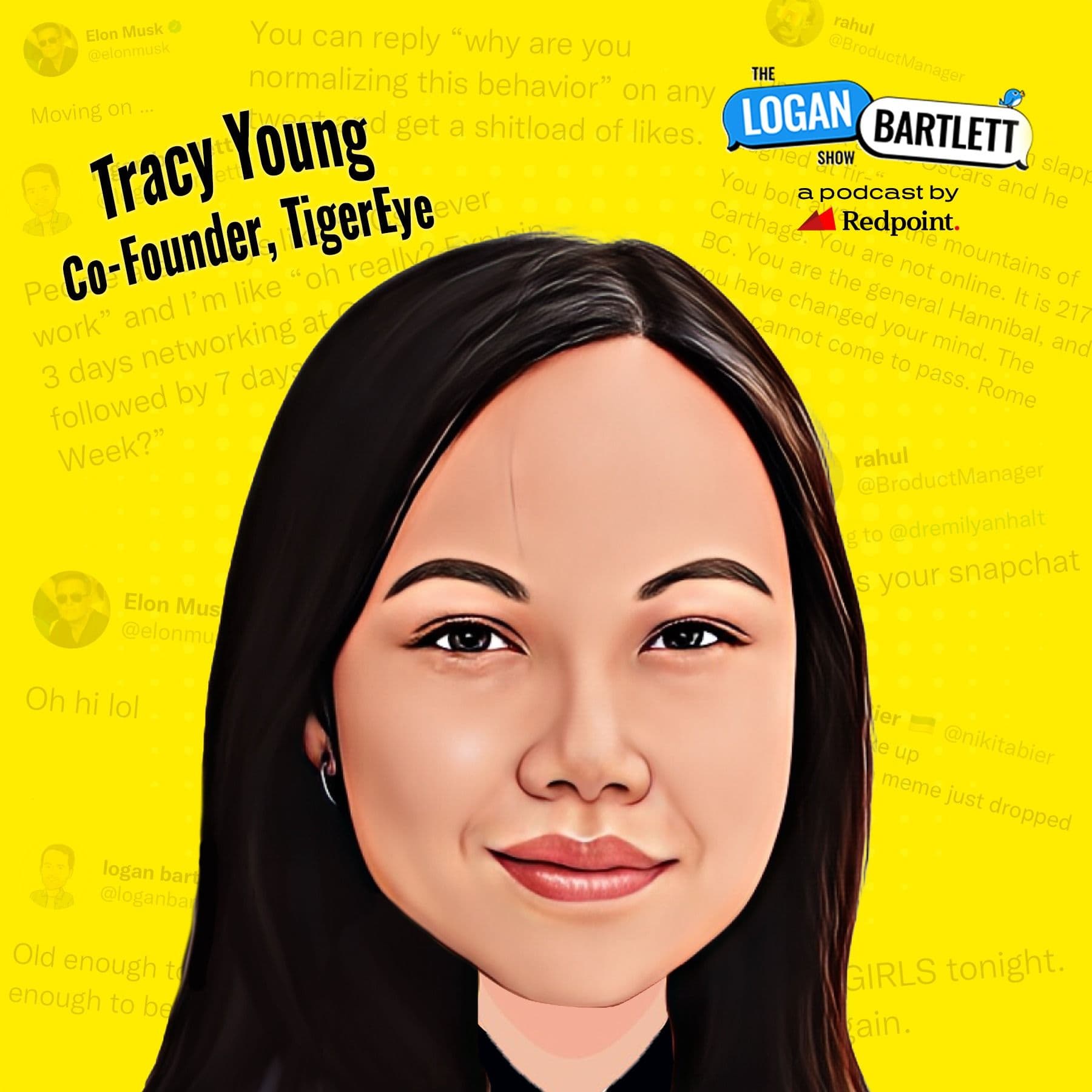
Podcast Summary: The Logan Bartlett Show - EP 96 with Tracy Young
Episode Overview In this episode, Tracy Young, CEO of TigerEye and former CEO of PlanGrid, discusses her journey from building a successful construction software company to launching her new venture, TigerEye, from stealth mode. Tracy shares invaluable lessons learned from her experience as a first-time CEO, including the mistakes she made and the insights she gained in the process.
Key Themes and Takeaways
Tracy's Background and Experience
- PlanGrid's Success: Tracy co-founded PlanGrid, which was sold to Autodesk for $875 million. She discusses the evolution of the company, the challenges faced, and how her experiences there shaped her approach to her second startup.
- Transition to TigerEye: After retiring from Autodesk, Tracy and her co-founder, Ralph, reflected on their experiences and identified the need for better tools in enterprise software, leading to the creation of TigerEye.
Market Dynamics and Lessons from PlanGrid
- Market Shift: Tracy explains how PlanGrid initially catered to end-users (construction workers) but eventually needed to adapt to the enterprise buyers (CIOs and VP of Operations) as market dynamics shifted.
- Product Development Insights:
- Importance of addressing multiple stakeholders in product development.
- The necessity of focusing on enterprise features, such as security and permissions, which were initially neglected.
Organizational Structure and Team Dynamics
- Evolving Team Structure: Tracy shares her realization of the importance of establishing a clear organizational structure as PlanGrid grew, moving away from a flat structure to one with defined roles and responsibilities.
- Culture and Values: At TigerEye, Tracy emphasizes the importance of cultivating a positive company culture and establishing clear core values that guide team behavior.
Recruitment and Hiring Practices
- Recruitment Strategies: Tracy discusses her approach to hiring, which involves clear communication about the company's mission and culture, and the importance of reference calls to evaluate candidates accurately.
- Importance of Reference Checks: She believes reference calls are crucial for understanding a candidate's true capabilities and fit within the team.
Product Development and Customer Tracking
- Customer Tracking: The conversation dives into the necessity of tracking customer behavior and preferences to tailor products effectively.
- Challenges with CRM and ERP Systems: Tracy notes the difficulties of scaling with existing CRM and ERP systems, emphasizing the need for innovation in this space.
Sales Strategy and Market Positioning
- Sales Evolution: Tracy reflects on the evolution of PlanGrid's sales strategy and the eventual need for a dedicated sales team.
- Positioning Against Incumbents: She expresses her desire to avoid feature-by-feature battles with larger competitors, highlighting the importance of establishing a unique market position.
Reflections on Leadership and Personal Growth
- Managing People: Tracy shares insights from her experiences managing a growing team and the emotional challenges of making tough decisions, including firing employees.
- Authenticity in Leadership: She discusses the importance of authenticity in leadership, especially in fostering open communication and trust within teams.
Work-Life Balance and Company Culture
- Embracing Remote Work: Tracy reflects on the benefits of remote work culture at TigerEye, which has allowed for a more diverse workforce and flexible schedules.
- Balancing Personal and Professional Lives: She emphasizes the importance of being fully present, whether at home or at work, to foster a productive and healthy work environment.
Final Thoughts
- Advice for Founders: Tracy encourages founders to keep their personal burn rates low, face realities as they are, and focus on the problems they are passionate about solving.
- The Importance of Movement: She concludes with the philosophy that action and movement are crucial in both business and personal growth.
Conclusion This episode of The Logan Bartlett Show provides a deep dive into the entrepreneurial journey of Tracy Young, filled with practical insights and lessons learned from her experiences in building and scaling startups. Her candid reflections on leadership, market dynamics, and the importance of company culture make this conversation a valuable resource for current and aspiring entrepreneurs.
Written by AI. May contain mistakes. Listen to the episode to check what was said.
Transcript
Automatic transcript. May contain errors.0:28Welcome to the Logan Bartlett Show. in how to sell your business and the process that PlanGrid went through in selling to Autodesk. We go back to the early days of PlanGrid. It was four co-founders and Tracy living in a hacker house together when one of her co-founders was diagnosed with cancer, ultimately receiving hospice care while they were going through Y Combinator before he ultimately passed. We talk about the advice that he gave Tracy and how that impacted PlanGrid's journey to the business that it ultimately became. A really powerful conversation with Tracy that goes into what she learned from her first go-round at PlanGrid that she's changing now that she has TigerEye.
1:04Tracy, thanks for doing this. There was a point in the journey of founding PlanGrid that you said you actually lost product market fit. You were north of 50 million in revenue, growing quickly. And it sounds like you maybe realized that you didn't have the same fit in the market that you once did. Can you go back to that moment and tell me what led to that realization? So if you have any success at all, especially in enterprise software, you're going to wake up one day and there's going to be just a dozen ripoffs of what you've built. We were really good at building software for the end user, people who take showers at night, people who work a hard days in hard hat, muddy boots, safety vests, safety glasses.
1:45The actual construction workers. The actual construction workers. And we just completely ignored the buyer in the office. they take showers in the morning. That's not who we build software for. And we woke up one day in about 2015, and VCs had dumped so much money into construction technology that everyone had just a copycat of our product and then something else, some other flavor to it. Didn't work as well, of course. And we had one competitor in particular, Procore, who was an incumbent. They had been around over a decade longer than us with a very broad platform and an enterprise-ready product.
2:29We had a product that was very much loved by the end user. If you were using PlanGrid in 2015, it's because you loved the product and you wanted to use it for your job. If you were using our competitor's product in 2015, it was because someone else at headquarters told you you had to use it. Well, that's nice, except that that person in the office became the buyer of construction software. And our product was not ready for that buyer. I mean, we didn't, we, wasn't that we didn't care about security or like admin consoles and enterprise features. It was just that we always pushed it off on our roadmap.
3:09We always prioritized functionality for the user in the field. So did the market shift or did you find a different customer type? Did you go up market and the considerations changed? Oh, that's a good question. And you point out something that's important. We were at this point, we were at about 50 million in ARR. And as we're trying to continue growth in the next few years, yeah, it was very clear to us we needed to go up market to the enterprise. We didn't realize that the entire industry would shift so quickly from moving buying decision that was happening in the field for so many years up to the CIOs and VP of operations in the office.
3:51That was surprising to us. It was almost as if overnight everyone started reading the funding announcements at headquarters of construction companies and realizing that, oh, that's my job, actually. I should be choosing software. And so we would get calls from CIOs saying, are you seriously selling a thousand licenses to us one at a time in the field? It's like, yeah, that's what we've done. Would you like to negotiate a better deal with us? But these were not friendly conversations. So the incumbents, Procore, they had the security and the role-based access and the permissioning and all that stuff that resonated with the buyer in the office, the person that showered in the morning versus showered at night.
4:39And you were beloved out in the field, but didn't have that. And so it shifted from underneath you. What did you do at that point in time? How did you actually realize that this had happened? Well, we did exactly what you pointed out was we ran the enterprise playbook. We got SOC 2 type 2 certification. We got ISO 27002 certification. We suddenly cared about GDPR, especially going towards the international markets. And certainly building out permissions controls and role-based access control was suddenly important to us as part of our strategy and roadmap. Is there something you could have done sooner to catch that in retrospect or was it?
5:20I think for sure. The answer is yes. I think we had to have gone where it hurt. We had all these feature requests to make the product better. And we were so laser focused on that that we just ignored the signals in the market. Because it was painful. We had to build out an enterprise team. Our team wanted, we had so sold them on this opportunity to make this entire industry more productive. No one on our team wanted to build out enterprise features. That's like boring stuff, right? And so we needed to recruit an enterprise team and invest in an enterprise team to focus on these products that not really anyone cared about.
6:03I mean, not our internal team, of course. And it was really painful. And I think for me, it was like, let's just ignore that. Let's build all this other cool stuff for our end user. And it was the wrong decision. We should have been investing in both. The advice that you often hear, and it's kind of a platitude, but it's like delight your customer, delight your end user. And it's counterintuitive in some ways that if you had just focused on your end user, that's what you did and actually led to the market shifting out from underneath you. I'm not sure if there's any takeaways that are broadly applicable to other companies.
6:39Or now as you're starting a new business, is there any lesson or was that a one-off, unique moment in time? Cloud construction, it just sort of moved underneath you. Yeah, I think the Kaizen and the edit to delight your end user is delight your end user and delight the sales order form signer, the money person, and delight the person who's going to deploy and train your software. So three different constituents and all that. Kaizen, continuous improvement, a Japanese phrase. Now it's one of your cultural tenets at Tiger Eye, right? So, yeah, it's interesting because those are three discrete people.
7:15Sometimes they're the same ones. I think security oftentimes can be, you know, they can have the same buyer, be the decision maker, be the end user in some cases. But in a bunch of different markets, the CROs, maybe the person writing the check, but the VP of ops is the person implementing it or something along the way. Yeah, what we have to understand is there's multiple buyers in enterprise software. There's the end user. There's a person who trains. There's a person who actually physically finds where the budget is and pays for it. I heard you say that you found yourself in a feature by feature battle with incumbents in your space and it wasn't something you ever wanted to do again.
7:53Is that playing on their terms to some extent and you wanted to shift the conversation more than you did? Yeah, it's an endless battle because for us, another company had 15 years head start of us. It was going to be very hard for us to catch up. It did 50 things. We did five things really well. And the other 45 things we frankly didn't care about, nor did we think was valuable. But you can imagine on a paper checklist, doing a bake-off between the software solutions for someone in the office who's not the end user. It's like, well, look at the value here. They do 50 things. And so that was a battle I would like to not be a part of again.
8:35But knowing that I am going into a highly penetrated space in sort of, and I haven't talked about what Tigray does, but going into any enterprise software, like horizontal solution, there's going to be a lot of incumbents, especially if you're adjacent to CRM and ERP. And so it's one of the reasons why we spent two years heads down building out our platform, because I didn't want to go into the market with a point solution again. That's not interesting. And so how do you think about shifting that discussion now? And maybe this is a good opportunity to, we'll dive into it more in earnest, but what TigerEye is doing and shifting that conversation so you're no longer battling an incumbent on a feature by feature, but instead helping.
9:23It's an architectural battle. And our solution is a time series database that understands and accounts for time. And we can use it using machine learning and advanced statistics to do very interesting things that are actually valuable for the end user. And that's a kind of a nerdy in the details thing here. But a lot of the existing systems, time is not a component of the underlying data structure. And so when you're trying to do things within Salesforce, for example, it requires a lot of writes and timestamps to capture what did this look like once upon a time. It's why you can't go back and do pipeline visibility at a point in the past if you didn't do it already, right?
10:09And so there's these database underlying considerations that exist within Salesforce. And it sounds like you guys are now solving some of these. It was very annoying to me as I was running my last startup for nearly 10 years to have incredibly brilliant data scientists and finance and rev ops analysts who would hand me spreadsheets with the title, whatever it was, it would have a date, it would have like version five and just basically telling me, I don't know if this is current or not, this data is from a week ago. And it's because, again, these are flat databases. And when you snapshot, it's just a moment in time.
10:47Well, time passes. You close more business, hopefully, every day, every minute. And suddenly what they've been working on is incredibly outdated. I want to stay on the plan grid story for a bit and then we'll transition to TigerEye. But one of the things I thought was really interesting, and as a board member, I've had these discussions more than once, is the idealistic approach of org structures and mid-level management and no salespeople and all of that. It sounds like you've converted from that past ways of thinking. But in the early days, you guys were pretty dogmatic about no mid-level management, flat org structure, no salespeople.
11:28So my biggest lesson here is be creative about the problem we're solving for our end users. Be creative about the technology solution that we are building. Don't be creative about org structures. There's a reason why MBA programs exist. and in the early days I mean we were all engineers all the founders of PlanGrid we would say crazy things like we're never going to hire MBAs I don't even know why we said that I mean you know at Tiger Eye I think our number two number three employee had an MBA and this is someone who is incredibly responsible incredibly hardworking and I get to learn from him every single day we wanted to be so creative about how we organized our team and we were less than 30 people.
12:15We would brag about this. We spoke of this in pride. We ran our startup as if it was Star Trek and you were in operations or engineering. No one had job titles. We were so proud of this. We thought this was like a selling point to candidates we were trying to recruit, right? You're going to come in, forget about your senior engineer title. There's no titles here. you're on team engineering and that's really cute and all until you get to 30 people and the first person who comes up to me and says like what's my career path here and I remember feeling so insulted at that time this must have been like 2012 2013 it's like there's so much work to do why do you care about your job title but in reality the most ambitious people and some of the best people where will care about that stuff and if you want to retain them you have to care about it too.
13:06There's these two different mindsets, I think, within Silicon Valley. And one is that titles are cheap and that you can give them away because they don't cost anything. The other one is titles are very expensive because they can introduce a ton of complexity potentially. And so you should be very deliberate with when you give them out, don't treat them as cheap. Did this lesson lead you to thinking that titles were more expensive and that you should be, if you're going going to call someone a VP, make sure that you really think it's clearing the bar because everyone's going to look at the lowest person with the VP title and say, well, I'm better than that person, so I should be a VP as well.
13:42Yeah, it's like it's really popular to have the title head of something. Yeah, exactly. So we can get away from the VP, the C-suite conversation. What is my take on this? I think if we're customer facing and, I don't know, titles somehow help the conversation in a positive way, then like, who cares? Just have the title that the customer wants to see. And so they're cheap in that side of the business. I think levels are really important for many reasons. But yeah, I think it's important to be thoughtful about it. And as you hinted, it's because there's going to be emotional challenges that come up and, you know, it's going to rub someone's ego the wrong way when they look at their title compared to someone else's.
14:28And so it's important that we're thoughtful about it. Was there a point in time on the sales journey that you converted to saying we need sales people or was it an evolution? Like, was there a specific moment that you're like, oh gosh, we can't deal with all these inbound requests coming in? We're really interesting in that we, in our last company, PlanGrid, we founded the company in 2011. We went through YC's Winter 2012 program. We fundraised our seed round shortly after, and we were making real revenue at that point. And then our first quota-carrying salesperson came in the building January 1st, 2015.
15:11Wow. So that's a long time to go without salespeople. We got to$5 million in ARR before we raised a Series A, and that round was led by Sequoia capital and they're just like, you need a higher sales team, you need a higher sales leader, let's grow a sales team because you've got product market fit. I think I thought that we could run a lifestyle business. We were having a bunch of fun building software for the construction industry with a relatively small team for how much money we were making. We were cashflow positive for all those years. And in reality, in the enterprise software business, there is one big gorilla of a winner and then a second and third place.
15:57And there's room for a second, third place, luckily. And then just a lot of smaller companies just waiting to die a slow death. And that wasn't obvious to me until I think 10 years into the company. It's still, I mean, remarkable just to say those numbers out loud, that you got to$5 million in recurring revenue, cash flow positive, with no salespeople in place. I see why. We had. So to be clear, there was no quota carrying salespeople. We didn't pay out commissions. But there were many of us doing the sales role, right? We were all trained on the operations side, if you remember, that side of the house.
16:35Everyone knew how to do customer support. Everyone basically did every marketing and sales effort. We would demo the software. We would show people how to use it. We would train customers. We had people doing sales. We just didn't have a formalized sales team. Got it. Got it. So Plane Grid ultimately had a very successful outcome. Sold for$875 million to Autodesk. Only$66 million raised. So great outcome for Sequoia and all your investors, I'm sure, for the co-founders as well. That said, I realized it was an incredibly difficult decision to sell. I think around that time, I was actually at Battery Ventures, and I think we had a term sheet in, or maybe we're talking about a term sheet, to lead the round before you guys ultimately sold.
17:25And so there were alternative paths, I think, to keep going as well. but you made the decision to sell Autodesk. What did you see at that moment in time that sort of led to this conclusion for you? So it's important to understand that that deal and that conversation with Autodesk lasted about 10 months. So for 10 months, it was this courting and evaluating and several term sheets in place that weren't right for us. I think by the time we got the term sheet that I signed, we ran the math and we would have had to execute flawlessly for the next three years for us to be at the same place. And in the end, I didn't have confidence and maybe courage in my ability to lead the company to execute flawlessly for the next three years.
18:21And it's also why we went out to fundraise a Series C at that time, which we didn't end up taking.
18:32um it's so strange to go through a fundraising cycle trying to lead the team and grow the company and trying to entertain mna because we're taking our hearts and our minds and we're splitting it into three very different directions and yet we have to maintain that these are totally good possibilities for us. And you're just trying to figure out which one is the best outcome. And the Zelda Autodesk was the best outcome at that point in time for us. Do you look back now, Procore is a$10 billion-ish business. Do you look back and wish you were still in construction and that plan grid, you had made a different decision?
19:21Are you very happy with the outcome and how it landed? The outcome was very meaningful for everyone involved in PlanGrid and their investors, the founders, our employees, and everyone's families. But yeah, a part of me wishes that I was still running PlanGrid today. It was a beautiful place, a beautiful company, and a beautiful product. And it's probably one of the reasons why I decided to start another company. Because you have to understand that I retired from Audidas after being there for a year. After the exhibition, you join the acquirers and you help with whatever they need help with. And for me, it was integrating Plangrid into Audidas construction.
20:05I retired March 2020. I thought I was going to take a long trip with my family, our first vacation as a family and we went into a worldwide shelter in place and lockdown and what that gave us was a lot of time and i'm married to my co-founder it gave ralph and i a lot of time to dissect every mistake we had ever made what could we have done right better what could what did we do right what what would we do better next time and we also just talked through a lot of the problems that annoyed us in the world. And TigerEye is the product that we really feel strongly would have been the difference between us having to sell to Audit Us and us still leading the company today.
20:51Not just any vacation, by the way, you were actually going to go on a cruise. Is that right? Yeah, yeah, yeah, yeah. And thank God we didn't get on that. Has that cruise ever happened since then? No, it hasn't. I'm actually a little bit scared because if you recall in 2020, people were stuck on their cruise ship dying of COVID. Out in the Bay, not too far away. You touched on this, but integrating the startup into another company, I had heard you say that it was like jumping into freezing cold water. There's an initial shock to all of the system. I guess any advice to founders as we sort of zoom out both in going down the acquisition path as well as reflecting on the plan grid journey?
21:28If someone's thinking about selling, is there anything that you would pass along to them that you've learned over the course of the last five years? Yeah. So for companies that are thinking about selling, it's really important to understand that companies are bought. They're not sold. if you want the deal more than your acquirers it's not going to happen there's a certain amount of you know you're the cool kid like you can come to me to buy my company right and what what makes the deal attractive is a growing business with good technology a good team and real revenue that is those are the the the downs that matter those are the the substance that matters.
22:14I think for startups who are just burnt out and wanting to, you know, leave all the responsibility to someone else, it's just not an attractive deal for an acquirer. But it's certainly possible. I think, you know, some people work with bankers. That's not a route we went down. It's not a route that I would recommend. Some people go through a lot of corp dev and BD conversations. And that just seems like a big waste of time to me. But it happens. It's just not the route we took. You guys, ultimately, the board wanted you to talk to other people. And ultimately, you decided that wasn't the right course for you all.
22:58And you mentioned no bankers. I'm sure bankers would have wanted you to talk to people to maximize the price that you could get potentially. Why did you elect to do not involve a banker and not talk to other people? I think I put myself in Oracle and SAP's leadership's head and it just, the deal just didn't make sense. And so if I couldn't see it from their point of view, why would I go through a whole emotional roadshow and create more work for myself? It didn't make sense. And that's what, you know, that's what I explained to the board. They didn't agree with it, but they were also okay with it because at the end of the day, I'm the one who has to have these conversations And if a founder is so unwilling, I mean, these aren't going to be good conversations, right?
23:43Yeah. So I guess this is a nice transition to TigerEye. Can you describe now that we're recording this before, but we've alluded to it. What does TigerEye actually do? TigerEye is a business simulation engine that helps companies predict their future so that they can make strategic decisions faster and better. So what does that mean in practice? Can you give me an example? So we sit between CRM and ERP. We understand every change in the business over time. We understand rep behavior, account behavior, customer behavior. And we use AI and advanced statistics on top of that to help a company predict its future.
24:29What that translates to is the ability to create sales scenario plans in minutes, not weeks or months. We also use a lot of math and advanced statistics and AI to show users how changes in their territory plans, their capacity models, their hiring schedules and plans, their quota plans will impact growth. And so are you selling into a sales buyer for the most part? Yes. Got it. And the existing players in this space, you touched on, we alluded to it earlier. Yeah, we touch a lot of folks. Because if you think about CRM and ERP, there's like thousands of companies here. There's a lot of forecasting and planning.
25:22Yeah, yeah, yeah, yeah. So I think the closest product that overlaps with our platform and our sweet is Anaplan. We understand historicals, we understand present day business, and we have a strong opinion about the future business. And for people that don't know, Anaplan was a$12 billion acquisition by Toma Bravo, a public company, very successful outcome. And now there's other people popping up selling into FP &A and sort of doing the financial planning side of this as well, but it sounds like you're more focused on the sales side. We're laser focused on the RevOps team. We sometimes pitch ourselves as co-pilot for RevOps so that they can free up their time instead of manually munging numbers on a spreadsheet.
26:10They can actually think strategically for the business and advise the sales leaders and sweet seeds on initiatives they can take on. I assume targeting mid-market enterprise or what's the... Upper mid-market enterprise. Upper mid-market enterprise. And you said that this would have led to a different outcome for you at PlanGrid, potentially. You wanted to solve the problem that you had lived. What did you see in the problem set that you wanted to solve? So this time of year, it's March. And I mean, we would be barely done with our planning cycle because it was such a beast of the process. It would probably start around Q4, maybe October, November.
26:53And maybe it wasn't like five people's full-time job, but it would require a lot of mind space for half a dozen people in the company and the whole leadership team. And that process would sort of trickle through Q1 and we would barely get comp plans out because that's how much work it was to plan on a spreadsheet. Now there's a whole so many products out there that are essentially spreadsheets on steroids. We evaluated many of them. But as my VP of finance at PlanGrid said, it's like, Tracy, I just don't think we should spend money on this because I'm an expert in Microsoft Excel. well, why would I spend time and waste my time on learning another spreadsheet product?
27:34And it was shocking to me by the time I left PlanGrid, we were spending over$100 million a year to achieve our growth. And we were planning all of that on a spreadsheet. And by the way, if we had an analyst leave, forget about it. It's like no one knew how to work that spreadsheet. And for Ralph and I, it's so obvious that AI can help here and that a simulator that's used in other industries can actually be used by businesses to help predict the future. And it can help with certainly forecasting, but that's short term. It's the planning process that we want to help out with. Because it was so costly for us to create, and you said on boards, a high, low, medium plan.
28:18And we'd sort of look at the board. It's like, can you sign off on this medium plan that took us like three months to put together? With TigerEye, it's a few clicks of a button. In a minute, you can generate an entire plan. So the idea is you can test drive. In construction, there's this term called measure twice, cut once. And there's no equivalent to that in business. You have QAQC in software. You have QAQC in manufacturing. You test it out before you give it to the end user. Why are we spending three months generating this plan that we know has human errors on it, that only one person can run on their Windows machine because we're a Mac house?
Read the full transcript
29:00And then we're asking the entire team to execute on this. And as time passes, you know the plan is outdated, but we don't ever update the plan unless we really seriously don't think we're going to hit it and we're going to ask the board for a replan to lower the revenue target. It's super interesting. It's a problem that all companies... We believe it's one of the most important decisions of the leadership team. and there just isn't any tools to have helped us think deeply about the plan we were putting in front of the board to sign off on and the plan that we were asking our team to execute on every year and it was so costly to us um i remember george who it's like he was one of our board directors and he's like george who was the ceo of twilio for a long time salesforce exists Salesforce as well.
29:50Yep. And he said, well, at Salesforce, we would plan every quarter. You guys need to plan every quarter. And I remember looking and I was like, you have no idea. That is like impossible at our small company. And it's because we didn't have the tools to do it. Hey, Logan jumping in here, just with a brief request, if you're enjoying this episode, or you have a favorite episode, we'd love for you to share that with anyone that you think would benefit from it. Anyone that is trying to be a better founder, a better operator, a better board member, a better investor would love for you to share any episode that you think makes sense with them.
30:28We're trying to get the word out, continue to share with people in the ecosystem. And so that would be really, really helpful. Now back to our conversation. So one of the things I heard that you wanted to be purposeful about from Tiger Eye, and it sounds like it was a reflection of your experience at Planned Grid was culture. and it sounds like maybe you deviated a little bit from the expressed values that you had at plan grid versus what was actually actionabilized along the way can you talk about that and how you're planning so just like all companies at plan grid we had the five core values and maybe i could recite it to you again and i think they were pretty good you know of course all core values are like decent enough um except we didn't live by it so one of our core values was no assholes and i think hr i think hr was the one that complained about it so we ended up editing to no jerks.
31:13And that's one of Plangrid's core values, except that there were a handful of jerks in the building. And since they were performing, I didn't fire them. And what that signaled to the team is like, hey, if you just perform for the company, you perform for Tracy, you can get away with murder. And oh yeah, by the way, the other four core values, those are all bullshit too. And so we were very intentional as we were drafting our core values for Tiger Eye. We actually had our core values in place before we picked the problem we would work on and build for. That's how important it was to Rolf and I.
31:51And really what we were optimizing for was just a healthy, productive culture where everyone can speak courageously and know their teammates are going to be backing them up. We have this other document that's called Our Commitments to Each Other, and everyone signs it in blood. Without blood. Everyone signs it. Proverbial blood. And it clarifies our core values. So there's no room for interpretation. It literally says, I will walk it like I talk it. I will never speak destructively behind my teammates back. If I have a problem, I will walk up to them and talk about it because we're all professionals and adults and we'll get through this problem together.
32:41Did the no assholes, no jerks thing at PlanGrid, when you start drifting from that, how does that manifest itself in the business? Once people start undermining or realizing that the values don't hold true consistently across the board, do they manifest themselves in some ways? Yeah. What you end up getting is these different camps. And at 500 people, there was probably like five different camps of different values. And nothing's better than the other. They're just different. And there was some combination of our five core values just split into five directions i feel like there's a game of thrones analogy here i'm sure like the different yeah different factions yeah yeah um what that ends up creating is a us versus them mentality about the our own internal team you know which is totally destructive um because we are one team except that not really we're five different teams.
33:43And now when things go bad, the first thing we do is point our fingers at each other. I get the sense in listening to some of the earlier podcasts that you've done and some of your reflections on PlanGrid that you maybe feel that you presented a version of yourself as CEO and maybe what you thought you should be as a CEO to the company, which wasn't always the most authentic version that you were feeling at all times. And I think there's an all hands that I had heard you talk about that you went on stage and finally just set all the problems that you had or all the problems that existed within the company and just sort of called it true in a very authentic way to the employees there.
34:29Is that fair? Am I reading too much into some of the past reflections? Yeah, I'm a construction engineer by training. I didn't know anything about business, yet I was leading this company that was literally growing every single day. And what that meant was that I was in the biggest job I had done before every single day. And I suffered from serious imposter syndrome. I felt like I had tricked everyone into believing that I was a startup founder and CEO. And I think part of the problem was representation. I didn't meet anyone who looked like me. I didn't know any CEOs who looked like me. I think now, hopefully times are changing, right?
35:07And it was so crazy. We were growing. Our business was growing. There were problems, yes, but objectively, Plangard was doing well. Any point in time of the 10 years, I was leading it. And I remember confiding in Carol Bartz, who was one of our board directors. Former CEO of Autodesk, Yahoo, before that. Yeah. And she's like, what are you so worried about? This is before a board meeting. I was like, well, I'm scared of being fired. And she cackled. I'll never forget that laugh. It's still in my head right now. She must have thrown her head back laughing at me and then saying, what is wrong with you, girl?
35:53You're not going to get fired. What are you talking about? But that felt real to me, every board meeting. I couldn't tell you why. And so I was suffering from imposter syndrome. I felt like I had tricked everyone into believing I could do this job. I felt like I was way over my skis. I didn't know what to do. And there was a version of a founder and CEO in my head that didn't look like me. It looked like everyone else I saw. And I wanted to be that competent, confident CEO. CEO. And that's how I presented myself. Well, the challenge is I didn't have all the answers. I didn't know what I was doing.
36:37And so it came off inauthentic. It was probably coming off like I was a tryhard or something. I actually don't know. I haven't talked to my team about that. But I remember there was one day where I was like so overwhelmed with work. I hadn't prepared for an all hands and it was time to go do the all hands with the team. So I went up and I just started talking about the problems I was working on and the risks I saw for the company. And I mean, I remember the team completely responded to that. It was the best all hands I had ever given. And it was like, whoa, I don't actually have to prepare for an all hands.
37:14This is great. In fact, at Tiger Eye, we have all hands every Monday and there's really no preparation. I just go in and I share with the team what's on my mind from the weekend. I share with them where I think the risks are, where I think we suck at, where I think we are doing great at. And then it's a full conversation. It's not just me monologuing at them. I want to hear from them. I want to hear the questions. In fact, if there's an all hands where there's no questions, I really feel like something is wrong. Like seriously, does everyone know exactly what we're doing? Like, is it really going that well where we have no questions?
37:47And that really changed, I think, the way I lead and how I see myself as a leader. Was there a moment in time, I guess, that allowed you to shift to that perspective? Or is it now that you've been successful, you realize you're no longer an imposter, you've sold a company for nearly a billion dollars. And so you can be more authentic to the organization? Or was it that all hands that you realized, hey, this is, you know, people resonate with it. It was halfway through plan you're in. Yeah, got it. So for another five years, I got to really feel more comfortable in my own skin. And certainly second time around, just having experience now, like I actually have experience as a CEO.
38:32That's really nice. Yes. And certainly that gives me a little more confidence on certain things, right? Like I know I can hire better people. I know how to interview now. I know how to look for the qualities that I think good team members possess. I know how to take competition much more seriously than I did last time. One of the things you outlined, and you just alluded to this, was recruiting people. And I had heard you say there's three things that you do in the recruiting process. And I want to make sure I have them clear and understand how you think about this. But explaining what you want the company to do clearly, what you are doing today and why it's a big problem, and then understanding the market size and why it's going to be important, a big, important opportunity for their career.
39:17I don't know if I have that exactly right. That's at least what I took down. But when recruiting people, how do you pitch and view these things as important? I think we all have a deep desire to work on something that is important, even if it's in our small little corner of the world, and to work on something that creates value for the world. And so whatever it is we're working on, we have to be able to communicate that to people that might or might not join us, especially for really ambitious people. Who wants to work on a project that doesn't matter, right? So that's number one. And then number two, I think when it comes to recruiting folks that will work nicely with the existing team and really, you know, who see our core values and raise their hand, it's like, actually, that's me too.
40:07That like, that's totally my vibe. It's really communicating how it is to work. How is it really to work? Like, let me paint a picture of how it is to work at our company. These are the projects that you will be working on. This is what we're trying to do together as a team. How does that sound to you? Does it sound exciting? Does it sound boring? And people will self-select them out. I had heard reference calls you view as super important and that you've said you've done up to 20 or something back channel and on sheet and all that. Why do you view reference calls as so important? Oh, reference calls, especially for executives and especially for folks in sales and marketing.
40:46I feel like those profiles and it's, you know, the people who go into sales and marketing, They're pretty good at selling things and marketing themselves. And it's really hard to tell what their actual accomplishments are, especially when you look at the resume and they're like big company names. It's like, it's hard to tell how much they actually contributed to the success of those companies. Did they just get lucky? And I find that the more people you talk to from their past starts painting a better picture of how it will be like to work with them. So I try to talk to people, of course, people that they reported to, their bosses.
41:24It's also nice if it's a manager to talk to people that reported to them and then certainly their peers as well. What you find in Silicon Valley is most people hate speaking poorly of their former colleagues. And so you also have to just get through all the extra conversations and really digging in deep on the areas that you think might be weaknesses or imperfections of these person. And sometimes it's okay. It's like this type of personality might work with our team, but certainly being able to talk to 20 people is going to give you a really good picture. Because we're talking about 30 minute to hour long conversations with these people about a specific individual.
42:06Do you have tactics to get them to be honest about things that are weaknesses or shortcoming? Because people, to your point, I don't want to bad mouth colleagues or former colleagues and reference calls. No, I think either the person has that personality to be confrontational or speak honestly or not. I usually, if I feel like I'm having an inauthentic conversation with someone who's just going to give me a bunch of fluff, I'll just ask them like, hey, who else should I talk to? Sometimes I'll find that they're actually giving me a name of someone who's more courageous than them. I found one of the things that I'll do is force ranking and throw out there like, is this a top 50 % person you've ever worked with?
42:54And when you put the puck on the ice a little bit and force them to think about, well, is it in the better half of anyone that I've ever spoken to? If they're in a top 10%, they'll immediately give you a more percent. No, no, no. Top 10 % easily, right? If they, yeah, I mean, definitely top 50%. then that probably means they're passing some platitudes off. And you can't really lie about that once you put it out there. And that hesitation will tell you a lot. It tells you a lot. And the implicit sign of all that is really interesting. Managing people is obviously a difficult thing to do. And Planned Grid got to 500 people, is that right?
43:32100 billion in recurring revenue. What did you learn about managing people over that time that you would impart to someone that's early on the journey of leading and managing a team? Because I was a new manager, a new CEO. Well, by the time I left the company, I was like 10 years into it. So maybe not that new. You start to notice patterns of the best managers and leaders that I got the privilege of working with. And usually the best managers have just been doing it longer than everyone. that they've just been managing people and they've seen all the different flavors of personalities and ego and they just know what to do to deal and manage with that.
44:18I just don't think it's something that's taught in school or that maybe it comes naturally for this small percentage of the world. But the best managers I had worked with that worked for Plan Grid had just been doing it longer than everyone else in the building. And it sheer said something, I think in that exact seat that I think about that leadership can be innate, but management has to be learned. It's like, it's something you don't you don't learn all these different social construct problems of all different personality types and feelings and all that stuff. That's not like a natural thing that people have.
44:54have. I'm a terrible manager. I mean, I'm either like, don't care about it. And I just like, can you just get it done? And then there's a lot of trust if I have the right person in place, or I'm just micromanaging the hell out of it, which no one wants that from me. I had heard you talk about the two by two matrix for product development, where on the y axis, I think it's level of effort and the x axis is impact to the to the business. And obviously, You can flip it, of course. Yeah, it works both ways. But I think there's an important quadrant, no matter which way you go, which is high effort, high impact to the business.
45:30I guess the best quadrant would be low effort, high impact to the business that you can just pick up easy wins. How do you think about that matrix in making decisions? And any tangible examples you can point to? Yeah, and it's low effort and high impact for our customers is obviously the quadrant you want to focus on. But nothing's really, sometimes you'll have the in-between where it's like in between all four quadrants, which is hard to choose from. But obviously it's veered towards the high impact. The way we think about product prioritization, which is, I think is more art than science. We try to look at it from several perspectives.
46:11So one, what is sales asking for? Two, what is the customer asking for? Three, what does the product team think we should be building? And then now that I'm doing it the second time around, I make sure that the founder's lens is also part of that decision making. What do the founders want? Because the founders will always be keeping the vision in mind. Whereas everyone, like sales might have a much shorter, short-term horizon when they're looking out in the future, right? They're thinking about this quarter. They're thinking about maybe this year and their target. And when you overlay that on the same four quadrants, what you'll see is there's going to be a density of certain products and features that will make a lot of people happy.
46:57It's going to make sales happy. It's going to make the customers happy. And the founders also think it's like a cool feature. Like you want to build the stuff that everyone wants. You had done a post on LinkedIn with sales advice for founders. And one of the things you touched on was that mid-market was in no man's land. And I think you got a lot of nice responses from people challenging that assumption. Why do you think that's a hard part to start a company around as a startup? Because it's such a toss-up of companies. It's a huge range. We define it as 100 employees to 1 ,000 employees. I mean, maybe people draw their lines a little differently, but let's say, give or take another 200, right?
47:39it's such a big range. A company with 100 people is completely different than a company with 1 ,000 people. So the mid-market is full of small companies that have recently graduated in, and it's full of companies that have been preparing themselves to become their enterprise counterpart for years. And they're going to have a ton of red tape. And so it's important that we focus either in the enterprise or SMB and know which lane you're serving. And of course, we're going to sign up as many people in mid-market as we can along the way. But there's just vastly different product priorities and decisions that you would make if you're serving SMB versus the enterprise.
48:22Suddenly, enterprise features that don't matter for the end user really matters, obviously at top of the market. And then your ability to self-serve a customer and help train them without ever having talking to them matters when you're serving lower market because there's so many of them. Yeah. The slope of the line is important. In the middle, you can get caught with a very divergent slope of the lines. You can have companies that are 100 years old or 500 years old or whatever it is. And you can also have companies that are four years old, five years old that are well on their path of growing past you and might be looking to the next solution.
49:02So focusing just in there can be difficult. It's all about focus. Yeah. One of the other things you said in that post was that in the early days of starting a company, you found it important to track your customers in a spreadsheet and do it as long until your life sucks, I think was the phrase you used. Why do you give that advice? Why do you think that's advantageous? Because it's not just about turning on a CRM system. It's about turning on a CRM system and then hiring administrators to administer that software solution. And unless you have the extra dollars and are ready to do that, it's just much easier to type it all into a spreadsheet.
49:43But it obviously doesn't scale. And so, yeah, I actually really believe in that advice. I don't know where you read that. Thank you. I'm so flattered you read so much of the content I've written. Yeah, don't turn on CRM until your life sucks so bad. Same with ERP. Don't turn any of that on until your life sucks so bad that you don't mind it sucking a little more. And the point is that the process around it should be thoughtful as well. And so I originally read it as the customer intimacy of knowing it inside and out. But it sounds like there's other considerations with it. And so you should make sure.
50:18The cost of deploying those software solutions is so high, both from a cost perspective and a time perspective. and more likely than not, you're going to set it up in a way that just doesn't work for your business because your business is evolving. Hopefully it's growing, it's evolving, it's changing. And what you've set up is probably not going to work for the next two years. So now you've got to rejigger it. And that requires a lot of administrators to make it happen, to build in custom fields. I mean, this is the power of the CRM systems and ERSP systems is you can customize it. But you also have to be deeply confident in your sales process for you to customize it in a way that's going to help scale with your company.
51:03And for most startups, they just have no idea. They're still trying to find product market fit, or they're just trying not to drown with the amount of business that's coming their way and trying to iterate on their product that all of this is just extra noise that I don't think founders have just the space to take on with everything going on. It seems like no leader has ever regretted managing someone out too early. It seems like a universal truth. And I think you agree with that sentiment. It sounds like something that was part of the reflections of PlanGrid as well. How have you found a way of putting this in practice when something feels like it's not working out?
51:46Do you act on it right away when you're starting to get that sense? Or how has that evolved in your understanding of operating and leading? It's really painful to fire people. It's very emotional. There's probably a ton of guilt involved because you weren't the right leader to help this person grow, or you've hired the wrong person, and they've been at the company to make things a little worse. If it's black and white, this person just can't do their job. That's easy, right? It's always like between the spectrum that is hard, that they're contributing, but it's not enough or they're contributing, but it's the wrong cultural fit or they've been doing a great job.
52:30And this is one of the most heartbreaking parts about being a founder and a leader is the people who you've been to war with for the last two years might not be the right people to take with you for the next two years, right? And you have to make the hard decision. And I think it's just really important to remember that this hard decision is happening for the best of everyone. It's the right decision for the rest of the team, for your customers. It's also the right decision for the person that's getting fired. And the best we can do is to be as compassionate and generous as we can when we separate.
53:08with teammates and I think in life as well. What have you learned about that conversation? I'm sure you've had to let a lot of people go. It's, I'm sure, varying range of emotional, but probably not easy no matter what. What have I learned? I think what I've learned is that it feels a little less bad when it's not a surprise to that person, that everyone deserves a chance. But if it's not working, it's not working. And it's actually your job to fix this mistake. And it's better for the employees so that they can be at a place where they are contributing. And so when it comes to not surprising them, the conversation needs to go as such.
53:48It's these are the expectations of the job. You are not meeting the expectations. And if this doesn't resolve itself or this doesn't change in some certain time period, we have to talk about parting ways. And so doing that up front so that they're not surprised. What you'll find is that some folks will immediately check out because they're probably interviewing at other places. And it could be a combination of they have lost trust in you. They don't believe in your leadership. They don't believe in the company and they just want to go somewhere else. Great. Or they don't believe in themselves, that they don't actually think they can meet the expectations that you've set in place.
54:28And so they're self-selecting out. And you'll sometimes find, I'd say only 10 % of the case, but it does happen. You'll just see a person wake up one day and just completely turn it around. That actually, I don't know, something was going on in their lives. And this is a job that they actually want to do. And they're going to do what they can to show you that they're going to meet your expectations and they deserve to be here. You outlined a few things that the worst executives do. And the list you gave was use the term I frequently. So I did something, now we did something. You hate having one-on-ones with these people.
55:01It's generally a sign that the leadership's not working or the relationship isn't. They blame their peers and they also complain. I guess I assume that's from lived experience in all these cases. But do you immediately, if someone's using I instead of we, do you immediately call it out and tell them like, hey, we don't do that here? Or does it, I guess some of these things feel like they could be very important. You're not giving credit to the other people on your team. or maybe just a stylistic thing. And so how do you think about that? I usually just file it away. Yeah. I mean, it's so subtle if someone's using the word I versus we.
55:39Of course, I'm not going to yell at them. I pick up on it all the time. Yeah. It's more something I just file away. It's like, oh, that's interesting. Yeah. See how much this happens. How that manifests itself. Yeah. Maybe this just is in passing and they just use the wrong pronoun. out. What's hard is because we've been so strategic and intentional about everyone we've been recruiting into the company that I just, and we're young, right? We're a young company. So we just haven't had these problems. As you're telling me these things, I guess in an interview, I've written it. I'm actually getting like PTSD.
56:15It's just like, oh gosh. Remembering all this stuff. Yeah, yeah, yeah. And it's just, I just haven't had that experience in a long time. Yeah. Well, I guess if you're self-selecting for - But let's say, okay, so if I hired the wrong executive and they're showing all the signals that you just reminded me of, yeah, it would be a conversation that it's not working out. I think the best thing to do is just to part ways. I want to back up a little bit to the Flangrid journey. So you were first in your family born in the U.S., right? Parents were immigrants from the Vietnam War and came over here. And then ultimately you ended up majoring in construction engineering in college.
56:52And so then you went and I heard you say at one point you were smoking cigarettes and chewing tobacco on the front lines of construction jobs actually out in the fields. What was the path from there to starting a company? Man, this is like over a decade ago. Let me jog my memory here. My co-founder, Plankridge's co-founder, Ryan, my good friend. he stood in line for hours and he purchased first generation ipad and he was so excited to show me so he showed it to me and we looked at it and we're like we should we're both construction engineers we've gone through the same program and we looked at it and it was this beautiful device and we thought hey we should use this for work we should put our blueprints on this and you guys were working together at the time we were working at different companies i was working for rudolph and slant and general contractors and he was working for um gilbing and we try to load one sheet of blueprint which is nothing because on the project i want was on there was like 5 000 sheets just for the initial set uh anyways we try to load this one blueprint onto the ipad and this box comes up and it says out of memory and Ryan's like this aha moment.
58:05He's like, we should build it. And I was like, yeah, it's a good idea but we're not software engineers. And he's like, we'll just convince our friends to build it with us. And that's exactly what we did. I guess you guys were iterating on ideas for a little bit. I'd heard Cat Roulette was one of the - Oh, Ryan is such an entrepreneur. So we went to university together and I met him when I was 18. I feel like he's been pitching me startup ideas since I was 18. and we finally started a company when I was 25. What was the idea behind Cat Roulette? Cat Roulette, I think, was, gosh, there's so many crazy good ideas that Ryan had.
58:41Cat Roulette was we were going to have cameras on cats that we would save from the pound. And you would play roulette and it would give you, you'd pay us, you'd play roulette, You'd get a cute cam on a cat and then you could pay us more and you could feed the cat treats. So you didn't decide to go down that path. But at the time you were dating a, now your husband. Yeah, Ruff was an engineer. He was an engineer. And so you guys are brainstorming these ideas. You and Ryan are and you're sharing calendars maybe. Yeah, yeah, yeah. He's like, what is this you're doing with Ryan? So Ralph and I were at this point of our relationship where we're going steady.
59:28We share our Google calendars with each other so we know where we are at any given time. And he says, hey, I've noticed that you meet with Ryan every Thursday. And the subject of the calendar invite is called peanuts. Why are you meeting with Ryan? I was like, that's really funny. you should point this out because we are working on a startup and we're looking for a technical co-founder. He was a rendering engineer at Pixar Animations at the time. So he had like the perfect background to build this company with us. Had it crossed your mind before he... Yeah, it did, but I really liked this guy.
1:00:04So I didn't want to complicate it with a relationship and a startup, which we ended up doing, but it does work because we have two companies and three kids. Anyways, I tell Ralph the project that we were working on. He's like, do you even know what I do for a living? I can build this. And I was like, that's great. Do you want to join us? And he says, yes, can I be CTO? He cared about his title and that was it. So there's five of you living in a hacker house together in the South Bay, right? When you're applying to YCOP. In Sunnyvale. In Sunnyvale. And I guess if anyone's thinking about starting a business with a significant other, any advice for them?
1:00:49It seems like you guys have done it pretty successfully so far. My advice would be don't do it. Don't do it. Don't do it. It's complicated. There's a lot of people out there. It is. If you really have to, it does work, but it takes a lot of work. We are now pros at working with each other, and it's still hard. I think relationships are hard. Marriage is hard. Kids are hard. Startup is hard. So you're just really like a combinatorial explosion of problems. It's probably exponential too. It's not a linear. Yeah. So can you talk about those early days of finding product market fit? So you guys have this idea.
1:01:22And like, how did you actually go about validating that at work? Presumably you had relationships. So it's 2011. We've written an iPad app that basically digitizes the construction record set. We go to a bunch of people we worked with in the field, our friends on the job sites that we were a part of. And we asked them to use it. And they're like, great, I'll try it out. I don't have an iPad. No one had an iPad at that point, not for work. So we did something that I actually also wouldn't advise, which is we maxed out our credit cards. We went to Apple stores. And at this time, Apple had limits on the number of iPads you could purchase.
1:02:00So we went to like four different stores. And we bought as many iPads as we can, which is just like four. And we just gave it to our users. We're like, here, you can borrow iPad and here's Plangrid. And we helped them learn the software, which is very easy to use. And at some point, our friends and our customers would say, I don't know what I was doing using paper. I don't know what I was doing before Plangrid. And we just looked at them and was like, great, beta's over. Will you pay us? And we converted a bunch of them and actually started making real revenue. And did that flywheel of juicing the market in the early days, I guess, or like kind of laying the groundwork, doing the things that aren't scalable, did that allow you to get to the point in time and build the product that met the market when ultimately iPads were more democratized out in the field?
1:02:55It took a few years to get there, But we, I mean, we basically had a program. We had something called the iPad mini deal that was only supposed to go on for one month, but it ended up being years that we had the iPad mini deal. And later on, it'd be like the Android tablet deal and the Windows tablet deal as well. We actually helped ship over 10 ,000 iPads into the field. So again, it was friction. It was a barrier to construction workers using PlanGrid. They didn't have a tablet. And so that meant they couldn't use our thing. And so we decided to solve that problem for them by buying it for them.
1:03:39I mean, you know, the economics worked out for us. It's basically like, hey, purchase two years of PlanGrid. It was like$2 ,000 and we'll throw in an iPad mini that will run our software beautifully. And that was a very popular SKU. People didn't have to think about it. And it just shipped out of San Francisco's Apple store. You guys applied to go to YC in the early? How did you find your way to YC? Oh, my co-founders are a bunch of nerds and they were big readers of Hacker News. Got it. They try to get me to read it. And it's like, this is just not my, just none of this calls to me. Yeah. But you guys got in.
1:04:17There was a request for startups that the YC partners had written, and one of them was the iPad and mobile tablets are coming on the market, and we think it's going to be valuable for specific industries that we're not even thinking about. And I remember reading it, and I was like, oh, that's us. Because before that, I refused to fill out the application. My co-founders, a couple of my co-founders wanted to go through YC, but I didn't think it was for us. And so until we saw the request for startups and a request for startups that was clearly that our solution satisfied, and I was like, all right, I'm going to fill out the application.
1:04:58And you guys got in? And then we got in. Now you're living in Sunnyvale. There's five of you at this point, and you guys have a prototype. You're going through YC. Is that is that the the did you have customers in the early days of going into YC? Yes, we did. Some friends and yeah, yeah. In the industry. And then I mean, this is something that I can't even imagine. But one of your co-founders got diagnosed with cancer at that point in time. And so he ultimately went through a bunch of chemotherapy one round and then decided he didn't want to go through it again. Is that right? Yeah, he chose not to.
1:05:34It was just, she just didn't want to put his body through that. He wanted to be happy in his last days. So it was crazy. We were trying to launch our startup. We did, you know, early, early stages of PlanGrid. And we had hospice care coming to our hacker house. I mean, I think back at it, it's like, I can't believe that happened. But it did. And then he passes. And I think, you know, we were just dealing with the death of our really good friend and co-founder and chief mad scientist. And we didn't know what to do. So we just poured everything into the company. For me, it was because it was my way of feeling closer to him.
1:06:22And I think for the hackers on the team, they must have been looking at Antoine's code every day. And it was their way of feeling closer to him. And I wanted to make the company successful in memory of my co-founder. Did you think about not going forward or was it just... No, that wasn't an option in my mind. It was this, I really wanted to do it. And I think in hindsight, I wanted to do it for Antoine because it was the last thing he worked on. He was coding all the way up until the very end. And he gave you some really touching advice as well, if you'd be comfortable sharing. Yeah, yeah, yeah.
1:06:57Let's see. It's something I think about every day. He says, life is short. Take care of Ralphie. I've since revised it to take care of the ones you love. Don't be afraid to try new things and never do anything that makes you unhappy. And it was his gift to me before he left. Profound, profound advice. Yeah. Someone on his deathbed who wanted more time and wanted to make sure that he got his last thoughts to a friend. Yeah, it's pretty powerful. And obviously, I can't even imagine going through that experience. It wasn't unique to us, though. I mean, I think we're all either dealing with it or will deal with it.
1:07:42Sickness, aging, death. You learn this when the team grows to a size where it feels like bad stuff is happening on a weekly basis. There's just enough people and then their relationships with their family and friends, like all kinds of crazy things were happening all the time. And we just have to be as generous as we can to our teammates when they have a partner who is dying of cancer or a child in the hospital because they're really, really sick. Or they themselves have been in a car accident and they need to recover. Like life continues even though we were trying to do something really hard like starting a startup.
1:08:22But can you draw me the through line from that hacker house to 5 million in ARR and raising a series A from Sequoia? What was, was it, did the market just catch up to where you were and things were coming inbound? We moved out of the hacker house. We had a small office in Hayes Valley, just a thousand square feet. We crammed like 15 people in there. We were working around the clock, but we were happy. and we just kept selling Plangrid. There's a natural virality in construction where construction folks want to show off their new shiny tool to their peers in the field. Like, look at my new tool.
1:09:07And Plangrid was such a nice thing that they could show off to their friends who weren't using it. Like, why are you using those blueprints? Let me show you what you can do with an iPad. And so we would get phone calls. There's so much inbound for our product, inbound demand. We would just get, it's like, hey, I just saw this on the job site. Can you come and demo it to us also? And we were just doing these demos and it was so easy to demo Planger because it was so simple of a product. It would take us 10 minutes to do a demo remotely and go to meeting in those years. And we were just, and we were probably underpriced.
1:09:45I think the street price for Planger at that time was like 200 bucks. So no one would blink an eye at a foreman swiping 200 bucks on their credit card or 500 bucks for the higher tier. And then time just passes. And I think that's true in enterprise software is just like, you just survive long enough and you just keep iterating and you keep talking to users, the company is going to get bigger. You're going to sell more if you're just not completely messing up. How do you think about that of waiting for the market to come to you? And I guess this maybe dovetails into Tiger Eye as well, but it feels like PlanGrid maybe was on a path of inevitability that this was going to happen in construction.
1:10:29And if it wasn't PlanGrid, it might be Procore, it might be someone else versus some other spaces. It might not be inevitable. We haven't had a new ERP in a while, I think. We can go back to NetSuite and whatever, 99 or maybe Intact. I think AI will change that. Maybe so. But how do you think about the inevitability of a market versus trying to will yourself into a market? Well, having worked for a public company, I just think even the best companies and the winners, time passes and leadership changes, and then a bunch of mediocre people stay there, and they just slow down to a halt. No decisions are made because everyone's trying to protect$1 of revenue.
1:11:13I think it's very limiting to see a company have to talk to Wall Street and analysts every three months and that the CEO has to do a public earnings call. And what that means is there are decisions that need to happen because the world changes, the market changes, competition changes. And as a company, we need to adapt with the world. Well, it's really, really hard when the leader of a company is only interested in how they appear to analysts on an earnings call every three months. It limits decision making because you don't want drastic changes because you don't want to tell Wall Street about it.
1:11:57And I think that just leaves a lot of room for startups to come and compete with them because they can make decisions. They can run faster. They can build faster. It's easier for them to adopt new technology. They get what I think Peter Thiel calls last mover advantage. And time passes, and I think the best companies, they just end up being mediocre. In raising your Series A, Doug Leone showed up at PlanGrid's office three straight days. What was that process like? Did you guys realize you had captured lightning in a bottle to some extent? I was so scared because I'd heard all these horror stories about deals falling through from my founder friends.
1:12:44And so I really didn't want to mess up our Series A. So we had this incredibly profitable business with no sales folks, clear product market fit, which I think is interesting to any Series A investor, disrupting an entire industry for the first time. I shouldn't have signed a term sheet so fast. Three days is crazy. Going on the road, showing up on Sand Hill Road, and then three days later getting several term sheets. And I signed the one with the heart on it because I thought it signaled that they cared more. But I think I should have done more about just evaluating the partners that we worked with.
1:13:22What is the lesson now other than don't sign based on the emojis that are put on a piece of paper? Although for Doug, I mean, I don't think he's a very emotive guy. So that's a big sign. Yeah, yeah. He was surprised. I told him a few years later that he did that. He's like, really? I did? And I was like, let me have a picture of it. Let me show you. Yeah, yeah, yeah. Other than take your time and be deliberate, was there any lesson? Yeah, just spend time with the partner. Get to know them. Is this someone you want to work with? Because it's going to be, if you're lucky, it's going to be a 10-year journey.
1:13:52If you're really, really lucky, it's going to be a 20-year journey or longer. You were at Autodesk for a year. Mm-hmm. Was it your obligatory? You signed on for a year to kind of manage the integration? We were actually out shorter than our required 18 months. It was just good for everyone. And so we had finished integration. We really pushed integration into Autodesk construction. New leadership bench was in place. Everyone's handcuffs were in place. They didn't need us there anymore. You tried being a VC for a bit? We did. It's a hard job. Did both of you do it? We both worked for Y Combinator.
1:14:30Oh, wow. What did you dislike about that job or what pulled you back into being a founder? I guess two separate questions. I think not knowing if I was doing a good job or not was really unfulfilling to me. And I didn't think I was actually good at it. I think I looked at the YC partners and everyone just had such broad knowledge and such deep care for just new technology. And I just didn't care about, you know, other people's stuff. Like, I don't care about FinTech. I mean, I know I understand it's important. I don't really care about crypto. I only care about the problems that I've experienced and understand.
1:15:07It's why I built Planker. It's why I decided to build Tigerei. and I think not being able to see tangible results because I'm sure you've made investments and you're on boards and it's like, you actually don't know if these are good investments for another 10 years probably. And I'm just impatient. I think I like building and I know when I do a bad job, right? Like in construction, in software, in tech, you can see it every single day, the progress. And that's really important to me as a builder. The feedback loops are very long in venture. And you can justify doing even having a podcast for whatever reason, because it can be opaque.
1:15:46The inputs into success can be opaque over a long time horizon. Yeah. And I saw what I thought were successful VCs. And it was clear to me I didn't have that. You referenced this earlier, but both companies you've started were pain points that you uniquely felt. Do you think that's a key ingredient to being a founder? Is that something you solve for? I think that there needs to be a domain expert on the team. And I really think someone on the founding team, and it's nice when the CEO is, is a domain expert in the problem that we're trying to solve. Everything falls into place. We know who to hire to help solve these problems.
1:16:30We know how to talk to users. We know how to talk to investors. Because it's like, I feel this deep in my bones that this sucks. this sucks so bad, I've decided to spend my short life working on this problem. I had heard you say that Tiger Eye was about activism in some way for you and showing representation of female founders and CEOs in the B2B enterprise world as well. Can you speak specifically about that? Yeah, I had the privilege to work for YC for a year. I got to meet crazy ambitious and talented founders every single day and i certainly met women founders who were building really cool things in consumer and health tech but i did sit there wondering why one there were so few women and two why there was no women in enterprise software when there's so much low-hanging fruit and so much problems businesses have that just aren't served right and I think as a mom it's really really important to me to show my children that you can dream and you can work at being part of the change and for me it's just you know I I can complain about not enough women starting companies not enough women in leadership not enough women getting funded or I can just do it and just be one improvement to the stats you all have been focused on building remote from day one, which was probably an outgrowth to some extent of the circumstances around COVID when you got going.
1:18:08But also it seems like a purposeful thing that you guys believe in. Can you talk about how you landed there and what some of the things you do to make sure you can maintain the culture and the process and the documentation and all that stuff? Yeah. So there's trade-offs to everything for sure. I got to have 40 ,000 square foot of office space in Mission District, San Francisco for almost 10 years, less than that, because we moved into that big office. So let's say like seven years. I got to see the power of having everyone in the office and the culture that that can bring. And now we've been running TigerEye for two years remotely as a much smaller team and everyone's experience, you know, the average age of Plangrid when we started, it must have been in the mid-20s.
1:18:56I'd say the average age of Tiger Eyes team is probably mid-40s. So we're just more experienced and many of us have worked together before. There's trade-offs to everything, but net-net for us, the positives outweigh the negatives. I'll give you a few examples. One, we are a diverse team. We are all over the world. We are a huge spectrum of age and our demographics are very different. And there's a lot of moms and dads on the team who have childcare duties. And our work schedule allows us to take care of the stuff we need to in our families and also take care of the stuff we need to build for the business.
1:19:47So in practicality, how that works, we have flexible work hours. there's six hours each day where because we're all in different time zones there's six hours each day where we are working together and then the last two or three hours I don't care when they work for me my kids are up by 5 30 one of them at least and so I might be answering emails from like six o 'clock to seven o 'clock and then for my team member they might be programming at 1 a.m. when half the team's sleeping right as long as work gets done and we're all contributing to the progress of the company. I don't care when those flexible work hours happens.
1:20:21Everyone knows when you have, when you're most awake and when you're most energetic to actually work on problems. And so go figure that out. But those six hours is like, those are core hours. So that's one. Two, everyone's really good at communicating, written communication, because so much about business building is making sure that we're all pushing in the same direction and trying to build in the most impactful and efficient way possible. And so you can imagine if we are lost in translation and not understanding each other in different states, and that's going to be a huge problem actually making progress.
1:21:03And so everyone is excellent at communication in the company. And that's something we really look out for. This is the only way it works. So it's allowed you to hire a more diverse workforce and have these flexible hours as well. There's some trade-offs on documentation and all of that stuff as well. I assume it gives a broader aperture of people you can hire talent-wise too, I assume, if you're not beholden to a local office as well. What about on the negative trade-off or the things that, I guess, process documentation is one that you guys have been purposeful about. But have there been things other than that that you've tried to, that you've had to correct having experienced an office culture?
1:21:47Yeah, there's no substitution for being able to see someone and look them in the eyes and like break bread and eat together. And so it's powerful when you have an office and you're literally eating lunch together every day. But as a remote team, we don't get that. So what we do instead is we actually have off sites quite frequently. We meet each other at least once a month, maybe several times a month. And certainly there's certain hubs around the world. And we're a small team. We're less than 30 people. But there's a density in San Francisco Bay Area. So many of us are meeting often at WeWorks and just places just to get that experience.
1:22:24Because it is nice. It's especially evident when we have our all-team offsites where everyone comes back together like we did last month. And it's just really nice. listen, it's just faster to solve problems together when we're all right there and just pull people and it's like, can you look at this? And so we have the remote version of that of like a five minute phone call or pulling someone into a Zoom room. Do you think you could have done a remote startup if not for the experience? Like if you're a first time founder, do you think you could have done it? 10 years ago, I didn't think it would be possible.
1:22:53It wasn't until COVID happened where I was like, whoa, actually this is a lot better. And if you hadn't lived the experience of PlanGrid though, do you think if you were a first time founder today at 26 years old or whatever? I think it's possible. I don't think it would have been possible for me. Got it. It'd been, it'd been too hard. Yeah. You know, it's, I'm, I'm a mom of three young children, as you know, and I can say that I wouldn't be able to found another company if our company was remote. If I had to drive to an office and sit there for eight to 10 hours a day, it'd be really, really hard to, to want to do that and live that life.
1:23:26What pulled you out of you tried the VC thing and then you got all the reflections that you had not going on a cruise ship and all of that, like going after the problem that you're going after now? What was it that led you to this as like, hey, I want this to be my next chapter? I assume you want to do this for a long, long time, right? And there's not going to be a third company in your future. So what was it that appealed to you about the problem set and actually starting this company? It's funny you say that because a couple of folks, we really wanted to recruit us on the team. I did look them in the eye.
1:24:05It's like, this is the last company. I'm not starting another company. So if you've ever thought about working with us again, this is it. This is the time to join TigerEye. You know, we are busy bodies. We like to work. We like to build things. and I didn't want to regret not building for this problem. It's so obvious to us that spreadsheet sucks. In the same way it was so obvious to us that paper sucked and that we need to digitize the construction set. It's so obvious to us that spreadsheets and spreadsheets and steroids, for that matter, just doesn't work and that there's actually technology to simulate that's much more accurate at predicting the future than someone can do trying to program macros into cells.
1:24:55And so one, it's we really deeply believe the solution should exist. Why hasn't someone built it? So we want to do it. Two, we need a job. We like building things. And then three, why not? It's really fun. It's really fun and hard to build companies. And we get to work with insanely talented people going after a vision that we set. And I think for most founders, you have to be a little bit like on the spectrum and a little bit crazy. And it's just a really nice way to be able to outlet that energy. Like my children and my parents live with me. My children and my parents don't need my intensity of a CEO at our home life.
1:25:38But it's welcomed in the startup life. It's like, Tracy, care about these things. All right, I'm going to care about it. Same thing with Ralph. And it's just a really nice place to be able to let all that out. What's the advantage of keeping TigerEye in stealth for the first two years or how long? It's been two years. Two years. It was just the founders, the two of us. Initially. And I have a two-year-old. So we went on maternity and paternity leave during that time. What is the advantage of being in stealth for two years? Well, we can build a lot more product. we can test it out with a lot more beta customers and really feel confident about our launch.
1:26:18Was there something about the copycat experience with PlanGrid that led you down this path? Yeah, I'm still shell-shocked from my experience at PlanGrid because it was an incredible outcome, obviously. But in the end, there is no PlanGrid today. The product still kind of exists, integrated to other solutions, but Plangrid doesn't exist today, not even as a product name. It's Build. It's Autodesk Build. And you can imagine as someone who's dedicated almost 10 years of her life to that product and it not existing, even though it's a great product, is kind of getting like sucker punched in the stomach, right?
1:27:04And so what is it about it? we wanted to come out into the market strong. Yeah, have customers live. Because again, we were so seen as a point solution in the market in construction software. I didn't want to do that again. I didn't want us to be pigeonholed by bleeding out features over the next 10 years. And I wanted to build what we feel is the complete product and go out to the market. And it does connect a lot of problems together, the past, present day, and future. One of the things I heard you say to founders is that they should keep their personal burn rate low in the early days. Why is that the case?
1:27:52Because you might not pay yourselves for a really long time in a startup. That was true for PlanGrid. That is true for Tigereye, although circumstances are different, of course. And so if you keep your burn rate low, then you can just last longer. At Plangrid, I remember we were all engineers. We're incredibly frugal. And so we had 18 months of runway. We're like, all right, even if we don't make money, let's just build this for 18 months. And then we'll see what happens. But you can imagine if we had more money in the bank and more savings, it could have been three years. And we could have built a lot more before we had to think about selling part of our company during a seed round or a Series A.
1:28:30There's a quote I heard you reference. It's Face Reality as it is, Not as it was or how you want it to be by Jack Welch from GE. By Jack Welch, yeah. Why do you like that quote? Oh, I love it. It's like my motto. I think it's incredibly practical advice for any problems, whether it's personal or in business, that sometimes problems can feel so overwhelming and just such a big mountain and big obstacle that you might, you know, there's like the body reaction. of like flight or fright or freezing and not doing anything. Well, if you can just forget about the expectations and just look the problem in the eye and let yourself go where it hurts, then you can actually start solving the problems instead of spinning your wheels about what should have happened or what should not have happened.
1:29:21Because what's in the past is like totally doesn't matter. You can still change the future if you action now. And I think in business and in product building and I guess in life, it favors those who move. That movement is life and it's certainly true in business as well. I heard you say that you should raise or not and there is no in between. Oh, yeah. Venture capitalists can be pretty compelling to sit down with and talk to about businesses at times. Either be in fundraising mode or not be in fundraising mode because it's too disruptive. It's too emotional. And you're also, again, living two different realities.
1:30:03And it's really hard to keep both realities in your mind. It just takes energy and calories to make that happen. But if you're just in fundraising mode, then you can just park the business aside for a little bit, let the team run it, and just focus on talking to as many people who might want to buy a piece of your business. It's easier. It's like a little factory. How do you tie that back with the three-day process in the early days and getting to know someone? How do those two things fit together? If I could do that round over again, I might have run a one-month process and talked to as many people as I can and see who's the best partner for us.
1:30:40Got it. So when you're in fundraising mode, focus on it, but spend the time. You don't need to get to know someone over months or years. You can keep it short in terms of process, but just really dedicate yourself to it. I think even a month is a quick round. Fundraising, it's just really emotional. You're taking all your hard work and your passion for the thing you've been building and you're putting it on a silver platter and you're almost begging people to please see the attraction and please buy a piece of it. Right. And you're getting diluted as part of it. You have very specific opinions about how to structure board meetings.
1:31:19First, what do you view as the purpose of a board meeting? The purpose of the board is to advise the company to its best possible outcome. And I've spent so many hours in board meetings, both as a CEO and as an independent board director, of just hearing founders and executives brag about what their accomplishments are. And it should never be used as like a showboating event. and I've sat in so many hours where it was. And no one wants to see that. No one wants to sit in three-hour board meetings where everyone's bragging about their work and not talking about real problems. And so getting to do this the second time around, and we're a young company where we can keep our board meetings short because not much is changing.
1:32:09Not many decisions are needing to be made. Our board meetings are one hour. I probably spend two hours thinking about the memo. I'll write them and I don't spend like days creating a 90 page board deck like I used to. And then it's about running the company in a way where the team knows what we are doing. And then we're updating the board. Whereas at PlanGrid, it was like, all right, let's spend a week putting this board deck together and our strategy together, present it to the board, get their feedback, and then announce it to the team. I don't know, it just ended up being this kind of a lot of waste of time trying to update the board where now it's let's run the business.
1:32:53Let's show them. Let's just take screenshots of like the work we've been doing, dumping in this letter I write to the board. There's no preparation I'm really doing other than like piecing everything together into a letter and then copy editing it and then handing it to the board. And it's like the expectation is just read the letter. It's three to four pages. and then the hour we're going to spend talking about the hard stuff. Like these are the decisions we need to make. This is what I think is the right decision. Speak now or forever hold your peace because this is the next three months of our lives.
1:33:23And so the hour is structured as you knock out all the legal stuff, right? You know, the approvals, the grants, all that. Then basically what's happened since the last board meeting, kind of a time-based snapshot update, and then zooming out on what's going on in the market. This is what we think we should be doing given the market landscape. These are the updates to the market. We talk about the competitive landscape often at our board meetings. This is where we think we sit in the market. This is where we would like to be. How do you think about work-life balance now that you're in? Yeah. One of our core values at TigerEye is wholeheartedness.
1:34:05it means that I expect the team to be wholehearted in whatever it is they are doing in their personal lives if they're with their kids I don't want to see them on slack I don't want to see emails from them I don't want them thinking about work they are with their family when they're at Tiger Eye I don't want them thinking about their personal lives these are the hours dedicated to Tiger Eye I'm here with you too and we're going to have our hearts completely here for this period of time. And then after work, it's their own time. Again, I don't want them answering messages from me or anyone. So that's how I think about work-life balance.
1:34:42It's really, really hard to find balance. So then it's about making sure we're not splitting our hearts in multiple directions at any given time, whether personal or professionally. It's about being present. I'm here with you right now, Logan. I'm not thinking about my kids. I'm actually not thinking about work, even though we're talking about it. My team's got the work stuff in about 10 minutes, hopefully, whenever this interview ends. That was the last one. So now, actually, yeah, that was my last question. So thank you for doing this. This was great. Yeah, thanks for the conversation.
1:35:34We'll see you next time.
From the publisher
This week, Tracy Young launched her second startup, TigerEye, from stealth mode. After selling PlanGrid to Autodesk for $875 million and working with YC for a couple of years, Tracy and her husband/co-founder decided to build the software they wished they’d had while building PlanGrid. In our conversation, Tracy unmasks her vision for TigerEye and shares everything she learned as a first time CEO that she’s bringing into her second company.
(00:00) Intro
(01:39) The Shift in Market Dynamics and PlanGrid's Response
(07:07) The Importance of Addressing Multiple Stakeholders in Product Development
(09:08) From PlanGrid to TigerEye: Tracy Young's New Venture
(11:39) The Significance of Organizational Structure and Team Dynamics
(15:03) The Evolution of Sales Strategy and Team Structure
(17:28) The Decision to Sell PlanGrid and Its Aftermath
(24:17) The Genesis of TigerEye and Its Mission
(31:09) Cultivating a Purposeful Company Culture at TigerEye
(39:29) Recruitment Strategies and the Value of Reference Calls
(45:42) Product Development Insights and Market Focus
(49:39) The Importance of Customer Tracking for Startups
(49:57) The Challenges of Scaling with CRM and ERP Systems
(51:55) Navigating the Tough Decisions of Firing Employees
(57:08) The Journey from Construction Engineering to Tech Entrepreneurship
(57:42) The Birth and Growth of PlanGrid
(01:01:24) Navigating Personal and Professional Growth
(01:05:50) The Emotional Journey of Losing a Co-Founder
(01:17:34) From Stealth Mode to Market Impact with Tiger Eye
(01:18:31) Embracing Remote Work and Building a Diverse Team
(01:30:15) Reflections on Fundraising and Board Meetings
(01:34:28) Finding Work-Life Balance in Startup Culture
Executive Producer: Rashad Assir
Producer: Leah Clapper
Mixing and editing: Justin Hrabovsky
Check out Unsupervised Learning, Redpoint's AI Podcast: https://www.youtube.com/@UCUl-s_Vp-Kkk_XVyDylNwLA
🎥 Subscribe on YouTube: https://www.youtube.com/channel/UCugS0jD5IAdoqzjaNYzns7w?sub_confirmation=1
Follow on Socials
📸 Instagram - https://www.instagram.com/theloganbartlettshow
📱 X - https://twitter.com/loganbartshow
🎬 Clips on TikTok - https://www.tiktok.com/@theloganbartlettshow
About the Show
Logan Bartlett is a Software Investor at Redpoint Ventures - a Silicon Valley-based VC with $6B AUM and investments in Snowflake, DraftKings, Twilio, and Netflix. In each episode of The Logan Bartlett Show, we sit down with the people behind today’s most important startups and extract the tactics, lessons, and frameworks they’ve learned the hard way. Conversations span hiring to GTM, product, growth, fundraising and everything in between - collectively forming the ultimate playbook to make you a better CEO, investor or board member.
Tap follow and enable notifications to stay ahead of the game.