
In short
Podcast Summary: The Logan Bartlett Show - Episode with Zach Weinberg
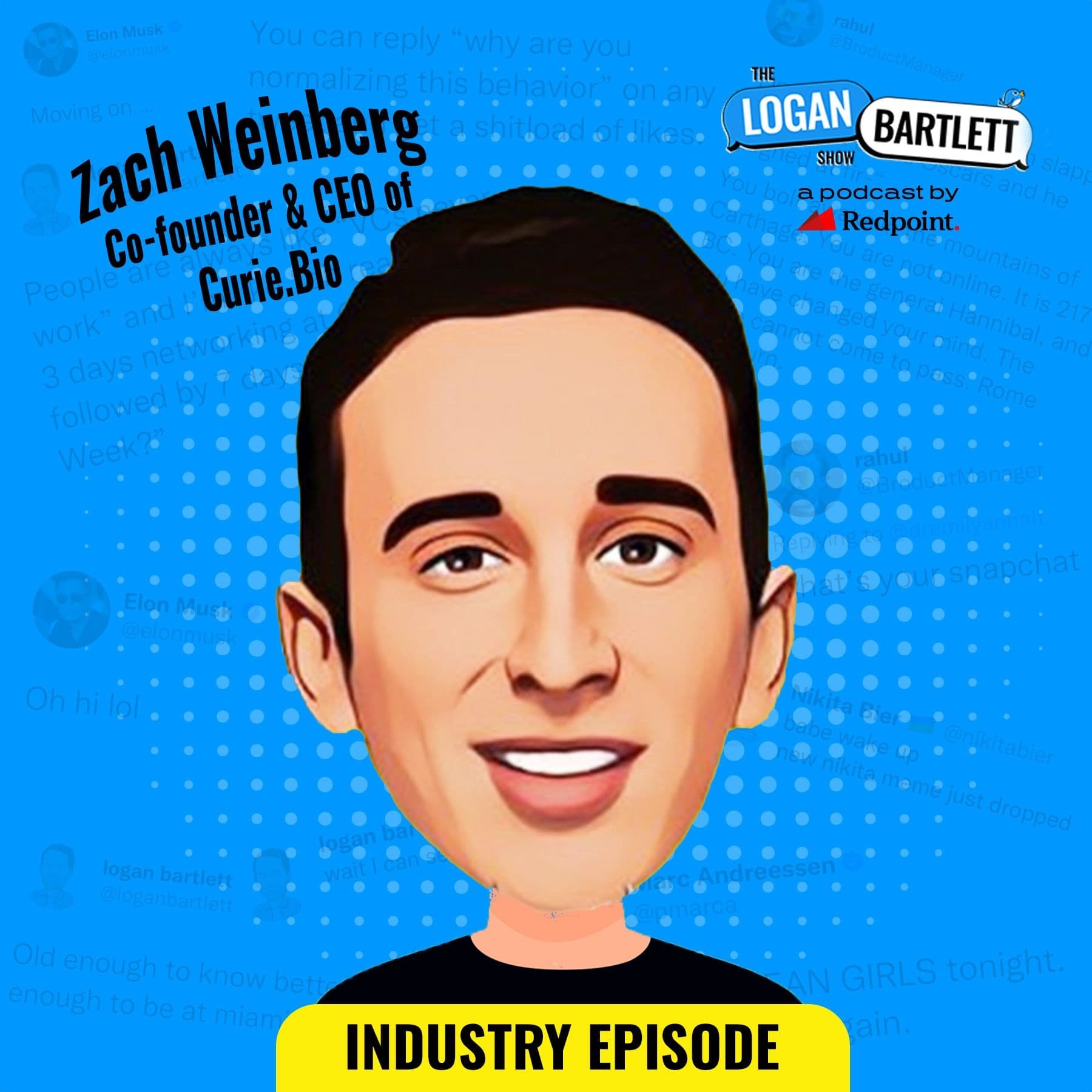
Episode Overview In this episode of The Logan Bartlett Show, host Logan Bartlett interviews Zach Weinberg, Founder and CEO of Curie.Bio, a biotech fund. The discussion covers a wide range of topics including venture capital predictions, the state of remote work, the impact of artificial intelligence (AI), and practical advice for founders.
Guest Background
- Zach Weinberg:
- Co-Founder of Curie.Bio, aiming to create a unique model in biotech akin to Y Combinator.
- Previously co-founded Flatiron Health (acquired by Roche) and Invite Media (acquired by Google).
- Operates Operator Partners, a venture firm focused on healthcare and software investments.
Key Topics Discussed
- NASDAQ Closing Bell Ceremony
- Zach discussed the significance of a recent NASDAQ Closing Bell Ceremony celebrating the launch of an infrastructure index, highlighting the presence of various infrastructure companies.
- Launch of Curie.Bio
- Weinberg described Curie.Bio's unique remote-first approach:
- Primary work from home with quarterly in-person meetings in Boston.
- Emphasis on maintaining culture and collaboration without a traditional office setup.
- Current State of the Venture Market
- Analysis of the venture capital landscape post-2021, including:
- Awareness of inflated valuations.
- Investors being cautious and hesitant to make bold moves amidst a turbulent market.
- Investment Philosophy
- Discussion on the quality of investments and the types of companies funded:
- Importance of analyzing the underlying business models rather than just the hype.
- The necessity of addressing actual market size and customer segmentation.
- The Role of AI
- Exploration of AI's potential and its implications on various industries:
- AI as a transformative force in biotech and enterprise software.
- Discussion of AI’s implications on productivity, customer service, and content generation.
- Lessons from Previous Market Bubbles
- Critical reflection on past market behaviors, particularly the crash of the crypto market:
- Need for pragmatic evaluation of business models in the context of overhyped technologies.
- Recognition that not all AI companies will yield success comparable to giants like Google and Microsoft.
Key Takeaways
- Venture Capital Sentiment:
- Current market conditions require investors to be more discerning, with a focus on sustainable business practices and realistic valuations.
- Remote Work Trends:
- Companies are adopting hybrid models to maintain talent flexibility while emphasizing periodic in-person collaboration.
- AI's Impact:
- AI is set to revolutionize numerous sectors, but caution should be exercised regarding valuations and the endurance of companies solely built around the trend.
- Navigating Complexity:
- Entrepreneurs should embrace complexity in their business models and have clear strategies for customer engagement and revenue generation.
Final Thoughts Zach Weinberg’s insights offer a comprehensive view of the current venture landscape, emphasizing the need for adaptability in investment strategies and a deeper understanding of emerging technologies. The discussion serves as a reminder of the cyclical nature of markets and the importance of foundational business principles.
---
Listen to the Episode
- [Apple Podcasts](https://podcasts.apple.com/us/podcast/three-cartoon-avatars/id1606770839)
- [Spotify](https://open.spotify.com/show/5WqBqDb4br3LlyVrdqOYYb?si=3076e6c1b5c94d63&nd=1)
- [Google Podcasts](https://podcasts.google.com/feed/aHR0cHM6Ly9mZWVkcy5zaW1wbGVjYXN0LmNvbS9zb0hJZkhWbg)
Follow the Show
- [Instagram](https://www.instagram.com/theloganbartlettshow)
- [Twitter](https://twitter.com/loganbartshow)
- [YouTube](https://www.youtube.com/channel/UCugS0jD5IAdoqzjaNYzns7w?sub_confirmation=1)
This summary encapsulates the key discussions from the episode, providing a useful reference for those interested in startup dynamics, venture capital insights, and the future of technology in business.
Written by AI. May contain mistakes. Listen to the episode to check what was said.
Transcript
Automatic transcript. May contain errors.0:04Welcome to the Logan Bartlett Show. I am your host Logan Bartlett and what you're going to hear on this episode is a conversation I have with Zach Weinberg. Zach is the co-founder of Curibio, which is trying to build the YC for biotech. Before that, he was the co-founder of Flatiron, which sold to Roche in a multi-billion dollar outcome. And before that, he was the co-founder of Invite Media, which sold to Google shortly after Zach graduated from college. He also runs his own venture firm called Operator Partners, where he, along with his longtime business partner, Nat Turner, make investments in companies in healthcare and in software.
0:43This is a wide-ranging conversation on markets where we talk about what we're seeing in the venture landscape, what's going on with down rounds, fund sizes, artificial intelligence, some principles around operating in a remote world among a bunch of different things. Zach's always a pleasure to have on and nothing short on his opinions as well. And so hopefully you enjoy this discussion now with Zach. If you are enjoying the content that we're putting out there, please do like, share, subscribe. Every little bit helps, particularly on YouTube. We're trying to grow that platform more and more. And so if you could subscribe to our YouTube channel and like the content that we're posting, we'd really appreciate it.
1:24It really helps spread the word for us. So now without further ado, Mr. Zach Weinberg. I feel like I'm dressed for a tennis game. We have a NASDAQ closing bell ceremony we're doing this afternoon. And so this is my summer business casual attire. This is what you're getting from me. What's the closing bell ceremony? What is that? We launched today some index, some infrastructure index. So you can track different infrastructure companies as an index. And so a bunch of the companies that are on it are coming and doing a ceremony. And then we came out with a private company list of, I think, 100 companies on the list of different stages, early, mid, and growth of these businesses, private infrastructure companies.
2:18And so everyone's in town for it. We're going to go clap and do the bell ceremony thing and then do the NASDAQ billboard thing and all of that. So it should be good.
2:39Where's the dinner? I assume there's a dinner. Zuzu. Have you been there? No, my heart is great. It's good. Yeah, yeah, yeah. It's not too far from you, I guess. I mean, whatever. It's in that Hudson Yards thing. Hudson Yards, did you see the, I think it was New York Times or Wall Street Journal. It seems like it's maybe not working out. They're having trouble with the... It's a lot of commercial space, right? They've got a ton of office buildings. So I assume whatever they underwrote the square footage price out. But it seems like the residential is struggling too, which is interesting. I guess why would you live there?
3:18It's kind of my... The price point is high. and there's not like bones or architecture of like getting New York. And so I get if you're working in Hudson Yards, why you would live there, but it's kind of like a developed, it might as well be in Dallas, Texas, or, you know, Charlotte, North Carolina, or a high rise in Miami or something like it's not, you're not really living in New York. Right. Yeah. I guess like access to the tunnel. Totally. Practically. It makes sense. Like if you're on the West side highway, it totally, if your office is over there, you can get to Newark airport pretty easily.
3:54Like I get logistically why you do it. It just doesn't shock me that the occupancy, if they're trying to charge$4 ,000,$5 ,000 for like a 600 square foot bedroom or something like I get why that value prop isn't going to resonate with a lot of people that want some element of New York, even if it is shitty walk-ups or whatever. Yeah. You know, it's the restaurants are really they've gotten pretty good but the neighborhood you know you feel like you're in the mall of america yeah i mean it literally could be in any city that you do some big development area over over there so it's not like it's a unique it doesn't feel uniquely new york in any way i well and then also like north of it sucks yes hell's kitchen and then there's you know it's because it's not even really hell's kitchen like as you get north there's like a there's like a nine block gap between they tried to name it uh like a decade ago probably when you were first moving into the city i think they tried to call it mima or something like middle manhattan and obviously that didn't exactly take off but you're right like hudson yard stops at what 38th or something uh i think even like even closer to like 35th or whatever it's like not there's a game you know the real like uh hell's kitchen area it's kind of like high 40s low 50s almost there's like a weird gap.
5:14And then south of it too, you're kind of in like Northwest Chelsea, which is like the, not the nicest part of Chelsea basically. So you're, you know, you're sandwiched between stuff. That's not super interesting to walk to basically. I wonder how much to go to New York. If you can walk, you want to walk to stuff, right? Like it's no fucking point, you know? And it's so far away. The subway stop doesn't exactly fix it, but like going, I'm on the side and getting from Hudson Yards to my place, it's just like, it's really far. And you really, you forget how far West being on whatever 11th Ave or on the West Side Highway, how far West that is to get to the East Village or God forbid, Brooklyn, or if you need to fly to JFK or LaGuardia, like it's, it's really far away, right?
6:02Especially if you catch it at any point of traffic getting cross town you'll spend as much time getting time getting cross town as you will getting like once you're out of the city to the airport yeah no new york needs like a zip line from like hudson yards to like bowery i like that yeah that that would do it actually that's like kind of even for me i'm in in chelsea kind of like east chelsea i guess on six between six and seven and like for me to get to the east village is a pain in the ass is it governor's island or roosevelt island that has like the little gondolas that you can go out to roosevelt yeah i i would be down for that like gondolas going cross city i mean theoretically subways should solve this problem but uh yeah i don't know god yeah new york never built that like cross cutting you know it just doesn't because it was really built to kind of like cut down to get to Brooklyn as opposed to like all the way for whatever reason you know the L is like the only effective crosstown subway and it's 14th street that's it what are you guys doing now so so last we spoke you were uh you had publicly launched your uh curry bio which I curie curie curie like Marie Curie I know I know who it's named after.
7:24I can't say it right. Anytime I try to say it, I say it differently. So you launched that. Are you guys going into an office? We have a little bit of a unique setup that I think if I were running, frankly, any startup, and I don't think it has to just be what we're doing in biotech, but almost any startup where you don't have like a physical manufacturing type work that you need to do. So for like software, obviously, and anything adjacent. So we have work from home is the primary, meaning like we assume you're working from home day to day, we don't hire you based on where you are, like where you live.
8:08And then every six weeks, we meet in Boston, which is where most people are for roughly four days, Sometimes some people stay for the whole week, but basically Monday to Thursday, every six weeks. And we do it where it's pre-scheduled for basically the whole year. Like we have all the 2024 dates already scheduled. So people know you can plan ahead. It's like board meetings-ish. It's just, it's more frequent than people were used to doing. A lot of times people will do it like every quarter, every half year or whatnot. So we're doing it every six weeks. You get to do about eight times a year, which is honestly like, I wish we did a little bit more.
8:44and then we'll do some like all hands, Zoomy stuff in between, but it's pretty often. Have you calculated the total cost? And I realize it's not just a cost trade-off. It's also like a talent, you know, opening the aperture of talent. But have you calculated, does it end up still being cheaper than having an office space in New York to house the number of people? Or have you not even done that math? Yeah, we just never did the math. My guess is it's probably the same. Like when you add in all the flights and the hotel and the travel and all that kind of stuff, you know, that frequently versus the reduced footprint you need on the real estate side.
9:25So we still have an office in Boston. It's just smaller. So you can go there if you'd like, if you're based in Boston. Then we have a small office in New York City because there's about six of us in New York. Those are the only two places. And eventually, I assume we'll get something in San Francisco. but like the footprint of those are materially smaller than you would normally have, right? For the number of people. I got to think it's a, it's a wash. That's my guess. What about process wise? Have you guys done anything process, like in a purposeful way outside of that for remote communication or is it just standard Slack?
10:01Have you done the, I saw you tweeting about Rome and what Howard's doing. Like, have you guys done anything interesting from a process standpoint for remote workers? By far. So a few, maybe a few thoughts. One, like, so we don't even have Slack. I hate it. And the thing that kind of drives me crazy for Slack, for what we do, I'm not suggesting this would work because like we don't build software. And I think if we were doing a lot more like software design, software execution, Slack would be really useful. I think it's particularly good for like small teams working on engineering. But I felt like Slack had two really big downsides.
10:40One is it just becomes like a social tool and it's completely distracting. And so I hated it from that perspective and it didn't want to have, you know, like the pets channel and stuff like that's not what work is for. And then the other one is that it's so easy to use from like a group discussion standpoint, right? Like, you know, everyone has a group thread. that I felt like a lot of decisions that shouldn't be made in chat were like getting made in chat, basically, because, you know, the friction of setting up a live meeting was always pretty high. And so, you know, when you have this like asynchronous or like semi-synchronous group chat going stuff, we're like, oh, I'll just like type it in the chat.
11:22And then whoever's like there to respond, all of a sudden you'd get these decisions that shouldn't have been done in a in a chat setting basically like it should have been in a call or a meeting so we we don't use it um we actually use whatsapp interestingly enough uh for everyone has it on their phone uh it's not as easy to use actually which i think is like a feature not a bug um i don't know how long will last like at some point we may have to get a Slack-like thing for this. The biggest gap with WhatsApp, and I think a lot of these, it's just the quick ad hoc audio. That's the thing we've been trying to replicate.
12:04It's just really, really difficult. The after meeting, quick discussion that isn't scheduled. The unscheduled meeting, basically. I referenced it, but for people that don't know, Howard Lerman was the CEO of Yext, public whatever, billion dollar company. And his thing now is... And there were a few of these that tried it during the pandemic where they were a little too gamey. It sort of felt like you were playing Pokemon where it's like you have your little avatar and then you can go walk over to someone and then a video would pop up and then you can go walk into another. And I think what Howard has done with Rome is like, it's pretty utilitarian in the way that a professional tool should be.
12:46But then you can quickly, you can see who's in calls or in meetings in a visual manner. You can drop in on that. You can do one click knock to set up an audio or a visual conversation. And so it's cool. One of my companies uses it within their engineering team and they swear by it. They really, really like it. I think Howard's doing a slow rollout of the number of people that get to use it. It makes sense. I feel like the process stuff with Slack is, it's almost like the standard is synchronous communication. And that is just not the way most decisions or by interruption, most work should be done.
13:34And so I have certain things that I'm very dogmatic about, email me about those things. And if someone sends it to me and it's like this detailed thing and I'm coming out of a meeting and I'm trying to catch an Uber, and then I have this fucking essay written out about should we do X, Y, Z thing, the context switching is really hard. And I was listening actually to an interesting podcast. The guy's name here, let me pull it up. The guy's name is Cal Newport. Have you ever heard of this guy? I think he's like a Georgetown professor or something. And he was on Sam Harris talking about, I think he was saying his view is actually that Slack as a tool hasn't led to productivity increase because the context switching of stuff and like just, it actually ends up degradating our work experience.
14:30And I don't know, I feel like it's such a powerful tool that maybe should be used with better process around it in the hybrid environment. Like, hey, these things go in Slack and our expectations are you respond in 24 hours. These types of things never go in Slack. You need to have your alerts off, right? Whatever. And just having different expectations set from a process standpoint of how it works, just because you can do so much with it and the expectations. I even have this as quick response. I see green light on, get back to me quickly on it. Right. And obviously that interrupts people's deep work, which you only have so many hours a day that you can do that stuff.
15:15Yeah. And it's interrupted in chat as opposed to audio where like on the audio side, you have just like higher fidelity. You can get to the answer a lot faster than typing. And so on the, on the limited unscheduled time you have, it feels like not a great use of that limited unscheduled time. There are clearly some things it's particularly useful for, like a small team. Yes, like group chat in a small team, I'm sure is better than long threaded emails. It's just when it devolves into whatever else, like channels with 400 people and them, shit like that. I just felt like it was distracting. So we don't use it at the moment.
15:58We're also a small group. We're like 30, 35 people now. So it's not huge. So Rome, by the way, Rome, I think is going to be great. I'm an investor. So I, and I've known Howard for a long time, but I think, I think something like that will become the default for many people. We obviously like, we did the remote thing, not because I cared about like the cost savings, but because the talent, It allows us to just hire kind of like wherever, whenever, you know, somebody is available. The number one thing that, and I didn't plan this, I think we kind of discovered it, is like, okay, if you're remote first, you assume that all the meetings are like Zoom or Teams or whatever, we use Zoom, but like same idea.
16:42We record quite a bit of the internal meetings, especially the ones that are the most complex from like a discussion standpoint. So like our investment committee, for example, like all our IC meetings are recorded. And then even some of the like lead up internal meetings we have to the investment committee where we're doing debate on the company itself. That's all recorded. And it goes, we use Grain, which is another company we invested in, but it's a, I personally invested in. We're all shilling stuff. Rome, I'm not investors in. So I just think it's interesting. I'm two for two here, you know, Rome and Grain.
17:17So we use all the tools I invested in personally. But yeah, so with Graham, we record all the meetings and then it goes into essentially like a library of recorded meetings. And so it solves two problems that I really like. One is like, you know, you want to give people exposure to these kind of discussions because it's good training and it's good context. But when there's like 800 fucking little boxes on a Zoom, you know, people's behaviors change in those meetings. And so what this does is it lets us kind of keep the meeting room smaller, but still provide context without them having to be there.
17:51So that was really nice. We have that weird thing with entrepreneurs coming in and pitching where we want to be inclusive and we want to have people in fullness have the expectations of like what's going on in the firm. but then an entrepreneur comes in and we want to feel bespoke and like you get me if I'm going to invest in you, like it's going to be us. Right. And then you have 15 fucking boxes on a screen and it just feels like you're presenting to an auditorium in some ways, I think as an entrepreneur. So recording is a little interesting on that side. Investment committee, I think makes sense.
18:28Recording an entrepreneur's pitch, I think puts them in a weird spot a little bit. Hey, we're just going to record this for other people, but I don't know. I've changed my tune on this quite a bit. We also do the other, by the way, the other use case we use it for is onboarding and training because we basically have like a playlist that we can give somebody in the two weeks before they start. And then, you know, when they actually started, like, all right, you want to see what the kind of work that we do and what we're up to, like, just go watch all, you know, these 17 videos that we've flagged for you.
18:57And they're all, but they're mostly internal meetings, some, some external ones. And I think we'll end up recording more and more with the founders over time. As a founder myself, so being on the other side of this, like when we were fundraising for Curie in the first place, would I have hesitated to have the meeting recorded? Yes. At the same time, there's so many decision makers inside of these firms that actually just having the recording of me doing the story might actually be better than the partner I was talking to trying to repeat what I told them and trying to sell it through. So I've like slowly changed my tune.
19:33I actually think these recordings can be quite valuable for sharing context within an organization in a way that like, if they're not, what is it? Was it like the notes document is doing it? Like, really? That's going to get, I'd rather them like hear it from me personally. It is interesting though. We came from the spectrum. If you talk to the people that were like dogmatically remote first pre-pandemic. It was like Matt Mullenweg from Automatic or Sid from GitLab or whatever. There were a handful of them. And how purposeful and thoughtful those folks were about stuff. Hey, if you're coming into, if we're going to do a big meeting, everyone needs to be in Zoom.
20:12And if we have people, if people are in the same office, we can't have them in the same room together because it changes the dynamic having two people having a conversation in a room while two others are both remote on a screen, which totally makes sense. And then we were forced to drink from a fire hose of like switching to fully remote. And I think people adopted a lot of bad practices, not in a very purposeful way, but it was fine because everyone was remote, like at the peak of the pandemic, right? There weren't two people that were sitting in the same room. And now as we kind of, as we've unwound remote as the standard and move back either to this hybrid thing or just more people are fully remote.
20:57I feel like the lessons are being learned from COVID and people are just taking what they did to COVID and going to in person. And now we sort of have this weird hybrid situation where seven people are in the room together and three are on video. And now the three that are on video aren't like tied in with the seven that are in the room, rather than like going back to the first principles that Matt and Sid and whoever else were so purposeful about Zapier were so purposeful about like 10 years ago, trying to make everyone on the same page with everything. Yeah, no, you can't do the like in office plus at home.
21:33It just doesn't. Which by the way, I think 90 % of companies are in some version of that or 75%. I think a lot of people are still in that ish mindset right now. And it's hard to unwind it. I'd be interested in your perspective on this. Let's say you want to go back to fully in person. I've talked to CEOs. They want to get back to fully in person and they feel like they made some mistakes over the course of COVID in allowing and hiring people to come in as remote workers. Well, how do you get there? Do you tell them over the next two years, we're going to transition? And so you make a decision if you want to move or not, and you give them two years, 18 months, six months, three months, like what is the right time horizon to tell them that they need to be back?
22:18What cost of living adjustment do you do? All of these things. It's like, it's pretty hard to figure out how to put the toothpaste back in the tube. Depends how competitive you feel from a talent market perspective. Like, are you willing to lose people? And what percentage of those people are you willing to lose? And what percentage of them are actually the really good ones? Like, I don't know, can you really mandate fully in person for the average company? Like if you are, I kind of view it as like, there's a lot of things you can ask your employees to do when you pay them a fuck ton of money.
22:57Like you work at a hedge fund, they could be like, you're sleeping in the office for the next 14 days and like, or you're fired and people will ham and ha. But then when you realize like, oh, right, I make like$4 million a year. And the alternative job for me is like nowhere close. Like, yeah, you're going to go sleep in the office and you just, you pay, you pay people to do that. And so I think some of these like really high comped hedge funds in particular, yeah, you're going to be in the office because that's what they want. And your alternative is not great. And then I think you can do it in kind of like the other end of the spectrum, actually in a really weird way where the employer holds all like people want the job, they need the job.
23:35And so they're just going to follow whatever the employer needs because, you know, maybe their alternative is not great. These are like lower skilled but remote type jobs where, you know, again, the power sits with the employer. It's that whole middle that I would actually be really concerned about if I were the employer. Which is the vast majority of companies are in the middle, right? Oh, it's probably 95%, you know, something like that. And by the way, every employee exists on a slightly different perspective on this. If you're co-founder or the VP of Eng that you worked five, like the last, whatever, five years to bring on board.
24:12And now that person lives in Florida. Are you going to create slightly different rules for it? Are you really going to let the VP of Eng walk over this thing? Like it's hard. And they drift. And then, you know, I kind of, it's like, all right, well, that person who's really, this is the problem. the really good people have choice right and you know even now in the shitty market they still have choice it's not even that shitty and employment's like three point whatever percent you know it's like tiny i mean i know it's tacked venture i feel like an attack yeah but like if you're really good you kind of always have choice is the reality maybe you don't have the highest end but you have choice and like you could just go get a job with a company that really wants you that is going to allow you to be remote.
24:53And that specific pressure right there where your best people can kind of do what they'd like is going to be really hard to keep people in the office. So I don't think - You know what's interesting is it's your best and also the most fungible. And that's really hard. Let's say you have a bulk group of CS people or something, right? And there's 150 of them, and this isn't ragging on CS people at all, but you're kind of beholden to, We see this in venture all the time about our associates, especially during the big run-up of the last two years. We were kind of beholden to the most flexible optionality that anyone gave because we were constantly at risk of an entire group of people being like, well, I like this place, but this other place will let me do this and I can go do that.
25:50And I think that's true of the jobs that are fairly fungible as well, where you might face just like a mass exodus of EAs or customer support reps or whatever it is. Like there are a bunch of those jobs that are going to be allowed to be remote as well. And so weirdly, it's like at barbells, the highest end people and the theoretically most fungible. But losing either is bad, right? In mass, it's really hard to do. I also think we talk about in-office time as if it's all created equal. You just need a certain number of in-office days, and that's probably not right either. In-office conversations for some specific type of work is really important, I think in particular complex planning.
26:38and so I don't know I think people are are gonna head in the direction frankly that that we are at Curie because I sat and thought about this for a very very long time about because I had a blank slate right I and I had seen the in-person thing for my whole career even Flatiron previously was like a heavy in-person New York culture and so and we had some remote but I think in office is going to be planned and not just like which days you're going to be there, but actually the agenda. Like we're in office for this reason. We're debating, you know, whatever next quarter's goals or this spec or something along those lines.
27:16And it's pre-scheduled and there's clear agendas and there's like action items and takeaways and all that. It's not like, oh, I'll be there on Tuesday. It's like, no, no, no, no. The whole team is coming in this week. That kind of thing. I'll say this black and white, and obviously it's not, but if you're an IC, the more IC-ish job you have, engineering and sales, sales in particular, where there's objective measures of your performance. Now, sales ramp is hard. And oftentimes you need very specific metrics to measure that and figure it out and all that. But there's ways of doing that. And so if you're an IC salesperson, one, you're very self-contained in a lot of the things you're doing.
28:01And performance is very trackable in a lot of ways, right? Engineering, you're very self-contained in a lot of ways of what you're doing. It's harder to measure performance, but those jobs are so desirable and the people so scarce that you're a little more beholden to the circumstances around it. There's the more collaborative jobs that exist where it actually involves strategic planning and coordination and oftentimes whiteboarding. And I think about marketing or product or executive team meetings and all of that. And there is the benefit of just short circuiting a lot of the stuff by being in person.
Read the full transcript
28:43And then there's this whole other bucket that's like culture and just the depth of relationship you're building with your colleagues. Because at the end of the day, I feel like especially our generation, the millennial generation on down grew up in the time at which the white picket that we saw our parents as boomers pursue their job as a means to an end of having this great life. And then a lot of us saw all of that shit unwind in 2008 where they're like, oh, shit, they bought this big house and now they're underwater and their life savings were tied up in it. Now they can't sell it and all that.
29:24And so I think there's a lot of people that are like disillusioned a little bit with work as a only means of of how they find fulfillment or at least the monetary value of it. And so I think those people like the culture, especially when you're younger, is like a super important thing. And so it's kind of like, to what end are you having these in-person office things? I think it's just going to be, you know, remote first will win for most of these companies over the long period because of talent and talent alone. Not because it's better, not because like, you know, it's more effective or anything along those lines.
30:03Like maybe it is, maybe it isn't. but just because the best people, which are what you need, are going to demand it because they want the flexibility and they can. And so remote first will win most of the, let's call it most of the time, as like the best talent realizes they have the leverage. And then you're going to have to back into like the things that you do need in person for, right? You need it for debate, you need it for some culture building, you need it for training in many cases. And that's why I think we end up with this hybrid where the in-person is almost off-site kind of in-persons.
30:40It's just way more frequent than I think people currently do it. The recording thing is interesting, by the way, that you're doing that. I've always thought there was a company, MindTickle, that was like sales enablement for video dissemination. And so Zach, if you had a bunch of enterprise sales reps, you could record the pitch of, hey, here's how I would articulate the battle card against our number one competitor. And as it changes, it would get pushed out almost like many TikTok or YouTube videos that sales reps could watch 90 seconds of the founder actually saying it. And I think video recording and LMS related stuff is underutilized, particularly now in this world where we're, we're, we have a camera on us for so much, right?
31:24There's so much fidelity of information that happens in these meetings and you don't have to go full Bridgewater, like everything's recorded, but I do think training is a really interesting point. Training, even just like documentation of decision-making, like if you do the five, why you know there's so many things that you can improve on when you have like the source data and it's not somebody's notes in a meeting or someone remote you know it's just like all right let's just go pull up the video and like see what happened the other thing we started learning with this stuff with the with the um uh recordings especially when we were early at curate not that we're not like we're around for like a year and a half whatever but really in the beginning uh you know we would be having debates about how to position the business or pricing or something like that.
32:17And usually there's somebody there like taking notes and that person really can't participate as well in the meeting because their brain is in like note-taking lands. And then when I realized like, oh shit, I don't have to take, I really don't have to take notes in all of this. I'd rather just have like the debate. And then when somebody on the team says something really interesting or smart or whatever in grain, you can just like click one button and it flags it. you know, it's like a bookmark. And then afterwards you can go back and pull the video and you have the transcription. You can turn it into like the slide that you need to make.
32:49It's really kind of amazing if you lean into like everything's recorded or at least most important things are recorded. So that's my guess. I think we're heading in a world where recording is the default, where tracking people's work when they're at home becomes the default. like the big brother thing is actually we're going to head more big brother than i think people realize because you know if you're remote first like okay well what are you working on what are you spending your time on all of a sudden those become like pretty reasonable questions for an employer to be asking because they can't see you right they don't know so i i think we're going to shift a little bit to maybe uh you know the eye of soar on if you will yeah of like employers but That's the trade, right?
33:37Like that's the trade. If you want to be able to work in your pajamas, like I have sandals. I don't think I put shoes on for like five days. You know, like that's what you're going to have to make the trade for. And I think people are going to do it. It's really lifestyle wise. I think the work from home stuff is materially better. Plus it's not like we're living in cities is getting cheaper, right? It's getting more expensive. You know, the housing costs are going up for in every major city. So especially for people that are starting families and they want more space, like that trade is going to win.
34:07The more space in the burbs is going to win. So I don't know. It'll be interesting. I've been trying to get you to opine on. I know you've had thoughts on the state of the venture market for we had this scheduled, I don't know, six weeks ago or four weeks ago or something. And it sounded like you had some thoughts on that. I don't know if you even recall what those were at the time, but it sounded like there were some Weinberg hot takes that were hanging out there. What's your opinion on what's going on right now in the market? I don't actually think I have any particularly unique opinions or insights into this.
34:45I mean, in general, what I think happened in many cases, and this is maybe like a little exasperated in some of the stuff I spend time in, which is healthcare, not just biotech, but like healthcare services, where it's probably one of the worst offenders is you had a lot of businesses over the last like seven or eight years that the margin structure of those businesses does not look like SaaS, but like SaaS multiples were applied essentially from a valuation standpoint. And those are the ones that seem to be the most in trouble where you look at them and you're like, okay, the actual ability for this business to produce cash when it five, six, seven, eight years from now is still in trouble.
35:31If your gross margin is under 8%, it doesn't give you a lot of wiggle room on EBITDA. Even like, okay, so like healthcare is the obvious one because you never really get to margins that are that high. And so you have to really think about like, what is the real contribution margin to these businesses? But even in fintech, I mean, and I invested in some of these companies myself, probably because I didn't like think about it. I got caught in the hype and maybe not as bad as some people, but it was still there. And I've gone back. I've had conversations with these founders and they're like, oh, we've got all this top line revenue.
36:06I'm like, cool. Walk me through the margin structure on the revenue here. And you start to see negative margins or 10, 20, 30 % because there's layers of fees underneath that you can't actually go and grab for yourself. And you realize like, okay, even like the fintech stuff in many cases is not really like SaaS margins. And so you throw interest rates on top of this, right, as well. And that makes a lot of things go haywire. It changes a lot of the assumptions. It's interesting you, I agree on the fintech in healthcare. Like there were definitely multiples ascribed or assumptions made on like what type of operating leverage could exist.
36:48And fintech had this weird thing that a lot of it was very circular, where it was like, oh, it's a fintech company, and it sells to some banks, right? But also, then it sells to all these other fintech companies. And so it's like, okay, so we're kind of rinsing venture dollars around in this pool over here, which was definitely, I mean, SaaS had the same thing in some ways, right? But there was more, I think there's been more forgiveness in certain ways there. But I think if you look at one of the things I think people forgot, and we were not totally immune from this at all, but there was an old adage when I got into venture that's like, it's really hard to make money in SMB and selling to venture-backed startups, right?
37:39And that's like, we should discount that revenue way less than any other revenue within SaaS. And then over time, there's been a bunch of companies that HubSpot or Shopify or whoever, who have actually proven SMB, yes, higher churn, recession, definitely more damaging, but they've actually outstripped any of the expectations I possibly could have had for what those businesses were. That said, a lot of people lost sight of like a dollar selling into an enterprise or a non-tech customer was not the same as a dollar selling into a venture-backed customer because of all the money sloshing around in the ecosystem.
38:24And we've seen it pretty hard in seat-based pricing and particularly seat-based pricing and things that are related to go-to-market sales in some capacity, right? People were pretty liberal in their ambitions around what their licensing would look like. And now as they triage it because they're venture-backed companies and they're trying to control their numbers, they are cutting back on their seats. And so while these are good companies, the acceleration of the growth that they had over the course of 2020 and 2021, 2022, let alone valuation, like obviously valuation went wacky and people were willing to pay 50, 100 times.
39:03But like the assumptions around what with the fundamental atomic unit of growth that they were going around, people really forgot that stuff as well. It's pretty painful. These are great companies, but it's going to take two years or three years of these businesses kind of right sizing their licensing and maybe at zero growth in a lot of ways. I've heard real good businesses at scale sell to go to market orgs, adding zero because all their net new sales are being offset by all their contraction and churn. Just overpaid for a bunch of stuff for a lot of years. And that's what's – you're going to get kicked in the face a little bit when you pay up for something at price that's 4X, 5X, 6X, what it should be.
39:49And it's not like there's – it's not like things were fraudulent. It was just overpriced in almost every case. Overpriced and under-considered on the risk. Like I never heard someone say, hey, the risk-adjusted multiple of this company because they sell to all venture-backed businesses should be lower than this or should have a higher risk adjustment than this company that sells to enterprises, right? Which would have been the right perspective. Well, I think like, you know, a lot of people assumed markets were bigger than they really were. And so, you know, you see these companies that are, they get to like tens of millions in revenue and then they kind of like top out and they don't grow as fast.
40:28And you realize like, oh, right, that's actually not worth 20X revenue. It might be worth two. Well, then the other thing is like their circular nature of valuation underwriting. I will tell you no one, and we were victims of this, right? No one was saying, okay, well, you know, the likelihood is all these things trade out at 10 times free cashflow or 20, like at terminal at end state, there was a lot of, well, if Snowflake is a$75 billion company, do I think this can be a 10th of Snowflake? Yeah, I think that. And so then you're paying a high price based on what is already a high price, right?
41:08And then Snowflake comes down and you're sitting there with like, oh, well, actually that doesn't work anymore. That totally breaks the valuation framework that you had from the start. It's also, and like, you got to remember, like Snowflake is in one of the largest markets in the world. Top trading software business out there. Yeah. Yeah. Yeah. So maybe like the biggest, I don't know, thing I've seen that stands out to me besides like the valuations that are nuts is just the quality of the ideas that I think entrepreneurs were held to for the last like six or seven years were really shit. You know, it was kind of like every low hanging fruit idea in the world that, you know, maybe you could turn into some like SaaS workflow tool got funded.
41:59And so not just the one, by the way, then the second and third and fourth. And so the whole category economics got fucked up because there were four people going after a$200 million market opportunity. And so all their pack went up to 60 months or whatever. And so now where do these companies go? Yeah. And I think there's a, there's a, not a whole class, but there's a set of founders that I think never felt like the pressure on the idea that they probably should have. And then, you know, the quality of the company they ended up starting or their understanding of what good looks like in terms of like being a founder and the quality of like the strategic thinking and complexity of the actual work you have to do.
42:43It's just, they're not up to snuff. Like there's plenty of founders I've met, even many that, you know, I should say many, because that makes me look bad, but like some of the ones that we funded where I've caught up with the founders, you know, a year, a year and a half, two years later. And I'm going like, you kind of suck actually. Like you're really not, you're not cut out for this job. You're the quality of the thinking is not there. The quality of the work isn't there. And so - What do you hear, by the way, in the quality of thinking that leads you to have this conclusion? Because thinking is such an ethereal thing.
43:20Is it just that they're not grokking intuitive concepts? Yeah. I mean, everything from like, you ask them to think through like the market, not like the bullshit tam that everybody sticks on a slide, but like the actual addressable market they can go after, the pricing that they're going to go into that market with, how they're going to defend it, like how they think about customer segmentation, the business model side of it, right? Like who is buying your thing at what price and why? And like the underlying bottoms up version of how you're supposed to build out that model, because that's what drives many of these businesses, it's just not there.
44:00Like, oh, we have these like eight, you know, first target customers and you're like, cool, how many more are there? They hadn't really asked themselves that question before. They hadn't thought about the ACVs that they ultimately will need to get to be able to support their actual sales costs. There was just nobody ever asking really difficult, detailed questions about the business model. And you see it now when you poke at it a little bit in many of these businesses where, I don't know, their cost structure is crazy. Building into a market that's got like 200 million in total top line revenue in the whole segment, stuff like that.
44:36And so I find it when you poke and when you dig into the details. So that definitely for me stands out. And then I also have seen just like many, in particular the younger founders who don't know how to manage like a small workforce well. Because the way they've always gotten out of problems is they hire more people. so like when when you money is free and you're like oh i got this problem all right let me like spin up a new team you know that doesn't create a lot of rigor in how you actually you know get stuff done within the organization and now when your budgets are constrained and you're forced to actually like make your current workforce better they don't have they don't have the skill set to do it they don't know how to they're not an interview they don't know how to help people accountable they don't manage to goals because they were never trained on how to do it so are Are you trying like how much you guys have, how many people in your portfolio or how many angel investments in totality that are active right now?
45:36From operator, which is everything but biotech. Biotech is all I do the main business, but probably 250, 300 companies, let's say over the last eight, nine years. And do you, if you're having that conversation and reaching that conclusion, are you telling them, what counsel are you giving? Or ultimately, obviously, I don't think saying you suck is a productive conversation to have. But when you have that conversation or you hear this, are you as a mostly passive early stage investor, are you encouraging them to maybe tap out and say, hey, you might want to start thinking about a different landing spot for this business?
46:22Yes. I also tell them they suck. Yeah. 100%. Because like, you know, A, I don't have the patience to like, you know, lipstick on a pig, whatever the phrase is. I just kind of be like, I don't think you're really good at this. Or like, here's an issue. Now, I try and be more specific of like, you suck at this thing. Yeah, yeah. Right. So it's not just like you suck generally. but you know, you, you don't, your ability to sit and actually think through like market segmentation and pricing and all that, like it's terrible. And usually what I'm telling people is like, if you're bad at these things, you need to go find people who are really good at them to teach you.
47:01That's usually my advice to almost everybody. It's not just like telling you you're an idiot because most of them, they're not dumb, right? They just maybe are missing certain skills because they were never trained on it. And so most of what I try and encourage people to do is to surround themselves with really, really sharp people in the areas in which they are the weakest. They may have never heard that they were weak at this thing. And so sometimes I'm the first person saying, you know, your storytelling ability sucks or your deck looks terrible, whatever. But like the advice is always to go get better people and then to teach them a little bit of like how to do it.
47:35And then, yeah, sometimes you have to tell the founder, like, look, I don't think this is going to be a billion dollar business. you may want to look to find an out or take the deal that was offered at a price you don't love, but the alternative is a zombie business that never gets there. I definitely will give tough love. I try to do it in a way where 24-year-old me would have appreciated. Some of the best ways I learned back in the day, and remember, part of this, I got lucky. I started my first company in 2007 and then the world collapsed in 08. And so we got some very tough love, very young.
48:13But we had one or two advisors who would just yell at us and like in constructive ways, but not nice. And I really learned very quickly of like what good looks like. I think I might have even told this story before on the podcast. I don't remember, but I remember being in one of the initial sales meetings for invite media back in like 2007 or something. And Brian O 'Kelly, who was our advisor, he was basically like me for us back in the day, like semi-successful entrepreneur who like kind of knows what they're doing and it doesn't have a filter. And he would join some of these sales meetings. And I distinctly remember him telling me after like one or two of these meetings, he's like, you are fucking terrible at this.
48:58And like, that was very eye-opening for me of like, oh, right. Yeah. Maybe I don't know what I'm doing here. And then he would give advice and like how to get better. But I still hear it. I still hear him telling me that in my head, you know, 14 years later, uh, I have some of the best advice I ever got was just like, you're, you suck at this. And like Brian proved to be actually, uh, you know, CEO of app Nexus, which sold for what, what was the actual acquisition price? Billion to Billy.
49:30I don't He takes no prisoners. I think in general, the good founders want to know what they're bad at. And it's hard because for a long time when you were raising money, nobody wanted to tell you something wasn't good because it was so competitive to get into these deals. And so that feedback loop of like, no, it's not great, it didn't exist or it didn't exist at the scale it should have. Now people are hearing it. I do think people are realizing, I hear it when I talk to founders, they're seeking advice, they want help. It's great. So this is healthy for the market. One thing you tweeted, I don't know how many months ago it was, but that I wanted to talk to you about was you said, I'll give a summary of it, but 2013 in later stages, Series B and C, VC will be defined as everyone has money, but no one has chutzpah.
50:22In my opinion, this comes from a dynamic and not wanting to be outside the herd. You don't get fired if everyone else sucked alongside you, aka 2019 to 2022, but you do get fired if you're the outlier doing big deals in 2023 while everyone else hides in the quarter, which likely means there's some very good deals out there that are underpriced if you have conviction and no fear. The best investors know this. Question is, can they convince their partnerships to swing? What's interesting that I found, and this is just like a weird thing, the one exception or asterisk I would put on all that is everyone has so much fucking money.
50:56And so there was this thing over the course of 2022 where no one really fundraised because they went in their bunker and they were like, shit, why would we go out right now? We can wait another few months and see if the market turns or whatever. So no one was really fundraising in 2022. Now we're seeing businesses that fundraise in 2023. And it's interesting, in particular with AI, which we can kind of put in a corner, and I would love to hear your thoughts on, but even in enterprise software or whatever else, healthcare, I think because these funds are so big and people haven't done deals in a year plus, that there isn't this logical-based underwriting that you think you would see.
51:47And so what I've actually seen weirdly enough is I've seen some companies caught in the margin, but it seems like there's this conceptual framework that people have of like a low enough in Series B and Series C land where I play, a low enough valuation. And low enough used to be when I started in the industry 10 years ago, it was like 100 million or 75 or 125. And then it crept up to like a billion dollars in the peak of 2022. Now it's like gone back down. It's sub 500, I think. It's kind of like 200 to 300-ish. But it's interesting. You hear about these companies that are raising around there, and they're getting browbeaten by so many investors that want to invest at that lowish absolute valuation.
52:34Because even if they're paying 100 times ARR, if they hold it long enough and it's actually a good company, it should find its way. If it's a software business, whatever, all that stuff. It should find its way to being at least a 2X, probably a 3, 4, 5, 6X if it's a real public company and has that path. And so it's interesting. I keep waiting. And I don't know when the reckoning is actually going to come. It might be when the funds that are so big have to go back and fundraise. And they have so much dry powder right now. And so they're like, oh, fuck it. We'll cross that bridge when we come to it.
53:10But it's interesting. I haven't seen. I've seen it decline slowly. But it's not like the reason they're on a lot of rounds in my mind is that there aren't a lot of fundraisers going on. Right. More than it's that the VCs are timid in it. The thing with venture in general is it's such a big industry now that like the kind of gross generalizations that you have to make on Twitter basically, they're just always sub segments where it's not true. What happens in healthcare, different from enterprise infrastructure, from, you know, like each of these categories has gotten so big that like you have a ton of like heterogeneity in all the markets.
53:54And so I see plenty of companies where I look at them and I'm like, I have no idea how you're ever going to get back to this valuation. And then I have the flip of them. Some of them where I look at it and I'm like, holy crap, this thing could be massive, but maybe the numbers aren't there yet and no one's willing to make the bet early. People got a little more conservative giving forward credit to some of the early companies. As with all of these things, I genuinely believe there's a lot of money. There's a reasonably large number of smart people in this. There's a lot of effort and hustle. The good stuff will get funded.
54:32It will survive. It will work eventually. It may not happen where the founders own 30%, 40 % of their own thing anymore. They take some dilutive rounds or down rounds, recaps, whatever. But good ideas will find a home. This isn't like 1997 where there's like eight venture funds on one strip in California, right? Like it's so big and it's global. So at this point, if you as a founder in software cannot figure out how to get your thing funded by just like dropping the price, it probably means the business is like is challenged on its own. It's just it's big now. Now, from the venture side, like, yes, I understand why you hold back and you don't do the deal on the margin because you don't want to go back to your LPs, right?
55:21You don't want to go fundraise. I mean, you can, you know, you read all the little stupid gossip of like Tiger and others struggling to raise their next fund and not buy off by like 20 % or 30%, but off by like 80 % kind of thing. It's funny to me, like what I don't, to take myself out of the founder seat and put it more as like an LP side of things, you know, you go and you talk to, as I did for Curibio, and I talked to many sophisticated LPs. And the thing that I could never get in my head straight was like, they know that the larger the fund, typically the lower the returns. Like there is an inverse relationship between size of fund and returns.
56:01They all know that. And deployment of, pace of deployment as well. Right. Yeah. Like anybody who's been an LP at any sophisticated endowment, family office, whatever, for more than a few years understands this like inverse relationship. And yet for like six or seven years, they were, you know, joining. I mean, I was an LP in one of the Tiger Funds too. Like that was big, not the biggest ones, but some of the recent ones. And we all just got caught up in the hype. Even the smartest people got caught up in the hype. And we're in a way kind of like resetting to what I think is a more normal, rational system, like smaller funds perform better.
56:34It's very hard to return a$20 billion mega fund in the private market. Yes, that is not hard. It's not like an easy thing to do when, you know, there's like one outcome every year that can support it. So I remember we raised a fund in 2021 and everything, we have good returns. And so everything went, you know, it was relatively smooth or as smooth as I ever could have hoped. But the number of times we got asked, where do you exist in this world of Tiger? Because we were raising$650 million for an early growth fund. And in the world of other people having$5,$6,$8 billion funds, and I'll say Tiger, but anyone can Google who else has funds of that size.
57:18Because in the world of all of those folks having so much money, we spent so much time. We had like a battle card of how we win and the explanation of like why we're keeping our funds smaller. In 650, we ended up at 725. Like that is not a small. It's not a small fund. It's not small, right? But we had a whole battle card about like, all right, well, here's how it works and all that. And I will say, being on the other side of it now, everyone obviously is so, oh, gosh, we love your model so much and whatever, staying small and disciplined and all that stuff. It was funny to have lived. I feel like I've learned more.
57:58So I joined 2013, 2014 in venture. I joined tech in 2011. I think I learned more 2019, 2020, 2021, 2022. Like in the totality of things I learned, my learning curve was steepest there because it's weird. You hear about bubbles and manias and all this stuff, but it's weird to be so trapped in it. And Chris Dixon was like number one on the Midas list for crypto investing, right? Like literally the number one investor in the world for all this. And the number of questions we got about our crypto investing strategy and all of these things. It's interesting to have lived through that whole rise and then the hangover.
58:45It's just like an experience I'm never going to forget. And so one of the things that's interesting now with AI, and we can talk a little bit about that, is anytime I've been in this market that we've had to rethink our investment prosecution and investment committee and how we operate and decision on things, anytime that's been a terrible fucking time to invest in the company that you're required to do it. In totality, right? Quite literally, it's a nightmare. And it was true of mobile, and it was true at the peak of SaaS, and it was true in crypto, and it's now true in artificial intelligence.
59:32And I actually am a pretty big believer in artificial intelligence as an economic lifter of society. I'm probably a skeptic of the near-term equity value that venture-backed companies are going to accumulate in that, but we'll see. I'm at least curious by all the things that are going on in a meaningful way. But when we talk about like having to reorient how we think about valuations and oh, the team is so good. And so we have to back the team rather than look at the metrics. It just sort of, I didn't live through the internet bubble, but I just sort of think of like eyeballs or I think about like community growth in crypto.
1:00:09And it's weird because like I'm optimistic about artificial intelligence in general. I have some concern about like some of the existential stuff, maybe. I don't know. Smart people seem to have some concern there, but at least it's like a societal lift. I think there's a lot there and it's going to create a lot of GDP productivity growth, I think. But that doesn't necessarily mean equity value to venture backed startups. If you go back and look at the internet bubble, and someone's going to correct me on this information, but what companies created value out of the internet bubble? It was Amazon, and it was Yahoo and it was eBay, PayPal.
1:00:45And you kind of go down the list and you get to like five, six, seven, eight names, right? And if you weren't in Google - It's never 400 companies. It's never 400 companies. And there's always like one or two that drive the lion's share of all the growth. And so if we assume OpenAI is one of them, then we're probably talking about a pretty short list of other names. And maybe for those you pay whatever it is to get into them, but like the spray and pray mindset of like, okay, let's buy these logos at, it just doesn't totally fit with, with a bunch of different things that I I've at least seen, but we'll see.
1:01:22We always like, I just have the same thesis to any of these things. And I think it was kind of true of crypto and all the other pieces, which is at the end of the day, what is your product? Who is buying it? What are they paying? What's the substitute product? Why do they pay you more? You know what I mean? It's just a business. And so I think a lot of these AI companies, the way I look at them is like, cool, you're another enterprise software company. That's great. Let's just go look at it through that lens, right? Like, who are you selling to? What are they willing to pay and why? And those are the interesting unlocks, by the way, that I can think of.
1:02:06Like, hey, what was... I think there's going to be a lot of the enterprise businesses that are public or whatever that are going to be able to increase their gross margin because customer support is going to go down as a percent. And so like some lift in that or ticket deflection, if your service now will have some AI or Adobe will have some AI. And then I think there's going to be a bunch of service oriented or like smallish businesses that you can now do stuff with software that actually can make them venture backed. And so a bunch of people have gone into legal and like historically legal was just an okay business, but you had to throw a ton of bodies.
1:02:41By the way, the reason those are – and legal one, I agree, by the way, is really interesting, is because it's pretty easy – not easy, but it's reasonable to tie the specific technical innovation in these new large language models, not AI broadly, but the LLM specifically, to an actual customer problem that these law firms or the customers of the law firms have. and you can see like, oh, right. Okay. Yeah. There used to be like a whole bunch of like paralegals making 60 to$150 ,000 a year who had to like look through a bunch of text data. You know what these LMs are like really good at? Looking through a bunch of text data.
1:03:19It's like the one thing they're kind of exceptional at that one, but oh, a thing they're exceptional at. That makes a lot of sense to me. Like, yes, they are probably going to be a bunch of these companies in that space that are successful because we understand the problem. We know exactly where the technology will fit. Seems great. The LL, they tend to, looks like they're very good at like creating imagery, right? Like you can see it in, you know, both images and then what eventually will be video, which is just kind of like stringing a series of images together, I guess, at its core. Seems like we're probably going to have a few like really big plays there.
1:03:53That would make sense. I think we're going to see a lot of interesting stuff in like meeting recording and meeting summarization. A lot of text. I just kind of go like, you can see it. You don't have to make these like 4 ,000 logical leaps in your head about how is this thing going to play out. And that's usually how we look at these investments is like, okay, I'm just going to look at it like any other software company. If I understand why you're better and why you're likely to win in the long run, it sounds great. The weird thing about software specifically in these AI companies is how much it does feel like the incumbents actually have the advantage here.
1:04:34And people have now realized this very quickly, right? But previously, if you wanted to deploy any sort of complex ML in your business, let's say your State Farm or Verizon, whatever, any of these companies, you had to do a lot of building in-house. right and that's part of what was the barrier to entry was like many of these companies don't have the sophistication to be able to do it now you don't you kind of don't have to do a lot of this stuff in house now we have like service providers and so yeah whether it's microsoft or google or one of the big guys now providing you know what is like an outsourced ml team to many of the existing companies all of a sudden you realize like actually the ones with distribution are likely to be the winners.
1:05:14Distribution leads to data. And if you're sitting on top of these open source models or whatever, or even closed source models, and you're using your own vector database to get your data into those systems, like the hard part of getting customers, the hard part of building a business is getting customers for the most part. And like, especially with how quickly in innovating or innovative, the platform companies are being from an underpinning standpoint right now. It feels like the ones that have the distribution already are going to be the ones that capture the lion's share of the equity value.
1:05:57Have you talked to Levy at all about this, Aaron? No, I haven't specifically, although that's probably a great example. Oh, to talk to him, I had him on the podcast a couple of weeks ago and following his Twitter now is just like, I mean, the guy has not, his wife said he had to stop talking about AI at home. He's like just so excited because they have all this data and like - I mean, he's a documents company. Yeah. It's like if there couldn't be a better setup, it's like, hey, you know what we do for people? We store a lot of text data in a variety of formats. It's like the perfect spot. You know who's not going to displace Box is the AI first content repository that wants to sell to the enterprise and goes and, you know, they're, they're 10 years away from hiring a million dollar sales rep to go sell the product.
1:06:46Right. And Levy's out here geeking out and doing the whole thing. It's like, you're not going to disrupt box like that. Right. It's like the best, one of my friends said to me, and I think he's probably right. Like the best way to play the like AI revolution as an LP is to just buy the NASDAQ and close your eyes. Yeah. Uh, like, I think that's probably right. You know, you don't even have to buy the NASDAQ to be clear. You could just buy like, you know, the top 10, the Googles and Microsofts and NVIDIAs and Snowflake, whatever, all the ones that are just like clearly poised to win here. And then you don't have to do all the picking.
1:07:24Well, if you look at like mobile as a category, right. And like what happened with mobile. So, so Apple and Google created a lot of equity value. uh there were there were companies like uh whatsapp and uber and maybe airbnb or whoever that like rethought instagram that rethought something from a mobile first standpoint of like what could be done that's interesting uh you know what b2b uh crm was in mobile it was salesforce right and yes there were some companies like service uh service titan like in field service management or whatever, that without people having smartphones and mobile apps, you couldn't really do that stuff.
1:08:03And so my analogy to that would be like the legal service business that like distillate, distilling down all this practice management stuff. I think that makes sense to me. By the way, in mobile, if you wanted to make the most money, you should have just bought Apple and Google. 100%, right? That was the lion's share where the value went. So just buy those two, you're good. What I think is also interesting though, and I'd be your perspective on this is like people didn't learn any lessons it feels like from crypto at all uh now that we're in ai and in obviously you and i have views about the utility of both that uh are different it's hard to i will say as much as i love the like ability to compare at least the ai stuff is like really awesome technology clearly applicable you know 100 there's hype stuff and i don't want to So that's why I don't want to over extrapolate this is like there, there is going AI is a real thing.
1:08:59A hundred percent a real thing. Right. And so in Web3 crypto, I think we both have shared you more than I some very public feelings on that. So I don't want to compare the two. That said, there was this period and we could even use SAS as an example over the course of the last three years. there was this period of irrational exuberance that everyone was operating under and like squinting and speculating on the future. And it was true in crypto and it was true in B2B as well. And it feels like we've learned a lesson. We learned the very specific lesson, the industry did. Like the very specific lesson of like, oh, that was silly.
1:09:37Like we shouldn't really value a$75 million revenue company in SaaS at$5 billion. We shouldn't do that. That's dumb. But man, this$2 billion round over here in this AI company is looking pretty good, right? There's probably some meme to come up with it. And I don't know how much is perverse incentives that people just have funds and they can tell the story that this is potentially really exciting versus they genuinely believe that AI is different. Because I think it is different. I don't want to be a total cynic about this stuff. But I think venture is pricing out all the potential returns in the way it's acting.
1:10:17And so maybe it's just this whole prisoner's dilemma thing of all it takes is one to set a market. But it has been super weird to watch from my perspective. If there was a category that I would feel comfortable overpaying in, I'm not sure it's the one where I have to directly compete with Microsoft and Google. that feels tough like they have all the resources in the world and so like those plays maybe you win because you get super lucky that you know amazon and facebook or whomever decide like they need to kind of hop ahead and they're essentially like willing to pay whatever it takes for cash burning but kind of like when walmart bought jet right like jet on its own is probably bankrupt but jet inside of Walmart is actually like a really good business.
1:11:08Is it? By the way, I actually don't know. Is it a good business within Walmart now? Well, if you assume that Walmart.com fails without it or isn't nearly as big as it is today, then yes, if it's like Jet on its own, no. But like what it became as a combination of the two. I just like, I wouldn't be overpaying for groups that have to compete with these giant players. And then, you know, if you're like the de novo AI first company, which I do think there'll be quite a few that are really interesting that, you know, there's like some new workflow that you wasn't possible before. Now it is sure. Absolutely.
1:11:43But at the end of the day, that's still going to be like another enterprise software company competing for customers. So like, I don't know. I would have to feel really confident that the underlying AI, a, that the team is like theoretically capable of producing themselves that isn't commoditized. So there has to be like some little twist that the team has is so clearly tied to like customers buying faster or with bigger prices or like buying something they never would have bought before. That link would have to be pretty clear for me, for me to go and overpay, to overpay at these like crazy multiples.
1:12:22They're probably great businesses. I'm not convinced that there's going to be that many like multi-billion dollar plays that you, you know, you can underwrite the like$600 million at$2 billion post checks for something that was created like 18 months ago. But I don't know. You never know, right? Like maybe, maybe it plays out, but. It always sounds smarter to be a cynic. Exactly. No, no, no. And I do, I do. There are going to be some very cool, great businesses that are built because of this. Like we, we, we're already seeing things. I mean, I even going back now, I feel like a grain shill, but like grain itself.
1:12:58One of the things that's like really interesting. What is the website for people? Grain.co. Grain.co. Yeah. A lot of free advertising you're plugging here. I know. Like when we record the meetings, there is like an AI generated summary and effectively like table of contents. They don't build that in house. I'm sure that I don't actually know how they do it. I assume they're using like open AI and then like some custom data they feed it on top. And that feels like what's going to happen. In many cases, you're going to take some proprietary data set you have. You're going to use some like big model that one of the guys that, you know, the Fortune 2 have built essentially.
1:13:35And there's your like little productivity increase right there. Is that a bunch of standalone companies? I don't know. Has there been outside of biotech? Is there anything that you've seen the last couple of months, any category or thing that has you excited in particular? Or is it just biotech kind of full-time job operator largely is investing in software businesses? Yeah. I mean, I spend most of my time in biotech day to day. And then from like a personal investing standpoint, it's good old classic like enterprise software healthcare. So I do see a lot. That isn't just like in science, let's say.
1:14:14I go back to, are there workflows that are now possible that weren't previously possible? Things you just couldn't get done because the technology wasn't there. And that's why I like the meeting recording thing in particular, right? Because the idea that you were going to somehow synthesize tens of thousands, hundreds of thousands of hours of text or video in any way, shape, or form that was high quality and scalable, there's no chance. It was never going to happen. Now you can. Now I think it's like reasonable to assume that you could record every meeting of every person in your company all the time and actually get something useful out of it.
1:15:00So those are really exciting to me because it's truly a use case that is unlocked explicitly by this technology. There's some really cool things happening in biotech related to LLMs and kind of like understanding, I think like protein folding roughly, right? There's lots of subcategories, but there's some really interesting things going on that I think will be really useful in kind of like the next generation of drug development. And there's stuff happening in like healthcare and others that have nothing to do with AI that are always exciting. I don't know. The one area that to me is the coolest, I know literally nothing about nothing is just in like the Adobe land.
1:15:41Yeah. Right. Like image and video stuff is cool. That's the one area I've spent time playing around with. It looks awesome. Awesome. And I have, I don't do anything in that area. I don't know how any of it works. It's all fucking magic to me. The idea that somebody can like draw a picture of a person that even looks like a person is mad. Like that's just, just incredible. video stuff. Runway is one of them that has come out. Uh, I think as it's, it's just so fucking cool. And I don't know how you get, it seems far away from like utility, uh, being derived at scale. The one thing that I think super interesting with that, and I assume YouTube and Tik TOK are going to do it, but like we have infinitely personalized and AB tested ads within Google.
1:16:28Right. And so, oh, let's do all the different permutations of advertising and text that can exist when I do a search, right? And let's like value all that stuff. Well, think about now that you can personalize any video. Zach sees a video and there's a cat in it. Logan sees a video and it's a dog. Zach sees a video and it's a black woman. Logan sees a video and it's an Asian man. And just like all the advertising that can be like on YouTube TV, Nike can spin up. Every video could be personalized to the individual from an advertising standpoint and also from a content standpoint in general. And that's pretty cool that you're going to be able to have like just mass personalized video.
1:17:13Obviously, TikTok's doing it in an algorithmic way, which is interesting in and of itself. But from like a content generation standpoint, I think it's fascinating. And I don't know what the implications of it are, but like people are making, I forget, there's like some Balenciaga version of the all in podcast. That was super weird. Somebody showed me like a never ending AI generated debate between Biden and Trump where the video and the con like the audio, whatever the text content was completely made up. And it's just them debating like 24, seven, three 65. So there's some really interesting, like entertain.
1:17:47I wonder if in 10 years, as we look back and we call this whole thing like the great distraction, not because like the tech was distracting because it's like attention. There's literally like endless supply of long tail content. That's funny or interesting or cool to look at. It's a little scary. That people are like talking to all the time. Right. And that's where I start to feel old of like, go out and like people need to touch some grass, but I wonder if there's like a return to brand and quality because you almost go from like everyone trusted everything on the internet to like the younger generation kind of realized you probably shouldn't trust everything, but like the boomers still don't understand that.
1:18:26So they were like way too trustworthy to now it's so easy to make shit up that the default is like, there's no way that's real. And that's actually maybe a good thing for us as society. I don't know. I think, I mean, think about the content aggregators and their ability to verify audio, especially around like Drake had that hit song that went viral that came out with the weekend and it was just totally made up. And then it was fake with like copyright licensing things, but like Spotify's position now to actually like stamp, this is a Drake and weekend song and like need for aggregate verification, do these things at scale.
1:19:04It kind of goes back to like, maybe you should just buy Google and Apple and Microsoft and Amazon and call it a day. because these big players are going to accumulate so much value in verifying Facebook probably as well. What's authentic content, what's total garbage, like copyright infringement, all of that stuff. Yeah. The trusted, you know, we're back to like, oh, okay. There's utility in like the New York times. Yeah. Walter Mondale actually served some purpose once upon a time. Yeah. We don't, I mean, I, I already, and I was, you know, I was in ad tech back before it blew up, well, not before, but like back in 07, 08, whatever.
1:19:42But now it's much bigger. And already then I was like a little skeptical of things I saw on the internet. Now, almost anytime I see a video or an image, my first reaction is, I doubt this is, I doubt this is real. How do you verify? Cause like you, you can only go to so much source material and figure shit out. That's kind of the thing. And we don't need to go down an RFK rabbit hole here, but like, I just don't have the time to go look at all the fucking studies that he brings up all the time to know that like I think this person's kind of crazy and and it's always the conspiracy theorist in an argument when everyone's like debate why won't he why won't anyone come and debate him it's because in the conversation if we were having a debate with RFK he would be like what about Pizzagate and like, you know, the COVID trials that happened in the back room where the pedophiles were.
1:20:39And I would be like, I'm not totally sure what you're talking about. I don't believe that. And then I would sound dumb because he could bring this thing up in real time. And I would be like, listen, man, I don't know. That just doesn't sound like a real thing to me. Right. And so it's this interesting thing with all these people disseminating information. It's so much work to go to the source material and try to verify it. And so I don't know how you do this. Do you just like go back to trusting media sources that actually report on it? And you're like, Hey, it might be wrong, but at least there's people that are giving their best intent around this.
1:21:14And I generally trust journalists that they do a good job, even if occasionally they're going to be wrong. I do the thing that I think is hard for humans. And I like slowly learn to do this. And maybe it's a skill I learned having to deal with it in the work life is like, I kind of wait. I just wait. And I'm like, I wonder if that's real. Let's go see if like a bunch of other people figure out whether that thing is real before I jump to conclusions. And like, you know, everyone has like their friends, WhatsApp group or whatever. And I'll, you know, someone sent me a picture of like Biden falling on the stairs because he's old.
1:21:54And I'm like, all right, I don't know. Did that actually happen? Is that a, you know, mashup of when it did happen one time, but now they're like redoing it. And I just, I have no idea. And so I just assume it's all comedy and bullshit until it turns, until I see it, honestly, until I see it kind of like on the front page of multiple verified third party sources. Like even if it's just in one spot, New York Times, whatever, I'm kind of like, maybe it's probably true. But like I'm looking for one other validation point here. What about like opinions, though? Like the Hollywood writer's strike. I was at a party this weekend and someone asked me what my opinion on it was.
1:22:33And I was just like, you know, I don't have one. And they're like, what do you mean you don't have one? And I'm like, I just haven't read that much about it. It's just not in my life. I don't know. It seems like a complex issue. I just don't really care that much about that specifically. And they're like, how could you not care? It's about Hollywood and people getting paid and you work in tech and that's the streaming and the licensing rights. And I'm like, yeah, I don't have time. I don't know. Do you just stay away from actually engaging in some of these things from an opinion standpoint? Pretty much.
1:23:01I mean, I try and find the things that I think are important to me or to the country in theory, because I find them interesting. And then the other stuff, I'm like, I don't, I just, I don't know. And I got to try and find a smart person if I like, I'm trying to figure it out. But yeah, it's really tough. I just hope culture. My only hope is that some point before it goes really haywire, culturally, we all wake up and like our default is to think and just be patient. Like it would just be so society would be like so much better if the minute you heard something that made you like angry or upset or sometimes excited, whatever.
1:23:41If you were just like, yeah, let's see. Let's see. Even the rest of the day, for all I care, it'd be so much better. Or just assume, I know we texted a little bit about this, but government intentions and negative externalities that come along with this. And just assume that most people are probably trying to do a good job. And there's a lot of perverse incentives that end up at play. and I found that. Or it's just, how about just like, hey, it's probably more complicated than I think. That's right, that's right. Like when, like back in COVID days, that's my favorite, back in COVID days, the original stupid argument I got in with Keith Rebois of like, there's already a cure for COVID, it's hydrochloroquine, the scientists are covering up and it's kind of like, do you really think that's, do you really think that's true?
1:24:32That like the entire medical profession just missed this thing? Like maybe, but like probably, not and there's probably some complex reason for like why giving it to a bunch of people in a non-randomized study doesn't give you the answer but like we're so quick to just assume that we know better because like everybody else is in it there's complexity all that's always complicated that's always my funny one where like someone has a conspiracy theory and then you just make them walk through how many people would have to be involved in a cover-up or how that would I'm convinced there can be no conspiracy theory more than like four people.
1:25:11Yeah, that's right. Like, everyone gossips and talks. And so how would that actually play out? Like, quite literally, how would that play out? When it gets to like 12 people, then it starts spiraling and everyone gets in the loop. And so like, how would and what influences and power would all those people have to have to actually pull these things off? And like, hey, maybe these are just well-intentioned people that are making decisions that prove to be incorrect or you disagree with or were whatever, ill-informed in some way. Like that's probably the answer in most of these things. Or how about just like it's a little more complicated than you think.
1:25:48That doesn't mean, by the way, whoever's talking about it is right. It's just like I'm sure there's some more nuanced reason of like how we got here. and it's not just like a cover-up or, you know, someone that's, whatever. It's just, life is more complicated than people, than people realize. That's why the one that, and I, I, then I have to jump, but like the one that always stands out to me is just when people start to get into medicine because I had to do this. Like I had to be the tech guy who does literally nothing about healthcare. And I had to go and like learn it. And you start to appreciate kind of like why it doesn't operate in the same way that tech does and why like move fast and break shit doesn't work and why little signals in the data are not proof and why like just doing more isn't necessarily a good thing because there's harmful side effects and like it's just a there's different contexts that you have to kind of like basic you have to learn the basics of and then you can have an informed opinion about it and so you know a lot of things i thought were stupid about medicine either the reimbursement of it or whatever.
1:26:54Once I actually sat down and understood them, I was like, oh, okay. Maybe I don't fully agree with it, but it's not as dumb as it looks from the outside. There's a why behind this. That would be great if you just assumed that somebody thought about it. I don't know, man. All big pharma trying to line their pockets at the expense of the American working man. I think that's the big conspiracy that we have going on here. Yeah, yeah, exactly. A longer story for another episode or a day or whatever is how pharma is vilified in ways that are actually unproductive and unhealthy for all of us. And while there are some bad behaviors, it would be really good to talk about what those specific ones are.
1:27:41Man, could you imagine a world in which we don't have new drugs? do you know bad that would be for all of us especially jews where like i have every skin condition in the world you're like oh there's a cream for that there's a pill for that you know it's like kind of perfect for us like man it would be bad it would be bad but thank you nice thankfully you're uh you're immune covid was made for you to be immune so i uh you know us in the and the chinese chinese jews and the chinese yeah yeah the two people that were uh it's all the it's all the Chinese food that the two cultures eat together. That's right.
1:28:16That's right. It's a Christmas day meal you guys have. You share December 25th and it unionizes you for the rest of the year. Honestly, that's probably like the best way to do it. Just like whatever it is, give it on Christmas and then it will just get to us really. Thanks for doing this. I want to give you next, next time we'll do, we'll do operating advice and I'll do life advice. I'm in the middle of wedding planning right now. And so I have a lot of opinions about, about that stuff so we can do operating and life uh hot takes or something next time my best advice is don't have don't have opinions don't ever have don't have opinions yeah wow just just inevitably you have to have opinions though you have to pick where you have opinions about things right it's actually it's not having the opinion or it's not what the opinions are it's the fact that you have opinions but then you have to be careful what you have opinions about so it's fine it's fine balance right there yeah all right man see ya
1:29:20We'll see you next time.
From the publisher
Zach Weinberg is the Founder and CEO of Curie.Bio, a $520M fund transforming biotech.
In the episode, Logan and Zach banter on the current state of the venture capital industry, as well as everything from remote work, artificial intelligence, and founder advice.
Prior to Curie.Bio, Zach was the Co-Founder at Flatiron Health (acquired by Roche) and the Co-Founder at Invite Media (acquired by Google).
(0:00) Intro
(1:29) NASDAQ Closing Bell Ceremony
(7:09) Publicly launching Curie.Bio and working from home
(34:11) State of the venture market
(45:26) What kind of investing council are you giving?
(50:07) You don't get fired if everyone else sucked alongside you
(53:24) Venture is such a big industry now, generalizations don't work
(1:00:34) The biggest companies will create value out of AI
(1:08:21) People didn't learn any lessons from crypto
(1:13:42) What has Zach excited outside of biotech
(1:22:26) Only engaging in arguments that matter to you
Mixed and edited: Justin Hrabovsky
Produced: Rashad Assir
Executive Producer: Josh Machiz
Music: Griff Lawson
🎙 Listen to the show
Apple Podcasts: https://podcasts.apple.com/us/podcast/three-cartoon-avatars/id1606770839
Spotify: https://open.spotify.com/show/5WqBqDb4br3LlyVrdqOYYb?si=3076e6c1b5c94d63&nd=1
Google Podcasts: https://podcasts.google.com/feed/aHR0cHM6Ly9mZWVkcy5zaW1wbGVjYXN0LmNvbS9zb0hJZkhWbg
🎥 Subscribe on YouTube: https://www.youtube.com/channel/UCugS0jD5IAdoqzjaNYzns7w?sub_confirmation=1
Follow on Socials
📸 Instagram - https://www.instagram.com/theloganbartlettshow
🐦 Twitter - https://twitter.com/loganbartshow
🎬 Clips on TikTok - https://www.tiktok.com/@theloganbartlettshow
About the Show
Logan Bartlett is a Software Investor at Redpoint Ventures - a Silicon Valley-based VC with $6B AUM and investments in Snowflake, DraftKings, Twilio, and Netflix. In each episode, Logan goes behind the scenes with world-class entrepreneurs and investors. If you're interested in the real inside baseball of tech, entrepreneurship, and start-up investing, tune in every Friday for new episodes.
Executive Producer: Rashad Assir
Producer: Leah Clapper
Mixing and editing: Justin Hrabovsky
Check out Unsupervised Learning, Redpoint's AI Podcast: https://www.youtube.com/@UCUl-s_Vp-Kkk_XVyDylNwLA
🎥 Subscribe on YouTube: https://www.youtube.com/channel/UCugS0jD5IAdoqzjaNYzns7w?sub_confirmation=1
Follow on Socials
📸 Instagram - https://www.instagram.com/theloganbartlettshow
📱 X - https://twitter.com/loganbartshow
🎬 Clips on TikTok - https://www.tiktok.com/@theloganbartlettshow
About the Show
Logan Bartlett is a Software Investor at Redpoint Ventures - a Silicon Valley-based VC with $6B AUM and investments in Snowflake, DraftKings, Twilio, and Netflix. In each episode of The Logan Bartlett Show, we sit down with the people behind today’s most important startups and extract the tactics, lessons, and frameworks they’ve learned the hard way. Conversations span hiring to GTM, product, growth, fundraising and everything in between - collectively forming the ultimate playbook to make you a better CEO, investor or board member.
Tap follow and enable notifications to stay ahead of the game.