
 Ask ChatGPT


- Podcasts
- The Modern People Leader: Forward-Thinking HR
- 343 - This CHRO Dismantled Recruiting. Here’s Why: Megan Barbier (CHRO, Xactly)
The Modern People Leader: Forward-Thinking HR3 Nov 2026 · 50m · 29 chapters
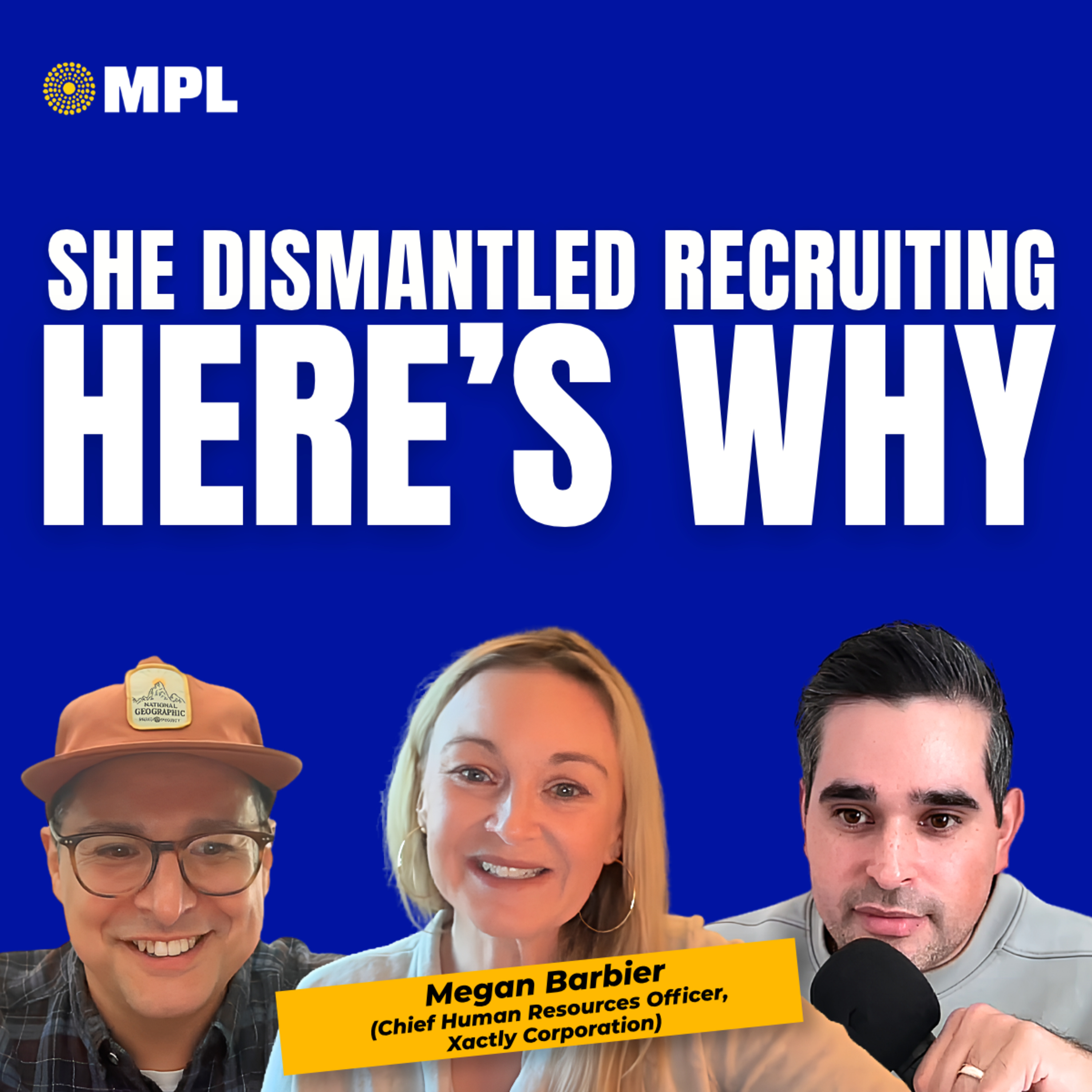
343 - This CHRO Dismantled Recruiting. Here’s Why: Megan Barbier (CHRO, Xactly)
In short
Megan Barbier, CHRO at Xactly, explains how she “dismantled” traditional HR recruiting by collapsing Talent Acquisition into “Talent Engagement,” redesigning workflows, roles, and the employee-candidate mindset. She frames it as an identity crisis for workers and a company-wide effort to pull down silos and connect strategy to execution.
Guest backgrounds
Megan Barbier grew up in a family business in rural California, has long worked in tech, and is motivated by fixing HR’s reputation (Dilbert-era “HR is the punchline” stigma). She leads HR at Xactly, an AI-driven sales performance company.
Key claims
TA shouldn’t be a separate function; engagement replaces recruiters. Hiring is being throttled and investment shifted to current employees. Change must be continuous (“no finish line”), guided by values (customer focus, accountability, responsibility, excellence). Don’t wait—enable “fail gloriously” experiments.
Notable examples
collapsing TA under HR business partners; removing the candidate/employee baton pass; pairing enablement/education with engineering; pairing customer and product under one leader; “high-slope talent” (brave, curious, growth-minded) as the hiring bar.
Written by AI. May contain mistakes.
Chapters
0:00
Redesigning Talent Acquisition
Explore how talent acquisition is evolving under talent engagement.
“We have collapsed and redesigned the talent acquisition as we know it.”
1:21
Good News Stories
Hosts and guests share positive personal and professional updates.
“I've been looking forward to this one for the last few weeks.”
2:00
Megan's Career Journey
Megan shares her career twists leading to her role at Xactly.
“So in the professional side, we celebrated at exactly our annual care week, which is this amazing manifestation of all of our values.”
3:00
Megan's Perspective on HR
Megan discusses her philosophy on changing HR's reputation and the importance of people in work.
“And so I've had to kind of, I've had to be the, uh, the person to kind of bear through it with poor little Joaquin.”
5:01
Intersection of Humans and Technology
Megan explains her fascination with the blend of HR, humans, and technology.
“So Megan, would love to just start with your story.”
9:41
Understanding Xactly's Core Business
Megan describes Xactly's AI-driven sales performance platform and its benefits.
“So exactly is an AI driven sales performance platform.”
11:28
Dismantling Traditional HR
Megan shares insights on her proudest moment of transforming HR practices at Xactly.
“And I would say, yes, I think even in the time that's passed, it is still my proudest moment, largely because it's something that's a little scary.”
14:02
Redefining Employee Engagement
Learn how talent engagement is being reimagined by breaking down traditional roles.
“rebrand it, we actually removed a number of roles and repurposed how our talent was operating.”
15:00
Mindset Shift in HR
Discover the importance of mindset in redefining identities within HR.
“I have the good fortune of working with people with a lot of like mental pliability where you're open to new ideas.”
16:05
Engaging with Boldness
Understand the necessity of bold actions in reimagining HR practices.
“And so before my instinct was to go straight into talent engagement and kind of dig into the changes that you made there.”
Show all 29 chapters
16:57
Removing Organizational Silos
Examine the approach of dismantling silos to foster collaboration and change.
“Like, did you there are some people that are that process and kind of hypotheses and waves.”
18:26
Innovative Team Structures
Learn about unique team pairings designed to enhance innovation.
“There's a product team and there's a finance team.”
20:31
Hyper Collaboration in HR
Explore the concept of hyper collaboration and extreme ownership in HR.
“Like in my head, I was imagining this house with like walls falling down or like getting lowered, the rooms rearranging.”
22:56
The Human Connection in Talent Engagement
Understand the significance of human connection in talent acquisition.
“just being willing to have a conversation to share.”
24:25
Surprises in Organizational Change
Discover unexpected insights and changes encountered during transformation.
“Like, it sounds like you went into this with eyes wide open sort of thing.”
25:10
Preparing for Future Challenges
Discuss the need for rethinking HR practices in anticipation of market challenges.
“And anything that surprises me is, oh, okay, that's shocking.”
26:48
Optimism in HR Transformation
Explore the optimistic view of the future of HR amidst change and challenges.
“And I guess like the two main themes are like one, we need to completely rethink everything and like redesign for the future that's coming.”
28:00
Preparing for Change in HR
Explore the need for HR to evolve and embrace upcoming changes positively.
“There's like this preparing for something that's coming.”
29:00
Dismantling Ineffective Practices
Discussing the opportunity to dismantle unfulfilling HR processes and connect people to meaningful work.
“Very few people love the administration.”
30:20
Navigating Change and Team Dynamics
Understanding the dynamics of managing change and meeting team needs during transitions.
“this beautiful part of the way companies operate into something that has a higher level purpose.”
32:00
Building Trust and Taking Action
Analyzing the balance between building trust and the urgency to implement changes.
“leaders and HR gurus, I feel like there's either those that are still arguing why I won't even go into the details.”
34:00
Vision for Continuous Evolution
Exploring the concept of resilience and the need for continuous evolution in organizations.
“And the other word that I refuse to say, I can't even say it.”
36:00
Identifying Core Values for Leadership
Highlighting the importance of aligning personal values with organizational goals for effective leadership.
“How do we make sure that we're having the right course trajectory?”
38:00
The Role of High Slope Talent
Understanding the concept of high slope talent and its importance in navigating organizational changes.
“to kind of influence design and execute the change at the magnitude that we're talking about because this is freaking big deal stuff, right?”
39:40
Engaging Talent in a Fast-Paced Environment
Discussing strategies for attracting and retaining talent in a rapidly evolving workplace.
“Like there's a whole list of things that would go into how I would define high slope talent.”
42:00
The Role of AI in HR and Employee Development
Explore how AI access enhances employability and career security for HR teams.
“That has been something that, you know, again, I've had team members join my team because in their previous organization, they were not allowed to, HR was not allowed to have access to AI.”
44:20
Identifying High-Slope Talent
Learn about the characteristics that define high-slope talent and how to spot them.
“So I have, I think we can, we can get through the other traditions pretty, pretty quickly.”
46:30
Shifts in Employee Expectations
Discuss the evolving expectations of employees and the importance of a caring organization.
“to have an organization that cares about its humans.”
48:40
Wrap-Up and Reflections
Conclude with rapid-fire questions and key takeaways from Megan Barbier.
“Like the FW, like now you know we're serious.”

Ask about this episode
Get the gist, explore an idea or ask about something said.
 Claude
On The Modern People Leader: Forward-Thinking HR, what are the key points of this episode?
Searching your listeningTranscript
Automatic transcript. May contain errors.
0:00Megan Barbier: We have collapsed and redesigned the talent acquisition as we know it. So we no longer have a standing separate TA function. This is now under talent engagement. And beyond titles and beyond names, because I don't think I'm the first person to, you know, rebrand it, we actually removed a number of roles and repurposed how our talent was operating. But all of that really comes into what I'm also calling this identity crisis. part of the biggest ways that I have to think about this change is not just do I redo the workflow and redo your title. I have to get you as a human to rethink about how you identify at work.
0:38Megan Barbier: So, wow, we don't have a recruiter. You're in the business of engaging talent. That could be a radical departure from your entire resume, right? So I think it's, it is, there is, there is a mindset aspect that it's critical to make sure that you're nurturing and that you're thinking about, not just, hey, everyone, take a look at the new org chart I, you know, happen to ideate on. This is where you sit on it. It's let me bring you along this journey. Let me inspire the shared vision of something that doesn't exist yet. You're going to be part of helping us build. You're listening to the Modern People Leader podcast, where we go behind the scenes with today's top HR leaders and work experts.
1:14We talk to them about how they've gotten to where they're at, what they do every day, and what they see coming next for the future of work. Hope you enjoy.
1:26Megan, welcome to the pod. How you doing?
1:29Megan Barbier: Hey, everyone. Nice to be here. Thanks for including me. I'm excited to chat with you today. I've been looking forward to this one for the last few weeks. So Steven, Megan and I met because she was one of the 30 interviews I did for the board and the research that I was doing. and when we were catching up she was sharing some of the radically different things that her team is doing and just like how they're structured and so I'm really excited for this one today. Before we get into any of that let's start with good news stories. I think you're familiar with the show so you know the tradition but yeah every each of us shares you know something either personal or work related just to kick this off on a positive note and we prefer for our guests to go first.
2:15Megan Barbier: Okay, well, I'll hit you with two. So in the professional side, we celebrated at exactly our annual care week, which is this amazing manifestation of all of our values. So I'm coming off of that high, where we take time, we volunteer as a team, we have all kinds of fun hackathons and other events to bring people together under our care value banner. So that is the afterglow of that last for a really long time. So I would say professionally, super great week last week. I'm still riding that high. And then personally, I was able to take a few days in Tahoe with my family. So we got the kayak out on the lake.
2:52Megan Barbier: I think we ate a lot of junk food, but I mean, nature's so rad. I just appreciated being out in it. So I love that. That sounds amazing. Tahoe is such a beautiful place. We have an aunt. So my, my, not me, but our kiddos have an aunt so Sarah's aunt great so it's my kid his great aunt lives in Tahoe and we have like a running invite to go ski out in heavenly but we haven't done it yet I'll go next I've had like bad news week uh so if you're wondering why I'm like such a big sigh I'm maybe my son will break his fever today it's the third day of fever my wife is also starting a new job so she's like having all these last interviews, they're old company.
3:39And so I've had to kind of, I've had to be the, uh, the person to kind of bear through it with poor little Joaquin. But yeah, there's a light at the end of the tunnel, I guess is my good news.
3:51Megan Barbier: Oh, that's tough when they're little too. So yeah, good, good, good trend is, is happy to hear. Also very relatable. Lena seems to be sick like every week. And so, yeah, I understand the big sigh. I feel like I've had a couple of weeks like that in the last month or two. My good news is that this is a short week for me. So tomorrow I will be leaving to Florida and my best friend is getting married. So Stephen Clausen, who you know, is getting married this weekend and all of the friends are going to be out there. And so I'm going to see some people that I haven't seen since college, which I can't believe I'm saying this was 10 years ago that we graduated.
4:34So it'll be a nice little reunion and we're leaving baby Lena behind. She'll be with the grandparents. They're splitting the weekend. So my parents are taking a couple of nights and my wife's parents are taking a couple of nights. And so it's sad on one hand to be away from Lena for the weekend, but I think it'll be kind of nice to like sleep in for once and yeah.
4:57Megan Barbier: Have some adult time. Have some adult time. That's right. That's right. And don't feel guilty. That's important too. I'll tell my wife that after this. So Megan, would love to just start with your story. Yeah. Take us through some of the twists and turns throughout your career and how that all led to you becoming the now CHRO at Exactly. Yeah. I mean, we'll start at the beginning because I think it explains a lot. I mean, if I have an origin story, it's probably this one. My family is from a very rural part of California and we own and operate a family business. So I've literally been in the workforce since before I could walk.
5:33Megan Barbier: I mean, it's been ingrained in me. And I think something that's really always pulled my attention and I've gravitated towards the people's side of what makes work work. And so even from an early stage, I think I always knew I wanted to be in the field of HR, which is a little bit different than, you know, some people that find the career or find the field and they stumble upon it. I just felt like this was always somewhat of a calling. I also grew up in the era of the Dilbert cartoon. I don't know if you guys are... Y 'all are going to have to educate me. I'm sorry. Yeah. And it was like it was this tragedy that HR was the punchline to work.
6:08Megan Barbier: And so I have this allergic reaction to the, you know, frankly, like we've had a somewhat notoriously bad reputation in the professional setting. And that's always really bothered me. And so I don't like to be a victim of anything. I like to say, okay, well, how can I change that? And I think that's literally driven... every career decision I've ever made? How can I change the way that people feel about HR for the better? And if I have to do that single-handedly, if I have to do that one role at a time, I will do it. But that's been something I think that would explain a lot of my choices. Another thing that I think is, you know, looking back now with the benefit of years is seeing that I love this intersection of humans and technology.
6:50Megan Barbier: So I have been in tech my entire professional, my entire professional career. And it's not because, oh, I happen to be in California near Silicon Valley, and it's just been, you know, infused in me. It's actually where I feel like this is the big call for humanity. Like, how are we going to use this amazing trajectory for where the technology that we are building is taking us? What does this mean? What is the art of the possible? And so that's always really, really lit me up. And I think another third thing is that I get bored really easily. I don't know if y 'all can tell that, but this is left brain, right brain work that I'm always challenged with.
7:26Megan Barbier: So it is an art, it is a science. And I know other functions can say that other practitioners can say that, but it's not as real as it is in HR. I really think that those two hemispheres of my brain need to be actively going. So as I'm going through this, learning about myself as a professional, I've gravitated also toward places with really smart, nice people. And I absolutely found that at exactly. So I have the privilege of working with amazing leaders that will be engaged when I ask the orthogonal question, they see the value of what the people function can do, and permission to get creative.
8:02Megan Barbier: And so I feel like there's been this really kind of natural arc that has led me to this point where wow, I get to be with this amazing leadership team with this amazing team of HR and business professionals. Oh, and it's at the intersection of human and technology. Oh, and it's very AI forward. I'm literally walking on a cloud. I'm about a year in, so I feel like the honeymoon phase has worn off. But that's a little bit about my thought process and how I got there. But we can go into all kinds of detail if you find that would be helpful. We definitely want to go in more detail before we do that, though, for people that maybe haven't heard of exactly, like, how would you describe the core business to a stranger.
8:43I feel like these days, Cloud and ChatGPT can get you surprisingly far in HR work. And they're great. Until you need live people data, or you need data from performance, comps, surveys. Then suddenly you're exporting CSVs, you're explaining the company's entire history, and you're figuring out what's actually safe to share with who. And that's the gap that Shapes is closing. Shapes basically brings that AI experience directly into the HR platform with your live people data, your org context, and your existing permissions built in. So instead of jumping between systems, people teams can build things like a flight risk dashboard, a reorg simulator, a calibration grid, or a completely custom workflow or visualization.
9:28You just describe what you need and Shapes builds it from the people data that's already there. It's kind of like Claude and your HRIS had a baby. If you want to see what this actually looks like in practice, go book a demo of the shapes. You can find a link in the show notes.
9:43Megan Barbier: We should start there, right? Yeah. So exactly is an AI driven sales performance platform. And so beyond all the fun stuff that goes into processing commission payments, we have this amazing revenue intelligence layer that provides things like territory mapping and quota planning. And it's all in the service to ensure that leadership has alignment between the incentives that we're offering reps to make sure that they're lining to revenue targets. So the AI motion has been a major unlock, like the things that we can do, we have over 20 years of data that we have been building since the inception of the company that now we get to deploy in service of our customers and our partners.
10:21Megan Barbier: So it's, it's really cool to see the impact we can have. Yeah. You're talking to sales guys here. So maybe we'll have to set up a separate call where you give us some of the secrets. I would love to demo this for you guys. Like it's really, really cool. It's really cool. Cause the idea is like, how are we actually, you know, moving away from my, one of my least favorite words is like management and managing we're orchestrating. So it's this idea of how can we use technology to impact decisions versus how can we look back and analyze what happened? We're actually driving those changes now, which is exciting.
10:55It's funny hearing you say that like, you don't like words like management. I feel like that's like almost like the perfect segue into today's conversation. I feel like you think about everything slightly differently than most people in HR. And I remember when we met, I don't know, month ago, month and a half ago, feels like three months ago, you were sharing how your proudest moment in the last 12 months was dismantling HR as you knew it, coming up with a new vision and making it real. So let's just start there. What expand on that? What does that mean? And what does that look like?
11:30Megan Barbier: Yeah. And I would say, yes, I think even in the time that's passed, it is still my proudest moment, largely because it's something that's a little scary. And it's a little bit of a foot into the unknown. But as we're looking through, you know, we have this focus at exactly on building the workforce of the future. And a lot of people say that I feel like that's a bumper sticker I've seen now sitting in traffic looking. How do I actually, what does that mean? Right. And so going into like, what does the workforce of the future look like? And I think we have an opportunity at this juncture, regardless of what industry you're in, whether you're in tech or not to say, well, how do we connect people to meaningful work and how does the work get done?
12:09Megan Barbier: And so for us in our situation, you know, we're taking a look and being really thoughtful and intentional about throttling hiring and turning that investment on our current employee base. That's a really bold move and it takes a ton of commitment. That's not just HR on its own out there saying we should change this path. It's getting alignment across your entire business and your board and your shareholders on how you're going to execute around this. And so when we think about what it's going to take, not just to thrive and survive right now in this moment, but how are we building something that's sustainable with longevity?
12:42Megan Barbier: We're looking across ways that we're doing work. We're looking across things that were built in a bygone era. And I think for me, I woke up and realized that bygone era was like a year ago when I started. We're already into the next. And so, you know, permission to look and say all of these things that were stood up for things like hyper growth or for this like really traditional SaaS model aren't necessarily going to serve us going forward. I think it's just having that permission to kind of challenge the day to day and step out and pick your head up and say, all right, here's what we're looking at.
13:13Megan Barbier: So this was a little bit of the spirit that was alive and well, or that is still alive and well, that kicked off a pretty radical redesign. And it wasn't just, oh, you know, we're going to talk about a new role, we're going to talk about a new workflow, we actually started dismantling, what is it that we need? And, you know, PS, we're no exception, like resources are constrained, we're working with a finite budget, we're working with a finite timeline, how do I get the most impact out of all of this. And so a couple of big things have happened, I think, even in the last three to six months. We have collapsed and redesigned the talent acquisition as we know it.
13:51Megan Barbier: So we no longer have a standing separate TA function. This is now under talent engagement. And beyond titles and beyond names, because I don't think I'm the first person to rebrand it, we actually removed a number of roles and repurposed how our talent was operating. So instead of saying, hey, we have this phase of the employee life cycle where you are a potential and then you're going to move in, we're going to do this baton pass to the business partners once you cross that line from candidate to employee, we've disintegrated that line. And so now you are a human and we're going to engage with you.
14:28Megan Barbier: And maybe you're a prospect now and maybe you're a potential candidate in a workflow or maybe you're someone that we find very interesting that we'd like to talk to. Maybe you're a former employee. It doesn't matter. You're a human. And we're going to introduce you into this process under this banner of talent engagement. And so beyond just like the fun words and getting the rebrand going, we actually had to redesign everything from the big philosophy on how we connect with people, but also into like the minutiae of the workflow and how our systems are set up and how the fields in those systems are operating.
14:59Megan Barbier: So this is something that we are now about seven months into, and it's been surprising. I will not say it's been easy. I have the good fortune of working with people with a lot of like mental pliability where you're open to new ideas. We're going to try something together. We're going to fail gloriously. We're going to share what we're learning. But all of that really comes into what I'm also calling this identity crisis. Part of the biggest ways that I have to think about this change is not just do I redo the workflow and redo your title. I have to get you as a human to rethink about how you identify at work.
15:35Megan Barbier: So, wow, we don't have a recruiter. You're in the business of engaging talent. That could be a radical departure from your entire resume, right? So I think it is there is a mindset aspect that it's critical to make sure that you're nurturing and that you're thinking about, not just, hey, everyone, take a look at the new org chart. I, you know, happened to ideate on, This is where you sit on it. It's let me bring you along this journey. Let me inspire the shared vision of something that doesn't exist yet. You're going to be part of helping us build. And so before my instinct was to go straight into talent engagement and kind of dig into the changes that you made there.
16:13But zooming out, this is the second pod in two weeks where we've had a guest who reimagined HR. In one case, it was a board mandate. In the other case, it was like, you know, this feeling of like, hey, we could be doing things, you know, drastically different and not really having strong ties to the ways of the past. And, you know, it sounds like you see what's coming. I think we all see what's coming. And if you are bold enough to kind of take that, take that and run when there's feels like there's so much at risk, but there's like an excitement in your voice, just like with Andy, the person we interviewed last week.
16:54And so I want to start with like, you know, did you when you were, I guess, pitching your CEO on, you know, we were going to dismantle what we had and we're going to we're going to build something new and it's going to be better. Like, did you there are some people that are that process and kind of hypotheses and waves. And there are other people that like, you know, want to they know how they're going to remodel the entire house because they've lived in that house, you know, for a long time. Which case was it for you? Were you like, hmm, let's take kind of a test orientation or like, did you already have it remodeled?
17:30Megan Barbier: Oh, wow. I think it's a little bit of both. Not to cop out, but I feel that I saw what was coming and I kind of needed to get a leap of faith going. And the way I've explained this is that there is a growing drumbeat around collapsing the distance between strategy and execution. and the more layers, that's one aspect that you have can really disrupt that. But I was looking at our organization from, it's not even layers, right? If I say, oh, we should take some layers out. I feel like if I thought about that a year ago, I'm probably not thinking about it progressively enough, right? Like, of course, you take a look at your spans of control and all your layers and see how many managers you have.
18:10Megan Barbier: That's not going to get the job done. I actually want to take down the walls of the house that you are talking about because I think it's those areas, those silos, I think are the biggest inhibitors to change. One, because they're so comfortable, right? Like this is what we grew up with. This is how I've always operated. There's a product team and there's a finance team. There's an HR team. We are actively pulling down all of those walls. Now it doesn't mean that we won't put up other little pony walls or divide. I mean, we can get into construction all day long. I'm happy to go into like the specs of it, but it's more about thinking, how do I want the rooms within this house to work?
18:45Megan Barbier: Because if we have this separated, I'm finding that is the bigger inhibitor to actually moving quickly to impacting change. It's less about the layers and it's more about how people are moving around the org. And so what I think is really fortunate is that I have some like-minded executives that are working on this as well. And this change is happening simultaneously throughout our business. We're having these conversations at the executive level. We evangelize it with our board. They've been really supportive, but we're taking this on our own to say, you know, for example, we're putting together what I think are somewhat novel and creative pairings that I have never seen before.
19:22Megan Barbier: So we have our enablement and education function now sitting in our engineering work, right? Like if someone has done that, I would love to talk to them. And this wasn't accidental and it wasn't a desperate choice. It's because, well, I actually need the people that are building this to understand how this is rolling out into the real world. And I need to like remove all these different formalities between that. We have our customer group sitting with our product group now under the same executive leader, and it is now innovation and adoption because it's not so much who has what title and who has what pedigree or who has what skill set.
20:01Megan Barbier: It's about what are we trying to do? Well, we're trying to innovate and we're trying to adopt. You have a different conversation when you put those things together. There's a lot of great tension. There's a lot of great dialogue. But ultimately, it's less about who owns what function. It's like, well, what change can we impact? How do we deliver for our customers? How do we actually show up in a way that means something versus how do we have a best in class, you know, title and job architecture for something that existed three years ago? That doesn't matter. I feel like you painted such a good picture.
20:34Like in my head, I was imagining this house with like walls falling down or like getting lowered, the rooms rearranging. And so what I'm hearing is it's not just a transformation within the people team. This is a company wide thing. Everybody is redesigning the rooms and the way that the work gets done. You know, coming back to this transition from TA to talent engagement, I think when we last caught up, you were sharing that now the sourcing, engaging, and closing all sit under the HRBP team. And I actually heard this a second time today in a prep call we were doing for NPL Live. And so why do you think this new model is catching on?
21:21And what does that look like? How has that change been going?
21:25Megan Barbier: Yeah, I mean, I think overall, it's net positive. And I also would say I still have a lot to learn. There's things I would do a little bit differently. So some of the things that were positive, surprising that we actually maintained our metrics. So I was expecting, hey, you know, I braced our hiring managers around, we may have some lag, we may have some, you know, protraction of what we're targeting for time to fill. Those metrics are staying on track, which is really, really fascinating. I feel like part of that is due to the fact that I have a team that's very committed to quality and excellence.
21:57Megan Barbier: And so they're pushing hard to make like they can't let this fail. Right. So they're going to put everything they can towards it. I also feel like we're taking out some of the complexity. And I believe that the biggest kind of foundational piece that I am seeing come online now, I still have more to go, is getting people to envision their ownership of this. Where I think one of the blockers before, and again, I'm speaking for myself, it may resonate with others. If I'm a recruiter and I'm an HR business partner, or I sit on the HR op side, I have my square and I'm responsible for this square. And I actually kind of deprioritize the squares of others, whether it's because someone's already covering it, someone's already on it.
22:39Megan Barbier: It's in a way, this extreme ownership across this area. Like we actually need to stop thinking about it as I own this plot. We now need to think about it. What is the human experience when they come into contact with us? And how do I impact that in the best way possible? And so, you know, hyper collaboration, I think is something that helps this process along, just being willing to have a conversation to share. I think we probably have a drinking game around how many times I use some kind of form of racy model, right? Like who is responsible, who needs to be consulted, who needs to be informed.
23:13Megan Barbier: But that basis is something, a language that we're aligning on where maybe you own the work, but let's be clear on who owns it, but let's be clear on who participates in this because it's different than it was even a quarter ago. So I find that it's in some ways, it gets a little more complex before it gets easier. But when the dust starts to settle and people get into this motion, you just are having an elevated conversation. And I think we're ripe for shaking that up. I think a lot of the talent acquisition motions that I know I've run for the last decade have been around hyper growth in SaaS.
23:46Megan Barbier: And there's a cadence to that, right? There's a grind that you put toward that. I do feel that we're shifting out of that on a lot of levels. And what is left, right? So what's the meaning of why we engage talent, how we understand what people need to connect with an organization? Why am I any different than another company that does the same thing? Well, that human connection becomes highly valuable. And I think companies that are re-envisioning this are looking for ways to optimize for that. And I know that's something we're seeing early signs of in our own change. When you were presenting or like, I guess, looking at all your findings and feedback from the team, you know, were there any changes that like surprised even you?
24:26Like, it sounds like you went into this with eyes wide open sort of thing. And I'm just curious, like any surprises to you or maybe even your CEO, like suggesting we do what? I'm just curious, like what were the biggest, the biggest kind of surprises.
24:40Megan Barbier: Yeah. I mean, for others, they all had a poker face. No one seemed like, okay, like I get it, you know. So I didn't get any, you know, shock or reaction. I certainly feel a pretty big onus that I'm putting on myself. Like I need to prove this is working or I need to prove it's not quickly, right? You know, we're kind of making a bet that I will be willing to double down on. I think that one of the bigger changes that was, oh, oh, I've never seen this before. Is our enablement an engineering side? And I think that that's been something, again, I don't know if I would have come up with that. And anything that surprises me is, oh, okay, that's shocking.
25:15Megan Barbier: But again, there were a lot of natural, cross-functional, unofficial touch points between those groups that were kind of in place anyway. And we took a look back and it wasn't so much HR coming in and saying, we need to redesign all this for the sake of being you know, progressive. It was more about, you know, as a leadership team, having the ability to have a dialogue. I think that's critical. You're not going to get this change done if you can't discuss this with your first team. And I think, you know, looking at friction points, what's tripping us up? What do we seem to keep coming back to?
25:47Megan Barbier: Or what are the themes of the rubs that we keep talking about in senior staff? Well, what if we actually targeted those areas of friction and harness them for, you know, positive, positive discourse or, you know, positive dialogue and then what are ones that like this doesn't even make sense why do we have this separate from the other team where these could start working together so i know i think daniel when you and i were talking i'm always equating this to like peanut butter and marshmallow where there's these two great things they are seldom put together but then someone on my team told me there's this thing called a fluffernutter which is a sandwich where you put these together so i guess i wasn't someone else thought of this i don't know who they are i like the cut of their jib though.
26:28I've heard of a flubber nutter. I've never had that. It sounds weird, but I have heard of it.
26:33Megan Barbier: But I'm like, I could see where this would be good. And then you dip it in chocolate and then you blow the doors off all of it. But I do think like there's that marshmallow and peanut butter effect. Like, oh yeah. As you know, Megan, we've been, you know, I've interviewed close to 40 CPOs off the record the last month or two. And I guess like the two main themes are like one, we need to completely rethink everything and like redesign for the future that's coming. And two, there's like this, it feels like we're like in the, everybody seems to be prepping for like a tough winter. I don't know a better way of putting it.
27:13Like feels like there might be some challenges to come in the next 12 to 18 months. And every company seems to be preparing for this. And so So when both of those are true, you need to rethink how the work is designed, how you do everything, but also you're working with maybe less resources and there's a real sense of urgency. And it's just like, how can we make it through these next 12 to eight months? I'll just stop there. Is any of this resonating?
27:49Megan Barbier: Yeah, yeah. I feel it. And I think that's a really interesting ethos. If I look back, you know, if I'm clinical about what we're going through right now, when I look back, that is going to be an ambient temperature of this particular era, right? There's like this preparing for something that's coming. I will say I subscribe to that. The world of HR as we know it is going away. Doesn't mean that we are out of a job. It doesn't mean it's not important, but I think it has to change. And I think it's also, and again, I'll own it. I'm an eternal optimist. So I'm going to take it as like, well, maybe we're preparing for summer.
28:24Megan Barbier: Like maybe it's actually not winter. We're preparing for something. And I think this idea of what could this become? Let's go back to the Dilbert cartoon or like every time HR was a joke. Well, we're not showing up adding value. This is our moment. Oh my goodness. What better function could there be to lead an organization into whatever season we're going into? Because it's going to look different. I think that's a little bit of the anxiety or the fear or the questioning. Another piece too, right? How can we think about this in a really positive opportunistic way? All that admin, right? No one ever loved the administration.
29:00Megan Barbier: Very few people love the administration. They are precious and they are rare and they are valued. Most people don't love this. Well, what better opportunity in my lifetime, I've not seen one, to dismantle all those parts of work that are necessary, but unrewarding and unfulfilling, right? Like this is the opportunity to connect people to meaningful work. So for me personally, I'm really excited about that. And I think at some point, like I want my excitement to be contagious. I also pragmatically have to say, I need to be thoughtful around stepping people through this change because in years past, I could say, or in a bygone era, I could say, we've done it, high five, change, we did it, we made it through, that I don't get to say that.
29:41Megan Barbier: It can change again. And so now I'm thinking about resiliency. I can't give you stability. I can give you growth. I can give you a great resume build. I can give you a great experience. I can give you a space to fail gloriously. I cannot tell you, good, we're done. Now we're here and you get to sit in the normal. That is a setting on your washing machine. It is not a thing that I think exists in tech right now. I agree. I think we're entering a turbulent period. And for many, I think change is an incentive or it's an excitement like, hey, we can finally evolve like this beautiful function and this beautiful part of the way companies operate into something that has a higher level purpose.
30:34And, you know, for years, I at least 20 because I joined HR in 2000. And I just remember for as long as I've been in HR, conversations that are kind of rooted or centered around like when we are finally a strategic function or when we no longer when we kind of break the chains that have held us back in the past. you know blah blah blah blah insert kind of utopian statement and it's been such an interesting few years for me because I pretty quickly was like oh shit everything's about to change and and there was a year of like no not everything's good like no like no one's actually using this and no like companies aren't actually you know finding ways of like radically transforming their their organizations and then there was like oh shit yeah like actually you know change is happening fuck excuse my language and then it became uh well you know you don't want to change that way do you it was like then there was like with like knee-jerk reactions to that and it's just been one thing after another.
31:56And if I go to my LinkedIn feed, which is pretty much dominated by HR and HR leaders and HR gurus, I feel like there's either those that are still arguing why I won't even go into the details. There are two camps and they're very divided. And meanwhile, companies, the courageous ones are jumping in and changing. And so I think, you know, going back to your comment that like you felt a need to change, you felt excited and ready for change, but you also knew that you had to meet your team. My words, not yours. You need to bring people along, meet your team where they're at, meet the company where it's at.
32:36Tell us a little bit about how you how you work through that, because honestly, I struggle with that. I'm a bull in a china shop. And if I don't, as Daniel knows, if I don't see change happening, and I know there's an imminent threat or need for change, like I will go in and I will change if I'm part of if you want me part of the team. And so I'm just curious how like those, I guess, more eloquent than me are handling kind of these big changes. And they're big. And there's a lot of fear tied to it.
33:07Megan Barbier: Yeah, you and I are probably a very dangerous combination. I definitely am an agent of chaos more often than I probably own. But I do think, you know, this is one of those areas, right? You if I could go back, you know, 90 days or, you know, six months and say, well, what would I do differently? I war with this internally, right? There's this idea of, well, let's, you know, really lay the foundation, let's build trust. And I'm not dismissed. These are really essential things to impact and lead, lead change. I also think that I don't have the luxury of time. And so I may need to go forward in this without having a perfect solution or with still having some blocks of trust that I'm going to need to build as we go.
33:46Megan Barbier: And again, I can second guess and go back and say, well, maybe I should have slow rolled this a little bit more. But ultimately, it's so funny. I heard you drop an F-bomb and I'm totally cool with that. I only have one, well, I'm adding like two cuss words. There's the S word, which is S-I-L-O. We don't silo. No. And the other word that I refuse to say, I can't even say it. I'll spell it. W-A-I-T. so my team knows this is a four-letter word don't you dare say it pick a different verb pick a different action we do not wait and I feel like that is something and I that was me since forever so I feel like that's serving us really really well in this time like don't wait if you're unsure do it anyway if we can't win like let's learn if you have a question let's talk but we cannot wait.
34:37Megan Barbier: And I think, you know, the best thing that I look back and say, well, maybe the best thing I've done is like, give my team permission to do this, because there will always be a reason not to. And I would much rather create a space to say again, like fail gloriously, like I'd rather you try and have this totally blow up as long as no one gets injured. And you know, we don't offend a customer, you know, create a detrimental situation for someone that we really care about, then we're okay, we can repair this, we can course correct, and we can come out better on the other end. So laying the groundwork, that's how I've how I've approached it.
35:10And so going back to the to this idea that, like, you know, the company's under construction, and you've started to knock down some walls and rearrange the rooms and make all of these, you know, these small changes, like how much more, you know, do you have to go? Would you say you're like 50 % of the way there? Do you feel like you're getting close or is this something that's just going to be nonstop going forward?
35:38Megan Barbier: Yeah, I cannot. I'd like to say I really don't know. I suspect that this is a state of evolution that we're it's going to be dynamic. I don't think we finish. And that's also a visual that I'm trying to paint for my team. When I think about resilience, it's not like this horizon that we get to when we're done. It is something that we are still driving towards. So how do we shore this up? How do we make sure that we're having the right course trajectory? But I don't think our year of change is over. Now we enter the period of calm. I do not see that on my horizon for myself or for my team. If we stop evolving, I really do think we become stuck, we become irrelevant, or we risk getting steamrolled.
36:20Megan Barbier: And so again, I have a really high sense of urgency around this, where it doesn't mean that we have to be running at breakneck speed, But we need to be constantly working and constantly questioning, you know, is what we're doing correctly. I will say, and I've paid a lot of lip service to this over the years in various roles. We talk about values and we have all these, you know, jokes about everything up on the wall in a, you know, beautiful acronym. This is where your values come into play. because if I am in an uncharted ocean and I am going to a never reachable horizon, what's guiding me? Okay, well then that's where we can take it back and say, well, what really matters?
37:00Megan Barbier: Well, for us, it's customer focus, it's accountability, it's responsibility and excellence. If I'm ticking those things off, that's good. It may look different and that actually is healthy for us to question, but it doesn't mean that we're changing course all the time. It means like we're picking a different guidepost because that is the one thing that's stable. And then taking that another level, if you are a leader and you have not really aligned with at least one core value of what matters to you as a human, please go do that now. Because without that, it is, you'd lose your mind. Or I would lose my mind.
37:33Megan Barbier: You need to know what matters to you because I'm not going to get all of this right and my team is probably not going to get all of this right. When all of this kind of goes into the next cycle and we look back here, what can we be proud of? what can we put our name on and what can we look ourselves in the mirror and say okay I spent my time well if you don't have that that compass you're going to be really really struggling to feel good about what you're doing because this is going to get tough like this is this is not getting easier anytime soon let's talk about the kind of team you need to have around you to to kind of influence design and execute the change at the magnitude that we're talking about because this is freaking big deal stuff, right?
38:18Taking your recruiting team or your talent acquisition, whatever you called that before, and like literally boiling that down to a single recruiter and, you know, rebrand to talent engagement and a whole host of procedural and process redesign around that. Like that's a big freaking deal and you're moving fast and you're having to show value in increments and margins. And so to me, like the team is going to make or break success, like, you know, no matter how sharp your HR leader is. So tell us about how you have built the team around you. And, you know, you mentioned something called high slope recruiting, I think is, is high slope talent.
39:03And, you know, explain that to us as well. Yeah.
39:06Megan Barbier: So I will say this is not high slope talent is not my concept. I learned this from the amazing Heather Doshay. If you've not talked with Heather, you absolutely should. And she subscribes to this concept of high slope talent. And I am 100 % like I am drinking that lemonade all day long. And it's this idea of what performance looks like and how do you have people that are, it's kind of like growth mindset on steroids. And, you know, I'm probably like not articulating it as nicely as Heather can. But it's this idea of how do I move forward? How do I persevere? How do I try something new? How do I expand my value?
39:45Megan Barbier: How do I take initiative? How do I own my own outcomes? Like there's a whole list of things that would go into how I would define high slope talent. if you have even one of these team members on your team, you're going to do okay. If you can build a team around this or have critical mass of high slope talent, you're unstoppable. And I think that this era that we are in, this intersection, that high slope talent has outsized value on so much of what you need to do. And so if I look at what does high slope talent look like, it doesn't necessarily mean that it is a career climber because P.S. those ladders are going away.
40:21Megan Barbier: I fully see that no matter what function you're in, this linear path upward is not going to be the only way and in fact it might be the one of the rare ways that you grow. You're going to be growing and expanding your scope and doing things outside of what your resume may have historically dictated what you would do. High slope talent is hungry for this. They're hungry for growth. They're allergic to standing still and being static. So when I think about what I need in my team, and this is what I'm fortunate to have some high slope talent in my group, I think this is a major unlock for anyone that's navigating this right now.
40:56I can't remember who said this on the podcast recently, but they were talking about how now every company should almost be thinking about themselves like a sports team, like a professional sports team. And you have to get creative in how you're going to attract and keep the best talent. And so I'm just curious, how are you thinking about this? What?
41:18Megan Barbier: Yeah, I get it. This is I'm always rethinking it, too. So I welcome ideas. And I'm always looking to see, you know, where others really, really nailing this where, you know, we want to close the gap. I think for what we're seeing right now, and I have this on my team as well. There are people that are joining that are choosing to engage and participate and have exactly as part of their career growth is this idea of we are an AI forward company and you will move fast here. You will find a group of lovely people to work with and you will absolutely be adding to your resume. You will get your hands on and you will have access to AI tools, development, enablement, opportunity.
41:56Megan Barbier: And I think for the right type of talent, that resonates very, very deeply. That has been something that, you know, again, I've had team members join my team because in their previous organization, they were not allowed to, HR was not allowed to have access to AI. And so that right there is a huge selling point for us. So I do think that that opportunity, and I think in a, I guess in a really kind of, kind of crass way to say it, it's job security, not necessarily your job, but it's your employability for the future. How can I equip my team members to be MVPs in the workforce of the future? And that's how we approach our engagement.
42:36So I'm hearing it's the selling point is career security. You're going to come here and do some incredible things and you'll be able to put that on your resume. And in 10 years, we're going to look back and there's going to be like five chief people officers that came from the exactly people team.
42:51Megan Barbier: That would be kind of awesome. And what are you looking for when it comes to high slope talent? Like how do you identify that in somebody? Like are there like some characteristics that you're trying to spot when you're interviewing or you're looking at across the team? What should people be looking for when it comes to high slope talent? Yeah, I mean, there's always different flavors of it. For me, I'm looking for people that are brave and curious. So you don't need to be fearless. You need to be brave. There are things that we do not know. You may be scared or intimidated. Guess what? We're going to go for it anyway.
43:26Megan Barbier: And so I think that there's a willingness where I'm looking to have people modeling that behavior. I'm also looking to have people challenge me. Like I said, like, you know, I'm a chaos agent. So I'm very open about needing structure and people holding me accountable and people challenging me when they feel like it's not the right direction. And I think that if you do not surround yourself with at least some aspect of that, you're going to get really insular as a leader. So I think high slope talent in the interest of, hey, you know, we're low politics. You know, there are no bad ideas. Your worth is not assigned to what level you are in the org.
44:01Megan Barbier: You're here and part of this team because you add value. So bring your value. Don't wait for me to invite you. Bring your value. So for me, that's one really critical attribute that I'm looking for, not just on the HR or the IT teams that I lead, but also outside of that in other parts of our organization as well. I feel like we're just getting started, y 'all. And I'm the one with a hard stop. So I have, I think we can, we can get through the other traditions pretty, pretty quickly. So Megan, I guess my last question for you is, you know, how, what does tenure look like today? And I, you know, as I heard you describe how you are becoming a talent magnet and how you are approaching, you know, bringing on the right people onto your team.
44:50I just thought about, because I've gone through a job search. I'm going through another job search a lot faster than I thought. The first, you know, due to unforeseen circumstances, like it just didn't work out. And just like I am, I move quickly when things are working or going the right direction. I also move quickly if I can like see things aren't. And, you know, as I was like listening to you, I was also just thinking about like, what are the things that I am looking for? And you hit on so many of them. Like I, if you are not describing a work environment where I have whatever tech stack I need to work in AI and work with the tool set and, you know, just the flow that I'm used to working.
45:37And Daniel and I are all, you know, I still rate myself like a 7 out of 10 on the proficiency scale. We may be a little higher than that. But I, so you have to have that. And just like in the timeframes that companies speak in also, like if you were speaking in like two, three, five years, like what once would have like attracted me to that, like that would have been attractive to me like 10 years ago. So today I'm like, ooh, is this company out of touch? Because like that is just like no one, you know, in the five months that I've worked at a AI native company, like no one thought in increments, like no one spoke in increments that big.
46:21And so I'm just curious, like, you know, what do you think people are looking for? What do you think companies are looking for in this turbulent time?
46:28Megan Barbier: Yeah, I mean, I think for an employee, if I'm looking, I think it matters more than ever. to have an organization that cares about its humans. And I mean, really cares, not just say they care and not just put it on the wall, but really, really treat their people well. And they care about the value that humans bring. Not every company is like this. I'd like to think most are. And then I think the question on tenure, yeah. I mean, I think that the timelines that we've operated on historically, permission to rethink those. Yes, I will deliver a three-year plan to my board because that is expected.
47:00Megan Barbier: And I will be having my team operate in three week to three month sprints because it's just moving so quickly. Well, Megan, I'm going to skip a couple of rapid fire questions because I know we have a hard stop. So I've got a couple of rapid fire questions for you and then one word or phrase close. You ready? I'm ready. All right. First question. What's a strategy or practice from another company that you'd love to steal? Meeting free day. Love it. And then who do we need to have onto the show next? Oh, this one's tough. Okay, you've already talked with Heather Doshay, but you should talk with her again.
47:33Megan Barbier: She's amazing. Courtney Cherry Ellis is doing amazing things over at Sol. Talk with her. And Sophie Hurcombe, Lattice, she and I have both recently taken into leading IT and business systems teams alongside HR. Fascinating. We're on the journey together. She is phenomenal. You want to talk to her. Yeah, I follow Sophie on LinkedIn and had seen that, but I love that recommendation. That gets us to our final tradition. We call it one word or phrase close. We prefer for our guests to go first. So a word or few just to wrap up the last little less than an hour we spent together. Yeah, I don't know.
48:09Megan Barbier: The word moxie is bubbling above my head in this big thought balloon. I feel like that's an apt call to action. It's an apt summary. and then I would also say stop waiting if you are waiting you are doing it wrong even what do you got all I heard was stop waiting and I all I think was that and I dropped an f-bomb earlier so I'm gonna go with fuck that yeah like stop waiting get get with it I the word that's in my my mind is uh like expand like expand the possibilities like there's there's so much that you can do and just stop waiting and fuck waiting or whatever Stephen just said so yeah that's waiting.
48:46Megan Barbier: Yeah, put the two curse words together. It's like a super curse. Like the FW, like now you know we're serious. Well, Megan, this was so, this is so fun. Thank you so much for joining us and we would love to have you rejoin us in the podcast again one day. Thanks so much. Pleasure to chat with both of you today. Loved it. Sorry to rush the chat, y 'all. No worries, David. Okay, bye. Thanks for tuning in to another episode of the Modern People Leader. We really, really appreciate it. And if you enjoyed the show, please leave us a five-star rating. It would mean the world to us. And connect with us on LinkedIn.
49:22We want to know what you think about the show, and you can find links to both of our profiles in the show notes. Thanks again for listening, and see you on the next episode.
From the publisher
Megan Barbier (CHRO, Xactly) joined us on The Modern People Leader.
We talked about how Xactly is dismantling traditional HR structures, replacing talent acquisition with talent engagement, and rethinking how teams collaborate in an AI-driven workplace.
Megan also shared why high-slope talent matters, how leaders can build a culture of continuous change, and why meaningful work and career growth are becoming more important than traditional job security.
----
Sponsor Links:
MPL Links:
----
(09:30) Why Dismantling Traditional HR Was Megan's Proudest Achievement
(10:35) Throttling Hiring to Invest in Existing Employees
(12:00) Eliminating the Traditional Talent Acquisition Function
(12:25) Replacing Talent Acquisition With Talent Engagement
(13:40) The Identity Crisis That Comes With HR Transformation
(16:00) Collapsing the Distance Between Strategy and Execution
(17:00) Breaking Down Silos and Removing the Walls Between Functions
(18:00) Why Xactly Moved Enablement and Education Into Engineering
(18:35) Combining Customer and Product Teams Under Innovation and Adoption
(20:15) Maintaining Hiring Metrics During the Transformation
(21:15) Shifting From Individual Ownership to Shared Human Experience
(23:00) Why Human Connection Is Becoming More Valuable
(27:40) Why HR as We Know It Is Going Away
(28:35) Eliminating Unrewarding Administrative Work
(29:20) Why Leaders Can No Longer Promise Stability
(33:05) Balancing Trust, Urgency and the Need to Move Quickly
(34:05) The Four-Letter Word Megan Doesn't Allow: WAIT
(34:30) Giving Teams Permission to Fail Gloriously
(35:40) Why Organizational Transformation Never Really Ends
(37:00) Using Company Values as a Compass During Change
(39:20) Introducing the Concept of High-Slope Talent
(40:00) Why High-Slope Talent Is Growth Mindset on Steroids
(41:00) Why Career Ladders Are Becoming Less Relevant
(42:00) Why Xactly's AI-Forward Culture Attracts Talent
(43:00) Employability as the New Job Security
(43:45) How Megan Identifies High-Slope Talent
(44:00) Why Brave and Curious People Stand Out
(48:00) Three-Year Strategies and Three-Week to Three-Month Sprints
(49:30) Megan's Final Message: Stop Waiting
----
📬 Subscribe to our weekly newsletter to get episode recaps
💡 Follow The Modern People Leader on LinkedIn
😊 Follow Daniel Huerta on LinkedIn
😊 Follow Stephen Huerta on LinkedIn
----
Past guests on MPL include Brené Brown, Annie Dean (VP of Team Anywhere, Atlassian), Josh Bersin, Katie Burke (Chief People Officer, Harvey), Liz Fosslien, Helen Russell (Chief People Officer, HubSpot), Dave Scott (Chief People Officer, ADT), Melanie Rossenwasser (Chief People Officer, Dropbox), Crystal Boysen (Chief People Officer, Sprout Social), and many more.
More from The Modern People Leader: Forward-Thinking HR
All episodes
We use cookies.They keep VO running smoothly and help us improve it. Privacy policy