
 Ask ChatGPT


- Podcasts
- The Modern People Leader: Forward-Thinking HR
- 341 - “80% of our Engineering Applicants Are Fake”: Inside the Candidate Fraud Crisis
The Modern People Leader: Forward-Thinking HR27 Oct 2026 · 58m · 20 chapters
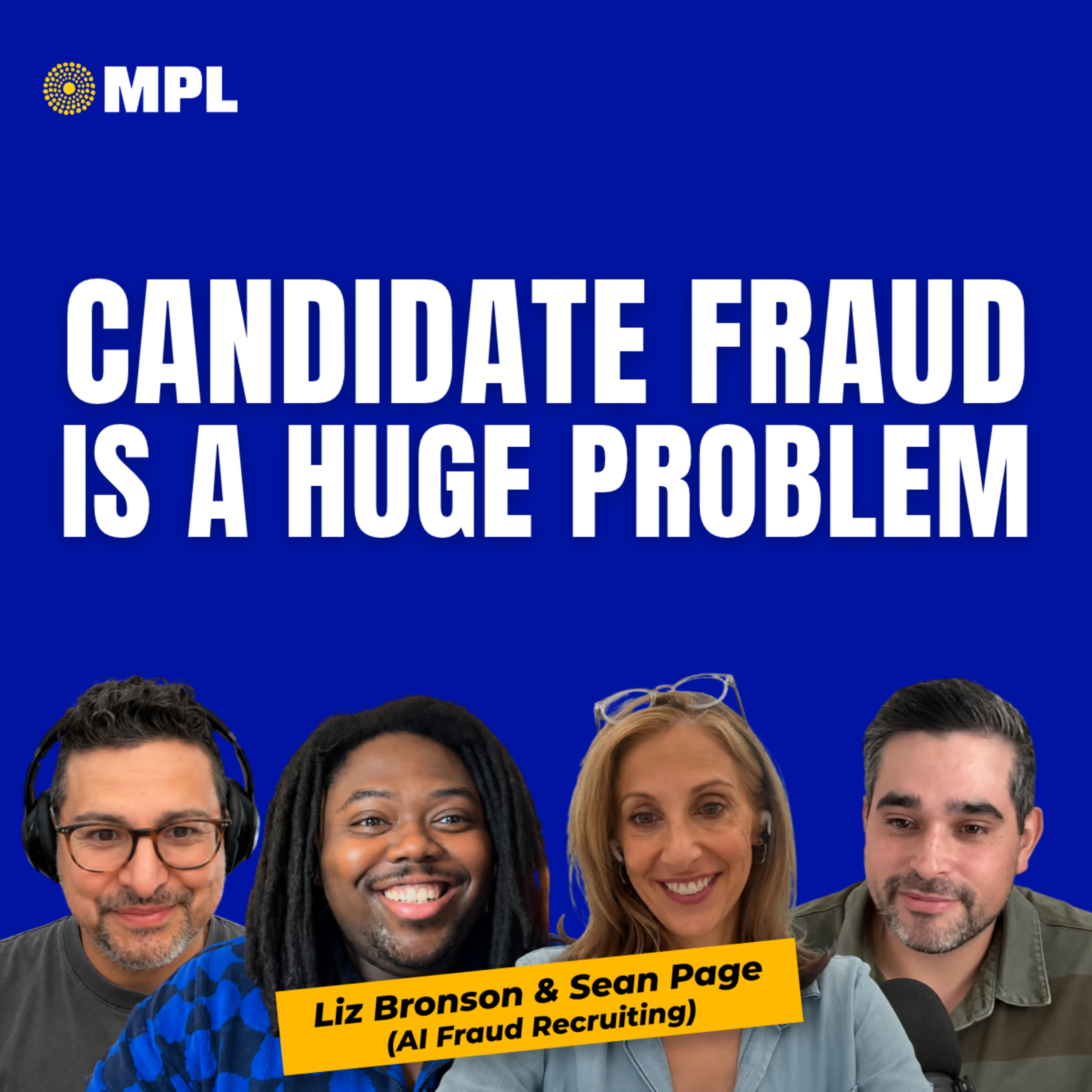
341 - “80% of our Engineering Applicants Are Fake”: Inside the Candidate Fraud Crisis
In short
Candidate fraud in hiring, especially engineering roles, driven by AI-enabled cheating and identity scams; how HR/recruiting teams detect it and redesign talent acquisition.
Guests (backgrounds)
- Liz Bronson (HR/people leader; experienced recruiter/HR leader; discusses fraud detection and interview process changes).
- Sean (recruiting/HR leader at Propel, a fintech serving 5M+ low-income Americans; currently in a job search; previously built sourcing/market-mapping workflows).
Key claims
- Fraud is widespread: 67% of applicants are fraudulent; engineering roles are ~80% fraudulent.
- Cheating is more sophisticated: interview “listening”/translation tools, AI-assisted coding exercises, fake LinkedIn profiles and contact info, and even bots showing up.
- Fraudsters may aim for paychecks, sell equipment, steal user data (Propel concern), or run “bot farms.”
Notable examples
- “Front person” impersonation; multiple people appearing across steps after background checks.
- Accent-reduction software used while the candidate was reportedly in North Korea claiming Kansas identity.
- Engineering application red flags: broken LinkedIn links, stolen profiles, weird emails, no LinkedIn photo, low connections, and AI-written answers (e.g., “English” instead of a coding language).
Written by AI. May contain mistakes.
Chapters
0:00
Introduction to Candidate Fraud Crisis
Learn about the alarming statistics of fraudulent engineering applicants.
“67 % of our applicants are fraudulent and if it's engineering roles, it's 80.”
1:30
Group Episode Dynamics
Discover the excitement and dynamics of group episodes among hosts and guests.
“I can't remember the last time we had a group episode, but like it's honestly one of my favorite episode types because it's just like a fun chat.”
4:40
Good News Stories
Hear personal and professional good news stories from guests and hosts.
“We do have some traditions that we like to follow.”
8:46
Setting Context for Today's Discussion
Learn about the topic of candidate fraud and its implications in the hiring process.
“And we always start with walk us through your stories.”
11:32
Understanding Candidate Cheating Trends
Explore the sophisticated cheating methods candidates are using in job applications.
“I feel like there's always been a level of embellishment or dishonesty in hiring where people are maybe inflating their titles or they're embellishing a little bit in their resume.”
14:00
Candidate Fraud Crisis: The Alarming Statistics
Discover the shocking rise in fraudulent job applications in engineering.
“numbers, like emails, all these things just with the goal of like, you know, trying to get through our process.”
17:41
Understanding the Motivations Behind Fraud
Explore the various motivations and methods behind candidate fraud in hiring.
“Like for us, Propel, we're a fintech company that serves over 5 million low income Americans.”
21:31
Identifying Red Flags During Recruitment
Learn the red flags to watch for when evaluating job applicants.
“Like, I, cause we're going to go into, jump into another problem, which is like, how do we rebuild and how do we, what is the new, the right new architecture for talent acquisition in the AI era?”
25:31
Strategies for Legitimate Job Seekers
Find out how legitimate candidates can stand out in a crowded job market.
“So for this role that we're hiring for, we had about a thousand applications.”
28:20
Improving Interview Training with AI
Discover how interview training is being enhanced through AI tools.
“one of the other investments that we started to do at Propel is like really focus on interview training.”
Show all 20 chapters
30:29
Addressing Bias in Recruitment
Explore the significance of bias training and equitable assessment in hiring.
“And it's, I think for us, once we like kind of realized because we had these fraud incident incidents, it was all hands on deck.”
32:39
Shifting Roles in Talent Acquisition
Learn how the roles of recruiters and hiring managers are evolving.
“to like really watch these videos and really see and look at the eyes and like really see how people are like presenting themselves.”
36:59
Navigating HR Tech Stacks
Understand the current landscape of HR tech tools and their applications.
“The closing piece, I think that should actually now start to shift to hiring managers.”
40:55
Enhancing Communication in Hiring
Discover strategies for keeping hiring teams in sync during recruitment.
“We've talked about like the consequences of fraud and all these nefarious acts in hiring processes.”
42:02
Keeping Teams Informed on Hiring Practices
Learn how companies can effectively communicate hiring strategies and practices to their teams.
“willingness to drink the Kool-Aid, like blah, blah, blah, blah, blah.”
44:26
The Challenge of Candidate Fraud
Explore the different methods of candidate fraud and how to spot them in the hiring process.
“I also love finding the front like, gotcha is like my favorite moment when I'm like, no, that wasn't them.”
47:52
Future Threats in Recruitment Fraud
Discuss potential future escalations in recruitment fraud and the risks they pose to companies.
“Y 'all, we unfortunately are very close to that time where we have to bring this to a close.”
50:33
AI and the New Era of Fraud
Understand how AI technology is being misused for fraudulent activities and the implications for HR.
“And like what Sean was saying about payments and payroll and, you know, we have a payment, we have, we have Stripe and like all that kind of stuff.”
53:09
Innovative HR Strategies and Recommendations
Hear about creative HR practices and recommendations for improving talent acquisition and retention.
“I'm like blown away with what you can do with with with tools like Higgsfield.”
56:00
Final Thoughts and Reflections
The guests share their key takeaways and memorable phrases from the discussion.
“And that gets us to our final tradition.”

Ask about this episode
Get the gist, explore an idea or ask about something said.
 Claude
On The Modern People Leader: Forward-Thinking HR, what are the key points of this episode?
Searching your listeningTranscript
Automatic transcript. May contain errors.
0:00Sean Page: 67 % of our applicants are fraudulent and if it's engineering roles, it's 80. That's bonkers. It's cuckoo bananas out there. There's a front person that I'm Liz and I'm the interviewee and then we had someone on their first day, a different dude showed up and that person had passed the background check. He passed the whole thing. Glenn caught a guy using accent reduction software. He was in North Korea saying he was a dude from Kansas. Like we've got nonsense across the board, but 80 % of our engineering applicants are marked as fraudulent. And that is what we're up against.
0:39Liz Bronson: But I think what's really happening is the sophistication when it comes to cheating. What I'm seeing in sort of the field right now is like, you know, for instance, I was talking to one of our engineering managers a couple of weeks ago about this. But she actually caught a candidate using some type of software to basically that listens into the interview, kind of translates that their response based off of the question that the hiring manager is asking. And they basically are reading off that prompt, you know, based off of that transcript. You're listening to the Modern People Leader podcast, where we go behind the scenes with today's top HR leaders and work experts.
1:17Liz Bronson: We talk to them about how they've gotten to where they're at, what they do every day, and what they see coming next for the future of work. Hope you enjoy.
1:30Liz Bronson: So we have a full house today. I can't remember the last time we had a group episode, but like it's honestly one of my favorite episode types because it's just like a fun chat. Like we feels less pressure. I don't know how you feel about the group episodes, Daniel. I agree. We have to do way less work as hosts. We just maybe ask a couple of questions and everybody just runs with it. So I'm super excited for today. And the one thing I said when they joined the call was I could feel the positive energy already, which I needed. It was a long week, not a bad week, but just like one of those weeks.
2:09Liz Bronson: And so I need all of the positive vibes. So I appreciate it. Well, we have one MPL alumni, one quickly becoming, you know, going, raising in the charts in terms of active, active guests that we've had. We have Liz Bronson and we have Sean, a newbie, which is always fun because usually when we have group episodes, it's like two people that have been on and we bring them on or like a CFO, CHRO. So today we have a new, a newbie, a new friend joining us, Sean. Welcome to the pod. How are you doing? Thank you. I'm doing pretty well. I'm really excited for this conversation. So thank you for inviting me.
2:50Liz Bronson: Yeah. And this is going to be this is going to be a fun one. We have a lot to cover. We're going to be talking about hiring. And like this is super relevant for me because I'm actually in the middle of a job search. I crazy enough. I just got a job. And as quickly as I got the job, I am now no longer working at the company. crazy set of circumstances, starting with like, you know, some changes in the top. And, you know, I was brought in with a very specific, you know, sales focus and angle. And when we had to unexpectedly, you know, replace our CEO, the new CEO had a very different angle. And, you know, you got to, we had a hard choose conversation.
3:34Liz Bronson: And, you know, we, my advice was like, if we need to do something here. Let's do it quickly. I've been in the other in his shoes before, and here we are. And it's like, I'm not going to lie. It's a pretty daunting, much love to all of the listeners that are currently trying to get through a hiring process. Some of the things that we're going to talk about is just how crazy it has become. Just reading the prep notes kind of just made me shiver a little bit. And so keep your heads up. Hopefully, you know, knowing what the process looks like in this AI era will help all of us just better navigate it.
4:13Liz Bronson: And for those looking for the best talent, find it more quickly. And for those looking for a new home, you know, that perfect fit job so they can find that, you know, quickly as well. So I'm just going to put that, put that energy out there. That was a big thing for me to just share the fact that I'm already because I'm pretty open on this pod, but it's kind of cathartic. I'll like, I leave it here and I can move on. And so before we can jump into all of that, I know there's a lot to unpack there. We do have some traditions that we like to follow. The first is what we call good news story, personal or work-related story, anything that's happened in the last week or two, just a way to kick things off with a lot of positivity.
4:53Liz Bronson: And we prefer for our guests to go first. So either Liz or Sean, whoever wants to kick us off. Yeah, since I'm the newbie, I'm happy to go first. So yeah, some exciting news on my end. I actually just reached my five-year anniversary at my current company, Propel. And so we have this really great perk where we are able to receive one month's paid sabbatical. And so I'm actually going on that sabbatical next month. And so I'm really excited. I actually just finished my itinerary, I bought my hotels and flights and I'm going to be going to Australia, Indonesia and Thailand for four weeks. So I'm really excited about that.
5:29Sean Page: Oh, great.
5:31Liz Bronson: I'm so excited for you, Sean.
5:33Sean Page: So excited for you. So mine's hot off the presses within the last 20 minutes. My kid who's in college, who's coming home tomorrow for her fall break, just told me she set the curve on an exam. So like, that's awesome. And proud mom. And the one I was planning before the hot off the presses news was Skimmer is doing great. And I love my job and I love my team so much. But we've gone into constructions. We expanded our TAM and we acquired two pool construction software companies. And we have been working really hard on integrating and all the things. And just like things are happening. And it's super, super cool.
6:13Sean Page: The momentum we've got and everything. It's just so exciting. The team loves being in a bigger place and having like structure and mentorship. So it's just been really fun to be working on two integrations at once as well as running the business. And it's been really awesome. Excited about construction.
6:31Liz Bronson: It literally has been a rocket ship for y 'all. And it's so exciting because we have some other friends over there. Shout out to Glenn Burnside. But yeah, that's Glenn Dog. Glenn Dog. Yeah, that's the Glenn zone is like when we were really looking to harness all the of our energies and like really propel us forward. We describe that as going to the Glenn zone. So Daniel, what do you have before we reminisce about Glenn for now? Man, I miss Glenn. Okay, so my good news, I'm going to keep it on theme. So we're hiring at the NPL. And over the last couple of weeks, we've had interviews just about every day.
7:11Liz Bronson: And we have some really strong candidates. And as of yesterday, the people that made it to the second round started getting their case studies in. And we gave them this somewhat ambiguous, like short take home project to build something in lovable. And I've been really impressed with what people have come back with. And so excited, we should be hiring this person soon, hopefully in the next couple of weeks. And yeah, this conversation couldn't be happening at a better time. I'm sure there are things that I just don't even know to look out for. And so I'm excited to learn today. That leaves me I the it's funny how the universe works.
7:50Liz Bronson: I find myself with time I didn't expect to have. And we bought a new home and we move into said new home on the 17th. Like I just don't I woke up this morning and I was like, what would we have done if I were grinding in my job right now? Like, this is insane. Not to mention, we also I've been using chat GPT to help me be an AI powered general contractor. So I've been sourcing materials and staffing teams and getting everything ready. And so we're painting the house today, which is like the last major thing we need to do before we move in. And like, we're taking the first few we're moving two blocks away.
8:31Liz Bronson: So that's the other like good news is should be pretty straightforward. So lots of good news, lots of positive ways for me to use my newfound time. And man, I I'm just not gonna I want to get into what we're going to talk about today. And so, you know, before we do that, we want to ask, I just want to like set context. And we always start with walk us through your stories. This is usually one story and one journey, we're going to get two stories intertwined here. And so like, Share with us how your paths crossed. I feel like these days, Cloud and ChatGPT can get you surprisingly far into HR work, and they're great.
9:08Liz Bronson: Until you need live people data, or you need data from performance, comps, surveys, then suddenly you're exporting CSVs, you're explaining the company's entire history, and you're figuring out what's actually safe to share with who. And that's the gap that Shapes is closing. Shapes basically brings that AI experience directly into the HR platform. with your live people data, your org context, and your existing permissions built in. So instead of jumping between systems, people teams can build things like a flight risk dashboard, a reorg simulator, a calibration grid, or a completely custom workflow or visualization.
9:47Liz Bronson: You just describe what you need, and Shapes builds it from the people data that's already there. It's kind of like Claude and your HRIS had a baby. If you want to see what this actually looks like in practice, go book a demo with Shapes. You can find a link in the show notes.
10:01Sean Page: So I started research. I'm like, did I meet Sean? Like, and I believe, and Sean totally correct me, that we met on either LinkedIn or X, formerly known as Twitter, like in 2021 is when we connected on LinkedIn. But I don't actually remember. Like, yeah, we just like each other's stuff.
10:21Liz Bronson: Yeah, yeah. So I believe it was on X. And like during this time, I was just starting to get into the tech industry. and I was starting to build my personal brand on X. And so I became a really big voice. I think at a certain point I had like 10 ,000 followers or what have you, but I was like really engaging with a lot of other HR leaders on X. And I believe we had like an engaging conversation on X. And then we decided, hey, let's bring this over to LinkedIn and like become actual like colleagues. And so since then we've been like sort of doing coffee chats here and there, but I really appreciate Liz because during the time I was a baby recruiter.
10:54Liz Bronson: And so it was really great to learn from someone with so many years of experience in the industry. And so it was really great just to get to know her over the course of like Twitter as well as LinkedIn. I think this is the first -
11:06Sean Page: I appreciate John's perspective. He's the best. So I've so appreciated and learned so much from him over the years.
11:11Liz Bronson: The people you meet online. I love that. Okay, so today we're gonna be talking about the candidate fraud that we're seeing in the industry. And I think this is a first, Stephen. Have we talked about this on the podcast? I don't think we have. No, no, no, we haven't. We haven't at all. Yeah, so I'm excited to learn. I feel like there's always been a level of embellishment or dishonesty in hiring where people are maybe inflating their titles or they're embellishing a little bit in their resume. But it feels like AI seems to have changed both the scale and the sophistication of what recruiting teams are dealing with.
11:53Liz Bronson: And so before we get into how to fix this problem, let's just start with what this looks like. Like, what are you experiencing day to day? And before we jump in, like, I do remember Daniel being at HR Tech a year ago. And because usually when we Daniel and I would go together, we'd split up and he would go prospect and talk to vendors, HR vendors that were like mid to large, like the big dogs. I would always focus on the startups. And I remember last year, like just every other company startup that we talked to seemed to be focusing on like eye scanning. So, you know, there's like a software that if your eyes look to the right, like as though you're like reading, you know, AI answers to the questions, like it would detect that.
12:40Liz Bronson: And I remember thinking to myself, why are so many startups focused on this? And so like, I really want to get at like what the reality is, because they I remember they stated numbers that just seemed nonsensical at the time, like this can't be true. And so so I just wanted to add that additional framing of like, let's really let's uncover here, y 'all, what the reality is.
13:04Sean Page: Don, you want to start since you sit in the recruiting seat every day?
13:08Liz Bronson: And yeah, yeah, of course, I'm more than happy to share sort of what I'm saying. So, you know, right now I totally agree, like resume embellishment has been happening for years and that's not nothing new, but I think what's really happening is the sophistication when it comes to cheating. What I'm seeing in sort of the field right now is like, you know, for instance, I was talking to one of our engineering managers a couple of weeks ago about this, but she actually caught a candidate using some type of software to basically, that listens into the interview, kind of translates that their response based off of the question that the hiring manager is asking.
13:42Liz Bronson: and they basically are reading off that prompt, you know, based off of that transcript. And so we're seeing that kind of level of cheating. We're seeing folks using AI tools to sort of solve coding exercises. We're also seeing folks using it, you know, just to like also falsely present themselves, like, you know, creating fake LinkedIn profiles, even going as far as creating like phone numbers, like emails, all these things just with the goal of like, you know, trying to get through our process. And so we're seeing a lot of these like different folks. And in addition to that, we're just seeing like the volume of cheating that we're seeing is just increased significantly where, you know, before we might have got like 400 applications for a single role.
14:20Liz Bronson: And now we're seeing 5 ,000 applications for a single role. So the volume is just getting really out of control.
14:28Sean Page: And to add to that, Stephen, if you want your mind blown with numbers. So we had a few fraudulent incidents that looked different and I can totally go into those. So we got a technology called TOFU, which is just a fraud detection software because the one within our applicant tracking system wasn't catching enough. And 67 % of our applicants are fraudulent. And if it's engineering roles, it's 80. That's bonkers. It's cuckoo bananas out there. It's like, I, so this is, this is my whole profile and it's not that. And they're using the software Sean's talking about. There's a front person that I'm Liz and I'm the interviewee.
15:04Sean Page: And then we had someone on their first day, a different dude showed up and that person had passed the background check. Like he passed the whole thing. And then different dudes showed up and my hiring manager was like, and you are. And of course we fired him that day, but guess what? They got a computer and a monitor because we were welcoming to the team. We had, you know, Glenn caught a guy using accent reduction software. He was in North Korea saying he was a dude from Kansas. Like we've got nonsense across the board but 80 percent of our engineering applicants are marked as fraudulent and that is what we're up against like only 13 of our percent have no suspicion whatsoever
15:50Liz Bronson: it's bonkers and so what what's the end game here like i mean what is causing so like we haven't seen anything like this in the past like what are some of the forces that are at play here at least that you think because obviously you know where this is speculation but like what do you think some of the forces are like some of the end games or you different use cases you're seeing of people that are like fraudulently trying to get you know apart from trying to get a job but that that even seems like that doesn't totally check out because you gotta know like at some point
16:23Sean Page: this is gonna be caught like tell us more what if i got a few paychecks you know and you didn't catch me? Or what if I'm the front and then I'm outsourcing it to another country? So I'm making $150. I'm paying$50 to someone in the other country doing the job. If I've got three or four of those, I show up to a couple meetings a week. I'm looking good. There's so many different versions of this fraud. It's wild, right? But if like, look at our friends, they were out of Dallas, they got, they just got, they got a nice new computer and a monitor they could sell. it's a nice day at the office right so they're trying to get paychecks so i think for bigger companies and stuff some are trying to get data and information and all kinds of craziness but if you get a couple jobs out there and you don't get caught for a few weeks and that's a couple thousand bucks and moving on and it doesn't cost you anything because if i hire a bot i hire a bot that because we've had bots show up in to an interview and you tell them to do this and then they disappear, like the bot gets hired, you don't have to pay them.
17:31Sean Page: So your bot farm maybe gets a few jobs and you get yourself an income that way. I don't know, Sean, other ideas?
17:36Liz Bronson: Yeah, no, it is crazy. And I totally agree. Like for us, Propel, we're a fintech company that serves over 5 million low income Americans. And so for us, it's actually the danger is them taking user information and data and using that in a nefarious way. And the reason why we're really concern about that is because actually in the US right now, there's a lot of fraud when it comes to Snap right now. And we're seeing that with people using scanners within grocery stores and other markets that accept EBT, and they're stealing users information. And there's like these really big, like, well, organizations, like, based in a lot of different countries outside the US that want to steal this information.
18:16Liz Bronson: And so, you know, for us, that's what we're, you know, that's like the worst case scenario is someone coming in and stealing that user data, and then, you know, whatever they use it for, you know, taking it back to a larger organization. And a lot of times they're like crime organizations. Wow. And so what are some of the red flags that people should be looking out for? Because even me, like I've doing these 10 plus interviews the last couple of weeks, sometimes the answers seem like almost too perfect. And I'm like, wow, like, how did they come up with that answer on the spot? And there's like this like spidey sense or this like skepticism that I have where I'm like, do they have some sort of technology that's giving them a script of what they should respond with?
18:57Liz Bronson: Or am I just being paranoid? And so yeah, I'm just curious, like, what are some of the red flags that people should look out for? Yeah, I think it really just starts at the very beginning with the application. Some of the things that I always look out for is like actually seeing, first of all, a lot of times, like people are now using chat, CBT, or like Claude to make their resumes. And so, you know, that's not necessarily a red flag on its own. But like, you know, oftentimes like the LinkedIn profile link might be broken. And so like, you know, that's been a big sign of someone that might be trying to like use a profile that's not them.
19:27Liz Bronson: Or, you know, sometimes I'll like click on the LinkedIn profile, go to the LinkedIn profile, and that person might actually have in their summary that someone's actually stolen my information and they're applying to a lot of different jobs. And so that's been another like flag that's really easy to catch. I think another way that I've also sort of caught people is like in our application questions, especially for engineering roles, which are where we're seeing a lot of fraud at. You know, we add a question there asking them, like, what's their most their strongest coding language? And people are using who are not English speakers that are filling out this using AI, they will actually like respond with English instead of an actual coding language.
20:02Liz Bronson: And so that's been a really hidden trick that we were able to like sort of uncover a lot of fraud based off of like just people submitting their applications that way.
20:11Sean Page: All those things. So we actually we have a technology called tofu that will match like if you see if you see my LinkedIn profile it is matched to my email address that I've had for a million years right but someone stealing it would match it to lizbronson1 at gmail.com right and so it would say wait these two don't match and so I would say something that comes up as fraudulent are people who don't have you are more susceptible to have your identity stolen if you don't have a picture in your LinkedIn profile for obvious reasons. But some other things, and these things are changing. Like every month it's something new is they will have a weird email address like liz at secure mail.io.
20:53Sean Page: It's like, you're out. They'll have, I do a question like Sean does where I say, would you rather swim because we're a pool service platform? Would you rather swim in a pool, a lake, a pond, or the ocean? The fraudsters never used to answer that question. So that was like a flag. You don't answer my fun question, you're out. But now they do. Now they answer it. So these things are constantly evolving and changing. But we look for little things in the application, like Sean said. And then throughout the interview process, we've changed everything because of all of this. I'm just curious, is there a way for those that are truly the legit job seekers to stand out in
21:38Liz Bronson: this process? Like, I, cause we're going to go into, jump into another problem, which is like, how do we rebuild and how do we, what is the new, the right new architecture for talent acquisition in the AI era? Like, you know, that we're about to go into that, but before we even get there, like what could get lost in this conversation is like, well, okay, 80 % of the engineering applications are fraudulent in some way, shape or form, you know, in some companies. And like, that means that 20 % are getting drowned out in by Forex like that, that to me is insane. And so are there any, are there anything you have any kind of recommendations or suggestions, or is this just another problem that we're going to need to work through?
22:27Liz Bronson: you.
22:28Sean Page: So right now we're going old school. Oh, a referral. Like you referred Sean, an actual person that you know, and he's human. Yes. Hired. Right. So it's going old school. A lot of companies like I'm done with the applicants. Like I'm just done. And it's like referrals and true sourcing. We're doing a lot more sourcing because the applicant pool is garbage. Right. So it's back to years ago of who do you know and how can you get in that way? Because I'm so much happier to hire Sean who somebody knows than somebody nobody knows, right? So that has absolutely happened. It's almost like, at least at Skimmer, we still have tools and obviously we're using AI as the fraud detection and all these other things through Tofu, but we're like saying to candidates, We may want to meet you in person and we're doing background checks before an offer and we're AI proofing our process because the AI loves the AI, right?
23:29Sean Page: So we're going old school and be like, tell me more about this deep behavioral interviewing because the fakes can't go deep. But as a candidate to stand out, it's like, who do I know at this company and how can I reach out to them? Because the ATSs are a mess. and I think that will change right but that's we're just in this crazy cycle where because of AI this is all like blooming not that there was a before but it's different so now we're having to over correct so that we can correct yeah heavy plus one on that and I think also what I've seen
24:06Liz Bronson: the best candidates how they get through the process is really strong personal branding I I think personal branding today, like I know we like as recruiters, like, you know, we selfishly want people to like broadcast their work. So it's so much easier for us to source. But there's also that tail end of like the fraudsters that you're also helping to like legitimize yourself by having this personal brand. I love like candidates that are like on LinkedIn, like doing posts about like their work or, you know, they might create a personal site and like showing like, you know, work that they're doing at their different companies or someone that actually is like communicating on like the social feed on LinkedIn, like those like activities really show us that this person is human because oftentimes fraudsters are not active.
24:46Liz Bronson: They're not out there like talking on different threads. They're not actually broadcasting themselves because they don't want to get caught. And so by having a really strong, you know, visible presence online, that really sends a great signal to us to know that, oh, this person actually seems like a real human.
25:01Sean Page: And having a picture like the no picture, that's fraud number one, or they usually don't do post. They usually have like connections, even 500 plus connections because it's all the background nonsense, but they don't post usually. Maybe they like a few things. So that LinkedIn and social engagement shows people you're human.
25:22Liz Bronson: It's funny. You heard it here. You got to leverage your referrals and you've got to be active on the socials, even if you don't love being active on the socials. Yeah, it's true. So for this role that we're hiring for, we had about a thousand applications. And, you know, Regina from our team was helping me go through one by one. And eventually I told her, I was like, you know what, it feels like we should automatically disqualify someone if they don't have a picture and they don't have a LinkedIn profile. And if they do have a LinkedIn profile and they only have one or two connections, that's a major red flag.
25:57Liz Bronson: and I don't know how many we eliminated, but it was at least like 60, 70%. And then you still have to do the hard work of like looking through the individual profiles and the ones that stood out had YouTube channels or they had like their own portfolio that they posted online. And so, yeah, I think those are all great things to call out. And Steven, like you have such a good personal brand and you've got your own website. and so you're already like way ahead of the curve on all this stuff. You are human, we promise. Yes. Unless I've been interacting with the bot all these years. Daniel, I have something to tell you.
26:39Liz Bronson: And so, you know, if you're a recruiting leader or a people leader and you're listening to this episode, like where do you begin? Like what are the first steps to start to redesign, you know, the hiring funnel and what it looks like at each stage. I'm hearing like more referrals, but like, yeah, give us some more tips. You know, we hear all kinds of stories in the podcast, and I'll never forget the story that was told about a Mexico Beach FMLA backfire. One of their employees was out on approved medical leave, and then somebody spots them on Instagram. Feet up on the beach, looking a little too okay for someone supposedly recovering.
27:24Liz Bronson: So cue the call from the CEO wanting to pull their leave and all of the panic that followed. But here's the thing. There's actual legal precedent that says a photo isn't proof of anything. You can't just yank somebody's protected leave because of how a vacation pic looks. You need real evidence. And that's a trap a lot of HR teams fall into. Making a compliance call based on gut instinct instead of actually knowing the law. And that's exactly the gap 650 has built to close. 650 helps teams manage compliance across the full lifecycle, from handbooks and policies to agreements, legal updates, and research.
28:00Liz Bronson: And their AI-powered research center gives you a way to ask employment law questions in plain English so you can better understand what applies and where. Because compliance calls shouldn't be made on gut instinct. They should be grounded in real legal clarity. For those of you that want to learn more about 650, go to the link in the show notes and let them know we sent you. Yeah, I think, you know, one of the other investments that we started to do at Propel is like really focus on interview training. I think it really starts on like having a really strong bench of interviewers who really understand not just to ask a question, but really the gold is in the follow-up question.
28:33Liz Bronson: Like, how are you framing your question in such a way? And are you getting to the real like heart of like the skills that we really care about, which is like taste and judgment and ability to prioritize. And so like being able to like sort of know what skills that you're responsible for as an interviewer is really important. But also to the power of that follow up question matters so much. And some of the things that I really love about AI now is that we are able to create even better questions than we've ever done in the past. Like I can tell you how many times I used to have to Google like, OK, how can I reframe this question?
29:02Liz Bronson: Like what's another way of saying this? And so I think it's really great to have a companion like Claude to like really help you like really think through like how are you asking the questions and really pressure test? Does it really get the signal that you're looking for? And so I think that's been really helpful for our interviewers. And then also to like train them up on bias. I think, you know, we're in this world where a lot of people think that D &I is dead and that it doesn't really matter. But it actually matters way more now than I think it ever has. Because we also have to make sure that we're being equitable with how we're like sort of sorting out people in these processes.
29:33Liz Bronson: Because like you said, we're sorting people out because they don't have a profile or because they don't have this. But that does have implications to someone who actually might be real. and they're just really terrible at like, you know, showcasing themselves. Right. And so I think there has to be more than one way for folks who may not be comfortable with having a social presence to also be able to present their self in such a way. And that could be a portfolio, that could be a website, that could be another avenue. But I think our society has also like shifted a lot from like the days of Twitter where, you know, being having strong written communication made you really popular.
30:05Liz Bronson: And now it's like video, like now you're on TikTok, Now you're on Instagram, you know, really promoting yourself. And I know for myself, I'm not a video person. I don't want to go on camera and be an influencer and be a, you know, that type of, you know, profession. I don't know. You're pretty good at it, Sean. But I love writing. And so I think for me, it's just like, I think you just have to have multiple avenues for people to really highlight and showcase those things and in a very equitable way.
30:33Sean Page: I agree. And it's, I think for us, once we like kind of realized because we had these fraud incident incidents, it was all hands on deck. It's training. I've got fraud training. I, in my monthly manager's meeting, I'm like, brought up Dave, here we go. Like, and they know if you see something, say something. And it's been really hard for the bias. We have an incredible diverse organization and they're like, I don't want to be, I don't want to say something, but this person's accent was weird. Yeah, because they were saying resume instead of resume, right? And so he's like, I don't want to be unfair to this person, but it was weird.
31:08Sean Page: They were using, you know, this software that reduced their accent. So it's like, if you see something, say something. You know, you have to listen to both your gut and your brain. But it's really been a retraining of our team of how to, like, go in deep. And like, we're not doing coding. Our coding challenges are like on a note. And if they do a big thing of text, it's like, that's from AI. So it's, we're like going old school. Like we'd get out a whiteboard in person if we could, right? And we're doing that because we want to make sure we get to know the person, not obviously someone who's trying to get a job that shouldn't have it.
31:51Sean Page: But it is a retraining and a rethinking. and you have to go deep on those questions, like Sean said, so that you can see if they're lying.
32:00Liz Bronson: Yeah. And another tool that I think has also been helpful for us is using BrightHire. So having that also record our interviews and so that we can actually look back and, you know, if we're second guessing ourselves, like, let's just rewatch the interview and see what happened. I think that has been a really great tool for us just to capture those things as well. I know it can be a little bit daunting for, you know, candidates that are like, you know, afraid about being recorded. But I think for us, that's been like the best way for us to like really catch people who might be using, you know, outside tools to really, you know, and I hate to be, you know, you almost feel like a test proctor in a way like you're like watching a test like being done.
32:35Liz Bronson: But that's kind of what, you know, TA is starting to evolve into where you kind of have to like really watch these videos and really see and look at the eyes and like really see how people are like presenting themselves. And then sometimes it's also a great way on the other side where it's like sometimes when I'm reading a scorecard and I look back at the interview and then I see a hiring manager saying one thing and then I re-listen and actually the candidate did answer the question, that actually gives me another like tool to be able to push back on hiring managers and say, actually, I think the candidate did say this and like, let's read, like, let's look at the script together and like, like, let's review that.
33:06Liz Bronson: So in some ways it's actually helped us be able to push other candidates forward who may in the past, you just like had to trust the hiring manager's judgment. Do you think this is an early signal that the structure of a talent acquisition team is going to change? Or if you look at 100 % of what a TA person does, at least a significant portion of that pie changing to whatever activity it was before to now like almost needing to have like ops engineering skills to kind of weed out like I just think about marketing and sales and you know this is a classic lead problem right we've got we need to scale leads so we're gonna pump a bunch of leads into the top of our funnel and as an AE like as a salesperson like I don't have time to figure out what is garbage.
34:12Liz Bronson: In fact, if I have to work through too many garbage leads, I'm probably not going to want to do sales here. So I've got to figure that out. I've got to think hiring managers just don't have a ton of time to figure these things out. I feel like I won't go into this rant, but I do feel like we've unfairly dumped a lot of responsibilities onto the hiring manager's shoulders because that was like the SaaS era, the SaaS way. And so I'm just curious, It's like, do you agree with some of the things I'm saying? Do you disagree? Like, how could this be reshaping the structure, the fundamental structure of a T18?
34:46Sean Page: So recruiting is sales. It is. Like, you got your funnel. You've narrowed down the funnel to the sale. Yay, we win. And so it absolutely is the exact same thing. What AI has done, like, what has happened is in the beginning of this whole AIR, ooh, we can match and score and do all these things. And so it was like, take the person out of that early funnel, like throw out the garbage, right? Except then now we're realizing like, uh-oh, the AI likes the AI and the AI likes the resumes that were tailored that may not actually be true. And the AI interviews, like to interview AI because it's perfect, got a perfect answer and perfect score.
35:24Sean Page: And so when I'm talking to other leaders, it's like we were using all these tools and just bringing in the senior recruiter like after everything had been weeded out. and now it's actually we're bringing the human back earlier because of all this stuff because we don't want the bots to get to later in the stages right and so it's kind of we're putting people back in the early stages so that we can try to combat some of this stuff it's yeah as we keep saying it's it's bonkers but it's really it's important yeah i totally agree with that and i
35:59Liz Bronson: I think also, too, kind of what you were hinting at as well is like the role of recruiters shifting. I think back in the Zerp era, back in 2021 and 2022, people were really focused on recruiters being strong closers. Like, you know, we were really supposed to be taught how to like be strong negotiators and how to use the market data and all those things. And now I think we're being all pushed up the funnel. And I think the people who started off as strong sourcers back in the day are the ones that are actually seeing like a rise in their and other companies being interested in their skill set because being a strong sourcer today is actually the skill that matters the most as a recruiter.
36:33Liz Bronson: And being a closer matters much less when you have companies like Pave out here with all the market data. We have Claude now that can do all the research on all the JDs to give you some market insights. Market mapping is much more easier today than it ever has been. And so I think a lot of the focus now as a recruiter, as a recruiter myself, a lot of my focus is sourcing. And I think that's where my superpower has to be. And that's the thing that Critter should be the strongest at, is being able to identify and bring candidates into the funnel. The closing piece, I think that should actually now start to shift to hiring managers.
37:06Liz Bronson: Because at the end of the day, what really matters is like, is the hiring manager good at selling their team? Are they good at selling the culture? And are they actually going to like stand up for that candidate in terms of like performance reviews? And when it comes to like them, like really understanding how the company works and operates during onboarding. So I think the hiring manager should be owning those pieces. And I think recruiters should be doing what we do best, which is bringing people into the company. Right. Okay. So we've heard a few different names of software companies that y 'all are using.
37:35Liz Bronson: So I've heard Tofu for fraud detection. I've heard Bright Hire for reviewing interviews after the fact, like looking at the transcripts, you know, looking at the tape and making sure that everything adds up. I've heard pay for market data and then Claude for research on JDs. Is this like the modern tech stack? Is there anything we're missing? I'm just curious what the, you know, best tech stack looks like these days on the recruiting front.
38:04Sean Page: There's so much going on in HR tech, as you all obviously know. There are lots of different tools that you can use. There's like Provo, which can help you with assessments. And they know when you're using AI versus not. And look, our devs all use AI. So it's not like AI is the worst, but you have to understand it in order to manage it and use it, right? So there, I don't know that there is an ideal tech stack because it's all evolving so quickly and we're all in annual contracts anyway, but we're figuring it out. And what, you know, kind of what I was saying before is we're learning too much tech isn't actually a good thing in the fraud world.
38:44Sean Page: So how do we balance those things? But I don't know an ideal tech stack, but I'm really glad I have fraud detection.
38:51Liz Bronson: Yeah. And I think part of it too is like, I think what also makes it unique is like every company has their own unique challenges when it comes to the funnel. And so for me, you know, as a recruiter, I'm actually building like my own products with Claude. I built my own visual offer letter tool because, you know, we wanted to like display our equity in a much simpler way so that candidates can understand the scenarios, but do it in a pretty way that's not just a PowerPoint. And so I think there's a lot of recruiters out here who are like me, who are also flexing into engineering and like building their own products as well to subsidize some of the things that, you know, the other products aren't able to do, or they may not be able to customize it in the way that we want to present it.
39:30Liz Bronson: So I would definitely say like, you know, I know there's a lot of recruiters out there in my own network that are building their own things using Claude. And that's been really helpful. I think there's other tools that I personally love using like Ashby. I think Ashby also has a really great fraud detection as well in terms of flagging IP addresses and like flagging when someone is using a VPN and, you know, giving you a lot more insights there. So I think Ashby has been really great for that capacity as well as the UI is like probably the best that I've seen out of all the market players when it comes to ATSs, you know, so that's another tool.
40:02Liz Bronson: And then I think also as well, like another tool that I also love using is like Juicebox. I think Juicebox in terms of AI sourcing has been really helpful. I never love writing Bool-Aid strings. I'm so glad I don't ever have to write one again. That was never a fun part of recruiting. I know there's some people out there who are probably shaking their heads because they love that type of stuff, but I hated it. And I love the fact that now I don't have to do it.
40:25Sean Page: And second to Ashby, I'm an Ashby user as well. I love how So you can do the scoring in it, which is a data point, not the data point. And there's a lot of like Claude and in Ashby, you can aggregate, you can ask, like you can have that kind of unbiased, like which candidate is best from the feedback and all those things. So there's just a lot you can do within our systems today that really just helps with the decision making, which is really neat, but it's all evolving right now.
40:54Liz Bronson: So we've talked about the problem. We've talked about like the consequences of fraud and all these nefarious acts in hiring processes. We've talked about how that's going to impact, possibly change the role of a TA person or at a minimum, how some of the core skills are shifting. Once again, it's so interesting to see what was out of vogue is now back in vogue. And like you hang around long enough, it all seems kind of comes back. And we've also talked about tech stack and like emerging things that are happening. And so one of the last pieces for me is like the, I guess, people component. So one of the additional complications is with TA, you're completing a function for the company, but you're also serving the business.
41:46Liz Bronson: And there are a lot of handoffs. It is like the most critical handoff, arguably, because all the research says a company that employees are most engaged right after they're hired and highest levels of engagement, highest willingness to drink the Kool-Aid, like blah, blah, blah, blah, blah. Right. And so how are you keeping everyone up to speed, all the various people involved at the company on your teams? because you shared a lot. And my the sense or feeling that I've gotten is it it feels like it's ramping up like this isn't like stalled out, like it's getting more and more. There are different ways that that, you know, these acts are being committed.
42:30Liz Bronson: And so so what is the game plan to just like keep everyone on the team in sync and up to speed on like how we're actually hiring people at the company? Yeah, that's a great question. I think for us, you know, we are big Slack users as a company. And so we have dedicated Slack channels, not only for hiring managers, but for interviewers, for individual roles, for just recruiting topics in general. And so we have a lot of avenues in which we share this information out to really make that relevant to folks. We also try to do trainings, at least on an annual basis with every individual team, just so that they can really understand not just AI, what's happening in the field today, but also doing bias training and things like that.
43:12Liz Bronson: And then for each like role, when we're ever going to like a final round, for instance, we also do breakout groups where we also come together as an interview team so that we're prepped and ready to go for folks who are going to be entering that final round. So that's also been a really great tool as well. And then I think also just like really being tight on the loop. I'm someone that reads literally every single scorecard that comes through our company. I have read, I know what's going on. I know what's happening in our system. And so I think that's part of like being a really great recruiter is just being on top of making sure that you really understand what's happening in the system.
43:44Liz Bronson: And when you are seeing those like flags being proactive at flagging that to the right people, and also to like knowing when, you know, you might have to stop and like, just like, I'm going to close down this JD because I'm just getting a bunch of crap. And I'm going to focus on sourcing and not being afraid to do so. I think, you know, a lot of times, like, you know, companies will have their JDs open for six months, eight months, 10 months trying to find this candidate. And they're just getting a bunch of crap going through. And sometimes you just got to say, you know what, like, let's stop publicly posting this.
44:12Liz Bronson: Let's like get a group together. And we're just going to do targeted sourcing. We're going to go through everyone's network and look for referrals. We're going to focus on those things that we can't control instead of focusing on the things we can't control. Yeah, for sure.
44:25Sean Page: Yeah, definitely. The sourcing piece is huge. I also love finding the front like, gotcha is like my favorite moment when I'm like, no, that wasn't them. They added something to their email address or something. Because the hardest ones are the stolen identities where it is a real person's whole profile that someone has stolen. But it's just being vigilant and keeping it at top of mind. And I think everything Sean said, plus maybe this is my HR leader in me, but having that open dialogue where you can Slack me like, do you have a sec? Which as an HR leader, you never know what that means, but this feels weird or, you know, can we talk this through?
45:04Sean Page: So just having that open dialogue with your recruiting team, with your HR team to flag things and not let them go farther or to investigate. And by the way, your security team has ways to investigate stuff that is quite, you know, complex and wonderful and can really help avoid some of these things too. So looping in the right people and not being afraid to wave the flag of like, I think there might be a problem. It's just a massive piece.
45:30Liz Bronson: Sean, you've mentioned sourcing several times, and it sounds like this is your superpower. You talked about things like targeted sourcing and looking for referrals within employees' networks. What are some of the other tactics that you're using? What does it look like to be a good sourcer in 2026? Yeah, that's a great question. I think, you know, really like, you know, doing a lot more like market mapping is really important. So one of the things that I actually built was a market mapping tool that basically I pulled in all the companies that we've hired people from in the past. And I added it into Claude and basically created a tool in such a way that helps me like surface up new startups that are like series A, series B, because we're a series B company that are like entering into like either our field or adjacent fields and helping me to like, you know, generate new companies for me to target.
46:26Liz Bronson: And so that's been like a really creative way for me to like start to spin up new lists because a lot of startups, you know, especially at series A and series B, they're not marketing in the way that these large companies are. And so it can be really difficult and challenging there. I think also to like going to certain VCs and being like, okay, let me go through your list and see all the different companies that you're sponsoring right now. And like, let me go through and like try to target those folks. And so going through those lists, I think also to just like looking through other people's networks.
46:53Liz Bronson: And one of my favorite feature about LinkedIn, I know we all hate LinkedIn, but one of my favorite feature about LinkedIn is when you click on someone's profile on the side, it'll give you suggested profiles. And sometimes there are actually pretty good profiles there. And so I will click on that and go through their list. I will also go through someone's like, you know, a personal history and I will go in their social feed. I'm like, OK, someone congratulates you on your new job. Let me go through your list of who's congratulating you and seeing, you know, if they're like, you know, someone that I might actually want to source for one of my roles.
47:23Sean Page: The people that are still in your old group, there's a reason you left. So maybe you have friends that they want to get out and then Sean's going to get you. I think a superpower of Sean, but all recruiters is being a detective. Like whether you're a detective or like who's on that team or you're a detective of are you a human or whatever it is. There's that natural curiosity that makes the greatest recruiters. And they want to understand the curiosity around the role in the company, but the curiosity around the person and where to find them. I think that is the superpower of anyone on a recruiting team.
47:55Liz Bronson: Y 'all, we unfortunately are very close to that time where we have to bring this to a close. We're not quite there yet. So we have time, I think, for a couple more questions. But if we look to the future, like what two questions, where do we think, you know, where's your best guess of like, where this kind of fraud escalates to next? Like, what's the bit the next big, like, kind of gotcha or like blind spot that we might have. And I know this isn't really the second question isn't really a TA conversation. But I can't quit thinking that like, if this is happening, if these tools are being weaponized this way at the top of the funnel are you know what are people doing once they're in in the company is fraud happening within the company not obviously my persona but like i am actually not operating as steven huerta like everything i am doing and saying is like an ai persona like are there bigger issues that we're not even thinking about that's the question I want to ask.
49:04Liz Bronson: So yeah, what is the next blind spot? And like, if we were to think in the traditional employee life cycle, right, that's linear, that starts, if there's fraud at the beginning, in a linear process, there's likely to be fraud throughout downstream. And so I'm going to open it up there and let y 'all react to that the way you want to. All right, so HR tech is coming up fast. If you're planning on being there, please come hang out with us. We're going going to take NPL Live to the Deloitte stage for two sessions. So on the Wednesday at 1.15, we're going to sit down with the director of TA Ops at Ford, and we're going to dig into their talent acquisition transformation.
49:45Liz Bronson: So how the tech has evolved, where agentic AI fits, and what that could mean for the way that recruiting gets done. And then on Thursday at 10.45, we're talking to the SVP of HR Tech at AT &T. And with them, we're going to unpack AT &T's learning and skills rebuild that's happened over the last couple of years. So two very big sessions. And if you're going to be in Vegas, please come join us. And if you want to meet up with us individually, just shoot us a DM on LinkedIn. We would love to connect.
50:15Sean Page: First off, there are two Wall Street Journal articles that everyone needs to read. There was one from August of 25, one just recently in August of 26. There must reads about candidate fraud and how candidates have infiltrated companies. There are candidates, there are operatives from bad, bad places that are in our government. Like it is so absolutely enormous. And like what Sean was saying about payments and payroll and, you know, we have a payment, we have, we have Stripe and like all that kind of stuff. Like you need to be vigilant, but there are these people throughout our society and throughout companies, governments, you name it, their infiltration has happened and we need to be aware of it.
50:59Sean Page: I spoke to an HR leader a few weeks ago. I was like, we don't have any fraudulent applicants. And I literally laughed in her face and which wasn't nice, but I was just like, yes, you do. Like you do. And so we have to act with that. We had a breach the other day where there's someone that fraudsters are coming in, putting something on people's calendars. When they click, they get access. And we had a gift card stolen that we had given to an employee because they found the gift card and they spent it really fast. There is fraud coming at us from every angle. It's so not just a recruiting problem.
51:36Sean Page: It is a recruiting problem, but it's so much bigger. And so companies have to be thinking that way and being proactive and vigilant on all fronts. It is everywhere.
51:49Liz Bronson: Yeah, I totally agree with that. And I think that, you know, we are a remote first company at Propel. And so a lot of our fraud, like, you know, we do do in-person retreats, which will help us like catch people. But obviously, like, it could be months before we do an in-person retreat. And one of my biggest fears for us, you know, especially with AI today, like there's a lot of deep fakes where people can legitimately make you look like a completely different person. It knows how to do the motion sensing. It knows how to like interact as though you're a real person. And so I'm always like scared and nervous that like at a certain point, like there's going to be going to have our first deep fake.
52:22Liz Bronson: And that's going to be a very like interesting time for us to have to like navigate that. And so I think deep fake AI is like something that is on my radar. And then I'd say the second piece to your second question, you know, I'm also like nervous about like expense reports. Right. Because I think people, you know, treat expense reports as like a very admin thing. You just submit your expense report, someone approves it and that's it. But I've seen people on, you know, TikTok, like teaching people how to like create fake expense reports or fake contracts or, you know, acting like a lawyer and like trying to sue companies.
52:55Liz Bronson: And so I think there's a lot of things that like, you know, people are using AI for in nefarious ways that aren't necessarily like, you know, they're a real person, but they're trying to get something from a company. And so I think there's there's a lot of fear there. I'm like blown away with what you can do with with with tools like Higgsfield. And I don't know if y 'all have seen this trend, but the kids are making videos from the, I think it's the Burning Bridges song from Drake. And it's like from the music video. And they're putting like Tony Soprano and his crew. They're putting NBA players.
53:30Liz Bronson: They're putting The Rock. And like I find myself scrolling through it and laughing and be like, oh, this is so good. But at the same time kind of freaked out. I'm like what if somebody decides to make a Hicks field video of me and Steven doing something crazy now that I'm putting this energy out into the world hopefully it doesn't happen but yeah it there's there's a lot of fraudulent activity going on going on out there and Liz looks like you have something to say but no okay well we have two minutes left and we still have a couple of rapid fire questions we usually do four but because we're short on time I'm just going to cut it down to two.
54:08Liz Bronson: And so question one is for you, Sean, what's a strategy or practice from another company that you'd love to steal? Yeah, that's a great question. So, you know, I'm not always a big fan of unlimited PTO. But I do know there's a company out there, I can't recall the name right now. But basically, they offer a$2 ,000 stipend for your first vacation in addition to the unlimited PTO. And I thought that was a really great, great perk. And their whole philosophy is to give that away so that people actually take the time off because unlimited PTO, a lot of times people are free to actually use it. I like that one.
54:45Liz Bronson: Okay. And this next one is for both of you guys. Who do we need to have on the show next?
54:51Sean Page: I've got three. So I've got Caroline Baldwin at Pilot Base, Tracy Cote at Slick Deals, and Andrew Meadows at Scribe, who's going to be on your panel in San Francisco. So you already know him, but I would have.
55:04Liz Bronson: He sure is. Yeah. And I would also add like Rona Barnett is really great. She does a lot of work in the social media, like influencer TA space. So really love her work. And also Tara Haynes also does a lot of great work in the D &I space as well. So those are my two picks. Honestly, we haven't done enough content in the TA side. Daniel and I have felt a little, I don't know. TA is like a very unique world that seems to have thought leaders and podcasters of its own. And you're either in that world or not. And we were always kind of fearful of just like not being received as part of like the real TA world.
55:48Liz Bronson: But this has been a fascinating conversation, y 'all. Like, I think we need to do more. So I'm just mentally plus wanting Sean, your, your recommendations. And that gets us to our final tradition. We call one word close can be a word, a few words. We all just respond with, as we reflect on the last hour we spent together, how we want to sum things up and we prefer for our guests to go first. Cool. I'm happy to go first. I think my favorite phrase that I've been using recently is joy is a form of resistance.
56:28Sean Page: I was going to say be modern, be human, and be vigilant.
56:33Liz Bronson: I'm going to go with watch out for the bots, y 'all. Jeez. The bots are out here walling out trying to get free laptops. Like what? No, they're getting free laptops. This is blowing my mind. Jeez. Wow. Daniel. All I can think is there's no better way to start a Friday. this was such a good conversation i'm glad that we switched up the topics i learned a few things and so thank you both so much thank you liz for helping coordinate this and sean thank you for joining us on the podcast you're great and yeah i hope you guys have an amazing weekend and i'm sure we're gonna do this again and both of you guys are gonna come back on another podcast
57:19Sean Page: we will love it thank you thanks for having us
57:23Liz Bronson: Bye guys. Thanks for tuning in to another episode of the modern people leader. We really, really appreciate it. And if you enjoyed the show, please leave us a five-star rating. It would mean the world to us and connect with us on LinkedIn. We want to know what you think about the show and you can find links to both of our profiles in the show notes. Thanks again for listening and see you on the next episode.
57:53curly pardon
From the publisher
Liz Bronson (Chief People Officer, Skimmer) and Sean Page (TA Manager, Propel) joined us on The Modern People Leader.
We talked about the rise of candidate fraud, why traditional hiring processes are becoming harder to trust, and how recruiters are rethinking sourcing, candidate verification, interview techniques, and technology to find real talent.
----
Sponsor Links:
🔗 Explore the 2026 Deloitte Human Capital Trends Report
MPL Links:
----
(12:10) Candidates Using AI to Generate Interview Answers in Real Time
(13:35) Skimmer's Fraud Screening Results: 67% of Applicants Flagged
(14:10) When a Different Person Shows Up on the First Day
(15:10) Why People Commit Hiring Fraud
(17:10) Why Candidate Fraud Creates Serious Data Security Risks
(18:40) Broken LinkedIn Links and Stolen Candidate Profiles
(21:15) How Legitimate Candidates Can Stand Out
(22:15) Why Referrals and Direct Sourcing Are Making a Comeback
(23:30) Using Deeper Behavioral Interviews to Verify Experience
(24:05) Sean on Why Personal Branding Matters More Than Ever
(27:05) Why the Best Interviewers Ask Better Follow-Up Questions
(28:20) Why Interviewer Bias Training Matters More Than Ever
(30:35) Using Recorded Interviews to Review Suspicious Responses
(33:35) Why AI Screening Can Favor AI-Generated Applications
(34:30) Bringing Human Recruiters Back Earlier in the Hiring Process
(35:05) Why Strong Sourcing Skills Are Becoming More Valuable
(38:10) Recruiters Building Their Own Tools With Claude
(43:35) When to Stop Accepting Applications and Focus on Targeted Sourcing
(45:50) Sean's AI-Powered Market Mapping Tool
(47:30) Why Recruiters Need to Think Like Detectives
(48:10) Where Candidate Fraud Could Go Next
(51:15) Sean's Biggest Concern: AI Deepfakes in Remote Hiring
----
📬 Subscribe to our weekly newsletter to get episode recaps
💡 Follow The Modern People Leader on LinkedIn
😊 Follow Daniel Huerta on LinkedIn
😊 Follow Stephen Huerta on LinkedIn
----
Past guests on MPL include Brené Brown, Annie Dean (VP of Team Anywhere, Atlassian), Josh Bersin, Katie Burke (Chief People Officer, Harvey), Liz Fosslien, Helen Russell (Chief People Officer, HubSpot), Dave Scott (Chief People Officer, ADT), Melanie Rossenwasser (Chief People Officer, Dropbox), Crystal Boysen (Chief People Officer, Sprout Social), and many more.
More from The Modern People Leader: Forward-Thinking HR
All episodes
We use cookies.They keep VO running smoothly and help us improve it. Privacy policy