
 Ask ChatGPT


- Podcasts
- The Modern People Leader: Forward-Thinking HR
- 340 - How Citizens Helps Leaders Build IQ, EQ, TQ, and MQ: Susan LaMonica (CHRO, Citizens)
The Modern People Leader: Forward-Thinking HR23 Oct 2026 · 46m · 19 chapters
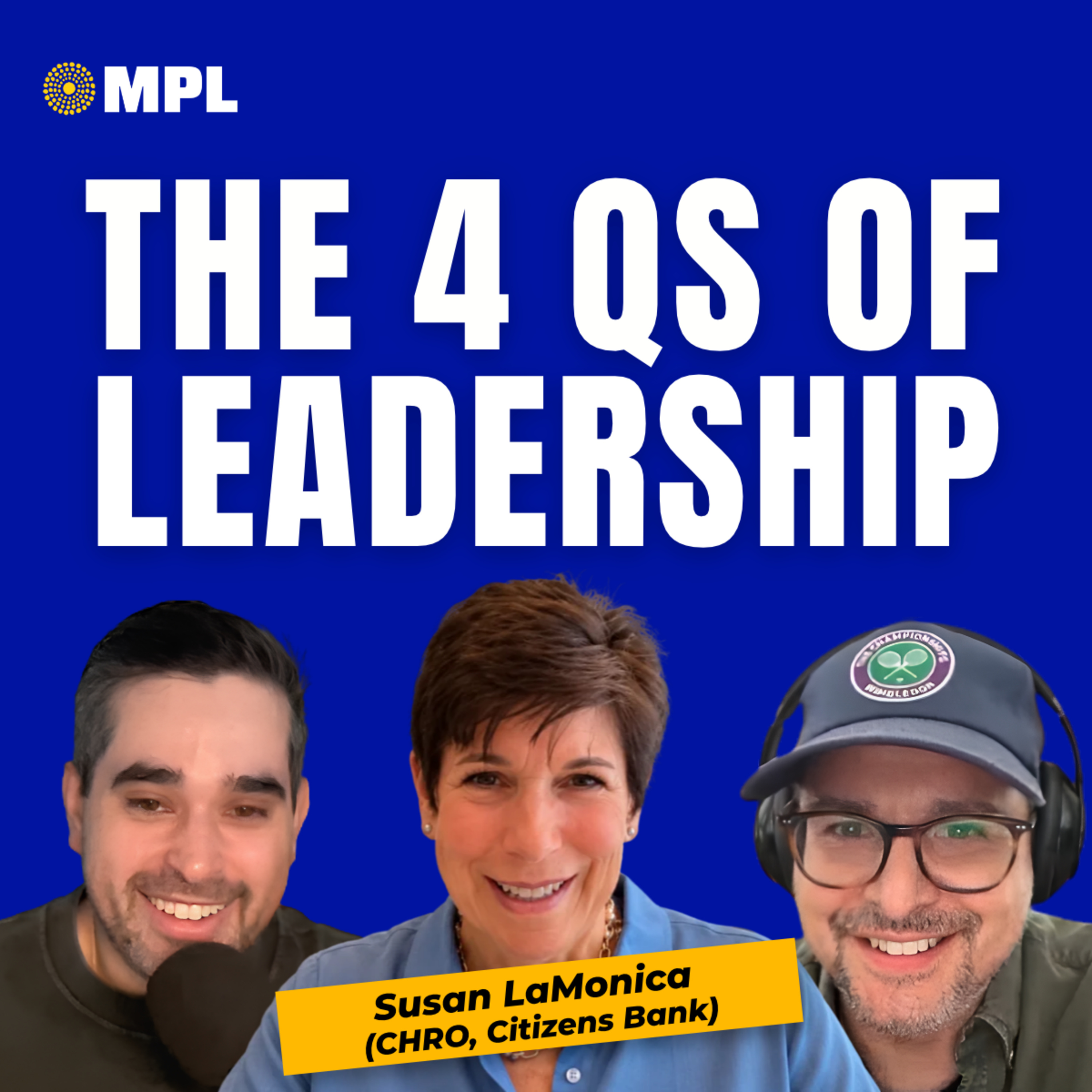
340 - How Citizens Helps Leaders Build IQ, EQ, TQ, and MQ: Susan LaMonica (CHRO, Citizens)
In short
Citizens CHRO Susan LaMonica explains how Citizens Financial Group built a refreshed leadership model (LQ) and culture after separating from Royal Bank of Scotland, emphasizing leadership development across levels and four leadership dimensions: IQ (insight/judgment), TQ (technology quotient, including AI fluency and digital experience), EQ (empathy, self-awareness, empowering others), and MQ (meaning/purpose and alignment). She also describes using an Organizational Health Survey (McKinsey-based) for a decade to improve management practices, moving from third to first quartile over time, and what “adaptive leadership” means (learn/test-and-learn, pivoting without losing the end goal, trust, and safe experimentation).
Guest
Susan LaMonica, CHRO at Citizens Financial Group; long career at Chase Manhattan Bank/JPMorgan (operations/technology management, then HR leadership and development), later business partner roles, five-year pause for family/community/wellness, then returned to Citizens (post-RBS separation) and led CHRO transformation.
Key claims/examples
Leadership investment was “table stakes” to win hearts and minds; culture kept “we” and customer-first while removing complacency/discipline gaps; leaders are assessed on LQ (TQ currently weakest); adaptive leadership requires trust and permission to make controlled mistakes.
Written by AI. May contain mistakes.
Chapters
0:00
Introducing Leadership Quotient (LQ)
Learn about the four dimensions of the new leadership model called LQ: IQ, EQ, TQ, and MQ.
“And more recently, you know, we were just introducing a new, I would say a refreshed leadership model.”
1:26
Celebrating Credo Week at Citizens
Explore Susan's experiences during Credo Week, celebrating employee contributions and company culture.
“Thank you so much for joining us and for bearing with us through all of our tech challenges.”
3:43
Personal Good News Stories
Hosts and guest share their personal good news, highlighting life events and family.
“But it was a little too much fun last week.”
5:50
Susan LaMonica's Career Path
Learn about Susan's journey from banking to becoming CHRO at Citizens, including pivotal career shifts.
“it's been miserable yeah yikes so susan would love to just hear your story whenever i see somebody that's in in your shoes you know chro at a company like citizens i always wonder like how did this person get there.”
7:18
From Banking to HR Leadership
Susan discusses her transition from banking operations to HR and her experiences in leadership roles.
“So I've been in banking for my whole career.”
13:44
Lessons from Running for Office
Susan shares insights gained from her experience running for town council and its impact on her HR work.
“Not to take us too off track, but you just very subtly mentioned that you ran for office.”
14:03
Lessons from Local Government Experience
Understanding the challenges of driving change in government versus corporate settings.
“You know, it's, I think you have an appreciation, quite frankly, of how the government, and this is on the local level.”
15:39
Citizens Financial Group: Company Overview
A detailed look into Citizens Financial Group's history, structure, and market presence.
“Royal Bank of Scotland, like that, that was all new to me, but I didn't realize, to be honest, that y 'all have like a significant presence in Texas.”
19:15
Transformational Leadership at Citizens
Exploring the cultural and leadership shifts after separating from RBS.
“And in so doing, the way the business is structured, we've got a full-service consumer business.”
22:30
Driving Organizational Change: Strategies and Tools
Implementing effective organizational health surveys to improve company culture.
“their talent acquisition transformation.”
Show all 19 chapters
28:00
Cultural Change Takes Time
Learn how a company's culture can shift over time with focused efforts.
“In fact, he was telling the story the other day.”
29:11
The Evolution of Leadership Skills
Discover the evolving nature of leadership and its impact at different levels.
“And you have like a whole program that you're working on for eight weeks.”
30:40
Understanding the Leadership Quotient (LQ)
Explore the four dimensions of the Leadership Quotient and their significance.
“In fact, you know, we're still doing work with our frontline managers, but that work is kind of evolving.”
34:14
The Importance of Adaptive Leadership
Learn why adaptability is critical for leaders in today's fast-changing environment.
“You know, we really do feel that, you know, things are changing so, so rapidly that our ability to adapt and to learn, that's going to be the competitive advantage.”
39:32
Assessing Leadership Across Dimensions
Understand how leaders are evaluated based on the Leadership Quotient.
“We just incorporated it this year into our talent assessments of our top leaders in the company.”
41:09
Rapid Fire Questions Segment
Engage with quick insights from the guest on career advice in HR.
“The technology just seems to, on the technology quotient side, everything is changing so quickly.”
42:01
Rapid Fire Questions with Susan LaMonica
Susan shares insights on HR advice, superpower nicknames, and learning cultures.
“But we there's so much more I would love to dig into.”
44:00
Thought Leaders to Feature Next
Discussion on potential future guests and impactful leaders in HR.
“a number of years but they've continued to kind of invest in modernize but that they really I think have done a nice job in inculcating kind of this, you're always learning mindset.”
45:15
Closing Reflections and Leadership Insights
Wrapping up the episode with key takeaways and reflections on leadership.
“Thank you for being patient with us for some of our technical difficulties earlier.”

Ask about this episode
Get the gist, explore an idea or ask about something said.
 Claude
On The Modern People Leader: Forward-Thinking HR, what are the key points of this episode?
Searching your listeningTranscript
Automatic transcript. May contain errors.
0:00Susan LaMonica: And more recently, you know, we were just introducing a new, I would say a refreshed leadership model. It's called LQ. And there's really four dimensions to it. There's what we call IQ, which is really around insight and judgment, how leaders are really making sense of all that's happening around them, which is hard these days. TQ, technology quotient, which you know what that is and how important that is, but developing digital experience, AI fluency, etc. And then there's EQ, which you know what EQ is, emotional quotient, but really important, right? It's so interesting that as we become much more digitized and highly technical, honestly, the human component is coming into much sharper focus, right?
0:56Susan LaMonica: So we talk about empathy, we talk about self-awareness, and the ability to empower others. And then the fourth piece is MQ, or meaning quotient, which really is about purpose and alignment. You're listening to the Modern People Leader podcast, where we go behind the scenes with today's top HR leaders and work experts. We talk to them about how they've gotten to where they're at, what they do every day, and what they see coming next for the future of work. Hope you enjoy.
1:32Well, Susan, welcome to the podcast. Thank you so much for joining us and for bearing with us through all of our tech challenges. Yeah, welcome to the show. How are
1:42Susan LaMonica: doing great happy to be here really delighted and looking forward to the conversation me too and we start every episode with something that we call good news story so we all go around and we share something either personal or work related just whatever is coming to mind for you as we kick off the pod okay i will start with we actually this is actually something that's work related last week was our credo week which you may be saying yourself what's a credo week It's one week a year where we celebrate employees, customers, the people who are at the heart of the credo of our company, our communities.
2:26Susan LaMonica: And it's a week where we spend a lot of time as a management team and a leadership team getting around the footprint, visiting with different employees. There's a lot of fun activities that are planned, a lot of eating, a lot of food, a lot of dressing up, actually. So we had a music theme going last week in some of our locations. And so we saw Led Zeppelin and we saw the Rolling Stones and people really get into it. And we capped off the week on Thursday evening with a lovely celebration, which we call the brick ceremony, where we celebrate colleagues who have been with the company 25 years. And so we had 147 colleagues that we celebrated, two of whom actually were getting a double brick.
3:17Susan LaMonica: They were 50-year colleagues. And they come with a guest. Then we have a lovely event with dinner and dancing, and it's really quite an honor. And we take their names, we put it imprinted on a brick, and that brick goes into a patio at our headquarters building, which is really a very nice way to honor the long service. It was so much fun that I'm battling a cold, so I apologize if I cough here and there. But it was a little too much fun last week. It's never too much fun. That sounds amazing. And I love the brick tradition and, you know, the meaning, all the metaphors involved in that, you know, because I, tenure and culture, I think is a key part of the foundation, foundations of a company.
4:09My, my good news, my good news is that it is feeling like, so my wife and I closed on a house a week or two ago, time's really flying by for me right now and I am finding myself with some extra time on my hands and I am taking on like primary moving responsibilities and so it's now like we're not through the hard part of the work yet but it's now sinking in that we are homeowners and we're moving into a new place and we're going to have a bunch of new space just as I've like been in the house the last couple of days doing some small projects. So that's my good news is we're about to get a major upgrade and that's fully sinking in now.
5:01Yeah, I'm excited to see the new crib. My good news is that my 16 month old daughter has officially said like her first sentence. So she's been saying donde esta a lot. Whenever she's looking for her little teddy, there's this teddy that she's obsessed with and she carries it around everywhere and she'll like walk around the house going oh sure oh so cute and so now whenever we we say its name she goes don't this she puts her hands up like this and it's just so cute and so having a lot of fun watching her grow up and and i i've also been getting a lot of cold season so i'm i'm right there with you i think i've been sick like probably half the time the last six or seven weeks so yeah that's a little kiss steven too yeah coming off a stomach we had stomach virus our entire house it's been miserable yeah yikes so susan would love to just hear your story whenever i see somebody that's in in your shoes you know chro at a company like citizens i always wonder like how did this person get there.
6:14And so would love to just hear the origin story and, and, you know, some of the twists and turns in your career that led you to where you're at today. For so long, HR teams have had two choices when it comes to leave. One, manage to leave internally with spreadsheets, email, and disconnected systems. Or two, just completely outsource it. Tilt is now introducing a third option. Their new in-house leave management tech gives organizations the tools they need to run leave internally while simplifying admin for HR managers and employees. So you can do things like centralize leave administration in one platform, configure workflows and policies to match your org, give employees and managers clear visibility throughout the leave journey, and replace manual coordination.
7:00And if you still need extra help, organizations can also add access to Tilt's leave experts for guidance and ongoing support. If this sounds like something your company needs, you can learn more at hellotilt.com slash MPL. That's hellotilt.com slash MPL.
7:17Susan LaMonica: Yeah, no, I'm happy to. Let's see. So I've been in banking for my whole career. I actually started with Chase Manhattan Bank, which for many people, they won't remember. But I started working there as a summer intern and actually for three summers while I was there when I was going to college. And when I graduated, I had loved it so much, I decided to start my career there, went through a management development program, did not start in HR, had no intention, quite frankly, of ever going into HR, which is oftentimes the way many of us get started. And I was actually in an operations and technology management program.
8:04Susan LaMonica: And I came out of that, I managed a number of line areas in our investment banking and foreign exchange areas, did a number of different things, moved into a role where I had an opportunity to really travel the world. So spent a lot of time in our global offices today. The role probably would sit somewhere in first line risk, but had a exposure to a lot of different banking products on the investment banking and capital market side. And as I said, you know, spent a lot of time in Asia and Europe and South America. And it was just a fascinating, fascinating time. I then had an opportunity to kind of get plucked out of that area.
8:49Susan LaMonica: and as part of an experiment to see, could we transport talent from one part of the organization, management talent from one part of the organization to another, had an opportunity to join the consumer bank and actually run a branch, a branch in midtown Manhattan. And so I did that for about a year and realized quite quickly how hard that role is and also realized quite quickly that I love the servicing end of the business, did not love the sales cultivation and sales development end of the business. And it was not something that I wanted to continue to pursue and was kind of looking for a way out.
9:34Susan LaMonica: And then had an opportunity where someone said, why don't you come into HR? We're trying to do some work to do X, Y, and Z. we think you'd be a good fit. And so I made the move thinking I would move into HR just temporarily and then move back into a line role. And then quite frankly, when I came into HR, running development for our corporate functions areas, and honestly, I found my niche. It gave me, I always loved to lead teams, and that was a part of my job that I, all of my jobs up until that point, that I really enjoyed the most. And this just gave me an opportunity to focus on development and leadership and not only impact the team that I was managing, but impact a much broader organization.
10:28Susan LaMonica: And then that role led to running development for the company globally. and after being in that role for quite a number of years and quite frankly having a front row seat to the merger between Chase and Chemical and then between Chase and JPMorgan and then Chase and JPMorgan Chase and Bank One you know I decided if I'm gonna continue to grow my career if I want to ultimately at some point ascend to a CHRO role. I really need to get business partner experience. And so then I moved over and became the senior business partner for our consumer business, consumer and credit card business, and then moved over to be the business partner running investment banking and globally.
11:24Susan LaMonica: And then at that point, quite frankly, I took a pause. I had had a series of things occur in my personal life back in the early 2000s with illness with my mother in particular. And it just kind of caused me to say, we got this retirement thing kind of backwards. And I'm going to find an opportunity to take a pause and to really ensure that this is what I should be doing with my life and explore some other options. And so it took me kind of five years to find the right opportunity to kind of step off in a way that I could step back on. So I took five years off at that point in time, did a host of different things.
12:13Susan LaMonica: I have three grown children at this point, but at the time my son was going into high school. And so it just gave me an opportunity to focus on my kids. I did some, I ran for elected office, actually, in my town, did a whole host of community work, and also, you know, invested in myself from a wellness point of view. And then I came back in. Five years later, I came back in to, at the time, it was Royal Bank of Scotland who owned citizens. And, you know, I could talk more about kind of the history with citizens. But from there, We went through a Royal Bank of Scotland was coming off of the financial crisis.
13:01Susan LaMonica: It was mandated by the government that they needed to shed assets. One of those assets was citizens. They had bought citizens back in 1988. and 2014 that we separated from Royal Bank of Scotland through what today still stands as, I believe, the largest commercial banking IPO in U.S. history. And we've been a standalone public company ever since. And so that gave me the opportunity to go from running Real Americas for the Royal Bank of Scotland, inclusive of citizens, to moving over to becoming the CHRO for citizens as a publicly held company. And the rest is history. Wow. What a cool story. I continue.
13:48Not to take us too off track, but you just very subtly mentioned that you ran for office. Like what, yeah, if you can share, you know, what you learned from that experience. I'm curious, like if there were any learnings from that experience that you've now brought into the work you do in HR?
14:04Susan LaMonica: You know, it's, I think you have an appreciation, quite frankly, of how the government, and this is on the local level. I ran for town council. I did two terms as a council person in my town. Again, I live in a relatively small town, 6 ,500 or so folks. You just learn how slow government, it's a real exercise, quite frankly, in patience. You have, I developed a newfound appreciation for civil servants and what they go through, quite frankly. And quite frankly, learned so much of what we're trying to do today in the corporate world around driving change. We were trying to drive change at a local level in a system that does not want change.
14:56Susan LaMonica: And so using different techniques and really was it really tested my influence skills. And, you know, I've renegotiated police contracts, DPW contracts, and it was hard. It was really it was really hard and building trust as a foundation to trying to get people to try new things and things that in the corporate environment we think we just take for granted. but things like pay for performance, that's not a given in a government setting. And so, yeah, it was fascinating. It was really fascinating, but it's frustrating and it's not for everybody. So hearing the story, like I did not know any of the history, Royal Bank of Scotland, like that, that was all new to me, but I didn't realize, to be honest, that y 'all have like a significant presence in Texas.
15:50And so I'm guessing some of our other listeners may not be familiar with your brand. And so like, how do you explain what you do at Citizens and why unique and different when you're talking to a stranger that's never heard of you?
16:05Susan LaMonica: Yeah, no. And, you know, and it's interesting because Citizens is actually one of the most popular bank names in the country. So one of the challenges we have, again, I think there's like 200 banks with the name Citizens. You know, we are the largest Citizens Financial Group or top 2020 bank in the country measured by assets. We do business in all 50 states. We've got a physical branch network through our retail presence in 14 states, but we do business on the consumer side and on the commercial side across all 50 states. 233 billion assets, 18 ,000-ish employees. You know, as I said, we actually are one of the oldest banks in the country, 1828.
16:56Susan LaMonica: And then in 1988, RBS bought Citizens and then went pretty much on like a two-decade run of acquiring, I want to say, 20, 25 smaller banking organizations. And then RBS ran into a lot of issues after the financial crisis, as I said, had to shed assets. And when we went through the IPO in September of 2014, when we measured our return on tangible common equity, we were around, call it around four and a half percent, which is really low. Today, we've clawed our way up close to 14, 15 percent. And we've got, you know, targets out with our investor community of being at 16 to 18 percent by the end of 2027.
17:54Susan LaMonica: And so we have like we have really turned this company around. And so it's been a really interesting story of separating from Royal Bank of Scotland, which we were dealing. We're in a highly regulated industry to begin with, but we were also dealing with UK regulators as well as US regulators, having to go through this separation process, making sure that everybody on both sides of the pond, so to speak, were comfortable, was quite extraordinary. And then having to tell our story to investors. You know, we off the stock was offered, if I recall, at$21.50. 50 cents. You know, today the stock is in the mid 60s.
18:38Susan LaMonica: I mean, we actually were mid 70s and then the market has corrected most recently, but quite a run up, quite a run up. So our investors have done really well. But in those early days, we had to tell a pretty compelling story in terms of like, why would somebody want to get into, you know, align themselves with us, best with us? And I I think the team did a fantastic job of being really clear about the story, being very transparent about what the opportunity was and how we were going to measure ourselves and hold ourselves accountable. And then, you know, kind of quarter by quarter, we were able to just, you know, meet or beat expectations and really build belief in the business.
19:25Susan LaMonica: And in so doing, the way the business is structured, we've got a full-service consumer business. We have a commercial business, which does lending to middle market clients. But also, we've got advisory capabilities in terms of what you would consider investment banking-type capabilities, corporate finance, M &A, capital markets capabilities, treasury solutions. And then the third leg of the stool, as we call it, is our more nascent business, which is our private bank business. So we have private banking and wealth. When First Republic had its issues several years ago, we took it as an opportunity to bring over 150 bankers who's formed the core of what is now our private bank, which has now grown several fold.
20:22Susan LaMonica: So we've got three legs of the stool, consumer, commercial, private banking, and wealth. And we've been on a rocket ship, quite frankly, since we've been able to kind of develop each of these capabilities. And over the course, we've done some acquisitions. We've done some targeted acquisitions on the commercial side. We did a full bank acquisition with Investors Bank, which was a New York, New Jersey bank to help kind of fill in for us in New York Metro Market, which had been missing along with, we bought the HSBC East Coast branches. And so it's been a nice story for us, which has, you know, yeah, it's exciting.
21:03Susan LaMonica: Great wealth for our investors. Well, and I want to go back to earlier part of the story where you've been owned by Royal Bank of Scotland for decades. And, you know, due to market turmoil, the things that happen, you now become your own entity. And I want to, like, in those moments, like, what did, you know, what do you think the organization was able to do? How did you approach culture building and establishing kind of a new leadership identity going through something so big like that? Like that that's a major change you're part of a global organization and now you're not or you know it's a materially different organization and i want to rewind to that because my sense is that that was part of why you're now on the rocket ship is you know goes probably all the way back to some of those early days and decisions that were made and can you share with us just kind of like your view on like what did you establish at that point and you know how has that enabled y 'all today all right so hr tech is coming up fast if you're planning on being there please come hang out with us we're going to take mpl live to the deloitte stage for two sessions so on the wednesday at 115 we're going to sit down with the director of ta ops at ford and we're going to dig into their talent acquisition transformation.
22:33So how the tech has evolved, where agentic AI fits, and what that could mean for the way that recruiting gets done. And then on Thursday at 1045, we're talking to the SVP of HR tech at AT &T. And with them, we're going to unpack AT &T's learning and skills rebuild that's happened over the last couple of years. So two very big sessions. And if you're going to be in Vegas, please come join us. And if you want to meet up with us individually, just shoot us a DM on LinkedIn. We would love to connect.
23:03Susan LaMonica: Yeah, no, great. Really great question, actually. Listen, when we parted ways with Royal Bank of Scotland, so much of citizens had been underinvested in, whether we were talking about technology, facilities, human capital systems. There was a lot that we needed to do to get things kind of up to code to first be public company and then to, quite frankly, you know, create a solid foundation that we could grow upon. And so it started with we had to get the leadership team aligned and we had to win the hearts and minds of the people. Right. And we had to be able to tell a story not only to investors so that they would support the support the stock, but so that we could bring the right talent in, right?
23:53Susan LaMonica: So much of this is about having the right horses and the right people on the teams. We knew that, and because there was so much that had to be fixed, if I just focus on the human capital side of things, we knew that, or I knew that, we can't focus on everything. There's a lot, you know, we got to prioritize. and there's one issue that we had to get right that was table stakes and that was leadership and so we had to start to identify you know who were the people who really could carry this organization forward and we had to make a real investment in developing a broad cadre of leaders, quite frankly, at all levels in the company.
24:43Susan LaMonica: And so that was a place where we really doubled down and we really said, you know, we're going to go in big. There's a lot of other things we got to fix, but good leaders set the tone. They can, you know, they can smooth over some of the other things that aren't exactly perfect and they can win the hearts and minds of the broader colleague base, which is so critical if we're going to kind of turn this ship. So there was a lot of work that we did and that we invested in leadership. And then closely connected to that was culture, right? I mean, leaders set the tone for the culture and the organization.
25:25Susan LaMonica: There was a lot of goodness in the culture that we didn't want to throw out. And, And, you know, I've been in other situations where the baby in the bathwater got tossed and then rebuilt. And that's not a great way of of operating, in my view. And it maybe is actually an easier way to do things. I think the harder way is to pick and choose the things that really are quite effective that you want to maintain. and then sunset those that are not and emphasize some of the newer things. So we were very intentional about the things we wanted to maintain with the culture and the things that we needed to change, right?
26:05Susan LaMonica: There was a genuine goodness in the culture around community, around collegiality. It wasn't an I culture. It was always a we culture. who we wanted to preserve that a real focus on the customer. Now our execution wasn't always what you would want, but the mindset of customer first was there. So we wanted to kind of retain that. But there was also like a complacency that was, had seeped into the culture that, and a bit of a lack of discipline that we wanted to eradicate, right? We wanted to be more on the front foot. So just some examples of things that we kind of focused on. And then the last kind of thing we were focused on, so you had leadership culture and then talent, right?
27:00Susan LaMonica: And what are we, who are the people that we're bringing into the organization? And then I guess the thing that we put in place that I think was a real game changer for us is we adopted a tool called the Organizational Health Survey, which actually at the time was a McKinsey tool. And we used that survey probably for 10 years. And that was really directed at, you know, helping to identify, you know, what are the core management practices and leadership practices that lead to outsized results? And McKinsey had done all sorts of research around what those factors were. And when we started the survey, we were in the third quartile, not a great place to be.
27:51Susan LaMonica: And we did it the second year. And, you know, I remember our CEO at the time, who's still our CEO. In fact, he was telling the story the other day. He said to me, sure, this is the way we should go because, you know, the results kind of weren't so good. I said, just stay the course. We got to focus on these couple of things because that was the other thing that we did. We said we're going to focus on, we looked at the results. We're going to focus on four things as a company. It was four or five things at the time. And we did the survey again the second year, flat as a pancake, no movement. And I said, it takes time.
28:30Susan LaMonica: Moving culture takes time. And by year three, we were starting now to move from the third quartile to the second quartile. And ultimately, we got to the first quartile over time. And so, but it was a real effort to, there was accountability. We were all focused on the same set of things. We were moving or rowing all in the same direction, trying to change the things that we felt were really going to move the culture and the needle the quickest and the furthest. So I love that. I feel like, you know, you know, leadership is like a muscle, right? And, you know, you start by just going outside and getting your walk in, maybe doing some pushups, and then you evolve to the next level.
29:19And you have like a whole program that you're working on for eight weeks. And then like the further and further you go, you're like making like little tweaks. And so I'm curious what this leadership muscle looks like at different levels of the business. I imagine it doesn't just start the day they become a manager, that this is something that's important across the business to have leaders that are early in their career, mid-career, or maybe they are leading a team of 10, 20, 30 people. And so, yeah, what does that muscle look like across the business and how are you helping to develop at each of those different points?
29:56Susan LaMonica: Yeah, I mean, listen, I think, you know, we talk about leadership is the uber lever and that really kind of and now today we've kind of evolved that to talk about bold leadership. Right. And that the leadership that needs to take shape today looks different. And leadership playbooks from yesteryear, you know, need to be modernized and need to need to evolve. And to your point, it's not a cookie cutter across the organization. And we do think about leaders at all levels in the organization. It's not necessarily a hierarchical reference. so you know and especially today where things are moving at such a pace and you know things are just so fluid you know we need we need people to have kind of a leadership mindset and headset and so there's over the years there's work that we have done and investments that we have made with different leadership groups you know starting with frontline managers and we've done a lot of work with our frontline managers.
31:05Susan LaMonica: In fact, you know, we're still doing work with our frontline managers, but that work is kind of evolving. And that work takes the form of, you know, formal education where we bring people together in cohorts. It takes the form of with some of our frontline managers. It takes the form of monthly check-in sessions where we take very specific topics and help to educate and coach them. It takes the form of individual coaching, which, you know, again, we don't do at scale for 18 ,000 employees, but is done, can be done in a very targeted kind of fashion. You know, similarly, we do work with our mid-level leaders and we also, we do work with our senior people.
31:53Susan LaMonica: So this isn't about, you know, we don't do anything with the executive committee, which is the top group in the, in the company or with our executive leadership group, which is kind of that next kind of top 150, 130 in the company. We're doing work at all, all levels. And it, and what we try to do is to, to drive a red thread throughout. out. So there was one point where we were really advancing this notion of adaptive leadership. And so we did work at kind of the senior level in terms of what does that look like? We did work at the mid-level and we did work at the more junior level as well. So it's been, it's taken a lot of intentionality.
32:39Susan LaMonica: And more recently, you know, we were just introducing a new, I would say a refreshed leadership model. It's called LQ and there's really four dimensions to it. There's what we call IQ, which is really around insight and judgment, you know, how leaders are really making sense of all that's happening around them, which is hard these days. TQ, technology quotient, which you know what that is and how important that is, but developing digital experience, AI fluency, et cetera. And then there's EQ, which you know what EQ is, the emotional quotient, but really important, right? You know, it's so interesting that as, you know, we become much more digitized and highly technical, honestly, the human component is coming into much sharper focus, right?
33:38Hardest part. Yeah. It's the hardest part.
33:41Susan LaMonica: But so necessary, right? So we talk about empathy. We talk about self-awareness and the ability to empower others. And then the fourth piece is MQ or meaning quotient, which really is about purpose and alignment. And which, again, today, you know, is really important that people understand, you know, how do they connect to? how does this work that they're doing, you know, connect to kind of the larger purpose. And part of that also gets to kind of learning agility, which is something that I think is, we talk a lot about at the company. You know, we really do feel that, you know, things are changing so, so rapidly that our ability to adapt and to learn, that's going to be the competitive advantage.
34:33Susan LaMonica: And that's the thing we got to cultivate. I'm glad you brought it back here because I was going to ask if it was okay if we could rewind to the example you gave of adaptive leadership management training and whatever it was that you mentioned. What does it mean to be an adaptive leader today? And why do you think that trader or factor is important? I'll probably start with the latter part of your question first. I mean, I think things are just changing so quickly. Excuse me. The pace of change is like nothing we have ever seen. And we can't possibly teach people everything they need to know. So we need people who can adapt.
35:20Susan LaMonica: And this goes truly at all levels of the company, right? We need people who can bob and weave. Today we have this information. Tomorrow we're going to have another set of information. we've got to be able to pivot. And we've got to be able to make a series of pivots based upon what's happening around us, but not losing sight of kind of what the end goal is, right? Because I think otherwise you can end up just kind of spinning. So I think it's really, I think, again, it's table stakes for the environment that we are all finding ourselves in. And I think it's not unique to citizens and it's not unique to banking.
35:59Susan LaMonica: I think this is, you know, expand, you know, extends across all industries. And I think leaders who are adaptive, I think they have a intellectual curiosity. I think they're always in learning mode. I think they have a test and a test and learn or an experimentation kind of mindset and approach. And I think they are, you know, there are leaders who are able to kind of create an environment that allows that kind of adaptiveness and test and learn approach to kind of flourish. And that's how you get innovation, right? And I think to create that environment, you know, we haven't talked about trust, but I think trust is really important, particularly, I think now, where there's so much uncertainty.
36:50Susan LaMonica: And, you know, part of what we encourage our leaders to do as well is you don't have to have all the answers. So really, you know, when we talk about adaptive leadership, you don't need to have all the answers. Today, you can't possibly have all the answers. And that's why the EQ and the MQ on the leadership model are super important in creating a culture and an environment that enables people to feel kind of safe, to feel that they trust leadership and that, quite frankly, it's okay to make mistakes, but we're going to create kind of these experiments so that it's, you know, you're making a mistake, but you're not, you know, you're not blowing four flat tires.
37:38Susan LaMonica: It's a more controlled scenario. So I am going to be repeating this leadership quotient, like the four dimensions of it over and over. I like how y 'all were able to boil it down to four very distinct things. So the intelligence quotient, the technology, emotional, and meaning. Is there a score that a leader gets where they, I know score is probably the wrong word, but how are leaders grading themselves on where they're at in each of these four quadrants? Are they doing that or is it more so just to understand what it means to be a good leader? People leaders want to hire the best talent regardless of citizenship or where that person is from.
38:21But when you're hiring across the globe, finding the right person is only half the battle. It's everything that comes after that can get really complicated. Can we hire this person? Which visa path makes the most sense? How long is this going to take? And who's going to be chasing updates along the way? That's where Manifest Law comes in. Manifest is an AI native immigration law firm built for companies that want to hire the best people regardless of citizenship. Companies like Resolve.ai, Novo, and LatchBio use Manifest to get hires onboarded and stay on top of compliance as they grow. For HR and global mobility teams, that means real-time case tracking, same-day candidate evaluations, fast filings, and a five-hour average response time.
39:05And there's real legal depth behind it too, including top tier attorneys and advisors like the current president of the American Immigration Lawyers Association and former USCIS leaders. So instead of immigration becoming another thing your team has to constantly follow up on, you get more visibility, faster answers, and fewer surprises. If you want to schedule a free consultation with Manifest, just click the link in the show notes.
39:31Susan LaMonica: So we're, we just, It's a really good question. We just incorporated it this year into our talent assessments of our top leaders in the company. So we haven't floated all the way down through the organization at this point from an assessment point of view. But as we, in fact, we are kind of in the cycle of having our conversations with our board of directors around talent. And as part of that discussion, you know, we're showing them how various our various leaders are assessed against these four dimensions. And what's, you know, what's interesting is then when you look at the composite picture.
40:19Susan LaMonica: So it's not only interesting to look at kind of the individual leaders, but when you start to look at the composite, you start to say, huh, you know what, this unit or this grouping of leaders has a particular strength in this area or particular weakness in that area. You know, it helps us to start to think about where we need to double down on an individual basis, but quite frankly, more interestingly, from a collective basis. So no surprise that, you know, to TQ, the technology quotient is probably the place where we have the most work to do right now. And I think that's part of that is because, again, I think the bar is just moving so quickly.
41:02Susan LaMonica: But it's so we are we are using it to assess our talent. That's the the adaptive part that we were just talking about. The technology just seems to, on the technology quotient side, everything is changing so quickly. It feels like you're learning, kind of learning a new tech stack again on the AI side just to keep up with, you know, everything that's happening. And so Daniel and I spent a lot of time talking about, like, you know, needing, wishing we could get faster and how it never, it seems never ending. And, you know, it has like a toll on you. There's a tax from using so much of your thought processing just like in that way.
41:45Like, I don't know if I what I'm saying makes sense, but again, I just feel like the adaptive, the agility and adaptive factors are just so important right now. Well, I know we have a hard, unfortunately, we have a hard stop today. It's not usually the case. And it's this time it's it's on us. But we there's so much more I would love to dig into. But I think we need to get, I want to make sure we get through all of our standard traditions. And next up, we have what we call rapid fire questions. We ask the same questions to all of our guests. Ready to go? Sure, fire. All right. What's one piece of advice you could give to someone in HR who's just starting their career?
42:25Susan LaMonica: I would say, I'm going to give you two. I know you said one, but I'm going to give you two. I think one is understanding the business, which maybe sounds like something I could have said 10 years ago. But I think it's even more important today because we're seeing just such a convergence of business, HR, technology, risk in our space that the lines are blurring. So you really got to be a business person first. And that's where it starts. I think the second thing kind of to the point around learning is I would just encourage, and this goes beyond people in HR, but we all have to be in active learning mode all the time.
43:08Susan LaMonica: That's great advice. All right, next question. If your team gave you a superpower nickname, what would it be? Yeah, that's a tough one. I think probably something like Catalyst. I love helping people in the organization broadly see what's possible and helping to kind of catalyze the group of people who can, you know, drive towards a result and kind of create the conditions to help them do that. Next question. What's a strategy or practice from another company you'd love to steal?
43:51Susan LaMonica: I'm going to stay on the learning on the learning theme I would say I had an opportunity to go out and visit with Microsoft and you know their learn it all culture which you know is it goes back a number of years but they've continued to kind of invest in modernize but that they really I think have done a nice job in inculcating kind of this, you're always learning mindset. And I think that is just so critical for us. Last question, who do we need to have onto the show next? You know, we've, we've been, I mean, there's probably a ton of people. I would say we've been doing a lot of work with, and have had a lot of exposure to some of the executives at Accenture.
44:38Susan LaMonica: I think Kate Clifford, who's the CHRO there now, Carol Lee Close, who runs their global talent and organizational practice. I mean, just very impressive thought leaders in the space. All right. That gets us to our last tradition. We call it one word or phrase close. As we reflect on the little under hour we spent together, just way to wrap it up. And we prefer for our guests to go first. Leadership is the uber lever. I'm going to say the leadership quotient. That may just happen to be the title of the episode. And I'm going to go with 4Q.
45:22Awesome. Well, Susan, this has been so much fun. Thank you for being patient with us for some of our technical difficulties earlier. We definitely should do this again if you're interested.
45:33Susan LaMonica: Yeah, that'd be great. Now I enjoyed the time and really great spending time with you guys. Thanks so much. Thank you. Bye, everybody. Bye. Bye. Thanks for tuning in to another episode of the Modern People Leader. We really, really appreciate it. And if you enjoyed the show, please leave us a five-star rating. It would mean the world to us. And connect with us on LinkedIn. We want to know what you think about the show. And you can find links to both of our profiles in the show notes. Thanks again for listening and see you on the next episode.
From the publisher
Susan LaMonica, the CHRO at Citizens, joined us on The Modern People Leader.
We talked about how Citizens transformed its leadership and culture, why leadership is the most important lever for organizational success, and how its new leadership framework combines intelligence, technology, emotional intelligence, and meaning to develop adaptive leaders.
----
Sponsor Links:
🔗 Learn more about Tilt at hellotilt.com/mpl
🔗 Explore the 2026 Deloitte Human Capital Trends Report
🔗 Schedule a consultation with Manifest
MPL Links:
----
(08:20) Discovering Her Passion for Leadership Development
(13:35) Why Trust Matters When Driving Change
(22:40) Winning the Hearts and Minds of Employees
(23:20) Why Leadership Became Citizens’ Top Priority
(24:30) How Leaders Shape Organizational Culture
(25:15) Preserving the Best Parts of Citizens’ Culture
(26:40) Introducing the Organizational Health Survey
(28:15) Moving From Third-Quartile to First-Quartile Organizational Health
(29:30) Why Leadership Is the Uber Lever
(30:05) Introducing Bold Leadership at Citizens
(30:45) Why Leadership Is Not Just About Job Titles
(32:50) Introducing Citizens’ Leadership Quotient Framework
(33:15) IQ: Insight, Intelligence and Judgment
(33:40) TQ: Technology Fluency and Digital Capability
(34:00) EQ: Emotional Intelligence, Empathy and Self-Awareness
(34:25) MQ: Meaning, Purpose and Alignment
(34:50) Why Learning Agility Is a Competitive Advantage
(35:15) What It Means to Be an Adaptive Leader
(37:10) Intellectual Curiosity and a Test-and-Learn Mindset
(38:10) Why Leaders Do Not Need to Have All the Answers
(39:40) Using the Leadership Quotient in Talent Assessments
(40:20) Identifying Strengths and Weaknesses Across Leadership Teams
(41:00) Why Technology Quotient Is the Biggest Development Opportunity
(43:00) Career Advice: Understand the Business First
(44:35) The Practice Susan Would Steal: Microsoft’s Learn-It-All Culture
----
📬 Subscribe to our weekly newsletter to get episode recaps
💡 Follow The Modern People Leader on LinkedIn
😊 Follow Daniel Huerta on LinkedIn
😊 Follow Stephen Huerta on LinkedIn
----
Past guests on MPL include Brené Brown, Annie Dean (VP of Team Anywhere, Atlassian), Josh Bersin, Katie Burke (Chief People Officer, Harvey), Liz Fosslien, Helen Russell (Chief People Officer, HubSpot), Dave Scott (Chief People Officer, ADT), Melanie Rossenwasser (Chief People Officer, Dropbox), Crystal Boysen (Chief People Officer, Sprout Social), and many more.
More from The Modern People Leader: Forward-Thinking HR
All episodes
We use cookies.They keep VO running smoothly and help us improve it. Privacy policy