
In short
The Naked Scientists Podcast - Episode Summary: Frozen Flora: 25 years of the Millennium Seed Bank
Episode Overview In this episode, James Tytko explores the Kew Millennium Seed Bank, celebrating its 25th anniversary and discussing the importance of seed banks for global plant conservation. The episode highlights the role of the Seed Bank in preserving endangered plant species and provides insights from various experts involved in seed conservation efforts.
Key Themes and Concepts
Importance of Seed Banks
- Conservation Role: Seed banks serve as a "Noah's Ark" for plant species, preserving genetic diversity and enabling future restoration of habitats.
- Current Risks: Approximately 45% of the world's flowering plants face extinction due to climate change, deforestation, and other human activities.
- Historical Context: The Millennium Seed Bank was established in response to the increasing threats to plant life, building upon lessons learned from the Green Revolution in agriculture.
Scientific Insights
- Seed Dormancy & Germination: The Seed Bank employs scientific methods to understand seed dormancy and effective germination under controlled conditions.
- Storage Conditions: Seeds are stored at low temperatures and humidity levels to prolong viability, with the lifespan of seeds doubling with every 1% reduction in moisture.
Collection and Restoration Efforts
- Global Collaborations: The Seed Bank collaborates with botanists and organizations worldwide to acquire seeds, ensuring a diverse and representative collection.
- Field Expeditions: Experts like Sian McCabe conduct field expeditions to collect seeds from unique and endangered species, including in challenging environments like the Arctic.
Restoration of Ecosystems
- Grassland Restoration: Marcus Wagner discusses the decline of species-rich grasslands and the importance of using local seeds for restoration efforts to enhance biodiversity.
- Forest Conservation Initiatives: Claire Callow details efforts to conserve tree species in Madagascar, emphasizing traits such as rapid growth and resistance to environmental challenges.
Community Engagement
- Working with Local Stakeholders: Projects in Mexico aim to integrate conservation with agricultural practices, offering synergies between coffee farming and tree planting to prevent erosion and promote biodiversity.
Expert Contributions
- Charlotte Lusty: Head of seed collections at Kew, emphasizing the urgency of preserving endangered species.
- Sian McCabe: Seed curator, sharing insights from expeditions and the importance of endemic species.
- Vicky Philpott: Seed curator providing a guided tour of the Seed Bank’s facilities and processes.
- Marcus Wagner: Plant ecologist discussing the importance of grassland restoration.
- Claire Callow: Global Tree Seed Bank Program manager, focusing on tree conservation efforts in Madagascar.
- Diana Carolina Acosta-Rojas: Coordinator discussing partnerships with coffee farmers in Mexico for sustainable agricultural practices.
Conclusion The Kew Millennium Seed Bank stands as a vital institution in the fight against plant extinction, showcasing the integration of science, conservation, and community involvement. As it celebrates 25 years, the Seed Bank continues to evolve, emphasizing future restoration and proactive measures to safeguard plant biodiversity against ongoing environmental challenges.
Additional Information
- For more insights and updates, listeners are encouraged to support The Naked Scientists podcast and engage with their content through various social media platforms.
---
This summary encapsulates the essence of the podcast episode, providing a structured overview of the discussions and insights shared by the guests.
Written by AI. May contain mistakes. Listen to the episode to check what was said.
Transcript
Automatic transcript. May contain errors.0:17Hello and welcome to The Naked Scientists, the show where we bring you the biggest breakthrough and talk to the major movers and shakers in the worlds of science, technology and medicine. I'm James Titko and today... You're now in the most biodiverse place in the planet. And so this is where all the seeds are stored. Fantastic. Can we have a look inside one of the... I can open the door but I'm not sure if I can let you in. It's minus 20 but also I think about minus 50 with a wind chill when the fans are running. As the Q Millennium Seed Bank celebrates its 25th birthday, we venture to its giant underground vaults to learn why they are a crucial part of global plant conservation.
1:06The first seeds travelled to Wakehurst Mansion in the Sussex countryside from Kew's historic Botanic Garden in southwest London in 1976 in a chest freezer. The principle? To store endangered plant species in their most easily preserved, but also most fragile state. Threats to plant life globally, from mining and deforestation to climate change, became more potent over the course of the following decades. Q's management thus saw a shrinking window of opportunity to secure the future of the world's endangered flora. Opened in 2000, the Kew Millennium Seed Bank see their work today as even more important than 25 years ago, with an estimated 45 % of the world's flowering plants at risk of extinction.
1:56Charlotte Lusty is head of seed collections. Ever since I started my career back in the 90s, we've been red-listing species and seeing an increasing proportion of the world flora in real danger of disappearing. For many decades, they had worked on the mechanics of conserving seeds long term in the agricultural world because they'd seen it all in the Green Revolution themselves. The Green Revolution changed farming. In the mid to late 20th century, Norman Borlaug, an American agriculturalist, kick-started the movement when, after extensive research into plant genetics and soil science, he bred a series of remarkably successful high-yield and disease-resistant wheat plants.
2:45Similar methods were used to improve the productivity of rice and other crops. Before that, people were genuinely worried about increasing human population and how it would be supported. And that agricultural revolution supported massive population growth in India and China. As a result, we've had massive development and a lot of our traditional agricultural habitats and our landscape has radically changed. We've grown cities, we've grown intensive land management, and a lot of the habitats that our grandparents would have been familiar with have disappeared. As a result of the Green Revolution, just 15 crops now account for 90 % of human food energy intake.
3:34The decline in plant species and populations has been very troubling for conservationists, But the science behind the Green Revolution provided them with some green shoots. Intensive agriculture had meant the massive loss of farmers' varieties, and they'd been collecting materials from fields and had done a lot of science in how do we then conserve these seeds for the long term. So it was very easy to jump to a conclusion that the same could be done with wild species. And so when Q was faced with questions about how to continue its seed collection work down at Wakehurst, the guys there who were in a management position said, why don't we go bold?
4:25Why don't we build a big seed bank that can have the capacity to do a major job of saving the world's flora? Seed banks have been described as a Noah's ark for the world's plant species, preserving them in case any are wiped out in situ so they can be restored to their habitats. Preserving the genetic diversity of plants means we may be able to utilise each species' specific adaptations to face the challenges climate change and diseases will pose to our crops in the future. Seeds represent the best way to store plants for a rainy day. I mean, seeds are remarkable. There's nothing else quite like seeds.
5:10They are little packages of diversity that can survive. They're dormant. They're the obvious thing. How else do you pack thousands of species into such a small place, knowing that they will germinate and turn into healthy plants? What is remarkable is the seeds are all very tiny, but the plants are incredibly different in their diversity, their life strategy, their size. You've got everything from a massive tree to tiny dune gentians or tiny plants that you wouldn't even be able to see. So seeds do offer us that remarkable gift to be able to be very effective in conserving a large amount of diversity in a small place at relatively little cost.
5:58Remarkable as seeds are, they're not much use to us unless we can corral them out of dormancy into germination. So how do scientists at the Millennium Seed Bank know their collection will become viable future plants? That's a really interesting question. So that is obviously something we are really geared up to looking at very carefully. We select the species that we conserve very carefully. We do not attempt to conserve materials that aren't going to store well. You need to be able to dry it. It needs to withstand temperatures of minus 20. So we are testing their germination before and after storage.
6:39So we have a very good idea of how they're behaving, whether they're doing OK. And we have probably one of the best teams in the world to understand how to break dormancy and how to how to get all these diverse species germinating. Charlotte Lusty, head of seed collections at the Q Millennium Seed Bank. More on the process she just alluded to a little bit later on, when I get the wonderful opportunity to go behind the scenes of the bank. But first, stepping back, how does this facility acquire seeds for its impressive vaults? Well, Wakehurst has collaborations with botanists all over the world.
7:18They send seeds to the bank, safe in the knowledge that they can make a withdrawal should they want to restore a species to its habitat. But for some hard-to-reach places, Kew will send some of its own scientists on expeditions to collect high-priority species. Sian McCabe has been a seed curator at Wakehurst for 20 years, over which period she's been involved with a number of expeditions, the most recent of which to Abisko in Sweden, which sits inside the Arctic Circle. We haven't collected seeds from Sweden before and the Arctic is unique in the fact that plants are experiencing climate change at a higher rate.
7:58And there's quite a lot of what we call endemic seeds, which is seeds unique to that area where they are so specialised in those cold climates. They are unique. They're going to have specific adaptations to that environment that you might not find from other places. and if we lose them we may lose it forever, those genetic traits. Tell me about the trip itself. I mean what was the atmosphere like in the Arctic Circle? It was very different. It's such a vast landscape and to the untrained eye it just looks barren but as a botanist we look further into it where just because everything's so small and on the ground but once you get your magnifying glass in it's amazing the diversity in species I've never experienced before.
8:48We want to specialise in the seeds that need to be conserved and need to be banked so they're the, as I mentioned before, the endemic species, the endangered species and the species that are useful for economic values so for example food and really important to their local communities that we don't want to lose those. you mentioned kind of the desolate harsh conditions what lengths did you have to go to what was the weather I suppose while you were foraging for these days and what time of year did you go we went technically in the summer so it was in September so it was coming towards the end there was not much in Abisko it's very beautiful but we stayed in a big field study centre but then we had two nights climbing up a mountain and we stayed in a hut with no electricity and no running water and it was torrential rain and it was just above freezing bearing in mind it was in the summer so yeah it was rather challenging and be honest with me were there moments foraging along the ground in a deluge in freezing temperatures we were like maybe next time I'll get to go to the Seychelles.
10:10It made it unique in a way because I have been to South Africa and I've been to the United Arab Emirates so it was really nice just to have that unique experience but maybe that's looking back in hindsight with slight rose tinted glasses but it's the reason why we're there. Tell me about the species that you were looking for. So we were looking for the species that were at the right point of seed dispersal. Luckily we had two local experts on the way that had local knowledge of that environment. We did collect some what we call crop wild relative species, a genus called Elemus. So because we have very few crops to feed a lot of our population, what we're doing now is we're looking to find alternative crops with a greater genetic diversity that may be more resilient to climate change they may be able to grow in drought and higher temperatures so we're trying to conserve it but also being proactive with what we conserve and what we do to for restoration afterwards indeed crop wild relatives are very important and exciting avenue of research for food security of course shan mccabe seed curator at the millennium seed bank The Naked Scientist podcast is produced in association with Spitfire, cost-effective voice, internet and IP engineering services for UK businesses.
11:39Find out how Spitfire can empower your company at spitfire.co.uk. Music in the programme is sponsored by Epidemic Sound, perfect music for audio and video productions. This is The Naked Scientist podcast with me, James Titko. Today, we're looking at how seeds are helping conservationists confront the crisis facing many of the world's plant species. Coming up, we hear how seed science is helping restore the UK's grasslands and tropical forests in Madagascar and Mexico. But first, I was lucky enough to take a tour behind the scenes of Q's Millennium Seed Bank, following the journey of each seed to arrive at Wakehurst over the past quarter of a century.
12:23Seed curator Vicky Philpott was my guide. okay we are by the reception in the millennium seed bank so this is where seeds from literally all over the world as we've been hearing they all arrive at this exact spot they do indeed yes they come through these magic doors and then they can be securely put into our upstairs dry rooms for safekeeping in the dry room it's at 15 relative humidity around about 18 degrees so not at ambient temperature on moistures. They will double in lifespan for every 1 % moisture content reduction and every five degree drop in temperature the lifespan doubles. So we're making them survive for as long as possible.
13:03What is the mechanism there? You need moisture, the right light conditions and sometimes we need to do other things to seeds in order to make them germinate. All the sort of respiration processes and all the metabolic activity within the seed is much slower at lower temperature. Where's who next? Okay so once they've come into here we go into the cleaning lab because ultimately all we want to store in the bank are just the seeds. We have a big array of sieves you can see along the back wall here. Just like ones you'd find in the kitchen. Quite a large selection of sizes here. So I'll just explain what we're looking at and so usually we get loose seeds in so the cleaning process is quite easy we're just trying to separate the seed from debris or empty seeds.
13:47This instance, they've come in as a multi-seeded fruit. So just to describe their fruit in front of us, it's about 10 centimetres max in size, and we've got five chambers going around the tub. Where does this seed come from? So this is from Thailand, so it's a tree species as well. So in the wild, it's probably just going to be a long time for this to germinate because the fruit's going to have to naturally decompose for the seed to actually come out of the fruit. Amazing. Thank you very much, Dave. Amazing. Thank you, David. As you can see we get a real variety of seed shapes and sizes some things we haven't really ever seen before.
14:20How is it that you build these bridges with botanists from different parts of the world? Who are your collaborators and how do they get in touch with you? We have coordinators and they have connections that they've made over the years through partners throughout the world basically and they've got to know university people or government people and it's just a network of connections. Presumably you're not putting one seed from each species into the bank that wouldn't be very much of a safeguard against biodiversity loss. No an optimal size is 10 ,000 seeds but of course some plants won't set that quantity of seed and when we're collecting in the wild we'll only take 10 % of the collection.
14:58You know we don't want to destroy wild populations. If the plant doesn't set many seeds it might be for many reasons threatened endangered or even just its own morphology. We might not have that many seeds. The seeds might be big, you'll have less, but if they're small like an orchid, even in one pod you could have that 10 ,000 seeds. So it's very variable depending on the collection. And if something's really rare and threatened, having a small amount of it is important as well. And the more collections we can have from different places around the world, even of the same thing, is important for genetic diversity.
15:32We might want species from the same type but from different ranges it might be growing at a higher altitude or a higher temperature or a lower temperature so these will all have genetic variation within them which means that they'll be useful for the future in in many ways so we're going to go down the spiral staircase oh very exciting into the bank vaults it's all got a bit james bond now yeah so now this is the entry to the the vaults we have a very large bank vault door on the front because ultimately the collections are very valuable. So you're now in the most biodiverse place in the planet.
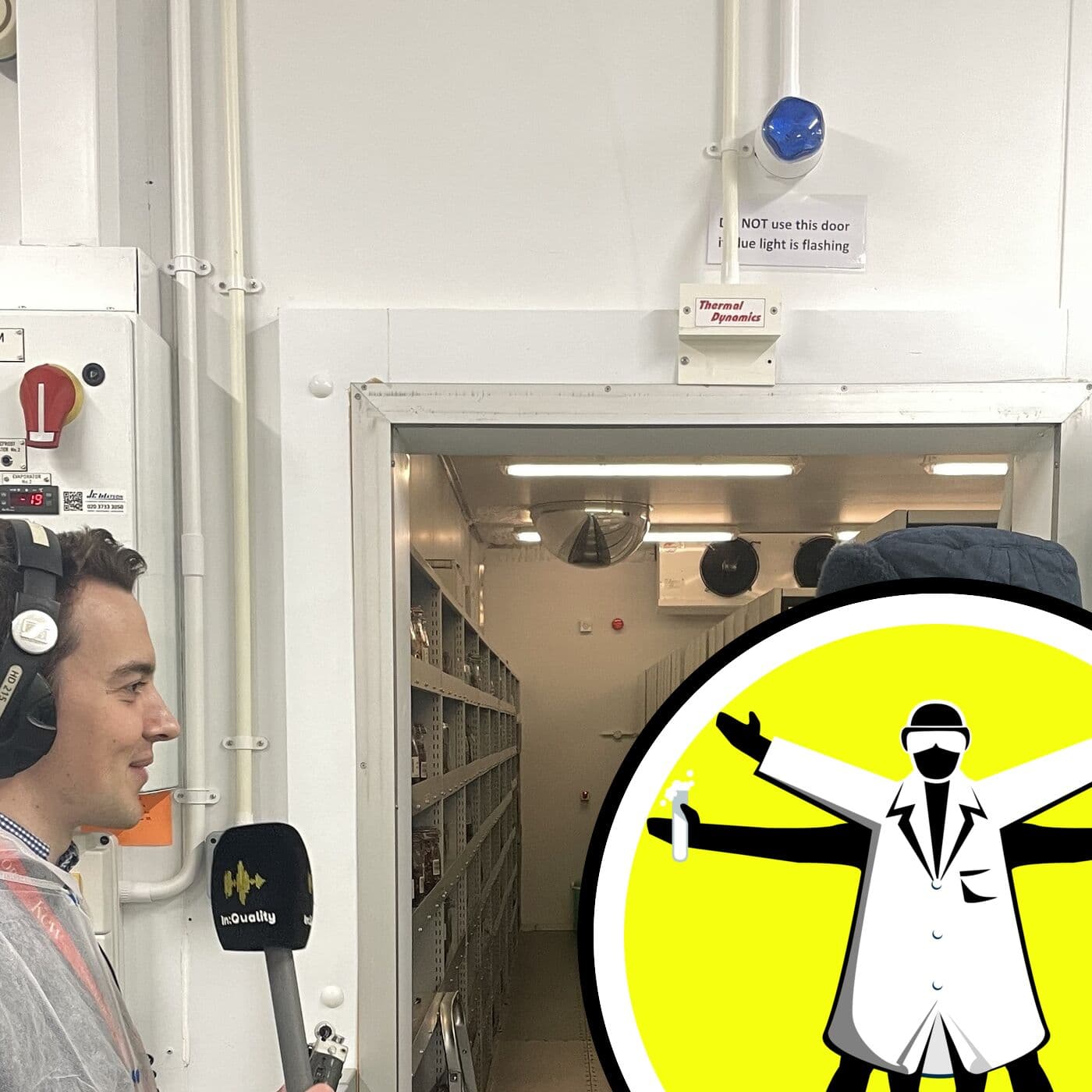
16:09Here we have six cold rooms leading off from a main dry room. And so this is where all the seeds are stored. Fantastic. Can we have a look inside one of the stores? I can open the door, but I'm not sure if I can let you in. I can show you the coats we have to wear. We can open there. It's minus 20, but also I think about minus 50 with a windshield when the fans are running. How many seeds are we within the near vicinity of? So we have two and a half billion seeds and 40 ,000 different species. There you go. That's quite something. Yeah, yeah, it is. So the computer, we put it into the database, we'll split the collections so that we've got what we call an active collection.
16:49And that's what we'll use for germination tests and for monitoring in the future. This is all very good while storing it. But if it doesn't behave when you want to take it out of storage as you hope it will, then what's been the point? The main aim ultimately for this seed bank is it's for restoration, it's for use in the future. There's no point having this if we don't have a purpose behind it. You split them into the active and the storage groups at this stage, but perhaps you might want to check up on how the seeds are doing a certain number of years into their storage, that they're still viable.
17:20Is that something that happens? Yep. So they have an initial germination viability test when they've been in there for over a couple of weeks, and then every 10 years if it needs to be it's monitored if it looks like it's declining it can be reduced to five years or even two years but equally if it's doing really well we can send that out to 20 years if needs be.
17:44So the oldest seeds have been in there for 25 years at this? Yeah we have some from the 1970s so they came down from initially the first seed bank was up at queue and it came down the back of a car it was in the mansion i think they even had like wooden fridges and things like that they were working in there and then they built these amazing vaults
18:12so once the seeds have been stored after a few weeks we will take a germination sample we've got incubators at lots of different temperatures you can see here so five 15 20 and 25 walk-in incubators we've got alternating temperatures to mimic all the climate conditions we might see from seeds all around the world so i imagine that thai tree species from a bit earlier has been one of the warmer of these incubators yeah i i think quite a lot of the hotter countries even madagascar sort of 35 20 degrees so 35 in the day 20 degrees at night but we even have species from the UK where might need pre-chill so they want to know they've had their winter before they're going to germinate in the summer so we might do five degrees for example for maybe six months and then move them up to a higher temperature like 20 degrees for example again mimicking what you'd see in the wild we can either mimic anoxic conditions if it grows it's an aquatic species and it grows in the mud we can make them in dark conditions as well so we'll cover them with foil if some things need dark I can imagine you guys like a challenge yeah we do we do Germination is obviously a crucial part in the life cycle of a plant, but there's more beyond that.
19:22Do you have ways of testing how they get on after the seed may or may not germinate? So at this point, we just take the seed to germination level. But if we know that the seed is critically endangered, we'll talk to the partners and potentially we can grow them on in our glass houses. And for the UK ones, we have restored them back into habitats. Thank you very much to Vicky Philpott, seed curator at the Millennium Seed Bank. for showing me around. As the scientists at Wakehurst have been keen to stress, the seed bank is not just one big stamp collecting exercise. Studying seeds to get to grips with their biological quirks is crucial for reintroducing them into their former habitats.
20:03Marcus Wagner is a plant ecologist at the UK Centre for Ecology and Hydrology. Not affiliated with Q, he works on the restoration of plant communities in the UK's species-rich grasslands. As such, seeds are the building blocks of his work. So the species-rich semi-natural grasslands have declined a lot since agriculture got more intensive after World War II and there's like only barely a couple of percent left compared to its former extent. Species of plants have been lost. Grassland is not just grass and we need to reintroduce them. And the way this is typically done is by either sprinkling directly sowing seeds or using material that contains seeds.
20:47And then obviously we need to know a bit about the plant species that we want to introduce and the ecology of their seeds is one part of that. You mentioned obviously grass and that family feature in these habitats, but there's also other flora that thrive there traditionally. Like compocytes, like the dandelion family, and the best grasslands are usually species-rich with forbs and grasses. And a lot of those best grasslands, they're basically, they accumulated their species richness over centuries. So obviously, species-rich grasslands have a lot of functions, like for pollinators, for example, if it's flower-rich and they support other diversity.
21:28If it's structurally rich, it might support more diversity in other taxa like spiders or other invertebrates. So it's not just about the plants, really. What is it about the biology of some of those plant species that you mentioned that once they thrived in these habitats, but now they struggle to survive? Plant species occur along a continuum of fast-growing species that are very good at exploiting nutrients. Slow-growing species that are more traditional species with grassland that are less good. And the problem of modern grassland agriculture is because you want to get higher yields. So you're basically putting fertilizer on and manure.
22:12You might cut them more frequently and that sort of crowds out those rarer species. Those fast-growing ones also usually terminate rapidly, whereas the other ones that are sort of the losers of this agricultural green revolution, they have often more complex requirements. Basically, you need to imagine when you restore grassland, basically you need to pare open ground and then you put the seeds on. But then you already have seeds there, like those competitive species can spread back into this area. So you have a small window of opportunity. So the species you want to establish, they need to germinate within the next sort of few months after you've sowed them.
22:53But often you have species that don't readily germinate because they have what is called seed dormancy. Even if the conditions are right, they might not immediately germinate. And this is where the painstaking work we've heard at places like the Millennium Seed Bank comes into play. You know, they've dedicated a lot in the laboratories to understanding exactly the right conditions for germination and for the seeds to proliferate. That's where you take the baton. So, yeah, what they're doing at the Millennium Seed Bank, they're collecting seeds, Flaichi, through the UK Flora project. And they have multiple seeds locations and accessions, which is also important in restoration.
23:32Often we say in restoration, local is best. If you use seeds from a local source, they might be better adapted. they can be useful for us as well as other conservation practitioners. Most of my work is more about the whole community, so we try and get most of the species in that would be present in the natural species which grows. Marcus Wagner, plant ecologist at the UK Centre for Ecology and Hydrology, on using the processes of specific seeds for restoring precious habitats. For the last part of this programme, we're going to turn our attention to the threats posed to the largest plants to start their journeys as humble seeds.
24:08Those are trees, of course. Millions of hectares of forests are bulldozed, cut down or burnt every year, sometimes for their timber or to make room for agriculture. Some fall victim to fires fuelled by rising temperatures. Whatever their demise, removing these natural carbon sinks from the landscape could mean exacerbating climate change in a vicious cycle. The backbone of their habitats, the destruction of often rare and perhaps undiscovered tree species is equally devastating for the flora and fauna in some of the most diverse ecosystems on earth. The Millennium Seed Bank has been working for a decade with partners in 41 countries with the aim of conserving over 3 ,000 of the rarest, most threatened and useful trees.
24:54Here's Claire Callow who manages the Global Tree Seed Bank Program and leads work in Madagascar. The latest statistic is 61 % of the tree species in Madagascar are threatened with extinction, but I think the real number is higher than that. The threats in Madagascar, particularly from a burgeoning human population, from shifting cultivation, from habitat destruction mainly, and also from fire. This season's been really bad for fires, particularly in the west of Madagascar in the dry forests. And Madagascar, of course, one of the most biodiverse places on Earth. 80 % of the plants and animals in Madagascar can't be found anywhere else on earth.
25:30A lot of places in Madagascar are very remote. So for seed collecting missions, sometimes it takes three or four days to drive from the capital to the place where you can drive no further. And then sometimes it's one or two days walk further on into the forest to get to trees that you want to have a look at. So in Madagascar, there's something like three and a half thousand tree species. But that's what's been described. But I think even from just a few years of working there, it's obvious that there are many more. Having worked there for 25 years, with 70 scientists currently stationed at Q's only overseas office, the team have found a formula for restoring forests effectively.
26:09So we're looking at, for restoration, traits of different trees which can be useful in kick-starting natural regeneration. So for example, they're easy to propagate, grow rapidly, their canopy spreads rapidly, they're resistant to fire because we're working the dry forest they are quick to flower and fruit so they attract dispersers into our restoration sites which then attracts further biodiversity so we're looking for trees with that type of trait that's kind of the first step along this seed supply pipeline and then we have teams of seed collectors who think about provenancing genetic diversity of all the different seeds that we want to collect making sure that the restoration projects will eventually be resilient.
26:52We're also thinking about having short term seed storage solutions for restoration projects. So we're kind of adapting the technology that we've learned through the Millennium Seed Bank to kind of field situations. And then the last step in the chain is using those seeds in restoration projects. So we're talking about germination protocols, propagation protocols, nursery trials, you know, and then the monitoring of what we've planted. So in Madagascar, we are working in Ankara Fanska National Park, and we've got a system of this framework species methodology, which was developed in Thailand, and we've kind of translated it to the dry forest in Madagascar.
27:30And we're monitoring that using drones and ground-treating the drone data that we get. So it's kind of seed conservation as a pipeline rather than just seed banking. Claire Callow, manager of Q's Global Tree Seed Bank programme. One of the most crucial aspects of ecological restoration projects like those Claire was describing is collaborating with communities that have often deforested habitats for their own economic need. Making sure restoration projects benefit not just the ecosystem, but the people who live in or near them, is where the Global Tree Seed Bank programme's Mexican partnership demonstrates the win-wins that are out there.
28:10The mega-biodiverse cloud forests, which cover just 1 % of Mexico's landmass but contain 10 % of its species of plants, are under threat from deforestation for coffee plantations. Here's Diana Carolina Acosta-Rojas, Latin American coordinator for the Global Tree Seed Bank program. So one of our key stakeholders in Mexico are coffee farmers. We are working towards the same objective. Our stakeholders, they really want to have healthy coffee plantations. So it's not that we are competing or it's not that we are saying like, you need to stop this and that. It's that we need to work in the best way to have healthy ecosystems, healthy coffee plantations.
29:02So, for example, in particular, we were talking with coffee farmers because we wanted to provide a selection of plant species that they can use with coffee plantations, you know. Like a symbiosis between the plants. They help each other develop and sustain. For example, coffee plantations, they are usually growing on slops. So when we have trees around the coffee plantations, they are avoiding erosion. They are helping the system to maintain, to avoid this problem. So that means that's another service that those trees are providing. Seeds to save the forest and to fuel your mornings. Thanks. Diana Carolina Acosta-Rohas there.
Read the full transcript
29:55The Millennium Seed Bank will rightly look back with pride on 25 years of hard work with collaborators around the world who've contributed to its impressive collection of tens of thousands of plant species. Each seed represents a lifeline for the flora endangered by humanity's ever-increasing encroachment on the environment. But this is not a facility which preserves plants merely for the sake of growing its coffers. Rather, it's a proactive nerve centre for conservation missions at home and abroad. Seeds are deposited in the bank, not donated, with a marked emphasis on work to ensure the restoration of habitats so they'll be ready when the time is right to restore species.
30:38This is the side of seed banks I expect will grow even more significant in the next 25 years. that's it for this episode but do join us on friday for the usual news and views roundup featuring as always the latest and greatest stories from across the scientific spectrum if you'd like to help with our running costs please do visit nakedscientists.com slash donate you can also follow us on linkedin instagram and x or leave us a review on all the major podcast platforms it really helps the naked scientists is supported by rolls-royce I'm James Ticktoe and from everyone here at the team thanks for listening and until next time goodbye