In short
How modern telescopes and observatories (Hubble’s legacy, JWST, Euclid, Vera Rubin, and Roman) extend astronomy—probing early galaxies, mapping dark matter/dark energy, finding solar-system objects, and searching for “baby” black holes.
Guests and backgrounds
John Czarnecki, former president of the Royal Astronomical Society; worked in the 1970s on the Hubble “faint object camera” for British Aerospace, including European-built instrumentation. Jenny Green, Princeton astrophysicist; studies early-universe black holes (“little red dots”). Megan Argo, University of Lancashire astrophysicist; works on Euclid’s large-scale cosmology. Matt Bothwell, Institute of Astronomy (Cambridge); involved with Vera Rubin science/commissioning.
Key claims
Hubble’s flawed mirror was fixed in orbit; JWST’s infrared vision reveals dusty star formation and exoplanet atmospheres via eclipses/transmission spectroscopy; JWST may image intermediate-mass “little red dots” forming within the first billion years; Euclid uses gravitational lensing to infer dark matter statistically; Vera Rubin should find ~500,000 solar-system objects/year and can test Planet Nine; Roman will deliver Hubble-quality wide fields from L2.
Notable examples
Hubble’s 1990 launch and 1990s servicing; JWST infrared stretching from cosmic expansion; water molecules in exoplanet atmospheres; “little red dots” as candidate 1,000–10,000-solar-mass black holes; Euclid’s 600-megapixel camera and infrared spectrometers; Rubin commissioning: 11,000 new objects, including 33 near-Earth asteroids and ~400 TNOs; Planet Nine search; Roman’s ~200x Hubble field-of-view concept.
Written by AI. May contain mistakes. Listen to the episode to check what was said.
Chapters
Tap a time to open that second in VOThe Evolution of Space Telescopes
0:45 to 2:54
Exploring the history and significance of space telescopes, particularly Hubble.
“Today, we're going to take a journey through the evolution of space telescopes and observatories.”
The Legacy of Hubble and the James Webb
2:54 to 4:56
Discussion on how Hubble paved the way for the James Webb Space Telescope.
“And then we're able to deploy a mission that fixed it in situ.”
Advantages of Infrared Observation
4:56 to 6:34
Understanding how infrared observations with James Webb enhance our view of the universe.
“It's a six metre telescope that's about three times wider than Hubble and it's gold plated and it has been optimised to see in the infrared.”
Studying Black Holes with James Webb
6:34 to 8:06
Exploration of how James Webb aids in studying black holes and their formation.
“And so you boost the amount of light coming from the planet versus the star.”
The Formation of 'Little Red Dots'
8:06 to 13:00
Examining the possible existence and characteristics of early black holes detected by James Webb.
“And the big promise with James Webb specifically was, in fact, to see the baby black holes as they're forming, the ones that ultimately become supermassive black holes.”
The Future of Black Hole Research
13:00 to 13:34
Discussing the implications of early black holes and future research methods.
“I don't think in this podcast you're talking about extremely large telescopes, but in the next decade we will be getting those as well.”
Exploring Space Telescopes
14:02 to 14:18
Learn how space telescopes are revealing the early universe and mapping its structure.
“are helping us to peer deeply into the early universe.”
The Euclid Space Telescope
14:18 to 15:36
Discover the mission of the Euclid Space Telescope in mapping the universe and dark matter.
“we now shift from looking deeper into the universe to mapping it on the widest possible scale.”
Understanding Light Paths
15:36 to 17:06
Gain insights into how light paths from distant objects are altered by gravitational lensing.
“aha, I know something about the star that made that, it's looking at the path of the light and saying, I now know something about the structure of the space it's come through.”
Instruments on Euclid
17:06 to 18:22
Explore the advanced instruments on the Euclid Space Telescope for deep sky observation.
“And that camera is, I think, 600 megapixels.”
Show all 16 chapters
Early Discoveries from Euclid
18:22 to 20:02
Review the early discoveries made by the Euclid Space Telescope since its activation.
“which is why you need the infrared spectrometer to try and measure their distance.”
Insights into Dark Matter
20:02 to 22:45
Understand the implications of the Euclid Space Telescope in studying dark matter distributions.
“Because it's one thing to look at the evolving structure of the universe and I get what you're saying about having a series of very clear pictures collected over a long time to do that.”
The Vera C. Rubin Observatory
22:45 to 24:41
Learn about the Vera C. Rubin Observatory's capabilities and its impact on solar system exploration.
“Finally today we are coming back down to Earth to gaze into the future of ground-based space observation.”
New Discoveries in the Solar System
24:41 to 27:09
Discover what new objects have been found within our solar system by the Vera Rubin Telescope.
“It's going through sort of commissioning now, taking snapshots of the universe to test how all the software and the data pipelines are working.”
The Search for Planet 9
27:09 to 28:00
Examine the ongoing search for Planet 9 and its significance in our understanding of the solar system.
“There are a lot of these trans-Neptunian objects that seem to have orbital residences that seem to imply, potentially, that they're being herded by some sort of massive planet.”
Exploring the Nancy Grace Roman Space Telescope
28:00 to 30:21
Learn about the capabilities and significance of the Nancy Grace Roman Space Telescope.
“We sort of have a mass range that it fits into and so we have some guesses about where it might be orbiting, but those guesses obviously haven't been good enough to find it so far.”
Transcript
Automatic transcript. May contain errors.0:17Hello, welcome to the Naked Scientist podcast. This is the programme that brings you the biggest breakthroughs and talks to the major movers and shakers in the worlds of science, technology and medicine with me, Chris Smith. And this week, we're going to find out what our space telescopes and ground-based observatories are teaching us about the great unknowns up there.
0:45Today, we're going to take a journey through the evolution of space telescopes and observatories. They're continuing to drive our understanding of the universe, and the latest iterations, the Vera Rubin Observatory and the Nancy Grace Roman Space Telescope, are hoping to go farther than any of their predecessors in this pursuit. For many, though, the revolution began with many young scientists consequently embarking on careers in astronomy, when our eyes were first truly opened in earnest, and we began to see the universe in a whole new way following the launch and successful repair of its initially faulty mirror, of the Hubble Space Telescope back in 1990.
1:24As part of our Titans of Science series recently, I spoke with space scientist and former president of the Royal Astronomical Society, John Czarnecki. One of his early career moves was to work in the 1970s on what must rank as one of the most famous space telescopes of all time. I went into the aerospace industry, to British Aerospace, who had what looked like a very interesting project. It was called, at the time, the Large Space Telescope. Now, you probably know it differently. While I was working on it, it was renamed the Hubble Space Telescope. Now, a lot of people don't know that actually about 20 % of Hubble, even to this day, is European.
2:09So, of the original five instruments, one was European, that was the faint object camera, and that was designed and built in Germany and the UK. So I went to British Aerospace in Bristol to join the team working on building the faint object camera. It wasn't your mess up that meant the mirror was wonky, was it? No, that was the Americans. I mean, what do they know? It was a company who, in fact, changed their name not long after that disaster so that they wouldn't be associated forever with that problem. It did get fixed, though, didn't it? Because that was another amazing space first that not only had we put this thing in space, but realised what the problem was.
2:54And then we're able to deploy a mission that fixed it in situ. I mean, obviously, it's a bolt on to fix it. But then look at the outcome. Look at the results. Absolutely. And of course, Hubble was, I think, pretty much the first space instrument, at least of any size, that was designed from the very beginning to be serviceable by astronauts delivered by the space shuttle. So, you know, without that, it would have been just a disaster. It would have, you know, never worked properly. Your engineering stood the test of time there, hasn't it? Because you think decades later, it's still up there. It's still working.
3:29We're still doing science with it in a really very inhospitable environment. Absolutely. Even when we were working on it, it was fairly old technology. The core of the detector and camera system was what's called a Vidicon, which, you know, goes back to the 30s. the technology. I mean, it was a very sophisticated Vidicon, but it was already kind of old-fashioned when we launched in, what, 1990, I think it was. That instrument lasted for 12 years, was replaced. All of the original instruments have been replaced, and much of the electronics. But yes, it's a remarkable testament to good design. John Zanecki, famous also for landing the first man-made object on Titan, Saturn's largest moon, as part of the Cassini-Huygens mission that launched in the late 1990s.
4:20Now, as well as opening a window onto the wider universe like nothing before, it discovered supermassive black holes at the centres of galaxies, the moons of Pluto, the age of the universe itself, and led to the publication of more than 20 ,000 scientific papers, the Hubble Space Telescope also played a critical role in the evolution of what was to come next, the James Webb Space Telescope. As a successor, James Webb has been designed to build on Hubble's legacy and specifically target the infrared light spectrum to enable it to peer through the dusty haze obscuring the deeper, older realms of the universe.
4:55Princeton University's astrophysicist Jenny Green. It's a six metre telescope that's about three times wider than Hubble and it's gold plated and it has been optimised to see in the infrared. And the reason is that because the universe is expanding, as the light from the first galaxies and stars travel through the universe towards us, that light is stretched out. And so by the time it reaches the James Webb Space Telescope, it's in the infrared. So if we want to see the very first stars and galaxies as they were forming, we need a telescope like James Webb. Does the infrared offer us other advantages in the sense that because that's longer wavelengths, it can see through things that visible light might be scattered or blocked by?
5:44I'm thinking gas and dust clouds that might obscure objects. That's right. So even nearby clouds of gas and dust that are actively forming stars, what we might see with Hubble is basically the dust. but we can peer right through that and see the forming stars directly with James Webb. So the two actually work beautifully together. Another context for the power of James Webb would be studying the gas around extrasolar planets, so planets that are orbiting stars other than our sun. And we've been able to learn quite a lot about what those planets are made of and what's in their atmospheres and whether they might harbor life because of James Webb.
6:26How does it actually do that? What's the physics behind being able to tell what the gases are in the atmosphere for a remote world? Basically, going into the infrared helps you because that's where the star makes the least light. And so you boost the amount of light coming from the planet versus the star. And then roughly speaking, the way that people do this is they pick planets that are eclipsing their star. and you can look at the difference in the light that comes from the star and then when the planet is in front of the star and that allows you to take away the starlight and see only the planet light.
7:06And so you can, for instance, see molecules like water molecules that are in the atmosphere of the planet as the light from the star passes through that planet atmosphere. What about things we can't see? And I'm thinking specifically, you work on black holes and that they don't produce anything, or not directly from the black hole itself, which is why they're a black hole. Can the James Webb, though, help to understand the fabric of the black hole and its environs? Yeah, so for sure, one of the reasons I became an astronomer in the first place is that even though you have these black holes, which are objects that are so dense that not even light can escape their gravitational pull, somehow, as astronomers, we've been able to figure out that there are black holes in the universe and we can study them with light.
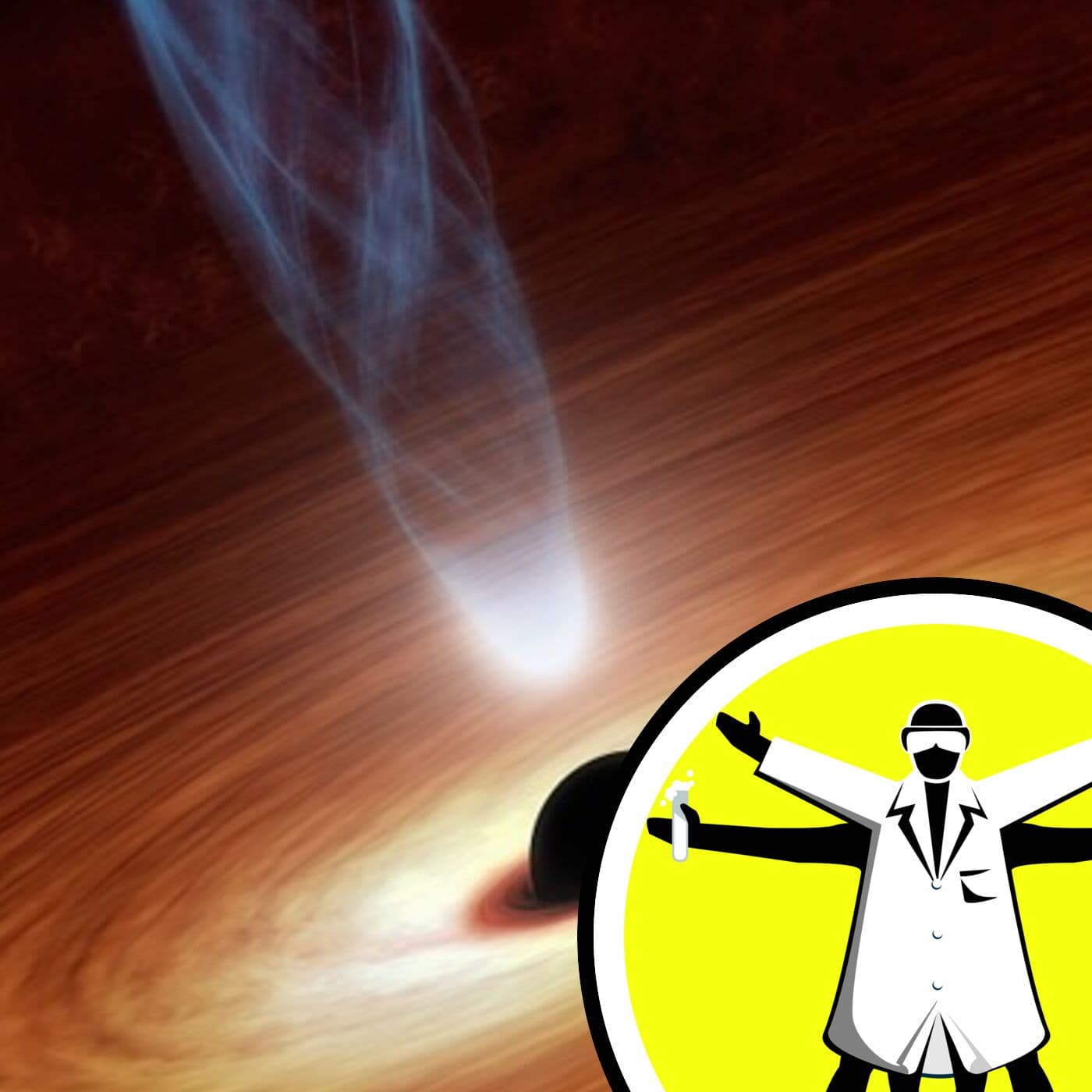
7:56And one of the key ways that we study the black hole is by looking at the light from the gas that's falling into the black hole as it falls in. That gives us a lot of information. And the big promise with James Webb specifically was, in fact, to see the baby black holes as they're forming, the ones that ultimately become supermassive black holes. Like we have a million sun black hole in the center of our own galaxy. But it didn't start that way. It probably started much smaller. And the James Webb is sensitive enough that we should be able to take baby pictures of these black holes. Has anyone seen any yet?
8:34We think that these little red dots that we've been talking about, there's actually quite a bit of controversy in the community right now about how big those black holes are. But I belong to the camp that these are indeed what we call intermediate mass black holes, so maybe 1 ,000, 10 ,000 suns. There are a bunch of reasons we think so. So the light that we see from these little red dots look different from the light that we've seen from any other growing black holes in ways that make us think that a tremendous amount of material is falling onto this black hole right now, which is causing us to see a different kind of spectrum.
9:12The lights look different. And we see so many of them that that makes us think that they're probably little black holes in little galaxies, and they're just popping off all the time as they're just starting to really get going in their growth. If they're black holes, why do you call them little red dots? And where are they? So anywhere you look in the sky with James Webb, you'll see with one picture, like four or five of these, they're all radiating, growing within the first billion years since the Big Bang. So this is very early universe. Another reason we think they're likely to be, you know, either babies or adolescent black holes.
9:54We call them little red dots because that's what they look like. They are very red, which means most of their light comes out in optical wavelengths that we see with our eye. And, you know, at these cosmological distances, that makes them look red in the pictures. We call them little because they're barely resolved with James Webb. James Webb has very crisp vision. And even with James Webb, they look basically the same as stars. So all of this light that they're making is in a very small region. If they are black holes in the primitive universe, what are the implications of that? Well, like I said, we have all of these hints now that they are basically the smallest growing black holes that we've been able to see at early times.
10:44And if that's true, we can start asking questions about, well, what's important for these black holes to grow? Like, we typically see little blue friends next to the little red dots. so maybe it's important that there's a couple galaxies merging together when the little red dot is growing how much metals have been formed already do you need really pristine gas to make one of these baby black holes that's the kind of thing we can start to learn now are there not lots of black holes still being made somewhere in the universe though because if you're looking back and you're seeing this to what 12 13 billion years ago and that's happening what's happening now in the modern era?
11:25Is this still happening or was that one special period in the universe's history when red dots, black holes were forming but they're not now? Most of the pictures that we have for how to grow supermassive black holes rely on very early universe conditions. Because the universe is expanding it means at early times the universe was much denser and so you can have these very extreme growth events. You also have much more, as you said, primitive or pristine gas, which allows you to make black holes actually much more rapidly at early times. Does this mean then this sort of black hole species is an endangered species, as in the conditions were only right once?
12:12It was like Goldilocks and the porridge, and the universe has now changed in such a way that this won't happen again? Well, we have looked for little red dots in the nearby universe, and people looked over about a quarter of the sky in the present-day universe and found three. So in the first billion years, in every little tiny James Webb field, we see three or four of them. Today, total in basically the whole universe, we see three. So they've become extremely, extremely rare. So yes, it does seem that they are a Goldilocks phenomenon that only can happen at early times. And how are you going to prove what you think they are?
12:53The dream is to really understand what the black hole mass is. And it's not clear that we can do that with James Webb alone. I don't think in this podcast you're talking about extremely large telescopes, but in the next decade we will be getting those as well. And so there's some dream that we can use those to peer all the way into the heart of the little red dots and get their black hole mass. Spine-tingling stuff, isn't it? And to think that we are probing the universe back to 13 billion years and beyond. That was Jenny Green at Princeton University with her little red dots that she thinks are the baby black holes that would grow up to become the supermassive black holes that we see at the centres of galaxies today.
13:33The Naked Scientist podcast is produced in association with Spitfire. Cost-effective voice, internet and IP engineering services for UK businesses. Find out how Spitfire can empower your company at spitfire.co.uk.
13:52Music in the programme is sponsored by Epidemic Sound. Perfect music for audio and video productions. This is the Naked Scientist podcast with me, Chris Smith, and we are exploring how space telescopes and observatories are helping us to peer deeply into the early universe. In a moment, the newest ground-based telescope, which has already dazzled during its test phase and uncovered over 10 ,000 objects in nearby space that we never even knew were there. But before that, coming off the back of the incredible discoveries of the James Webb Space Telescope, we now shift from looking deeper into the universe to mapping it on the widest possible scale.
14:28Enter the Euclid Space Telescope, a mission that isn't about close-up images of individual galaxies, but about building a vast three-dimensional map of the universe and uncovering the hidden influence of dark matter and dark energy. Megan Argo is an astrophysicist at the University of Lancashire. Almost all of the telescopes that we've ever built are designed to explore visible matter, the stuff that we can see in the universe, so stars, planets, galaxies, black holes, that sort of thing. And we might do that using visible light or infrared or ultraviolet, maybe radio waves. but almost always we're collecting actual photons and we're interested in what emitted the photons whether it's a star a galaxy or whatever with euclid we're still detecting photons but instead of using them to understand the nature of the object doing the emitting we're using the object that did the emitting and the structures that we see made up of those objects to try and understand something more fundamental about the universe its structure on the largest possible scales and what that tells us about the origin of the universe, its evolution and potentially where it will go in the future.
15:34So rather than looking at the light and saying, aha, I know something about the star that made that, it's looking at the path of the light and saying, I now know something about the structure of the space it's come through. Yeah, exactly. So we're using it to try and both understand the large scale structures, how these galaxies are organised in three-dimensional space on vast scales and also about how that distribution of matter makes the light paths change on their long journeys from distant objects that are doing emitting to us along the way they pass through a foreground of other galaxies and those galaxies alter the shape of space-time they alter the fabric of space-time and they make the light path change it's an effect called gravitational lensing and by using that gravitational lensing we can then infer the distribution of matter that's actually invisible to us any other way this thing called dark matter that we actually can't detect directly we can only see it indirectly by using this gravitational lensing technique.
16:31Where is Euclid and how is it actually doing what you've just described? So Euclid is not in Earth orbit like the Hubble Space Telescope is it's out more where the James Webb Space Telescope is so it's out at the Lagrange point away from the Earth and it's out there because it's a really good place to do sensitive observations away from any interfering light radiation coming from the Earth itself. And what sorts of instruments is Euclidean equipped with then to do what it's got to do? So it's got a camera that works in the visible part of the spectrum, so the same part of light that our eyes see.
17:06And that camera is, I think, 600 megapixels. So it's a big camera and that's designed to enable it to do very, very sensitive, but very, very wide field images of the sky. What you want to do to work out what this large scale structure looks like is to image as a larger section of the sky as you possibly can. Lots of telescopes that do sensitive surveys often do it with quite small fields of view. But Euclid is designed to give us a lot of sensitivity so we can look deep into the sky and deep into the past over large areas so that we can see that large scale structure. It's also got spectrometers on board so spectrometers working in more the infrared part of the spectrum the further away a galaxy is the faster it's moving away from us and because of this effect of redshift the Doppler effect essentially but on cosmological scales the further away a galaxy is the faster it's moving away from us and the further towards the red end of the spectrum any emission lines are coming from that galaxy so to measure its distance you need to look at that spectrum and measure those emission lines and stuff that's emitted in the rest frame of the galaxy.
18:10So if you were standing in the galaxy, you'd see those lines in the optical part of the spectrum. By the time you've moved that galaxy millions of light years away and made it move relative to you at high speeds, it shifts those lines into the infrared part of the spectrum, which is why you need the infrared spectrometer to try and measure their distance. What have we actually discovered from it so far? It's been flying for about three years now, hasn't it? It launched in or became active in 2023. What have we learned from it so far? So, yeah, I mean, even the first images from this telescope were really quite spectacular.
18:41And there have been lots and lots of papers published to date. Its nominal mission lifetime is going to be about six years. So we've got a way to go before they've done the full survey yet. But the aim is to study about a third of the entire sky. So we're looking away from the galactic plane. If you look at the Milky Way on the sky and how the stars are distributed, you've got a lot of thick dust lanes, a lot of parts of the sky that are full of Milky Way stuff, which is really interesting, but they just get in the way if you're trying to understand the background universe. So the field of view, the part of the sky that Euclid is actually observing is away from the galactic plane.
19:17So over the next six years, it's going to survey all of that area and there are parts of the sky that it will keep coming back to as part of that survey, partly as calibration fields, but also partly so that it can do really deep studies on a few patches of sky that we can then cross match with deep surveys that are being done by other telescopes in other parts of the spectrum as well and that's really interesting because those deeper surveys that you can then use with interpretation from other telescopes as well so in in the radio and the infrared and the ultraviolet looking deeply into a patch of sky with all of those different parts of the spectrum gives you the best handle on the physics of the objects that you see in that patch of sky so there's an awful lot that's going to come but not until we've got the full survey data to go up.
20:01Have we got any more insights yet into the dark matter problem though? Because it's one thing to look at the evolving structure of the universe and I get what you're saying about having a series of very clear pictures collected over a long time to do that. But to look at dark matter, that's a bit more kind of, we get some observations and we can see possibly distributions of that once, can't we? So what's that revealing? We can't see it directly we can only infer that it's there. One of the ways we do that is by looking at the rotation rates of galaxies. They're rotating faster than they should be unless you account for this invisible matter that we can't see.
20:37It's really interesting trying to figure out exactly what its distribution is when you can't see it. And it's one of the things that this telescope is going to be doing, but on a statistical basis. So by looking at this idea of gravitational lensing, how the light waves change position as they move from the distant universe to us, they can cause the background shapes of the galaxies to become slightly distorted from what we expect a galaxy shape to look like. It's a very subtle effect and so the only way you can really study it is by doing a very wide survey like this one and then doing really detailed careful statistics on the data that you get and because of that you do need an awful lot of data taken over many many years in order to do the detailed analysis.
21:21How does it get the data back to us though because if it is parked all that way away from earth in that lagrange point there's there's got to be a way for it to send back what it is seeing how does that happen yeah so similar to how the jamesworth space telescope does it so all of these telescopes that are out in space including the hubble space telescope have down links so they are sending data back to earth over usually over radio waves back to receivers on the earth now for something like Euclid with its 600 megapixel camera that's quite a lot of data so it does take time for that data to be downlinked and then again it takes time for scientists to process it so there are actually several data processing centres spread out around the world.
22:00It's a very very large collaboration that have put Euclid together from astronomers in 18 different countries so there are lots of data centres around where a scientist can go and work on the data. And is the camera static as in it's got to stare at the same patch of space continuously or can it actually move it's doing feels all the time so it's moving around the sky doing a patch here and then moving on to the next patch it will come back and rescan each of those patches and some of them it will come back to multiple times and the more times you observe a particular patch of sky the deeper your observation gets in the same way that Vera C.
22:35Rubin is going to make up a really deep image of the sky by repeating visits to the same patches of sky over many many years. Megan Argo at the University of Lancashire on how the Euclid Space Telescope is trying to shed a bit of light on dark matter. Finally today we are coming back down to Earth to gaze into the future of ground-based space observation. The team behind the Vera C. Rubin Observatory had promised that it would discover up to half a million new solar system objects in each year of operation. Well it very much looks like it will come good on that following confirmation that it recently captured more than 11 ,000 asteroids just during the initial testing phase.
23:14Matt Bothwell is a big fan of the initiative for a number of reasons and he's based at the Institute of Astronomy in Cambridge. So the Vera Rubin Telescope is this brand new telescope high up in the Atacama Desert in Chile and it's really the first modern super powerful telescope to combine a very wide field of view with a very, very, very high resolution. So previous telescopes like Hubble have been very, very good at peering very closely at individual objects. And we've also had survey telescopes that can go wide but at lower detail. And Vera Rubin is sort of the best of both worlds. It can go very, very wide and very, very detailed in a way that just lets us capture more sky and more stuff than ever before.
23:56I think you mentioned when we spoke about a year ago when this was beginning to fire up that the physics behind the optics was actually pioneered a number of decades ago and presented where you're sitting. That's right. So it's a unique three-mirror telescope design. The theory behind this was drawn up sort of mid-20th century, but the first sort of real working model of this was here at the Institute of Astronomy. Obviously, the one in our back garden is not quite as powerful as the Vera Rubin, but yeah, it's nice to know that Cambridge was sort of part of this story. When did it first turn on and begin to produce data?
24:33First light, as we call it, when telescopes sort of opened their eyes to the sky for the first time, happened in June 2025. It's going through sort of commissioning now, taking snapshots of the universe to test how all the software and the data pipelines are working. And then we're hopefully going to be starting the big survey, what we call the Legacy Survey of Space and Time, later this year. So this amazing announcement that just during the commissioning phase it's already seen thousands of objects, tell us about that. What's it picked up? Where are they? Just during testing, it's seen about 11 ,000 new solar system objects.
25:11Buried in these 11 ,000 are 33 near-Earth asteroids and nearly 400 what we call TNOs, trans-Neptunian objects. These are objects way out in the Kuiper Belt in the frozen outer reaches of our solar system. And I think just the fact that it's found 11 ,000 brand new things even just during testing is just a testament to how amazing this telescope is going to be. Before we talk about the ones way out there beyond Neptune, the ones closer to Earth, presumably these are not Earth impactors, or are they? So we've not found anything so far that is likely to be an Earth impactor, although one of Vera Rubin's science cases is to be able to do a proper census of all the stuff moving around in the solar system, and it will be able to identify any potential impactors.
25:58That's not what we've found so far. We've found lots of things in our neck of the woods, if that makes sense. to be it nothing that's going to be a danger one space commentator said to me before that there are objects that we've seen in the past and then we've i don't mean that they're careless but we've lost because we didn't manage to hang on to them visually for long enough to get a sort of idea of their trajectory are we actually losing many objects and will they be re-found by rubin or indeed are some of these objects that it has found in inverted commas lost objects from yesteryear That's absolutely right.
26:30So yeah, that 11 ,000 number is the new thing that we'd never seen before. But on top of that, there's something like 80 ,000 that have been re-observed, ones that were previously lost. These were maybe old detections that weren't archived properly, or their orbits were a little too uncertain to be sure of where they were going to be in the future. And now Ruben is able to see them again. So yeah, it's a mixture of the old and the new, if you like. I'm intrigued by what might be going on out beyond Neptune, though. Do we think that there's more big stuff out there, or is it just picking up bits of ice?
27:03Astronomers have wondered if there is something very big out there beyond the Kuiper Belt. There are a lot of these trans-Neptunian objects that seem to have orbital residences that seem to imply, potentially, that they're being herded by some sort of massive planet. So this gets called Planet 9 because if it's real, it would be the ninth planet in our solar system. And yeah, a lot of astronomers are hoping that Ruben will have the power to either confirm or rule out Planet 9 once and for all. I thought at one point it got called Planet X because X is 10 and Pluto is a planet. But now it's unfortunately lost that rather exciting name, Planet X, because Pluto is not a planet anymore.
Read the full transcript
27:45No, no, it sounds like Planet X was nice and mysterious when it was the 10th planet. Planet IX doesn't really have the same ring, does it? Not really, but what characteristics might it have? So we think it's sort of several times larger than Earth and also astonishingly farther away, like much, much, much further from the Sun than Pluto. That's all we really know so far. We sort of have a mass range that it fits into and so we have some guesses about where it might be orbiting, but those guesses obviously haven't been good enough to find it so far. And that's where Vera Rubin comes in with this very wide field of view.
28:16It should be able to capture it. now the other project that's on the drawing board well it's beyond that isn't it it's earmarked to fly fairly imminently that's the nancy grace roman space telescope so this unlike vera rubin which is on the ground that's going to be in space we've got a few space telescopes now what does this add and when will it be up there i think we're hoping towards the end of this year and i think at least at the very latest by spring next year is when it should be launching in terms of what it will add I think the best way to think of the Nancy Grace Roman telescope is as lots of Hubble's working together.
28:52It's sort of similar to Hubble. Like the size of the mirror is about two and a half meters in the same way that Hubble's mirror is. But the amazing thing about the Nancy Grace Roman is that its field of view is maybe one or 200 times larger than Hubble. So it's essentially like having 200 Hubble space telescopes sellotape together. in just one single pointing it can see you know what would have taken Hubble thousands of hours at Hubble quality resolution so yeah it's an astonishingly powerful instrument. Where will it be stationed? So there is a very popular parking spot for telescopes which astronomers lovingly call L2 which stands for the second Lagrangian point and basically what that means is it's a stable point in our solar system it's about one and a half million kilometers away from the Earth in the same direction away from the Sun, if that makes sense.
29:46So a telescope parked at L2 will go around the Sun sitting right behind the Earth once every year. And the James Webb Space Telescope is out at L2 at the moment, and that's where Nancy Grace Rowan is going to be as well. It's a really popular spot because by parking behind the Earth, you can block the Sun and get this sort of uninterrupted view of the night sky in a way that's very, very stable. so several things to look forward to in the year ahead matt bothwell there at the institute of astronomy in cambridge and that wraps up our brief tour of the telescope seeking to unlock some of the secrets of the universe back here on earth meanwhile you can catch us next on friday for our weekly whistle stop look at what is making waves in the world of science news more generally there'll be findings on why repeated knocks to the head often sustained in sport are linked to dementia and a new way to spot the perfect coffee formulation.
30:39So use that, grab a coffee and tune in to one of our podcasts, wherever you get it, of course. We'll also have our usual updates on social media. So if you want to check us out on Instagram or LinkedIn, you'll find details of what we're up to there. And if you'd like to support the programme, nakedscientist.com forward slash donate. It's a huge help to us and we are really very grateful. If you want to get in touch, meanwhile, Well, I'm at chris at thenakedscientist.com. We love getting your thoughts, comments and feedback. I'm Chris Smith. Thank you for listening. And until next time, goodbye.