In short
The episode covers three science stories: (1) how spaceflight affects the body and mind, (2) what chronic pain does to the brain and how it may relate to burnout, and (3) how male octopuses mate.
Guest 1
Kevin Fong, broadcaster and doctor; worked in NASA’s human spaceflight programme in Houston and nearly became an astronaut.
Key claims
microgravity unloads physiology, causing muscle/bone deconditioning, heart deconditioning, balance/coordination changes, and “space anemia” (space anemia is hard to pin down). Early effects include inner-ear–driven nausea/vomiting; fluid shifts upward cause congestion-like symptoms and altered taste. Artemis II is beyond most Earth magnetic shielding, increasing vulnerability to solar particle events. Radiation risk is a major concern.
Guest 2
Marta Favara, University of Oxford; director of Young Lives.
Key claims
poverty reduction improved health and nutrition, but gains are unequal and fragile post-pandemic.
Notable examples
Peru undernutrition fell from ~40% (2001) to near zero; India shows “double burden” (undernutrition plus obesity).
Guest 3
Trevor Robbins, Cambridge neuroscientist.
Key claims
chronic pain alters hippocampus structure/function via immune activity (microglia) and excitotoxicity; minocycline blocked depression-like transitions in rodents.
Notable examples
UK Biobank imaging shows larger hippocampi in chronic pain alone, but smaller in chronic pain plus depression.
Guest 4
Nicholas Bellono, Harvard; lead author.
Key claims
male octopuses use a specialized arm (hectocotylus) for “taste by touch,” detecting female progesterone; mating can occur with minimal vision.
Notable examples
mating through a barrier and in the dark; receptors localized more heavily on that arm.
Written by AI. May contain mistakes. Listen to the episode to check what was said.
Chapters
Tap a time to open that second in VOImpact of Space Travel on Astronauts
0:49 to 1:20
Explore how space travel affects astronauts, including challenges faced in microgravity.
“and talks to the major movers and shakers in the worlds of science, technology and medicine with me, Chris Smith.”
Physiological Changes in Microgravity
1:20 to 2:26
Understand the physiological changes astronauts experience due to microgravity.
“Astronauts aboard NASA's Artemis 2 mission are heading home after a lunar flyby that saw them travel farther from Earth than any other humans ever have.”
Nausea and Balance Alterations in Space
2:26 to 3:56
Learn about balance and coordination issues astronauts face that can lead to nausea.
“and the bones also get thinner in certain load-bearing areas.”
Fluid Redistribution and Its Effects
3:56 to 5:15
Discover how fluid redistribution in the body occurs in space and its effects on astronauts.
“nausea and in some case vomiting amongst the crews so much so that one of the most prescribed medicines there is up in space is anti-emetic anti-sickness medications.”
Radiation Risks Beyond Earth’s Magnetosphere
5:15 to 6:31
Examine the increased radiation risks astronauts face during lunar missions.
“The present mission goes way beyond where we would normally get that sort of protection.”
Historical Improvements in Space Missions
6:31 to 7:44
Discuss advancements in space mission conditions and astronaut living standards.
“in which you can suddenly have many orders of magnitude, greater flux of radiation coming through the space.”
Evolution of Space Food Technology
7:44 to 9:50
Learn about the advancements in food technology for astronauts over the decades.
“There's that and then there's the remoteness.”
Young Lives Study on Poverty and Inequality
9:50 to 11:03
Explore findings from the Young Lives study tracking children's development across several countries.
“But without objective data documenting where problems lie, how they arise and the impacts, successful or otherwise, of interventions to address them, we are flying blind.”
Trends in Health and Nutrition from Young Lives
11:03 to 12:30
Analyze improvements and ongoing challenges in health and nutrition among studied children.
“The study's director Marta Favara is based at the University of Oxford.”
Mixed Outcomes in Child Development
12:30 to 14:00
Understand the mixed outcomes in child development and the factors influencing them.
“These kids, some of them are now in their 20s, so they're young adults.”
Show all 15 chapters
Improvements and Challenges in Global Poverty
14:00 to 16:44
Learn about the progress in reducing poverty and the remaining challenges across nations.
“So what do you attribute the improvements before we look at the disimprovements to?”
The Impact of Chronic Pain on the Brain
18:29 to 21:21
Explore how chronic pain affects brain structure and function, leading to cognitive changes.
“The Naked Scientist podcast is produced in association with Spitfire.”
Understanding Neurogenesis in Pain Conditions
21:21 to 27:14
Investigate the relationship between neurogenesis and chronic pain, and its implications for mental health.
“But when the hippocampus got smaller, their cognitive performance in this other group who had depression got worse.”
Mating Behavior of Male Octopuses
27:14 to 28:00
Learn how male octopuses use a specialized arm for mating and the challenges of studying their behavior.
“Here's Harvard's Nicholas Bellono, lead author on the study, telling me how octopuses find love.”
Octopus Mating Behavior and Mechanisms
28:00 to 34:11
Explore the surprising mating behaviors of octopuses and how they use specialized arms to mate.
“very aggressive toward one another and will even kill each other.”
Transcript
Automatic transcript. May contain errors.0:00Thank you for calling the Bombas comfort line. Bombas make socks, slippers, tees, and underwear made with the highest quality materials. Press 1 for comfort, 2 for style, 3 for donation. You chose style. Bombas is styles for whatever you enjoy. You can run in Bombas, lounge in Bombas, dress them up, dress them down, but always give back in Bombas. Because with every item purchased, another is donated. Bombas, comfort worth calling for. Go to bombas.com slash audio and use code audio for 20 % off your first purchase. That's B-O-M-B-A-S dot com and use code audio.
0:34All engine running. Absolute genius. Get this. Welcome. Welcome. This is the show where we bring you science. What that essentially means is... Discovery is the question. Advances. Research. Technology. Unbelievable. Without further ado, this is The Naked Scientist. Hello, welcome to The Naked Scientist podcast, the show that brings you the biggest breakthroughs and talks to the major movers and shakers in the worlds of science, technology and medicine with me, Chris Smith. And in the programme this week, the impact of space travel on Artemis II's astronauts and how the food has improved enormously since Neil Armstrong's flight.
1:09Also, a new study identifies the neurological basis of burnout and swipe right the discovery that male octopuses use a special arm to taste a match to see if they want to mate.
1:29Astronauts aboard NASA's Artemis 2 mission are heading home after a lunar flyby that saw them travel farther from Earth than any other humans ever have. We've all seen the footage of them floating in microgravity, with remarkable shots of the Earth rising behind them. But what demands has this mission placed on their bodies? Kevin Fong is a broadcaster, doctor and also worked at NASA's human spaceflight programme in Houston. Out of more than 20 ,000 applicants to become an astronaut, he also almost made it. I asked Kevin to explain the particular challenges that are posed by going off-planet. The thing that makes space unique is the microgravity environment.
2:10So that is the fact that although you're still within the gravitational field of various planetary bodies, you are falling through space and so you are effectively weightless. And that means that your system, your physiology is unloaded. And of course we always think about our muscles and our bones, and they do decondition the muscles' waist, for want of a better word. and the bones also get thinner in certain load-bearing areas. The heart, which is actually a muscle pump that routinely does work against gravity every day, deconditions to a degree. Other systems are affected, your system of balance and coordination, even your system of hemopoiesis, so the way that you form new blood cells.
2:47There's this so-called space anemia, which has actually been a little bit hard to pin down. But the good news is that, broadly speaking, for the missions that we have so far put up in space, we've found good countermeasures to all of that. How quickly do the changes like those you've been outlining kick in? Actually the thing that you notice first is the alterations of your balance coordination associated with changes that are sensed by your inner ear because we don't think about it on a day-to-day basis you know if you're running down the wing of a football pitch and someone kicks the ball at you that's a very complicated coordinating function for your body Your head has to swivel around.
3:25Your body has to know how it's moving, where it's moving. It has to be able to track the ball coming across. And so you have your vision, what you can see. You have what you can feel in your joints in terms of the proprioception, the position of your joints, and what you can feel in your inner ear in terms of accelerations. And so although that simple task of someone shouting your name and chucking a ball at you and you catching it, you don't really give it a second's thought. It is a deeply complicated task. and as soon as you go into space they're really thrown off and so that manifests quite quickly as nausea and in some case vomiting amongst the crews so much so that one of the most prescribed medicines there is up in space is anti-emetic anti-sickness medications.
4:06People also talk about the fluid redistributing around the body so a lot of it moves upwards because there isn't gravity pulling it downwards you get very bloated head and you end up looking like you've got a sort of lemon with cocktail stick arms and legs yeah that that phenomenon is really interesting so on earth you've got a bunch of mechanisms that effectively try and push blood away from the gravitational force back towards your central circulation otherwise it would all just pull in your lower limb you go into space and there's no gravitational loading and so the fluid unopposed sort of shifts up into your head and this means a number of things first of all they complain for a little while of feeling like they've got a head cold because of course they've got all of this congestion in the blood vessels that line the nasopharynx etc so it basically feels like you've got congestion and a cold it alters your sense of taste for the same reason and it's really interesting because if you know someone who's a mate who flies in space and you see them a few days before launch and then you see them when they do their first press conference what they look like they put on quite a lot of weight and that's the fluid shifting into their face what about radiation because a lot of the near-Earth missions are within the envelope of the Earth's magnetic field, which can fend off a lot of radiation.
5:21The present mission goes way beyond where we would normally get that sort of protection. Are they at greater risk? And if so, to what extent? Yes, so the lunar crews are absolutely at extra additional risk. So for the last 50 years, we've spent our time very productively in low-Earth orbit aboard space station, aboard space shuttle, aboard Soyuz and Mir, a few hundred miles above the Earth. That is well within Earth's magnetic field. And the magnetic field is important because it can pick up certain types of radiation, particularly the highly energetic charged particles that sort of are showering out of the sun or from extra solar sources that is coming through our solar system.
6:04So the Earth's magnetic field acts like a net for those charged particles. It just picks them up and sweeps them away. Once you venture further from the Earth, and the Artemis crew have gone more than 250 ,000 miles, you're outside most of that protection. So you are much more vulnerable to that type of radiation. And in particular, the thing that keeps most human spaceflight operations teams awake at night is the risk of a big solar particle event, a big solar flare, in which you can suddenly have many orders of magnitude, greater flux of radiation coming through the space. You have to think quite hard about what contingencies you would have if such a thing were to happen.
6:45Presumably, the duration of this particular mission and its distance will be extremely insightful from the perspective of all of the possible health impacts that you've been reviewing for us in informing what we do next and what it is like to go farther and for longer in these sorts of environments as a human. Yes, we'll learn something more about how crews respond to the space environment in this particular vehicle type. But we've done so much of that groundwork in the last 50 years. Space Station was the perfect laboratory to look at human bodies in space and how they respond and how they respond to long duration.
7:25We've had crews up for more than a year constantly in space. So we know quite a lot about the effects of the human body. So 10 days, which is the duration of the Artemis mission, you know, well within our operational experience. So apart from the radiation, there's less in the way of unusual challenges up here. There's that and then there's the remoteness. The remoteness is also something to think about because, again, for the last half century, we've been within a few hours of return to Earth. Now the lunar missions take you out to days. you've mentioned that it's been a number of decades that we've been making these sorts of explorations one person i spoke to told me that the environment that astronauts experience is leaps and bounds better now than it would have been back in neil armstrong's day the smell alone they said was really quite something that confronted you when everyone came home the last time i don't think any of these vehicles smells very good when it comes back they used to talk about that one space shuttle you know when you finally popped the hatch on the space shuttle even after 16 days it was you know it is exactly as you would expect a hermetically sealed environment to be when you'd had sort of four to seven bodies sitting in it you know for up to 16 days at time but you're right that there are many more creature comforts the big difference is food because during the Apollo era food was these awful sort of ration packs and meat pastes in metal tubes and really unpalatable stuff.
8:54And they've realized over time that food is such a massive modifier of your morale that they take quite a lot of care about that. And the science involved in the food is quite incredible because people don't really think about it. They say, okay, I get that you don't have a stove up there, but surely you've got a space microwave. Well, no, you don't because a space microwave is very heavy, very power hungry, and also it could set things on fire, so you can't have that. And then you think, okay, well, then you're obviously eating sort of instant noodles and you're going to have a kettle somewhere, but you don't have a kettle because boiling water floating around the cabin is extraordinarily hazardous.
9:31So the only source of water you have is pretty tepid water. There are no fridges because they're heavy and power hungry. So you have to find ways to store your food and you do that variously by pasteurizing them i guess to kill organisms or irradiating them or dehydrating them and that's quite impressive and then once you've got that then you can build a menu based upon those preparation limits and and and they do some they do some impressive stuff i've had space prawn cocktail it tasted all right actually kevin fong doctor broadcaster would-be astronaut and also author of minute six how high performance teams navigate the unknown across the world millions of children grow up in poverty and consequently enormous efforts are made by the international community to try to minimise inequalities and maximise the outcomes for those individuals.
10:19But without objective data documenting where problems lie, how they arise and the impacts, successful or otherwise, of interventions to address them, we are flying blind. And that's where research like the Young Life study comes in. Launched in 2002, this unique longitudinal study has been following thousands of kids born in Ethiopia, India, Peru and Vietnam and they've just published findings from round seven of the study looking at young people's education and learning, work, family lives, health and well-being. Now some of the news actually looks good. Poverty is reducing but not everywhere or for everyone.
10:58Malnutrition remains a problem. Starvation is being replaced by obesity in some places. The study's director Marta Favara is based at the University of Oxford. So Young Lives is the largest and longest running longitudinal study of poverty and inequality. It started back at the beginning of the millennium, and it was set up to monitor the progress toward the so-called millennium development goals. There were basically eight development goals that the United Nations established back in 2000 and were to be achieved by 2015. So Young Life's mission has been since the beginning to deliver a better understanding of how growing up in poverty affects the lives of children and young people, especially in the middle of different crises that they experience over the life course.
11:47How many kids are you looking at and where? So we have been following 12 ,000 individuals that were children back in 2001, defined by two age cohorts, what we call younger cohorts. There are roughly 2 ,000 children in each one of our studies country, India, Peru, Ethiopia, and Vietnam. So they were born at the beginning of the millennium. And then we are looking to a second age cohort, the older cohort, that were basically born seven years later and collecting information about any aspect of their life, really. And we have been able to go back to more than 80 % of the original sample, which is an incredible success compared to other longitudinal studies of this nature.
12:31These kids, some of them are now in their 20s, so they're young adults. What have you learned now from following them up? Where have they gone? What's happened to them? What trends effectively have emerged from this longitudinal follow-up? Overall, what we observe in the data is that there has been a general improvement, specifically on health and well-being. We have seen real improvement in their health and nutrition, for example. This is quite encouraging, even when we compare them with their parents. They have been born healthier. They have much better access to services. But what is important to highlight is that those gains haven't been shared equally.
13:14So we do observe still heavy pockets of poverty and inequalities quite stark across the four-study country. And one thing that we noticed most recently is that, and what the pandemic actually showed us, is that those achievements that happened over the past two decades are very fragile. And this picture emerging is actually revealing profound inequalities. So you say that things have on the whole got better across the board. So is that because each of the individual countries have done something? Is that because globally people are getting better off? Or is this because of actual interventions because you've gone to the poorest places and so therefore have charities and so on who want to intervene meaningfully?
14:00So what do you attribute the improvements before we look at the disimprovements to? Yeah, it's a mix of the two things. So there has been a general improvement looking at data such as the reduction of poverty. This is across the board. It happened in all countries. Poverty went down massively. We start from rate of undernutrition, for example, in Peru back in 2001, where 40 % of the children were undernourished. And now undernutrition is no longer a problem in Peru. But it's still a problem in some other country. It is still a problem in Ethiopia. It is still a problem in India, for example, but has a different phase.
14:40So we observe, for example, what is called double burden of malnutrition. In the case of India, you have still a quite consistent proportion, like 20 % of our sample that are undernourished and more or less the same on the other extreme with raising obesity and overweight, which obviously has other sort of implications for their future life. and similar in education we saw reducing the gap more young people are in the education and for a longer period primary completion is no longer a problem it's more about secondary completion and moving up to higher education but still the quality of education is not good enough to secure them a decent work.
15:20Now the value of a study like this though isn't so much about patting ourselves on the back for things that have improved that's great but the real value is in identifying things we can improve on more and also areas of real deficiency or things that cause major problems. Have you been able to highlight areas that are obvious targets for intervention that would be easy wins and would lift people out of that poverty situation? Yes. For example, at the beginning, I'm talking about 20 years ago, when you talk about intervening on human capital development, education, skills formations, health and nutrition.
15:59Most of the focus was on the first thousand days, which basically include the pregnancy period plus the first two years of life. So a study like this highlighted that it is very important to invest in this first thousand days, but not everything is lost if that doesn't happen. So for example, we identify new window of opportunity during the life course, where there is still space for social protection program, cash transfer program, or depending on the nature of the problem, where we can intervene and compensate or remediate for what didn't happen before. So this is something that has been missed so far.
16:43And I think this sort of evidence might encourage policymakers to intervene even later on, and not necessarily only in the first thousand days, which we still recognize is a very important period. The other things that study like this, particularly because of the holistic approach and looking at the children and young people's lives through different lenses, is that we need more cross-sectional intervention because there is a different way to look at the same problem. We learned that being undernourished as a kid doesn't have only an implication on physical growth. It does have an implication on brain development, which has an implication on building up those foundational cognitive skills or the building blocks of cognition, which allows you to learn, to study, to be successful in the labor market.
17:35So that's really important not to think in a sectorial way only to nutrition without taking into consideration other aspects which are more related to education or then going to the labor market. So I think that's another very important point. Marta Favara at the University of Oxford there.
18:17Bombas, comfort worth calling for. Go to bombas.com slash audio and use code audio for 20 % off your first purchase. That's B-O-M-B-A-S dot com and use code audio.
18:29The Naked Scientist podcast is produced in association with Spitfire. Cost-effective voice, internet and IP engineering services for UK businesses. Find out how Spitfire can empower your company at spitfire.co.uk. Music in the programme is sponsored by Epidemic Sound, perfect music for audio and video productions. This is the Naked Scientist podcast with me, Chris Smith. Still to come, why octopuses keep their mates at arm's length. But first, chronic pain doesn't just affect the body, it can also change the brain. Some people develop depression in the aftermath, in fact, and in a groundbreaking new study, researchers have discovered why.
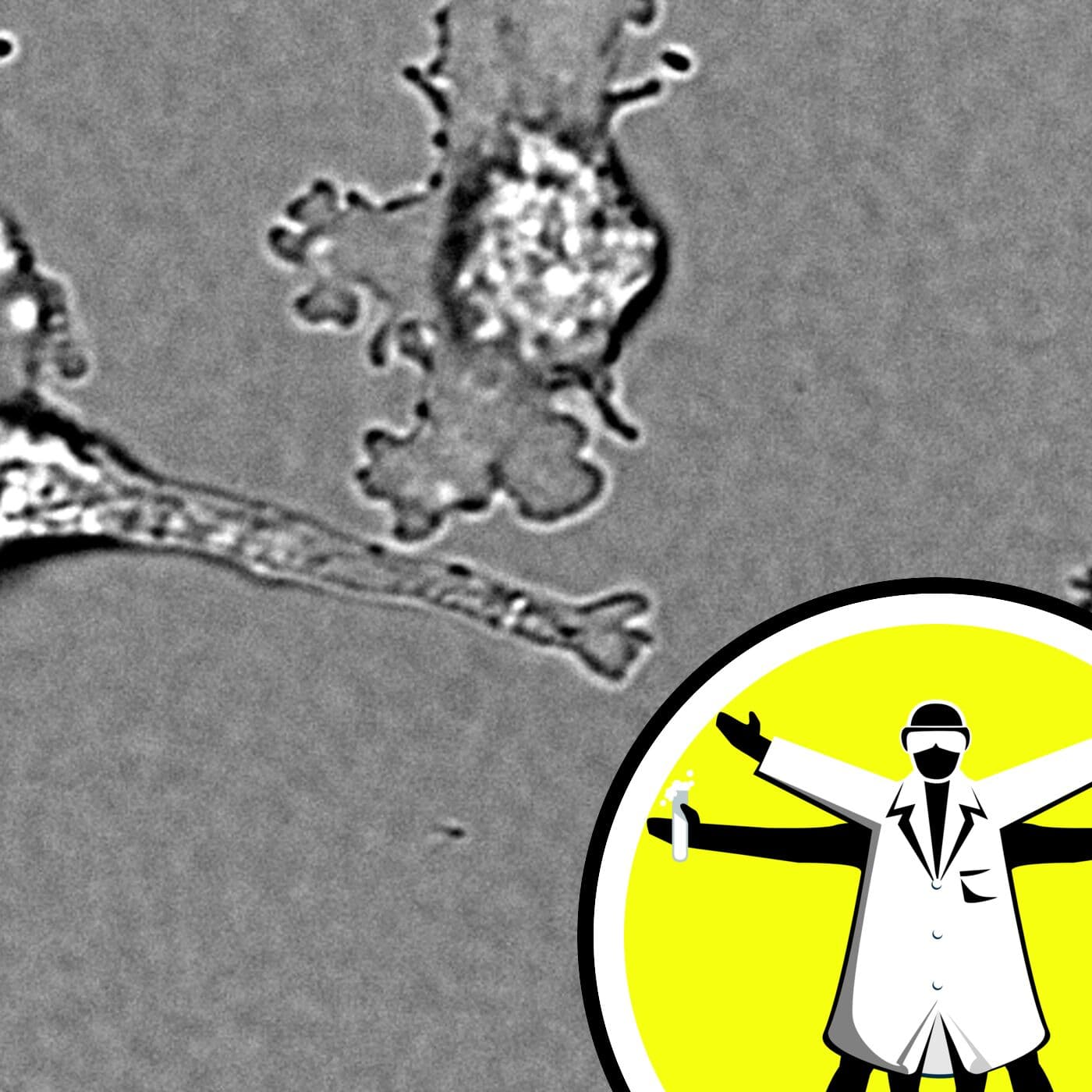
19:14There is a link between stress, the immune system and the nervous system. Short-term stressors, including pain, put the body into a state of alert, reflected by a short-term increase in the size of the brain's memory system. But in the long term, if the pain or stress continues, this boosts the activity of immune cells in the brain, which ultimately chew up nerve cells, leading to longer-term shrinkage and mood changes. an antibiotic drug seems to be able to block the effect in test animals by turning off the immune response and intriguingly an antibiotic drug seems to be able to block the effect in test animals by turning off the immune response publishing in the journal science cambridge neuroscientist trevor robbins suspects that what they have uncovered is the basis also of burnout We studied a large number of humans who were participants in this well-known UK biobank project.
20:12In this big sample, there were quite a number of individuals, thousands actually, who'd suffered chronic pain. Now some of these had just suffered chronic pain and weren't depressed, but another big group had been diagnosed with depression. and we were able to stratify the population into three or four stages to kind of look at a cross-sectional representation of how this relationship between pain and depression might actually develop in the brain by looking at the brain scans. And amazingly, what we found is that people with chronic pain have larger parts of certain regions of the brain. These include the hippocampus, which, as you probably know, is a major organ of learning and memory and emotion for that matter.
21:03So these people with chronic pain had larger hippocampuses. But when they had chronic pain and depression, the hippocampuses became smaller than normal. And parallel to this, their cognitive functions changed. People who had chronic pain did better on so-called working memory tasks associated with good hippocampus. function. But when the hippocampus got smaller, their cognitive performance in this other group who had depression got worse. And what is contributing to the change in the shape and the shrinkage of the hippocampus? That story emerged from the study of experimental animals, because what we also found is that rats and mice, actually, we use both types of rodent in this study, who were exposed to chronic pain, these animals developed larger hippocampuses as well.
21:56But if the chronic pain persisted, then it did the opposite just as the human hippocampus did. It became smaller. Now, what we discovered is that what's underlying these structural changes is the production of new nerve cells. The hippocampus is one of the few parts of the brain which does generate its own nerve cells during adulthood. Neurogenesis was increased by chronic pain. So in summary then, when you have a pain state, this seems to temporarily enlarge the hippocampus, and we believe that that is because more nerve cells are born or more survive. if the pain state persists though the equation reverses and it shrinks is that because we lose cells or is it because you stop making as many cells both the other factor is that the hippocampus becomes overexcited glutamate levels greatly increase and that means the hippocampal excitatory balance is shifted towards excitation.
23:03Excess excitation over a period of time is not good for neurons. It causes neurodegeneration through a process called excitotoxicity. Is this a survival mechanism? In the short term, activation through a pain route, it puts you in a sort of fight or flight, I need to survive mode. This means you grow your hippocampus because the stimuli that are arising because of the stress are saying we need all of the resources we can plug into this may include making my hippocampus work as well as i can to remember the way out of the situation i'm in but then if that's allowed to persist it then becomes very maladaptive and you start to do damage absolutely right spot on do you think a sort of lower grade version of this might underpin phenomena like burnout where people are subject to a period of intense chronic stress they rise to the occasion they manage to get through it but then they say in the aftermath they feel completely hollowed out and they're not the same person that's exactly correct yeah a stress will cause excitement neurotransmitters will work more and you'll be more active but if the stress persists and you don't escape from it you release so much transmitter in order to cope with this problem you've run out of the supply of the neurotransmitter you need more to be synthesized and that puts you into this trough or downstate which you know might be analogous to depression where does this leave us then trevor because it sort of suggests that we might by stressing ourselves be putting ourselves at quite considerable risk of this sort of thing happening or are there some people that this is particularly a problem for do you think there are subgroups who need to watch out for this but many of us are more resilient Not everyone who experiences chronic pain gets depressed, probably maybe half.
24:55And as you know, all of these things, there are so many individual differences caused by genetic factors. Your immune system may be working better. There's a very important aspect of the immune system involved in this phenomena as well. Because one of the other things that happens is the microglia. They're not nerve cells, but they're in the brain. They're cells, immune cells, which help maintain nerve cells and get rid of them when they're not working. These microglia also are greatly increased during chronic pain. And initially, they have the effect of actually shaping the newly born neurons to be excitatory.
25:38But again, if there's too many of them, these microglia actually have adverse effects and begin to kill off nerve cells. And so it's dealing with these microglia, which is important from the transition from chronic pain to depression. Are there then any interventions that can block this effect? For instance, if we intervene in the immune pathway, does that stop it? Yeah, very interesting question. What we did find is that if you infuse minocycline, which is an antibiotic, into the hippocampus, That has the effect of blocking the transition to the adverse emotional state, the anxiety-like behaviour and the depression-like behaviour in the rodents.
26:29Do you think that the minocycline is working as an antibiotic or do you think it's an off-target effect? There's something about that molecule that is doing something interesting in the hippocampus. Because one other possibility is that the minocycline is doing something to the microbiome in the gut and that is affecting the hippocampus. because we know that that happens. That wouldn't be the case when we're giving the minocycline directly to the hippocampus. However, there may well be more than one effect. I mean, minocycline could be expected to reduce inflammation, but also it has this selective effect on the microglia.
27:02By reducing the microglia, that reduces this excitatory drive, which may be at the basis of the neurodegeneration. Absolutely fascinating. Trevor Robbins there. to the undersea realm now and the world of the octopus male octopuses it turns out have a specialized arm called a hectocotylus which they use for mating however scientists at harvard university have noticed that male octopuses actually use this arm to find mates in the first place through a process that's described as taste by touch and they believe that this is driven by the male's ability to detect the female hormone progesterone using this arm.
27:45Here's Harvard's Nicholas Bellono, lead author on the study, telling me how octopuses find love. We were interested in studying mating and the reason that that's hard to do with octopuses is because they're solitary creatures and when you put two octopuses in the same environment they're very aggressive toward one another and will even kill each other. And so we wanted to study mating in a laboratory setting. So we put two octopuses in a tank and we put a barrier between them so they could get used to one another. And in that barrier, we put three little holes so they could at least get a sense of the other's presence, but they wouldn't be immediately aggressive.
28:25And to our surprise, without even removing that barrier, the octopuses were able to mate by the male octopus putting its specialized arm called the hectocotylus through one of those holes finding the female and then initiating mating. So the kit there mates at arm's length, quite literally, by the sound of it. Right, right. But why do they need to use an arm for that? And is it any arm they can use or is it a specialised one of their arms? So the male octopus has one specialised arm. It's the third arm from the right in all species. And the way in which it specialises is rather subtle. If you look at the arm sort of macroscopically, it looks just like all the other arms.
29:09but it actually has a little bit different tip. And then it has this flap of skin along the length of the arm. And so how they made is they use this arm to, again, insert into the female mantle, find the oviduct. And once they do, both the male and the female freeze. And then the male transfers a package of sperm from its own mantle down the length of its arm through that groove. and then the sperm is released at the oviduct and then fertilization happens. Does it do that purely by touch or are there other things deployed here to work out? I mean, because if it's just reaching out and touching the female, it's not using vision.
29:51So that was the surprising result. That's what we did not expect. And so that was where the barrier proved this interesting observation that the octopuses were able to mate with minimal visual information then we put them in the dark and they could still do it and so to us that suggested that there must be some aspect of touch or chemical that's guiding this arm because there's no vision and then furthermore when we did this with male male pairs they didn't mate and so we thought there must be some signal that's coming from the female specifically that the male octopus senses that is surprising because octopuses correct me if i'm wrong are very visually guided they have good vision so it's surprising that they would be prepared to put that to one side and go entirely on touch that's right they do have a very impressive visual system and it's not to say that there isn't some component of vision in the wild certainly octopuses can recognize one another but there is this really important component of touch and what we found is that this touch slash taste of the arm is sufficient on its own without vision to mediate mating.
Read the full transcript
31:04Are they picking up chemicals then? Do they have chemical sensors on that arm? They do. So that was the other sort of unexpected finding. Pablo Lar, the lead author, was characterizing these receptors, which are proteins that are used by the octopus to sense environmental molecules to help guide its exploration. And we found these receptors, which we named chemotactile receptors for this taste-by-touch behavior that the octopus does. We found them around the arms, and they're used to sense molecules that are made by microbiomes in the seafloor and specifically on their prey. And Pablo was surveying where are these receptors for these environmental ligands and he surprisingly found that some of them are indeed localized on that specialized arm.
31:55Exclusively on that arm or do all arms have chemical sensors and this one they happen to be different or they're the same? How does the spectrum break down? Yeah this is another surprising aspect. So all the receptors are in fact the same across arms. The hecticautilus has a lot more of them and it has one specific receptor that's particularly good at binding a molecule called progesterone which we found by profiling what is expressed in the ovary and oviducts. We've only considered this from one direction so far which is the male finding the female. Does anything work the other way? Is the female getting any signals back from the male and can she decide to abort the process or encourage the process in response to signals arising from the male?
32:47Yeah definitely it's a really interesting system for what's called sexual selection so how the octopuses find the right species how they choose the right mates and the female is a big part of that in two ways one is that she will allow the male to initiate mating or she'll actually swim away from the male. And we see that in our experiments where particular pairs mate better than others for reasons unknown. And then the other thing that the female does that's really interesting is that she will actually hold on to sperm following the mating events. And from wild-caught females, actually, one can find in the female internally that many mating events have occurred, both with the same species, but this even can happen with different octopus species, where they attempt to mate with the wrong species.
33:41And that's one thing that we found was particularly interesting also on the male side, where we seem to see some evidence of diversification in the proteins that allow the male to sense the female. And this suggests to us that not only is the system important for finding the right sex, but it's also probably very important for finding the right species, which is important for maintaining species barrier or cross mating and generating hybrids and different species. Lovely story, isn't it? Nicholas Bellono at Harvard University. That study was just out in the journal Science. That is it for today.
34:19But do join us on Tuesday, though, when we're going to be exploring the oil and gas industry literally from the ground up what is the geology of oil formation how does a petrochemist go from crude to highly refined can the uk solve its energy price problem by actually using the oil on its own doorstep and what lies downstream of oil as we transition to alternatives we will find out thank you meanwhile to all of you who are supporting us with your very kind donations to help us with our running costs and if you would like to make a contribution and haven't yet we've made it very safe and simple please head over to nakedscientist.com forward slash donate you can also find out more about what we're up to on linkedin and instagram and do please if you have a moment leave us a review on spotify and on apple or wherever you get your podcasts i'm chris smith thank you for listening and from all of us here at the naked scientists until next time goodbye
35:46www.banyhana.com Why settle for an ordinary steak dinner when you can taste the world in one bite? Only at Benihana. Book your table at benihana.com.