In short
The Naked Scientists Podcast: The Mosquito - The World's Deadliest Animal
Episode Summary In this episode, Chris Smith and various experts explore the biology, behavior, and ecological significance of mosquitoes, often labeled as the deadliest animal on Earth due to their role in transmitting diseases. The podcast delves into the evolutionary history of mosquitoes, their unique feeding mechanisms, the diseases they carry, and the strategies being developed to combat them.
---
Table of Contents
- [Introduction to Mosquitoes](#introduction-to-mosquitoes)
- [Evolution and Biology](#evolution-and-biology)
- [Feeding Mechanisms](#feeding-mechanisms)
- [Diseases Transmitted by Mosquitoes](#diseases-transmitted-by-mosquitoes)
- [Control Strategies](#control-strategies)
- [Conclusion and Future Topics](#conclusion-and-future-topics)
---
Introduction to Mosquitoes
- Host: Chris Smith
- Guest Expert: Heather Ferguson, University of Glasgow
- Overview of mosquitoes as the world's most dangerous animals.
- Discussion of their evolution over 100 million years and adaptation to humans.
Evolution and Biology
- Mosquito Classification: Part of the Diptera order, unique for blood-feeding.
- Evolutionary History:
- Evolved to consume blood, primarily for female reproduction.
- Current species have existed for about 65 million years.
- Feeding Habits:
- Mostly target vertebrates, with some adapted to feed on birds and frogs.
- Over 3,600 mosquito species identified.
Feeding Mechanisms
- Sensory Modalities:
- Mosquitoes use smell (carbon dioxide and skin chemicals), warmth, and visual cues to locate hosts.
- They can sense body heat and use it to target feeding areas.
- Tasting and Feeding Process:
- Taste receptors on their feet and proboscis assess the host's nutritional quality.
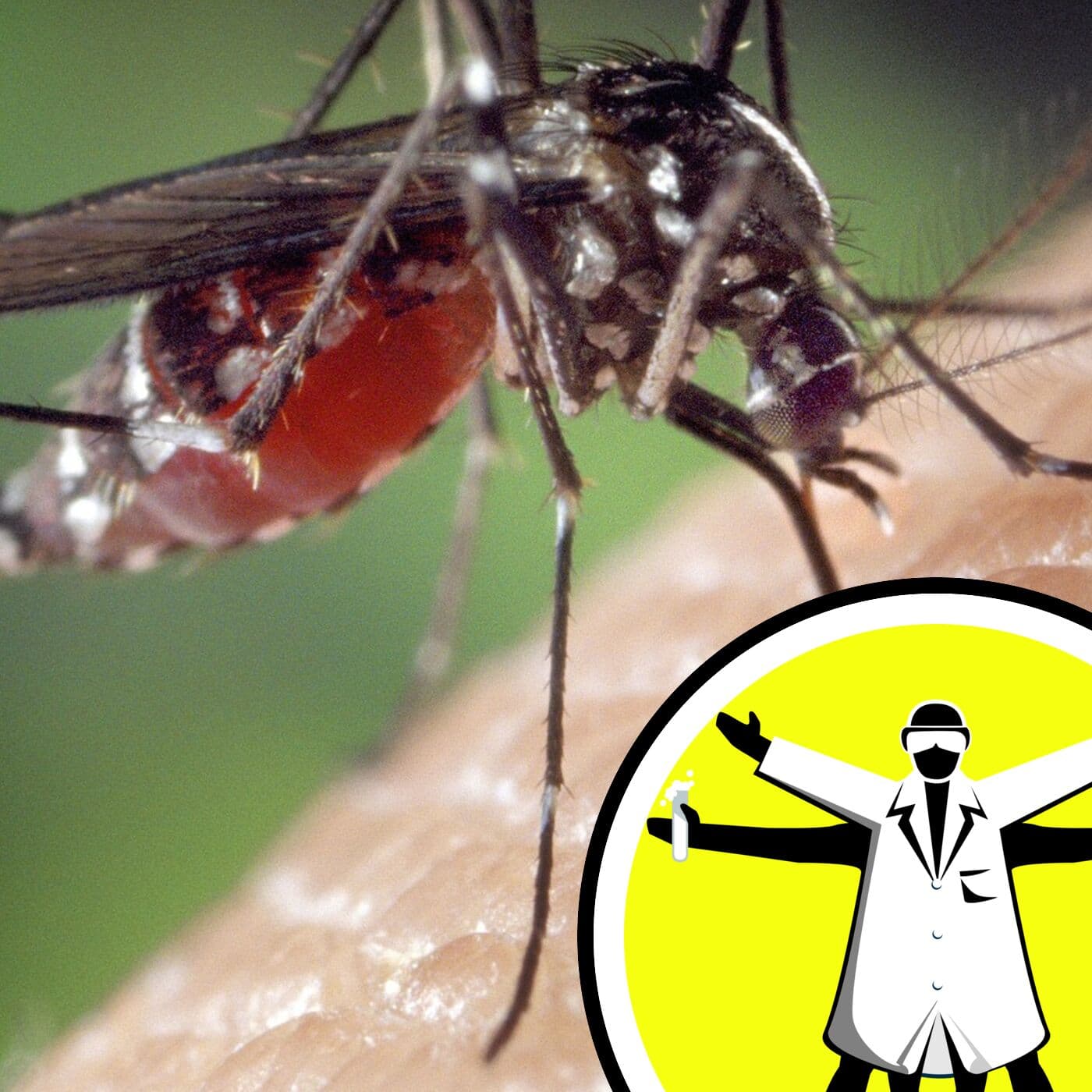
- Mosquitoes insert a needle-like proboscis to find blood vessels.
- They inject saliva containing anticoagulants to prevent clotting while feeding.
- Volume of Blood Consumed: About 2-3 microliters, doubling their body weight.
Diseases Transmitted by Mosquitoes
- Pathogens:
- Viruses: Dengue, Zika, chikungunya, West Nile virus.
- Bacteria and parasites: Malaria, leishmania, sleeping sickness.
- Transmission Challenges:
- Pathogens must survive in the mosquito's gut and reach the salivary glands to infect a new host.
- Low percentage of mosquitoes that successfully transmit diseases.
Control Strategies
- Current Methods:
- Bed nets effectively reduce malaria transmission.
- Challenges with daytime-biting species like Aedes mosquitoes.
- Innovative Approaches:
- World Mosquito Program: Introducing *Wolbachia* bacteria to inhibit virus replication in mosquitoes.
- Successful in reducing dengue transmission by 70% in clinical trials.
- Gene Drive Technology: Still in pilot stages, aims to alter mosquito populations to reduce disease transmission.
- Resistance Issues:
- Mosquitoes developing resistance to insecticides and repellents, prompting the need for alternative strategies.
Conclusion and Future Topics
- The podcast highlights the complex relationship between humans and mosquitoes, their ecological role, and the ongoing battle to control their populations to reduce disease transmission.
- Upcoming episodes will focus on specific diseases like malaria and feature experts in the field.
Thanks and Acknowledgments
- Appreciation for support and donations to the Naked Scientists.
- Encouragement to feedback through reviews on podcast platforms.
---
Key Takeaways
- Mosquitoes have significant ecological roles despite their dangerous reputation.
- Their feeding behavior and evolutionary adaptations make them effective disease vectors.
- Innovative control strategies are emerging to combat the rise of mosquito-borne diseases, focusing on prevention rather than eradication.
---
This episode sheds light on the intricate biology of mosquitoes and the ongoing scientific efforts to mitigate their impact on global health.
Written by AI. May contain mistakes. Listen to the episode to check what was said.
Chapters
Tap a time to open that second in VOThe Evolution of Mosquitoes
0:45 to 2:12
Exploration of the evolutionary history of mosquitoes and their blood-feeding behavior.
“100 million years adapting to shifts in climate and environment and also of course the emergence of us humans.”
Mosquito Adaptations and Host Preferences
2:12 to 6:40
Discussion on mosquito adaptations to various hosts and their ecological role.
“But you raise an interesting point, which is the emergence of this behaviour.”
Mosquitoes and Human Interaction
6:40 to 8:23
Insight into how mosquitoes adapt to urban environments and their interactions with humans.
“That's a shame that the myth has been busted but it's good that science has prevailed.”
How Mosquitoes Find Their Hosts
8:23 to 13:09
Overview of the sensory modalities mosquitoes use to locate hosts for feeding.
“Well, they might well be irritating, but they certainly are also fascinating.”
The Blood-Feeding Process
13:09 to 14:03
Detailed explanation of the process mosquitoes use to feed on their hosts.
“And this is actually a remnant of a plastid-like organelle or like a chloroplast.”
The Mosquito's Feeding Mechanism
14:03 to 16:20
Learn about how mosquitoes feed and the unique adaptations they have.
“the tip of that sort of needle that they stick into you to blood feed.”
Pathogens Transmitted by Mosquitoes
16:58 to 19:06
Discover the various pathogens mosquitoes can transmit and their implications.
“But first, mosquitoes are notorious for their roles as disease vectors.”
The Complexity of Disease Transmission
19:06 to 22:44
Understand the challenges mosquitoes face in transmitting diseases.
“And then that parasite has to develop and find a way to get to the salivary glands, which is its ticket out, right?”
Innovative Strategies for Mosquito Control
22:44 to 27:25
Learn about new techniques to control mosquito populations and disease transmission.
“Fettini Sinis there at the Johns Hopkins Malaria Resurge Institute.”
Understanding Mosquito Virus Interactions
28:00 to 28:21
Explore how certain molecules aid in virus replication within mosquitoes.
“and the virus for key molecules that the viruses need to replicate, molecules like cholesterol and other fatty acids within the insect cells.”
Show all 12 chapters
Preview of Upcoming Malaria Discussion
28:21 to 28:37
Get a sneak peek into the next episode focusing on malaria and its research.
Community Engagement and Support
28:37 to 29:13
Learn how to engage with the podcast and support its continuation.
“Thank you in the meantime to all of you who've been supporting us with donations to the programme.”
Transcript
Automatic transcript. May contain errors.0:11Hello,
0:17welcome to the Naked Scientist podcast. This is the programme that brings you the biggest breakthroughs and also talks to the major movers and shakers in the worlds of science, technology and medicine. I'm Chris Smith and this week we're delving into the biology of the world's most dangerous animal, the mosquito.
0:44Now mosquitoes have been evolving for more than 100 million years adapting to shifts in climate and environment and also of course the emergence of us humans. They're themselves also exploited by a host of diseases that make use of their blood-sucking biology to hitch a ride between hosts. I'm of course referring to parasites like malaria, the transmission of which to millions of people worldwide is what makes the mosquito one of the world's most dangerous animals. So on today's programme they're going under our microscope to reveal where they came from, how they use smell, vision and taste to track down a meal, the diseases they transmit and how, and also the measures that scientists are developing to try to control them.
1:28Up first is Heather Ferguson, who's an expert on mosquito ecology at the University of Glasgow. Mosquitoes are small insects within a larger group that we call the diptera or true flies, and while many flies that you can think of generally feed on things like plant nectars, rotting vegetation, other insects or even poo, the mosquitoes and a few other types of flyers are unique in that they've evolved specifically to feed on blood. And this is a great idea for mosquitoes because it has the advantage of providing the females, which are the only ones that blood feed, a big source of protein that is what they need to make eggs.
2:02And very thankfully, this strategy of blood feeding has not emerged in many other organisms. For example, it would it'd be absolutely horrifying if spiders did it as well. It certainly would, wouldn't it? But you raise an interesting point, which is the emergence of this behaviour. How far back in evolutionary time can we trace mosquitoes? So mosquitoes in general probably go back to at least over 105 million years ago is our best estimate. But in terms of the mosquitoes that we see flying around today, most of them have been around for about 65 million years ago, so still quite a long time. Michael Crichton wasn't completely adrift then when he conceived of mosquitoes drinking dinosaur blood in Jurassic Park.
2:47They would have overlapped with dinosaurs to some extent. Absolutely, I'm sure they gave them a hard time. But what were they feeding on back then? What was the motivation for their emergence at the time? As I said, I think there's been a lot of selection on feeding on blood because it's such a good resource and full of lots of calories. and we think mosquitoes may have emerged from earlier flies that might have had similar sort of piercing mouth parts that they used either to sort of suck on the plant nectars or maybe even pierce at need other insects and then along the way they found out that if they could do this into sort of vertebrates they could get some blood and then that was very useful as well.
3:26Do they prey on all species, mosquitoes? Do all animals have a mosquito that will go after them or do they generally confine their antics to warm-blooded things like you and me? Yeah, so most mosquitoes are confined to vertebrates, at least at the adult stage. They spend their early life as little wiggly worm-like creatures called larvae in water. But when they become terrestrial adults, they're generally adapted to vertebrate blood. And although we often think about them as just being a pest to humans, they've been around so much longer than humans that obviously they've had to adapt to other species.
3:59for example there's a huge number of mosquitoes that are highly adapted to feed just on birds and there's even one australian mosquito species that is adapted to feed on frogs and usually just on their little noses as that's the only bit that sticks out of the water they're amazing aren't they i've read somewhere there's more than three and a half thousand species is that correct yes it's probably at least three thousand six hundred or so and probably more once they've been fully identified and we presumably have got some of our own if there's a frog that has its own mosquito that preys on it we presumably have some mosquitoes that selectively seek out us absolutely there are a few species that are really highly adapted to feed on humans and surprisingly these species are often the ones that are associated with the greatest risk for diseases because those mosquitoes are so good feeding oilers and spreading pathogens between us for example the anopheles mosquitoes that spread malaria in africa and also the aides mosquitoes that are responsible for spreading dengue and other viruses are really highly adapted to live in or near human homes.
5:07And for example, some of the Aedes mosquitoes are actually adapted to lay their eggs on sort of in our rubbish or things that you find around our houses. So that could include like discarded plant pots, water storage tanks, or even old tyres. There are about eight and a half billion of us on earth, more all the time, and we are changing the environment a lot but we're also changing the environment in new ways as time goes on so are the mosquitoes keeping in step with that are they evolving and have we seen any new mosquitoes or mosquito behaviors emerge as we have emerged evolution is an ongoing process and we see that in almost every aspect of life new species don't suddenly appear but we do see lots of changes in existing species and in particular one of the most important types of adaptations are how mosquitoes in Africa, particularly those that spread malaria, are changing to avoid the control measures that we put out to try to stop them.
6:04For example, we see things like these mosquitoes becoming resistant to the insecticides we might use to control them, or also changing their behaviour from historically feeding late at night when people are sleeping and would be protected by a bed net if they're using it, to starting to shift to feed either outdoors or earlier in the evening before people go to bed and that way they don't get stopped by bed nets. I did read, and it might be apocryphal, that the London Underground had some of its own species of mosquito. Was that proven or was that just a good yarn? So this is a different variant or different type of a very common mosquito called Culex pipiens that's found all over the world and initially people had thought that this specific biotype or form was only in the London Underground but recent analysis shows it's actually been around for several thousand years and it just likes living underground and that's probably why people noticed it in the underground.
7:01That's a shame that the myth has been busted but it's good that science has prevailed. One question I'm often asked, people say these are horrible creatures, they're the most dangerous animal on earth, why don't we just get rid of them? What do they feed though? Because everything has its place in nature and although they're a pain for us, they're presumably someone else's lunch. Absolutely. So mosquitoes always get a bad rap because of the nuisance. We don't like being bothered by them and also in some cases the disease they pose. But by and large, the vast majority are not dangerous to people and in fact play a really important and natural part of ecosystems around the world.
7:37So just as some examples, mosquitoes lay their eggs in water and that's where their early larval stages develop. These larvae are really important food sources for other species like different types of aquatic invertebrates and fish. And even the flying adults can be fed upon by things like dragonflies and bats. And there's even one species of spider in Kenya that's been described as specifically feeding on recently blood-fed mosquitoes inside houses. So maybe that's a blood-feeding spider after all. Also, they can play a role in pollination, especially male mosquitoes who don't blood-feed. They instead feed on plant sugars and nectures, so they can move that around.
8:17And in fact, in some places like the high Arctic, where contrary to common knowledge, you see some of the highest numbers of mosquitoes anywhere in the planet. Sometimes there are so many blooms of mosquitoes that come out at certain points of the year that they were thought to play a role in influencing caribou migration and behaviour and maybe changing where they go to as they try to avoid getting bit. Well, they might well be irritating, but they certainly are also fascinating. fascinating. Thank you very much to Heather Ferguson. She's at the University of Glasgow for that introduction to the world of mosquitoes.
8:49Well, now that we understand what mosquitoes are and how they've evolved, we're going to turn to their behaviour and the features that allow them to feed, reproduce and survive in a whole variety of different environments. Connor McMiniman is an associate professor at Johns Hopkins Malaria Research Institute, where he studies how mosquitoes are attracted to us in the first place. Mosquitoes will blood feed on animals, but also humans. They do this actually using a variety of different sensory modalities. First, they actually smell you in the environment. So they pick up on chemicals such as carbon dioxide, which we all exhale in our breath as a byproduct of cellular respiration.
9:28But also the unique combination of scents that we emit from our skin and also our breath, which is really a product of our diet. our genetics and associated physiology, and also the microbiota that live on our skin surfaces and also in our gut. Once they smell us, they start to track towards us following this plume of scent, eventually into the range where they can see you. Then within maybe a metre or so of the host, they can actually sense warmth from our body. Can they actually see where the best place to land is? They're actually following convective currents that are emitted from the body so heat rising and a lot of mosquito species actually will follow those convective currents to the lowest place on the ground it varies depending on the species but for instance the mosquito that transmits malaria if you're standing up it will go for your feet if you're doing a handstand it will actually go for your hands what the mosquito is doing is it's it's sort of integrating the smell information from your body parts with those thermal currents to identify identify regions that are you know exposed and perhaps those reasons you know your ankles for instance are also targeted because they're far out of the range of you slapping the mosquito or farther away than say if they would land on your arm for instance when you say they can see us are there any colors that they're particularly drawn to is there truth i guess in what when you go on bushwalks and things on safari the safari guides will say don't wear those colors they're a mosquito magnet.
11:06Is that true or is that a myth? Mosquitoes definitely have good visual acuity and in particular like the contrast between light and dark and so that's often a cue that they use to hone in on you. As for particular colour preferences, certain mosquito species do have certain colour preferences towards for instance orange hues and it's thought that maybe that relates to the certain wavelengths that are emitted by human skin, for instance. But this is a really emerging area of research in mosquito biology, particularly with regards to how their visual senses integrate with their olfactory senses, for instance, their sense of smell.
11:54I did read somewhere, though, and it's been reiterated a number of times in recent years, that there are certain diseases, including diseases that mosquitoes will transmit, that appear to make us smell better to a mosquito. And the evolutionary argument is that, well, that makes the disease more likely to be transmitted because you'll pull in more mosquitoes, you'll get more bites, you'll transmit the disease to more mosquitoes, which will then in turn transmit it to more people. Is that true? I think there's a couple of really nice examples of where parasites or pathogens that are transmitted by mosquitoes could potentially modulate mosquito behavior to enhance their own transmission.
12:35It's been hypothesized for quite a long time that the human malaria parasite makes humans more attractive to mosquitoes to enhance its transmission. In particular, there's a stage of the malaria parasite called the gametocyte, which is the transmissible form of the malaria parasite to mosquitoes. And it's thought that perhaps the presence of gametocytes in the peripheral circulation of the human could somehow lure mosquitoes in. One hypothesis is that plasmodium parasites could make us smell more plant-like. There's an organelle in the malaria parasite called the apicoplast, which carries out various metabolic processes.
13:15And this is actually a remnant of a plastid-like organelle or like a chloroplast. This potentially releases terpenes, which will lure mosquitoes in. When they actually do find us, and having followed that sense of smell, then use their eyes and ultimately homed in on the heat, they make a landing. What do they do next to get their dinner? Right, so actually when they land on your skin, they actually taste you. They taste you in one of two ways. The first way is that they actually have taste receptors on their feet, which allow them to sort of survey the nutritional quality, if you like, of that particular host.
13:58The second thing they do is that they insert the equivalent of their tongue, an organ called the labella of the proboscis. the tip of that sort of needle that they stick into you to blood feed. On the labella of the proboscis, there's also taste neurons that again sort of survey how tasty you are. If they decide they're going to take a meal, the next thing that they do is they stick a very thin needle into your skin, something called the stylet of the proboscis. And this is quite a bendy appendage. It can actually search around in the skin for a capillary to actually insert into. So if you ever watch this it looks like a needle being inserted and then having basically full range to move around searching for a blood vessel.
14:46There they actually use chemicals including one called ATP to actually survey that this is a living organism. During this whole process they're actually also spitting into the skin a unique cocktail of proteins that actually facilitate the blood feeding process. Because presumably your immune system is going to have something to say about this and blood naturally clots. When it sees a foreign surface that it shouldn't be seeing, it forms a blood clot, a thrombus. So they've got two things to contend with. How do they surmount those? Yeah, so each of these proteins actually have different qualities.
15:25So one is anticoagulant, that prevent clotting of the blood. The other is vasodilators. So they're trying to ensure that the blood vessels don't constrict because that would be really hard to be able to feed from a tube that is closed. They also will spit into a wide variety of other molecules that, again, really make that blood feeding process smooth and really efficient. How much do they actually drink, though? what's a big meal for a mosquito? Mosquitoes actually will drink about two to three microliters of blood. That's about a thousandth of a milliliter. It's actually probably doubling the mosquito's body weight.
16:12So think of engorging upon your favourite snack and doubling your body weight. Well, that certainly is some meal, isn't it? Thanks very much to Connor McMenamin there. The Naked Scientist podcast is produced in association with Spitfire. Cost-effective voice, internet and IP engineering services for UK businesses. Find out how Spitfire can empower your company at spitfire.co.uk.
16:41Music in the programme is sponsored by Epidemic Sound, perfect music for audio and video productions. You're listening to the Naked Scientist podcast with me, Chris Smith, and today we are exploring the life cycle of mosquitoes, officially the world's most dangerous animals. And in a moment, we'll look at some new strategies that scientists are developing to try to help us to better control them. But first, mosquitoes are notorious for their roles as disease vectors. Luckily, across much of the world, that risk is very low, but it becomes more relevant in parts of Africa, South America, Southeast Asia and the Caribbean.
17:18So what should we know about the types of pathogens that mosquitoes can convey. Fatini Sinis is the deputy director of the Johns Hopkins Malaria Research Institute and professor in the School of Microbiology. It can range from very simple organisms such as viruses. Examples of that would be dengue, chikungunya, zika virus, West Nile virus. They can spread some bacteria and then parasites which are more complex organisms and parasitic infections that they are responsible for spreading are malaria, leishmania, trypanosomiasis or sleeping sickness. And there's a website that talks about the most dangerous animals in the world and mosquitoes are on the top of the list.
18:05It's not trivial though, is it, for an animal to spread one of these diseases? Let's pick that apart a bit because you're thinking about you've got a disease that is optimized to infect one species and it's then going to go via a totally different species, an insect, and they get into a different entity. Transmission by a mosquito is a huge bottleneck for any pathogen. They take such a small amount of blood, even though it's very noticeable to us by the itching, but the amount of blood they take is so small that the amount of the pathogen they take is very low. The likelihood that that pathogen, whether it be a virus or a malaria parasite, succeeds in establishing an infection in the mosquito is low, actually.
18:52And in the mosquito with malaria, it's been estimated to be maybe 10 % of mosquitoes that get infected blood from people succeed in getting infected with the malaria parasite. And then that parasite has to develop and find a way to get to the salivary glands, which is its ticket out, right? And so that process takes some time. And that mosquito has to live for that time because a mosquito's lifespan is not that long and then bite a person again to transmit that disease. And in the case of the mosquito with the virus, the virus has to basically expand in numbers and enter the salivary glands and the malaria parasite goes through a whole life cycle in that mosquito and that takes a minimum of 10 days for there to be infectious parasites in the salivary gland.
19:48At the same time you can't help but be impressed can you in the sense that you've got this simple virus like dengue for example which knows in inverted commas how to make a human ill, it can then get out of a person, infect a mosquito. So it's infecting insect cells instead of human cells, bypassing an insect immune system, grow in a mosquito, and then exploit the biology of a mosquito to amplify itself to get back into a person. It's very impressive. And this requires a long evolutionary history between the pathogen, whether it be a virus or a parasite, and the mosquito host. And there's a high degree of adaptation.
20:35And so mosquitoes, for example, can't just transmit any pathogen or infection that people have. These pathogens have adapted to live in and multiply in a mosquito. And when the mosquito takes the blood meal with either the virus in it or the parasite in it, it first has to withstand all the digestive enzymes in the mosquito's gut that are digesting the blood. And most things will just be killed by those enzymes. And after the mosquito digests the blood and takes the nutrients, it excretes the rest of the blood meal and the rest of the pathogens that have not adapted will just be excreted out into the environment.
21:15So there are multiple steps and multiple ways in which each pathogen that has adapted to be transmitted by vector has adapted to the mosquito. You sort of anticipated my question, which is that we know there are thousands of species of mosquito, but relatively few of them that spread the diseases that we dread. Is this why? Yes, it is. If you're going to spread a disease among humans and among human populations, you really need to have a mosquito that primarily bites humans. So with both dengue, which is a virus transmitted by the mosquito Aedes aegypti, and with malaria parasites, which can be transmitted by about 20 species of Anopheles mosquitoes.
22:04But only two or three of those species are what we call anthropophilic. They really like to bite humans. And so you really need to have the human human on both sides, both when you take the infected blood meal, when the virus or parasite develops, then in that mosquito, and then the next blood meal needs to be very likely to be in a human to cause sort of widespread disease. And we have that with the malaria carrying mosquitoes in sub-Saharan Africa. And we have that with Aedes aegypti mosquitoes carrying dengue. Isn't nature amazing? Fettini Sinis there at the Johns Hopkins Malaria Resurge Institute.
22:49So what can we do to control mosquito populations and thereby reduce the risk to us humans of picking up these diseases? Scott O 'Neill is the CEO and the founder of the World Mosquito Programme, and this is his mission. The most popular strategies as far back as the 19th century involved trying to kill these animals, but as Scott explains, that's easier said than done, which is why scientists are now trying alternative techniques to attempt to neutralise the threat. It's proven to be very, very difficult, whether it be through draining larval habitat, waterways, etc., or using chemical and insecticides.
23:24We've found it extremely difficult to control the mosquitoes. And as a result, you know, mosquito-borne disease just keeps getting worse and worse around the world. But there are currently a few things that are proven quite effective. You know, using bed nets to stop anopheline mosquitoes from biting people at night is a way to control malaria quite effectively. For other diseases, bed nets don't work very well because the mosquitoes bite people during the day. And that's particularly for the 80s mosquitoes that transmit virus diseases like dengue, chingunia, Zika. And in those areas, we're starting to see quite novel approaches being developed, new ways to think about controlling the diseases which don't rely on necessarily killing the mosquito but blocking the mosquitoes from transmitting viruses between people and so that's the work that we do for example in the World Mosquito Program.
24:14I read an intriguing story the other day about a project to treat mosquitoes for malaria for example the idea being that if they haven't got the disease they can't transmit the disease so it's almost like rather than kill them off or kill the bug inside the mosquito, let's cure the mosquito, which it sounds counterintuitive, but it seems to work. Yeah, certainly that's where the interest is at the moment. Some really interesting technology is being developed. A lot of different technologies actually about, focused on how do you stop the mosquito from picking up the pathogen and then transmitting it to people.
24:48One thing that does surface quite often though is that in the same way that bacteria become resistant to antibiotics and malaria becomes resistant to anti-malarial drugs. Mosquitoes seem to be becoming resistant to some of the agents we throw at them to either put them off coming near us or to attempt to actually kill them off. So it's a common property of biological organisms is that they evolve and they evolve to protect themselves and so we've found that mosquitoes have become highly resistant to insecticides, repellents which are just another the form of insecticide and those those mainstays of control for the last 50 or 60 years have are now becoming less and less effective and that's why these diseases are proving so difficult to control at the moment which of course is is encouraging scientists to think outside the box because we're now looking at various other measures to control things aren't we things like using genetics molecular biology and the so-called gene drive and also infecting the mosquitoes with microbes that change their behavior so tell us about either of those two strategies yeah so what we're involved in in the world mosquito program is using a commonly occurring bacterium called warbachia that exists naturally in up to 50 percent of insect species but not in the mosquitoes that of the main disease vectors.
26:10And we've found that when you introduce it into those mosquitoes, like Aedes aegypti, it prevents viruses from being able to replicate in the mosquito body. So if the viruses can't grow in the mosquito body, they can't be transmitted between people. We've found that to be extremely effective in reducing dengue. In big clinical trials that are run in Indonesia, for example, we were able to measure reductions in dengue transmission of around 70 % and reductions in hospitalisations of people around 86 % in large trials over whole cities. And so we're in the process of rolling that out. Now we've covered around 14 million people in 14 countries and expanding that at the moment as we make it available for countries in need around the world.
26:56Other groups are doing other types of work. Gene Drives, for example, is still quite upstream in its application and has yet to be rolled out very far. It's just really at a pilot stage and it's being used to target diseases like malaria and malaria transmission. So it's really quite an interesting point in history at the moment as we have this new technology starting to be applied for hopefully, you know, having really significant rollbacks on the diseases these mosquitoes transmit. And on the Wolbachia approach, how does that actually work? What's the mechanism by which that stops the transmission of the disease?
27:37We think that the way Wolbachia prevents replication is still not fully understood. We think there's a few different mechanisms going on. One that it primes the innate immune system of the mosquito, so the mosquito becomes more resistant to the viruses through its natural immune system. Also looks like there is a competition occurring between the bacteria and the virus for key molecules that the viruses need to replicate, molecules like cholesterol and other fatty acids within the insect cells. And so we think it's a combination of methods that are responsible for the blocking, but that's still being fully determined.
28:15What we do know at the moment though is that it's very effective in the field at being able to block transmission. Scott O 'Neill from the World Mosquito Programme Now next month, having told you all about mosquitoes we'll look in much more detail at the major disease that they transmit internationally and that is malaria and to do that we're going to meet the formidable Jane Carlton Jane runs the Johns Hopkins Malaria Research Institute we've spoken to her before on the programme and she's going to be our next Titan of Science Meanwhile, do join us on Friday when we're going to be rounding up the top science stories from the week and if you'd like regular updates on what we're up to, do please follow us on LinkedIn and also Instagram and we really appreciate your feedback and reviews that you leave on Apple, Spotify or wherever you get your podcasts.
29:01Thank you in the meantime to all of you who've been supporting us with donations to the programme. These are our lifeblood and we are really grateful and if you haven't yet and you'd like to make a contribution towards keeping the programme going, do please head over to nakedscientist.com forward slash donate. we've made it really safe and really easy i'm chris smith thank you very much for listening and until next time goodbye