
In short
Plant genetics and development, focusing on transposable “jumping” DNA segments (transposons) and how they act as genetic switches that control which plant structures form; includes examples from primroses, snapdragons/antirhinum flowers, and carnivorous plant trap shapes, plus discussion of why gene-to-form understanding remains incomplete.
Guest backgrounds
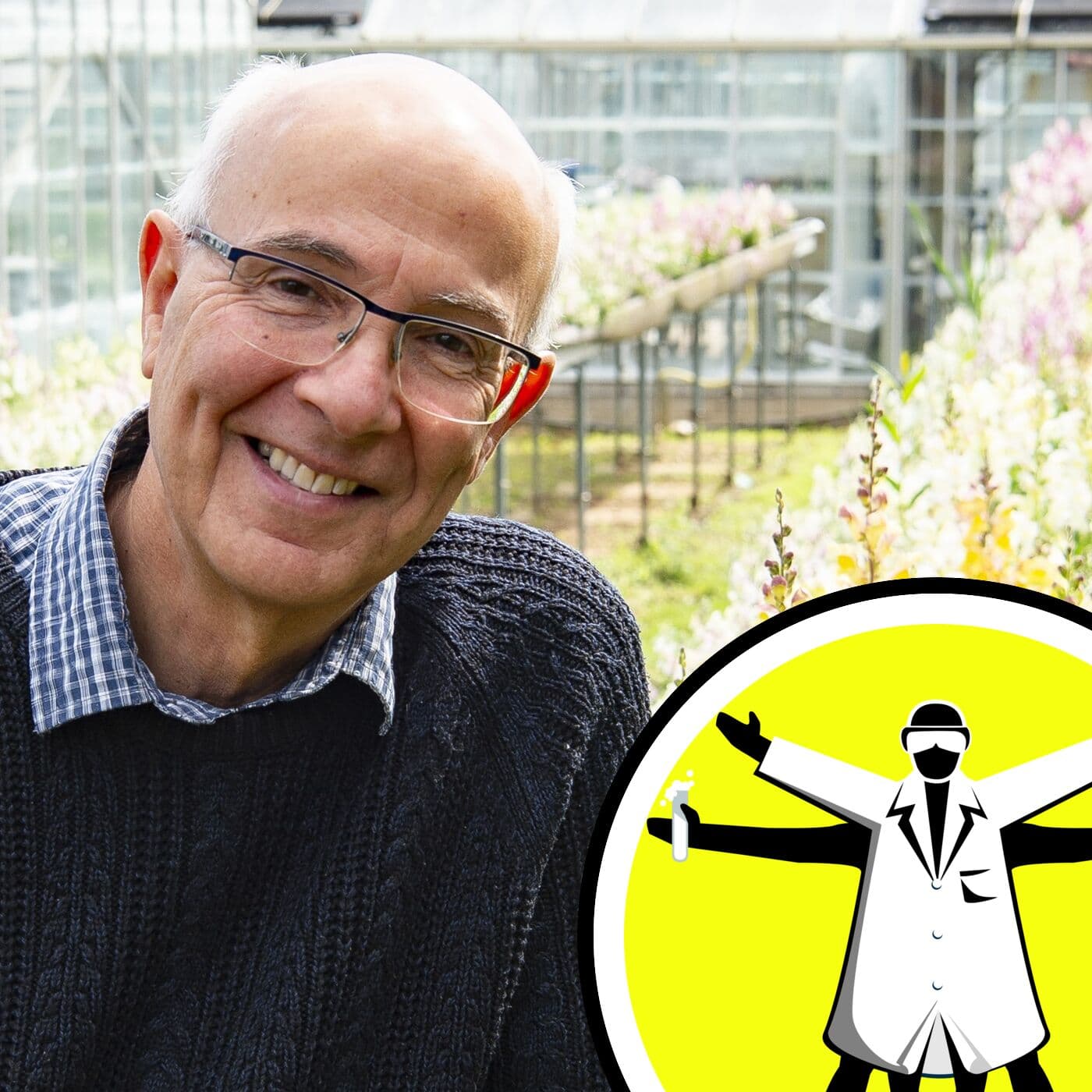
Enrico Cohen, born in Liverpool (1957), studied natural sciences at Cambridge (PhD in molecular genetics). Works at the John Innes Centre (Norwich). Fellow of the Royal Society; foreign member of the US National Academy of Sciences; advocates public understanding of science.
Key claims
Transposons can move by cutting and stitching DNA, sometimes affecting nearby genes. Genetic switches are conserved across flowering plants. Gene activity patterns help determine 3D shapes, modeled computationally for carnivorous traps.
Notable examples
Barbara McClintock’s maize kernel variegation; snapdragon variegated flowers; “Valentine’s rose” mutants with petals replacing stamens/carpels; carnivorous traps in Saracenia, Utricularia (trapdoors), and Nepenthes (pitchers); Turing-style patterning vs sculpture analogy.
Written by AI. May contain mistakes. Listen to the episode to check what was said.
Chapters
Tap a time to open that second in VOIntroducing Enrico Coen
0:56 to 2:50
Meet Enrico Coen, a prominent plant scientist discussing mobile genes.
“Hello, welcome to the Naked Scientist podcast, the show that brings you the biggest breakthroughs and talks to the major movers and shakers in the worlds of science, technology and medicine.”
The Quirks of Plant Genetics
2:50 to 5:28
Enrico shares his journey from fruit flies to studying plant genetics.
“Natural sciences, something must have stood out.”
Genetic Switches in Primroses
5:28 to 7:22
Exploring how genetic switches determine flower forms in primroses.
“And so I started to study this problem in primroses, which was to do with genetic switches.”
Antirhinum and Barbara McClintock
7:22 to 9:56
Discussing the significance of antirhinum and McClintock's discoveries.
“would be an interesting example in plants to figure out how a genetic switch would operate.”
The Nature of Jumping Genes
9:56 to 12:28
Understanding how DNA segments move and their implications in genetics.
“Well, the thing that jumps is a segment of DNA.”
Transposons in All Organisms
13:32 to 13:49
Enrico explains the prevalence of transposable elements in various life forms.
“cost-effective voice, internet and IP engineering services for UK businesses.”
Understanding Repetitive DNA Sequences
14:00 to 15:00
Learn about the significance of repetitive DNA sequences across organisms.
“A lot of our DNA comprises, is made up of sequences that move around, so-called repetitive sequences.”
Identifying Genes with DNA Tags
15:00 to 18:00
Discover how transposable DNA helps in identifying important genes.
“So what were you doing with them, with the Antirhinums?”
The Genetic Machinery of Flower Development
18:00 to 22:20
Explore how genetic switches control the development of flower organs.
“pollinators and so they have these often very showy colors.”
Research in Carnivorous Plants
22:20 to 25:30
Understand how the study of carnivorous plants reveals gene function and evolution.
“They've got to be one of my favourite and in fact the world's favourite types of plants.”
Show all 13 chapters
Modeling Plant Growth and Development
25:30 to 28:01
Learn about the role of computer modeling in understanding plant shape and growth.
“Eutricularia has these tiny little cups.”
Understanding Plant Development
28:01 to 31:32
Explore the complexities of plant growth and the challenges in creating designer organisms.
“If I may give an example, because it may be hard for people to think, well, why?”
Credits and Upcoming Stories
31:35 to 32:22
Acknowledgment of contributors and teaser for future episodes.
“so familiar with it that we kind of forget how amazing it is.”
Transcript
Automatic transcript. May contain errors.0:00Is your kid's birthday coming up? Don't stress the prep. The Party Shop at Michaels is your one-stop shop for everything from bluey to rodeo. Transform your space into a birthday wonderland with dream-worthy tablescapes and decor starting at$0.99. Plus, get free helium inflation on select balloon styles. Whether you're crafting a one-of-a-kind bash or grabbing the essentials, Michaels has everything to make their big day legendary. Shop now and order ahead for delivery or in-store pickup. Michael's. Everything to celebrate anything.
0:41All engine running. Absolute genius. Get this. Welcome. Welcome. This is the show where we bring you science. What that essentially means is... Discovery. Sciences. Research. Technology. Unbelievable. Without further ado, this is The Naked Scientist. Hello, welcome to the Naked Scientist podcast, the show that brings you the biggest breakthroughs and talks to the major movers and shakers in the worlds of science, technology and medicine. I'm Chris Smith and today a titan of plant science joins me to reveal one of the oddest quirks of genetics, genes that jump about inside our DNA.
1:26Enrico Cohen was born in Liverpool on the 29th of September 1957. He studied natural sciences at Cambridge University, culminating in a PhD in molecular genetics and a desire to crack some of the big questions that had prevailed in the 1980s around working out what genes actually did and how they were turned on and off in different tissues. Along the way, he joined a project at the John Innes Centre in Norwich, where he still works today looking at intriguing pieces of DNA that jump about in the genome, literally snipping themselves out of one location and stitching themselves in elsewhere. This bizarre behaviour can cause trivial things like colour changes in tissues, which is in fact how it first caught the eye of biologists, but occasionally it also disrupts the action of adjacent, more critical genes accidentally revealing their roles at the same time.
2:19And that's what Enrico was interested in, linking how genes map out and dictate the shapes of a developing organism. The journey has taken him from primroses to snapdragons and even to carnivorous plants and latterly complex computer models capable of linking the actions of genes to the ultimate structures of plants and tissues. A fellow of the Royal Society and a foreign member of the US National Academy of Sciences, Enrico is also a staunch proponent for public understanding of science. Welcome to The Naked Scientist. Hello, Chris. So how did plants draw you in then? Natural sciences, something must have stood out.
2:56Actually, I did my PhD on fruit flies. I wasn't really passionate about plants for quite a while. I was drawn to plants really because of the science, the scientific problems that they posed. Towards the end of my PhD, I'd been doing this PhD on fruit fly molecular genetics. I felt slightly disillusioned with science, actually, because it was a bit like discovering your parents aren't perfect. I'd expected science to be this impersonal search for the truth. And I'd found out that actually scientists are human. They have foibles, they get attached to ideas, and they get quite emotional about things and egos get in the way.
3:40And at the time, I found that surprising in retrospect our parents are not perfect and the same is true of science so I had this period where I was searching for something to do that was slightly off the main flight path it's interesting because the guy that taught me virology because I thought I was going to be a neurologist and got drawn into viruses and he started his career as a botanist but it was the virus lectures on plant viruses that drew him into virology so he was like the mirror image of you yeah that's very nice i think yeah science you follow paths that you couldn't really predict another thing about science is often the problems and the systems that you study are not necessarily seen as the most important from sort of the general public for example if you think about genetics, the rules of genes, the rules of heredity, they were discovered about 150 years ago now by a monk crossing together different pea plants.
4:43And through crossing these peas, he figured out the basic principles of how genes are passed on from one generation to another. And that underpins everything we know about genes, the DNA, all the rules of DNA. He figured those out, just crossing these plants together, these pea plants together in this monastery. Now, of course, we tend to regard ourselves as quite important. You know, humans are much more important than peas. But nature has no respect for our self-importance. And so the rules of life apply across the board. They don't decide, you know, that humans are the most important things.
5:20And so often the rules are discovered through studying problems that to the outside world may look rather peculiar. And in a way, that's what drew me to primroses. I was interested at the end of my PhD to do something that was off the main flight path, that was slightly sort of unresearched, as I felt this would kind of give me a breathing space from this sort of mainstream politics of science. And so I started to study this problem in primroses, which was to do with genetic switches. How do you switch between one form and another form? What are the two forms then? So there are two types of primrose, two different types of plant.
6:01So if you go into a garden centre, you'll see that some plants have all the flowers with the male part of the flower, the stamen, visible just at the flower opening. Whereas another type of plant, you'll find that the stamens, the male part, is deep tucked in and you'll see a female part just at the flower opening. So if you compare different plants, you'll find half of them are one and half of them are the other. And it's effectively a coin toss, is it? The plant's doing a sort of genetic coin toss to do that. There's a 50 % chance that you'll have one sex or the other sex. You don't know which it's going to be, and that's determined by the chromosomes that you inherit.
6:41And how did you try and predate that problem to work out what was actually the genetic mechanism? Because we know in humans, you add a Y chromosome to an X chromosome, you're going to get a male. You add an X chromosome to an X chromosome in an egg, you're going to get a female. So what happens in the plants? Is it similar? So you have to remember this was in the 1980s. At that time, people were very interested in these genetic switches, but nobody knew how they really worked, even the male and female of humans. So we knew that the males had a Y chromosome, but we didn't know what was it on the Y chromosome that caused this genetic switch from female to male.
7:21And so I thought, well, this primrose would be an interesting example in plants to figure out how a genetic switch would operate. How did you go about it? Unfortunately, I'd bitten off a little bit more than I could chew. I tried various techniques, but it wasn't to be for another 30 years before the technology had reached the point that you could tackle this problem. So that's when I switched to working on antirhinum or snapdragons. Why antirhinums, snapdragons? We all love them. I mean, I used to play with them as kids because you could squeeze the flowers and make them open up that's why they get the name isn't it but why are they attractive to a geneticist the story relates to a scientist who later got the Nobel Prize Barbara McClintock she in the 1940s was studying variegated patterns in maize in corn so when you look at maize you have the cob and then you have corn on the cob when you eat the corn, those kernels on the cob, sometimes they're spotted.
8:23So you have varieties in which instead of being yellow, which is the normal colour that you're familiar with eating, they're flecked. They have spots of purple, say, on the yellow background. Barbara McClintock was studying these and she came to a revolutionary idea, which was that these spots were being created by pieces of DNA that move around from one position to another in the genome. Now to give you an idea how weird that idea was, imagine you're reading a book and the next day you open it and you find that a whole sentence has been moved from one page of the book to another page of the book.
9:00That's a crazy idea. Words, sentences don't move around, they stay put. And in the same way, when she was discovering this, at that time, people thought that genes always stayed in the same position. The genes are along a molecule, the DNA molecule, but the position of a gene, which is equivalent to a sentence or a word, doesn't change. That was the dogma. And she'd found that it was changing. When one of these words or sentences moved, it created this spot of colour. Now it turned out that snapdragons, antirhinum, have this same phenomenon. Sometimes they have flowers that are white but with purple flecks.
9:42They're called variegated forms. So that's how I got into snapdragons. I went to the John Innes where they'd been studying this phenomenon. I was lucky enough to be able to get the job to join the team and work with the John Innes. What actually is the nature of the thing that jumps then? Well, the thing that jumps is a segment of DNA. And these three and a half thousand letters, part of what they do is produce proteins that help the jumping. They have like little scissors. And these molecular scissors come along and they snip the DNA and move it to another piece of the genome. So it's a bit like a virus in a way, in the sense that it's kind of can spread itself by moving from one position to another.
10:27Why don't they completely destroy the integrity of the DNA? Because presumably it's a bit like me being in a stream of traffic and then just deciding, oh, I'm going to pull in here. And not necessarily going between two cars, but going in the middle of a bus. Do they not just chop a bus in half, a genetic bus? There might be a gene and they jump in the middle of it. Or are there rules that dictate where they go in? They tend not to do that because if you kill your host, let's suppose you have a mutation and it has a very severe effect on the genome the organism that's carrying the genes then that organism won't reproduce so you'll kill yourself and so evolution has led to quite clever mechanisms that these transposons these jumping genes jump intelligently as it will they seem to sort of show intelligent behavior they choose certain locations preferentially and they don't increase in vast numbers so that they tend to reduce the number of car crashes that they create and so they can coexist with the organism.
11:32If they didn't do that then they wouldn't actually spread because they would kill their own host which would be self-destructive. What's the point of jumping around at all then? There are various interpretations for why these things jump around. One is that they just want to maintain themselves. They're selfish elements, in a sense. So it's not that they're doing us any good, necessarily, or the plant any good. They're just maintaining themselves just as a parasite maintains itself. That's one interpretation. But there's also the view, and McClintock was particularly keen on this interpretation, because when they insert near genes, they can be beneficial to those genes.
12:12They can bring new regulatory sequences, new potential to those genes. These mutations aren't always car crashes. Sometimes they improve the car. And so sometimes these elements may be preserved for that reason as well. So there are different views. It's probably a mixture of the two. They're partly there for selfish reasons, but also they may be conferring benefits because they create new types of variation which can be useful and and help the organism survive and reproduce have i got these things buzzing around in my genome you do i'm not a snapdragon the same ones is your kid's birthday coming up don't stress the prep the party shop at michael's is your one-stop shop for everything from bluey to rodeo transform your space into a birthday Wonderland with dream-worthy tablescapes and decor starting at 99 cents.
13:09Plus, get free helium inflation on select balloon styles. Whether you're crafting a one-of-a-kind bash or grabbing the essentials, Michaels has everything to make their big day legendary. Shop now and order ahead for delivery or in-store pickup. Michaels, everything to celebrate anything.
13:32The Naked Scientist podcast is produced in association with Spitfire, cost-effective voice, internet and IP engineering services for UK businesses. Find out how Spitfire can empower your company at spitfire.co.uk. Music in the programme is sponsored by Epidemic Sound, perfect music for audio and video productions. This is the Naked Scientist podcast with me, Chris Smith, and today I'm in conversation with the revered British plant biologist and author, Enrico Cohen. A lot of our DNA comprises, is made up of sequences that move around, so-called repetitive sequences. There are multiple copies of them.
14:14So yes, they're ubiquitous. They're found in all sorts of organisms, humans are no exception. As I said earlier, the rules of life don't treat humans special in a special way. And we have transposed on so do mice, so do bacteria. Pretty much every organism you can think of will carry these elements. But they were first discovered, again, in this bizarre way, by Barbara McClintock being curious about what was causing these spots on these kernels of corn. That to me is amazing that so many really fundamental discoveries are made in this bizarre, almost sort of idiosyncratic way. And it turns out to be just by following your curiosity, you uncover something that's radical.
15:03So what were you doing with them, with the Antirhinums? Well, initially, I was trying to understand how these pieces of DNA moved about. And then I started to get interested in using these pieces of DNA to identify genes. So if we take your bus analogy, if it causes a bus crash, then it helps you identify the bus is one way of thinking about it. So these pieces of DNA that move around, once you have got some way of identifying the piece of DNA that moves, when it lands next to a gene that's interesting, such as your bus crash, and you say, oh, I'm really interested in the bus because the bus now has disappeared.
15:47Because this piece of DNA has landed in this position, it kind of labels the bus for you in a way. it sort of carries with it a kind of tag and that means that you can use that to identify the the bus gene okay so that's what we started to do we started to use this piece of dna that was moving around to identify the genes it was landing next to so if we go back to the idea of the book and a sentence is moving about if that sentence lands next to a very interesting sentence it creates a change your attention is drawn to and that's what we started to do we started to identify genes using this method using these pieces of dna as tags to find particular genes and what genes jumped out if you excuse that pun um i was interested already at the time in these genetic switches i was we were talking earlier about the switches between different types of primrose the switches between male and female another type of switch is the switch between different types of repeated structures for example your arms and your legs they're very similar in some ways jointed and they have digits at one end but they're also different an arm and a leg are distinct and so there's a genetic switch that determines whether you make an arm or a leg similarly if you look at a fruit fly you'll see there are different segments in the fly some have wings some have legs so again it's almost a variations on a theme in a fruit fly and in a or any any insect for that matter.
17:25In plants, we also find variations on a theme. And the most striking example is the flower. So the flower is the reproductive part of the plant, the sexual part of the plant. And it has various types of organs. It has male organs. They're the stamens. They produce the pollen, which generates the sperm sperm cells. And then there are female organs called the carpels that they house the eggs that are then fertilized to produce the seed. And then there are the petals. Petals are the attractive organs usually and they serve to advertise the flower to attract pollinators and so they have these often very showy colors.
18:06And then finally on the outside of the flower there's another set of organs called the sepals or sepals and they enclose the bud. So a flower has these four types of organ, saples, petals, stamens and carpels, and they're arranged in this concentric arrangement. And the question is, how are these different types of organs being produced? What are the genetic switches that control this? And we didn't have any idea of how that was done back then. We're talking again, the 80s, late 80s. And so we started to identify mutations using these pieces of DNA that moved around. We look for mutations that changed these types of organs so that you would end up, for example, instead of stamens, you would end up with petals, or instead of sepals, you would end up with carpels.
18:56These mutations, by the way, we see all the time in gardens. So on Valentine's Day, if you get a rose, it won't contain stamens. It's a mutant. It's a mutant in which the male organs have been replaced by petals. So and also the female organs. So a rose, a wild rose, has stamens. It has carpels. But we've selected mutants which have lots and lots of petals because we find those attractive. The plant, of course, can't reproduce normally. It can reproduce vegetatively. vegetatively, you can propagate these roses, but they can't produce sexually because they've lost their sex organs. But we find those attractive.
19:38So every time you give somebody a flower on Valentine's Day, what you're really doing is giving them a mutant. It doesn't have quite the same romantic sound to it, does it? I find it romantic, but I love mutants. So did this enable you then to track down the genes that do that so that we're in a position to now understand a lot more about the genetic machinery that is guiding how flowers develop exactly that's exactly what we could do by looking for these weird weird flowers where one type of organ has been replaced by another we could identify the genes we're using this transposable this piece of dna that moved we could find the genes and not just our group there are other groups as well that also identified these genes and started to come with a model for how the combination of these genes or the activity of these genes was controlling the different types of switches making different types of organs in the flower so it was an example in the plant world of a fundamental phenomenon which is how genes switch between different types of related structures.
20:49Are the roses that you use rose as an example are roses and antirhinums are they analogous in the sense that the gene that does that job in a rose you've got an equivalent gene in an antirhinum you haven't got to go completely hunting from scratch in a different species of plant? Yes these genes turned out to be highly conserved and one of the most exciting things was that while we were studying this phenomenon in snap dragons in antirhinum another group uh eliot meyrovitz and his colleagues were studying in the united states they were studying similar phenomenon and what's called arabidopsis a weed a very distantly related weed to snapdragon and they came up with essentially the same idea and it was turned out to be the same genes so two very different plans it's a bit like comparing say a human with a frog or a fish you're taking plants that are very distantly related you find the same genes are involved in those switches and so not surprisingly roses also have those turned out to have those similar genes I mean there are each species maybe has a slight tweak but fundamentally those genes are conserved right across the board among all the flowering plants and one of the presumably the origin of flowering plants relates to deploying these different types of genes.
22:15Did I read somewhere that you've branched out since into carnivorous plants? They've got to be one of my favourite and in fact the world's favourite types of plants. Is that true? Yes, yes, we got very interested in the formation of the trap, the carnivorous traps. So one of my interests in in the flower, as we started to understand how these genes were controlling these switches, we then started to think about, well, how do these switches actually produce an organ of a particular shape? In a sense, you can think of it like in the 1980s, 90s, people were very interested in these switches, which you can think of like, how do you create a pattern or like a painting, different patterns of regions.
23:02If you look at a painting, it has different regions of colour, and these regions of colour are produced by putting paint in certain places. In the same way, what we were discovering through these switches is that as an organism develops, whether it's a human, a mouse, or a snapdragon, genes were coming on and off in different places, just like a picture having different colours, genes were coming on and off in different places. But the question was, how did the activity of these genes lead to a particular shape? It's the difference between painting and sculpture. So with painting, you have a pattern.
23:42With sculpture, you have a three-dimensional shape. And that started to interest me, how you move between one situation and the other. How does the pattern influence the shape? There's a nice example from Alan Turing. Alan Turing, the guy who was key in terms of inventing computation, he was very interested in this phenomenon, in this problem. And he came up with what's still a very fundamental idea for how this patterning process, the painting process happens. But somebody asked him about this and he said, and you could use this patterning to explain things like the stripes on a zebra. and he said that about the zebra the the stripes is the easy part the hard part is explaining the horse in other words the pattern was easy relatively although even that isn't so easy the question is how do you produce the shape of a zebra with this horse shape and that's what we became interested in and that's why we looked at carnivorous plants because they have these amazing shapes they have these cups that essentially trap animals and what you're interested in thinking what how how does it deploy its genetic arsenal to produce that particular configuration exactly not only that this configuration has been produced four times independently in evolution so carnivorous plants there are four independently evolved cases where these cup-like leaves have been produced.
25:22Saracenia, for example, is one type. Another type, which was the one that we worked on, was Eutricularia. Eutricularia has these tiny little cups. It's an aquatic plant and it has these little trapdoors. And if a little crustacean happens to wander by, it triggers one of these traps. It gets sucked in to one of these tiny little cups and then gets digested. So a much bigger version of that is nepenthes, the pitcher plant. That's a much bigger example. But this is tiny. And we were interested in using that as a system to try and understand how do genes produce this form? How are genes leading to the production of this amazing cup shape?
26:08So all these cups are derived from leaves. They're kind of modified leaves. It's as if somehow somebody has taken a leaf and decided to shape it in a completely new way to make a cup. But of course, that's not the way that evolution works. It doesn't take a leaf and then, as it were, cut it up into little pieces to make a cup. These cups are starting off cup-shaped from a very early stage of the development of these structures. So they start off, when you're talking about a fraction of a millimeter big, they're already starting to form this cup shape. Is this where the computer modelling comes in because once you get to a situation where we know what the genes are but we know that we've got enormous numbers of interactions and degrees of freedom and permutations to consider it becomes very very difficult to think of this as a human and you begin to need some way of seeing how this can evolve on a computer in order to test is this how it could be happening in nature.
27:09Sometimes computer modelling helps you test ideas when it's too complicated to work things out intuitively. And that was the challenge. How do you figure out that process? And since most of the things that we're familiar with do not grow, we had to develop methods that would allow us to simulate how growing material would behave. OK, that kind of was the challenge. We had to say, right, we wanted to create, in a sense, a sandpit where we could say well now in this sandpit if you do something to this material it's going to start to grow and if you do something else to it it'll grow more in this way or that way and then we can test ideas out and see could this be one way that the carnivorous leaf these cups could have formed and it was really a way of us exploring different hypotheses and seeing what what would work in principle and then once you've done that you can then say can we experimentally test that hypothesis and see if it's correct where does all this leave us then because you began by looking at primroses decided you didn't like them because it was a hard problem and it needed 30 years more science to your credit to solve it which it has been solved since then antirhinums and discovering a lot of the genes that help things look the way they do and then carnivorous plants similar sort of problem where are we now we had a position where we have a really thorough understanding so we can almost do for for plants what builder bear does for teddy bears you can sort of almost design a plant from the ground up now i don't think we're there yet another feature of science is when then have you ask one answer one question you know 10 more sprout and so although we have some understanding what certainly much more understanding than we did have when i was beginning these questions we're still in the dark in in all sorts of areas and this is not just true incidentally of plants it's also true of humans or animals we still don't understand the principles of how this growth is actually being controlled so what you were talking about the designer are we in a position to do make designer organisms the answer is no we can certainly have mutations that change organisms we know about that but if you were to say to design something new we're very very far from that because we still don't understand a lot of the basic principles by which these things are put together.
29:33If I may give an example, because it may be hard for people to think, well, why? Surely, surely we've got smartphones. Surely we've got the internet. We've got AI. How can this be a problem? Well, let me give an example. Suppose you went to a shop and you said, I'd like a new smartphone, please. And they give you a tiny little packet. And in this packet, there's a tiny little spec. You take the speck home, you put it into a pot, you water the pot, and gradually this smartphone emerges. Now you'd say, wow, that is incredible. How could that happen? That's a miracle. How did this tiny little speck grow, turn itself into a smartphone?
30:20Well, that's what plants and animals are doing all the time. But we're so used to it that we take it for granted. We don't see the miracle. we just think oh well you know yeah of course you put a seed into some soil it turns into a plant yes you you man and a woman have reproduced they have a baby yeah that's what happens but it's incredible it's totally incredible and mind-boggling that this can happen at all and we don't understand how many of the aspects of how that works how something can kind of construct itself see the smartphones that we make for all their beauty and technology we assemble them we make them there are in a sense hands on the outside that are constructing these things for you a seed doesn't have that you're you started off with a tenth of a millimeter sphere there was nothing that was going it's all in that sphere that tiny package of information is enough to somehow assemble itself and turn itself into a human being having a conversation with me now.
31:28So that's just incredible. And its familiarity, in a sense, breeds contempt. We're so familiar with it that we kind of forget how amazing it is. Wonderful insights. Thanks very much to Enrico Cohen. And the person who helped to make that interview happen was John Innes Centre PhD student Petra Merzen, who's been spending the summer helping us with the production of our shows here at the naked scientists and we are really grateful to her thanks petra we'll be back of course with the latest science news stories for the week on friday and our lead story will be the development in super fast time of a new vaccine for ebola to help to tackle the ongoing crisis in the congo thought to have affected over 2 000 people and killed over 700 already that couldn't come soon enough could it we'll also have our usual updates on linkedin x and on instagram and if you'd like to support what we do here each week it really helps us and we're extremely grateful head over to nakedscientist.com forward slash donate to show your support i'm chris smith thanks for listening and from all of us here at the naked scientists until next time goodbye
32:55Is your kid's birthday coming up? Don't stress the prep. The Party Shop at Michael's is your one-stop shop for everything from bluey to rodeo. Transform your space into a birthday wonderland with dream-worthy tablescapes and decor starting at 99 cents. Plus, get free helium inflation on select balloon styles. Whether you're crafting a one-of-a-kind bash or grabbing the essentials, Michaels has everything to make their big day legendary. Shop now and order ahead for delivery or in-store pickup. Michaels, everything to celebrate anything.