In short
The Naked Scientists Podcast
Episode Title
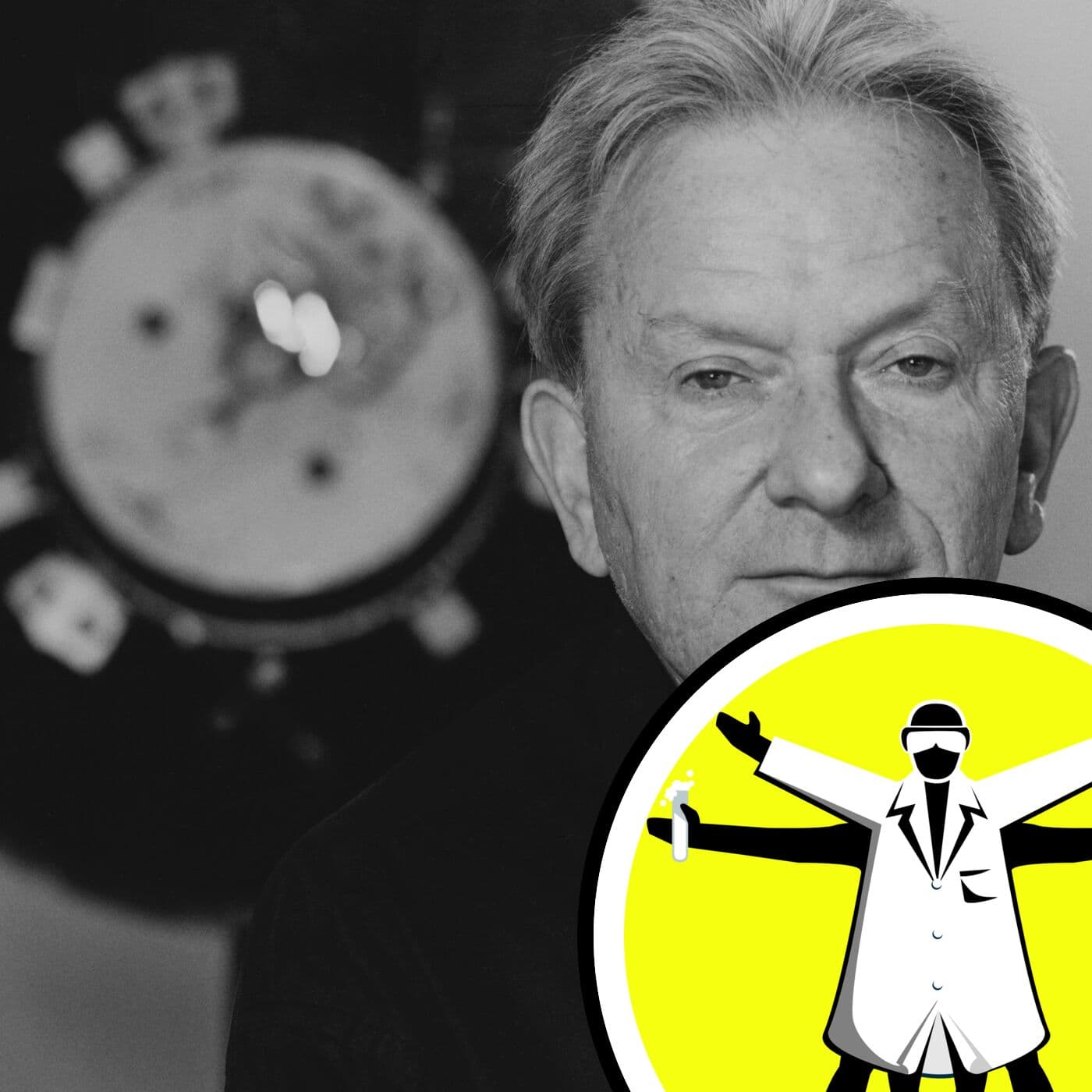
Titans of Science: John Zarnecki
Episode Overview This episode features John Zarnecki, a prominent figure in the UK's space community, discussing his pivotal roles in various space missions. The conversation covers his career highlights, notable missions such as Cassini-Huygens and Hubble, and the evolution of space science.
---
Key Points
Introduction to John Zarnecki
- Birth and Early Interest in Space: Born in London on November 6, 1949, Zarnecki's fascination with space began after witnessing Yuri Gagarin's visit to Highgate Cemetery in 1961.
- Education:
- Studied natural sciences at the University of Cambridge.
- Completed a PhD in physics and astronomy at University College London.
- Career Milestones:
- Developed instruments for notable missions, including Hubble Space Telescope and Giotto probe.
- Served as Director of the International Space Science Institute.
- Currently an Emeritus Professor of Space Science at the Open University.
Early Career and Contributions
- PhD Project: Worked on X-ray astronomy using Skylark sounding rockets in Australia.
- Discussed the significance of X-ray astronomy and pioneering techniques used in early space research.
- Developed a Bragg crystal spectrometer to detect X-ray spectral lines, leading to important publications.
Transition to Major Space Missions
- Hubble Space Telescope:
- Joined British Aerospace to work on the Hubble's faint object camera.
- Noted that 20% of Hubble's original instruments were European, showcasing collaboration in international space missions.
- Highlighted the importance of servicing the Hubble, which allowed for its continued success over decades.
Giotto Mission to Halley's Comet
- Mission Overview:
- Joined the University of Kent to work on the Giotto mission to Halley’s Comet.
- Described the mission's challenges and the decision to risk a close encounter.
- Key Achievements:
- Successfully gathered data despite the high-speed risks (68 km/s) associated with the mission.
- Giotto was able to transmit data after several instruments were damaged, demonstrating resilience in design and engineering.
Cassini-Huygens Mission to Titan
- Selection of Titan:
- Discussed the competitive nature of mission selection and the unexpected choice of Titan as a target.
- Emphasized Titan’s unique characteristics, such as its atmosphere and potential for surface liquids.
- Role in Huygens Probe Development:
- Led the development of the Huygens lander, which was designed to explore Titan's surface.
- Proposed an innovative Surface Science Package to measure Titan's physical and chemical properties.
The Descent and Findings from Titan
- Huygens' Descent:
- The probe was released from Cassini and descended over Titan using parachutes.
- Initially designed for three minutes of surface data, Huygens ultimately transmitted 72 minutes of valuable data.
- Key Discoveries:
- Titan's surface is mostly icy, with about 10% covered in liquid ethane lakes.
- Insights into Titan's thick atmosphere and potential subsurface oceans.
Conclusion and Future of Titan Exploration
- Significance of the Mission:
- Cassini-Huygens was a landmark project for the European Space Agency and underscored the importance of international cooperation in space exploration.
- Future Missions:
- NASA is planning a follow-up mission to Titan to build on the discoveries made by Huygens.
---
Final Thoughts John Zarnecki's contributions to space science, particularly in the fields of astronomy and planetary science, demonstrate the importance of perseverance, collaboration, and innovation in tackling the unknown frontiers of our solar system.
Support the Naked Scientists For those interested in supporting the continued efforts of The Naked Scientists, donations can be made via their website.
---
Stay Connected
- Follow The Naked Scientists for updates and new episodes on LinkedIn and Instagram.
- Leave a review on your preferred podcast platform to support the show.
Written by AI. May contain mistakes. Listen to the episode to check what was said.
Chapters
Tap a time to open that second in VOJohn Zarnecki's Early Fascination with Space
0:45 to 2:09
Exploration of John Zarnecki's childhood inspirations and academic background in physics and astronomy.
“John Zonnecki was born in London on the 6th of November in 1949.”
Pioneering Space Instruments
2:09 to 3:58
Discussion on Zarnecki's contributions to significant space probes and telescopes, including Hubble.
“I began by asking him when he first realised that he was destined for a career in space science.”
X-Ray Astronomy and Supernova Remnants
3:58 to 7:59
Zarnecki details his PhD project on X-ray astronomy and the first detection of an X-ray spectral line.
“Was the recording made while the rocket was airborne then?”
The Hubble Space Telescope Journey
7:59 to 11:33
Insights into Zarnecki's work on the Hubble Space Telescope and the challenges faced during its development.
“was resolved into three separate spectral lines.”
Transitioning Back to Academia
11:33 to 14:00
Zarnecki discusses his shift back to academia and involvement in the Giotto mission to Halley's Comet.
“Was that the project or did you carry on for a bit longer?”
The Giotto Mission and Its Challenges
14:00 to 16:26
Learn about the challenges faced by the Giotto spacecraft on its mission to Halley's Comet.
“So the launch was mid-85, arrival was March 86.”
Data Transmission and Surprising Results
16:26 to 18:47
Discover the unexpected outcomes and data received from the Giotto mission after passing Halley's Comet.
“So the decision was taken just a few days before encounter.”
The Birth of the Cassini-Huygens Mission
18:47 to 19:46
Explore how the Cassini-Huygens mission to Titan originated and its significance in space exploration.
“and it was retargeted to encounter a second comet.”
Collaboration and Mission Selection
19:46 to 21:11
Understand the collaborative efforts and competitive selection process behind space missions.
“sponsored by Epidemic Sound, perfect music for audio and video productions.”
Titan's Mysteries and Scientific Goals
21:11 to 24:49
Learn about the mysterious properties of Titan and the scientific goals of the Huygens probe.
“Science missions are selected competitively.”
Show all 14 chapters
The Descent to Titan's Surface
24:49 to 27:36
Get insights into the descent process of the Huygens probe and the challenges faced.
“So really, it stands out for all sorts of reasons.”
Mission Control and Data Transmission
27:36 to 28:02
Experience the excitement and tension of monitoring the Huygens probe from mission control.
“If we were lucky, it would survive for, well, we were designing for three minutes.”
Journey to Titan: A Space Exploration Experience
28:02 to 29:41
Explore the challenges and emotions of monitoring data from Titan.
“I mean, it was the highlight, I suppose, of my professional career.”
Titan's Unique Features and Future Exploration
29:41 to 30:29
Learn about Titan's icy surface, lakes of liquid ethane, and upcoming missions.
“but about 10 % of it is covered with lakes and seas of liquid ethane mostly.”
Transcript
Automatic transcript. May contain errors.0:11Hello,
0:17welcome to the Naked Scientist podcast, the programme that brings you the biggest breakthroughs and talks to the major movers and shakers in the worlds of science technology and medicine i'm chris smith and today is no exception to our mission because titans of science is back with john czarnecki his remarkable work in space exploration has helped us to understand the farthest reaches of our solar system
0:47John Zonnecki was born in London on the 6th of November in 1949. He attended Highgate School in North London where in 1961 pupils were remarkably given the day off to go and see the first man in space, Yuri Gagarin, who was visiting the tomb of Karl Marx at nearby Highgate Cemetery. John was among them. From an early age, perhaps motivated by seeing Gagarin, John developed a fascination with space. He went on to study natural sciences at the University of Cambridge and then graduated with a doctorate in physics and astronomy at University College London. John later made significant contributions to the field of astronomy.
1:26Alongside his team, he helped to develop scientific instruments for a range of space probes and telescopes, which included the famous Hubble Space Telescope and also the Giotto probe, the first to study Halley's comet, and the Huygens probe that saw us land on Saturn's moon Titan for the first time, and in the process made him a genuine Titan of science. This work has earned John and his colleagues the International Academy of Astronautics 2006 Laurels for Team Achievement and also the NASA Group Achievement Award. Along the way, John's also served as the Director of the International Space Science Institute and he's currently an Emeritus Professor of Space Science at the Open University in Milton Keynes.
2:09I began by asking him when he first realised that he was destined for a career in space science. I saw an advert, I don't know where it was, you know, maybe New Scientist, something like that, from UCL. And basically he said, come and do a PhD with us and you can launch rockets in Australia. I couldn't resist that. It was just a fabulous opportunity, you know, to go and launch rockets because I was a product of the 60s. You know, I'd grown up with the space age. I'd love the theatre, the drama of the space age, which I'd watched on our grainy black and white television at home. so the opportunity to work on instruments that would go on Skylark sounding rockets that are launched from the Woomera rocket range in South Australia and they give you about 10 minutes above the Earth's atmosphere and the thrust of the UCL group was X-ray astronomy so it was a very young branch of astronomy and X-rays of course are absorbed by the Earth's atmosphere which is a bad thing from the point of view of astronomy but for us as humans it's rather good because X-rays are very dangerous it's partly why there's life on Earth but then with the advent of the space age we could build X-ray telescopes if you like put them on these rockets and start to explore this new aspect of the electromagnetic spectrum because for millennia we had been only able to use visible light Then, of course, since the 40s, 50s, we'd been able to do radio astronomy.
3:49And then this was another part of the spectrum, the electromagnetic spectrum, that was opened up by the advent of space vehicles. Was the recording made while the rocket was airborne then? Was that why you said you get 10 minutes, you get it up there and you've got enough time to make some observations? How do you get the data back? OK, there's a telemetry system on these rockets generally. So the data is relayed in real time down to the ground. I started with my own project. This was unbelievable. I was, I think, 23 when I was given a Skylark rocket of my own. They sent you to Australia to launch rockets?
4:28Oh, absolutely. Absolutely. My PhD project was Skylark 1012, 1012. And, I mean, it was just a wonderful experience. It was sink or swim. This was the Mallard Space Science Lab, which is part of University College London, which had tremendous expertise, you know, in electronics, in mechanical engineering. And there was no formal training you learnt on the job. Quite amazing. I can't see that happening today. Can you? No, absolutely impossible. But, I mean, what a way to learn. And these, I mean, they were risky projects. And of course, sometimes they failed. You got a PhD, though, so you didn't fail.
5:13So you must have got data. Oh, absolutely. We were looking at a supernova remnant. So a supernova remnant is what is left over after a star goes bang. Most people have heard of supernovae there, these very dramatic events. But what happens afterwards? You get an enormous shockwave ploughing out into the interstellar medium. Very hot material, which is, because of the temperature, it's emitting mostly in X-rays. And so the one that I was looking at, Puppis A supernova remnant in the southern sky in one of the brightest X-ray sources, about 40 ,000 years old. And we were not sure why supernovae, or remnants of them, and there were several that had been detected, what was the mechanism that was producing the X-rays?
6:02And there were two possibilities. And so if we could see a spectral line in the emission of X-rays, that would tell us that the mechanism was what's called bremstrahlung radiation. That's thermal radiation. Basically, the X-rays are being produced because of the heat. The X-ray detectors then had very, very poor spectral resolution. It's very difficult to pick out colors, if you like, X-ray colors. So we built a Bragg crystal spectrometer. That's a device which basically enabled you to look at X-ray colours. And we detected for the first time ever an X-ray spectral line from an X-ray source other than the sun.
6:48We take all this for granted these days, don't we? I mean, you must look back on that and think the effort you had to go to to make that measurement. And now you've got people building telescopes where they're surveying half the universe in an evening. I mean, it's eye-watering now, isn't it? Absolutely right. And this was because in the early days of space-based astronomy, there were very few, if any, satellites available for that. So, you know, the early days were done with sounding rockets. You had at most 10 minutes of observation. So by the time the rocket had locked onto the object, you know, was pointing in the right direction, and that was very difficult to achieve, we only had two minutes worth of data and I got this little hump in the spectrum and it was just enough to be able to stick your neck out, publish a paper and say we've detected an X-ray spectral line.
7:45Go on about eight years and one of the first satellites that was devoted to X-ray astronomy was able to look at this object for 10 hours. And the little bump that I detected was resolved into three separate spectral lines. You know, you could just stare for 10 hours instead of my puny two minutes. And of course, you get so much more light, so much more x-rays. You can really, you know, see what you're doing then. But it was there. That's the critical thing. And you were proven right. But how did you end up then, because really the defining thing in your career must be to say you have put a probe on the biggest moon of Saturn.
8:34So talk us through that journey. I don't mean as in launching the probe yet, but how did your career begin to evolve that would take you in that direction? I loved pretty much everything about it. The discipline of being a rocket scientist, but also the technology that went into it. When I finished my PhD and had to, you know, look at where to go and what to do, it was actually a recession of the late 70s. Jobs were incredibly difficult to come by in the universities. So, in fact, I went into the aerospace industry, to British Aerospace, who had what looked like a very interesting project. It was called, at the time, the Large Space Telescope.
9:17Now, you probably know it differently. While I was working on it, it was renamed the Hubble Space Telescope. Now, a lot of people don't know that actually about 20 % of Hubble, even to this day, is European. So, of the original five instruments, one was European, that was the faint object camera, and that was designed and built in Germany and the UK. So I went to British Aerospace in Bristol to join the team working on building the faint object camera. It wasn't your mess up that meant the mirror was wonky, was it? No, that was the Americans. I mean, what do they know? It was a company who, in fact, changed their name not long after that disaster so that they wouldn't be associated forever with that.
10:09It did get fixed, though, didn't it? Because that was another amazing space first that not only had we put this thing in space, but realised what the problem was, and then we're able to deploy a mission that fixed it in situ. I mean, obviously, it's a bolt on to fix it, but then look at the outcome, look at the results. Absolutely and of course Hubble was I think pretty much the first space instrument at least of any size that was designed from the very beginning to be serviceable by astronauts delivered by the space shuttle. So you know without that it would have been just a disaster. It would have you know never worked properly.
10:46Your engineering stood the test of time there, hasn't it? Because you think decades later, it's still up there, it's still working, we're still doing science with it in a really very inhospitable environment. Absolutely. Even when we were working on it, it was fairly old technology. The core of the detector and camera system was what's called a Vidicon, which, you know, goes back to the 30s, the technology. I mean, it was a very sophisticated Vidicon, but it was already kind of old fashioned when we launched in 1990, I think it was. That instrument lasted for 12 years, was replaced. All of the original instruments have been replaced and much of the electronics.
11:28But yes, it's a remarkable testament to good design. Did your time with British Aerospace end then with the launch of the Hubble? Was that the project or did you carry on for a bit longer? How did you then get back into, shall we call it proper science, where you're actually leading research? Yeah, well, I spent three years at British Aerospace and it was a tremendous experience. I learned a lot about the, if you like, the formality of how you build instruments and the rigour, quality assurance and so on, which, you know, is kind of difficult to learn about in the universities. and is more important probably on long-term satellite missions than a short-term rocket flight.
12:10In the end, I was slightly frustrated. I missed the cut and thrust of the academic world and, you know, you're more able to try new ideas and new things. And I saw an advert for a job to work on a mission to go to Halley's Comet. It was like seeing the advert to go to Australia and launch rockets in the desert. It was just too much to resist. So this was the Giotto mission of the European Space Agency. And I would say this was the first really, really daring project that ESA had undertaken. What was it going to do? It was going to go to Halley's Comet, fly past it at a close, close distance. and for the first time see what is really at the core of a comet.
13:07Because with the best telescopes on the ground, you just cannot see what is at the heart of a comet. You see a head, a coma and a long tail stretching out, but you just don't have the resolution to know what is it that's causing this phenomenon. 1986, was it Halley's Comet came on its closest flyby? So I moved to the University of Kent where Tony MacDonald, who's my boss there, he had been selected to provide one of the, I think, 12 instruments for Giotto, an instrument to measure the dust particles which make up much of the comet. And I moved there in 1981, not long after the mission was selected.
13:51So there's a five-year lead time to do this? Well, in fact, the launch was 85. It was something like a nine-month journey to meet Halley's comet. So the launch was mid-85, arrival was March 86. And the thing about Halley, I mean, it's been observed for centuries and we know its orbit very well. It is one of the most active comets, so that means there'd be a lot going on to measure and observe. But its orbit is retrograde, which means it's going around the sun in the opposite direction to the Earth and the planets. So it inevitably means that the relative speed between your spacecraft and the comet is going to be very high.
14:36In the case of Giotto and Halley, it was 68 kilometres per second. goodness knows how many tens of thousands of miles an hour. So the decision was taken from the start that this would be a kamikaze mission, we would go as close as we could and with the expectation that the spacecraft would be destroyed because at that speed even a tiny dust particle, you know, milligrams, would be sufficient to do irreparable damage. We were talking about space debris on the programme recently And one of the Warwick scientists who works on this said a centimetre cubed particle in space at the trajectory and rate they're moving has the energy of a hand grenade.
15:21I mean, so something like what you're saying would just destroy your spacecraft very, very quickly. Absolutely. And I mean, in low Earth orbit, debris typically has speeds of seven kilometres a second. We're talking 68 kilometres a second. So in fact, Giotto was designed with a dust shield. This was sometimes called a Whipple dust shield proposed by, in fact, cometary scientist American by the name of Fred Whipple. He wrote this up in the 1950s before even Sputnik 1. And so this was basically two shields at the front of the spacecraft. The first shield would break up a particle and then the second shield, about 20, 25 centimetres behind, would then absorb the shock that had been generated by the impact on the front shield.
16:17We were hoping that that would enable us to get close, but we knew we would almost certainly be destroyed. Did it work? Yes. In fact, it worked better than ever we'd expected. So the decision was taken just a few days before encounter. We would aim for a missed distance of 600 kilometers. one of the most bizarre meetings I've been to when PIs, the principal investigators the head of each instrument team was arguing for what distance to go for some wanted to go for zero to actually try and smash into the comet others wanted to go further away which would give us a chance to survive and make more distance measurements so 600 was the compromise and actually what was achieved was 594 So it was staggeringly good.
17:12And I'll never forget that day. We're watching the data coming in and, you know, we're being bombarded with dust particles which are hitting the spacecraft. And about a missed distance of 2 ,000 kilometres or so, the screens went blank. We'd lost it. We'd assumed that the spacecraft was destroyed. And, you know, the champagne came out. We were all absolutely ecstatic. after about, I can't remember, 20 or 30 minutes somebody shouted out hey, there's some data on the screen communication had been re-established what had happened was that a big particle and big is a few milligrams, I kid you not had knocked the spacecraft so it had started wobbling so the data beam back to the Earth was missing the Earth but there was actually an onboard damping system So after this 20 or 30 minutes, the link was re-established and we were getting data as the spacecraft was going away out from Halley's Comet, which was absolutely remarkable.
18:20Now, when we finally analysed all the data, we realised that several instruments had been damaged, the camera was destroyed, we had six or seven dust instruments, two of them were destroyed, but basically the spacecraft was functioning. It had lost some bits and pieces, and to cut a long story short, the spacecraft was put into hibernation, I think the first time that had ever been done in deep space, and it was retargeted to encounter a second comet. We flew past the Earth in 1990, which gave us a kick and modified the orbit because there was no on-board fuel to do that. And in 1992, we encountered a second comet.
19:06And, I mean, it's absolutely remarkable. And I think it was so important for the European Space Agency. I think it gave them the confidence that they could do difficult, exciting stuff. And I think the rest of the space world said, hey, this is a serious organisation.
19:46sponsored by Epidemic Sound, perfect music for audio and video productions. This is the Naked Scientist podcast with me, Chris Smith. And today, the space pioneer, John Czarnecki, is our guest, Titan of Science. You came to Cambridge. I joined the Scientific Society. I was really interested in just learning about science. This guy turned up and gives this talk and says, I'm going to land a probe on a moon, not just any old moon, the biggest moon of Saturn. and it's going to take seven years to get there. Now, for me, in my early 20s, that was a lifetime. And it was a phenomenal lecture, though.
20:23And that was you. And that was the birth of the Cassini-Huygens probe. You were the PI. You led the development of the Huygens lander. There were six instruments, six scientific instruments on the Huygens probe. And I was one of the PIs, one of the six leaders. And of course, with all of these projects, there's an enormous team involved. I mean, not full time, you know, some come and go teams in the space agencies in industry. In fact, one of the things that I loved about the work, this collaborative way of working, and, you know, I mean, being a child of the 60s, a bit of a hippie, really, you know, this is an example of people working together for no reason other than pure science.
21:10Why did you pick Titan? It picked me, really. Science missions are selected competitively. It's really very democratic. And so after Giotto, I got involved with doing studies for a mission called Vesta. This was a French-Soviet ESA mission to go to an asteroid and to fire a dart, if you like, a penetrator into the asteroid to try and make measurements. And this was in competition. I think there were five or six missions in the competition. and I remember going to Bruges in Belgium where there were the presentations of each of the missions and then the top committee in ESA would go away, deliberate and decide which one to choose.
21:58And to my horror, rather than choosing Vesta, which was clearly a magnificent project, they chose something which I think at the time was called the Titan Probe. It was a project to work with NASA. NASA would provide a big spacecraft called Cassini, and Europe would provide a probe, a smaller probe, that would be detached and would land on Titan, the largest moon of Saturn. Did you know much about Titan at the time? Or had you just sort of had this as an afterthought, oh, it's a moon I've heard of? It was a moon I've heard of. I hadn't published a single paper with the word Titan in it. But I remember going back to our lab, really deflated, and saying to my colleagues, you know, we spend a year working on this Vesta project.
22:45We've done some interesting work. Is it all wasted? Can we adapt any of it and use it for this dreadful mission, which ESA and NASA have chosen, which, you know, maybe we can get in on it. And so we sat down and I literally remember it was a coffee break and we had a new coffee room and we went in there And we got an enormous sheet of blank paper and I said, right, if you land on a somewhat mysterious and unknown moon on the surface, what measurements would you like to make? And is there anything that we've done that could contribute to that? So we wrote down just all of the physical and chemical properties that we could think of.
23:32Remember, we knew virtually nothing about the surface of Titan. It's shrouded in a very dense atmosphere and bloody cold. It's what, minus 200 degrees or something, isn't it? 180 minus, yeah, something like that. And it's covered Titan, which is the second largest moon in the solar system, but it's shrouded in orange smog. So the Voyager 1 spacecraft had flown past in the early 1980s and produced a couple of thousand of images, all of which showed basically an opaque orange blob. No view of the surface. Was that the attraction then? Because it was mysterious, people thought, let's go there. More than that, there was lots of data about the atmosphere from the Voyager flyby.
24:22And the inference from that was that the surface could actually be covered with liquid. Not water, of course, at minus 180, but hydrocarbon, so liquid methane or liquid ethane. So there was a real possibility that this was a really exotic place, the only other place in the solar system with liquids on the surface. So, you know, that and the fact it is also the only moon in the solar system with an atmosphere, a thick atmosphere. So really, it stands out for all sorts of reasons. And that is why the target of the Cassini-Huygens mission, as it came to be called, was the Saturnian system, but with an emphasis on Titan.
25:09And how did you get in on the action then? Was your pitch that, well, we actually know how to do some of this stuff then and this is what we think we can deliver? sort of basically ESA through open, this is normally the way it works the opportunity to propose an instrument so they would say we have committed to fly this mission it's got this much mass volume power data available we think we should fly these instruments so respond to this AO we call it announcement of opportunity So from that start over coffee, I put together a team, international team, and we proposed a collection of instruments called the Surface Science Package, basically nine individual sensors, each of which would try and make a particular measurement on the surface of Titan.
26:05And this was particularly difficult because, A, we didn't know if the surface could have been hard ice. It could have been a gooey, tiring surface. It could have been liquid methane lake or sea. And also we had no idea how long we'd survive. ESA always told us we should aim for three minutes on the surface. So most of the measurements of the six instruments would be done during the descent. and maybe we'd get three minutes on the surface. So we made a proposal to fly this instrument and we were selected. That took off in 1997. It reached the Saturnian system in 2004. What was then the process to get to Titan?
26:53Because that was just Cassini-Huygens got there. How did you then get to Titan? Once Cassini-Huygens had been captured into orbit around Saturn, Huygens was released just on a set of springs it was essentially pushed away and it was then on a ballistic trajectory so it had no rocket power it was just on a path on an orbit that would take it inexorably three weeks later to Titan and it would hit the atmosphere had a series of three parachutes so it would sail down to the surface two and a half hours, something like that, land on the surface. If we were lucky, it would survive for, well, we were designing for three minutes.
27:42As it turned out, we got 72 minutes on the surface. Was your heart in your mouth? Because you must have been, because you went to America to be at mission control for this coming down the descent, didn't you? The descent was monitored and controlled from ESOC, we call it European. Space Operations Centre in Darmstadt in Germany. I mean, it was the highlight, I suppose, of my professional career. This was the culmination of 15 years of work. And I mean, you do have to be a little bit mad to do this sort of work, because it could have been lost just like that. We could have ended up with zilch, no data whatsoever.
28:27And I mean, there are many bizarre aspects of it. One is that we were monitoring essentially what had happened four or five hours previously, because the data could not be transmitted straight to the Earth. It was transmitted from Huygens, our probe, up to the Cassini spacecraft, which was flying over Titan, a few thousand kilometers away. Cassini would record the data, and then it would turn to point its large antenna to the Earth, and then it would squirt the data down to earth. And so this all meant that we got the data four or five hours after whatever had happened had actually happened. So that was kind of bizarre.
29:10I bet you were standing there watching the clock thinking, it's now in the lap of the gods. This thing has, whatever's going to happen has happened. Now I'm waiting for the radio signals to make it all the way back across the solar system. I mean, it was a highly emotional culmination of all these years of work. and we'd worked as a team pretty much very closely together. What did you learn about Titan though? What did that magic 72 minutes that you were hoping for three and got 72, what did it reveal? Well, that Titan is really a remarkable place. The surface is mostly icy, but about 10 % of it is covered with lakes and seas of liquid ethane mostly.
29:50The largest sea is larger than the largest of the Great Lakes, for example. And the atmosphere is thick. We know a lot about its composition. And we know a bit about what's underneath the surface, the icy surface. And there's a real possibility that there is a sea, a subsurface sea. So it's truly a remarkable place. Cassini-Huygens just scratched the surface. and this is why now NASA are building a mission to go back to Titan due to launch in, I think, a couple of years. A truly remarkable scientist, John Zanecki, a true Titan of science too. Now don't forget to mark Friday in your diaries. That's when we'll be rounding up the best science stories of the week for you.
30:40And if you'd like regular updates on what we're up to in the meantime, do follow us on LinkedIn or on Instagram. You can also leave us a review, please, on Apple, on Spotify or wherever you get your podcasts. Thanks, meanwhile, to everyone who's supporting us on a regular basis. And if you would like to do the same and contribute to our running costs to keep the Naked Scientist show on the road, we've made it safe and easy. You go to nakedscientist.com forward slash donate. I'm Chris Smith. Thank you very much for listening. And until next time, from all of us here at the team, goodbye.
Read the full transcript
31:16Thank you.