In short
How cells sense mechanical forces (stretch, pressure, shear, microgravity), convert those signals into gene-expression changes via ion channels and chromatin, and potentially “remember” past stress in DNA/chromatin to alter future behavior; implications for development, cancer, training, infection, and future therapies.
Guest
Dr. Sara (Sarah) Wickstrom, director at the Max Planck Institute for Molecular Biomedicine (Münster, Germany). Background: pioneered mechanisms linking mechanosensing to chromatin/gene regulation; won the 1M-euro Körber European Science Prize (bioscience track). Former MD-PhD path; worked briefly as a general practitioner before postdoc.
Key claims
Cells adapt to pressure by changing chromatin accessibility; cancer may subvert these force responses, turning a “brake” into an “accelerator”; memory may be encoded as global chromatin state and possibly specific “memory genes.”
Notable examples
tight shoes causing thicker skin weeks later; embryo force-guided positioning; tumor growth-derived pressure increasing aggressiveness; microgravity sensing (moss spirals; inner ear balance); bacteria/biofilms using mechanical forces for infectivity; fibrosis as a target for “rewriting” mechanical memories.
Written by AI. May contain mistakes. Listen to the episode to check what was said.
Chapters
Tap a time to open that second in VOIntroducing Sarah Wickstrom
0:44 to 1:52
Meet Sarah Wickstrom and her groundbreaking research on cellular memory.
“how cells sense and react to pressure and other stimuli and then store their experiences in their DNA.”
Skin Adaptation and Memory
1:52 to 3:18
Discussion on how skin cells adapt and store memories of stimuli.
“This is a crucial branch of biology and the person who's pioneering a path to understand how it works and to harness it to make us healthier is the scientist and doctor Sarah Wickstrom.”
Mechanisms of Cellular Response
3:18 to 5:24
Exploration of how cells sense pressure and adapt their gene expression.
“And that's essentially what we study, how the sensation happens, how the adaptation happens, and whether sometimes the adaptation is not good for the tissue in the end.”
Universal Mechanisms in Biology
5:24 to 6:44
Understanding how sensing mechanisms are conserved across species.
“You've talked about skin and we walk on that, we hold things with our fingers etc.”
Gravity and Cellular Growth
6:44 to 8:16
Exploration of how cells sense gravity and its effects on growth patterns.
“And we already know that at the origin of multicellularity is actually compressive forces that trigger the cells, single cells, to attach tightly to each other.”
Cancer Cells and Mechanical Signals
8:16 to 11:15
Discussion on how cancer cells respond to mechanical pressures and change behavior.
“i also think that cells are being able to sense microgravity and that's for example how balance is being sensed in the inner ear what's interesting though is that it's probably based on scale.”
Adaptation Through Exercise
11:15 to 13:58
Examining how muscle cells adapt to mechanical stress during workouts.
“But why would we go for such a brute force mechanism rather than a more discrete, if a cell can sense some pressure, turn on this suite of genes, or turn on this control gene that then controls other genes?”
Cell Development and Mechanosensitivity
14:02 to 16:14
Learn about how cells respond to mechanical forces during development.
“that then divides and divides and divides and turns into 37 trillion cells in an adult human, all in the right place, amazingly, in the majority of us, do these effects play out there too?”
The Kerber European Science Award
16:14 to 17:42
Discover the significance of the award and its impact on research.
“cost-effective voice, internet, and IP engineering services for UK businesses.”
Memory of Mechanical Stress in Cells
17:42 to 20:13
Explore how cells may remember past mechanical stresses and their implications.
“on equipment and how much we can spend on consumables.”
Show all 15 chapters
Epigenetic Changes and Tissue Response
20:13 to 22:29
Understand the role of epigenetics in how tissues respond to stress and injury.
“It could be adaptive and thereby maybe beneficial because the tissue is more resilient or it could be maladaptive and render the tissue more sensitive to the insults.”
Journey from Medicine to Science
22:29 to 26:04
Hear about Sarah's transition from medical practice to a career in research.
“So then, of course, it would be amazing.”
Future Implications of Cellular Memory
26:04 to 27:47
Examine the potential future applications of understanding cellular memory.
“But what do you do when you're not in the lab?”
Exploring Cellular Memory and Fibrosis
28:00 to 29:14
Learn about the impact of fibrosis on health and potential solutions through cellular memory manipulation.
“And the second is trying to erase or write these memories in tissues.”
Science News and Listener Engagement
29:14 to 29:56
Stay updated with the latest science news and how to connect with the show.
“including this one we just sniffed out, that a baby's brain synchronises its activity with that of another person when they can smell their dad.”
Transcript
Automatic transcript. May contain errors.0:00Sara Wickstrom:This Monday.com ad was created by a team of people and AI agents. The agents wrote the copy and managed the timelines, while our human creative director made sure it all made sense. Easy. Create your own AI agent today on Monday.com.
0:30Unbelievable. Without further ado, this is The Naked Scientist. Hello, welcome to The Naked Scientist podcast, the show that brings you the biggest breakthroughs and talks to the major movers and shakers in the worlds of science, technology and medicine. I'm Chris Smith and today we hear from titan of science, Sarah Wickstrom, who has pioneered how cells sense and react to pressure and other stimuli and then store their experiences in their DNA. So does this mean that individual cells can have a memory?
1:08Clap your hands, stamp your feet or pull on a pair of shoes that are too tight and in the days to weeks that follow your skin cells in the affected areas will respond to those shock waves by toughening up. They'll lay down more protective tissue but they might even go a step further and store a memory of that insult in their DNA. The implications for cells sensing, remembering and responding to pressure and other stimuli speak for themselves. Think about a developing embryo where cells jostle for position and rely on knowing who their neighbours are so all our body parts ultimately form in the right places and with the right proportions.
1:44Or consider how cancers behave when this system goes wrong and grow invasively and without any regard for normal tissue boundaries. This is a crucial branch of biology and the person who's pioneering a path to understand how it works and to harness it to make us healthier is the scientist and doctor Sarah Wickstrom. Born on the 30th of April 1976 in Espoo on the outskirts of Finland's capital Helsinki, she's now the director of the Max Planck Institute for Molecular Biomedicine in Munster, Germany. And she's just won the million euro Korba European Science Prize for her discoveries. She's our Titan of Science this week.
2:23One of the tissues that we study is the skin or the epithelial, so the surface part of the skin. And it's kind of clear that although the skin is composed of the exact same cells in the different parts of our body, but the composition in the end is very different if you think about the eyelid, think about the elbow or the sole of the feet. The consistency and the composition structure is very different. so this already made me think immediately that there must be some mechanics involved how much pressure or how much stress stretching the tissue experiences and maybe that kind of guides the functional specialization and that's how I kind of got into the subject.
3:04So in the same way if I wear a pair of too tight shoes initially I might get a blister but two weeks later I've got much thicker skin there and I don't get a blister again the skin somehow knows in inverted commas the pressure effects have changed and it needs to change. Exactly. It first senses and then it adapts. And that's essentially what we study, how the sensation happens, how the adaptation happens, and whether sometimes the adaptation is not good for the tissue in the end. Is that at a local level? Is that decision-making cells locally doing that? Or is there a more central mechanism that says, hey, nerve cells here are getting wound up.
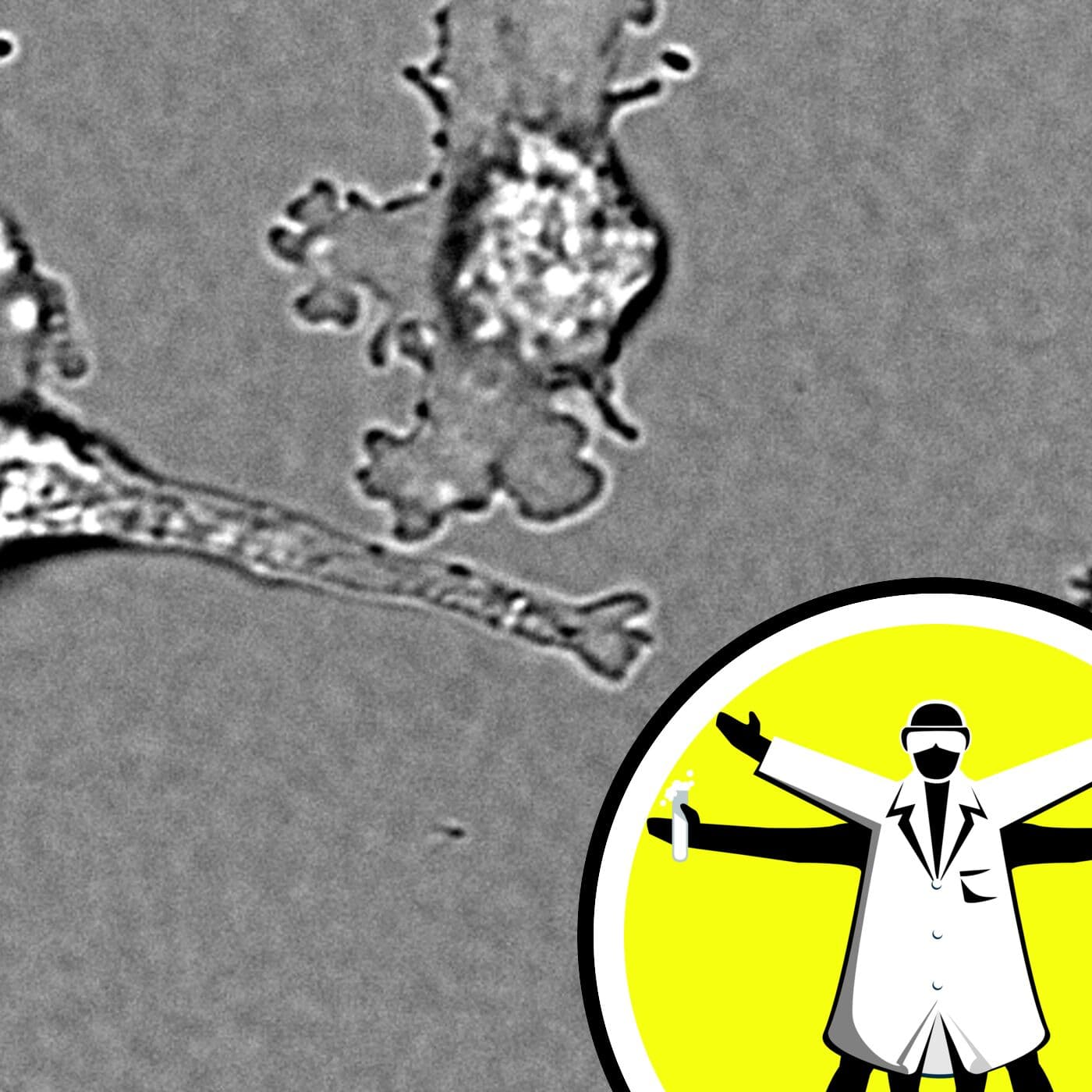
3:39Let's send a message back to tell the skin to change? Which is it or is it both? That's a really great question and we don't exactly know so that's still something that we're actively investigating. Does every cell sense on its own and make its own decision or is there some collectivity involved just as groups of cells or we even across cell types like epithelial cells and neurons so that's still an open question. How might cells if it was just cells on their own do it though? Well, we know, for example, that much of the sensing is happening at the cell surface, so the plasma membrane. So if you imagine that the cell is experiencing stretch, there are so-called ion channels that gate how ions flow from outside of the cell inside.
4:23And some of them are mechanosensitive. So they might be, for example, opened up in response to the stretch, which generates ion gradients that trigger changes in cells. and okay that would change the electrical activity that the cell is feeling but crucial to that is responding in the right way so how does that happen right so one important mechanism and that's what we have discovered and we study is that how gene expression changes in response to for example stretch and what we have learned that these these ions but also other signals are actually relayed to the nucleus of the cell where the DNA is stored and regulated in a protein complex called chromatin and how these ions and other signals actually change the chromatin and thereby change which genes are being expressed and that directly then changes how the cell will behave.
5:21Presumably different cell types are sensitive to different sorts of pressures then. You've talked about skin and we walk on that, we hold things with our fingers etc. But there are going to be other cells in other parts of the body that are experiencing quite different stresses, but it would be useful for them to sense those. Exactly. So that's what we think is part of the adaptation. If we think about development, we know that actually forces are important for the development of the cardiovascular system. So the shear flows from the blood or the stretching and contraction of the muscle will actually further guide the specialization of the tissue.
5:58And then these similar forces that might cause massive changes in skin cells no longer change the behavior of these cells because they are adapted to experience these continuous forces. But on the other hand, they might actually react differently when these forces stop. So this means that the cells are specialized to sense their force environment. And what we think they're doing is that then they are actually, they are sensing the change. And that might trigger these rapid responses in gene expression that we see. Presumably, although we think we're very special as humans, we're obviously evolved from a more simple or more primitive biology.
6:39Presumably, then, this is much more widespread than just us. Absolutely. I think these are conserved mechanisms. And we already know that at the origin of multicellularity is actually compressive forces that trigger the cells, single cells, to attach tightly to each other. So I think these are universal mechanisms that have evolved for organisms to sense their environment. You see, when I first read about your work, I was reminded of one of the first interviews I ever did when I was making science programs, because we were very lucky to speak to one of the team at NASA who had unfortunately recently lost Columbia, the space shuttle.
7:21But one of the experiments that was aboard that was coming back from space where they'd flown moss in microgravity. And the question they were asking is, well, would it grow? And what was amazing was, A, the experiment survived the crash and they got it back and they were able to analyse it. But B, when they analysed it, and this is about 20 years ago, they saw these bizarre spiral growth patterns. And when we interviewed Volker Kern, who was one of the contributors to that study, I said to him, well, why would the moss know it was in space if all other things were equal? And they said, well, what we suspect is that the moss cells can detect gravity.
8:00and they speculated at the time that there were particles of starch and things inside the moss cells that were settling under gravity on earth and bending the inside of the cell and that's how it knew what was up and what was down yeah that's really fascinating and i also think that cells are being able to sense microgravity and that's for example how balance is being sensed in the inner ear what's interesting though is that it's probably based on scale. So for example, it's known that certain cells are very large and therefore microgravity plays a more important role because of the structures being sensitive to gravity versus smaller cells might not be so sensitive.
8:44So there might be interesting special aspects of size that are related to sensing microgravity. But that's a very difficult topic to study. Not all of us can send our samples to space. No indeed but there must be situations where if you can unlock or work out what the genetic programs are that are interpreting these signals it might have really important clinical applications because I'm thinking if we think cancer grows invasively the cells don't know where to stop is one of the reasons why cells normally know where to stop because they feel the pressure from adjacent cells and that switches them off and cancer's ignoring that?
9:23Absolutely. I think there's two things that are likely important for cancer. One is indeed that they might become insensitive to this kind of signals that normally, for example, restrict growth. But they also might, in fact, become more reprogrammed. Because if the forced environment changes, and that changes gene expression, that actually might also lead the cells to differentiate in the different trajectories. And that's what we have also shown is that cancer cells, when they experience pressure that is derived from the growth of the tumor they actually might gain properties that make them even more aggressive.
9:59So they subverted the system and sort of flipped it around so what would normally be a handbrake now becomes an accelerator. Exactly. Wow and do you know what genes it invokes to do that because obviously if we want to try and gain or regain control knowing how it is doing that is critical. So what we have learned is that it's maybe not one or two key genes. It's more essentially the entire cellular program, because I already mentioned chromatin, because all of our cells have identical DNA, and the chromatin is there, so the protein component that packs the DNA is there to control which genes are expressed in which cells, and that makes them specialized.
10:41And now what happens in the case of pressure, for example, that the entire chromatin structure kind of changes that allows more genes to be accessible for activating factors. So it's more like an entire reprogramming of the genome than switching on one or two genes. So it sort of unwinds the DNA into a state that can be read or winds it into a state that can't be read. It's pretty gross rather than discrete individual genes. Exactly. And that's why it may be harder also to target with drugs, because it's an entire reprogramming rather than activation of a pathway that could be targeted with drugs.
11:21But why would we go for such a brute force mechanism rather than a more discrete, if a cell can sense some pressure, turn on this suite of genes, or turn on this control gene that then controls other genes? I think initially it might be beneficial for the cell to do this in a healthy situation because these kind of mechanical stresses are maybe something that is evoking these adaptations. And that's why in these stressful situations, it might be beneficial for the cell to react very fast. So by changing the chromatin structure, it becomes very efficient for the cell to launch this kind of adaptation mechanisms that we discussed.
12:01But now in disease, these stressful situations become prolonged. And maybe then these adaptive responses are not launched in time. And thereby, the cell has kind of a longer period of time to launch more kind of malignant or less beneficial adaptations. This is more speculation at the moment, but if we compare the signatures of healthy and cancer cells to these stresses, on short timescales they are very similar, suggesting that it's not like a pathological response, but rather a healthy adaptation response. But somehow these stressful situations seem to last longer in disease, maybe kind of prolonging the window of opportunity for the cell to then receive additional signals and become more and more altered.
12:49when people train they're obviously putting huge pressure on different tissues is that adaptive as in are they plugging into the system that you work on and that's how a muscle knows apart from it's being injured a bit because obviously when we work out we do injure our tissues a bit but is that part and parcel of how tissues think i need to get bigger because i've just had a workout yes so basically when we look at these gene expression changes that i mentioned a major component of genes that are being changed are these so-called cytoskeletal genes, which are the components of the contractile machinery that the muscle uses to generate force.
13:28So exactly this adaptation and the ability to generate more force, but also resist deformation. These are kind of the same machineries used for both. And that's why the cell, by increasing the production of components of this machinery, will be able to sustain its shape and maintain its function in response and in the presence of this kind of mechanical stresses. When we develop as embryos, because obviously we all come from a single cell that then divides and divides and divides and turns into 37 trillion cells in an adult human, all in the right place, amazingly, in the majority of us, do these effects play out there too?
14:11too, because that ball of cells, there must be quite a bit of contact and pressure signaling going on for things to then know, right, OK, I'm in the middle or I'm at the edge and I have to become skin or I have to become a heart. Yes. So that's what we're actively studying. So we're kind of working out the mechanisms, but we exactly believe that the forces, although they are not the only players in development, obviously, but they are kind of guiding to help and reinforce the signaling decisions by exactly giving this kind of positional information. But it also might be that this mechanosensitivity is something that develops during development and there might be periods of time, for example, in very early development where the cells are less sensitive to forces.
14:58But this is something that we are studying at the moment. And do any microorganisms also plug into this? Because we've talked so far about health, we've talked about development, we've talked about pathological states and also reactive states like me wearing too tight a shoes. But there are things like parasitic infections, malaria, for example, that need to know about the environment they're in to react accordingly. Malaria glues red blood cells to blood vessel walls, for example, to stop the spleen grabbing them. Does this play into that? Or is there any evidence that microorganisms and parasites might be subverting this same system?
15:35Yeah, so there are some really exciting studies, for example, from bacteria and biofilms and how actually bacteria also sense mechanical forces and use it for infectivity. So definitely this is not something that is restricted to eukaryotes or mammals.
16:05Sara Wickstrom:It all made sense. Easy. Create your own AI agent today on Monday.com.
16:13The Naked Scientist podcast is produced in association with Spitfire, cost-effective voice, internet, and IP engineering services for UK businesses. Find out how Spitfire can empower your company at spitfire.co.uk.
16:33This is the Naked Scientist podcast. with me Chris Smith and I'm talking with Titan of Science Sarah Wickstrom about the discoveries that she has made about how cells sense what is around them. Now you've won a pretty significant prize for unlocking the door and opening the door on a lot of this and really shining a light on this world. What actually is that award and what are you going to do with it? Well it's called the kerber european science award so um this is award given every other year to a a um bioscientist and every other year to a physicist or a computational scientist and and this is a a award of one million euros that one can use for research so it's not going on my private account it's it's going to my research account it's a shame i was going to ask you to buy me a beer but Yeah, I can still do that, but not with a million.
17:29So the fun thing about this award is that it's still flexible to use because normally in science, we are very constrained with our grants in terms of budget, how much we can spend to hiring students, how much we can spend on equipment and how much we can spend on consumables. But this grant is more free to use, and this means that more room is given to serendipity, creativity, and just kind of the scientific progress. And the focus of the research that I will use this grant for is to try to understand whether these effects of forces on chromatin and gene expression is something that the cells and the tissues can remember.
18:12So as an example, the cell has experienced mechanical stress, but then the stress goes away. But whether some traces of memory will be retained in the nucleus, in the chromatin, that when the cell gets another similar experience or even something a little bit different, it will behave differently because it's had this previous experience, similar to us. So essentially, it had made an experience and it recalls this experience that changes its future behaviour. What a fascinating idea, because I mean, I first came across this about 20 years ago when researchers began to point to the link between obesity and the fact that a person pregnant and starved had children that were much more likely to turn into diabetics who were obese and with high blood pressure later.
19:03the Dutch hunger winter was used as an example, and they were able to point at epigenetic changes in certain genes that had occurred to cause that. So that was a biochemical stress. So you're sort of saying that physical stress might be remembered in a similar way in cells then? Exactly. So there are some hints that this might be the case, but I think it has not really been stringently and rigorously tested so so that's what we plan to do and particularly we're interested in whether pathological tissue states so whether if a tissue has been injured whether that could leave this kind of memory scars and when then another injury or another insult arrives whether this previous injury is somehow affecting how the tissue will respond to the next one For instance, if you had an episode of extremely high blood pressure and put massive load on your heart, would your heart cells remember that they were under more stress and therefore permanently or semi-permanently label some genes that might then affect, say, disease risk or even resilience in future?
20:13Exactly, exactly. I think both effects are possible. It could be adaptive and thereby maybe beneficial because the tissue is more resilient or it could be maladaptive and render the tissue more sensitive to the insults. So both outcomes to us are equally interesting and equally plausible. Are you going to look at the level of individual genes with this though or back to what you were saying earlier about the fact that it's whole chunks of how the DNA is wound up and put into an inaccessible or a more accessible state that you think underpins a lot of this? Well, while we think that the initial response, and we know that the initial response is quite global, it's still possible that there could be certain memory genes or certain genes that are more prone to be part of such a memory.
21:03And they might be the important genes that then regulate the future responses. So here we are definitely also focusing on individual genes, because these, of course could act as fantastic markers for such memories that we could detect them in tissues and also trace them over longer periods of time to kind of try to understand this behavior also in the context of tissues and not just in single cells. Well I'm thinking because someone once asked me if you have a heart transplant does the heart have any memories from the person it was in that's then conveyed to the new recipient and I sort of laughed at the time and said well no no That's not how memory works.
21:42But actually, you're sort of rewriting that book then, because if the heart from the donor has got one of these sort of epigenetic memories in it now of past pressure experiences, it could well carry some change in function into that new body. Well, in theory, yes. And I think our research should be able to find those genes and understand whether it's relevant for the future health of this transplant recipient. Do you know how to rewrite the book, though? So although you can see changes when tissues are subject to pressures or stress or being bent and deformed and distorted, and this translates into genetic changes, is it a one-way street or do you think you can rewrite the book?
22:27Well, that's, of course, the ultimate goal, especially if it turns out that these memories are disadvantaging the tissue. So then, of course, it would be amazing. And of course, if it's encoded in chromatin, we know already a little bit based on other people's work how to modify, for example, these chromatin readers or writers. So in theory, it might be possible to rewrite the memories and that of course is is a dream outcome of this research there are some drugs that as side effects do this kind of thing though and we discovered this as a sort of by product of looking at these drugs we actually invent them for something else they treat the condition they're designed to treat quite well but then you find oh they also do things to the chromatin are there any drugs that serendipitously happen to do this and which can give you some insights into how this might be working?
23:21Well there's an important class of drugs called the bromodimane protein inhibitors which are used for cancer and they are exactly targeting these epigenetic enzymes so they could be a good candidate. Of course the problem with these drugs is that they are again targeting a very broad range of chromatin effects so again whether they could achieve the position of then controlling these few genes that are important, that of course is something that is likely to be challenging. Now when you first started out, you actually went to medical school to start with. Did you actually become a doctor for a while or was science just too much of a lure and you got seduced by that and didn't practice?
24:07Well, I did, but actually I went to med school, but I always wanted to be a scientist. I just didn't, because I don't come from a science family, but I wanted to become a scientist, but I didn't understand how I will achieve that goal. So I went to med school because they had the MD-PhD program, which was appealing to me because then I thought, OK, maybe that's my path to science. So I went through med school, but I already started also doing cell biology in medical school and fell in love with cell biology. But then after I got my MD and my license to practice, I then finished my PhD. And after my PhD, I worked one year as a general practitioner.
24:49So just in a healthcare center, seeing patients just to be sure that when I'm as old as I am now, I will not have a midlife crisis and thought that I should have become a clinician. It was a really rewarding experience. I enjoyed actually being able to help people, but my love of science was greater. So after this one year stint, I did my postdoc and after that, I have never returned to the clinics. And what was the journey between Finland and where you are now? It was my journey of serendipitous decisions and kind of just always thinking about the path to do the best possible science. So I ended up going to Germany kind of based on just the lab.
25:34So I was not thinking about moving to Germany to be in that country. So that was a decision driven by science. And then I got an offer to be a group leader. So I ended up staying. But then in 2018, I got an offer to become an associate professor in Helsinki, which was my hometown. So I went back to Finland and stayed there for four and a half years before. then Max Planck offered me this director position and then I decided to return to Germany. They realised what they'd lost. Who knows. But what do you do when you're not in the lab? Because, you know, lots of scientists do interesting, exciting things away from the bench, which is where they have their thinking time and they come up with their best ideas when they're not trying to think of them, sort of reverse psychology.
26:20So where do you have your best ideas? Well, I mean, I'm thinking about science a lot in random places, but I do love sports and exercise. So I do some road biking, some running and all kinds of outdoorsy stuff. And usually I end up thinking about science at some point when I'm enjoying getting some exercise and some fresh air. I know you're thinking about all the pressure effects on yourselves when you're doing that. I try not to think about that, though. So it's more important to just enjoy the movement than to think about mechanical stresses. Indeed. But if this comes off and you're able to get evidence that tissues do have these sorts of pressure memories in that way, what will this unlock and where will you take that next if you're successful?
27:15I see two possible trajectories. One is that we find memory genes that we can use as markers, because my lab is also very interested in understanding how the tissue architecture and how the shapes as proxies for these forces, because it's very difficult to measure forces, for example, in diseased humans. So we rely on using shapes and architectures as proxies. And it has turned out that we can actually develop those analyses into diagnostic tools for cancer. And now I envision that if we can find these memory genes, we could also use them as biomarkers that could tell us about the disease progression.
Read the full transcript
27:59So that's one application where we would like to take this. And the second is trying to erase or write these memories in tissues. For example, fibrosis is one important health threat. So actually it's estimated that 50 % of deaths actually result from fibrosis, either as a secondary outcome of heart infections or infectious diseases or cancer. So if we could somehow tackle these fibrotic reactions by rewriting these mechanical memories, so the cell, instead of producing more and more of this very stiff scar tissue that prevents these normal organ functions, it would start remodelling and basically restoring the normal tissue stiffness and architecture.
28:53Absolutely fascinating. Sarah Wickstrom there, director of the Max Planck Institute for Molecular Biomedicine in Münster, Germany, and winner of this year's Corbe European Science Prize for the work that she's just been explaining. Will transplanted organs turn out to have a memory of what they've been through? Wouldn't that be an extraordinary finding? We wish her all the best of luck. Now we're back with the latest science news stories of the week on Friday, of course, including this one we just sniffed out, that a baby's brain synchronises its activity with that of another person when they can smell their dad.
29:25We'll discover why scientists think that is. Meanwhile, if you'd like to get in touch, you can drop me a line via chris at thenakedscientist.com and do, please, if you have a chance, also drop us a rating and a review wherever you get your podcasts to help us to spread the word. lastly if you appreciate what we do here for you each week and you'd like to support the show do please consider making a donation you can do so at nakedscientist.com forward slash donate and to those of you who already do thank you so very much i'm chris smith from all of us here on the thank you for your time and for listening to us and until next time goodbye
30:20Sara Wickstrom:This Monday.com ad was created by a team of people and AI agents. Reese, our content agent, wrote the copy based on our best practices, like mentioning Monday.com three times. That was the second. Johnny, our coordination agent, built the timeline and kept everyone aligned. And Olivia, our human creative director, stayed in the loop. Because agents are great, but they don't always know when a joke lands. She had one note. Tell listeners it only takes minutes to build an agent. So, minutes. Create your own AI agent today on Monday.com.