 Ask ChatGPT


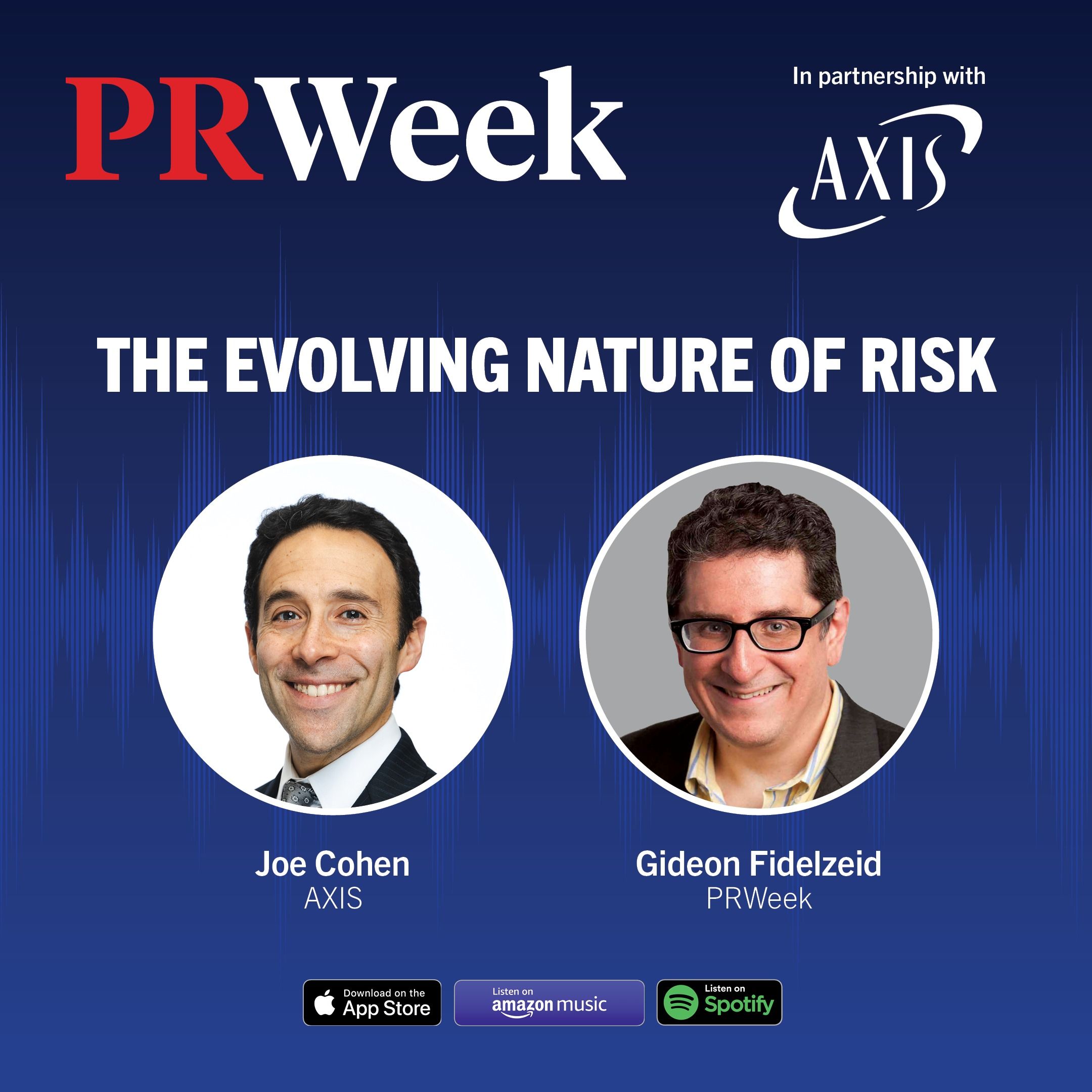
The evolving nature of risk in communications and marketing, using Axis’s insurance perspective to explain how brands should prepare for crises and communicate without fearmongering.
Gideon Fiddlezide, VP of Hate Market Studio and Editorial Director of Custom at PR Week; Joe Cohen, Chief Marketing Communications Officer at Axis.
Cohen previously worked at Kind Snacks; earlier career included agency crisis work at MWW and communications leadership across consumer and financial services.
Risk should be treated as a business/operational issue, not just external reputation crises; comms leaders must partner with CEOs on enterprise risk management; marketing should feel “the risk” creatively while staying optimistic.
Axis launched after 9/11 to insure hard-to-place risks like terrorism and aviation; campaign “25 Years of Specialty Solutions Elevated”; cyber risk, energy transition, extreme weather, inflation; wildfire education via irrigation/buffer zones and building code; Kind Snacks FDA labeling crisis (“healthy” removal) resolved by challenging regulation with FDA.
Written by AI. May contain mistakes.
Explore how creative expressions can reflect the concept of risk with optimism.
“And if you look at some of our videos, they're fast moving, they're jarring.”
Discussion about Joe Cohen's background and the founding of AXIS in response to 9/11.
“So it is something that I'm really happy to tackle today.”
Insights into how AXIS was formed to handle specific types of risk in insurance.
“So can you talk a little bit about that?”
Discussion of AXIS's 25th anniversary campaign reflecting on its origins and impact.
“All the business lines that we represent, I named terrorism and aviation, there's cyber, there's energy, many different lines within the property and casualty spectrum, marine.”
Insights into how AXIS's marketing integrates risk management with creative storytelling.
“So, Joe, can you talk a little bit about this campaign and how you brought it to life?”
How AXIS positions itself uniquely in the insurance market through creativity.
“So one thing I'll note with the marketing and comms team was almost a little over six and a half years ago in 2027, it'll be seven years, we blended the functions.”
Joe discusses his musical tastes and how they influence his work at AXIS.
“Every piece of that marketing communication spectrum, we're looking to lean back into that broader brand vision.”
Exploration of how communication strategies can address internal and external risks.
“But anyway, let's get back to our regularly scheduled programming, shall we?”
Discussion on various external risks impacting businesses today, including cyber threats.
“What you're talking about is internal crises with the business and the way it's operating and how communicators can really, really need to get involved in those things.”
Learn how to protect and respond to attacks on your business.
“If an attack or breach occurs, how do you try, how do you respond?”
Discover how to construct positive marketing narratives amid risks.
“Which unfortunately these days is very likely to happen very soon because that's just the nature of the world we live in.”
Gain insights into key risk management lessons from a decade of experience.
“And that comes from our CEO, that ultimately, we really want to be endeavoring to make a positive impact.”
Reflect on the discussion with appreciation for contributions to the field.
“that you're able to have the you're able to really maximize that precious time.”

Get the gist, explore an idea or ask about something said.
 Claude
On The PR Week, what are the key points of this episode?
Searching your listeningAutomatic transcript. May contain errors.
0:02We wanted people to feel the risk in our creative. And if you look at some of our videos, they're fast moving, they're jarring. At times they could almost feel overwhelming. But at the same time, we wanted a spirit of optimism and hopefulness. The idea that while these challenges are out there, with the right approach, it creates opportunity.
0:26Hello, everybody. This is Gideon Fiddlezide, VP of Hate Market Studio and Editorial Director of Custom at PR Week. Really, really excited about this podcast for two reasons. One, the topic. We're going to be talking about risk. Now, no, I don't like risk, but it's such an important topic and every communicator out there deals with it on a daily basis. So it is something that I'm really happy to tackle today. And the second reason I'm so excited is because of who's joining me on this. Joe Cohen, Chief Marketing Communications Officer at Axis, who I've known for many, many years. And he's truly just one of the more brilliant communicators out there.
1:00Joe, save the embarrassment of the compliment. It is nice to see you. Gideon, it's always nice to see you. Thank you for that introduction. It's good for my self-esteem. So excited to have this conversation with you. Awesome. and, you know, well, that's what I'm good. I'm good for people's self-esteem, except my own. But that's another story. Really, the whole theme of this is the evolving nature of risk. And honestly, there are a few people in the industry who really, really could speak to this with the expertise that Joe can. And by the end of this conversation, you're going to understand why I said that.
1:32In fact, my first question for you, Joe, the way I teed it up is, I truly believe there might not be a better Mark Homs leader to discuss risk than you. How about that? Part of that belief of mine stems from the timing of when your company, Axis, was born. Can you please talk about that? Because again, Axis's birth has a lot to do with risk in some ways. So can you talk a little bit about that? Yeah, I think that's exactly right. And Axis was born in the aftermath of the September 11th tragedy. And at the time there was, so Axis, I should say, is a global insurance and reinsurance company. At the time of 9-11, what wound up happening in the risk and insurance space was that people weren't writing terrorism or aviation risk, and there was capacity in the marketplace.
2:19So AXIS launched as a specialist insurer that excelled and was really created to help companies manage hard-to-place and highly complex risks. And two of the immediate areas where AXIS wrote business was in terrorism and aviation. And now AXIS is a large global multibillion dollar company, but the roots of the organization began 25 years ago during that tragic period. As it relates to risk and the understanding that I've developed as a communications professional, just by the nature of working for a company like AXIS, where you not only have to understand the AXIS brand, but have to understand risk from so many different dimensions.
3:04All the business lines that we represent, I named terrorism and aviation, there's cyber, there's energy, many different lines within the property and casualty spectrum, marine. There's a unique set of risk dynamics for each of those types of businesses. And having an opportunity to understand, at least at a high level, some of those different risks and help our company articulate a position and a voice. It's rich work. It's intellectually stimulating work and easily the smartest work that some of the smartest work that I've done in my career. Thank you for that, Joe. And you mentioned this is born of 9-11.
3:48That actually tells everybody that AXIS is now 25 years old this month. And that also means that AXIS is marking its 25th anniversary this year with a very special campaign that commemorates the anniversary and celebrates AXIS's roots. And I apologize for using the word anniversary. That might have been the best word to use considering when it was 9-11. But, you know, just remembering that day and again when AXIS was born. So, Joe, can you talk a little bit about this campaign and how you brought it to life? Yeah. So the campaign is called 25 Years of Specialty Solutions Elevated. And a parallel that goes back to the time when the company was born was in that timeframe, there was the tragic attacks, but it was also a time of massive change and uncertainty across a range of dimensions.
4:38It was geopolitical. It was war. There was also technological disruption. At the time, you started to see the internet revolution and the beginning of mobile very early days begin. Also, there was a period of economic volatility, the beginning of the dot-com fallout and the recessionary conditions that followed. So access as a business grew during that time. And we helped our customers, which were entirely companies, were B2B, manage through that period when their organizations and enterprises faced risk across so many different dynamics. So today you fast forward and there's some clear parallels, whether it's geopolitical tensions, whether it's war, whether it's how AI is and emerging technologies are reshaping the technology landscape and creating all sorts of new risks.
5:36And of course, there's economic uncertainty, inflation, some of the different things happening at a geopolitical level tied to economics. So today, again, part of what we're doing through that campaign is helping our customers navigate those risks. And it goes back to the heritage that I spoke about before. Or as a company, we excel and stand apart for our ability to help our clients navigate and manage very complex risks and sometimes volatile risks. So through the campaign, what we really are doing is bringing to life what that looks like. And I'll pause there. Thank you so much for that. Now, I want to get into I want to get a little bit of nuts and bolts about how the marketing communications teams at Access, both of which you lead, sort of work together on all this.
6:22So when you and I spoke recently, we touched on how the marketing and comms teams at Access think about risk when it comes to everything from experimentation to philanthropy to even your choice of music for various initiatives. It touches everything. So might you be able to elaborate a bit on that for us? Yeah. So one thing I'll note with the marketing and comms team was almost a little over six and a half years ago in 2027, it'll be seven years, we blended the functions. And at the time, a decision that I had to make was, were we going to have a separate marketing team and a separate comms team?
7:00And the decision that I made with input from the team and input from our stakeholders was to blend the functions. And by doing so, one, we're able to approach our work in a truly agnostic way. So are we choosing the right approach for any given assignment instead of really feeling pressure to satisfy someone who's thinking more marketing or someone who's more comms looking at it in a way that's unbiased? Also, part of it is giving our team a chance to get to understand both disciplines. So to answer your question directly, part of how we run our team, of course, we contemplate risk in our own actions and in our own strategies and in how we communicate on behalf of our businesses that we represent within the access portfolio.
7:51But in addition to that, we actually look at the brand beyond risk and we try to differentiate ourselves. And what I'll note is early on, around that period, six and a half years ago, we stepped back and we realized that most insurers presented themselves as either a company that protected their partners or were partners. And what we saw as a different area for us is the idea that we're navigators and we help our customers really manage through this volatile terrain. And by looking through that different lens, it gave us a different approach and a different narrative thematic. Also, we want our look and feel to be different.
8:35And in looking at a lot of insurers, not all, but a lot of insurers, there's a very crisp, formal look and feel. And we wanted more energy. We wanted people to feel the risk in our creative. And if you look at some of our videos, they're fast moving, they're jarring. At times, they could almost feel overwhelming. But at the same time, we wanted a spirit of optimism and hopefulness. So the idea that while these challenges are out there with the right approach, it creates opportunity. And you mentioned music. I early before going into this field, there was a time where I was a professional DJ, a radio DJ.
9:16So I have a lot of passion for music and the power of music. And again, in thinking about how to differentiate our brand, what it felt like at the time, some of our competitors were playing very conservative, stayed music. We wanted something with energy, with a beat that really reflected this dynamic, modern look and feel that we projected. It was almost more like a tech company look and feel versus what you'd see from an insurance company. So whether it's tonal branding, whether it's the look and feel, whether it's how we tell our story, where we tell our story, you mentioned philanthropy, how we getting our hands dirty as far as how we go out and support the communities, how we run our events.
10:00Every piece of that marketing communication spectrum, we're looking to lean back into that broader brand vision. Okay. Joe, you and I have known each other for a long time, and I really, really thought I knew everything about you. somehow your time as a DJ slipped past me. So I guess I just have to ask, okay, what are you listening to now? What are you listening to these days? Yeah, well, I have a six-year-old and an eight-year-old son. So I spend a lot of time listening to music that my kids care about. A lot of music that's created by YouTubers, a lot of K-pop demon hunters. But as far as my own musical tastes, it runs almost every single genre.
10:42I appreciate all forms of music. I, having grown up in the eighties and nineties, I'm increasingly just feeling nostalgia for how good the music was back then. But yeah, but today often a lot of kids music. You are, you are so right about the eighties. I don't know, I don't know how Fitz feels about that, but eighties is the best decade for music. I am sorry. Anyone out there want to text me or I am me or something and argue with me, I'm ready for it. 80s and 90s, 80s and 90s. Yeah, yeah, yeah, the 90s too. But if I had to choose one decade, I'd go with the 80s, but maybe that's because I'm old.
11:16But anyway, let's get back to our regularly scheduled programming, shall we? So Joe, what are some of the risks that businesses are facing now that can have true implications on the marketing and comms function? Or maybe I should say, what are some of the newer risks businesses are facing now that can have implications on the marketing and comms function? Yeah, well, first something that I'll do is I just want to step back for a moment and talk about how comms people, I believe, should be thinking about risk. And just as some context, I had an interesting conversation with Erin Passan, who is a friend and she is at Spencer Stewart.
11:56Something that she had researched a few years ago is that what CEOs look for in communications leaders are they're looking for people who can really guide them on how to look around the corner and going beyond even just media, how can you dig in and help identify operational challenges? It being looking at from an enterprise risk management approach, how can you add value and help arm and prepare your CEO? And I'll note, I'm very fortunate that I have a great CEO, Vince Tizio, who really has welcomed me into function as a partner to the business and empowered us. So that's something I don't take for granted.
12:38So if you have that opportunity or if you're able to advocate and secure that opportunity, a lot of, and even to earn that opportunity, it comes with helping to be a partner in not just creating comms plans and crisis management or comms crisis management plans, business crisis management plans, getting involved in that. And then in doing so, you really understand at a deeper level, what are some of the operational risks that your business faces? And by extension, what are some of the comms repercussions that could come from it? So I think that's one way just in general, philosophically, to look at it.
13:19I can get into the exact question you asked about some of the different risks that companies face, but I hope that's helpful sharing that background, Gideon. It actually is because usually when you talk about crisis with communicators, it's about external factors and things that are down, things that are harming the brand reputation. What you're talking about is internal crises with the business and the way it's operating and how communicators can really, really need to get involved in those things. So that really, really is helpful. But for the sake of the question that I ask, maybe there is one or two things that you could mention that are maybe a little bit more external that brands are facing now.
13:53There's a number of emerging risks that businesses are facing and where comms has a direct and meaningful role. So a notable example is cyber risk. So if an attack were to happen, one, before the attack, how do you protect and prepare your business? If an attack or breach occurs, how do you try, how do you respond? How do you help mitigate and contain the damage? energy. The energy landscape is transforming dramatically, whether it's a result of energy transition, politicization, also war, which is having an impact on energy. And what are some of the repercussions on your business, on supply chains, on your operations?
14:33So that's something where if you're not really immersed in how that could impact your business and how it may be now, That's a crucial area. Extreme weather. All too often now we're seeing increased flooding, severe convective storms, hurricanes, rising temperatures, El Nino. What kind of impact could that have and is that having on your business? Whether it's something that could be an operational threat or reputation as far as being in the news on how it affects how you service your customers. But those are just a few areas. I mentioned at the beginning of the interview, economic inflation, so economic risk.
15:15In addition to that, there's technology and there's political violence and terrorism, CEO security. There's really so many different areas you could delve into. and for each of them having the right approach, really playing out scenarios and the types of things that could happen and not doing it in a vacuum where it's comms people sitting in a room, coming up with holding statements, sitting at the table and going through those various risks with the relevant internal stakeholders and preparing for what could happen, educating yourself on what could happen and then coming up with response strategies and of course, action plans.
15:54that's the kind of preliminary work that can pay meaningful returns if and when a crisis does strike. Which unfortunately these days is very likely to happen very soon because that's just the nature of the world we live in. So I appreciate that. Now, insurance is ultimately a promise to perform during a crisis. Now, I can't take credit for that, Jim. That's from Joe Cohen. How do you construct marketing and brand campaigns that project strength and reliability without sounding overly alarmist about macro risks? Yeah, well, I'll take a moment to shout out on our Marcom team, Lynn Harris, who's our global brand leader, who I think has done such a great job crafting the specialty solutions elevated campaign that I mentioned earlier.
16:39But the idea is to approach all of this with a sense of optimism and not have it be about doom and gloom. We do, as I noted, want to capture the tenacity and volatility of risk. But also, as I noted, in times of challenge, there's opportunities. So part of what we'll do through the creative that we put forward, through the thought leadership that we put forward in the talks that our executives deliver is we'll talk about the different types of businesses that we insure and the different insurance products that we offer and how ultimately by having that protection, you're able to create opportunity.
17:22And some of it comes down to education. So hopefully we're ultimately supporting the business and supporting the efforts to generate premiums and the equivalent of revenue, but at the same time, just educating people. So an example is earlier, I spoke about wildfire risk. And if you have the right property insurance, are you thinking about, one, from an education standpoint, irrigation systems, buffer zones, making sure your buildings are up to code, having the highly specialized risk management protection, including insurance? Those are all different ways that by sharing that information, we're giving back, we're educating people.
18:07We think that it's going to support our business as well. And it also captures the way our culture is. And that comes from our CEO, that ultimately, we really want to be endeavoring to make a positive impact. And through the service that we provide, it is delivering on a promise. But also, if we're doing this the right way, we're the safety net for the free markets. Mm-hmm. With the final question, I want to turn it over, kind of focus on you a little bit more, Joe. Now, we've been talking about anniversaries. You joined Access in 2016, if I'm not mistaken. So this is your 10-year anniversary at the company.
18:48Could you share one or two of the biggest risk-related lessons that you've learned over your decade at Access? And I'm going to preface this by noting that Joe, if I'm not mistaken, came to Access from Kind Snacks, right? That was your job before this. That is a very interesting transition because those are two pretty different kinds of companies. So I'm just curious again, what are some of your biggest risk-related lessons that you've learned over your decade at Axis? And maybe you could talk a little bit about, you know, some of the skills that you developed over your time at Kind that perhaps have transitioned over to your time at Axis.
19:21Yeah. So to answer your question directly, two lessons, the importance of preparation and anticipation. And that I'd say even going back earlier in my career, it began at MWW. I was fortunate to work under leaders like Michael Kempner and John Harris and Kareem Winters. And I had it ingrained in me that when you're, if you're doing this job right as a comms pro and as a branded marketing pro, you need to be a business strategist, not just someone who crafts narratives. And MWW always stood apart for its crisis work. So having a chance to really understand that and be schooled in that. And also at that point in my career, I was working with financial services companies.
20:11I was working with both B2Cs and B2Bs. Eventually, by the time I left MWW, I was more heavy in the consumer marketing space. But I think if there's a takeaway for any emerging or new professionals who are beginning their careers, one of the great benefits of starting at an agency is that you just get a great body of experience. And years later, it put me in a position where I was able to lead communications at a snack brand and then later lead communications and marketing at an insurance company. So it began there. At Kind, which also a fantastic experience, Daniel Lubetzky, the founder is just a brilliant guy.
20:54We faced crises. We had a FDA investigation into the labeling. And at the time we were told that we need to remove healthy from the labels, which was an existential threat to the brand. Fortunately, we were able to respond decisively We're able to respond in a way where we were pointed to flaws in the regulation and something that was a bold decision. And I credit Daniel for really having the bravery to go with this approach that was the recommendation came from our comms team was to challenge the regulation to petition for it to be updated. And in partnership with him and the general counsel, Justin Mervis and others, we were able to partner with the FDA to update and change that regulation.
21:52But by the time I went to Axis, I had a lot of crisis experience. I understood the importance of preparation and anticipation. Working in insurance for 10 years, that's multiplied and expanded significantly. But ultimately, it all comes down to some of the fundamentals that I was trained in at the beginning of my career and that just matured. I matured over time is understanding what can you predict, what can't you predict for the things you can predict, taking the time to think through all the scenarios, identify what could go wrong, identify the action steps that you would need to take so that you're able to have the you're able to really maximize that precious time.
22:37When you make decisions, and this is something that really came to life in a more meaningful way when I worked in insurance, is understanding risk and probability and looking at things through that lens on the spectrum of risk, the decisions that you're taking. How big is the risk? Is it worth the reward? And really looking at risk as a calculation. and with that calculus, trying to make the most informed decisions. But being effective as a risk manager, I think it also bears parallels to working in Marcom that anything you should be looking at work through that lens, the preparation, the anticipation, the weighing of the pros and cons.
23:29Those are lessons that are instructive for marketing and comps professions and really for anyone at, I think, in almost any field and certainly within our field at, I'd argue, any level, whether you're an emerging professional or a seasoned leader. Awesome advice. And, you know, the one thing that I've learned over my time at PR Week is one thing that is never a risk is asking Joe Cohen to join a podcast, a panel, anything, because he'll always give you great advice, as he just proved. So, Joe, I know how busy you are. I know there's a couple of phone calls that you ignored, you know, for our behalf.
24:03I appreciate that. And again, just thank you so much for joining us today. And honestly, congratulations on, you know, 25 years of AXIS and the company's doing some amazing things. And unfortunately or fortunately, there's a lot of risk going on right now. So I'm sure it's keeping you quite busy. And also congratulations on your 10 year anniversary at the company. I know how fortunate they are to have you there. On behalf of Joe and AXIS and PR Week, thank you all for joining us today. And I will see you out there again really soon. Thanks.
24:59We'll see you next time. global creative at Pinterest. Hi, Megan Lally here from High Dive. Today, I was able to grab Aaron Starkman, global CCO of Rethink. Listen, follow, rate, and review wherever you get your podcasts. And for the latest news in our industry, visit campaignlive.com.
Joe Cohen joined Axis in September 2016 as its CCO. Marketing was added to his purview in 2020. In that decade, Cohen has become one of the industry’s foremost authorities on not only managing risk, but avoiding it when possible. He knows how to construct marketing and brand campaigns that project strength and reliability without sounding overly alarmist about macro risks. His brands current “25 Years of Specialty Solutions, Elevated” initiative is proof of that. He understands that some of the biggest risks brands face are internal and operational. He and his team think about risk when it comes to everything from experimentation to philanthropy to even your choice of music for various projects. And he generously gives of his time and expertise to spotlight all of this and more during this podcast.
Theme music provided by TRIPLE SCOOP MUSIC
Jaymes - First One
Follow us: @PRWeekUS
Hosted by Simplecast, an AdsWizz company. See pcm.adswizz.com for information about our collection and use of personal data for advertising.