Ask ChatGPT

 The PR Week
27 Oct 2026 · 30m · 17 chapters
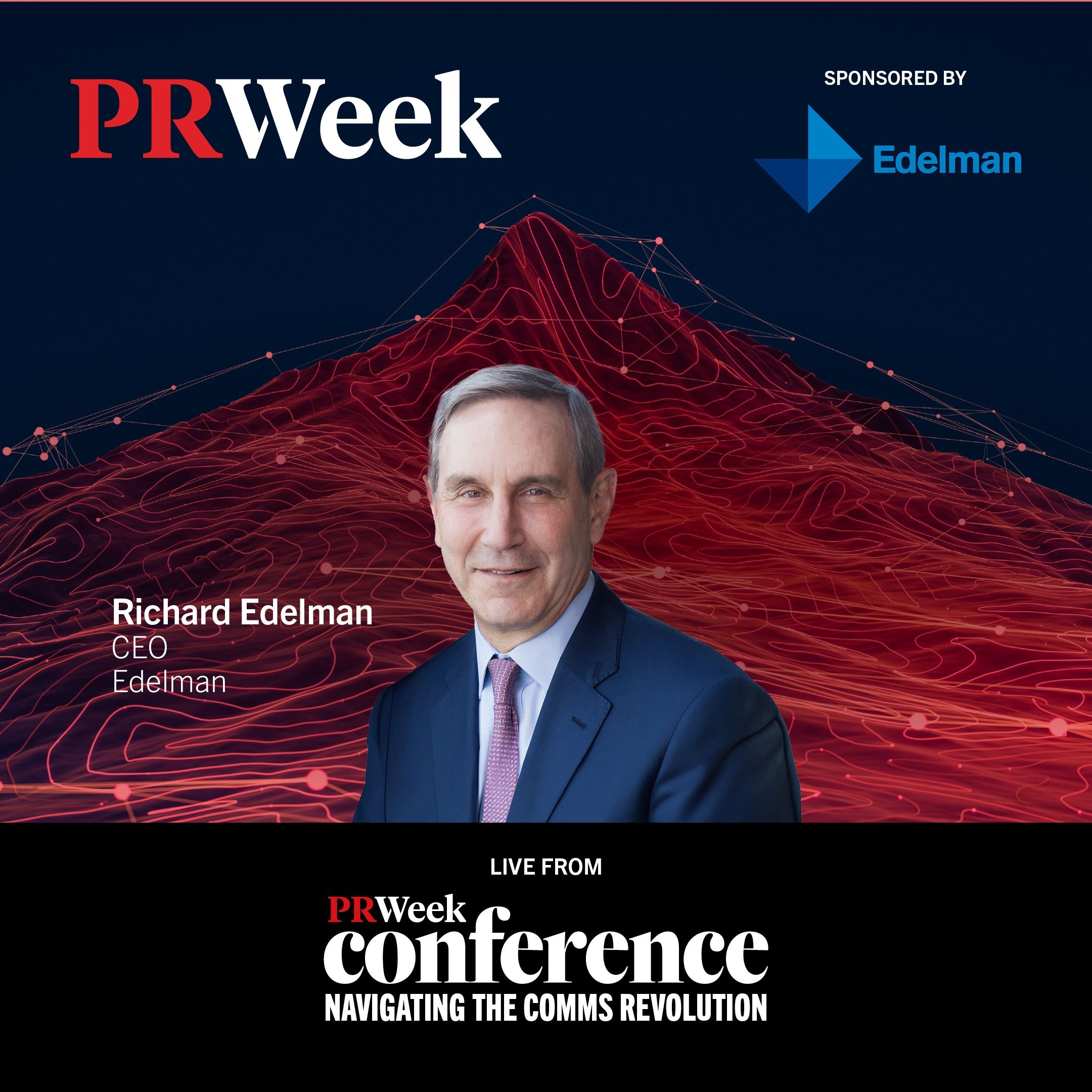
Richard Edelman (CEO, Edelman) argues PR should be the lead discipline, driven by trust, action, earned strategy, and local-first thinking—especially as AI and health misinformation reshape how audiences get information. He also critiques advertising ROI and emphasizes creators and “trust brokering” to counter insularity.
Richard Edelman is CEO of Edelman since 1996 (30 years), previously grew the firm from $85M revenue to about $950M globally by 2025; he’s a long-time PR leader. Interviewer: PR Week’s Jess Ruderman. (Mentioned: Valerie; also Aaron Starkman, global CCO of Rethink, appears briefly at the end.)
Trust is built through action, not talk; earned strategy matters more in the LLM/AI era; PR must fight disinformation with bottom-up, credible sources; creators and employee voices are more trusted than top-down media.
Butterball Turkey Talk Line online; CVS removing cigarettes; REI closing for Black Friday “Opt Outside”; DP World changing refrigeration temperature; REI/DP World follow-on adoption; pharma: educate patients and insurers, not just doctors; health myths (fluoridation/raw milk); Dove “real beauty” gray-hair campaign in Canada; HP Indonesia training highway underpass artists as IT types.
Written by AI. May contain mistakes.
Learn about the context of the PR Week conference and the significance of the episode.
“We want to give people choice not to be told.”
Discover the importance of Richard Edelman's leadership and the agency's history.
“This is a very special episode of the PR Week in partnership with Edelman.”
Edelman shares insights from his 30 years as CEO and the evolution of the firm.
“with PR Week's Jess Ruderman, Edelman will outline the principles of independence, client service, and entrepreneurialism that underpin this agency's credibility and give it an edge.”
Understand why trust is the foundation of Edelman’s approach and how it has evolved.
“Well, the first thing is, I had the idea for intellectual property because I saw McKinsey and Booz Allen and BCG having IP.”
Edelman discusses how trust influences growth and PR strategies over three decades.
“I think it's fair to say that trust is the core principle, if not one of many of the principles that Edelman has.”
Explore the changing role of PR in the pharmaceutical industry amidst misinformation.
“Our job historically, I've been in pharma PR for 40 years, was to drive patients to the doctor.”
Learn about the shifting dynamics between advertising and PR in today’s market.
“If you look at the return on investment from advertising, it doesn't work.”
Edelman emphasizes the role of creators and influencers in modern PR strategies.
“Does what we say ring true and does it make a difference?”
Discover strategies for fostering trust and improving relationships in business.
“And so I believe, again, also in employee news creators.”
Explore the concept of insularity and how it affects communication.
“It was about insularity, the rise of insularity.”
Learn about the concept of agency and its significance in today's world.
“It's not about a PR agency, but it's agency.”
Discover why having a local presence is crucial for global brands.
“And we're in 60 markets because culture increasingly is national.”
Discuss changes in client needs and the future of PR in marketing.
“And we took them and we trained them in computer skills and made them able to compete in a tech economy.”
Understand the benefits of maintaining independence in the PR industry.
“Do not go to meetings and just say, what is it you would like us to do?”
Learn what qualities are essential for the next generation of PR leaders.
“Hill and Dalton and Porter and Ketchum effectively.”
Explore the lessons and ethical considerations passed down through generations.
“As you look for the next leader to emerge, what key qualities are you testing to ensure they or potentially someone externally are ready to lead an agency of this scale?”
Explore Richard Edelman's vision for the agency's legacy and PR's evolution.
“your own staff, but it's also for the culture of the company to feel as if, you know, not everything's for the money.”

Get the gist, explore an idea or ask about something said.
 Claude
On The PR Week, what are the key points of this episode?
Searching your listeningAutomatic transcript. May contain errors.
0:02Richard Edelman: We're in culture. We want to be of the moment. We want to give people choice not to be told. So I believe in advertising as a support element. I think that the change is that actually PR should be the lead. This is the total opposite of how marketing has been done in my 50 years in the business. And so we're not the tail of the dog anymore. We're the brain. Because we are the ones who are on the trend and in the moment and making brands relevant.
0:37Richard Edelman: Recorded live at the PR Week conference in Chicago. This is a very special episode of the PR Week in partnership with Edelman. Next up, we have somebody well-known to all of you in this industry and well-known to everybody in Chicago. and we have a great panel brought to you by Edelman titled The Chicago Principles, In Trust We Trust. As Edelman approaches its 75th anniversary, Richard Edelman marks 30 years as CEO of the world's largest PR firm by doubling down on the values that defined it. In conversation with PR Week's Jess Ruderman, Edelman will outline the principles of independence, client service, and entrepreneurialism that underpin this agency's credibility and give it an edge.
1:19Richard Edelman: He will describe how trust, earn strategy, return on relationships, and a local first mindset will enable Edelman to lead and win.
1:32Thank you so much for joining me, Richard. I know Frank just kind of teased it, but obviously this month is very important for you. You became CEO of Edelman in 1996, which is 30 years ago this month at the age of 42. When you took over the agency from your father, who founded the firm in 1952, Edelman's revenue was$85 million. Since then, the agency has grown to be the first PR firm to cross the$1 million global revenue mark, and as of 2025, sits at$950 million globally. Looking back over three decades in the chief executive role, what core principle has remained unchanged since the firm's founding in Chicago almost 75 years ago?
2:05Richard Edelman: So I'm walking over to the stage and I saw Ellen Ryan-Mardex, who was there the night that my father handed me the baton. And I read this poem from Longfellow about the village blacksmith. And I got partway and I started crying. And she read it for me. That was very moving. So I thought about that this morning. I had big shoes to fill. You know, the guy invented the media tour. He kind of invented marketing PR. And so I thought, you know, what can I do? Well, the first thing is, I had the idea for intellectual property because I saw McKinsey and Booz Allen and BCG having IP. And I went, what can we do?
2:46Richard Edelman: And so I came up with trust in year 2000. So that was important. I also in 96 saw the opportunity in digital. We did the first Butterball Turkey talk line online. And so instead of having people answer the phone, how you cook a turkey, we had them do it on the computer. And you think, well, this is very simple. It was very simple. We followed it with immortal moments like bear flea male. Like if you had a dog and you had a flea collar, we remind you every month to change the flea collar. I mean, okay, things have gotten better. But the point was, I needed also to make sure that the global network continued to be as robust as Burson and Hill and Knowlton in those days and whatnot.
3:31Richard Edelman: And so, we had to keep buying up firms all over the place. So, every dollar we made in the U.S., we invested overseas. And the last thing was, we had to develop on the corporate side, because my father's expertise was always on the brand side. And so, we invented litigation PR, and we did Walmart and GE and things that were big. And so, that was sort of the basis of how Edelman grew. I think it's fair to say that trust is the core principle, if not one of many of the principles that Edelman has. Our session today is titled The Chicago Principles, which you've outlined, obviously, trust is everything.
4:06Valerie said that trust is also hope. Why has trust been Edelman's guiding principle since you took the helm? And how has the firm's approach to trust, do you think, evolved over the last three decades?
4:16Richard Edelman: So when we started the trust barometer, you know, I didn't know how much legs it would have. And events seem to play in our favor. Not that the world has done so well with the Iraq war, the financial crisis, COVID, populism, now, frankly, the fears from AI. I think that trust has to be seen as trust driving growth. But what gives you trust? It's action. If you don't do something, all the talk doesn't get you anywhere. And I think that's the mistake that many leaders have made, which is not doing, just expressing. And so our community needs to go to clients with ideas and things that I'm so proud of for during my time as CEO.
5:04Richard Edelman: When we worked with CVS to take cigarettes out of the store, I don't know, but you know, I have a huge anti-smoking thing. Whenever I go to Edelman offices, I offer people$2 ,000 to quit smoking and I have 150 who quit smoking. And my CFO is always pissed when I go to India because we have hundreds of people. And he's like, you didn't have to offer them$2 ,000. I said, but it's$2 ,000 in Japan. I can't do nothing in India. Anyway, don't repeat that. I'll get, but - You're going to find a couple of smokers. No, no, but the broader point is, and persuading REI to close their stores the day after Thanksgiving, Black Friday, whoa, opt outside, have people go hike.
5:44Richard Edelman: That's an action. And then a bunch of store chains followed. The same with DP World when we suggested that they change the refrigeration temperature and they looked at us like, you're PR people. You're not engineers. What are you talking about? You can't do that. We said, well, we read this scientific paper and it said that you could do it. And so they did it. And then 60 percent of the world's fleets followed. That's what great PR is, doing something. One of the other principles is obviously, you know, earned is the strategy, which a lot of the people in this room can empathize with. But that's really shifted over the past couple of years with the introduction of LLMs and how that's really prioritized earned when you look at the landscape of advertising, marketing, things of that nature.
6:25You noted that this has made it PR's moment with the LLM AI age that we're in right now. How is Edelman capitalizing on this shift, particularly in some high stakes industries when we think of like pharma or health care?
6:37Richard Edelman: Well, let's use pharma as an example. Our job historically, I've been in pharma PR for 40 years, was to drive patients to the doctor. And we would have done PR with the doctor, either at medical meetings or whatever. Even their freaking notepad said, you know, Crestor or whatever on the bottom. So not anymore. Our job is to educate the patient so that he or she goes to the doctor properly informed, not with disinformation, but with good stuff. And so the battle is actually to get quality information read by the machine, which is either earned or owned content, and have a good patient-doctor interaction, but also persuade the insurer to pay for the product and to have it on the formulary.
7:24Richard Edelman: So it's a different job. And it's arguably a more important job than before because we're now battling disinformation. Literally, read our health trust study from April. If you want to be scared, read it, not before you sleep. But literally 70 % of people believe in health myths, like fluoridation of water causes cancer or raw milk is better than pasteurized. Ludicrous, but it's more sparky. It gets social traction. And interestingly, for the first time, people who read more and have better information, meaning more information, not better, but more, believe the myths more with if you want a mission of why you're in this business you should take that on your shoulders and say it's not okay we're losing the quality information war we're being overwhelmed by crap and by people who say stuff that's politicized and otherwise and i i am neither r nor d i give money to both sides and just statement though i grew up in chicago and voted straight democrat until i moved to new york where i vote state democrat no i'm kidding.
8:35Richard Edelman: Important. This is very important. We've got to fight back disinformation. People have likened AI to the digital age in terms of how much change is really happening now. I know you just outlined misinformation, disinformation as a challenge that we're seeing with this. What are you seeing for PR as the biggest opportunity having lived through and experienced, you know, in an executive title, these changes that we've seen previously? I think we should get the money that's being spent in advertising. I've been saying this for years. Some of you in the holding companies do it quietly, steal their money quietly.
9:06Richard Edelman: We do it explicitly. But advertising, people aren't watching. They don't pay attention to advertising. If you look at the return on investment from advertising, it doesn't work. What works is living in culture, being fast, having people who you don't expect as credible sources, pastors, people who are religious figures. Don't just rely on top-down information. It doesn't work. You need the ground game, pharmacists, community members, and disaggregate your sources of information. Make them bottom-up, not top-down. This is a very important lesson that politicians have, you know, you listen to Valerie and how they're using creators at the library.
9:52Richard Edelman: They wouldn't have done that before. Too risky. It's totally risky to not do it because you cede the ground to everybody else. That's why we're losing on health. That's why we have to fight back that way. With news creators, we should create creators as news people, not as channels of distribution. This is my biggest argument with the holding companies that have bought creator firms. They take a message and they say, we're going to distribute it through creators. And so they pay creators to say something. What credibility does that have? It just has volume and say, well, look at all the audience we have.
10:27Richard Edelman: I don't care what audience you have. That's efficiency. The goal we should have is effectiveness. This is an important distinction. Does what we say ring true and does it make a difference? I want to talk about creators because that's an area that Edelman has really doubled down on this year in terms of where people are looking for a trusted institution that they're looking for for their information now is creators and influencers. I feel like that much has been proven. But you guys have doubled down in the sense that you hired Kenny Gold as your first global chief creator officer this year. You just were brought on by the American Egg Board as its first creator, AOR.
11:01Why are creators so pivotal to Edelman's future across all of its business? Obviously, that's Food InBev, but across all the different clients that you're working with.
11:10Richard Edelman: Because creators are representative of their generation and of their communities, and they're seen as much more trustworthy than mainstream media. We have a real issue with top-down media. I mean, you know, my generation, Bloomberg, FT, New York Times, Wall Street Journal, fine. But Mo News or under the desk news, I started to pay real attention to this because of Mayor Mondami when he, you know, came and beat Andrew Cuomo, the great establishment figure by a landslide. Because, you know, when he jumped in the river with his suit on to say that I'm going to freeze rents, I thought it was lunatic.
11:52Richard Edelman: But obviously, people your age thought it was great and funny and magnetic. No, no, but no, no, I don't. I don't. It's smart. And but it but it expresses a truth, which is rents are a big problem in New York, for instance. And he was just doing it in a way that was important and visual and short and shareable. And so I believe, again, also in employee news creators. I think we should liberate the employee force as Starbucks is doing others. If you have a barista who's passionate about his or her job, it's hugely credible for Starbucks. And you can do this times 100. You know, if you're doing I saw a guy here from Patagonia, if you've got a Patagonia store and you have dirtbag billionaire all over the place.
12:39Richard Edelman: But you need the people in the stores to show that they love the brand as much as as the founder does. on that note you know you talked about the importance of creators on return on relationships and that kind of versus roi can you just talk a little bit about that principle for edelman and why that's important i think that the essence of trust there are like four or five components of trust ability ability is almost taken for granted that a company can do something like make shoes Dependability. Can they do it all the time? Integrity. Very important. You know, do you actually show that you have the right values?
13:18Richard Edelman: Then you need a mission. You need a North Star. Purpose is a little bit. It's been compromised as a word, but you can use it if you want. But you have to have a mission. And then last, it has to somehow affect your self-image. I think too many companies rely solely on ability. It's not about that. Since the 2008 financial crisis, it's much more about, are you dependable? Do you have integrity? And do you have a North Star? And so the shift of where we put our effort should be, can we forge relationships? Valerie said it correctly. Companies have to listen. And it's the essence. We had this theory.
13:58Richard Edelman: I don't know if you read our trust barometer this year. It was about insularity, the rise of insularity. So we've gone from polarization, which is political, to grievance, which is the system doesn't work, to insularity, which means I only believe those people who have the same values, same information sources, in fact, the same backgrounds as I do. Very dysfunctional. So we think there are some solves to this. Part of it is something called trust brokering. And if you sit in a room with people who are of different backgrounds and whatever and talk about hard stuff, I don't know, Palestine, pick a subject.
14:36Richard Edelman: Don't try and persuade people. Don't say that you're wrong. Just say, I hear you. This is my view. This is your view. If you don't try and force them, they respect you much more because they think, OK, that person's given me grace. and are just a little spoiler alert. Our study this year is about agency. It's not about a PR agency, but it's agency. Like, do you give people the sense that they're in control? Because this is an important word. I think people feel very out of control. I think they think they're going to lose their jobs to AI. I think they're afraid of downward economic mobility. I think they're afraid that they don't get good information.
15:17Richard Edelman: I think they're afraid. And so if you give people agency through reskilling or through reliable sources, I think you're in a different world. That's a world of hope, to use her favorite word. I want to go back to the point in terms of where we're meeting people. You know, local first is another principle for you. It surrounds the idea, obviously, of local trust, while other maybe holding companies have consolidated down to a handful of maybe international hubs. Edelman has 60 offices globally, if that's correct. And earlier this month, you took a stake in Japan's Pratt from WPP. Why is having a direct presence in these local markets still of importance, a priority for Edelman?
15:57So being local and global is what we're trying to do.
16:02Richard Edelman: And we're in 60 markets because culture increasingly is national. It's not global. And the creators are national. And the country preference is to buy local products. And so if you're Unilever with Dove, our big client, and you're selling in markets all over the world in China, you have 100 e-commerce competitors all in skin care and products of hair care. So how do you compete with that? You've got to be as local in your choice of spokespeople. You have to be in issues that matter to Chinese women. You have to actually be fast, as fast as e-commerce brands because they're super fast. And you have to take some chances.
16:52Richard Edelman: Taking a chance, meaning getting into issues that, well, this isn't normally our thing. Example, our team in Canada saw that a woman anchor was 55, starting to turn gray. She was taken off the air. Meanwhile, a guy is my age, gray hair, but still on the air. This is BS. Yes, this is ridiculous. So we said, Dove, this is a chance to show that real beauty applies to older women. We persuaded them to do a gray package and we did a campaign about women having real beauty in their 50s and 60s. And the woman was put back on the air and our share went up 10 points. So the point is we were of culture.
17:32Richard Edelman: And if we didn't have a strong Canadian operation, we'd never known about that. And we did something in Indonesia with HP where we found that artists were drawing on the undergrounds of highways, underpass, whatever. And we took them and we trained them in computer skills and made them able to compete in a tech economy. And they're like a little cadre of 15 or 20 street artists who've now become IT types. It's a great story, but you don't find that unless you have a team in Indonesia going through underpasses. So my point is walk a lot. Walk while you're here to the Obama Foundation. It's a ways.
18:13Richard Edelman: You may want to ride a bike. You've outlined, obviously, some of the clients that have been critical to Edelman since its founding. But client needs have shifted dramatically since Edelman's early years. There's talk of RFPs going by the wayside, pitches being by test altogether, such as Publis' recent PepsiCo win. What are the biggest changes that you've seen during your tenure and challenges ahead for acquiring and retaining client accounts in this environment? So, Publicis makes a big deal of having a superior data lake and a flywheel that works in a predictable return on investment. You know, you give us a dollar, we'll give you 10 in sales.
18:52Richard Edelman: That's one approach. I reject that approach. I don't think that people know exactly what and who and why you want to do something. I think our approach is the opposite, which is we're in culture. We want to be of the moment. We want to give people choice, not to be told. So I believe in advertising as a support element. I think that the change is that actually PR should be the lead. This is the total opposite of how marketing has been done in my 50 years in the business. And so we're not the tail of the dog anymore. We're the brain. And because we are the ones who are on the trend and in the moment and making brands relevant.
19:34Richard Edelman: So what yields relationships of trust with clients, though, is give them ideas. Do not go to meetings and just say, what is it you would like us to do? No, this is what you should do. Now, they'll decide whether they will do, but you should be smart enough and confident enough to go in that room and say, this is the way. And here's why. And here's data that shows why and how. So we have this earned growth engine. We have a culture lake. They've named the product, thank God, after my dog at Edelman called Archie AI. They know how to butter the boss, which is very good. But RGAI is doing social sensing.
20:17Richard Edelman: You have to go into meetings with data. If you just go in with your gut, no good. You lose because publicist has the data. We know who they are. You have to have your own data. And it can't just be of journalists. It needs to be synthetic audiences of consumers or journalists. And you need to know the last hundred stories that Jess has written. And so that the means by which they can pitch you is more accurate and smarter. because we can do that. Be smarter, but also make relationships. I don't believe in this sort of, we just do this for price. It matters. People trust you if you do a good job and if you deliver.
20:59Let's talk about rejecting our competitors here. So in its nearly 75 years, Edelmanism has impressive scale, both geographically and in revenue, but you have continuously remained independent. So the firms that you compete with for business, they're the likes of Omnicom, Publisys, WPPs, all those different PR firms, but you don't have the holding company or private equity oversight. Almost amid so much consolidation, excuse me, how has your commitment to independence ever wavered or has it only strengthened?
21:29Richard Edelman: It's strengthened because I observed that, I don't know, five of our 10 top competitors, When I started, we were number seven. Now we're number one. But leave that aside. Hill and Dalton and Porter and Ketchum effectively. It's gone and absorbed and merged. And so I believe in the power of brands. I believe I mean, I grew up in Chicago. Leo Burnett was like going, I don't know, to the mountain. Yes, Leo has spoken with apples in the front hall and with pencils. Brands matter and cultures matter. And I don't believe in smashing companies together and saying we were better. We're not better. So, yes, we've had opportunities with various companies to be acquired.
22:23Richard Edelman: And both my father and I have said, no, thank you. No, we're happy doing our homework. We love being the underdog. This is the thing about Edelman's. We like to fight. We grew up in Chicago and that's what we do. Chicago Bears style. I mean, a lot of people have had really strong opinions, particularly with the Omnicom IPG of it all, of whether it is better to be independent, if it's better to be smaller, if it's better to be bigger, if it's better to have PE backing, where do you stand? I mean, obviously you remain independent, but what are your thoughts on that? And do you see that changing?
23:00Richard Edelman: So there are probably some independents in the room, a few, any good. It's your moment. It's your moment because you're not having to consolidate. You're not having to figure out all sorts of personalities and styles and which offices are going to close and which efficiencies you're going to make and all this. And I think you're also freer to make your opinion known. You're not part of a interagency IAT or whatever those are. You just say what you think, which is good and keep doing it because independence gives you the ability to think for yourself and you're not a support element, you're a lead element.
23:46And I mean, for us,
23:48Richard Edelman: It's allowed us to invest in the trust barometer, invest in building digital. We decided in 2013 we wanted to be a communications firm. It's taken us more than a decade to be recognized as being able to do our own creative and strategy and research. And now, you know, we win Cannes Lions. That's just one way. But we win against Ogilvy. We win against McCann. You would never have thought this possible, but it is possible. 25 % of Edelman personnel now are non-PRs. They're in areas that support the PR folks. This is a good thing because we're stealing advertising money. That's the goal. Yes, they have a lot of it.
24:34You've said that you'll be at Edelman forever, but you won't be CEO forever. All three of your daughters work in PR under DGA Holdings, and you've expressed that you hope that one of them will take over the family business when the time is right. As you look for the next leader to emerge, what key qualities are you testing to ensure they or potentially someone externally are ready to lead an agency of this scale?
24:56Richard Edelman: So, look, I took over Edelman when it was 85 million and, you know, I don't know, a thousand people. And now it's 5000 people and bigger. And so my successor has to have resilience because not every day is great. As all you business owners know, sometimes you lose clients. Sometimes you have people quit or, you know, so you have to have resilience to you have to be completely global minded. You can't just be American. It's not enough anymore. Certainly not for us. You have to be able to counsel Middle Eastern clients coming here or vice versa. Three, I think the person has to be equally good on the brand side and the corporate side.
25:37Richard Edelman: And for. Care about the family heritage. You know, I have pictures of my father in my office and he's on my shoulder every day. Like, come on, boy, let's go. And it's true and it's OK. And I hope that it's that way with my daughters in a good way. Not guilt, not the Jewish guilt thing. Not the Jewish guilt. No, but the play the game forward. You make some mistakes. So what? Get up. I mean, I made a mistake my second year as CEO. I hired a CFO who brought in a new financial system, and it didn't work. And we couldn't send bills for clients. And my father called me, and he goes, what's going on?
26:20Richard Edelman: I said, well, not great. And we can't send out bills. He goes, get rid of that CFO. He brought the old CFO back for a while, and he called me, and after we stabilized, he said, don't do that again. I said, right, I won't. So the next time we had to upgrade the system, I made sure that it was tested in Canada first. I love Canadians. But we tested it in a smaller market, and it didn't work so well. And so I said to the CFO, you see? I learned.
26:53Richard Edelman: And we just did an implementation that was perfect. So I credit my CFO for having learned, too. So no problems. Your father is considered one of the founding fathers of PR. What would you say is the biggest lesson that he's taught you or that you've taken into your own leadership? I think my father was a dreamer, as many founders are. And he believed Edelman could do anything. And I think that's an important skill that you have to believe in yourself. If you get knocked down 10 times, you get up the 11th and learn from it. And I think he also believed in telling the truth to the client and telling the truth to the media.
27:33Richard Edelman: He was very upset with some of our competitors taking on certain clients in the 90s. And he got into public feud with one of them. I won't go into details, but you can go check the history. But he felt very strongly about the ethics of the PR industry. And I've really tried to carry that forward. And also that Edelman should do some part of community service. And I'm proud that we've worked on the rebuilding of lower Manhattan or that we've helped on the presidential center for the Obama folks, because that's, I think, very important for your own staff, but it's also for the culture of the company to feel as if, you know, not everything's for the money.
28:13Edelman approaches a big milestone next year. It'll be 75 years. You talked about the importance of your own personal legacy with Edelman, but what legacy do you hope the agency leaves on the global communications industry? And also, what is the biggest challenge do you think the next generation of PR leaders have to solve?
28:30Richard Edelman: I think that the 75th of Edelman is a big marker, not just for ourselves, but for all of you. Because it shows that a brand that was founded by a guy with an idea with four people in the merchandise mart in Chicago could grow into a big global company. And that PR could be a lead discipline, not a support discipline. And he always felt that PR was more important than advertising. And so, I really hope that the 75th also, in a way, marks Edelman as, I don't know, the distinctive one in the industry that has stayed independent, has stayed private, has stayed family-owned, and will continue for the third generation to do that, devoted to client service, devoted to creative ideas, and devoted to action.
29:24Richard Edelman: And if that's my legacy, that would be a pretty good one. You mentioned you have an incoming grandchild. So maybe 40 years from now, we'll see a new Edelman face that's sitting up here. Yeah, I feel a little bit like Simba. I'm going to sort of go. Yeah, it's coming in five weeks. I'm very excited. I've got a little tennis racket and baseball glove and the whole thing ready to go. That feels like a good hope note to end on. So thank you again for your time. Thank you, guys.
30:26I'm Megan Lally here from Hi, guys.
30:28Richard Edelman: Today, I was able to grab Aaron Starkman, global CCO of Rethink. Listen, follow, rate, and review wherever you get your podcasts. And for the latest news in our industry, visit campaignlive.com.
In 1996, Richard Edelman took over his eponymous agency from his father. Now, celebrating its 30th year under Richard’s leadership, the firm’s global revenue is $950 million. It was $85 million when he took the reins. The rousing success of his independent agency is largely due to Richard’s constant eye on the future, as well as his ability to anticipate it — a skill as sharp today as it ever was. That was on full display during the session at the recent PRWeek Conference in Chicago. He spoke to PRWeek’s Jess Ruderman about his succession plans, his stronger-than-ever belief in being an independent shop, the industry-wide impact of agency consolidation and the ever-increasing importance of a word that has become synonymous with Richard and his organization — trust.
Theme music provided by TRIPLE SCOOP MUSIC
Jaymes - First One
Follow us: @PRWeekUS
Hosted by Simplecast, an AdsWizz company. See pcm.adswizz.com for information about our collection and use of personal data for advertising.