 The Rest Is Politics: Leading
4 Oct 2026 · 1h 18m

 Add vo to ChatGPT or Claude to ask about everything you hear
vo listened to this episode to put together the overview and transcript, so there may be the odd mistake.
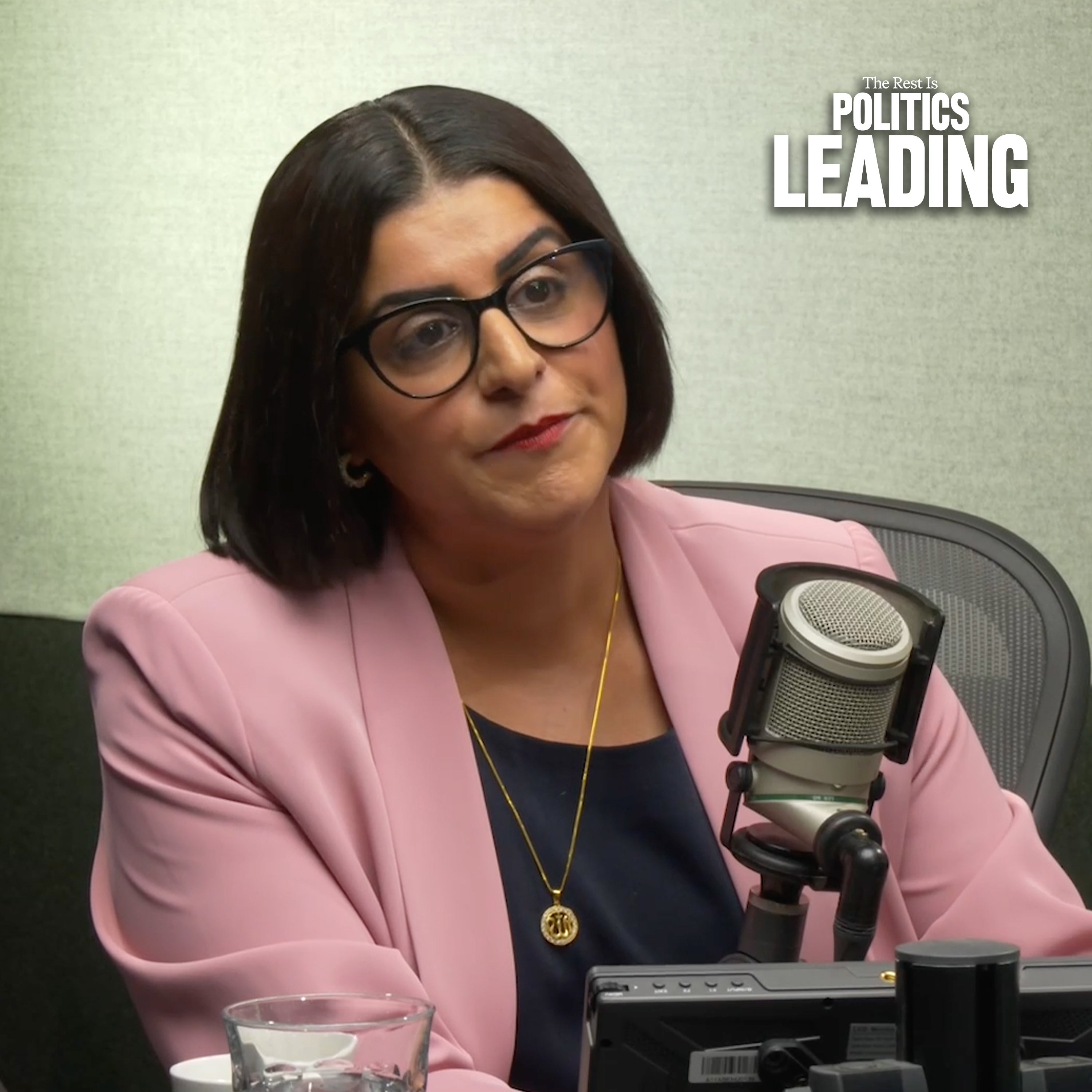
Shabana Mahmood discusses how her Muslim faith shapes her public service, her views on Islamophobia and “Judeo-Christian civilization” rhetoric, Labour’s approach to faith, and her policies as UK Home Secretary—especially the ban on Palestine Action, immigration/asylum strategy (including EU-Turkey-style return hubs), and labour-market visas.
Shabana Mahmood is the UK Home Secretary (MP since 2010). Raised in Small Heath, Birmingham, by Kashmiri Pakistani parents; Muslim and says faith is central. Educated at Oxford; trained as a barrister. Held front-bench roles under Ed Miliband; became Justice Secretary and then Home Secretary under Keir Starmer.
She says belief in God never waned, though religious practice varies. She argues far-right and some “Christian nationalist” figures use Islam in an extreme, fundamentalist caricature to polarize. On Palestine Action, she defends proscription and says protesters commit a “support offence” by displaying support for a proscribed group; she rejects reopening prior legal decisions and stresses equal law enforcement. On immigration, she argues EU-Turkey worked because Turkey agreed to take people back; “one-in-one-out” logic is politically contingent. She emphasizes controlled, fair systems plus safe/legal routes and “safe third country/return hubs.”
Palestine Action protesters holding placards and being arrested under the Terrorism Act; Dover/Port shutdowns by far-right protesters; “one-in-one-out” with France; safe return hubs framed as a “better version” of Rwanda.
0:00Thanks for listening to The Rest is Politics. Sign up to The Rest is Politics Plus. To enjoy ad-free listening, receive a weekly newsletter, join our members chatroom and gain early access to live show tickets. Just go to therestispolitics.com. That's therestispolitics.com. This episode is presented by IG. October is here and we're barreling towards the biggest financial moment of the year, the budget. Between that and new Chancellor and the new Prime Minister, there's genuine uncertainty about what's next for our finances. And of course, uncertainty is a massive problem for all of us. Rumors, speculation, opinions from absolutely everybody.
0:34And the trick to navigating all this noise, whether in politics or business, is to try to know exactly where you stand. And that's where IG comes in. From investments to trades, it brings your entire portfolio together in a single app with one unified wallet to fund across all your accounts. And with over 20 ,000 stocks and ETFs, you'll have the breadth to act no matter what the Chancellor announces. And here's the cherry on top. With no annual fees and zero commission on UK stocks, shares and ETFs, more of your money stays where it belongs. Download the IG app to get started. IG. Trade. Invest.
1:11Progress. Capital at risk. Other fees may apply. Are you looking for support in your weight management journey? ZepBound Terzepatide may be able to help. Z-Bound is a prescription medicine used with a reduced calorie diet and increased physical activity to help adults with obesity, or some adults with overweight who also have weight-related medical problems to lose excess body weight and keep the weight off. Z-Bound is approved as a 2.5, 5, 7.5, 10, 12.5, or 15 milligram injection. Z-Bound contains terzepatide and should not be used with other terzepatide-containing products or any GLP-1 receptor agonist medicines.
1:50It is not known if ZepBound is safe and effective for use in children. Don't share needles or pens or reuse needles. Don't take if allergic to it, or if you or someone in your family had medullary thyroid cancer, or if you've had multiple endocrine neoplasia syndrome type 2. Tell your doctor if you get a lump or swelling in your neck. Stop ZepBound and call your doctor if you have severe stomach pain or a serious allergic reaction. Severe side effects may include inflamed pancreas or gallbladder problems. Tell your doctor if you experience vision changes before scheduled procedures with anesthesia, if you're nursing, pregnant, plan-to-be, or taking birth control pills.
2:26Taking ZepBound with a sulfonylurea or insulin may cause low blood sugar. Side effects include nausea, diarrhea, and vomiting, which can cause dehydration and worsen kidney problems. Talk to your doctor. Call 1-800-545-5979 or visit zepbounds.lily.com. For adults with Crohn's disease or ulcerative colitis symptoms, every choice matters. Tremphaya offers self-injection or intravenous infusion from the start. Tremphaya is administered as injections under the skin or infusions through a vein every four weeks, followed by injections under the skin every four or eight weeks. If your doctor decides that you can self-inject Tremphaya, proper training is required.
3:10Tremphaya is a prescription medicine used to treat adults with moderately to severely active Crohn's disease and adults with moderately to severely active ulcerative colitis. Serious allergic reactions, increased risk of infections or lower ability to fight them, and liver problems may occur. Before treatment, get checked for infections and tuberculosis. Tell your doctor if you have an infection, flu-like symptoms, or need a vaccine. Explore what's possible. Ask your doctor about Tremphaya today. Call 1-800-526-7736 to learn more or visit trimfireradio.com.
3:52Welcome to The Restless Politics, leading with me, Rory Stewart. And with me, Alistair Campbell, and we're with Shabana Mahmood. And Shabana Mahmood has one of the toughest jobs in British politics. She's the Home Secretary. And it's therefore quite fitting that she has a reputation of being a pretty tough personality herself. She is a working-class Brummie, raised above a corner shop by Kashmiri Pakistani parents. She's a Muslim who says that her faith is the most important thing in her life. She got to Oxford University. She became a barrister, but politics was always, I think, calling. MP since 2010.
4:30She had a number of front bench roles under Ed Miliband, none under Jeremy Corbyn that was her choice but when Keir Starmer became leader she rose to the Shadow Cabinet became Justice Secretary when Labour won power and then moved to the Home Office and that's a position she's retained under Andy Burnham so with crime, policing asylum and immigration to deal with she's going to need all of that toughness and all of that faith to deal with all the problems but Shabana thank you very much for being here Thank you for having me Thank you for coming So, Home Secretary, just to begin, tell us a little bit about faith.
5:08We're very interested in faith and how important it is in your life. And is it literally more important than anything else? Yes, it is. I was born to Muslim parents and I was raised in a very religious household. The practice of our faith, prayer, fasting, all of those things have been a part of my life since I was born. And was that true of all your relatives and other neighbours? When you were growing up in Birmingham, were there families from Uzad Kashmir who were more religious, less religious, some people praying five times a day, other people not? So, I mean, the community I grew up in Small Heath in Birmingham, at the point at which my family came to live there, became a very Kashmiri, Pakistani dominated area of the city.
5:53And lots of my own relatives basically live on the same street as us. So my mum's sister lived across the road from us. You know, my dad's mum and siblings lived just up the road, like two minutes away. So like the family was very closely situated to one another, the extended family. and I would say you know almost all of my extended family are as religious as my own parents you know they they're all raised in very practicing very faith conscious households where faith is the the thing around which the rest of life is organized and that was the environment I was in the first six years of my life though I spent in Saudi Arabia because my dad's a civil engineer and there was a lot of work for British civil engineers out in the Middle East in the 80s they were building desalination plants.
6:37They were getting water out of the desert. So he had good work opportunities in Saudi. He went first and then the rest of us followed him. And, you know, our family life, one weekend we would go to Mecca, Mecca Sharif. And then the following weekend, we would go to Medina Sharif. So the Prophet's Mosque in Medina. And we did that pretty much every weekend for the whole time we lived in Saudi. I performed the Hajj as a three-year-old, so it doesn't actually count. I need to perform it as an adult under my own steam. But as a child, my parents went and it was just my twin brother and I then we were three years old.
7:10And that is one of my earliest memories in life. So I remember being on my dad's shoulder. He had me on his left shoulder. He had my twin brother on his right shoulder. He was holding us quite tight because he's busy. There's a lot of people there who sort of grabbed onto my mum and the four of us performed hudge like that. So that's one of my earliest memories. I remember the sea of people. I remember looking at the sky. I remember feeling like it was a bit like magic. That's one of my earliest memories in life. You then became a lawyer, went to Oxford, and are now a Home Secretary. As you've gone through that journey, have there been times when your faith has been less strong, where you've felt that you might be in danger of losing faith?
7:49Have there been times when it's been stronger? And how does it inform public service? What's the relationship between God and public service? So my belief in God has never waned. It's always been very strong. You know, my sort of making sure I've done all my five prayers a day has waxed and waned over the course of my life. I'm having a good phase at the moment. But so the actual practice, but although I've never missed a day of Ramadan in my life. So since I was 10 years old, I think is when I first started observing Ramadan, never missed Ramadan. You know, the practice of my faith, like lots of, you know, people that grow up might have gone up and down a bit.
8:22But my actual belief in God, the belief that all good and bad comes from God, that life is a test, it's also a gift, that you're accountable to God, that has never changed. So one of the earliest lessons I remember my parents teaching me is that you're never alone. Even when you're on your own, you're actually not alone because God is always with you. That also means God is watching you. God knows the truth of your heart, even when you don't know it yourself. And therefore, you're always accountable. And so So you might think that you've lied and got away with something with your parents because you stayed back with your friends a bit later than you should have or whatever.
8:55But God will know, right? So even if other human beings don't know, God knows. And that belief, that sense of God's presence has never, ever changed in my life. Did it take you some time to become as confident and open talking about your life? It's wonderful to hear you, but you talk about it in a very uncomplicated, straightforward way, which I guess would make anybody proud who feels that you should be encouraging people to believe in God. But was it something that you've got more used to recently? Oh, that's a really good question. I think my experience in politics and talking about faith is that when I was first elected in 2010, it wasn't a thing that was talked about.
9:32You know, I'm not shy talking about faith. I wear the name of God on my person every day. You know, it's not a thing that I hide. Spend five minutes in my company, you will very quickly work out I'm in the God squad. But I think other people didn't really talk about it. And so then it just becomes a thing that people don't talk about that much. Or they sort of see you as a block without really engaging with the beliefs that you actually have and how those beliefs might shape your life. So I think that the broader conversation around faith, when I first sort of entered public life, just didn't feel like a very rich conversation or it felt a bit embarrassed.
10:06I've jokingly sometimes said, oh, that's, you know, Alistair with his we don't do God comments, which he has told me he has been much misquoted on before. So I'm sure we might pick up on that in a minute or two. But it just wasn't a thing that other people felt that comfortable about. But at any point that I've been asked about my faith, I don't hide it. It's not just about being proud about it. It's actually just who I am. And so if you're going to ask me questions about who I am, I'm going to lead with being a Muslim. Because that is the thing that's the most important thing about my existence.
10:37We talked about this when you came to our place for dinner. It wasn't misquoted. It's what I said. We don't do God. but the meaning that I was trying to apply to it was I at the time always worried that if Tony Blair talked about his faith it would be misinterpreted and that his opponents would claim that he was allying God to labor God to politics I actually think we're now in a different era I agree with I love it when you talk the way that you did I don't have faith I'm fascinated by people who do but you say you've never wavered in your belief in God. Has it ever caused you problems in your political career, do you think?
11:15I think that yes, in the sense that I think the Labour parties are very welcoming and open place and a large part of my being Labour comes from my family and the sense that Labour's the only party around at the time that they came to this country that was willing to look at them like they could be fellow citizens. So a lot of it is tied into our origin story as Brits, if you like. But there is a tendency in the party, certainly the modern Labour Party, to sort of see faith as an identity and not a belief. And so I've had moments where I've tried to explain to colleagues, like, this is not like a badge that you wear.
11:51It's not a team that you're in. It affects how you see life and how you think a good life should be lived. and you know those can be quite challenging conversations sometimes because I think a lot of people this is just not just for labor but actually in the world of politics more broadly if they engage with faith they do it in a slightly detached way and they see then the very nice soft side of let's say interfaith work you know going to a mosque having tea and samosas with local worshipers but without getting into the god bit of it it's almost like faith but without having to touch the idea that we believe in a deity that created us to whom we are accountable, that there will be a life after death, that there is a greater thing to which you must answer.
12:36Like people don't find that comfortable or they think it's like voodoo, judo, magic or something and they think you're a bit of an idiot. I mean, it's really interesting that you probably talked to your special advisor coming in. What do you think they'll lead on? Here we are straight into faith, but I get the feeling you love talking about it. Yeah, I mean, I feel comfortable talking about it and I find it interesting when people who are not religious or from a different faith ask me questions about mine. I like that sense of connection that you can still find with people, even if they have a totally different view of the world and how it came to be.
13:07I have a constituency that is very sort of God loving and God believing, but with lots of different faiths. And, you know, I represent lots of people from the Pentecostal tradition of Christianity, a small number of Anglicans, a small number of Catholics, a small number of Jews, a bigger number of Sikhs, you know, and I sort of love going to their places and working out the bits that I think are almost the same. And then the bits that are really, really different. I enjoy that. It makes me feel good about the world. What's your experience through life in Britain of racism, you personally? I mean, racism has been a fact of life.
13:50You know, the first time I was called a packie at junior school, we'd left Saudi. We were back home in Birmingham permanently. And I didn't actually know what it meant. I remember going home and asking my parents. I do remember them panicking a bit and feeling unhappy. and then I very quickly learned what it did mean. Actually, it was one of my black friends at school that really taught me what it meant and she's also the one that taught me what the N-word is and explained that that's how some people see us. So it has been there and, you know, it's something that has happened. I think I've had a reasonably good experience in that I've had those instances throughout my life but they haven't dominated my life.
14:33There haven't been sort of daily occurrences. Do you look at the stuff that people say about you on social media? No, I don't look at that. You don't bother? I don't bother, no. We're now in a very, very different conversation, I think, from where we were 10, 15 years ago, because you've now got figures on the far right, even some figures in the Conservative Party, who are beginning to talk about Britain as a Judeo-Christian civilization. I came across very influential people recently who I hadn't had an argument with, who were trying to characterize Islam in the most sort of extreme fundamentalist sense and trying to quote lines the Quran at me in order to suggest that real Muslims have to agree with everything that ISIS says.
15:21What is going on here? Because it seems quite dangerous to me. I mean, it seems as though there's a story emerging that Muslims are somehow not real British people. Yeah, and there's, I mean, look, the level of Islamophobia and straight up hatred of Muslims has gone far beyond what I ever thought it could, even in the aftermath of 9-11, the point at which I was still at university and I thought the world had changed then, but it feels like it's much worse. I think that the people who sort of pontificate a lot about the Judeo-Christian tradition tend not to be very good Jews or Christians themselves, as it happens.
15:52I think it's a label that people have sort of taken and they think this means that they are speaking great truths about where we've all come from. And I think it's actually just to tell that they are usually malign actors trying to dress up their worldview in sort of pseudo intellectual ways. And there's definitely a new vein on the right of like the radical right that are trying to now be Christian nationalists, I think, is a bit of what I see going on. And again, I'm not actually that convinced that lots of those are proper God squad Christians as it happens either. but I mean to the extent they might be see the phenomenon I see over there is not that different to the phenomenon that I've seen with Muslim fundamentalists like they're just fundamentalists they're people who have a need to be supreme over others our way is the only way there is no other way you're either one of us or you're not and in that respect they're just they're just like every fundamentalist I've ever met in my life.
16:47Weirdly fundamentalists projects fundamentalism on other people so what I notice when you're hearing people being critical of Muslims they're trying to characterize Muslims in the most extreme fundamentalist version, as though you're not a real Muslim unless you agree with Abu Bakr al-Baghdadi. And that's important for them because that helps to fuel their polarization. And also because now that they've latched onto a religion as the outlet for their supremacist tendency, they can only see the world through that prism. And then they have to assume that everybody that isn't in their group and thinking the way they think has to be the worst version of the other thing.
17:20And then final thing for me, I then notice other minority communities getting unsettled by this. So I will hear Jewish friends say, oh, well, that's just, you know, these people believe in Judeo-Christian stuff, so we're sort of okay. Or Sikhs saying, well, that's a kind of anti-Muslim thing. And then, of course, it's revealed when there is some horrible incident that actually the same groups will turn very quickly on the Sikh community or other minority communities. The idea that somehow this is just a thing about religion is very misleading because as soon as some crisis happens, it turns out that they are perfectly happy to go after almost any other minority group who don't happen to be Muslims.
18:02Exactly right. I mean, the fundamentalist has in their sights everyone, really. They just need the one big bad that they will define themselves against. And, you know, there is no shelter or shade if you happen not to be that one group because one day they will turn on you as well it's why you know particularly since I've been home secretary and you know obviously the the brief I have and the work I do it's why I feel it's so important to take a stand against anti-semitism as a Muslim because one day they come for them but they'll come for me too and there has to be a solidarity amongst those of us who are minorities and we have to be able to shade and shield each other.
18:39I do think that that sort of willingness to do that on all sides is being tried and tested. Interfaith work in this country has taken a real hit post the events in Israel and Gaza. And it's a bit more difficult to build that sense of solidarity and community amongst minorities today than I think it was when I certainly first entered politics. So it's much more challenging. But I think in these moments, it's actually more important than ever. And And certainly if you're religious minorities, because actually, you know, sometimes the only people that understand how it is to be you are other minority communities.
19:14And I mean, sometimes I almost include like, you know, my Christian friends in this. I have a lot of Irish origin Catholic friends in the Labour Party. And then in my constituency, I have lots of people who are a bit more sort of Anglican and of that persuasion. But, you know, being a believer in God is feels like a minority pursuit, even if the numbers overall still suggest that you're in a majority. And so there's a sort of camaraderie that you have. And, you know, when I hang out, if I hang out with friends who are both Christian and Jewish, you know, we always all turn on each other in a funny way to be like, you know, you know, I raise your one day of Passover with 30 days of Ramadan kind of jokes.
19:47And so you can have a level of honesty and a freedom of hanging out and connection that sometimes doesn't exist with other groups. So on that, I think that it is a mistake for any one group to think the spotlight is not on us and therefore we're safe because actually one day that spotlight will shift. You mentioned Gaza there. If you go back through your entire parliamentary career, and before that, you've always had very, very strong views and very, very pro-Palestinian. And when we asked our listeners, we told our listeners and viewers we were talking to you, and, you know, what you wanted to talk about, the number one issue that we were asked about was the ban on Palestine action and the treatment of Palestine action protesters.
20:30And I just wonder whether, given how strongly you feel about Palestine and the Palestinian cause, whether you, in coming into the job, thought there was any merit in looking at that decision again. So you're right, the decision was made before I became Home Secretary by Yvette, who was my immediate predecessor. I think that you have to do these jobs in a consistent way that has to stand the test of time. So, you know, I've come in and I know I'm not going to reopen every decision every previous Home Secretary has made. Was it lawful? Yes, it was. Does it meet the legal test? Yes, it does. Has something else gone awry that shouldn't have happened?
21:09No. And therefore, if you start that process, I'm going to re-litigate everything. Then I'd have to literally re-litigate everything. But you, I can't believe for a minute that you feel comfortable seeing the pictures that we're having week after week of little old ladies holding up their placard with Palestine Action and being carted off into a police van. And I don't ever feel we've had the proper explanation as to why Palestine Action is this prescribed organisation. So, I mean, it's proscribed because it has met the test for proscription within the Terrorism Act. And that test remained passed, as it were, by the facts of their behavior and the escalatory effect of their behavior, even when I came into position.
21:51So it isn't as if the test was no longer met. And in fact, you're in a world of considering deproscription. Sometimes a deproscription happens as well. That's what the Terrorism Act allows. But the facts had not changed. And in fact, in some instances, the facts had become worse and more fitting of the legal test than might have been the case before. But you're also an incredibly canny politician. Was there not a way of somehow keeping the prescription, but at the same time, not allowing your argument to be weakened by this weakly sight of little old ladies? No, and let me tell you why, because I think this is why I started with consistency and coherence is really important.
22:28You've got to be able to apply your principles, even when it's uncomfortable for you, because you're going to really want to apply them when it's something you, you know, with your whole heart are feeling very passionately. So the thing that you're seeing with the protesters is they are committing what is called the support offence in the terrorism act. And that is holding up placards saying that they support a proscribed organisation. and see for those of us who are in the pro-Palestinian cause all of our lives, like these are people, sometimes you'll know who they are. You know, you've been on the same marches with them.
23:00It feels very uncomfortable to see them falling foul of Section 13 of the Terrorism Act. But when you get a group of skinheads standing outside a mosque holding up a placard saying, I support national action. I'm going to want the Section 13 support events to be applied. And I'm going to want the police to go and arrest those people. and I'm going to want them to degrade the capacity of a white supremacist terror organisation to recruit more members. Why was there not tougher action taken against the people who shut down the port in Dover and Portsmouth? Well, so I think what's happened, what happened at Dover and Portsmouth, particularly the group that we're dealing with there, are very much wanting to stay just in the grey zone of the law and to avoid getting arrested.
23:43And actually, it's interesting you've raised both those cases because the phenomena you have on one hand from one group of protesters is they actively want to be arrested because they want to make the point that they disagree with the proscription of this group. You have another group. So this is a far right group who definitely don't want to be arrested and are highly knowledgeable and canny enough to stay just the right side of the law and to disperse when, in fact, they're about to get arrested. So you actually have a phenomena of protest where some people want to be arrested and some people really, really don't.
24:17And the law has to be able to deal with everyone equally, though. My fundamental belief on these things, and I used to be a barrister, is the law isn't there for when you feel good about it. It's also got to be there and equally applied for when you're on the other side of the political equation. and that's why coherence, consistency, fair application, those are the ethics that run through me as a former barrister but they are also the ethics I bring to the table as a politician. There is no doubt that the politics of it can be deeply uncomfortable but you know I have never shied away from saying to people face to face including friends, extended family members and everyone else in between there is absolutely no problem in people and let me do it right now, I support the cause of the Palestinian people.
25:02I support their right to self-determination. I support them having a state of their own where they can live safely and securely and freely. And you can do all of that as passionately as you want. And you can use contested terms if you want as well, like you're within the law. But you don't have to show your support for the Palestinian people by also supporting a proscribed organization. If you want to challenge the proscription, there are ways of doing that too. If you want to challenge whether the support offence in the terrorism act should be a strict liability offence as it is you can do that too that's all perfectly legitimate public discussion and debate there is no clamping down on any of that but literally committing an offence is going to face the force of the law because i'm also going to want to see the people committing that offence from other political persuasions also facing the full force of the law.
25:51Homes Secretary moving on to immigration which is one of the big parts of your brief. We often interview on the podcast a friend of mine called Gerald Knauss, who with ESI has been making very, very powerful arguments for the fact that the EU-Turkey deal, which was essentially stopped the migration across the Mediterranean by Turkey, agreeing to take people back, I mean, stopped it almost overnight, should be the model with dealing with migrants crossing the channel. That if every migrant arriving in Britain understood that they would immediately be sent back to France or Belgium, they would stop coming.
26:26It seems straightforward. Furthermore, France and Belgium are safe countries. I mean, there's no reason for them to come, right? And I worry sometimes that what you're doing is coming up with lots of interesting niche changes to the status of people to make it slightly less attractive for them to come to Britain, but these are pretty complicated, detailed things, which are never going to have the same clear black and white impact that you'd have if you could say, anyone who arrives in Britain will be returned. And why on earth, and maybe in exchange, we will take a set number of people every year, not one in one out, which gives weird incentives on people going forward, but we will take, let's say, 15 ,000, 20 ,000 people a year who are proper asylum seekers from France, properly processed in France over, but in return, no boats.
27:14Well, so what I would say to you is, I mean, it sounds deceptively simple. I've spoken to all of the same people, no doubt, that you have. And I've engaged with all of my counterparts across Europe on this as well. And I talk to them regularly. I talk to Minister Nunes over in France very regularly. The reason the EU-Turkey deal worked is because Turkey was willing to take those people back, right? So it only works if there is that will on both sides. And the reason why the Knauss plan and other similar plans haven't got off the ground is the willingness of the country that would have to take those people back to actually take them back.
27:48Why aren't they willing? I mean, what's it just sort of? But they're politicians too. I mean, look, the one in one out deal got underway really because there was political will, particularly from the then foreign minister who's not, wasn't Minister Nunes, it was his predecessor. And Yvette had a good conversation about the politics of the north of France and the politics of what was happening in the UK. And there was a political alignment for a period that will wax and wane because they're politicians too. And they've got to win an argument back at home for why should we take them back? And, you know, the default position is they've left our territory.
28:18They're no longer our problem. So, you know, we've put a lot of effort into the one in one out deal. And that was the best version of that plan. That was the best version of that plan that we could get an agreement on from the people that need to agree to take people back. But the logic on one in one out has always been a bit confusing because we're trying to get to zero people crossing the channel on a boat. So if it's one in one out, if you get to zero, you don't take anyone from France. What you want to say is we will take 15 ,000 genuine asylum seekers from France, regardless of how many are crossing the channel.
28:48The problem is one of the worst. The incentives will get mugged up. But that was the only version of that plan that could get agreement from our friends in France. So the reason why that kind of burden sharing and returning to country of origin within Europe hasn't got off the ground is because of the pressure it places on the countries that are the route into Europe. And also, you know, the EU at the moment is working on its asylum pact. But every EU minister I talked to and also people at the commission all acknowledge like just getting that up and running is going to be a big deal for them.
29:20You saw the events in Souter and the way that the Spanish dealt with that, but also the very, very strong reactions it drew from other countries within Europe. So all I would say to you is here, this is a deeply contested territory. And I'm afraid we don't just get to say France take them back and they just take them back. That doesn't work. They have to agree to do that. even if we just sent people on a plane and said off you go you're going straight back to France they can turn that plane back and send it to us as well that's just not how those relationships between countries work. Final thing if we could get there would that be the right solution in which case maybe the the long-term strategy however difficult it is is to work towards it and to try to develop a shared understanding across European Union the UK that that is where we want to get to that we have a fair burden sharing of asylum seekers properly selected, but we stop all illegal migration.
30:14I'm personally in very regular contact with European counterparts and very happy always to talk about any way in which we can collaborate on a shared problem. I think that across Europe itself, there are very big differences of view about what the right landing zone for the future is. So, you know, we can't wait for, you know, many years down the track to have a potential solution to our small boats problem. We've got to crack on and do things ourselves as well. I'm not close-minded about wider collaboration across Europe. I'm just very politically, I guess, realistic about the fact that there's just no prospect of such an agreement.
30:52The different nation states are in different places. And as I say, if they can get data sharing across the EU such that they know who's claimed asylum in other EU territories before they arrive on a different one. And if they can get that bit up and running, they'll be doing really, really well. And that's not being down on them. That's just an acceptance of their reality. So, these are obviously very, very contested issues. We have a similar discussion with our colleagues and friends in the Republic of Ireland, because some people go from Britain into Ireland, and they would want to send them back to Britain too.
31:27So, there is a sort of, it has knock-on consequences that it's very easy to sort of say, just come up with some sort of burden sharing. But there is no doubt some countries would bear a bigger burden than others. And that's how do you find the right way to do that? There's no political chance of that. And I think we have to crack on and do everything we can that's in our control to sort out this part of our problem. We mentioned these sort of balaclava thugs sort of wandering around the place, attacking live boat people and shutting down ports and what have you. that was happening at a time when actually you were able to say that the numbers are coming down quite substantially in terms of the small boats is there a danger that we're entering a kind of into another sort of brexit zone where the facts don't matter farage can rant on about the echr and if only we come out the echr that will solve every problem these people can say well i don't care what the numbers are because we still see them coming over until it's zero so how how are you managing the politics of this and the messaging on this?
32:29And how much are you comfortable with the fact that actually you do have people on the far right who say, well, you know, thank God for Shabana Mahmood. She's the only one who gets it. Oh, God. Well, I've said before that all of those troublemakers on the far right can, I mean, I won't swear on your podcast, but they can sod off, right? Like they're just troublemakers. You know, they'd kill me in a minute if they could and they'd definitely kick me out of my own country. So let's just be really clear about who and what they are. They don't think I'm a true Brit and they hate the fact that I'm a Muslim and those are things about me that will never change.
32:59So give me your sense of when you say, you know, the messaging, because this stuff does matter. The signals matter. What's the message you're trying to put out about asylum and immigration? So I think I think what the public wants is a system that is controlled and that is fair. I think that fairness means it has to have a strong contributory element. I think you need to be able to say that people are coming over, making a contribution. I think that sense of fair play unlocks the generosity of the British people. I've talked a lot about how I know that we're an open, tolerant and generous country, but there are conditions to how that sense of generosity of spirit is unlocked in people.
33:36When people are complaining about immigration, it's easy to draw the red line and say, well, that's the far right, right? They're not going to be happy until there isn't a single non-white face in this country left, right? So that's what their end game is. So leave them out of the equation, forget about them. Lots of other people are worried about it. You know, at heart, what they're really describing is like anger and rage that gangs get to decide who comes to our country and we don't. And I mean, I share that rage. We're not in control of this border. and the sifting of the people that end up in the north of France and are about to get on a dinghy is done by criminal gangs who are also, by the way, people traffickers.
34:15You know, you can almost guarantee that every woman that's in the north of France has probably been raped along the journey. Some of the men too, they've certainly been abused and threatened. Like that is not the model that should decide whether somebody gets to come to the UK, make this their place of sanctuary and ultimately become one of us right we should be deciding that it's why and this is the thing that obviously people on the right will never focus on is alongside all of the changes I'm making to the immigration and asylum system I'm also and it will happen in the autumn later this autumn opening up safe and legal routes like we should be in control we should be looking around the world thinking of the sorts of communities to whom we can make a particular difference whom we can integrate very quickly and we should we should accept them as refugees before they arrive and then help them integrate into our country.
35:03So I want us to play our full part and do right by, you know, people around the world. We do have a humanitarian role to play, but that is best done through these new safe and legal routes. And, you know, in the not too distant future, we'll be accepting people from all over the world on a community sponsorship model. Universities will be able to sponsor students, refugee students, and companies will be able to sponsor refugee workers. It's like that is the proper way to fulfil our international obligations, do the right thing as people, offer sanctuary to those in need. But this time we're in control.
35:38And then we can make choices about communities that we particularly think, you know, we might want to in the future have a particular role to play in helping minorities in the Middle East, for example, or gay people or women who've been denied an education. Like we're the sort of country that can offer those people a new future. That's what we should do. So safe legal routes. Brilliant. but logically could be very powerfully connected to safe third country return. And so I would have thought that the only way this really works is you say, okay, let's say women judges in Taliban Afghanistan should be able to come safely and legally because they're genuinely in threat.
36:16And in return, a young man getting on a boat, paying a people smuggler, turning up in Britain, should be able to be returned to a country that wants to take them. You may be right that France doesn't want to take them. but a country that is safe. And that's what the EU-Turkey deal was all about, right? So what are we doing to try to find countries around the world which are genuinely safe, meet our standards and are prepared to take refugees? Because we're not obliged to take people if there's a safe place to which they can go. No, absolutely correct. And I can't lift the veil on lots of diplomatic discussions that are going on or discussions across government too much, but we've made it very clear that seeking safe return hubs and safe third countries to return people to that we otherwise can't return to their home country but they have no asylum need is very much a part of this agenda.
37:06It's a sort of better version of Rwanda which turned out to have a lot of drawbacks but it's fundamentally like the Turkey deal an idea that there could be a country that's safe. And the concept that sits at the heart of that is exactly as you say if you're about to make that journey and you know that the end result will be a return to somewhere you don't want to go it stops people from making the journey that's exactly what sits behind our one-in-one-out with France, it's the EU-Turkey deal. And in a funny way, that was also where the Tories were trying to get to with Rwanda as well. They couldn't make it work.
37:34That was a sort of, you don't even process people in your own country, you return them somewhere else. But return hubs is very much where ourselves and other countries in Europe are looking to take policy. Obviously, in the end, you do have to find someone at somewhere willing to do a deal. But you know this government is very actively wanting to explore those sorts of innovative solutions where do you see immigration in the broader context of the economy of demography of the fact that we've got an aging population social care sector in real trouble health service in real trouble and the need for immigrants how how how do you manage the balance between wanting to show that you get why people are angry about asylum and immigration you want systems that the fair and the work.
38:22But at the same time, we have to be drawing talent into this country just to keep the place running. Look, we definitely do. We're going to need workers from abroad, but there have to be, I think you have to be really clear-eyed about what you're trying to achieve there and that you're not just giving either the private or indeed the public sector a free pass on training people here at home and giving them fair pay and conditions. One of the things that really bothers me in this debate is sometimes with some of my own colleagues in my own party is that you know we're the party of work and workers like workers rights workers pay and conditions like these are the certainly the reason why i'm in politics and in a funny way we're too easy on both the public and the private sector always pulling the immigration lever to bring workers in without thinking about the fact that we have so many young people out of work a million needs, but also so many other people who are the working poor in our own country.
39:18So they get up every day, they do the right thing, they go out to work, and they never earn enough to make a living. This is the bread and butter work of a Labour Party. And you should absolutely seek to bring, you know, workers in from abroad when you have a genuine labour shortage that you can't fix any other way. But I tell you, I got to tell you, since I've been in the Home Office, the sheer number of requests I get from colleagues across government, from other departments, can I have you know 10 visas over here for um you know welders or something i'm like you're telling me that we can't find 10 welders in britain you know that's just not but it's become a lever that is easy to pull and everyone always says well it's urgent and we haven't got the time and i just think we should be more in control here and we should we should really think carefully about our labor market skills education it's all about skills it's all about reskilling people as well It's about having a proper plan for workforces, you know, a clear sense of the direction of that workforce.
40:15And then you know what your real gaps are. And then, of course, in that environment, I would say we'll need to try to attract some talent from a board instead. You literally have a cabinet minister phoning up and saying, I need 10 welders. I need visas for 10 welders. I've had. So I have a conversation like that at least once every week or two. It happens all the time. And, you know, from their side of the equation, they'd be thinking, you know, we've got to plug a gap really quickly and this is the best way to do it really quickly. To which I would say you've got to be able to do a bit more medium long term planning for your workforce in your own country.
40:49This is how you end up with a million needs because no one has been thinking about the skills needs of people who are already here because it's a bit too easy to just always bring in foreign workers. And the other thing that bothers me about that is, be you no doubt those foreign workers are being brought in because they're cheaper. and their conditions will be worse, right? So the massive numbers of people who've come for care work, for example, we all know this is a sector riven with poor pay and conditions, often very abusive working conditions. Again, it's the job of the Labour Party, the party that literally is about work and workers, to be thinking about those pay and conditions, sort the sector out, and then whether you're an immigrant who's doing a job there or a British citizen, at least you'll know that your pay and conditions are fair.
41:33Alistair, Home Secretary, quick break and they're back for more.
42:03arthritis. Serious allergic reactions, increased risk of infections or lower ability to fight them and liver problems may occur. Before treatment, get checked for infections and tuberculosis. Tell your doctor if you have an infection, flu-like symptoms or need a vaccine. Imagine being a million miles away. Explore the possibilities. Ask your doctor about Trimphia. Tap this ad to see new joint data and learn more about Trimphaya, including important safety information. Kelly Clarkson here with Wayfair. I know holiday magic starts at home and Wayfair makes it easy. They have everything from Christmas trees and mantle decor to outdoor lighting and inflatables that I'll use year after year.
42:48Head to Wayfair.com today.
42:56Welcome back to The Rest of Politics Leading with me, Rory Stewart. And me, Alistair Campbell, who were with the Home Secretary, Shabana Mahmood. You're often identified with blue Labour. I'm glad you're pulling that face. But where do you see yourself on the Labour Party spectrum? So you get identified, whether you like it or not, you get identified as you're pretty tough on asylum and immigration. So there people think you're on the right. And yet, as we've said, I always feel that you're one of the strongest voices on Palestine, which is often identified with the left. So, and economically, I'm not quite sure where you are.
43:32We're not going to find out because contrary to the reports of the FT, you're not going to be, you're not yet going to be the chancellor. That didn't happen. So where do you put yourself politically? The reason I'm pulling your face is that I just, I find it weird, like people trying to get in my head and work out where I sit or where I stand. On like the spectrum of labour, it just, it makes me laugh. Mostly people see what they want to see. Well, I don't want to see blue labour. No, but like, you know, I have lots of friends who are in that part of the Labour tradition. What they really care about is a sort of a politics that's oriented around, you know, family and like a respect for tradition.
44:11I can really relate to lots of those things because that's also the, as we were talking about at the top of this program, like that is a part of who I am too. But I'm in the party because actually I can relate to lots of different, I mean, our party in particular has such a need for like its different tribes. But I just see myself in the tribe that is labour. And the way I describe my own where I sit is just to say, if you know I'm a Muslim and you know I'm immigrant working class, second generation, and you know that I'm a Brummie, you know everything there is to know about my politics from those three things.
44:45You'll be able to clock where I stand on almost everything that there is to know. So that's how I define myself. There are Brummie working class Muslim who don't necessarily agree with you on every policy. Small Heath. But your inclination, your character, your disposition, not everyone is engaging with the detail of every bit of every policy that's ever been thought about, right? So mostly people are not such political animals that they focus on every bit of it. But your political disposition, I think, can be shaped by those things. That's where mine comes from. I'm also fascinated. The one thing I wouldn't do as a Tory is just keep bringing it back to class.
45:20I mean, I could say, wait a second, you're an Oxford educated lawyer whose father was a civil engineer. I mean, it's a bit like Alistair trying to make himself out as being working class. No, I don't. Dad was a vet, right? So what's going on here? I mean, is it just that none of you are able to admit that you're actually middle class? Is it just central to that whole? No, no, no. But I've lived the immigrant working class dream, which is I've like jumped in one generation to being sort of in terms of job and income impeccably. Your father was a civil engineer working in Saudi Arabia. No, but I mean, he got, but when we, listen, we came from nothing in Kashmir, like rural Kashmir.
45:52You live off your land, right? If your land, your crops fail, you're going hungry. If your animals die, you can't eat. But that wasn't your life. No, exactly. And so my dad was one of a tiny number. And it was only just actually because he was naturally very gifted at maths. So the thing that saved him and got him enough O-levels to - Into the middle class. Yeah, yeah. No, no, but he would say the same. I'm not trying to - You're obsessed with class rurally. But I'm not ashamed of that. Listen, I'm Asian. We're proud of this story. This is like a life-affirming thing. We're very aspirational. But maths is a universal language.
46:23So it was the same in the village, in rural Kashmir, and then in the Punjab as it was in the inner city of Birmingham. And because he had that ability, he was able to thrive. But he would say himself, like, you know, the people that, you know, his cousins that came at the same time had a much worse life. I'm sure his father, too, would have had stories of what his parents did. These are, but I don't wear it as a chip on my shoulder. I just like acknowledge that where we're from, you know, B10, the postcode I grew up in, was one of the poorest in the whole of Europe. The school I went to, I failed 11 plus, so I went to my local state school.
46:55And I think at the time I got there, maybe 20 % of students got five A's to see at GCSE. So like, yes, like a good side of that. And then also maybe the less privileged bit of it as well. Not as posh as you. Come on, Rory, for God's sake. What are you trying to do here? You're trying to say lovely little Etonian over there. I'm not trying to lean into that. I'm not trying to lean into that. It's just every single Labour person that I interview has a backstory, which often is slightly at odds with the fact that I would have thought if you were an American looking at you, you'd say, this is a middle class person.
47:32And in the Labour tradition, you have to be, I'm working class. No, I think it's the, what I'm describing when I'm talking about, when I say why you can clock my politics from knowing I'm immigrant working class background is aspiration like every single you know would would you see would you see Rishi Sunak in the same light um I mean I don't know I don't know enough about like all of his life circumstances but you know and I don't know how he would describe himself I just know that where my my experience to that part of Birmingham is the aspiration side of wanting your children to have a better life than you and really valuing education and the opportunities that it opens up for you.
48:12Lovely. Let me, sorry, that was a cheeky side. No, that was Rory saying, sensitive to your class. I think that was a dear Alistair actually, in fairness. Cheeky side. Let's just, before I hand back to Alistair, one of the things that fascinates me is you've done these jobs which are about managing very complicated, uniformed organisations. So you were the Justice Secretary and you were having to deal with tens of thousands of prison officers doing these very difficult jobs, dispersed in prisons. Now you're responsible for the police, right? Very complicated uniform service. And yet being a minister, certainly I found when I was the prisons minister, it's very odd because you're not quite chief executive of the prison service or the head of the police.
48:54So you might look at things and say, I think this is out of control. I don't like what they're doing there. I'd be running things differently. But your relationship with those organizations is not that straightforward. forward. How do you talk about that issue? How do you deal with the public saying, I don't like what's happening in this policing in my neighbourhood, I'd be doing it differently. And you think, well, actually, maybe I agree, but I've got this massive machine to worry about. Yeah. So, I mean, one of the things you learn when you first become a minister really flipping quickly is the things you can control and the things you can't, the levers you can pull.
49:26And often, in fact, the levers you don't have, usually because a politician long before you decided you shouldn't hold that lever. I think that like my experience over at the Ministry of Justice was that's about crisis management almost, right? So the prisons are, I mean, they're still too full. When I got there, they were about to run out of prison places and that summer when we had the violent disorder post Southport, I think we went down to about 80 places in the prison estate. And let me tell you, that's a very stressful moment in the life of a of a Secretary of State. So you've got to set a clear direction.
49:59And actually more of that system, even though obviously prison officers are doing their jobs themselves far away from Petit France, where the Ministry of Justice is based, but you've got to set a direction. You've got to show those people who are at the sharp end of your policy choices and your decisions that you understand where they're coming from, and that you have a vision for where you're going to reform this system so it's better for the future. And so when I walked into the MOJ, you know, I met all of the prison officer representatives, the prison governor's side of the equation as well.
50:28But I spoke to the whole system as one and I tried very clearly to explain what I saw as the role of prisons and probation in the wider reform program, why we needed to resolve the prison crisis, but we also needed to do better on rehabilitation and so on. So it was a, I felt that I could take people with me, even if I wasn't directly telling them how to do their job every day by showing them where I wanted to improve the service that they were delivering and what their role in that was. In the home office, I mean, it's just a much more massive beast. So there's even more people and you're doing everything from national security and the security services to policing and then border security.
51:05So instead of one reform programme, there's multiple reform programmes here, but it's the same sort of thing. You've got to give people a clear sense of direction, where you think things need to get better and how you plan to do that. And you've got to be clear in what your ask of the rest of the system is as well. Funnily enough, my answer on policing, though, whilst fully respecting operational independence, because no politician should ever interfere in individual investigations. But I do think that you need a national police service in this country. I do think the Home Secretary needs some more direct control over the governance and the running of policing, the ability to remove chief constables, things that were given away under the Tories in a decentralization program but I think hasn't worked for policing so actually as I set out my police reform bill later this year that I'll have more to say about where I see the balance really sitting but in in the home office and certainly for policing I think some more direct control is required not on individual investigations but on the quality and the performance of the system.
52:11Generally do you think the police do generally do a good job, an average job or a not great job? No, I think, look, the vast majority of officers are going to work every day trying to do a good job for the public. And I know lots of police officers. I have my own protection officers and they're all serving police officers who I've got to know very well. I know the police officers in my own constituency really well. You know, you meet your sort of your ordinary Bobby on the beat, if you like. And I'm always overwhelmed by the fact that these people want to give their lives to this job when they could have maybe done a slightly easier job you know these are leadership yeah these are these are physically demanding jobs and these people do run towards danger i think the overall system again we have some excellent leaders in policing but i actually just got david blunkett and nick herbert to do a review on um leadership in policing and there's definitely work to do at the top there are there are some issues with like the pipeline of talent and then also how you hold to account people who behave really very badly when they when they're in such positions of power.
53:08So, you know, I think there are challenges, but mostly like these are people trying to do good things. But, you know, when they make mistakes, the problem is that those mistakes can have a catastrophic effect on public confidence. And so that's where, you know, I always feel really sorry for a cop who's just got filmed like for 30 seconds of doing their job, but it looks awful. And even though there's lots of good context that explains what was really going on, it does have a debilitating impact on confidence and getting that balance right. Again I think the Home Secretary should have a bit more of a role in helping the system be held to account properly making sure the leadership's right without ever getting into the operations and I think that balance is in the wrong place now and I want to get it to a better place.
53:50If you don't sort out asylum and immigration if you don't have a sense of the country being cohesive do you think these are issues that could actually see Labour put out of power? Yeah I mean look I it's sometimes people say to me you know you shouldn't really talk about it so much because you're just raising salience and that makes people worry about it more and I mean you know good luck trying to not talk about it because it is such a topic of conversation all over the country and I think you've got to be in these debates and you've got to shape those debates and you've got to say what you're going to do and then you've got to do it and you've got to explain the values that help you make the choices that you're making.
54:30So I think it is a central issue for the next election. I think it's, you know, the economy overall is where we, you know, we should be. I worry that if you're fighting an election on immigration, it's just going to be nationalism versus everyone else, that those divisive forces will have won if immigration is still on the ballot paper. I've got a big job to do to persuade enough people in the country that we've got this under control. I'm getting it sorted. Some of the biggest problems are being fixed. so that it's not as contested um uh and how do you feel you're getting on with that i mean the fact the most i saw a poll the other day very few people even realize that the numbers are coming down of the small boats i mean look i feel we're making progress i think it's a low trust environment um to go out and say look i've i you know we're doing really well you know people and you don't say that really you just say we've got a big problem we're trying to fix it well no because I think I'm only partway through, right?
55:26The numbers are still quite high. They are the lowest in about five years, I think. So, they are significantly down. I feel like we've made a lot of progress, but I know there's more to go. And I'm not that sort of person that sort of, you know, starts claiming victory early. Like, I want to wait until I know it's done. No, and I want to go out and I want to be able to say, look, this is what we've actually like done and the job is done. You know, I want to be able to say the job is done. And that's a test I've set for myself. What's your sense of how things have changed mood-wise, policy-wise, direction-wise with the change of the prime minister?
56:03I mean, it's a big change. It is a big change. And it's both a big change in terms of just the functioning of government and the ability of the government to get its agenda done. And then also, I think, out there with the public. I think what Andy has given us, the Labour government, is a second chance at making a first impression. I think he is a much more intuitive politician. He likes being a politician. He understands the business of politics is being out, talking to people, making an argument, trying to persuade people your answers are the right answers. Like that's the real art of politics.
56:40And I think he enjoys that. And I think people can tell. They might not always put the same words to it as we might when we're trying to dissect it all. But in the end, people can intuit that this is a politician who wants to lead and be in charge and call the shots and explain why he's done that. And so I think he's given us a second chance at that. What I think he can give to the country, which is more important, is a government that can get its business done, right? So a government that can function. What was it like those last days? Because you were identified as one of the people that very clear to Kier, there's got to be a change.
57:12First of all, is that true? Secondly, what was it like? Because outside, sort of close, but outside, it felt sort of fragile, perilous, actually felt like there was a mood developing, we're going to lose here. Was that what you felt? I don't want to get into exactly what I said. I was always honest with Keir and I had been talking to him. He'd asked to see me a few times in the lead up to the local elections and I did see him afterwards as well. I think actually leave aside what was happening with the local elections a real problem you know we were we were in a position where he had lost his authority and he could not govern and it felt in that period in the run-up to the local elections in the sort of post-Mandelson scandal period that we were living as a government day by day and every vote felt like a crunch vote and you know the government was considering pulling business because it wasn't sure it could get the business through.
58:12And you've lost your majority. And what is our constitutional arrangement? The person who's the prime minister is the person that can command a majority in the House of Commons. And the hard message to land was, leave aside everything else that's going on, all the reasons why you've got to this place, but you are now in the place where you can no longer command a majority in the Commons, and therefore you can't govern. And you can litigate all of the different reasons why that happened. And, you know, he might feel hard done by, you know, that he didn't get a fair crack of the whip and so on. But we were two years in or almost two years in at that point.
58:49And to have such a large majority and to be pulling business or to be living vote by vote is not healthy for the country. And in the end, my own sort of view on that was the country needs a stable government. The country needs a government that can win an election and then just govern for a full term and to prove that actually it can still be done. And that is the stability and the sense of confidence that you get from that that allows people to invest and the economy to run if you can get it growing. All of those things are conditions from stable government. And I thought we had got to a position where that was no longer possible under Kia.
59:24On this question, getting the economy going, how does your immigration policy attract and retain real talent, the great founders of the great companies of the future, the great entrepreneurs, the kind of Silicon Valleys of Britain, the great AI leaders. What is it that you were offering to them? Because often it doesn't feel as though if you're looking around the world and you're saying, do I go to California or do I go to Dubai or do I go to Portugal, that Britain is the obvious place to go partly because of the tax system. Yeah, I mean, look, that's wider beyond just what I'm in charge of in terms of the operational functioning of the immigration system.
59:58There is a wider sort of government question across all departments. How welcoming are we? How welcoming is our home environment? How much do you try to win an argument at home about, you know, the right balance of talent from abroad and the difference that they can make? But, you know, this government does want to attract talent from abroad. You know, I think Rachel and John, you know, former chancellor, new chancellor, are very clear about the fact that they want to they see the role of investors and of business in essentially being the backbone of the economy and, you know, providing the good jobs that we want people to work in.
1:00:33So there is a wider economic point. I think on immigration, the thing that if you're going to be an immigrant to a country that I think actually most immigrants want to feel is like once you've come to this country, you're going to be welcomed. Is there going to be a sense that you can be part of this community forever if you want to be? I don't think anyone does well including the people that have arrived if actually there's a general view that it's a it's a broken system that doesn't really work for anybody I think we all thrive when you can take confidence from the fact that something is well managed and there's a pride I think that comes with coming in when you know it's a welcome but also in a system that people other people have respect for when there was all that talk that you might be the chancellor I mean I said at the start you've got one of the toughest jobs in politics but being chancellor right now is that is was there a part of you thinking leave me where I am I laugh because it's so weird that was such a strange period to get talked about and it doesn't really bear that much resemblance to reality but firstly I do love the home office I love the job I'm doing I also love being Lord Chancellor like I feel one of the things I've learned about myself as a politician in the last two years is I do thrive in high pressure environments and I see a real like I feel quite emotional about the privilege of sort of looking at a massively intractable problem and having the the chance to be a person that might fix some of it you know that is like amazing you should be chancellor then well but so so I love the job I'm doing and I'm not a person that sits there and covets another job is actually totally I guess what I'm saying is whether you'd be scared of it hell no nothing to be scared of like a high pressure you've got to make decisions And as I say, the thing I've learned about myself as a politician in the last two years is...
1:02:14You love the pressure. I can work under pressure. I don't get overwhelmed by it. I don't lose my head. You know, when there's 80 places in the prison estate, like, Shabana Mahmood isn't going to flake. She's not going to... I'm not going to, like, suddenly have a panic. And I'm going to work out how I get us out of that mess. And it's the same energy I brought to the home office. But, you know, when I was Lord Chancellor, if I'd stayed Lord Chancellor the whole of my political career, I'd have been living the dream. I loved that job. and it was a tough job but I loved it and I love what I'm doing now and if the prime minister had asked me to do a different job I'd have attacked it with the same sort of you know energy that I brought to everything else I've done but I you know I think I am I am a person that can handle a big problem and think about it and work out what to do and then make the argument for how to get get to the right destination.
1:02:59Final one for me so you came into politics with me we both came in the 2010 election. Looking back on this political group, what are the toughest moments of it? Were the moments when you were sitting on the back benches during Jeremy Corbyn where presumably you didn't get the satisfaction you get of managing things, running things, solving crises that you're getting now, you weren't able to? Give a sense of the shape of a politician's life. We often hear how stressful and miserable it can be. You've talked about the more positive bits very powerfully just now. What are the more difficult bits of it that maybe the public density?
1:03:32My most difficult moments have been where the sort of rage and abuse of social media or other people out there in the world becomes a real thing in my lived experience. The actual being a politician, being a parliamentarian, I honestly, even on your worst day, I love that. I was part of it. I don't know if it was the same on the Tory side in 2010, but it was definitely fashionable amongst new intake 2010 Labour people to be like, oh, Parliament's such a terrible building, you know, it doesn't work. Why are we in this like museum? You know, you should just like sell it off and go to a proper office where you've got proper chairs.
1:04:08Was that you as well? Oh, shut up, man. No, like we're so lucky. We don't even know we're born. Like that's how lucky we are. I love that place. I love what it represents. So the actual, even in the Corbyn era, when things were difficult in the Labour Party or, you know, not very nice days as a backbench MP I still love I really love parliament and I honestly I take my seat there and I like you know my heart quivers a little bit and I feel like it's a special place so I think that sense of it being special and being such a privilege overrides all of the vexations of the life of being a parliamentarian and there are vexations but my hardest moments have been, you know, where like the abuses arrived right in my face.
1:04:57And my last election campaign is the toughest I've had. But I mean, I had death threats after I voted in favour of equal marriage in my first parliament, at various points when there's been votes on wars or military action, you know, that has become a real thing for me at home. It's invaded the safety and security of my my home space. And then the last campaign, you know, there was just a desire on the part of my opponents to essentially make it impossible for me to move around Birmingham, which again, I sort of, I didn't normalise it, but I learned to work around what was going on. But actually, what really made me think I'm not sure about politics anymore momentarily was, you know, my dad being abused on the streets of Birmingham for being out campaigning, calling the police and nothing happening.
1:05:4440 minutes of hardcore abuse being chased down a road god bless him he carried on with a smile on his face my my brothers were all but all but physically attacked campaigning for me and at one point you know my my campaign team who love and adore me just said like we can sort of take people screaming abuse at us but we just can't bear to hear them say it to you so please go like just go, let us do this for you. And it was so hard. Who were the worst offenders? So this is in the aftermath of obviously October the 7th and everything that was going on in Gaza. So I had independent campaigners, had others who were trying to stoke up more extremist positions.
1:06:24Because they felt that the government, the government's position was too weak. Yeah. So they were predominantly pro-Palestinian Muslims who were angry with you for not being pro-Palestinian enough. In their view, yeah. and uh and you know which as a purely political debate i'm very happy to have that discussion i had those discussions with people whose houses i was visiting people you know very upfront very direct conversations uh which i'm you know that is the that is the process of politics and uh it might be difficult but i have a real respect for that but this was this had i think it had morphed into like a desire to humiliate and abuse and physically threaten and people wanted to see me scared and wanted to do that and it was the hardest thing i think i faced exact working class birmingham kashmir families that you're talking about yeah so some of these people you knew yes which must have been particularly awful and terrible yes it was it was again i like you don't get to do almost 20 years in in a city birmingham politics and not be a bit of a street fighter yourself right so i have survived and thrived in that environment because was when I need to, when I need to fight back, when I need to defend myself, when I need to explain what's going on, when I need to stand up and be counted, I've got the ability to do that.
1:07:41I wouldn't have said that about myself before I'd become a politician, but I learned it very fast as a female politician in Birmingham at the time that I got elected. But this was something completely different. This was a sort of like people love the drama of going after someone physically. People wanted a TikTok video of me being run out of town. That's the one thing they woke up every day wanting. That's not legitimate political debate. That's not like someone saying to me, you're a practicing Muslim. Why did you vote for gays to get married? To which I can say, okay, I am a practicing Muslim, as are you.
1:08:14Let me tell you why. That's a conversation I can have and have had. This was not that. There was no space for discussion amongst a group of people. this was a bunch of baddies trying to trying to get the shot they wanted. Was there a part of you at the time that felt that the government wasn't being strong enough on Gaza? Yeah yeah and I made that argument on the inside of obviously it's easier for me now with the change of prime minister to talk a little bit more openly it's still not my style to lift the veil on all of those private conversations but I had a lot to say to Keir in that period particularly on when he did the LBC interview and things can go wrong in an interview you know we're all politicians you can make a mistake but I was really saddened that there was such a desire not to correct that mistake and a sense that it didn't need to be corrected.
1:09:05This is when he was asked about whether the Israelis were justified in stopping water and fuel and all that stuff. And I was on the phone immediately and I knew all of these people because I'd been the campaign coordinator for so long so you know like I used to speak to Morgan McSweeney five times a day every day. I spoke to Matthew Doyle like multiple times a day every day as well. So it's not like I'm someone they don't really know that well. I've hit the phone. I've said, what? He needs to get out immediately and explain what he really meant. And was that because they wanted that to be the position or because they didn't want to?
1:09:37It took two days to correct. It took more than two days to correct. That was the great tragedy. When they corrected it, it was a way of correcting it without apologizing. That was one of the, of my professional life, that was one of the worst moments. It must be impossible when you were actually being, that's what I mean, you were being attacked, including your dad being attacked in the street, in part over positions that they probably know you don't fully support, but you're bound into the cabinet. Yeah, look, I believe in collective responsibility, right? So there are often moments where, you know, certainly when you're always in opposition as well, where policy is just being formed, you know, there's more disagreement then.
1:10:15When you're in government, you've sort of got a plan, got a manifesto you have to try to deliver, right? But there are moments where maybe I'd have a different emphasis or I'd do something slightly differently. But, you know, the point is you govern as a collective. And I think there's a real honour in collective responsibility, in quietening down the self, the individual and speaking for the whole and the collective. I think that's a, you know, it speaks to me. I think it's a really valuable thing. It really bothers me when people break collective responsibility, even if they've said out loud a thing that I might think in my heart, because I think it breaks the rules of the game.
1:10:47And I think there's a value in making an argument from the inside as well. And we all have a different role to play. And there's a role for the protesters on the outside, there's a role for the people who might be saying something different on the inside as well. But I didn't want to, I didn't want to just resign and walk away and not shape what the Labour government might be like. I feel that the people I represent deserve a voice at the table. And maybe sometimes they don't see all of the ways in which I'm shaping the discussion at the table. And they'll never see that. And I don't talk about it either because that's not how you do things.
1:11:22But that is my intention. And in the end, I mean, I suppose it goes back to how we started this interview. Like even if no one else knows, God knows, right? So you feel like you've got to do the right thing and hope eventually it matters and that it counts. And even if nobody else recognizes it, you still have to go and answer to God for it. My final one. Thank you. First of all, thank you for being a rare guest who was early. I didn't know that was the way to win your heart. Also, it does. And also for being a guest who doesn't have a single note that they keep looking at. final final question for me is it true that in your spare time you don't have much but you do weightlifting oh yeah i do i love weight training yeah i reckon i could deadlift rory you probably you're a bit taller you're a bit taller you might be a bit heavier what weight can you deadlift uh my lifetime personal best on a regular deadlift is 120 kilograms i have a hip problem at the moment so i can't quite hit 120 oh i think i'm i'm less much less possibly weigh 120 120 kilograms.
1:12:29Much less. You said I'm 120 kilograms. No, but you're like longer. Sorry, I've definitely been excommunicated from the show now. I apologize. But yes, I love weight training. You could lift almost twice of me. Yeah. Probably, yeah. That's amazing. I couldn't. Yeah, probably good. Just, yeah. If you're arranged on a dumbbell. Thank you. Thank you for your openness and frankness as well. Just every single question. I could just sit and talk to you all day. We've got listeners pushing for longer interviews, so we're going to come back to you at some point. Oh, I love a long interview, so I'd happily do that.
1:13:01We'll come back and we'll do a longer interview in the future. Thank you. Thank you very much. Have a great day, and you've got much to be getting on with. Thank you again. Bye-bye. Thanks, Savannah.
1:13:11I mean, I guess we give a bit of a clue to the audience what we thought about that with our elaborate praise quite a long way through. But she's pretty impressive, isn't she? Yeah. What I loved about her was the, genuinely, she's right. The way to my heart is to be early. She was early. We have had a couple of interviews recently who've been a tad late. She didn't come across as arrogant as part of that at all. No, not at all. And she wasn't defensive either. She was remarkably open. Right from the top about the faith. I mean, it's true, not least because we don't do God, is that a lot of politicians don't like talking about their faith.
1:13:48but she really lent into it and i can imagine you know when she said that all you need to know about me is i'm a muslim i'm working class brummie etc etc you can imagine some people think well i don't want to hear that i don't want to hear that the home secretary that's how i define myself but she defined herself and and she is and no pivoting what i noticed which less confident politicians would do is if you ask them they would say yes but what i really wanted to talk about you know the four missions to the government or whatever. Yeah, none of that. She absolutely answered. And I thought it was very moving because the arc of the story you got to at the end, which is she is all those things, very proud Muslim, very proud working class Pakistani immigrant family in Birmingham.
1:14:32And yet she's just gone through an election campaign where people from her own community, I mean, what we have to imagine here is literally working class Muslims' neighbors surrounding her and trying to hound her out of town. As you say, with her feeling, whoa, whoa, whoa, whoa, whoa. I almost agree with you. I mean, I can't quite say that because of collective responsibility, but I'm really kind of with you. What the hell are you doing? I know, and I think a lot of politicians might think the thing to do is, well, let's try and meet them halfway. way but of course she was also pointing to the fact that you know we're in the sort of social media tiktok asia when those people are handling they're filming every single thing she says and does so therefore if she were to say well look you know yeah between you and me i think we've made a complete arse of it on lbc okay she could have done that but she didn't now i think what came across was really comfortable in her own skin uh maybe that is faith maybe that's what faith does give you in the end i don't know but also every single thing we asked and there'll be some listeners who think you didn't give her a hard enough time over this over that or whatever but i think every single thing that we asked her was just like an answer came straight out and it didn't feel like she's reading a brief it didn't feel it was it was coming from somewhere so i was very very very impressed and it's odd because to be honest i don't agree with this prescription of Palestine action, it seems to me excessive, bizarre, and I would have thought that a sensible government wouldn't be rallying.
1:16:03But I wonder if she doesn't fully... No. No. She was basically saying, I inherited a decision, I can't revisit every decision. Yeah. So she wasn't being disloyal. And she had a very good argument that she made well, and it sort of was convincing. The other one that I guess I've always worried about with her is that she still often speaks as though the way to stop people coming over on boats is to change some of the terms and conditions around the kind of benefits and residents that you can have in Britain. I don't think that really works because I think if you're a young man who's spent 11 months with a people smuggling gang coming all the way across and you're trying to get to Britain where you've got relatives, the exact details of what kind of package you get when you arrive doesn't think.
1:16:45The answer has to be the safe third country reform, return, but I got a sense that she's getting there and the stuff under the hood, which I hope she's going to release quite soon on that. And I felt also, you know, one of the reasons this job is so lovely is I get to have that conversation with her, which I wouldn't listen to, you know, to say, what about the Gerald plan? When's the safe third country coming? And to have that. Yeah, but let's be honest, Roy, you just wanted to say, yes, I listened to the episode with Gerald Knauss and I totally agree and I'm going to implement it. In fact, what she said to you was, well, that depends on the French, doesn't it?
1:17:17But she may be able to find another country because as soon as you've got a country, It doesn't matter whether it's Kenya or Rwanda or Turkey or wherever it is that will say we'll take people back. The numbers will stop immediately. She's absolutely right about that. Nobody's going to get on a boat to Britain if as soon as they arrive in Britain. They're going somewhere else. Even if it's safe. Anyway, no, I thought it was great. And maybe we should have a pack for three hours. Well, I'd be very happy to do that. I'd be very happy to do that. And I also think, listen, if you're looking for a way to sell, I know you don't like the blue Labour thing.
1:17:46But if you're looking at a way to sell the Labour Party to the moderate mainstream Tory liberal voter, this is perfect. Well, put it this way. She's a better spokesperson than Maurice Glasman is what I would say. She's also a much better spokesperson, I'm afraid, than quite a lot of Keir Starmer's front bench was. I mean, you know, I didn't feel chippiness, class rage. what I felt was somebody who cares about workers' rights, cares about the working class, cares about decent standards, but also wants to attract business people, build the economy, run a sensible immigration system. It was religious, but it wasn't morally judging.
1:18:22And she was describing the Labour Party in the most human terms as something that made her feel welcome. Yeah. And also, I think the other thing I'd say about her, she's a happy warrior. She's clearly really enjoying the job. And loves Parliament. Which, you know, and the Home Office, is such a bloody difficult department to be on top of. But so, yeah, good. Let's see what our listeners thought. But I thought she was great. Thank you. See you soon.
1:18:53So you're not worried about hosting the whole family for the holidays? Why would I be? Wayfair had everything I needed to get the house holiday ready. What if Mike brings his cheerful dogs? My tree has tons of five-star reviews telling me how sturdy it is. But what if everyone's plus one brings a plus one? We'll see how extendable this extendable table really is. And extra chairs are on the way. Okay. What if there's a blizzard and everyone has to sleep over? Ready to go with extra bedding and towels. From guest-ready essentials to holiday decor you can trust, Wayfair delivers. Ryan Reynolds here from Mint Mobile.
1:19:25The message for everyone paying big wireless way too much. Please, for the love of everything good in this world, stop. With Mint, you can get premium wireless for just$15 a month. Of course, if you enjoy overpaying, no judgments, but that's weird. Okay, one judgment. Anyway, give it a try at mintmobile.com slash switch. Upfront payment of$45 for three-month plan, equivalent to$15 per month required. Intro rate first three months only. Then full price plan options available. Taxes and fees extra. See full terms at mintmobile.com.
Is the government's ban on Palestine Action lawful, or overreaching? Why can't Britain just send small boats straight back to France? Can faith and public duty coexist in modern British politics?
Rory and Alastair are joined by the Home Secretary, Shabana Mahmood, to answer all this and more.
Search IG.com to find out more and/or Look for IG in your app store.
For more Goalhanger Podcasts, head to goalhanger.com
Instagram: @restispolitics
Twitter: @restispolitics
Email: therestispolitics@goalhanger.com
__________
Social Producer: Celine Charles
Video Editor: Kieron Leslie
Assistant Producer: Daisy Alston-Horne
Senior Producer: Nicole Maslen
Head of Politics: Tom Whiter
Exec Producers: Tony Pastor, Jack Davenport
Learn more about your ad choices. Visit podcastchoices.com/adchoices
Scan the code with your iPhone camera
Listen in the app.