
 Ask ChatGPT

- Podcasts
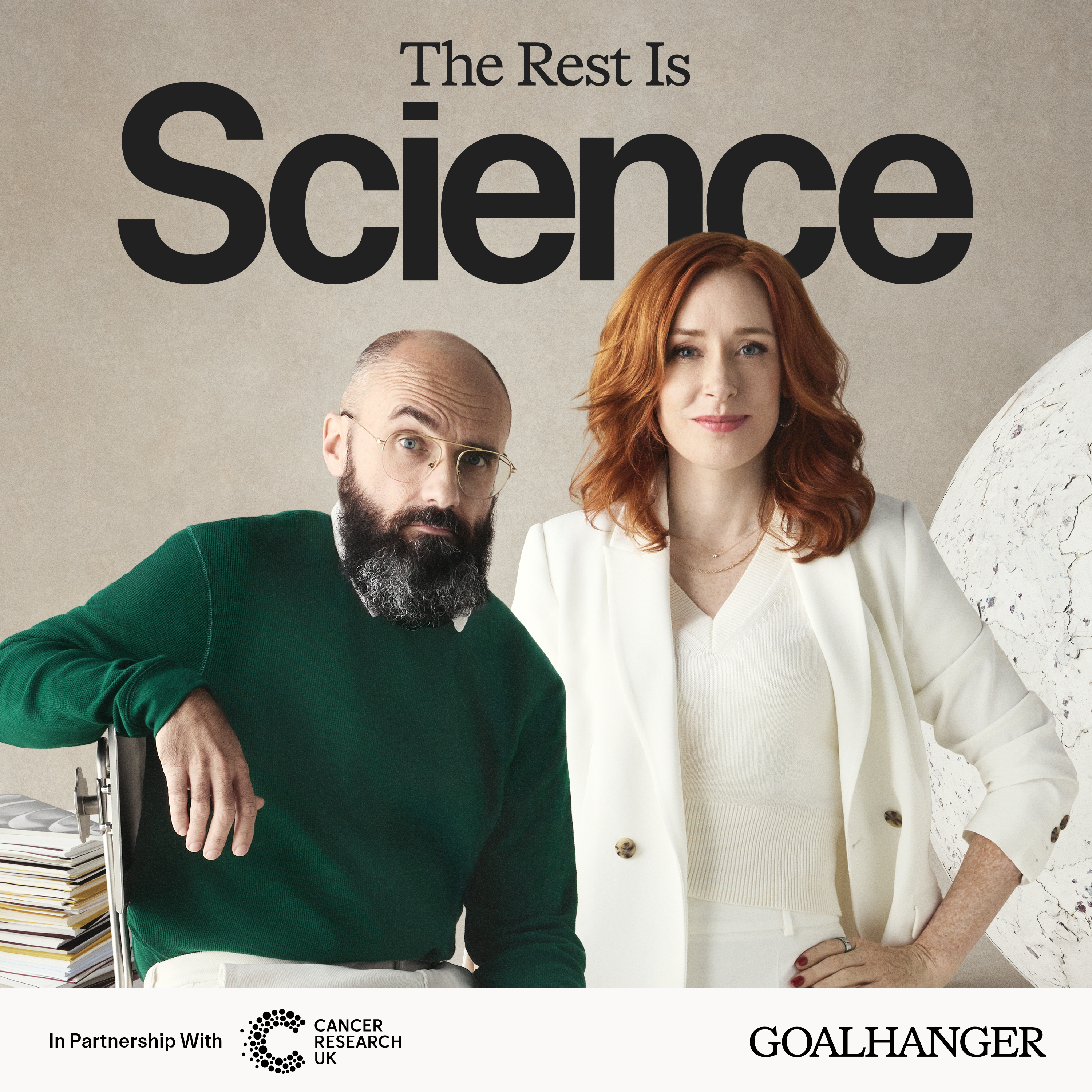
- The Rest Is Science
- What Happened When We Stopped Squatting?
In short
A “Field Notes” episode on the history and physiology of squatting, using a Kenyan stool (an ekihalong) to compare resting squats vs chairs. It argues that many people’s ability to squat declines due to tendon/ankle angle limits, and that bone “squatting facets” can reveal habitual squatting across history (including Neanderthals). It also answers audience questions on car-turn air pressure, burp pitch from stomach gas, and why tautologies feel wise.
Guest backgrounds
No external guests; only hosts Michael Stevens and Hannah Fry (science communicators). Michael brings the Kenyan stool; Hannah leads much of the biomechanics discussion.
Key claims
Squat comfort comes from sit-bone loading and larger foot-shin angles; chairs reduce muscle micro-adjustments and can contribute to back problems. Squatting declined in medieval Europe alongside chair proliferation.
Notable examples
Ancient Egyptian cancer papyrus (sponsor segment); Neanderthal shin facets (Eric Trinkaus, 1970s); helium balloon in a turning car; soda burps producing CO2; examples of tautologies like “boys will be boys” and “it is what it is.”
Written by AI. May contain mistakes.
Chapters
0:46
The Story of the Ekihalong
Discussion about a traditional stool from Kenya and its cultural significance.
“Really, really, really, really, really rural part of Kenya.”
3:29
Physicality of Squatting
Exploration of squatting positions and their comfort compared to chairs.
“What I will say is the thing that you didn't see is that we just moved the table.”
5:18
The Evolution of Squatting
Discussion on the historical prevalence of squatting and its impact on the body.
“Do you think this is what school teachers feel like when they're like, now children?”
8:09
The Decline of Squatting
Examination of how the invention of chairs led to a decline in squatting practices.
“Chairs are in the same way as this is a luxurious upgrade.”
12:32
Cultural Differences in Seating
Analysis of cultural variations in the use of chairs and their significance.
“We also know homo sapiens, absolute squatters, love a good squat.”
14:00
Cultural Significance of Seating
Explore how chairs have evolved and their historical contexts in different cultures.
“And China sticks out, you know, around the rest of Asia in particular, because in Japan, I mean, they were very late to adopt chairs.”
16:50
Stools vs. Chairs: A Comparative Analysis
Discuss the physical effects of sitting on stools versus chairs and their impact on health.
“Okay, so the Colkin guy, what's his name?”
21:50
Physics of Air Pressure in Cars
Learn about air pressure dynamics in vehicles during turns and accelerations.
“Strategic struggle between Britain and Russia.”
28:00
Burps and Gas Density Explained
Understand how gas density affects the pitch of burps and voice.
“you know, going forward to the windscreen, just careful acceleration, basically, so that it doesn't block your view.”
30:34
The Nature of Tautologies
Explore why tautologies resonate as wisdom and their psychological effects.
“This is from quick hurry up, slow down from Reddit, obviously with that name.”

Ask about this episode
Get the gist, explore an idea or ask about something said.
 Claude
On The Rest Is Science, what are the key points of this episode?
Searching your listeningTranscript
Automatic transcript. May contain errors.
0:01Hannah Fry: Hello and welcome to The Rest is Science. I'm Michael Stevens. And I'm Hannah Fry. And this is an episode of Field Notes. It's a sort of grown up game of show and tell between me and Michael. And delightfully, we get to do the show and tell in person.
0:13Michael Stevens: Yes. And before we started rolling, you said that this is going to involve physical activity.
0:20Hannah Fry: Well, actually, I think it's going to involve resting states. Oh, now you're speaking my language. Yes, resting states. But some of them are more physical than others. We've got right to the heart of it already. This is what I brought for you today. Oh. Do you know what that is?
0:37Michael Stevens: No, but I'm going to guess. I'm going to guess that it's a kind of chair.
0:41Hannah Fry: It is a kind of chair. Yeah. Okay, so I got this. I got to go and film near Lake Takana up in Kenya. Really, really, really, really, really rural part of Kenya. And the people there are still largely nomadic. They'll still move around. And the men in particular, they have goats that they will take to different pastures. And as they travel around, they have two things that they carry with them, for sure. One is a cane and one is this thing here. What do they call it? This thing here is called an ekihalong. I imagine I have not pronounced that correctly. But, you know, you can tell me in the comments.
1:17Michael Stevens: Okay, it's a stool. I called it a kind of chair. Interestingly, what's the difference? whether it has a back. Yes. Because it doesn't have a back. It doesn't have a back. But it'll support a body.
1:27Hannah Fry: Yes. It could also be used as a headrest. Oh, interesting. Yeah. So if you want to lie in the ground, then you can use that instead. Right. Basically, I want to do the history of squats. The thing about these is they're like, it's one per person, right? Yeah, I figured. So it's like, it's molded over the years to your butt cheek. Oh. Not my butt cheek. Whose butt cheeks? I don't know. Okay. I bought it off at Trotsman. Mystery butt cheek shape. I think it's either somebody... So you're saying it's been used. Oh, yeah. Can you not see the black stripe in the middle? Well, I can now. Yeah. Oh, this has been used.
1:59Hannah Fry: This is perfectly crafted to an image. How did you get it?
2:02Michael Stevens: You didn't take it from someone who has to sit on the ground.
2:04Hannah Fry: We went to go and visit the tribe. And as we were leaving, they were like, they have like lots of beads as well. Yeah. Yeah. And so they were like, you know, we were doing like some trading. It was awesome. That's cool. Okay. Would you like to sit on it?
2:15Michael Stevens: Yeah, I would love to. Wait, let me sit on it. And I'm going to guess how it works. Okay, go on.
2:26Hannah Fry: This episode is brought to you by Cancer Research UK.
2:29Michael Stevens: All right, here's something really cool. The earliest written description of cancer that we've ever found is from an ancient Egyptian papyrus that was around before even Cleopatra was on the throne.
2:40Hannah Fry: It described tumors being removed by a tool that they called the fire drill, which we think was used to burn off disease tissue.
2:49Michael Stevens: Beating a disease that's so ancient and complex with over 200 different types, it's not going to happen overnight.
2:55Hannah Fry: But thanks to research, cancer treatment has advanced a lot. And Cancer Research UK is driving further innovations like cancer-sniffing robots and drugs made from gut bugs that could change the future of medicine.
3:09Michael Stevens: Over the past 50 years, Cancer Research UK's work has helped double cancer survival in the UK. And today it's continuing to save and improve lives around the world.
3:19Hannah Fry: For more information about Cancer Research UK, their research and breakthroughs, and how you can support them, visit cancerresearchuk.org slash rest is science.
3:36Hannah Fry: What I will say is the thing that you didn't see is that we just moved the table. So I'm going to try it long ways.
3:47Michael Stevens: And I'm just going to bend my knees like this. Yes. I'm not doing like a squat or anything.
3:52Hannah Fry: No. How does it feel?
3:54Michael Stevens: This feels the best with this acute angle here. Right. So I'm putting a lot of weight on this.
3:59Hannah Fry: So the angle of your knees, your thighs to your knees, it's slightly unfortunately below the... We should just do the episode like this. So, Michael, what do you think?
4:13Hannah Fry: if you were there if i go back here yeah go on then maybe you can see better that i've got
4:21Michael Stevens: there we go now you can see it okay so this is okay this is how it's actually pretty comfortable you look really comfortable a lot of weight on this and my legs are only here for the balance right there's like almost no pressure on my feet exactly do you feel like that's sort of you could
4:37Hannah Fry: chill there all day, couldn't you?
4:38Michael Stevens: I could for a long time. Eventually I would switch it up. But.
4:44Hannah Fry: Okay, now I want you to try something else.
4:46Michael Stevens: Yeah.
4:47Hannah Fry: Can you do a resting squat?
4:49Michael Stevens: Oh, you mean like the Serbian squat?
4:51Hannah Fry: Like an old school, how people used to get into a resting position. Can you do one of those? Take that. I want you to basically, I want you to feel this stool is an upgrade. That's what I want you to do.
5:05Michael Stevens: So like, now, should my feet be flat on the ground?
5:09Hannah Fry: Yes, your heels should be on the ground.
5:10Michael Stevens: I'm not sure. Oh, you know what? That's pretty good. I can get into it, but I don't feel very balanced. I think I need to lean forward more.
5:18Hannah Fry: Do you think this is what school teachers feel like when they're like, now children?
5:23Michael Stevens: Hold on.
5:24Hannah Fry: That's pretty good, you know. I think that's better than I can do.
5:28Michael Stevens: Oh, yeah. When are you going to try?
5:30Hannah Fry: Off camera. That's what I'm going to try. Okay, how does that feel in comparison?
5:35Michael Stevens: Not as good.
5:36Hannah Fry: Right. Why? Can you tell me why?
5:38Michael Stevens: I am wondering why. Hold on, let me think it through. So my legs have to be a lot more crunched up. Correct. When my butt is lower.
5:47Hannah Fry: Yes, the angle of your knee. Yeah. In this, you can get to about, let's say, you know, 40 or so.
5:54Michael Stevens: It was less than 90, but it was way bigger than when I was squatting, in which case they were basically closed. at the knee as much as I could.
6:04Hannah Fry: Exactly. And at which point you've got nerves, really big nerves, and you've got big arteries and veins that are running around the back of your knee. Right. And they get kind of compressed really hard. And that can end up giving you basically pins and needles in your legs. Yeah. I think there's another reason why it feels horrible though, other than the fact your knee's really crunched. Why? I mean, there's a few. One of them is that when you're in the squat position, all of your weight is essentially going through your ankle.
6:31Michael Stevens: Yep.
6:31Hannah Fry: Whereas when you're on this, your weight is on your sit bones.
6:34Michael Stevens: Yeah. Like in your... Yeah, and my soft gluteus maximus and the fat and all that.
6:39Hannah Fry: Exactly. So your legs are just carrying much less tension through them and are just able to, as you said, they're there to stabilize you rather than necessarily hold you in position. Yeah. But the other thing, the main thing about this is the angle that you are making with your foot and your shin is much greater. It's much bigger. Because when you're in the squat position, you are basically at a real, you know, this is extremely small, this angle between the two. That angle, by the way, that is the reason why a lot of people cannot get down into that squat position. That squat position, by the way, every toddler on earth can do it.
7:17Hannah Fry: Yeah. Can do it really easily. and there are places all around the world where actually adults you know even sort of grannies basically can very comfortably rest in that squat position however this is like a you use it or you lose it situation and if you do not practice changing the angle between your foot and your shin to make it smaller and smaller and smaller essentially what happens is your your tendons on the back of your ankle, your Achilles and so on, they shorten, then they can't be lengthened into that position and you are locked. You can no longer get down.
7:52Michael Stevens: That's what I was feeling. That's why when I first squatted like that, I was on my tiptoes to keep the angle between the top of my
7:59Hannah Fry: foot and my shin big. If you're doing this all the time, it's extremely comfortable. There's been lots of studies looking at parts of the world where people are just squatting all the time. And actually, people can spend as much time squatting as we spend sitting in a chair.
8:12Michael Stevens: Oh, interesting. I'm just not doing the same thing. Now, let's say you are a squatter. Are chairs less comfortable?
8:21Hannah Fry: Well, no. Chairs are in the same way as this is a luxurious upgrade. Yeah. You know, you get to switch off your shins. You get to relax your ankle joint. You're just basically going for gravity on your sit bones instead. It's not like you're holding yourself in a position. It's really passive. A chair is even more passive still. Chairs is just like an absolute step up from anything you've had before. Let me come on to chairs in a second. Okay. Because the thing is, is that if you are a habitual squatter, right? Makes it sound like a bad thing somehow. There is a clue that gets left in your skeleton that you do this a lot.
8:59Michael Stevens: So we can look at historical bone records and tell how squatty people were.
9:05Hannah Fry: How squatty people were. Yeah. It is called a squatting facet. Right. And it's basically a shiny bit of bone that you get between sort of right at the base of your shin, just at the top of your foot. And essentially what's happening is this is, I really wish I'd worn better socks today.
9:25Michael Stevens: What's wrong with your socks?
9:27Hannah Fry: I mean, they're fine. They're just not my best pair.
9:28Michael Stevens: Oh, they're fun. What is that? Like coral or flowers?
9:31Hannah Fry: They almost always have swear words on the microphone because people. Oh, no. And they know that away from this podcast, I have the voice of a sailor. Okay. says boobs um it says i don't actually know where it says come on it says corals oh fine
9:48Michael Stevens: corals it says corals i could tell that they were little corals in the shape of letters i'm the ultimate sock identifier i can't squat for shoot that's but i can read a sock yeah
9:58Hannah Fry: the ones i was wearing yesterday said i hate people so now is that you saying that or do your socks feel that way maybe it's both maybe it's both i mean mate a sock would definitely
10:12Michael Stevens: hate people if it was in a squat position i don't know they were born to be used in the way that
10:17Hannah Fry: they're used right but if you were in a squat position then you're like rubbing this bit all the time okay i mean you basically you want to think of this as a as a chart as a triangle yeah or like you're thinking very much about the angle of your foot and your shin and the more and more and more you close this angle, right, the more that your shin is rubbing on your ankle bone. And this is where you get... So the two bones rub together. Exactly. Ah. Exactly. And this is where you get this polished patch on the shins. Now, one thing that's worth saying is it doesn't necessarily mean you're definitely squatting because it can be that you're kneeling a lot.
10:55Hannah Fry: So if you kneel, you can make that, if you're sort of on your knees, you can make that angle with your foot and your shin. Or if you're climbing uphill a lot. Oh, okay. Right. So like, I think you probably find them in Sherpas, for example.
11:08Michael Stevens: Yeah, right. Because either way, whether you're kneeling on your knees with your foot back.
11:13Hannah Fry: Look at that angle. That's genuinely impressive. Is it? That's genuinely impressive. Do you know what? The other thing is, I actually worked on this a lot in Pilates for years, and I really struggled with it. I really struggled getting a good angle. But yours is good. Yours is really good. I've also got pretty big feet for how short I am. Do you know what you do? What size are your feet? Ten and a half. Hey, hey. America. I don't know.
11:35Michael Stevens: What's that in UK? I don't know. Two blobbervorts or something? Exactly. Seven barleycorns. But sometimes I can wear 11s. When you've got thick socks on. But enough about me.
11:48Hannah Fry: Okay. So here's the thing. What this means is that you can look back at skeletons of different types of people that lived across the centuries and millennia and you can work out whether they were squatters. So there's one study from the 1970s by an academic called Eric Trinkaus who was looking at the shins of Neanderthals and demonstrated that they have this same shiny little facet on their shin bones. So Neanderthals were squatters.
12:19Michael Stevens: Yeah, they were squatting because they probably weren't like walking uphill more than usual. Have we looked at other hominids of the time? Like, can we find contemporaneous homo sapien skeletons and see if they squatted more or less? Yes.
12:34Hannah Fry: We also know homo sapiens, absolute squatters, love a good squat.
12:39Michael Stevens: Yeah.
12:40Hannah Fry: All the way through history, all the way through sort of the ancient world, all the way up until the medieval period, at which point squatting started to decline, which just so happened to coincide with the proliferation of the chair.
12:59Michael Stevens: The chair. The chair. Don't always think about chairs as inventions. Right. But they were and they proliferated. And there's a lot of natural chairs. You can find a tree, a rock formation, but one that you could bring into your home, expect to have. Yes. It's like not, we haven't always had them.
13:20Hannah Fry: You are sitting in a luxury right now. Okay. This is, you do not know how lucky your body is to be in this particular position. I don't. I take it for granted. Yeah, I take it for granted too. So chairs, by the way, were invented as like an object that was created that you could sit in, were created a really long time ago. There's like evidence for them going back thousands of years. However, even up until like the 1600s, in uh in in europe if you had a chair it was only for the important person right this is why you
13:53Michael Stevens: have wow a chairman yeah like the chairman would be the important person that would get to sit
13:59Hannah Fry: and luxuriate in the chair and everyone else was on the floor wow maybe on a bench this is making
14:05Michael Stevens: me appreciate in a whole deeper way that bit in i think it's the borat movie where he goes into a hotel room and it has a bed and a chair and he's like i have a chair um and he sits in and he goes king in the castle i have a chair and it's like uh it's so bizarre that he thinks a chair is neat and yet historically oh yeah oh yeah it was an important person's rare device yes completely rare device you were literally the king in the castle do we know why though because obviously the idea of a chair is ancient but what people just their bones and muscles and tendons were different enough that they didn't find having a back that important well i don't know really i
14:46Hannah Fry: mean because it's not this is not universal around the world china kind of sticks out here um as different to what was going on in europe in europe they're just people just weren't really bothering with chairs um but in china actually from like the second century onwards people were having to By around about 1500, you know, when chairs were just beginning to be used more commonly in Europe, in China, it was expected that if you were a posh person, right, you would be sitting at a table eating, eating your dinner while sitting in a chair. And China sticks out, you know, around the rest of Asia in particular, because in Japan, I mean, they were very late to adopt chairs.
15:24Hannah Fry: You can still, there are many restaurants you can go into in Japan where you are sitting, you're sitting on a bench or sitting sort of really on the floor. And that actually wasn't until after the end of the Second World War that people were like, OK, look, guys, we need to modernize. We need to get American here. We're going to get chairs. We're going to do this with chairs. But what's interesting, what I really like about this is that in Europe, we know that the chair started to become more and more commonplace in people's homes. because when there were documents of people's wills, when you were emptying people's houses when they died, initially, no chairs anywhere, and then started being like, this person died with a chair.
16:03Michael Stevens: Died with a chair.
16:05Hannah Fry: Died with a chair. King in the castle. King in the castle. Nice. And then more and more and more and more and more, there would be chairs all over the place. So you can, I just love these kind of stories because it's like you take two different distinct historical records. You take the things that we are writing down and you take the marks on our bones and they line up. Yeah. They match up with one another. I think that's so amazing. I want to go back to this stool there, right?
16:30Michael Stevens: Yeah.
16:31Hannah Fry: And I want to do a trade-off, a comparison, a direct chair versus stool situation. Okay. Because I'm not convinced that we've ended up with better instrument here. Okay.
16:41Michael Stevens: Tell me why.
16:42Hannah Fry: Okay. So when you were sitting on the little stool, yeah, you could relax there. you can chill out but your muscles are still actively working right you're still doing these adjustments you're you're still holding yourself up you're still you're still supporting your torso with muscles yeah when you sit in a chair you're not doing any of that no which is part of the reason why they can feel so comfortable yeah every single one of your muscles is just like
17:06Michael Stevens: ah i get to just completely switch i know something i think about a lot because i mean you may have noticed when i sit in chairs i often really really you do don't i just i wish it was a bed and i'm like look it's a bed with a lot of pillows i want to do less and less this is how i normally am sitting because i find this and this worries me when i sit like this i'm like what is this exercise give me a break because i'm having to use muscles yeah more than when i'm just lying down Have you watched the TV show Succession? Yes. Okay, so the Colkin guy, what's his name? Oh, Roman. In that show, he sits like I do.
17:52Michael Stevens: And I felt so seen by media. He's always like a liquid poured into a, not even a chair, but any kind of piece of furniture. He's just like no muscles being used at all. And I'm like, yes, there's at least two of us.
18:08Hannah Fry: Yes, I think in that show, I think there's many people, Michael, who would be like, I just really feel like I can identify with the most abhorrent character in the most abhorrent family. I'm only identifying with one feature of Roman. Okay, so here is the thing, right? Because you are switching off completely. Because, I mean, let's go with your extended version of just pouring yourself into it. But even when you're just using a chair that has a back to support you, you're no longer holding yourself up with muscles. You're basically like hanging off from your ligaments, your skeletal structure.
18:46Michael Stevens: It's like literally the poly exclusion principle is why I'm still above the ground. Right. I can't go through this matter.
18:52Hannah Fry: And so I'm supported. And so therefore I'm supported. And so here's the thing, you know, within like a really short space of time, the twitches in your muscles just completely switch off. Your muscles are completely sedentary. but that then has this knock-on effect it changes the amount of fat and sugar that is in your bloodstream also your pelvis the way your pelvis is tilted when you're sitting right is different to how it would be when you're standing up right so if you kind of imagine i like to think of like your pelvis as though it's like a ball that can be like rotated up or rotated back when you're sitting you're tilting it in this way right right especially when you're kind of like a bit slumped
19:29Michael Stevens: Yeah.
19:29Hannah Fry: So you're you're you're like your buttocks, right? Your your gluteus maximus are not switched on in the same way. And then you're especially when you start slouching forwards as well. So the top of your shoulders is going this way. You're kind of curling your whole body in like this. It's just like not good. Basically, all of your your muscles start shortening in the wrong places. And this is the reason why people end up with so many back problems, because they're you're you're the human body is not supposed to be in that position of rest. When you're on the stool, on the other hand, because you're making these micro adjustments all the time, like it does feel a tiny bit more effortful than just being like, pour me into a chair.
20:12Hannah Fry: But it's just for your for your body. It's just way, way better.
20:17Michael Stevens: I mean, I think sitting on like those exercise balls is a much more active kind of sitting that's using and requiring a lot more muscle action. Right. So but even on that, though, Your thighs, they aren't getting much. They're pretty relaxed. Yeah. They're not getting much at all. Depends, I guess, on how you use it and how you balance. How bouncy you are. Yeah. How bouncy you are. Did you ever do that? Did you ever try and sit on one of them balls? Yeah, I did. Because we got one when my wife was, you know, due very soon, you know? And I was like, oh, I kind of like this. But after like five minutes, I'd be like, oh, cramping up the muscles.
20:51Michael Stevens: It's not strong enough. Too much. Too much. Too much. Pour me into a chair bed.
20:59Hannah Fry: Yeah. So anyway, that's what I've decided. I've decided we're getting rid of these. We're going to get two of the stools. We're going to get two of these and we're going to do the rest of our podcasting just sitting on one of these little stools.
21:12Michael Stevens: Sounds all right? I think that's fine. I mean, we could go further and each get a treadmill and we could be actually actively sprinting for the whole 40, 50 minutes.
21:24Hannah Fry: I mean hey look why not I think people would like to see it Maybe for our 200th episode Alright should we go to a break Come back with your questions in a minute
21:53Michael Stevens: Great game.
21:55Hannah Fry: Strategic struggle between Britain and Russia. We assess our Prime Minister. With high confidence it was Russian.
22:07Michael Stevens: Holding the Russians accountable is World War III.
22:09Hannah Fry: They took down a British passenger jet containing 350 people. The man in the Kremlin is playing, Alex. You've got to ask yourself, do you want to play or not? You're the Prime Minister. You've done nothing!
22:25Michael Stevens: We would need to understand the policy context.
22:28Hannah Fry: All the relevant context will be structured as a framework today. And disseminated into an operation order. Or frago. Or a frago that says to kill the president of Russia. Yes. New from Goalhanger. Who is going to be able to pull this off? You're my soldier, are you? Sergeant Tom McDuff. Duffy! An audio drama journey like no other. Men like Duffy, they are our most valuable weapons. Devised as a technically rigorous geopolitical action thriller. Where Britain plays its strongest hand. He's the best. Against its strongest foe. Don't do it, Duffy! Bear Hunt.
23:12Michael Stevens: Available now, wherever you get your podcasts.
23:30Michael Stevens: All right, welcome back. We are now going to take a look at some questions that came from you guys.
23:36Hannah Fry: We are indeed. Okay, this came in from Heavenality from Reddit, who asks, when driving on the road and I go around a curve, which spot on my car receives the most air pressure other than the front?
23:50Michael Stevens: I love this question because I know some pretty cool videos have been made about it, but I want to first give the like not the answer heavenality once. Deal. Which is that as you're turning in your car around a curve and you wonder where's the air pressure higher on the inside of the curve or the outside, the answer is. We're talking about outside of the car here or the inside of the car? Inside the car. Right. Inside the car, you've got this air and it's sloshing around. As you turn, the greatest air pressure in the whole vehicle is in the pistons in the engine. Because, I mean, that's huge, right?
24:32Michael Stevens: I found this cool website called performancetrends.com and they analyze the pressure in your engine. It gets up to like 800 or more than a thousand PSI inside that cylinder when it explodes, when the spark plug like shoots off.
24:46Hannah Fry: And think about what PSI is. That is pounds per square inch. Yeah. So 800 PSI, wait, do a metric conversion for me, will you? It's like 2.2 pounds to a kilo, is that right? Yeah. So 800 PSI is something like 362 kilos per square inch. Yeah. So that's like, imagine getting 362 kilos and putting it on a space that's like that big.
25:13Michael Stevens: Yeah.
25:13Hannah Fry: That's wild.
25:15Michael Stevens: Yeah. Wild. That's enough to turn a driveshaft and move your car. The next highest air pressure is going to be like in your tires. But I think what the question is asking about is inside the car where the people are, what's happening to the air? And the air really is sloshing around in there. So when you make a turn, all that air wants to continue on in a tangential direction. So straight ahead, tangent to that curve that you're taking, which means it all gets crushed up against the far side of the car away from the turn. So the air pressure is greater there than it is on the other side of the car that's closer to the axis of your rotation.
25:57Michael Stevens: And you can see this by putting a helium balloon in a car because you get the opposite from the helium balloon that you get from the people in the car. So when you're in the car and let's say you take a right turn, the humans are all doing what the air does. They're all going, I'm going straight ahead. Now the car is moved and I appear I feel this fictitious force pushing me this way and we all move away from the center of the curve. But the air does that to a helium balloon floats because the air pressure below it is greater than the air pressure above it. That's why they float up and because they're so darn light that the air can actually accomplish the movement of the balloon.
26:39Michael Stevens: But usually the air pressure is greater the lower down you go because the air is all piled on top of itself under Earth's gravity. When you turn in the car, the air on the far side, let's say on the left side of the car, gets denser. And so this has higher pressure. And that balloon is now being more pushed by air on the left than by air on the right. And it will move towards the center of the curve. So when you, you know, turn your car really fast, everyone inside goes like this. The helium balloon goes like this. That's amazing. It's really counterintuitive. And it's so funny to watch. Same goes for accelerating.
27:17Michael Stevens: Well, I mean, turning is also a kind of acceleration for all of you physics listeners out there. But if you if you accelerate forward or break, the balloon will also do what you don't expect. So if you break really fast, the humans all go forward. But the helium balloon flies to the back. That's amazing. Yeah, because the air and the air all crowds up in the front. It has so much higher pressure up here. the balloon's like, whoa, I'm being pushed more by the stuff now in the front. And vice versa, you speed up in a car, people get thrown back, the helium balloon comes forward. Yeah, it comes forward.
27:48Michael Stevens: So it looks like it's alive, like it's making these decisions that are counter to nature, but it's pretty neat. That is so fun.
27:55Hannah Fry: I absolutely want to do that. You got to do it. I really want to try and do that. Hopefully the balloon, you know, going forward to the windscreen, just careful acceleration, basically, so that it doesn't block your view.
28:06Michael Stevens: I think the same thing happens with anything that's floating in a liquid. Like if you tied a ping pong ball to the bottom of a jar and filled it with water, it would also have that kind of opposite of what you would expect motion.
28:20Hannah Fry: Yeah, that's amazing. I like that so much. Okay, next question. This is from Jacob Ewing from Reddit who says, does the gas in my stomach affect the pitch of my burp? So the answer is sort of yes. and sort of, no, there's more to it than that. But I believe that when you're drinking soda, you get lower, deeper pitch burps.
28:43Michael Stevens: Because it's carbon dioxide as opposed to lighter gases like nitrogen?
28:48Hannah Fry: So for example, helium's featured quite a lot in this episode, but when you take helium, that is what's happening. As you say, the helium gas is much lighter, and so it changes the resonance that's going on inside of your throat. So your voice box is still working in exactly the same way. You're still like making the vibrations, the flaps are opening and closing in exactly the same way. But because it's filled with a gas of a different density, the resonance is different. Right, exactly. It moves much faster. Higher pitch. Higher pitch. And then therefore you sound really squeaky. So it is true if you had lots of carbon dioxide, which is denser, that you would get it lower pitch.
29:26Hannah Fry: but actually I think what's really happening here is that when you drink a can of soda the amount of gas that you're producing is so much greater than it does when you just swallow a little little mouthful of air and for that it's a bit like if you imagine you're taking a balloon and you do like a really small little escape of gas you get a really high-pitched squeak whereas if you just let it go and it's that much lower right so that's essentially I think what what's happening here. You've got the soda in your stomach, which can produce, like a can of soda can produce like as much as a liter of carbon dioxide.
30:04Hannah Fry: Oh, wow. Your stomach is not designed to hold a liter of gas. So when it comes out, it's like, it really opens everything up.
30:12Michael Stevens: Yeah, it's exactly like the balloon. So what we've got to do is put a liter of helium in someone's gut and see what that burp sounds like. Yeah. I bet it would be a bit higher, But I think you're right when you're comparing swallowed air versus a soda burp. Yeah. Yeah. You're talking about a balloon going and a balloon going. Right. Totally. Totally. Exactly.
30:34Hannah Fry: All right. Last question. This is from quick hurry up, slow down from Reddit, obviously with that name. OK. It is what it is. Why do tautologies sound like wisdom? Are they hitting some sweet spot between ambiguity and relevance? Why do some, like business is business, boys will be boys, feel like a nefarious attempt to stop us thinking critically? Whereas what is done is done. Wherever you go, there you are. Feels like either acceptance or a platitude. What a great question.
31:03Michael Stevens: I think that's totally right. They are a really poetic example of a thought terminating cliche where you're just supposed to stop thinking now because I've said something that is so fundamental, that's so, it's not even like axiomatic. It's just straight up a tautology. I just said the same thing twice. There's nothing else to say. But why do we have to do this? Look, it is the way it is. There's no why there. There's nothing else to describe. There's no more questions to be asked or thoughts to be had. It's all terminated. And - Why don't you get that with - It is. You do. I mean, it is is is like a very, you know, deep way of saying like, but why why is this here?
31:53Michael Stevens: Because it is. You're right. I know it's more poetic if I say it's here because it is. But either way, it is interesting that we don't always catch tautologies. We instead feel really comfortable with them. A tautology is like a redundant phrase. It's something that is just. You're saying the same thing twice. You're saying the same thing twice. You already said that. So I don't know why psychologically we don't catch them better because I rarely catch them. And then I'll read, you know, the next sentence in the book and they're like, but that's a tautology. And I'm like, what was it? Oh, I just thought it was smart.
32:32Michael Stevens: I mean, not that tautologies can't be smart, but yeah, we feel very comforted by them. It's like, look, it's been put into words and it's done. That's not to say they're always satisfying. I think boys will be boys is a real like, yeah, you're right. But there are other things that can describe that need more said.
32:56Hannah Fry: Because in a way, boys will be boys is the same as it is what it is. It's just you're applying it to a specific circumstance which comes with its own like heavy history and cultural and societal.
33:09Michael Stevens: I mean, yeah, yeah, it is what it is. Que sera, sera. That is telling us just chill out. You can't do anything about it. We're not going to do anything about it and just accept it. And when it comes to, oh, why must love be so difficult? Que sera, sera. You know, but sometimes we don't want to be told, look, that's just a thing that happens. We go, no, but it doesn't have to be. Right. Of course. So I guess tautologies don't always satisfy us. The problem with explanation in general is that it never ends. You can always ask why. You can say, well, they did that because of this psychological phenomenon known as blank.
33:51Michael Stevens: Yeah, but why? Well, because of the neurotransmitters in the brain that are a product of natural selection. But why? Well, because in this universe, you know, logical contradiction means an impossibility. But why? Well, I don't know if God comes first or logic, but it could be. Why? Whereas if I just say it is what it is, whatever will be, will be. There literally isn't anything else. Yeah, you're right. It's the end of the discussion and we can move on.
34:15Hannah Fry: I do also think, though, so sometimes I deliberately create tautologies, especially when I'm writing. Not so much for like scripts or whatever. but when I'm writing I deliberately create them because I think sometimes um your brain just needs a moment to like settle on one particular idea before you're ready to move on right because I think that if you I don't know like it is doesn't feel satisfying to me as it is what it is yeah and I I wonder whether there is part of that that's like actually I just need it said twice sometimes. Yep.
34:53Michael Stevens: Now, I bet you're right. As a rhetorical device, yeah, it's a great way to pause without pausing. Yeah. You've added more, but it's actually a reflection on the same thought. You can use it really well to highlight what the important thoughts are as well. Yes, you can. And sometimes what might be technically a tautology isn't because you've rephrased it and saying it and hearing it in two different ways can help a lot. And even if you're You're not rephrasing it. It is what it is. You're highlighting. You're emphasizing what you've said. It's like you yelled it or underlined it. You repeated it.
35:34Michael Stevens: Right.
35:35Hannah Fry: Sometimes you just need a bit of repetition. Well, it is what it is. And this is what this was. Thank you so much. As ever, with Build Notes, you can send us in your questions. The rest is science at goalhunger.com. Or leave them on our subreddit, The Rest is Science. or leave it as a comment wherever you are watching slash listening to this.
35:52Michael Stevens: And I hope that you're already following us wherever it is that you are.
35:55Hannah Fry: And if you're not, ask yourself, why not are you?
35:58Michael Stevens: Why not? Is it a tautology to say either you are or you aren't? Turns out these are harder to come up with on the fly than they appear. Follow us so that you're following us. We'll see you when we see you.
36:13Hannah Fry: We'll see you when we see you.
36:15Michael Stevens: Yeah, there you go.
36:20Thank you.
From the publisher
In many parts of the world, people rest in a deep squat every day. In others, most adults can barely get down there. So what’s going on? Hannah Fry and Michael Stevens dig into the history of squatting and why the ability to squat differs so much between cultures.Plus, your questions: What happens to the air pressure inside a car when it goes round a bend? Why do some burps come out higher than others? And why do tautologies sound like wisdom?-------------------For more information about Cancer Research UK, their research, breakthroughs and how you can support them, visit https://cancerresearchuk.org/restisscience Cancer Research UK is a registered charity in England and Wales (1089464), Scotland (SC041666), the Isle of Man (1103) and Jersey (247). A company limited by guarantee. Registered company in England and Wales (4325234) and the Isle of Man (5713F). Registered address: 2 Redman Place, London, E20 1JQ. ------------------- Find The Rest Is Science all over the internet by clicking here. ------------------- Video Producer: Adam Thornton + Oli Oakley + Jack Meek Animator: Sam Benson Video & Social: Bex Tyrrell Producer: Simona Rata + Lucy Lipscombe Senior Producer: Lauren Armstrong-Carter Chief Digital Officer: Samuel Oakley
Exec Producer: Neil Fearn
Learn more about your ad choices. Visit podcastchoices.com/adchoices
More from The Rest Is Science
All episodesWe use cookies.They keep VO running smoothly and help us improve it. Privacy policy