
 Ask ChatGPT

- Podcasts
- The Rest Is Science
- The Right Way To Open A Shaken Soda Can
In short
How to safely open a shaken carbonated drink, explaining the physics of foam/“geyser” formation via nucleation sites and dissolved CO2; then a Q&A on skepticism vs paranoia (replication crisis), Archimedes’ lever thought experiment, and maintaining curiosity/wonder.
Guests
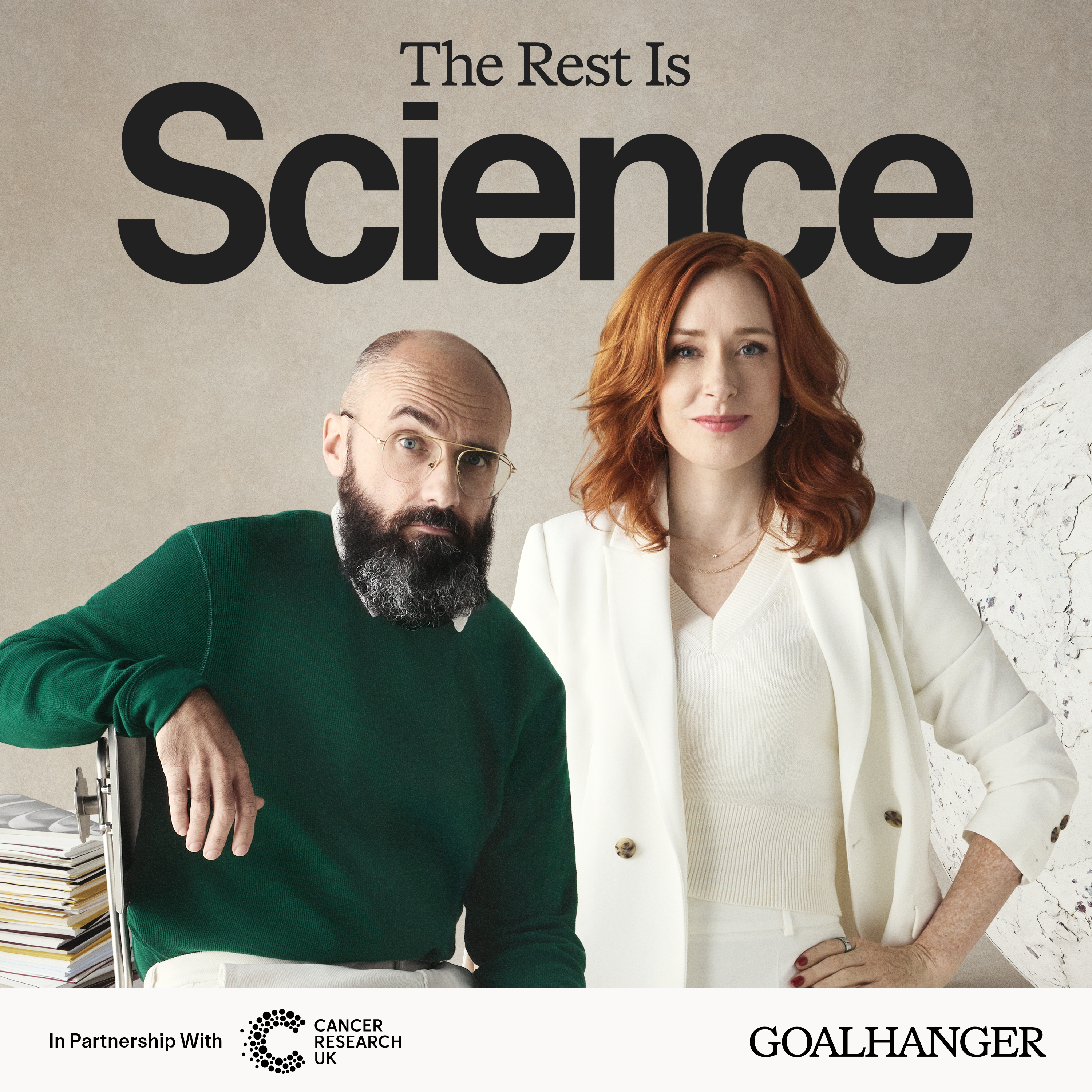
None. Hosts are Michael Stevens and Hannah Fry. (The episode includes references to a “colorectal surgeon” and a “medic” friend, but no additional guest speakers.)
Key claims
Shaking increases foam risk by distributing CO2 and creating bubbles that stick to imperfections; tapping the sides releases those bubbles to the top so opening causes less foam. Waiting 10–20 minutes also works as gas re-dissolves. Replication crisis stems from fluke results amplified by incentives and small samples, especially in psychology. Curiosity and doubt reinforce each other; certainty can reduce curiosity.
Notable examples
“Nun’s fart” phrase; Mentos-in-Coke as nucleation example; pressurized aircraft fuselage analogy; gingers-in-a-room statistical threshold; Archimedes lever limits (rigidity implies faster-than-light information); Red Cross negotiator story about turning people into “machines” or “madmen.”
Written by AI. May contain mistakes.
Chapters
0:46
The Tapping Trick
Discussion on a life hack for safely opening a shaken soda can.
“I'm going to move my laptop out of the way.”
3:37
Science Behind the Fizz
Exploration of the science behind why tapping a soda can works to reduce fizz.
“Are you saying that nuns actually have great farts?”
6:15
Pressure and Aircraft
A discussion on pressure within cans and its relation to aircraft structure.
“Clearly, you're not adding anything to the contents by shaking.”
9:21
Skepticism in Science
A conversation about issues of trust in science and the replication crisis.
“You have to be really careful because you're inflating it, deflating it, inflating it, deflating it all the time.”
14:00
Revisiting Psychological Studies
Explore how outdated psychological experiments may not reflect current understanding.
“Yeah, a lot of psychological experiments from decades ago that became staples of textbooks that we all just accepted as like, yep, that's what people do.”
15:33
Understanding Scientific Evidence
Learn about the challenges of drawing conclusions from psychological studies.
“And if we would expect to see this evidence, if it was just a complete fluke, less than one in 20 times, then that's good enough.”
17:41
The Replication Crisis in Science
Discuss the replication crisis and its impact on psychology and other fields.
“However, there is a weird thing that statistically happened in this one study that we did and we wanted to show the methods so that other people can learn from this and do more studies.”
20:47
Doubt and Faith in Science
Examine the relationship between doubt, faith, and scientific belief.
“If we try and claim that modern society isn't held up by faith at every conceivable level, I think we're really fooling ourselves.”
22:47
Archimedes' Lever and Its Limits
Investigate the practicality of Archimedes' famous lever quote from a physics perspective.
“This came in from Vikram, who says, I've always been fascinated by Archimedes' famous quote, give me a place to stand and a lever long enough and I will move the earth.”
24:30
Creative Applications of Leverage
Delve into imaginative uses of leverage and what could be possible with theoretical constructs.
“But the point is, we don't even need to focus on that right now.”
Show all 14 chapters
27:28
Curiosity and Society
Discuss how societal curiosity can diminish and its connection to self-doubt.
“You could have built a skyhook or two or 12.”
28:04
Exploring Doubt and Curiosity
The discussion revolves around the intricate relationship between doubt and curiosity in individuals and society.
“Gosh, that's such an interesting way of thinking about it.”
32:51
The Dangers of Certainty
A deep dive into how certainty can lead to thoughtlessness and lack of curiosity, referencing historical and personal anecdotes.
“like you need to allow more modes of thought and action.”
34:55
Fostering Curiosity in Society
A reflection on the importance of curiosity in society and how engaging in diverse conversations can enhance communal knowledge.
“And I think that actually having curiosity about ideas, curiosity about science, about philosophy is a really good way to start.”

Ask about this episode
Get the gist, explore an idea or ask about something said.
 Claude
On The Rest Is Science, what are the key points of this episode?
Searching your listeningTranscript
Automatic transcript. May contain errors.
0:01Michael Stevens: Welcome to The Rest is Science. I am Michael Stevens. I'm Hannah Fry. And today I've got a can of a carbonated beverage. We're going to talk about how many calories there are in there. Nope. Hey, don't shake it. Don't shake it up, right? Oh, yeah. I can feel how tight it's getting. Can you? All right. Now, do you want to open it? No. Good, because I don't want you to open it. Not yet. Instead, I'm going to try a little life hack to fix this and make it safe to open. Okay. Now, have you heard of this before? Tapping the sides? Yeah, or tapping the top is the one that... Tapping the top is terrible.
0:35Michael Stevens: Is it? It does not work. Tapping the sides is where it's at. Right. Should I tell you why now? Or should I just go ahead and surprise everyone with how well it works?
0:45Hannah Fry: There's no way. That's going to fizz, surely. You think so? Yeah.
0:48Michael Stevens: I shook it really a lot.
0:50Hannah Fry: I mean, that was intense. I'm going to move my laptop out of the way.
0:54Michael Stevens: Move your laptop out of the way, but I trust the science. Okay, you ready? Yeah, go on.
1:01Hannah Fry: okay okay compared to what compared to what you were expecting wouldn't that have been even cooler if it didn't make any noise but i mean that's not too bad that was amazing do you know why that works do you know the phrase that um that some people i don't know even this you'll have this in america but the phrase that's used to describe what you just witnessed there is a nun's fart do you know this no my the only one who's heard that phrase you've heard that phrase pleasant you've never heard that phrase yeah like
1:36Michael Stevens: like it's not good but it's not as bad as it was just like a really gentle release of air
1:42Hannah Fry: oh you know like it wasn't like it wasn't aggressive i get it but i think nuns should
1:48Michael Stevens: feel comfortable flatulating however loudly they want. I completely agree.
1:53Hannah Fry: Okay, so I had this friend when I was at uni, a friend who's studying to be a medic, and they were like top of their class, aced it, aced it, aced it, aced it. And the consultant in the hospital who they were working under came to find them one day because they were like, I've got a genuine treat for you. There is a nun who needs to have a rectal exam, right? And that is how you stun Michael Stephenson's silence.
2:16Michael Stevens: That's how you leave me with nothing to add.
2:26Hannah Fry: This episode is brought to you by Cancer Research UK.
2:29Michael Stevens: All right, here's something really cool. The earliest written description of cancer that we've ever found is from an ancient Egyptian papyrus that was around before even Cleopatra was on the throne.
2:40Hannah Fry: It described tumors being removed by a tool that they called the fire drill, which we think was used to burn off disease tissue.
2:49Michael Stevens: Beating a disease that's so ancient and complex with over 200 different types, it's not going to happen overnight.
2:55Hannah Fry: But thanks to research, cancer treatment has advanced a lot. And Cancer Research UK is driving further innovations like cancer-sniffing robots and drugs made from gut bugs that could change the future of medicine.
3:08Michael Stevens: Over the past 50 years, Cancer Research UK's work has helped double cancer survival in the UK. And today it's continuing to save and improve lives around the world.
3:18Hannah Fry: For more information about Cancer Research UK, their research and breakthroughs, and how you can support them, visit cancerresearchuk.org slash rest is science.
3:36Hannah Fry: I think that's quite interesting scientifically, personally.
3:40Michael Stevens: Are you saying that nuns actually have great farts? yes like gentle farts like gentle thought i guess i could believe i don't want to stereotype nuns though okay look like if you're a nun who listens and and and this is bothering you because you think your farts are a little like louder or smellier than than they should be it's okay it's okay you're still a valid nun i'm not i'm not commenting on the smell i'm merely commenting on
4:06Hannah Fry: i'm commenting on the smell okay okay but is it real i can see lauren in the corner of my eye
4:11Michael Stevens: Okay, so our fact checkers are saying that a nun's fart is not a thing. I'm sorry. That you have created this in your own mind as a saying.
4:20Hannah Fry: No. Look, when you open a bottle of champagne and it goes, then you say, oh, like a nun's fart. I didn't make this up. Look, I'm not an expert here. I'm sure that people in the comments with opinions. Look, if you happen to be sort of a colorectal surgeon and you've got evidence, then we want to hear it.
4:42Michael Stevens: Let us know. Do nuns farts earn their name as a nun fart? But look, why does the tapping the sides work? Well, at the end of the day, here's what's happening. When you've got the liquid in the can, I'll pour it into this cup so we can look inside. Yes, please. When you shake it up, the carbon dioxide gas that's dissolved in the liquid collects on little imperfections on the glass. Yes, stuck to the side. It's stuck onto these sides. So if I like, I don't know, I'm trying to make this like shaky, but you'll notice that you get bubbles on the outside. When you then release the pressure at the top, those bubbles along the sides expand rapidly.
5:23Michael Stevens: And that creates the foam. foam that creates the geyser that comes out. But if you tap the sides, you can try this with a clear glass. You can watch that when you flick the sides, the bubbles get released and they go up to the top. Right. So all that gas that came out when I shook the can still out of the liquid, but it's all collected at the top of the can. So when I open it, the gas all comes out, but no foam and liquid does too. So essentially you're getting rid of the nucleation sites on the side well the nucleation site is still there it's just there's no more gas caught on that site because you flicked the bubbles off the site and they floated to the top amazing if you tap the top you're not cleaning the bubbles off the sides the vibrations might still cause some bubbles to leave the side so it's still better than nothing but the sides and even the bottom is what you want to do you want to clean them so there's no gas mixed in and in bubble form in the liquid to then expand
6:20Hannah Fry: and bring the liquid up with it got you okay well this is a good trick this presumably works for any
6:26Michael Stevens: drink that has got carbon dioxide dissolved within the only other solution is to just wait if you wait like 10 20 minutes the gas will be dissolved back in and you can open it without
6:40Hannah Fry: an explosion so i see why it fizzes up i understand that right that you've got like little pockets of air that are rapidly expanding and thus causing all this foam i get that I think what I'm asking is, why does the act of shaking physically do to the contents inside the can?
7:00Michael Stevens: Clearly, you're not adding anything to the contents by shaking. But I guess the gas, when it's dissolved, takes up less room. And then once it leaves as a gas and the molecules stick together.
7:16Hannah Fry: When you open a can, the liquid is not right at the very top, is it? There's like a little gap.
7:21Michael Stevens: Yeah, there's a little bit of air. That's why you can take a full can and you can hear it slosh in there. Right.
7:26Hannah Fry: So you're taking the air and mixing it into the liquid, I guess. The air that would sit at the top. There's a little layer of air. As you shake it, that air gets mixed in with everything else.
7:37Michael Stevens: I couldn't really describe it. I don't totally know why a mechanical nucleation site, an imperfection in the metal, a scratch, causes the gas to appear out of the liquid. same with why a mentos dropped into coke mentos is just somehow covered in nucleation sites and just an enormous amount of gas gets produced but i don't know why it's just really hairy mental is just really really sort of has all of these little air pockets but why is it that when this hairy surface comes into contact with a gas dissolved in a liquid the gas goes whoa i'm out?
8:16Hannah Fry: I don't know. Well, I think that is just because carbon dioxide is really unstable. And so it kind of kickstarts it. But there's different ways, right? Because there's dissolved as tiny air bubbles that are just separated and suspended within the liquid. And then there's dissolved in the sense of it's no longer just carbon dioxide, it's a new molecule. Tell you one more thing about Coke cans. Have you noticed how you can stand on a full Coke can, but on an empty one it crushes under your weight. That makes sense though, right? Like,
8:49Michael Stevens: I can't crush the full can because I can't compress the water. Right. Because there's pressure inside it. Whereas when you release that pressure...
8:56Hannah Fry: It's so much stronger. Right. Okay, so here's the thing about aircraft. Same story. Inside an aircraft, it's so much stronger when it's pressurized within than if you have like an open fuselage. It's also much more comfortable. You can effectively be your body can effectively be at 5 ,000 feet or whatever it might be while you're physically much higher in the atmosphere. The only thing about this is that if you imagine releasing all the pressure and then blowing up again, and then releasing all the pressure and then blowing up again, and then releasing all the pressure and then blowing up again, it ends up with a bit of a mess.
9:36Hannah Fry: Yeah. And it's the same thing with aircraft. You have to be really careful because you're inflating it, deflating it, inflating it, deflating it all the time. Right. And a lot of the skin of aircraft, particularly older designs of aircraft, is panels, metal panels. I think it is actually aluminium, some of it. These aluminium panels that are riveted onto the surface, into the structure. And so, as a result, you have to be extremely careful about how far you inflate the fuselage of your aircraft so that you don't end up causing structural damage like this however this is the reason why one aircraft is
10:15Michael Stevens: way superior to every other and i was on one of them on my flight out were you because you told me if they have the windows that like yes magically change yes they become darker yes you don't have a window shade that i was on the right kind and yeah it did it just felt wonderful okay should
10:33Hannah Fry: we have a little break going to the questions yeah all right let's do it
10:46Michael Stevens: We are getting a statement from number 10. On that flight, with 350 passengers on board. The great game.
10:57Hannah Fry: Strategic struggle between Britain and Russia. We assess our premise to... With high confidence it was Russian.
11:09Michael Stevens: Holding the Russians accountable is World War III.
11:11Hannah Fry: They took down a British passenger jet containing 350 people. Man in the Kremlin is playing, Alex. You've got to ask yourself, do you want to play or not? You're the Prime Minister. You've done nothing!
11:27Michael Stevens: We would need to understand the policy context.
11:29Hannah Fry: All the relevant context will be structured as a framework today. and disseminated into an operation order, or frago. A frago that says to kill the president of Russia. Yes. New from Goalhanger. Who is going to be able to pull this off? You're my soldier, are you? Sergeant Tom McDuff, Duffy. An audio drama journey like no other. Men like Duffy, they are our most valuable weapons. Devised as a technically rigorous geopolitical action thriller.
12:03Michael Stevens: Where Britain plays its strongest hand against its strongest foe. Bear Hunt. Available now wherever you get your podcasts.
12:33Hannah Fry: Okay, should we do some questions? Let's do it. Right, here's one from Benjamin on email. Benjamin says, ever since I was little, I've held science and scientists in the highest regard with an almost religious amazement, admiration and trust. Over the past five or six years, though, as I learned more about things like replication crises and counterproductive incentives in the funding and publication processes, I find it harder to trust the scientific establishment and related media and government organisations. So, my questions. practically how do i know when and if i cross the line from healthy skepticism to paranoia emotionally how can i deal with the feeling of my faith in science being shaken what great question yeah i've actually been thinking about this a lot recently you know like a lot and i don't have a firm answer but i have thoughts okay yeah what do you think because first of all i'd say as soon as
13:27Michael Stevens: you have a religious faith in something you've set yourself up for a problem especially if that something is not an actual god right scientists are people and scientific progress as plonk told us happens one funeral at a time yes okay yes so yeah humans are wrong scientists try their best but we all have biases we all have prejudices and that comes through even in science even in math
13:57Hannah Fry: Yeah. We should probably say what the replication crisis is for those who have been following every twist and turn of scientific kind of common subjects in science in the last hour of a while.
14:08Michael Stevens: Yeah, a lot of psychological experiments from decades ago that became staples of textbooks that we all just accepted as like, yep, that's what people do. That's how we behave. That's how we perceive have not been replicated since they were first put down in those textbooks. We've revisited them lately and been like, oh, yeah, let's try this study. Let's see if this is really how people assign motivations to each other. And it just isn't. Right. This one study that was done on 12 college kids in 1957 did not, as it turns out, completely explain all of human behaviour.
14:48Hannah Fry: Exactly. I mean, surprise.
14:51Michael Stevens: Yeah.
14:51Hannah Fry: But it's not only because it was something really fundamental about the way that science was structured. The problem with, you know, if you are looking at where stars are in the sky, or coming up with a precise calculation about the way that space-time warps with two black holes. You are within a very narrow window. You can make your measurement, you can come to conclusions with some confidence that what you are saying is correct. When you are dealing with people, it's a whole different game. This is messy, it's all over the place. People don't give you the same response two times in a row and so on and so on.
15:30Hannah Fry: As a result, what scientists did is they said, okay, we're going to draw a line in the sand. And if we would expect to see this evidence, if it was just a complete fluke, less than one in 20 times, then that's good enough. That's evidence for us. So the example that I like to give my students is gingers are about 1 % of the population. If you have two gingers in a room, that's pretty suspicious. If you start to get like five gingers in a room, something's going on. Yeah. So what science did is they worked out a way to say, if something is so unlikely that there must be something going on, that you're like, okay, I'm really suspicious now.
16:14Hannah Fry: They worked out where to draw that line. The line that they drew was they said, we will accept one in 20. That's kind of where the line is.
16:22Michael Stevens: Yeah.
16:23Hannah Fry: The only problem is that when you add in the whole of scientific establishment, like people trying to get grants, people trying to get things published, if you try something 20 times, that means just by fluke alone, one of them is going to look like a real result when it isn't. Then if you have an entire population of scientists who are just trying this, try this, try this, try try this, try this, try this, try this. It means that so many of these fluke results, that's just like, sometimes you're just in a room and there's five gingers, you know? Sometimes that just happens.
16:59Michael Stevens: Sometimes you're in Ireland, okay?
17:01Hannah Fry: Sometimes you're in Ireland, exactly.
17:03Michael Stevens: And like, yeah, I think so much of, I put a lot of the blame on the fact that the actual research, the actual papers are usually behind a paywall. It's completely obnoxious that I'll hear about something, I'll read an article from The Guardian and they will say, whoa, you know, within a 95 % confidence interval, like this is causing this. And I'm like, wow. But then I find the paper and I can only read the paper if I pay$98 per month and I subscribe to this service. So, I will illegally get the paper. I'll read it. And the paper does not make the claim that the article made yeah the paper says well we were really interested in this one really specific thing and we wanted to add some data and we tried this and there's all these other reasons that could be explaining it but it seems like this might be in favor of this but we need at least 2 000 more data points and i'm like this is science that's science but it gets filtered down to the rest of us as whoa green m &ms are poison but when you read the paper the paper is like green m &ms are not poisonous.
18:12Michael Stevens: However, there is a weird thing that statistically happened in this one study that we did and we wanted to show the methods so that other people can learn from this and do more studies.
18:21Hannah Fry: And that's all it says. Right, right. Totally agree. But so there was this, I mean, they called it a crisis, the replication crisis, where suddenly psychology in particular, but other subjects too, looked at everything they had and were like, okay, hold on a second. How much of this stuff is actually real? Like how much of this stuff is just flukes that we have published? because of course it's publishing the most interesting things, publishing the most strange results. A lot of science did fall, a lot of science fell. Mostly it was at the sort of more human-y end of things. Psychology, some sort of medicinal studies as well, right?
18:58Hannah Fry: But things like maths were absolutely fine. Physics was largely untouched. I think that what this does for me is it reiterates what science should really be, which is it should be an engine of doubt. Right. Exactly. It should be that at the centre of science, the thing that drives progress forward is intelligent doubt. It's continually asking more and more questions, continually wondering if there's more, continually trying to find out more. And so I think that actually science as a whole is really one of the only institutions that we've ever created as humans that has worked out how to turn doubt into something incredibly positive.
19:50Hannah Fry: I mean, there's a couple of others, right? Like the airline crash report industry is pretty good at it too. But I think science is really good at like continually questioning itself. Scientists, not so much. Science, much better.
20:03Michael Stevens: Wisdom of the crowds. Right. You get one scientist, you've got one person. If you get a thousand scientists, you've got a whole new superorganism.
20:13Hannah Fry: Mm-hmm. The final thing I would say about all of this though, is that that comparison that was made between having faith in science and sort of having a kind of religious faith, I do also think, and I say this as somebody who's brought up Catholic but is no longer religious at all, I think it's really easy to assume that, oh, I've left faith behind because I'm no longer religious. I have science. That's what I believe in. I actually think that we're kidding ourselves if we make that assumption. If we try and claim that modern society isn't held up by faith at every conceivable level, I think we're really fooling ourselves.
20:58Hannah Fry: You know, I believe in science too, right? But I also know that science itself takes quite a lot of faith. Like, why is the speed of light an absolute limit? Like, why that number? You know, what happened before the Big Bang? Like, there's certain elements of, I mean, there's all kinds of elements of science that I don't personally know or understand, but I have to like have faith that the people who do understand it, understand it themselves. You know, all I think that you're doing if you believe in science as opposed to believe in religion is I think that you've just got a different starting point for your faith.
21:31Michael Stevens: Yeah, right. You take some different things to be sacred and beyond question. And that can get dangerous when you're like, ah, no, I'm going to support this particular scientific hypothesis because it's like my favorite sports team and I'm just all in it for that reason. And I'm going to pretend like you're unscientific for questioning it. But you're right. There's a kind of intelligent doubt that isn't just a I don't believe it unless it's what I want to believe. That's that's not intelligent doubting. But there's a kind of let's question this and really be sure. How can we really be sure if this is true, then this other thing shouldn't be true.
22:11Michael Stevens: Let's test that. It's a process. Science is a way of knowing. It's not the same as knowing through revelation. Oh, I was told in a dream or, well, this old book says so. I also think that science and religion aren't a one or the other thing.
22:30Hannah Fry: Non-competing majesties.
22:32Michael Stevens: Yeah. I think that they are co-monarchs and they both have an element of each other in them.
22:39Hannah Fry: Yeah, I think you're probably right. Anyway, sort of gone full circle back to nuns. haven't we? Yeah, we have. Next question. This came in from Vikram, who says, I've always been fascinated by Archimedes' famous quote, give me a place to stand and a lever long enough and I will move the earth. I was wondering how literally this can be interpreted from a physics perspective. If we can imagine an impossibly strong, perfectly rigid lever with a fulcrum somewhere outside of earth, could this actually work in theory?
23:11Michael Stevens: No, not the way you're describing it, but also not even in any way. Like, I love that idea, right? Like, a lever amplifies force so almost magically that we can use levers to lift a car, right? And so Archimedes was like, wow, I could lift something as heavy as the planet Earth if you gave me a lever long enough. And that whole quote is like this real triumph of science and engineering over nature, right? Give me a lever long enough and I will move the world. But Vikram in the question says, if I had like an infinitely strong, perfectly rigid lever, boom, you've already lost. The lever cannot be totally rigid.
24:01if it was totally rigid one it would violate physics completely because that would mean
24:08Michael Stevens: that moving one end would cause the other end to move instantaneously so you would be sending information through that lever faster than light i can't describe this in all the detail that i want to because it's the topic of my next long video right i know you've been playing with
24:24Hannah Fry: levers for a while for a long time i've seen i've seen i've seen into your workshop and there were Leaves all over the place.
24:31Michael Stevens: And pendulums and hoops and disks. Right. But the point is, we don't even need to focus on that right now. The problem is, okay, so you want to lift the world. First of all, against what? Like the earth can't be put on a table because a table large enough to hold the earth would collapse into a planet itself. All right. So whatever. But that's just kind of a joke. The point is, if I want to lift something arbitrarily heavy and I have a surface to do it on, the other problem you get is that the lever itself winds up having to weigh so much that – and I saw – oh, man, there's a great video where someone broke this down.
25:17Michael Stevens: and they were like to lift the empire state building with a sheet of paper you would need a lever made of more matter than the entire planet earth or something wait with a sheet of paper i don't understand so you you've got a fulcrum right next to the empire state building and a lever and a beam that goes underneath the building and then it goes really long out the other way and then you drop a piece of paper on that end and it lifts the empire state building the problem is levers themselves also have weight and so just by installing that lever you're going to start lifting the empire state building because of the mass of the lever beyond the side this was a problem that i had with one of the levers i built it was so big it left the gravitational pull no it was it was just so big that it lifted everything because it was already so big and i'm like no no no, I want to be able to push.
26:12Michael Stevens: So I had to make the lever smaller and less effective. Right. So that I could actually have a role in the lifting. To basically answer your question, in a way, lifting the world with a lever is a great way to describe how mechanical advantage has like no bound. But yet it does even theoretically, a lever that long, if it was rigid it would not work as a lever it would be a physically impossible object
26:41Hannah Fry: maybe we just kind of leave it there here's what i'm hearing archimedes was an idiot that's uh no he wasn't i love i love i'm hearing loud and clear michael i love the like how that teaches
26:55Michael Stevens: leverage and and imagination but it just falls apart as an actual experiment we could do even in our own minds.
27:05Hannah Fry: I also think if you were capable of building a sort of impossibly strong, perfectly rigid lever and installing a fulcrum somewhere outside of the earth, I would say you're putting your effort into the wrong thing.
27:19Michael Stevens: You could have built, I don't know, a giant pair of sunglasses to put around the sun. Now we're talking. Right? Now we are talking. You could have built a skyhook or two or 12. Space elevator, you know? There's other things.
27:35Hannah Fry: Okay, here we go. Last question. This is from Nils Moody on Reddit, of course, with a name like that. What is your strategy when curiosity and wonder seems to dwindle?
27:46Michael Stevens: Oh, do you have an example of when that would happen? I think there are people on earth who have a lot of influence, but have no curiosity. I agree with that. But are there times when all of us as a society don't have enough curiosity? Gosh, that's such an interesting way of thinking about it.
28:08Hannah Fry: The way I took that question on the surface was within you as an individual, right? And I was thinking, well, yeah, when I'm really tired or when there's lots of stuff going on. But I love the idea of thinking of it at a society level. You know what, actually? I think that this does link back to that first question about doubt. I think that for me, doubt and curiosity go hand in hand in a lot of ways. When you think that there is always something more to discover, you're insatiable for the next thing. I think that's how curiosity appears. And I think there have been times in the past historically when doubt, self-doubt in sort of societal, cultural decisions has gone down.
28:57Hannah Fry: And I think curiosity goes down at the same time. You know, I'm thinking about really bad, I've got bad, bad things in my head here. But I think when you're really certain that another people, another country, another whoever, are whatever story you want to tell yourself, and don't have curiosity for who they actually might be, I think that's when doubt's gone down.
29:18Michael Stevens: I think you're right because what I'm thinking of are two books.
29:21Hannah Fry: One is Hannah Arendt's Life of the Mind.
29:26Michael Stevens: The very first chapter in that book, she talks about evil being such a non-storybook thing that it's just flat out thoughtlessness. I'm not going to question this. It is what it is. And then I just finished reading Perfect Soldiers, which is a book about the life stories of the 9-11 hijackers. And that guy's like right off the bat, he's like, okay, I've studied everyone involved. And like the one thing they all had in common was certainty. They were certain that what they believed was the only correct answer.
30:07Hannah Fry: Gosh, that's so interesting.
30:07Michael Stevens: It wasn't any particular religious or political belief. It was their certainty in the belief. And he's like, that's always the problem. That's all I have to say about this.
30:19Hannah Fry: That's amazing. I sat next to dinner once to a guy who was really high up in the Red Cross. and it would be his job to go into war zones and to negotiate with people who were even committing genocide. Like really horrific, horrific stories with horrific people. And it was his job to go in and negotiate with them to allow access for the Red Cross to give aid to whoever needed it, regardless of what side they were on. And he said something really interesting, which is that in order to make a soldier, in order to make it so that a human is capable of committing those acts on another human, you really only have two choices.
31:06Hannah Fry: Either you have to psychologically mess them up so much. So this is like the child soldier thing that happens in places around the world where you expose them to such brutal acts that you deliberately, psychologically damage them, turn them into madmen, essentially. That's one route. Or the other route is that you turn them into machines, you turn them into robots. And for that type, this is the marching, like this step, this step, this step, this step, you take your gun, you strip it down, you put it back together, you put it back together, you strip it down, you put it back together, you put it back together.
31:45Hannah Fry: Like over and over and over and over again until the act disentangles itself from your consciousness of the act itself so that you are completely robotic in your actions the other thing he said that really stuck with me was that when you get inside and he had met some horrific people like really big sort of famous names of like tyrants like horrific people and he said that when you when you get in there there's one they described as like this palace and it was like mad max all of these unbelievably expensive vehicles and they were basically committing genocide i mean they actually were committing genocide and he got into layer and layer and layer and layer once he got in he was like it was just a really sad little man yeah inside the most horrific people you can imagine he was like it was actually actually just a sad little man.
32:43Michael Stevens: So what do you do when people become sad little incurious people? I don't know. I feel like you need to allow more modes of thought and action. Don't circumscribe people. Allow them to go, oh, I have the freedom to be different than that. Like, I think a lot of the things that we today have less of are like ways of life there's like one option for example not even just a few decades ago selling out used to be a major problem but today the more ads and brands you have the better you're doing get that bag like no because because what else are you supposed to do if you're a band, where do you put your music except one of the major streaming platforms?
33:37Michael Stevens: Like, yeah, you could press your own vinyls and like hand them out on the street, but we've just become so stuck into having only those options that I think we just accept them, that we become, we say, well, that's, it's sacred. We don't even, we weren't even curious about what other options there could be. And so, unless we, as a society, allow people to explore weird things out beyond the pale, we will become less and less curious.
34:06Hannah Fry: This answer brought to you by…
34:09Michael Stevens: This answer brought to you by the curiosity box.
34:14Hannah Fry: I mean, this went in a dark direction, didn't it? This went in a very different direction. I think it went in a dark direction, but it found a little bit of light in the darkness.
34:24Michael Stevens: Yes, I think so too. And that light is known as an annual membership to the curiosity box.
34:31Hannah Fry: I think you're right though. It's the opposite of what the Red Cross guy said. You don't want to end up being robotic. You don't want to end up in a situation where you're following action after action after action after action without any curiosity about why you're doing it or whether you should be doing it. I think it's about really recognizing that you can choose your own path. And I think that actually having curiosity about ideas, curiosity about science, about philosophy is a really good way to start.
35:05Michael Stevens: Because the thing, selling out doesn't mean selling stuff that you make. It means changing your values because you got paid some money. So if we made our own merch, that's not selling out. But if we started selling RFK Jr.'s book to science, then we've abandoned our principles.
35:30Hannah Fry: I do think that a society is healthier and, bluntly, happier when they ask more questions, when they are more curious. I think that in the tiniest possible way that we can contribute to a culture which allows room for that, I do actually, bluntly, maybe this is just on my bad days when I want to feel like I'm doing something good for the world, but I do actually think a little bit the stuff that we do does do that a tiny bit you know like we make silly little instagram shorts that um aren't important don't change the world but they're better than the slop that's out there
36:12Michael Stevens: i don't know i think they can change the world i think they're part of the world even if they're silly and small that's what the world is it's a bunch of silly and small stuff and at the very least we're kind of putting out another perspective you know another another little hook that makes things less smooth and makes it more curious but it can't just be us can't just be us yeah it has to be you and your questions which you reliably send us into the
36:47Hannah Fry: at gohanger.com and we enjoy every single one of them.
36:51Michael Stevens: And we enjoy all the questions on the subreddit. And you guys have these conversations about them and they can be about the most trivial things, but yet the act of talking about them is not trivial at all. That's like community. Exactly. So thank you.
37:10Hannah Fry: Yeah, genuinely. Thank you. And we will see you next week.
37:21Thank you.
From the publisher
A can of fizzy drink has been violently shaken. The pressure is building, the bubbles are ready to erupt, and Michael Stevens is about to open it. But Hannah Fry has a trick up her sleeve. Can a few taps really prevent an explosion?This week on The Rest Is Science, Hannah and Michael begin with the surprisingly complicated physics of carbonation before tackling a much bigger question: can we really trust science?From the replication crisis and scientific studies that fail to stand up to scrutiny, to the strange incentives that shape what gets published, they explore why even respected scientific discoveries can turn out to be wrong...and why that might not be such a bad thing.Along the way, they investigate whether Archimedes really could have moved the Earth with a long enough lever, why aircraft are designed to withstand enormous pressure changes, and what happens when we lose our curiosity.Plus, an unexpected discussion about nuns, the dangers of absolute certainty, and why asking questions might be one of the most important things we can do.-------------------"For more information about Cancer Research UK, their research, breakthroughs and how you can support them, visit https://cancerresearchuk.org/restisscienceCancer Research UK is a registered charity in England and Wales (1089464), Scotland (SC041666), the Isle of Man (1103) and Jersey (247). A company limited by guarantee. Registered company in England and Wales (4325234) and the Isle of Man (5713F). Registered address: 2 Redman Place, London, E20 1JQ."-------------------Find The Rest Is Science all over the internet by clicking here.-------------------Video Producer: Adam Thornton + Oli Oakley + Jack MeekAnimator: Sam BensonVideo & Social: Bex TyrrellAssistant Producer: Lucy LipscombeProducer: Simona RataSenior Producer: Lauren Armstrong-CarterChief Digital Officer: Samuel OakleyExec Producer: Neil Fearn
Learn more about your ad choices. Visit podcastchoices.com/adchoices
More from The Rest Is Science
All episodesWe use cookies.They keep VO running smoothly and help us improve it. Privacy policy