
 Ask ChatGPT

- Podcasts
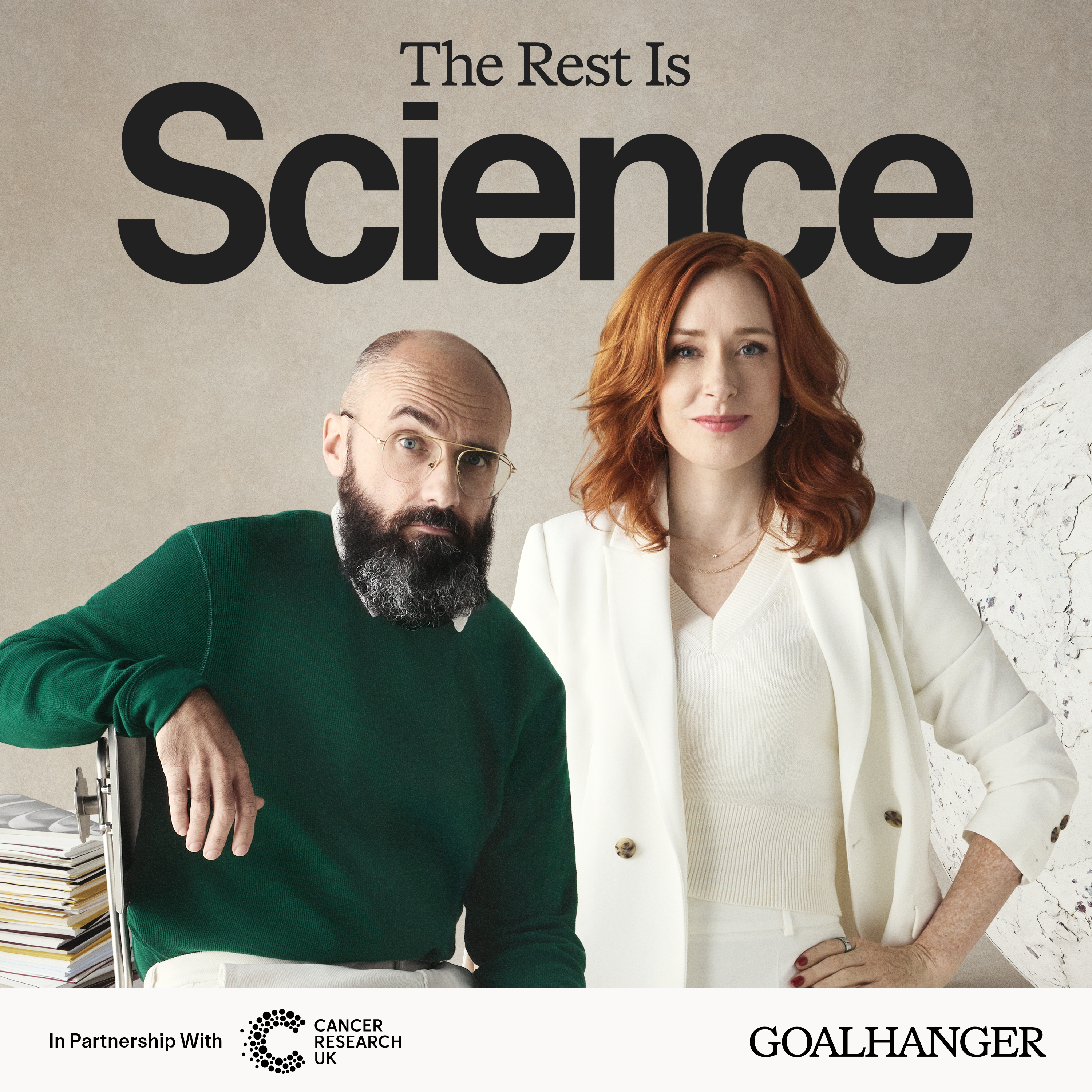
- The Rest Is Science
- What Was A Mammoth Doing At The Bottom Of The Sea?
In short
The episode explains why mammoth bones and other fossils are found dredged from the North Sea, using them to reconstruct Doggerland, a prehistoric land bridge that connected Britain to continental Europe, and how it likely vanished in a sudden tsunami about 8,000 years ago. It also discusses older evidence from Norfolk footprints and a “stank face” question about heavy music.
Guests
Hannah Fry and Michael Stevens (hosts). No additional guests are interviewed.
Key claims
Doggerland existed when mammoths, humans, and Neanderthals could move between regions; fishermen repeatedly brought up mammoth remains and other artifacts. Oil-and-gas 3D seismic surveys revealed valleys, estuaries, and forests under the North Sea. Geological cores suggest a major earthquake collapse and tsunami erased Doggerland. Norfolk footprints dated by magnetic reversal and other evidence suggest hominids outside Africa older than 780,000 years.
Notable examples
a mammoth vertebra dredged from the North Sea; a 50,000–70,000-year-old Neanderthal skull found in the same region; Neanderthal “cancer” mentioned as a cyst; 2013 Norfolk storm exposing estuary silt with humanoid footprints; levator labii superioris muscle linked to “stank face.”
Written by AI. May contain mistakes.
Chapters
0:45
Unveiling the Mammoth Vertebrae
Discussion about a mammoth vertebrae found at the bottom of the North Sea.
“I thought it was either going to be much heavier or much less heavy.”
5:11
Sponsor: Cancer Research UK
Promotional segment highlighting Cancer Research UK's advancements and support opportunities.
“It can help you with practically anything on the web, like restoring a vintage motorcycle from a 50-page restoration block, or finally break down that long article you've had open for weeks.”
5:41
The Lost Land of Doggerland
Exploration of Doggerland, its significance, and its connection to mammoths.
“It is the prehistoric landmass that used to connect the UK to continental Europe.”
6:37
The Catastrophic Event
Insights into the geological events that led to the submersion of Doggerland.
“the UK and Europe, the beginning of it started in about the 1930s.”
11:50
The Name and Legacy of Doggerland
Discussion about the origins of the name Doggerland and its historical context.
“Genuinely, I think there's something in that.”
14:01
Introduction to Doggerland and Mammoths
Learn about the historical significance of Doggerland and its connection to mammoths.
“It was 1989 when, oh, no, I do know why.”
15:01
Ancient Footprints and Geological Evidence
Explore the discovery of ancient humanoid footprints and the methods for dating them.
“it means that the river estuaries had a different structure.”
17:40
Questions About Hominids
Discuss the meanings of terms like 'hominids' and their implications in anthropology.
“To me, at least, it feels like an insult, right?”
18:22
Break and Auction Idea
The hosts introduce a light-hearted break and discuss a potential auction idea.
“Yeah, we could raise money for charity by auctioning off, as featured on The Rest is Science.”
20:17
The Nature of Coolness
Delve into the complexities of coolness and its cultural significance.
“I've been listening to the podcast for quite a while and I finally have a question for you that I can't seem to answer.”
Show all 15 chapters
23:11
Politeness vs. Coolness
Examine the differences between societal norms of politeness and coolness.
“But coolness is something that I think is only possible when your society starts to value individualism, creative work, cultural contributions.”
24:19
Influence of Music on Emotion
Investigate the phenomena of 'stank face' and its connection to musical experiences.
“They're like, I used to be a battalion commander.”
28:01
The Mystery of the Stank Face
Explore the phenomenon of the 'stank face' when listening to heavy music.
“Okay, should we go on to more cool things?”
33:34
Book Recommendations and Insights
Discover engaging book recommendations and their thought-provoking themes.
“are you reading right now uh i'm reading project hail mary it's really good it's really funny I mean, he's an amazing writer, isn't he?”
36:33
Terry Pratchett's Discworld Reflections
Delve into the philosophical themes of Terry Pratchett's Discworld series.
“I think I'm going to have to, this is one of the ones you're going to have to read with a highlighter in your hand.”

Ask about this episode
Get the gist, explore an idea or ask about something said.
 Claude
On The Rest Is Science, what are the key points of this episode?
Searching your listeningTranscript
Automatic transcript. May contain errors.
0:00Welcome to the rest of science. I'm Hannah Fry. And I'm Michael Stevens. I have just been on holiday for the summer. And while I was on holiday, I was, of course, thinking about you, Michael. And I saw something on a shelf in a shop and I was like, I know who would like that. Michael Stevens of Bezos fame. What is this? Can I hold it? Yes, you can. I want to guess. Are you going to lick it? I will if you tell me to. Oh, my gosh. It's more stony than I thought. I thought it was. Is it like a coral? I've handed Michael something that looks sort of like a cross between a stone and a bit of wood, I guess.
0:38Yes, it's like wood colored, but it's like a giant shape of a shark's tooth. Right. That's a nice way to put it. But it's not a shark's tooth. It's not a shark's tooth. How large is it? It's larger than my hand. And it's not that heavy. No. I thought it was either going to be much heavier or much less heavy. It's quite porous, isn't it? Yeah. It looks like it would be really porous, but it's denser than if it was wood. It's got quite organic shape to it. Is it bone? It is bone. Yeah. Okay. It's bone, but it's not a tooth. It's not a tooth. It looks like it's like a hip bone because it's so smooth here, like a ball joint.
1:14One section of it is very smooth. I don't think it is a hip joint, but you're getting close. Okay. I'm going to smell it. Mammalian? Mammalian. Yep. Female. No. What if I could smell a bone and tell that I just made that up as a joke? Amazing. Where did you go? I was in France. Oh, so yes. Jerry Lewis. I'll give you a bit more of that in a minute. Okay, let's think about this, right? It's an animal bone, a fossilized animal bone. How big is the animal? The animal's big. Right. How big? Bigger than a human. Correct. How big? Three times as big as a human. I'd say bigger. Really? I'd say really big.
1:58Like whale big? Dinosaur big? Well, it depends which dinosaur we're talking about. It depends. There's some chicken sized ones, I know. Mammal though. Stay on mammal. Land mammal. A land mammal. So elephant? You're closer. Rhinoceros. Bigger. Hippo? I mean, their name means big. Oh, a mammoth. Yes. Really? There's a mammoth vertebrae. Whoa, a vertebrae. Isn't that cool? That's so cool. Isn't that cool? Not a mastodon, a mammoth. A mammoth. A mammoth. A mammoth. Now, the thing that I think is - Oh, shoot. There's a sticker on here. I know, I took it off because I didn't want you to. But if I look, why did I not look closely?
2:41Because I can tell that that's the back of a mammoth. Yes. Oh, I would have looked like a genius if I noticed that. And I could have smelled it and been like, whoa, mammoth. Curve your hair. Yeah, it's a mammoth vertebrae. How amazing is that? That's amazing. Isn't it? Okay, now here's the thing, right? Let me tell you where it came from. This was dredged from the bottom of the North Sea. But that's water. Why is there mammoth detritus at the bottom of the North Sea? And this is what I really want to talk to you about. I want to talk to you about the secret lost land of Doggerland. Doggerland.
3:24Basically the silliest name of all time.
3:34This episode is brought to you by Cancer Research UK. All right, here's something really cool. The earliest written description of cancer that we've ever found is from an ancient Egyptian papyrus that was around before even Cleopatra was on the throne. It described tumors being removed by a tool that they called the fire drill, which we think was used to burn off disease tissue. Beating a disease that's so ancient and complex with over 200 different types, it's not going to happen overnight. But thanks to research, cancer treatment has advanced a lot. And Cancer Research UK is driving further innovations like cancer-sniffing robots and drugs made from gut bugs that could change the future of medicine.
4:16Over the past 50 years, Cancer Research UK's work has helped double cancer survival in the UK. And today it's continuing to save and improve lives around the world. For more information about Cancer Research UK, their research and breakthroughs, and how you can support them, visit cancerresearchuk.org slash rest is science. Fall has never looked or tasted this good. Sweet Greens Fall Harvest Menu is back with seasonal favorites dressed to impress and made to be devoured. Warm roasted sweet potatoes, crisp apples, maple glazed Brussels, and crave-worthy flavors in the autumn harvest bowl, maple glazed salmon plate, and roasted bacon Brussels side.
4:58The season's most desirable menu has returned to Sweetgreen, featuring fall's best dressed. Make your move. Order on the Sweetgreen app. This episode is brought to you by Google Chrome. You think you know a browser, but Gemini and Chrome? That's new. It can help you with practically anything on the web, like restoring a vintage motorcycle from a 50-page restoration block, or finally break down that long article you've had open for weeks. Gemini and Chrome is here for it. Ready to make anything online make sense? There's no place like Chrome. Check responses set up required, compatibility and availability varies 18+.
5:40I love the name though. I've heard it before. It is the prehistoric landmass that used to connect the UK to continental Europe. The British Isles used to be accessible to all the mammoths. So all the mammoths wandering across it. They could just wander to and fro. Now, somehow, I went through almost all of my life not knowing that the UK used to be a connected landmass with mainland Europe. Wasn't always an island. It wasn't always an island. And we are talking really recent. Yeah, because mammoths were around when humans were around. Yep. Oh, we're talking more recent than this. We're talking super recent that Doggerland disappeared into the sea.
6:24When? We'll get there, but really recently. Wow. I mean, put that in perspective. that was written about it. Okay, so the whole idea that there used to be this landmass between the UK and Europe, the beginning of it started in about the 1930s. So for generations, fishermen, when they've been trawling their nets in that part of the North Sea, they would bring up kind of all sorts of detritus, lots of mammoth, you know, limbs, teeth, that kind of thing. lots of reindeer antlers that sort of stuff so people sort of knew vaguely that there was something weird going on but but people just didn't really care about it right they sort of would just like chuck it on the fire use it as extra firewood yeah and then in the 1930s someone pulled up this reindeer horns that had been sharpened into a tool right and then yeah okay something's going on here yeah this is like this is evidence of there being a human here So this artifact was passed around from pillar to post, different museums.
7:27No one sort of wanted it. It kind of got kind of forgotten in the archives. But smartly, some people had the idea to test the mud that it had come surrounded in, specifically the pollen that was embedded within the mud. And what was interesting was that it was freshwater mud, which is like, well, how can this possibly, we're just taking it from the bottom of the ocean, of the sea. Of the salty sea. Of the salty sea. So over the years, like sort of nothing really happens. People are like, yeah, maybe there was some lost land there, but who really cares? But also while all of this was going on in Holland, what they would do when the trawlers would bring up all of this stuff, they would dump it onto beaches, which they need for their flood defences.
8:08And while all of that was going on, some paleontologists went through it and started finding really interesting objects in there, including a Neanderthal skull that had been sitting at the bottom of the North Sea. So now we know that there's humanoids down there somewhere. This particular Neanderthal, they aged him to be about 50 ,000 to 70 ,000 years old. Okay, so we're talking like long civilizations and he had a little cyst sitting above his right eyebrow, a little version of Neanderthal cancer. So all of this is going on, fishermen are like bringing up this stuff, being like, what, another Neanderthal skull?
8:48Like, what, another, like, woolly mammoth vertebrae? Whatever. Anyway, then in the late 90s, early noughties, it was the oil and gas industry. Oh, sure. Who finally demonstrated that there really was this lost land because they had been mapping the terrain of the North Sea for a really long time. The bit that they care about is further down, right? It's sort of beneath the superficial layers where there is pockets of oil and gas. But they had these 3D seismic surveys all across the North Sea. And when they looked at them, they realised there are hills and valleys and estuaries. There's like all of this incredibly detailed geographic terrain under there.
9:28They've got oak, there's elm, there's hazel, all of this stuff is growing in Doggerland. And that changes the mindset because people were like, well, maybe this is just a little rat run that comes between Europe and Britain when people were sort of escaping the ice age, they kind of ran across it. But the fact that all these forests, it actually looks like there was this abundance of life. It was like proper forest land. Proper forest land. So it's about, by the way, the North Sea average is about 95 meters. but the Doggerland half is about 40 meters deep. Wow, that is not deep. Not deep. If you told me it was eight miles deep, I would have said, yeah, sure.
10:06Yes, nothing. I mean, you could free dive that, right? 40 meters, that's it. 40 meters. Yeah, that makes more sense because you wouldn't have to have much change for that elevation change. I mean, obviously that's a big one. Like this was a quite cataclysmic geological event that erased Doggerland. It's even less, actually. Sorry, the western end is 15 meters below the surface. Fifteen. It's nothing. It's nothing. You could just walk across that. You could walk. And they did. And they did. It was higher up then, or there was less water in it. Less water. Quite a lot less water in it. Okay, so here's the thing, right?
10:43Now you know that there is this abundant land where humans and Neanderthals and mammoths and reindeer and forests were all present. Where the hell did it go? What happened? And it turns out there is more evidence in the geological record because in the north of the North Sea, this is like really recent research, by the way, we're talking like 2018 or so that people have fully established their stuff by taking cores from old rivers and then looking through them. It looks as though there was a continental shelf about the size of Scotland that there was a big earthquake and it collapsed. This gigantic volume of mass that just sank all at once and created a gigantic tsunami that came over and just wiped out Dockland.
11:38Just flushed that space, cutting off the British Isles from continental Europe. Exactly. Jeez. And this happened, by the way, about 8 ,000 years ago. Noah's flood. We found it. Noah's flood. I know. Genuinely, I think there's something in that. Because we know that there were people around there around that time. You know, you have like, you've got the French in the caves of like, sort of 15 ,000 years ago. They've been there for thousands of years by this point. You've got evidence of human settlements up in the north of Scotland. You definitely had people there. I mean, that is recent enough that it could survive in folklore.
12:198 ,000 years ago? 8 ,000 years ago. So like 6 ,000 BCE. Right. Wow. I mean, the thing is, people weren't writing yet. Agree. There was no history. This is prehistory. And yet it's, yeah, within, easily within oral tradition range. Mm-hmm. So the reason why we can be sure that this happened, incidentally, is that when you take these cores, sort of across this whole section in Northern Scotland in particular, but also across Norway, all around there, you see inland, you have evidence of human settlements. And then on top, there is sediment of like crushed seashells, as though the tsunami brought in this incredible amount of silt as it came.
13:07Right, right. And then you have more layers on top. There is some evidence, a little bit of evidence, that suggests that not all of Doggerland was swallowed at once, or that perhaps some of it came back and then sea levels rose and then sunk the rest of it. but this really was like I mean in one day it sort of disappeared. Wow imagine that you're you know living in where Penzance is now and you're like oh we've got to go down to Paris oh I hate traveling and you get your whole family ready and you're like an old you know a Neanderthal and you're like we gotta go and then you hear this rumbling like the ground shakes and then and you're like woohoo trips canceled.
13:49It's canceled yeah exactly. And your wife is like, oh, my parents. And you're like, oh, no, my in-laws. Now they're across an ocean. Guess we can't see you anymore. Dang. Oh, Doggerland. See you. Doggerland. Why is it called Doggerland? No, I don't know. It was 1989 when, oh, no, I do know why. That's not true. I do know why. It's because there's a place called Doggerbank, which is where medieval Dutch cod boats are doggers. Okay. Yeah, so it's named after a fishing vessel. Got it. And so mammoths were roaming around that land. Yes. In Doggerland. Earlier. Earlier than social. Earlier. But then this bone got covered up by water.
14:32Right. So this mammoth would have died in Doggerland when it was a land and laid there for many, many, many thousands of years, tens of thousands of years, no doubt. And then one day, a tsunami came and swallowed up the land that this had once stood on. And then, you know, over time, it sort of arisen to the surface and then was dredged up. How cool. And now it's come to you. Can I tell you my favourite thing about Doggerland of all though? Yeah. Okay, so the thing is, because the structure of the coastline of Britain was different, it means that the river estuaries had a different structure. So the Thames did not used to come out through London, it found its way out to the sea much further north through Norfolk.
15:16Okay, so in 2013, there was this storm, really big storm. This is a beach at Hapsoberg in Norfolk. Okay, so you're talking like quite far up just where the bend is. And this would have been maybe not quite inland, but it's sort of like on the edge of Doggerland. but as this storm came in it exposed this this layer of estuary silt that had human footprints in them oh or at least humanoid footprints yeah right so there's at least five people that have these footprints on had like been walking along this river bank uh adults and children by the way and they were like walking around and these muck flats that was the banks of the river thames and left these footprints in them.
16:01People have aged these footprints, tried to work out how old they are. The footprints themselves, they're just holes you can't really do anything about. Yeah. But when you look at the surrounding rock, you can look at the magnetic elements within it and you can demonstrate that this solidified before the last switch of the poles. Oh, cool. Right, so you know it's - You kind of date it before a switch. By the way, carbon dating does not work for this because the carbon dating fails after about 50 ,000 years. You've just got so few left that it doesn't really work. So it's too old. Older than 50 ,000 years.
16:39But the last magnetic switch happened 780 ,000 years ago. 780 ,000 years ago. So they're not the footprints of Homo sapiens. It's some other hominid ancestor. Exactly. Wow. You can also, there's other, there's voles that appear in the, in the sill, but sort of trapped in the sill. You can tell them apart. There's some that went extinct 600 ,000 years ago. So we know there's extra evidence that it's more than 600 ,000 years old. There's pollen also that you can work out where it is in a cycle. I mean, I don't really understand this pollen dating stuff that well, to be honest with you. But put together, the estimate for these footprints is somewhere between 990 ,000 years ago to 780 ,000 years ago, right?
17:35Which makes these the oldest evidence of humanoids. Is humanoids the right word? Hominids. Fine. Humanoid, I think… It's a bit robot-y, isn't it? It's also, I think, a bit like… To me, at least, it feels like an insult, right? like humanoid. Okay. Hominids. Okay. Hominid sounds more like, oh yeah. Yeah. You know, one of us. Okay. This is the oldest evidence of hominids outside of Africa and it's on a beach in Norfolk. I love thinking about history through our geology. That's going to live on a shelf in my house now. It's a beautiful specimen. It's so big. Yeah. You know, should we do some questions?
18:17Let's do some questions. We'll take a quick break. And when we come back, We'll provide some answers. Do you think one day we should do a Field Notes auction where we just get rid of all of our... That would be a good idea. Yeah, we could raise money for charity by auctioning off, as featured on The Rest is Science. I would empty my house out. My God. Here's a can of Diet Coke that Michael shook up a bunch. Okay. We'll start at$1 ,000.
18:52Brussels clean up nicely at Sweetgreen. Maple glazed, roasted, and edges perfectly caramelized. Sweetgreen's fall harvest is back on the menu, and the season's most overlooked little green vegetable is dressed to be devoured. You know what to do. Order on the Sweetgreen app.
19:12This episode is brought to you by Google Chrome. You think you know a browser, but Gemini and Chrome? That's new. It can help you with practically anything on the web, like restoring a vintage motorcycle from a 50-page restoration block or finally break down that long article you've had open for weeks. Gemini and Chrome is here for it. Ready to make anything online make sense? There's no place like Chrome. Check responses set up required compatibility and availability varies 18+. When you need to build up your team to handle the growing chaos at work, use Indeed Sponsored Jobs. It gives your job post the boost it needs to be seen and helps reach people with the right skills, certifications, and more.
19:49Spend less time searching and more time actually interviewing candidates who check all your boxes. Listeners of this show will get a$75 sponsored job credit at Indeed.com slash podcast. That's Indeed.com slash podcast. Terms and conditions apply. Need a hiring hero? This is a job for Indeed sponsored jobs.
20:15Okay, we're back from the break. We have some questions, right? Here's one for you, Michael. This is from Thule on email. I've been listening to the podcast for quite a while and I finally have a question for you that I can't seem to answer. Why does coolness vary so much, whereas the standards of politeness are more mutually agreed upon? How did a word, meaning cold, turn into resembling a whole attitude and a way of being insanely good? I have many questions here, but mainly, why is coolness a thing that we can't seem to agree on? We can't agree on politeness either. I agree. Do you know what?
20:50I disagree with the premise of the question. Oh, disagree is such a strong word. I'm intrigued by the premise and I'm very excited by all the thoughts it's producing in my head. Okay, there we go. Because coolness is really weird. In some ways, no, we can't agree on it. But in other ways, we agree on it in ways that are very puzzling. When you look at what cool means and you look at other words that are also quite recent in their meanings, coolness prevails over all of them. We have words like groovy and da bomb that come and go. But cool always stays. It doesn't become uncool. And I think it's because cool is describing something that is very real and not a temporary trend.
21:46But the word cool didn't emerge for what it means today until the early 1930s. Right. That's older than I was expecting. So it's not even 100 years old. But it has meant cool ever since then. No matter how many times things become uncool and new words for cool come about, it's always remained. But it wasn't a word that meant what it means today before like 1933. So why? Was there some other word that meant cool? Not really. You couldn't be cool in the modern sense before the 1930s. Okay. Because society, we don't know why, but I love investigating this. And I was, I got obsessed again when I was reading a Reddit thread about who, who was more influential, Britney Spears or Taylor Swift.
22:47And people were like, okay, thing is Taylor Swift just isn't cool. I didn't say I just am saying what I read. Okay, go on. And I was like, whoa, what does coolness mean? Because I kind of understand what they're saying. Now, to not be cool doesn't mean you aren't influential, important, relevant, all these things, successful. But coolness is something that I think is only possible when your society starts to value individualism, creative work, cultural contributions. It's no longer about your rank, your position, who you are because of birth. Now what matters is what you got. What new cognitive inventions do you have for us?
23:37But it's not the same as creativity. coolness is this kind of like i fit within the current schemes but yet i'm pushing them just enough and i'm doing it in a very comfortable way i'm not goofy i'm not way out here i'm just different enough and comfortable enough that i'm fitting in but i'm not in right okay it's in a way That people want to follow you rather than that you're following other people. Exactly. You are a leader, but you're not trying to be a leader because that's too normal. That's not cool. That's not cool. That's exactly what old my old grandpas do. They're like, I used to be a battalion commander.
24:25No, no, no. The new leaders were these leaders of expression. And of course, the word cool came from the African-American community in America. I'm not surprised. Exactly. It was in many ways this like, okay, there's this schema. There is this world around me that is not friendly and I can fight it or I can fight it in this cool way. And so that's where we get cool pose where you're just like not phased, effortless. And these are behaviors that did not mean anything or matter or do anything prior to the early 1900s. So politeness, that changes generation to generation. And country to country. I mean, I remember going to Japan and we had this whole fixer and basically his job was to travel, filming with a crew.
25:19And his job, as far as I could work out, was to follow us around and tell us when we were being impolite. And no intention of being, but we were just impolite. That guy could have had that job 500 years ago. Politeness, what isn't is not polite, changes all the time. But what is cool and not cool changes all the time. But the fact that politeness and coolness always mean something is important. But the fact that coolness did not exist 500 years ago, 700 years ago, 200 years ago, tells us a lot about how our societies have changed. I hear what you're saying about the word didn't exist. But in terms of the concept, Like, I think, I don't know, Mozart's pretty cool, wasn't he?
26:04Sort of. You're a nerd. Now, he may have been a rapscallion. He may, he was influential. You know, he was, he was daring. He was, he pushed the boundaries of etiquette. But also, I think people wanted to be associated with him, wanted to be. Of course, of course, they admired him. They aspired to be like him. but he wasn't cool. Okay. I wonder about the word, right? So I guess for me, I would add in that there is a certain authenticity to coolness where you as an individual are unapologetically a really honest version of yourself. Correct. And I think the unapologetic part is important. So I always thought that that was, I don't know there's something in the way that the word reflects that that while everything around you is warm and sort of sharing its own temperature you're standing out from the crowd ever so slightly yes you aren't trying because to try it's too in schema it's too protestant work ethic it's too that's what everyone's always been doing and we all can do that yeah but if you're cool you are flying by effortlessly it's just who i am i don't even think about it you're you're pretty cool you are pretty cool thank you you're pretty cool and i aspire to be cool because what else could i possibly be the strongest no i mean you could be i could be you could be how in In what way?
27:48In a really narrowly defined group. Let me ask you this, though. Could I be the coolest? Doesn't matter. I don't care. And that's the coolest thing you've said. Okay, should we go on to more cool things? All right, here's a question from Sean, who says, Something that occasionally fascinates me is the so-called stank face. What is it about certain kinds of bass or heavy music that make our faces scrunch up like that okay the stank face we should probably explain this because i didn't know it was called this i didn't either but i know exactly what he's talking about go on do the stank face okay so you listen to some really heavy yeah it's almost like your your face recoils in disgust it's not a disgust face at least for me it feels more like a like a strong face right yeah like i'm a warrior yeah okay like you're ready to go into battle yeah okay so i had a look into this there is there is very little evidence uh or research into why this happens but it does appear to be quite universal i know i make the face yeah um it's something that does happen and when you're listening to mozart you're like oh yeah you're so cool look mozart can be cool to us but he could not be cool in the same way to his contemporaries how dare you mozart is is super cool okay so it's one it's one muscle in particular it's called the levator labi superioris ala que nazi oh that one how was that for latin uh it translates as the elevator of the upper lip and the wing of the nose.
29:29But exactly. That's it. That's it. That one. Yeah. Okay. So, uh, I mean, why on earth you, that particular muscle gets triggered? It's, it's like sort of a bit of a mystery. So there's, there's definitely reasons why that kind of music might end up having a physical reaction to us. So, um, there's this idea that you've got like these really low bases or you've got this kind of heavy distortion that it can create this cross modal response in the brain where you're like, that's filthy, yeah! Right? So your body is like, ugh. So it's related to disgust under this hypothesis. Mm-hmm. Maybe not like, ugh, but like, yeah.
30:14Yeah, yeah. Yeah. Or there's also this idea that it's like benign masochism, that it's sort of like a pleasurable pain. Yeah, this is bad, but I'm enjoying it. Right. Exactly. Oh, interesting. Yeah. I mean, the reason why you go on roller faces, essentially, the reason why you might eat chili peppers, that kind of thing, like, I'm just enjoying. I'm going to write this down because I'm working on a theory of humor. okay and it's bedrock is the classic uh benign violation theory that things are funny when they're bad but okay that's so wrong but it's safe yes and so stank face being a benign masochism i wonder if there's a line between them maybe dubstep and jerry seinfeld have something in common.
31:06Maybe they do. Maybe they do. There's also this idea that it's like, because your brain's this big prediction engine, it's like working out what's coming next, and then you are delighted by surprise. So there's an idea that when you're listening to like really heavy music, you're sort of expecting this like synchronicity to happen. And then when it changes, you're like, oh yeah that feels good yeah i never went to a single live event i went to a skrillex concert did you yeah it was like a surprise concert with noisy the uh the vice vice magazine had noisy they're like music right and they loaded us all into a bus and they took us to this like secret location we didn't even know who the performer was going to be and it was skrillex this was in 2009 I actually, weirdly enough, I think I did an episode about coolness, like the history of the concept of cool.
32:07And I included footage of myself at the Skrillex concert in that video. This is all coming together. All these years later, let's come back. Let's come back. There's also this idea about bass on its own. Why am I doing the music question? This doesn't make any sense. No, this is very fun. You're enjoying it. You're like, well, you know, bass like Mozart. Did you know the cool musicians like... You know, dubstep, it's kind of like Mozart. Can you name an artist that's made music after Mozart? Yeah. Okay, go ahead. Vivaldi? I don't actually know. Was Vivaldi after Mozart? Yeah, yeah, yeah. See, you do know that.
32:52I'm not hating on that. Vivaldi is amazing. four seasons like yeah man it's incredible that is stank face territory it's you know my first the very first cds i was ever allowed to have were classical thunder right it was a collection of four cds that had like the most stanky classical music it had like the overture of 1812 where there's like cannons in the music yeah it had beethoven's fifth amazing yeah all these like oh yeah and it had one of vivaldi's songs like a really fast one spring maybe or summer spring yeah yeah i loved it it's honestly i i love that shit i love that shit i do too okay last question this one's from robin what are you reading right now oh a nice little breezy cue i love this cute one at the end what are you reading right now uh i'm reading project hail mary it's really good it's really funny I mean, he's an amazing writer, isn't he?
33:47I never actually read The Martian, but I'm really enjoying Project Hail Mary. It's also, the bit I really like about it is that he just makes these little maths jokes all the way through. Ah, yeah. And I'm like, that makes you feel clever to get them. Okay. I haven't read it, so I'll have to read this because - It's good. It's really good. Yeah. Like, it starts off, this isn't giving anything away, but it starts off and he sort of wakes up in this laboratory and he's like no one's around and he's like something weird is going on and i can't work out what it is and it's how he works out that gravity isn't what it should be oh so he's like trying to work out yeah it's great it's really great but it's all all the science is really really really good how great how about you i just finished a book this morning actually i finished reaper man by terry pratchett oh yeah disc world novels yeah it's it's I love the books that are quite silly, but they contain like really good insights into the human condition just as little asides.
34:54So I write down like all these quotes. And so I brought soul music with me. I'm going to read that one next. They like there are such great psychological, scientific and philosophical scenarios in them. One is that, okay, so the premise of Reaper Man is that death has been asked to retire. The Grim Reaper, right, is this personification of death that visits people, helps their souls get out of the way, go on to the afterlife. And he's asked to retire. But in the interim between deaths, there's no one to help the souls. And this one guy dies and he's like, what the heck? Where do I go? So he goes back into his body and he controls his body.
35:37but his body's dead and so he has to control every part of it and he's like oh crap like it's only now that i'm realizing how much of my existence was done by automatic processes um it's pretty easy for me to walk because it's there's like pretty obvious like nerves that are pull which muscle but breathing digestion like what what does a spleen do and how do i make it do that he doesn't know he's trying to like operate this body completely under conscious control and it's just this amazing like uh thought experiment that shows you how little of of you is you it's mainly being done for you and you're just along for the ride oh i like that so much it sort of taps into your your soul music thing it's like there's an element of consciousness going on there right exactly exactly and then i think i'm going to read mind over matter next this is the one i brought this is by casey cole she wrote the universe in the teacup which i read like a decade ago and i loved that book so much um i even discussed it in some vsauce episodes years ago and i found that in a thrift shop and i'm like casey cool she wrote more books and it's not even a new book but i'm very excited to read it because it looks like it's pretty mind-blowing yeah that looks good i've got the next one on my list it's arriving today it's called straw dogs uh and it's by john gray have you come across this one that's yeah it sounds familiar yeah so it's um it's all about the idea about uh human beings their place in the world it's sort of very philosophical um about sort of i think trying to challenge our assumptions about what it means to be human oh how'd you hear about it um someone told me about it last week and we're like, oh, you can just gobble this in a weekend.
37:33It might be quite hard. You'll be fine. But for me, it might be quite hard. I think I'm going to have to, this is one of the ones you're going to have to read with a highlighter in your hand. Yeah, that's the best way to read. Lauren, our producer is looking at me scathingly that I could possibly put a mark in a book. I put marks in nonfiction books, but in the fiction ones, I just, I copy down the exact, there's some cats that my daughter drew but copy down whole bits because i they're just kind of long and then i can add my own thoughts to it um i'm trying to see if there's anything particularly cool from what i just read man sometimes i go so off the rails i'll be like oh oh that makes me think of this idea i've been oh here's one they're describing this woman named Mrs.
38:23Cake, and she's a medium. She can talk to the dead. And a lot of the other religions in Discworld believe that that's sinful. So they say that whenever she's told that she's wrong by a priest, she gives them a piece of her mind. There were so many pieces of Mrs. Cake's mind left around the city now that it was quite surprising that there was enough left to power Mrs. Cake. But strangely enough, the more pieces of her mind she gave away, the more there seemed to be left. And I'm like, that's a funny way of describing what I think gave us our sense of selves. It was sharing it. When you have to communicate what's in here, you actually define yourself.
39:02And so it was giving people a piece of our mind, both in an angry sense, but also in the sense of, whoa, you know what I just saw that you didn't see? That we developed from being this eusocial sort of selfless not human to the incredibly interiorly active humans that we are today that are self-conscious and that have wills and desires and are alone in our own minds. and it just came from that little joke about Mrs. Cake. So that's what I love about the Discworld books. They're just like the richest. Endless fun. I shouldn't read them. The jokes are good. I'll recommend one to you after I've read a bunch, but I'm reading all the death, all the death ones that are all about death.
39:48In the first book, he needs to get an apprentice. And then I think in this next one, I'm going to read his apprentice and his daughter. He has a daughter because he like spared this baby's life and raised it and now it's his daughter. So there's a kind of plant, there's a kind of tree in Discworld that are called the counting pines because they realized or they thought that humans were cutting them down in order to figure out how old they were to count the rings. As soon as the trees learned that we count rings to see how old a tree is, they thought that that's why they were being cut down. So they evolved to display their age on their bark.
40:26It's big numbers. but that did not save them it just turned them into people got even more excited to cut them down for the address plate business of like okay what's your address and you went and you found the trees that had those numbers on its bark and cut them down he was amazing terry prudy was just amazing yeah just amazing all right to wrap it up let's wrap it up let's wrap it up by saying you guys are amazing as well send us in your questions your thoughts your concerns your fears and your hopes. The rest is science at goal hanger.com. Well, I don't know about you, but I'm hoping to find some coolness somewhere.
41:07You can also check us out on our Reddit, r slash the rest is science, or leave us a comment wherever you are watching, listening to this, or send us an email or stop us in the street, or just shout really loudly and hope that one of us will be walking past it close enough to hear you anywhere you want to get in touch. But we will see you next time.
41:56We'll see you next time.
42:25We'll be right back. $20 MyLows Money. Use it to save on your next Lows Hall. Exclusions, restrictions, and more terms apply. See Lows.com slash MyLowsMoneyDays for details. MyLows Money expires 30 days after issuance. Subject to change. Credit offer subject to credit approval. Your heart can tell you a lot about your health. Apple Watch Series 12 measures your heart rate every five seconds with the most accurate heart rate sensing in a wearable. So your Vitals app, now with heart rate variability, can tell you when something is off. and your readiness score can let you know when to rest and when to push.
42:58Hear the story in every heartbeat with Apple Watch Series 12. The features described are for wellness purposes only and not for medical use. iPhone 11 or later required. Based on Apple conducted study of heart rate accuracy, August 2026. Visit apple.com slash apple watch series 12.
From the publisher
Hannah surprises Michael with a mammoth bone from Doggerland, the lost Ice Age land that once joined Britain to mainland Europe, and now lies beneath the North Sea. Who lived there, what roamed it, and how did an entire landscape disappear under the waves?Then it's your questions: where did "cool" come from as a word for style, and how did it stick around for so long? What on earth is "skank face"? And what are Hannah and Michael reading right now?-------------------For more information about Cancer Research UK, their research, breakthroughs and how you can support them, visit https://cancerresearchuk.org/restisscienceCancer Research UK is a registered charity in England and Wales (1089464), Scotland (SC041666), the Isle of Man (1103) and Jersey (247). A company limited by guarantee. Registered company in England and Wales (4325234) and the Isle of Man (5713F). Registered address: 2 Redman Place, London, E20 1JQ.-------------------Find The Rest Is Science all over the internet by clicking here.-------------------Video Producer: Adam Thornton + Oli Oakley + Jack MeekAnimator: Sam BensonVideo & Social: Bex TyrrellAssistant Producer: Lucy LipscombeProducer: Simona RataSenior Producer: Lauren Armstrong-CarterChief Digital Officer: Samuel OakleyExec Producer: Neil Fearn
Learn more about your ad choices. Visit podcastchoices.com/adchoices
More from The Rest Is Science
All episodesWe use cookies.They keep VO running smoothly and help us improve it. Privacy policy