Ask ChatGPT
 The Speed of Culture Podcast
25 Aug 2026 · 28m · 16 chapters
Heineken’s brand-building approach to staying authentic while evolving with changing consumer culture—especially real-life socializing, fandom, collectibles/nostalgia, and the growing non-alcoholic beer category. The episode also covers media mix (creators/influencers), AI’s role in speeding creative development and reporting, and what CMO attention is triggered by.
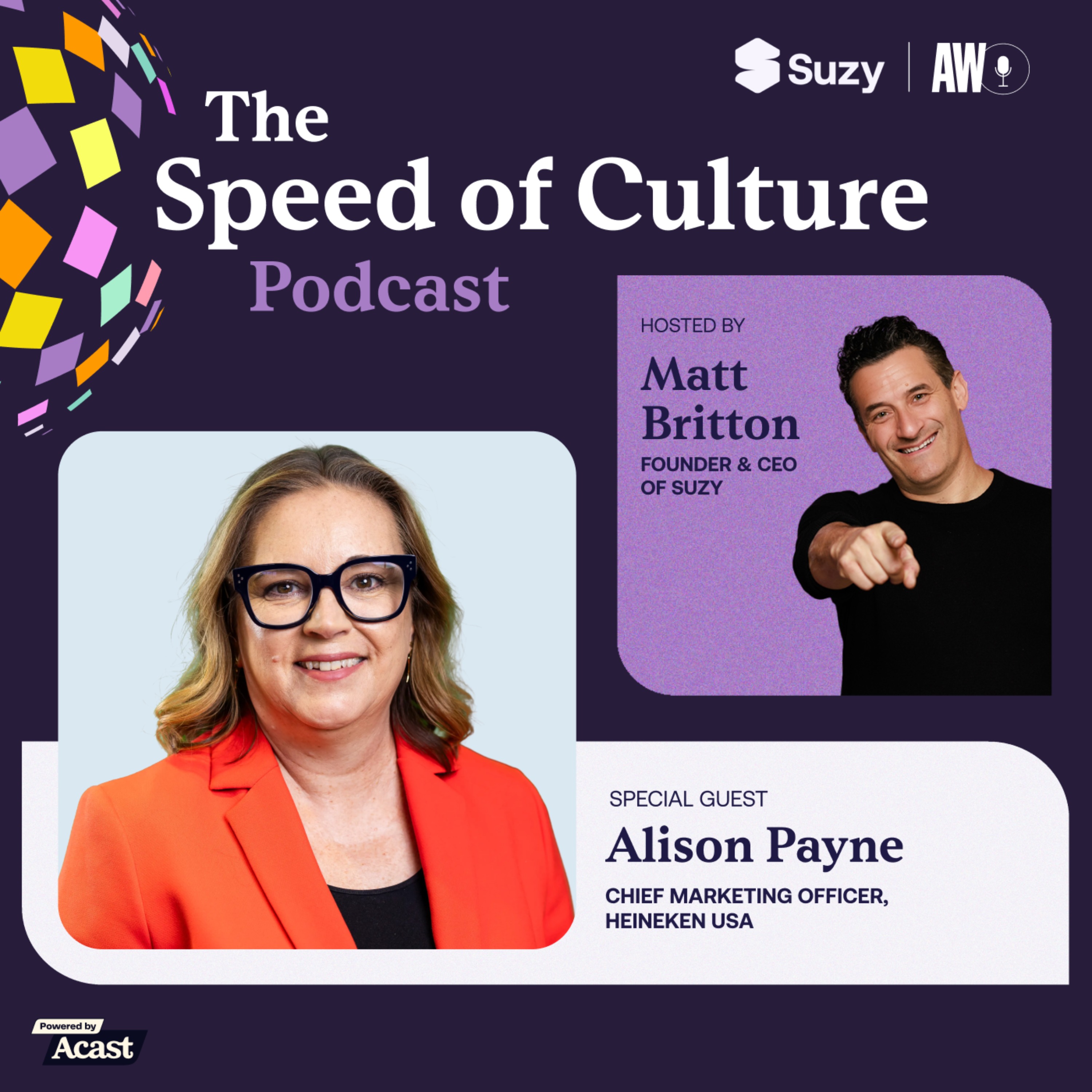
Alison Payne, Chief Marketing Officer, Heineken USA. Career includes growing Guinness, Smirnoff, Lay’s, Doritos, and Special K, and leading marketing for Heineken’s fan culture, experimental marketing, and non-alcoholic beer.
Don’t stretch into cultural conversations beyond where the brand should play; keep brand pillars while evolving. Experiences matter “before/during/after,” not just logo sponsorship. Fans statistically have more friends; fandom drives social connection. AI should accelerate ideation and summaries, not create “fake” real-life moments.
Heineken 00 + Max Verstappen/Player 00 gaming activations; US Open “Second Serve Tickets” VIP competition with Serena Williams; Heineken Grand Central Station sampling; “Fans Have More Friends” launched around World Cup; Heineken Zero Zero “zebra striping” and “social marathoning”; mini kegs/slimline cans; Pier 17 zebra-stripe cup activation.
Written by AI. May contain mistakes.
Discussion on brand authenticity and consumer trends with Matt Britton.
Introduction of Alison Payne, CMO of Heineken USA, and her background.
“Join me and key industry leaders as we dive deep into the shifting consumer trends within their industry, why it matters now, and how you can keep up.”
Alison discusses the evolution of Heineken's brand identity in relation to consumer behavior.
“You've helped grow brands across beer and spirits and food and wellness in so many different categories.”
Exploration of Heineken’s focus on real-life experiences in marketing.
“And of course, socializing in real life is making a raging comeback right now.”
Discussing Gen Z's spending habits and their love for experiences.
“obviously we're in the summer concert series is now like there are more people going to more events in real life than ever before.”
Heineken’s strategies for engaging fans at events like Coachella and the US Open.
“So for example, like at Coachella, even if we're sponsors, it's moved beyond being what I call a badge sponsor.”
Discussion on why Heineken invests in the US Open and its significance.
“It's a bit like people scrapbooking their memories and things like that.”
Alison explains Heineken's 'Fans Have More Friends' campaign and its insights.
“events that happen during the heart of a busy season professionally.”
Heineken's approach to media mix and emerging trends in advertising.
“Given the changes in media consumption across the core beer drinking audience, I guess every brand defines it differently.”
Explore how Heineken utilizes AI to enhance creativity and efficiency in marketing.
“Snapchat said that any, what they call AI slop or any AI created content, they're just not even let on the platform at all.”
The host riffs on whether packaging should count among the marketing Ps before turning to how packaging matters in a guest's category.
“I don't know if this is one of the Ps, but maybe it should.”
Analyze the significance of packaging and the rise of non-alcoholic beer.
“to a bodega in New York City and boom, that's what they see.”
Gain insights into what catches a CMO's attention for potential collaborations.
“So I would imagine there's still more room to run as the category grows through innovation in the category.”
Explore practical insights on marketing execution and creativity in brand management.
“shows up when you're sitting in a bar or you're walking the supermarket aisle of a Publix or a 7-Eleven store.”
Learn valuable career strategies and reflections from a CMO's journey in marketing.
“Thanks again for taking the time to do it today.”
Understand the importance of nurturing creativity within large organizations.
“The bigger the organization, the bigger the teams, the easier it is to lose sight of creativity and kill by committee and those sort of things.”

Get the gist, explore an idea or ask about something said.
 Claude
On The Speed of Culture Podcast, what are the key points of this episode?
Searching your listeningAutomatic transcript. May contain errors.
0:00Suzy: Brand Week is back September 15th through the 17th in downtown Atlanta. And if you're serious about where marketing is going, this is the room for you. I'm Jenny Rooney, Chief Brand and Community Officer at Adweek. And for three days, we're bringing together the sharpest minds in marketing for the ideas, insights and connections shaping what comes next for brands. From culture and creativity to growth, leadership, and consumer behavior, Brand Week is where brand leaders come to think bigger, connect deeper, and leave with a clearer plan for what's ahead. Get your tickets now at brandweek.com and use code BW26 for 20 % off.
0:36Suzy: That's brandweek.com, code BW26.
0:43Suzy: That sound could mean a lot of things.
0:49Suzy: can be figuring out what the problem actually is. At Thumbtack, you can upload a voice message or a photo, and our AI-powered search will help diagnose your project. Plus, the pros we know have over 14 million five-star reviews, so you can hire with confidence. Thumbtack. We know homes. Hire the right pro today.
1:13Suzy: Blowing ad budget on metrics that look great till the CFO sees them, that's bull spend. and marketers are calling it out in dashboard confessions. I remember telling my boss, it'll be good for the brand when leads were slow. Yeah, it wasn't. Cut the bull spend. LinkedIn lets you target by company, job title, and more. Advertise on LinkedIn. Spend$250 on your first campaign and get a$250 credit. Go to linkedin.com slash campaign terms and conditions apply. the key thing for me is to sort of really be true to what the brand stands for consumer trends are changing but if you try and sort of stretch a brand or wade into a cultural conversation that really is beyond where your brand should play i think it's inauthentic so it's about being moving with the times but making sure you're very true to what the brand stands for to thrive in a rapidly evolving landscape brands must move in an ever-increasing pace I'm Matt Britton, founder and CEO of Suzy.
2:14Suzy: Join me and key industry leaders as we dive deep into the shifting consumer trends within their industry, why it matters now, and how you can keep up. Welcome to the Speed of Culture.
2:28Suzy: Up today on the Speed of Culture podcast, we are thrilled to welcome Alison Payne, the Chief Marketing Officer at Heineken USA. Alison has spent her career growing some of the world's most iconic brands from Guinness and Smearoth to Lay's Doritos and Special K and now Heineken. Today, she leads marketing for one of the world's largest beer companies, helping shape the future of fan culture, experimental marketing, and the rapidly growing non-alcoholic beer category. Allison, so great to see you. Yeah, hi, Matt. Great to be here. Absolutely. You've helped grow brands across beer and spirits and food and wellness in so many different categories.
3:00Suzy: What would you say has consistently guided your approach to brand building over your career? The key thing for me, I think, in any category I've worked in is to sort of really be true to what the brand stands for. consumer trends are changing. But if you try and sort of stretch a brand or wade into a cultural conversation that really is beyond where your brand should play, I think it's inauthentic. So it's about being moving with the times, but making sure you're very true to what the brand stands for, I think is the key thing. Yeah, of course, as times change, sometimes I guess you do have to look at from time to time the brand pillars to the extent they need to evolve.
3:36Suzy: When do you know it's time to sort of evolve what a brand stands for based upon changes in culture and of course the consumer and their preferences. Yeah, look, I think if you look at our category in beer with the Heineken brand, for example, we're seeing ways that consumers are changing. They change the way they socialize. Like how I used to socialize back when I was a university student is very different from how my kids are socializing today. And I think that's how we've evolved. It's either via offering options, like non-alcoholic options obviously the degree to moderation for consumers is very important or where we show up things like gaming have become an important part of socializing and we've entered into that space with say Heineken 00 and Player 00 and Max Verstappen and some of the activations we've done there we still do really encourage socializing in real life but I think it's how we show up is slightly different based on where consumers have moved to in the way they get together.
4:40Suzy: Yeah. And of course, socializing in real life is making a raging comeback right now. Like there was a time during COVID when everyone was saying, oh, people are never going to go to a sold out concert again. And obviously that proved to be anything but the truth. And I know that Heineken's brand for a very long time has been synonymous with real life experiences. Talk to me about why that's so important. I understand what you're saying earlier about gaming and obviously at the same extent people are on their phones they're playing games but Heineken I feel like it's so many great events I've been to it's been there and it's been there in a big way why is that so important to the brand?
5:14Yeah look I mean I think at our heart where if we go back to Freddie Heineken the founder he said we don't sell beer we sell good times and that is absolutely at the core of what Heineken stands for so as we move forward it's about how do you you know ensure that every we call it a we believe in a refreshing social life that is enhanced by a cheers over a Heineken. So yes, you will see us show up at events like Coachella, Formula One, we celebrate fandom. US Open is coming up in New York City in a couple of weeks. That's about getting fans together over the common lovers of tennis. Yeah, so it's critically important to us.
5:50And you're right. I think post-COVID, everyone sort of hunkered down in their homes and got a little bit homebody-like. I think we're seeing a real resurgence in wanting to get together. It's about quality time though. It's not about when they go out, they want to really want to make it count and really want to make it matter. And you'll just see like, obviously we're in the summer concert series is now like there are more people going to more events in real life than ever before. And I think that's where we can be with the Heineken.
6:16Suzy: Yeah, it's incredible. I mean, I just did an interview last week with NPR and there was a stat that Gen Z relative to their savings spends way more than any other generation. It doesn't surprise me. I think one part of it is that these generations have grown up watching everyone else's highlight reels over Instagram. Obviously, there's a case to be made for saving. And when you juxtapose that against baby boomers who grew up in the shadows of World War II and the Great Depression, this generation is not afraid to go out, not afraid to spend their money. And I think there's a case to be made for that, obviously, in moderation, just like anything else.
6:50Suzy: But are you seeing just a lot of demand from this youth generation for experiences? And obviously, I would imagine that provides a lot of air cover for the brand and everything you're doing there. Exactly right. But I think it's experiences in its broader sense. So for example, like at Coachella, even if we're sponsors, it's moved beyond being what I call a badge sponsor. Slap your logo on. Put up your logo on a banner and that's it. Call it a day. Exactly. And in the event, you sort of have a presence. There's now the lead up, the social conversation before what people are wearing, who they're going to see, the backstory on the artists or the sportsmen or sportswomen, that all come part of the cultural conversation.
7:32Then there's the event itself. And then there's all the posting afterwards, like how it was. And that's where we sort of ride with our consumer along that sort of before, during and after journey. US Open is a perfect example. We've got this competition right now where you can win a VIP event to come to the US Open if you've been a ticket collector holder from past tickets where Serena Wayans is our ambassador. She won the U.S. Open six times and people collect tickets. If you have an iconic ticket from the U.S. Open, you have a chance to enter into a drawer and be attend a VIP event at the U.S.
8:07Open. So it's that sort of thing. Competitions, fan engagement, a lot of conversation around who's kept tickets, like you can see on our social media feeds. Oh, wow. You know, I have tickets from way back.
8:18Suzy: Yeah. I love that campaign. The campaign Second Serve Tickets. And I think Like, what's cool about that is that I think it really taps into a lot of key, I think, big drivers of the consumer zeitgeist right now, one of which is this notion of nostalgia, obviously, and collectibles. You know, there were a huge event called the National in Chicago that happened a couple weeks ago, and tens of thousands of people came in right before there was Fanatics Fest in New York. Collectibles are huge. And so it plays into that, and nostalgia, collectibles, and obviously fandom, which we'll talk about in a second.
8:49Suzy: in and you're hitting it the right time with the right athlete. And I think that's a good example of, I think, how a brand can really ride the wave, but still stay true to its brand equity pillars. Yeah, exactly. You're so right about collectibles. I mean, we have another brand in our portfolio of Dos Equis where we have the most interesting man. We've brought him back and we've got iconic bobbleheads that are out in stores and things. People love to steal them, collect them. But also at the U.S. Open, we've got limited edition cans with each famous ticket from the six U.S. Opens at Serena One, you know, and it's all those things that add like a memory.
9:24It's a bit like people scrapbooking their memories and things like that. So it is very important. And I think it is about that in real life moment is so important that people want to capture it, remember it, share it with people. And that's how we sort of capture the whole thing.
9:38Suzy: And of course, the U.S. Open itself is such an iconic event. And it happens right before the back to school season. It's in New York and it's always like a gazillion degrees, but everybody's watching it. What goes behind the decision to invest in a property like the U.S. Open relative to all the other options that you have? Yeah, look, it's a combination where, as I said, we've been sponsors for close to 30 years. So it has been very much part of the Heineken brand in the U.S. New York is one of our biggest markets. Like it's where it was the first imported beer after Prohibition landing on the docks in New York City.
10:14So Heineken's Heartland is in New York. So it's sort of in many ways a match made in heaven there. And as we said, look, we really activate. We've taken over Grand Central Station with sampling for people who are heading to the US Open. And it really does dominate sort of New York social calendar for a whole three weeks. So yeah, and it's an important beer drinking occasion for us. People go there, they love a beer whilst watching the tennis. So it's sort of, I guess, it ticks a lot of boxes for us.
10:42Suzy: It really does. It's also during the time when a lot of people in America, at least, they're not working as hard. They tend to take off. So they're more likely to be able to sit around with their family and watch the U.S. Open than maybe some other sporting events that happen during the heart of a busy season professionally. Yes, exactly. And a lot of the great games are in the late afternoon. So people go drop in after work. And so it really, It's such a great event. Another platform that you're getting behind relative to US Open is this Fans Have More Friends platform. And behind that, it's really about fandom.
11:15Suzy: And we talked about collectibles and nostalgia and great athletes like Serena Williams. Talk to me about that campaign and why Hannigan's so excited about it. Yeah. So look, it's based off a very core insight, which is that people who are fans of something actually do statistically have more friends. And it's because you are following something. You're generally interesting, right? You're generally interesting. And we've moved a lot as a family. My husband is a lifelong Arsenal supporter. And wherever we've moved, whatever country we've been, he's always found Arsenal supporters. And you can roll up to a bar and if the Arsenal gains on and you don't know a soul, you can chat to the person next to you who's an Arsenal fan and you're sort of your buddies by the end, right?
11:57And so it's really based on that insight, which is you do have more friends and getting together over a common interest and a beer is really what it's all about. And it's been very successful. We sort of launched it during the World Cup here in the U.S. across all the major cities. We were not the official sponsor, but it enabled us to really get behind the fans. I mean, you saw what the fans did in the U.S., the fans of each country, you know, the ultimate, like with the Norwegians doing their rowing, the Dutch doing their left, right, left, right, left, right.
12:27Suzy: Did you see in Boston, apparently there was no beer left in Boston when Norway was flying there? Exactly. Yeah. The Scots, the Tartan Army drank Boston dry and sort of we came to the rescue and delivered the Heineken kegs to Boston. So, yeah, like the fans of the country, because there's no more bigger fandom than your own country, right, really showed what I guess really brought that insight to life for us. And we were able to sort of really jump in and participate in that and support the fans. It's not more than anything. Yeah. Given the changes in media consumption across the core beer drinking audience, I guess every brand defines it differently.
13:03Suzy: But for Heineken, how are you looking at your media mix? How are you looking at emerging trends like creators and make sure you're in the social feed and content versus tried and true traditional above the line advertising, which Heineken obviously has leaned in to build such a globally recognized brand? Yeah, look, I think you're right. There is a massive change in the media landscape. I think live sports is probably one of the few where you get the eyeballs on TV. But beyond that, yes, we do engage with creators. We try and build relationships with loyal influencers who can represent the brand.
13:37And this is where we have used the fandom platform, you know, so fans of the brand, fans of Formula One, for example, we engage with fans of US Open. So yeah, we've definitely swung our media mix to more creator influencer content.
13:53Suzy: Yeah. And I think it's going to be interesting to see in this world of AI content as it gets better and better, what happens to the creator economy. And I think I saw that, I think it was Snapchat said that any, what they call AI slop or any AI created content, they're just not even let on the platform at all. So, I mean, what's your take on AI as part of the creative process? Where is Heideken using it? Will Heideken ever use AI to actually create content? Or where is it used from, I guess, top to bottom within your organization when it comes to content? Yeah, it's fun. We just literally had a discussion around this today because, yes, especially because AI has evolved dramatically when I was looking at it maybe three years ago.
14:30Even creating visual content, right, versus like summarizing Word documents and things. You know, people had 15 digits and all these sort of things. And you're like, well, this is never going to work. But it has evolved significantly. we do have some guidelines around because we promote things in real life you want things to be it's real you don't want a scenario of people cheersing over a beer and they're like they're not real you know we've manufactured these people through ai but where it does play a role for us is actually getting to a creative idea or cracking a creative idea faster we can simulate what the content may look like very quickly show it in front of some consumers get some very quick reads to then be go, look, you know what, this is worthwhile investing some real production money in.
15:18So we've sort of like our speed to content creation has got shorter to enable us actually to sweat the stuff that really matters. And as I said, it helps also the brand teams do all the busy work, summarizing brand performance. Marketeers, no joke, do a lot of stuff that isn't content creation and isn't a lot of marketing. It's a lot of reporting on performance. It's a If AI can help sort of do that busy work, it enables us to be actually much more creative and spend time on those things that really count. So that's how I see it evolving for us.
15:50Suzy: And with that, I mean, obviously, Heineken has a world-class team. So in order for you to find the next generation of leaders who will continue to propel your brand forward, what are some of the skill sets that you're looking for as CMO based upon the power of AI and all the innovations we've discussed that you think are incredibly important? Yeah, look, the skill set for a marketeer, I think they have to be certainly agile. It's very strategic, but agile and actually not afraid to take some calculated risks and test some things. We sort of have to throw ourselves into some of this stuff and say, hey, let's give it a go.
16:23I was just on, we have an in-house creative agency and we were just on talking about, we did a set of tests. Hey, look, AI can be used from swapping out a bottle in this scenario, you know, into someone's hand versus all the way to sort of pure video creation. Let's see, hey, where should we go and what should we do? So I think experimentation is going to be quite important and evolving because things are changing so rapidly. Even just the media landscape, platforms that we thought of a while. Obviously, it was all about TikTok. It was all about Instagram, Facebook. For example, Reddit has become a much bigger platform because consumers rely on peer-to-peer, I guess, reviews and that sort of.
17:05And so you're like, oh, wow, we haven't thought as much about that platform and how we show up there. So I think you've got to keep evolving. And there's going to be another one. There's going to be something beyond TikTok and beyond those things that we know today where how you show up, how your content is digested from that platform is going to be important. So yeah, it's evolution, agility, making tests, moving on. If it doesn't work, move on. That's how I see the skillset. But also having the real core fundamentals of marketing. I still think of the four Ps. You know, your positioning is so important.
17:35You've got to have a great product. You can't let your quality slide. Those sort of things are still going to play a big role. So have the basics, but be agile.
17:43Suzy: We'll be right back with The Speed of Culture after a few words from our sponsors. What counts as a video impression? Sounds like a simple question, but it isn't. Because when it comes to unified reach, different measurement providers can evaluate the exact same campaign and deliver very different results. And those differences matter. In fact, 79 % of agencies and marketers say that if they don't feel confident in unified reach metrics, they cannot fully trust campaign outcomes. So Warner Brothers Discovery Advertising took a closer look. The result is a new white paper, The Unified Reach Paradox.
18:18Suzy: Learn what's really driving the differences behind unified reach and what that could mean for how your campaigns are measured and valued. Different assumptions, different results. Download the full report today. Visit advertising.wbd.com slash unified. That's advertising.wbd.com slash unified. Flowing ad budget on metrics that look great till the CFO sees them. That's bull spend. and marketers are calling it out in dashboard confessions. I remember telling my boss, it'll be good for the brand when leads were slow. Yeah, it wasn't. Cut the bull spend. LinkedIn lets you target by company, job title, and more.
19:01Suzy: Advertise on LinkedIn. Spend$250 on your first campaign and get a$250 credit. Go to linkedin.com slash campaign. Terms and conditions apply.
19:11Suzy: Brand week is back. September 15th through the 17th in downtown Atlanta. And if you're serious about where marketing is going, this is the room for you. I'm Jenny Rooney, Chief Brand and Community Officer at Adweek. And for three days, we're bringing together the sharpest minds in marketing for the ideas, insights, and connections shaping what comes next for brands. Get your tickets now at brandweek.com and use code BW26 for 20 % off. That's brandweek.com, code BW26. This message comes from Jackson. Taxes aren't something you can only think about once a year. With investments, planning for tax days year-round.
19:50Suzy: Fortunately, Jackson offers tax-efficient products. Visit jackson.com for more information on how our products can make your tax bill a little bit less painful. Jackson is short for Jackson Financial Incorporated, Jackson National Life Insurance Company, Lansing, Michigan, and Jackson National Life Insurance Company of New York. Purchase New York. I don't know if this is one of the Ps, but maybe it should. And your category is packaging. We've seen in your category, packaging has been so important, especially when you look at like tequila brands. But I would imagine your category is, how do you look at packaging and some of the other intangibles as part of overall brand building, both off-premise and on-premise?
20:30It is a really important part because at the end of the day, that's what shows up on shelf. And sometimes we call it the first moment of truth. sometimes that the only thing your consumer will see. They might have not seen any of your wonderful US Open activations or anything. They're walking on their way home from work and stop in to a bodega in New York City and boom, that's what they see. They see your pack on shelf. And if it's not premium looking, if it's not shouting the key brand icons, they're not going to pick it up. I do think also packaging, being very cognizant of packaging solutions for people.
21:02We're seeing, For example, a shift to smaller pack sizes with the sort of economic realities, inflation, people's wallets are squeezed right now. You know, smaller pack sizes, mini bottles, you know, are becoming a bigger part. So how do we make sure we evolve and meet consumer needs in different pack types? Then again, you've got sort of keg formats for people to buy for parties. So evolution, you know, we've got mini kegs which you can dispense at home. So I think all those things, slimline cans have become a big thing. You know, they used to be the sort of big, thick squat cans. Slimline cans have bought in a lot of female consumers.
21:39Interestingly enough, I think they see them as more they can hold them. Yeah, they give cues of sort of freshness and less calories, for example. So all those things are really important to keep track of. And we do audits to make sure that we're all like our packaging is always seen as premium on shelf.
21:55Suzy: Yeah, one of the big trends, obviously, and you mentioned earlier, is non-alcoholic beer. And when I first heard of it, I just didn't understand it. But obviously, the world has changed. And maybe I'm just getting old, Allison. But obviously, your non-alcoholic brand has done incredibly well. I read it's up almost 100 % since you debuted it in 2023. What do you attribute this? And you had said in an interview once this notion of zebra striping, where basically you're alternating between alcoholic and non-alcoholic drinks, which I didn't even know was a thing. So I'd love to hear your take on just that category overall and what innovation looks like in that category.
22:29I think we launched Heineken Zero Zero in the U.S. in 2019. And I think some of our distributors, because we go through a three tier system, so we sell to distributors, we sell to retailers. I think they thought we were a bit crazy when we stood up on stage. We had a big sell in meeting like, hey, we're going to put a big bet behind Heineken Zero Zero. And if you think about the category before, they're dusty on the bottom shelf, seen as something really only like people who were sort of, you know, reformed alcoholics would go to a very niche, very old fashioned, tasted terrible. And this, we literally shook up and revolutionized the category because we could see this sort of moderation trend coming.
23:07And I think the important thing is going back to the four Ps, the product was amazing. It tastes like Heineken, just without alcohol. You know, as we say, it's Heineken without alcohol. And I think that was first and foremost. A lot of technology, many years of development behind it to crack that formulation. In the iconic packaging, it looks like a beer, smells like a beer, does everything like a beer. So you can stand with your friends at a barbecue and it's like you're part of the crowd, right? I think that's an important unlock as well, which is you can cheers with a beer like everybody else.
23:40Versus if you say, oh, I'm not drinking today and I'll have a water. It just doesn't sort of have the same. Right.
23:45Suzy: The conversation could direct to that. Exactly. Oh, then we always talk about the excuse. You then don't want to be sort of the Spanish inquisition around. Why aren't you drinking? You know, like and so now that is happening less and less. Gen Z, it's actually quite acceptable to walk in and say, hey, I don't drink. May never drunk, actually drunk alcohol. And this is where we see quite the presence of zebra striping coming in, where people will drink a beer and swap to a non-alcoholic option. So this is what's great where you have Heineken 0-0 because you can drink Heineken and then swap to Heineken 0-0.
24:15And so we offer that sort of, we call it the zebra striping where you flip from one to the other. And we've noticed this idea of what we call social marathoning. People want to be, stay in control. They know that they've got a long day. Like if you're at a summer festival, you could be turning up at 3 and you've got to last till 3 a.m. That's a long time to keep going. and that's where it really has a role in this sort of social marathoning where you can stay in control but still have a beer with your friends and yeah we've seen some real success there we actually did an activation at pier 17 in new york city where if you bought a heineken original you got a heineken zero zero and a zebra strike cup where you could like rip off and that people went to the other as a sample so yeah it's a trend that we're leaning into for sure
24:59Suzy: and i know there's been some innovation in the category like cold press lime and nectarine Juniper flavors, so flavor categories, as well as Heineken, Zierzer, Ultimate. So I would imagine there's still more room to run as the category grows through innovation in the category. Yeah, totally. Because if you look at like non-alcoholic beverage options, we call them sort of adult non-alcoholic beverages. If you're sort of at a party and you're not running alcohol, some of your choices were water or soft drinks, carbonated soft drinks, which, you know, I have very sweet. So actually offering something like cold press lime with like beer notes gives you that sort of more, I guess, adult drinking experience.
25:39And it's been very, very popular. And then obviously Heineken Ultimate 00, which is a triple zero benefit. So zero calories, zero sugar, zero alcohol, really again, unlocking a lot of, because people are like, well, if I'm not drinking, I don't really want to drink a lot of calories. So actually it's a great alternative.
25:55Suzy: Absolutely. So I want to shift gears a little bit to you and your role at Heineken. So everyone talks about at every conference, whether it's Cam Lyons or CES, the CMO, the CMO, they've kind of been put on the pedestal and you probably just say, oh, I wake up every day, I'm doing my job. What does it take for someone to do business with Heineken? And more specifically, what does it take to get your attention as a CMO of Heineken, someone who's listening that has a great idea or wants to work with Heineken? What do they need to do? And I would imagine it's not cold calling you or spamming you. What is it?
26:28Well, it is about a great idea. Obviously, I get millions of emails a day almost on various trying to sell me something. But someone can catch my attention with a great idea. If they've done the research on the brand and we're like, hey, we've got this thing that we think. There's been a lot of response to the fandom, for example. Fans have more friends. And obviously, because it's really tapped in on a real consumer insight. And so there's some things that I've looked at and gone, yeah, yeah, you know, this could be interesting. Let's have a conversation because, yeah, this is something that the brand could do because you're tapping into that insight.
26:57So, yeah, look, you know, whilst I probably don't get to every email, it's something that catches my eye around pivoting off our core insight, staying true to the brand positioning. You know, when we have a great agency network, we say agency network, great ideas can come from anywhere. And so I think that I truly believe that. So that's sort of what catches my attention the most. Obviously, backed up by a little bit of data, that will help.
27:20Suzy: And what does the pie chart of your week look like? Where are you spending your time on an everyday basis and how has that evolved over time? Yeah. So I do hope with AI that I can spend less time on sort of the reading waves of reports and getting the key summaries. It's sort of like, co-pilot's great. It's like, hey, summarize my emails from last week and tell me what I should be. So you're less busy work. I do, obviously, being across so many functions, media planning, insights, trade marketing, I still love the creative process, the creative development process. So I always say to my teams, I want to be there at the brief and there at the sort of key, you know, the bookends.
27:56That's a sort of really critical part for me. Out in trade, I do a lot of market visits because you really only see how the brand shows up when you're sitting in a bar or you're walking the supermarket aisle of a Publix or a 7-Eleven store. I think that's very, very important. And sometimes you can see we're not as good as competitors. Well, you know, our execution wasn't as great there and jumping on it because what you might approve on a computer laptop is not what it looks like when it gets into store.
28:25Suzy: Right. There's a whole supply chain where it ends up and so many things can go wrong. Exactly. Yeah. Or, or wow, you really can't see that logo from that distance, you know, those sort of things that go on. So yeah, walking in store, obviously I spend a lot of time on marketing capability and creating like building the team. We have a fabulous marketing capability group over in Amsterdam. So I work very closely with them. Obviously, I can, we won a creative brand of the year. Those things don't happen with a lot of momentum on how to write the case studies, how to really champion creativity. So yeah, I guess it's those elements, creativity, building capability and going and seeing it in store.
29:02And as I say, your strategy is only good as the execution that you see on the floor.
29:07Suzy: So true. So to wrap up here, and it's been an Awesome conversation. Thanks again for taking the time to do it today. When you look back on your career journey to date, what are some of the things that you think you did right along the way, whether it's areas you lean into or decisions you made that put yourself in the position to end up in the CMO seat? That's a good question. Look, the mantra, and it was from one of my first bosses in marketing, who said to me, strategy and indeed marketing is more about what you're not going to do than what you are going to do because you can be asked to do a lot of things.
29:39And so having that sort of North Star is particular on the brand because you can wade into a lot of things and think, oh yeah, we could do that. We could do that. We could do that. We should do that. Maybe we should wade in this cultural conversation. And so being very clear about what you're not going to do is one of the critical ones. And the other was, as I always say, killing things early. You can have a lot of pet projects that keep coming around and around that can waste a lot lot of people's time over years sometimes. And so being very clear around the opportunity cost of procrastination or everyone knows this is a dead duck, but they're not going to like kill it yet.
30:14So I think those two things. And then maybe the third would be championing the creative process through an organization. The bigger the organization, the bigger the teams, the easier it is to lose sight of creativity and kill by committee and those sort of things. So I play a big role, actually, in a quite a lot of upward stakeholder management. Hey, let this idea breathe a little, don't kill it yet, or let's not dull it down by so many people's points of view. And I think that's very important as a leader to try and keep that alive through the process.
30:46Suzy: Yeah, I love that. I mean, I think there's so many great insights of just the things that happen behind the scenes in order to get something across, because everyone wants to put their two sense. And you also don't want to dilute it to the extent that it looks like everything else, which is what tends to happen when you bring a creative concept to a committee or a big group, as you know. Yes, exactly. And look, there is risk, right? Cancel culture and all those things. What if you get it wrong? But we can't let it completely stifle creativity. That's right. Well, we're going to leave it with that.
31:12Suzy: This has been such a great discussion. Wishing you and the brand great luck during the US Open. I'll be looking out, especially for your activations and everything else you have coming up for you in 2026. So thanks for taking the time. Yeah, awesome. So great to speak to you. Thanks, Matt. Likewise. On behalf of Suzy and IWeTeen, thanks again to Alison Payne, Chief Marketing Officer at Heineken USA for joining us today. Be sure to subscribe or review the Speed of Culture podcast on your favorite podcast platform. Until next time, see you soon, everyone. Bye-bye.
31:41Suzy: The Speed of Culture is brought to you by Suzy as part of the Adweek Podcast Network and Agass Creator Network. You can listen and subscribe to all Adweek's podcasts by visiting adweek.com slash podcast. To find out more about Suzy, head to suzy.com. And make sure to search for the Speed of Culture in Apple Podcasts, Spotify, or anywhere else podcasts are found. Click follow so you don't miss out on any future episodes. On behalf of the team here at Suzy, thanks for listening.
32:22Suzy: Are your ad campaigns lighting up the dashboard, but not the pipeline? That's bull spend, and marketers are calling it out in dashboard confessions. My boss asked for results, so I opened my dashboard for the only positive-sounding metric I had. Impressions. Cut the bull spend. See revenue, not just reach. LinkedIn delivers the highest return on ad spend of major ad networks. Advertise on LinkedIn. Spend$250 on your first campaign and get a$250 credit. go to linkedin.com slash campaign terms and conditions apply. Brand Week is back September 15th through the 17th in downtown Atlanta. And if you're serious about where marketing is going, this is the room for you.
33:03Suzy: I'm Jenny Rooney, Chief Brand and Community Officer at Adweek. And for three days, we're bringing together the sharpest minds in marketing for the ideas, insights, and connections shaping what comes next for brands. From culture and creativity to growth, leadership, and consumer behavior, Brand Week is where brand leaders come to think bigger, connect deeper, and leave with a clearer plan for what's ahead. Get your tickets now at brandweek.com and use code BW26 for 20 % off. That's brandweek.com, code BW26.
This episode of The Speed of Culture podcast features Alison Payne, Chief Marketing Officer at Heineken USA. Alison explains how one of the world’s most recognizable beer brands stays culturally relevant without forgetting what it authentically stands for. She breaks down the changing role of live experiences, fandom, creators, AI, packaging and non-alcoholic beer, while sharing why strategic restraint and protecting creativity are essential leadership skills for modern marketers.
Follow Suzy on Twitter: @AskSuzyBiz
Follow Alison Payne on LinkedIn
Subscribe to The Speed of Culture on your favorite podcast platform.
And if you have a question or suggestions for the show, send us an email at [email protected]
Hosted on Acast. See acast.com/privacy for more information.