Ask ChatGPT
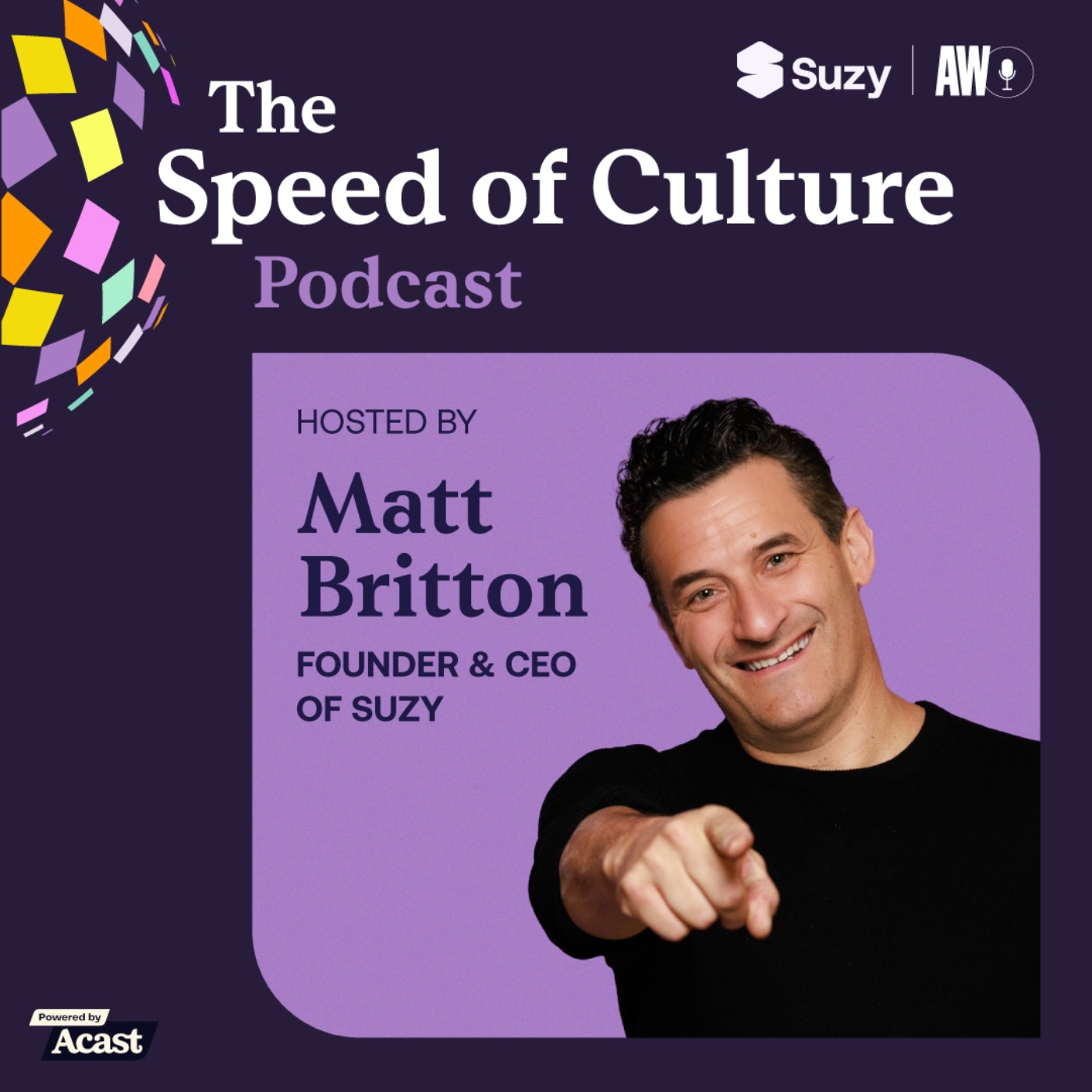
 The Speed of Culture Podcast
20 May 2025 · 26m
Written by AI. May contain mistakes.

Get the gist, explore an idea or ask about something said.
 Claude
On The Speed of Culture Podcast, what are the key points of this episode?
Searching your listeningAutomatic transcript. May contain errors.
0:01When we can get really under the hood, so to speak, and see certain people are more impulsive than others, or some tend to be more community oriented. These sort of insights that give us just a nugget that we can use for creative briefs that really bring things to life in a more emotional way that resonates with people is making such a difference in sort of unlocking our creative potential. To thrive in a rapidly evolving landscape, brands must move in an ever increasing pace. I'm Matt Britton, founder and CEO of Suzy. Join me and key industry leaders as we dive deep into the shifting consumer trends within their industry, why it matters now and how you can keep up.
0:40Welcome to the Speed of Culture.
0:47Up today on the Speed of Culture podcast, we are thrilled to be joined by Charlotte Blank, the Chief Marketing Officer at Jaguar Land Rover North America. From activating a house of brands to launching purpose-driven platforms like the Defender Service Awards, Charlotte is redefining what it means to connect with today's values-driven consumer while moving at the Speed of Culture. Charlotte, so great to see you in that. Great to see you. Thanks for hosting, Matt. Absolutely. So the auto industry is at quite a crossroads right now, and arguably it's been at a crossroads for the last several decades.
1:15It's just always such a category that sits at the crossroads of so many different cultural movements and that the consumer, obviously, you have things like interest rates and urbanization, all sorts of things impact the industry. What do you think are the biggest drivers of change in the automotive industry today in 2025? Oh, my gosh, never a dull moment. We are as guilty as any other marketer of overusing the word transformation. But I would agree that that applies to the ever-changing economic regulatory landscape, to electrification and different choices consumers have to make about powertrain.
1:51One that's really interesting from a marketer and consumer behavior standpoint is the shopping experience and what consumers, particularly luxury consumers, have come to expect in an omni-channel shopping experience and the ability to start, stop, or continue your journey from your phone, from your computer, from in person in the dealership. So we're really focused heavily on that this year, trying to create a more seamless experience, both with technology and in partnership with our retailers. But you name it, I mean, there's just nothing constant. So how important is the physical dealer experience in the buyer journey?
2:29Because obviously so many categories like pre-COVID, people never would have thought groceries would have taken off the way it has online. Obviously, buying or leasing a car is a much more substantive purchase than a bag of groceries. But that being said, with today's advancements in virtual reality and mixed reality, you can really experience a vehicle in a lot of ways without even being there. Is there a shift going on or do you see the dealership always as kind of a core pillar to the buying journey? Both. I think the dealership always plays a crucial role, not only in the shopping experience, but especially in the after ownership experience.
3:03Going in for service is where the rubber meets the road, so to speak, in terms of hospitality and being treated like you're part of a luxury community in our case. So we really do value and emphasize that relationship with our retailers and are working to build that cultural movement of hospitality and behaving as a, say, luxury hotel chain might as opposed to a traditional car dealership, so to speak, which many of our retailers naturally do. That said, behavior is shifting every day and more and more of it is going online as that becomes more and more convenient. And particularly when we see strong loyalty as our brands have enjoyed and people have come to know and love their Range Rover, their Defender, they know that they want another.
3:47It might be easier to make that decision from home and just to sort of go ahead and order another as opposed to when you're new to a brand. They know they love the brand. So just give me a new one. But when you're exploring the brand, when you want to come in and experience it for the first time, there's really no substitute for a proper test drive and a proper explanation of the technology really kind of having your hand held a bit, I think, is appropriate for such a significant investment. Yeah, it's interesting you mentioned the word cultural several times in this interview already. And when you obviously think about the youth market and that next generation buyer, their needs have changed.
4:20Luxury used to mean craft and it used to mean sophistication. And obviously, in a lot of ways, it still does. But obviously, having a brand that is relevant to culture matters so much. Rolling up in a Range Rover is very culturally relevant today, arguing more so than other luxury brands in the automotive space. So what do you as CMO do every morning when you come into the office and you think about, I'm going to drive my brands forward relative to their place in culture? Like, what does that look like in terms of your approach? There's so many ways to think about that and to answer that question.
4:53I mean, since you chose Range Rover, there is just something really fantastic about that feeling of driving around in a Range Rover. And that's an interesting brand to start with in that it has enjoyed success kind of in its own right for some time. And we haven't historically put a tremendous push behind that brand. It's kind of like if you know, you know, and if you're in certain circles, it does well. But we want to grow the brand. We want to continue scaling it and capturing on this momentum. The U.S. became the biggest market of the global brand last year, and we want to continue that success.
5:27So there's this careful balance of growth and scale, but maintaining that sense of scarcity and exclusivity that makes it so special. That's a special challenge for luxury brands and one that we consider in every decision, be it the transactional and how we communicate pricing or in the much more upper funnel communication and what is the most appropriate way to convey luxury and invoke a sense of willingness to pay, etc. et cetera, in a way that stands out from our competitors and feels uniquely Range Rover. Yeah. I mean, you mentioned pricing. What we have seen some luxury brands do, not just in automotive, but whether it be in fashion or apparel, is they've either created a second kind of entry-level brand or entry-level models to let younger consumers get in so they don't disenfranchise the youth generation, because then it obviously allows other brands to kind of capture those lifelong brand loyalties.
6:21And by the time they can afford your car, they're already stuck on another brand. How do you look at that dynamic in terms of creating entry points for consumers at younger ages? So within the Range Rover brand, you could start with a Range Rover Evoque, which is a popular smaller size crossover that sort of ladders up through the Velar, the Range Rover Sport and the Range Rover. But that's actually a really interesting question of its own is Range Rover Sport in one way is a model of the Range Rover brand, but in some ways behaves like a brand of its own. And we've seen some really interesting, not so much demographic differences like the age that you referenced, but more psychological and how people see themselves and sort of emphasizing the dynamic sort of roguishness, playfulness of that brand that's in some ways sort of distinct from Range Rover.
7:07So that adds a little bit of complexity where sometimes we treat it as a model and sometimes we treat it as a brand of its own. And what are some of the things that I guess consumers, regardless of, I guess, their age or where they're entering with your various models, are, I guess, clamoring towards relative to like the offerings of the vehicles? Like what matters more today than maybe didn't a decade ago? I think we see this shift toward experiences, community. The car is so much more than a car. It's what it says about you and the company you keep. So that I think our marketing has kind of evolved to keep up with that and an increasing emphasis on experiential marketing.
7:44our platform now globally around Range Rover House, which is creating a really curated experiential element of a way to experience the brand. And we'll activate it. Events like around Monterey Car Week in Pebble Beach or Salt Lake City and a popular ski destination in Park City, where we're creating sort of a cultural moment and curating an experience that helps us think about if Range Rover were literally a house, what would it look like, feel like, smell like? What would you eat there? Who would you invite? What would you wear? And And it sort of brings the brand to life in a certain way that makes people feel like they're part of a special club or tribe.
8:19And that sort of extends the experience beyond the product itself. So another iconic brand that you oversee is Jaguar. And I know Jaguar is in the midst of a big brand relaunch. And I'd love to hear your thoughts on that brand, which obviously isn't as culturally at the center as a brand like Ranger, but obviously has a lot of legacy, a lot of history. A lot of drivers absolutely love it. Just love to hear your thoughts on where you're taking that brand. I think you just spoke to a little bit of the answer in your question. It's my adding experience coming out. Yeah. I mean, for some time, Jaguar has not been in the cultural conversation to the extent that it should be, given its historical significance and just the incredible performance and passion around that brand for those in the know.
9:03And it's been through so many iterations and different sort of eras and phases and different strategies for that brand over decades. And this year is us embarking on a really bold, complete transformation of the brand, the product, the shopping experience. Really, the whole promise around the Jaguar brand is going to be fresh and new going forward over the next couple of years. And in a way, that's very true to the original essence of the brand. The campaign or the sort of ethos and mantra that we've been communicating around copy nothing is borrows from an original quote from the original designer of the brand.
9:40It's really been at the core as being unique, original, and truly a copy of nothing. And so the new product and strategy will reflect that. And if we learned anything from this past year is that we definitely could have drummed up some interest in what's coming next, could not have anticipated the reaction, the level of attention that we received, But it really turned into a tremendous amount of eyeballs and engagement and interaction with the concept vehicle that we revealed at Art Miami in early December. And overwhelmingly, the concept vehicle was well received by the press and really sort of turned the conversation toward this is going to be really exciting.
10:19This is a new way to do to present an electric vehicle and a potential new electric lineup. Yeah, even launching an Art Basel is new, I mean, versus a traditional auto show or something like that. True. Yeah. We'll be right back with the Speed of Culture after a few words from our sponsors. You really have to redefine so much in, you know, obviously driving relevance in the auto space. I know purpose is another area that you've done a lot of work in, specifically the Defender Service Awards. We'd love to talk about why that's important as a core pillar to some of the work you're doing on that brand.
10:51Yeah. Defender is historically a purpose-driven brand, really, for over 70 years, it's had a relationship with the Red Cross globally, going on now 20 years with TUS, a global conservation organization focused on African wildlife. And here in the United States, we have our own sort of grassroots version of a cause marketing platform going on five years with Defender Service Awards. And it's all meant to bring to life this lifestyle pillar around the Defender brand being purposeful, which can be defined multiple ways, but it's to contrast with other vehicles that are highly off-road capable, rugged and durable, but kind of just go out and get muddy for the sake of having fun.
11:30Defender is about adventure and heroism and purpose. And it has a certain charm and charisma that's attached to the impact it has, like who it is that it's serving or saving or empowering to make a difference in their community. And that's been true and core to the brand for, as I said, 70 years. If you look back to the beginning of the Red Cross relationship. And what we've done to localize that in the United States since relaunching the Defender brand just a few years ago is through a really grassroots and organic concept whereby we invite hyper-local hands-on charities to submit video applications for the chance to win a Defender.
12:08These are organizations in categories like wildlife conservation, veteran services, environmental work, and tend to be organizations that need an off-road capable vehicle to get to challenging to reach places or to accomplish difficult physical challenges. And then we invite our community, our consumers and audiences to vote and across multiple categories. And so now going into its fifth year, we've given away 24 Defender vehicles to these wonderful charities and over a million dollars, thanks to Chase and our other sponsors. So it's become a collective effort whereby we invite like-minded brands and companies to partner with us.
12:48And it's a great content generation machine and a way to showcase the capability of the vehicle in context of these really emotional stories. So kind of the highlight of our year is a brand festival called Destination Defender. That's sort of a weekend festival of modern luxury outdoor adventure. And we usually have the annual gala whereby we choose the winners, honor them, and give them the keys to the vehicle, so to speak. And there's never a dry eye in the house. So that's one of my favorites. I'm sure. I mean, I think there's a lot you touched on there. And at the core of it, I think, is the new way to really drive engagement and capture attention from the consumer.
13:25When I was growing up, the way that automotive manufacturers captured attention is they ran billboards, magazine ads, TV, very linear advertising, so to speak. And what you're talking about is anything but content, it's storytelling, it's more emotional. What is that journey like for you as a marketer? And where do you see it going in terms of your ability to take, whether it's the Jaguar brand story or the Defender brand story or all these different brands that you sell on top of and make sure that you're adequately reaching the consumer in a way where you're actually going to be able to capture their attention and mindshare in a very challenging landscape to do so?
13:59It's all about the mix. It's a storytelling and the organic sort of grassroots one-to-one way that we touch people is an important and authentic way to generate some kind of realness there that gives people something to touch and feel that we're not just a car brand. There's actually some substance there and something useful. But I am the first one to go old school and say, you know, what is the job to be done? And Defender is actually the best example of, it's our newest brand in the States and one that has the most room to grow from an awareness perspective and especially knowledge of the brand as a standalone versus its sort of parent brand of Land Rover.
14:36We're really driving that Defender and Range Rover are separate brands of their own. And we still have such a journey to go on to just grow awareness and appeal and just introduce ourselves to people. And there's nothing like TV. We do a lot of TV and connected TV. And it's not the case anymore that it's difficult to measure or, you know, we have lots of tools now at our disposal to test closed loop and measure our growth from a sales perspective. And one of my favorite KPIs is tracking organic search activity, like are people going to their search engine and looking into us as an indicator of interest and curiosity?
15:13That's been shown to be highly predictive of future sales. So we can track that and we can use a measure of whether people are searching for us immediately upon seeing it on TV as a way to optimize our creative and our media channel choices. So we do love TV for some of our bigger models like the Defender, Range Rover Sport. But for the lower volume ones, it's so much fun to do these like richer kind of custom content partnerships. We have a beautiful one right now live with The Atlantic with a partnership with Will Gadara, who's a lovely, charismatic entrepreneur who's famous for his work in unreasonable hospitality.
15:51And as part of our leadership platform for Range Rover connecting with entrepreneurs, business owners, we recorded some custom content with The Atlantic just with Will in the vehicle and talking about his perspective on leadership. And it's doing incredibly well. People are sitting down, watching the video, completing the video, and then clicking through to learn more about the Range Rover brand. So I see it's all about the mix and the constant testing and optimization and doing what's right for each brand and nameplate. Yeah, I mean, you're so right in that television used to be more of a spray and pray channel, and it was very monolithic.
16:23I'm going to target the 18 to 49 demographic. But now with CTV and address the media and all the attribution that you kind of alluded to, you can be pretty precise and leverage the scale of a platform like TV, but also be very data driven and precise in terms of how you reach people. And to your point, seeing what the trickle down effect is first being, it sounds like consumer searching, which is interesting. It's also gonna be interesting to me to see how the experience of search changes with AI. I have teenage kids and they don't really use Google as much anymore for searching. They're on chat GPT searching more and more.
16:59So it's going to be interesting to see how companies like yours and others really optimize organically, whether it's the content they put out there or other mechanisms to make sure that they're front and center when consumers are searching on a chatbot versus a traditional search engine. I totally agree. I think Google has a lot to figure out right now. Right. It's interesting, but at the same time, their new AI tools are pretty powerful as well. But how do advertisers show up in those AI-driven results? I don't think anybody's figured it out yet. That's a really hot space. I know. It's going to be fascinating to see for sure.
17:30So shifting gears as we wrap up here, Charlotte, I know that your background before your current role was in the agency space and your last role before joining the company was chief behavioral officer. And to me, that means you really spend a lot of time really trying to decode the consumer and the way that they think and how it drives their actions. Talk to me about that experience and how that background and training helped you become the marketer that you are today. Yeah, I describe myself as a marketer by way of psychology, which I think is true for many of us in marketing and advertising.
18:03You know, it's that passion and curiosity for consumer behavior that drives us to this industry, but mine probably more academic than some. So like I've studied neuroscience in undergrad and kind of came back and forth in terms of like more applied advertising roles versus more academic kind of research-oriented ones. The latest role before joining JLR was as Chief Behavioral Officer of Merits, which is basically an incentive and reward company that motivates the behavior of stakeholders, of our clients at the time, many of whom were automotive manufacturers. So I had a lot of experience running experiments on car dealers, basically, which was a great way to learn very hands-on and pull from the scientific toolkit of running randomized control trial experiments to really isolate causality.
18:50And that was the lesson and something I try to impart to my team that to lead like a scientist really means to behave as a scientist, no matter what the question is at hand. It's to come up with an informed hypothesis based on the data you have available and then to truly experiment with it, meaning have a holdout control group and isolate the change so you can know that the thing you tried is actually what caused the change. And that's such a basic fundamental tenet of science, but it's something that's overlooked in sort of business management. Sometimes when people say test or experiment, they just mean like, try it and see.
19:24But of course, then you can't really be sure if what you're seeing is because of what you did. So that's kind of like my main rule of thumb and something that most digital marketers are doing accidentally anyway, just when you buy advertising and a digital partner. But I think what's really exciting now is some work we've been doing with actual clinical psychologists, PhDs, in behavioral science and consumer psychology and people who are working with AI to find ways to apply these academically rigorous scales of personality trait and the way people make decisions and the way people are motivated and apply that to the consumer landscape and help us to identify differences in what predicts likelihood to purchase, say, a Defender versus a Range Rover Sport.
20:10And we're finding such interesting differences that are really useful in our house of brand strategy that we wouldn't have just looking at demographic information or even self-report. What do you do with your spare time on the weekend? People of a certain income level kind of look a little bit similar on paper. I like to go to nice restaurants. I like to play golf. I like to go do things outside with my family. But when we can get really under the hood, so to speak, and see certain people are more impulsive than others or some tend to be more community-oriented, These sort of insights that give us just a nugget that we can use for creative briefs that really bring things to life in a more emotional way that resonates with people is making such a difference in sort of unlocking our creative potential.
20:54It's interesting because so much discussion in the advertising and marketing space right now is about AI and what is the role of the human. And what you just described is essentially what makes us uniquely human. We are not just rational beings. We're emotional beings. The reason brands exist is that we're emotional and we get attached to things that don't always really make rational sense. The reason that people pay$5 ,000 for handbags makes no rational sense whatsoever, yet the luxury category in that space is booming. And I think ultimately underneath all of this, how you put it is what's beneath the hood.
21:25And I think that is going to be a science that's going to get more and more valuable in the age of AI, because I think holding on to what makes people uniquely human is going to be the key ingredient in a world where everything else is going to be largely commoditized. Everybody's going to have access to AI, but people truly understand consumers, I think, are going to be ones that are going to most be able to put it to work for you. So true. Couldn't agree more. Cool. So wrapping up here, obviously, you're in a really cool role overseeing some really iconic brands. And just for our audience, who maybe is a younger point in their career that want to end up in a CMO seat one day, what are some of the steps you took along the way that you think were the right moves, whether it was the areas that you focused on or the relationships that you built that you believe put you in a position that you're in today?
22:10For my journey specifically, it was following this passion for psychology. And I remember when my dad dropped me off at college, he was like, just study what you think is interesting. Don't major in business. You'll learn that on the job later. And I hope that's not outdated. I know everything is like really messed up now with the whole educational system and non-affordability. But I think about that often, like just that studying neuro way back then and the path that that set me on and sort of being true to that. And even when I went into media advertising brand roles, there was always sort of a ways for me to keep one foot in that space of the kind of keeping up with the psychology that's relevant.
22:49So that allowed me to, A, just stay engaged and stay interested and productive because I really enjoy it. But it also helped me to develop a personal brand, so to speak, and kind of stay in a path that at least looking back retrospectively, I could draw a red thread through. So that kind of became like my thing. So I guess that's a really general bit of advice, I guess, I would give is to find your thing and like find a way to stick with it. You can always kind of stretch around it and expand it, but kind of make this one thing your area of interest that you could tell a story around has been helpful.
23:23Yeah. And create differentiation in the marketplace. place that can often be a sea of sameness where everyone's saying the same thing, reading the same things and regurgitating it. If you have this kind of point of differentiation, you can lean into it. Then whether it's in interviews or whether it's manifest into some of the campaigns that you talked about today, in terms of what goes into the real world, you are able to put your stamp on it in a unique way. Yeah, absolutely. So we often wrap our interviews by asking our guests if there's a saying or mantra that they believe has defined their professional journey you to date and just wondering what might come to mind for you.
23:55Oh, well, I guess I teased it. My saying is lead like a scientist. There you go. And is there any, I guess, person that you follow or book that you've read that if other people want to lead like a scientist, you would recommend? Yes. I bet many listeners of your podcast are fans of Dan Ariely, who's a very well-known behavioral economist who kind of, I think, personally championed the applied space of behavioral science. He's really kind of brought that to mass market and to business leaders and found ways to talk about it conversationally that get people excited and engaged. So I love Dan and have read and watched everything he's ever done and can't get enough of Dan.
24:35Awesome. We'll have to check him out. And I appreciate you checking out the podcast and enjoying today. It's been a great chat and a very different enlightening one relative to a lot of the marketing discussions that we have. And I think that our audience is going to get a lot of value. So thanks so much for joining today, Charlotte. it. Thanks, Matt. It was a lot of fun. Absolutely. On behalf of Susie, I would keen. Thanks again to Charlotte Blank, the CMO of Jaguar Land Rover North America for joining us today. Be sure to subscribe, rate, review the Speed of Culture podcast on your favorite podcast platform.
24:59So next time, see you soon, everyone. Take care.
25:18more about Suzy, head to suzy.com. And make sure to search for the Speed of Culture in Apple Podcasts, Spotify, or anywhere else podcasts are found. Click follow so you don't miss out on any future episodes. On behalf of the team here at Suzy, thanks for listening.
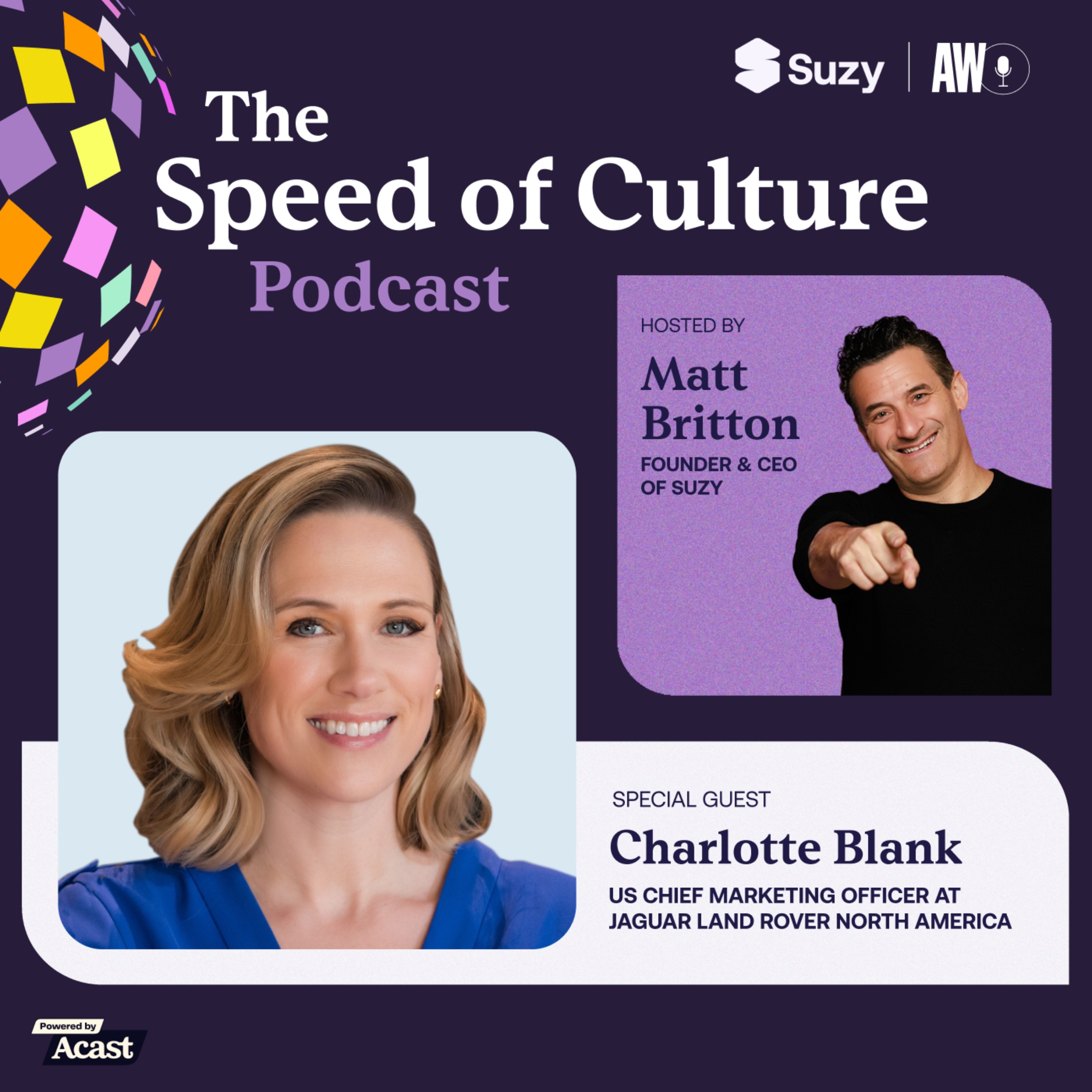
In this episode of The Speed of Culture, Charlotte Blank, US Chief Marketing Officer of Jaguar Land Rover North America, joins Matt Britton to talk about redefining luxury through purpose, emotion, and experiential storytelling. From leading the bold relaunch of Jaguar to connecting Defender with grassroots causes, Charlotte shares how behavioral science, curiosity, and creativity drive marketing forward in an industry at a cultural crossroads.
Follow Suzy on Twitter: @AskSuzyBiz
Follow Charlotte Blank on LinkedIn
Subscribe to The Speed of Culture on your favorite podcast platform.
And if you have a question or suggestions for the show, send us an email at [email protected]
Hosted on Acast. See acast.com/privacy for more information.