Ask ChatGPT
 The Speed of Culture Podcast
18 Aug 2026 · 33m · 14 chapters
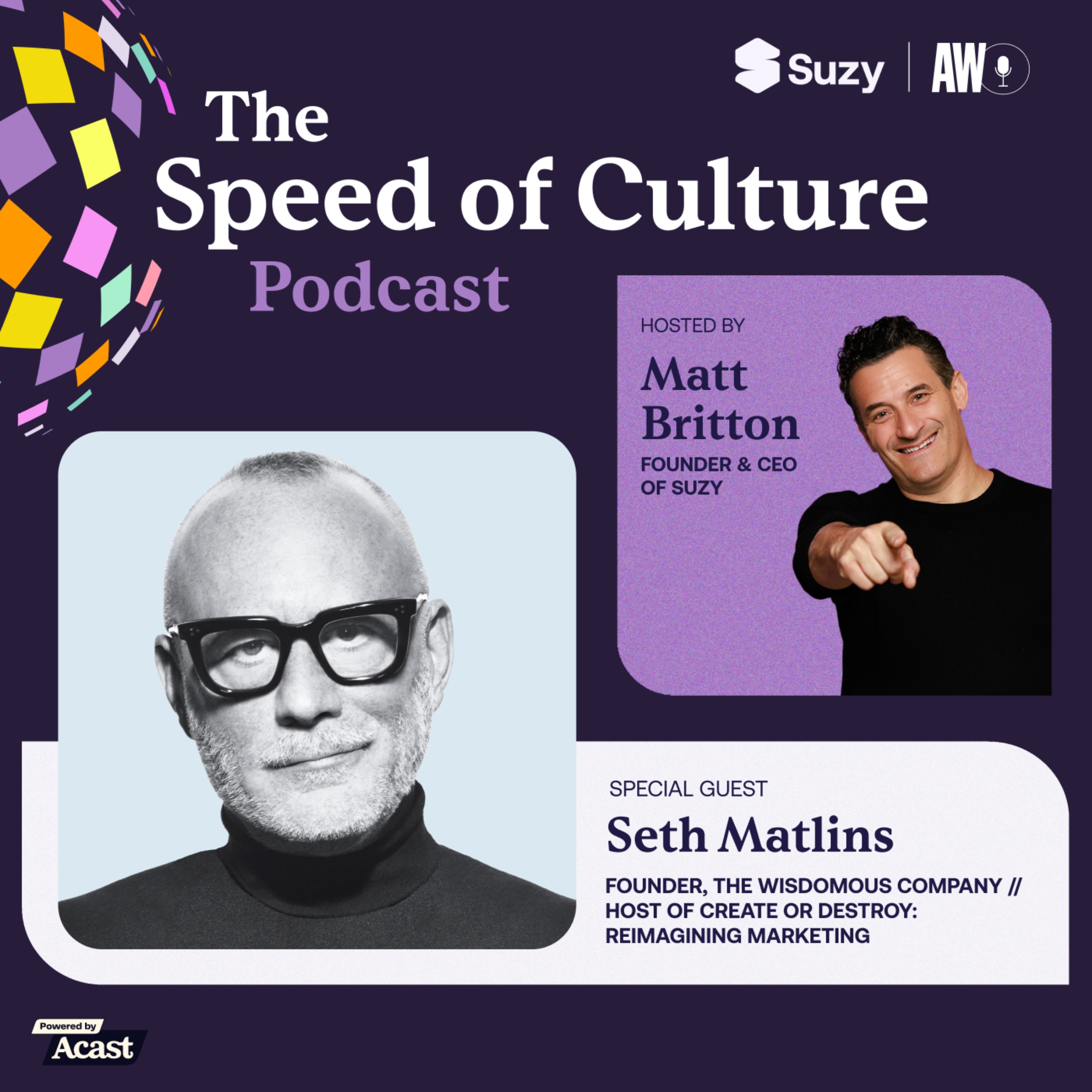
Marketing’s “horizontal blind spot”—CMOs and marketing leaders must think across functions and organizations, not in vertical silos, to create value (and avoid “change for change’s sake”) amid AI-driven transformation and shifting brand building.
Seth Matlins is founder of the Wisdomist Company and host of Create or Destroy, Reimagining Marketing. Career includes launching businesses inside CAA/Endeavor, serving as first global CMO of Live Nation, and leading the Forbes CMO network. He’s also hosted/served in sports marketing and ran Rock the Vote.
CMO tenure narratives are misleading; departures are often promotions/retirements, not just failure. AI transformation requires organizational permission and CMO capability. Brands can still be built, but differentiation must be meaningful to audiences (not just product-led growth). Marketing should be taught as a commercial engine with horizontal thinking and critical thinking.
Live Nation CMO tenure; Vinit Merritt (Chime) reinventing fintech marketing; Antonio Lucio; Claude Super Bowl ad; Nike brand struggles; Bill Joy quote (“invent the future”).
Written by AI. May contain mistakes.
Discussion about Seth Matlins' background and career.
“Not all manipulation is a bad thing, right?”
Insights into the evolving role of CMOs and marketing strategies.
“Up today in the Speed of Culture podcast, we are thrilled to welcome Seth Matlins, the founder of the Wisdomist Company and the host of the podcast, Create or Destroy, Reimagining Marketing.”
Exploring skills needed for marketing leaders in the future.
“It does require right moment, right fit, right organizational enterprise?”
Learn about the importance of horizontal thinking in marketing.
“We have generations now of marketers who have been trained in verticals, right?”
Explore the evolution of brand building in the modern market.
“And then some of the other biggest brands are just great product utilities.”
Examine the role of emotional needs in consumer behavior and marketing.
“And I think that too is something, going back to my point about the role is the same, the job is different.”
Discuss how societal views on status symbols are evolving.
“in their lives is essential and I think unchanging.”
Debate the future of education and the relevance of traditional grammar.
“I think it's much harder and it goes back to the role of the CMO to kind of just rest on your laurels of having a strong brand in a world of disruption like this.”
Explore the importance of critical thinking in the modern marketing landscape.
“And so if the semicolon becomes metaphor for process, I think it still matters.”
Seth discusses his current projects, including his new podcast aimed at marketers.
“I'd love to hear about what you're working on right now.”
Understanding how every business decision impacts value creation and destruction.
“the marketing ones, not just the ones made by the chief marketing officer, either contribute to value creation or destruction and that it's black or white, right?”
Seth shares his vision for marketers collaborating on storytelling.
“And I'm oriented to stakeholders, not just shareholders, so that more growth and value can be created that benefits against stakeholders, not just shareholders, but shareholders.”
Seth provides guidance for young professionals entering the marketing field.
“But my objective with everything is to leave the audience better able to do better work because they were there.”
Seth emphasizes the importance of adaptability and tolerance for uncertainty.
“So to wrap up here, we always ask our guests if there's a saying or mantra that's helped kind of guided their professional journey.”

Get the gist, explore an idea or ask about something said.
 Claude
On The Speed of Culture Podcast, what are the key points of this episode?
Searching your listeningAutomatic transcript. May contain errors.
0:00Brand Week is back September 15th through the 17th in downtown Atlanta. And if you're serious about where marketing is going, this is the room for you. I'm Jenny Rooney, Chief Brand and Community Officer at Adweek. And for three days, we're bringing together the sharpest minds in marketing for the ideas, insights and connections shaping what comes next for brands. Get your tickets now at brandweek.com and use code BW26 for 20 % off. That's brandweek.com, code BW26. ACAST powers the world's best podcasts. Here's a show we recommend. You want to be the most interesting person in the room? Then listen to the best one yet.
0:41Our daily news show of pop culture meets business. We'll tell you why Abercrombie was saved by a$100 wedding dress. How keeping a Beyonce-style brag book is going to get you that promotion. And the AI drama that made Reddit our stock pick of the year. Jack and I worked on Wall Street, got MBAs, sold our last company to Robin Hood. Plus, we were freshman year roommates. So I can tell you why Jack's a briefs guy, not a boxers guy. So listen to T-Board, the best one yet. It'll be the brightest part of your day. And if this podcast lasts longer than 20 minutes, call your doctor. Acast helps creators launch, grow, and monetize their podcasts everywhere.
1:12Acast.com. Blowing ad budget on metrics that look great till the CFO sees them. That's bull spend. And marketers are calling it out in Dashboard Confessions. I remember telling my boss, it'll be good for the brand when leads were slow. Yeah, it wasn't. Cut the bull spend. LinkedIn lets you target by company, job title, and more. Advertise on LinkedIn. Spend$250 on your first campaign and get a$250 credit. go to linkedin.com slash campaign terms and conditions apply. Not all manipulation is a bad thing, right? If you think about it structurally, and that's our business is to create demand and desire responsibly, ethically, morally, and figure out how to do that, figure out why people make decisions and why they do not.
2:05To thrive in a rapidly evolving landscape, brands must move in an ever-increasing pace. I'm Matt Britton, founder and CEO of Suzy. Join me and key industry leaders as we dive deep into the shifting consumer trends within their industry, why it matters now, and how you can keep up. Welcome to the Speed of Culture.
2:27Up today in the Speed of Culture podcast, we are thrilled to welcome Seth Matlins, the founder of the Wisdomist Company and the host of the podcast, Create or Destroy, Reimagining Marketing. Over the course of his career, Seth has helped shape modern marketing from nearly every angle, launching businesses inside companies like CAA Endeavor, serving as the first global CMO of Live Nation, and of course, leading the Forbes CMO network. Seth, it's so great to see you today. I've been looking forward to this. Hey, man, thank you so much for having me, Matt. Absolutely. So for those that don't know you, talk a little bit about your career journey leading up to today and some of the areas that really kind of get you excited every morning and jump out of bed right now.
3:02Well, those are three questions, I think. I'll start with the first one and then help me remember the others. Fair enough. Yeah. My career journey, well, it's a long one at this point too, but it's interesting to me. I hope it will be to somebody else, but it's completely nonlinear except in retrospect. I am not somebody who had a particular plan, a particular vision, a strategy to get from A to Z to my dismay and probably detriment, but I've always been in marketing. It has been client side, agency side my whole career. And as it turns out in retrospect, I've never had a job that existed before I had it.
3:47I knew I wanted to get into marketing. I grew up in Manhattan. My parents were marketers. And there was something to me, even before I could articulate it, about the power of a story well told to influence attitudes and behaviors that was compelling, that really drew me. And I was the third person in the marketing department in the United States for Avion as my first job, which was an extraordinary privilege. Avion tequila. No, Avion the bottle cutter. Proceeded Avion the tequila with an A by a century or so. Then was in the sports marketing and management business. Where did I go? Oh, ran Rock the Vote.
4:31Then I wound up at CAA, which you mentioned in your passing, then Live Nation, then blah, blah, blah. In terms of, and I think I remember at least one of the other questions, what keeps me interested, what makes me excited is the ongoing challenge of marketing any product or service. I was just on the phone before we got on together, Matt, with the CMO of a massive company who's been in the job five months. And just as we were talking about the strategic and creative challenges she faces within and beyond her category, that's what has always kept me going today. and really since my time at Forbes, I think the incremental and adjacent challenge of marketing, marketing to a business community that doesn't typically understand it and therefore gets in its way and therefore gets in the way of greater growth and value creation, I also find pretty engaging.
5:30Yeah. And I'm glad you mentioned, you know, and I know that you have a deep CMO network And the average CMO tenure in the U.S. at least has fallen to roughly 40 months in recent years, which means three and a half years is kind of the average. And CEOs last seven to eight years. And, you know, there's a lot of change. It's the only constant. Well, look, the CMO tenure narrative is disruptive and oftentimes wrong. While the data around 40 months and I think it's closer to 42 or 44 is right, it lacks the context of why. The narrative has been shaped historically by search firms who were in the business of replacing CMOs.
6:12So a negative narrative was positive for them. They were the only one who benefited. And the problem with the narrative is, again, it lacks the context of why somebody could look at Antonio Lucio, who just ended his second tenure. It was only 24 months. Well, he just went to PayPal. That was also his second time at age. It was his second time there. but it lacks the context of why people leave, of why they move. And it leaves people with a implicit narrative, oh, they got fired. They couldn't succeed. They couldn't make it work. And while that is absolutely sometimes the case, it is not the case commonly.
6:48It is not the status quo circumstance. They're getting better jobs. They're getting other jobs. They're getting promoted. Sometimes they're retiring. And so I really think the perpetuation of that narrative is wildly self-defeating. Well, I think that you're conflating like good talent is going to be fine. And yes, they jump around and even younger people. That's not necessarily true either. By the way, I'm down with conflating, which is to say good talent needs to be in a position where they can succeed. And there are situations, back to context, where they cannot succeed. What are some of the situations?
7:23Yeah, I don't think I ever did better bottom line work than I did during my 14-month tenure as CMO of Live Nation, but the work I did couldn't survive inside the construct of that organization. It couldn't live inside the construct of that organization, which is neither damning for that organization, which I wish I had invested money back then because it's been like a rocket ship since, nor on the work I did. It does require right moment, right fit, right organizational enterprise? Sometimes. I'm not saying that's the only reason, but if only talent were enough to guarantee success. Yeah, of course.
8:03And when talent isn't enough to guarantee success, a lot of times, and you mentioned the word organization, I mean, a lot of CMOs today are just in this position where they have to drive so much change. If you look at AI, one of the bullseyes of AI is marketing. And obviously there's those that say AI has no role in creative. There's some that say AI has no role in the company, but obviously CEOs are getting pressured by Wall Street and they're pressuring certainly their CMOs to adopt AI and drive AI transformation the same way that they were with social media transformation or digital transformation itself.
8:35When you found it to be successful, a CMO could basically drive that internal transformation here in 2026. Like, what's true either with the CMO or the organization? Well, I think it comes down to the capability and orientation of the CMO and the permission of the organization to allow the CMO to do that, right? Which is, again, something I talk a lot about, which is a lot of brilliant CMOs are not given the permission to do what they do, at least unfettered by, oh, my 12-year-old who's not the target hated the ad. Like, that's not the matters whatsoever. But I think you've said something that was really important a moment ago, which is they're being charged with driving change.
9:15And I think oftentimes the mindset they're being charged with having to respond to change. And in fact, half an hour ago, I posted a quote on LinkedIn from Bill Joy from 25 years ago. Bill was the co-founder and chief scientist at Sun Microsystems. And what he said 25 years ago is the best way to predict the future is to invent it. And I think that's the opportunity and challenge a lot of brilliant marketers and brilliant organizations face today. And ultimately, if you're going to invent the future, then you can't look in the rearview mirror as sort of a historical guardrail to move forward. And I think a lot of executives at large, especially Fortune 500 companies, they're not interested in renovating the wheel.
9:59They just want to continue to cash in. I mean, a lot of times that's why they end up with big companies to begin with. CMOs sometimes are a little bit different and they are pioneers and they want to go into a big organization and change things, like Vinit Merritt, who I'm sure you know well at Chime, like he's somebody who went in there. Now, they weren't Bank of America, right? But they were an established fintech company, but he completely reinvented the way that they market. Was he able to do that at J &J? Not really as much, right? So I think some of it is based upon, you're right, the organization's ability to ingest any type of dynamism that comes with inventing the future.
10:33Vinit's a phenomenal example of a brilliant CMO, who's a brilliant CMO, not just because he's a great marketer, but because he views himself first and foremost as a commercial leader, which is what everybody in his organization should see themselves as. And I think that you said something that also merits a moment, which is it cannot be change for change's sake. So the best work CMOs have done is to mine what's been done before them, which can be really brave, right? And up the moss, right? Instead of vein the wheel every time. Exactly, right? And I do think there's a pressure that is oftentimes, and again, self-destructive or enterprise destructive to change things without asking the right questions about why they need to be changed.
11:19Now, sometimes transformation companies, turnarounds, of course they have to be changed. And there's always an opportunity to do better, whether you're the same CMO or the next CMO. But there are moments when they're fewer and further between when a status quo does serve you. And so being beholden to the status quo is as bad as just throwing it out because it existed before you got there. Yeah. I mean, this podcast is supported by iWeek, but I know a lot of times I've worked throughout my career with clients who just want to get a story in a week. Like they're not on the cutting edge, they're in the bleeding edge.
11:53You're trying to do something with 3D printing or something, right? When it comes out so they can say that they did it and it doesn't move the needle at all. And it is change for change's sake. We've both seen situations like that. Yes. Yeah. So moving forward, what are some of the new skill sets that you think marketing leaders need to develop based upon the state of the industry here in 2026? It's a hard question to answer for a couple of reasons. One, I'm not an operator anymore, so I'm not in that role. And it's become so technical and oftentimes tactical that I don't actually know how to answer it.
12:30But that's a big change, right? Because it used to not be that. It used to be sign off on BVDO and Themic spots, and that was okay, but it has been much more technical over time. A hundred percent, though I think it's also fair to say it hasn't just been that for 25, 30 years, at least for those who are on the forward edge of it, because the mass market didn't cease to exist last week. It was crumbling 30 years ago, you know, 35. But your point is a good one, which is, I say a lot, the job has changed dramatically. The role hasn't changed. It is still, the role is still to create and keep a customer, capture attentions, influence attitudes and behaviors, drive increasing growth and value, if not valuation.
13:15the job, the technical skills are extraordinary. The data fluency, the information fluency, the architecture and orchestration of the job are quite brutal, honestly. And I'll reference Antonio Lucio again, obviously a brilliant, brilliant, legendary Hall of Fame marketer who said something to me years ago about this. It's like three years ago, we were sitting having coffee at AdColor. And he said to me, today's CMO needs to be the CEO of the function. And like a CEO, she needs to be able to allocate resources, time, capital, and human to drive outcomes. And I think in searching for an answer or a skill, it's a bit of a fool's errand.
14:00But I think what I would say, having just said that, is the ability to see horizontally, to think horizontally. We have generations now of marketers who have been trained in verticals, right? And in silos, typically don't connect. And so you have a platform marketer who's optimizing for the platform rather than outcomes that actually drive the business forward and thinks they're the same thing. And I think that horizontal, collaborative, integrative, holistic view is essential. We'll be right back with The Speed of Culture after a few words from our sponsors. What counts as a video impression?
14:36Sounds like a simple question, but it isn't. Because when it comes to unified reach, different measurement providers can evaluate the exact same campaign and deliver very different results. And those differences matter. In fact, 79 % of agencies and marketers say that if they don't feel confident in unified reach metrics, they cannot fully trust campaign outcomes. So Warner Brothers Discovery Advertising took a closer look. The result is a new white paper, The Unified Reach Paradox. Learn what's really driving the differences behind unified reach and what that could mean for how your campaigns are measured and valued.
15:13Different assumptions, different results. Download the full report today. Visit advertising.wbd.com slash unified. That's advertising.wbd.com slash unified. Flowing ad budget on metrics that look great till the CFO sees them. That's bull spend. and marketers are calling it out in dashboard confessions. I remember telling my boss, it'll be good for the brand when leads were slow. Yeah, it wasn't. Cut the bull spend. LinkedIn lets you target by company, job title, and more. Advertise on LinkedIn. Spend$250 on your first campaign and get a$250 credit. Go to linkedin.com slash campaign. Terms and conditions apply.
15:59Brand Week is back September 15th through the 17th in downtown Atlanta. And if you're serious about where marketing is going, this is the room for you. I'm Jenny Rooney, Chief Brand and Community Officer at Adweek. And for three days, we're bringing together the sharpest minds in marketing for the ideas, insights, and connections shaping what comes next for brands. From culture and creativity to growth, leadership, and consumer behavior, Brand Week is where brand leaders come to think bigger, connect deeper, and leave with a clearer plan for what's ahead. Get your tickets now at brandweek.com and use code BW26 for 20 % off.
16:35That's brandweek.com, code BW26. Quick question. When was the last time a display ad changed your mind? Now think about the last time a friend told you about something they loved. Different feeling, right? That's how podcast advertising works. A host who's built real trust with their audience talks about your brand in their own words, in their own voice. It doesn't interrupt the experience. It's part of it. With Acast, you can access the world's largest podcast marketplace. Choose the right shows, the right audiences, the right format. Then watch the data tell you it worked. You're not buying impressions.
17:12You're buying influence. Learn more by visiting acast.com slash advertise.
17:21On the kind of topic of CMOs and kind of transition to conversation a little bit, I have a take on the future of brands. I'm just really curious to get your take on, because if you look at the most prolific brands in America, most of them were built during the TV industrial era, where companies could just basically write checks and force their message onto consumers, often with their unique selling propositions. And then some of the other biggest brands are just great product utilities. So Airbnb, which is basically a verb or Instagram or today Claude. They're utilities where the power is in the product.
17:55They didn't build their brand through advertising. I was surprised even Claude advertised during the Super Bowl because the product itself is really what's going to take it. The question I have for you is, do you think new brands in the way that the traditional brands we look at, like Nike and Hershey's, can ever really be built again? Or is it much more just about utility and actually driving value to the consumer because things have become so fragmented? I think you're right, but I think you've created a false binary. And I think there's also an implicit hypothesis in your note, which is, again, the separation of product and brand, the separation of those two things rather than being inextricably linked.
18:31I'm not sure Claude is a great brand yet, though I did think hands down they won Super Bowl. I thought that was a great spot. It's absolutely a great product. And I think on its way to perhaps becoming a great brand, but I don't know that I'd say they're a great brand quite yet. What makes them a great brand? Isn't a brand what you say about a company when no one else is in the room? I think that's amongst the things. And there are a lot of definitions of brands, but I don't think people are choosing Claude because of Claude. I think they're choosing Claude because of its product. Now, I'm creating the same binary that I said you ought not.
19:07So I recognize that. But it is still product-led growth. It is not brand-led growth. What I do think, and I'm a brand marketer through and through. That's why I bring it up. Yes, I think it's absolutely possible and imperative to build brands in new ways that forge the same emotional connections. and before we get into a conversation about agentic commerce through different tools. And I think that too is something, going back to my point about the role is the same, the job is different. What's changed dramatically and will probably be different tomorrow than it is today is the how. But the what and the why, pretty much the same, right?
19:47The how is changing dramatically. The tactical executional complexity is wild. But I think you still build a brand the same way, which is by differentiating yourself meaningfully. It's easier to differentiate. It's much harder to do it meaningfully with your audience and your prospective audience. And I think, I mean, look, there are a lot of brands that good brands, even old brands that have just stopped with television altogether. It's certainly outside of live sports where you actually have an audience that's paying attention. but I have always believed brands, maybe because I'm just a superficial, but brands are the principal driver in many, not all, in many categories of purchase intent.
20:33Well, Chanel can still charge$10 ,000 for a handbag, but the question is, will a new Chanel be built? No, you're absolutely right. And actually, your note reminds me of something that Scott Galloway said a couple of years ago. He wrote about it, and I hope I'm representing what he wrote accurately, which is there was a moment in time, I think it's two or three years ago where Bernard Arnauf, who runs LVMH, became the world's richest man. And in that moment, Galloway's post, again, if I'm representing it accurately, was worth noting that the world's richest person makes something nobody needs. Right.
21:06And one could argue, yeah, nobody needs a Vuitton purse to wallet to carry their shit. But what that ignores is the very human need for the communication of status, for the expression of identity, for things that talk about who we are, even if it's just our taste. And I do believe it's not a utilitarian need. It's not a functional need, but it's an emotional need. And I think that too, as we think about what problems we solve for people, what opportunities we create for people, understanding it's Maslow's freaking hierarchy and the role we can play in their lives is essential and I think unchanging.
21:49I just question, is that sort of a backward looking thing? Because I think there was a time where people built their personal brands through their sneakers or their watches. or their car. But now I feel like, and I wrote about this in my book, I think it's status update over status symbol. I think that people now identify with experiences and tribes and passion points far more than products. And the thing that's changed is now they have the ability to express that through content creation. I don't disagree. But again, I think you're creating a distinction that may not be there, right? Which is to say, and I was really talking about identity more than status and status, certainly status symbols, which is to say, and first of all, I'm guessing that the car in your driveway, Matt, reflects something about you as you want to be seen and that you didn't buy, not knowing what car you drive, you didn't buy the least expensive, highest review.
22:48And yes, experiences create memories and connections that endure. And I think that's a reaction to things like the pandemic, things like the recession of 15 years before the pandemic, where we learn that possessions are fleeting. They can be taken from us in a moment. I just moved from L.A. because the fires got so close to us. And I know a hundred people who lost everything in an evening. And so, yeah, we turn to that which can't be taken from us by external circumstance, memories, experiences, and the experiences that engender them. But all of which adds up, and I think this is actually a reasonable parable for marketing itself.
23:29These are the ingredients that make up our sense of self, whether it's purely internal and or how we communicate self externally. And I think the parable to marketing, if I'm using the word parable, right, I'm not convinced I am. I wouldn't know, so. Okay, we'll both look it up after. Is marketing's a whole bunch of ingredients? And would that there were a singular recipe that was guaranteed a delicious outcome every single time? This is not the world we live in or market in. Yeah, it's interesting. Like you look at chocolate, for example, and there's Hershey bar, and now there's the Feastables Mr.
24:05Beast bar, right? And they kind of both ended up at the same place, to your point, where it's packaged chocolate. it. One came through an individual creating content and going through the long tail of social media, and then he used a personal brand, and the other one came top down through traditional media. But they did both end up at the same place, which is a chocolate bar that's packaged. And it's just interesting to think about that way. I think you're absolutely right. And yet will be interesting. You know, we're saying that about Feastables three, four, I don't know how many years in. It's like, call me in 120 years when he's been around as long as Hershey's.
24:40Right. It'll be interesting because you look at a brand like Nike and they are at the level of Hershey's and look how much they've struggled. So the minute we think that a brand is infallible, I think it's much harder and it goes back to the role of the CMO to kind of just rest on your laurels of having a strong brand in a world of disruption like this. I think you're right. And people who have heard me talk about Nike a lot, it's such an easy example. that wasn't on the CMO, that was on the CEO, who did not understand brand, did not understand anything that makes up a business and really fucked it up pretty royally.
25:15Interesting. So would love to hear from you. I was at a conference the other day and I was interviewed and I made a comment that pissed everyone off. And it's really curious if it pisses you off, if you agree. I made the comment that I don't think that the semicolon matters anymore. And what I meant by that is that in a world of AI, it's much more about you have any ideas on what you want to write the stories you want to tell than how to grammatically tell correctly and it was in the context of education and what kids should be taught and should they be taught things like grammar in a world war is that going to be something that's more beneath the hood and should we instead teach storytelling and a lot of people thought that that was taking away one of the core functions of humanity especially our upbringing which is the ability to read.
26:01Now, it's in the sense of you saying you shouldn't be able to read, but we got into this crazy, and I just want to know what your thoughts are on something like that, and a broader just talk track from you around, like, what should kids be learning at early ages so they can set themselves up for success in this new world? Well, as somebody who has probably abused the comma more than anybody in the history of grammar, I hope you're right, kind of, you know, at least metaphorically. Look, I have a 19 and 20-year-old, and my 19-year-old is a dancer, so he's not wildly concerned about AI's implications on his career at the moment.
26:37But my 20-year-old's an economics major and she's got some real concerns. Look, I'm a big believer that a liberal arts education has always been important and I actually don't think it's ever been more important. And yet I think it's gonna go away by and large and continue to be deprioritized. But I think that, look, the two things that are in my head is the cliche, you know, if the only tool you have is a hammer, every problem is a nail. I do worry very much that we will see AI as our hammer. And yet, to butcher the reference further, AI is an insanely useful tool. And it will only become more so tomorrow.
27:18I mean, look at what Google I.O. just announced. It's like mind-blowing kind of, you know, the potential for the integration of this tool to not just make things more efficient, but in time, if we have the right focus to make them more effective. And our focus on efficiency at the expense oftentimes of effectiveness is wildly deleterious. But teaching people how to use the tool is of essence, and it was not five years ago. It was not three years ago. I do not think, again, that we need to separate the use of the tool from being a broader thinker, a more informed thinker, a more educated human.
28:00And so if the semicolon becomes metaphor for process, I think it still matters. If it's literal, I tend to think you're right and, you know, we'll have a machine that will be our editor and it doesn't matter if I abuse a comma, they put it back in the right place. Critical thinking still needs to be there, essentially. It definitely doesn't piss me off. So, you know, your question. Nice. Okay. Score one for me. So shifting gears, we wrap up here. I'd love to hear about what you're working on right now. I know that you're talking to a lot of marketers and trying to help them navigate the future.
28:30And I know that you recently launched a podcast that you plan on taking to more of a media platform and just want to hear about both of those initiatives. Yeah, so my entire career has been built on the belief that marketing is the greatest of strategic and financial engines in an enterprise. That's my bias. It's my belief. It's my conviction. And despite everything changed and changing, it remains exactly that. At least its potential to be exactly that. So I left Forbes, which was an absolute privilege to have been part of that organization that ran that mission. In January, I started, as you said, in your kind introduction, which was rather breathless.
29:13I have a career as an auctioneer, I think, to start the Wisdomist Company. The Wisdom is Company really in this moment does a few things. Most importantly and significantly, it houses my partnership with Vox Media. Vox Media and I have just launched a week ago from this telling my new show. It's called Create or Destroy, Reimagining Marketing. You mentioned it also in that breathless intro. And its whole premise is that any decision and every decision a company makes, not just the marketing ones, not just the ones made by the chief marketing officer, either contribute to value creation or destruction and that it's black or white, right?
29:51Because resources are limited and you're either building for creation or you're not. And if you're not, you're leading to destruction, at least over time. The tagline, if you will, of the show is it's a business show. It's a marketing show. It's a show that argues they've always been the same thing. And my intent, my hope is in engaging guests from across the cultural spectrum, the business spectrum, we will provide insight and observations on how value is created and destroyed that leaves the audience saying, oh, I never thought about it that way. Or sometimes, oh, I never thought about it all.
30:29Because my kind of mission is to help people get out of the way of growth, responsible growth, sustainable growth. And I'm oriented to stakeholders, not just shareholders, so that more growth and value can be created that benefits against stakeholders, not just shareholders, but shareholders. Absolutely. We also are eventizing this and the creator destroy sessions, which will be similar to the work I did at Forbes and kind of akin to CMO summits, but different than we have a U S event in Napa at the end of October. We have a London event at the end of September. And we'll be doing other events, small bespoke from one conversation to many that continue this conversation on public and private stages.
31:17Yeah, I mean, I think the model is spot on. I think obviously you have a bunch of leaders that want to be able to tell their story, that want to be able to build their brands and want to be able to meet and convene and share new ideas. And I think the approach that you're taking. Well, I will share just, I'm actually not that interested in leaders who want to tell their story because that's self-promotion and my stages are not the place for that. My stages are the place for leaders to connect and help each other get better at telling different stories and their stories, learning from each other.
31:48There's plenty of places for marketers to get microphones and spout key messaging points. I don't have any tolerance for that because it tends to bore the audience. Good for the marketer, bad for the audience, raising the question of whether it actually is good for the marketer. But my objective with everything is to leave the audience better able to do better work because they were there. And if you're just spouting key messaging points from a conference, it's rarely that. Yeah, point taken. So to wrap up here, as I mentioned earlier, we have a lot of younger listeners on the podcast. And just from your perspective, what are some of those key specific areas you think young people should be leaning into right now as they prepare maybe for an entry level path in the world of advertising and marketing?
32:31Well, I want to first say, and it's funny, I almost linked this in earlier today. It's not advertising and marketing from my perspective. It's marketing is the category and advertising is a segment within the category, right? Advertising is just a lever inside marketing, which is to say it differently. All advertising is marketing, not all marketing is advertising. That's my bias. Brand is another lever, blah, blah. And I think that that's actually where my answer to your question might start, which is get really clear on what the role of marketing is in the life of an enterprise or sometimes in the life of your enterprise, because it does vary.
33:11get really clear on your role or your passion, if you're really leaving college next week and looking for what's next, what role you play and can play and your group plays in driving the business forward. And I said it earlier, I think the greatest thing missing from business is a horizontal perspective, is an understanding that everything connects regardless of whether or not It's in fact connected organizationally. I wish I had more training in finance because marketing is a commercial engine. I also wish I had more training in behavioral economics because we are in the business of influencing attitudes and behaviors that can be wielded for ill or good, right?
33:58You can do bad things with that. We're seeing it play out on America's national stage in real time, but it doesn't have to be bad. But not all manipulation is a bad thing, right? If you think about it structurally. And that's our business, is to create demand and desire responsibly, ethically, morally, and figure out how to do that. Figure out why people make decisions and why they do not. Everything else falls underneath. Awesome. So to wrap up here, we always ask our guests if there's a saying or mantra that's helped kind of guided their professional journey. What's the first thing that comes to mind for you?
34:34Well, the first thing that came to mind is I don't know that it guided my professional journey because my journey started 15 years before I heard this, but it certainly guided the last 20 years. I was joining CAA to Creative Artists Agency to start the marketing practice there. I was on a phone call with their general counsel, legendary guy named Michael Rubel. We had agreed in principle, verbally, in terms. and I should have asked this question before I agreed, but I wasn't that smart. So I said to him afterwards, I was like, what's it gonna take to be successful here? He doesn't miss a fucking beat.
35:10And he says to me, a high tolerance for ambiguity. I've never obviously forgotten those words. I've never hired somebody who I didn't think subsequently had that high tolerance for ambiguity. And I do not think words could be more suited to this moment than they are, which is we all need a high tolerance for ambiguity. Yeah. And right now, some people want the assurances of a future that is so unknown and gets more uncertain every single day. As we see big tech companies that have tens of billions of profit cut employees, it's like nothing is known moving forward. And you do have to arm yourself with the right skills and to your point, the ability to be agile and roll with the punches and live an ambiguous future to survive and compete.
35:51That's exactly right. Awesome. Well, it's been a great conversation. Thanks for having me. It was, absolutely. And looking forward to hearing your podcast and continuing to promote it and follow you. Yeah, check it out wherever you get your podcasts and on YouTube, Creators, Destroy Reimagined Marketing. That's my plug. And we'll drop a link to the show notes as well. On behalf of Susie and every team, thanks again to Seth Matlins, the founder of the Wismas Company and host of the Creators, Destroy Reimagined Marketing Podcast. For joining us today, be sure to subscribe, rate, and review the Speed of Culture podcast on your favorite podcast platform.
36:19Until next time, see you soon, everyone. Bye-bye.
36:25The Speed of Culture is brought to you by Suzy as part of the Adweek Podcast Network and A-Guest Creator Network. You can listen and subscribe to all Adweek's podcasts by visiting adweek.com slash podcasts. To find out more about Suzy, head to suzy.com. And make sure to search for the Speed of Culture in Apple Podcasts, Spotify, or anywhere else podcasts are found. Click follow so you don't miss out on any future episodes. On behalf of the team here at Suzy, thanks for listening.
37:23We'll see you next time. See revenue, not just reach. LinkedIn delivers the highest return on ad spend of major ad networks. Advertise on LinkedIn. Spend$250 on your first campaign and get a$250 credit. Go to LinkedIn.com slash campaign. Terms and conditions apply. Brand Week is back September 15th through the 17th in downtown Atlanta. And if you're serious about where marketing is going, this is the room for you. I'm Jenny Rooney, Chief Brand and Community Officer at Adweek. And for three days, we're bringing together the sharpest minds in marketing for the ideas, insights, and connections shaping what comes next for brands.
37:59From culture and creativity to growth, leadership, and consumer behavior, Brandweek is where brand leaders come to think bigger, connect deeper, and leave with a clearer plan for what's ahead. Get your tickets now at Brandweek.com and use code BW26 for 20 % off. That's brandweek.com, code BW26.
38:46Acast helps creators launch, grow, and monetize their podcasts everywhere. Acast.com.
Seth Matlins, Founder of The Wisdomous Company and host of the Create or Destroy: Reimagining Marketing podcast, joins Matt Britton where they discuss what forces move the industry in 2026. Seth provides a new perspective on why common data about executive tenure is often misunderstood and why the ability to see across the whole organization is now the most valuable skill for any leader. How do brands build emotional connections through identity? And what is the best way to prepare for the future? These are questions they get into in this episode.
“Create or Destroy: Reimagining Marketing” with Seth Matlins is produced by Vox Media Podcast Network in partnership with The Wisdomous Company, with new episodes releasing every Tuesday wherever you get your podcasts.
Follow Suzy on Twitter: @AskSuzyBiz
Follow Seth Matlins on LinkedIn
Subscribe to The Speed of Culture on your favorite podcast platform.
And if you have a question or suggestions for the show, send us an email at [email protected]
Hosted on Acast. See acast.com/privacy for more information.