
 Ask ChatGPT
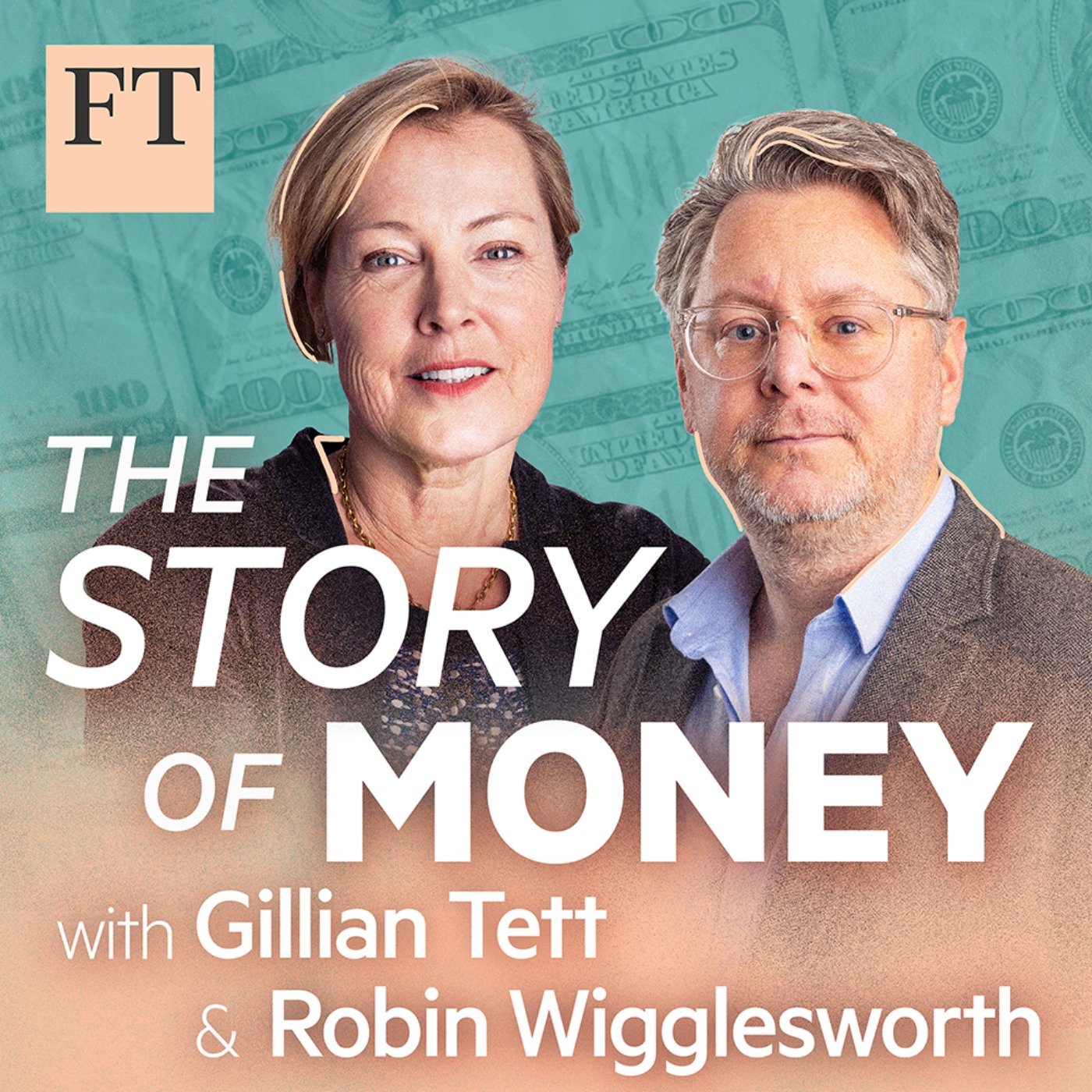

- Podcasts
- The Story of Money
- Why money is the biggest shared hallucination in human history
The Story of Money13 May 2026 · 45m · 22 chapters
Why money is the biggest shared hallucination in human history
In short
Money as a “shared hallucination” rooted in credit, clearing, and trust—not in the physical token. The episode uses Yap’s massive calcite “rye/fey” stone disks to show money can be non-portable and still function via a shared ledger of debts/credits, with value persisting even if a stone is lost at sea. It contrasts the conventional barter-to-money-to-credit story with the claim that money starts from ideas and social agreement about the monetary system. It then applies the lesson to modern crypto (stablecoins/Bitcoin), arguing the key issues are the monetary standard (rules for creation) and who decides, plus how trust works in both fiat and crypto.
Guests
Felix Martin, macroeconomist and author of Money, the Unauthorised Biography.
Key claims
tokens are interchangeable; money is virtual; barter is secondary; crypto still relies on trust in code/design.
Notable examples
Yap stones mined on Babelthwap (~300 miles) and a shipwreck losing a stone without changing its credited value; Burt Lancaster’s O’Keefe scene about people valuing stones over coconuts; gold as a “6,000-year-old bubble.”
Written by AI. May contain mistakes.
Chapters
0:30
The Nature of Money as a Shared Hallucination
Exploration of how money functions as a confidence game and shared belief.
“Well, Gillian, before we get into today's story of money, I want to ask you, what is money anyway?”
2:10
The Stones of Yap: An Alternative Form of Currency
Discussion on the unique monetary system of the Yap island utilizing stone disks.
“So you might say, well, if you believe that's money, why not go say a stone is a bit of money too?”
4:25
Understanding Money Beyond Physical Tokens
Insight into money as a virtual concept rather than just physical objects.
“What happens next in the story of money?”
4:48
History and Characteristics of Yap
Details about Yap's geography, history, and the significance of its stone currency.
“Visit nuveen.com slash future to learn more.”
6:00
Furness and the Discovery of Yap's Currency
Exploration of anthropologist William Henry Furness III's findings on Yap's monetary practices.
“is like, what it looks like, what its history is?”
7:00
How the Stone Monetary System Functions
Explanation of how the stone currency system works without physical exchange.
“Because there was an anthropologist called William Henry Furness III, who arrived on this island when it was actually under German colonial rule, wasn't it?”
8:15
The Concept of a Shared Ledger
Insight into Yap's monetary system as a shared ledger rather than physical transactions.
“and so he observed all kinds of things that were going on there.”
8:35
The Challenges of Controlling Currency Supply
Discussion on the complexities of defining and regulating the stone currency standard.
“But most importantly of all, of course, for this podcast, its monetary system.”
9:45
Historical Standards of Money and Value
Overview of historical standards of money and how they relate to contemporary concepts.
“Maybe the whole thing just works by barter.”
11:40
Cultural Reflections of Money in Film and Literature
Discussion about cultural representations of Yap's currency in film and literature.
“It's a system of ideas rather than a real thing.”
Show all 22 chapters
14:01
The Role of Stone Coins in Yap's Economy
Explore the unique use of stone coins on the island of Yap and their significance in trade.
“And I mean, the analogy here is with gold in today's world.”
16:15
Conventional Story of Money: A Historical Overview
Learn about the traditional narrative of money's evolution from barter to credit and banking.
“Felix I mean you're our Sherpa today can you tell us a little bit about the conventional story of money and what yap shows about it and where it goes horrifically wrong.”
18:53
Rethinking Money: Insights from Yap
Discover how the experience on Yap challenges conventional economic theories of money.
“It starts from the underlying system of credit and clearing.”
22:45
Keynes and Friedman: The Impact of Yap
Understand how economists like Keynes and Friedman viewed the lessons from Yap on monetary policy.
“And of course, there was quite a lot of European sort of smug patronizing superiority towards other, what later became colonial countries, wasn't there?”
26:01
The Legacy of William Henry Furness
Explore the fate of Furness after his groundbreaking work on Yap and its implications for economics.
“You sound like young men in the Roman Empire, Gillian.”
28:00
The Importance of Monetary Policy Examples
Explore the significance of monetary policy through historical examples.
“They're always crucial policy debates in monetary policy, but they were particularly important throughout the 20th century.”
30:20
Understanding Yap's Monetary System
Dive into the fascinating monetary system of Yap and its implications.
“So we're talking about the stones of Yap, the rye stones and how they were used as the underpinning of a really quite sophisticated, fascinating monetary system.”
32:45
The Role of Trust in Money
Discuss the essential role of trust in both cryptocurrency and traditional finance.
“It's actually a very interesting and informative story, that one that you told us.”
38:45
Colonial Perspectives on Yap's Economy
Analyze the implications of colonial narratives on the understanding of Yap's economy.
“And they're part of, you know, the much broader question of to whom we entrust our political governance more generally.”
42:00
Yap's Economic History and Lessons Learned
Explore the historical context of Yap's economy and its implications on financial understanding.
“residents of Yap who are pleased that their history was recorded in this way, from a particular perspective, of course, but it was a rare example of that kind of writing in those days.”
43:26
Key Takeaways from Financial History
Understand the critical lessons from the study of financial history and money standards.
“The real lesson, I think, to take away a couple of them.”
44:39
Acknowledgments and Recommendations
Hear the hosts acknowledge their guest's work and recommend further reading on the subject of money.
“Well, thank you so much, Felix, for sharing your time with us.”

Ask about this episode
Get the gist, explore an idea or ask about something said.
 Claude
On The Story of Money, what are the key points of this episode?
Searching your listeningTranscript
Automatic transcript. May contain errors.
0:00Money starts from a set of ideas. It starts from the underlying system of credit and clearing. And then what is used as a token to represent that can actually be anything at all. It could be gold coins or it could be stone disks.
0:26Today on the story of money. Well, Gillian, before we get into today's story of money, I want to ask you, what is money anyway? Great question. And people say it makes the world go round. But the irony is it's also the most successful shared hallucination in human history. It's a type of alchemist, if you like, where we all pretend to agree that something that is intrinsically worthless, like a slip of paper, is actually worth something from a horse to a house. and it only works because we're confident the next person will play this trust game too. So money is basically just a confidence game then.
1:08It's literally just a printed IOU on a piece of paper or maybe a shell that everybody hopes they wouldn't actually have to cash in because the value isn't stored in a vault. It only magically becomes real at the exact moment you hand it to a stranger who's gullible enough to trust it and give you something in return like a service or some groceries. Absolutely. I mean, it's basically all about credit, which is the Latin word for to trust or he, she, it trusts. But beyond the philosophical question about trust and money, your question about what is money really matters today because we're seeing an explosion in digital currencies like stable coins and bitcoins.
1:50And so the question a lot of regulators and investors would actually ask is what on earth is a basis of trust behind those currencies. What's their value? I mean, it's not like gold, it's not like silver, it's not the credit worthiness of the state or its institutions are backing it, it's simply the belief that this is money. Digital code can be money. So you might say, well, if you believe that's money, why not go say a stone is a bit of money too? Well, it's funny you should say that because there is an island in Micronesia where stones have been used as money, the island of Yap, which in fact is where we're heading on this episode.
2:30So Robin, show us what you're holding there. I think you've got something prepared, haven't you? Yes, I do. I even framed it just for this episode. This is one of the stones of Yap. I'm going to hold it up so you can see it properly. It's actually known as rye or fey stones. They're these big, sometimes huge, even human-sized rocks carved from calcite. They range from one foot to 12 feet in height, and each of them has a circle in the middle. You can see it there. And these stones are scattered all over the island of Yap, along paths, on beach shores, some in front of hotels, in people's garages, everywhere really.
3:08But there is a question, is that that big, how on earth can you actually use them as money? Because you can't exactly carry them around in your wallet or pocket, can't you? Well, this is what it's so interesting about it, because these stones, this beautiful little yap stone here, kind of flips the conventional idea of what money is on its head. Because we often think of money as a physical portable thing, ideally something convenient like pieces of paper in our wallet, something that essentially you have to physically hand something over. But if you think about it, that's not actually true, right?
3:39As you said, money isn't necessarily a physical object. It's really a system based on trust and social belief. So I feel a discussion coming on about the meaning of money, what it actually is and how it works. Might sound a bit strange talking about this, given our podcast is called The Story of Money, but sometimes you have to go back to basics. So welcome to The Story of Money from the Financial Times, a history show for finance geeks and a finance show for history buffs. And if you're neither yet, we're going to try and make you both. I'm Gillian Ted. I'm Robin Wigglesworth.
4:25What happens next in the story of money? Nuveen has spent over 125 years helping clients answer this question. By investing in the growth of businesses, real estate, infrastructure and natural capital, we continue to deepen our expertise across income and alternatives so investors can confidently write the next chapter of their own portfolio stories. Nuveen. Invest like the future is watching. Visit nuveen.com slash future to learn more. Investing involves risk. Principal loss is possible.
5:01So Gillian, I do suspect that the multifaceted nature of money is going to be a bit of a running thread in this podcast, because whether we're talking about Bitcoin, well-capped banks, Mesopotamia, clay tablets, or even modern day treasury bills, money is more fungible than most people think. And I don't think there are, frankly, any better phenomena to explore it through than the rye stones of Yap. As an anthropologist, I love this. But to help us talk about the stones of Yap today, we have a guest with us, the macroeconomist and author Felix Martin, who has written a fascinating book that I actually drawn heavily for my own last book.
5:41His book's called Money, the Unauthorised Biography. Hello, Felix. Great to have you with us. Hello, Gillian. Hello, Robin. Very nice to be here. Okay, so we are talking about the stones of Yap. And obviously, to do so, we should really know what Yap is. Felix, can you take us there? Can you tell us a little bit about what the island is like, what it looks like, what its history is? Yap is a tiny island in the Pacific, in modern day Micronesia, one of the Caroline Islands, very distant from everywhere else in the Pacific. It's a mere day's walk sort of across a sun-kissed, palm-covered island.
6:24And until basically the end of the 19th century, it had had very little contact, effectively, with anywhere else in the world. But it really came to prominence when there was a sort of colonial tussle over the sovereignty of these islands between Spain and Germany. And eventually they were purchased by Germany from Spain for the sum of$3.3 million in 1899. And that brought them more to the attention of at least anthropologists and ethnographers. And that's where one of the key characters in this story comes in, isn't it? Because there was an anthropologist called William Henry Furness III, who arrived on this island when it was actually under German colonial rule, wasn't it?
7:12As an anthropologist, he was interested in studying social systems. Why was he so important? And why did he go to Yap? Yes, that's right. Furness, very intriguing fellow from a distinguished Northeastern American family. His grandfather had been a very important abolitionist, Unitarian minister in Pennsylvania, a leading figure in the lead up to the Civil War. And he himself had studied to be a doctor, but had given that up for the far more interesting vocation, Gillian, of being an anthropologist. Yay, I love it. Now, yeah, now you're just fueling her desire now. Yeah, well, I'm all for this kind of transition.
7:54And he'd made several trips to Borneo with various friends in the late 1880s. And then this opportunity came up to visit this Pacific island of Yap. And he made a trip there in 1903 and spent two months on the island. There was a single trade ship that would come five times a year to the island. and so he observed all kinds of things that were going on there. He produced a fascinating book, which was published in 1910, about this island, cataloguing its customs, the way people lived. It had about 5 ,000 inhabitants, the sorts of things they ate and so on. But most importantly of all, of course, for this podcast, its monetary system.
8:41Yes. Wow. So what exactly did he find? What did they use for money on Yap? Well, it was hard to ignore. the monetary system because the coinage of this monetary system was enormous stone disks. This came as a surprise because, like most people, Furness had absorbed the sort of conventional theory of money and the conventional version of money's history. That is to say, I think he was under the impression that money emerges from barter, that people are trading things with each other. I've got fish and you've got corn and we have to wait until you want my fish and I want your corn and we have to wait until we both want them at the same time.
9:21So that would have been in his head. And when he got to Yap, which was a very simple place, he remarks that there are really only three important commodities on the island. There are fish, there are coconuts, and there is the one and only luxury, the sea cucumber. It's exactly the sort of place where you would have thought, well, maybe they didn't even need to invent a medium of exchange. It's all so simple. Maybe the whole thing just works by barter. And what he discovered was something totally different. And as Gillian will know, this is, again, very common, in fact, when anthropologists have gone to so-called primitive societies.
9:59They had a complex monetary system. But how exactly did the stones work? You know, it's quite baffling to try and imagine a system founded on these working great enormous bits of stone. What Furness discovered was that they didn't function as a medium of exchange. In fact, the longer he spent on the island, the more he realized that nobody carried them around the island at all. what they would do is they would chalk up in their heads the wealth that was owned by a particular family or individual, and they would offset this in transactions with one another. And only very rarely they might actually move one of the stones from one house to another in the sort of final settlement, the final netting off of a particular debt.
10:44It's like a human blockchain, basically. Or a shared ledger. A shared ledger, exactly. And he tells an important story of how a particularly notable and valuable stone, which was being carried from a neighboring island some 300 miles away, Yap itself being a coral island, doesn't have any stone. And in transport from that mine island, a storm blew up, sank the ship, and this stone was lost, sank to the bottom of the sea. But, he points out, this made no difference to the fact that everyone on the island acknowledged the value of the stone still accrued to the family who had owned it. And it was used for many generations to settle transactions.
11:26So that, of course, tells you something very fundamental about the monetary system of Yap and, in fact, about all monetary systems. It is, as Gillian was mentioning early on, that money is a purely virtual system. It's a system of ideas rather than a real thing. And it's easy to get very confused with the tokens which represent money, in this case, big stone coins. At other times in history, it's been all kinds of different things. We're familiar with metal coins and notes and so on and so forth. But we're also familiar today, of course, in the digital world with not needing to represent money with anything physical at all.
12:09And so it was a sort of very early insight and very obvious insight into that underlying fact. But what's to stop people from just going out and, you know, creating more and more stones? I mean, you know, how do they control the supply of stones? Could they? so very important question you're raising there although i would put it slightly differently of course we don't know everything about the monetary system of yap um uh unfortunately this monetary history was and here i'm going to say something against anthropologists jillian was uh was not written by an economist so um he doesn't actually tell us some of the some of the really crucial things about the um about the monetary system i'm as a journalist i'm all here for making fun of both anthropologists and economists, given that I'm neither.
12:55And the real key question with any monetary system is the definition of the monetary standard. It's how the standard monetary unit, that would today be something like a dollar or a euro or a pound, is defined. And historically, there have been lots of different ways of doing that. There have been precious metal standards like the gold standard, where you say there's a fixed parity between the pound sterling and a particular weight of gold. There are standards like we have today, an inflation targeting standard in the UK and many other countries, where we choose not a single commodity, but a basket of goods and services.
13:35And we don't fix it to the price level, we fix it to the rate of growth in prices. And all this information, which is the crucial information about the underlying network of credits and debts and about the standard unit, that doesn't appear, of course, in Furness's account. As I said, like most people unfamiliar with finance, he didn't get to that point of things. And instead, he was focused on the coinage, the particular coins, the stone coins which represented these underlying credits and it so felix i don't know if you've seen the film there's an old burt lancaster film called his majesty o 'keefe which is about more vaguely about yeah but he the rye stones have a big role because he's he's this irish american adventurer who ends up uh on the island and he's desperately trying to get the natives to basically give him their coconuts so he could uh you know sell them and he really struggles because they don't really want anything he has to offer and he threatens and and jolves and you just can't do it but he discovers that they love these these rye stones and i remember there's this scene where he is just befuddled when they drop all the stuff he's tried to give them and they run to the shore because somebody has arrived with these stones they're screaming rye rye rye and there's this line i actually noted it down because it's so delightful uh so this is burt lancaster is o 'keefe saying i don't understand you offer them a fortune for a few coconuts and they refuse to work that they go and kill themselves for six pieces of stone but that meant that they imported the stone you said yeah it was a coral island primarily where did the stones come from then they were mined on on a neighboring island although it's it's not at all close you know um some 300 miles away babel flap which is a dangerous journey then indeed indeed and that was the reason there was that shipwreck that we mentioned um earlier um so So yes, that's where they came from.
15:35And I mean, the analogy here is with gold in today's world. You know, you could ask the same thing, why are we all so excited and obsessed by gold? It has some industrial uses, it has some sort of value, but that, of course, is not predominantly what drives the valuation of gold. It has a social value far in excess of all that. It famously was called by the monetary economist Willem Boiter, a 6 ,000-year-old bubble. yes and and similarly of course you know gold is only mined in certain places around the world and the quantity that's mined is quite sort of arbitrary and so on okay so before we go any further it feels important that we maybe spell out some of the economic assumptions about money Felix I mean you're our Sherpa today can you tell us a little bit about the conventional story of money and what yap shows about it and where it goes horrifically wrong.
16:31And just remember, to paraphrase Jeremy Irons in that film Margin Call, explain it to me as if I were a young child or a golden retriever. And I love golden retrievers. Yes. Well, I'll do my best. The conventional story of money, and by that I mean, you know, it's the story that you find in a lot of historical sources, going all the way back to sort of Aristotle, you find Adam Smith and lots of 19th century economists. But more importantly, it's the one which is really ingrained, I think, in most people's minds, even people that have never thought about economics. And we can discuss later why that is.
17:09It is the idea that, you know, in the beginning, there was no money. There was just barter, right? You know, I have fish and Gillian has corn and we have to wait until Gillian wants my fish and I want Gillian's corn. And what's more, we have to wait until we both want them at exactly the same time. That's what economists call a double coincidence of wants before we can transact. Otherwise, we can't make any transactions. And that's, of course, a very, very inefficient system. And therefore, at some point in time, some bright spark came up with the idea of choosing one commodity that's produced in the economy to serve as a so-called medium of exchange.
17:46And that means a thing which people want not for its own sake, but simply because it's acceptable to everyone in settlement of debts incurred in transactions. And in the course of history, generally speaking, the thing chosen to serve as this has been precious metals. And that's because they have desirable properties. That's the theory. They're ductile. They're malleable. You can make them into little pieces. you can carry them around. If everything goes kaput, you know, they're valuable anyway in other uses. And that's basically the invention of coinage. And then as you move forward in history on this conventional view, people started to borrow and lend this money stuff, and that's the invention of credit.
18:37And then even later, institutions were created which specialised in this borrowing and lending of the money stuff. And that's the invention of banking. So that's the kind of sequence which I would call the conventional story of money. Now, the reality discovered many times by anthropologists in many different places and actually evident in the historical record, and also effectively what, of course, William Henry Furness discovered on the island of Yap is exactly the other way around. Money starts from a set of ideas. It starts from the underlying system of credit and clearing. And then what is used as a token to represent that can actually be anything at all.
19:25It could be gold coins, if gold is available, for example, or it could be stone disks, if stone is what you've got available and decide to make valuable as collateral. Or it can be purely virtual as it is today. So when we ask, you know, what are the sort of key broader lessons that Furnace and indeed later economists take from the example of the app, I think there are a couple. One is it's a very nice reductio ad absurdum of the idea that money is a medium of exchange which is selected for its desirable properties. Furness himself said when he got to Yap, he was baffled by the fact they were using these coins because they were, in fact, very difficult to carry around the island.
20:14They were sort of the last thing that you would have chosen to be a medium of exchange. He says, when it takes six strong men to carry the price of a pig, burglary cannot but be a disheartening occupation. Yes, that does sound very inconvenient. Exactly. So, you know, it flies in the face of this sort of conventional theory. Right. So in many ways, what you're saying is that the economist Adam Smith, who had this vision that you started through historical evolution, first with barter, then with money and then with credit, he was kind of wrong. That's what Yap is showing, that actually, in many ways, you started with credit and money interchangeably.
20:55And barter was a bit of a sideshow. Yes, that's right. And Smith is, of course, an absolutely brilliant economist. But it's very interesting to take that as an example, because I think the third thing which Furness' experience on Yap showed is one of the reasons why this conventional view of money is so common. it is because from the perspective of an individual from the bottom up of course money does look like a thing it's it's extremely easy to confuse the physical tokens for money itself um it's it's you know what you see when you hold uh cash in your hand and and even when you're looking at your bank balance you know on your in your um digital banking um account you know it looks like something that you own that's yours.
21:46It's only when you look from the top down, as it were, and you have a view of the system as a whole, that it becomes clear that it's a gigantic web of credits and debts being continuously offset against one another in the course of settling trade. And, you know, that was easy to do for Furness because he was on this tiny little island. You know, it's all very obvious if there are any 5 ,000 people there and only a handful of commodities and very limited trade and a few other things. So I think, you know, that's why it was easy to see in that case. It's very, very difficult to see that when you're trying to think of a modern macroeconomy, a vast financial system and so on.
22:26And of course, Smith is the key figure at the transition point between people starting to think about the economy as a whole. He's the original sort of macroeconomist, if you like, or one of the original macroeconomists, the first person to just be beginning to take that view, but probably still not doing it sufficiently. And of course, there was quite a lot of European sort of smug patronizing superiority towards other, what later became colonial countries, wasn't there? I mean, the idea to Europeans that they could learn anything from Yap, it would have been seen very odd, where everyone assumed that so-called primitive cultures like Yap were part of our long-forgotten prehistoric past, where it was all about Barter.
23:15I am curious, what was the response to Furness's paper when he returned from Yap? What did people make of it all? One of the charming things about the whole story, to come to both Gillian's question and yours, Robin, is that the book was picked up in 1914 by the Economic Journal, then the leading economics journal of the day. And it was assigned to a young treasury Mandarin, an alumnus and fellow of your college in Cambridge, Gillian. King's College, yes. I think I know where this is going already. A certain John Maynard Keynes, he did not at all take that condescending European view that Gillian was describing of this system.
24:03He said, these people really understand money. They have, he said, a much more philosophical view of money than we do. And still later, at the back end of the 20th century in 1991, another of the very great economists of the 20th century, Milton Friedman, also picked up the story and wrote about it. The reason why they latched onto it was because it's such a picturesque and compelling example or story that demonstrates the purely conventional nature of money. And for different reasons, for those two economists, that was something very important in the policy debates of the time. M. Keynes was just beginning to formulate his ideas of how it might be better not to be on a fixed precious metal standard on the gold standard, why it might be a good thing that the government was able to manipulate monetary policy in order to stimulate or calm down the economy.
25:03We're very familiar with that sort of thing today, but that was not conventional wisdom back at the beginning of the 20th century. And Friedman also was very keen to stress the conventional nature of money and therefore the importance of monetary policy. Though for completely different reasons, by the end of the 20th century, he was very keen to argue for having a strictly rules-based monetary policy. But both of them saw it as very important to get the public to understand that money is a purely conventional construct and therefore can be managed by government, something which, you know, under the gold standard had been sort of abrogated by economists and policymakers.
25:51I mean, it's absolutely fascinating. I've got a great quote from John Manny Keynes, who is indeed someone I spend a lot of time thinking about because King's College in Cambridge was his base. He wrote about Furnace that… You sound like young men in the Roman Empire, Gillian. Exactly. Keynes actually wrote about Furnace's book. He said Furnace's book, quotes, has brought us into contact with the people whose ideas on currency are probably more truly philosophical than those of any other country. That's pretty amazing, given that Bretton Woods is usually associated with Western industrialized countries, not somewhere like Yap.
26:30Yes, absolutely. I mean, like I said, of course, he was investing it with his own ideas and he was very excited. You will know, I mean, Keynes was a master of the use of picturesque stories and he also loved to use myths and legends and colourful illustrations to animate what are sometimes quite difficult conceptual ideas. And so I think that's really why the story appealed to him. So how did Yap, if it inspired to the frankly greatest economists of the 20th century, what kind of a shadow did it cast over macroeconomics of theories of money? Did it change the conventional story at all? I think the important thing to grasp is that the question of whether monetary policy should be discretionary or rules-based, that is to say, you know, whether central bankers should be able to decide at their discretion whether to allow the banking system to create more money or whether they should stick strictly to some rules.
27:39And the question of what they should be targeting when they do that, whether it should be a fixed price of gold, for example, as was the case under the gold standard, whether it should be a particular inflation target as it is today, or whether it should be some completely different kind of monetary standard, like some of the ones that are adopted by modern cryptocurrencies. You know, these questions are crucial. They're always crucial policy debates in monetary policy, but they were particularly important throughout the 20th century. And so the use of this example of YAP to, first of all, demonstrate the conventional nature of money.
28:23So the possibility of using monetary policy to adjust the value of money. That was a very important background to both what Keynes and what Friedman were saying. So just to go back to Yap and Furness again, what happened to Furness after he went to Yap, wrote his book in the early 20th century? What happened to him after that? He retreated back, as far as I know, to his family home. As I say, he came from a distinguished family, and they had a rather lovely house in the town of Wallingford in Pennsylvania. But he, alas, met quite an early end. I think he may even have died before his account of Yap was published in the United Kingdom.
29:09So he never got to enjoy the fame heaped upon his story by by Keynes and later economists. Okay, on that slightly sad note, let's pause for a moment. And when we get back, let's really dig into what the stones of yap, these rise stones, tell us about what money really is. And more importantly, how it relates to some very modern day questions around crypto, for example.
29:43the future of fixed income investing will continue to blur the lines between public and private markets nuveen's credit platform was built to navigate this shifting landscape channeling capital toward the businesses infrastructure and energy solutions that are shaping tomorrow's economy all while aiming to deliver the resilience and returns that portfolios seek today nuveen Invest like the future is watching. Visit nuveen.com slash future to learn more. Investing involves risk. Principal loss is possible.
30:20And we are back. So we're talking about the stones of Yap, the rye stones and how they were used as the underpinning of a really quite sophisticated, fascinating monetary system. But before we get into the real discussion about what is money and what is crypto and what we learn from Yap, I have this one more pop cultural reference that I want to take some shoehorn in there, just because it relates to my childhood. I don't know, Gillian and Felix, did either of you ever read any of the Karl Barth's Uncle Scrooge books? I'm afraid not. I think I was too busy reading Edith Blyton. Okay. Well, that sounds probably a little bit better.
31:00I was reading Adam Smith. no i wasn't really reading adam smith no more as as as all children should really well so i as a elder millennial definitely read lots of donald duck uh comic books and there's a series of them by this writer called carl barks and he wrote these series of stories about uncle scrooge he's the wealthiest duck in the world and there's a one book he gets just exhausted by business he's tired of money even which is kind of outrageous he's so stressed out that he flees to this one place is heard about that is supposed to be devoid of any money it has no money and it's a mythical place called Trolala in the books but it's actually based on Zanadu somewhere in the Himalayas where Kublai Khan fled as well and and he gets there and it is as specific as he's been told it's amazing he relaxes he doesn't need to drink the nerve tonics any longer but Uncle Scrooge ironically has brought with him the seed of this specific society's destruction by bringing these nerve tonics he's drinking because the bottle caps are so weird and novel that the people of tra-la-la adopt it as currency and go frankly completely mad for it uh and i just like that you know even in cartoons sometimes you've had treatments of what is money and and shown how what is money can be quite fungible and people can build quite complex systems around it and do really stupid things for it.
32:30But with that slight possible digression into my childhood, let's get stuck into money today. Felix, what does DAP's monetary history tell us about what money is and what does it mean in practice today, especially given, frankly, what we can see going on in cryptocurrencies? These are great, great questions. I must just follow you. It's actually a very interesting and informative story, that one that you told us. It has a couple of very common themes from monetary history. One is the corrupting power of money. societies which don't have money are somehow pure and peaceful but as soon as money is introduced you know it um it stimulates all the sort of worst uh habits and um and proclivities of people so interesting that donald duck spots that one um and then of course this idea that a huge variety of things can be used as money although you'll understand i would actually correct that a bit and so can be used as the tokens that represent money.
33:38And that brings us back to Yap, of course, because, again, what this example of Yap shows and the reason why it's been so often used is, you know, through its really very bizarre type of coinage, huge, heavy stones and all that. It's a good illustration of all the kinds of different things that can be used. And its primary value is, therefore, to draw our attention away from the tokens themselves and towards the underlying system. And that's really important, especially as you alluded to today, when we have purely digital forms of money and privately issued monies and so on in the form of cryptocurrency.
34:25Now, privately issued monies, for example, they're nothing new. There's many, many examples of them throughout history, albeit that state-issued monies are much more dominant, of course, in financial history. But there's no shortage of private money issuance throughout history. But it's tended to remain small-scale for all kinds of different reasons, whereas today, due to digitization, the internet, its global nature, and so on and so forth, modern virtual monies, crypto monies, they really can be very, very widespread. And so it's very valuable that this example of YAP, you know, draws your attention away, ironically, from the nature of the tokens used to represent money and towards the underlying system of credits and debts and clearing, which is common to all monetary systems and which is common to cryptocurrency.
35:19Which, of course, is wonderfully ironic. I mean, it does raise a question, though, that if it's really about trust in tokens, and if the tokens can be all manner of different things, ranging from, you know, bits and bytes on your phone in terms of cryptocurrency through to big stones on Yap, what does this stop someone just creating more and more of those and essentially generating an inflationary moment that destroys the crypto market? or is the whole financial system? Yes, it's the key question I think I mentioned earlier on. The two key questions on which all of monetary history depends are what is the definition of the standard monetary unit, whether it's a dollar, whether it's a euro, whether it's a Bitcoin.
36:07And so, in other words, what are the rules that govern the creation of money? And then who gets to decide that? And then if we think of a cryptocurrency like Bitcoin, Not all cryptocurrencies, of course, have the same standard as Bitcoin does. The answers to those questions would be, well, there's a fixed issuance of Bitcoins towards which the total number in circulation is asymptoting over time. I can't remember what it is, either 19 or 21 million. I can't remember. So it's a fixed monetary standard in that sense. And then the answer to the second, who gets to decide? Well, it's hard-coded. It's hard-coded.
36:46So in theory, anyway, it can't be changed. So, you know, that's the answer on that front. But there are other kinds of cryptocurrencies with different rules for the creation and extinguishing of the tokens. So they have different monetary standards. And in principle, you know, you can have any monetary standard you like and you could hard code it or have it completely at the discretion of some authority. Those are also options. Of course, the danger is that if it's all reliant on social trust to glue the system together or trust in an institution or authority figure, that can also evaporate, can't it?
37:27Yes, it can. I mean, so advocates of cryptocurrency, they like to make the distinction between trusted protocols and trusted institutions. So they like to say, well, the conventional so-called fiat monetary system relies upon trusted institutions and trusted policymakers. And they like to contrast that with the idea of trusted protocols. So you've got some sort of hard code. And as long as you, like I said, I mean, as long as you trust that the code is what you've been told, then you don't need to worry anymore about trusting that your bank isn't going to go bankrupt or that your policymaker is not going to go completely mad and start an inflationary spiral.
38:05um i personally think this is a bit of an equivocation because you know in truth you still you've got to trust uh whoever designed for example you know the whoever wrote the code and who's ever designed the system most people using these cryptocurrencies are not qualified to actually scrutinize the underlying code and so on so there's the same exactly the same element of trust that you mentioned i think it's the same across conventional systems and and cryptocurrencies ultimately. And, you know, probably that puts cryptocurrencies on a more similar level than its biggest advocates would like to admit with conventional fiat regimes.
38:45And just to return to, you know, the point we were making about why the example of Yap was picked up by Keynes and Friedman, these two great 20th century economists, it's really important to understand you know that any monetary system is ultimately manipulable it can be operated badly it can be operated well and the key questions are you know what are the criteria by which you decide whether a monetary policy is good or bad and to whom do you entrust those decisions whether it's a coder or a central banker or whoever it is and those those questions are just perennial. And they're part of, you know, the much broader question of to whom we entrust our political governance more generally.
39:30You know, we live in a democratic system, we'd like to have a democratically governed monetary policy, or, you know, do you live in a monarchy back in the olden days, and you would entrust the management of the currency to the sovereign, often with disastrous results? Well, I think that right now in America, because there's a very live debate given the attacks on the Federal Reserve. But I'm curious, I mean, the story of Yap, as you say, has attracted attention from people like John Maynard Keynes or Milton Friedman. But there are some anthropologists, aren't there, who say, in fact, this is an awful lot of colonial era prejudices and reframing.
40:09And in fact, that we shouldn't be using the Yap story in this way, because it simply demonstrates Western blinkers. What do you think, Felix? I mean, is the story sort of inaccurate or is it a fair template for discussing money in a wider sense? I think it's undoubtedly true that both Keynes and Friedman, for all the great intellectuals they were, and certainly in Keynes' case, a man of great sympathy with other cultures and so on, for all of that, of course, they were just seizing upon this picturesque story. and extracting from it one or two general lessons about the operation of money, and then using it to convince people of their particular arguments about how monetary policy should be won.
40:57So I don't think they were particularly interested or familiar with the actual experience and details of Yap. William Henry Furness himself is a little bit different. I mean, I'm sure in many respects, He is a, would be considered today a very, you know, a classic 19th century Western anthropologist carrying with him all kinds of prejudices and so on. But reading his book also, and again, you'll know this, Julian, like most real, sincere anthropologists, I think what comes across from his book is an immense interest and love for the people that he was visiting and hanging around with. Of course, he was coming with prejudices.
41:40Of course, he had a limited understanding. I myself accused him earlier on of not having really a very good understanding of money and finance per se, albeit we should thank him for bringing us the picturesque example of the stone coinage. It's a very fascinating, enjoyable book. And I imagine that there might be contemporary residents of Yap who are pleased that their history was recorded in this way, from a particular perspective, of course, but it was a rare example of that kind of writing in those days. Do you know what happened to Yap's economy after Furness came in and left? I know that no stones have been made since the 1930s, because obviously, you know, it's been colonised and ruled by many people since then.
42:28I seem to recall that one of the problems was that, ironically, because of colonization, more and more stone-cutting tools started to circulate in the economy. So it became easier to create these stones. And, of course, then you get a bigger supply and, guess what, inflation as well. There was stone inflation, if you like. Yes, Julian, but the only problem is that the stone didn't catch on elsewhere. You see, that wasn't a problem for gold producers, as you know, around the world. They become much more efficient at extracting gold. But for some reason, that 6 ,000-year bubble keeps going. Alas, the calcite of Babelthwap didn't catch on with everyone else.
43:06So what's your sort of final takeaway from all this, Felix? I mean, other than the fact that if you are studying economics and listening to this podcast, you probably ought to organise a school trip to Yap sometime soon to go and have a look at the topic at the original source. But what do you take as a big message that everyone should learn from this? The real lesson, I think, to take away a couple of them. One, financial history is totally fascinating. And if you want to understand economics and economic theory, you must read and understand financial history. And the other one would be when you're studying financial history, the great lesson, of course, to draw from Yap and everything that we've discussed is do not allow yourself to become distracted by the very fascinating topic of numismatics, that is the study of coins, the tokens, notes, tally sticks, and all the other things which have been used, even those bottle tops, perhaps, in the Xanadu of Donald Duck, which have been used to represent my...
44:13But don't be distracted by that, because what you really need to learn, understand in financial history is what is the monetary standard and who gets to decide what it is? And if you answer those questions for any money throughout history, whether it's money in ancient Rome, money in early modern Europe, money under a gold standard, modern cryptocurrencies, you will really understand a lot about them and how they work. Well, thank you so much, Felix, for sharing your time with us. I must say your book, Money the Unauthorized Biography is a real must read for anyone who's in the world of finance either as just a student or a wannabe investment banker or an investment banker or anyone else who's interested in how money does or does not work.
45:01Thank you very much indeed for those accolades from two great authors yourselves whose books I very much enjoyed and I'm looking forward Robin to your forthcoming book. I'm looking forward to having it out there as well. So that's it for this episode of The Story of Money with me, Julianne Tett. And me, Robin Wigglesworth. So we'll see you again next week.
45:41The future of fixed income investing will continue to blur the lines between public and private markets. Nuveen's credit platform was built to navigate this shifting landscape, channeling capital toward the businesses, infrastructure and energy solutions that are shaping tomorrow's economy, all while aiming to deliver the resilience and returns that portfolios seek today. Nuveen. Invest like the future is watching. Visit nuveen.com slash future to learn more. Investing involves risk. Principal loss is possible.
From the publisher
What is money? And what can a small island in Micronesia teach us about how it works? On Yap, a remote island in the western Pacific, giant calcite “Rai” stones once functioned as currency, where ownership and collective trust — rather than physical possession — defined wealth and status. In this episode of The Story of Money, macroeconomist and author Felix Martin joins hosts Gillian Tett and Robin Wigglesworth to explore the stones of Yap, the origins of money and why the traditional “barter theory” may be a myth.
Further reading:
Money: The Unauthorised Biography (2015) by Felix Martin
Uap of the Carolines (1910) by William Henry Furness III
A Treatise on Money (1930) by John Maynard Keynes
The Island of Stone Money (1991) and Money Mischief (1992) by Milton Friedman
‘Tralla La’ in Uncle Scrooge #6 by Carl Barks (1954)
His Majesty O’Keefe (1954) Warner Bros
To enjoy future episodes, be sure to subscribe to The Story of Money wherever you get your podcasts. You can also follow the show's dedicated YouTube channel here.
Love listening to The Story of Money? Join us live on Saturday, June 20 at our inaugural NYC FT Weekend Festival at Spring Studios. Put your questions directly to our experts, experience your favourite podcast in person, and see the FT come to life. Register now and enjoy 10% off with code FTPodcast — this is one Saturday you won’t want to miss.
Learn more at ft.com/tsom or get in touch at [email protected].
Hosts: Gillian Tett and Robin Wigglesworth
Guest: Felix Martin
Producer: Lulu Smyth
Senior Producers: Laurence Knight and Michela Tindera
Executive Producers: Flo Phillips and Manuela Saragosa
Original music: Breen Turner
Broadcast engineers: Bianca Wakeman and Petros Giuompasis
Podcast Development: Laura Clarke
FT Global Head of Audio: Cheryl Brumley
Video editors: Kristen Kenyon and Josh Divney at Podcast Discovery
Read a transcript of this episode on FT.com
Hosted on Acast. See acast.com/privacy for more information.
More from The Story of Money
All episodesWe use cookies.They keep VO running smoothly and help us improve it. Privacy policy