Ask ChatGPT
 The Ultimate Human with Gary Brecka
15 Oct 2026 · 40m · 18 chapters
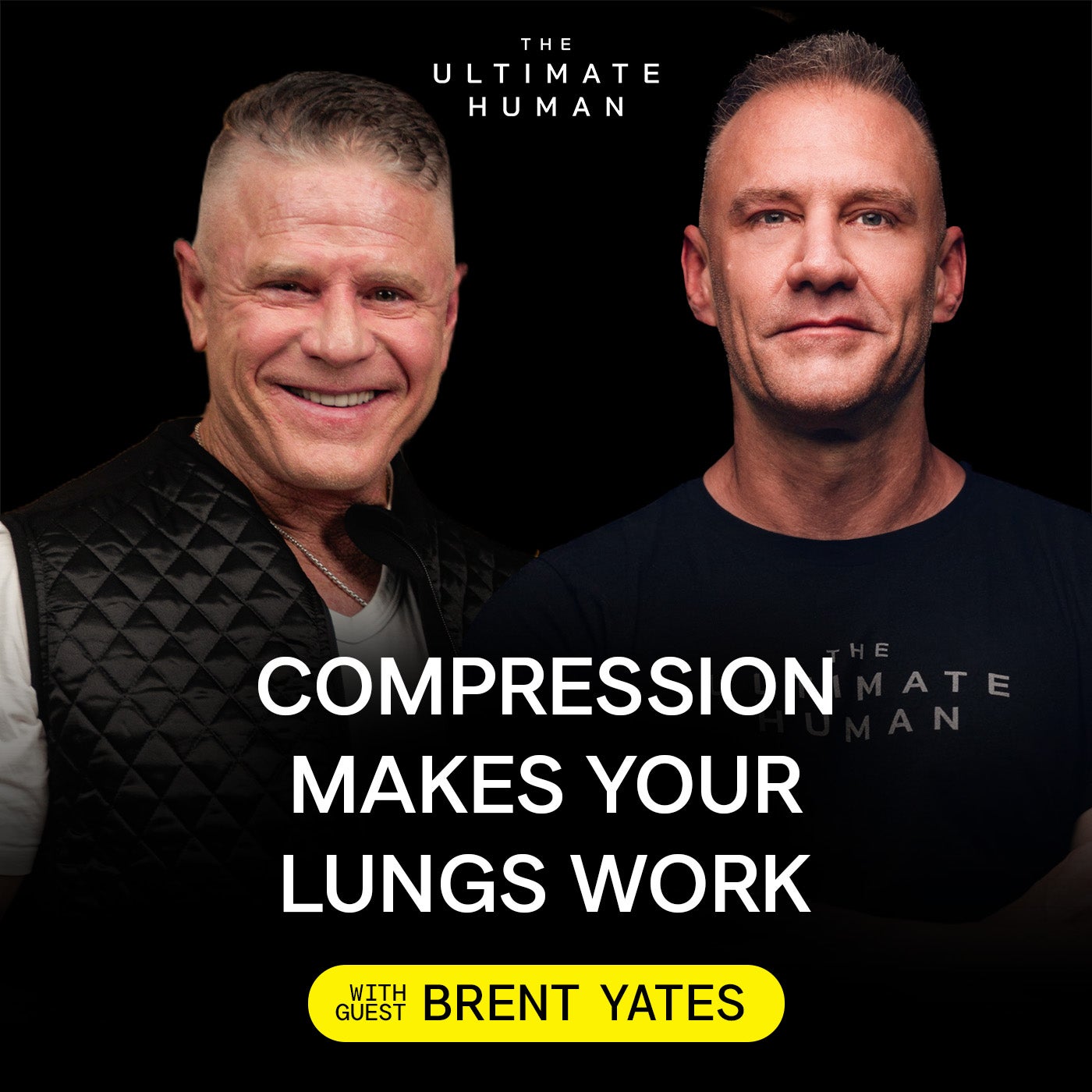
Brent Yates argues that sedentary people can use a “passive biohack” via a lightly weighted, compression-based vest (ION) worn daily to improve circulation, metabolism, and adaptive stress response, without gym time. He reframes rucking/weight as everyday lifestyle wear, not just workouts.
Brent Yates is a serial entrepreneur and Wall Street Journal bestselling author of The Gravity of Up. He previously pursued professional long-drive golf and later suffered a supraspinatus tear, MRSA, and major health breakdown around age 47, including surgery delays during COVID. He co-develops ION with a focus on compression/heat/fractional loading; he also worked with data partners and a human-performance program for the Department of War.
Compression increases blood flow/oxygen to tissues; heat (neoprene) raises body temperature; fractional load engages more of the torso/core versus shoulder-hanging weight. Optimal starting weight is ~3–5% of body weight (e.g., ~5–8 lb for many women). Testimonials show leaner appearance via redistribution rather than overall weight loss. He cites hormesis and “passive” daily adherence.
He tried multiple heavy vests that hurt his back/shoulders; he wears his vest daily (including on podcasts). He describes a military onboarding concept using progressive loading (e.g., starting ~15–25 lb before 50 lb rucks) to reduce injury/attrition.
Written by AI. May contain mistakes.
Learn about the speaker's health struggles and their introduction to rucking as a solution.
“At the same time, I went, all right, how am I going to fix my body?”
Brent shares his personal health challenges and the journey to recovery.
“You're looking good too, brother, by the way.”
Brent discusses the importance of relationships in his health journey and the inspiration for his book.
“And, you know, what was the problem that you solved in your life?”
Brent describes the motivation behind creating a fashionable weighted vest and the science behind its design.
“And, um, I kept whining to God, like I've transformed my life.”
Explore the science behind how compression and weight affect the body and improve fitness.
“The ones I ordered, I had bean bags shoved in it, and I would not wear it out of my gym.”
Learn about the benefits of compression and optimal weight in exercise.
“To me, more blood flow, more oxygen, right?”
Explore the idea of integrating weight into daily life for better health.
“you know, improving metabolism, raising body temperature, and increasing the rate for this adaptive response.”
Discuss misconceptions, especially among women, regarding the use of weighted vests.
“But always wanting more, a little bit more, especially as you age, like you have to look for every tool you can find.”
Learn how to safely incorporate weight into your fitness routine.
“So 120-pound woman is going to wear about 6 pounds.”
Discover how passive biohacks can enhance your health without taking extra time.
“But what is the advantage of the combination of not just weight, but weight and compression?”
Learn about advancements in human performance kits for military recruits.
“Like the biohacks that don't take any time away from your day because a lot of, if you walk around my apartment, You know, it's like a lot of these things take a lot of time.”
Understand the importance of progressive loading for military recruits to prevent injuries.
“all the measurements that you measure, right?”
Discover optimal weights and methods for starting a weighted lifestyle.
“It stops them, especially when they throw 50 pounds on them immediately.”
Learn about the importance of progressive loading and recovery in weight training.
“Someone listening to this podcast, new to weight, new to rucking, you know, has sort of piqued their interest about a lightly weighted lifestyle.”
Explore strategies for getting better results from shorter workout sessions.
“When I started wearing mine, I've worn mine, I don't know, 250 days a year.”
Understand how meditation can enhance mental clarity and performance.
“And I think everybody is in that same bucket of how do I improve my results by not extending my amount of time.”
Learn the importance of mindfulness and appreciation of nature in meditation.
“different ways to do all this, but what I'm truly after is to feel my body again and to forget everything else.”
Discover what it means to be an ultimate human and live with purpose.
“Well, somebody asked me the other day, how long would I do this?”

Get the gist, explore an idea or ask about something said.
 Claude
On The Ultimate Human with Gary Brecka, what are the key points of this episode?
Searching your listeningAutomatic transcript. May contain errors.
0:00Gary Brecka: 18 years ago, I lost my health. I was self-injured. My body had broken down. At the same time, I went, all right, how am I going to fix my body? But once I decided it was weight, get my body back faster, I needed a tool. And so I ordered every weight vest on the market and it not only hurt my body, but it compromised my movement. The way that people think about rucking and weight as being something that can be incorporated into their lifestyle rather than just something they go do at the gym, I think is a reframing for me that's had very positive consequences. especially as you age. Like you have to look for every tool you can find.
0:28Father time is staring you right smack in the face. And when I invented it at 62, I got to have more tools, man. And I thought, what if I could tap into my metabolism every day, tone a little bit all day and look good doing it.
0:40Gary Brecka: There's science around compression. There's science around weighted exercise, improving metabolism, raising body temperature and increasing the rate for this adaptive response. Most weighted vests give you weight because of the compression, heat and the load, we give you a transformational body. Someone listening to this podcast, new to weight, new to rucking, sort of piqued their interest about a lightly weighted lifestyle. Where do they start? I think the biggest thing is...
1:16Gary Brecka: Hey guys, welcome back to the Ultimate Human Podcast. I'm your host, human biologist Gary Brekka, where we go down the road of everything, anti-aging, biohacking, longevity, and everything in between. And today's guest, not only a New York, or a Wall Street Journal bestselling author, he is a partner of mine, and he is a partner of mine in a project that I think could change the landscape of how you walk through your daily life. You know, as a mortality scientist, we knew long time ago that sedentary lifestyle was the leading cause of all-cause mortality. Today, sitting is the new smoking. And I've asked Brent to come on and talk about his invention.
1:53Gary Brecka: He's a serial entrepreneur. He's an amazing partner. And what we have to talk about today may reframe the way you think about how you go through your daily life. Welcome to the podcast, Brent Yates. Hey, brother, pleasure to be here. It's a pleasure to have you on. Pleasure to be my partner. You're looking good too, brother, by the way. Yeah, thank you. What have you been doing? Every day, right? Way to pass. I mean, if you follow me on social media, you see me on stage talks, podcasts, lectures, interviews, and people see me in the airport. You like, you really wear that thing every day. And I do, I really do wear it every day.
2:29Gary Brecka: Um, and before we get into the whole discussion today about lifestyle and, um, how weight and compression, I want to get into some of the science behind it. Um, I do just want to put right out there upfront, what was my trigger, um, you know, for partnering with you. Like I say, we knew the data on sedentary lifestyle was not good. We've engineered movement out of our lives, you know, walkways, escalators, elevators, moving walkways, cars, everything. We know that sedentary lifestyle is the leading cause of all-cause mortality, but some people just don't have time to go to the gym. Yeah. And your philosophy of a lightly weighted lifestyle really set off a light bulb for me.
3:12Gary Brecka: And I've been an ion advocate ever since. And it was an easy transition for me. And if you look back on my videos and podcasts and lectures over the last few years, I'm always in this thing. So I love it. But there is a common theme that runs through nearly everybody that sits in that chair. And they may or may not be the most credentialed, but the most passionate, purpose-driven, and powerful people that I've ever met have solved some kind of problem in their life. And I'd love to know the backstory, you know, what led to this. I've never asked you about that. And, you know, what was the problem that you solved in your life?
3:51Gary Brecka: I know you're on your way to a great golf career. Yeah. Yeah. I was. I was. You're a big guy for a golfer, dude. Yeah. Yeah. Yeah. Yeah. So I solved that problem, but, but truly the backstory would be like 18 years ago, I lost my health. And I think when I built up my health through a lot of people coming into my life, which we'll get to, um, at 60 years old, when you mentioned like, hey you had a golf career going on I was doing long drive golf ball contests professionally oh professionally and tore my super spinatus and so uh that kind of that kind of yeah that kind of ended that but uh it was the time after and it wasn't COVID and so the protocols to get PT all that stuff I couldn't get in I knew I had a problem uh but I had to keep going so in one swing I just gotten a 48 inch driver um it's a little more torque with that uh but I really I found myself trying to optimize, right?
4:47Distances, like it's acquired, like the stronger you get, the more torque you have, the better shape you're in. And I found myself in the look back working out wrong with a TRX bar. Like I got it up here, my shoulders overwhelmed, my core overwhelmed my shoulders. And I think that was part of my pitfall. But ultimately tore my supraspinatus, four to five months trying to get surgery in COVID.
5:11Gary Brecka: um as i mentioned the protocols were pretty messed up and i immediately lost my body that i had worked 13 years to get at age 60 because i've lost my body at 47 and so here i am watching my body degenerate in front of the mirror which you know once you lose it and you get it back like that's all i worried about like you don't want to lose it again i wanted to be the very best i could be and so when i saw that going on uh first i wrote the book at the same time i went all right how am I going to fix my body? Yeah. Tell me about the Wall Street Journal bestselling book, The Gravity of Up. Was this injury, this recovery journey you were on, is that the inspiration behind the book?
5:53Gary Brecka: No, sir. Okay. No, sir. And so Christina, who you've met, my wife, 10 years, I've known her 11 years. Amazing woman. We got married almost 10 years. Yes. One of the reasons I sit here today - Way out your lead, dude. Dude, you know, when I pray, it's like, it's like, I know I have purpose because of who he put beside me. And so I had that conversation with her the other day. And I'm like, baby, like, do you know, do you understand what power that gives me in a feeling of gratitude that you're beside me? That's amazing. Anyway, but what was the question now? What was the inspiration behind the book?
6:28Gary Brecka: Because lots of people write books, not a lot of people write number one telling Wall Street Journal bestsellers. Christina met me 11 years ago. My transformation happened almost 19 years ago. And when she met me, I'd already transformed into who you see today, the guy that thrives and wants to be better and looking for more and always knowing the right people around him are going to get us where we want to go. All those things that I hope we get to cover. But ultimately when that occurred, when she met me, she'd heard the stories and then we were a year together, she started meeting the people.
6:59And then after we got married, really meeting the pastors and the life coaches and the trainers that finally she got to meet and understanding the transformation by those people that I'd told stories about, but now they got to tell their stories to her. And so for about five years, she kept saying, you need to document this in a book. And I kept saying, I kind of get it, but I don't want to take the time. I don't want to really reveal how I lost my health. That's that's not an easy thing to do. Um, and I just didn't want to take the time, but then COVID hit and, uh, can I tell you why I did it right then and there?
7:35When COVID hit, I tore my shoulder. All that was occurring at the same time. And, um, I kept whining to God, like I've transformed my life. I'm doing all the right things. And why did you tear my shoulder? And so I got back two nights in a row when I'm whining, what are you going to do now? And that second night I got that, I knew it was time to share my story.
7:56Gary Brecka: Wow. And so I asked Christina to go get some big notebooks. And in a sling, I'm writing over the pool table my book. So three months later, we got it to an editor. We brought in a ghostwriter, and we brought it to life. That's great. What would the audience, what would be the main topics that your audience would get from the book? Yeah, so the main topics are obviously my transformation. But the bigger thing are the people that come, that came, that I wasn't looking for. A trainer comes, a life coach comes, a church comes, community comes for me. And it really, I think we were having a conversation earlier and it's, and it's, my story is don't, don't know.
8:35You don't know that's coming. You don't know what you need. You have to open your mind to, I need something, but you don't really know what it is. Right. Or I went and got it.
8:43Gary Brecka: Right. When I'm breaking down, when my body's leaving me, I was going through a divorce, a lawsuit. It was right in the financial crisis. A bank had taken my note on a new project I had started in Alabama. And I'm going through a divorce. I'm losing community. And you're injured. And I'm injured. And I'm losing community. No, this was at 47. I was self-injured. My body had broken down, convulsions, MRSA. I was on a crutch. And when the trainer found me, it was 47 years old. First was a trainer in Arizona finds me. There's more to it. But I'm looking up at a mountain. I'm looking at Campbellback Mountain, never been on, but I'm on a crutch.
9:20And a trainer that worked at the Montalusia Spa puts his arm around me. I'm kind of on his level. His gym's on the second level, and I'm looking at this mountain in awe. Have you been to Paradise Valley? Oh, yeah, yeah. Beautiful. And I'm looking at it in awe. I'm never thinking about climbing that. Right. That's way beyond me. And he goes, and I'm on a crutch, and he puts his arm around me and goes, how are you doing? And this beautiful spirit that he had. And the ego kind of kicked in a little bit, but I go, well, you can kind of see he goes you're gonna work out and i go how am i gonna work out he goes come see me tomorrow a year and a half later i'd lived with him for over eight months he poured into me everything that he ate everything that he thought how he trained this guy was like superhuman he finds me nobody had met no one like him today still to date like this guy when you walk into a restaurant with this guy like he just floated he loved on everybody yeah nobody even knew i I existed.
10:14Serendipity. And I thought I had a little bit going on, but nobody, nobody saw me. He was so beautiful and powerful. That's amazing. And he tapped into me. Nobody else did I see him. That's the power of community, the power of connection.
10:27Gary Brecka: So at some point you transitioned to address another major problem that I think you saw in the health industry. Yes. And, you know, created what I'm wearing right now, which I think is amazing. You made weighted lifestyle functional and fashionable. Pretty well got it. I do hate to say it wasn't fashionable. I don't know. If I couldn't get away with wearing it in public, I don't know if I'd wear it. You know, and, but I wanna go into the genesis of that. But more importantly, because my audience, you know, has always wanted to know the why. I wanna talk about the science behind compression, behind weight, how the body responds, the adaptive response, hormetic stress.
11:12Gary Brecka: I want to go into the whys. So how did the journey begin to what's now ION? Yeah. And so after the surgery, I'm writing the book, my body had lost 10 pounds of muscle and it went right here. And so again, working for 13 years at that point to get the body that I had lost, that I wasn't willing to give up even through a surgery, somehow something triggered had never worn weight before um but i was triggered that i was my biggest when i was doing construction carrying my tools you look at the roman soldiers like like they carried their armor all those things were in my mind like is there something to that and when i saw people in the gym doing that i mean rucking had been around right rucking had been around but i wasn't around it i've seen it a couple times but i kind of went why would you work harder you're already doing something really hard why would you make it harder right and so uh with that in mind i also knew about neoprene i knew about the sleeves and i'd used them on the planes for the blood flow and so the first thing i did though is i ordered every weight vest on the market once i decided it was weight could get me there faster get my body back faster i needed a tool i wasn't sure it was that tool i ordered every weight vest on the market and it hurt my body basically right And it looked terrible.
12:32The ones I ordered, I had bean bags shoved in it, and I would not wear it out of my gym.
12:37Gary Brecka: You know, I've been rucking for a while. And before I rucked with a properly fitted weight vest, it did used to really always bother my low back. And it always bothered my shoulders because the weight kind of just hangs on you. I had the kind that had the plates in the front, and they would kind of slap against you. There was no jogging in it. It was only rucking. but it would kind of slap against you in the front, slap against you in the back, and then it would just kind of bounce up and down on your shoulders. And so I always felt worse coming back from something like that. Like I'd done something bad to my body, not just stressed my body.
13:11Absolutely. Yeah. And so that's what I found out real fast is it not only hurt my body, but it compromised my movement. And so vertically it hurt. I'd go this way. The vest would go that way. You could really cinch them up, but then that hurt. and so i was like all right how am i going to fix this and so um yeah so yeah so the combination of
13:30Gary Brecka: having a fabric that creates um compression and it's the distribution of weight which was the big thing for me i mean it's almost like the same way that your body would put on the weight if you just gained the weight right i mean it's a very natural way of layering weight onto your body instead of just piling it onto your shoulders but what is the science what does the data say behind compression and weight. Yeah. I think for us, it's multimodality. And that's how I got my patent, was the compression first. To me, more blood flow, more oxygen, right? We were compressing our lungs. We have to work a little harder.
14:09And I want to go into the optimal weighting part. And that's what you said at the beginning was the lightweight, the right weight. I call it the optimal weight. So you've got the compression, which is more blood flow to the tissues. Then you've got the heat, which is thermogenic. It's made out of neoprene. The neoprene was the key to keep it to my body where it didn't hurt my shoulders. I just had a shoulder surgery, and that hurt. I couldn't wear any other vest for more than two minutes before it hurt my body. And so then you got the fractional load. So your entire body, 40 % of your upper body is touched by weight.
14:40So you're engaging your inner core. You're engaging your obliques, your back, your chest. It's all working with you versus maybe a typical weighted vest.
14:49Gary Brecka: Right, which is just your shoulders. Yeah. just weight hanging down on you. So, but there's science around compression, there's science around weighted exercise, you know, improving metabolism, raising body temperature, and increasing the rate for this adaptive response. Because, you know, my audience is very familiar with hormesis, right? You apply stress and the body strengthens in response. That's the whole concept of exercise. Tear muscle, grows back larger. but where where i think most people don't think about like they think about weight as an event right i go to the gym i lift weight or i put on a ruck and i go for a rock walk they don't think about a weighted lifestyle yeah um and conceptually i know you didn't just design this boardroom vest out of the gate um where did that come from yeah so golfer i i kind of thought of it and saw it.
15:43And I thought, man, what if I could, what if I could tap into my metabolism every day, tone a little bit all day and look good doing it? And I was like, okay, what, what benefits would that have? Could it be an off day? Yes. Could it be when I don't have a chance to work out? Yes. Could it be all the time? Yes. But always wanting more, a little bit more, especially as you age, like you have to look for every tool you can find. Father time is staring you right smack in the face. And so at 65, and when I invented it at 62, going, I got to have more tools, man. I got to stay up to the Gary Breckes of the world.
16:19And so, you know, that was, I want to stay in the game. Yeah. Yeah.
16:24Gary Brecka: I mean, the, you want to stay in the game, but the, you know, it's an attractive vest. I mean, what, what are, for someone that's had so many of these out there in the market, what is number one, a common misconception about weight, especially around women? And number two, what are some of these stories that you get back, like the testimonials that you get back from people who have made this a part of their lifestyle? I mean, I know what my own testimonial is. Yeah, sure. And it's the reason why I always have it on. Yeah. Even when I just do podcasts because I just, I don't take it off. Yeah. But what are some of those that surprised you?
17:03Yeah. Well, I think the biggest thing is most people thought they looked terrible and they hurt their bodies and or they thought it was just for rucking. And because the military, you know, that started the rucking. When you think of rucking, you think of the military. Is it really part of our daily lives?
17:19Gary Brecka: We also don't think of it very much as a female sport. Like when I told my wife about wearing a weighted vest, she's not for it at all initially. Yeah. Like I would say less than half of 1 % of women have ever, ever worn weight. It's probably a much smaller number than that. But when some of them have, the bodybuilders had worn weight, right? And so there was a misconception, oh, we're going to get big. That's what the bodybuilders were. Not true. And so I think if it done right and incorporated into cardiovascular and movement, it's you know it's all about what you eat and how you how you train in your body as a whole whether you're going to get big but for the most part women are not going to get big they're going to get lean if you're a woman that's like starting out and wanting to add weight to her lifestyle like where do you start yeah you start you start if you've never done it around uh it's about three to five percent of your body weight and that's what we carry carry it's about five to eight pounds depending on your size and so we think it's optimally weighted a great place to start it's 3 % to 5 % of your body weight.
18:19Yes.
18:20Gary Brecka: So 120-pound woman is going to wear about 6 pounds. Yep. Okay. Yep. And how is that distributed for women? Is it just across the shoulders or is it all down the body? It's all fractionally loaded. We do make a crop vest, so it's a little more shoulder back loaded. The weight's up there. But on the full vest, it's just like the man's compression vest. Yeah. It's fractionally loaded. After putting so many of these out on the street, what has surprised you with the testimonials that are coming back from men and women that are wearing weight? Was there anything shocking in the data to you about transformation that you didn't expect?
19:05Yeah. It's not that I didn't expect it. I think it's more of the acceptance of it than you're going to hear the stories. It takes a moment to do it. We've only been out until you came. And we might as well have only been out a year. And so 28 ,000 vests later, now people are starting to have testimonials a year later. Complete trust. The big thing is the weight loss, right? We're going to lose it off our gut. But you're not going to lose weight overall. You're just redistributing. Now you've got muscle. Now it's lean. And now we've got the things going on that we all want to be. We want to look better.
19:38And we want to stay healthier longer.
19:40Gary Brecka: and and you know for me it was just the uh the slow incorporation of it into my daily lifestyle the only times that i really noticed it was one time i was really late for a flight i was actually in the lounge and and the gate was right across from the lounge where uh i was i was eating um but i went into the wrong terminal and then i heard him paging people for the flight and i ran like a half a mile um to get to my gate and that's why i really noticed that i was sure that I was wearing weight. But what is the advantage of the combination of not just weight, but weight and compression? Why did those two have to go to the same parties?
20:18Yeah. So weight and compression, and I would say that weight, compression, and I like to add heat because it's the three things that really make it up, but it's really, it's your blood flow. Like it's the circulation. And when you look at that, when I go back to the OG of it's oxygen. And I think we're all talking about oxygen, more oxygen, how do we get more oxygen? It is really the life blood for me of the body. And if I'm going to get more healthy, it's my metabolism. It's my metabolism, my, my, my health, right. And it's oxygen flow and oxygen, uh, oxygenized blood to your tissues. I mean, that's, that's anti-inflammatory.
20:57That's growth. That's more healing. Uh, it's all those things. So for me, it's all oxygen.
21:02Gary Brecka: Yeah. Heat is heat trap, heat trap, load on and compression. and it's it's transformational yeah so so for men yeah um that are already doing uh you know ruck workouts so the weighted workouts which has been around for a long time i mean i was i was rucking with cross i had a crossfit gym way back in in 20 2013 2014 2015 i ended up selling because the injuries were so high um and yeah i didn't like the idea of a speed and heavyweight but we We did a lot of weighted types of workouts back in the day, but we were limited on what we could do because the way the weight swung around. So you do a lot of static things like static pull-ups, static push-ups, air squats, walking lunges, things like that.
21:52Gary Brecka: What I like about a light lifestyle is that you put it on, you kind of forget about it, and your body's just pushing a little harder all day. and that extra boost in metabolism. You know, our bodies are so adaptive. You know, the body's just an amazing thing. If you push on it, it'll push back. You know, if you consistently get in cold water and you trigger this hormetic response, you get a consistent improvement over time. And I would put this in the category of things that I call passive biohacks. Like the biohacks that don't take any time away from your day because a lot of, if you walk around my apartment, You know, it's like a lot of these things take a lot of time.
22:33Gary Brecka: Sure. But throwing this on the morning and just getting out the door, you know, doesn't take any time. I know, too, that you're trying to address some challenges that we have with our military as well. What does that look like? Yeah, so we were tasked by a group that takes human performance kits to the Department of War. It's a cool story. This is probably one of the more, it's a recent kind of a God story. And it's a recent, like Brent has a lot of businesses. He's figured out a lot of things. But when things happen that you don't expect, this is one of them. Two and a half, three years ago, before I opened the company, I was looking for a physiologist to do the data, the analytical data.
23:17And there was a guy in Phoenix. On what, like metabolism?
23:20Gary Brecka: Yeah, yeah, yeah. On two, caloric burn, all the stuff, all the biometrics. And so I gave a guy a vest that was a physiologist in Phoenix. And he said, hey, I'll get back to you. I'll get a proposal to you. By the time he got back to me, I'd already gone on. I'd found another physiologist to do it. And spend a year and a half, almost two years later, an associate of mine said, hey, this physiologist got a hold of me and he has given your data to somebody that does human performance kits and gets them to the Department of War on your vest. I'm like, okay, what does that all mean? He goes, well, you might have a talk with him.
23:59And so there was five or six people on this call. And here he was, this guy that I'd given a vest who never did the work, but he did the data. And that was just like, how often does that happen? When you say he did the data, what data did he do? What exactly did he do? All the biometrics. So how long in zone two, caloric burn, all the measurements that you measure, right? heart rate, body fat, all the stuff that the vest produced.
24:29Gary Brecka: And what was the outcome of that? The outcome of it was incredible in his eyes because no other weighted vest had ever done that. And he'd been doing weighted vests for a long, long time. And so most weighted vests give you weight because of the compression, heat, and the load. We give you a transformational body. So he looked at, I would love to look at that data because I come from a data science background. So anytime that you have data behind is something like real data, it becomes different than just a tool for strength gains. It can become a tool for healthy metabolism. Right. And depending on what he was measuring, which I would love to see, you may have sort of a backdoor into metabolic health.
25:14Gary Brecka: because if you look at the state of America today with 85 % of chronic disease, in the opinion of health and human services being preventable, mainly through dietary and lifestyle changes, incorporating a lighted, weighted lifestyle to me is one of those things that would be easy to do and would have tremendous results. So he puts together this data set and reaches out to the Department of War on his own? It was a group that takes products to the Department of War. A human performance kit. They put together two or three things and go, I think we can help our people be better through this kit. Okay.
26:00So it's two or three modalities. One's a resistance cable machine, and one's some technology that will measure the biometrics and send it to a centralized data point, which is huge. And so what their goal is to get the recruits, 250 ,000 recruits are coming next year. I think the rate of failure is like, nutrition rate's like 16 % against, through all the branches of the military.
26:25Gary Brecka: 16 % that enter the military don't. Don't make it to boot camp. Don't even make it to boot camp. Don't make it to boot camp. So they paid them 50 ,000. They're probably on now disability. It's a multi-billion dollar problem. and we lose good men and women that had we done some progressive loading for the musculoskeletal, they may still be here, you know, being warfighters for us today. They don't even get to boot camp. Is this because of injury? It's because they're overloading them. Ah, too fast. Yes, they're too fast. 50-pound ruck right out of the gate. Throwing it right on them. And so their goal is to get these recruits in our vests and then work through programming days off the whole thing, what they're eating, what they're putting their body, what they're listening to, the whole body.
27:03We want to work a human performance. It's not just, hey, how physical can you get? What's your body going to operate like under stress? What's your body going to operate next week like? And what does that programming look like? And so we've been tasked to figure that all out and try to get all or lower attrition rate for sure rate to boot camp.
27:21Gary Brecka: So what does an on-ramp to a 50-pound rucksack look like? I think it looks like 15 pounds for three or four weeks. It depends on the person, number one. And what they're also seeing over the last few years, there's these high schoolers coming in. They're 20 years old. They're soft. Real freaking soft, Gary. And so the concern is for all of us should be. Not to see. That would be millennials. Yeah. Can we train and deploy these guys? And the answer is the number is getting larger that we can't. So the problem continues to get bigger, not just monetarily, but who's going to protect us, right? Who's going to the front line for us?
27:58And so I'm totally tapped into how can we help them progress through progressive load, musculoskeletal, the tissues, the ligaments, the tendons that are breaking down in their feet and their shins. It stops them, especially when they throw 50 pounds on them immediately. So it's about a 90-day program, train with weight on, three weeks. What's the weight? How does the weight progress? I think it's 15. We think. We're working through that.
28:22Gary Brecka: I mean, we've been in this maybe a month, but we're working through that with another physiologist. What is that weight? What's the optimal weight to start? My thought is it's 15, 25, 35 pounds, and then they're into the 50. And then from there, the idea is if they take the vest on with them, and now they don't have to put so much unfunctional load on them with a ruck pack, they can keep that vest, get rid of the ruck. when they go rocker, you know, they add weight, but then they can go train in our vest and it's amphibious. Wherever they want to go with it, they can go in the water with it, they can go wherever they want to go in our vest.
28:58Gary Brecka: Swimming with like 12 pounds of weight doesn't sound like the best idea. I just did it with 25 pounds. I just did it with 25 pounds, which is the military. Hopefully the vest gives you some buoyancy, dude. A little bit. A little bit. Does not sink you. Come back up. But the resistance going horizontally is pretty tough. Yeah. In 25 pounds. That's great. So just to kind of land everything we've talked about so far, Someone listening to this podcast, new to weight, new to rucking, you know, has sort of piqued their interest about a lightly weighted lifestyle. Man or woman, where do they start? Yeah, they start with our OG weight.
29:31They start with lighter weight, whether it's us or someone else. You'll hear out there, oh, they need to wear 15 pounds, 10 pounds. I don't know where that comes from. How much are I wearing right now? You're wearing six pounds. Six pounds. Six pounds.
29:42Gary Brecka: That's all day. I feel like I'm adapted to this. Yeah, right? I don't even notice this anymore. We're going to fix that too. Oh, we are? Fix that. Yeah, that progressive load thing. But you start where your doctor tells you to or what you think you're capable of. If you've never done it, you want to start with a lighter weight and then progress into a heavier weight. We want to build your tendons, your ligaments, your fascia up before. We want you to go forward, not backwards. Right. And especially as we age, we don't have time to go backwards. So what does that look like on an average female?
30:08Gary Brecka: I think it's five pounds. Yeah, it's five to eight pounds for an average female. And then we'll progressively load you from there or however you want to do that. You could add all kinds of different weights. But ultimately, it's what your body has done. What did it do at five pounds? Is it good? Are you ready? How long have you worn it? Wear eight pounds and then maybe two days off. And I think that's where you're reforming the tendons and the ligaments. Yeah. And it takes some time. It takes the recovery. It's not every day. When I started wearing mine, I've worn mine, I don't know, 250 days a year.
30:41I never thought about the recovery piece. and you know i'm a knucklehead but but really truly the recovery matters right you talked about your sleep last night all that matters in this equation especially if you're introduced to weight at probably a young age yeah where your body's not it's not really ready to go yet yeah you know i i
30:59Gary Brecka: was i'm 190 pounds now i was at one time 240 pounds some muscle probably a lot of fat um You know, when I was younger, I would try to get big. Yeah. And now when I put on, you know, some of your heaviest vests and I just go through a regular workout with it, I'm like, wow, dude, just 12 pounds is a game changer, you know, for how much intensity it adds to the same timeframe. And for me, it's always about how do I get more out of the same or less time? You know, like what's that tipping point of getting the maximum result for the minimum amount of time commitment. And I think everybody is in that same bucket of how do I improve my results by not extending my amount of time.
31:48Gary Brecka: The tail end of this book, you said it also talks about leaving the weight topic for a second. It talks about meditation and how big of a part of your life that that's been. What brought meditation into your life? And I'm always fascinated by people who start meditating later in life. because everyone that I've ever met that meditates on any kind of regular basis, founder of Whoop, I mean, all of these folks I've had on my podcast, say that that is the or one of the biggest game changers in their life. Do you give it that high of a mark in your life too? And what does meditation look like for you?
32:24When you start it and when you, you know, it's like anything that needs a lot of reps and a lot of practice, might be golf, might be whatever your job is. there's no end to how good you can get to clearing this thing out like like life is coming at each
32:38Gary Brecka: and every one of us every day and pretty hard especially with social media especially with your job i think mail's a little more we've got to provide we've got to defend at least that i felt like that was my role when i started all that 40 years ago but until you can clear your mind nothing new can really come in where it comes in but then it deflects and so when i went through my problems at 47 years old, my life coach had me write down what I was thinking about every day. And it was embarrassing. All the thoughts that continue to revolve in my mind. Most of them were not good because people were taken for me.
33:12I wanted to fight. That was kind of my mentality. And he got me to slow that down, find some love and compassion for myself and others. In my journal, like on every other page, it states that. It states love and compassion for yourself and others. but to get to that place it takes a little work especially for a knucklehead like me but what
33:33Gary Brecka: does that look like it's like meditation i think that most people is like you close your eyes imagine you're on a beach or you know there's a long hallway with a light at the end of the hallway like yeah where did it land for you for for me it got to a place where i could clear my mind and actually uh not have a conversation with the man above but trigger one and listen when you can actually listen or hear the water or hear a bird, like I would challenge you to go out and breathe and calm your mind and know what you, when you walked out there, what you hear, what you feel, and then take some time, go through some of your breathing methods, whatever the breathing method is, right?
34:12And there's, it continues to escalate the better you get at it. Once you see the results, you're going to want more of it, you know, more oxygenization or slowing it down or, you know, different ways to do all this, but what I'm truly after is to feel my body again and to forget everything else. And then there's a moment where I know I'm at that place and I get grateful. And then I talk to the man above and then I'm cool. That's the place I'm trying to get to.
34:37Gary Brecka: Yeah. Um, so Brent, but not so much talking, but listening. Thank you. Thank you. And in that moment of peace, you actually can, it's not always, but something good comes, whether it's thought from me, whether it's peace around me, whether it's a bird, whether it's the breeze that I now feel that I wouldn't have felt had I not got quiet. So it's appreciation of nature that I'm really looking for. It's so hard for us to just sit in silence now. It really is. I mean, I try to do it for a few minutes every day, right down on my balcony, try to get sunlight and do it too. And it's something I really want to get better at.
35:13Gary Brecka: I've never been really good at meditating. That's probably you know weak point for me um maybe somebody can teach me how to do it right but but everyone i know that's that's meditated on a regular basis says it is top one two or three things that i've ever incorporated into my life i think reframing the way that people think about rucking and weight as being something that could be incorporated into their lifestyle rather than just something they go do at the gym um that again back to that passive biohack i think is a was a reframing for me that's had very positive consequences. You know, I wind down all of my podcasts and then I know you got a gift from me.
35:50Gary Brecka: So I've been looking at it on the floor. So I'm excited to find out what's in that box. But I want to ask you this question first. What does it mean to you to be an ultimate human? Well, somebody asked me the other day, how long would I do this? And I feel like this is my purpose. When I sold my company nine years ago, I knew I had a greater platform. And so as long as I can show up like I am today, healthy, tapped in, wanting to help people, like, let's go. That's the feeling I get. Like, really, I get to do this? So an ultimate human is somebody who's on their purpose. Yeah. Yeah. They're on their purpose.
36:34They're healthy. Part of the human platform, the human performance, like that's what we've created. Like, I feel like as long as I'm healthy, vibrating high, working on my health, and I can show up and I can admit that. And if I can do that, I'm on my way.
36:47Gary Brecka: I love that. Yeah. All right. So before we transition to the VIP group, what do you got in the box for me there? All right. So it says move with intention, but hold on, let me read this again. It says to stay at the top of your game, it has to become a lifestyle. I like that. And my name's on that. Like I got to represent, I got to show up. Right. And that's what you ask about the human. Yeah. But your vest, has been uh five or six pounds the boardroom vest the casual vest the passive weighted vest and now we've increased that weight so obviously you've proven and i've watched your body i've earned it by the way i've watched your body over the last year yeah like how are you um 56 how are you getting better it's everything we go all in yeah i think that's the big thing with human performance no matter what's going on in your body in your mind like let's take it all in let's not take just little steps right let's find adventure in the change yeah and so here's change all right i love this oh i'm feeling serious so if you go running in the airport i wouldn't suggest that just tomorrow i would i would take some adaption all right so what is this one that's uh eight and a half pounds this is this is only eight and a half and also think wow gary uh a lot of the things i've learned from you like it's non-linear what's that really gonna feel like right Should be a picture of Gary Brucker right there.
38:08Gary Brecka: I don't know who this dude is, but. That weight gain, that's so cool that, you know, that's going to feel like maybe 10 pounds to your body. So take it easy with that bad boy. That's a big transition, man. I'm excited for this. All right. This is going on every day from here forward. You hear that thing hit the fore? Brent, thank you so much for coming on the Ultimate Human Podcast. Brother, I'm proud to be your partner and excited. Back at you, brother. And if I had to ask one question, how does it feel like for you to be the alternate human? You got the name. I just showed up as kind of your brother here.
38:46Like you have the name. That's a lot of pressure. I thought about that before I came in and I thought, Matt, like you got to show up like on the top of your game, just like we're saying, not just with the vest, but with your mind.
38:56Gary Brecka: Yeah. It's just, you know, it's about being authentic and intentional. You know, I think when, when most people either meet me or they come into my ecosystem, I don't know why it's so surprising, but they're like, wow, you do all the things that you say you're going to do. I'm on my fourth night in a row of a hundred percent sleep scores. I, you know, had a workout with my kids this morning, you know, came home and ate the same breakfast with, you know, with like fermented vegetables and everything. Um, and, and I think, I think being authentic in your journey, transparent and intentional is, is what makes you an ultimate human, right?
39:33Gary Brecka: I mean, the disconnect between what you say and what you do or what you advise and what you do, I think that creates a, an authenticity void, uh, that sadly exists in a, in a lot of the market, you know, and it forces people to, to take the position that I'm good because everybody else is bad. Right. And so it's been a life transforming journey for me too. And I know that I have a responsibility to my audience now. 100%. Everybody asked me like, what's Gary Brecker really like? And I said, what you see is what he is. He shows up, he's prepared. He's already worked on his body, doing things that you would never dream to be the ultimate human.
40:12Gary Brecka: Thank you. And so I've taken a little bit of that and I appreciate what you shared with me. Yeah, it's been an amazing journey. And until next time, guys, that's just science. Thank you.
Many weighted vests hang the load on your shoulders and leave your back to take the hit. Gary Brecka sits down with Brent Yates, author of The Gravity of Up, to break down how weight, compression and heat work together, why your tendons, ligaments and fascia need time to adapt, and where to start (3 to 5% of body weight). Plus the progressive load problem Brent is working on for military recruits. Don't guess, test.
Click here to join Gary’s VIP Community: https://bit.ly/4ai0Xwg
Connect with Brent Yates
Website: https://bit.ly/3UdUpez
YouTube: https://bit.ly/4hN5NFY
Instagram: https://bit.ly/3TJCE6A
Facebook: https://bit.ly/4dp5sYR
TikTok: https://bit.ly/4yEa1Ht
X: https://bit.ly/4dqQ8uM
LinkedIn: https://bit.ly/4AQGLP2
Thank you to our partners
A-GAME: “ULTIMATE15” FOR 15% OFF: http://bit.ly/4kek1ij
AION: “ULTIMATE10” FOR 10% OFF: https://bit.ly/4h6KHAD
AIRES: “ULTIMATE20” FOR 20% OFF: https://bit.ly/4a3Duze
BAJA GOLD: “ULTIMATE10” FOR 10% OFF: https://bit.ly/3WSBqUa
BODYHEALTH: “ULTIMATE20” FOR 20% OFF: http://bit.ly/4e5IjsVBREW: THE ULTIMATE COFFEE: https://bit.ly/4elHM82
COLD LIFE: THE ULTIMATE HUMAN PLUNGE: https://bit.ly/4eULUKp
CYMBIOTIKA: “BRECKACYM30” FOR 30% OFF: https://bit.ly/4tjyluP
GENETIC METHYLATION TEST (UK ONLY): https://bit.ly/48QJJrk
GENETIC TEST (USA ONLY): https://bit.ly/3Yg1Uk9
GOPUFF: GET YOUR FAVORITE SNACK!: https://bit.ly/4obIFDC
H2TABS: “ULTIMATE10” FOR 10% OFF: https://bit.ly/4hMNdgg
HEALF: 10% OFF YOUR ORDER: https://bit.ly/41HJg6S
PEPTUAL: “TUH10” FOR 10% OFF: https://bit.ly/4mKxgcn
SNOOZE: LET’S GET TO SLEEP!: https://bit.ly/4pt1T6V
WHOOP: JOIN & GET 1 FREE MONTH!: https://bit.ly/3VQ0nzW
Watch the “Ultimate Human Podcast” every Tuesday & Thursday at 9AM EST:
YouTube: https://bit.ly/3RPQYX8
Podcasts: https://bit.ly/3RQftU0
Connect with Gary Brecka
Instagram: https://bit.ly/3RPpnFs
TikTok: https://bit.ly/4coJ8fo
X: https://bit.ly/3Opc8tf
Facebook: https://bit.ly/464VA1H
LinkedIn: https://bit.ly/4hH7Ri2
Website: https://bit.ly/4eLDbdU
Merch: https://bit.ly/4aBpOM1
Newsletter: https://bit.ly/47ejrws
Ask Gary: https://bit.ly/3PEAJuG
Timestamps
00:23 - Introduction: Weighted Lifestyle and Sitting Risk
03:00 - Brent's Torn Supraspinatus and Lost Muscle
05:01 - Writing The Gravity of Up
08:08 - The Trainer Who Rebuilt Him at 47
10:28 - Why Standard Weighted Vests Hurt
13:04 - Weight, Compression and Heat Explained
16:10 - Women and Weighted Vests
17:11 - Starting at 3 to 5% of Body Weight
19:23 - Oxygen, Blood Flow and Passive Biohacks
21:55 - Military Recruits and Progressive Load
29:12 - Building Tendons, Ligaments and Fascia
30:55 - Meditation and Clearing Your Mind
35:24 - What It Means to Be an Ultimate Human
36:17 - Upgrading Gary to an 8.5 Pound Vest
38:48 - Gary on Authenticity and Intention
Disclaimer: This podcast is for informational purposes only and does not provide medical advice. It is not intended for diagnosing or treating any health condition. Always consult a licensed healthcare professional before making health or wellness decisions.
Gary Brecka is the owner of Ultimate Human, LLC which operates The Ultimate Human podcast and promotes certain third-party products used by Gary Brecka in his personal health and wellness protocols and daily life and for which Ultimate Human LLC and / or Gary Brecka directly or indirectly holds an economic interest or receives compensation. Accordingly, statements made by Gary Brecka and others (including on The Ultimate Human podcast) may be considered promotional in nature.
Learn more about your ad choices. Visit megaphone.fm/adchoices