Ask ChatGPT

 The Ultimate Human with Gary Brecka
12 Nov 2026 · 1h 11m · 25 chapters
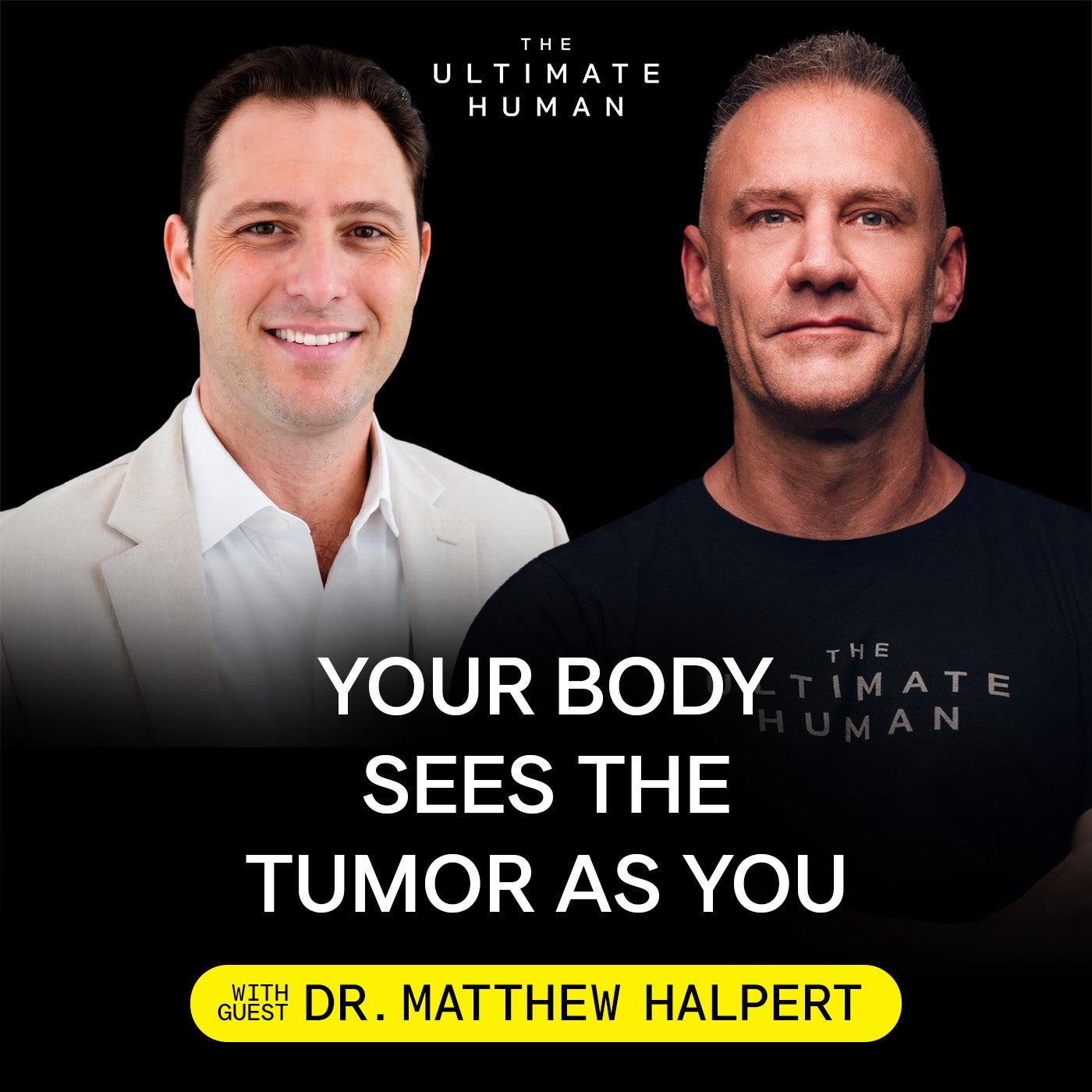
Dendritic cell cancer vaccines and the “immune education” approach—argues cancer persists mainly due to immune evasion, and effective therapy requires properly activating dendritic cells with patient-specific tumor antigens via both MHC class I and II pathways (“double loading”/two-factor authentication).
Dr. Matt Halpert, PhD immunologist and co-developer of dendritic cell vaccine technology; background in immune system research (lab work at Baylor College of Medicine mentioned). He credits scientific partners Dr. Will Decker and Dr. Vanuja Kandori; discusses starting Diakonos Oncology and Immunosem/ImmunoCene (as described).
Prior dendritic cell vaccine attempts failed because they didn’t “turn on the engine” correctly; using both MHC pathways with identical antigen presentation is essential. When properly activated, the therapy can generate a strong Th1 immune response. He claims lower side-effect burden than chemo/radiation in some cases, but no universal cure.
Brock (39, stage IV melanoma with 15 metastases; given ~90 days; treated in Mexico; first clear scan ~5 months later; still cancer-free years later). A 47-year-old female with stage III colon cancer also reportedly cancer-free after treatment; another example of refractory triple-negative breast cancer patient reportedly cancer-free for years after declining chemo.
Written by AI. May contain mistakes.
Learn how immune evasion allows cancer to persist and the role of dendritic cells.
“There's several ways we've come up with attacking cancer, but we've made a little bit of a mistake of thinking that's the end of the story.”
Hear about Brock's cancer diagnosis and the transformative impact of dendritic cell vaccines.
“Thank you for having me on and giving me this chance to tell you our story.”
Explore the science behind dendritic cell vaccines and their potential to educate the immune system.
“And I think that the work you're doing is just life-saving.”
Delve into the immunological aspects of cancer formation and the importance of immune responses.
“But I'm definitely going to give a shout out here to my scientific partners, Dr.”
Learn about the crucial role of dendritic cells in the immune response to cancer.
“Um, and so we kind of go back to the story, um, which at that time we're, uh, you know, we're at Baylor college of medicine.”
Explore the challenges faced in making dendritic cells effective for cancer therapy.
“Meaning can't get them to perform their function, which is to present what we call an antigen.”
Discover the concept of two-factor authentication in activating dendritic cells.
“two-factor authentication for now, none of them are as important as this decision.”
Understand the mechanisms through which dendritic cells recognize and respond to threats.
“We feed it into one of those tunnels, one of those pathways.”
Learn about new approaches in cancer immunotherapy utilizing dendritic cells.
“system, which allows a disease state like what you're talking about to slip through.”
Learn about the advantages of dendritic cell vaccines over conventional therapies.
“that have the same downside that conventional therapies has, and that is that we didn't win, but have dramatically less side effects and have higher target ratios.”
Discover the complexities of initiating FDA-approved trials for dendritic cell therapies.
“People need to know about this because people have written off dendritic cells prematurely.”
Hear about real patient experiences and the dynamics of the immune system in fighting cancer.
“Again, there are different institutions around the country.”
Learn about the critical role of the immune system in combating cancer.
“We've had a, you know, we have a patient with, you know, relapse, triple negative breast cancer.”
Understand the importance of biopsy in cancer treatment and how it impacts immunotherapy.
“And, you know, so let's walk a typical case through what this treatment looks like.”
Discover the role of cryopreservation in cancer treatment choices and patient autonomy.
“which I think would further support something like a dendritic cell vaccine treatment because even if something got out and got into the bloodstream, if the immune system is trained to see it, it's going to find it.”
Learn why initiating treatment early can enhance cancer treatment outcomes.
“If all the cancer's currently been shrunk, there's nothing for us to adequately sample.”
Explore the potential of using dendritic cell vaccines even after remission.
“Because, you know, when a surgeon removes a tumor and gets clean margins and surgery goes very successful, there's no guarantee that some of that tissue at some point hasn't broken off.”
Understand the advanced methods used to analyze and activate dendritic cells.
“And so we put into place a lot of QC, a lot of quality control and data analysis.”
Discuss the significance of data analysis in improving patient treatment outcomes.
“So this is day one, day five, day seven?”
Learn how dendritic cell vaccines are developed and their application in cancer treatment.
“We have some other markers that I'm not going to necessarily share, but we use to try and distinguish the double loading effect and did we load them with the tumor information.”
Hear a compelling patient story illustrating the impact of dendritic cell therapy.
“Is there, I hate to use this term, but is there a sweet spot for people that you've seen with a specific type or form of cancer that respond very, very well to these?”
Discover the best conditions under which dendritic cell treatments are effective.
“As I was alluding to earlier, our favorite time to do this is not when you are end of the road.”
Explore how managing systemic inflammation can impact cancer treatment outcomes.
“Our goal is not, hey, we want to get you two more months.”
Learn about the role of the immune system in fighting cancer and how to enhance it.
“Yeah, that would be a core competency of mine.”
Dr. Halpert discusses the importance of using immune responses in tackling health challenges.
“I'm very passionate about getting the word out about the benefits of using a – I mean, it's a weird – I didn't know this when I was five maybe.”

Get the gist, explore an idea or ask about something said.
 Claude
On The Ultimate Human with Gary Brecka, what are the key points of this episode?
Searching your listeningAutomatic transcript. May contain errors.
0:00There's several ways we've come up with attacking cancer, but we've made a little bit of a mistake of thinking that's the end of the story. The only way that cancer is actually allowed to persist and become a problem is because of ongoing immune evasion.
0:13Gary Brecka: I mean, the immune system is like a highly authorized police officer that has a key to every door, which is why I think that a novel theory that the immune system could be the gateway to solving cancer is fascinating. Anything we want to do within the realm of using the immune system, getting that immune education component is probably going to be critical to legitimate wins in the fight against cancer. And that's kind of how we came at it. We're deciding to work with the dendritic cell. And not a lot of people have heard of the dendritic cell. So what you're doing in immunocene, you're taking the cancer cell, you're presenting it to this dendritic cell.
0:49Gary Brecka: And that dendritic cell, because you've activated both of these pathways, wakes up and says, you're the enemy. It recognizes the cancer and now it says I'm gonna go tell the immune system to come kill you and everybody that looks like you. A lot of people coming up to us that would have seen our data or science and realize this could be game-changing. Let's walk a typical case through what this treatment looks like. It depends on your case when you apply to Immunosem there's gonna be a
1:28Gary Brecka: Hey guys, welcome back to the Ultimate Human Podcast. I'm your host, human biologist, Gary Brecca, where we go down the road of everything, anti-aging, biohacking, longevity, and everything in between. And today's podcast is actually a podcast that's been in the making for four years. And I'm gonna tell you why that's the, it's been four years for me to get this guest on, because I had a very personal journey with our next guest through a friend of mine. after a very grave terminal cancer diagnosis. And it turned me on to an area of science that I feel is so important that needs to have a light shown upon it.
2:07Gary Brecka: If you or someone you love or you know has been diagnosed with cancer, this is the episode for you. We're not gonna go down the road of curing cancer by any means, but we are going to go down the road of where the leading technology in the world is in the new fight against cancer. and it is not in the places that you think. It's within your own immune system. So welcome to the podcast, Dr. Matt Halpert. Thank you. Thank you for having me on and giving me this chance to tell you our story. Yeah. I mean, your story is absolutely incredible. I want to start with a very personal story about how you and I tangentially got connected.
2:46Gary Brecka: I have a friend named Brock. um at the time uh going back to november of 2022 um he was 39 years old at the time um preparing for his 40th birthday he was a private client of mine i was working with him on peptides and his hormones and his diet and you know had him in the gym and he was just wanting to basically be the healthiest version of himself and i'd been working with him for a few months and he developed a cough like a nagging cough and he would just kind of all the time just kind of clearing his throat kind of that itchy cough you get when you have a sore throat or cold and because it wasn't going away it was more persistent and it was getting more frequent he finally went to his primary care doctor and the call that I got from him I'm going to try not to get emotional just recounting it but the call that I got from him was a phone call that I will never forget because he was barely audible.
3:46Gary Brecka: And I thought he was in a car accident, like actively in a car accident. And what had happened was he had just been told that his chest X-ray had revealed stage four melanoma that had metastasized all throughout his body at 15 sites of metastasis. And the primary one that they were looking at was the lung. and I don't profess to know everything about the diagnosis, but at the time the tumor was so large that he was told it was inoperable. It was fatal. He was told he had 90 days to live and 18 days later they were going to start hospice care. So 39 years old, preparing for his 40th birthday. Finally, after about 25 minutes, he was able to get this out through his emotion and get it to me.
4:38Gary Brecka: um and i remember the whole world just coming to a screeching halt at that moment and i said brother i don't know what to do but i know the people that do and so i reached out to a dear friend of mine who is a phd doctor dr gonzalez because i knew that he was involved with a uh a novel cancer cell vaccine therapy called dendritic cell vaccine and through that introduction we got brought down to your clinic in in mexico and uh five months later he got his first clear scan that was november of 2022 he got his first clear scan sometime january february march i forget Yet we are going on the fourth anniversary from that clear scan today, and he is still cancer-free.
5:37Gary Brecka: Absolutely, he is. And so that's the reason why you're on the Ultimate Human today because I think you're an Ultimate Human. I think the work that you are doing is life-changing. It is groundbreaking. I wish we could accelerate the delivery of this to the population. It just so happens I have another very dear friend of mine, 47-year-old female who's worked either for or with me for the last 10 years. Her and her sister are family to me, recently diagnosed with stage three colon cancer. And as we sit here today, she's cancer-free. She's also in your dendritic cell vaccine program. So I wanted to open up with those stories because they're very personal to me.
6:22Gary Brecka: And I think that the work you're doing is just life-saving. But for the folks out there that may be facing this kind of grave diagnosis, I would love to back this all the way up to what led you to this discovery that we could educate the immune system on how to identify and fight cancer. And I might add that neither Brock or this female friend of mine, I don't want to say her name because a lot of people know who she is, they've gotten barely flu-like symptoms, did not lose all their hair, didn't muscle weight, weren't emaciated, weren't crippled with nausea, had no chemotherapy, no massive surgical incisions, no radiation, it was just purely this treatment.
7:14Gary Brecka: But tell me how this whole thing came about because I think a novel theory that the immune system could be the gateway to solving cancer is fascinating. Yeah, no, I mean, so again, I always love to tell this story. And, you know, with cancer, we're constantly looking at statistics and large, you know, trials and efforts. But on the individual basis, it's always personal, right? I mean, cancer just is very heart gripping and heart wrenching whenever it happens to you or someone you love. So, and in that moment, you maybe don't care as much about the, you know, the stats. You just, you want the best thing you can get.
7:57And so, yeah, my, you know, as you know, my background is as an immunologist. PhD immunologist. Yeah, I'm interested in the immune system. And to be honest, I didn't start with cancer. I didn't go to school to study cancer. I went to school to learn about the immune system. Certainly not to open any clinics or do what I do now. Like that's just where the science and the story has evolved. But I'm definitely going to give a shout out here to my scientific partners, Dr. Will Decker, Dr. Vanuja Kandori. The three of us have had different roles in the discovery, the study, the evolution of this science.
8:35Certainly not a one-man show. And I'll give Dr. Decker, you know, tons of praise for making that first, you know, Petri dish level discovery and just, oh, my gosh, have we misunderstood the immune system? And then I'm just crazy enough to join him in that story. And then Dr. Conjuri is equally as crazy to join us. And so for the, you know, really since 2011, 2012, the three of us have been pushing this forward. And so, yeah, so let's just look at it from the perspective of the immune system or how an immunologist would. Cancer, look, there's a lot of things that go into the formation of a tumor.
9:14There are, and you know this. I mean, there are healthy ways we can age, but as we age, we collect, you know, whether it's damaged by UV or chronic inflammation or your diet. Toxicity. Mutations happen. Things happen. And the body is amazingly capable of actually handling most of that. It really does. But every now and again, for some people, unfortunately, this cluster of cells won't stop growing until it's visible or it spreads and it causes problems. And we call that cancer. And so then because it's so urgent, we get very focused on, well, sure, we've got to adjust the lifestyle changes maybe or what can we do to be healthier and swing the terrain.
10:02But also are there things to attack the tumor? And this is where you do get chemotherapy, radiation, targeted therapies. There's several ways we've come up with attacking that tumor. And not that those are invaluable or just wrong, but we've made a little bit of a mistake of thinking that's the end of the story. Right. And it isn't because the only way that tumor, that cancer is actually allowed to exist and persist and become a problem is because of ongoing immune evasion. It is actually an immunological disorder as much as anything else.
10:40Gary Brecka: Yeah. We have an immune system designed to protect us from bacteria, viruses, parasites. Like, that's what the system is there to do, protect us. And it normally does see these clusters of cells and eliminates it. We have killer T cells. We have natural killer cells. We have cells that can do this, but it didn't here. Why not? And, you know, I don't want to cut you off, but I talk very often about how all cancer, regardless of its form or its origin, was at one time a healthy cell. And so that cell shifted its metabolism for some reason. It's multifactorial, could have been toxicity, x-ray, all the things that you outlaid.
11:19Gary Brecka: And there's not one reason we get cancer, but there is one thing that makes cancer common and that is a shift in the cell's metabolism. And a healthy immune system, you're right. By the time you're my age, I'll be 56 in two months, 55 years old now. By the time you're my age, there's virtually 100 % chance that you have had what we would designate as a circulating tumor cell in your bloodstream at some point in your life. But for my immune system, or for most people's immune system, was a walk in the park. They saw that shift and the immune system went in and attacked it, right? And so we don't become a part of the statistic.
11:57Gary Brecka: And for whatever reason, in some cases it slips by because the immune system wasn't hypervigilant, maybe it was overwhelmed, maybe it was suppressed or it was in a low-grade fight and a dozen other areas of the body, whatever the rationale is, the immune system missed that circulating tumor cell or missed that shift in metabolism. And now you start the fertile ground for cancer. Yep. Okay. Oh, there's been a number of studies as well that you could take quote-unquote healthy tissue and look at it and find cells in there that absolutely have accumulated mutations. They maybe haven't gone malignant yet, but mutations happen.
12:35Sure. Just it does. And our body is in a way prepared for that. The fact that the immune system is as complex and capable as it is tells us, while cancer is a dysfunction, it's actually – the origins of it are not unexpected. Our body was prepared for it and ready to fight. And absolutely, I have no doubt that I've had those little bubble ups because we probably all have. And immune system wipes it out. I cough. I go on with my life. And, you know, obviously in the event where you're getting a scan like Brock did and, okay, there's a problem here. Something's gone wrong and, you know, with that pathway.
13:12And, you know, not to put any, you know, specific statistic on it because they're always moving. But much of the time, most of the time, it's a form of immunological ignorance. It's not that the immune system sees it and is just too weak. That happens for some. But more often than not, it's just, as you said, the cell, if you think about what a cancer cell is, yes, it had certain. It's still you. Right. It's still you. And we get focused on is it breast cancer? Is it, you know, prostate cancer? Is it pancreatic cancer? It's you cancer. You know, it started somewhere. And though there are mutations that have allowed it to replicate beyond control, most of a cancer cell is actually still healthy.
13:51It didn't mutate 100%, right? That's not how it works. And so because it still represents you and your immune system has learned to mostly ignore that, it may continue to ignore that even though there are mutations there. And that's what we have to fix. That's anything we want to do within the realm of using the immune system, getting that immune education component is probably going to be critical to legitimate wins, to discrete moves forward in the fight against cancer. And that's kind of how we came at it. Um, and so we kind of go back to the story, um, which at that time we're, uh, you know, we're at Baylor college of medicine.
14:30That's just where our lab was. Um, uh, not to say more than I can say, that's just where we were doing the studies. I'm, I think I'm allowed to say that. Um, and it's not, it's not like a secret. You can Google it. You'll see where all the work is coming out of. Um, and we're deciding to work with the dendritic cell and not a lot of people have heard of the dendritic cell. It doesn't get a lot of love. And I'll tell you why. But the immune system is a system. It is not one cell. It is not one thing. It is beautifully complex, different cells, different superpowers. It's like an army. And like an army, you actually don't want one component just randomly firing off in the corner because they thought they saw something.
15:16That usually is called autoimmunity. That's not a good system. A good system is they're ready to go, but they need marching orders. Someone has to be air traffic control. It's got to be the general of the army. And I don't think there's a ton of debate on who that is in biology. That's the dendritic cell. It educates the immune system. It is the main educator. It's a professional antigen presenting cell. I mean, if you look at a lot of textbooks, it gets some cliche term like a master regulator of the immune response or something like that. It is important. And it was discovered in the 1970s by Dr.
15:51Ralph Steinman, who ended up winning the Nobel Prize for this discovery. Wow. We've known about the cells for a while. It's not new. And you study and you study and you learn, okay, so they're the generals. Their job is to see the threat, whatever it is, and then organize the optimal complete immune response to wipe it out. That's what it's supposed to do. Right. So naturally, people being very smart, well, let's use dendritic cells then to rearm the immune system to fight cancer. And so really starting heavily in the 90s, there's been a lot of efforts to use dendritic cells to fight cancer. And look, I'm just going to be brutally honest.
16:28They haven't gone great. It's been a lot of failures. And so an analogy I kind of use is even if you're looking at a car and you've seen cars drive. You know they can go from Florida to California. You know they can. So you get in the car and you play with the radio. You play with the cup holder. You move the seat around. You turn on the windshield wipers. You're not going. And you can do what a lot of people did. All right, the car doesn't work. And you get out and you move on and you look for other ways to hijack or innervate with the immune system.
17:05Gary Brecka: Right. What happens if you get in the car? And I know there aren't cars where you turn keys anymore, but that's, you know, you turn the key and the engine turns on. I do remember that. You're dating me, but yeah. I'm dating myself. Remember you actually put a key in the door and the same key worked for the ignition. It doesn't sound as good if you say you push a button. Yeah. But yeah, what happens when you turn the engine on? Look, I'm not telling you we have all the answers. Are there better fuels? Are there better, you know, engines? Are there better systems? But you've got to turn the engine on if you want any shot of actually winning.
17:37And that's actually what, you know, that's the analogous part to what we discovered is so dendritic cells aren't working. People can't get them to work. We'll come back to that.
17:46Gary Brecka: Meaning can't get them to perform their function, which is to present what we call an antigen. But basically the general goes to the army and explains to the army, here is the uniform the enemy is wearing. You guys go kill this enemy. And so it presents the enemy's footprint, uniform. Yep. to the fighting soldiers, which would be the natural killer cells, kind of the SEAL Team 6 of the immune system that would just go and kill something. But they have to take a directive from this dendritic cell. You got to get the information as to what you're looking for and then some other signals as to what to do when you find it.
18:22Okay. So it's really complex. It's, again, really impressive. And so, you know, I guess I'll stick with the dendritic cell. There are other forms of immunotherapy that have come about, but they're usually or they have been downstream of the dendritic cell. How do we empower these T cells? How do we empower these natural killer cells? How do we give them bazookas? How do we take some and turn them into the$6 million man and make them more powerful? And all of that can be great. But you're still in that scenario. You're still not using the dendritic cell. So it's tough to call that a physiological response.
18:59You just have to accept not that there's no benefit to it. You just have to accept we're probably missing some signals going that route. We're probably missing some information because biology is not really created by accident. It's not like maybe the dendritic cells are important, maybe not. No, they are. So if you don't use them, you're going to be missing components. And so here you've got a dendritic cell. And, you know, we can put a graphic up. But if you picture. We're going to throw one up. Yeah. So if you picture, if you take a dendritic cell out of a textbook, you're going to see these, something you'll learn about are these two pathways.
19:35You know, the pathway one and pathway two. And this is simply how dendritic cells are going to get information about a target and then communicate to the rest of the immune system what to do. Tunnel one, tunnel two. And for the longest time, we thought these tunnels were basically dark, blind. It didn't really matter. Meaning you could use either one. You could use either one, and you could use cancer lysate. You could use cancer mRNA. You could use cancer peptides. You could use cancer proteins. You could cancer whatever. Get it in this pathway. Get it in this pathway. Whatever. And then we take those cells, and we give them back to the patient and say, go.
20:14Launch an immune response. It hasn't really worked. And I don't know why there are still groups today that that's all they still do. We've known now for decades. That just doesn't really move the needle. And it doesn't mean there aren't one-offs or some successes. Obviously, biology is complex, but as a bell curve, it just hasn't really won the day. And so you've got some groups that say, well, that's because we're missing the wrong or we need a better stimulation in addition to this. And you can add BCG or coles toxins or a virus. I mean, there are things you can add to try to wake that dendritic cell up.
20:48And maybe in the process, it sees the cancer information you fed it and it goes to fight. And that absolutely, in some cases, moves the needle. But, you know, we're still missing something fundamental. And so I actually love, you know, what we discovered because it just further highlights how creative and protective the immune system is. But if we stop and think, man, if the dendritic cell, the gatekeeper of this type of immune response, where parts of you are essentially dissolved, was actually that simple to turn on?
21:23Gary Brecka: Yeah, it would be a problem. It would be a problem. If it's like, yeah, I injected some peptides and boom, the whole immune system started melting parts of me. Like that sounds like it would be kind of dangerous. Yeah. And if you think about all the things in life where we all have, you know, two-factor authentication for now, none of them are as important as this decision. Right. So why wouldn't there be a form of two-factor authentication for this? And that's what we discover. So you discovered this two-factor authentication for the dendroned Excel. I mean, I know that I'm going to oversimplify this for my audience, but essentially what you did for Brock and what you're doing for my other dear friend and countless others is you're taking the tumor, the cancer cell, you're presenting it to this dendritic cell in some kind of laboratory environment.
22:18Gary Brecka: And that dendritic cell, because you've activated both of these pathways, wakes up and says, you're the enemy. It recognizes the cancer. And now it says, I'm going to go tell the SEAL Team 6, the immune system, to come kill you and everybody that looks like you. Oversimplification. But that's essentially what that dendritic cell is, this intermediary. That's exactly right. We take the cancer information from the patient. This isn't off the shelf. It's personalized. And yeah, we've got to break it down to its components. And we use that as an important point. We use the total tumor information.
22:57We're not cherry picking our favorite mutations that we like. And we're not trying to guess which antigens are important. The dendritic cell already does that naturally. That's its job. And so we don't need to pick. We just need to give it the information correctly. So we get that information. We feed it into one of those tunnels, one of those pathways. The dendritic cell is constantly looking for foreigners in that pathway, for threats, virus, bacteria, cancer. It's looking for mutations. It's looking for things that don't belong. And when it sees something, the mistake has been thinking, that's it.
23:32That's enough. It saw it. It'll go launch a whole immune response. It doesn't. It turns and it looks at the other pathway. These pathways, they're always shown completely separate. They're not. But they perfectly and purposefully intersect inside the cell so that the cell has a chance to not just see what's in this one pathway, but to compare it to what's in this other. And if it sees the exact same thing, the exact same mutation.
24:01Gary Brecka: Ah, two-factor authentication. That is what tells it. Email code and the text code, you must be authorized to open this account. I'll tell you what. What if you get that text code and you're off by one digit? Does it work? No. Doesn't work here either. We have published this. If this is slightly off, it doesn't really work. The dendritic cell says, guess what? You're off. I'm sorry. You're off by two amino acids. Not the same. Doesn't activate. Thank God it does that. You know, it's so fascinating to me is, you know, the more I study the human body, the more I believe in God because it's so infinitely complex and yet so beautiful at the same time.
24:40Gary Brecka: I'm just awestruck by it. and by your work. What, for my citizen scientists out there, the nerds like me, what are these pathways called? These are the MHC class one and class two pathways. Okay, and these are essentially the two doors that you have to come in to actually, for the dendritic cell to elicit a response. That's what we've shown. And I mean, like when this, what we call double loading, it's not just using both pathways. They have to be identical. They have to be overlapped or what we call homologous from the same source. We have shown, I mean, that's again, you publish this. The fact that we could be off a couple amino acids and the whole thing fall apart.
25:28Yeah, it's important. Biology did not put that kind of refined, complex system into place for no reason. And what happens when they're the same? Is it, oh, you know, there's a 5 % kicker. No. Things happen like the responses are 20-fold, 30-fold. They're massive, which in biology, as a scientist, you're looking for – if you're trying to make 1 plus 1 not equal 2, you're hoping it equals 2.2, 2.4. Like we can get a grant. We can study. Man, if we get some synergistic effect, maybe we'll equal 3. That'd be groundbreaking. Like, what happens when one plus one equals 10 ,000?
26:08Gary Brecka: Right. You go, what? We really haven't. Like, we have not understood what's possible because we just didn't even have the right scale. You know, I've always thought that the secret to longevity, I think, you know, I've gotten asked this question before. Like, what is the leading theory in aging right now? And I think if you put all the top experts in the world in the room, they would agree on this theory of immunofatigue. It's a little slightly different than what you're talking about. But back to the immune system, it's so infinitely complex and it's so capable when it's healthy and when it's operating and functioning well of policing us, of protecting us, which by the way, the policing role is the role that a lot of people forget that it does.
26:50Gary Brecka: It doesn't just protect us from foreign invaders. It also makes sure that internal things are going on time. Oh, that cell's living too long. That cell didn't die on time. Yep. And it gets rid of those too. Yeah, senescence, cortisol. Cellular senescence. autophagy. And the concept of immunofatigue is a slow, progressive overwhelming of the immune system, which allows a disease state like what you're talking about to slip through. So what you're doing in immunocene, and there are sites around the country in the United States that are doing these under FDA clinical trials, but for very narrow specific cancers.
27:29Gary Brecka: I think you have one for glioblastoma, pancreatic cancer. But if someone falls outside of a specific clinical trial, their only option for this type of therapy is to go to Mexico, where Brock went and where my friend are. At this time. At this time. And hopefully you're meeting a very progressive listening ear with the Health and Human Services and the FDA to fast-track therapies like this that have the same downside that conventional therapies has, and that is that we didn't win, but have dramatically less side effects and have higher target ratios. So, yeah, that's a great segue. We see this double-loading the dendritic cell with the target information turns on this profound, unique, it's not just quantitative, it's qualitative, this phenomenal Th1 immune response that now is going to go after the target, whatever the information was.
28:40And we're in the lab and we see this work for target after target after target. And to our eye at the moment, it doesn't have anything to do with what the target is. It has to do with just how it's presented to the dendritic cell. And so this gives us, obviously this eventually moves towards, could this be useful for, look, it could be useful probably for viruses and all sorts of things. It's a, it's a targeting platform, but we, we go for cancer and our thinking was, all right, we got to get this out there. People need to know about this because people have written off dendritic cells prematurely.
29:17No, they haven't really worked phenomenally, but has anyone actually ever done this before and made sure they're, you know, quote unquote, turned on the right way? Because what could that do? And no, we don't have every answer, but you got, again, turn the engine on and what is the options? And so, you know, I'm happy to talk about, we as a group of scientists, we had plenty of naive moments and we probably thought this would be easier. But we start a biotech company in the U.S. You know, we start Diakonos oncology. And the whole goal is this needs to be FDA approved. How do we get there? What do we do with clinical trials?
29:55And so, like you said, we fast forward to today and we've been fast-tracked by the FDA numerous times. We have trials for newly diagnosed glioblastoma, for pancreatic ductal adenocarcinoma, for refractory melanoma.
30:09Gary Brecka: And we are - What is refractory melanoma? It means melanoma patients that are beyond responding to normal treatment. And we picked, and you're thinking, you're thinking, why did we pick, like, what did we do? We picked the hardest of them. We didn't, we fully believe in the power of what this can do. And so we said, let's pick the toughest things we can find. Maybe, maybe an ill-advised decision. You know what? There were only scientists in the room at the time. And so we picked the tough ones. And we said, if we can show that just, let's start with three shots. just three shots of double-loaded dendritic cells can move the needle for something like unmethylated glioblastoma and can do it safely.
30:56Gary Brecka: Which is usually inoperable and fatal. Right. If it can move it there, why do you think it couldn't work for prostate cancer or breast cancer? Like nothing about this is tumor specific. So in that trial, right, we, and these trials, Again, there are different institutions around the country. And, you know, some are open, some are closed. So you've got to always check, you know. But you talked about the – and the reason I was doing this is you talked about the burden to the patient. In the phase one trial with the GBM, there weren't any severe, you know, attributable SAEs. Right. Like this is – What's SAEs?
31:34Adverse events. Oh, okay. Like how risky is this for the patient? So we're talking about brain cancer. We're targeting in the brain. That's not the safest location. What's going to happen? And in that trial, burden was low. Side, quote unquote, side effects. I mean, it's your immune system.
31:51Gary Brecka: Your immune system can go anywhere in the human body. Exactly. It can, you know, can eat the cancer like a termite. It can chase it down like the Gotti boys. It can go into lymph nodes. It can go into tissue, into muscle, into the blood, into the platelets, crosses the blood brain barrier. I mean, the immune system is like, you know, a highly authorized police officer that has a key to every door. I mean, it can, which is why I think this type of therapy is so exciting. I've seen it save the lives of two people that are very, very close to me. I am very close to other stories that have come out of immunocene as well.
32:28Gary Brecka: So I know that it doesn't work all the time, but I know some clients that have, their lives have been saved by this. And more importantly, you know, a lot of the conventional routes available to people today make them deathly ill, horrifically sick, you know, emaciated, hair loss. I mean, the general process of going through cancer treatment is not an exciting process, not a fun process by any means. And there's a long recovery road, even if you do win. um you know you've usually caused a significant amount of harm to the host and one of the things i've always like struggled with in a lot of conventional therapies is we're aggressively going after disease but nobody's caring for the host it's like there's still a human being here and and there's still the host and yeah they got a villain inside of them and we need to go after that but um you know some of these uh patients of yours report basically mild like flu symptoms yeah um and and and yet their their cancers are in full revision yeah no we have um i mean some of our best cases i mean it's it's funny because patients are always you know you expect the worst when you're dealing with cancer treatments and and believe me whatever i say here is not like, I don't want to mislead.
33:56It's not universal. It's not the same for every patient. Nobody has the cure for cancer. Let's just say that for sure. We've had a, you know, we have a patient with, you know, relapse, triple negative breast cancer. She's told she has months to live. They've got to get her on chemo to give her those months. She says, I don't want to do that. She comes for treatment. She's been cancer free now for a couple of years. She had no symptoms. Very boring story.
34:19Gary Brecka: Yeah. Not a boring story for her. I can promise you that. Right. I've just... Because the alternative is not good. It's your own immune system. What we are doing, and the reason we started Immunosine, was not to try and skirt around the need for trials and statistics and, you know, reducing variables and proving points. Like, that wasn't the goal. It was just, look. You needed to get it out now because the data was so good. There were a lot of people coming up to us that would have seen our data, our science, and realized this could be game-changing. They would even say, I am going to do my standard of care.
34:55Absolutely. Why wouldn't I want to get – if this has a chance of fixing my immune system to finally see the threat, and that's all this really is, why wouldn't I want to do that? Wouldn't that improve my odds of a durable long-term response? And as an immunologist, and I just, I'm brutally honest. Yes, I think that improves your odds. No, it's not a guarantee. Of course not. But I would want to use my immune system.
35:20Gary Brecka: Oh, no question. To fight. If myself or anyone that I love is diagnosed with cancer, they are 100 % coming to you. Thankfully, that has not happened in my, you know, tight, immediate family inner circle. But if it were to, there'd be no question this would be my first line of defense. Well, I could say the same.
35:44Gary Brecka: And, you know, so let's walk a typical case through what this treatment looks like. And let's talk about something allowed in the United States for a trial that's being conducted here. We know that there's treatment options outside of the United States for ones that don't fit these clinical trials. I wake up with symptoms. I go to my doctor. I find out that I have ductal pancreatic cancer. It's important that when the biopsy of that cancer is taken, that you get a piece of that tissue. Am I right? Yes. Whether a trial or a immunoset, we need your cancer to do anything. So you either collect it or the oncologist or the surgeon that's going to biopsy it.
36:36Gary Brecka: Because, you know, when you see a spot, the first thing they do is they biopsy breast cancer. Most forms of cancer, they'll go in. And sometimes they do multiple biopsies. You know, they'll go into the lymph, go into the tissue that has this specific nodular tumor. And there's a whole school of thought around that too, taking an encapsulated tumor and piercing that capsule and potentially opening that capsule up to the outside environment for metastasis or spread, which I think would further support something like a dendritic cell vaccine treatment because even if something got out and got into the bloodstream, if the immune system is trained to see it, it's going to find it.
37:20Gary Brecka: Right. It's one of the things I do say is, again, without guarantees, but this type of treatment, I mean, those breakaway cells admittedly are some of the easier ones for the immune system to clean up as long as they know what they're looking for. Right, but for conventional treatments, they're not until they set up shop somewhere and start to manifest another tumor and it's visible on image. And in fact, it was only until recently that I'd even heard of in cancer therapies looking for doing testing for CTCs, these circulating tumor cells. And we have had other clients, VIP clients of mine that I've sent for forms of blood filtration that attempt to filter these out of the blood.
38:09Gary Brecka: And I've seen pre and post filtrations where you have high CTC and then they're down to zero. But if you have these circulating tumor cells, it's very comforting to know that the immune system knows who they are, knows they're not supposed to be there and is oriented towards killing them and removing them. So let's go back to this course of treatment. A patient gets a biopsy of this tumor and sends a sample of that tissue to you? So there's going to be a couple of options depending on the route. And I'm going to, you know, you mentioned Dr. Gonzalez before. Rafael. Yeah, Rafael. He and I, you know, along with some, you know, it's a group effort, but we also created Immunosine Preserve specifically to help patients in this position as well.
38:54Save some tumor. Just you've got to save it.
38:59Gary Brecka: Conventional therapy fails later. You could potentially option for this. And so even if you're going to do conventional therapy, to be real clear, we're not necessarily against it. It depends on your case. And when you apply to Immunocene, we don't just say, come on. I mean, if that's not the ethical decision. We don't charge you. We're going to do a review of your case for free. And then we're going to tell you, do we think now is the right time to come for this or not? Look, as you can imagine, we get a lot of patients where, okay, you need to buy some time. Like the window is really short at the moment and this is a system play.
39:36You need time. And that may be unfortunately might mean you have to do conventional care. You've got to do something quick that's going to punch that cancer in the face. But if you're able to do one of the trials, you actually enroll or hopefully you enroll before you do any surgery. And that way the surgeon already knows we're going to cut this out. We're going to save it the right way.
40:00Gary Brecka: We're going to cryopreserve it. Right, cryopreserve it. You don't want to send it to pathology. You don't want it to be dunked in formaldehyde or paraffin or fixatives. That actually destroys it. So you want to get ahead of that. And so if you're in the trials, the doctor will know that. We'll save the tissue because we need that to manufacture your personalized vaccine. But if you can't get one of the trials and you still want this biology, you still want just this fundamental fixation of your immune system. Yeah, we need a sample. And so in that case, you've got a couple options. You reach out to us.
40:35We say, look, we see a pretty good site. We can biopsy ourselves. Go ahead and come to immunosine in Cancun or in Cabo and let us do a biopsy. Let us get that sample. And then, again, it depends on the situation. Either proceed with treatment, get your double-loaded dendritic cells, or go do whatever else you want to do. We've got your sample. We can use it later. If you have a procedure in the States or at home, and the doctor says, I will help you. I absolutely am on board. Just tell me what you want to do. This was the case. That's where you go to an immunocompromised preserve and get a kit.
41:11Because we've already made this. It's just tubes of solution.
41:15Gary Brecka: Just put some tumor in those tubes and ship it back to us. You know, overnight at FedEx, we walk you through that. It's not that hard. And then, again, we've got it. Okay. And this gives you the freedom to - And once it's cryopreserved, the clock stops, right? Correct. So the urgency stops, at least for - From that perspective. Yeah. I mean, there still may be urgency, but - Urgency in the course of treatment. If you're a patient, you're like, look, I am going to do my six months of chemo. I want to. That's fine. But if you wait to the end of that and the cancer's all, let's say it's all shrunk a lot and the doctor says, good news, I don't think it'll come back for a year.
41:54But then, you know, we got nothing. And the patient may say, well, I don't know why you said good news. That's not really the best thing I want to hear.
42:01Gary Brecka: Yeah, relapse and remission. Now, oh yeah. So now I'm going to do immunosync. Hold up. If all the cancer's currently been shrunk, there's nothing for us to adequately sample. we're now in the position of waiting for a relapse or growth, which could be not the best time. Right. But if you thought ahead before all that and you save some tissue and you get to that point. I mean, I love that idea of people having the freedom of choice, but also having the safeguard of saying, look, I'm going to stay at Mayo or Sloan or whomever. I like my oncologist. I feel like they have the highest standard of care.
42:41Gary Brecka: but as a fail safe i'm going to cryopreserve this uh this portion of the tumor this tissue so that if god forbid that you know it metastasizes or comes back at a later date and a lot of uh you know cancer patients do relapse um it's sort of that that god awful haunting you know thing that keeps you up at night ruminating about whether or not is it really gone right for me and this is a little bit my personal hat, but the optimal time to do a treatment like this is not, hey, let's wait till the last minute and it's relapsed, it's back, it's doubling every five minutes, now I'll do it. You're asking a lot of the immune system.
43:31You're asking a lot of anything at that point. And in a way, this is like, you have patients, they run as fast as they can to do all the things. And our discovery, unfortunately, would suggest that a lot of those patients simply aren't actually on the racetrack.
43:45Gary Brecka: Right. And we want to put them on that racetrack. But it is a race. And if you wait until the cancer is 99 % of the way done with the race to then start your guy, even if we do everything right, even if the immune system does fully activate, it may be tough to put that back. But if you're in the position of stable disease, remissive disease, even being disease-free, if you have that time, that calm period, and now you can get your immune system fixed and going, you're likely going to have better odds of a legitimate, durable win. that's when you want to do i mean look in the home run idea all patients should be doing this on the front end right and you should save the cytotoxic and harsher things in the back pocket for if you need that i mean that's how i want to see this because right certainly how i would approach it you know why go through that cytotoxic environment you know another thing that really piques my interest is um the two are not necessarily mutually exclusive if if you had if you cryopreserved your tissue and manufactured this dendritic cell vaccine, at the end of a course of treatment, could you prophylactically do dendritic cell vaccine to make sure that you got everything?
45:10Gary Brecka: Because, you know, when a surgeon removes a tumor and gets clean margins and surgery goes very successful, there's no guarantee that some of that tissue at some point hasn't broken off. And it's located elsewhere. We just don't know it. It's not large enough to show up on the positive on an image. And so we can't detect it yet. It doesn't mean it's there. It just means that it hasn't proliferated to the point where we can detect it. Would it be a good idea to prophylactically, even if you are, quote unquote, cancer free? Yeah. Is there any downside to doing? No, that's what I would do. And I want to see the data.
45:47Gary Brecka: You brought some data. I told my team that we're going to – I'm going to have you send me these images so I can actually throw them up. But I'd love for you to walk me through some of the data for the nonbelievers on what you're seeing clinically. Sure. And I'll send this so we can put it up here and point to it like weather people. Okay. But can you walk me through what's on there? So we do a couple things at Immunocene. And this is my friend, right? Yes. This is your friend. Yeah. Um, because, so again, I, doing all this science and being a scientist was not so we could open a company in Mexico.
46:23That wasn't the goal.
46:25Gary Brecka: Right. Um, I assure you. It just became almost for me, and I'll just, again, put this on me. It was almost a bit of a moral imperative. I know what this science is. I know what it can do. I know the relative safety of it. And when you compare it to a lot of what cancer patients are able to do. We could go down the street right now to a convenience store, buy a shelf of supplements, many of which could be dangerous, take them all. Like that's perfectly fine. But we can't get our immune systems fixed the right way. And I, again, rules are there for a reason. And I get that. But I had this idea. Well, look, again, nothing against these, the framework, but are there options?
47:08Are there ways that we could train someone else to maybe do this technology and ethically, legally, you know, get this science where it fits? And immunosin is not a walk-in clinic. You can't just say, I'll be there tomorrow. We have inclusion criteria. We have a protocol. Unfortunately, that's a rude awakening for some patients. They just assume it's their choice and it's not just their choice. I just want to get this word out there that you have options. So I go and I meet with a bunch of different groups. And I'm not going to name any of them, but you do see some corners being cut. You do see some questions in the minds of patients of, was that a real treatment?
47:44You know, I just spent a lot of money. Did I get anything? And I don't like that. What a horrible thing to do to take advantage of somebody in that darkest moment. Yeah, it's disgusting. And now you've added this stress to the patients, which that's not when they need this emotional anxiety, right? I mean, this is a tough time already. And so we actually want to go that extra level and do what we can. Look, again, it's not a guarantee. Starting the race, even the right race with the right player, doesn't guarantee you win. It just does give you a chance at that win. And, of course, we've seen it now multiple times.
48:19But I don't want patients to leave questioning the legitimacy of what we do. And so we put into place a lot of QC, a lot of quality control and data analysis. And so we do a couple things I think that are important. One of those is we actually do analyze patient's dendritic cells two different ways. One is actually outsourced. So it's not just us, you know. And then we, of course, analyze as well so we can do more analysis. And so, you know, one of our techniques that we do is called, you know, flow cytometry.
48:54Gary Brecka: I'm familiar with that. And is there a way, again, I didn't mean to cut you off, but is there a way for you to tell whether or not you have properly activated the dendritic cell and specifically activated it to that cancer antigen? Yes. Okay. There are ways that we do that. And there's also going to be some no. So I want to be fair here in what the levels of our technology do and don't. So just to give an example with this flow cytometry, and what this is, this is a tool immunologists use all over the place in academia, but it's not readily available for patients. It's not just something you normally do.
49:36But we have the ability to look at each, you know, we can take a sample of your cells just from a blood draw. Yep, blood draw. And we can actually now look at one cell at a time real quickly. And cells look different. Dendritic cells don't look the same as T cells, and they have different representative markers. And as they, let's say, become, you know, undifferentiated as they're immature, moving to mature, what we want, those markers will change. We should be able to see that, you know. And so if we look here at like, you know, on day zero, you see a bunch of dots here in, you know, quadrant four, for example, just to give an idea.
50:17I'm just, this is an example. As we move now to day six of differentiation, day seven of maturation, you see that the cells have dramatically shifted what quadrant they're in. And what is that upper right quadrant migration indicating? Well, in this case, we're looking at just two markers here, CD11C and HLA-DR. CD11C is a marker expressed on dendritic cells.
50:41Gary Brecka: Okay. And so when we start on day zero, there's actually not a lot of dendritic cells in your blood. So something we uniquely do. and it's a little sad this is unique but when we reintroduce these cells to your body we do not do an infusion in your blood they don't go there they don't go there naturally we're going to do an image guided injection near your functional draining lymph nodes because that's where they go an image guided injection near functional draining lymph nodes so you are you going to go to the lymph node closest to the site right if you have brain cancer breast cancer right axillary region Right.
51:14But if you have prostate cancer, why would we go there? We'll go to the inguinal area. And if you don't have, if you've had lymph nodes removed, we go to the next one in the chain. And of course, the immune system can even create lymph nodes, tertiary lymphoid structures if it needs to. It's pretty impressive.
51:29Gary Brecka: It is very impressive. And so there's a lot of markers we look at. And there's not going to be any magical one or two. We're putting pieces of a puzzle together. But for example, if we don't see a majority of these cells move from the left to the right on the x-axis, meaning that CD11C go up, then we probably haven't made dendritic cells. Like, they better move or this is going to be... Like, that looks like a very positive response. Yes, it's shift. And HLADR is just something on mature dendritic cells. And so we want to see them shift up in the Y-axis as we're making these dendritic cells. And so we see that in day six and seven as we get closer to a true DC population, a dendritic cell population.
52:10Gary Brecka: And so, you know, I don't want to bore the audience here. Sorry. How far apart were these taken? Well, I'm day zero, day six, day seven. I come from a data science background. This is in the first week. So this is day one, day five, day seven? Day zero. So at baseline, before we started anything, what does it look like? And then six days later. Wow. And then one day after that. Okay. So you're getting dendron excels. Yes. Oh, yeah. I mean, if something doesn't, if we don't see the right shifts here, and again, we look at several markers, CD80, CD83, CD86, HLADR, CLEC9A, there's different markers that these dendritic cells will differentially express as they mature and become properly loaded.
52:51Gary Brecka: Okay. When you say properly loaded, does that mean properly educated to fight the cancer? Yes. Okay. And so on that note, because people will ask, do you know specifically what the dendritic cells are going to choose to target? No. Since we're not cherry picking, We're using the total tumor mRNA, the total tumor protein library, and we're feeding all of that to the dendritic cells. We let the dendritic cells pick what it should target. Using the innate intelligence of the immune system. And so in the end, just again, I'm a brutally honest guy. No, we do not know what it shows. We do know that in almost 20 years of research, we have not been able to yet turn on autoimmunity.
53:35We haven't seen that. It seems to weed out the things that should be there. And it seems to be very target specific. We've had a number of patients where if you've got a tumor in your rib and your femur, as an example, your rib and your femur, you may, after the course of starting treatment, say, I feel it. You feel tenderness. You feel, you could feel pain in guess what? Your rib and your femur, wherever the cancer is. That's great. And if it's like in your prostate, do you feel your prostate right now? Really? Lee. So a lot of times, you know, if it's like that, the patient will say, I don't really, you know, I have some fatigue.
54:09I might have some.
54:10Gary Brecka: Both of the, both of the, uh, very close friends and clients of mine had at worst flu-like symptoms. Right. It's an immune response. Your body knows. And what was wild, you know, I forgot to bring this up at the beginning of the podcast, but I may, I may go back in and superimpose these images that I have of Brock because nothing is more compelling than looking at this cross-sectional image of the lungs and seeing these massive nodular tumors just shrinking sort of month over month over month and then going to completely clear. What's the second piece of... This over here? No, here. Over here?
54:49Gary Brecka: Yeah. So just to give an example of some more dendritic cell maturation markers or differentiation, just because, again, we look at more than just one thing. I like to look at it as much as possible. And so in this case, we're looking at, you know, two markers called CD80 and CD86. And of course, on day zero, these are not mature dendritic cells. They should be, look at that as zero, zero. So you've introduced these to the tumor, but they just haven't responded. No, no, no, no, no. We haven't even gotten to that part yet. Okay. We just, we're still looking at just the dendritic cells, right? That you took from the sample.
55:19Did we make them correctly? And so I'm just saying, if you look at day zero, they're there. If you look at six days later, when they've been getting the right information to turn into dendritic cells you see how it's shifted to the right meaning now they express more cd86 um and then as it keeps going i don't know if you can see but this population has shifted now more percentage-wise to over here to the right yeah and more up so cd80 now has gone from you know five and a half percent to 23 percent just giving this is after one day and they're going to keep maturing even when we inject them in the body and So we use this just to validate these are real dendritic cells.
55:58We did differentiate them correctly. We are maturing them correctly. We have some other markers that I'm not going to necessarily share, but we use to try and distinguish the double loading effect and did we load them with the tumor information. And so we use this as well as the outsource data to confirm to ourselves and to our patients and to potential doctors or other people. Like, look, we're not just saying that we're using dendritic cells. We are, we're doing it. We're analyzing it. We've got this data here. And importantly, we can back analyze this. I mean, we're scientists. We need to get, please give us 2000 patients so we can see who does great, who maybe doesn't.
56:39And do we see a difference there? Can we tell what is leading to great versus not great? And, you know, unfortunately, that's just the reality of life. Not every patient is going to win the day, but we need to always learn from that.
56:52Gary Brecka: I think admitting that nobody has the, you know, carpalage cure for cancer, I mean, this is very exciting and very compelling data. Is there, I hate to use this term, but is there a sweet spot for people that you've seen with a specific type or form of cancer that respond very, very well to these? or does it seem to be more universal? So we're starting to get some of that. Now, there's been some exceptions to what I'm about to say where it's like, okay, it did work. I'll give you, actually, let me just give this story because I don't like to leave this out. Patient one, I would say, is an exception to the rule.
57:33But it really opened our eyes to what this could do. And this is back in 2016, 2017. Like, we're not, immunoset doesn't exist. We're not in clinical trials. It's just a long story. But there's this gentleman with, you know, he's got stage four prostate cancer. He has like 40 lesions throughout his skeleton. He's in very bad shape, horrible shape. And at the time, the only way we could even potentially offer this treatment was with this kind of weird relationship or partnership. We have this group abroad. Just this long story, but we had this connection to this company in India. And he says, I want to go to India and get this treatment.
58:14And we point blank told him, no. We said, we do not want you to spend your money on this. We don't want you to die in India. We're sorry. It is good science, but it isn't magic. And we turned him down. I will not go into the ridiculousness of how he ended up in India and we ended up treating him. But we did.
58:34Gary Brecka: Okay. And I mean, kudos to him. Because that was... He's still alive today? Yep. He is. And it's been all... We're approaching 10 years. This was metastatic prostate cancer. Yep. Which prostate cancer has a lower metastatic rate. I mean, most of the time, by the time you're in your 80s, you almost universally have it. It's interesting the way we think of prostate cancer. So, absolutely, there's a larger percentage of, you know, watchful waiting and early stage prostate cancer. But I will tell you that once it is stage four, the statistics are not great. It's not a lot better than stage four breast cancer or colorectal.
59:10It's actually pretty dismal at that point when you start looking at the five-year survival rates. And it's been very eye-opening for me that we think in our minds, eh, prostate cancer. Stage four prostate cancer does belong in the group of...
59:25Gary Brecka: Okay. I'm glad you said that. And so we end up treating him. And no, it doesn't happen this way for every patient. But literally within weeks, if not a couple months, almost all the tumors in his body are gone. and how old was he at the time 52 my god he had two small kids i mean he was fighting for them and um good for him and and so and yes we're approaching 10 years he actually recently messaged me he you know he's got to get his diabetes under control he has other issues yeah but he's he's doing he's still here yeah he's still here and me you know my eyes like I told him no I said this isn't magic and for him at least you know we were wrong so so is there um if somebody's watching this podcast and I think a lot of people are going to watch this um and wants to know is is there a sweet spot if I have okay sorry so I I didn't want to not answer your question um you asked like do we see more favorable responses and that's what I'm and And so here are some things that we have gravitated towards.
1:00:34You know, we like to see this. We prefer to do it this way. As I was alluding to earlier, our favorite time to do this is not when you are end of the road.
1:00:45Gary Brecka: Right. Not the literal end of the road. This is an immune response. We actually aren't. We do some other things. We are going to try to enhance the immune response with some adjuvant treatment. We are going to maybe attack the tumor a little bit with some other things. But our whole thing is double-loaded dendritic cells, turn your immune system on, get it in the game. Right. But that takes time. It's not an overnight thing. You know, we've got to get you to us. We have to make your personalized product. We have to administer those cells at your lymph nodes. Then the immune system starts. And guess what?
1:01:20It's not maximum next day. It takes a little bit of time. If you're in the position where that time is not likely available, then maybe this isn't the right time to use your resources on this.
1:01:32Gary Brecka: So early in the diagnosis. So in a position, either you're earlier, and I'm not telling you, again, it doesn't mean it can't be stage four. Most of our patients are stage four. But we would prefer you to be in a position of some sort of stability. Maybe you, you know, are able to do some standard care. Maybe you're able to do something in addition to this, a targeted therapy or something like that. If the cancer is, quote unquote, reasonably contained, being pushed back, you're in a period of general health. You know, that's a better time than, I mean, look, if you can't get out of bed. Yeah. You know, this probably isn't going to be the right move.
1:02:14Gary Brecka: So earlier stage. Or just having less tumor burden if possible. And so things you can do, whether they're, you know, healthy, just healthy lifestyle things or standard of care things, things you can do to be, quote unquote, healthier are going to give us more chance because we want you to win. I will tell you this now. Our goal is not, hey, we want to get you two more months. Right. No, our goal is 50 years. Our goal is win. Yeah. And so, again, we're honest with patients. If we think, look, we will do this or we can, but we think you should do X, Y, Z first, we'll tell you that. If we think, you know what?
1:02:54We think you have time. Your doctor has told you, look, I think you have a year. Okay, that's time.
1:03:00Gary Brecka: Yeah. A year is time. Six months is time. Three weeks is not time. Yeah, yeah, yeah. If your doctor says you are down to weeks, you need to do something else to make that weeks turn into months. Then maybe we have a shot. but we do need some time. Another one that I'm leaning more and more towards is reduced or lessened systemic inflammation. We're likely going to turn your immune system on. We're going to take your cells, your cancer, go to the lab. We're going to get it turned on. I mean, we're going to have plenty of evidence that that's probably going to happen. No, it's not 100%, but we're hovering around 90%.
1:03:40Gary Brecka: There's going to be a cytokine storm. Well, we haven't turned on cytokine storm. We haven't done that. But let's say we turn your immune system on, and it's on, and it's in the game. The blindfold comes off, but the whole village is just phenomenally foggy. What I'm saying is systemic inflammation. Even though we did everything we could, it might still get lost. And so if your LDH is super high, it's 700, and your CRP is super high, your ESR, your RDW. Think of the things that we measure as like your inflammation is out of control. Right. That's kind of a core competency of mine. Like I would make sure that a client of mine was properly prepped.
1:04:23Reduce that. And the thing is we do want to turn on an inflammatory response. I mean response is inflammation.
1:04:29Gary Brecka: You got to have that room to turn it on. There's a difference of a localized inflammatory response at the tumor versus it's just a mess everywhere. Systemic, yeah. And so unfortunately, because the immune system moves by gradients, if there's no gradient because you're just out of control from an inflammatory perspective, I'm not telling you it's impossible. I'm just telling you that is not my favorite situation for a patient to be in. And so if you have, you know, personalized help or time, yeah, try to get your inflammation as under control as you can. And you are more the expert in that area than I am.
1:05:05Gary Brecka: Yeah, that would be a core competency of mine. get that inflammation down dr hopper this is like um i i hope that this is ends up being one of the top podcasts i've ever done because people so desperately need hope in that moment and um i think people have such a fear of chemotherapy radiation surgery um for them to know that there's possibly uh other other routes or things that can work in conjunction with that again not over promising that anyone has a 100 % cure for cancer. What I've seen with my own eyes, I've seen with my own eyes. There's no doubt about that. For my audience that wants to know more about this, how did they find you or find Immunocene?
1:05:50So, well, so I, yeah. So look, Immunocene.com is our core website. We put a lot of information there. It's easy to apply there. Again, we don't really charge to work for you. I mean, give us a shot. Send us your records. send us your scans we'll look at it we'll tell you what we think and if we think this is a good move then we're going to set up a private call and we're going to review your case and and does this make sense and if we don't we will tell you right um so immunosine.com immunosinepreserve.com is where we are offering the logistics of cryophrase of save some cancer yep i try and put a lot of save some cancer yeah uh look uh my instagram at matt halpert phd and then of course the immunosine Instagram, we try and put information out there.
1:06:35We just like, not just about us. Sometimes it's just educational.
1:06:39Gary Brecka: Yeah. I'm going to do the same. I'm going to do the same. We just, we want to help. I just, that's all we want to do. Um, I mean, I know that sounds, uh, everyone's a skeptic these days, but it's like, you know, you, you, you have such a caring staff. And like I said, I have two people very, very close to me. Um, one is literally like family to me that's going through it right now. And I will say is in remission, at least from every test that she's had. I'll send you her dad as well. We were going over the dendritic cells, but again, something else we do is we look at the responding immune system, the immune response from before we start treatment and throughout.
1:07:20We're not just telling you, just trust us.
1:07:22Gary Brecka: We're literally going to measure your immune response and we're going to see it change. It's educating, it's activating, It's responding. If the dendritic cells are dead or not made right or we're just fooling you and injecting water, we'll see this for everything. And it's not that this, for some things, this should happen. But if everything is flatlined, then I would have to tell you, no, I don't think your immune response really activated here. But if we start seeing this and this, whatever, what else did we do? It's responding to the dendritic cells. And we can see that. You talk about CDCs.
1:07:57We actually analyze patients, CTCs, before we start treatment and a few weeks later to see how are they changing in response to immunological pressure. Because if their changes are good.
1:08:09Gary Brecka: Yeah. If they're changing, why? It's because the immune response woke up. And again, I wish I could say more, like I wish I did have powers. That alone doesn't mean the cancer just says I give up. Right. Right. But what other weapon do you really want to, why would you not use this weapon? I trust the immune system more than I, like I said, I mean, I have more faith in what God gave us than what man makes us. You're getting back to what God gave us. You're just empowering our God-given immune system, our, you know, our learned and our innate immune system to do what it does best. And a highly trained immune system to me is, I would rather bet on that than uh bet on someone myopically looking from the outside in so um first of all it's been amazing having you on the podcast um i think that this is going to really move the needle for a lot of people i want to take you into my vip group because they're waiting for you they got a bunch of questions for you um but before we go in there um i wind down all my podcasts by asking my guests the same question.
1:09:17What does it mean to you to be an ultimate human or to be the ultimate human? Yeah. I don't think I have this t-shirt on. I don't think I'm the ultimate human. Um, uh, so that's, that's a great question. And of course, I'm sure there's a variety of answers here, but I, you know, look, all of us have unique abilities, gifts, things that come to us naturally. And I think a lot of times people actually find themselves very stressed and anxious because they're trying to put a square block into a round hole. And I think it's critical to find what you're passionate about. I'm very passionate about getting the word out about the benefits of using a – I mean, it's a weird – I didn't know this when I was five maybe.
1:10:08But use a physiological immune response in your toughest fights. And I think you need to take your gifts. And I think figure out how you help society, how you help others with those gifts. And no, I didn't go to grad school thinking any of this was going to happen. That wasn't the plan at all. And I didn't see the discovery of these dendritic cells and even see at that time what this would become. But I just, yeah, clinical trials, let's create this pathway. I'm just trying to use what I've got to help other people for as long as I can. I'm here for a short while, as we all are. That's it. And you can either choose to lead a purposeful life where you're trying to improve the lives of those around you, or you can not.
1:10:55Now, I'm not trying to blast anyone, but that's just a philosophy I try and do my best with.
1:11:02Gary Brecka: Well, you're definitely changing lives. Dr. Helper, thank you for coming on the Ultimate Human Podcast. Thank you. And I'm going to follow this journey. I'm going to follow our mutual friend's journey that's working with you all the way through to fruition. I'll report back to my audience on it. But until next time, guys, that's just science.
Dendritic cell vaccines for cancer have mostly failed for decades. PhD immunologist Dr. Matt Halpert explains why: dendritic cells, the cells that give your immune system its orders, need two matching signals before they switch on. Gary and Dr. Halpert break down why the immune system often ignores tumors, how a personalized vaccine is built from a patient’s own tumor and blood, why to save tumor tissue before treatment, and what his FDA trials are testing. Don’t guess, test.
Click here to join Gary’s VIP Community: https://bit.ly/4ai0Xwg
Connect with Dr. Matt Halpert
Website: https://bit.ly/3WF2zxw
Instagram: https://bit.ly/4zeYDku
Facebook: https://bit.ly/4kaIFEr
LinkedIn: https://bit.ly/4iEcXyg
Thank you to our partners
AION: “ULTIMATE10” FOR 10% OFF: https://bit.ly/4h6KHAD
AIRES: “ULTIMATE20” FOR 20% OFF: https://bit.ly/4a3Duze
BAJA GOLD: “ULTIMATE10” FOR 10% OFF: https://bit.ly/3WSBqUa
BODYHEALTH: “ULTIMATE20” FOR 20% OFF: http://bit.ly/4e5IjsV
BREW: THE ULTIMATE COFFEE: https://bit.ly/4elHM82
COLD LIFE: THE ULTIMATE HUMAN PLUNGE: https://bit.ly/4eULUKp
CYMBIOTIKA: “BRECKACYM30” FOR 30% OFF: https://bit.ly/4tjyluP
GENETIC METHYLATION TEST (UK ONLY): https://bit.ly/48QJJrk
GENETIC TEST (USA ONLY): https://bit.ly/3Yg1Uk9
GOPUFF: GET YOUR FAVORITE SNACK!: https://bit.ly/4obIFDC
H2TABS: “ULTIMATE10” FOR 10% OFF: https://bit.ly/4hMNdgg
HEALF: 10% OFF YOUR ORDER: https://bit.ly/41HJg6S
PEPTUAL: “TUH10” FOR 10% OFF: https://bit.ly/4mKxgcn
SNOOZE: LET’S GET TO SLEEP!: https://bit.ly/4pt1T6V
WHOOP: JOIN & GET 1 FREE MONTH!: https://bit.ly/3VQ0nzW
Watch the “Ultimate Human Podcast” every Tuesday & Thursday at 9AM EST:
YouTube: https://bit.ly/3RPQYX8
Podcasts: https://bit.ly/3RQftU0
Connect with Gary Brecka
Instagram: https://bit.ly/3RPpnFs
TikTok: https://bit.ly/4coJ8fo
X: https://bit.ly/3Opc8tf
Facebook: https://bit.ly/464VA1H
LinkedIn: https://bit.ly/4hH7Ri2
Website: https://bit.ly/4eLDbdU
Merch: https://bit.ly/4aBpOM1
Newsletter: https://bit.ly/47ejrws
Ask Gary: https://bit.ly/3PEAJuG
Timestamps
00:00 - Introduction: Dendritic Cell Vaccines for Cancer
01:30 - How Gary met Dr. Halpert
06:21 - Dr. Halpert’s path into immunology
09:16 - Why cancer is an immune evasion problem
11:51 - Why the immune system ignores tumors
14:28 - Dendritic cells as the immune system’s generals
15:05 - Why dendritic cell vaccines kept failing
18:22 - MHC class I and II pathways
20:44 - Double loading and immune two-factor authentication
27:12 - FDA fast-tracked trials for hard-to-treat cancers
30:29 - Safety and side effects in the phase one trial
34:40 - How treatment starts with a tumor biopsy
37:33 - Saving and freezing tumor tissue
42:06 - Why timing matters for treatment
45:04 - Quality control and flow cytometry testing
49:40 - Injecting near the draining lymph nodes
51:54 - Letting dendritic cells choose the target
59:25 - Who is the best candidate
01:02:18 - How inflammation affects the immune response
01:08:30 - What it means to be the ultimate human
Disclaimer: This podcast is for informational purposes only and does not provide medical advice. It is not intended for diagnosing or treating any health condition. Always consult a licensed healthcare professional before making health or wellness decisions. The views and statements of guests are their own and do not necessarily reflect those of The Ultimate Human or Gary Brecka.
Gary Brecka is the owner of Ultimate Human, LLC which operates The Ultimate Human podcast and promotes certain third-party products used by Gary Brecka in his personal health and wellness protocols and daily life and for which Ultimate Human LLC and / or Gary Brecka directly or indirectly holds an economic interest or receives compensation. Accordingly, statements made by Gary Brecka and others (including on The Ultimate Human podcast) may be considered promotional in nature.
Learn more about your ad choices. Visit megaphone.fm/adchoices