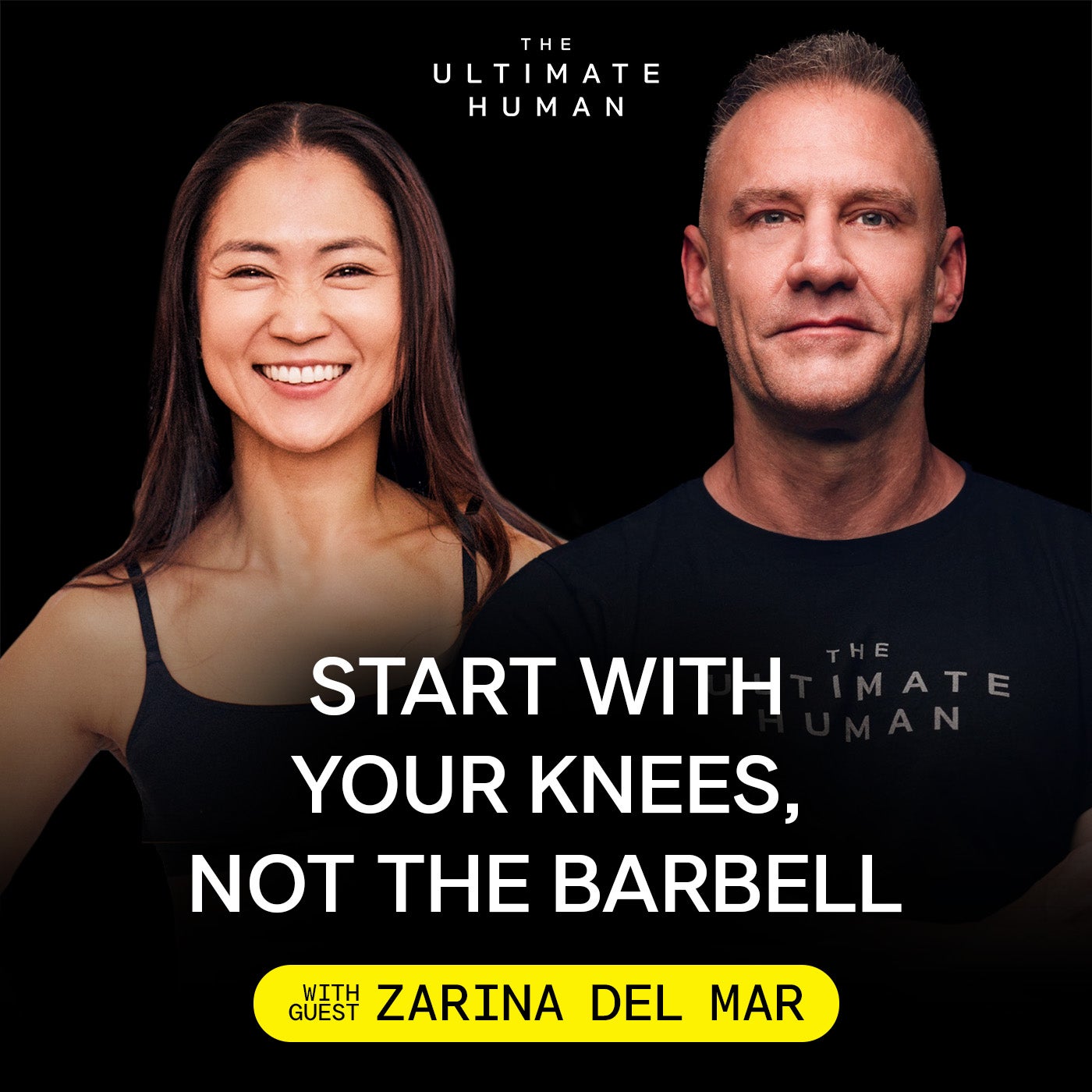
 The Ultimate Human with Gary Brecka
19 Nov 2026 · 58m

 Add vo to ChatGPT or Claude to ask about everything you hear
vo listened to this episode to put together the overview and transcript, so there may be the odd mistake.
Why “just lift heavy” fails many women in perimenopause; the episode argues that women need 3D, adaptable movement (not only heavy strength training) to maintain mobility, proprioception, and nervous-system regulation.
Zarina del Mar (Serena Del Mar). Backgrounds: former international tax attorney; started training at 15; trained twice daily while working; later shifted from law and “lift heavy/CrossFit” toward movement education focused on anatomy/biomechanics and “3D movement.” Her audience is ~85% women, mostly 45+.
Gym/yoga/Pilates often restrict range of motion to one plane; chronic pain comes from limited movement exploration and poor body connection. Adaptability means having many options to move in real-life environments, not just ideal gym conditions. Movement is “language” to the brain and provides information for the nervous system, fascia, and proprioception; it supports circulation, sleep, and even hormonal “requests” during perimenopause.
her father’s falls/injuries from stiffness; Wim Hof balcony breathing + squatting; women’s frozen shoulder and knee/back fear; “movement snack” and floor-based scapula/pelvis/spinal waves; crawling/shin-box/deep squat practices from infant motor development.
0:00When I see all the people in a regular gym or during any yoga or Pilates class, I see that we have not been taught to use all the potential our bodies have. When you need to do a kind of squat and move your torso, I see just one third of the range of motion that you can do.
0:17Gary Brecka: I'm not moving my body necessarily the way that my body was designed to move. We're constricted by the direction that allow our body to move and ancestrally it's just not how we were designed. That is why you create this freedom of movement. The way we move is shaped by our everyday habits. We know that movements can calm us down. Movements can wake us up. You know, their environment quiets, their mind wakes up. Movement is the language that your body speaks to your brain. You need to move on an everyday basis. Move in the way you feel it. What would be like the basics that people could do right out of bed, first thing in the morning?
0:53I am teaching my audience to start creating movements they already have. All the properties of the body are important, but what I have noticed and revealed...
1:15Gary Brecka: Hey guys, welcome back to the Ultimate Human Podcast. I'm your host, human biologist Gary Brekke, where we go down the road of everything, anti-aging, biohacking, longevity, and everything in between. And today's podcast guest is someone that I actually got to know at an activation that we did in Los Angeles. And I really fell in love with the simplicity and the applicability of what she does and what she teaches. She calls it 3D movement. And I think that there's a really interesting concept about 3D movement, you know, because most of the time when we're in the gym, we're constricted by the direction that our weight machines or our barbells or our dumbbells allow our body to move.
1:55Gary Brecka: and ancestrally, it's just not how we were designed. So I'm really excited to dig into some of the practical things that we can do to stay healthy, to stay flexible, and to stay strong, especially for you women out there, even while you're on the road. So welcome to the podcast, Serena Del Mar. Thank you, Gary. Thank you for having me. I have nothing to add. Let's talk about movement. Nothing to add. Okay, thank you for watching the Ultimate Human Podcast. Have a great day. Yeah, yeah. You know, I find it fascinating that you were an international tax attorney and you were training twice a day, seven days a week.
2:31Gary Brecka: And then for some reason, you abruptly, not only gave up law, but you gave up that type of training. So walk me back to that timeframe in your life. Yeah, I was raised as many of us millennials, I was raised as a high achiever in A person. and I've started my training sessions when I was 15. You know, there is a rule of three P in a life of every woman, puberty, perimenopause, and pregnancy. So it is puberty, pregnancy, perimenopause. Hopefully it goes in that order. Hopefully it's not perimenopause, pregnancy. So my relations with my body started during puberty. Every girl wishes to stay as slim as possible.
3:22So I've been training a lot to stay as slim as possible because initially I'm a chubby child and I have these genetics. Then pregnancy, of course, and now it is perimenopause. And yes, I worked as a lawyer. It means that you have to work 24-7. You have this corporate job. You see it a lot. And I tried to find time slots for the training, for the exercising, because like even 15 years ago, the health industry, the fitness industry told us that we need to lift heavy. And the CrossFit appeared and all the marathons. So I did running. I lifted heavy. And I found this time for my exercises routine.
4:07It was like 5 a.m. Because at 8 a.m. you should be at the office. and I started feeling that I'm kind of trapped in my own regimen and my own body. I did not know anything about the anatomy, biomechanics of human movement, about different diversity of movement. I thought there was a gym. I didn't like dancing because I thought that I was not born flexible and I don't have this groove inside my body.
4:39Gary Brecka: This groove inside my body. You need to have this. I have the same. They call it white boy syndrome, and I have it. Like two left feet. You know what I mean? It's like shooting basketball with your left hand. It's a terrible thing to watch me dance. And that is why I'm short. I'm strong. I'm Asian. I can do pistol squats, dragon squats. That is great. And I was doing CrossFit. By the way, I participated in a competition, and I did take the second or the third place. Really? Great for you. Maybe I'm not, I do not look like I'm strong, but I'm strong. And then I've just started searching. Being a lawyer, sitting at the office, I've started searching, like, neuromuscular connection.
5:21What do you can do? What else you can do? And this is how I found the movement practitioners, the movement community, where they have practiced movement. not just exercising and working out.
5:38Gary Brecka: You know, so what do you, you talk about the difference between being fit and being adaptable. And what do you mean by that? Because, you know, as someone who studies longevity and mortality science, we know that frailty in older ages is one of the greatest risks to longevity. And we talked about it before the podcast, how you had a grandmother pass away and they said she was just old. You know, she went, and I've experienced this in my own parents. You know, on two separate trips, where my parents stayed with me. My father literally getting into the tub, broke his arm. He healed from that. And about 10 months later, he fell in my kitchen and broke his hip.
6:19Gary Brecka: And both times it was because he didn't have the grip strength or the coordination and he was so stiff that what otherwise would be a simple movement was very difficult for him. And he ended up getting injured in the bathtub and got injured in the kitchen. And so what is this difference between, what do you call adaptability? What is that? Is this a special type of movement? Is it more of the normal way that humans are supposed to move? Yes. This is the foundation of my 3D movement method, the adaptability. Because if we see a person, a particular person has his or her own movement repertoire, and we have the environment, and the adaptability means that we have a lot of options on how to move within the particular environment.
7:07And you can be really fit, you can have a great blood work, but you are using, for example, your body only in a structured environment like a gym. You're doing squats in ideal form, you're doing lunges, you're doing push-ups, pull-ups, but when your life requires you to step out of the, stage, for example, or do any everyday movement, which requires additional ranges of motion and planes of motion. This is when adaptability starts to play a great role. This is why I am teaching my mom, step onto the coach, like step out of the coach, jump and jump off. not only doing the ideal Romanian deadlift, which is good for your glutes, but also to explore additional ranges of motion for your ankles and your knees.
8:08The same with your upper body. Why only, I'm sorry, why only biceps curls or something in like most of the movements you're doing in a gym, they're one plane of motion. But when you're going to fall, you will never fall in ideal neutral anatomical position, unfortunately. This is why when I'm showing something from the gait biomechanics, I have, like within my theory, I have six movement families. One of them is the movement based on your gait. When you're shifting your pelvis, when you're tilting your pelvis, and you're trying to reach somewhere, and you're using your body cross-laterally, This is the way you may build not only flexibility and mobility, but the elasticity and the ability to adapt.
9:03Because our life requires different positions of the body. Unfortunately, it is not always your knees towards the second and third toe. And what I see like in my audience when I'm showing them like sissy squat, a kind of sissy squat, But when you're moving your knees away from your toes, they're telling me, it will ruin my knees. But when you're going to fall, this will ruin your hip joint and your knee when you're like 60 or 65.
9:34Gary Brecka: It happened to my father. I mean, literally broke his hip in my kitchen. Yeah. This is why I'm asking my parents, get rid of the slippers when they are walking around the house. Use your foot. Use your toes. Yeah. Feel the grounding. and you have a lot of muscles here. I can show. So you need stability. Yes, yes, yes. You need stability here and here and your ankle and your foot shall be strong. Yeah. That is why usually barefoot training. Take rid of your shoes. You have great shoes. I love these shoes. They're almost no padding. Yeah, I don't like all these like modern shoes for the run, for the hike.
10:15They are great. but our flesh needs to stay in contact with the surfaces. In ideal world, different surfaces. Wooden floor, I don't know, any kind of sand, if it is possible. So, yes.
10:32Gary Brecka: What would be different between your philosophical approach and let's say yoga, you know, which is primarily focused on flexibility? You know, every time I've taken a yoga class, and it's like the hardest class I've ever done. And I think it happens for a lot of men. We go in the gym and we build a lot of strength. And then you go into this class and you're standing on a mat and you're asked to hold the candlestick pose. You know what the candlestick pose is? Yeah, yeah, yeah, yeah. It's modern day torture is what it is. Shouldn't even be legal, but it is. And I start shaking and I start sweating and I'm looking at this woman next to me And she looks like she's ready to take a nap.
11:15Gary Brecka: She's like so peaceful. And I'm like, how did you get there? And I think it's kind of like a metaphor for life, like learning to be calm under stress. Right. But what would be the difference, whether philosophically or just, you know, practically between what you're talking about and something like yoga? The difference is that I am teaching my audience to start creating movements they already have. We already have in our body. And usually I'm telling them that I'm giving them, it's a kind of scaffolding, a framework. I'm putting your body in a framework and I call it human origami. You start realizing the points, the main structures of your body and these structures, they may interact.
12:00For example, you have your hip joints, you have your shoulder joints. What you can do? You can start playing with these points of your body. Close each other away from each other. that will be how you extend your spine, how you bend your spine. So like a human origami, you're playing with your body. You don't need to remember the yoga asana. And in my philosophy, in my system, there are no particular rules. You can do this form or this movement only in this way, the adaptability, you may adjust. Yoga for me, I am not a professional yogi or, I don't know, Pilates instructor. Yeah. But I truly believe that modern yoga is in many cases about ego.
12:49You see the instructor and you want to do the same. Any pose, you want to do the same and you think that you're not flexible enough. But it is just a matter of time, the ranges of motion and the freedom you have in your joints as for now and you can develop it and you don't need to stay in a position and initially if we talk about yoga it's it's it's more about super flexible and hyper mobile people but many poses uh as i see them are harmful you don't need to sit that low You don't need to use these particular ranges of motion. You don't need to be able to do leg split. There's no sense in it.
13:32But to feel the range of motion in your joints and control them, control the position and the ability to organize your body. That is why you create this freedom of movement. You can do anything, tennis, golf. Golf is terrible for your lower back and for your knees. I don't know how you guys are playing. Like being a lawyer, I remember all these super rich guys who spent like eight hours playing golf and they were struggling with their big tummies and stiff hip joints with the spine. I've tried several times. You need to be like super intelligent in the context of movement to play golf and to stay healthy.
14:20Gary Brecka: Yeah, well, why do you think that it is that so many people that are exercising are still experiencing like chronic pain? I think that they are not curious enough. You know, when I see all the people, for example, in a regular gym or during any yoga or Pilates class, I see that we have not been taught to use all the potential our bodies have. I see the restricted ranges of motion. For example, Pilates class. Pilates goes, you're doing great. You're doing it regularly. And when you need to do, for example, a kind of squat and move your torso, I see just one third of the range of motion that you can do.
15:00Why just class by class, you're not doing it deeper, deeper and deeper. Why you're just staying in one range of motion and you're not exploring all the possibilities.
15:15Gary Brecka: The additional ranges of motion. Yeah, yeah. I see it during group classes. It happens every time. The people don't understand the movement itself, how they should do it, how they shall feel the connection. I don't know, for example, arm swings. I've seen that you're practicing with your son the arm swings. Do you feel that it goes through the lower belly, through your deep frontal line, which you have? Do you feel how your shoulders are connected with your hips and the arches of your toes? It is beautiful. And you can do a kettlebell. You can grab a kettlebell. And now this is the way when you're doing the arm swings, you're going to feel your deep core muscles.
15:57And if there is no connection, you're going to hurt your lower back. This is how it works. I like working with kettlebells because it's nice weight distribution. And you really feel the inertia and the elastic recoil in your body. I know that we all just wanna be healthy, strong and thin, but elastic recoil that will help you to stay healthy without any pain, even if you're doing something.
16:23Gary Brecka: You know, we had a weighted walk this morning on the beach with a bunch of folks. And Mike was leading us through these exercises and I've done them with him before. And what I find, I do exercise more traditionally like a high rocks athlete because my, my sons both exercise that way and I work out with them in the mornings. But what I have noticed is since I've taken a few minutes in the morning, I do breath work every morning. But since I've taken a few minutes to do, they look so silly, like these flinging my arms up in the air, flinging my arms up in the air, slapping, you know, letting him fall around and slapping my back and slapping my shoulders and, you know, getting down into a squat position.
17:11Gary Brecka: I'll never forget, Wim Hof came here for a podcast. We went out on my balcony and he got in a wide, almost like a, you know what a sumo deadlift is? Okay, so like this wide deadlift stance and he squatted down, I squatted down next to him and we started doing some breathing exercises. Well, like two minutes in, I'm starting to shake Like my, my, my ass is burning. My knee's hurt. I'm in a great deal of pain. I'm looking at this man in his seventies and I'm like, he's gotta be feeling what I'm feeling. And, and so like three, four, five minutes in, I look over at him. How are you still in that position?
17:53Gary Brecka: And, and he's like, well, I just tell him my brain, my brain tells my body, this is not useful information. He goes, when it sends the pain up, I tell it's not useful information. And I found him so strong and so flexible. And I think what you would call adaptable, and yet he's never exercising in a gym. And I thought, I go every day, I beat my ass into the ground for 55 minutes. I do a hundred wall balls, I do a sled push, and I can't hold a squat as long as a 75 year old man. And it just dawned on me that I'm not moving my body necessarily the way that my body was designed to move, right? Absolutely, but it's just a matter of practice.
18:40Like you've told, he has never been training in the gym. You're a gym guy, but that does mean that you cannot add some like natural movements. I don't like the idea of, you know, this type of activity, animal flow. It was like popular five or 10 years ago. animal flow like a human moving like an animal in order to get this uh fluidity
19:03Gary Brecka: yeah spinal articulation like a cat they barked like a dog i thought that was a little too much but uh i remember when i started learning more about human movements uh i started learning the motor development of any human of first like 24 months yeah how you the verticalization is the greatest point in the development. But before you stay in a vertical position, you're laying on your back, you move your limbs to the center, then you rotate, then you crawl, you sit, you crawl, and then you have this ability to stand up. That is why in my movement sequences, I grab the movements from these like 12 stages of motor development.
19:47Let's crawl. And it's not animal flow. It is the crawling position and it's not quadruped from pilates it is the movement you already have in your body yeah infants learn yeah deep squat or shin box position if you remember your kids you should remember your kids they are sitting in the shin box position they may sit for hours what's the shin box where you have your legs back this one oh my god 45 45 my daughter does that dude it makes me crazy every time deep squat i understand that in a young body in a body of a small baby they have more flexibility, of course it is natural, but shin box position, deep squat position, kneeling position, and crawling positions are the basic ones.
20:27And I have an audience 45 plus, mostly 55 plus, and they're telling me we cannot sit, knees hurt, or hips are rigid and stiff. I cannot do it. show me something different uh you can put the pillow but in five to seven days practicing this movement you're going to be able to do it just um this i don't know this
20:53Gary Brecka: mentality when i'm going to dub in some of the the visuals of this um um you know from your from your instagram because i i think a visual would align very well with what you're saying Do you find that most people can do it after five or six days? Yeah. Wow. We are doing our research. We are sending the questionnaire, which has a lot of questions, like 150. And our subscribers who are ready to participate in our surveys, especially mostly women, they are telling, yes, the mobility improved, the proprioception improved. and that is why I'm asking them to practice movement on an everyday basis. It is not like the workout protocol or the heavy lifting, which you have to do like three times per week and you need to rest.
21:44You need your body to recover. In my theory, you need to move on an everyday basis. You're waking up, you're moving your joints. Like, let's say about 10 main joints. Move in the way you feel it. You have your knees, you have your ankles, hips, the whole spine, move it. Spinal waves, the best movement. You need to do it on an everyday basis. You don't need to recover from spinal articulation. Your gait, when you are walking, have you ever noticed what is happening in your shoulder joints, in your hip joints, and in your spine? Just one step or several steps. You're moving. Your hips are moving in three dimensions, and your spine is moving like a snake when you are walking.
22:28Not in this range of motion, but yes, every segment of the spine shall what? Do movements in three dimensions when you're walking or running.
22:38Gary Brecka: So what would be a typical, so for an audience member, you know, starting out, you know, what is like a typical scenario? Wake up, maybe hydrate, and they want to get some basic movement in. You know, this is what I liked about Mike's protocol. It was very, very simple, throwing your arms, timing it with your breath, slapping the body. I actually found that my workouts were better and I felt better just from doing that. It was very easy. Like I say, it looked silly, but I noticed that my shoulders would begin to open up. It must have something to do with the fascia, you know, sort of getting constricted.
23:17Gary Brecka: What would be like two or three of the basics that people could do right out of bed, bursting in the morning? because you're talking about this spinal movement. Yeah. I even noticed that your fingers are flexible, more flexible than mine. Her hand's like a wave when she does that. If you have this opportunity, just lay down on the floor, not a soft carpet, just feel the floor and feel every bone, every part of your body that you are aware of on the floor and start just moving your scapula, your shoulder blades up and down, up and down. And you're going to feel your shoulders, of course, move your hips, move your pelvis the way you can do it, up and down, up and down.
23:58Then pull your left hip up, right hip up. And then just tell yourself what segments of your spine are now on the floor and move them away from the floor and towards the floor and side to side. This is how you may start exploring in just three dimensions. And I like the connection with the floor because now it, our environment is super comfortable and it is bad for our body. We don't walk using our, the strength of our, the soles of our feet. We are using the mattresses. I know you have the great one and it is really great if you can find the great mattress and the pillow, but nonetheless, explore connection and contact with the floor.
24:44Gary Brecka: Don't tell me you sleep on the floor. No, I don't sleep. But I know one of my teachers... Because I was like, I'm sorry, I'm not going there, Zarina. But I'm interacting. I like my bed. You know, I have tatami, the Japanese floor tatami, and it is natural. And usually I'm lying on tatami and I'm doing something with my body. Is that like a padded mat or is that more like a... No, it's the natural one. It's not wooden, but very soft wood. It's fabric, but very thin. Uh, it's not fabric. Yeah, it's just the, and it smells like a grass. It costs a lot, but it costs it. It costs a lot. Because it's a natural one.
25:26Gary Brecka: I like natural surfaces. I have very expensive carpet in my house. Smells of rich mahogany. But it is Japanese tatami. Or you may start with the arm swings, like you've described. And this is so great when you're moving the torso and you keep your shoulders, your traps and your neck relaxed. We have a lot of pressure around our upper body, women especially, frozen shoulder syndrome. Everyone is suffering. Oh my gosh, my wife had it so bad in menopause. And if you cannot lay on the floor, just spread your arms, shake a little bit, do the swings, and then start to exploring the movement. I have this idea of two main segments of your body, the pelvis and the thoracic spine.
26:15Just move forward, backward, side to side, and rotate the pelvis and the thoracic spine. And you're going to feel it. In just five to seven days, you will get more freedom.
26:25Gary Brecka: Freedom as in flexibility, freedom as in circulation, energy. Yeah. The circulation inside your body, yeah. If you believe in it, it really works, and you will get it. And you don't need special machine to tell you that there is something, there is inflammation inside your body. You really feel when there is inflammation. Yeah, you know, it's fascinating. Years ago, it's going back to like 2000, I own a CrossFit gym. And I ended up selling it because I didn't like the combination of speed and heavyweight. I'm still a believer in CrossFit. I think it's great. But just when I saw soccer moms and lawyers doing compound Olympic lifts that I thought - Lawyers.
27:06Gary Brecka: Yeah, lawyers. No offense to lawyers. I mean, like teachers, I mean, anyone, firemen, you know, just doing, you know, really complex compound, you know, overhead snatches, cleaning jerks. And then when we were combining like deadlifts and 400 meter sprints, it was like, you know, people arrive back at the deadlift bar exhausted and it was called an AMRAP, as many rounds as possible. And then you try to do 10 deadlifts and then you're back out the door for a 400 meter sprint. I was like, this is a recipe for disaster. But what was fascinating is we started this afterschool program to try to recruit new members.
27:43Gary Brecka: And so during the school year, we would allow middle school kids to come in and we would essentially babysit them for an hour to 90 minutes. And we would put them through these classes and the parents loved it because it was in this shopping center and they would drop the kids off. We would keep them in the gym and run them through these exercises. and to break them into groups, we did like the most basic of fitness assessment. And these were sixth and seventh graders. And so we had a one foot high box jump and we were like, okay, sit down on the box jump and without using your hands or rolling to the side, stand up.
28:20The number of kids that could not stand up
28:23Gary Brecka: from a box jump, not from their butt on the floor, a foot off the floor. And then we had another test where we would put them up on the pull-up bars and all they had to do was hang. And we wanted them to hang for 30 seconds, right? We would put them there. We'd let go of their waist, they'd fall. And I'm like, no, no, no, hold on to the bar. Just hold the bar, don't fall. And as soon as I would let go, they would fall. And we started to realize, like we would put our feet on kids' feet and all I needed them to do was just lay down and sit all the way up, bring their shoulders to their knees. They would roll to the side.
28:58Gary Brecka: They would try to pull their legs up. It was astounding to me how many kids could not just move their, basically their bodies through normal planes of motion. And I'm talking about sixth and seventh grade kids. So for a parent with children, like, is there a way to incorporate something like this to make it fun? Because I noticed you seem to be muscular. I mean, you seem to be holding a lot of muscle. and yet you're not using big, heavy resistance training. Are you, is all of what you're doing with body weight, you know, are you just challenging yourself with your own body weight? Mostly, yes.
29:38I can deal with the weight of my body, meaning that I can do like five to 10 pull-ups. Of course I can do push-ups, but at the same time I can put like 55 kilos on my shoulders and I can do squats. Or I can do Romanian deadlift with the weight of my body. And I don't think that I need to go further. Like, I don't want to lift 70 kilos. I don't see any sense in the weight as the number. I see the sense that you need to feel your body and you need to be capable of like simple movements you talked about the kids I don't know about you but nobody ever told me like my parents that I need to stay physically active I need to read books I need to take the best grades I need to enter this college this university but I have never been taught that while you're sitting change the position.
30:39And when the first grade in Soviet Union countries starts from seven years old, this is the end of movement. But the end of movement, I mean, you're sitting at the desk and you need to sit straight to put your forearms and elbows on the desk. And this is your kind of sitting for 45 minutes, then you have a break and usually you have six to seven lessons. we as humans, we for some reason, we think that our intelligence is growing from sitting and learning, but not from moving our bodies. That is why if my kid, he's now the second one, he's now 60 years old, if he's telling me that he doesn't want to sit, we stop any reading or writing or doing home tasks and he's running and I'm letting him to jump over every surface he has the table the chair the sofa and he's doing crazy stuff and he's trying to repeat my six years old yes and now we have all these uh we we we have a lot of additional activities like physical one the the soccer, the dance classes, any class.
31:58But what I see, my older one, she's 13 years old and she's a dancer, hip hop dancer. And she's telling me, oh, my friend, she has lower back problems and knee problems. 12, 13 years old, 15 years old. And they are not the professional dancers. That is the disaster because no one still, we have dance, football, tennis, but we don't have this like elite athletes, they have performance coaches who are taking care of their body and joints. But for our kids, no one takes care. So we shall ask once you wake up, do, I don't know, something simple, pushups, squats. It is easy for the kids. They will never ruin their joints and they can do it or jump onto the couch or chair.
32:47So use the surfaces around you. I have never heard, you know, I have a research team and told them I'm using the environment. And they told me there is a
32:58environment engagement theory, the affordances theory, that every object around us has its own affordances. For example, the chair for sitting, or you can use it for, I don't know, you can squat or you can jump onto the chair. So this is the way you're using the objects around you. I don't need Pilates machine. I have my chair and I can start using it as the great tool for flexibility. I can put like my one leg here, the opposite there, and I can move. And I don't need special machine.
33:35Gary Brecka: Yeah, I've seen you go from kneeling positions, step all the way up onto a chair. Yeah, yeah, yeah. I'm using the environment. And your kids shall learn how to use the environment. And with the low walking score in the most cities in the U.S., it is difficult because we're using cars or buses. But still, I'm asking my girl, my teenager, walk down the hill. We're living up the hill. Walk down the hill, buy your ice cream, and then walk back. She's struggling. She's crying. Yeah. But I think that it is necessary. I don't know, 10K steps, 15K steps. It doesn't matter. but just use the environment and move.
34:16Gary Brecka: What is this multi-planar sensory motor intelligence? Yeah. What does that mean? We created it. You know, I have my 3D movement method manual, and we needed the structure because, you know, many guys are now talking about movement, and they're, like, fascinated about human body. But for me, there is no structure. So we created the multi-sensory, multi-planar intelligence, meaning that you need to have this body schema in your mind, in your brain, to be able to use your body. First of all, in three dimensions. Just realize that you are a three-dimensional creature and you can move like in sagittal plane, meaning you can move up and down.
35:00You can move in frontal plane from side to side and in transverse plane, just rotation and spiral motions. and you can play with the movement because nowadays we can repeat the exercises and we can remember the exercises. But for example, you're traveling a lot and many of my subscribers are telling me, I don't have time for a gym, I'm traveling a lot or I'm on vacation and I do not do my exercises routine. For me, it is the low intelligence. You're still eating, you're sleeping, you're brushing your teeth, but there is no, uh, the desire to move, uh, and your movement, the way you're working out or exercising, exercising has not become the like non-negotiable part of your life.
35:53When you're not torturing yourself, you're not convincing yourself, wake up and do, but you're waking up and you know that you need it to feel better, to feel, um, like high on energy or on mood and to support your body because movement is not for your for looking good in a mirror for looking good in a dress or for looking good in a bikini um on miami beach but uh to feel better and you're investing your time in order to look and feel better like 20 or 30 years down the road. I believe in it. And I see it, uh, like in my parents, the, the, the, like, like you've told about your guest, my dad is 64 now and he has never been training in the gym, but he's in a great shape.
36:46Why? I did not know that. I, I, he came now and he told me there was no, a single day when I was not doing like a kind of exercises. So he has his own set of movements that he's doing on everyday basis, even traveling around Japan, even living in a tiny hotel rooms. He was doing his stuff just laying in the bed. He can be better. Yes. He can be more muscled. Yes. If you go to the gym, he will grow the muscle mass. Right. But the way he looks now is just great. his skin, his mobility, and his curiosity. If you're 64, you may start just losing your curiosity and this sense of life. But he's still doing it.
37:38Like he quitted his job. He's helping me in my project. He's filming his own short videos. Is he really? Really? And he's 65 and he's going to do it for like other men his age.
37:51Gary Brecka: And your audience is mainly female, right? Mostly, yes, 85 % female audience. Is female. And why do you think that? Why do you think females gravitate towards this? Because men, you know, we want the vanity muscles, right? I think most men would skip the gym if they could look good skipping in the gym, right? Yes, my husband is telling me I would never go to the gym. In case I can just grow muscle and keep it tilted. Why women? Because I am advocating for women, for women's body, and for women's lifestyle. Midlife crisis. It is so difficult when you're losing yourself. You're losing the sense of yourself.
38:40And you're not losing your body. You realize that you have never had any touch with your body. And you start doing something and every great longevity and health experts and perimenopause experts are convincing us lift heavy. But what I see, a lot of women are left behind. They are afraid of weights. Maybe because they want to still stay as thin as possible. Or they are afraid of injuries and pain in their knees and their lower back. And of course, you may tell them, start with little weights and then progression and you will feel it. But what I'm telling them that just start with your body. Like, let's do step ups.
39:26Let's do deep squat or let's do like any additional movements that will help you with your knees, with your ankles and your lower back. I am telling them that movement is simple. You don't need to overcomplicate it. you don't um you don't need to find any excuses i don't have time uh my my schedule is tight uh i don't feel like i need to do something because we have a cycle and i'm telling them if it is a certain phase of your cycle you can skip the whole session but still you can do
39:58Gary Brecka: something to help your lymphatic system and to help your neuroendocrine system because even if you're on HRT, you need your body systems to send the request. I need this estrogen, for example. How you can send the request if you're not putting your body in a movement environment? If there is no movement, for me, there is no request. Like, let's spend this estrogen for something else, but not for the movement, not for the joints. Movement is the language that your body speaks to your brain. And this dialogue, it becomes the main one when you are, I suppose, 35 plus, because I've started seeing the changes in my body after 35.
40:41That is why a lot of women from 55 countries, by the way, they are believing because they start practicing. You see the short video and you can repeat the movement. And you can like start practicing right now. thanks to social media.
40:58Gary Brecka: And you can also do it in your hotel room. You can do it. Anywhere. See, that's what I really love. I love that it's adaptable and portable because most people will abandon their diet. They'll abandon their exercise routine. They'll abandon their sleep routine, you know, when they travel. When I'm on the road now, and then when we started this about six years ago, I schedule all of my meetings and travel around sleep and exercise. So you could actually, if I had my phone, I would show you, You could scroll in my calendar, stop it, and click a random day, and you will see that there is a block on my calendar wherever I am in the world for sleep and exercise.
41:37Gary Brecka: And so I've reprioritized my schedule around that. And I will tell you that and the ability to fast and keep my digestion on the same clock, just those three simple things, the most major impact on my capacity to absorb and not be fatigued with travel. Sometimes I'm energized by it, honestly. And what I love about this is that you can take it anywhere. Like, you know, and it's so portable. Even here, even now, I'm moving my hips. That is great. You're making me, like I see you do it and I start doing it. I'm like, okay, I like it. And by the way, I didn't change the position, but we need to change the position.
42:16You know, your best posture is your next posture. There is no one, there is no ideal posture. You don't need to keep it straight, never. It is bad. You need to bend. You need to extend. You need to shift side to side. Just change the position and listen to your body. But we don't talk to our buddies. That is why, because we have a lot. Luckily, you have an opportunity to schedule everything in your life. But if you have the regular job, 24-7 job, or if you're a nurse, a lot of nurses or track drivers are texting me telling that, oh, it's great, I can do it in my truck. Even sitting, I can do it.
43:02Gary Brecka: Just move. Yeah, just move. or any, like my friend, she's an assistant in a store and she has to stand for the whole day, like eight hours standing. It is bad, but still you can bend your knees and extend your knees. You can do something, you can do spinal waves, which is great. I did not, I haven't been able to do spinal waves like five years ago. My spine was a stick. because I was doing CrossFit, I know how to keep it in an atomical neutral position, but I was not able to move segment after segment. I've learned it. You can learn to do any movements, natural movements, just practicing and spending some time.
43:52No one was like born flexible or not flexible. Maybe more or more - Do you think flexibility is more important than strength
44:01Gary Brecka: or strength is more important than flexibility? Flexibility. All the properties of the body are important. But what I have noticed and revealed, the elasticity, elastic recoil, the bounce, the organization of the body, and this tension, how you feel the tension inside your body, because there is no situation when we are relaxed. when you're meditating or you're doing anything and you want to relax, we are existing because we have this integrated and elastic tension in the body. Like my hips are hanging on my shoulders and I need to distribute equally the weight between the main points of my body.
44:43And once you feel it, you're going to be able to do any movement. You're going to be able to start lifting heavy. you may become a super heavy lifter. Once you feel the grounding, you feel the position of your body, you know. I know that I can lift heavy. I don't do it because I have my, I have like two hernias in my neck. I have certain condition of my sacrum after two pregnancies. I don't want to do it, but I know that I can. Once I found the right coach, I can lift a hundred kilos because this is my physique. I'm short, I'm strong. But at what cost? I don't need it.
45:23Gary Brecka: Yeah. Why do you think that some people from a movement perspective, they age faster? Meaning their movement is restricted much faster because now that I'm in this space, I see 65 people that are as agile as a 25 year old. I see 65 people that really struggle to get out of the car on their own. is this stiffness and lack of movement, the contraction of maybe their fascia, why do you think that some people arrive at the inability to move properly so much earlier than others? The way we move is shaped by our everyday habits. Maybe it is because of the environment. Each person is different. Of course, genetics plays a great role, but the environment and the patterns and the habits that we've been developing for decades.
46:26For example, if I'm 65 years old and I'm a judge, like my dad was, if he did not do his exercises routine, I don't know how he was going to look in his 65, but he was doing something. He got rid of snacks because the judge means that you're sitting, sitting, and sitting. There were only three meals per day for him. No coffee, no like candies or cookies. That was his lifestyle. And he did not read anything about longevity like when he was like 45. but it was like the inner sense of how I can keep my body working and my mind sharp. So the lifestyle, the habits, and the lack of practice. When you think you're working out and you have this goal, you want to lose weight, you want to gain muscle mass, but unfortunately with the body, it never happens so that you have gained the result and you stay with this result with nothing.
47:35You need to find the way of movement that will stay for you forever. So the adaptability and sustainability will keep you movable. Just practice. I don't like the word exercise because exercise means that you need to push yourself. Pick a time, block it off.
47:55Gary Brecka: That's when you exercise. And then you're not moving the rest of the day. You're like, I would call it snacking on exercise. Yeah. You're sort of snacking throughout the day. I have an article about movement snack. I believe in it. I believe in it. And I started doing it when I worked at the office. Luckily, we had a good office environment and we had spaces where we had an opportunity to move. And I started doing something for myself because when I was 25, I had severe pain in my lower back. Not being an athlete, I didn't do anything with my body, but the pain was there. And my neck, because it's a kind of scoliosis, I suppose.
48:33movement snack is great. And you have your, I believe that everyone has their own movements. They need to just remember what keeps you in a certain -
48:46Gary Brecka: What is the relationship between movement and the nervous system too? Because, you know, I talk a lot about being trapped in a sympathetic state, in the state of fight or flight versus a state of parasympathetic, which is rest and digest when the immune system is active, when, you know, during deep sleep, when the lymphatic system is draining. And what is the connection between movement and our nervous system? For me, it is just the information. The more you move, I mean, the more, let's say, joints are engaged in the movement. And when you really feel that this is the full range of motion and you start controlling the range of motion and the position of your body, your nervous system gets a lot of information about your body.
49:34And the more information, the better, the clearer the feedback will be. And this is how you learn and you practice and you learn and you develop and keep the qualities, the properties of the body. Because you're telling your brain, I need it. This is the way I keep myself alive. So give me, let's say, give me more flexibility stability uh keep my tendons and ligaments uh and um like keep them strong and elastic so i don't know if we can say it if it is scientific but send more hormones into my body into my joints to um to protect me because i am moving on everyday basis and this is my lifestyle this is the environment I am creating inside my body.
50:26I don't find any way to interact with the nervous system, with the brain. It only happens through movement. Once you're moving, you're sending the signals and even your vagus nerve gets more information, even about your internal organs. If we talk about the fascia, it is the same. We may say that it has more intelligence than muscle. Muscle can only contract or relax, but everything happening in the body when we talk about compound movement happens because of the fascia, because of the ligaments and tendons moving and engaging in movement. So only information. And I believe that you don't need to read anatomy books or books on biomechanics.
51:14Just start moving and noticing what is happening inside your body. Like I've told you, When you're walking, notice what is happening with your pelvis and your spine. Just be conscious of where you are. Yes, and what is happening with your shoulders, in, out, in, out, in, out. Not just, I was running, so everyone in Miami are running in the morning, and I notice the running biomechanics. So you keep your shoulders stiff and you're just running. Where is the flow? Right. Where is the movement of your spine and your hips and your pelvis? Maybe the runners will tell me you need to keep it in neutral position, but not.
51:54You should not. You should move like a real human.
51:57Gary Brecka: Yeah. And speaking about the parasympathetic nervous system, once you feel the control and confidence, it will be easier for you to switch off this flight or fight and relax. When you say, once you feel it, like, are there specific, you know, like in a lot of meditative practices, they'll use muscle contraction and then muscle release. And muscle contraction and muscle release. And there is some evidence, you know, around that sort of calming the nervous system down. What sort of things do you suggest for that? Like, because we know that movements can calm us down. Movements can wake us up. So do you have something you would prefer to see people do at night?
52:45Gary Brecka: Like, you know, a lot of women have a tendency to ruminate at night, right? I mean, just, you know, their environment quiets, their mind wakes up. And so they're just thinking, but did I get everything on my groceries? Did I match my shoes? Did I return that Instagram post? And just ding, ding, ding, ding, ding. Are there movements that you find that are very soothing, very relaxing, obviously not holding a deep squat or doing a pushup, but. I like the movement which I'm introducing to my audience. So you're standing in neutral position, you feel the grounding, you put your feet just not too much close, not too much far away, you close your eyes and you're starting to move the whole body just 360 degrees.
53:30So you're distributing the weight, for example, just to the left side, the maximum to keep the balance. Then forward, you feel the weight around your toes. Then you are moving to the right side, the edges of your right foot and the arch of your left one. Then you move to the heels and you're doing this 360 degree circle just five times clockwise. With your eyes closed. With your eyes closed. And this is how you are increasing the proprioception. the feeling of your body in the space. And it is good because you have your like midline and the body is organized. Let's say you don't know what is midline, just your spine, your inner thighs, your inner shins and the arches of your feet.
54:16This is your foundation. And you start moving around your foundation. And once you feel supported, confident, you're all going to sleep. You're going to sleep. You're all going to sleep better. But with close eyes, it is great. The same with laying on the floor. Just close your eyes and tell yourself which body parts you now feel in contact with the floor. And this will give you the body schema or the whole perception of your own body. It will also help you to sleep better and deeper. I believe that staying in touch with the body is great for anyone. Of course, I cannot argue that still you need to lift heavy, you need to work on your cardiovascular system through sprint interval trainings.
55:12But I see a lot of women who cannot do it.
55:15Gary Brecka: Yes. Especially, for example, 60 plus. We can all move. Like my mom, she cannot do sprint interval trainings. It is impossible. but I'm asking her jump, walk, use the kettlebells. I'm teaching her how to use it and she's walking. So just stay in touch with what you have. Serena, this has been amazing. So for my audience that would like to know more about you or where do they find you? How do they find you? On Instagram, on Facebook, on YouTube, TikTok, every social media platform. Is this Serena Domar? Yes, this is Arena Del Mar World. If you speak Russian, you can join my Russian speaking platforms.
56:00And if you're a researcher, you know, Gary, I have this brochure. So if you're a researcher and you have a lab and you're fascinated about the women's body, let's work together. because I have my own research team and we're doing questionnaires, we're doing surveys, but it is, for now, these are self-reported,
56:23like self-reports from my audience and I don't have the lab to physically prove what I know is working. So if you have a lab, just let's work together. And I have this, you may try it, I have this just test, 3D challenge.
56:43Gary Brecka: I'm going to put a link to your social. Can they get this on there? Yeah, of course. Okay, great. So let's work together. Let's move together. And of course, just... Let's live a long time. As long as we can. But the quality of life means much more than just the years of living. So let's say active, just active and curious. So Zarina, I wind down all of my podcasts by asking my guests the same question. What does it mean to you to be an ultimate human? stay curious uh live and feel my life at fullest and just stay confident uh about everything happening inside me and and keep moving of course keep moving wherever you are irrespective of your age your profession just find the ways to keep moving amen Serena thank you so much for sharing your time today and guys until next time that's just science
Women in perimenopause keep hearing they need to lift heavy, but many get left behind by knee and lower back pain. Former international tax attorney Zarina del Mar, creator of the 3D Movement Method, joins Gary Brecka to explain why gym training works in one plane while falls happen in all three, how fascia and elastic recoil support pain-free movement, and simple daily moves like spinal waves, the shin box and barefoot training that support your hips, knees and feet. Don’t guess, test.
Click here to join Gary’s VIP Community: https://bit.ly/4ai0Xwg
Connect with Zarina del Mar
Website: https://bit.ly/3UA2mv1
YouTube: https://bit.ly/4t4328F
Instagram: https://bit.ly/3VuvqV1
Facebook: https://bit.ly/4zOzX3n
TikTok: https://bit.ly/4zO8UFo
X: https://bit.ly/48iDOKb
LinkedIn: https://bit.ly/4fCL87h
Thank you to our partners
AION: “ULTIMATE10” FOR 10% OFF: https://bit.ly/4h6KHAD
BAJA GOLD: “ULTIMATE10” FOR 10% OFF: https://bit.ly/3WSBqUa
BODYHEALTH: “ULTIMATE20” FOR 20% OFF: http://bit.ly/4e5IjsV
BREW: THE ULTIMATE COFFEE: https://bit.ly/4elHM82
COLD LIFE: THE ULTIMATE HUMAN PLUNGE: https://bit.ly/4eULUKp
CYMBIOTIKA: “BRECKACYM30” FOR 30% OFF: https://bit.ly/4tjyluP
EUCLASE: A NEW SIGNAL IN SKINCARE: https://bit.ly/3UYqM1m
GENETIC METHYLATION TEST (UK ONLY): https://bit.ly/48QJJrk
GENETIC TEST (USA ONLY): https://bit.ly/3Yg1Uk9
GOPUFF: GET YOUR FAVORITE SNACK!: https://bit.ly/4obIFDC
H2TABS: “ULTIMATE10” FOR 10% OFF: https://bit.ly/4hMNdgg
HEALF: MY PRODUCTS IN THE UK https://bit.ly/41HJg6S
PEPTUAL: “TUH10” FOR 10% OFF: https://bit.ly/4mKxgcn
SNOOZE: LET’S GET TO SLEEP!: https://bit.ly/4pt1T6V
WHOOP: JOIN & GET 1 FREE MONTH!: https://bit.ly/3VQ0nzW
Watch the “Ultimate Human Podcast” every Tuesday & Thursday at 9AM EST:
YouTube: https://bit.ly/3RPQYX8
Podcasts: https://bit.ly/3RQftU0
Connect with Gary Brecka
Instagram: https://bit.ly/3RPpnFs
TikTok: https://bit.ly/4coJ8fo
X: https://bit.ly/3Opc8tf
Facebook: https://bit.ly/464VA1H
LinkedIn: https://bit.ly/4hH7Ri2
Website: https://bit.ly/4eLDbdU
Merch: https://bit.ly/4aBpOM1
Newsletter: https://bit.ly/47ejrws
Ask Gary: https://bit.ly/3PEAJuG
Timestamps
00:00 - Introduction: Zarina del Mar and 3D Movement
01:07 - From Tax Attorney to Movement Coach
04:23 - Fitness vs. Adaptability and Fall Risk
08:21 - Why Your Feet Need to Lose the Slippers
09:17 - 3D Movement vs. Yoga and Human Origami
13:04 - Why People Who Exercise Still Have Pain
15:08 - Wim Hof’s Squat and Gym Strength Limits
17:54 - Crawling, Shin Box and Deep Squat
19:54 - Daily Movement and Spinal Waves
21:22 - The Morning Floor Routine
24:17 - Arm Swings and Tight Shoulders in Women
25:30 - Kids Who Can’t Hang From a Bar
28:41 - Teaching Kids to Use Their Environment
33:01 - Multiplanar Sensorimotor Intelligence
36:37 - Lifting Heavy in Perimenopause
42:44 - Elastic Recoil vs. Flexibility and Strength
46:43 - Movement Snacks for Desk Workers
47:33 - Movement, Fascia and the Nervous System
51:01 - Eyes-Closed Balance Drill for Better Sleep
55:54 - What It Means to Be an Ultimate Human
Disclaimer: This podcast is for informational purposes only and does not provide medical advice. It is not intended for diagnosing or treating any health condition. Always consult a licensed healthcare professional before making health or wellness decisions. The views and statements of guests are their own and do not necessarily reflect those of The Ultimate Human or Gary Brecka.
Gary Brecka is the owner of Ultimate Human, LLC which operates The Ultimate Human podcast and promotes certain third-party products used by Gary Brecka in his personal health and wellness protocols and daily life and for which Ultimate Human LLC and / or Gary Brecka directly or indirectly holds an economic interest or receives compensation. Accordingly, statements made by Gary Brecka and others (including on The Ultimate Human podcast) may be considered promotional in nature.
Learn more about your ad choices. Visit megaphone.fm/adchoices
Scan the code with your iPhone camera
Listen in the app.