
In short
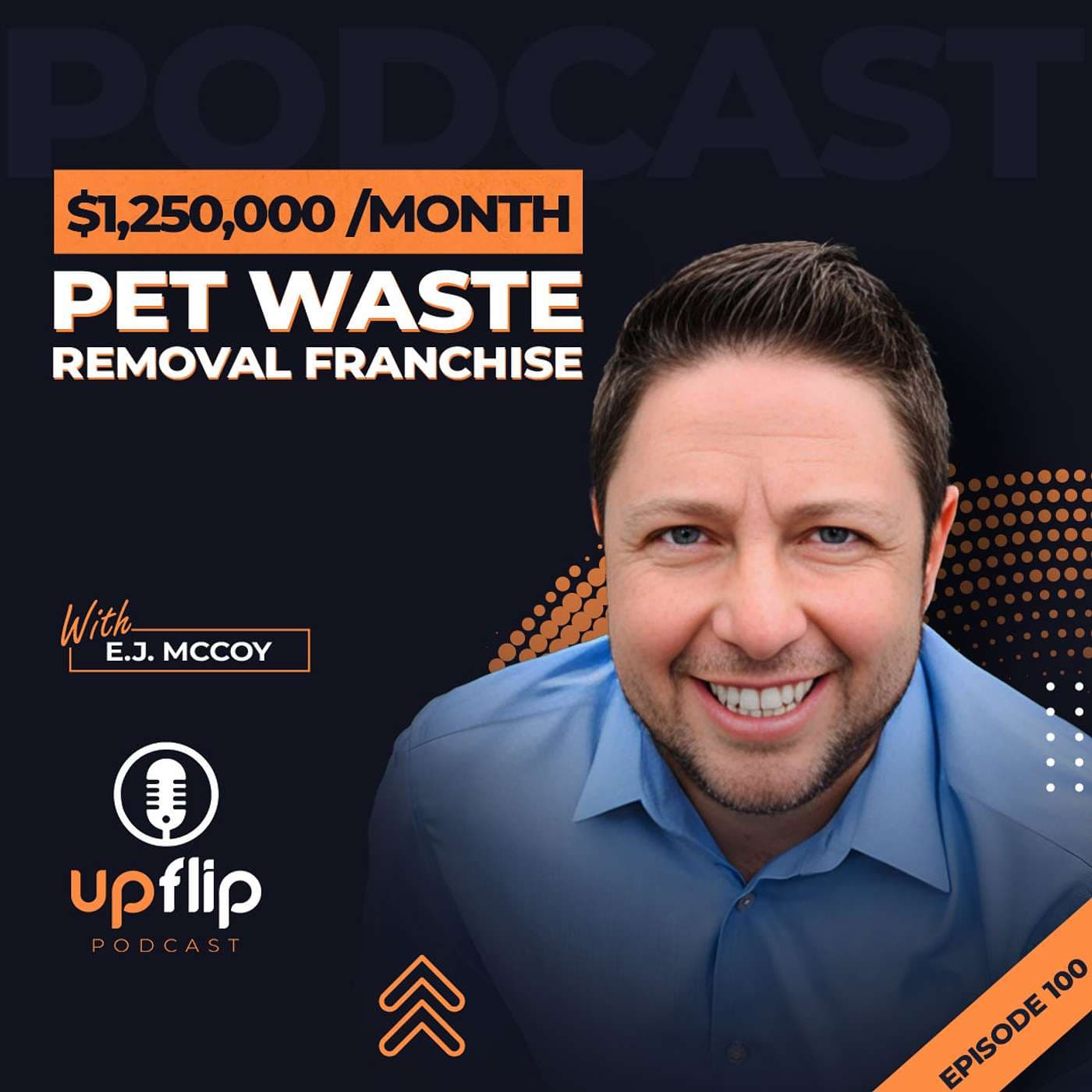
UpFlip Podcast Episode 100: How He Makes $1.25M/Month Scooping Pet Waste?!
Overview In this episode of the UpFlip Podcast, host Alex Freeman interviews E.J. McCoy, the founder of Scoop Soldiers, a successful pet waste removal service. McCoy discusses his entrepreneurial journey, the challenges he faced, and how he built a multi-million dollar business in a niche market.
Key Concepts and Themes
Entrepreneurial Beginnings
- Early Entrepreneurship: E.J. McCoy started his entrepreneurial journey at a young age, mowing lawns at eight years old and officially founding his first business, Emerald Lawn and Landscaping, in 2006.
- Identifying Market Gaps: Recognizing the demand for pet waste removal services, he launched Scoop Soldiers in 2010, capitalizing on a niche that most people find undesirable.
Business Strategy
- Service Diversification: McCoy has expanded Scoop Soldiers to include complementary services such as pest control, fertilization, junk removal, and window washing, creating multiple home service brands.
- Franchise Opportunities: The company has developed a franchise model, allowing for rapid expansion beyond Texas, with plans to grow into new markets.
Picking the Right Pricing
- Pricing Strategy: McCoy prefers to maintain competitive pricing rather than being the cheapest, emphasizing value through customer service and reliability.
- Profit Margins: He notes that pet waste removal tends to have high profit margins ranging from 20% to 35%.
Customer Engagement and Marketing
- Initial Marketing Tactics: McCoy began with traditional methods like door hangers but shifted to focusing on Search Engine Optimization (SEO) for acquiring customers in the pet waste business.
- Social Media and Customer Interaction: He advocates for consistency in social media presence, with a focus on volume and quality of content to connect with customers.
Business Challenges
- Scaling Operations: McCoy describes the difficulties in managing manpower as the business grows, highlighting the struggle to find reliable workers for labor-intensive jobs.
- Client Care: The company's client care centers are critical for maintaining customer relations and managing retention through personalized communication.
Lessons Learned
- Importance of Patience: McCoy emphasizes that patience and consistency are key in the early stages of business growth.
- Adapting to Market Needs: He discusses the need to pivot and adjust strategies based on market feedback and competition.
Insights from E.J. McCoy
- Mindset for Success: McCoy advises aspiring entrepreneurs to be decisive and remain open to shifting strategies based on learning and market conditions.
- Long-term Vision: He sees his growth as part of a broader mission to innovate the client experience in home services.
Closing Thoughts E.J. McCoy's journey highlights the potential for success in niche markets through hard work, strategic expansion, and a strong focus on customer service. His story encourages aspiring entrepreneurs to recognize opportunities that may be overlooked and to remain adaptable in their approach.
Resources Mentioned
- [Start a Pooper Scooper Business](https://bit.ly/3NGXSeI)
- [Scoop Soldiers Website](https://www.scoopsoldiers.com/)
- [UpFlip Franchise Guide](https://bit.ly/4aWuGvc)
Connect with UpFlip
- [YouTube](https://www.youtube.com/@TheUpFlipPodcast/)
- [Instagram](https://www.instagram.com/upflip/)
- [Facebook](https://www.facebook.com/upflipofficial)
- [Twitter](https://twitter.com/upflipofficial)
Additional Links
- [UpFlip.com](https://www.upflip.com) for more resources on starting, building, or growing a business.
---
This markdown provides a structured summary and insights from the podcast episode, effectively capturing key points and themes discussed by E.J. McCoy.
Written by AI. May contain mistakes. Listen to the episode to check what was said.
Transcript
Automatic transcript. May contain errors.0:00Are you struggling to scale or start a business? In this episode, you'll be able to think about the million-dollar business idea that might be hiding right under your nose. Or, in EJ's case, under his nose. And offending his nose. The mission of that company is to conveniently add value and comfort to your property. The long-term vision of it is to be an all-encompassing home services brand that really innovates the client experience in home services at the macro. And as we were dominating the search engine optimization, we just kept going. And before we knew it, we had 12 markets. We tend to be middle of the road, our pricing.
0:34I don't like to be the cheapest. And when I'm the cheapest, I feel like I'm probably selling ourselves short. But at the same time, we want to be competitive. We don't want to necessarily be the most expensive just to be the most expensive either. I'm your host, Alex Freeman. And on today's episode, we're going to speak to E.J. McCoy, owner of Scoop Soldiers, a pet waste removal company that began when E.J. was mowing lawns. He took this nuisance of a problem he encountered while mowing and scaled it to a $25 million business. Let's get started. EJ, welcome to the show. Yeah, thank you. Thank you for having me, Alex.
1:05Appreciate it. So I guess to start us off, give us your background and what prompted you to start a pet waste removal business? Yeah, no, I started mowing lawns at a really young age, eight years old. And by the time I was 21 years old, I was, you know, pretty seriously mowing yards. I kept trying to get away from it and couldn't get out of it. And so naturally I got pet waste removal and the industry got my attention as I was growing my mowing business. It just seemed like something that was natural. It was an easy fit. It didn't require any kind of licensing, that sort of thing. And so yeah, after mowing yards for five, six years, I saw the opportunity for pet waste and I saw an open area.
1:42You know, I'm a big believer in the convenience economy. I thought pet waste was a really good fit to the convenience economy. Now, I know a lot of people start mowing lawns at a fairly young age, but eight seems very young and sounded like it went beyond mowing the neighbor's lawn for like 20 bucks. So what kind of gave you that entrepreneurial spirit at such a young age? You know, it did start with just the neighbor's yard. I had a neighbor who had rheumatoid arthritis, good friend of my mother's. And my mom was somebody who believed in the value of work. And so that's kind of answers that question as far as that entrepreneurial spirit.
2:13And she said, you know, EJ can do this. He's old enough to learn. And so it was definitely tough. I wasn't terribly mature early on. And I was only getting five or$10 when I was eight, nine years old. But that is how it started, a neighbor who had a need. And my parents definitely instilled in me the value of hard work. My dad was a fireman, and a lot of firemen have side gigs and are very entrepreneurial. My dad was entrepreneurial. And so he really did instill that ownership mentality in me from a young age. What were some of those early lessons that you learned in the lawn care business that kind of ultimately helped you as you launched Scoop Soldiers and your other ventures?
2:49Yeah. So as you can imagine, there's a lot of similarities. Lawn mowing was a little bit tougher in a number of areas. It required more equipment. It's a little bit tougher work. It's dirtier work, believe it or not. As unsanitary as scooping dog poop might sound, it's really a pretty clean job. I mean, your equipment isn't big, loud, heavy machinery. It's a dustpan and a rake. And so it was simple. It's about simple services. And our lessons learned in mowing definitely carried over. Answer the phone. Make sure you're answering the phone. Take care of your client, the very basic things that work in all business, take care of your client and make wise decisions, plan ahead.
3:24That taught me in lawn mowing, the weekly consistency of it, the fact that it has to be done every week. So they're expecting you there. That really played into our early success with pet waste removal because that's what they expect in the pet waste business is really a consistent service. And when you went into that pet waste removal business, what were some of those startup costs? Because obviously, yeah, there's equipment involved, but it's not lawnmowers and that kind of equipment. So what were those startup costs? To put it in a nutshell, we started our business with about 5 ,000 bucks. Ironically, that's about the same amount that I started my mowing business with.
3:55Granted, I already had the equipment when I started my mowing business, lawnmowers and such. But we started with$5 ,000. As far as what that goes to and what the costs are, you don't have any equipment. You need a truck. Some in the pet waste industry, we frown upon it, but some in the pet waste industry leave the waste at the client's property. And so they don't even, all they need is transportation. They can be driving around in a Toyota Prius. We recommend trucks so that you can haul the waste away. So you need a truck, you need a dustpan, and you need a rake, and you need trash bags. Now there's a little more to it than that.
4:23We've got a few other services, deodorizer and sanitizer services, but it is really a very simple service in the fact that you don't have to have a whole lot of startup costs. The rest of that startup cost goes into your marketing, and that's where you definitely have to have the know-how. That's where really there is a huge difference in your success versus your failure, is your consistency and your know-how when it comes to marketing. And I'm sure we'll get into that here shortly. Yeah, definitely. And I want to hear a little bit more about if cost isn't prohibitive, what's the biggest challenge of starting this kind of business?
4:52It's the grind, that early grind, the patience and the consistency that it takes to ramp up your business. It's not something that from day one or from day five, you're going to be cash flowing and it takes time. It's a snowball and more than any business I've ever seen or been a part of, it's very much so a snowball. It starts off real small, real slow, and it just gradually builds and builds and builds and builds. And while it's doing that, and while it's snowballing, of course, how well you're tweaking things, how fast you're learning, how much you're pivoting and shifting based on what you're learning, all of those things play in.
5:24But it is a very slow process, especially early on in this industry, as I've found. How do you push through that grind? Patience. Patience. And with that patience, you've got to have the resources. You know, the longer something takes it going, the more it tends to cost. And that cost is usually, you know, that's money, but it also is a cost in time and in labor. The longer it takes to get your first route, the harder you're going to have finding somebody who has just that perfect, you know, I need this many hours and you've got this many hours of work for them, if you know what I mean. Figuring that aspect out early on is definitely can be a grind, especially if you're doing this as a side hustle, which a lot of people tend to do.
5:59You're operating multiple brands in the home services niche beyond Scoop Soldiers. So can you talk about what those other brands are and how they complement Scoop Soldiers? Absolutely. You know, I mentioned earlier, I started mowing yards. I incorporated my first business when I was 21, which was basically me mowing yards, literally mow yards, trim shrubs, mow yards, trim shrubs. And that's what we started. That was back in 2006. Five years later is when we established Scoop Soldiers. What is today a second brand that I operate as the co-founder and CEO called Chorby? It's really the original business I started when I was 21 years old from mowing yards.
6:34It's still bread and butter to this day is still mowing yards, but it does everything from mow yards all the way to cleaning pools, to pest control, to plumbing. The mission of that company is to conveniently add value and comfort to your property. The long-term vision of it is to be an all-encompassing home services brand that really innovates the client experience in home services at the macro, you name it, we want to be a part of it. But really innovating the client experience through technology, that's a long-term play, that business. But that's actually really the business that got everything started.
7:05It became Chorby in 2019. Forgive my long-windedness on this answer. Another brand we've got is White Picket Team Management, which is really kind of our back office business. It's an ASO, an administrative support organization. And really that's your back office type support, your accounting, your legal, your HR. That's a company that we've got that really operates kind of as that parent company for our multiple brands. But it also, in time, will be a brand that helps other businesses in that back office support, specifically in home services. And so thirdly, we've got another mowing brand called Executive Lawn Care.
7:38And that business is much more simple than Chorvy. It just simply mows yards. It was a company we acquired back in 2014, and it's basically operated independently since then. What are the pros and cons of having those multiple brands as opposed to just staying focused in on the Scoop Soldiers niche? Yeah, so the definite pro is that it does give you some flexibility and diversity, both in income. So, you know, for example, Chorby's a long-term play. Chorby is not something that necessarily is a huge moneymaker today. We reinvest all of the profits back into it. Scoop Soldiers is something that's growing very fast, but at the same time, there's some profit in that business.
8:14And so it gives you that diversity and focus and the timeline of each business and the strategy of each business. The con is exactly what you said. It's the focus. The toughest business that we've got is the business that is offering the most services and is trying to do the most. That is the hardest business. Now, I think that business has validity. What we're trying to do there is really to disrupt home services and to really do something unique that's never been done before with the client experience. You know, it's not about how easy it is. It's about the client experience. But at the same time, it's really hard.
8:44And it's hard for that business because it is so broad and it's hard to stay focused. Whereas the other businesses we've got that we've done a good job of keeping very specific and very focused to just a handful of things. We are really good at those things and it allows us to grow and scale a lot faster. Can you give us a sense of kind of what the profit margins look like in the different home services that you work in? If somebody's thinking about starting a lawn care company or a waste removal company, what kind of margins should they be expecting or aiming for? So when you mention profit margins, I'm going to assume you're specifically talking about bottom line net profit.
9:18What can you walk away from in these sorts of businesses? It's your net profit, your bottom line profit. And in a nutshell, and this kind of transcends the various home service industries, is anything at, around, or north of 20 % net profit, you're doing pretty good. Now, there's a lot of variables to that, a lot of variables. Chorby, for instance, has not made a 20 % net profit in probably five to seven years because we just dump everything back into the business. It's not intended to have a big profit. But then you look at the simple service of pet waste removal. That's by far the most profitable service line that I've seen in home services of any of them.
9:51And it runs anywhere from 20 to 35 % net profit. We've got different franchisees across different geographic areas and demographics, but it tends to be the most consistently high profit. It's such a simple business. And that's the beauty in it. The key is, is the know-how and having that know-how. But yeah, 20 % give or take when you think about all home services and mobile pet oriented type businesses. But the farther north you can get of that, the prettier the business model tends to be. There are a lot of ways to start a business in the home service niche. check out the UpFlip free masterclass on how to start a cleaning business and make$10 ,000 in the first month.
10:25The link is in the show notes. EJ, I want to get into some of the marketing side of things here. And I guess the first question in that realm is how do you connect with customers as a new home service business? So I guess I'm going to ask you to go kind of back to the early days. How did you initially start connecting with those customers? Yeah. So we built our business starting off when I go back to 2006 and even earlier than that, totally different world. It was all door hangers, especially when it came to what I cut my teeth in lawn mowing. It was all door hangers. It was how many door hangers could I get out?
10:55I can remember having a full-time job, 40 hours a week, 7 a.m. to 3 p.m., but then going out and doing door hangers for a couple of hours until it'd get dark. Then I would replace the time I spent with those door hangers doing the work that those door hangers produced. That's how I started. In 2010, when we started doing pet waste removal, the bright idea about why we looked at that and saw that as an opportunity was like, hey, we can just put a pet waste removal business on the back of our door hanger for lawn mowing. Now we've got two businesses. What a beautiful thing. We quickly learned that for pet waste removal, door hangers didn't really work.
11:27They just dumped. I do still think there's value in door hangers today when it comes to lawn mowing and lawn and landscaping and other home services. You got to do them right. It's definitely more challenging than it used to be, but there's some value. In pet waste removal, I don't see much value in door hangers. So we early years in pet waste removal, we learned and figured out what search engine optimization was. We had never heard of it when we first started our pet waste business. And we learned through just really studying and obsessing over what is the competition doing? How do you get clients in this business?
11:57And we discovered search engine optimization. And for years, we dominated for both mowing and lawn care, as well as pet waste removal, we dominated organic search engine optimization. And of course, that's a moving target. And so as that began to get more competitive, we continued to focus on it, but we introduced other social media and some paid, some organic. In some ways, we've been ahead of the curve in how we've done that. In other ways, we've been a little bit behind the curve, especially when it comes to really building out organic social media, which is now and moving forward into the future, a huge focus.
12:29I want to hear a little bit more about your social media use. What tips would you offer to someone else in the home service business about how they should be utilizing social media to connect with customers and generate leads. Absolutely. I'll first admit that I'm still a student here more than a master. It's a moving target. It's something I have studied for years, but I have not really fully begun to execute on and do what I'm about to preach until here the last few months. And so I'd love to follow up with you in another year or two years and let you know how it's going. But the biggest thing I would say, and the strategy we're going off of is volume, like start, get in the habit and build volume.
13:03And of course that volume has to be quality. You can't just throw absolute crap out there and expect it to do much. You've got to have quality in mind, but that goes without saying, you've got to have quality in everything you do. You've got to get the volume. You've got to be consistent in what you do, whether it's once a day, five times a day, whether it's LinkedIn, whether it's meta, the various meta platforms, start somewhere and stay consistent at it. And based on my studying, being a student of this for the better part of a decade, granted, haven't properly executed until fairly recently, and we're still learning.
13:33But that's kind of my take on where we're at with media and what's needed for home service businesses. How do your marketing strategies differ between seeking commercial customers versus residential customers? Yeah. So we are 95 to 98 % residential in all of our business lines, depending on the business line, depends on whether or not we're 2 % commercial or 4 % commercial, but we are almost all residential. And I say that that's not something I'm necessarily proud of. It's just kind of the way it is. We do. We still do hundreds of thousands a year in commercial work. So I don't know a ton about it.
14:06It's an area that we want to focus on these next couple of years. I will say that the big difference is with commercial, in my experiences, is you've got to have somebody actively working the leads, actively out there trying to get bids and putting your brand out there. That's not been a focus of ours historically. We were always, whether it was door hangers, search engine optimization, or paid ads, we were always It's very much so focused on that residential client one at a time. And we've picked up some commercial work over the years and we've talked about and we've looked to build strategies to expand commercially.
14:36I think it's some serious low hanging fruit for us. It's just a matter of putting the resources, the manpower, the talent into it. I think it is a different game though. And that game does involve a lot more sales, direct sales, like relationship based, boots on the ground, you know, handshake, pat on the back type sales. With that in mind, with understanding that maybe the bigger sales department is a longer term game for you, what is the lead process right now when somebody comes in via whatever marketing portal? How do you then turn that lead into a customer? What's that journey? So we've got what we call our client care center at any of our companies.
15:13We basically call it the same thing. It's our client care center. And that client care center is basically ran by account managers. Not all one center, by the way. You've got Scoop Soldiers Client Care Center. You've got Shorby's Client Care Center, Executive Lawn Care's Client Care Center, and so on. So they're all independent of one another, but they run a lot of similar KPIs, a lot of similar training processes and whatnot. The executive team is managing all the client care centers, so to speak. But these client care centers, they're account managers. They're incentivized to close new sales.
15:44They're also incentivized through various metrics for retention, and they're assigned specific clients, specific geographic area, if that makes sense. And while they get assistance, obviously they have to take days off and they have to have time off. They get assistance in that area. They're really the core person responsible for those areas. And there's key KPIs that both help them and they get paid bonuses and commissions when they bring on new leads that have come through websites or truck wraps or in the case of some of our mowing services in rare cases these days, door hangers, as we were talking about.
16:14So a mixture of digital, but they come in as leads and our client care team converts them. And that same client care team is who's taking care of them throughout their client journey with us, which we hope to be, you know, years and years long. How do you make sure that your team is providing excellent customer service for those kind of renewals and that retention level? Yeah, so we're constantly measuring retention. We have retention churn rates that we measure on a month to month basis, 12 month recurring. We measure that. We've actually literally got what we call an ACAR metric. It's average.
16:44Hold on. Now I'm going to really test myself. Average client, annual recurring client, something like that. I just butchered that. But basically it measures everything you just talked about. And then some, it measures accounts receivable. It measures churn rate. It measures how much the client annual spend is. And it measures that month to month. And as it improves, our client account managers are bonus based on that improvement. That all feeds into the fact that you have a 4.8 star rating on Google across some 600 plus reviews, how do you not only make sure the client is happy, but then encourage them to go to Google and tell other people about how happy they are?
17:20We ask and like seriously, so we incentivize and make it a bigger deal for our team members. When a client is happy with something they provided, we do it very tactfully. It's not like high pressure or anything like that, but we ask for the review and we incentivize all of our team members to ask for that review. And they actually do get compensated if they're actually mentioned in a positive review because they impress a client so much that that client named them in a review and gave us a five-star review. They actually get incentivized for that. We celebrate named reviews. If they're named in a review, that's a big deal.
17:53And by making it a big deal, it scales up. Now, you also have a money-back guarantee on your services. So how often are people cashing in on that? And have you had any issues with people abusing that system? Because I know that's one thing that makes some business owners nervous about a money-back guarantee. I empathize with the business owner that's nervous with that. At the same time, I don't fully get it. It's never been an issue. It's less than 1%. And I say less than 1%. It's probably less than one-tenth of 1 % of somebody actually taking advantage of it. So if you think about it, the services that we have built our business on, they're all recurring services, whether they're weekly or whether they're a fertilization program that's every six weeks, they're an ongoing service.
18:32And so clients have habits and patterns. And so, yeah, if we are routinely having to comp service because one thing or another is wrong, obviously, we're going to have a conversation with that client and work with that client to determine, are we the best fit for them? We're not just going to keep doing it for free over and over again. But at the same time, in the day-to-day or in the one situation where we've done something wrong or a client's not happy, we comp the service, no questions asked. And what we have found is that the concerns of being taken advantage of as a business or the concern of anything like that is just so minuscule.
19:03Now, we've tested that, I will mention. We've tested that. We once ran for two years. We ran a program called, If You're Not Happy, You Don't Pay. And we actually practically advertised, If You're Not Happy, You Don't Pay. Well, that was a little bit extreme because we did literally build a culture of clients who every little thing they expected to not have to pay for their service. And that isn't that they were taking advantage of us. We were taking advantage of ourselves in so many ways by just overly driving that home. And so there's a balance. But just offering a 100 % guarantee, you're not going to get taken advantage of.
19:32I guarantee it. The other thing that especially first time business owners struggle with is setting prices, especially in a service based business. How do you go about setting your prices and what would you recommend somebody factor in as they start to set those prices for their own business? The number one thing I'll say is almost everybody in home services starting out, whether you're scooping poop or whether you're a plumber, and those are kind of, to me, two ends of the skilled trade spectrum. No matter who you are, you almost always undervalue yourself. Almost always. It's one of the big issues to me, the overall home services industry.
20:02Huge demand for the services across the board, huge demand, and yet people tend to undervalue their skill set, whatever it is. When it comes to pricing, every business has its own set of overhead. The bigger you are, the more overhead you tend to have, but you also hopefully are going to replace some of that overhead with economies to scale. The way we generally price is we want to figure out what is our cost of goods, which in home services businesses is your manpower, the cost to get the work done, as well as your materials, your products and your materials. So in pet waste removal, that's literally your trash bags and your dustpan and your rakes, and then your manpower, your labor to get the work done.
20:36In mowing, well, that's going to include a few other things. In fertilization weed control, it's going to include your chemicals, your products, along with your labor. And so we want to figure that out. We want to figure out where can we be competitive after those costs, but then what are our other overhead costs, including marketing? What additional value do we provide a client that so few of our competitors can provide? Answering the phone, handling problems, doing a 100 % guarantee, and really living up to that, factoring in and building that added value. We tend to be middle of the road, our pricing.
21:04I don't like to be the cheapest. When I'm the cheapest, I feel like I'm probably selling ourselves short. But at the same time, we want to be competitive. We don't want to necessarily be the most expensive just to be the most expensive either. So this is going to bring us to a section of the show that we call our Fan Blitz questions. These questions come from our YouTube community. Listeners, you can go to youtube.com slash upflip, join the community and post questions to future podcast guests. EJ, I've got four questions here we're going to do in about a minute. Are you ready? I am ready. Let's do it.
Read the full transcript
21:31Even though it is a hard challenge for me in case you didn't notice. you're going to do great. If you could change one thing about your business, what would it be? I would make manpower easier. The relationship between ownership and managers and the people really doing the work, I would make that relationship better and easier. Can you tell us about your most bizarre business encounter? Most recently, what comes to mind is I was cleaning pools literally three weeks ago, and I had to carry a frog about 100 yards down somebody's driveway because they wanted it off their property. It was a big property.
22:04If you could have anyone in this world endorse your business, who would it be and why? Elon Musk, because I think he's absolutely brilliant. I don't think he should ever be counted down or out. By no means do I fully agree with everything the guy says, but he is a lightning rod for attention and mostly, at least until recently, positive attention when it comes to business. What is the worst name that you could have given to your business? I'm going to jokingly say Ernie's because my name is Ernest and my dad goes by Ernie and I always joke that I was going to name a business Ernie's. I love it.
22:36Those are our fan blitz questions. Listeners, if you're new to the show, hit the follow button in the podcast app that you are listening on right now so that you can get new episodes of the Upflip podcast every Monday and discover how great businesses are built. Now, EJ, I want to talk to you about what you just mentioned in the fan blitz questions, the relationship to labor. Is it hard to find people to work in pet waste removal? It's not easy. It's the hardest part of the job. Once you get that snowball effect going, I was talking about earlier, once you snowball, that's the first problem is it's like, my gosh, where are the clients?
23:05I have five clients. I don't even need to worry about who's going to scoop them. I can have them done in three hours every week. You know, you go from that problem to, holy crap, how am I going to get all this work done? No pun intended. And that ends up being your number one problem with our 15 franchisees, with our experience in all the different markets we're in corporately, the name of the game is manpower. And building those relationships and getting a deep bench of talent, it can be challenging. What are you looking for in someone that kind of lets you know that this is going to be a good employee, someone good for us to invest in that is going to potentially be here for the long term?
23:40How do you know this is going to work when you meet someone who's interested in the job? That's really hard, especially because it takes so few managers to lead so many people. So it's Like you can't give them just this immediate, this is your upward trajectory. This is how you become a manager at this company. And so we figured that out years ago and we implemented a system. You know, our company name is Scoop Soldiers. So we love the theme of military when it comes to our pet waste removal business. And so we love the military theme and tying that kind of military-like culture into keeping it really positive, but also having fun with the military environment.
24:11And so we created what we call a rake up program, a rake up program. And so when you start off as a technician, you start off as a private. You're learning, you're getting better and better. And so three months in, if you're thriving at the job, we promote you with a bonus in front of all your peers. We're very remote business, but we get on a remote call with the entire team and we do what's called these rake ups. And so after three months, you get promoted from a private to a private first class. After three more months, you get a bonus with that,$200 or$250. After another three months, you get another bonus and you get raked up to a corporal.
24:44And then from there, you go to a sergeant. And so by a one-year mark, you've made over almost$1 ,000 in bonuses as long as you're killing it, as long as you're rocking and rolling. And you've made over$1 ,000 in bonuses, and then you're eligible for a raise at the one-year mark. So some of that helps with that retention. It's still a very high turnover business, though. I would say most people come and go inside of about a year, no matter how good we're doing. And how do you, as the chairman of the Joint Chiefs of Scoop Soldiers, oversee this large army of a workforce? Yeah, no, I love that. So that's where franchising came in for us is, you know, we grew this business to, I want to say at one point we were in 12 markets before we started franchising and we just couldn't do it anymore.
25:24We were up to, I think, 80, 85 trucks. So we had an army of 85 people and it was very clear to us that it was going to be really hard to continue to grow and scale corporately like that. And that's where franchising came in. And so part of it is we've outsourced through franchising a lot of that growth to be able to scale faster. But then we've also continued to expand corporately. So franchising is key in that. But then also, we've got an awesome team. Once you become a sergeant, you basically become a market leader where you're leading markets, you're leading teams, you're still out scooping at certain times, but you're also helping interview and hire.
25:57We've got a team of what we call market leaders. And then beyond the market leaders, we've got an operations manager leading those market leaders. And basically, their full time job is motivating the troops and hiring new troops. With the franchising, what are you doing kind of centrally to ensure that the brand remains what it is in those places where you have less control with the franchisees? Absolutely. So it's a win-win in this regard. The client care, as I mentioned earlier, that client care center, that's one of the pieces of support we provide our franchisees. And so it's a win-win. They can focus on dispatching the jobs, getting the field work done.
26:32They outsource to us. We handle all of their client care. But what that also does is it allows us to manage the quality. We can keep our thumb on that quality management because we're managing the client. I would say 90 to 95 % of the client interaction is actually with our client care center that's managed by us. I want to kind of go back to the beginning of your expansion as a company. How did you know it was time to expand from your first initial territories? And what did you need to have in place before you started that expansion process? My joking answer to this, Alex, is my business co-founder and I, we put our finger in the wind and we said, let's go.
27:10That's the joking answer. And in a lot of ways, I mean, there was no set methodical reasoning for this. It started out when it came to the first round of expansion back in 2014. We were in North Dallas, kind of the northern Collin County, just north of Dallas area, and expanding into all of Dallas-Fort Worth. We did that back in 2014. And the strategy was we were dominating our search engine optimization. And so when you have something that's dominating, expand. And we had something that was winning. And so we just looked at that and thought, well, wow, let's scale this. And then we got to DFW and less than a year later, it was like, there's no reason we cannot do this in Austin and Houston.
27:45And so literally inside of about a one month period, we decided we're going to Austin. And then literally within a matter of two or three weeks, it was like, we're going to go to Houston at the same time. They're just a quick drive away. And I'm half kidding, but there was a lot of energy in that. And as we were dominating the search engine optimization. We just kept going. And before we knew it, we had 12 markets. When you start to expand, you've got this obviously formula that's working in one place and you're going into a new place and it seems reasonable to assume that it's going to more or less work in that new place.
28:13But what's the biggest challenge you face as you go into a new market? The biggest challenge you face is going back to that manpower. Again, you go from just where you're getting a few clients. It's very slow. When we hit a market, we hit the entire market. So when we went to Houston, we pretty much went to all of Houston, which was a challenge because there's a lot of traffic in Houston. And so you might literally be an hour between stops. So obviously you're spending money to work basically in those early months and even that early year or two. But then the next thing you know is you've got one, two, and three trucks, and you've got enough work for a full-time employee.
28:43But then what happens when that employee quits and you've still got to get the work done? People are expecting their jobs done weekly or sometimes multiple times a week. And so having the resources and the bandwidth in your bigger territory, we started in Dallas-Fort Worth, having the resources to be able to send somebody down there when that sort of thing happened. I'll never forget. We had three trucks in Houston. Now we have like 15 trucks, but back we had three trucks. And in about a five day period, two of those trucks got totaled and all three of the employees quit all in about a five day period.
29:12We still had to work to get done. And so you've got to be able to manage those worst case type scenarios because they are going to happen. Give us the full breadth of the locations of the company. What territory have you conquered so far? We are in Washington state. We are in Oregon, Portland, Oregon, Seattle, Salt Lake City, Las Vegas, Phoenix. We're about to launch in Tucson. A new franchisee in October will be in Tucson. We are in Kansas City, Oklahoma City, Tulsa, Denver, Colorado Springs, all of the major Texas markets, Austin, San Antonio, Houston, Dowd, Fort Worth, which is where we started.
29:46Then we go to the East Coast. I'll work our way back. We were in Orlando. We're in Tampa. We're about to launch in Southwest Florida. Another one in October, a new franchisee that's like a Naples, Fort Myers type area. We just launched Jacksonville last month, a new franchisee in Jacksonville, Florida. We're in Raleigh, we're in Charlotte, we're in Northern Virginia, Washington, DC, and then we're in Nashville and Atlanta. And then lastly, and this one is not to be forgotten, is Northwest Arkansas. We had a franchisee launch in Bentonville, Arkansas last year. They're doing quite well as far as client growth.
30:21So how many franchisees are you adding on like a monthly or yearly basis? I will go off yearly. It's not necessarily every month, but we've got 15 total franchisees. At the beginning of last year, we only had five. So we've added about 10 franchisees in the last year and a half. Some of those were enhanced territory. Some of those were franchisees that came in and bought existing corporate owned locations, such as Phoenix, for example, that was a big one that was bought and converted to a franchise. So we offer our corporate locations available for franchise opportunities. We also offer new territories.
30:52Is that sort of the ideal pace for you? Are you looking to go faster or how's that working? We've actually gone really fast the last two years, the last year and a half. We are not necessarily, I would say, slowing down. I'll say it. I just hate using those words because generally speaking, we're growing. We always like to say growing all ways in all ways, but we've kind of got a new growth strategy as we get into late 2023, into 2024 and 2025. And that is to take on new franchisees. Absolutely, there's still so much room to grow, both in areas we already are operating, but also in places like the Northeast where we're not operating yet, or the Midwest.
31:28We're not even in Chicago, for example. And so there's opportunity in new expansion, but really our focus is internal growth, as well as really working on what we call our unit economics, the success and expansion of our existing 15 franchisees. And as new franchisees and new possible partners come on, by all means, we're looking to expand, but we're also really focused internally on our internal growth. With all this flying high, growing with some great speed, I also have to ask, what's been the lowest point so far for you with the business and how did you push through it? When I think of this question, really one of the toughest times actually comes, it was during a time Scoop Soldiers was still quite small.
32:07It wasn't a Scoop Soldiers low point. We've been very fortunate at Scoop Soldiers. Let's put it that way. But when I think of a low point in business, it was 2016 in what is today Chorby. It wasn't called Chorby yet. It was a mowing business, lawn and landscaping business. And we were doing things right. We were using the H2B visa program, which allows you to get temporary workers, seasonal type workers from Mexico. In this case is where we were going. And it's a really good program to be able to find legal manpower to be able to do mowing type jobs. Otherwise, it's almost impossible in most parts of the country, but especially in Texas to find that legal work.
32:38Well, that program is put on through the Department of Labor and it is very tough. It's got a limited number of visas. And in 2016, a lot of businesses went out of business. They didn't get their people. There was backup, just paperwork, just bureaucracy, so to speak, within the Department of Labor. And this is really a challenge every year. But in 2016, it really hit hard. It hit us and it hit a lot of other businesses and it put them out of business. Had we not handled it correctly, it could have put us out of business. But we very quickly re-geared, re-shifted to a subcontractor model where we sold off our fleet of branded trucks and there were brand new trucks we had just invested in and had our name on them for marketing and such.
33:16And we re-geared and re-shifted to being a subcontractor model and were able to make sure all of our jobs got done, make sure all of our people were taken care of. And it ended up being a blessing in disguise. But early on in that spring and summer of 2016 because we had to change so much in our business. Had it not been handled properly and swiftly and had we not been decisive in our decisions, it could have definitely given us some financial issues. And what's your biggest source of headaches today? Figuring out growth, especially when it comes to, you know, manpower. We've got the handle on that.
33:46We take care of people. We're friendly. We smile. That makes it a nice place to work. And so even though manpower is always the biggest challenge, we're in very people-oriented businesses and sometimes tough work, sometimes work that's hard to find people that want to do it. But we've got that covered. The biggest thing is figuring out growth and meeting our growth desires, meeting our franchisees' growth desires when it comes to our pet waste business. And then separate from that, on the Chorby side, it's technology. Technology is definitely Chorby's biggest challenge. You've got a partnership with Valor Service Dogs.
34:15Can you tell us about the partnership and why forming that partnership was important to you as a business? Yeah. So first, I have to admit, that is a relationship I inherited that I'm actually going to see them in person next week at our first annual Scoop Soldiers Conference, where all of our franchisees and some of our key partnerships like Valor Service Dogs come. So that's a relationship that my business partner and co-founder really nurtured the last three to four or five years. We believe in generosity. We believe in having a spirit of generosity. My business partner and I, as individuals and individually, we very much so believe that generosity needs to play a key role and business and just any individual.
34:52It enriches your life in so many ways. So we've always believed in generosity. And when it came to Scoop Soldiers, we wanted to develop a relationship with an organization that we knew the money was going directly to a pretty significant cause. And what better cause to fit Scoop Soldiers than Valor Service Dogs, who is literally training dogs to be support animals for wounded veterans. And so to us, it just made so much sense having that military connection, but also having a connection to animals. Has there been a point that you've sat there and said, ah, I've made it? What was that point? And how long did it take you to reach it?
35:30That's an interesting question. On one hand, that's not something that just I woke up one day and thought, yeah, I've made it on one hand. And the reason for that is because I'm a wildly ambitious person and I always have been. So, I joke, I'll never necessarily retire in the sense of how most people view retirement. I'm just having fun. And so I haven't made it in a lot of ways. There's still many, many, many, many, many things that I want to do. But at the same time, when I think back to my 21-year-old self or my 18-year-old self and all that I'd hoped to accomplish, yeah, in a lot of ways, we've gotten there in a lot of ways, but it wasn't any specific moment.
36:04And if I had had that moment, I would have very quickly told myself, shut up, don't let your ego get the best of you and move on, is probably what I would have quickly told myself if and when that might slip into my mindset. I'm not the greatest at celebrating for that same reason. If someone listening to the show is an aspiring entrepreneur who wants to follow in your footsteps, what's the number one piece of advice that you'd give them? You got to stay consistent and you got to be decisive. And that's not to say that you can't change your mind. I was accused constantly and less so these days, but I was accused constantly in my early years as an aspiring entrepreneur of changing my mind all the time and maybe even being a little bit double-minded.
36:43And I took it personally. I really thought I was too often changing my mind and too often double-minded. At the same time, what I was doing was I was changing my mind and I was pivoting because I was learning and I wasn't afraid to quickly pivot and to quickly say, nope, I might've thought this was the right course 30 days ago. This is not the right course. I got to change it because you're learning. So don't be afraid to make those pivots. But at the same time, you've got to make good judgments in that. And you do have to stick with something. I was not successful in anything until I literally put my head down and said, I'm just going to mow yards until something better comes along.
37:14Frankly speaking, yes, other opportunities came along, but to this day, we still mow a lot of yards. Nothing better necessarily came along that made me get rid of that skillset and that ability of us to be able to manage mowing lots of yards. What's your favorite business book and why? This fluctuates. I'm the type of person who has a new favorite business book every time I read a business book, but I would say it's two books. It's The Everything Store, which was written in 2012. I don't remember the author. And then it was followed up in 2022 with Amazon Unbound. And it's basically the story of Jeff Bezos and Amazon, both of them.
37:46One of them is the follow-up. But it fascinates me, that story, because people thought that he was nuts. They absolutely thought he was nuts on what he was trying to do. But it just took him, you know, most people have a three and five-year outlook in business. And for him, it took a seven and 12 and 15-year outlook to show everybody what he was talking about. EJ, where can people connect with you and learn more about what you're up to. You can connect directly with me through my website, ejmccoy.com. We've got a lot of different content that basically just talks about our vision, our perspective, our mindsets on things and outlook on things.
38:17So ejmccoy.com. And then you've also got our two main brands, scoopsoldiers.com and chorby.com. And chorby is spelled C-H-O-R-B-I-E, chorby.com. That is going to do it for this episode of the Up Flip Podcast. Listeners, if you like this episode, make sure to check out the link to episode 82 in the show notes on how iHeartDogs built their e-commerce empire in the pet niche. Don't forget to follow the show and leave us a rating on Apple Podcasts and Spotify. We'll see you next week. E.J. McCoy, Scoop Soldiers, thanks so much for joining us. Thank you, Alex. Pleasure.
From the publisher
E.J. McCoy saw a gap in the home services market for pet owners: poop scooper service. He started Scoop Soldiers in 2010 to meet that need, and has built this concept into multiple home services brands with more than $25 million in combined revenue. We’ll learn how he started and grew his businesses in this episode.
Like many kids, E.J. mowed lawns for extra money when he was growing up . He had his own lawn care business by the time he was in high school, founding his first business, Emerald Lawn and Landscaping, in 2006. He’s continued to add brands and expand his business in the years since, expanding to include pest control, fertilization, junk removal, window washing, and other complementary revenue streams. Along the way, he’s also expanded with franchise opportunities to grow beyond his Texas community.
With Scoop Soldiers, E.J. offers something unique: a pet waste removal service–in other words, something most people don’t want to do themselves. We’ll learn how he launched this business, along with his other brands. While lawn care and maintenance are easy businesses to start, they’re not without their challenges. E.J. will share the setbacks he faced and how he overcame them to build an 8-figure empire.
Resources:
- https://bit.ly/3NGXSeI Start a pooper scooper business today
- Scoop Soldiers - Learn more about the company on their website
Ready to be your own boss without starting from scratch? Grab our FREE Franchise Guide and unlock the secrets of proven business models that have already created thousands of success stories.
Connect with UpFlip:
- On Youtube
- On Instagram
- On Facebook
- @UpFlipOfficial on Twitter
For more insights to start, build, or grow a business, check out the resources on UpFlip.com or head to the UpFlip YouTube channel to see more interviews with business owners and experts.
Thanks for listening!


