
In short
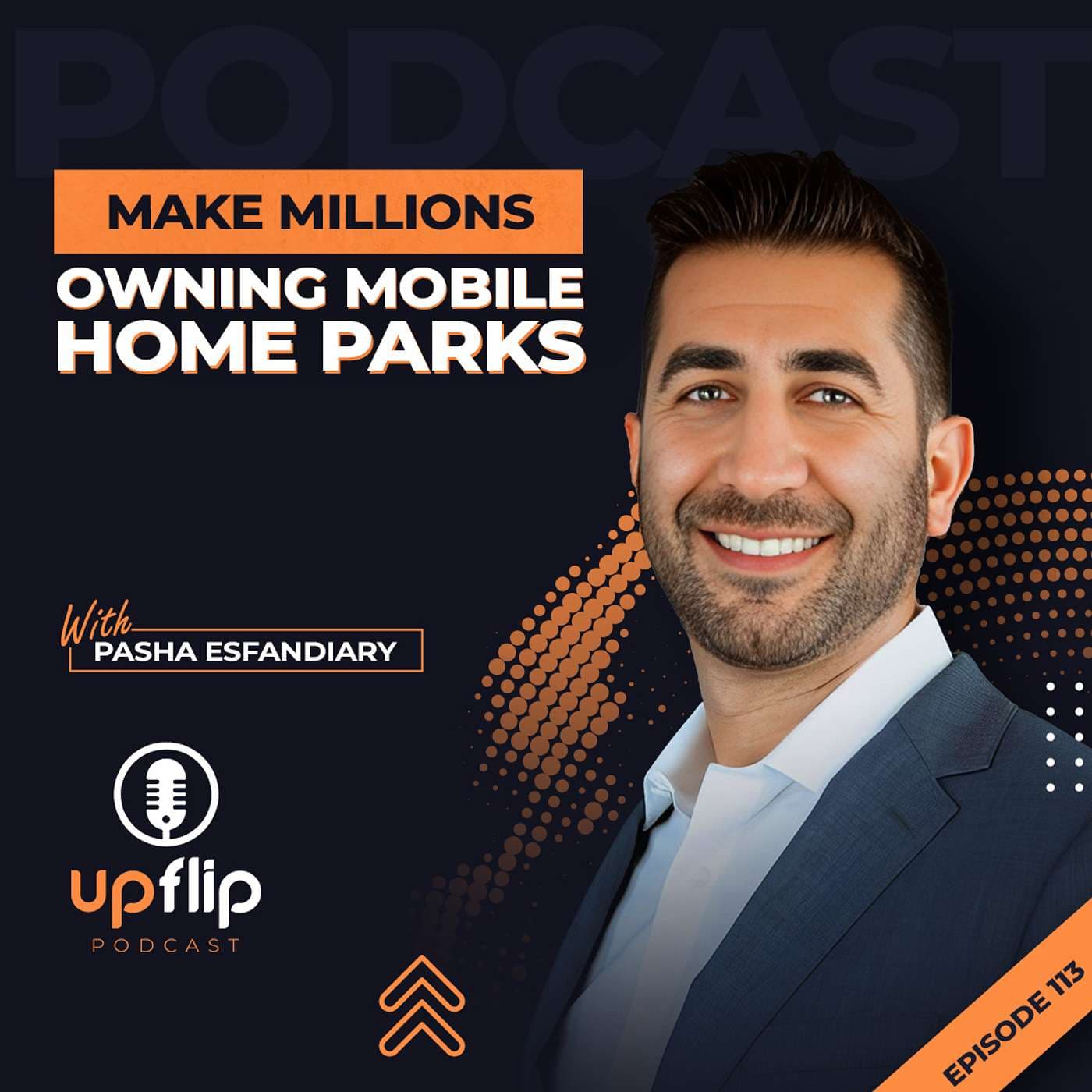
The UpFlip Podcast Episode 113: Less-Known Real Estate Investing Strategy Making $6M/Month
Episode Overview In this episode of The UpFlip Podcast, host Alex Freeman interviews Pasha Esfandiary, a former professional poker player who transitioned into real estate investing. Pasha shares insights about his company, Evoke Capital, which focuses on mobile home park investments. The discussion revolves around the lucrative potential of mobile home parks, strategies for success, and the unique challenges of this niche market.
Key Themes & Insights
- Background of Pasha Esfandiary
- Transitioned from professional poker to real estate investing.
- Started in real estate in 2021 with Evoke Capital.
- Driven by a desire to honor his father's sacrifices and achieve financial independence.
- The Untapped Market of Mobile Home Parks
- Mobile home parks are described as an "untapped goldmine" for investors.
- Evoke Capital has rapidly grown to manage over 1,800 units with revenues of $5-6 million/month.
- The market offers low mortgage delinquency rates and high cash flow potential.
- Investment Strategies
- Pasha emphasizes the importance of cash flow and velocity of capital.
- Comparison between mobile home parks and other sectors like multifamily homes shows higher returns in mobile home parks.
- Focus on buying from "mom and pop" sellers who may not manage properties effectively.
- Identifying Opportunities
- Importance of evaluating the condition of homes and the operational setup of parks.
- Key metrics to consider include:
- Occupancy rates.
- Ratio of tenant-owned vs park-owned homes.
- Utility systems in place.
- Challenges in Mobile Home Park Investments
- Overcoming negative perceptions surrounding mobile home park tenants.
- Navigating potential operational challenges, including tenant issues and maintenance of older homes.
- Learning from initial mistakes, such as trusting unreliable banks or local authorities for expansion approvals.
- Scaling Evoke Capital
- Transitioning from a small team to managing a larger operation with many employees.
- Focus on establishing clear roles within the organization, including operations, finance, and investor relations.
- Importance of creating a positive company culture and addressing employee needs effectively.
- Investor Relations and Returns
- Evoke Capital aims for an internal rate of return (IRR) around 18%, offering cash flows and potential distributions.
- Commitment to ensuring investors receive their initial capital back before profits are taken by the company.
- Advice for Aspiring Investors
- Importance of education and partnering with experienced individuals.
- Encouragement to start small and grow organically within the industry.
- Necessity of being conservative in financial projections and understanding one's investment goals.
Resources Mentioned
- [7 Steps to $100K/Month](https://www.upflip.com/blog/how-to-invest-in-real-estate)
- [Join UpFlip Academy](https://bit.ly/3C21eGL)
- [Evoke Capital](https://www.evokecapital.net/)
Conclusion This episode of The UpFlip Podcast emphasizes the viability of mobile home parks as an investment strategy. Pasha Esfandiary's journey exemplifies how personal motivation and market understanding can lead to substantial success in a niche often overlooked by traditional investors. The conversation reinforces the importance of education, careful analysis, and community focus in building a sustainable business.
Written by AI. May contain mistakes. Listen to the episode to check what was said.
Transcript
Automatic transcript. May contain errors.0:00Mobile home parks are an untapped goldmine for real estate investors. and Evoke Capital's fast growth is proof. In under two years, they've built a portfolio with a total value of over$75 million, and they're just getting started. This is Alex Freeman, and you're listening to the Upflip Podcast, where we uncover how great businesses are built, how they're run behind the scenes, and how you can replicate their success. Each week, I talk to entrepreneurs who share how they built and scaled their business. I'll start with their background and expertise, then ask FanBlitz questions directly from our YouTube community.
0:31Every episode ends with my takeaways ways that you do not want to miss, along with a business section where we share helpful resources. Today, I'm talking to Pasha Esfandieri, a poker pro turned real estate investor who started Evoke Capital in 2021. His company has quickly become a leading firm for mobile home park investment with a 100 % investor satisfaction rate and an emphasis on community that makes their parks great places to live. We'll find out what drew Pasha to this niche, how he's built his impressive portfolio, and his tips for other investors who want to put their funds into affordable housing.
1:01Hasha, welcome to the show. Thank you so much. I'm super excited about being on this show with you, Alex. I'm curious where your entrepreneurial spirit comes from. Like, where did you kind of want to go down that entrepreneurial road? I think it was that necessity. I could never work for another person. It was really difficult for me. And I always had this really budding drive when I was younger because my father had to move from Iran and essentially move by himself with me and my brother to America growing up. He never talked about it, but growing up, we always heard what he sacrificed for us.
1:37I mean, my mom stayed over there in Iran. She couldn't move to the US. My dad was incredibly successful in Iran. I mean, he had a warehouse, he had social clout, he had everything and he literally gave up everything to start fresh in America with his two kids. And he had to work odd jobs. And so I think somewhere along the lines, and I think both my brother and I came to this conclusion of like, we have to do this to make dad proud. And I think that's the drive. And I always just had this feeling, this internal drive, even when I was younger, like I'm going to make it. Like I'm going to make something of myself.
2:13And I never want to see my dad struggle for money again, because I understood what he had to sacrifice for us. That's a really, really powerful motivator. Thank you for sharing that with us. Of course. You know, it's funny because I still today, anytime I take down any deal, I call my dad first. And I probably got into real estate because of my dad growing up, he was always like, oh, I should have bought that house. It was 50 ,000 at the time. Oh, I should have bought that land. I was thinking about it, but he couldn't do it. He couldn't pull the trigger on any of them. And I think I just adopted that.
2:46And now my dad is still like, hey, what's your unit count? Hey, how much are you making in cash flows? Hey, how are you doing? He's just, and it just lights up my world. And so it's pretty amazing. Tell us what Evoke Capital does and when and why you started it. Sure. Yeah. In a nutshell, you know, I've been in real estate investing for about 13 years. I played professional poker before that. And real estate was always my end game. And it was one thing after another. I started the traditional route of, you know, flipping homes. And then I went to, you know, development and multifamily. And Evo Capital really started because I found an opportunity in the mobile home park space that, in my opinion, felt very untapped.
3:23I'm still buying from mom and pop sellers. And what really transitioned is I bought a few deals with me and my partners. And then we decided, well, we don't want to turn off deal flow. And why don't we get investors to come and kind of get the returns that we're getting? not really knowing that Evo Capital was going to become the size that it is now and how fast we grew. It's just one of those organically built companies that were, hey, we had a problem, let's tackle it and let's keep growing. And so the biggest piece of feedback I get now is the people who've invested with us on our first few deals.
3:57They're like, wow, I've never invested in a real estate deals because it was basically just friends and family. This is amazing. I love this. I love them seeing that their money is working for them and something that I'm passionate about. And that's how Evo Capital started. It was never this grand plan. It's just like, well, there's an opportunity here and we don't want to miss it. Because I do think that within five to seven years, Alex, this opportunity that we have and the properties that we have and the niche down what we go after won't be around in five to seven years. And I hope I'm wrong, but I just don't think it will be.
4:28Why do you think it won't be around in five to seven years? What's happening in the space that makes you think the opportunity will go away. I think I have to compare it to when the market was super hot, let's say in 2021, and cap rates were super compressed, and everyone from multifamily was looking for edge and equity elsewhere. What really happened was that a flood of people went into the mobile home park community space because they saw that we had better yields, we had better returns. And so just like myself in my own journey, I started educating myself on it. And right now, what we buy is truly properties for mom and pop sellers.
5:02And the thing is, is our other competition that are buying these properties are other operators like myself. So when the operators go in there and do what they need to do and build the equity and build the juice in there, they're going to go ahead and sell it, but they've already sucked out all the juice. And so this is why I have a ton of urgency on this for these, because I do think in five to seven years, all the properties that we are going to see are going to be skewed, I would say, 75, 80 % of other operators who have already taken the juice out. And then it will, I think, have a remnant of what the multifamily and apartment kind of realm looks like at this point.
5:40That makes a lot of sense. And I think that your background as a poker player definitely, I think, leans into that, okay, great, here's the opportunity right now. We now need to take the big swing to take advantage of it. How did you get that start in real estate? You know, what were you focusing on when you first got started? Yeah. So, you know, it was interesting because at that time, I'm still playing poker. I'm getting a little bit older, around that 26-year age, and I'm playing poker. And I'm just like, this can't be my life. I don't want this lifestyle to be my life. Now, granted, that's a very difficult pill to swallow when I was doing very well for myself, let's just say.
6:17And to realize that I had to take a step backwards to then launch forwards. And so, So what I did in that, I said, okay, well, I really have these really high aspirations. Is poker and this lifestyle for the next 10 years be the lifestyle that I want? And I said, no, absolutely not. This is not for me. I want a family. I don't want to stay up late at night. And all of the things of playing poker into the wee hours of the morning brings you in the bad eating and all that. And I said, let me take a step backwards. And I went and interned from a mentor of mine. He's still my mentor today for three months on just how to flip homes.
6:49And so this was, you know, kind of recent after the Great Recession. So a lot of good properties to buy from the auction. So I was buying auction sight unseen. And that's what happened. I knew where I wanted to be 10 years from now. And I had to make the decision of what is the fastest way to that trajectory. And sometimes that's taking a few steps back, perceived, right, from poker and not making as much as I was, which is okay. It's contest time. Listeners, we have an exciting announcement and giveaway to share with you. In April, the UpFlip membership site is launching, which will provide members with access to courses on everything from starting a vending machine business to running your own Google ads and everything in between.
7:30One lucky winner of our contest will receive free lifetime access to the site. You heard that right, free lifetime access to the site, where we'll be adding new content frequently. If you'd like to participate, please click the link in the show notes. The winner will be announced on March 18th. How much capital did you have to get started in real estate? Because obviously, when we think about real estate, a lot of us think of it as a very capital intensive industry. So I took essentially what I had of my bankroll, which was a little bit under six figures. I think it was around 80 to 85. And I ended up buying my first home.
8:07It was actually a mobile home in a mobile home park. Actually, it was in a 55 and over community. And I had skipped over that little fact. And when I bought it from the auction, they're like, you can't own this. I'm So like, you have to be 55 and older. I don't know what to tell you, but I will sell it to someone who's 55 and older. And they were okay with that. And that's how I started. I made every wrong decision that you could. I got emotional. The things that I thought were I needed to do, I didn't do like, I didn't do the kitchens, but I scraped off the popcorn ceilings. Nonetheless, I still bought it correctly and I made$3 ,000 from that.
8:43And, you know, it's interesting because when you are used to bluffing that amount, but you made that after, you know, two months of at that time hard work, then you would probably try to say like, oh, I mean, that's not a lot, but I got the itch. I mean, Alex, I just was like, this is it for me. I love this. And that's what happened. I just, and then I started getting my hands on more properties from the auctions. And then I started JVing and I started to just expand my operations. And I started just really rolling over any profit into my homes that I was flipping. And luckily my wife at the time was working a good job.
9:17And so I was just focused on snowballing our capital. Now, Pasha, I want to ask about mobile homes, because I know for myself, it's not what my mind has thought of in my own real estate investing. I don't have any mobile home parks in my real estate portfolio. Why mobile home parks for Evoke? I mean, this is a loaded question. There's so many reasons. So I think one philosophy I have to really bring home is that I only buy no brainers. And what I mean by that is it has to go with your investment thesis. My investment thesis is I love cashflow. I'm a big cashflow investor. And secondly, how fast can I turn my money around the velocity of capital?
9:51How fast can I recycle and get my hands on other properties to let time do the work? So in mobile home parks, what I realized is that I'm getting higher IRRs and rate of returns than I would in multifamily, first of all. That was number one. Second of all, in multifamily, and I'm just generalizing here, I think every deal is different. Cash flow in year one is probably around that 4%, right? And then it steadily grows. And in mobile home parks, we're finding cash flows at 7 % to 8 % and double digits in year two. So already there, perfect. Secondly, I love consistency. And then when I learned this stat, 50 % of all mobile home park tenants have lived in that same park and same home for over 14 years.
10:32That just screams consistent cash flow for me. Then you learn the non-transitory aspects of mobile home parks. Now, yes, technically they can move the homes, but in practice in the markets that we're dealing with, no one really moves the home. They leave it there and no one really moves. Then the delinquency in mortgages for mobile home parks are the lowest of any real estate sector there is. You can couple all of these with the fact that I'm still buying from mom and pop sellers who are really badly managing these parks. And so it doesn't take a huge heavy lift. And then the last thing is that we get double the bonus depreciation than we do in multifamily.
11:08And so when I learned that as well, I just said, this is a no-brainer and I have to learn about it. Now, mobile home parks do present different challenges than multifamily. Some of the tenants are rougher. Some of the parks are, you know, we bought it from the definition of slumlords and you have to put a lot of capex into there. There's a lot of heavy operational work, but I truly do believe kind of going back to the game selection is that you could just find the right niche and do the hard work up front to get rewarded on the back end for it. And that's why I picked mobile home park because it's a no-brainer on all facets for me.
11:45With all that in mind, then, how are you going about spotting opportunities? How are you noticing the difference between what might be a good mobile home park for you to come in that you can return versus something that is maybe on the surface to the outside or looks like the same opportunity, but for some reason isn't? How are you identifying the right opportunity? There's two things here. And I want to point to the last part of your question is that what is isn't an opportunity that I think sometimes masked is an opportunity from brokers is that, you know, a lot of people in the mobile home park space, especially other operators, and I don't want to generalize everyone.
12:16I just know that operators get in trouble when they have a large infill play. Infill being there's a vacant lot and there's no home on them and they think they're going to bring in a new home and then sell it off. I just was having this conversation earlier today. The difficulty with that is that yes, the demand is crazy. The demand is there for that home. People want low-income housing. It's just not that everybody qualifies for those homes. And that's the hard part, getting tenants to walk them over the finish line for that. So infill plays are very sexy when you do a pro forma. It's like the sexiest part of any mobile home park operators pro forma is that value add play, but it's also the most difficult play.
12:56So you got to be really, really careful on what ratios you keep for infill and non-infill. Secondly, people will go in and find that there's a difference between tenant-owned homes and park-owned homes. So POH is being park owned homes. You can get in there and the cash-on-cash numbers can come out astronomical, but now you're running it like an apartment complex. You're responsible for every plumbing issue, every roof that comes down and everything like that. So I think people get enticed by really high cash flows and a price for that and say, wow, this can't be real. But then once they get in there and they buy these parks, they're like, oh crap, this is a lot more maintenance than I thought.
13:36And then secondly, someone who doesn't know about mobile home parks might see, oh, they're just homes there. That's fine. What we look at is what year are those homes? Are they 90s and above or are they 90s and below? If they're 90s and below, you probably don't have a long shelf life for those homes. And so we have to demo a lot of homes and tear them down and take them out. So it just really causes it of that a year built of the homes. If you are looking for just your cookie cutter property, I would always say start off small and grow into your problems organically. And so when you look at a park, you should look for high occupancy and a lot of tenant owned homes and try to have park owned home aspect be 20 % of the whole park.
14:25That way you won't be dealing with a lot of maintenance. And then lastly is look for city utility and waters. I mean, you might see a mobile home park with like a lagoon system or a well water system. And those things can be just operational nightmares and always be breaking down on you. So be really, really careful of what you're getting yourself into. There's a lot of landmines in mobile home parks that you can step into. I think that one of the things that a lot of investors have, fairly or unfairly, about mobile home parks is this kind of perception of poverty of the residents that you're dealing with.
14:55But what do you find that people who live in mobile home parks want out of their environment? And how are you making sure that your residents get that? Yeah, and it's true. I mean, you know, it's funny when I say that we're in mobile home parks, they immediately sink, you know, the scenes from the movie Eight Mile or everything that's been projected onto, you know, any movie, you know, they make it sound and seem really bad. But once you get in there, you really realize that it's blue-collared workers who are just trying to get by, who are wanting lower affordable housing than what's available everywhere else, right?
15:27And so what we do at Evo Capital is that we always will go in there, we'll always fix up the streets, We'll always fix up the lighting for the nighttime, the signage. We will put our tenants first. We have a value that our first value, our core, super core value is people first. And so I always will drill that I don't care what income bracket you're in. You got to treat our tenants like gold. And when you do that, they will then treat you like gold and your property like gold. And we clean up bad tenants, man. You know, they're putting trash out and they're making the property look bad. We will make sure that they remove that.
16:01And we do, because of the states that we buy in, have the power to move them out if they're a troubled tenant. And so time and time again, we naturally will get bad tenants out, which can be drug dealers, prostitutes, all the things that you don't want your children to grow up around. And our tenants thank us. And secondly, we have a human element to it. Mobile home park industry gets a bad rap sometimes because there are operators who catch themselves into the news, who will go and find a park and increase the rents by 100 % in day one. I mean, those are just predatorial operators. And because you technically are able to do that, when it comes to money, there are unfortunately people who will just take advantage of what it's given to them without adding in the human element of like, you know, you should be able to sleep tonight.
16:48And I think there's enough wealth generation here for it to go around without you really hurting your tenants. So that's something I wanted to really make sure to point out. I know Evoke hasn't been around for too, too long, but any mistakes in the early days of the business that you wish you maybe had done something differently or that you learned from? I mean, there was a few times that we put a lot of faith into regional banks. And at the last minute, they pulled the cord on us for the shifting of the time. So now we just work with a more conservative bank and they're always do what they say.
17:21There was also a part in Pennsylvania that we bought that we contacted the lawyer, made sure that we could expand out the park. We even went to the city and asked them, hey, can we expand the park by 13 lots? And they said, yes, no problem. Only for when we got in there, the Bureau was like, no, absolutely not. Then they're protesting it left and right. So they've made it really, really difficult for us to expand. So that was a learning lesson on who we trust with information, especially when we're doing something like that. Again, You should never get a deal where things have to go right for it to work.
18:00Look for your base case, your average case, and your highest best case. That portfolio is still doing really well because it was a part of a three-pack portfolio that we bought. But that was something that was like a kick to the stomach. Oh, man, we said we're going to be able to do this and we couldn't do it. So that kind of hurt. This is going to bring us to a section of our show that we call our Fan Blitz Questions. These questions come from our YouTube community. listeners you can head to youtube.com slash upflip and post questions to future podcast guests i've got like five ish questions here are you ready okay yep all right first one here from abdul myhamin six one six five five how can i start this business in the initial stages number one thing is education secondly get a partner that's gonna help do the things that you don't want to do and grow organically i find a lot of business owners try to say oh oh, I'm creating a business.
18:52I'm going to do all of these things. I have to have all these things figured out. Grow organically, grow into your problems. And that's the greatest thing about entrepreneurship is that a problem will come to you and then you have to solve it and let that happen naturally instead of trying to take on more than you could show. The follow-up there being, how does somebody get started owning mobile home parks without a lot of liquid cash? If I were you, I would get really, really good at underwriting and get really, really knowledgeable in the mobile home park industry. And I'm going to go with my belief, if you find a good deal, do all the legwork, get the elbow sweat in there.
19:28And then if you find the deal, you will find the money because there is plenty of money and plenty of capital out there that's willing to invest in mobile home parks. If you have the intelligence, you have the education, and you know exactly what you're talking about, and they feel that, you will find the money, I promise. If there was a movie made about your journey, what would the title be? What was it? Title B? Oh, man. I would say if I could do it, anyone can or made it or something like that. I mean, I think my life has been such a journey. And there was moments in my life where I just could have never conceived to be where I'm at now.
20:04I mean, on all aspects, health, family, my kids, my wife, and the business and just kind of the friend groups that I have. So something to that aspect of it. And this last one here from Dak Janiels. Any relation to Antonio as Fondieri? Yes, that is my brother. He is the one who got me into poker indirectly because when I was younger and I was wondering what I was going to do, my brother had just won a tournament and I had been playing poker here and there and doing good in my home games. I was like, well, crap, if he could win this tournament. And at the time, he won a$1.4 million tournament right as in like 2004, when poker was becoming really popular.
20:40And I said, well, crap, if he could do it, I could do it. And that's what got me into it. Yeah, but that is my brother. Yes. He's my older brother by five years. That's going to do it for the fan blitz questions. Before we continue with the interview, I want to take a quick second to remind all of our listeners to rate, review, and share this episode if you're learning something from it. Ratings and reviews help us grow our audience so we can keep bringing entrepreneurs this valuable knowledge. We're grateful for the support of all of our listeners. What are some of those challenges that have come with scaling the business?
21:09When we first started going down this route, it was just me and a couple guys who were just buying these properties. And we know this is a great property. And we brought a few investors along. And it started to grow into this thing where we kept taking down these deals. And out of nowhere, we look around and we're like, wow, we have 20 full-time employees and we have lots of different relationships and personalities to manage. And it's like, oh, wow, you know what? And one thing that I do, there's this book called It's Your Ship. And I forgot who the author was, but taught me a lot about management and just asking your employees, what do they need?
21:42And I really kind of got it ingrained it to me when I was young, even when I read this book, probably like 10 years ago about a CEO's position or somebody who's growing a business is just to make their life easier for the employees. And that's it. And so the challenges of that, creating systems and learning how to create systems and how to manage and make sure culture is very prevalent and good and keeping talent and recruiting, all of these things, just learning. And so you're never going to please everybody. And I think that's the hardest thing for me is that I'm never going to make everybody inside of my company happy because we do have a pretty high standard of what we need to get done and whatnot.
22:23And then the hardest part is always the firings. I just had to fire someone that was really close to me. Not fire, sorry, to let go because the position, we don't need that position anymore. And we really unfortunately don't have a position anywhere else. And that hurt. That sucks. How do you keep the team running as the well-oiled machine? How are you assessing the needs? How do you make the assessment that, oh, we no longer need this position? I think it's always just a cost analysis and to understand what we really truly need for it. So for example, we needed to beef out our sales department and we need to revamp it.
22:58We need to rethink it. And so what we were doing previously is we would just have some certain admins to kind of help out with sales and whatnot. And we really realized like, hey, this needs to be a main focus. That really stems from what is your vision for that year? What is your vision and goals for 10 years? What do you need to do to accomplish your goals? And then you can work yourself backwards. So in this case, we knew that we had to really bring somebody on to build out a whole sales department. But that means this kind of hybrid role that was not as busy really isn't needed anymore. And that person really isn't good at sales.
23:33And so you have to make the decisions from the future backwards. And that's what we did. And that's how we do it. What are those key members on the team right now? Like if someone is saying, I'm going to start a firm, I'm going to structure it out. What are the roles that they should have in place? Yeah, I think that's a great question. I think there's three really big divisions within our company. One is the operations, which is the biggest component of our whole operation. That's evoke management. And then we have evoke capital, which has the financial department, which is basically the acquisitions to underwriting and all that.
Read the full transcript
24:06And then there's investor relations, raising up the capital and making sure all of your customers being the investors are happy and they're getting regular touch points and you're communicating with them. The operational department is pretty massive. And within that, there's multiple layers. For example, you have the sales department, the infill department, the construction department, and then you have the regional manager who then managed all the property managers. And then we have an admin department also who handles all the backend paperwork and lease-ups and making sure there's the rent increases and all the stuff that goes in the back of that works.
24:43And then in the financial department, there's also the controller who handles all the taxes and all that. So it's pretty well built out. And I'm sure there's going to be other ones that we're going to have to build up. But that's our operation right now. If someone who's starting, I would just say, hey, what are you good at? Me? I'm good with people. I'm good at vision. I'm good at opportunities and broker outreach and all that. And then I found a partner who was really good at the operations, who knew how to make these properties run efficiently and to build equity into them. And I could not be where I'm at without my partners.
25:14And I'd hope they would say that about me as well. What do the typical revenue numbers look like for Evoke Capital? And what are the kind of profit margins on that? Right. So we work off of IRRs, which is internal rate of returns. and I want to give a caveat that we pro forma this on a 10-year sales scenario, even though our strategy is to keep the properties forever, but we really can't pro forma and understand what the market's going to give us 11, 15, 17 years from now. So we only just do it on a 10-year basis to show investors how much money they would make. So typically what we're projecting is about an 18 % return on their money.
25:53That's including cash flows and distributions and the refi that we do in year five. Year five, we always return back 100 % of initial capital. That's how we underwrite. That is our basis. That means we're able to build enough equity into the deal to make all of our investors whole again. We actually even structure our fund where we don't even touch anything. We don't touch a dollar until they're paid back 100 % in full. Because again, we're really investor focused and me and my partners are the largest investors in this. So we invest alongside with the LPs. And with that, it's about an 18 % return.
26:24We're typically able to beat that, but that's a pretty good return when you kind of evaluate that compared to, let's say, the easy hanging fruit is the stock market, which is about 7-8%. And with that, you get cash flows coming in every single year and in perpetuity as well. I mean, I have a sense of what your answer to this one might be then, but if you could pick the one thing that listeners would take away from this interview, what would it be? Yeah, just be really conservative
26:50in your numbers. I mean, really, at the end of the day, be super, super conservative. And I really try to say this time and time again, is really understand where you want to go in your investment career, because it will guide you from shiny object syndrome and will really guide you to your North Star of where you want to go. And I see too many people in their investing career say, oh my God, that's a good deal. I'm going to go do that only to realize years down the line, like, ah, maybe that really kind of align with what my vision was for how I wanted to live and invest. Pasha, where can people connect with you, learn more about what you and Evoke Capital are up to?
27:26Yeah. You can just go to my website, www.evokecapital.net, or you can shoot me an email at Pasha at evokecapital.net, and I will respond back to you. What I really loved about talking with Pasha was not just wrapped up in our poker conversation, but throughout his conversation about building his business and this entrepreneurial aspect of trust your gut, but back it up with numbers. He preaches conservatism, which seems weird from somebody who used to gamble large sums of money. But I think that understanding of, okay, my gut says this, but does the math back me up is so important for so many people as they dive into a business that you got to trust that gut, but you got to make sure that the numbers are there for you as well.
28:09Listeners, you can find more advice for how to start a business the right way on the Upflip Hub or listen to episode 96 of the Upflip podcast to hear how Andrew Freed built a$10 million real estate business on the side while still working his full-time job. I'm Alex Freeman. This is the Upflip podcast. We'll see you next time. Pache Sfandieri of Evo Capital, thank you so much for joining us. Alex, I appreciate being on here, man. Thank you so much.
28:36you
From the publisher
Mobile home parks can be a gold mine, as Pasha Esfandiary quickly discovered. He left his professional poker lifestyle and began purchasing parks across the country. Owning mobile home parks doesn’t sound glamorous, but it’s one of the most lucrative investment properties, with the lowest rate of mortgage delinquency in any real estate sector out there. For investors, this is a golden opportunity to purchase poorly managed properties and to turn them around. Bettering the community and your portfolio all at the same time.
Pasha’s company, Evoke Capital currently manages over 1800 units and brings in $5-6M/month. In this episode he shares his expert insights on what to look for in a mobile home park, what pitfalls to avoid, and how you can begin with very little upfront capital.
Resources:
- 7 Steps to $100K/Month - https://www.upflip.com/blog/how-to-invest-in-real-estate
- Join UpFlip Academy- https://bit.ly/3C21eGL
- Evoke Capital - https://www.evokecapital.net/
Ready to be your own boss without starting from scratch? Grab our FREE Franchise Guide and unlock the secrets of proven business models that have already created thousands of success stories.
Connect with UpFlip:
- On Youtube
- On Instagram
- On Facebook
- @UpFlipOfficial on Twitter
For more insights to start, build, or grow a business, check out the resources on UpFlip.com or head to the UpFlip YouTube channel to see more interviews with business owners and experts.
Thanks for listening!


