
In short
```markdown
The UpFlip Podcast - Episode 116
From Broke to $130K/Month Marketing Agency Owner
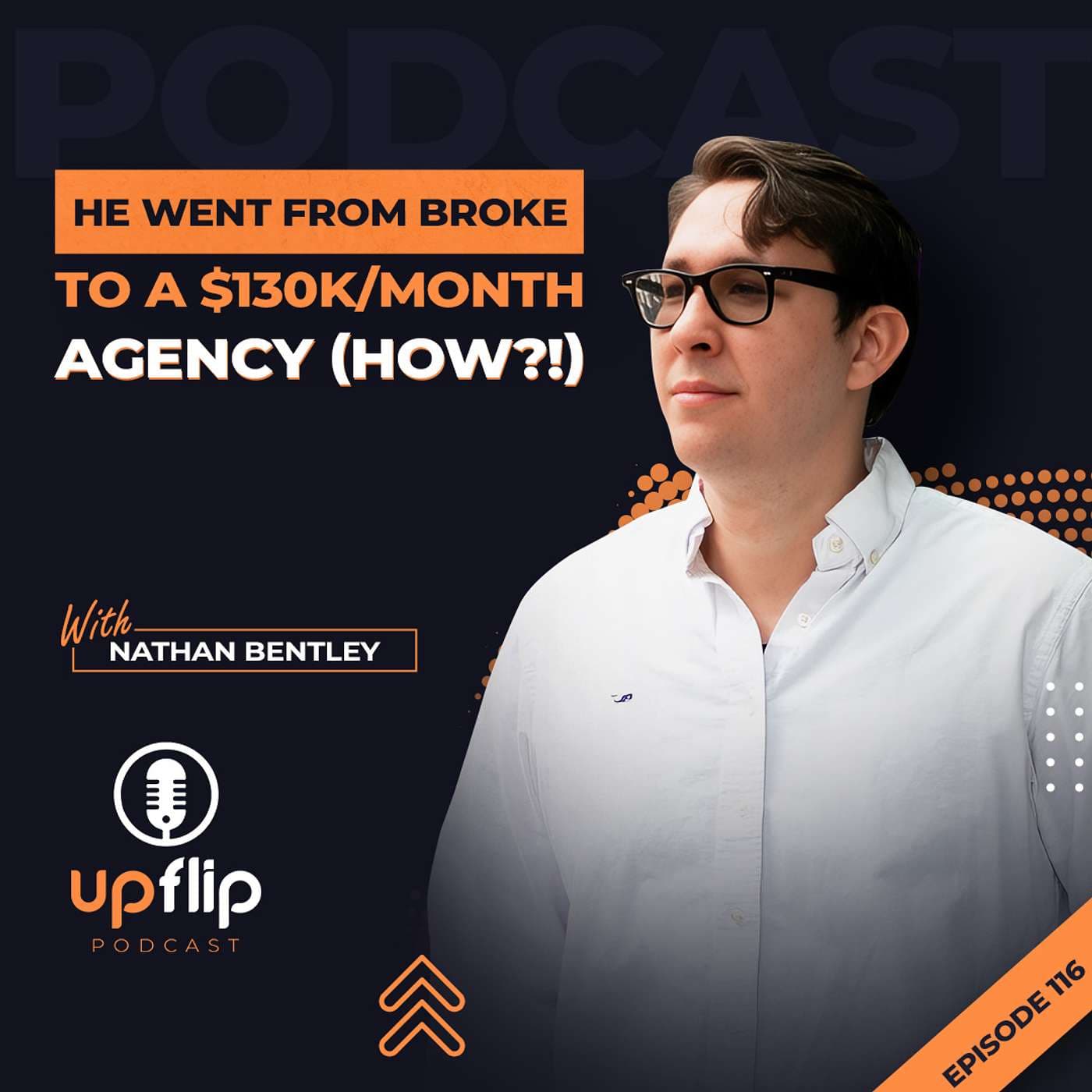
Episode Overview In this episode, host Alex Freeman interviews Nathan Bentley, the founder of Practice PhD, a digital marketing agency focused on chiropractic clinics. Nathan shares his journey from being a physical therapist to successfully running an agency that generates $130,000 a month. The discussion revolves around the challenges and strategies of digital marketing, particularly in the healthcare sector.
Key Themes and Discussions
Nathan Bentley's Background
- Transition from Physical Therapy to Marketing:
- Worked in a clinic while in medical school.
- Faced personal loss due to COVID-19 when his mentor passed away.
- Initially assisted a chiropractor with poor marketing results, generating $40,000 in leads in his first month.
Learning and Skill Development
- Self-Education:
- Gained expertise through free online resources, including YouTube, and completed digital marketing certifications.
- Emphasizes the benefit of finding mentors or teachers once financially stable.
Common Marketing Mistakes
- Neglecting Marketing:
- Many healthcare professionals focus on service delivery rather than marketing.
- This imbalance leads to poor patient acquisition and retention.
- Tech Savviness:
- Not all professionals possess the necessary technical skills, making partnerships with agencies critical.
Marketing Strategies for New Businesses
- Client Acquisition:
- New businesses should prioritize marketing and client acquisition over other operational aspects.
- Recommendation: Use Facebook ads as a primary tool for immediate lead generation.
- Ad Spend:
- Suggests spending a substantial portion (up to 30%) of revenue on advertising, emphasizing the importance of measuring return on investment (ROI).
- Educates that successful businesses often see returns of $3-$5 for every dollar spent on ads.
Platform-Specific Insights
- Facebook Ads:
- Considered the most effective platform due to low costs and high returns.
- TikTok Ads:
- While cheaper, they may yield lower-quality leads, particularly for local businesses.
Email Marketing
- Integration with Ads:
- Email marketing remains a crucial tool for client engagement, with 16% of booked calls stemming from email campaigns.
- Encourages leveraging AI tools like ChatGPT for generating email content and organizing marketing efforts.
Metrics and Data-Driven Decisions
- Key Performance Indicators (KPIs):
- Cost per lead, cost per booked call, and cost per acquisition are critical metrics monitored for evaluating marketing efficacy.
Team and Operations
- Agency Structure:
- Nathan's agency consists of about 16 employees, primarily overseas, allowing for high-profit margins.
- The team includes sales closers, client success managers, and a call center team.
Unique Marketing Tactics
- Catch Opportunities:
- Discusses creative strategies such as leveraging platform glitches to maximize ad performance.
Takeaways
- Vending Machine Analogy:
- Emphasizes the need to invest in advertising that yields a profitable return, akin to feeding a vending machine.
- Niche Market Identification:
- Highlights the importance of defining and targeting a specific customer archetype for effective marketing.
- Action Over Procrastination:
- Encourages listeners to take risks and implement learnings from discussions and research into actionable business steps.
Connect with Nathan Bentley
- Instagram: [Nathan R. Bentley](https://www.instagram.com/nathanrbentley)
- Practice PhD: [PracticePhD.com](https://practicephd.com)
Resources
- [UpFlip Academy](https://bit.ly/4hg4G0)
- [Waste No Day Podcast](https://open.spotify.com/show/7HJADE1rsh26RC79kUnewR)
---
For more insights into starting, building, or growing your business, visit [UpFlip.com](https://www.upflip.com) or check out other episodes of the UpFlip Podcast. ```
Written by AI. May contain mistakes. Listen to the episode to check what was said.
Transcript
Automatic transcript. May contain errors.0:00Running social media ads can feel like a gamble. In fact, over three quarters of advertisers lose money on their campaigns. Shocking, right? But those who've unlocked the code to successful ads can get over 10x return from their ads. And today, we'll catch a glimpse of how it's done. This is Alex Freeman, and you're listening to the Upflip Podcast, where we uncover how great businesses are built, how they're run behind the scenes, and how you can replicate their success. My guest today is Nathan Bentley, the founder of Practice PhD. He's an expert in digital marketing for chiropractic clinics on a mission to connect patients with the healthcare services they need to live life to the fullest.
0:39Nathan went from being a physical therapist in a small clinic to running an agency making$130 ,000 in a single month. In this episode, I'll find out which social media platform he thinks is the best for marketing in 2024, along with his tips and strategies to maximize the value of digital marketing across all platforms. Nathan, welcome to the show. I'm excited to be here, Alex, man. Great podcast. Awesome, awesome. So to get things started, can you kind of give us the overview of what you were doing before you started Practice PhD and how that ultimately led to you starting the business? Yeah, absolutely.
1:14I think I had a little bit of an interesting start. A lot of people might see, especially in the marketing agency space, they might see like a Tai Lopez kind of course online and that's how they get started in social media marketing. But my start was a little bit different. I wanted to be a doctor. So I was working in clinic while I was in medical school. And while I was in clinic, I did everything for them. I handled x-rays, treated patients, did all the treatments in the office. And then COVID happened. And unfortunately, the mentor of mine, who was the owner of the clinic, ended up getting COVID.
1:48And unfortunately, he passed away. Oh, wow. Yeah, it was pretty crazy. And at the same time, his cousin came to me who was a chiropractor. and he's like, Nathan, I'm working with this marketing agency. They're dropping the ball. They don't know really what they're doing. They're getting me leads all over the place. I know you haven't done marketing before, but you're a smart guy. Can you take a look at it? I was like, sure. And then in the first month of ever running any ads before, I was able to generate him$40 ,000. So I was like, wow. Wow. Either I'm a super genius at this or these other guys kind of suck.
2:20Maybe a little column A, a little column B. Yeah, maybe a little bit of both. How do you go about gaining those skills? Because obviously when you meet somebody who has built a life that kind of came out of that young entrepreneurial spirit where they were trying to really find any way they could, especially early in life, I find that they become really good at skill building really quickly. And so I'm just curious how you did that with digital marketing. Like where did you turn to build that skill really quickly? Yeah, absolutely. So, you know, I got my marketing degree from YouTube University, essentially, and, you know, grinded through quite a bit of YouTube videos.
2:54When I started out, I didn't have access to capital to invest in coaching, consulting, et cetera, that I do now. But starting off, I ripped through pretty much every free resource I could find. And I just spent an overwhelming amount of time locking in and really focusing on learning one skill set. So I did all the certifications that I could see online. You know, there were some free certifications and courses you could take around digital marketing, Google ads, Facebook ads, and some of the different advertising platforms. So I went in all in on those. A little bit of it was trial and error, like actually doing the thing.
3:28But it was just, you know, when you're learning a new skill set, when I was starting from zero, I had to do all the free resources. Now that I have access to capital, my recommendation is if you can find somebody that knows the skill that you're trying to learn and then pay them to teach you is always the easiest way to get a jumpstart and a high level overview. What are some of those like primary mistakes that you see businesses, whether in the healthcare space or not, doing when they're trying to market their business and maybe what should they be doing instead? I think that, you know, marketing and sales are probably the two most important components of any business.
4:04And if you spend 90, 95 % of your time actually on the fulfillment side of things and delivering on the service and only 5 % of the time, you know, generating new consistent flow of new patients, customers, sales, et cetera. It's a really important switch that needs to take place and having that balance because most doctors are very ethical and they just want to treat people. They didn't want to focus on the back end of the business, marketing, Facebook ads, SEO, et cetera. So most of the mistakes that they make is one, it's very hard to learn these skills. It takes a lot of time. I got lucky right in the beginning.
4:38I was blessed with certain tech savvy skills and an extreme amount of focus to learn these skills. But a lot of business owners don't have the time, energy, and effort to put into actually acquiring those skills. And I love my doctors. I love them to death, but I've seen some doctors struggle to open up Excel spreadsheet. So I know that there might be a certain lack of tech skills where there is really good technicians on the fulfillment side. So that's where a partnership with an agency that can take away some of those services for you guys and really implement quality results is super important.
5:13When they're not taught these skills, they don't really want to learn these skills. They're very difficult and high level skills to learn in the first place. And all that compounds into why they would want to hire a marketing agency versus just go out and learn the skills themselves. Listeners, we'll be right back with this conversation with Nathan after we head over into the business section of the podcast. If you're thinking about starting your own marketing agency, make sure to watch episode 164 on the UpFlip YouTube channel to find out how Eric Su invested$2 to start Single Grain, now a$14 million a year digital marketing agency.
5:48We're back with Nathan Bentley, the founder of Practice PhD. Nathan, I want to get into some more nitty gritty of marketing as we dive into it. So I guess let's start with from the healthcare space that you work in from chiropractors and their practices. Let's say someone's opened a new practice, what should they be doing from a marketing standpoint to get those first few patients in the door? I think marketing is a primary focus. When you open up a new business, a lot of people are like, oh, I need to set up with my chamber of commerce or, oh, I need to get my decor set up right and I need to paint the walls this color.
6:21But as a business owner, 90 % of your time should be focused on client acquisition or patient acquisition, sales acquisition, and essentially getting new business in. So most of the time I would focus on what the best revenue stream is for most of our doctors, which is Facebook ads. You can turn on a Facebook ads and you can immediately get a new stream of people that are interested in your products or service pretty much immediately. That's why I like advertising as compared to a social media organic route where it takes a while to build up a big following or website SEO where it takes a while to rank locally.
6:57Paid ads, you can pretty much turn them on immediately and they work that same day in terms of getting you leads that if your sales process is dialed in turn into patients walking in the door. So I feel like that's so important in starting a new business where so many different new businesses start focusing on all this other like kind of frivolous fluffy stuff that's not as important as the main driver which is revenue producing activities like marketing and sales. When a business is in that growth mode whether it's you know they just opened their doors and they're trying to get those first customers or they've been open for a while, but they want to grow, how much should they be spending on advertising?
7:37Because obviously it is a place where they could spend, you know, there's almost an unlimited number of zeros they could put at the end of the number of how much you could spend on advertising, but like what should they be looking at spending? From an advertiser's perspective, I'm going to say as much as you possibly can. That's what we try to do in our business. We spend about 30 % of our top line revenue on actual advertising. Why do we do that? Because it works. It's the best way for us to get new clients for our business. So then when we hold the frame of this is what will generate you the best clients for your business, it holds true in that aspect.
8:11So the correct answer, it varies, but essentially if you create a vending machine where you're sitting in there and you're putting$1 into a vending machine, it's producing$3 out or$4 out or$5 out. Any entrepreneur is going to sit there all day long feeding$1 bills into that machine. That's essentially what you can create with marketing and advertising is knowing, okay, if I put$1 ,000 into Facebook ads, I'm going to get$3 ,000 out. Or if I put$10 ,000, I'm going to get$30 ,000, et cetera. So you want to increase your ad spend. Once you are profitable with your ad spend, you know you're getting a good return.
8:46You want to keep accelerating and spending as much as possible until you hit that limit. You know, essentially it's maybe like a one to two X return. So, you know, at first you might spend$5 ,000 and get$50 ,000 in return. Well, then you want to push until you get about a one to two X return and really hit that cap to see what that limiting factor is. So, you know, once you get like a one to two X return, that's when you might say, okay, we're hitting the theoretical, you know, ceiling of how much we can spend in our particular area of market, et cetera. But most business owners never really get to that point.
9:20And it's a lot higher than they think. Most of our clients for local businesses, we'll start them at$1 ,500 to$3 ,000 a month. So they can see the system, they compound, they get some sales from it. And then we build up their ad spend from there. But the correct answer is as much as you possibly can. And then make data-driven decisions going forward to keep spending more on that advertising until you hit that ceiling or theoretical limit of how much you can spend in your market. We love partnering with other podcasts and we have a great one for you. Are you in the home services industry and looking to elevate your sales game?
9:53Then you need to check out the Waste No Day podcast. This powerhouse podcast is specifically designed for professionals like you, aiming to boost their sales. Each episode is packed with actionable tips, industry insights, and sales training techniques from the top salespeople and trainers in the world that are easy to understand and implement. From mastering the art of the upsell to navigating customer objections and everything in between, Waste No Day has got you covered. Tune in now to transform your approach to sales, exceed your goals, and take your business to the next level. Subscribe to Waste No Day today, wherever you get your podcasts.
10:26Or use the link in our show notes and start turning those cold estimates into huge jobs. You've mentioned Facebook, and so I'm curious if that is the best ROI platform or kind of generally speaking, what are those best platforms for ROI on ad spend? Yeah, it varies between different niches, different companies, different business types. For right now, Facebook is still number one for us. It's still number one. It's the most evergreen. We get the biggest outside returns. I personally only run ads on my business on Facebook. Why? Because we get the best returns. Google ads and TikTok ads can work in specific situations.
11:04Sometimes they can outperform Facebook, but for overall speaking, 80 to 90 % of our clients are strictly on Facebook ads with us. Why? Because they tend to get the best results. So Facebook is still number one for us. Talk to me about TikTok because I know that that also features kind of pretty heavily in what you're doing for clients. So talk to me about how TikTok factors. Yeah, I think TikTok is a really nice platform because it's new, it's fresh. Anytime there's a new advertising platform, the CPMs and the cost to get in front of people are lower. But with that, you might see particular drawbacks.
11:38So for TikTok, for example, it's a lot cheaper to get leads, but the leads might not be as quality. And it again, really depends on the niche and business that you're in. I know a lot of e-commerce businesses that are crushing it on TikTok, but for local-based businesses, for our chiropractic medical agency in particular, or tend to target a broader demographic that's a little bit older. So TikTok might not be the best platform as compared to like a Facebook or Instagram. So that's a couple of factors, but I really think it comes from market analysis and knowing where your market is at. If the market and the people that you're trying to get in front of in your ads are on a certain platform, then you absolutely should be investing in that platform and then invest in the platform that the majority of the people that you're trying to get in front of are actually on.
12:24For us right now, it's Facebook and Instagram. TikTok is awesome. One of the things that's interesting is it introduced short form style ads. So a lot of our ads that you guys might see online are short form content, TikTok style videos, that vertical videos that's like kind of short with some hyper edits in there. Those coincidentally perform really well across all ad platforms like Facebook and Instagram. But TikTok really started that of UGC and user generated ads. That was a huge trend that they started. They also do really well with influencer-based ads, you know, day in the life of here's what I'm trying or here's this cool product I found and having influencers review that.
13:02That was a big trend that TikTok really started as well too in their advertising platforms. So TikTok's really paving the way in terms of some new fresh outlooks on advertising, but overall, Facebook is still the number one that we see for our business and our results. You know, one of the things that people get skittish about around social media is the amount of time that it takes from a business owner's perspective to kind of invest that time if they're not hiring somebody to take care of it for them. Do you have any advice for a business owner who maybe isn't yet at the point where they can bring in a marketing firm to handle that work for them to make themselves better at utilizing social TikTok, both in Facebook?
13:39That's why I feel like running ads is such a powerful tool. I hate recommending this advice, but you can even start out with like boosting posts and build up from there as you learn the platforms, etc. because you might have to learn it yourself if you're tighter on funds. But the reason why I love paid ads as opposed to organic, it can take months, years to build up a localized organic following. And then anytime you post a video just naturally on your Facebook or Instagram feed, you can't control who is getting in front of that ad and who that ad is actually being shown to. But with an advertisement, you can essentially make sure that I only want this video to be seen by females from the age of 35 to 65 in a five mile radius of my clinic.
14:23And then that really helps in terms of targeting down and getting in front of your ideal client archetype. Whereas social media content is so broad, you know, you post a video on social media and it can go to India, China, Japan and get a lot of views. Whereas with ads, you can ensure that you're only getting in front of the people that you actually want to get in front of. And if you have, even$8 to$10 a day to spend on Chipotle or Chick-fil-A or whatever your meal of choice is, then you probably have enough money to start running on advertising and build that skill set, learn, make some mistakes, and figure out that process if you're tighter on a budget.
15:00That's essentially what you have to do. So obviously, the market analysis side of it, understanding your ideal customer is very important. So I do want to ask your advice on developing that persona to then run ads against? I think it's a great point. A lot of people like shockingly don't really know what their ideal client archetype is. If you don't know and you don't have a good thought, a quick way to do a test is look at where the top 20 % of your customers are. So who is the top 20 % of your customers that have the longest lifetime value, stay with you the longest, purchase the biggest amount?
15:36What demographics, what interests, what nuances do they have in common? And then you can make data-driven decisions as to who your ideal archetype is and then really honing that in. And that's so important in marketing in general because there's this big quote that if you speak to everybody, you're really speaking to nobody. So when you hone down your ideal audience and you know exactly who you're trying to get in front of, it not only makes it easier to target those because you can set up those demographics and targeting interests, but also your ad spend is going to be tremendously more effective.
16:09Your messaging, your offer, your creative is going to be much more dialed in versus running some broad interest targeting. So most of the time you can do some self-analysis of like, what is my most ideal client? If you can't figure that out, look at your top 20 % of your clients that spend the most money, have the longest LTV, and then look at their demographics, interests, et cetera, and then find some commonalities. And that's probably your ideal client archetype. Real quick, I wanted to take a moment and thank our loyal listener, Imagination Creations. They recently reviewed our show and said, There's no better podcast to listen to while I am having a boring day at my 9 to 5.
16:45There's so much to learn here and I plan to put it to use. Imagination Creations, that's awesome. And we are looking forward to hearing your success story. Return listeners, if you could take a moment to give us a share and a review, it helps us to reach more people who want to start and grow a successful business. We really appreciate it and we appreciate everybody out there listening right now. Why do you think so many businesses and business owners don't actually understand who their ideal client is? In my own life as a sales rep, I remember wanting to pull my hair out as I would ask people that question.
17:15They'd be like, oh, it's kind of for everybody. And I'm like, no, it isn't. So like, why don't people know that about their business? Oh, absolutely. This is a lesson that I had to learn to probably the hard way where when I started my marketing agency, I so clearly had a specific niche where I was working in chiropractic clinics. I ran chiropractic ads, but I've discovered this skill and I'm like, oh, I can do this for everybody. I can do this for solar providers. I can do this for any doctors or medical providers. I can do this for other big companies, like cryptocurrencies, I can market for them.
17:47But the thing is, is like when you run a business, you really want to have a systemized and streamlined process for fulfillment too. Because not only on the front end in your marketing is it much easier if your message is going to one specific person versus going to everybody, but also fulfillment operations and et cetera is a lot easier on the back end. But I think most business owners start that way because they learned a cool, unique skill. They started getting cash flow and getting paid for their services. And they just have this like big, grandiose idea that, oh, I can do this for anybody.
18:21I can do this for everybody under the sun. But they don't know that when you speak to everyone, you really speak to no one. And having a specific niche in terms of targeting your messaging and your ads, your offer, your creative, your landing pages, you know, and then also dialing your service to get the best results possible is really important as well. Because if you try to do everything for everybody, your results are also not going to be as good on the back end versus if you can really hone in on one niche and get so good at that niche that nobody can compete with you in that particular space.
18:56So I think it's really important, but most of the time it's like businesses learn this new skill. They get so excited about the skill that they want to just help everybody. And it's a good thought in theory. They're like, I can make millions of dollars with this, but you know, you have to start with one niche, get really good at that particular niche, and then you can scale horizontally or scale vertically into other niches. But until you get really, really good at one specific thing, I don't recommend anybody scale and have multiple different services, multiple different offerings. It just creates way too much complexity in terms of your messaging, offering creative, and also fulfillment on the back end is a pain.
19:30I feel like in digital, especially when we start talking about the social media space, there's always the other voice in the room that's shouting. But if I build my email list, then I own the platform. And a lot of marketers will then say, yeah, you should be doing both things, building up your social and your social advertising and building up your email list. So how does email marketing fit into what you're doing with your company? Yeah, absolutely. I think that's a great point as well, too, because there's multiple different marketing avenues. And based off of the company, the type of service you're providing, the niche and the ideal client archetype, that's where it really depends which particular method of marketing you use.
20:09I feel like in general, once you build up your business, you should get to the point of where you have paid ads, email marketing, organic marketing, affiliate marketing, all the marketing sources are really good, but I think it's important to scale one first and then kind of build the other. So email marketing could be great. But again, if you have 10 leads in your CRM and you have 10 emails, it's not going to be as effective. So the first step is getting a bunch of emails, which comes from lead generation, running paid ads, building up organic, et cetera. But email marketing is a big portion of our business.
20:43I would say in sales terms, about 16 % of our booked calls actually come from email marketing. And a lot of business owners might get a little bit lazy when it comes to email marketing, but it's so easy nowadays. You guys can literally have ChatGPT write 15 email marketing email campaigns for your specific niche and then just drip feed them out and then find the best ones that get the most booked calls, the most sales, et cetera. And then know, okay, let me build out more of those types of emails. Because from our perspective, the most effective emails for us really comes down to three things.
21:19It's really testimonials. So increasing the perceived likelihood of achievement in our customers, they are actually going to get the outcome that they want by seeing other people getting that outcome is huge. So testimonials is very big for email marketing campaigns. The second is education, educating them on why you're different than other things they've tried in the past, educating on nuances on your services, your products, etc. is really important because you know every nuances, nook and cranny of your businesses, but people over you might have seen one ad or one opt-in and don't know as much.
21:54So education is important. And then also just the generalized offer. It's amazing to me how many CRMs out there and how many businesses have a CRM with thousands of leads in there. And they don't know that they could send out an email to that whole list and then boom, get some appointments, get some schedules, get some sales pretty much immediately. So I'm a big fan of email marketing. I'd say it's about 16 % of our actual booked appointments come from our email marketing campaigns. And then we're rocking and rolling. And another quick sales hack is when you run consistent email marketing campaigns, like you can start with ChatGPT, have them write you 15, 20 emails, put them out as like, you know, biweekly or three times a week emails to your list, and then look at your best performing emails.
22:36And then you can add those as nurture sequences. So when somebody opts into your system, they give you their name, funder, or an email, you can have your best performing testimonials, educational emails, and offer-based emails in the actual nurture sequences that go out in order. So you can make data-driven decisions behind the emails that you're actually cranking out. I want to pick up that ChatGPT thread. How are you utilizing automation and AI to improve the marketing campaigns you're running for your own business and for your clients? I feel like right now there's a balance where we don't go all in on AI and we're like, we're going to change our whole business, our whole fulfillment, which I feel like a lot of businesses are leaning into right now.
23:16But it depends on the business that you're in. So there are certain things where ChatGPT has been very beneficial for us and other AI tools, like we use AI video editing tools that can chop up an entire podcast and switch between speakers on video. So those are really cool. But ChatGPT, we have a few use cases for it. It's the email marketing campaigns. That's what's really nice. Contracts. Don't talk to my lawyer on that one. But we have used ChatGPT for some contracting, some generalized email threads, basically some SOPs and operations. That's where it gets really, really killer because there's AI tools from a business owner where you can record yourself doing a task and it will essentially create an SOP step-by-step Word document that outlines the exact processes that you're doing when it watches you perform that task.
Read the full transcript
24:04That really helps in terms of necessarily the output that a business owner is willing to make because we have all these employees that have to do certain tasks and SOP creation can be a huge component of it. So that's one other aspect that we've been leveraging AI technology to help with as well, too. So we have a few nuanced things that we help out with AI, but overall, we tend not to push too heavy into AI and rely on it. But we definitely use it for quite a few different nuanced things. When you've got a campaign up and running for your clients, what metrics are you tracking for that campaign?
24:38And then how are you utilizing that data to refine the approach? Usually in most advertising campaigns, there's two big ones or maybe there's three, but there's usually leads like a name, phone, or an email. There's appointments. Did I get this person to book on a calendar to speak with me? And then there's like direct sales. If you're going to like an e-commerce website for us, we do lead generation predominantly. So that means leads and booked appointments. So we've focus predominantly on those. For leads, there's two big metrics, which is like cost per lead is usually the biggest metric to track that one.
25:16For appointments, it's cost per booked call is the metric that we use. How much does it actually cost me to get somebody to book in on my sales guy's calendar? And we use those two big metrics. Probably the biggest, most important metric in terms of marketing to track that I feel is cost per acquisition, which is how much does it actually cost me to acquire a patient customer sale from digital advertising and then making your data-driven decisions around that number. So for example, with my marketing agency, it costs us between$500 and$600 to acquire a client from Facebook ads. So I know that if I spend$500 to $600 a day in ads, I'm getting one client per day, essentially.
26:04So you can make a lot of data-driven decisions off of that. And that's where it becomes more of an advanced technique to want to only track those data. Most people only get past the actual running ads and they might look at cost per lead and say, oh, I'm getting a hundred leads a day at 10 cents a piece. I'm getting crazy, crazy results. But if none of them are actually converting into sales and you're not seeing what does it cost you to actually acquire a new client, customer sale, et cetera, off of that number, then you're leaving a lot of stuff up in the air that doesn't need to be. So cost per lead, cost per booked call, and cost per acquisition are our three big metrics that we track right now.
26:44So with that in mind, talk to me about from the agency side, from your company, what are revenue numbers in a typical month today? And what are profit margins on that? If somebody's sitting here listening, saying, I think I want to get into this, this marketing game, what can they be dreaming about? What are you guys doing in a month? Yeah, absolutely. So I know in the online space that a lot of people will throw out some crazy numbers. There's really three numbers to track, which is total revenue. How much money did you actually collect? There's profit, which is like how much money was your actual profit margin?
27:15And then there's a third, which is take home. And most people assume when these digital entrepreneurs are like, I make$100 ,000 a month. They think they're putting$100 ,000 a month in their personal bank account, but it's not necessarily the case. So we have really good margins. We're one of the more established marketing agencies in the space, one of the best in our niche. So on average, we did like last month around$153 ,000 in revenue. And out of that, we see a typical margin. My margins are really good. I have a slim and streamlined team. So we have about 60 to 70 % margins on that. So profit's looking pretty good on that.
27:51Tell me about the team. How big of a team do you have now? What are kind of the main roles on that team? So I have about 16 employees, two sales closers, two client success managers, video editors. I have a call center team, which is a service that we provide to our clients that actually calls the leads and sets the appointments for them. That makes up a big portion of my team. It's around six or seven. And then some generalized virtual assistants. And one of my favorite things is I probably have 16 team members and out of those, three of them are actually located in the United States. The rest are predominantly located in the Philippines or across the world.
28:29And while I would love to hire US-based employees for those positions, honestly, it's just one too expensive for us to do so when we have somebody that can really provide a much bigger service for a considerably cheaper price so that I can increase my revenue to eventually hire US-based employees, which is ideal. But honestly, most of the time for certain positions, you don't need them. And leveraging overseas employees has been a huge, huge benefit for us in terms of keeping higher profit margins. What's a unique or out-of-the-box marketing tactic that you've tried and seen work? Right now in marketing, there's huge trends, especially in like the marketing agency space.
29:10So you either want to be the one that sets the trends, which we try to do and innovate on, or catching the trends are still beneficial as well too. So in marketing, there's two words that perform pretty much better than any other words, and that's free and guaranteed. So if you can put free and guaranteed in your offer, you're definitely going to get the best response from your paid ads. And then you can focus on quality and filtering down on the sales side of things. But there's quite a few different tips, tricks, et cetera, that people will do. One of the things that I've seen in the marketing agency space that a lot of people will do is this is a really big glitch that they found on TikTok ads where they would set their campaign budget to like$50 a day, but then they would create a bunch of ad sets that were like$1 ,000 a day.
29:54And then they would turn on like 100 of them all at once. And then TikTok would be rushing really quick to get them some conversions because they think they're spending$1 ,000 a day when really the campaign itself is only spending$50. So that was a quick hack that I saw work really well for a lot of people in e-commerce. We did try it on our end as well too in terms of booked calls and we did have a lot of success with that as well. But that was a quick hack. I think it might have been like nerfed for lack of better terms a little bit recently. They kind of figured that one out, but it's like those small little things where if you're in the know, you keep up with the trends, you're aware of certain techniques, et cetera, you can really capitalize on stuff like that.
30:33It's kind of back to that vending machine example that you gave where suddenly you're putting in a dollar and maybe four or five,$6 was coming out, but eventually that machine's going to run out of dollars to spit back out for you. Oh, a hundred percent, a hundred percent. It's like the best analogy that I can ever get. Cause that's like the business and advertising analogy. You put$1 in, you get three, four, $5 out. Any entrepreneur with a decent head on his shoulders is going to sit there all day feeding$1 bills into that machine. And that's what we want to create for ourselves and also create for our clients on the backend.
31:02Nathan, you've offered an incredible amount of advice, all of it, just tremendously valuable to our listeners. But if you had to go back and pick the one thing that listeners are taking away from this conversation, what would it be? I want to say run paid ads as a marketing, as a marketer guy, I want to say run paid ads. I have to say that mentally, but I think it's like, you know, when in doubt, test it out. Like there is going to be so many things in your entrepreneurial journey that you are not going to know the right answer to until you actually do it. And you have to find that data, make data-driven decisions based off of it.
31:38Don't make emotional-driven decisions. A lot of entrepreneurs will be like, oh, I had a couple of no-shows, so I'm going to crank up the cost of my first appointment to an absurd amount, and then everybody will show up. But they don't realize that they just cut off a lot of potential sales and leads by doing so. So making data-driven decisions and not emotional driven decisions in your entrepreneurial journey is very important because when you're testing things out and you're learning, you don't want to be emotional in your decisions. You want to be very logical and data-driven so that the numbers don't lie.
32:09I did this thing, it produced X more revenue than when I tried this thing. That means I need to allocate my funds, energy, and effort into the thing that's producing more revenue. Nathan, where can people connect with you and learn more about what Practice PhD is up to? Yeah, absolutely. The best place is probably my Instagram. I tend to post most of my content on there. If you guys have any questions, I do get a lot of questions from other marketing agency owners. So if I don't respond right away, apologize if I try to get to everybody at some point. But my Instagram is the best way to reach me at.
32:38That is Nathan R. Bentley. So you can look me up on Instagram. Again, it's Nathan R. Bentley. That's probably the best way to get a hold of me, see what we're doing, see what we're working on, and see the content that's coming out. And I keep people updated on my stories pretty frequently. That was Nathan Bentley, the founder of Practice PhD. One of the big takeaways that I took from that was that vending machine example, the idea that once you find the thing that is working, that you can put that dollar in and return three to four dollars, you as an entrepreneur then need to start feeding as much money into that machine as possible until you start to see those returns start to diminish.
33:14And I think there's so many that are just afraid of increasing that ad spend that for whatever reason, they think that, okay, but it only works for the first hundred dollars. No, no, like increase, dive into marketing your business. It's the way to bring dollars back in the door is to get those monies out there. Also making sure that you have that niche, that your service or business is not for everybody. It is for a very specific subset of people. And you need to figure out who those people are in order to get that vending machine working for you. And finally, I think that there are so many of us that are guilty of productive procrastination.
33:46So I hope that you are listening to these episodes, watching various YouTube videos, diving down those rabbit holes, finding the thing that you want to do, and then actually taking action and doing it. Get out there, do it, take the risk, start your business, and keep coming back to UpFlip for more advice on how to start a business the right way. Listeners, if you want more advice for how to do that, head over to the UpFlip Hub, or you can check out episode 66 of this podcast to hear how James Lee launched the wellness app Mighty Health. I'm Alex Freeman. We'll talk next week. Nathan, it's been an absolute pleasure chatting with you.
34:19Thanks for joining us on the show. It's been a pleasure, Alex. Thanks for having me.
From the publisher
Running social media ads can feel like a gamble. In fact, over three-quarters of advertisers lose money on their campaigns. But those who’ve unlocked the code to successful ads can get over 10x return. In this episode we’ll catch a glimpse of how it’s done.
Our guest, Nathan Bentley is the founder of Practice PhD. He's an expert in digital marketing for chiropractic clinics, on a mission to connect patients with the healthcare services they need to live life to the fullest. Nathan went from being a physical therapist in a small clinic to running an agency making $130K in a single month. In this episode, we'll find out which social media platform he thinks is the best for marketing in 2024, along with his tips and strategies to maximize the value of digital marketing across all platforms.
Resources:
- Episode 66: https://upflip.com/podcast
- Join the UpFlip Academy: https://bit.ly/4hg4G0t
- PracticePhD: https://practicephd.com/
- Waste No Day Podcast: https://open.spotify.com/show/7HJADE1rsh26RC79kUnewR
Ready to be your own boss without starting from scratch? Grab our FREE Franchise Guide and unlock the secrets of proven business models that have already created thousands of success stories.
Connect with UpFlip:
- On Youtube
- On Instagram
- On Facebook
- @UpFlipOfficial on Twitter
For more insights to start, build, or grow a business, check out the resources on UpFlip.com or head to the UpFlip YouTube channel to see more interviews with business owners and experts.
Thanks for listening!


