
In short
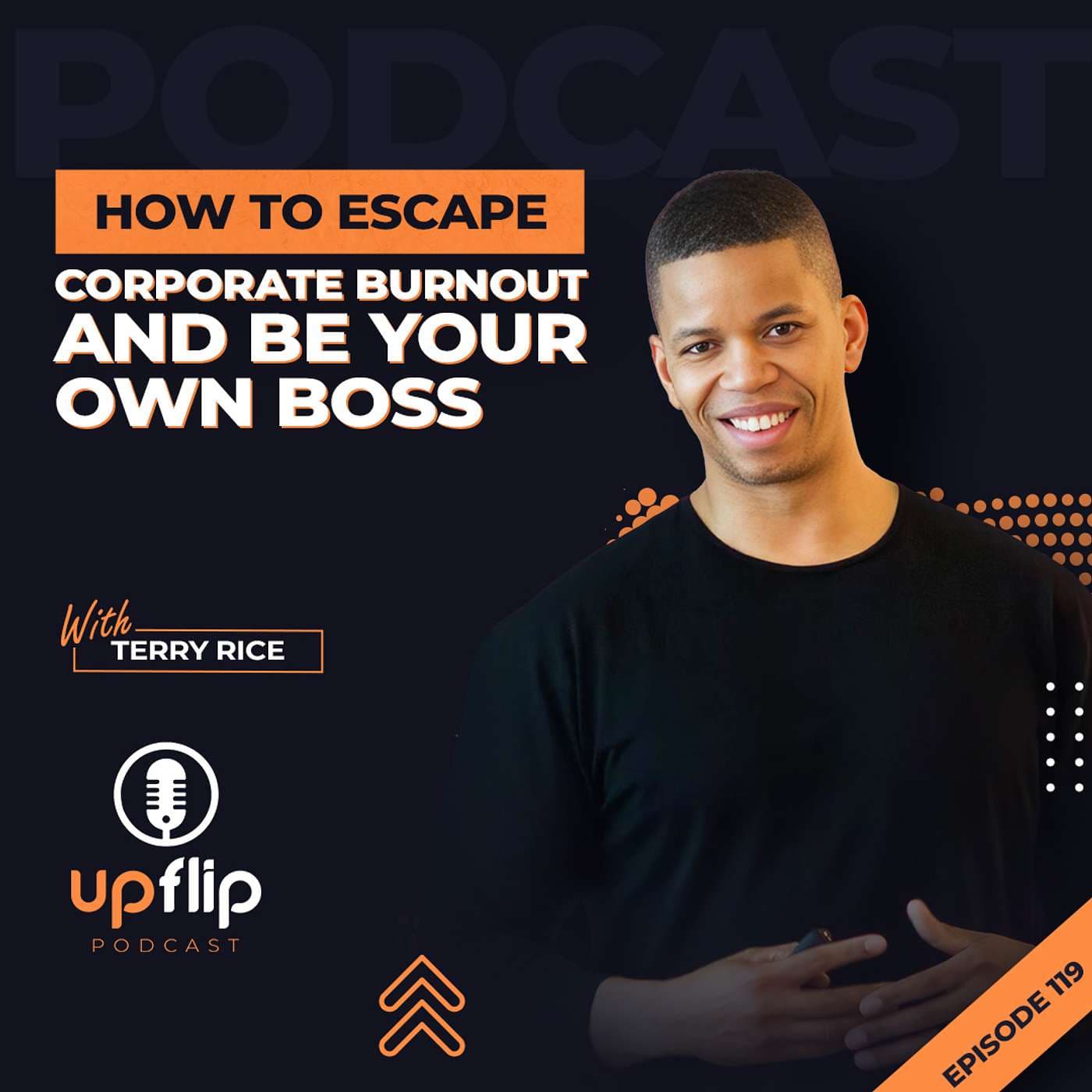
UpFlip Podcast Episode Summary: 119. How to Escape Corporate Burnout and Be Your Own Boss
Episode Overview In this episode, Terry Rice, a former corporate employee at Facebook and Adobe, shares his journey of escaping corporate burnout to become an entrepreneur. He discusses the challenges he faced, the mindset that helped him succeed, and practical advice for those looking to transition from a 9-to-5 job to entrepreneurship.
Key Themes
- Corporate Burnout: Terry highlights the exhaustion and dissatisfaction he experienced while working in high-pressure corporate jobs, particularly in digital marketing.
- Transition to Entrepreneurship: He emphasizes the importance of establishing boundaries and making strategic choices to create a fulfilling business life.
- Mindset and Resilience: The episode revolves around cultivating a winning mindset, staying curious, and continuously improving to succeed in business.
Major Points Discussed
- Burnout in Corporate Jobs
- Personal Experience: Terry shares his struggles with burnout and unhealthy habits that escalated as he balanced work and personal life.
- Recognition and Action: The realization of needing to change came when he was about to become a father, leading him to leave Facebook proactively.
- Establishing Boundaries
- Importance of Boundaries: Terry stresses the need for setting limits in both corporate roles and entrepreneurship to prevent burnout.
- Self-Care Practices: He recommends scheduling downtime to recharge and maintain a healthy work-life balance.
- Building a Business
- Identifying Problems to Solve: Before launching a product, Terry advises entrepreneurs to focus on the problem they intend to solve.
- Strategic Partnerships: He highlights the value of teaching and leading workshops in targeted domains as a way to build an audience while getting paid.
- Entrepreneurial Mindset
- Curiosity and Grit: Key traits of successful entrepreneurs include curiosity to learn and the grit to tackle challenges.
- Unreasonable Expectations: Terry discusses the necessity of having high expectations for oneself and others to drive progress.
- Connecting with an Audience
- Personal Branding: Sharing personal stories can help build trust and connection with the audience.
- Community and Networking: Surrounding oneself with other entrepreneurs can provide support and insights not typically available from friends and family.
- Overcoming Challenges
- Dealing with Loss and Grief: Terry shares his experience of personal loss and emphasizes the importance of acknowledging grief rather than rushing through it.
- Openness and Vulnerability: Being transparent about challenges can foster deeper connections with others.
- Business Development Strategies
- Effective Marketing: Terry advises focusing on business development (Biz Dev) before branding and engaging with potential clients and partners directly.
- Use of Email: Maintaining an email list is critical for nurturing relationships and sharing valuable content with the audience.
Key Takeaways
- Boundaries are essential to prevent burnout in both corporate and entrepreneurial settings.
- Start with solving a problem rather than creating a product to ensure market relevance.
- Stay curious and seek continuous improvement to stay competitive.
- Leverage personal stories to build connections and trust with your audience.
- Seek help and mentorship early in your entrepreneurial journey.
Resources Mentioned
- [Start and grow a business successfully](https://www.upflip.com/courses/business)
- [Join the UpFlip Academy](https://bit.ly/3YDxmt2)
- [Connect with Terry](http://terryrice.co)
- [Follow Terry on Instagram](https://www.instagram.com/itsterryrice/?hl=en)
Conclusion Terry Rice's insights serve as a rich source of inspiration for anyone contemplating a transition from corporate life to entrepreneurship. His emphasis on mindset, boundaries, and community provides a framework for navigating this journey successfully.
For more advice and insights, listeners can explore additional episodes of the UpFlip Podcast or check the resources available at [UpFlip.com](https://www.upflip.com).
Written by AI. May contain mistakes. Listen to the episode to check what was said.
Transcript
Automatic transcript. May contain errors.0:00After building a successful career in the corporate world, Terry Rice left his 9-to-5 job and started his own business to give himself time to focus on the things that matter most. I'm your host, Alex Freeman. And on today's episode, I'm talking to business expert, Terry Rice. He spent a decade working for companies such as Facebook and Adobe, but discovered he was burned out and wanted a career that would let him spend more time with his family and live his values. Now he helps startup founders and business owners streamline their operations to unlock their full potential through the Launch Your Business podcast, solopreneur, fast track course, and other speaking engagements, workshops, and content.
0:35On today's episode, he'll share how he successfully launched his own business and his advice for other entrepreneurs to monetize their knowledge, boost their resilience, and streamline their operations to build a business that lasts. Terry, welcome to the show. Alex, thanks for having me. Let's get started a bit with your background. So when and why to just start your own business, and what were you doing before? Yeah, well, let's start with before. I worked in corporate for about 10 years, largely doing digital marketing roles that were customer-facing, so helping mostly e-commerce brands grow through paid social as well as paid search.
1:07Did that at both Adobe, Facebook, and a few agencies. And as I was going through this transition in my career, I lived here in New York City and was just going out way too much because I had some friends that worked in the restaurant industry, some at bars and clubs all night long, and then trying to wake up the next morning and go to work. And that worked out okay when I was single. Once I got married and actually had a kid on the way, it caused a lot of conflict because I was just out either at work or not partying so much anymore, but just so many social events for work that it caused challenges in my personal life and just literally like drinking every day.
1:42So I want to be clear about that, just not being as healthy as I could. In 2015, I had, I found out my daughter was on the way, my first child, and I was still working at Facebook, still just like spinning out of control in regards to, again, drinking. And that's when the decision was made for me to leave Facebook. And when I say the decision was made, it wasn't just my idea is the best way to say it. I was just completely underperforming. And I want to bring that up because I'm sure there are some people listening who are forced out of an industry or a job that they enjoyed and feel like, you know, less than as a result, I'm here to say, Hey, look, I've been there before too.
2:15And it worked out in the end. First, I want to say, I really appreciate the candor with which you answered that question and kind of the vulnerability there that we don't always get from some of our guests and from when people are talking about like launching a successful business. They don't talk about the dark points that maybe led them to that. So thank you for that, first of all. Yeah, yeah, of course. And it's interesting because even after I started my business, there were, as you can imagine, some dark points there too, because I was no longer drinking, which is good. That was helpful. But I realized that even though I was an expert when it came to digital marketing, I had no clue whatsoever how to start, run, or grow a business.
2:51And it was almost embarrassing because I have an MBA, right? I went to business school. I wrote a million marketing plans when I was in business school, when it was time to actually launch my company, I wrote zero, right? So it was frustrating because you see yourself as this expert in your field, and all of a sudden you're trying to monetize and it just wasn't working whatsoever at first. Sort of related to that, I want to ask you about what are some of those things that you did feel were useful to you having spent 10 years in corporate roles when you branched out on your own? Obviously, we'll talk about also some of the things that you maybe wish you had known or done better at the beginning.
3:23But what were some of those things that you learned in those corporate roles that you definitely took with you and were useful when you went out on your own? One thing I learned in my corporate roles was just the advantage of being able to learn quickly and not being afraid to take on challenges. Because when I started at Adobe, this is like years ago, I had no idea how like automation worked between one tool and another or just coding and systems integrations, things like that. I was just locked in a hotel room in Utah for a month of training. And that's when I learned how to do these things.
3:55And I was like, wow, this was transformational. So ever since then, I've never been afraid of technology or even business challenges. So at least I had the confidence to move forward, if not the clarity. To ask you about burnout, and I want to ask you about it in two different kind of forms. One, that so many entrepreneurs can find themselves dealing with burnout as they launch their business. They go a little hard at the beginning and they just flame out. But then obviously also in the midst of a corporate job, you can experience burnout as you did. So I guess I want to first ask about what you maybe wish you had realized before you'd burned out in the corporate job and like what you're doing now to prevent burnout in your life.
4:33Yeah, I would say in the corporate world, you really have to establish boundaries. And I know that can be challenging because again, I remember being at Facebook and, you know, some key stakeholder from a huge client was in town. It's like, oh, they want to do a happy hour. And I'm like, I just want to go home. Right. But But when you have this feeling like, oh, no, I have to be there or else they're going to think I don't care. Here's the opportunity to do X, Y, Z. Then that fear of missing out or fear of other people's opinions will cause you to do things that maybe you don't want to do. Right.
5:01So I think that's one major cause of burnout is feeling like you have to show up more in order to be seen as being more productive. And on my end, that's, again, a challenge I had in corporate. On the entrepreneur side, though, it happens quite often there, too. And I think you have a much more defense against it as an entrepreneur. Because again, remember, you don't have to do more to be more. And I think what I would recommend anyone do as an entrepreneur is to literally block off time on their calendar to take a break, right? Some kind of self-care. Maybe it is going to the gym. Maybe it's going for a walk.
5:30Maybe it's meditating. Maybe it's like preparing your meals, right? Bulk preparing your meals for the week. But you have the ability to create the lifestyle you want. So why would you just pack it full of stuff, right? That's going to make you burn out. So that would be my first piece of advice is to literally schedule downtime. time. Therefore, you don't neglect yourself. I want to kind of get a little bit more towards the actual launch of the business. When you did launch the business, how long did it take before your new business ventures were making you more than your nine to five job? It took 18 months, but the first six months, I would say were almost practice because I wasn't doing much.
6:06I wasn't doing some of the right things, but I'm very grateful for those times. and I wish I appreciated them more, but it took about 18 months. And the way that I built my business was through strategic partnerships. And I recommend anyone form those if they can. And specifically what I did is I was teaching at schools and organizations that aligned with my target audience. So I was teaching digital marketing courses at New York University, as well as General Assembly. So I was getting paid to lead these workshops, but I was also prospecting at the same time because these are people who've already paid to learn from me.
6:38I could then say at the end, hey, by the way, if you want to learn more, here's how I can help you out. So that just constant flow of qualified leads and getting paid to prospect, that was just so perfect for me. And it worked out extremely well. Terry, you work with a lot of entrepreneurs. You are an entrepreneur. Talk to me about the entrepreneurial mindset. What are the core aspects for a successful entrepreneur? I'd say the first one is curiosity. And I think that's the challenge when you're going from corporate to entrepreneur. When you have education and experience, it's easy to go backwards to things that have worked before.
7:09And like, oh, this should just work because I've done it before. But as an entrepreneur, you have to go forward, right? So the more curious and I would say gritty you are to solve not only the problems that your audience might have, but your own problems within your business, the better. So that curiosity, that grit, I would say are super important. You also have to be almost unreasonable with expectations of yourself and others. And one of my favorite quotes by George Bernard Shaw is, reasonable people adapt themselves to fit the world, unreasonable people expect the world to adapt to them. Therefore, all progress is made by unreasonable people.
7:41So the best entrepreneurs I know just make unreasonable demands of themselves and others. And that's why they succeed. So I think you want to tether your thoughts to reality, but don't let any kind of imposter syndrome or self-limiting beliefs lower your chances of success. How do those translate into like principles for business success? Like what are your kind of key principles for building a successful business? It all starts with the audience. And I know that sounds trite, but I think too often entrepreneurs think, what product can I create as opposed to what problem can I solve? And if you start with saying, what problem can I solve?
8:16The product or service will emerge from that, but then you'll already have an audience built in that needs your product or service, right? So I've come across a lot of startups in my day and sometimes they have ideas that are cool, but they aren't really super useful. It's like, here's an app that helps you find your left shoe. It's like, okay, yeah, that's interesting. But is that really useful? Can that scale? So I think it's really solving. It's starting with the problem you want to solve. And then I would almost immediately pivot towards educating yourself. Okay, well, how can I learn the best processes for attracting, converting, and fulfilling the needs of my clients?
8:49It's really just those three things. And as a result of that, you'll grow, maybe not as quickly as you could if you use some kind of hack, but you'll grow. So and I would say the last thing, the last trait is finding your tribe, finding your community, because often as an entrepreneur, the majority of your friends and family, they have nine to five jobs, right? So they can't necessarily give you the advice or sometimes the right support that you might need. But if you're around other entrepreneurs, like these days, they're going to say, oh, how are you using AI to grow your business, right? And you're going to say, oh, shoot, am I doing that or not?
9:17Whereas your friends and family are just going to say, oh, yeah, good job. It looks like your Instagram is really blowing up, right? So that's what I would say as well. Listeners, a quick reminder that for new entrepreneurs who want to start their first business, check out the Upflip Business Startup and Growth Blueprint, a new free course taught by Brandon Vaughn that talks you through how he built$12 million businesses from scratch. Now, Terry, I also want to ask you about, you went through a very deep personal loss shortly after starting the business with the loss of your son, 18 months into the business or so.
9:46What advice can you offer for entrepreneurs about dealing with loss or grief from your experience going through that? I'll unpack it more because my father passed away in December of 2015, the first year of my business. And that's actually the month my first child was born, my daughter. So my daughter was born the 8th. My father passed away the 20th. So I had a new business and a new daughter and no idea how to grow either one of them. And I also lost my father. And then to your point, yeah, 18 months later, unfortunately lost my son, TJ. Two years after that, I lost my grandfather during COVID.
10:17And just recently, I lost my brother this year. So So it's been obviously challenging. And what I would say to anyone who goes through this is the very first thing is to just acknowledge what happened. And on my end, I tried to rush through things before to try to get back to whatever normal is. But I feel like if I had paused to really acknowledge, okay, this was a loss. This is something really big. And being busy won't fill the void in your heart. You have to go through this in a more productive and I would say structured way. So it's that. But I think it's also this. It's me realizing that the people I've lost, they want me to move forward.
10:51They want to see me succeed. So I have like, you know, these angels with these fans rooting me on even at my lowest moments because they want to see me win and I want to win for them, too. So I use it as motivation. And the last thing I would say is just being more open about your challenges or in this case, you know, my losses with your audience just really humanizes you. And the thing to realize is that people give you opportunities when they feel connected to you. And often that connection occurs when you share something more vulnerable. more authentic, including some of the more painful experiences that you had.
11:20So I think being open about it is the smartest thing I've done with my unfortunate most recent loss of my brother, because now people see who I am as an individual, not just an expert. And that alone makes a deeper connection and understanding with your audience. That makes so much sense to me, because obviously, you know, as I've commented on already, I've super appreciated your openness here. And I think about like business relationships being so much about trust and just being able to be open and vulnerable with other people. You know, we don't often talk about vulnerability as a business asset, but I think it really can be as it builds that trust, as it says, okay, great.
11:54I understand that like I'm meeting you as a human where you are. And I think that that's so, so important in building relationships. Let me share, which will hopefully be a funny story to go along with that. Like I said, people give you opportunities when they feel connected to you. So the best thing that any entrepreneur can do to build their personal brand is tell personal stories. And I'm going to share one that I posted on LinkedIn as well as the outcome. So I was at my daughter's Christmas recital and I was there with my two sons. And one of them wanted me to pick them up to the point where he was pulling on my pants to pull me up.
12:24And he pulled my pants down in a crowded theater. So I was like, this is not pleasant. Right. So pull my pants up real quick and I get back into it. But one thing I reflected on later is I didn't get angry at all. I thought it was kind of funny, actually. And back in the day, meaning, let's say last month, I would have got angry about that. But I've been intentionally going through some self-care practices after losing my brother just to be more in control of my thoughts and my emotions. Right. So didn't get angry, laughed about it. I told that story on LinkedIn. And within an hour, one of the editors from Fatherly, which is a blog for fathers, as you may have guessed, reached out to me saying, hey, we'd love to share your story through our readers at Fatherly.
13:01And for me as a father, I've been trying to find a way to get involved with Fatherly one way or another over the past several years. Apparently, all I had to do was have my pants taken down in the theater and share that publicly. But again, now I'll be featured in this publication that I respect because I was open about this clearly embarrassing moment, but also shared the outcomes from it as well. You've obviously got a lot going on in your life. And you talked about one of the goals of launching the business was to, you know, create a work that fits your lifestyle and the lifestyle that you're going for.
13:28So how do you manage your time effectively to balance all of the different things you have going on along with time with family and making sure that you have those times for self-care as well? Yeah, I mean, it's just discipline. And I always say discipline is destiny. And I know discipline doesn't sound fun. It sounds painful. But there's a quote that I'll try not to mess up too much. We can't avoid pain. We have to suffer either the pain of discipline or the pain of regret. The only difference is the pain of discipline weighs ounces, whereas regret weighs tons. So on my end, I'm like, look, you have to be disciplined, even if it is not pleasant.
14:01So I structure my day in a way that I can get everything done, both professionally and personally, without feeling stressed out. So, for example, I do my best creative work in the mornings. So all the writing I do, I do that in the mornings. Therefore, I don't schedule meetings in the morning. Therefore, I'm not annoyed in the morning because I have a meeting as opposed to creating content. So little things like that. But I have my whole day planned out. and kind of going deeper in that question. One thing I'm realizing with my kids is they're gonna need even more of my time in the future because my oldest, my daughter is eight years old and just helping her with her math homework is freaking hard because when I was a kid, if someone said, hey, what's 14 plus seven, you would just say 21.
14:41You can't do that anymore. You have to jump through several hoops in order to get that answer, which is still 21. But I'm like, look, if I'm burned out because of the workday or if I'm short on time because I have other stuff to do, I can't sit down and calmly go through this homework with my daughter and then my other children as they get older as well. So now I'm looking more into automation, into AI. I already have a team that supports me. But my goal is to be just super, super, super present in the lives of my children to the point where they're like, why is this guy always here? Like, why?
15:09How do we have things? When do you work? Like, I want them to just wonder, like, when the hell is that actually going to do something that involves work? I love that because I'm also very much unlike the discipline structure of my day and kind of finding out those different ways. How often are you analyzing what's working and what isn't? And then like, how do you implement a change if you're like, okay, this has stopped working for me for whatever reason? There's two opportunities per week. So one is I journal every day. And during that journal, I write down my wins, but I also write down where am I falling short, right?
15:39How can I improve? And sometimes the answer based on that day is nothing like, hey dude, you had a good day. But regardless, every week I go through an exercise, start, stop, continue, change. For my business, when I start doing, stop doing, continue doing, or change how I'm doing it. And that alone just gives you an opportunity for a continuous improvement. So it's a fun exercise because you just reveal just so many opportunities and blind spots that maybe you wouldn't notice if you don't pause to do so. Going to do a little bit of a pivot here into some nuts and bolts advice kind of questions.
16:08And so we're going to just kind of kick that off with what's the best way to attract customers or clients to a brand new business? Speaking, speaking, because what I like to do is find the gatekeepers to my audience, people who already have access to them, form some kind of partnership by saying, I will deliver this workshop five ways your audience can do better in 2024. And then just by doing that, one yes from that organizer gets you in front of 20, 30, 40, hundreds, thousands of people. So if I was just starting out, I wouldn't go on social media. I wouldn't start a newsletter. I would try to come up with a good speaking topic or I would come up with a good speaking topic, identify outlets I can deliver that to, deliver my topic, then have some kind of lead magnet or some kind of way for the audience to follow up with me.
16:47And that's how I will grow. So you go through that, you develop those things. You've had the opportunity to speak at some major events. You've been on Good Morning America, all sorts of great stuff. So how does somebody take that step of, okay, I'm going to go this route. I'm going to start speaking. Now, how do I land those high profile appearances? Yeah, I can't give someone that path. I can just being in the right place at the right time. So I never try to give people advice on how to do exactly what I've done. What I would say, though, is start small. I would start small. I mean, I started speaking at the Brooklyn Chamber of Commerce.
17:19Then I went to the Brooklyn Public Library and I started going to co-working spaces here in Brooklyn. So I would do like, you know, two, three, four talks a week for free, by the way. And that's how I got really good at it to a point where WeWork wanted me to go and do these tours at their offices as well. This is back in 2015. From there, I started getting some smaller speaking gigs at local conferences, like nothing too huge. And that then led to me getting a job teaching at a school called General Assembly, where I was delivering workshops, like I said, two or three times a week. So start small and don't focus on trying to get paid to speak initially.
17:50Just focus on getting on stages and getting good at delivering content and actually listening to your audience's feedback because that's how you get better. What's the biggest mistake that you see other business owners make when it comes to their marketing and what should they be doing instead? It's posting too much on social media, which I know sounds weird, but I had to see people like posting, posting, posting, posting and wondering when nothing's happening. And I say to them, look, whenever you're posting on social media, which I'm not saying don't do, you're hoping your target audience sees it.
18:18And then you're hoping they reach out to you for more help. That's a lot of hope, right? So on my end, I always say, look, do biz dev before branding. Actually reach out to someone and say, hey, Alex, I see you work in this industry. By the way, I created this guide, five ways you can win in this industry. Can I share it with you? Cool. There you go. Now you're giving first. You're approaching with an offer instead of an ask. And then from there, you can build the relationship. Another thing you can do is sure, go on social media, but come up with a list of like 40 people that you want to know or be known by, maybe prospects or partners who are active on social media, and then just continuously engage with their content over and over again.
18:51Keep on commenting every time they post, keep on commenting. And the best comments include a question. That way, they're more incentivized to respond because you ask them a question. That's what I would do. I wouldn't worry about too much about my branding. I mean, sure, be present on social media. So when they look at your profile, they know who you are and that you're legit. But I would spend way more time on biz dev and less time on branding if I was trying to grow through online channels. How does email factor into all this? You got a big email list? What's that look like? Yeah, I mean, email is super important.
19:19I wouldn't recommend starting there because at first, you're going to feel like I have four people on my list. Why should I write this newsletter this week? So that's tough. But that's where I have the strongest relationship with my audience. And I can tell, like I can see if I post on LinkedIn and there's a link for some event that I'm doing, I can see how many clicks I'm getting, right? You know, it's not a lot. But within the newsletter, it's, you know, 10, 20x when I'm getting on LinkedIn. So I think that's very important for you to have that. And on my end, what I'd like to do to grow my newsletter is this, because I think that's a question behind the question.
19:49Pretend that my upcoming newsletter is about three ways to make more money as an entrepreneur. Before it comes out, I would post on a platform like LinkedIn, hey, in my next newsletter, I'm going to announce three ways you can make more money in 2024. Here's one way for the other two ways. Click now in order to get the email before it comes out. Click here to sign up. But even after it goes out, what I do is all my newsletters get posted on my website as a blog. So now after the newsletter goes out, I can say a week or so later, hey, my most recent newsletter, I shared three ways you can make more money as an entrepreneur.
20:20Here's the second way to do it for the other two ways. Go to my website now, read the newsletter, read the blog or whatever it is. And then in that article or blog, there'll be a link for them to sign up to my email list as well. So you're creating like this flywheel almost where you're using your content to promote your content. And as a result, you're getting more people on your list. And how often are you sending to your email list? Like how often are you talking to that audience? Once a week, but there have been times when I've fallen off. So on my end, that's what I'm going to be doing over the next month or so is this bulk creating newsletters.
20:50And what I found is it helps to have a structure that you're using. And the structure I'm using is situation question complication question answer. So, hey, are you in the situation? Here's how it gets complicated. You might be wondering this. Here's the answer. And as a result of that, I can make these much faster and they're much more tactical and immediately up to a couple. So this is going to bring us to a section of our show that we call our Fan Blitz Questions. These questions come from our YouTube community listeners. You can head over to youtube.com slash upflip. Join the community and post questions to future podcast guests.
Read the full transcript
21:18Terry, this is going to be about five questions. We're going to try and do them in about a minute. Are you ready? I'm ready. All right. First one from DK7233. What made you stand out from the crowd in business? And at what critical period of life have you learned? What makes you unique? What stands out to me in regards to my approach is I don't focus on seeming instead of being. And what I mean is some people in my position are just so polished. Like when you see them on stage, you can tell they're very practiced. And I remember one time I was speaking at Amazon and someone came up to me afterwards and said, that was amazing.
21:48I can tell you're not a professional speaker, but that was amazing. And I was like, damn, dude, you could have left that part out. But that's who I want to be, the person who just is real, relatable, authentic, not polished and presentable. I'd rather um and ah too much, but be approachable and genuine as opposed to being perfect in my delivery. From John Kerry, 2324, if you had to make$100 ,000 in profit in three months, what business would you start and why? I would start a service that focused on B2B. And what I would do is I would look at companies who have a C-suite of executives that want to grow their personal brand.
22:23And I would volunteer to... I wouldn't volunteer. I would charge them to do that. I would look for an industry where the stakes are higher. So like finance, travel, auto, medical, because there's a lot of money there. And I would just solve an obvious problem, which is you need to grow the personal brand of your executives in order to attract investors, better talent, as well as grow your customer base. So that's what I would do. If you had the chance to wave a magic wand and change one thing about businesses at the fundamental level, generally, what would you change? I would change the perception of the barriers to entry to business because there were so many people who I think would be amazing entrepreneurs, but they think they need to have X amount of money or certain kind of education or certain kind of connections.
23:06So I would just democratize access to entrepreneurship to everyone. If you could tell your previous boss one thing, what would it be? I would say thanks. Thanks for highlighting the point that I should not be in corporate. And it took me 10 years to realize I just never was meant to be in corporate. I followed the track I thought made sense after getting an MBA and all that stuff. But I can look back now and just think to myself, I don't want anyone's job that I've ever observed in corporate, including mine. And I'm not putting corporate down. It's just, it's not a good fit for me. That's going to do it for our FanBlitz questions.
23:39Listeners, if you're enjoying this episode, please take a second to leave a review to help other entrepreneurs find and learn from Terry's insights. Terry, just a few more questions for me as we go on. Thinking back on both your work for entrepreneur.com as a writer, the Launch Your Business podcast, what's one piece of advice or strategy that you've learned in those conversations that you'd be able to share with us right now? I have a favorite question that I ask my guests on my podcast. asked, what is one lesson about entrepreneurship that you wish you learned sooner? And overwhelmingly, the response is, I wish I got help sooner.
24:13I wish I had a mentor, a coach, even like a community to get help sooner. So that's the thread that goes between all these responses is like, it's just getting support sooner. And I would argue, even if you have to pay for it, even if you have to get like some kind of new credit card to pay for a reputable coach or a great online program, I think communities are actually better than coaches sometimes. So that's really it. It's just getting help as soon as possible. What's the most unique or unusual entrepreneurial story you've heard in your time interviewing entrepreneurs? Okay, I'll give you one.
24:43So I was talking to T.I., the rapper. He lives in Atlanta. And I said, I was asking him, hey, T.I., what is the first non-rap venture that you went through as an entrepreneur? And he mentioned when his first album came out, his uncle just recently got out of prison and asked him to borrow, I think, $30 ,000, which is almost like his whole advance on his first album. But he gave it to his uncle and they were driving around their neighborhood like three months later. And his uncle's like, hey, you see that house over there? And T.I. is like, yeah, that's a trap house. I used to buy drugs from there.
25:10He's like, well, now that's your house. There's two families living there and they're paying you rent. They're going to pay you rent every month. That's how you're going to make money. If you want, I can give you$30 ,000 back. Or if you want, we can go buy another house with this money that I'm making. So T.I. is like, go buy another house. Let's make this happen. Over the course of 10 years, him and his uncle bought 100 houses in the Atlanta area. Yeah. So for me, like that's just an amazing story where you trust your uncle, who's clearly, you know, a felon or ex-con at least with$30 ,000 and he turns it into this real estate empire, which is amazing.
25:40That's incredible. I didn't even know that about TI. That's great. So in your experience working with business owners, I think you touched on a couple in there, but I want to kind of get there more specifically. What are some of those common areas where you notice that businesses are often lacking systems or even if they have a system, it maybe has a high level of waste or inefficiency? Yeah, I mean, there's a few. The first is your process of creating content if you are a content creator. So how do you systematize this? How do you turn one piece of content into 10? Just getting that part down is super important.
26:11Also going into just, if you're doing professional services, how do you manage your clients? Everything from the onboarding form when they first sign on to the communication to project management. But yeah, just having that put in place is important too. Then your back office, right? How are you making sure that you have a good system for keeping track of your bookkeeping, for your taxes, who's paying you money, so on and so forth? Because, and I'll admit this, just today my assistant found$10 ,000 that was owed to me by one of my partners that I forgot about. So maybe that's another one is having someone else be a second set of eyes on this stuff for you.
26:44I want to tap into some of your expertise right now and ask you to look into a bit of a crystal ball. But what are some of those niches where you might see the most potential for entrepreneurs right now? and what is kind of making them so appealing? I think, and I don't want to sound like too bandwagon-y, but anything in regards to AI and process improvement is going to be needed across all industries. So if you could find a way, even if you are saying, hey, Terry, you know, I don't work in AI, if you can find a way to just integrate AI into what you're doing and how you help people, that alone will be a differentiator.
27:15And I keep on harping on this because I just think back to when I was younger, when I was in high school, we had easy access to computers, the internet, all this stuff. And this is back in the mid nineties, by the way. I still just date myself, but not everyone like people who are adults back then didn't have time to learn how to use like the Internet. So they didn't have digital skills. Unfortunately, when it's time to get a new job, they could even use a mouse. Right. So right now, what I'm thinking with AI is it's going to be another one of those defining moments. Like right now in your current nine to five job, maybe you don't need it.
27:41But guess what? You eventually will. And if you don't start finding practical applications for it, you will get left behind. And it's an easily avoidable mistake because we've seen it happen in the past. So if past is prologue, then we know what to do. learn these skills and figure out how to implement them in your business. What's been your biggest regret in business and what did you learn from it? My biggest regret would be just not being patient enough to let things develop and or come to me. Because on my end, I just always wanted some kind of immediate gratification. And the way that works sometimes in business is you're selling low ticket items or you're not charging enough just because you want to get that quick yes.
28:19You can get a yes for charging$100 an hour for consulting much faster than you would for charging$30 ,000 for a consulting project. But the thing is, you're still putting effort into that$100 an hour. And it's not going to scale whatsoever. But on my end, initially, I just wanted those quick wins because of a scarcity mindset. I was projecting lack. But if I had done things differently, gosh, I could have just really grown a lot faster just by being more patient and also being more bold in the asks I made of other people. Even with my pricing, it was way too low initially. And I'll make a point on that.
28:50One time I got approved to speak in a conference and then they turned me down later because they said my rate was too low and it scared people away. I was like, gosh, you could have told me you didn't like me. But when it went to all the stakeholders, I'm like, why is this guy's rate so much lower than everybody else? Let's get him off the docket. So yeah, those low rates are costing you a lot more than just the money that you think you're missing out on. Terry, this entire conversation has been filled with just absolute gold. So I'm going to ask you to do the difficult filtering for our listeners?
29:18If you could pick the one thing that they take away from this conversation, what would it be? I think the most important thing is to be in conversation with other wise women and men who understand you. And as a result of that, first of all, you won't feel so alone. You'll realize other people have the same challenges, but you'll get the support and strategy that you need to grow. Terry, where can people connect with you and learn more about what you're up to? Yeah, I mean, you can stop by my website. It's terryrice.co, not terryrice.com. There's a photographer in Indiana who has that. So if you want some photos, go to that.com.
29:51If you want to see me, go to docco. Also on Instagram, it's at it's terryrice. And I post on LinkedIn every day as well. You can just search for Terry Rice on there. That is going to do it for this episode of the Upflip Podcast. Listeners, you can find more advice for how to start a business the right way on the Upflip Hub. And you can hear more insights on how to turn your passion into a thriving business. If you check out episode 76, where Stu from the future talks about how to make money doing what you love. Terry Rice, thank you so much for joining us today. Yeah, thanks. It's been great. I appreciate it.
From the publisher
Terry Rice worked at some incredible companies, including Facebook and Adobe but the burnout he experienced was ruining his life. Leaving his job, bad habits, and unhealthy lifestyle behind, he started his own business to create a life he could enjoy with his family.
In today's interview Terry shares his winning mindset that helped to catapult him out of his 9 to 5 and into entrepreneurship. The winning habits that have helped him stay focused and the steps you can take to do the same.
Key Takeaways:
- Establishing boundaries can help reduce or eliminate burnout. That includes a corporate job and your own business. You have more of a defense against it as an entrepreneur because you don’t have to do more to be more.
- Figure out what problem you want to solve before you think about what product you can create. If you aren’t solving a problem, you will not succeed.
- People give you opportunities when they feel connected to you.
- Always stay curious to stay relevant in business. Don’t get complacent but strive to improve a little each day.
Resources:
- Start and grow a business successfully: https://www.upflip.com/courses/business
- Join the UpFlip Academy today: https://bit.ly/3YDxmt2
- Connect with Terry: https://www.instagram.com/itsterryrice
- Podcast Episode 76: How to Earn $4.8M/Year Doing What You Love
Ready to be your own boss without starting from scratch? Grab our FREE Franchise Guide and unlock the secrets of proven business models that have already created thousands of success stories.
Connect with UpFlip:
- On Youtube
- On Instagram
- On Facebook
- @UpFlipOfficial on Twitter
For more insights to start, build, or grow a business, check out the resources on UpFlip.com or head to the UpFlip YouTube channel to see more interviews with business owners and experts.
Thanks for listening!


