
In short
UpFlip Podcast Episode #121 Summary
Episode Title
How to Fail the Right Way: Lessons from a Multimillion-Dollar Company
Host
John Palumbo
Guest
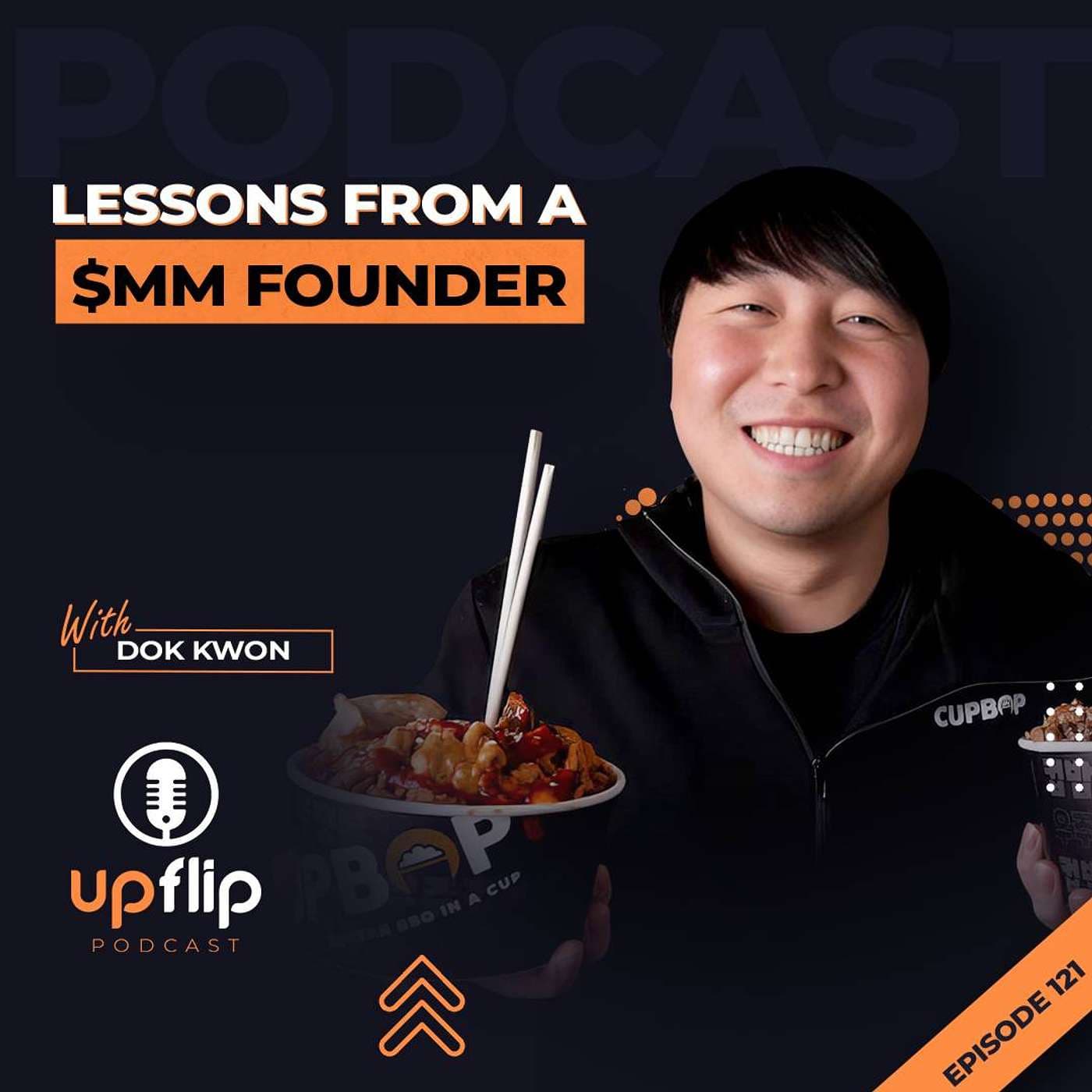
Dok Kwon, Co-owner of CUPBOP
---
Episode Overview
In this episode, Dok Kwon shares his entrepreneurial journey with CUPBOP, a Korean BBQ restaurant chain that has expanded from a single food truck to 220 locations worldwide, generating $3.5 million in monthly revenue. Kwon discusses the challenges of entrepreneurship, the reality of failure, and the importance of resilience and adaptability in business.
---
Key Takeaways
- Learning from Failure:
- Don't linger on failure; instead, extract lessons and move forward.
- Understanding that the best decisions are made with the available data at hand is essential.
- Misconception of Entrepreneurship:
- Entrepreneurship is often perceived as glamorous, but it demands a higher pain tolerance than conventional jobs.
- Tenacity:
- Successful entrepreneurs don't take "no" for an answer. They persistently seek solutions.
- Adaptability:
- The ability to adapt to changing circumstances and challenges, especially during crises (like COVID-19), is crucial for survival.
---
Detailed Insights
Dok's Background
- Career Transition:
- Kwon transitioned from finance (working at Goldman Sachs and Citadel) to entrepreneurship, driven by a desire to create something impactful.
- CUPBOP's Beginnings:
- Initially encountered CUPBOP through its food truck in Utah. The brand's potential prompted Kwon to take a leap back into entrepreneurship.
Business Model and Growth
- From Food Truck to Brick-and-Mortar:
- Kwon explains that scaling through food trucks presents challenges such as weather dependencies and inventory management. Thus, CUPBOP focused on establishing brick-and-mortar locations for better consistency and control.
- Shark Tank Experience:
- Kwon shares insights from his appearance on *Shark Tank*, where all investors expressed interest, reinforcing the brand's potential and validating Kwon’s decisions.
Navigating Challenges
- The Covid-19 Pandemic:
- Early in Kwon's tenure, CUPBOP faced significant sales declines during the pandemic, prompting liquidity management strategies.
- Emotional Resilience:
- Kwon emphasizes the necessity of maintaining composure during crises and the importance of leadership in fostering team morale.
Entrepreneurial Mindset
- Coping with Uncertainty:
- Kwon illustrates that feelings of doubt and fear are common among entrepreneurs, emphasizing the need for a strategic mindset in evaluating risks and rewards.
- Long-term vs Short-term Decisions:
- Choices that provide immediate gratification may not always align with long-term company health. For example, despite franchise inquiries, Kwon stresses prioritizing the brand’s integrity over quick cash influxes.
Future Considerations
- Impact of AI and Technology:
- Kwon discusses the implications of emerging technologies such as AI and the need for entrepreneurs to stay informed and adaptable.
- Skills for the Future:
- Curiosity and a broad perspective on emerging trends will be critical for navigating future business landscapes.
---
Resources Mentioned
- UpFlip Academy: [Join the UpFlip Academy](https://bit.ly/3YA73nw)
- Connect with Dok Kwon: [CUPBOP Website](https://www.cupbop.com/)
- Franchise Guide: [FREE Franchise Guide](https://bit.ly/4aWuGvc)
---
Conclusion The conversation with Dok Kwon provides valuable lessons for current and aspiring entrepreneurs. His insights on resilience, the reality of failure, and the importance of tenacity resonate deeply, reinforcing that while the entrepreneurial journey is fraught with challenges, it is equally rewarding for those willing to persevere.
Written by AI. May contain mistakes. Listen to the episode to check what was said.
Transcript
Automatic transcript. May contain errors.0:00Welcome to the UpFlip Podcast, where we flip the script and ask successful entrepreneurs the questions that all those other podcasts out there aren't asking but should. They're questions that dig a bit deeper, maybe a little more personal, and are designed to arm you with information and insights that you aren't going to get anywhere else. I'm your host, John Palumbo, and today I have with me an entrepreneur who has not only been through a lot of the ups and downs many of us who have started companies have experienced and are familiar with, but he's also had some pretty unique experiences that I think we could all learn from as well.
0:35Like, for example, being on Shark Tank and having all the sharks offer him deals, which, as we know, doesn't happen all that often. I'm talking about Doc Kwon, the president and COO of Cup Bop, which is a fast, casual restaurant chain that serves Korean barbecue in a cup. Hey, Doc, thanks for coming on. Hey, thanks, John, for having me. So, Doc, like I mentioned, and as you know, we don't want this to be the typical podcast interview where I ask you a bunch of questions, a bunch of the same questions that you've answered other times on other podcasts or media interviews, but I obviously want to do a bit of that right out of the gate just to get our listeners familiar with you and Cupbop if they aren't already.
1:12So I apologize if you've been asked these next few questions hundreds of times and you're sick of answering them. So bear with us on this. Let's start with your personal background, which I think is fascinating. Can you take a minute to tell our listeners a bit about yourself and maybe even would influence you to start a business? Yeah, great question, actually. I mean, I never actually thought I would end up in the restaurant industry. After college, I actually kind of went the finance route, started my career at Goldman Sachs as an investment research analyst, equity research analyst. And then I think I spent about close to three years there.
1:48And actually after that, worked as an investor at a major hedge fund called Citadel and as an investor for about four and a half years. And, you know, I just had this burning itch to do something more entrepreneurial. CupUp, it's a funny story is, so I lived in Utah, I went to school in Utah to BYU. And right before I left for New York, a few months prior to that is when the CupUp truck started in Utah. And so I had a few months overlap and I loved the food truck. And so I was going every week they were in town. And so I got to know the food truck personally. And the founder, Jung, my partner, he was the person running the truck at the time.
2:33And, you know, there aren't that many Koreans in Utah. So I connected and I was a customer. He was a vendor. And I remember, I think a few days before I left for New York, I went to the food truck for the last time and I told him, hey, you guys have an incredible brand. Like I'm moving to New York, but I hope to see you in New York. Bam. And so and that was the last time I had really contact with them. And one day it just popped up in my mind. I was like, man, that was such a good brand. How are they doing? So I started like face talking, cup up a little bit. And then I hit up the founder through Facebook and said, hey, we got to talk.
3:06And I asked him a bunch of questions. I said, hey, how's business going? This, that, that. They're very early on still. And he said, hey, look, the people love the brand. that there's a lot of demand, but it is getting very, very hard to manage at this point. So they were kind of right at a place where, you know, you could kind of scale and get to at least kind of the next level where a lot of companies fold or you just don't grow. Right. And yeah, I thought, huh, interesting. So talk to him more and more. And, you know, what got me over the line was because, you know, the comp wasn't going to be it because they had no money.
3:41It was a startup. They literally, and it's a restaurant company, they haven't raised money. So they had literally nothing. And I, you know, I told him, hey, this is not what I'm coming for. Like salary, I don't care, you know, but I want to be, you know, your partner that can take this, you know, nationally. And we talked over a few months and it was very clear that we gelled very well. And what caught me really over the line was when he told me, hey, look, there are a lot of very successful, wealthy hedge fund managers in New York. But I'll tell you what, nobody has been able to create a national QSR brand out of Korean cuisine.
4:17And that just hit me with a hammer. There it is. And I was like, that is like actually the coolest thing ever. Right, right. What a carrot to dangle. Yeah. And so when I heard that, I was like, all right, I'm on board. Right. I'm going to pack up and move back to Utah. We're going to grow this thing. Would they have been able to grow it? Did they have that experience, that skill set? Or was that something when you called them, they were like, oh, this is perfect. I think they were just still trying to figure out. I mean, it was just they were on their 10th location at the time. And you, you know, at the time, they were just brute forcing each location, right, without processes.
4:53And it was at a point where it was starting to break down, honestly. And that was one thing that Jung told me was like, it's getting, you know, yeah, it's getting very hard. And consistency is getting hard. Services getting hard. Hiring is getting hard. We got to do something. And so and I don't know why I had that confidence because I've never run a business. business. I just thought, yeah, I feel like I can do it. And so I said, yeah, let's do it. I think this is such an incredible brand that we can scale. And so I joined in kind of late summer of 19, moved back. And yeah, a few months later, there was COVID and that was another story.
5:28But that's how my journey with CupUp started. Well, first off, the hedge fund, I'm sure if you go look at your counterparts from the hedge fund from Citadel, I wonder how many of them have gone off Not very many. Right. And they definitely aren't going and doing food trucks, right? And then there's also just this idea. I think a lot of the entrepreneurs probably listening to this probably founded their company, probably started their company, whereas you were actually a customer, which I think is really unique. And you know what I want to talk about a little bit too, Doc, is that evolution from food truck to brick and mortar.
5:58Can you talk a little bit about why you guys decided to take that path? I think simply food trucks just don't scale. I think that was really it. For example, you can't control weather. Right. Right. And, you know, the impact that you will have as a food truck versus a brick and mortar is night and day. Second, because you have all these individual events that you're always going to actual inventory management, food management, how much to cook. It's just a nightmare. Very, very tough to manage. And you constantly have to try to get on schedules. And there are so many variables between that. Food trucks break down all the time and it's very tough to operate.
6:36And so, and that was one of the first things I came and said, hey, look, food trucks, we will keep them, but we will not actively grow them. We use them as marketing. It's interesting because I think a lot of people, when they think food truck, it sounds kind of like interesting and sexy and it's like, oh, it's a food truck. And you don't realize the realities, like all the things that you just talked about, but it is interesting that you went to them already knowing that. And that's one good thing, one training that I think I received well, kind of my days in New York is, you know, as an investor, the first thing you always try to do when you get coverage of a new sector or an industry is you try to figure out the drivers of the industry.
7:15What are the most important metrics that you need to look at? And is it scalable? Is it not? How is it valued? Because it is scalable, it is not. And yeah, food trucks right off the bat was, okay, can't do it, but it's a great marketing tool. We can't forget our roots. So we'll keep food trucks, but all our growth is coming in the form of brick and mortar. So you still have food trucks now? Yes. So it's more of a marketing? Marketing and some big catering events. Yes. In my intro, I mentioned that you were on Shark Tank and everybody hears, everybody gets excited when they hear that. If I'm remembering correctly, I think you pretty much ran the floor.
7:51I think you got deals from every shark, if I'm remembering that the right way. And I'd love for you to talk about it. And By the way, the presentation was hilarious. It was great. Thank you. So what was that like? It was fun. I honestly, both Jung and I, we actually had a blast. I think for Jung, it was for him, it was especially emotional. I remember after the show, he got very, very emotional. You know, he started this company literally from nothing. And he got all this confirmation from these great, great entrepreneurs in front of him. Right. And for me, it was obviously also a confirmation of the bet that I made.
8:26But also, you know, we had a lot of fun preparing for it because, you know, myself, it was actually the first time I was sitting on the other side. I'd always looked at investments from the investors. Oh, that's a good point. Yeah. You could have been sitting in the chair. Yeah, it was very natural of, OK, this is what they're going to ask. This is what they want to hear. This is how you want to tell your story. So I kind of had that game plan from the get go. and, you know, kind of all the intangibles were, hey, we got to show who we are. We got to represent what our brand stands for, which is, you know, we're an energetic, fun, loud, crazy brand.
8:58So let's deliver that. The economics really speak for themselves. And so I can obviously kind of explain that part and get them over the hump on that. And so, yeah, that was really the game plan. And we had a blast. It was great. It was such a great presentation. Their faces, when you guys talked about the numbers, it was just fantastic. It was a lot of fun. Honestly, I don't even know how we got on. It's crazy. That's great. Hey, everyone. If you're enjoying our podcast, you'll probably be interested to know that we're launching UpFlip Academy, a premium membership program where you'll find things like comprehensive courses and complete business blueprints created by industry leaders, a vibrant community of entrepreneurs, both eager novices and rugged veterans, workshops dedicated to mastering very specific skills where in four weeks you'd learn what would have taken you months if you were doing it alone and a whole lot more.
9:52Now to celebrate our launch, we're offering a pretty amazing early bird prize that will never change if you sign up. So follow the membership link in the description of this episode to sign up and enjoy the benefits and lock in that price. All right, doc, so that's going to conclude the you've been asked these questions a million times part of this interview. So that part's over. So now what I want to do is I want to hit you with some questions that might to be a bit different than what maybe you're used to, but I do think your responses are going to really end up inspiring and educating, even motivating the listeners who are out there.
10:21And I want to begin by talking about that time that I think all of us as entrepreneurs have. We've all experienced it. It's the time when we decide we're going to really do this thing and take the leap into entrepreneurship. And I think everyone out there listening is going to agree that it's a really unique time because you have all these mixed emotions. You're excited. You're scared to death. You have people telling you that you're making a great decision and you're feeling all confident while others are kind of looking at you with a blank look on their face and you find yourself kind of sitting there thinking that you might be nuts for even considering this.
10:51You think your idea for the company is amazing and necessary on like, let's say Monday. And then you think it's a terrible decision by Friday, right? Like on Monday, you're thinking, oh man, Korean food in a cup. This is genius. And then by the end of the week, you're thinking, what am I doing? What am I thinking here? More like within the hour, right? Within the hour, right, right, exactly. So the point is, I mean, it's a really confusing time to say the least. and it really can be difficult to navigate for some people. So with that in mind, I'd love it if you could kind of take us back to that time for you and maybe talk a bit about your experience then.
11:21Like, where was your head at? Were you all over the place, back and forth, up and down? And most importantly, how did you navigate it? And what advice would you give to entrepreneurs out there who are probably nodding their heads off because they know exactly what we're talking about here right now? Yeah, no, great question. I was pretty methodical about it And I think it was just my background, right? I treated it as almost any investment that I would look at. And obviously, your career is one of the biggest investments you're making because you're spending so much time on it, right? And so I knew that I wanted to try something definitely more closer to entrepreneurial spirit, right?
11:58It's something I had that. I wanted to tangibly build something. That decision I had already made up in my mind. And I think where a lot of people get hung up is the risk, right? And it was kind of the same thing for me. I thought about it a lot. And in fact, a lot of people, I told a few of my close friends, family, and thought when I kind of started getting more firm on this cup up idea, I let them know. And then my colleagues and so forth. And a lot of them honestly thought I was crazy. They thought, wait, you're leaving Citadel, the most profitable hedge fund in history. to join not a sexy SaaS company even.
12:38Right. A company started from a food truck. That is just nothing. Yeah, yours is the extreme example. Right. But a local business at the time, they thought, you're nuts. Like, my brother actually got mad. He was like, you're crazy. Like, what are you doing? And, you know, for me, the answer was, what's the worst downside? You know, sure, there's that. What do you lose? The opportunity cost of what I would be making at Citadel, right, versus that much smaller, obviously, paycheck from CupBot, right? But on the other side, I'm learning something very different that I knew, you know, would actually even make me a better investor if I were to come back.
13:17And it was worst case, I'll just come back. It's very logical, but I think a lot of people forget that. And I think people just forget it. And look, this is now that I am on the side of an employer hiring a lot of people. if you have good talent and if they leave the moment they want to come back, I promise the company will want you back. And that's what they don't realize. Trying to find talent and already being able to have somebody back who was already trained in the system, all of that. I mean, that is just not even a no brainer. And so if you've done a semi decent job, I promise you will have that job back.
13:49Yeah, that's a great point. And that's, I think, something that a lot of people forget. I love that. Like the fact the risk looking at it and saying, well, what's the worst. I also love that whole idea of, well, I'm going to learn something. Oh, yeah. That if I do go back, I'm going to be better at what I was doing. A hundred percent. You'll be way more valuable, way more valuable. And so I thought, OK, you knock out kind of that difference in pay gap or whatever, all of that. I'll say, yeah, but I get to take these new lessons. And that's the cost of the lesson of being an entrepreneur, which is well worth it because, you know, there is still a lot to go in my life.
14:23And I know, you know, this is not going to be the only time I'm going to be involved in the business, right, in my life, I'm sure. And so I thought, okay, that's fine. And then it was just the downside risk was I'll come back. Yeah, the skills you're going to learn, you're going to keep, I mean. Yeah, I didn't think much more about it after that. And then I started doing like I would always do when I had a number of offers from some of these SaaS companies to, you know, cup up. I actually just all put it in a spreadsheet and really started thinking about kind of the risk reward of these opportunities.
14:54At the end of the day, what drew me to Kupap was, hey, I get to drive the ship with my partner and we could be the first ones to create a Korean national brand. But it also made sense financially or it absolutely could pay off financially if it kind of went the direction that I thought it could. You know, you never have a crystal ball, but you can have a ballpark of, you know, what could upside look like versus a downside. And I I was just going to come back if things didn't work. But Upside ended up being actually much better than some of these other offers that I had because number one, I was going to have much more equity in the company.
15:30Plus, I was going to be driving the ship with my partner and so forth. And so when I put it on a spreadsheet, it was and I forgot about the industries and all else. It was very compelling and telling that this was the right opportunity. There's a lot of lessons in that that I think could put people at ease and help them through that. And you know, Doc, I'm not sure there's an entrepreneur on the planet who didn't hit a point, especially early on, when maybe they were close, and I mean very close, to maybe giving up. Personally, I probably had that feeling a ton of times. I'm curious to hear your, I guess I'll say, I'm done.
16:02I'm out. You know, that story or those stories. And I want to hear it for a couple reasons. First, I do think entrepreneurs, as entrepreneurs, we take comfort in knowing that other people have gone through this experience and we don't need to be, I guess the word would be almost ashamed of the fact that we almost quit. right? It's always nice to hear that. And second, I'm betting there are people out there listening who might be feeling that way right now and would appreciate some insight, even advice from someone who was in that place and pushed through it. Oh, I'll tell you this. We're in that place every day and will be for a long time.
16:34And I fully expect that. I think that should be the expectation. I think Elon Musk hit the nail on the head when he said, being an entrepreneur, being a CEO is like eating glass and staring into the abyss. You don't know what's going on. You don't have a lot of visibility, right? And there are things that happen, you know, that are out of your control. I mean, that happened with us when COVID hit. And that was just a few months after I joined, like five months after I joined, like the world just shut down. And I remember that first week when the total kind of shutdown mandate came down. After that first week, I looked at our numbers and our same store sales, it was cut in more than 50%.
17:13It was down like 60 plus and not just first week. And I had to literally run like liquidation scenarios. I was like, wow, we don't have much capital. If this goes on for another month, we're toast, right? And so we felt it then and we thought, okay, how do we do it? And one thing that you have to do is number one, don't panic. It's easier said than done. Yeah, it is. Yep. But you can panic by yourself, it's okay, but don't show that to your people ever, ever. Never let them see you sweat. And I think that training I got pretty well as well from an investor because you know, there are days you'll lose five,$10 million in a day and you kind of want to shoot yourself, but you learn over time with the experience to just move past it and really just focus on what is the next course of action that I have to take that will be the best decision, right?
18:05And one thing that I've realized is as you're scaling, especially if you're a high growth company, your cost structure doesn't go up linearly. So you'll have these big, you know, stair step ups where you were running, you know, at a certain level. And all of a sudden that cost structure just balloons and you're constantly going through that and you have to have that to grow. And every time that happens, you feel like giving up. And there may be reasons where you want to give up, not for financial reasons. may be a relationship with your business partner. We have a lot at CupUp, the history of, we had some nasty breakups with some former partners that really taught me a lesson, a lot of lessons.
18:48And that was another factor that was hard that we had to go through. And I mean, even last year, right? The rates were increased at an unprecedented rate. Inflation was nuts, right? And a lot of businesses felt a lot of pain. And so I think one thing that every entrepreneur should take comfort in is the fact that, look, it doesn't matter what business you are, you are always going through a struggle. Just like personal life, you know, everybody may seem fine, but they're always going through their own battles, right? And yeah, even Cupop at its eyes, we have a lot more resources than we did before, right?
19:26But still, we have opted to not raise money and to bootstrap this whole thing. At least so far, we've done that. And it's literally a battle every day. It's literally a battle every day, right? And I'm always making sure I'm checking our accounts, payable accounts, we're still, right? And I remember having this conversation with a great friend of mine who is an unbelievable entrepreneur. And I said, man, when does this get better? It's a battle literally every day, right? And he gave me a great quote. He said, hey, doc, when we were building my business every month until we got to close to$100 million revenue, we didn't know if we could make it or not.
20:06That's how we felt. Wow. Every month up until$100 million, and that's when things started getting significantly better. And he said, that's normal. That's what everybody goes through. Yeah. See, knowing that, it's funny you bring up the quote. I think it was Sean Parker who had said, running a startup is like eating glass. You start to like the taste of your own blood. Yeah. Right? And so I think it's just knowing and taking comfort of that. Yeah, exactly. That is being an entrepreneur and you will face it. Keep your expectations low because even if you grow your revenue and the company's growing, you're going to continually face it.
20:40It's not going to go away for a while. You could have all the money that you think you needed and you're still going to be feeling that way. It's interesting. I mean, these days, a lot of people in the business community, they talk about how important it is to move on from failure or like learn from failure. Failure has become a very big topic. And of course, as entrepreneurs, the failures we experience, I want to say they hit a bit harder than say a failure than an executive, maybe at a large corporation, somebody like that, when they go through it, because our companies are our lives. They're more personal and they could potentially be more devastating.
21:09And I'd love to know what's your approach to dealing with failure? Yeah, I think you just have to move on. You can't linger. Learn your lesson and do not linger on it because there's too much to do. You have to have the takeaway asked to. And look, it's fine because half the failures, like nobody has a crystal ball. I think you have to realize that even knowing what you know now, there are many decisions that ultimately lead to failure that when you were making that decision at the time with the set of information that you have, you would be making that exact same decision anyway. And it was really because that was the best decision available at the time with the data set that we had.
21:46There is that idea of have confidence in the fact that you made the right decision, it failed, but that was the decision you made and you'd do it again. You have to, you have to. Yeah, and it doesn't matter. You could go back 10 times, you would have made the same decision because that was the best decision you can make at the time. And it happened to be the wrong decision. But look, if we had a crystal ball, everybody be running a business, right? And so that's the whole point is that if you made the right decision, and I think that's when you look at your mistakes. When I first started managing money and actually started investing at Citadel and I had my I got my own portfolio, there were my biggest kind of mistakes were, you know that you see some data points that you know in the back of your head are important, that you need to act on.
22:29But as human beings, sometimes you choose to ignore it because you have your bias that you have and you like to stick to your thesis that you came up and you fall in love with your own story. And those have always, always ended in dumps. And I've had to do that multiple, multiple times to continue to improve on that, to be just intellectually, be brutally honest with myself. I cannot be biased. I cannot fall in love with my own investment thesis. You got to have some self-awareness. Exactly. But look, there are a lot of investments that went wrong that if I were to go back, I would be making exactly the same decision.
23:07And you just learn over time, but you have to move on. Take what you can from it, but move on from it as quickly as possible. Don't dwell on it. you know, fail fast. So doc, as you know, on this podcast, we talk with entrepreneurs who have, I'm going to say weathered the storm, so to speak, and have experienced a lot of things that entrepreneurs who are just starting out are probably going to experience. So our guests kind of had the luxury of looking back on those experiences and helping others, especially people who are just beginning that entrepreneurial journey by giving them, I guess I would say shortcuts that they wish they had or pointing out potential landmines that they wish they had known about or just giving them the encouragement and advice that they wish someone had given them.
23:44So with that in mind, I'd love to ask you a few things that you probably wish you knew then, things that entrepreneurs listening need to know and appreciate. And the first thing I'd love to know is, is there a misconception about entrepreneurship in general that you'd like to debunk based on your experience? Maybe something that you believed about entrepreneurship when you first started out, it just isn't true or what you thought it would be. Yeah, I think the biggest misconception generally is that, you know, the grass is always greener on the other side. Everybody wants to be an entrepreneur until you are one and it's miserable a lot of the times.
Read the full transcript
24:22And you start, you know, appreciating kind of that biweekly paychecks that you're used to. Right? Yeah, sure. I think that's the biggest misconception is in a way it looks very glamorous. Not to people inside it, but people outside, it looks very glamorous. But it requires much higher pain threshold than working for a company. That's a great misconception. Entrepreneurs and startups have become so popular. And in the mainstream, in Shark Tank, for example, right? You see it and people sit there and they're thinking, oh, you know what? I should do my idea that I was thinking, you're like, you don't even know what you don't know right now.
25:01Yeah. And a lot of times I think people think, oh, I kind of don't like my job. It's stressful. I got all these people around me who are starting their companies. Let me start it. Let me start one. Yeah. And they have no idea what they're in for. You don't know stress. I think the first thing is knowing that it's not glamorous at all. It is literally you're in the dumps 80 % of the time, especially when you're starting. It is hard and it's painful and it's miserable and it's fun though, right? It's fulfilling. And that's what gets you through it is the fact that it's very, very extremely fulfilling.
25:35Well, the little wins are huge wins. A hundred percent, a hundred percent. So I think, yeah, I think kind of that glamorous aspect of, yeah, I want to start this. Yeah. Don't get into it if you're not ready to take some hits. So, Doc, let's stick with this looking back line of questioning. And first, I'm curious to know, is there something that maybe when you first started out that you thought was going to be really hard that turned out to be easy? And then I want to flip it and maybe talk about how you tell us something that you thought was going to be really easy and actually turned out to be incredibly difficult or challenging.
26:07And by the way, you can feel free to answer this by looking at it through even your specific industry or just the broader entrepreneurial lens or even both. Yeah. Yeah. Is there something that when you first started out that you thought was going to be really hard, but turned out to be easy? No, actually none. I don't think. The answer to that one's no. Something that I thought was going to be easy, but actually turned out to be difficult or challenging. Oh, very many. I have a pretty good perspective on this. And one perspective is that I've had the perspective of being an investor. And part of my job was, by the time I resigned at I was running close to half a billion dollar portfolio and I was calling the shots on him.
26:47And part of my job was, you know, once generally once a quarter, I would be meeting with the C-suite management team of Fortune 500 companies in a one on one setting. And I would be asking them a lot of not only questions, but a lot of times literally telling them how they should be running their business, which is so humbling and honestly embarrassing looking back at it. And I think one thing that I've really come to realize is how big of a gap there is between the investment community and the operations, like operating community, the operators and the investors. The gap is massive, much bigger than I thought.
27:21The investors, it turns out, tend to have a pretty limited one-dimensional view of a business given they're looking at the business through financials. And it is very easy for an investor to look at a company, look at the peers, look at the difference in margin, go to the management team who's doing not as well and say, hey, look, your competitors are doing this. Their margins are 10 points higher than yours. This is what you need to do. Cut this, cut this, cut this, cut that. There you go. I just gave you 10 points. In reality, to move margin a point requires an unbelievable amount of work, an unbelievable amount of work.
28:01And so that's one thing that, you know, when I first looked that couple of inch bills. As I was joining before I joined, I thought, okay, we could change it here, change it here, change it here. There's a lot of margin points. Bam, I'm a genius. You go in, you actually try to do it, good luck. It takes much more change from all kinds of different places to actually make significant impact. Is there an actual example of that? Yeah. Let's say improve margins on your stores, right? And a lot of people say, hey, your peers are running at 26, 7 % food costs. Why are you running at 30, 31, 32? Like, just cut that down.
28:40Like, what does that mean? Right? Because it has everything to do with not only portioning. So every employee needs to be trained much better. Waste management, waste logs, inventory logs. Okay. Are we doing that? And if not, do we actually have systems and technologies to do that? Number one. And how much does it take to get that in place? So you're dealing with all these things that once you start digging, you have to go down many, many layers and start from there to even start making an impact. You went into it thinking, I can almost imagine your first meeting where you sat down, guys, let's do this.
29:15And they probably looked at you like you were nuts. Yeah. I was like, let me get on a call with a few vendors. Let me get some better pricing and let's get people just control portions better, control waste better. Bam, we got it. No, It's like, no, it doesn't work like that. It takes so much in action and actual implementation and execution. Because this is one thing, right? Investors can talk about what needs to happen. 99.999 % of business is execution. It's not planning. It's execution. And so the fact that you have to execute and the fact that execution is hard is really kind of everything.
29:54What would you tell the entrepreneurs? Because I'm sure people are in this situation, right? They get an investment and they have people come in who are not operations people and they say, yeah, just do this, this, and this. But that's not an easy conversation on the other side to have back to them. So what would you recommend? Look, investors are good at certain things. They're very good at figuring out the drivers, what you need to focus on, what ticks the industry. So definitely take some learnings from there. But know that you know the business better than the investors and have confidence in that.
30:26And this goes back to kind of that, you know, more limited view that investors have. There were times where our financials probably look the worse to investors. And if you're an investor looking at our financials would have thought, oh, man, this company is toast. This brand is donezo, gone. Right. And that was a great example, actually, in 2019 when I decided to join. You know, we had same store sales falling two years in a row in double digits, 17 and 18. And like generally, like that is the death of a brand. And if you look at it through a spreadsheet, that's how you're going to feel right.
31:03What you have, the advantage that you have as an operator being in the business every day is you get these subtle confirmations, multiple sometimes daily about your product and your business. And it can come from a customer walking to you and saying, hey, look, I tried CupBop for the first time yesterday. I loved it so much. I'm back again today. That's all you need to know. Like literally that is all you need to know. Well, those anecdotes, they keep you going. And that's such a great point that you need to have the confidence and look at those things and realize saying that back to the investor, they may be like, yeah, that's one person.
31:37It's almost going to always come back to like numbers. Yeah. And it was so interesting because I had a call with a big fund. No, it wasn't even a call. Another firm actually visited here to Utah and wanted to meet with us. And they said, OK, sure. and because I was an investor, obviously they took what I told them, I think more seriously. Sure. Because they knew that I was in their shoes. That's the flat out what I told them was, hey, look, the reality is there's such a massive gap and you're only seeing a portion of what a business is through those financials. Because what you don't get to see is the interactions that I see with our customers, right?
32:13And our brand and the confirmation of that day in and day out. And we clearly, more clearly, internally also see all the levers that can get us to where we need to be. Like where we're falling short, all the low-hanging fruit that we have inside on a daily basis that we see inside, that doesn't show up in financials in a detailed way at all. Yeah, it's interesting because they might say, hey, look at this area. And like you said, focus on that area. Pay attention to what they're saying. But their solution to it might not be the solution you know is the right solution. Exactly. So, Doc, I do want to talk a bit about characteristics and qualities as well as skills.
32:49I'm wondering, looking back, are there any qualities or characteristics or skills that you had that you believe, and I think I know one that you're going to say, that you believe helped with your success as an entrepreneur? Honestly, I think the biggest one, I think I have a pretty high pain threshold. Okay. I thought you were going to go the finance route. Look at that. That's great. No, I mean, there are a lot of people with that and it certainly helps. But I think high pain threshold is something that is critical. Why do you think you have that? Yeah, looking back in my life, I think I've had the opportunity to always be in very uncomfortable situations where the future was very unknown.
33:34For example, when I came to the US, that was back in 1999, I was 11. My family came on a vacation and literally the day before we were supposed to fly back to Korea, my parents sat me and my brother down and actually told us, hey, you guys are going to be actually staying here. You're going to be studying here. Wow. How old were you? I was 11. Wow. And that's back in 1999. We didn't have any technology, right? There's no FaceTime. There's none of that. Internet was just literally starting to come out. Wow. And didn't know the language, had to start learning everything, started going to school.
34:08I had to go through that. I think potentially even a bigger event when I was in middle school, early on high school, my dad's business went under. It was very obvious quickly that I came to realize that we had nothing left. And so I was racing against time at the time to say, okay, I got to graduate. I got to go through college real fast and I got to make a lot of money. And I've got to make sure that our family's taken care of and we get back on our feet. And And that's part of how I got to finance because I literally Googled it and said, where can I make the most money? And they said, if you go to a hedge fund in New York, you're going to make a lot of money.
34:45I was like, okay, that's what I have to do then. Let's figure out a way. Well, there you go. Now we know why you have a high pain threshold for sure. The funny thing is I'm inherently a very lazy person, a very, very lazy person inherently. That's just who I am. But I was put into a situation where there was nowhere to turn. It literally forced me. I was like, how do I get ahead? I don't care. If I have to work 120 hours a week, I do not care. I will do it no matter what. And so having to do that, going through that for a while really just kind of got me trained with kind of the pain threshold and the hedge funds, you know, the emotional, you know, that like not panicking that I think I got that training.
35:24And so pain threshold is really, it's really a big one. And one thing that I think another trait that I think I've learned over time that is very helpful, and I see it in people a lot who are very successful in business is people who literally won't take no for an answer. It is because everything comes down to execution, meaning you have to find a way to get it done. And what I found out is the vast, vast majority of the people, when they first hit a roadblock and you talk to a vendor or somebody and they say, hey, sorry, there's no way we can do that for you, the conversation ends. You'll be surprised that generally I'd be willing to bet Over 80 % of the time, there's a way to get that done.
36:04If you make the call five, six, seven more times, or you're talking to other people to ultimately, you know, get together to get this done, there's always a way. That's one thing I found. There is always a way. And people generally give up on the first step, but there are generally like 10 steps you can take to get to that finish line. I wanted to build on that qualities and skills question and say, what are ones that would have helped you when you were just starting out that you had to learn and develop? Is that one you did learn and develop? You learned that? I think I had some of that. Right.
36:35But a lot of it I had to learn. You got to just say, nope, that's not the end. Nope, we have to find a way. You have to find a way. And I think there were enough instances where I saw that in front of my eyes where I thought, yep, okay, literally, we got to get it done. We have to find a way. We're going to have to hear like 10 no's before we hear a yes. And so it's kind of the norm. but we know that if we keep knocking, there is a way. Tenacity, I guess we would say. Yes, tenacity, yes, persistence, tenacity is very, very important. What about some watchouts? What would you say are some of the biggest watchouts for entrepreneurs in general, and even entrepreneurs in your area, and maybe even ones that you wish somebody had told you about?
37:19Yep, I think the biggest watchout is you're gonna be met with temptations daily, because as an entrepreneur, your job is to make decisions to move the company forward in the right way. And there are 10 decisions daily that you have to make that may be very good for you in the short term that you know won't be very good in the long term or something in the middle or decisions that you know will be painful in the short term, but in five years it's going to pay off, right? And it is very easy to give into the temptation and take a decision that will benefit and give you that immediate gratification, but may not be good.
37:58I'll give you an example. So CupUp as a QSR brand, we've had now probably a couple thousand emails of people wanting to franchise our brand. And the initial jerk reaction is, let's go. Let's take a thousand franchisees that if we do that upfront cash, we'll have$40 million in the bank to work with. If you have partners, let's say, or three partners. It's like, hey, we could have$40 million in the bank. Let's dividend that out. Let's keep 5 mil, 35. Let's divvy it out. That takes care of our retirement and we're all good. And let the chips just fall and let's see what happens. Right. And we've been dealing with that for the past few years because there's a lot of interest in franchising our brand.
38:43And we sat down and said, is this the right long-term decision for the company? Number one, are we ready? We have the fiduciary duty to make sure that our franchisees are making a lot of money, right? Like that's the whole point. And we only succeed as a franchisor if we want to go that route, if our franchisees succeed, right? Are we ready for that number one? Are we confident enough right now in our procedures systems enough that there are no gaps? And even beyond that, is that the right strategy for the brand long-term? Is it a better corporate model or is it a better franchise model? So right now we've taken essentially the decision to kind of continue generally on the corporate side.
39:20And we recently more very heavily leaned towards, you know what, let's just keep it corporate, which is a tough decision because, you know, we're bootstrapping it. So the pace is going to be slower, much slower, number one. We're not going to get that influx of cash. But the more I think about it, I think I'm getting more convinced that that is the right long-term decision because the attractiveness and the qualities that make our brand such a good franchise unit arguably makes us a more attractive as corporate, you know, lower build cost. But the lesson is really interesting, which is that as the watch out, which is that decision, you're going to make a lot of decisions and you have to look at the long-term and the short-term and make that decision.
39:58Don't give into temptation. Don't give into short-term temptation. All right. So doc, we did some looking back, but now I want to talk a bit about the future. Now, obviously there's a lot of talk these days about all these emerging technologies, AI, AI, robots, all these things. And I have to believe that some entrepreneurs out there are kind of freaking out a little bit, wondering like, well, wait a minute, how is this going to impact my business? Or should they even start a business? So now this is obviously a very hypothetical question, but how do you think you would be feeling if you were just starting out today with all this technology and all this uncertainty looming?
40:31It's a great question. And that's something actually I think about every day, especially kind of the topic of AI. I think about it every day. I talk to a lot of people around me who have expertise in AI, right? And I think how you would approach it is, number one, it is right to be thinking about it. You absolutely have to. And you got to do it methodically, right? Like what industries are you planning to get into? Because AI can have very different implications for different industries. So for example, AI becomes actually a tool to help us rather than to replace food. So in a way, I actually have a sigh of relief sometimes thinking, whew, at least, you know, this industry is better shielded.
41:10Than say marketing, right? Like people are - Exactly. Exactly, right? But to your point, if you're marketing, you're in video editing, and you see all these products coming out now. Yeah. Yeah. You need to think hard about it. And ironically, the more roles that take more brainpower will get replaced first. It does seem that way. Yeah, for sure. Yeah, it's kind of counterintuitive, right? Because everybody thought, oh man, all the manual labor is going to be gone. It's all going to be automated. Everybody's going to be out of jobs and manual workers, you're done. No, ironically, it turns out if you're an investor, it's not very attractive financially to replace manual workers through automation.
41:52Your returns aren't that high. But if you can invest billions and billions, but you have an opportunity to replace software engineers that are making six figures and you can replace multiple of them, all of a sudden financially, the value proposition is unbelievable. And so that's what's happening. I want to stick with this kind of idea of the future. I find it really interesting that there's a lot of talk about skills and the skills that are going to become obsolete in the future when all this technology becomes mainstream. But I kind of believe as well that there are what I would call future proof or forever skills.
42:23So skills that are never going to become obsolete and will probably maybe even become more important. And I'm really kind of talking here about maybe these soft skills or power skills, not so much technical ones. So, for example, I think adaptability is a skill that's only going to become more important for entrepreneurs to focus on because you have to be adaptable, especially with all these things happening. And I'm curious, are there any skills that you would recommend the entrepreneurs out there listening focus on? And whether that be in general or in your area or even both, because you believe that they're going to become more necessary, even more important.
42:57I think that something that would be even more and more critical down the road is making sure that you have a very broad view, right? Okay, you see AI, you hear about it. Well, let's figure out what's actually going on. Oh, I hear about this Ozempic drug. Okay, what's the actual impact on these patients? Huh, could there be a connection? And it's a whole point of just staying curious on even topics that may not at face value may not seem to get directly correlated with your industry. Yeah. Staying curious and even stepping back and looking at the broad view of things that are emerging or becoming popular and seeing if there's dots that need to be connected.
43:37That's a skill set for sure. How millionaires were made, you know, in crypto, right? Just an example. Well, guess what? Those guys were just freaking curious. Oh, what is this? I'll buy a thousand of these for like five bucks. And that's what it is. Things that you may not think is that related to your business actually may be. And having kind of that curiosity is very important because what investor is getting the big picture right. A lot of times buying the worst company in a thriving industry, a lot of the times is much better. And you'll come out much better than buying the absolute best company in a declining industry.
44:15Right. And we used to always call that and say, it's like if you're buying the best company in a declining industry, it's like you're buying the best house in a burning neighborhood. Or you literally buy the worst, crappiest house in a neighborhood that is just thriving. I'm in restaurants, but because of, you know, at the end of the day, I make a widget and I sell a widget. And there's a lot of connections to manufacturing, retail, e-commerce, right? And there are these broad themes you talked about of AI technology, pay attention and pay more attention than the average person would. I think it will come in very handy and it'll allow you to pivot faster and to be able to adapt to this very, very fast changing environment.
44:58It seems like, and a lot of people will say this about leaders of companies, that they need to always be learning. How do you do that? How do you find the time to do it? What is it that you do to kind of fit that in? I think, yeah, it's as easy as, you know, I'm generally anything business. I'm reading just, you know, Bloomberg articles that come out, right? And every time there's an interesting article, there's a notification, I'm reading it. So I have a pretty good idea of even within your sector, right? And if I'm running a restaurant, I follow all the public restaurants and their earnings call.
45:30And I have a pretty good idea of how everybody's doing and what they're seeing, because they see it from a much broader picture than we do, right? Given their footprint. And that's something that I'm always looking out for. I think actually listening to podcasts, that's one thing I do every night when I'm in bed. Whether it be like Friedman or I'm listening to great entrepreneurs, I try to learn as much as I can from them because they've all done it. But yeah, I think that's kind of all I do. But even a few articles a day, it really helps you. And just being aware, I love the idea too of just like kind of connecting it back.
46:02Well, Doc, I mean, this was fantastic. But before I let you go, I have one last question. Now, obviously, you've done a lot of interviews over the years, podcasts, business outlets, you know, you name it. And I'm wondering, is there an aspect of maybe your story that often gets maybe overlooked, but has been crucial to your success? Or maybe even a question that you wish interviewers or hosts like myself would ask you, but they never do. Oh, let's see. Aspect of my story that I think it's... Like where you walk away and you go, you know, why is no one asking me about that? Hmm. That's a great question.
46:34I think what I've learned is, I think I could answer the former a little bit better. I think what's been crucial to, I don't even want to call myself successful yet. I have far too long to go, but at least to get me to where I am today, I think was situations that made it very like, yeah, we talked about it, right? My dad's business going under was looking back the biggest blessing in my life because it gave me no choice. That's incredible. And I think about this a lot where, and I've got three kids now, right? I'm a dad of three kids and I look at them and you're always worried about the future, right?
47:11You have kids, you got a family to feed. And one hope and one relief that I have is I think about the scenario where let's say cup-op fails. I lose everything I have. I have to start from ground zero. The one benefit that that will bring is that it's actually going to be awesome for my kids. There you go. There's the one question. That would be the question, right? Like what if it fails? Is there any good in that? That's amazing. That's incredible. How old are your kids? They're four, almost three and four months. Okay. Oh, wow. So about seven, eight, nine, ten years before you drop them off and you leave them.
47:46Yeah, exactly. When they hear this story, when they're older, they're going to be like, wow, what? Yeah. If things turn really sour, well, at least can it be good for my kids? That's right. There you go. Well, Doc, thank you so much for the time. We really appreciate it. Thanks for your time. This was great. And to all of you out there listening, I hope you enjoyed this conversation with Doc and it armed you with some actionable insights and information that you can use as you launch and build your business. Thanks so much for listening.
48:21you
From the publisher
Dok Kwon co-owns CUPBOP, a Korean BBQ business, with 220 stores worldwide and $3.5M monthly revenue. But it all started with a single food truck! In this episode Dok digs deep to share his insights on entrepreneurship, growing a business worldwide, and why sometimes you just have to fail the right way.
Key Takeaways:
- Never linger with failure. You have to have the takeaway from it but you likely made the best decision with the data that you had.
- The biggest misconception about entrepreneurship - it looks glamorous but it requires a much higher pain threshold than working for a company.
- Don’t take no for an answer. Execute and figure it out - to be successful you will find a way.
Resources:
- Join the UpFlip Academy today: https://bit.ly/3YA73nw
- Connect with Dok: https://www.cupbop.com/
For more advice, check out Episode 115 where Michael Tecku shares the principles he used to scale his business to $1M per year. https://www.upflip.com/podcast
Ready to be your own boss without starting from scratch? Grab our FREE Franchise Guide and unlock the secrets of proven business models that have already created thousands of success stories.
Connect with UpFlip:
- On Youtube
- On Instagram
- On Facebook
- @UpFlipOfficial on Twitter
For more insights to start, build, or grow a business, check out the resources on UpFlip.com or head to the UpFlip YouTube channel to see more interviews with business owners and experts.
Thanks for listening!


