
In short
UpFlip Podcast Episode Notes
Podcast Overview Podcast Title: The UpFlip Podcast Description: The UpFlip Podcast aims to share insights on how successful businesses are built and run, providing practical knowledge to encourage entrepreneurship.
---
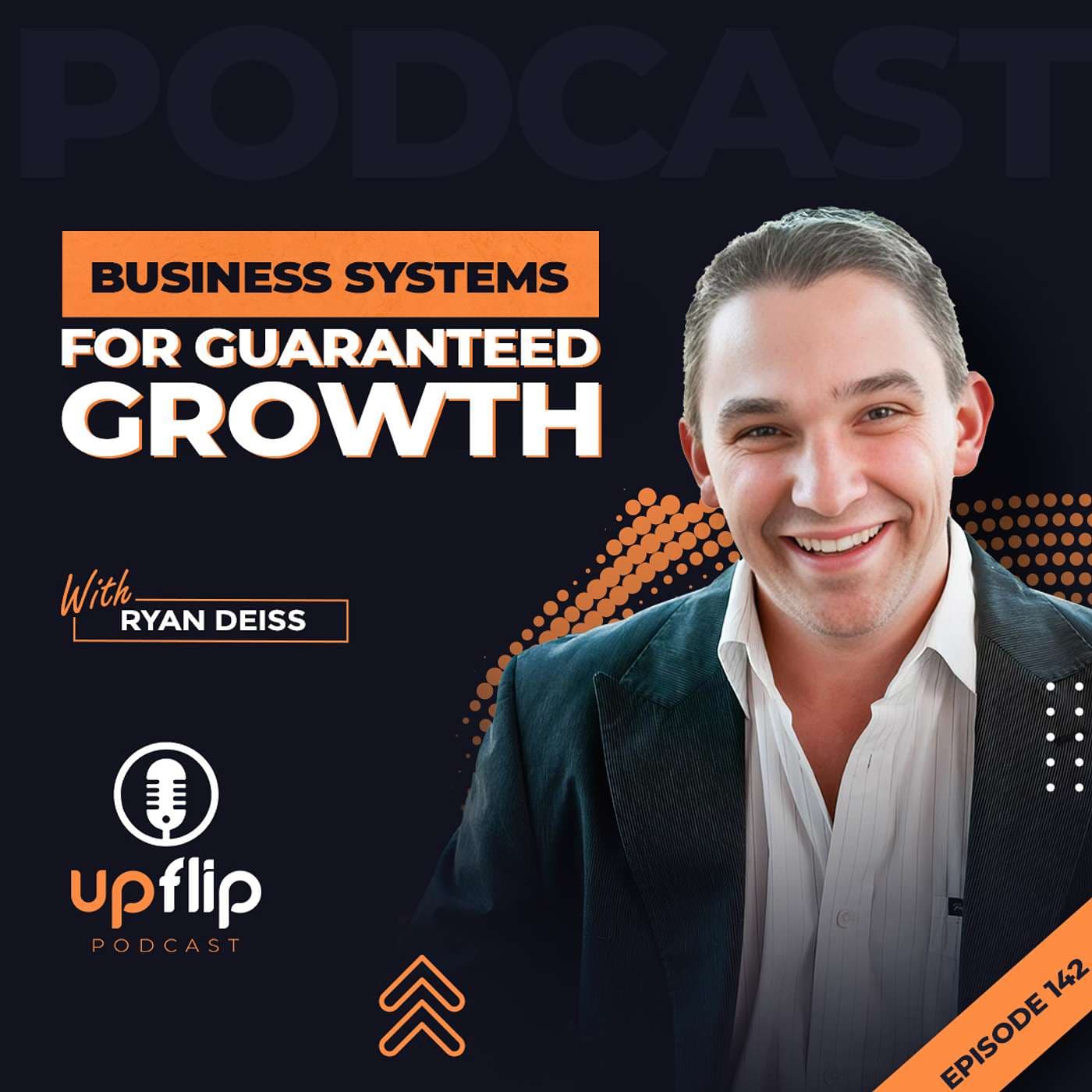
Episode Details Episode Title: 142. Business Systems You Need to Make 9 Figures (!!) with Ryan Deiss Guest: Ryan Deiss, Founder of DigitalMarketer.com and expert in scaling businesses Air Date: Not specified
---
Episode Summary In this episode, Ryan Deiss discusses effective business systems crucial for scaling a company to nine figures. He shares his entrepreneurial journey, emphasizing strategic planning, systemization, and the importance of understanding the customer journey.
Key Points Discussed
- Journey to Entrepreneurship:
- Ryan's early entrepreneurial efforts were sparked by a desire to buy a diamond ring for his girlfriend.
- His first venture involved designing websites, which led to the creation of an e-book about baby food.
- Importance of leveraging opportunities and understanding market demand.
- Foundational Business Systems:
- Growth Scorecard: A tool to track key metrics and customer acquisition steps.
- Customer Journey Visualization: Essential to understanding how customers find and interact with your business.
- Documentation and Systemization: Importance of creating frameworks for repeatable processes, especially during the early stages of a business.
- Sales and Customer Retention:
- Sell 10, Serve 10: Before systemizing, entrepreneurs should prioritize serving a small number of customers well to understand their needs.
- Importance of receiving feedback and ensuring customer satisfaction.
- Scaling Strategies:
- Focus on creating a compelling front-end offer to upsell subscriptions, rather than selling subscriptions outright.
- Successful clients are more likely to stick around and refer others, emphasizing the need for delivering value.
---
Key Takeaways
- Visualization of Business Processes:
- Use flowcharts and sticky notes to map out the customer journey, identifying critical stages where improvements can be made.
- Systematic Approach to Growth:
- Documentation should begin with core systems that drive customer acquisition, prioritizing sales and customer satisfaction before expanding operations.
- Understanding Your "Why":
- Entrepreneurs should evaluate their motivations for growth at three levels: personal goals, family and close relationships, and broader community impact.
- Metrics and Accountability:
- Establish a growth scorecard to track key performance indicators (KPIs) across the customer journey.
- Ensure that team members are accountable for specific metrics, encouraging them to actively engage with data.
---
Recommended Resources
- Books Mentioned:
- *The Goal* by Eliyahu Goldratt - A key text on process efficiency applicable to customer journeys.
- *Ogilvy on Advertising* - A foundational book on marketing and advertising principles.
- A finance and accounting book for entrepreneurs to understand cash flow management.
- Websites:
- [UpFlip Academy](https://bit.ly/3YA8Wkf) - Access additional resources and courses.
- [DigitalMarketer](https://www.digitalmarketer.com) - Learn more about Ryan's work and methodologies.
---
Conclusion Ryan Deiss emphasizes the importance of structured systems in achieving business growth. By understanding customer journeys, focusing on effective sales strategies, and visualizing processes, entrepreneurs can set themselves up for scalable success.
---
Fan Blitz Questions
- How do you get your book noticed as a new author?
Focus on grassroots strategies and leverage existing influential networks rather than launching widely.
- What is one secret of business that could make someone a billionaire?
Understand the founder's paradox
the more valuable you are to your business, the less valuable your business is.
- Key tips for scaling a subscription-based business?
Focus on compelling front-end offers and prioritize making clients successful.
- Books recommended for CEOs?
*The Goal*, *Ogilvy on Advertising*, and a finance book for entrepreneurs.
- What sentence would you like to hear from your employees?
"I created a place where they could do their best work."
---
Connect with Ryan Deiss
- Twitter/X: [@RyanDice](https://twitter.com/RyanDice)
- Book: *Get Scalable* available on [Amazon](https://www.amazon.com) or via [GetScalable.com/free](https://getscalable.com/free)
---
Thank you for tuning into this episode of The UpFlip Podcast! If you found this insightful, check out episode 131 featuring Michael Lisavetsky on developing a billion-dollar mindset.
Written by AI. May contain mistakes. Listen to the episode to check what was said.
Transcript
Automatic transcript. May contain errors.0:00Anyone can start a business these days, but scaling it to seven, eight, or even nine figures. This requires some incredible planning and flawless systems. Not many people have the knowledge and skills to do it, but today we have someone who does exactly this. This is Ryan Atkinson and you're listening to the Upflip Podcast, where we uncover how great businesses are built, how they run behind the scenes, and how you can replicate their success. Our guest today is none other than Ryan Dice, a legendary entrepreneur and the founder of digitalmarketer.com. He has created several multi-million dollar businesses, launched the largest digital marketing conference in North America and developed his own methodology for customer value optimization, among many other things.
0:41Today, Ryan's going to reveal how to build a scalable system for your business. Ryan, so, so excited to have you on today. Thank you so much for the opportunity. Yeah, thanks for having me. Appreciate it. I want to start with the very first way you made money. You have made a ton of money. You've generated a ton of revenue, but your story really gets started in 1999 when you're a freshman at UT and Austin. This goes back to your freshman year. You're at Texas and you create a website Played in an e-book on what? Can you kind of give the audience what that e-book was about? On how to make your own baby food.
1:08It's a funny story. I didn't set out to be an entrepreneur. I didn't set out to start a business. I met a girl. So my freshman year of college, I met a girl and I knew within a couple of weeks of dating her that she was the woman I was going to marry. And I know how creepy and weird that sounds, by the way, which is why I didn't tell her that because that sounded freaking creepy and weird. But I thought this is how my brain works. I'm like, OK, met a girl. She's awesome. Probably going to marry her. To do that, I should ask to marry her. To ask to marry her, I need a diamond ring. Diamonds are expensive.
1:32I'm broke. I should start a business. No joke. That was the thought process that led me to starting a business. I had a job and I had some scholarships that were basically just paying the bills. I didn't have any extra money or a whole lot of extra time, but it was 1999, man. Like the internet was brand new. My dorm had just got high speed internet installed the year before. So I figured let's give this pesky internet thing a try. And my first business actually was designing websites. Now I didn't know how to design websites, but I figured if I could get a client, I would learn. And so I went out there, I marketed myself as a web designer and I got one.
2:01And this one woman, she was willing to take a chance on an upstart web designer, and she was a lactation consultant. Do you know what a lactation consultant is, Ryan? I kind of have an idea, but I definitely want you to tell me. Yes, I've got four kids now and my wife nurse all of them. But a lactation consultant helps new moms with the nursing their babies, stuff like that, because although it's a natural process, it doesn't always come as naturally. So that's what a lactation consultant does. And so she wanted a website to help promote her services. And also she sold different products, breast pumps and things like that.
2:29So here I am. I'm 19 years old. I'm in my dorm room. And I'm building a website with like nursing pads and breast pumps. My roommate walks in and thinks I'm into like some, you know, weird, creepy stuff. Trying to explain to him, no, I now have this web design business. She's paying me 500 bucks to build her a website. I'm thinking I'm in the money. Unfortunately, the economy took a turn. Her husband lost his job. She had to go back to work and had to abandon her lactation consulting practice. And she called me up and said, hey, I'm sorry, I can't pay you. And I was freaking pissed. I was broken.
2:55I was so upset. I'd worked really, really hard and I needed the money. And she said, but what I can do, I had started working on this ebook that I was writing on how to make your own baby food. And I'll just give it to you and maybe you can sell it and make some more money. And I remember thinking, what the heck am I going to do with a stupid PDF on how to make your own baby food? Like, there's just there's no way. But Google was brand new back then. And back in the day to sound like a guy who like had to walk uphill both ways to school in my barefoot. Google will tell you the search volume for any keyword.
3:26It'd be like, this is how many people search for that. And so I remember just getting ideas like, I wonder how many people even look up how to make your own baby food. I don't remember what the number was, but it was shockingly high. And I went and I Googled it and there was very little listed there. So I was like, well, crap, what do I have to lose? So I built a simple one page website, you know, sales letter that talked about the importance of making your own baby food and all these other things. I, you know, signed at the bottom with her name, even though she didn't give me permission to do that.
3:48I didn't know any better. And I put at the bottom of the page back in 1999. Are you ready for it? I just put how to make baby food over and over and over again at the bottom of the page. And I made the words the same color as the background because that was good enough to get ranked back then. Just keyword stuff, the thing and waited a couple of days. And sure enough, there was my site, number one on Google and AltaVista and all the other search engines. And that day I had my first sale, then a couple more, then a couple more. And before too long, it was like a nice little business producing well in excess of not just 500, but more than$500 every single month.
4:20I thought, what would happen if I had 100 of these things? So that's kind of where I went next. That's absolutely incredible. I like that it starts off with like, oh, well, I need a diamond ring to like marry this girl. Then it leads to a website design and then it leads to maybe formula, which I think is really interesting. I love that growth I got you had there. It's the classic entrepreneurial path that everybody follows, right? What other path would you want to follow as an entrepreneur, honestly? But what were those kind of those next steps? Because I know this is around 1999, maybe it's like 2000, 2001.
4:45You can kind of like lay those big next steps. We are going to talk about systemizing your business, everyone, I promise. But yeah, what were kind of those next steps? I want to lay the base on because you have a phenomenal background here. I truly said, I mean, I'm not exaggerating. I was like, what would happen if I had 100 of these? And so what I realized at the time and what I did back then, look, would never work today. And I think it's important anytime you talk to an entrepreneur and they don't credit luck to at least some, if not a significant aspect of their success, they're completely full of crap or delusional.
5:08I was very, very lucky in the time that I showed up on planet Earth. But I asked myself, what are some other things that people wish they knew how to do, but there's not just books out there? This was later on referred to as a long tail strategy or a niche strategy. So that's what I did. And then next, I think I went into how to roll your own sushi. And so I got somebody who had done a project on like a multimedia project. And that was his topic. I was like, hey, can I license your content from you? Because I knew I don't know anything. And so the only thing I know how to do is build a website, get it to rank in Google and stick an order form at the bottom so that people will give me money.
5:42That's the only thing I know how to do. So I'm only going to do that for everything else. I'm going to get other people to do it. So I was researching things. I have my, you know, English major friends write e-books for me. At this point, the kind of freelance movement started to begin. So you could hire people overseas to do it. And so, yeah, I was just putting out all these little e-books, not really telling anybody what I was doing. And so I found one thing that worked. I found one thing that I was good at it. And I just doubled down on both. Interesting. I think your origin stories really start from like this digital age.
6:08And like you said, I feel like you were born at like the perfect time to actually be able to capitalize on like this digital boom of like people going to Google to actually search for things like how to roll sushi or like baby forma and all this stuff. And I feel like it's just, yes, it's luck, but it's also a testament to like your skill of actually being able to monetize online and understanding what people want and actually being able to deliver that for them. And that was the thing I focused on. Everybody else who was building websites was focused on design and prettiness. I did wind up actually getting a job doing web design.
6:34And I remember there was a group of us and everybody else knew how to do flash design. And I don't know, you're probably not old enough to remember this, but it used to be you'd go to a web page and there was this like flash intro and all this like swirly stuff would be there to welcome you to the page. And that's what everybody wanted because it looked cool. Now, I didn't know how to do that because it was hard. What I knew how to do was to put a table, like a border with a headline at the top and some other words down below it and a button that said, buy now. That was all I knew how to do. And if we were going to build a web page that was going to collect leads, for example, everybody else knew how to do these really swirly, twirly, pretty landing pages.
7:08I didn't know how to do that. I knew how to have a headline with a sub headline and a form. Well, guess what wound up actually converting better? Mine. And even today, if you look at the landing pages of all the major newsletters that are out there, they would look really similar to the same things that I was building back in 2000, 2001. It's not because I was good or had all this foresight. I was constrained. And I think too many entrepreneurs feel like they need to figure out everything before they can get started. When more times than not, if you'll just freaking get started, you'd be shocked at how often the simplest, most basic stuff is what works the best.
7:41It's not just that it's all you can do. It's what actually works the best. I'll speak to like my experience with that as well. We have a landing page here that we use at Space Bar Visuals. It's literally if someone clicks on a newsletter ad that we like have and like takes a start landing page, it's literally like two sentences and enter your email. That's all that we have on there. We just keep it super simple. And compared to like these really fancy ones that we've done, like it's by far our best converting one just because it's so simple. Well, and last I checked, you're pretty good at the production design stuff, right?
8:07Like that's kind of like what you do, right? So I think it's important that people remember that. And so often it's why I think success is such a terrible teacher because really it just makes you fat and arrogant. It's kind of some of the losses, some of the L's that you take where you actually learn some things. And the beauty of getting started is you don't know what you don't know. And if you're willing to just move forward in the mystery, you're going to be better off than everybody else because everybody else thinks they got to have it all figured out to even get started. No, you don't. I love that.
8:33The number one step, if you want to become an entrepreneur, just take action. I want to kind of shift to that systemizing the business aspect because it's one thing to get started, but then that's the next thing to actually grow your business through systems. And for someone that's at like the baseline level entrepreneur, that's like zero to 500K in revenue, somewhere around there. Let's talk about like your definition of like a business system and like why it's important for someone to actually implement it early on in their business. A core business system is just any documentation that somebody with basic training and context can take that system, execute it and achieve predictable results.
9:06Right. So that's the essence of a business system. Now, there's higher levels to that. You've got total company wide operating systems and those kinds of things. Frankly, you don't need to worry about that until you're doing millions of dollars in revenue. The very first business system that any entrepreneur needs to create, though, is what we refer to as their growth engine. The growth engine is the system that documents how new customers and clients happen. And that is the single most important system that you can document. Have you read the book, The E-Myth? I have not, but it has been a world-renowned book.
9:33I have not personally read it, though. So I'll summarize it for you. It is a great book. I'm not knocking it. But the essence of The E-Myth is as an entrepreneur, you need to document absolutely positively every little thing that you do in your business. McDonaldize your business. Systemize every little aspect of your business so anybody can do it. And look, that is directionally accurate. But if you do this early on, and even if you do this when you're generating millions of dollars in revenue, it'll be the most giant waste of time you will ever spend as an entrepreneur. Ask me how I know. I literally, I read that book over vacation.
10:02And I remember coming back the next Monday to the office and calling a team meeting and be like, which by the way, don't do that. Anytime you're about to call a team meeting, you're probably about to say something super stupid. But I called this team meeting. I asked everybody to come into the room. I like everybody. I've got an announcement to make, effective immediately. I'm not going to greenlight any new projects. We're not going to make any new hires. We're not going to do anything until everybody's documented absolutely everything they need to do. It took 30 days. Everybody was super pissed off and panicky that I was making them do it.
10:26But at the end of the day, we had it. We had these binders full of all of these checklists that literally nobody ever looked at. Nobody freaking looked at. I'll tell you, the very first checklist, the very first business system that we ever created was a checklist on how team members could request paid time off, how they could request vacation. Oh, man, Ryan. I'm telling you, man, when people go to systemize stuff, we start with systems that don't freaking matter. Nothing. I repeat, nothing, nothing, nothing happens until something is sold. I work with a lot of entrepreneurs at all different levels.
10:56Anytime I'm working with an entrepreneur who's in that early stages, sub a half a million dollars in revenue, and they're frustrated and like, I don't know what to do. This isn't working. I don't know what brand is. I was like, just go sell some stuff. Only thing that you need to focus on is just go and sell it. But, you know, it's not scalable. I don't freaking care. And I say this as the person who owns the scalable company. So if I tell you it's OK just to go through and do something, even though it's not scalable, I promise you it's freaking OK. So step number one is always just go out there and sell some people something.
11:26Then step number two is you got to make sure they liked that they did business with you. You got to sell them. You got to serve them. That is level one. That is stage one, phase one. Sell and serve. And, you know, I tell the people that I'm mentoring 10, sell and serve 10. Now, sell and serve. That doesn't mean just go out and sell 10 people something because it's possible you sold 10 people something and five of them thought it was awesome and five of them thought it sucked. You did not sell and serve 10. What this means is you're still not clear on who your ideal client is, not until you have sold and served.
11:56And we define served as if you ask them at the end if they're happy and if they would refer you to their friends on a scale of one to 10, you get all of them saying nine or above. That's classic net promoter score. OK, sell and serve 10. Once you've done this, now we can start to think about systemizing some business systems in the very first business system that you systemizes that process for getting those 10 ideal people. And we do this. It's really, really simple. I go to a whiteboard and I get some sticky notes and I ask the team, OK, team and maybe team is just me at this point. How the heck these 10 that we sold and served that actually liked that they did business with us, how did we get them?
12:33Where did they come from? And that's important because people, when I ask this of folks, they'll be like, oh, well, you know, we'll advertise on Facebook and we'll advertise on Instagram and we'll do some Google stuff. And, you know, I'll do some things at trade shows. Yeah, OK. But the 10 that were happy, where did they come from? Oh, well, across the board, they all come from when we sponsor events. OK, event sponsorship. And I write that on a sticky note and I put that on the board. Then what I do is I go to the bottom right hand corner and I write sale is made. So we got the start. We got the end.
13:02Now all you do is you go back and you say, okay, once, you know, we talked to somebody in event sponsorship or once somebody clicks on this Facebook ad, then what happens? And you literally put sticky notes for each stage of the process. You connect the sticky notes with the arrows. You've got a basic flow chart of how clients happen. And that is the most important thing and the very first business system that any entrepreneur needs to create a visual picture, a visual map of how customers and clients happen. Can I get a drum roll, please? because we are giving away a free lifetime access to the Academy for one lucky listener.
13:34And it's super simple to participate. All you need to do is leave us a review on Apple and then send us a screenshot as proof. Takes five minutes for lifetime access to the Uplip Academy for free. So two steps, leave us a review on Apple Podcasts, send us a screenshot, and the link to participate is in the show notes below. If you are a wannabe entrepreneur, the courses in there are so invaluable for you to actually get that first business idea off the ground. And then for the current business owners that are looking to sharpen their skills, there are a ton of courses in there for you. And the best part, you're gonna be able to connect with other top-notch entrepreneurs in your field to network with them and learn from them.
14:10The winner will be announced on July 26th. All you need to do, leave us a review on Apple, send us a screenshot of proof, and you guys can find more details in the show notes below. So it sounds like a little bit of this is like attribution reporting or like knowing, maybe from like, fully distracted if I'm wrong, like, oh, did they come from an event? Did they come from a Facebook ad? do they come from a cold email campaign? That's kind of how you're building that first system for your company. I mean, at this point, I don't think we're that granular. I mean, if you know anything about attribution, you know that it's always horse crap, right?
14:35Yeah, honestly. It's accurate to some degree, right? But I mean, anytime you get into multi-touch and all these other things, they're like, I don't know. So I'm oftentimes just going by like, you only got 10. Ask them, how'd you hear about us, right? You got 10. And it's fine if you have a couple. So if you've got multiple channels and you know they work, you know, that's great. You can have multiple sticky keynotes. We simply want to create a visual picture of they hear about us here. And then once they do that, then they go to this page. And then once they do that, then they're going to go to this one.
15:01Then we're going to have this conversation. And if they don't opt in, we're going to do this follow up. And if they do, then we're going to go over here. You want that visual picture of the customer journey. You cannot optimize until you first visualize. So that visualization is the first one. You don't need a ton of checklists. Just get a whiteboard sticky note flow chart of how customers and clients happen. I love that. And I want to ask as well. So basically, is your cutoff like sell 10, serve 10 and then start doing this? Or like, is there a certain revenue mark where it's like, OK, now we're at 500K a year, like we should start doing this?
15:31Or is it truly that sell 10, serve 10 and then start doing this? By the time you've sold and serve 10, it's really hard for you to not be generating in excess of$100 ,000 a year in revenue, right? I mean, some of my programs only like$1 ,000, right? Yeah. I mean, you're going to start adding other things to it. So I'm not saying that your average client is necessarily going to be worth that. But you're also probably going to need to sell more than 10 to find the 10 that you truly served, that were your ideal clients. You're going to kiss a lot of frogs, which in the early days is okay. It's okay.
16:00But you need to find the ones that you freaking thrilled beyond belief. And so, yeah, it's loosely that kind of number when I have a sense of confidence. And at that point, that's when you know you're post-traction. You've got product market fit. And I just think it's important. Never systemize until you've proven. Like, don't build systems around things you hope super true. That's stupid. Go out and do the thing. And then once you've proven that it worked, then systemize it. The last thing you want to do is systemize a third. Yeah, agreed. So I really like that. So number one, like really visualize that.
16:29So once we do visualize that customer journey, like we have an idea of like how they're coming in, we're serving 10, we've got 10 happy people. What's kind of like that next step along that someone should be taking once they do visualize that customer journey, just so they can start thinking about systemizing their company. Yeah. Then what you want to do is you want to look at those different steps and stages. So literally look at the sticky notes. And ultimately, what we're going to do is we're going to, by the way, plot this in an actual flow charting tool, whether it's like whimsical or, you know, one of the other billions of like flow charting things because sticky notes fall off of whiteboards.
16:55But you want to look at the still think about it as sticky notes. And I want you to look at an audit it and say, of all these sticky notes that are up here on this whiteboard, what are the ones we absolutely positively cannot screw up? Like what are the high stakes, high chance for human error? We got to make sure that we get this right. And what are the ones that consume a lot of your time that you would like to hand off to someone else. One of the biggest mistakes that entrepreneurs make is they think that they can make one magical, mystical unicorn hire who will do all the crap that they don't want to do so that they can now just focus on vision.
17:23That is one of the biggest lies ever perpetuated on the entrepreneurial community. It is horse crap. Okay. You're not going to hire some magical quote unquote integrator who's going to do all the crap that you don't want to do in your company. It ain't how it works. At some point at scale, you can hire an operator, but operators come after operating systems. Systems first, then the people to run them. That is one of the most important things. So don't just start hiring people, okay? You've got it visually mapped. Now look at it and say, okay, what are the specific steps and stages that I need help with?
17:50Either because you suck at it or because it's just taking up too much of your time. Then those are the ones you say, okay, I'm gonna need to hire someone to do that sticky note right there. But if you hire them first and you bring them in, they're probably going to fail because you haven't yet documented and systemized how you do that thing. So you need to do that first so that when you hire that person, you say, welcome, brand new hire. Could be the first, second, it's probably one of your early stage hires. Welcome to the company. This is how we get customers. Let me walk you through it. Do you understand how we get customers now?
18:18I do understand that. Thank you so much. Great. Of all these steps and stages, I hired you to do just this one right here. And good news, here's a checklist and a little video training on how to do it. That is how you scale teams. That is how you get out of the day-to-day of each and every one of these things. You first visualize, then Then you systemize, then you outsource. Right. And that sequence is everything. If you throw people at your problems, you're just going to have more problems because good people do not fix broken systems. Broken systems break good people. That's a phenomenal quote.
18:49But I want to also ask what I really like about this as well is like you're doing the work before you're actually hiring someone to do it. You're not just bringing on someone and be like, can you actually figure out like all these systems that are in place? It sounds like this strategy is a little bit more of like identifying everything, systemizing than actually hiring someone to fit in that unique skill set that they have that you might not have? Well, if you're doing it already, right, then you do know how to do it. You have done it. Now, if you've got a founding team and there's other people coming together, I'm not saying it has to only be you.
Read the full transcript
19:14But look, if you're a solo founder, you know, then you're all you got. And so you're doing it. And I'm always a big fan of do then document. You can bring somebody else in to say, how can we do this better? This particular stepper stage here, that's usually not an employee, though. It's especially not an employee that's going to come and work for an early stage company, because typically at early stage companies, you're going to attract people who are early stage in their career and are not knocking those folks. Those folks have hustle. They got drive. They frequently have time and they'll almost always work for less.
19:42The problem is they don't know what the hell they're doing either. And if you ask them to systemize, if you ask them to optimize something, well, by God, they're going to try. And they're probably just young enough to think that they can do it. And so, you know, one of the worst things in the world that you can do is ask a new employee to do something that you have no reason to believe at this point in time that they can do. You're setting them up for failure. So I would much rather say, this is how I do it today. I would love for you to do it this way. If you have ideas for improving it, I would love to optimize this together.
20:11But can you start by doing what I know works to some degree so that we're basically limiting our variables? At scale, heck yeah, you're going to look to hire people who are way smarter, way better than you are at specific things. But typically, you're not going to be able to afford those people until you're probably north of seven figures a year. Because usually those people who are better at the stuff that you are, are going to claim six figure salaries. I like absolutely love that advice. And I can speak to that from heart because our average age on Spacebar Visuals is like 24 and a half years old.
20:37And like, we have like a lot of young people that are like hustle, do anything, like we'll try. But it's also setting up for success. Like when they get in there, it's saying like, hey, this is how like a documented account management process. This is what we do now. But like, and please optimize this as you see, like fit and like we can work together on this. I feel like that's a really beautiful marriage to actually have there, to be able to scale those operations with those standard operating procedures. Don't hear me say that you need to tell them that they need to be robotic about this, right?
21:01It is wrong. You will break people if you throw them at a problem and say, figure it out, I trust you, even though you have no reason to believe that they can do it, right? That's super uncool, okay? You're setting them up for failure. It is equally wrong and equally uncool and maybe more so to say, all you are is a robot. I don't care about your opinions, your feelings or anything that you figure out while you're in the trenches. Do it my way or it's the highway. There may very well come a time in your company when you get there. Like if you, for example, are a McDonald's franchisee, it's like, no, this is how we make freaking fries at McDonald's.
21:28OK, I don't need your ideas. We're McDonald's. We've been doing it forever, but you're not there yet. So, yeah, it's here's how I do it. It's worked for me. Please start from this so that we've got the same foundation. But God dang it. Yeah, if you got ideas to optimize it, give it hell. Let me know. I absolutely love that. Ryan, you say a lot of quotable stuff. I really like that about you. I want to do a callback to that growth engine as well that we talked a little bit earlier, because I think that's a really interesting part. So on that's in sales, that loves marketing. Like I love talking about like growth, growth, growth.
21:53How do we grow? How do we grow? Can you kind of expand on that growth engine a little bit more that you talked about? 10, 15 minutes ago. So it's funny, the very first growth engine that I ever documented, it was the first time I nearly bankrupted a company. And I've done it a couple of times. But yeah, I was actually in Dallas, Texas at the Hilton Anatol at a conference and I went to go pay my bar tab and my card declined. So I gave another card and it declined as well. I pulled up my bank and I realized that I had no money. I was overdrawn in my checking account, I was going to pull some money from a line of credit, but it was tapped out.
22:20I was going to pull money from a credit card, but they were tapped out. I was literally about $250 ,000 in debt. Oh my God. At the time, the business was doing okay revenue-wise and cash flow-wise, but I believed that as long as I made enough money at the top, that some of it would trickle down to the bottom. And it turns out if you spend more than you make, you still go broke, no matter how much you're making. Hard lesson that I had to learn. And what I was doing at the time is I was flailing around and practicing random acts of marketing. And I see entrepreneurs, I see marketers do this. You know, they'll listen to a podcast.
22:47They'll see a YouTube video. They'll hear about somebody who's doing some amazing super whiz bang thing. And they're like, I'm going to do that, too. And some of it works and some of it doesn't. Some of it sticks and most of it doesn't. And you turn around and you go, I don't even know what works anymore. And so just simply pausing to say, how do these customers actually happen? Not what do we do? What actually generates them? And to have that visualized. And so a classic one, when I was sitting there at that bar in Dallas, Texas, I was literally ready to hang up. I was like, I'm going to have to go file bankruptcy.
23:16I'm going to need to go and see if I can get a job and shut my company down. And just like the week before, I'd had a conversation with another entrepreneurial friend and he told me, we were just talking about how isn't it interesting how so many business ideas were formed on the back of a napkin, right? You know, at the time you were having ideas in Silicon Valley getting funded just scribbles on a napkin. And I don't know why that memory just popped into my head and I looked up and there was a stack of cocktail napkins. I was at a bar after all. This is not particularly extraordinary, but I grabbed it and I borrowed a pen and I was like, I made myself a deal.
23:41if I can document on this stupid little napkin how my business works, then I'll work my napkin, I'll figure it out. And if I can't, then I'll just accept the fact that it was just luck. I never knew what I was doing all along. I'll quit and I'll go try to find a job and do what I can to dig myself out of this hole. And so I sat down and I asked myself, okay, what's the first thing that happens? Well, I need to generate traffic. How do we get traffic? Google ads. The time is Google ads. Then where do people go? And I drew a box on the napkin for landing page. What happens after the landing page?
24:09Well, it depends. If they opt in, then they're going to go to the thank you page or I'm going to make an offer. If they don't, then, you know, we're going to look to follow up with them in other areas, you know. And so all I did was just, you know, drew squares on this napkin. And when I was done, I had filled up the napkin. Man, it was only like five or six squares. It wasn't that complicated, but that was enough. And so I think it's important when you're mapping this growth engine, you don't have to get hyper granular with it. But you do need to be very clear. This is where it starts. This is how people become aware.
24:37This is where it ends. We got the sale. The contract was signed. And all you're saying is great. Then what happens? Then what happens? Then what happens? The only other little advanced maneuver that I've added since that day back in 2006 at the Hilton Anatol, I realized that if you get to one of those, it depends. And this happens a lot of times after a landing page, right? So let's say somebody, they click on an Instagram ad, right? What happens then? Well, they're going to go to your landing page. Well, if they opt in, then what? Well, it depends. So if you say it depends, write a diamond, or you could take your sticky note and just turn it on a diagonal.
25:05Sticky notes are great because they come in both square and diamond shape, right? So you're going to say like, did they opt in? If yes, then they're going to go to thank you page. If no, then we'll add them to our retargeted pixel audience and we're going to try to bring them back, right? And so what happens after thank you page? Well, we're going to have them watch this video and see if we can get them to book a meeting. You know, what if they don't book a meeting? Well, we're going to add them to this follow-up sequence, right? And so I don't have to have a sticky note for every single email in the follow-up sequence.
25:30I'll just have a sticky note that says follow-up sequence, new lead follow-up sequence or indoctrination series. What is that designed to do? To bring them back over to this other sticky note to get them to wait for it, book a meeting. And then it's like, okay, when they book a meeting, you know, then what? I don't know. Did they show up, right? We've got another little thing here. Did they show up? What I'm really digging from this is like visualize like every step of like your lead gen process, like those if then statements, if not, like what are we doing to get them to actually like book a meeting or like get a sale with us?
25:56That's kind of like my big takeaway is so far from like just all this. And then the next step. So we talked about how you can look at that and say, what are the ones we don't screw up? That's where we create documentation. What are the steps where I need help? That's where we build our hiring plan. The next step after that is to go back to that flow and say, what are the metrics we need to track to know that each one of these steps and stages is working? And so now what we do is we build a growth scorecard. And at the top of the growth scorecard are all the awareness sticky notes. And as you move down the scorecard, and we just use Google Sheets for this, by the way, we don't use any fancy software.
26:25We track it week by week. These are the metrics that we need to track to know how we're doing within this particular customer journey, within this value flow. We use color coding, red, yellow, green, depending on if we're ahead or behind target. So it's very easy for me to see at a glance where in this value flow is there a bottleneck? Where is it constrained? What do I need to fix? And so now the game is no longer, I need to just figure out how to get more traffic. We need to get more leads. Well, maybe you do. Is that red? Maybe you're hitting your traffic goals. That's green. The problem is, is that your sales conversations are low.
26:59Why are they low? Well, God, look at our show up rate. Oh, we had a show up rate of 80 % and it's 48%. Let's just fix that. Once you have visualized how customers and clients happened, once you built a scorecard to track each step in that process, the game becomes really simple. Turn red to yellow and yellow to green. That's it. Turn red to yellow and yellow to green. But I don't know how to turn this one from red to yellow and yellow to green. Ask someone. Get in a group. Buy a book. Watch some YouTube videos, right? Now it's not random acts of marketing. if you know the question to ask, the answer is usually pretty easy.
27:29The problem isn't that we don't know the answer, it's that we don't know the right questions to ask. The scorecards will give you the right question, but if you don't have a scorecard based on your growth engine, on that visualized customer journey, you're probably gonna have vanity metrics and it's not gonna tell the story it needs to tell. Yeah, it's not gonna be accurate at all. And like a lot of the things that I learned from this podcast is like so much of like measure everything. And once you're able to measure, you can actually improve stuff. I wanna ask on those KPIs specifically, can you give us a high level overview of like what are the KPIs on the scorecard?
27:54I heard like traffic, of course, and like show up rate, all that stuff. But like, what are some other KPIs that people should be measuring on the scorecard? Sure. And again, it's going to depend largely on what the specific growth engine is. But let's say like a typical one would be there's a sticky note for Facebook and Instagram ads. OK, so how do I know that Facebook and Instagram ads are working? What are the metrics? I'd want to look at what is the total ad spend? Because we're going to have a budget on that. I'm going to want to look at what is, you know, the click-through rate. I'm going to probably want to know what's the cost per click.
28:17So those are three metrics that would represent that particular one. OK, now let's move on to I feel like that sticky note is covered. Let's move on to the next sticky note, the landing page. Well, I'm going to want to probably look at how many visitors hit this page. And I'm probably going to look at what's the conversion rate, right? If you have a drop down there, maybe on your landing page, you're asking a qualifying question. You might say, what percentage is qualified versus disqualified, right? Okay, that sticky note's covered. Let's move on to the thank you page. How many people hit this thank you page?
28:41What was the conversion rate, you know, or the click-through rate from the thank you page to the book a meeting, right? Okay, let's go to book a meeting. What percentage of people who hit the meeting actually booked a meeting? What percentage of people who booked a meeting are actually qualified based on the questions that we asked? I like this. Now we're going forward. You know, the next day is like, did they show up? OK, what's our show up rate? Right. What's the close rate? So it becomes really, really simple if you just say this sticky note, how do we know this one is working? And then you just stack these going all the way down the page.
29:05And when you're done, typically we're going to be tracking you are between 15 and 20 metrics per growth engine. So for me, I don't want to track everything. And we'll have people on the team like, oh, you don't have any metrics there. I remember when I showed the growth engine to one of our marketing teams like, oh, you're missing some metrics. What metrics are we missing? Well, you don't have blog visitors and how many people read our articles. You're right. We don't because there's not a sticky note for articles, blog articles and blog anywhere on the growth engine. Oh, well, it should be because we spent a lot of time on that.
29:32We spent a lot of money on that. OK, great. Can you show me how when somebody reads one of our articles, where do they go? Where do they go from there? Oh, yeah. You know what? I know we're supposed to be doing interlinking to like other lead magnets and things like that. But yeah, we haven't been doing that. We've been really busy lately. OK. Until you can show me how those efforts connect back into one of these growth engines, you don't get a sticky note on the board. And frankly, if you don't have a sticky note on the board, I start to wonder, why the hell are you here? Right now? I wasn't that curt with this person, but you get the idea.
30:00It is amazing how many orphaned efforts you have that reveal themselves when you realize, oh, it's not a sticky note on the value engine. Well, that's because it doesn't connect to the value engine. Well, we should figure out how to connect it to the value engine or wait for it. It's not valuable. And if it's not valuable, we should just stop doing it. That's really good. I want to ask real quick as well, and like how you're getting these metrics, how you're tracking is, are you using any special software? Are you just using like Google Analytics, any software that you're particularly using to help track?
30:25Typically Google Analytics and then, you know, CRM. So most of our companies are on, you know, HubSpot or, you know, something like that. So typically they're active campaigns. So yeah, they're usually going to need to look at Google Analytics for all the conversion traffic data. They're going to be looking at HubSpot or one of the other ones for pipeline data and things like that. But an important aspect of our scorecards, they're all manual by design. So none of our scorecards auto populate data and none of them auto create a status. If somebody owns a particular metric. So if you're, you know, our traffic manager, there are metrics next to every single one of those metrics is a name.
30:56Somebody owns that metric. And so it is their job to go into whatever system and manually look at what the number is and manually copy and paste it or write it into the scorecard. And they do this every Monday morning and people will fight me on this and they'll go like, oh, but you could write a macro. I know. Oh, but there's like business intelligence. I freaking know. I've spent hundreds of thousands of dollars on all of these freaking tools. And guess what? They all break because the little connectors become disconnected. And now you have the worst thing in the world that's worse than no data, which is bad data, inaccurate data.
31:26When that happens, people stop trusting it. They stop looking at it. But the bigger issue is when people don't manually enter their data, they don't know their freaking numbers. And it drives me insane. If you're on the marketing team, if you're one of our heads of marketing and I say, hey, how many leads did we get last week for that thing? You need to know that number. That's like your whole freaking job. Like know that number. If every single Monday they're manually putting it in, they know their numbers. You also get something more than data. You get insight because now they look at it and they go, oh, that seems off.
31:50I'm going to go do some research and figure out what's going on. They're also going to have to manually select red, yellow, green. Green is on track or ahead of goal. Yellow is we're behind, but we've got a plan to catch up. Red is we're so far behind. We won't catch up or we got no plan. We don't know how to catch up. Well, nobody wants to put red. So yellow means I need to come up with a plan before this next meeting because I don't want to have red on my scorecard. So we use Google Sheets. It's all manual and it's all by design. I love that. Yeah. What I really like about what you said there is like when it is manual, you actually know what your numbers are and it actually adds accountability.
32:22And when you're doing the accountability piece, is it just one person that is accountable for each metric or is it like sometimes like two people on a metric? How do you play that? If multiple people are accountable, nobody's accountable. So yeah, there's going to be one primary for each metric. I love that. That's why I asked. Yeah, good question. There's one primary and it's common for one person to own multiple metrics and it doesn't take that long. It's not that big a freaking deal to go in and populate. And it's some of the highest leverage, highest value time. But yeah, there's going to be one.
32:48Now, if they know they're going to be gone, like let's say they're going to go on vacation or they're sick or something like that. And if it's like a last minute, somebody got sick Sunday night, like whatever, I got it. But I mean, if they know they're going to be gone because they own the metric, it's incumbent upon them to assign somebody else who's going to get it for them. And they'll put that person's name next to it for that week or do like a slash for that week. But then after that, it's gone. I don't want two names in there for any length of time. I absolutely love that. I want to wind down that segment because we are kind of winding down on time here.
33:12I want to make sure we get to our fan blitz questions. But selfishly, I'm going to ask a question that's a little bit off the beating path. And that's like the power of thinking big. It's well known on your LinkedIn. You have it right there. You want to grow your hold co from like 200 million to$1 billion. I think that's amazing. It's big goals. It's big thinking. What is the power of thinking big as an entrepreneur? Because I'm going through this exercise now. I feel like sometimes my goals are too small almost where it's like, why am I not thinking much, much bigger on a scale? Like, where does that come from?
33:35So in your eyes, like, what is the power of thinking big? Just kind of some theoretical advice here for people that are listening. I'll give you some practical advice. I think you will only ever grow as big as you let yourself grow. The entrepreneurial journey, I mean, we're alchemists, right? I mean, we're creating something from nothing. That's hard. And so if you're not motivated to push, I can promise you it's not just going to magically happen on its own. No more often than you'll win the lottery. So you will only ever grow as big as you want to grow. So what you always have to be evaluating is what is your why?
34:00My very first business goal was to make $10 ,000 to buy my then girlfriend, my now wife of 20 plus years, a ring. So my first goal was, how do I make$10 ,000? Now, when I made$10 ,000, I could have stopped. But what I then realized is, whoa, I've got an opportunity now to build something really cool and big that could provide for my family, provide more, be able to do all the things that I wasn't able to do as a kid, because I didn't come from money. And then we were married for a couple of years. And here comes kid number one and kid number two and kid number three and kid number four. I mean, every other year there was a new little why showing up.
34:31And so I kept expanding my reason and my vision as my why was increasing. So I think I said I'd offer you a practical exercise. Your why comes in three levels. Level one is me. Like, what do you want for yourself? Your selfish why that you want for you? I want to grow this thing and make this much money because I just want a freaking Patek Philippe. I've always wanted it. I've always wanted a Lambo. Fine. Right. That is good. And I I think as entrepreneurs, it's like we're told because I'll do this with clients and things like that. Why are you doing this? What's your why? And I always get these very like lofty things.
35:00And after you get to know somebody, you know, they go out and they buy like a freaking McLaren. It's like, yeah, I've just always wanted a McLaren. Why didn't you tell me that? Right. That's great. I want that for you, too. So I think you want the selfish me. Why? Then you want the us why? And the us is I want this for my inner circle. That is yourself, your partner, spouse, if you have one, kids, if you got them, business partners, close friends, parents. Like I wanted to, you know, buy my mom a house. That was one thing that I really wanted to do because that's what frankly broke Southern kids do.
35:27You got by mama house. And then there's the them. So there's the me, the us and the them. And the them is what is the thing that I want, you know, beyond me. And ultimately, that is the one that is going to propel you the farthest because what you want for yourself is really only going to be so much. Right. It's only going to grow you so much. At some point, you're like even like private jet type money. It's like, do I need to own it or can I just charter? You know, it's fine. Like, I'm not motivated to work that much harder so I can own the jet versus charter. Right. And at some point, you're just like, how big of a yacht do I need?
35:53It just gets stupid. Ultimately, the people around you're taken care of and they're starting to get obnoxious. You've got to expand the why to others. And I'll tell you, I lost my way for a good number of years because I failed to step back and reevaluate my why. And I got bored. I got lazy. I got a little bit burned out. And it really took my wife saying, I'm kind of sick of you being a navel gazing, you know, whiny little twerp. You need to figure it out and get motivated again. And it did. It was during COVID. I hadn't really taken the time to think beyond me. But I do think if you don't have a why that is bigger than you, you will absolutely be capped.
36:22So it's essential that you think big. Yeah, I love that. And where it came from, from me is like, okay, like we can do 20k in revenue a month consistently, but am I capping myself at doing 20k a month? Or I need to start thinking about like, oh, we can realistically get to like 50k a month. And it just takes different systems to get there. But it also broadens your thinking about like, okay, how can we actually get to like 50k a month in revenue? And it always takes more than you actually think it does. And so yeah, that's just kind of where that question comes from is like, how do you think big as an entrepreneur to help you like propel like towards the goals that you want to hit.
36:51And I feel like that definitely answers those three whys that you have there. I want to wind down then here with our fan blitz questions. Ryan, this has been an amazing episode. So much about like the scorecard, the systems, the why. So this has been a ton of fun. And I know our listeners are also excited to ask you some questions. So if you guys want to join in on world class entrepreneurs and join in on the conversation, you can go to youtube.com slash upflip and submit your questions there. But Ryan, ready for our last five questions here? Let's do it. Number one, we're definitely going plug this at the end, but how do you get your book noticed as a new author?
37:19I had a very different strategy with my book. I didn't want to launch it. I didn't want it to be known. I wanted it to be everybody's dirty little secret within particular pockets. So the main strategy that everybody does to get noticed is they do a big launch campaign. They do a book launch and they try to get booked on every single little thing all at once. That will get you known, but that is a really fast fire that flares out really quickly. I think a better way to get known is more of a grassroots strategy. Go to key centers of influence that influence It's pockets of people far more persuasively than trying to be everywhere all at once at the same time.
37:50It's really hard to pull off. And I don't know if you know who Alex Formose is. He's a buddy of mine. I've known Alex for, you know, a long, long time. And same with, you know, Tim Ferriss. Like, I knew Tim Ferriss back. I sound like a total douchebag doing name dropping, but they're good examples. When Tim first launched the four-hour work week back in, I don't know, the dinosaur times, that really grew. Like, that got in the hands of a couple of people. And for a year, it was seen as a status lift to tell somebody about the 4-Hour Workweek because some people had heard about it, but most people had not.
38:18And I think for your very first book, what you would rather be than everywhere all at once at one time for a brief moment is you want to be important people's dirty little secret for a period of time and then allow it to just percolate up. That's what Tim Ferriss did. That's what Alex did for his first book. Now, for your second book, you don't really have that as an option because you got a big brand. You better freaking blow it out and hit it out of the park. But for your first one, don't try to blow it up big. You probably won't pull it off in trying. You're probably going to fail. You're going to look sad and doing it.
38:45It's going to make you unhappy. So try to come up with 100. Make a list of your classic Chet Holmes Dream 100 and see if you can't get that book in the hands and get them excited about it. Because if 100 people tell 10, you're done. Like it's going to go nuts. I love that. Number two, tell me one secret of business which makes me a billionaire. I refer to it as the founder's curse, the founder's paradox. and it states, the more valuable you are to your business, the less valuable your business is. And it is the single hardest thing for founders and entrepreneurs to get their head around. But your goal as you scale is to not be increasingly more valuable to your business, to not be your team's MVP, but instead to be the least necessary part of your business.
39:24You don't become a billionaire by being the most valuable person at your company. You become a billionaire by having equity in multiple businesses. And you cannot have equity in multiple businesses if you're the most valuable person at all of them, unless you're maybe Elon Musk, but you ain't Elon Musk and neither am I. That is really good advice. I like that a lot. What are the key tips for scaling a subscription based business? Nobody wants to buy subscriptions. And so the best way to scale a subscription based business is to have a really compelling front end offer that is sold a la carte that upsells and ascends into subscription.
39:57So we don't sell subscription, we upsell subscription. And then when we get somebody into subscription, we focus all of our efforts not on making them happy, but on making them successful. Happy clients don't stick and happy clients don't refer. Successful clients stick and successful clients refer. So don't focus on selling subscription. Get a front end sale. Get some type of productized service out there if you need that. Ascend people into subscription and do everything you can to make them successful. I like it. Two more. What are two to three books you'd recommend any CEO to read? Book number one would be The Gold by Eliyahu Goldratt.
40:28It's a book that is fundamentally about manufacturing process efficiency. But when you realize that as marketers and as salespeople and as entrepreneurs, we are actually manufacturing customers. And so the same rules that apply to the assembly line also apply to the customer journey. And what I described to you in terms of how you go about mapping the growth engine with the sticky notes, that is largely based on a lot of the applications that Eli Goldratt talked about in the goal with theory of constraints. We have scorecards. We identify the bottleneck. That just, to me, is absolutely required reading.
40:58Another book I would say that's essential is Ogilvy on advertising. I think you've got to know kind of basic aspects of sales and basic aspects of marketing. And then the third one, as an entrepreneur, there is a book put out there by, I believe, Harvard Press, but it's Finances for Entrepreneurs. You got to read some kind of finance and accounting book because every time I've almost gone broke, it wasn't due to a lack of sales. It was due to a lack of margin and poor cash flow management. And I'll tell you, it's the cash flow management that's going to kill you. So read a good book on basic finances for entrepreneurs.
41:29It's out there. Not always the most fun read, but it will make you more money than just about anything else. I love that. That's something that I'm really wanting to get in home here is like the cashflow and all the finances because I don't have a finance background. I have a marketing background, so I need that. But last question for you on the Fan Blitz question. What's one sentence you'd like to hear from your employees? Oh, that's a good one. I would like to hear that I created a place where they could do their best work. If we can create a place where people can do their best work, then we're aligned.
41:59Because when it comes to team members, it's not a family, it's a team. And it's inherently a transactional relationship, right? They're going to stick around with me as long as they can exploit me for as much as they can. And I'm OK with that. And so I know that as long as they feel like they're in a place where they can do their best work, they're unlikely to be looking somewhere else. And that usually means that if good people are sticking around because they're doing your best work, then you're probably growing and scaling as a company, too. That's amazing. Ryan, if someone wants to learn and connect with you and they're thinking, oh, my gosh, this guy's amazing.
42:29I loved everything he said and they want to learn more about you. Where can they do that? Please plug your book. Please plug wherever people can find you. Yeah. So I'm on Twitter X. So just X dot com forward slash Ryan Dice, R-Y-A-N-D-E-I-S-S. My DMs are open. And I always just love to hear from people who heard me on, you know, podcasts like this. I can't promise to do like hours of free consulting. But if you got a question here or there, I'm always happy to happy to help. So me directly, that's actually me. I'm actually posting. That's not my team. Every other social channel is probably my team.
42:54I did write a book you get on Amazon. It's called Get Scalable. And it is my playbook for scaling companies. Probably not relevant until you get north of about a half a million dollars in revenue. But if you want to start reading it now so that you can be ready when the time comes, it's called Get Scalable. Also, if you go to get scalable.com forward slash free, you can get a copy of it totally for free. Just pay shipping. And it really is the actual cost of shipping, not like some BS inflated thing. I'm covering the cost of the book. Again, you can buy from Amazon as well. It is there. And you should also follow me on YouTube.
43:19I'm beginning to document now. It's fairly new for me, which I know makes me sound even older than I am, But I'm beginning to document the process of how we are going to scale that$200 million holding company to a billion. And I've got some videos on there that are breaking down our exact things. So I plan to just publish it all for the world to see. Everyone, thank you so much for tuning into today's episode. Ryan Dice, a really fun episode here. Three quick takeaways for you. Number one, visualize, visualize, visualize. Ryan talked about doing flow charts throughout your process. And this is the best way to identify your customer acquisition strategy.
43:50And this is going to allow you to refine those processes and start investing in areas that are actually driving growth for your company. Number two, sell 10, serve 10. Before you even want to start visualizing, though, sell 10 customers and serve 10 customers. That will give you a 10 on an NPS score. Make sure you can make 10 customers happy before you're actually starting to systemize. He gave that great example about how he started to systemize with binders and everyone is all upset at him. So don't systemize too early. sell 10, serve 10. Number three, the last question that I asked him at the end there about what discovering your why and like goals.
44:26I love that answer of like, if you want to identify your why, what is your selfish why? What is your inner circle why? And what is your them why? And this is going to really help you grow and think big as an entrepreneur. Really enjoyed having Ryan on this episode. This episode had a ton of value on systemizing your business. If you enjoy this episode, we have another episode that you will love. It is episode 131, where I spoke with Michael Lisavetsky about how to develop that$1.3 billion mindset. Michael has done a lot of cool things in his life. He has started multiple companies before the age of 30, has generated billions in revenue, and gives his ideas on how to develop a mindset where you can do the same.
45:04So definitely tune into Michael's episode. And that is episode 131 in the show notes below. Thank you so much, everyone. But Ryan, thank you so much for being here today. Amazing episode. So thank you so much for the opportunity to come on the show today. Thanks, buddy. Appreciate you.
45:19you
From the publisher
Ryan Deiss is the founder of digitalmarketer.com and has officially cracked the code in scaling a company to the enormous sum of nine figures. In a conversation with Ryan Atkinson, he walks us through the process of successfully building scalable systems for your business.
Ryan advises on creating a growth scorecard to track each step of the business, warns against hiring people to fix broken systems, and emphasizes the importance of visualizing the customer journey while strategizing. He also recommends books like 'The Goal' by Eliyahu Goldratt, 'Ogilvy on Advertising', and a finance and accounting book for entrepreneurs for those looking to jump into the ring.
Resources:
- https://bit.ly/3YA8Wkf Join UpFlip Academy
- https://www.upflip.com/blog Check out the blog for even more business hacks and key strategies
- https://www.ryandeiss.com/ Connect with Ryan
Ready to be your own boss without starting from scratch? Grab our FREE Franchise Guide and unlock the secrets of proven business models that have already created thousands of success stories.
Connect with UpFlip:
- On Youtube
- On Instagram
- On Facebook
- @UpFlipOfficial on Twitter
For more insights to start, build, or grow a business, check out the resources on UpFlip.com or head to the UpFlip YouTube channel to see more interviews with business owners and experts.
Thanks for listening!


