
In short
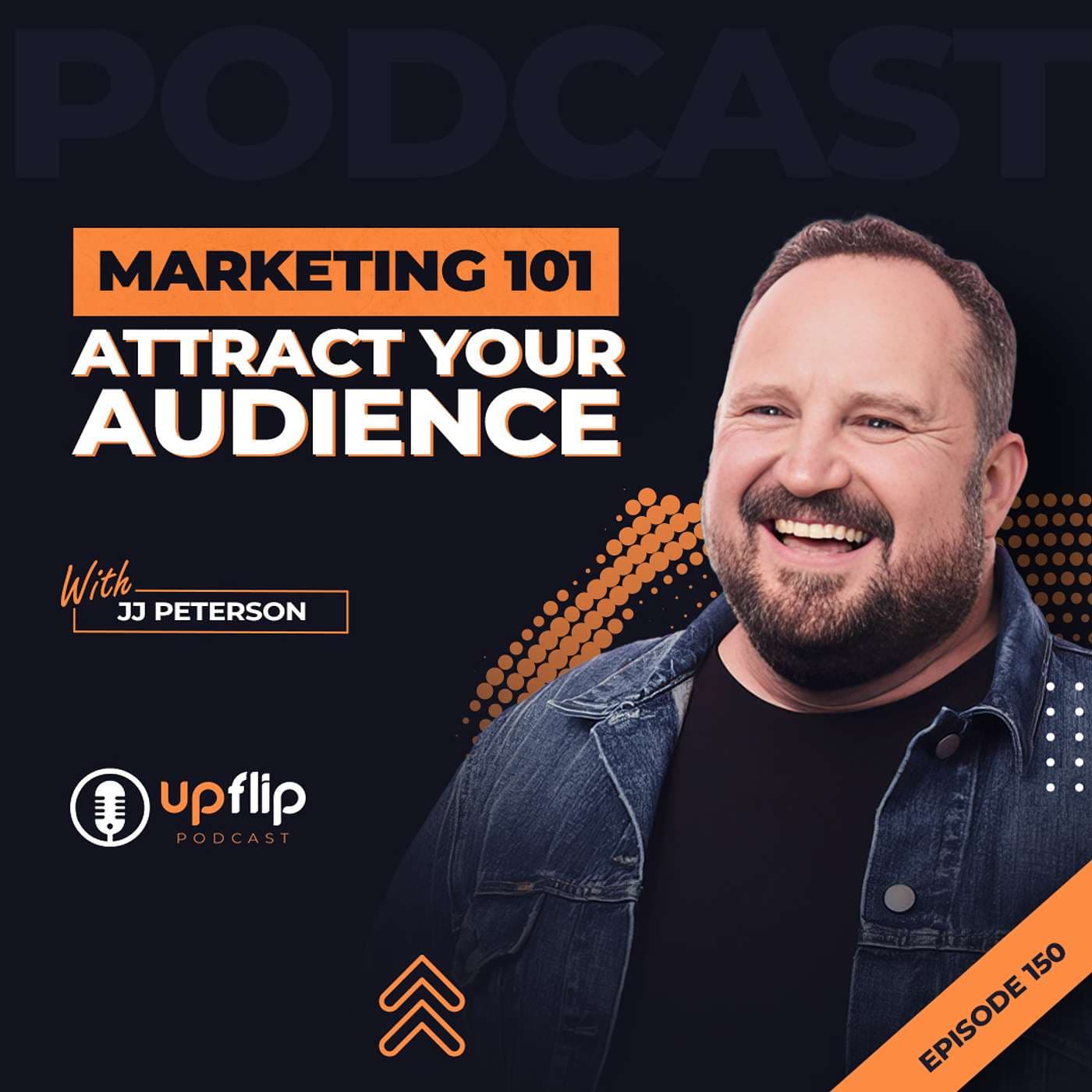
The UpFlip Podcast - Episode 150 Summary
Episode Title
Attract Your Audience: Marketing Strategies for Exponential Growth
Guest
Dr. JJ Peterson
- Best-selling co-author of *Marketing Made Simple*
- Over 20 years of experience in marketing and communication roles
- Consultant to notable companies such as Microsoft and the U.S. Olympic Committee.
Episode Overview Dr. JJ Peterson discusses effective marketing strategies focused on clarity, storytelling, and understanding customer needs. He emphasizes the importance of answering three key questions in marketing communications to avoid wasteful spending on ineffective campaigns.
---
Key Concepts
Importance of Clarity in Marketing
- Three Essential Questions:
- What do you do?
- How does it make my life better?
- How do I get it?
- Clarity over cleverness is emphasized; the message should be straightforward and easily understood.
Distinction Between Branding and Marketing
- Branding: How people feel about the brand (colors, logos, design).
- Marketing: The clarity and simplicity of the message that effectively informs the audience.
Parallel Development of Branding and Marketing
- Many entrepreneurs focus excessively on branding before establishing a clear marketing message.
- Prioritize creating effective messaging before focusing on the visual aspects of branding.
Effective Marketing Examples
- Tempur-Sealy: Clear messaging that addresses customer needs for comfort and customization.
- Poor examples include vague statements that fail to convey the actual service offered.
Customer-Centric Messaging
- Marketing should be focused on the customer’s story, not the company’s achievements.
- Identify customer problems and how the products/services resolve them.
---
Practical Strategies for Implementation
Storytelling in Marketing
- Utilize the StoryBrand Framework which includes seven elements:
- Identify what the customer wants.
- Present a problem that needs solving.
- Introduce a guide (your company).
- Provide a plan for resolution.
- Create a call to action.
- Highlight the stakes (success or failure).
- Your customer is the hero; your company acts as the guide.
Testing and Feedback
- Continuously test messaging through networking interactions and adjust based on feedback.
- Utilize metrics such as bounce rates and conversion rates to assess messaging effectiveness.
---
Closing Advice for Entrepreneurs
- Start with identifying the problem your customers face and how your service solves it.
- Craft an elevator pitch that begins with the problem, followed by your solution and the outcome for the customer.
- Keep refining your messaging based on real interactions and customer feedback.
---
Key Takeaways
- Clarity Over Cleverness: Prioritize clear communication of your services.
- Customer Journey: Understand customer pain points and guide them through your offerings.
- Simplicity in Marketing: Focus on solving customer problems and the potential positive outcomes from your service.
---
Resources Mentioned
- [Join a Free Community of Entrepreneurs](https://bit.ly/3AOEY2j)
- [Connect with JJ Peterson](https://storybrand.com/)
- [Free Brand Script Resource](https://storybrand.com/sb7)
Connect with UpFlip
- [YouTube](https://www.youtube.com/@TheUpFlipPodcast/)
- [Instagram](https://www.instagram.com/upflip/)
- [Facebook](https://www.facebook.com/upflipofficial)
- [Twitter](https://twitter.com/upflipofficial)
For more insights and resources on starting and growing a business, visit [UpFlip.com](https://www.upflip.com).
Final Thoughts Dr. JJ Peterson stresses that effective marketing is simpler than it seems. By focusing on clarity, customer needs, and storytelling, businesses can significantly improve their marketing effectiveness and customer engagement.
Written by AI. May contain mistakes. Listen to the episode to check what was said.
Transcript
Automatic transcript. May contain errors.0:00What if you could attract the right, high-paying customers so you could work half as hard to make a sale? This is the power of brand storytelling. Today, we're joined by the best-selling co-author of Marketing Made Simple. He's also a consultant to major brands such as Microsoft, Tempur-Sealy, and even the U.S. Olympic Committee. He's helped thousands of entrepreneurs and corporate CEOs define their story, leading to major deals for both big-time corporations and new business owners alike. This is Ryan Atkinson, and you're listening to Self-Fit Podcast, where we uncover how great businesses are built and the secrets to replicating their success.
0:34Oh my gosh, am I excited for today's episode with Dr. JJ Peterson. He is going to come on the episode to talk about the hero's journey, storytelling in your marketing, and why clarity matters over anything if you're going to get one thing right in marketing. Dr. JJ, welcome to the show. Super excited to have you on. Thanks for having me. This is going to be fun. This is going to be a blast. You're an expert in all things marketing. I know our audience loves this. Before we do that, though, I want to level set on marketing and basically how you would define it from an expert's opinion. So if you had to describe marketing to someone that like doesn't know a lick about marketing, how would you describe it?
1:05For me, marketing is the ability to answer three questions in all of your collateral. So whether that's your website, your social media, your emails, your elevator pitch, anything you use to talk to customers, you need to be able to answer three different questions. What do you do? How does it make my life better? And how do I get it? That is the core of marketing. And for me, there is a difference between branding and marketing. Branding is about how you make people feel. So you're talking colors, logos, website design. All of that kind of stuff is really what I would argue is branding. Marketing really is the simplicity and clarity of that message that answers those three questions.
1:46What do you do? How does it make my life better? And how do I get it? And you putting that language in all the different types of collateral that where you reach your audience. Perfect. I want to ask you about the brand and marketing perspective here. So if someone's like a small business owner that wants to start a business, does brand and marketing work kind of parallel to each other or do you need to get one right before the other? They do work in parallel, but I think a lot of people spend way too much time on the branding part first. So they're like, we have to look cool and we have to feel cool.
2:16And then people look at your website or look at your business cards and go, I don't know what they do. I mean, I like it, but I don't know what they do. And so I would argue that you should get actually your messaging first. If you get your messaging and your marketing message down right, then you have a quick way to explain people what you do. You have a quick way to invite people into a story about your product and service. Then that can inform the look of your site, the fonts that you use, the colors you use, the feel that you offer. But if you don't know who you're talking to and what you're telling them, then you can have the prettiest site and the prettiest logo in the world and you're going to fail miserably.
2:52And I want to drop a resource like early for people just from your knowledge. Is there a company that comes to mind that has marketing branding down? Can you kind of tell us like why they have their brand marketing down? I hate to put you on the spot right there on that one, but I would love to just talk about it. Yeah. And take a few moments to think about if you need. I'll give a broad example. I mean, there's so many out there. I mean, I was just working with a guy who's a business coach yesterday and he's unbelievable. His messaging is fantastic. But I'll start with a company we've worked with, Temper Sealy.
3:19So they're the largest mattress company in the world. And when you look at their messaging, it talks about how great the product is, but really it is customer centric. And they're very, very clear about what it is that their customer wants and what problems they're solving for their customer. And when you can do that in that marketing and messaging, you're going to win. So when you look at their sites and even you look on Amazon, they get very quickly to what is the product? How does it make my customer's life better, which really is what problems do we solve for our customer? Does this mattress help people who have back pain?
3:55Does this mattress help people who get too hot at night? Does this mattress help couples who prefer different hardnesses in the bed? They get to that stuff quickly and talk about how it makes their customer's life better on a product specific basis. And then very quickly, how do I get it? Which stores to go to or order online? You have to be able to do that within about 30 seconds or people are bored and move on. And Tempur-Seely does that really well. Whenever I'm looking at a website, if I see a website and they're using pretty and poetic language, I immediately know they're missing the mark.
4:27So I was working with another person yesterday who said on his website, he said, we eliminate poverty conversations. Now, you tell me, Ryan, what does he do? That's a good question. Something with poverty and conversation. I have no idea. No, no, no. He trains sales teams. Oh, no. Oh, my gosh. No. He trains sales teams. And that was the language that was on his website. And he's trying to be, this is where I talked about, you know, the side of people leaning into branding too hard. He was trying to get the feel like we're kind of this artistic conversational form of things. So he's trying to say, like, you know, a lot of companies struggle with poverty.
5:08I don't even know what he meant by poverty conversations, but I was like, get that off your website now, because what he's trying to do is be poetic and bring a feeling to the messaging. That's not marketing. First off, I would say he missed the mark on the branding side as well. But where I would tell him and say, we help your sales team create the words that close more deals. Now, do you have any questions about what he does? No. There you go. And so that's what I mean. When I say like to get your marketing right, you have to answer the question, what do you do? A lot of people start out by saying, well, we help make people's lives better.
5:42And I go, that tells me nothing. Are you a counselor? Are you a life coach? Are you a psychologist? Are you, you know, are you somebody who gives me money? I don't know. Tell me what you do. That is marketing. And so anytime I see a site like that or a company that really focuses on that, it's great. Now, just one more little caveat is the problem. Why people, I think, get marketing and branding confused is because the biggest companies in the world, in many ways live in the branding space more than the marketing space. So Coca-Cola, right? The largest drink company in the world. Everybody knows who Coca-Cola is.
6:16They don't have to say we sell sugar water with caffeine. Like they don't have to say that. So they live in the Coke with a smile, right? That's branding because they're so big. They don't have to explain the marketing side of things. They just go straight into branding. So we look at like Apple. We look at Coke. We look at these huge companies and think we need to be modeling ourselves as entrepreneurs or business owners after those giant companies. Those companies don't have to do, quote unquote, this basic marketing side of things. They have to be about branding, creating a tribal commitment.
6:51The rest of us, we don't have that advantage of people knowing like us, like Nike. They need to know what it is that we offer. And that's where we need to focus in that marketing. So when you say like, can you point to sites? I can point to a lot of sites, but I will point to the big sites and say, don't copy those unless you are a multimillion dollar, billion dollar worldwide. Then you can. That was a question I wanted to ask, too. So, like, as a small business owner or as an entrepreneur that's like wanting to get started when they're marketing on their website, basically, like you're just kind of like trying to get straight to the point of like what you do.
7:22That's what you would advise people to do. Absolutely. The reality is most people, depending on the research you read, people will give your website about three point seven seconds. That's the average amount of time that you have on a website. Within those 3.7 seconds, you need to answer the three questions I talked about earlier. If people are confused or overwhelmed by what you're offering or talking about on your website, they'll bounce. They'll go to the next thing on the Google search, you know. And so people need to understand why. Why is that the case? Our brain is really, at any given moment, designed to help us stay alive.
7:55And one, a couple of the ways that our brain does that at keeping us alive is it helps us focus on information that contributes to our survival and thriving. What I mean by that is when you walk into a stadium, like a football stadium or even a movie theater, you walk in, you have no idea how many chairs are there, seats there are. You have no idea how many tiles are on the ceiling and everything. But if I had a stadium full of people and I was on a microphone and I said, how many people in this stadium know where the exits are? Every single person would raise their hand because subconsciously when we walked in there, we were like survival.
8:31We know where the food is. We know where the bathroom is. We know where the exits are. We don't know how many chairs are there. We don't know how many sections there are because that stuff is superfluous. And our brain literally says, don't pay attention to the stuff that doesn't matter to me. The second thing our brain does to keep us alive is it actually is trying to conserve calories. Our brain burns a lot of calories. And every time we have to process information, the harder that information is to process, the more calories our burn brains. Nope, I said that wrong. Our brain burns. And there's only a limited number of calories at any given moment.
9:04So if I have to process a lot of heavy and difficult information, I burn more calories and my brain is kind of going, warning, warning, you're running out of calories. And if an emergency is about to come up, then you're not going to have any calories to get out of that emergency. So our brain goes into daydreaming mode. The average person daydreams about 30 percent of their day. That's a survival mechanism. So all that means is that if somebody comes to your website and you have flowery language that is not clear, the first thing that happens is the brain goes, I don't know how this applies to me.
9:39I don't know how this helps me survive and thrive. I'm looking for exits and they're throwing chairs at me. And then the second thing is our brain goes, this is too confusing to figure out. I got to get out of here because I'm burning too many calories. And so it leaves. That's why people are only on your site 3.7 seconds. They can't see why it applies to them. And it's too confusing. So they're burning too many calories. So your brain is literally going, this website is killing me. It's like you're killing me small. So you have to get to that stuff quick. Listeners, we want to hear from you. What are you struggling with?
10:12Why haven't you started your business? Why haven't you taken the next step? And what are you most afraid of? This is your invitation to tell us. Send us an email at podcast at upflip.com today and share what you're struggling with. As an entrepreneur myself, I have struggled with imposter syndrome, fear of failure, and just overall doubt that I can actually succeed as a business owner. It is a very scary world being a business owner and being able to navigate through basically invisible obstacles is a very hard challenge. But as I've grown my own business, I have learned countless lessons through trial and error.
10:41And today we're scaling spacebar visuals faster than I thought even possible. So I want to help you guys on your entrepreneurial journey. Send us an email at podcast at upflip.com with the subject line question for Ryan to get your questions answered and how we can best support you. Yeah, I want to ask, how about like testing this message and how do you start to know like when messaging is like resonating? Is it simple as like looking at the bounce rate or people say on my website or like what are some actual metrics that you look at to know if your marketing messaging is resonating with your audience?
11:08I mean, you can look at bounce rates, conversion rates, you know, number of clicks through all that kind of stuff for sure. But what I would say is what most companies, again, they make the mistake of is they're trying too hard to get the perfect message. And the reality is, if you create a story that people want to be a part of and see themselves in, that is the better approach to things. Yes, check everything, test everything. We test whether to put the call to action in the top right or the middle. Is it going to be blue? Is it going to be red? We test all that stuff. But what companies and business owners and entrepreneurs need to realize is your job as a marketer is not to reflect this customer story back to them or even tell your story.
11:49Your job is to invite customers into a story. Your job is to lead them in the journey and show them why being a part of this story is going to make them the hero. Because you can go like somebody is like, well, as I say, like as a life coach, I solve 20 different problems for people. I have 20 different, you know, types of clients, which is the right one to use? Well, my question would be, what's the most compelling for the people and audience and customers that you want to engage and invite those customers into the story? Lead them. You're the author of the story. Movies, you know, they look at and go, what is going to relate to the audience for sure?
12:26But they're not sitting there doing they and they do testing for sure. But really what they're trying to do is create a story that people can connect with and see themselves in. When you do that, movies win. And when you do that in marketing, your marketing wins. So how do you do this in practice? Because I a thousand percent agree as a marketing, you need like storytelling abilities. You need to be able to tell your company and like a story matter. How do you actually like do this in practice a little bit more? Can you talk about that? Like what are like two or three ways you can actually do this in practice?
12:53Yeah. So we use what's called the story brand framework, which really is the seven steps that every story has to contain. So the seven, there's really in any story, whether it's a movie, marketing, a book, they're all the same. They've been the same. The study of this goes all the way back to Aristotle and Plato. I mean, it was it's really like how do you compel people to action through story? And we use what's called the StoryBrand seven part framework. I'll give a high level of that. And then I will give like two really specific tips that people can start thinking about. So there's seven elements in every story that have to be in a story for it to be good.
13:28The first is it has to be really clear very early in the story what the customer or hero wants of the story. So you can't be confusing about that. If Jason Bourne wants to find fulfillment, he wants to open a bakery, he wants to run a marathon, he wants. No, has to be one thing. It has to be really clear. Then for the story to get good, element number two is that the hero of the story has to encounter a problem. If there is no problem, there is no story. So they have to overcome something. Then the third element is that the hero meets a guide, and that is somebody who has gone ahead of them to help them win the day.
14:06So that would be Yoda, Obi-Wan Kenobi, Gandalf, Image. There's somebody there, a wiser, older person to help the hero win. And the fourth element is that the guide gives the hero a plan, a way to win. Trust the force. We're going to rob the Bellagio this way. Then there's a moment that the hero must be called to action. That's element number five, where a bomb is going to go off. So there's like a countdown. Think about how many movies have countdown clocks in them. So there's a moment the hero is forced to act through a call to action. And then foreshadowed through the whole story are the stakes of the story.
14:39What's at stake? There's positive and negative stakes. That's element six and seven. So what can be won or lost by the hero in the story? Those have to be really clear. So those are the seven elements. Every story, every good movie you've seen has those. A hero wants something, encounters a problem, meets a guide who gives them a plan, calls them to action that results in success or failure. What we do with companies is we help them create those seven talking points for their customer story. Your customer is the hero and your company is the guide. Your job is to help the hero win. So there's two things as people are thinking about creating messaging around this point is the two things I want people to start thinking about.
15:20The first thing is, is your marketing about you or your customer story? If it's about your story, this is when we were founded. This is how good we are. These are all the features that we offer. Then you have lost this narrative because your customer is trying to figure out how they survive and thrive and how this contributes to their story. And if you make it about yours, now you're in competing stories. So it has to be about their story. I don't care that you've been on the top 10 best places to work in America. How does that have to do with my story unless I'm trying to work there? So the first thing is do an audit of all of your marketing material and identify where are the places that we talk about how our customers win and the benefits of our product for our customers versus making us the hero of the story.
16:03The second thing I would say is that the only reason people are coming and buying your product and service is because you solve a problem for them. In their story, they are experiencing problems. They're experiencing difficulties. So in order to invite your customer into a story where they know this is the story I want to be a part of, you have to talk about their problems. You know, if you're a lawn care company, what is the problem you solve? Well, either it's wasting too much time keeping your lawn looking great or your plants keep dying. So we help you like make sure that your lawn looks great all the time.
16:36You should be spending more time enjoying your yard than working on it. You have to find that problem and talk about it over and over and over again. So the question I would ask everybody is what problem is your customer experiencing that you can solve? Name it. Make sure that's all over your marketing. The second part of that, part B, is how does that make them feel? Are they frustrated? Are they overwhelmed? Are they confused? Are they insecure? Because you solve that problem as well. So what problem are they experiencing and how does it make them feel? We have what's called a brand script that we walk companies through where they actually create the talking points, the seven talking points.
17:15And we actually, people can fill one out for free at storybrand.com slash SB7. And you can go on there and you'll just see there's like these kind of boxes that walk you through how to create talking points for all those seven elements. So what I just did is help you talk to people about, here's two things you can do. But if you go on that site to the storybrand.com slash SB7, you'll be able to actually fill out all seven elements. And when you fill out the seven elements on the brand script, you'll be able to take that and just put that language in your website, in your emails, in your elevator pitch.
17:50I want to ask here, the underlining thing that like what skill you need to like really be able to like execute this for me, it comes down to like copywriting, like, are you like a pretty good copywriter? But like, is that the skill that you would also agree on? Like what skill, like to really be good at these seven elements, like should a marketer really hone in on? Truthfully, clarity, clarity. That's the point. I would say clarity is going to beat out creativity every single day. So I think even really good copywriters who are like incredibly artistic, who are great, if they don't start with clarity and just put in some creativity and cleverness, they miss the mark.
18:25So they can be like flowery and poetic and inspiring. But if it's not clear, it's not going to cut through. So for people, that's actually a thing I would say from people who are worried about you have to be a great copywriter. Just take that and take it off your shoulders. Take that weight off. Start with clarity. If you wrote an email that just said, I know most of my customers struggle with this, which makes them feel like this. My product solves that problem like this. That is going to beat. If you write that three sentence email and then go schedule a call, if you write that three sentence email, make it a little bit nicer than that.
19:00That's going to beat somebody going in a world where this, you know, it's like, no, but like, and that's a great copywriter, but maybe not a great communicator. And I think so when we're talking about this kind of stuff, yes, be a great copywriter. The best copywriters start with clarity and then elevate, but really start with clarity. It goes back to like one of the first points you made, like an Apple or Coca-Cola, they can afford to be like a little fluffy with their copy. And I think a lot of small business owners, like when they look for like, what does good copy look like? They'd go to those companies about, oh, this is what Coca-Cola did.
19:30This is what Apple did. So I'm going to do something punchy, super fun, super fluffy. But at the end of the day, when you're at a small business where you're maybe not even having a million revenue, you just have to be very clear with your message is what it sounds like. Absolutely. People, depending again on the research you read, people receive up to 5 ,000 commercial messages a day. So they don't have time for flowery. They have time for quick. And so the faster you can help people understand what you offer, how it makes their life better and how they get it, those are the people who are gonna actually cut through the noise.
19:58Yeah, and I think a perfect example for the audience that I can give here is we used to have like a landing page and like I honestly went to ChatGVT and was like write out like what we do and make it like similar to like Apple. And it was like super punchy. It was like kind of fun. And the landing page like didn't convert. But when we switched our landing page to like get three videos for$6 ,000, we'll handle everything. That landing page actually converted better. Now, when you're thinking about this, like the wheels are starting to turn about like what actually we need to change. I think that's a perfect example.
20:22It is. I was like, like, if you'd hired me to come in and look at your website, that's what I would have said. Now, that's what I would have put in the header and maybe the second section of your website. After that, after you've captured people, they're like, yes, I want three videos for$6 ,000. After you've captured that, then you can be artistic. You can put your videos up there because you're creating it. You're working in a visual medium. Your website has to look good or people will bounce as well. So like I'm not discounting the visual or the creative, but you just showed that exact example.
20:52Clarity first, then elevate. I absolutely love that. So does the hero's journey, I want to talk about it because people listening to this, there's some wild ideas out there, different industries, different services, different products, et cetera, et cetera. These seven steps can apply across the board to like any industry or is there? Yeah, absolutely. Absolutely. In fact, so my dissertation, so my PhD studies were in narrative theory and narrative marketing, and the research shows it works across the board. It works across the board. There's one category that it's more nuanced and you have to be a little more careful with if you are a rock star.
21:23So if you are a band or you are a like singer songwriter or just a painter who is selling their art, it's more nuanced and it's not quite as cut and dry for literally those two musician and painters. But if you're a house painter, if you're painting houses, it works for you. If you're writing songs for other people and trying to sell your songs to artists or to TV shows, it works for you. But if you're just like, you know, one of my favorite singers right now is Ben Rector. If you're Ben Rector and you're going out and you're performing concerts, it doesn't work like that for you. But everybody else, yes.
21:56I don't think Ben Rector is listening to this podcast. Ben, if you are, definitely drop a review. We would love that. But I want to ask as well, because as entrepreneurs, Like we like to move quick. We like to break things, you know, like the typical saying as like someone that's starting a business likes to say, how long should you wait to see if your messaging is paying off? Like what's the time for? Is this something you'll know right away or is it something you need to wait like five or six months? That's a little nuanced because it depends on the industry. But like where I would say is like what we're talking about mostly here is words.
Read the full transcript
22:26So putting up a website, what I would say is make sure that in those when you're creating websites and we are creating sales funnels and lead generators that you, even if you're hiring somebody else to create those at marketing agency, you need to have the power to edit. So don't build a website that you don't have the power to walk in tomorrow and change that headline in. What we do is we really let things run for a while, but then we're constantly tweaking that. We say your marketing should never be laminated, like never like make it permanent because the seasons change, the time change. But in reality, if you develop some messaging and you go to a networking event, you're going to find very quickly whether that messaging resonates or not.
23:05Because you're going to have people literally say to you, tell me more. And if they're not saying that, if they just go, oh, interesting. And then they go look at the crab puffs, you know, that's not working. Change it, you know? And so we do a lot of that. Like I do a lot of like testing with our customers and just going just when I'm on stage or when I'm on podcasts or when I'm talking to people individually, I begin there, then from there. And then I kind of tweak it a little bit and then we make it more permanent. But the reality is like our email campaigns that we have running for a long time, we'll let them run for a while and then we'll look at the conversion rate and then we'll go, this isn't converting very well.
23:39Did we miss something? Did we miss the problem? Did we miss language? And if we did, we tweak it and we put it back in. And I think especially with that kind of stuff, you're constantly testing and just trying to get a little bit incrementally better all the time. I like that problem one, because like right now we're like testing like email copy as well. And like, I feel like honestly, now that you say that we could do a much better job at talking about that problem that they're experiencing, like how we can actually help, because I feel like that could then they like, you know, your audience best and your ICP best, especially as a small business owner.
24:06But including that messaging, I think can also be applied to email campaigns where it can help boost those reply rates. Absolutely. I love that. Let's kind of wind down here before we go to our fan blitz questions. Any questions that I missed? Anything that people should know? I know I probably missed a lot of questions, actually, but just final word for people that are wanting to get started with marketing, like what general top of punchy advice that you would give someone that is wanting to start a business and needing help with marketing? If you're getting ready to start a business, the very first thing I would tell you is don't even worry about the full brand script yet.
24:35I want you to focus on three parts. I want you to focus on the problem that your customer is experiencing, how you solve it, and what their life is like after. This is a formula that we use for an elevator pitch. So it's kind of taking three elements of the story and making it a short story. So if somebody says, what do you do? What you need to start practicing is you should not say like for you, Ryan, you should not say somebody goes, what do you do? Oh, we make videos for organizations. No, you don't say that. You should start with the problem because when you start with a customer problem, what you're doing is you're hooking them into the story.
25:09So for us, when we say at StoryBrand, when somebody goes, what do you do? I don't say I help companies with their marketing branding. I say most companies websites are not performing the way they want them to. And it's because they're telling the wrong story. At StoryBrand, we actually walk people through a seven-part story framework to help them create clear messaging so they connect with more customers and grow their business. If I use that, people immediately go, tell me more. Because I'm identifying the major problem most of our people experience or whether they do or not, they go, yeah, I want more sales off my website.
25:42So I named the website and I say, here's the problem. You're telling the wrong story. So I'm opening up a story loop. Then I tell them how we solve it. And then I say what their life is like. If you're just getting started in business, if you can get your elevator pitch down to that tight, customers experience this. Here's how we solve it. And this is what their life is like. And test that over and over again with different people. Change the problem a little. Change how you talk about what you do. You're going to learn to begin telling a story in a way that invites customers in and begins to position you as a guide.
26:13So the broader part, yeah, we have all the seven elements. But really, if you can focus on that, you don't have anything. You're still even almost figuring out what you're trying to do. Start there and you're going to win. I love that. And real quick, before we do move to our fanbots questions, we actually started a sales call the other day, leaning into the problem that we help with, instead of just like, oh, like what video ideas do you have? It's, oh, like we're helping like marketing teams that want to do video, but just like don't have the time, don't have the resources. You have a thousand things that you do.
26:40Like what we're helping you do is create video in a hands off way, maybe get better at the hands off way. But I'm doubling down on what you said and everyone. So take that to heart, everyone listening. Let's move to our fan list questions. These questions are submitted from our community at www.youtube.com slash upflip. People are interested in joining entrepreneurs, joining these conversations. So we have five ready questions from our community. Let's find them down. Number one, what is something the 1 % don't want average Joes like me to know? You don't have to spend a lot of money on marketing in order to be effective.
27:08We look at the 1 % and go Coca-Cola, Apple, Nike, and we just go, well, we don't have their budget, so we'll never compete. Nope. You don't have to have that amount of money. You have to create clear messaging. I love that. That is awesome. Number two, what do you feel like you've mastered and what do you feel like you're still learning? That's huge. I do feel like I've mastered the art of marketing and storytelling. What I'm still learning, if I'm really honest, it's that branding piece, how to incorporate the two together. Because I can get your marketing and messaging down like nobody's business, but there are some luxury brands and some of those high-end brands that it's like, it's a little bit more artful.
27:41And I'm stepping into the artful side a little bit more these days. That's awesome. Number three, what is something that most people believe about success that you disagree with? People who are not successful believe that when they get success, that's when they're going to be happy. And if you're not happy now, you might not have some of the same problems, but you're going to, if you're not happy now, you're not going to be happy when you're successful. You have a whole podcast about that one, honestly. Number four out of five. How do I create a brand around a local service business? Local service business.
28:13Again, that's what I would say is first start with the problem. What problem do you solve? And make sure that you talk about that over and over. The second thing I would say with that is because it's a local service business, don't try to be creative in your branding. Be very specific and answer this question. What are people Googling when they're looking for my type of business? Because you're local. So like for me, I might say best house cleaning in Nashville. If I'm looking for a house cleaner, it's a service-based business. It's local. I'm Googling best house cleaning in Nashville. That type of language needs to be on your website.
28:47Even if you don't know that you're the best, if that's what people are Googling, be that clear so that when people come to your website, say what they're looking for. That's what we're talking about when we're saying, make it focused on your customer. Don't say, we are great at house cleaning. No, don't make it about you. Have the cleanest house in Nashville. Get the easiest cleaning in Nashville. You know, what are they Googling? What do they want? And make it really, really clear so people can find you with SEO. I love that. That is really, really good stuff. Number five, last question for you.
29:17I really love this question. So shout out to whoever submitted this one. Should teen entrepreneurs advertise that they're so young or that keep people from using our services? Again, nuanced. So when we talk about being the guide, right? So when you are a guide for a customer, it really isn't about you. But there are two elements that position you as a guide in your customer's mind, empathy and authority. So if you are a teenager and you are trying to help people with marriage advice, you do not have a lot of empathy. So one, I would say, don't go into that space. But what you're looking for, if you know what it's like to struggle with this or you are being creative with this or all of that stuff, you've struggled through something, then name it.
30:00Say, this is what I used to struggle with or this is what I did. Then you have to give a little bit of authority. The authority is that you solve the problem for somebody else. So that's a testimony. That is a Google review. That is something else. That is like statistics or case studies of people who won using your business. So I don't care if you're 13 or you're 113. You have to have those two things for people to trust you. Empathy, I understand your pain and problem. So you need to be able to say that. And then authority, I've solved it for somebody else. If you can demonstrate those things to me, it doesn't matter how old you are.
30:37So if it's kind of like this cool thing that you're 13 and created this unique thing, put it in there. But the story isn't about you. Doesn't matter. If it's not cool that you're 13, don't put it in there. Lean to empathy and authority in that space. Don't rely on your age to be the thing that makes it happen. But don't be afraid to use it if you have empathy and authority. I love it. Dr. JJ, this was incredible throughout the whole podcast. Thank you for breaking down all those steps. You made it super inactual for the community and everything. So thank you so much. If people wanted to learn more about you and be like, hey, I want you to do my marketing for me, where can people learn more and connect with you to do so?
31:14Storybrand.com. So storybrand.com is where they can go. And then again, that free resource where they can create their own brand script is storybrand.com slash SB7. Amazing episode with Dr. JJ Peterson today. Three quick takeaways. is number one, your message needs to be clear. You need clarity over cleverness, over creativity. At the end of the day, if you're doing under a million, maybe even like 10 million, I'll say, you just need to be very clear in the messaging that you want to have. Number two, you need to take your customers on their journey. Where can you meet them, identify their problem and guide them to the actual solution?
31:48I think that was a phenomenal breakdown of the seven steps that Dr. JJ did. And number three, marketing is simpler than you think. All you need to know is identify those problems, solve that, and what's the life after they come to you? So those are my three takeaways from Dr. JJ Peterson, a ton of good tidbits in here. So I hope you guys enjoyed it as well. And question for you, have you emailed us yet? We want to hear from you. Let us know your biggest challenges and struggles as a business owner or wannabe prenewer. You can do this at podcast at upflip.com. Perfect. Dr. JJ, thank you so much for being here.
32:18Thanks for having
From the publisher
JJ Peterson wanted to start his own business when he quickly realized how much money people waste on marketing that doesn’t work. Now with over 20 years of experience in marketing and communication roles and over 1MM books sold for his book Marketing Made Simple, he sits down with Ryan to inform companies how to avoid making the wrong marketing investments.
JJ’s worked with top companies in the world on their strategies such as Microsoft, Tempur Sealy, Certified Angus Beef, and the US Olympic Committee. He shares about the importance of storytelling in a marketing strategy, clarifying your brand’s message to consumers, and how to stop wasting money on campaigns that don’t work. He also emphasizes the importance of answering three questions in marketing: what do you do, how does it make my life better, and how do I get it?
Resources:
- https://bit.ly/3AOEY2j Join a free community of like minded entrepreneurs for free
- podcast@upflip.com Email Ryan what you're struggling with
- https://storybrand.com/ Connect with JJ
Ready to be your own boss without starting from scratch? Grab our FREE Franchise Guide and unlock the secrets of proven business models that have already created thousands of success stories.
Connect with UpFlip:
- On Youtube
- On Instagram
- On Facebook
- @UpFlipOfficial on Twitter
For more insights to start, build, or grow a business, check out the resources on UpFlip.com or head to the UpFlip YouTube channel to see more interviews with business owners and experts.
Thanks for listening!


