
In short
UpFlip Podcast Episode Notes
Episode Title
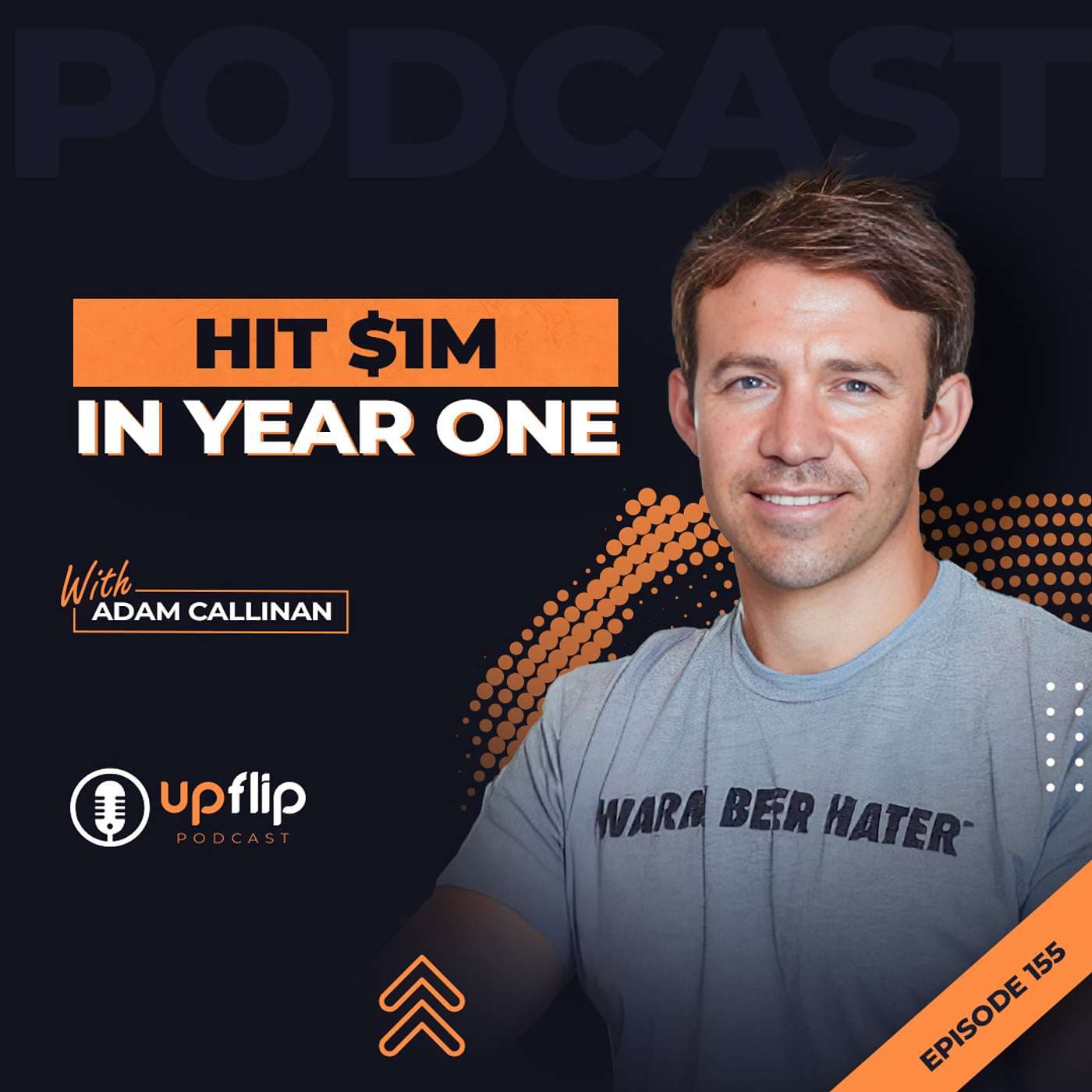
155. Build Your Dream Business: The Million-Dollar Blueprint
Guest
Adam Callanan
- Founder of BottleKeeper and Pentane
- Formerly aimed to become a doctor but transitioned into entrepreneurship
- Experienced success with crowdfunding and Facebook ads
- Featured on Shark Tank
---
Episode Overview In this episode, Adam Callanan shares insights on building profitable businesses and reaching target audiences. He emphasizes the importance of compelling content in marketing, managing fixed expenses, and adapting to customer feedback.
---
Key Concepts and Discussions
Transition to Entrepreneurship
- Adam started with aspirations of becoming a doctor but shifted focus during college due to the long education pathway and significant debt.
- He began his entrepreneurial journey working in a startup orthopedic device company.
Founding of BottleKeeper
- Concept originated from Adam’s cousin, who created a product to keep beer cold at the beach.
- Initial doubts led to the decision to test the market through crowdfunding to prove the product's viability.
- Achieved over 350% of their crowdfunding goal.
Importance of Crowdfunding
- Used as a way to validate the product idea without significant upfront investment.
- Strangers, not friends or family, were targeted for feedback and purchases to validate the concept.
Marketing Strategies
- Focus on authentic, relatable content to engage potential customers.
- Emphasis on video advertising, particularly on platforms like Facebook, which became crucial for growth after their launch in 2014.
Shark Tank Experience
- The team was approached by Shark Tank in 2015 but didn't appear until 2018.
- Adam and his team faced intense questioning from the Sharks but ultimately secured a deal with Mark Cuban and Lori Greiner.
---
Tactical Insights for Entrepreneurs
Managing Fixed Expenses
- Critical to keep fixed expenses low as they can spiral out of control, impacting profitability.
- Avoid adding unnecessary payroll or office space until it becomes essential.
Advertising Budget
- Understanding advertising spend relative to revenue generation is essential.
- Companies often underestimate the amount they should spend on advertising to drive sufficient revenue.
Metrics to Monitor
- Contribution Margin: Understand the profit margin after variable costs to determine pricing strategy.
- Return on Ad Spend (ROAS): Monitor how much revenue is generated for every dollar spent on advertising.
Building a Profitable Business
- Test product ideas in the market before fully investing.
- Listen to customer feedback for product adjustments.
- Utilize partnerships for mutual growth and resource sharing.
---
Resources Mentioned
- Pentane: [Website](http://www.pentane.com)
- UpFlip Academy: [Join for free](https://bit.ly/3YGhNRu)
- Franchise Guide: [Grab it for free](https://bit.ly/4aWuGvc)
---
Conclusion The episode provides practical advice for aspiring entrepreneurs on validating business ideas, managing finances, and utilizing effective marketing strategies. Adam's journey emphasizes the importance of adaptability, understanding metrics, and leveraging customer insights for growth.
---
Key Takeaways
- Validate your business ideas through real market feedback.
- Manage fixed costs to maintain profitability.
- Know your metrics: contribution margin and ROAS are critical for business success.
Written by AI. May contain mistakes. Listen to the episode to check what was said.
Transcript
Automatic transcript. May contain errors.0:00Launching a business is exciting, but it's even better when you know it can make millions. Today's guest has a knack for turning brands into profit-making powerhouses. Not only did he grow his first business to$1 million in sales within the first year, but he consults with other businesses to break patterns of their steady sales so they can get to exponential growth. This is Ryan Atkinson, and you're listening to the Upflip Podcast, where we uncover how great businesses are built and the secrets to replicating their success. On today's episode, Adam Callanan, founder of Bottle Keeper and newly launched Penetane, shares his best kept secrets on marketing a product's value, creating a cost-effective manufacturing process, and generating more sales online.
0:40It's his own method for generating millions, and he's here to share it with us. Adam, welcome to the show. I'm so, so excited to have you on. Thank you so much for being here. And I am thrilled to be here, Ryan. Thanks for having me. It's gonna be great because you're a serial entrepreneur. You were part of the founding team at American National Medical Management, which was acquired. You started Bottle Keeper, which you appeared on Shark Tank, and you secure to deal with Mark and Lorian. That was acquired. And now you're starting Pentane. I've got to ask, when did you know you wanted to be an entrepreneur?
1:09Is that something that you're built up for? How did you know you're going to be an entrepreneur like this? You know, I was not even remotely that kid that was leveraging all the kids in the neighborhood to go and sell rocks to strangers. And you hear those stories, and I was not that kid. I grew up wanting to be a doctor my entire life. From the age of six, I started having these weird dreams about saving people on operating tables, which is very odd for a six-year-old to have. But I built my entire life around medicine, around being a doctor. Actually found, we just moved out of a house recently, and I just found a book in a box that I used to use when I was eight year olds.
1:39It was how to read an EKG with like a whole workbook in there of like you're defining all the waves inside of an EKG. So that was the kid that I was. Going to college, I got a crazy science degree because I wanted to go to medical school. About halfway into college at the University of Arizona, I decided that I didn't want to go to medical school anymore, largely because I had had every doctor that I'd ever worked with, which was a lot at that point. Not every doctor, obviously, but the vast majority of them say, don't do it. It's not worth it. It's not what you think it is. And, you know, as I got halfway into college, I realized that the track that I wanted to take and what I wanted to do, I was going to be 35 years old, getting out of school and training with half a million dollars in debt.
2:14I certainly was going to, you know, if I had a family, it was going to be a struggle. Like my life was effectively going to start at 35. And that just, the older I got, the less attractive that got. So I translated that into business and went into an orthopedic device company that was pretty much a startup. I mean, it was working out of an apartment. in Phoenix, Arizona. And I was the first outside salesperson to come in. It was a family basically that had started this company. And so that was my first foray into it. I mean, I did early on, I always was very interested in how things work. I had a grandfather that was very influential in that, that, you know, it was like the wizard genius master tinkerer that invented a thousand things and never, you know, never figured out how to get any of them to work.
2:50So we got to take things apart and put them back together a lot. And that was very foundational. And frankly, that's a lot of what science and math is, is really just knowing where you are, you know, where you need to be and you have to figure the stuff out in between. Absolutely. And I feel like you figured out like a ton of stuff in between, because like I said, you were a part of that American national medical management team, which was acquired and you started bottle keeper, which I know people listening are going to be super enthusiastic to hear about. Cause like I said, you appeared on shark tank and we're going to dive into that story.
3:15But before we do that, can you tell us like what led up to bottle keeper and your founding story? I've already listened to it. It's very cool, but I want to give the audience an idea of like what started bottle keeper. Yeah, I will clarify A &M or American National. The company wasn't acquired. My position was acquired. That is a much longer story. That's not that fun. So we move forward. point of clarification. Yeah, there's a lot of scar tissue there, probably for another podcast. With Bottle Keeper, that was in May of 2013 that I sold my position in that company. And my cousin, Matt, had a few months earlier invented this product sitting on the beach drinking a beer out of a red party cup.
3:46And he's the kind of maniac that will only drink a Corona at a specific temperature out of a bottle. If it's not that, it's just not good. So he's on a beach drinking out of a party cup. It's warm in four minutes and whatever it is, it's gross. And he sees people using water bottles everywhere and just has this idea. Why can't I cut one of those in half and pat it or put something inside of it and put a beer bottle inside of it? And so he went and got an off the shelf water bottle, vice-gripped it to a table, hacksawed it in half. I actually should have brought it. I have one in my office. We have like the original prototype.
4:16It literally has like these vice-gripped marks on it with a hacksaw in the middle of it. And he took neoprene koozie material and super glued it inside and it fit his Corona perfectly. Like the beer bottle stuck out of the top about an inch so you could drink directly from the bottle, but it kept the beer super cold and it protected the bottle. You know, glass and beaches is not, you know, it doesn't notoriously make a lot of sense. And so that happened in the fall of 2012 and going into 2013, I now was kind of looking for the next thing to do. I decided to go and start a venture fund, which is an awful idea because I hate raising money.
4:44So I'm very bad at it. And Matt, my cousin kind of harassed me. And I say that very lovingly. We were super close. He was the best man at my wedding way before all that. And, you know, finally it was like, look, very admittedly, I was not convinced that this product was a thing. It just looked to me like a product that you would find at Spencer's Gifts for$7 and you'd give it as a white elephant gift. And that is fine. And that's a hobby if that's where you want to spend your time. But that's not a business. I mean, you got to sell a billion of those things to make any money doing that. And again, you have to be making money for it to be an actual business.
5:11So I agreed to come on with him to try it, to see what it was, but did so with really strict guardrails. And that was, we needed to be able to prove that we could get strangers to swipe their credit cards and click buy at a real price point before we went and contributed real time and some money to it. That was the first guardrail. The second guardrail is that if it worked, I never wanted to have employees. I had 80 people in multiple states and it was, you know, an orthopedic stuff. It was delivery vehicles and devices and warehouses. And it was so much stuff. It was so from a fixed expense standpoint, it was so heavy and that sucked.
5:43Honestly, it just sucked to operate. It wasn't fun. You couldn't get away from it. So those were sort of the guardrails we put in place with Bottle Keeper. So we proved out the first part of that with crowdfunding. There's a longer story to that, but we ultimately ended up at crowdfunding. And that was a really, really good way to get strangers from all over the country, in our case, from five countries, to click buy at a real price point. That's where we got started. That was in the fall of 2013. And it sort of took off from there. Yeah. I want to talk about this crowdfunding platform as well, because I believe you guys raised over like 350 % of what your actual goal was.
6:15Correct me if I'm wrong there, but I want to ask, once that happens, once you start actually getting people to buy and whatnot. Like what's going through your mind? Like, oh my gosh, I'm about to do this full time now. Or what was kind of going through your mind once you get people to buy? It's working. Yeah. I think that was going to happen. Now we got to do it. I mean, look, the reality is like on one hand, I'm trying to start a venture capital fund, which is a very complicated, challenging thing to do unless you're an expert at raising money, which again, I am not. And then this thing starts working and it's so simple.
6:41It's like you buy it for X, you sell it for Y. And our margins were incredible because we tested a real price point. We did. We tested at a$20 per unit price point and people were buying it at$20 per unit, pre-ordering it, you know, months ahead of when they were actually going to get it. We got publicity stuff. There was an article in Gizmodo about it and there was a lot of strategy behind all of that, but we did end up selling a lot more. Then was our minimum sort of, is this a thing or not a thing threshold? Interesting. I want to get a little bit tactical here with this crowdfunding platform because it's obviously a great way, like Kickstarter, there's a ton out there how to actually do this successfully.
7:14If you could give advice to someone listening that wants to start their own business and crowdfunding is a good way to do it. Kickstarter is a great way to do it. What are like one or two things you would advise them to do to market it successfully on those types of platforms? Yeah, I mean, I think the first very misunderstood component of doing both crowdfunding and really any early stage startup is that you don't need to go and pay a company or pay a consultant or pay this big infrastructure thing to help you do it right. The fancier it looks, you're supposed to be a mom and pop, like starting up and scrounging and it comes out and looks like a mega motion picture.
7:47I mean, there's a time and a place for that in a business, but it's probably not at the point of crowdfunding. And granted, it depends on what you're doing. If you're starting a cancer therapy company, you probably need that. We were starting a beer koozie company. So I literally shot it on a camera in my kitchen or crowdfunding video, which you can still find. It was unfundable. So that's the first thing is like you can do most of the things yourself. If there are some components you need help with, like video and, you know, some content creation, absolutely do it. But be really, really careful about how you do it and where those expenses go.
8:14The other is platform does matter. At least it did then. And again, as a reminder, this is 2013. So that's more than a decade ago. The platforms have probably changed a lot. Then Kickstarter wouldn't let us do it because they were focused on art projects. And that was just where they were in their journey. They literally kicked us off the platform, which was amazing because what it forced me to do was leverage resource and network and ended up at Fundable, right? It turned out I actually knew the guy that started Fundable. His name is Will Schroeder. And they were amazingly helpful. They gave us access to all sorts of stuff that we probably, you know, we could have had access to, but we would have had to pay for like PR.
8:48And they had an internal person that had a PR list that part of, obviously, they want you to be successful. So they had put a bunch of tools and systems inside their business to help you be successful. And that worked really, really well for us. Even then, that was a really new crowdfunding platform. It wasn't no name by any stretch, but it certainly wasn't Kickstarter. Interesting. And the reason you guys did the crowdfunding, just so I'm interpreting this correctly, is because of that first guardrail. You had to actually proof a concept, essentially, that you can sell this at a real price point and that you can put a customer out there and people are going to put their credit card and it actually buys.
9:17Is that the main reason for the crowdfunding initially? And those people, 100%. That was the only reason. And those people were not our family members. And this is a mistake first-time founders make all the time. They go and they ask their friends what they think about their idea. And that is worthless. I mean, it's nice. They're nice conversations to have. Ask your mom because it's going to make her feel included. And you want mom to feel included. That makes mom happy. Take what she says with a grain of salt. It doesn't mean anything. I was really, really adamant that we have to find a way to get complete strangers that don't know us.
9:48They don't know our backgrounds. They literally know nothing about us outside of this one-minute video that they see. and that they could be compelled enough based on the imagery and the copy and the language to click buy. In this case, enter their credit card information online and click buy. I just want to take a minute and ask you, our listeners, how we can help you get started on your entrepreneurial journey. What are you struggling with? Why haven't you started your own business or begun investing in real estate? I'd love to know what challenges you're facing and how our team at Uplip can help.
10:14Email me directly at podcast at upflip.com and I promise to read every single email. We'll get back to you guys on that, but email us with any questions that you have around entrepreneurship. And so obviously enough people did this where they're swiping their credit card, clicking buy, because then you guys eventually decide, hey, let's go on Shark Tank here. What kind of led up to you guys deciding to go on Shark Tank? And can you walk us through that process? It's an amazing process to all us hear about. So yeah, what led up to that? Well, there was a lot of time in between those two things.
10:38So that's an important caveat. From a timeline standpoint, crowdfunding closed in the fall of 2013. Starting a company where a guardrail is you can't have employees means you have to do everything. And that you is me. I'll separate that with Matt was responsible for the back end of our business. So he was dealing with manufacturing. He was dealing with our finance, you know, bookkeeping, payroll. There was no payroll. It was just he and I, we didn't make money for the first two years. But like dealing with that part of the business and I was responsible for the front. So anything a customer interfaced with or touched.
11:06So our website, our copy, the images, the videos, the paid media, the email, like literally every single piece that you can think of, I built or wrote or did internally. Now that sounds in hindsight, like that's a fun fact to look back and well, wow, that's crazy. it, but you do it in these tiny little pieces. And the reality is if you learn how to do those things, you're so much better at the point that you have to hire somebody at being capable of hiring the right person, number one, and number two, being able to hold them accountable because you speak that language. You'd know how to do that thing, which years later became tremendously helpful.
11:40But then I had no idea how to do paid media. So I was shooting videos on a backpack, you know, on a beach by my house in Southern California, putting them on Facebook and like, you know, slinging spaghetti against the wall. And that was the marketing strategy. And over time, you iterate and iterate and iterate. And then in August or summer of 2014, Facebook launched their video ad platform. At least they launched it to the masses and that everything changed. We went from like$2 ,000 a month to 20 to 60 to 100 to sell out a product in December. And that's where our massive growth came from. It's like in 2014, this is rough numbers.
12:11I don't remember exactly what it was, but we did like 150 ,000 in sales. In 2015, we did 1.8 million in sales. In 2016, team, we did 8 million in sales. And yet we still had no employees. We had no investors. It was just like running and gunning as fast as you can run and gun. That all came because of the Facebook launching their video ad platform where you're just probably shooting this on like an iPhone, maybe, and uploading and like you said, hoping it sticks and eventually it does stick to actually grow the company. That's part of it. Yes, we were very lucky in hindsight that we unintentionally timed Facebook launching a massive new component in their system that happened to be what we needed to sell our product.
12:46You had to see it in action. You couldn't just see a picture of it because it looked like a water bottle. That could not have happened had the foundation not been in place for that scale to happen. And that's where this system of automations that we built really, really came into play. That's a huge part of it. I mean, you can dump all the money in the world and run as much money into your system as possible. If you don't have the processes in place to handle that kind of traffic and that kind of load, it will burn to the ground. So that was really, really important. But that gets us through 2016.
13:14Shark Tank reached out to us in 2015, I believe, because they saw a Facebook ad. They have production, people that go out and look for companies. And we were spending a boatload of money on Facebook. And so they saw a video ad and reached out. So we started the process in 2015, but weren't actually on the show until 2018, when we were a significantly larger company. Oh my gosh. So that's a three-year process to like that first initial conversation when they reached out to 2018. What are some of the things that like you go through in the process when you are going on Shark Tank? So at the very beginning, it's a conversation of interest.
13:48And then again, this may have changed. This was almost a decade ago. You know, you shoot like a mock pitch video. So you have to like slam together a mock pitch video knowing it's going to look like crap, but they just want an idea that you have some energy, which frankly was very difficult for me. I am not a great on camera person generally. And you do that multiple times and then you get assigned a production person or a producer that basically is your point person and guiding you through the process. And there's a number of like cut points in the process where, you know, if they don't like something or they have too much of this or too little of that, you could get cut.
14:17And we did, even in the first time, we made it all the way to the end. So part of the whole have no employees thing is I wanted to be able to run the company from anywhere in the world with internet. So my wife and I were gone four or five, six months a year for the first five years of the business. We were traveling because we could, that was the whole point was build your business around your life and not your life around your business. And the production team wasn't okay with me just flying back for the one week of production, which I didn't know, or I obviously would have planned around that.
14:41So they pushed us in the next year. The next year they had too many beer companies. So it just kind of got pushed. And ultimately, you know, we didn't kind of fit into the slot where it all lined up until 2018. I mean, in the trailing 12 months leading up to airing, we did$11 million in sales. We were super profitable. Like we're way too big to be on Shark Tank, which is frankly, we're like 50 of the 55 five minutes of taping was about them beating the hell out of us for not needing to be there. Well, that's what I was going to ask. When you're doing that much in revenue and you actually get to that date, are you thinking like, oh, I don't even know if we should be on here or like what was going through your mind in that initial conversation?
15:13It's like most things, probably all things in business, in particular early stage business, you're just you look at what you have and you put pieces in place to mitigate the risk. So what are the risks associated to going on Shark Tank? They make you look like an idiot. OK, well, that's an emotional, personal thing. I don't care about that. They make the company look stupid. Like, okay, great. But I mean, so we're a tiny company. Early on, you film a show, an episode, and it doesn't go great, and they end up not showing that episode. That's a risk. And you don't know that until a month out. They overtape, at least they tell you this, they overtape what they have space for.
15:46So it's like, really, what's the downside risk is that they beat the hell out of us for not needing to be there. We knew that was going to happen. So we planned for it. We had answers to the questions. We had things that we needed help with. So we looked at more risk of like, how do we ensure that they put our episode on TV? How do we absolutely give ourselves the highest probability that our episode is going to air? And in our case, we had Alex Rodriguez was a guest judge on our show. So we changed our opening. We didn't know that until maybe three or four weeks before taping. We didn't know that.
16:17So we completely redid, which are the producer, they'll let you do whatever you want, basically like within some bounds. Like we wanted to get the sharks out of their seats and like take their shoes off and come sit in our beach setting. But you couldn't because the camera angles would be all wonky. But otherwise, you could pretty much do whatever you want. So we completely redid our intro. We designed a thing that would have Alex Rodriguez throwing a ball. We just figured if we could get Alex Rodriguez throwing a baseball on TV, there is no possibility they're not going to play that episode. Love that.
16:43Thank you. So we designed this dumb little game, like a carnival game where we had a bunch of bottle keepers with beer bottles in them, where you'd throw the ball at the bottle keepers and we'd show that the glass wouldn't break. So we just built that in the office at a plywood or whatever, an old milk crate. And that was the intro. And the reality is not only obviously it aired because we did a great deal and that's fine, but like they use that in their promo reels, which is what we thought would happen. So like we got so much extra exposure because of the fact they were literally using Alex Sugar just throwing a ball on TV and all of their promotional stuff.
17:13Oh my gosh. I absolutely love that thinking. It's honestly like people say this all the time. Like while they zig, we zag. And I feel like you were thinking about like the whole thing about it is like, well, we want to make sure this air, how can we do that? Let's use Alex Rodriguez actually to be throwing a ball because how could they not air that? Yeah, that was the thesis. Yeah. And from a financial perspective, how do you prepare before you go on Shark Tank? Are you like doing like flash, like note cards about like your margins and everything? You're like, how do you even prepare to be peppered by these questions by these sharks?
17:39I should say. There's definitely some of that. I mean, as you know, you're running from my perspective, if you're running the business, you probably know what those things are already. If you don't, you really should. But we absolutely put them down on note cards and memorize them and practice them because even, you know, between the time you're rehearsing those things six weeks out, they're going to change a little bit between now and then. And it's like, you just have to have one number memorized. There was a lot of that. I think the other more dangerous parts of preparation revolve, particularly if you're a product company, which most companies end up on Shark Tank are, is inventory.
18:09Like, how do you manage that? Because we taped in June, right before Father's Day, which was epic timing for us because that was our second biggest holiday of the year. So with, well, in the last 12 months, we did$12 million in sales. In the last week, we did$1 million in sales, which was totally true. But it was like only like three other weeks the entire year could we have said that. But if you tape in June and you air in December, but you don't know that you're going to air in December until November, like how do you deal with inventory? Oh, man. And you don't know. You might air in December.
18:40You might air in May because the season starts in November and goes until May or June. So that's the biggest to us risk of the whole situation. And we were able to mitigate that by working with our manufacturer. We had a company, a sole source company in the US that was unbelievable. And we got to them over years of managing our own manufacturers in Asia, which was a nightmare. More Matt's nightmare than my nightmare, but we got to deal with some of that together. The company is called DirectSource or DirectX, but they are a domestic company that we were effectively buying it from them. They had all their own facilities and people in Asia or China or Thailand or wherever, whatever it is you're trying to make.
19:15And so they agreed because we had history with them to make like 10 extra containers of product, but there were like 35 ,000 units in a container of product. And they would bring them into their warehouse in California and just hold them until we needed them. So, I mean, those sorts of creative, you know, in hindsight, creative outside of the box things, you know, made the biggest difference in the world because we didn't have to go. And I mean, we were a very profitable company, but we didn't have$3 million of cash laying around to go buy 10 or 12 containers of product, right? So that's where a lot of the risk is in going on the show.
19:47I like it. One more question. And then we're going to dive into profitability and the metrics that matter and everything that you're doing at Pentane. You secured a deal with Mark and Lori. How did you know? Talk about the feeling of excitement once you guys were like, let's do a deal with those two. Obviously, two very... I mean, they're all great sharks, but Mark in particular is my favorite. So I'm curious, what were those feelings once you guys actually did close a deal with them? Yeah, I mean, you have to set the stage that we got there and they immediately beat the s*** out of us. And Mark opened the episode with, you're either the worst business people in the world or you don't need to be here.
Read the full transcript
20:14That's Mark Cuban. And then went out in like minute three. So our goal, we went in asking for a million dollars for 5%, which is a lot for a Shark Tank company, probably not a lot given we were at a business, but as a business, but we had to be realistic with what we were doing there. So you go into this massive, chaotic, there's no breaks, like there's no take twos. It is literally an hour or so of just mayhem of four smart people and Alex Rodriguez asking you the same question, 9 ,000 different ways, hoping for that like, aha. It is complete chaos. Aside from the time I accidentally delivered my son in the bathtub, different story.
20:48It is the most chaotic 45 minutes of my life. I've never been in like that much of a, just an insane, condensed, wild situation. So looking back at it, Lori comes in, we have offers for multiple people. She comes in, then we're able to get Mark to come back in. to do a co-deal with Lori. Like it was insane. It was absolutely insane. So at the end of that, I mean, it's literally in the closing, I think my comment was like, I've never needed a beer more in my life, which was absolutely true. It was incredible to go through this. Like they just beat the hell out of us for so long. And then to have it come all the way full circle and get exactly what we wanted with exactly who we wanted was epic.
21:27Yeah, I was going to say, I feel like one, I didn't know there was an hour long that you're just getting like peppered by these questions, but I feel like it would be such a chaotic and like intimidating environment, honestly, to be standing there, like exposed to like all your financials and then like them just hitting you with a thousand different questions to actually see like, is this legit? Is this something we should invest in? It was an amazing experience. It was really good for the company. We didn't end up doing the deal in real life, which is a whole nother story, but it was a really, really positive experience.
21:49I would highly recommend it to anybody who has the opportunity. And let's talk about the positive experience you guys are doing over there at Pentain with helping companies be more profitable. Let's get a little bit more tactical in this episode with the time that we do have left here. So when you think about profitability for a company, obviously profitability is the metric that is most important. But what are some other like important metrics companies should be considering when like getting to profitability? What are some metrics they should be looking at? Yeah, the number one thing that I and we see in particularly early stage in small businesses, let's say sub 20 million in revenue.
22:20The metric that gets out of control that makes it the most difficult to achieve profitability is your fixed expenses. These are expenses that exist whether or not you make a dollar. There are things like payroll, health insurance, office expenses. I mean, pick one. These are the easiest things that get out of control because typically what happens is we start a company and we start to have a little bit of success, meaning revenue. And we think that's going to go on for forever. And although it generally doesn't, there are cycles to that. And so we add people to help facilitate growth. We add offices that we're going to grow into.
22:50And suddenly, you know, we're spending$50 ,000 a month on payroll, health insurance, crazy benefit packages that I think are incredible and important for team members. We had an incredible benefit package at Bottle Keeper. But the revenue doesn't respond or we don't know what the revenue needs to respond to in order to pay for those expenses. So that's the first thing is you're absolutely your fixed expenses. The second thing is it's really, really important that you have a mathematical understanding of how to build your advertising budgets. Normally, we build our ad budgets looking at them exclusively as expenses, and we set them at what we are comfortable with or that what we feel is correct.
23:29And I cannot tell you how often Pentane is literally built to solve this problem. It's one of the things built inside Pentane. Can't tell you how often we see companies that are dramatically underspending on their ad budgets because they don't understand the amount of revenue their business needs to make to pay for their fixed expenses. because they've added too many fixed expenses and they haven't figured out how to ramp their sales up enough to cover the cost of those fixed expenses, which is why they get a P &L, you know, a month from now that says they're losing money. And they don't know it until they get that P &L, which is a disastrous situation.
23:59There are a lot of metrics. Contribution margin is the other one. That's the happy dollar metric. That's the most important metric, but that's a bit more complicated. What are ways to like always be managing your fixed expenses? Is it looking at like the software you use and be like, are we using this to its full capacity? Or like, what are some ways to actually manage those fixed expenses besides just giving advice of like, keep it low. Yeah, I know, I know. So tactically speaking, I will try not to make this just an entire plug around Pentain, but it frankly is exactly what Pentain does is what tends to be the most eye-opening moment that helps you to look at fixed expenses is to get an understanding of how much revenue the business needs to generate today with$0 in advertising to break even.
24:39And as you start spending advertising dollars, Where does the revenue need to go? The result of which is your return on your ad spend ROAS or MER, depending on how you want to splice that. See where your revenue needs to go in order to continue to get to break even or accomplish whatever net margin goal that you have. When you see that and you have the ability to adjust your fixed expenses up or down and see how much easier or harder those numbers get, that is a revelatory moment. That's the like, aha, got it. And then it's much, much easier to go to your P &L and find places to get more efficient because you know what that number needs to be.
25:13You can do that and say, if at$2 ,000 a day, we need to be at a three return on ad spend to get to break even. But if we reduce our fixed expenses by$10 ,000 a month, we might only need to be at$1 ,400 per day at a three return on ad spend, which is a lot easier, right? So now we know that there's that$10 ,000, we need to go find$10 ,000. So much easier to go and take the scalpel and go do that than to your point, just say, do better, like spend less. I think you have to be able to quantify the numbers. Interesting. And when you say quantify the numbers, it really goes back to that return on ad spend is like, well, are we getting a 3x with this?
25:46Are we getting a negative ROAS with this? It's finding that and then being able to plug it back in to know what your break-even costs are and be able to be profitable. Yeah, that's correct. And the reality is the more revenue that you drive, the lower the return on the ad spend needs to be to accomplish that goal. They're inversely related in every business on the planet. And the system shows you that. It says, if you spend this, you'll drive at a 20 return on ad spend is what you have to be to break even. But if you increase your ad spend, that return on ad spend will come down to six. And if you increase it a little bit more, that ROAS will come down to three and a half.
26:19And so it's creating that quantifiable clarity around creating your ad budgets so that you can actually accomplish the goal with realistic return on ad spends. I want to ask, like, what's an easy way for people to track that? If this is a Pentane plug, like, please do. But like, what's an easy way to track like all these metrics that we're throwing out here? Pentane. It is literally the reason the system exists. This is one of the reasons we got so big and so efficient. I mean, we got acquired as an eight-figure revenue business with four employees and no investors. That's insane. A lot of that is because we built internal systems on crazy spreadsheets that grew over the almost decade we operated the company that allowed us, we wrote a ton of math that allowed us to see what was happening in the business in real time and be able to guide us into creating advertising budgets.
27:01That was just us solving our own problems. And then the company got acquired. And a year later, I started consulting and realized that other companies had the same problem. They didn't know how to answer those questions. So I completely rebuilt a lot of that in spreadsheets in those companies. And it changed them, like materially changed them, like losing$100 ,000 a month in month one to making$40 ,000 a month in month three, because they weren't spending enough on advertising. So it is, you know, at that point, I was like, this has to be a software tool so we can get it to more people. But it is literally why it exists.
27:29Yeah, it's just like a natural plugin once you start figuring that out. And what I really like about this advice too is like a lot of times we'll have people on the podcast and it could be like marketing and sales related. And a lot of times it's like know your numbers, know how many emails you need to send to book one meeting and off of those booked meetings, know your close rate because then you can be predictable in revenue. And this is the same thing, but just in the finance realm instead of like the sales and marketing realm. A hundred percent. That's a really important metric to know if you're in a business booking meetings or you're in a business that's generating ARR, which Pentain is.
27:57you know, again, at the end of the day, if you want to be in a position where you're not dependent on investors, you have to be profitable. And I understand that it's hard. The math is complicated. And the whole purpose of the system is to simplify the complicated. Are there businesses that you advise that you have looked into that have had like crazy good profit margins industries that people should consider when building a profitable business from day one, I should say? Yeah. Yeah. You know what? Some of the most profitable, healthy businesses are the least sexy. I mean, software companies generally have amazing margins, but they also have a lot of upfront capital costs.
28:28They have other things to them. Consumer product companies are really difficult. I can tell you, I'm not going to do one of those again. Doesn't mean you shouldn't, you know, the listeners shouldn't. You absolutely should. I learned an incredible amount. I wouldn't be doing this without that. And that was an amazing experience. It was really difficult. That's part of the deal. I have a friend that owns a company that does a very specialty organic fertilizer spray. That company LTV is$7 ,000. Oh my gosh. $7 ,000 of LTV. I mean, their margins are insane and it's not sexy. It's fertilizer. It's like specialty fertilizer for lawns in Montana.
29:00And it is the most beautiful, epic business ever that nobody will ever hear about. It's not going to be on the cover of a magazine. It's not going to get publicity, but it is an incredible business. It reminds me about one of my teachers here. I'm in Clear Lake Iowa. He taught and on the side, he did chemical spraying to disinfectant stuff. And he ended up actually quitting his TC job to run this full time. And I just drove by like his building the other day with like five different trucks. And it's, again, one of those unsexy businesses that have crazy good margins. And I don't know what his LTV is, but I'm sure it's pretty darn high because he's the only one in North Iowa that does it.
29:32Yeah. I mean, you get a customer like that and they don't leave ever. That's amazing. Really, really, really special companies. Yeah. And especially when there's no competition in the area either. Like what's the tradeoff? Not doing it. But I want to know as well, because like you've been in a few different industries, like CPG, I'm not like software here, but like, talk to me about like, how do you know when it's a good business idea? Because a lot of people, especially if they haven't launched a business yet, they're like, oh, I have 30 ,000 different ideas. I know I ran into this as well. But like, what are some things to look for when you know if you have a good business idea and something you should pursue?
30:02Kind of similar to like those guardrails you talked about earlier. Yeah. I mean, I think at face value, at the very beginning, you need to have an idea that can generate enough gross margin for it to actually be a business. That's a mistake that I think a lot of people make. We'll have a, you know, like a friend of a friend or a cousin or someone that wants to talk about an idea, which I'm always super happy to do. I love talking about this stuff. They're like, I have a hat company. I want to make these hats. They're going to be incredible. Like, great. What's that going to cost? $35. Cool. What's that going to cost you to make?
30:30$15. Like that's not a company. You were never going to pay to acquire a customer and ship it to the customer and provide service to the customer and do all the other things you need for the$20 contribution margin that is built into that before you spend anything. or it's not contribution margin at that point, it's just gross margin. It's not gonna work. I'm sorry. Unless you can sell somebody 10 hats at one time, that's not gonna work. That's a huge thing. It's just, it has to have enough margin dollar in it for it to actually be a business. And then you have to test it and then listen to the customer.
30:56The customer will tell you what is working and not working. What margins do you look for? Does it need to be above 60%, 70%, about 50 %? Like what are some good, I mean, benchmarks, of course. Yeah, what are some good ballparks to shoot for? I think it depends on the value. I think if you're selling a product that's$1 ,000, I mean, a 50 % gross margin is a$500 margin dollar situation. Like you could probably acquire a customer for less than$500. Now, again, if it's a big thing, can you ship it? There's all this other stuff you have to build into that. But I think it's a little bit of a difficult question answer because again, even if that hat company, they're going to sell a hat for$15 and they had a 95 % gross margin, it's still not a company because there's not going to be enough margin dollar in it to actually operate the business.
31:34Well, we are going to have some easier questions to answer here because we're going to move to our fan blitz questions, Adam. And these questions are submitted from our community. And guys, if you want to join in on world-class entrepreneurs like Adam, like other amazing entrepreneurs we have on the show, you guys can go to www.youtube.com slash upflip and submit your questions there. But Adam, ready for our last six questions? Not five, everyone. Last six questions here. Absolutely. Let's do number one. What's the best way to patent your idea to keep someone from taking it? Massive question. Incredibly big question.
32:00The best thing to do is talk to a real patent attorney. Do not go to your real estate attorney, your cousin, that's a whatever attorney, like intellectual property is extremely specialized. You have to talk to an intellectual property attorney. So step one, don't make that mistake. Because if they do it wrong, which they will, because they don't understand it, you're going to be in a world of hurt and you're going to spend a lot of money doing it. So the second, which if you have a good patent attorney, they will tell you this, is to file a provisional patent. And I will caveat that I am not an attorney, but I have an incredible amount of domain expertise.
32:29We had 42 patents when we got acquired. We had an epic patent portfolio. So the first thing that you do is file a provisional patent, which is a placeholder patent. The way patents work, which is different than trademarks, They are first to file, not first to use. So that gets your place in line in the patent office and they're cheap. You can file a provisional patent for a couple thousand dollars. And then you go and see if that thing works and it's worth continue investing in from a business standpoint. If it is, you have 12 months to convert that provisional patent into a utility or other patent, which is a more expensive thing to do.
32:59But that's where you get that like real patent protection. I mean, honestly, we could spend three hours of podcasts just talking IP strategy, but that's the starting point. I like it. It sounds like I'm also going to send my kid to be an IP lawyer. It sounds like there's some good money to be made there. Attorneys are like doctors are like accountants. Like there's really good ones and there's really bad ones. So you do need to be careful, but they do make a lot of money, but they're really important. They know what they're doing. Number two, what is the best marketing process that you found to work?
33:24At Bottle Keeper, talking really, really directly to the customer and being extremely personal was really important. That was part of our brand. I'm sort of rebuilding a different version of that. Obviously, with Pentain, we're doing financial kind of chief revenue officer SaaS products. So the voice is a bit different. But I think being extremely personal and direct is important because there's just so much noise and we get so many emails and we get so much crap in our systems. The other, I think it's really, really important to not build the foundation of your revenue on paid media. I think there is a place for paid media, but I think it should be used as adding fuel to the engine once the engine is going and not the sole basis.
34:03And that was a mistake we made at Bottle Keeper. a massive mistake we made at Bottle Keeper. We were way too dependent on Facebook through the entirety of the business and couldn't figure out how to, outside of retail, how to really modify that. Number three, is there a process template that can be applied to businesses or is every business different that will need a different template? That's a really good question. I think that there probably is a path to follow with a clear understanding that it's going to be different than what you think it is and it's going to change constantly. I think the way that I look at it is very scientifically.
34:35And that is just admittedly from my heavy science background. I do and test everything following a scientific method, which is not complicated. It's literally you have an idea, which is what you come up with, and you have an outcome that you want to test and you limit the variables. So you're only testing one thing at a time so that things are influencing other things and you create a process to test them and let the answer be the answer. Don't try to influence it based on your emotion. I think that's a critical, absolutely critical part of really all stages of a business. But really, really early on, I would say that's probably the closest thing to a template I could come up with.
35:06I like it. Number four, three more here. How do you transition from one job to another? Like from contracting positions, doing something you enjoy into a small business? The only contracting position I've ever had was after Bottle Keeper got acquired. There were some companies that my wife and I had invested in that I went in and got under the hood and again, realized that they really didn't understand how they made money. They were good, healthy businesses. They just didn't know how to pull the levers, right? So I rebuilt systems in there and it change them. And then I got paid as a contractor to come and help turn around a$2 million a year e-commerce business that was in really bad shape.
35:39And again, I did the same thing. And granted, I was really intimately involved in helping them fix the P &L and do some different things, but the math and things inside of Pentain were implemented there and it completely changed their business. And now a year and a half later, they are crushing. Wow. Because they know how to make money. They know how their fixed expenses impact their business. They know how to set their ad budgets. They know what their margins need to be, and they can see it in real time. And they are doing unbelievably well. They're like the poster child of Pentane. In all honesty, that's the only time I've ever done that.
36:06And that was because I was advised by a wise old man, post bottle keeper to not just go and start another company, like give it time, let it like calm down, relax, spend time in the woods, play with your kids. And six months later, I realized the hardest decision I had to make all day was what to have for breakfast. And that's bad. And that was the, you know, let's go get brain working again. And I started doing consulting stuff. So it was a really brief period in time. I love it. Sounds like a great opportunity. Number two, did you genuinely sacrifice things to get the business where it needs to be?
36:33Actually, no. Outside of capital, that is a strategic sacrifice. And Bottle Keeper was really built on this premise. Before that, I was absolutely sacrificing. And that's why when I got out of it, I never wanted to do that again. I was sacrificing life and time and family and mental bandwidth and travel and the things that to me are what life is about. So Bottle Keeper, we did that differently. I mean, I still worked a lot, but I did it from Africa and I did it from Asia and I did it from Europe. That was just the reality. And Pentain is the same. Like, I mean, now I have young kids. That is no question my priority.
37:05Family is my priority. This is secondary. And when you build like that from the beginning, it makes it a lot easier. Yeah, Adam, I absolutely love that answer because I feel like as entrepreneurs, there's like a pressure when you ask those types of questions to be like, yeah, I sacrificed so much. I'm working 70 hours a week, like all that stuff. And I really appreciate entrepreneurs who can like actually say publicly like, no, I didn't actually sacrifice that much. And kids are my priority over my business. So I applaud you for that one. Yeah. And not to rip on those people. I know a lot of those people, but those are choices.
37:30That's a choice that you get to make. And if you're doing that and you don't want to be doing it, something is broken and you need to fix it. Take a step back and fix it. It takes time, but you can fix it. Last fan blitz question for you here. This one probably is actually the biggest one here, but I have no money for marketing my health product. I'm 0 % funded with Kickstarter after 10 days. I have great brand marketing and I've contacted 150 50 plus people on social media with no returns. What would you do if you were in my position? Partnerships. Go find the company that their client is your client and modify your product in a way that is beneficial for that company as well as their client.
38:04Create a situation where that company wants your product in their situation so they push it downstream to their client. That is literally exactly how I'm building Pentain. We're partnering with advertising agencies because they need the data in our system so they're pushing it downstream into their e-commerce businesses, which is ultimately who our client is. So it's a win-win, everybody benefits situation. I would try to go replicate that through partnerships. I like it. Run parallel to what they are doing. But Adam, this has been amazing. Thank you so much for this little partnership that we just made here.
38:34I appreciate you coming on the podcast. If people are like, oh my gosh, this Adam guy is incredible. I want to meet with them. I want to learn more about him. Where can they find you and where can they connect with you? LinkedIn is the main place. You can find us at pentane.com. So you can find me on LinkedIn. I'm spending a lot more time there than I historically have based on this business and my desire to help. So find me there. This was a super fun episode with Adam. It was really cool to hear about his Shark Tank story and what that process looked like. And then also actually getting tactical into profitability.
39:01Three quick takeaways for you. Number one, find quantifiable clarity. Know your numbers, measure what matters. Know exactly what you guys are bringing in, what profits need to look like, et cetera. Number two, going right off of that, find your break-even costs. Once you do find that break-even cost, you know what you need to do each month to be profitable and knowing that. I think Adam talked about it a lot there, but it would be shocking to know how many companies actually don't know their average break-even costs about being successful and how to keep your fixed expenses low. Number three, know your ROAS, return on ad spend, super valuable metrics, because that's how you're going to know which levers to pull to make sure you guys are breaking even and being profitable each month.
39:40If you enjoyed this episode, check out episode 137 with John Burdett on how to build a million dollar business that you will love. This was a super fun episode to do with John. He has a ton of great takeaways on building that business that you will also love. Combine that with this episode and next thing you know, you have a business that you love. Awesome. I love it. Adam, thank you so much for being here today. That was awesome, Ryan. Thanks for having me.
From the publisher
Adam Callninan transitioned from wanting to be a doctor into a serial entrepreneur and is the founder behind company’s Pentane and BottleKeeper. He’s found success by crowdfunding and Facebook ads, and he’s made an appearance on Shark Tank. He now takes a seat to discuss his pathway to profitability in his businesses and how to reach your target audience with your business ideas.
Adam talks about focusing on creating compelling content when marketing a crowdfunding campaign, managing fixed expenses to achieve profitability, and listening to customers so you can alter services/products accordingly. He also highlights the importance of adaptability and willingness to learn new skills when going down the path of entrepreneurship.
Resources:
- Email Ryan: podcast@upflip.com
- Join UpFlip Academy for free: https://bit.ly/3YGhNRu
- Connect with Adam: www.Pentane.com
- Ep 137 How to Build a Million Dollar Business You Love: https://www.upflip.com/podcast
Ready to be your own boss without starting from scratch? Grab our FREE Franchise Guide and unlock the secrets of proven business models that have already created thousands of success stories.
Connect with UpFlip:
- On Youtube
- On Instagram
- On Facebook
- @UpFlipOfficial on Twitter
For more insights to start, build, or grow a business, check out the resources on UpFlip.com or head to the UpFlip YouTube channel to see more interviews with business owners and experts.
Thanks for listening!


