
In short
UpFlip Podcast Episode 167 Summary
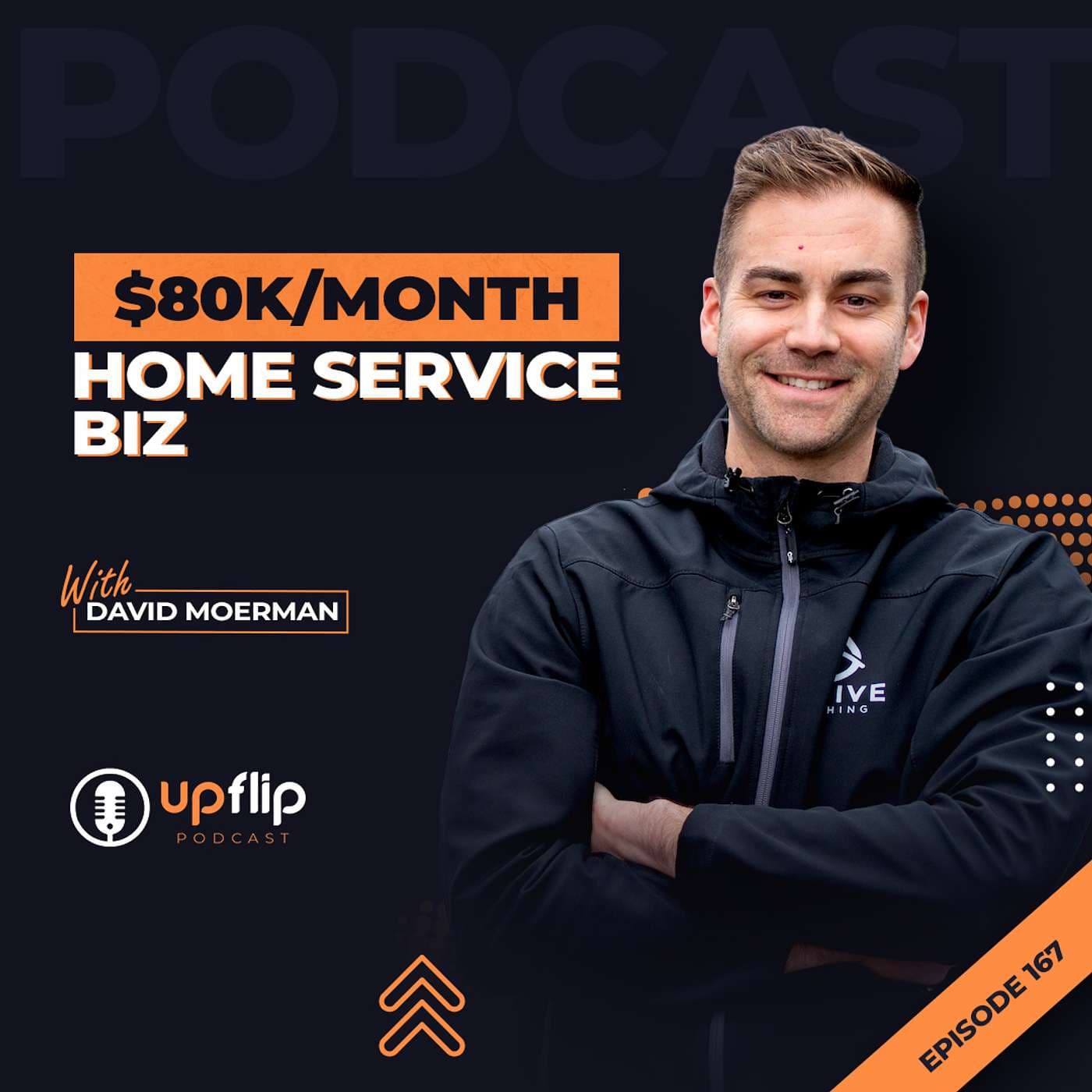
Episode Overview Title: His Secret Weapon to Building a Home Services Empire to $810K a Year! Host: Ryan Atkinson Guest: David Moerman, owner of Revive Services
In this episode, Ryan Atkinson interviews David Moerman, who shares his journey from starting a home services business with a minimal investment to generating significant monthly revenue. David discusses the importance of strategic hiring, marketing, and operational systems that have contributed to Revive Services' success.
Key Concepts and Discussions
Business Beginnings
- Initial Investment: David started with a used van, a pressure washer, and basic equipment, totaling a $3,000 investment.
- First Business Venture: He previously ran a painting business during college before transitioning to pressure washing in 2016 after feeling limited by franchise fees.
Revenue Growth
- Year-One Revenue: Revive generated $89,000 in its first year, primarily through grassroots marketing efforts like door knocking.
- Current Revenue: David reported consistent monthly earnings of around $80,000, with peak months reaching $130,000, indicating substantial growth over the years.
Marketing Strategies
- Customer Acquisition: The initial strategy involved door knocking and leaving door hangers, with David personally engaging with potential customers.
- Referral System: A key component of their marketing strategy relies on customer referrals and obtaining Google reviews — approximately $50,000 of their monthly revenue comes from this source.
- Branding & Visibility: Emphasis on vehicle wraps, technician uniforms, and neighborhood branding to create a recognizable local presence.
Operational Systems
- Team Structure: David operates with a lean team of six technicians, two managers, and three trucks, focusing on efficient operations.
- Employee Compensation: He discusses a unique compensation strategy that incentivizes technicians to garner reviews, enhancing their customer service and overall satisfaction.
Key Takeaways for Aspiring Entrepreneurs
- Foundation of Reviews and Referrals: Building a business on satisfied customers who provide reviews and referrals is crucial.
- Become Irrelevant: Successful CEOs should aim to be the most irrelevant in their businesses by building strong systems and delegating effectively.
- Systematize from Day One: Establishing standard operating procedures (SOPs) for both operations and marketing is vital for long-term success.
Advice for New Business Owners
- Focus on Marketing: Establish a robust marketing plan, particularly door knocking, to build a client base.
- Scheduling: Block off specific times for marketing activities and remain consistent in outreach efforts.
- Understand Your Numbers: Be aware of pricing and ensure that labor costs align with service pricing to maintain profitability.
Conclusion David’s journey illustrates that with determination, strategic planning, and effective marketing, it is possible to build a successful home services business from the ground up. His insights serve as valuable guidance for aspiring entrepreneurs looking to replicate his success.
---
Resources Mentioned
- Pressure Washing Course: [UpFlip Academy](https://bit.ly/4iKH1pL)
- Connect with David: [Instagram](https://www.instagram.com/homeservicebusinesscoach_)
For more insights on entrepreneurship, visit [UpFlip.com](https://www.upflip.com) or explore their [YouTube Channel](https://www.youtube.com/upflip).
Written by AI. May contain mistakes. Listen to the episode to check what was said.
Transcript
Automatic transcript. May contain errors.0:00How can you turn a modest$3 ,000 investment into a revenue generating machine? Our guest has cracked the code on home services and today is generating$80 ,000 per month in revenue, all while working on the business, not in the business. This is Ryan Atkinson and you're listening to the Upfit Podcast, where we uncover the secrets of building and scaling successful businesses. Joining us today is David Mormon of Revive Services. With nothing but a used minivan, a pressure washer, and some basic window cleaning equipment, David has built a business that's not only profitable, but also a leader in the industry.
0:35I am so excited for today's episode with David. We're going to talk a little bit more about the startup costs, revenue, marketing, and so much more. So David, welcome to the show. Thank you so, so much for being here. So honored to have you on here. This is going to be a great one today. Yeah, Ryan, goes both ways. Love you guys' show. Excited to dive in. Well, let's do just that. To start us off, can you share a little bit more about Revive? What are you guys offering? How did you get into this business? Yeah, definitely, man. So we're a full home service detailing company. So we do a lot of window cleaning, pressure washing, roof cleaning.
1:06We're out on the West Coast, just outside Vancouver. So like we're chatting off camera. We get a ton of rain. So doing a lot of roof cleaning. And in 2019, we actually plugged in holiday lights as well. So we do a lease model with that. So we've been able to make the business go year round. In a nutshell, how I got started actually was way back in 2009, I ran a student painting company all through college. So I will say you don't need a business degree to run a business, but I thought you did. So I was going to school on a soccer scholarship and painting houses along the way. So that's really where I got my start.
1:39Interesting. All right. So that started in 2009. So let's kind of quickly fast forward the clock from 2009. What really led up to like getting started with the Revive? Yeah, man, I was in a painting franchise at the time. I had cleared over$500 ,000 in revenue. And I distinctly remember looking at my profit and loss statement, I was paying$52 ,000 a year to the franchisor for franchise fees, right? And it wasn't inherently bad. I just felt I wasn't getting a lot of value. So I said, screw this. I want to go build my own brand. And I was signed in something called the non-competition agreement, which said, you can't just start your own painting business.
2:17So I met with the franchisor. I said, I'm going to go into pressure washing. They said, we don't care. There's not much money in that. You won't be able to grow it. So I had a bit of, you know, extra motivation in my spirit. And in 2016, Revive Washing, we were originally called, was born. We did$89 ,000 in our first year. Wow. Window cleaning, pressure washing, and gutter cleaning. And that's really where we got our start. Oh my gosh, absolutely love that. I love the point of like the chip on the shoulder because I feel as like entrepreneurs, like it's kind of like a code that you need to have is like, You need to have that chip on the shoulder that really motivates you in times, and it speaks true to that.
2:51But$89 ,000 in year one, that's incredible. I think listeners' ears would perk up with that. Before we dive into all of that, what you're doing in revenue now, marketing, I want to talk about the startup cost. What did your startup cost look like back in 2016? Yep, so I had$3 ,000 to get started. So I bought a used Chevy Astrovan. It was like a 2002 at the time. I love that. Nothing special. but because I had grown my painting business previous, we used Dodge Caravans and they were a few thousand bucks and I would wrap them. So I've now bought year to date 13 pre-owned vehicles. I only bought a new vehicle last year.
3:26I just love the pre-owned and wrap it. So that was a big cost was initial, was getting the van going. And then man, I walked into Home Depot and I rolled out a 200 dollar Ryobi pressure washer, which in the pressure washing industry, people would laugh at. And the other day, it's just part of my story. I was in for$189 rolling out that pressure washer and I was literally unboxing it on my first job site. So it wasn't like I had all this extra money. It was literally just like, this is how I'm getting my start. So it was 3 ,000 bucks we started with. I love it. So you're rolling out like$189 pressure washer is what I'm hearing.
4:01But obviously to do that, you have to land a customer. And we're gonna dive into marketing and sales later in the episode. But for now, how did you get your first customer of the$189 and a dream? Yep, it was door knocking, man. Most of that 89 ,000 the first year was a combination of either me door knocking, say, hey, I'm Dave with Revive, can I get you a quote for your windows? Or it was a door hanger that I left behind if they did not answer the door. So I really became a student of the neighborhoods that worked well in my painting business. And I distilled it down to about 30 neighborhoods were really good for us.
4:35And so I took myself, actually a member of the high school soccer team I was a coach at, And I said, man, you want some extra hours? I'll doorknock left side, you doorknock right side. And if he'd get more leads than me, I'd go buy him a gift card. So we started doorknocking. I love that. So let's talk about that specifically about doorknocking, but also like who do you have on your team in year one? Because is this$89 ,000? You have two people, including yourself on this team. Talk to us about those logistics. Yeah, so it was Dave, myself, and it was two part-timers. So one was Graham. Graham was actually a student at a local college and he had four months free.
5:14So I stacked up the work and he would do a lot of the production. So he was the one driving the van for those four months. And then my other employee was Conrad and Conrad was a part-time doorknocker with me who, funny enough, he's a lead today still at Revive and my company's grown up and he's crushing it. So kind of a cool story there over a bunch of years for employee retention. Yeah, employee retention is always super important for any company to retain your most important employees here. And what I honestly love about the home service business is a lot of it is just like how you get your first customers, like door knocking, like go knock on doors, get in people's faces.
5:50But I'm honestly just like curious, I've never done it. Like, what are you saying? Like when you knock on these people's doors? Yeah, it's short and to the point, man. So through student paintings, that's what we were taught. I actually knocked on 4 ,000 doors as a student painter. And I got really comfortable with people telling me to screw off and all kinds of things that I developed such a thick skin that I just don't care what people say when it comes to rejection. So it's just a really simple doorknock. I say, hey, I'm Dave with Revive. We're doing some homes in your neighborhood for window and gutter cleaning.
6:21I wanted to see if I could give you a quote. So it's like seven second pitch. What most people do, they screw up and they just keep talking because they're so nervous. You have to pause because psychologically we open the door and we just want to say no as quick as we can. but you want to make that offer. Quickly say who you are, drop the social proof you're in the neighborhood doing some jobs. That really helps and make sure that, you know, ideally you are doing some jobs. And then mention of your service and offer the free quote. So it's kind of four things in like a seven second window and no pitch is perfect, but I just try and lead with authenticity.
6:55Same with these interviews, just what you see is what you get. And I think people really buy into that. Interesting. So we got$189, got our pressure washing. We got our first job from door knocking. Talk to us about like those first years. Like, what are you doing? We're going to dive really into revenue, what you're doing now. But month one of 2016, like, are you doing$1 ,000 in sales? Like, talk to us about that. Yeah, we would have done, I don't remember exactly the first month, but I had Graham going pretty well full time. So it wouldn't be abnormal for us to do like a$15 ,000 month. I would approximate.
7:27He was stacked up pretty good cleaning. He was just a solo technician. I would jump in if needed to help him, but he could easily do$700,$800 days executed. Wow. He could handle that. One other thing to note too is with my painting business needed some pressure washing jobs done. So I had some contacts that I could say, hey, this could actually be washing on our washing side. So that did help, but it was really a full on push for me. I launched Revive actually in January of 16, but we weren't actually doing jobs until I want to say late April, early May. So I gave myself almost five months to just go buck wild with marketing and door knocking to load up that hopper.
8:09And I think a lot of service businesses don't initially do that. Yeah. Interesting. So I'm here like, yeah, like you said, like a four or five month lag time. Was that like intentional to build that client list or was it because of like weather conditions in Vancouver? I just want to be clear on that. It was a hundred percent intentional, man. And I think that's something a lot of owners miss. They get one client, And they get so excited. They do. And then they take their foot off the pedal with marketing. Again, this was instilled with me of student painting. I remember my fourth year painting houses in college.
8:39I came into May with$106 ,000 of signed contracts without painting a house that year. So it's like, I'm all for doing a pre-launch properly. And then you can segue into production. So it works beautifully for painting, pressure washing, whatever home service you have. Interesting. Well, I want to hit on that then, of course. What goes into like a successful pre-launch with like the home service industry? Yeah. So branding is a big one. Like I really love having a good logo, a good name, lock in a website. With Revive, I was really proud of myself. I set up my Google business profile from day one.
9:12Used to be called Google My Business. Now it's your Google business profile. So from day one, I'm asking for reviews, right? And Google's changed a lot. But back in the day, you could go ask your grandma, your girlfriend, your girlfriend's parents and get reviews. It's a little different now, but you definitely want that set up from day one. I built out my CRM on Jobber. So that was set up from the start so I could have accurate data. And then it was just, man, like literally at the time, printing out neighborhoods and circling maps and making marketing routes. We got a bunch of lawn signs, tons of door hangers.
9:45So it wasn't like I had, though, like, you know,$50 ,000 for startup. It was still just very lean. but I used like my sweat equity and my time because I didn't have a lot of money. Want to launch your first business with confidence? Start with a 10-day free trial of the Uplup Academy. The Uplup Academy provides unlimited access to 11 plus courses created by seven figure entrepreneurs who walk you through exactly how they built their businesses from the ground up. They'll show you what to do every step of the way so you can grow fast and avoid the common pitfalls that keep most entrepreneurs stuck.
10:18This is as close as you can get to guaranteeing business success. So if you're serious about launching with confidence, start your free trial of the Uplip Academy today by clicking the link in the show notes below. And that's what I want listeners like really know is like you don't need$50 ,000 like launch a home service company. A lot of it just comes down to that sweat equity piece and like, are you able to develop those routes? Are you able to put yourself out there and actually go knock on the doors? Are you able to actually do that work to land your first client? I think that's a super important part when it comes to home service companies.
10:47Yeah, and I had the hunger, man. I got into cleaning. I'd seen painting. It's good. But with cleaning, you've got higher profit margins, which is great. We could talk about that. You've got recurring revenue. And you've got what I call a fragmented industry, which is if you go on Google and look, there's not one dominant washing company yet that's really taken over. There are some, but there's potential in any given market if you brand properly and build a business. So those are the three factors. I'm like, whatever my revenue is in the first few years, I'm just going to make the jump and get started.
11:19I absolutely love that, David. And last question before we dive into revenue, what today looks like those margins. I want to be clear as well here. So when you're pressure washing, was it you doing it for the first year or so? Or were you hiring people to actually do the pressure washing? So I would say the first year of 89K, Graham probably did 70 % of it, I would say. And then I was filling in the other 30-ish percent because Graham also went back to school in September. And so I had another part-timer stay with me. So it was kind of a combo of getting Graham doing the jobs and I would jump in when needed.
11:50I love that. Graham sounds like a great employee here. He sure is. Yeah, I love that. Let's talk about revenue. Listeners love revenue. Talk to us. What are you doing yearly now, monthly? How has it grown over the past, whatever, it's been seven years or so, eight years? I don't know. Something math. Yeah, seven years, man. It's funny. Our annual revenue has almost turned into our monthly revenue now, which is exciting. I think it's tough on a show to say this is exactly what it is because we're mid-year. But I would say very confidently,$80 ,000 a month now is like a base for us. But August this year, I just looked on our CRM, we did$127 ,000.
12:27Last November, we did$130 ,000 of Christmas lights. So it kind of ranges as$80 ,000 monthly as a floor. And$130 ,000 would be like a high, crazy busy month for us. And it's not like you need all these employees either. That's running for us, running three trucks, six technicians, and then I've got two managers that help me run the day-to-day. So it's not a huge, complex organizational structure. Interesting. So if someone was going to look at your guys' operating expenses, what are the largest expenses? I'm assuming payroll, but what else would be your largest expense? Super good, man. I'll just riff on this for a sec.
13:04Super easy numbers. I go 30, 50, 20 if the listeners follow me. 30 % goes to our crew. So that includes payroll taxes and workers' compensation insurance and paying the crew to do the job so the owner doesn't need to be there. 50 is the biggest one of the company. And that's what's called our overhead. So of that 50, 30 is like marketing, insurance, technology stack, all this good stuff. 20 of that 50 is what I call overhead salaries. So that would be my office manager, my sales consultant, paying any virtual assistants we have overseas. And then the final 20 everyone loves, that is net profit.
13:43So that is the business running without Dave. Everything paid, we want 20 % left over. And that's really how I chunk it down. 30, 50, 20. Love it. 20 % net profit is a pretty good margins here that we're dealing with. It's good. I think one caveat with that, our holiday light division can be close to 40 % net. Wow. Yeah, it's an amazing business. I know you've had some of my friends on this show just crush their episodes. So that's a great add on profitable service if you run the lease model. And so that lighting division, we do a few hundred homes a year in Q4. That helps push us up to that 20 % mark.
14:25But yeah, one other key thing too, Ryan, I have yet to have a year in business that I've spent more than 7 % of my overall revenue on marketing. So I'm not going so break the bank on paid ads. We do a little bit, but we've really built a great brand locally that pulls the right clients in that we don't have to go out and go buck wild on marketing if we don't want to. Yeah. It gives us a good idea. Like you broke down like what your revenue is, what your net profit is, where your expenses are going. So I do want to hit on that marketing piece as well. Cause we just heard you say like, yeah, I'm going super crazy with marketing.
14:57And that's amazing to hear, obviously. So a lot of it has to be, you're providing a great service, but you're also getting like referrals or what would be that funnel, like how you guys are getting clients? Yeah, definitely. So reviews and referrals is like, if it's a pyramid, like reviews and referrals is just baseline. So you should have reviews coming in every week and you should have referrals coming in every week. And for those of you starting, like I want to get to 10K a month, like just go one job needs to turn into two. And we call it at the end of the job, every job, we call it the three R's.
15:26We want a review, we want a referral, and then a receivable is like, we want to get them paying. So the reviews and referrals I'd say is like, we can't talk about marketing without just like baseline. And I'd say of our$80 ,000 a month, what reviews and referrals contribute to probably 50 of that 80K. Someone's reading a Google review or getting referred or seeing a van. Those would be a huge baseline. Beyond that, second tier of the pyramid, we do a really good job. We call it creating neighborhood buzz. So that is, we call it a five around, which is five flyers to every neighbor we do. We put signs up in the neighborhood.
16:02All our technicians are in uniform. Back in 2019, I put$12 ,000 into wrapping all of our vehicles because I just was such a believer that we want to brand this thing properly. So we dominate the neighborhoods. And then final tip of the pyramid is paid. We work with an SEO company right now. We're about$900 a month just to keep that top ranking on Google. And then additional to that, we do the Google pay-per-click ads. And we've also ran some Facebook campaigns. So for listeners listening, I try to keep it so simple. I would build that three-tier pyramid in that exact order, one, two, three. David, I have to say thank you so far on this podcast because you've been great just breaking down a revenue and super actionable.
16:44So you're doing a great job and we're going to continue this. So stay tuned as well. But the reviews and referrals piece, I think is interesting because that's really the foundation of how you're getting, you said$50 ,000 a month to get to that$80 ,000 a month. What's that system that you guys have in place? Are you just simply asking people, asking them to go to Google, ask them for other houses? What does that look like? Yeah, so we got to give credit where credit's due. We work with a software called Nice Job when we're around 100 Google reviews, and that helped grow us and get a few hundred more reviews.
17:12So that was great. But honestly, man, we've not even used much software in this last year. It's just been us doing a great job. And through Jobber, we actually, when we send the invoice is finally paid, we send just a hyperlink that says, thank you so much for your service. If you could do us a solid writer review. Here's the kicker though, man. And I'm so glad to just get this out to the world. We say in that email, we will tip our technicians$10 each on behalf of you if you leave a Google review. You say that, conversion through the roof. And we do. We tip our technicians$10 for every review that they get.
17:45And we see a steady highway of Google reviews come in. And one more thing I want to say, man, we actually had our Google business profile suspended earlier this year for about 65 days. And as a business owner, I was freaking out. like, are we going to get jobs? Is this going to happen? We still had really strong months for revenue. And one thing I want to hit on with marketing, we have a client base now of about 8 ,200 and some odd people we can email and text. And now that was the strategy that got us through those 65 days of just going back to our well, people who hired us and saying, Hey, it's Dave with revive.
18:21We're doing this service. So it don't want to talk about marketing and not touch on reengaging your clients because it saved us this year. Yeah, that's what I think is a really important piece and what I'm running through my own business right now is who are people that were expressed interest at all over the past year? Because we're going into November, December as an agency. It's tough. People are like, I'm planning budgets. I don't want to take a meeting. So it's going back to people be like, hey, you're interested in July, like is now a better time? And I think that's a really important piece is who do you already have existing in your CRM that you can hit it on that have expressed interest and resell to them.
18:54100%. It's been a huge boost for us this year. Yeah. I'm curious as well. So that's been a huge boost for you as a whole, as a company. A question that comes to mind for me that I'm just like, personally, just curious is you did$89 ,000 in your first year. Now you're doing$80 ,000 a month. But that's soaking. I'm curious, like, what has been the differences as like a leader, as like a CEO of doing$89 ,000 a year to$80 ,000 a month? Yeah, two things, man. It's your systems that we have and it's our team. The best thing a business owner can do, and this might just mess up people, but it's fine. You have to become the most irrelevant person in your business.
19:34And I'm no word of a lie, man. I'm in our office once every two weeks and I take all our team out for breakfast every second Monday. And additionally to that, I'm still available on Slack if someone wants to meet or there's a big issue. But I've worked myself out of a job to go build another company. And I think that's the ultimate compliment is when your people can run the day to day of the business. And I'm not saying this is easy. Like I've been in home services for 16 years. We've done over$7 million in revenue overall. So it's just like it takes time to get there. But if you can really learn to identify who's great people and bring them in your company and show them, hey, in three years, this is our vision where we're going, you'll keep great people.
20:16So that's my little piece on people. We could do another chat about that. The other one is just systems. Everything in your business recurs. And I read Michael Gerber's book, The E-Myth, back in 2016. And that really helped me, Ryan, say, okay, it's so cool to go and get money and do an$800 job and make money. But I need to take that 10 hours a week and work on my business and build out an inbound call script. So what do I say when clients call? What do my technicians say to get reviews? Even what you're wearing on the job site, that's a system in itself. Do you have uniforms? Do you have a nice logo?
20:51So it took me 8 ,000 hours, but I systematized every part of my company to be able to run. And the beautiful thing with cleaning, it's a recurring service. So as long as you're doing a great job and building a great brand, the services will recur. So I would say if you put 80 % of my brain power the last seven years went into team building and system building. And that's really, I think, how we moved our annual revenue to our monthly revenue. Yeah, I love that piece because it is so hard as a business owner to be an owner, not an operator. I think that's a really big jargon work on your business, not in your business.
21:26How long did it take you to do that? Was this a day one day? I know you had Graham doing a lot of stuff early on, but how long did it actually take you to go to that completely owner's mentality? Yeah, it was the year between 2018 to 2019. So first year, just to, I know your audience loves numbers. So first year was 89 ,000. Then we added a second truck seasonal still did 155 ,000 in 2018. Here's the kicker, man. In 19, we went from 155 ,000 to 582 ,000 in one year. So added the vans, wrapped, hired. The winter of 2018, I built out the business. I'm like, we're moving from, you know, one, two trucks up to four and we're going to do this more seriously.
22:08And I still had my painting business running too, by the way. So it's just like a crazy, crazy time. But I had this vision I wanted to grow. So it really took off that year for me because of the systems that I put into place in the winter. And again, giving credit where credit's due. I ran across a fellow on the internet called Josh Latimer, became a mentor of mine. I spent money on his coaching program, got on a coaching call with him and really systematized out my business the best I could at that level and built systems. Then I operated, then I went back, built more systems and operate. So it's constantly osculating from in to on the business.
22:44Cause man, if it's May 15 and you've got$5 ,000 on the books and vans breaking down, you're not going to sit in Starbucks and build out SOPs. Like I'm not I'm not even going to say that. But in the winter, at least in Canada, we get four months or really slow. I was just like a student every day, just working on different departments of the business. And I think it showed come operating season. Dude, I love that mindset of like, there's ebbs and flows when it comes to an entrepreneur, it's working on the business and the business and you have to pick that at the right times. I want to get actual for the listeners here.
Read the full transcript
23:17If you told them one department to build out systems first, what department would that be? Oh man, it'd be a two-way tie. I would do marketing systems and I do operation systems. So I think the first hire in any home service business should be the owner extracting themselves off the job site and putting in a lead technician. In some markets, that's$25 an hour. Others, it's 35, whatever it is. You've got to get yourself off the tools so you can actually do business development and grow. So I'd first some operation systems just to rattle them off. Job site checklist. We have a 10-step checklist.
23:50Every job has to be done non-negotiable. Review script, that'd be another one. And then if you do window cleaning, you should just have a one-page sheet for a standard operating procedure, how to clean a window. On the marketing side, it's still a seat I sit in today, Ryan. I see myself as the marketing director at Revive. Like if the phone's not ringing, it's because Dave dropped the ball in marketing. So I think marketing can be your leanest department, but we have a team of virtual assistants that help us with graphic design and running Instagram and all this stuff. So I think you want to also build out some basic systems on the marketing side too.
24:23So I'd start with ops and then move to marketing when you got time. Interesting. On the ops side, I'm curious for you, your first like few hires, were they on an hourly salary or were they on like a fix like you're getting paid$400 a month or how do you approach that as a business owner? All hourly, man. I've done salary before. We've done performance pay. Like we've done it honestly all. I've hired over 150 people now. So I just find hourly in this trade, in cleaning specific works great. And I know you can do subcontractor. And I just want to speak to what's worked for me. And that's paying technicians hourly, but bonusing them up$10 per review.
25:01We double that to$20 each when their name gets personally mentioned on a review, which is killer. And then they get the opportunity to receive 100 % of the tips they make as well. And we use Jobber to process our payments. So we kind of do solid base rate hourly, and then we pay additionally those performance bonuses based on how they do. And that's made for a really great structure when it comes to compensation. Yeah, and I feel like compensation as a business owner is like one of the hardest things to like get right because you don't want to undercompensate people, but you also don't want to overpay people.
25:34It's like a really hard balance to get. Yeah, it really is. And I think a lot of new business owners will actually overpay their people. I know I did. Originally, I was paying technicians 50 % of the job, which was just like, it's way too high. Now we run on about a 30 % model, like I said. So generally, I'll see owners actually overpay their people. And then there's no room for margin. And here's the thing, your employees should want to work for a profitable business because that means that they have some ascension opportunities. And I think most home service business owners, they're like, cool, Ryan, Dave, I'm gonna scale up.
26:09But they scale up with this owner-operator price book still, and it's just charging too cheap, and they just run themselves crazy and stay too busy. Yeah, and I think that's another important piece as well, is you're hitting on a lot of points here, is like not undercharging for your services, especially when you're starting your first company, you might not have that confidence or like that no. And so people always say like, charge like 50 % more than like what you wanna charge, because that's what like you're actually worth, especially in like a home service business where, you know, margins can be margins.
26:36You want to definitely make sure you're getting paid fairly. Yeah, I think the biggest thing, like again, a cliche, like know your numbers, but I think the biggest thing is just jump on Indeed or Glassdoor today and find out what you need to pay a technician in your market. Whatever that is, I would times that by three or four times. We call it the 4x wage multiple. So if I'm$25 in my market, I need to make sure that technicians billing out at$100 an hour because that's going to keep my direct labor at 25%, which I said on this podcast, I like 25, 30 % range. So most owners will be like, okay, I have to pay Josh 25 an hour.
27:13I'm going to charge him out at 50. I'll be killing it. But this overhead is going to sneak up on you and you'll end up with no margin. So I think it's really important when you choose to step off site, you got to make sure your price book matches and you have to be okay. Like I'll say this too, a really important point. the clients who paid me that first 89 grand, most of them are not our clients today because our prices have went up, up, up like a professional cleaning company. And that's, it's no one's fault. It's just, that's how the business evolved and grew. And I eventually learned my numbers that to scale up, we've got to charge higher for this to make this thing profitable.
27:50Yeah, that's an exercise we're going through right now at Spacebar Visuals. So I definitely hear you on that. But because of time, someone's like, Like, well, David, you are super profitable. And you know what? I'm ready to get started. Last question before we get to our fan blitz. If someone's like, I want to get started with this, what advice would you give them for the next 30 days on how they can get started? Yeah, I mean, I would get serious about building out a solid marketing plan. I think if you could come to an expert like myself and line out, hey, I want to get to 100 grand. Here's my marketing plan.
28:20This is exactly what I'm going to take to do it. That'd be one, the plan. And then two, I would block schedule out your calendar, man. And for me with door knocking, I just set it up three days a week. I was going for three hours, non-negotiable rain, dark, light, didn't care. It was just in my calendar. So I like to see the plan married with like that implementation of like, I'm going to have some gumption and stick to this. So I would start with marketing and then of course, through the off season, build out your Google business profile, set up your CRM. But you know, those things don't necessarily generate revenue right away.
28:52So you want to kind of have that fire in your belly to say, I'm just going 100 day marketing blitz and I'm going to go stack up those contracts. I love it. That is phenomenal advice and phenomenal advice to have this podcast. So we are going to move to our fan blitz questions here. And these are questions submitted from our community. And guys, if you want to join in on amazing entrepreneurs and get your questions answered, go to www.youtube.com slash upflip and submit your questions there. But David, ready for our last five questions? Let's do it, man. Let's do it. I'm really excited for this question.
29:21That's a good one. If I ran this business solo, what's the most I can expect to make before I have to make my first hire? Oh, man, the highest I've ever seen is a colleague of mine. He got up to$400 ,000. But I don't want to say that's normal. But if you want to work 100 hours a week and have no life balance, that was his max was$400 ,000. But we usually don't see that, man. I would say in the cleaning space specific, generally about$200 ,000, you're looking at, I need a virtual assistant to help me in the office. and like I'm just maxed out 50 hours a week on the tools. So I need to get someone in.
29:55But yeah, 400 is highest I've ever seen, but about 200 is where the wheels start to fall off and you lose that like life outside the business. It's time to think about hiring. Yeah, love it. Great advice. And number two, what business book had the biggest impact on you and why? Three of them. One, Michael Gerber's book, The E-Myth is great. I've actually read it 13 times. I'm just a nerd like that. Two is Dan Sullivan, Ben Hardy's book, Who Not How, the best book I've read on delegation and look out because you'll start shifting around your personal life as well with your time. I know that I did.
30:26Number three is Greg McKeown's book, Essentialism. It's all about time management and getting solid where your time's going. Who, not how. Interesting. That's the only book I want to read. Number three, if there was a movie made about your journey, what would the title be? Oh man, I think it would be called Resilience. I've had some pretty crazy things in my story with business. Honestly, every year, 16 years in business, there's a couple of big situations that take me back that you almost want to just quit because it's just heavy stuff with employees, clients. So like, I think it's all about just resilience and persevering, something in that regard.
31:01I love that. If you're an entrepreneur, you better learn resilience. Number four, can you tell us about your most bizarre business encounter? Oh man, there's been a few. I'll just share one of the struggles, man. So we did like a hundred year old heritage house in Vancouver. This was way back in the day. And I sent my guy out before I had revived. We were just pressure washing as is. So my guy went out. His name was DJ. DJ went out to wash the houses over 10 years ago. And there was a vine in the way. So DJ just took it upon himself and hacked out that vine so he could wash the house. It turned out that was like a pass down from the ladies like grandma.
31:34And it was in the family forever. And you can imagine how lit up I got when we hacked out that vine. So problems like Batman. You're like, that's absolutely bizarre. It's 100 % our bad. And there was definitely some serious damage control that, you know, young Dave at 22, 23 was thrown into. So that was bizarre. And that was our bad. And as an owner, share this to the world, you're going to make mistakes. Like you don't stay in business 16 years being perfect. So you got to know when you screw up and you got to find a way to fix it. I love that. Great mentality right there. Number five, last one for you.
32:06Could your business survive and thrive if you were away on vacation for a few months? Oh, a few months, I'm going to say no. A few weeks, yes. I've done now 10 years in a row, taking 40 days off a year from the business. So I think it can go for weeks, but I'm not going to say it could run for months without doing anything. But I would say a few weeks for sure. Nice. Well, I may need a few weeks to decompress from this episode because this was so, so good, David. Thank you so, so much for being here. Someone's like, I need to connect with David and learn a little bit more about them. Where can they do so?
32:36Yeah, we're on every platform, man, at Home Service Business Coach so people can reach out and see what we're doing there. Everyone, that was an amazing episode with David. Three quick takeaways for you. Number one, I loved when he talked about the foundation of what he's doing. $50 ,000, in fact, of what he's doing from reviews and referrals. So if you're looking to build out your marketing strategy, start with reviews and start with referrals. Number two, be the most irrelevant at the company. I know that sounds crazy to hear as a CEO, as an owner, but you want to build out SOPs where people can work off of, where people can go without you.
33:09And that leads us into our third one, build out SOPs. Build out SOPs from day one. He gave great tips on build out marketing, but also build out ops at the same time. It was a tiebreaker for him. So choose which one you want to do, but definitely start building out one. Amazing episode with David. Ton of great advice in here, guys. And I know you guys are gonna be empowered to start your own home service company. Perfect. Well, David, thank you so, so much for being here today. Appreciate this episode. Really great insights here. So thank you so much. Yeah, thanks, Ryan.
33:38you
From the publisher
David Moerman of Revive Services started with nothing but a used mini van, a pressure washer, and some basic window cleaning equipment. Today he’s a leader in the exterior cleaning industry, going from $0 to $80K in monthly revenue.
David is here to share his insights on hiring the right people, maintaining growth during slow seasons, and the innovative approaches that set Revive Services apart.
Resources:
- UpFlip Academy’s Pressure Washing Course: https://bit.ly/4iKH1pL
- Connect with David: https://www.instagram.com/homeservicebusinesscoach_
Ready to be your own boss without starting from scratch? Grab our FREE Franchise Guide and unlock the secrets of proven business models that have already created thousands of success stories.
Connect with UpFlip:
- On Youtube
- On Instagram
- On Facebook
- @UpFlipOfficial on Twitter
For more insights to start, build, or grow a business, check out the resources on UpFlip.com or head to the UpFlip YouTube channel to see more interviews with business owners and experts.
Thanks for listening!


