
In short
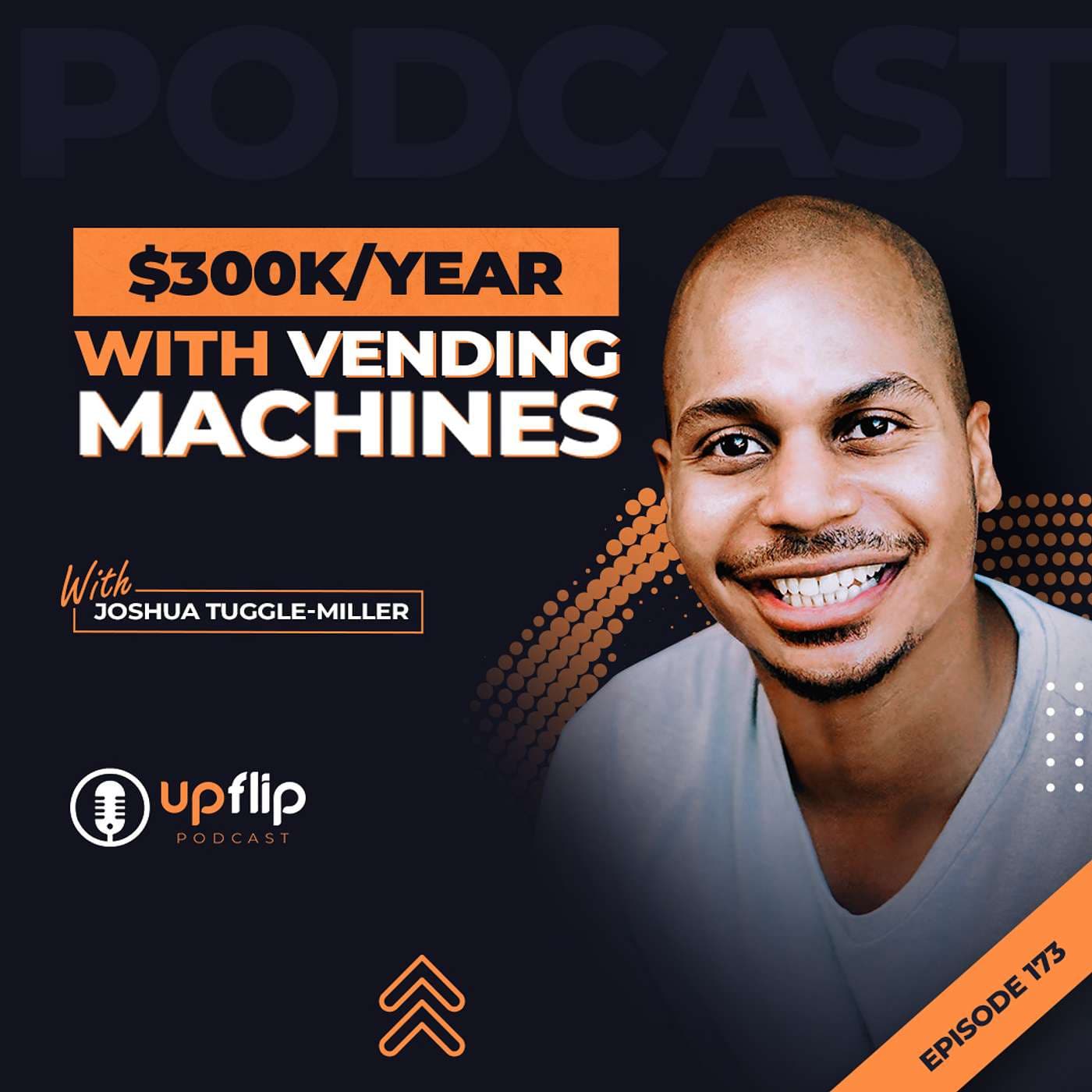
The UpFlip Podcast Episode 173: Passive Profits with Vending Machines - Local Market Domination Strategy
Podcast Overview
- Podcast Title: The UpFlip Podcast
- Description: A platform where entrepreneurship is explored, focusing on how successful businesses are built and managed, emphasizing the accessibility of the American Dream.
- Episode Title: Passive Profits with Vending Machines - Local Market Domination Strategy
- Guest: Joshua Tuggle-Miller
- Duration: Approximately 1 hour
Episode Summary This episode features Joshua Tuggle-Miller's transition from the entertainment industry to the vending machine business, detailing his journey and sharing practical insights for aspiring entrepreneurs. Joshua emphasizes the importance of strategic planning, operational efficiency, and maintaining financial awareness in the vending machine industry.
Key Concepts Discussed
Introduction to Joshua Tuggle-Miller
- Background: Transitioned from the entertainment sector (TV and film) to a successful vending machine business after seeking financial stability.
- Initial Steps: Started with one machine, funded by a loan from his father, after volunteering for a year to learn the ropes.
Starting a Vending Machine Business
- Initial Investment:
- Suggested starting capital: $10,000
- Includes costs for machines, credit card readers, product inventory, and miscellaneous expenses.
- The first machine cost approximately $2,500.
- Finding Locations:
- Importance of securing locations with foot traffic and building relationships with property owners.
- Recommended outreach strategies include cold emailing and creating business packets.
Operational Insights
- Daily Operations:
- Joshua emphasizes the need for regular checks on inventory, machine maintenance, and sales tracking.
- Highlights the importance of being organized and prepared for the day ahead.
- Customer Acquisition:
- Suggested strategies include offering referral fees to incentivize existing customers or contacts to refer new leads.
- Building a network through personal relationships and community connections is crucial.
Financial Considerations
- Startup Costs:
- Breakdown of expenses including machine purchases, credit card readers, product inventory, and operational costs.
- Importance of maintaining an emergency fund for unforeseen expenses.
- Revenue and Profitability:
- Typical ROI can be expected within one year based on location and foot traffic.
- Emphasis on reinvestment in the business for growth and sustainability despite initial profits being low.
Long-term Strategy
- Scaling the Business:
- Importance of gradual growth to maintain operational efficiency and manage complexity.
- Consistent reinvestment leads to sustainable success over time.
- Risk Management:
- Emphasis on learning the business thoroughly before making significant investments.
- Recommended starting small to mitigate risks and learn through experience.
Key Advice for Aspiring Entrepreneurs
- Three Essential Steps to Start in 30 Days:
- Take a Course: Leverage resources like the UpFlip Academy for structured learning.
- Volunteer Experience: Work for free in the industry to gain firsthand knowledge.
- Start Small: Don't rush into large accounts; focus on learning and growing gradually.
Key Takeaways
- Start Small: Begin with one or two machines and gradually scale operations.
- Build Relationships: Network with property owners for prime machine placements.
- Financial Preparedness: Understand all financial aspects, from startup costs to ongoing expenses.
- Operational Efficiency: Maintain organized operations to ensure smooth day-to-day functioning.
- Consistency is Key: Long-term success relies on ongoing commitment and reinvestment.
Resources Mentioned
- Joshua's Academy: [Join Joshua in the Academy](https://bit.ly/3Q9i6Px)
- Franchise Guide: [Grab our FREE Franchise Guide](https://bit.ly/4aWuGvc)
Connect with UpFlip
- YouTube: [UpFlip Podcast](https://www.youtube.com/@TheUpFlipPodcast/)
- Instagram: [UpFlip Instagram](https://www.instagram.com/upflip/)
- Facebook: [UpFlip Facebook](https://www.facebook.com/upflipofficial)
- Twitter: [@UpFlipOfficial](https://twitter.com/upflipofficial)
Conclusion This episode provides invaluable guidance for anyone interested in the vending machine business, highlighting the practical steps needed to start and grow a successful enterprise. Joshua's experience underscores the importance of perseverance, adaptability, and continuous learning in achieving entrepreneurial goals.
Written by AI. May contain mistakes. Listen to the episode to check what was said.
Transcript
Automatic transcript. May contain errors.0:00This isn't a get rich quick scheme, but if you're looking for a great way to make a healthy monthly income, vending machines may be the ticket. This is Ryan Atkinson and you're listening to the Up To Podcast where we uncover the secrets to running and scaling successful businesses. Joining us today is Joshua Tuggle Miller. He's a seasoned vending machine expert who has been running his business for 14 years. Starting with a single machine to now running a$25 ,000 per month operation. He is the man for the job today. He wanted financial stability after leaving home at just 18 years old and vending machines have provided that and then some.
0:35Joshua, welcome to the show. So, so excited to have you on here today. Oh man, thank you for having me, Ryan. I appreciate being here. I'm excited about the interview and let's get to it. Let's get to it. And venue machines are a really hot topic right now in the Elphab Academy, but all over the entrepreneurial world. And we're going to talk about all that. Before we do that, I want you to intro yourself. You've been doing this for 14 years. You left home at 18. Paint us a quick background picture of you now and what you're doing with the vending machine world. Okay. So a little bit of my background.
1:06So I actually come from the TV film world originally. I came to LA doing TV film. I got my start probably about 21, 22. I got my first TV deal on Comedy Central doing sketch comedy. So one of my biggest frustrations were at the time was, you know, entertainment is very up and down business. Sometimes I have money. Sometimes I wouldn't have money. You know, I'm working all these like part-time jobs because I'm trying to keep my schedule open, whether it was at Buffalo Wild Dowwings, Abercrombie and Fitch at night, stuff like that. And I just got tired of feeling powerless. I was always at everybody's beck and call.
1:40So I was thinking about what's one way that business-wise, what's one way that I'm able to go ahead and build something for myself and build stability. And so vending ended up becoming that place. But how I got into vending is because one of my other homeboys who is around the same age as me, at that time he was doing vending and where he would go to Vegas to visit his family, he would ask me to fill. And so I would help him spot feeling. And then what I started to realize is I really want to invest and be serious about this business myself. And so what I did was I told him, look, you ain't got to pay me.
2:09You don't have to give me anything. Look, just make sure to cover my costs for gas and for the supplies. And I worked a year for free for him just to learn the business. So I gave a year of my time for free to him. And then I went out and started doing my own thing. And so that's how I really kind of got my introduction into the business. And then I met an older gentleman. He's real crazy, funny, but a guy named Pepsi Frank. He goes by Pepsi Frank. And he started teaching me more about the business because at first I started buying vending machines from him, but then he started teaching me more as time went on.
2:44And I will say to kind of go backtrack, my first machine I got was kind of this rinky dink combo machine. And it was for like$2 ,500, just one machine. and my pops end up giving me$2 ,500 after I graduated from Cal State Northridge, CSUN. And he made me pitch to him like he was the bank. And so he said, I'm not going to give you the money, but I want to see. But he knew I had been dedicated towards, I already had been volunteering a year for free with my friend and stuff like that. So he gave me$2 ,500 for my very first vending machine. And from there, I just kept building and going and going.
3:18But yeah, it started off with one machine and$2 ,500. That's awesome. I love the story. and I love like the life lesson your dad gives you. I'm like, you have to pitch me like I'm a bank. Like you have to like actually earn. I think there's a lot in there. So$2 ,500 for your first machine. Is that what it costs now to start like a vending machine business? And then once you answer that, I want to ask, how did you land your first customer essentially? So you can get machines cheaper than 2 ,500 bucks. Like when we're talking about one machine, you can get that definitely cheaper than 2 ,500 bucks.
3:48But if we're talking about a group of machines, it's very hard to do now Because a lot of times, sometimes people see these machines for 500 bucks, 800 bucks. But the thing is, people don't realize they're all outdated technology in the sense that they don't take credit card readers. They're single price machines. The person who's selling it to you is selling you something that really doesn't work. Now, you know, I do sell machines sometimes on the side myself and I sell them for fair deals. And I make sure everything's working. So you can get a machine for like 1500 bucks, 2000, whatever. But the thing is, is that people need to know that you're going to have to invest and put up some coin.
4:22Not a crazy amount of coin, but I would say if you're getting into the vending business, it's really good to have at least about$10 ,000 set aside for yourself. Because you're going to need to do with movers or the credit card readers, all these extra little miscellaneous things. And then you need to have about$1 ,000 for product and everything. So you just need money. You need just-in-case money, if I make sense. No, you 100 % make sense there. And I want to ask, so you have$10 ,000 for startup costs on what you would advise someone. Break that down further. Is that just one machine that costs$10 ,000?
4:52Talk to us about that and talk to us about like getting supplies. So let's say snack machine. You might be able to get a decent snack machine for about$1 ,500 to maybe$2 ,000. Like anything that's worthwhile. Let's see like the Ben Max 4. Ben Max 4 is a glass front drink machine like you see in Costco. Those ones that have the bottle of water in them. Those refurbish are going to run. you're probably about close to four grand right there. And then let's say if you wanted to add a cam machine, because you may have to add a cam machine to a certain location, that might run you about another$1 ,500.
5:24With your credit card readers, you're going to need credit card readers for all the terminals. Your credit card readers will run you about$300 a pop. And then your CoinMax and validators are about$1.50 a pop for each machine. So$300,$300,$300. So you can see now where we get to where you need that$10 to get all that. And then you got to pay your mover to move your machines for you, unless you're going to do it yourself. And they charge about a buck 50 per machine to move. So that kind of gives you a realistic picture why I say the 10, because it's bigger than just the machines. But you got these little miscellaneous things that you need to order and add up.
5:57And then you have about another thousand left over 2000 for product. And then you're off to the races. I love that. And you're off to the races. That was a beautiful breakdown, because like when I was thinking about vending machine businesses, I wasn't thinking about like the credit card readers, the movers. Honestly, I Googled it. I was like, oh, like a$5 ,000 machine, like that's it to get started. So I appreciate you asking that. And we're going to talk about expenses here a little bit more, but we're off to the races. You got$10 ,000, you get your first machine. Talk to us about landing like that first location.
6:23Talk to us about that. So ironically for me, that first location came in an acting studio, but acting studio, I use a frequent. So one of the acting studios we used to study at was a stellar Atlas studio. So what ended up happening was because I knew all those guys and had a relationship with them from acting class to I knew a lot of the managers and the owners and stuff like that. They have Stella Atla New York and LA. So I went to places that I already knew I had relationship with. I went to Stella Atla Studio, pitched them. I ended up getting into there. And also I went and pitched to my improv place.
6:57I used to do improv for ImprovOlympic. So I went to them. They wanted a machine, but the space was too small, so I couldn't do it. So I just went to places I already had relationships with, I was already familiar with, and I knew there was a lot of foot traffic and I felt like they could use my services. And both instantly told me yes. So I ended up only getting one of those locations. And one thing I always tell a lot of people is in the barter acting studio later on, a few years down the road, ended up being a good location. But when they first moved and were really trying to get established in LA, there wasn't so many acting students.
7:28I was just thrilled and happy if I was making$30 a month in profit. But I'll tell you what it did for me was it inspired me. For one, I couldn't believe that somebody would even buy anything for me. So for me, I was just shocked, like, wow, you know, I'm not making much profit at the time, but somebody's actually buying something for me. Like there's a place for me. And then that really helped my belief system. And what it did was it encouraged me to keep going. Also, what I learned is people sometimes want to start on a big stage, but you need to start on a small stage because on that small stage, I was able to make all my mistakes and learn.
8:03Behind the scenes, when things went wrong with the machine, when refrigeration decks were coin mechs, when all this stuff about the vending business I didn't understand really well, when things went wrong behind the scenes, I was able to fail behind closed doors with not so much pressure on me. The bigger the account, the more pressure you have on you to get stuff done and get it back up and running. Like I have bigger accounts now and I can't be down for too long. or I need to have an answer to the problem pretty soon, you know, within a reasonable amount of time. So that's something I tell a lot of new people is you think you want to start off big, but you really don't.
8:39You need to place a safe haven where you can learn, grow, fail, make mistakes behind the scenes so it prepares you for the bigger moments. So when I started off early on, the cold accounts I would go to, I actually just created like a little simple business packet. In the beginning, I created one at home myself off Microsoft Word. I don't know if it was the best, but I did on Microsoft Word. Later on, I ended up getting somebody when Fiverr came around to help me. And then I had my little business packet. And then I would just go around to different people and I would talk to them and I would build relationships with them and I would pass out my packet.
9:09I would email them my brochure and I'll say, hey, you know, I have a vending business. I see that you guys may have a need for my services. I would love to be your vendor. You know, these are the type of machines that I use and operate with. And if you're interested, give me a call and some people will reach out. And then what I would let people also know in the beginning too, what helped me a lot was I would tell people, if you know of somebody that I don't know about, I would pay them a referral fee. I would pay them a$500 referral fee because what it would do was it would make other people become salespeople for me and they would give me leads.
9:43I love that. And I tell them if I land the account and I set up operation, I'll pay you$500 for the referral. And so I got a number of accounts in the beginning of people just, hey, I know this person. Hey, I know this person. Hey, let me give you the phone number to this person. Okay, boom. And I would give them$500. And people would sometimes tell me, isn't that a bit much? I said, but no, because you got to make it worth people's while. If you make it worth people's while, they'll hustle for you. and I said, they're giving me free leads and they don't get paid unless I close it. So if I go in and close it, that's easy money for them.
10:18They're not even having to do much. That's so good. I love the referrals. Talking to someone the other day, another business owner, and he was like, dude, referrals are such a unlock because basically you just have a bunch of boots on the ground doing leads for you, getting you leads and everything. Yeah, and they're warm leads. They're not cold leads. Exactly, yes. It's a good intro for sure. Obviously, there's variables here. location, product, everything. How quickly can you expect like an ROI on a machine? I would say realistically, depending on how much you really invest in that machine and if it's a decent location, realistically, your ROI, I don't say about a year or less, but it just also depends on foot traffic and location.
10:59About a year or less, you're looking at ROI and then long-term ROI. Now that's a different picture because as much as you're making the money, you're going to be reinvest it. I tell people I've been broke for years. It's not because of being broke broke, but it's being broke because I put the money back into the business. And if you want the business to keep growing, you got to nourish it. You got to water it. You got to water the plant. You can't take all the money from it. And so I used to take my money and always redistribute it back into the business. Take what I need to survive, but the rest of it, everything goes to the business.
11:31That literally transitions us to our next question here. What are your monthly expenses And how do they compare to that$25 ,000-ish in revenue? Walk us through your expenses here. Okay. Well, I have my van note because I have an Amazon-style van, Ford Transit. I have my van note. I have gas. I have commercial insurance on the van. I pay for warehouse expenses because I lease warehouse space. Product is a big one. You're also spending expenses on every credit card reader you have out there. And I got tons of credit card readers. Those credit card readers alone are$10 a month. So you got a$10 a month fee on that.
12:05And if you have the inventory system on it, it's an extra$3, so$13. And then on top of that fee with the credit card readers, Visa, MasterCard, all those people, they take a 5 % cut anytime somebody swipes a credit card. Hence why I charge 10 cents credit card transaction fee, because you have to be able to pay Visa, MasterCard, all these people. So they take a cut. You got your repair guy, like my repair guy in here right now. He's not my employer or anything. He has his own business, but he subs out and does stuff. but I have to pay him when I need his help on stuff. So I have those expenses, repair expenses.
12:40And on some accounts, you got to pay your commission fees. And then also you got to pay the border equalization, your sales tax fees to the state. It's$25 ,000 in revenue, but that's obviously not$25 ,000 in profit. I do want to make that clear for everyone as well here. But let's talk about that. Someone might be like, okay, like, you know what? Like logistically, this sounds great. I want to do a vending machine business. I know what expenses are now. I know kind of what that ROI looks like. But like, what the heck do I do during the day? Like, what does a typical workday look like for someone that's just starting with the vending machine business?
13:11I think the first thing I look at in the morning, and that probably drives my fiance crazy, is I wake up in the morning and I actually look at my sales report in the bed. I wake up at like four or five in the morning and I'm looking at my sales report and seeing how everything's doing for the day. Well, then once I get done with that, you know, I typically get ready. Then I might go, if I got to do a little bit of shopping early in the morning, like six, seven in the morning, I go do that. I try to get most of my stuff as much as possible delivered these days because shopping eats a lot of time up.
13:40So I try to get it delivered to the shop. It saves me a lot of time. Then what I typically do is I organize and kind of pre-kid. I spend like an hour or two in the warehouse before I even go fill, organizing all my orders for the day before I go out and run my routes. So when I go out, I'm able to execute as fast as possible. And then once I do that, I make sure, you know, I wipe down machines, make sure things are clean, make sure there's no coin jams or any other jams. And then from there, if there's any other stuff I have to address during the day, like feeling does take me a while. So if people think it's short, it's not short.
14:13It's short only if you have a few locations, but you have a lot of locations that could be a long day. But when I get done with it, I typically will come back and then I'll look and I'll kind of tally up what I have in inventory, what I need to order, stuff like that. If I'm not too tired, I'll tend to pre-kit for the following day, kind of get a jump on things, maybe break down boxes, stuff like that. When I get back, I'm usually breaking down a bunch of stuff and then just kind of set myself up for the next day to kind of repeat. And if I got any service calls, like I got to go repair a machine and everything, then I try to schedule that out the next day.
14:47Or if it has to happen that day, then I have to throw off my schedule and cut that day short on feeling and go jump on fixing something and then roll that over to the next morning. What I have to do feeling wise. So a typical day of filling, if I have a machine problem, then sometime I address it midday. Sometime I have to address it the next day. So my schedule kind of varies. I think it like paints a nice picture of what you do a day. So now we've got the listener hooked. They're like, oh my gosh, yes, I want to do a vending machine business. I will do that day to day. So for listeners wanting to start a vending machine business, what are like the first three steps they should take in the next 30 days?
15:24And I know you've had a few experiences with Uplift Academy as well. So I'd love to hear about those experiences. We have some great courses in there when it comes to many machine businesses. I mean, getting started, but what are the first three steps they should take the next 30 days? I think in the first steps, I mean, I wish I had it around. I think that, you know, the Uptip Academy is doing a good thing. You know, the course that Adam Hill has is really awesome. And I just got tipped my hat to Adam first and say YouTube could be a very suspicious place sometime and it could be very suspect on like who you're getting your information from.
15:54but I know this because I'm in the vending game and I've been around him a lot. Adam, what he's teaching you is on point. Also, he's a very trustworthy guy. He's not leading you down the wrong path. He's not trying to just take your money. And so what he's doing with Uplift is very legit. It's very real. And I think that if I had a course around like that where I had the Uplift Academy available to me at my disposal and I had Adam as a teacher, I think that would just be an awesome thing because that didn't exist when I was around. I just kind of learned boots to the ground the hard way. That wasn't around.
16:29I would take the course. Then after taking the course, if you still aren't sure if you want to go full-time in vending, you could always do what I did. Go volunteer your time. Go work for somebody for free for the business to go get a little bit of extra learning in the business, boots to the ground. On top of that, you can see if it's for you because what I've learned is a lot of people, they think vending is easy and they think it's quick money, which it's not. And when they actually get into vending and they realize what it really is, they hate it or they don't like it. And I always tell people, go try it for free.
16:57Look, somebody like myself, somebody like other people, they'll be glad to work you for free. We don't mind having a free labor and you can really get a feel to see how you like everything. So the course, volunteer your time. And then I would say, don't be scared to go out there. You don't have to go out there and get the big fish. Start small. It's a small thing. Who cares? Like I say, My first account ended up being successful later on. It ended up getting the foot traffic I needed a few years down the road as the clientele got bigger. But you can start small, even if it's not profitable. The experience is still you learn from it.
17:31And guess what? Even if it doesn't work that first location, you still own those machines. You can move those machines to another location. So it's not the end of the world. But start small, learn, and from there, just keep going. I love it. Such good advice. And Joshua, you've given us amazing advice. And we're going to go to our fan blitz questions here in a moment. But just reflecting on the past 14 years of a vending machine business, what's the biggest lesson you've learned from that 14 years of experience? I would say biggest consistency. Sometimes my fiance will talk about stuff and it kind of makes me sometimes, you know, get a little bit teary-eyed.
18:04She say, you know, we've been together almost seven years. And she says, younger you will be thrilled and will be proud of where older you has ended up at. She was like, I remember when you wasn't who you are now and the struggles you were going through. And she was like, the younger you would be so proud of this version of you because the younger you would be like, you did it. You made it. You made it happen. And the only way I was able to make that happen is through consistency. And consistency doesn't mean that it's all going to work out. During COVID, I had locations closed down. I had to sell machines to keep afloat, to keep myself going business-wise.
18:44everything else, but I stuck with it. I stuck through all the dark times. I had so many dark times. There were so many times I could have went upside down, Ryan, but I stuck with it. And through sticking with it, I would be honest with you, I've been in the business 14 years. I think it was about year eight when I truly, doesn't mean I wasn't profitable those other years, but it was about year eight when I found my stride. And so this is giving people a realistic perspective where it's like, okay, I turned a corner about year eight is when it's like, okay, now I'm starting to find my rhythm. Now I know that I'm in this and I have anchored myself in this business.
19:20Like I'm not going nowhere. Yeah. It's such good advice. Consistency is everything. And like, yeah, I think you've consistently been great throughout this whole episode. So yeah, this has been so good. I want to jump to our fan blitz questions here. And these are our last five questions submitted from the community. And guys, if you want to join in on world-class entrepreneurs, get your questions answered. You can go to www.youtube.com slash upflip and submit your questions there. But Josh, we're ready for our last five questions? Yes, sir. Let's kick it off. Number one, what does your biggest regret?
19:50Good question. I think my biggest regret vending wise, a problem kind of having now is I think I would have been a little bit more organized on the back end of things because what happens is trying to do that when you've gotten bigger and you're busier is much harder to do. It's like pulling teeth now because now I still have to do everything, all these millions of things I have to do during the day. And now I still have to go back and do all the back end work to put myself where I need to be, like the behind the scenes stuff. Like, you know, whether that's getting my inventory system on point, whether that's even on the business aspect, whether understanding stuff about paying yourself for SBA loan, all the stuff, things I wish I would have did sooner that I had to do on the back end and prepare myself for, but to be able to jump to bigger moments.
20:39Number two, what is the most valuable piece of advice you've ever received? What most valuable piece of advice that I ever received? So Pepsi Frank, the old man I told you about, crazy old man, Pepsi Frank. I worked in corporate America while running my business. I ended up switching from entertainment to going into corporate America as a sales rep for PPG in the paint industry, in the coatings industry. And for a long time, I used to want to quit my job because I'd be tired. And he'd be like, don't you quit that job. Don't you quit that job. You keep that job. He was like, you keep that job and you keep working.
21:10Oh, I don't. You know how most people just want to quit their job because it's the thing to do. He would be on me about keeping my job. And I said, I'm so tired. I'm tired of keeping his job. I said, how do I know when it's time to leave? He's like, you'll know when it's time to leave because you'll be so busy wearing both ends of the candle so much that you'll be so tired that you'll know the only thing you have to do is you're going to have to choose to go work your business because your business is going to have to stay afloat because you're so busy with business that you're going to have to pick one.
21:36And he say, that's when you'll know when it's time to quit their job. He say, other than that, he's like, you keep pushing through and you keep enduring. And I think that was key because it allowed me to stay afloat through all the ups and downs. And it also allowed me to be my own financial bank system in vending because I did keep my job. I kept my job to the last moment when literally I ended up growing so big that I just, there was no time for my job. My business needed all of my attention. That leads us to our next Fan Blitz question actually is, can I do this if I have a full-time job? You definitely could do it if you have a full-time job.
Read the full transcript
22:11If you do get bigger, you will have to burn both ends of the candle in the sense that, like for myself, when I wasn't working my journey, it got to the point always focusing on my business. So it got to a point for me where literally for four years straight, I was working seven days a week. Because when I wasn't at my day job, I was so busy with my vending business that it needed all that extra free time. It got that bad where it's like, okay, I'm off my day job. I need to turn around and go feel this even. And sometimes I'll be off dealing till midnight, one in the morning, some of my locations.
22:42I literally have to just switch up hats. So yeah, when you're smaller, it's more chill and you can work it as a side thing. But as it gets bigger, it is going to be more demanding and it is going to require more of your time. Great advice there. Two more for you here. How long did it take you to land your first customer? Not too fast. I say probably in like a month, month and a half, because I already had the relationship. I knew these people for years. So yeah, month, month and a half. That's really good. Number five, what advice do you have for someone tired of being broke? Start small. If you're doing vending, whatever it is, I think anybody, which Uflip teaches a lot, if people find out and they look at Uflip, most of the business in their courses are service businesses.
23:23And the reason why service businesses are important is because they take very little capital to start. So basically most of the capital you put in is sweat equity. So you're putting in a lot of sweat equity. So start small. Don't worry about being broke. Be broke. Enjoy the broke times because the broke times, I'm going to tell you why it's important. Because if you get money too fast, if you make too much money too fast, you're not going to be money mature. And if you get it all fast, you're going to end up being broke. And so what happens is that money maturity it allows you. I started out$2 ,500 first machine.
23:59I grew it to the point where obviously I'm doing$25 ,000 a month in the business. That's not all profit. That's what the business is grossing. But through all those trials and errors, what happened is my maturity grew. And so what happened is my discipline with money, my understanding with money, how to utilize that money, how to not blow the money, how to not go out party, be silly with the money. And so what happens is you grow into being mature with the money. So I know that your question is about being broke, but really you want to be broke and you want to grow into something because what it's going to do is you're going to mature with the money.
24:32And what's happening is your discipline is going to become better. So be thankful for the broke times because the broke times are actually going to teach you how to deal with money and understand money better. Dude, that's so good. I literally love that advice. I know there's a stat out there of like how many lottery winners go broke after winning the lottery because you don't have the opportunity to mature into that. But Joshua, this was so, so good. Great advice right here. A lot of actual advice. I know this is such a hot topic. So thank you for hopping on the podcast with us. If someone's like, you know what, Joshua, like I want to learn more about this.
25:00I want to ask you questions. Where can they connect with you? So you could definitely connect with me in the UpFlip Academy. Also too, you could connect with me. I do have my own Instagram. So my Instagram handle is j.t.miller, just like the JTBer, JT.Miller, the number two, is my Instagram handle. So you can find me there. Awesome. That was an amazing episode with Joshua. Super excited we could talk about the vending machine business. If you guys go to the F-Up Academy, this is like everywhere right now. This is a super hot topic. So happy we could have someone on the podcast to talk about it.
25:32Three quick takeaways. Number one, to get your first customer, find a place that you know. Number two, your startup costs are going to be higher than you may originally think. I originally thought it was$5 ,000. It's really gonna be about$10 ,000 once you incorporate all of those credit cards, product, everything like that. So definitely take Guy in Town if you're looking to get started. Number three, the point, the very last point of the podcast was consistency. He's been doing it for 14 years and he said year eight was when he felt like he had it down. So keep that in mind as you're building your bending machine business and check out the Elphab Academy to learn from Adam Hill, an actual course on how to get started.
26:04Phenomenal episode, everyone. Looking forward to the next one. Joshua, appreciate your time and thank you so much for the opportunity. I know, thank you so much, Ryan. I appreciate everything. Thank you.
From the publisher
Joshua Tuggle-Miller shares his journey from the entertainment industry to establishing a successful vending machine business. He breaks down the key steps to getting started, scaling operations, and maintaining long-term profitability.
Learn about location sourcing, customer acquisition strategies, and the critical financial aspects of the business. This episode offers practical insights for aspiring entrepreneurs interested in the vending machine industry, from initial investments to daily operations and long-term growth strategies.
Key Takeaways:
- Starting Small – Begin with 1-2 machines and reinvest profits for steady growth.
- Finding the Right Locations – Build relationships with property owners and offer incentives for prime spots.
- Financial Planning – Understand startup costs, operating expenses, and the importance of an emergency fund.
- Effective Outreach – Use professional business packets and cold outreach strategies to secure locations.
- Operational Efficiency – Stay on top of inventory, maintenance, and daily sales tracking.
- Scaling Strategically – Maintain steady employment while gradually expanding the business.
- Risk Management – Learn the industry before making significant investments and prepare for challenges.
- Maximizing Revenue – Optimize product selection and location strategy for higher returns.
This episode provides practical insights for anyone interested in the vending machine industry or looking to build a profitable small business.
Resources:
- Join Joshua in the Academy: https://bit.ly/3Q9i6Px
Ready to be your own boss without starting from scratch? Grab our FREE Franchise Guide and unlock the secrets of proven business models that have already created thousands of success stories.
Connect with UpFlip:
- On Youtube
- On Instagram
- On Facebook
- @UpFlipOfficial on Twitter
For more insights to start, build, or grow a business, check out the resources on UpFlip.com or head to the UpFlip YouTube channel to see more interviews with business owners and experts.
Thanks for listening!


