
In short
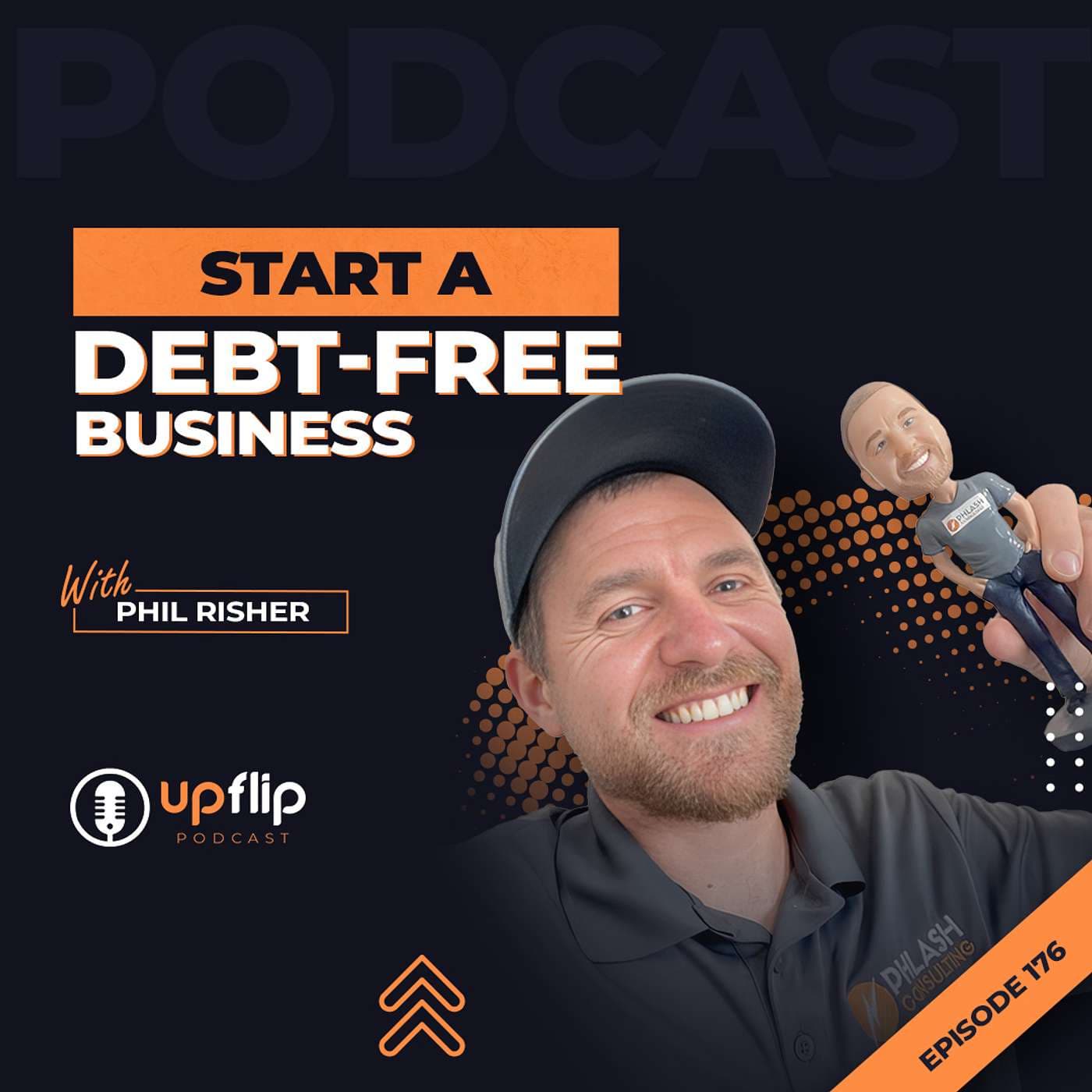
The UpFlip Podcast - Episode 176 Summary
Episode Title
From His Parent's Basement to $105K/Month Business with Zero Debt
Overview
In this episode, Phil Risher shares his inspiring journey of building a successful digital marketing company, Phlash Consulting, while initially living in his parent’s basement with significant student debt. The discussion focuses on how Phil achieved financial freedom and built a seven-figure business without taking on debt, emphasizing practical strategies for aspiring entrepreneurs.
Key Themes
- Debt-Free Business Model:
- Definition: Starting a company without incurring debt, refraining from loans or other financial obligations.
- Phil's Approach: Utilized his knowledge and network to secure clients without upfront costs. His first client was his previous employer.
- Key Advice: Focus on acquiring clients before spending on marketing or operational costs.
- Strategic Client Acquisition:
- Initial Steps:
- Phil landed initial clients by leveraging existing relationships and providing consulting services based on his expertise.
- He emphasizes the importance of networking and obtaining referrals.
- Marketing Strategies:
- Engaging in free marketing through content creation and networking groups like BNI (Business Networking International).
- Phil created niche-specific content which helped attract clients within his targeted industries.
- Financial Management:
- Cash Flow Discipline:
- Implementing a budgeting framework to manage income, expenses, and reinvestments effectively.
- Phil follows the "Profit First" method by allocating percentages of revenue for payroll, marketing, taxes, and profit.
- Avoiding Common Pitfalls:
- Advises against spending excessively on marketing without first validating a product or service.
- Scaling the Business:
- Transitioning from Service to Productized Offerings:
- As demand grew, Phil transitioned from trading time for money to offering productized services.
- Building a Sustainable Team:
- Hiring skilled team members to enhance service delivery without overextending financially.
Key Takeaways
- Client First: Before quitting a job or taking on debt, secure initial clients to ensure cash flow.
- Budgeting Framework: Allocate income into buckets (payroll, marketing, profit) to maintain financial health and growth permission.
- Content Creation as a Lead Strategy: Develop niche content to attract and generate leads effectively.
- Networking: Engage with local business networks to quickly establish connections and potential clients.
- Sustainable Growth: Focus on a sustainable growth model that prioritizes profitability over rapid scaling.
Resources Mentioned
- Profit First Method: A budgeting strategy by Mike Michalowicz.
- Networking Groups: BNI (Business Networking International) for referrals and connections.
- Content Creation: Strategies involving blogs, YouTube, and niche marketing to attract clientele.
Conclusion
Phil Risher's journey serves as a testament that starting a successful business is attainable without debt, provided one remains disciplined, resourceful, and focused on acquiring clients first. His practical advice offers aspiring entrepreneurs clear steps to embark on their own debt-free business ventures.
Connect with Phil Risher
- Website: [Phlash Consulting](https://phlashconsulting.com/)
- LinkedIn: Phil Risher
Connect with UpFlip
- YouTube: [The UpFlip Podcast](https://www.youtube.com/@TheUpFlipPodcast/)
- Instagram: [@UpFlip](https://www.instagram.com/upflip/)
- Facebook: [UpFlip Official](https://www.facebook.com/upflipofficial)
- Twitter: [@UpFlipOfficial](https://twitter.com/upflipofficial)
For more insights on starting, building, or growing a business, visit [UpFlip.com](https://www.upflip.com) or check out their YouTube channel for more interviews with business owners and experts.
Written by AI. May contain mistakes. Listen to the episode to check what was said.
Transcript
Automatic transcript. May contain errors.0:00For the normal person that's just trying to start a business and get going, I would say the biggest thing is go get your clients first. The biggest thing that I found with the percentages and having some type of a budget is that it gives you permission to spend money in your business. If I had one piece of advice for aspiring entrepreneurs, it would be... Picture this. It's 2012 and our guest Phil Risher has just graduated college with$30 ,000 in student loans. He's earning$48 ,000 a year working at Enterprise Rent-A-Car and living in his dad's basement. Fast forward a few years and he's not just debt-free.
0:32He saved$60 ,000 by age 25 and bought a condo outright with cash. But that's just the beginning of an incredible journey of grit, resourcefulness, and smart financial decisions. This is Ryan Atkinson and you're listening to the Outfit Podcast, where we uncover the secrets of building and running successful businesses. And our guest today, Phil, did not stop there. A blog sparked by his friends' curiosity about his financial success turned into a platform that landed him features on Forbes, CNBC, and Business Insider, attracting tens of thousands of readers each month. Then he took the open road, traveling the country in a converted school bus, all while building the life he wanted free from financial constraints.
1:06And today, he's here to share how you can get started with a debt-free business. And I am so, so excited for today's episode. So, Phil, thank you so, so much for being here. Yeah, Ryan, thanks for having me, man. I'm really excited to talk. I know a lot of listeners, they're going to see the title of this. They're going to hear that intro and be like, starting a debt-free business? How do I do that? So let's baseline there. How the heck does someone start a company that is debt-free? And before we dive into that, let's first clarify what we mean by debt-free and let's talk about ways that you could do that.
1:34Yeah, when we talk about debt-free, it's basically not having any debt when you start the company, not taking on your own SBA or something like that to try to start a company. When I started Flash Consulting, which is my company now, my first customer was my prior employer. And basically I was working there and I wasn't making six figures. And I was like, hey, maybe I could be a consultant of some sort and go and get a bunch to other clients and still fulfill the same amount of work. But then, you know, he would pay me for an hourly type of thing. So that was my first client who then was starting to pay me.
2:07And what I didn't have was I didn't have a back end of all this digital marketing help. So I found a company that I could layer in with my services that would do the work as well. And I could bring them on and increment as I grew with them. So basically my startup cost was nothing because it was my past employer that then hired me as the person to do the work. I want to ask here as well here. So you're starting a company, you're not taking on SBA loans, you're not raising funding, I guess. What are a few ways to like not take on debt when starting a company? Yeah. So when you have a service business, which is what I do, like a consulting type of company, it's really just your time that you're trading for money.
2:46You don't have to buy trucks or equipment or anything like that. So it's like there's no debt needed for that. A lot of times I find people that fall into the trap of they take on debt to try to pay for marketing or other things that are not necessarily moving the needle. You really just need to go out and get some clients and start. Funny story, I do digital marketing consulting and for the first four months, I didn't even have a website. So a lot of people think, you know, I got to invest all this money in a website or this or that, but it's really, you got to get that sales, that niche sales down to who you're serving and then you can knock it out from there.
3:18Phil, what I love that, and I want all the listeners to note here as well, a lot of times when like you talk to business owners, people that want to start companies but never do their typical workflow and they get started is, you know, like think of a name, get a logo, build a website. But in your case, in a lot of other people's cases, it was like, have an idea, get your first customer and then build everything after that. Yeah, the ready fire aim, you know, I'm ready to go, you know, let's go get it. Another funny thing, the guy that I used to work for, he actually named my company Flash Consulting.
3:44It's Phil, PH, and then Ash, you put it together, he's like, go do this company and go help people. So pretty cool. Yeah, I absolutely love that. I think and that's a great way to get started as well. And a point that you hit it back on, I want to call back to it, is like taking on debt or like not taking on debt. And I just want to play debtals advocate here. There's a lot of financial gurus out there to say like, oh, debt's good. You need to take it on. But when it comes to a company, like what's the reason why you shouldn't take on debt? Yeah, for me, I'm really big on peace and being content, but not complacent.
4:14And could I grow much faster if I took on debt and try to grow my business and make all this money? Yeah, sure. But at the same time, that to me was not the goal. So I was just trying to make six figures and do something that was fun that I enjoyed doing. I would say if you're looking to grow a$100 million business and you're trying to do that in five years or something, yeah, of course, go get debt, build out this whole thing. But for the normal person that's just trying to start a business and get going, I would say the biggest thing is go get your clients first and then go get a client. I've heard people talk about it on the show before, like get a bunch of clients, then go get the equipment with the money that you have up front.
4:46There's a lot of ways to do it without taking on debt. Interesting. So it sounds like the biggest thing for you, an early takeaway for this conversation, just for our listener as well. It's like, before you quit that job, before you even take on debt, go get customers first before you fully jump into it, before you even think about throwing money into it. Exactly. For me, my first client was my past employer, and then he referred me to two other businesses. So when I made that transition, I had three clients right away, and they were each paying me an hourly amount. So I already had money coming in the door with the clients that I had.
5:16I love it. That is great stuff there. A question that comes to mind as well here. So we kind of baseline what is a debt-free business? What are ways to get started landing that first customer? Let's talk about industries that are best for starting a debt-free business. Can you highlight three to four industries that are best for this? Yeah, well, definitely a service business like mine, where you're just basically trading your time for money or your expertise for money, because it's very easy to go out and get clients and then just sell your expertise on that. I would say also content creation type affiliate companies.
5:44I started a blog, as we mentioned in the beginning, And that blog was just through affiliate marketing, creating content, documenting the things in my brain. It didn't make a ton of money by any means, but it was relatively like no cost or low cost. One very simple way is like just start an Instagram, add value, get some affiliate links. You can start getting some revenue going there. So those types of companies are pretty easy, I would say, to start debt-free. Yeah, and I love that. I want to hit again on the service piece because I have a video marketing agency. And the nice thing about like these service-based industries are you can get clients first, get cash flow going before you like really truly jump into it.
6:19And that is a nice thing about service based companies is like you can cash flow in basically under a month if you do things right and you're kind of lucky off the bat. That's right. A really big thing for me, I mentioned was I wasn't the expert in digital marketing necessarily. So I went and found an agency that I could bolt onto my service offering. Oh, I love it. Yeah. So then it was me selling my consulting piece and then having an agency that would support me on the back end. And that initial So offering was my offering for probably my first five to 10 clients. And I could scale up and down each client I brought on, you know, pay them a percentage of each client.
6:51So it really helped me scale without a bunch of overhead. Yeah. So what I love, what I'm comprehending from this so far has been like, you really are like building a company like mindfully, like financially mindfully, but where you're not taking on a ton of debt, you're not taking a ton of risk, honestly, it sounds like in a way, but that's how you're intentionally building this thing. I think how a lot of entrepreneurs would honestly prefer to build their companies as well. Yeah, that's exactly right. Not over-risking things and building smart so that you have a sustainable business that can continue to grow through cashflow.
7:19Yeah, that's great. That literally leads us right to my next question. So cashflow, like how did you manage cashflow and ensure profitability from the start? I know you landed customers, but like the tools, what are you bringing on? I know you had a partner there, but like how do you ensure profitability right from the start while growing? Yeah, so initially I didn't have a project management software. Now we use Asana, but initially I just had Excel spreadsheets with a bunch of different workbooks and I would just keep track of the different tasks and stuff in there. As I continued to grow, I implemented Profit First, which is a tool from Mike Michalowicz.
7:49It's a way to budget your money so it's not just running out of a checking account. And that really helped give me permission to start to scale my business. So I started an account for payroll, an account for marketing, an account for taxes. And then I would have percentages in buckets so I would know, okay, when I get to this threshold, now I can bring on a virtual assistant or something like that. I have a question for our listeners. Are you wanting to get featured on top podcasts like Upflip without spending hours on outreach? If you answered yes, then the answer for you is Podpitch. Podpitch has the largest podcast database in history.
8:20It's updated daily with every data point you could imagine. All you have to do is describe the kind of podcasts you want and boom, Podpitch instantly built a massive list ranked by relevance. Then just craft your pitch or let Podpitch do it for you. It even syncs with your email to match your writing style. And when you're ready, send up to 10 ,000 fully personalized pitches, each one tailored to that podcast host's latest episodes, tweets, and interests. Stop wasting time on cold outreach. Get booked on the right shows with PodPitch. Try today by clicking the link in the description below. Oh, man.
8:50Let's talk about that a little bit more. Let's talk about the percentages that each account has there, because I love that concept. I read I Would Teach You to Be Rich by Ramit. I can't think of his last name. Very popular book. But he says to do that in your personal savings. I thought about doing that in my company savings as well. Talk to us more about that breakdown. I'm like, what are you allocating to payroll? That's obviously probably your largest. Marketing, virtual assistants. Let's talk about that. So very similar how I paid off my personal student loans and saved up money was just by allocating percentages and making sure that I had the right buckets to reach my goals.
9:20So when I first started, I didn't have this profit first framework, as I mentioned. I was just doing like 30, 30, 10. So I would pay 30 % to me, 30 % to an outsourced person, 30 % to profit and 10 % to tax of some sort. And then slowly I would kind of build that out. Now we're at around like 40-ish percent for payroll and different percentages like that. But a really simple one's like 30, 30, 30, that gets you to 90 % and then 10 % for taxes and something like that. That's a very easy way to kind of scale it. The biggest thing that I found with the percentages and having some type of a budget is that it gives you permission to spend money in your business, where a lot of times when you start a debt-free company like mine, you just think that 100 % of the revenue is yours.
9:59You know, it's like you just own a job. You're not actually like building a business. And when you think of it like in the percentage ways, it gives you the permission to grow. Yeah, I think that is such great advice. And listeners like take notes on that. That is like very, very good advice. You're talking a lot about money here. I want to ask pretty early on here, like what are the biggest mistakes you see entrepreneurs make with money? Yeah, well, when you're first starting out from a debt-free perspective or even just like budgeting is taking that money and then investing a ton of it into like sales or marketing or things that are not going to move the needle necessarily.
10:31I think it's good to do marketing, but the right type of marketing, like join B &I groups, put yard signs out, that kind of stuff. But don't go and throw it into the Google gods and into the black hole that's going to magically give you all these leads. That can be very tempting, but it's not going to work if you don't know what you're doing. So a lot of it is instead of focusing on external things, focus on making your product so great and going and getting more clients. Don't have more logos than you have clients. Really focus on just going to get your clients, serving the clients great. And slowly you'll start to figure that part out.
11:01Inside of those buckets and those percentages, most companies are spending around iService home service businesses is my niche. So three to 10 % of their revenue is going towards marketing. So if they make$100 ,000, three to 10 % of that, that should be your marketing budget. It gives you permission to spend that money. And that's how you can start to think about it. But one of the biggest mistakes is just taking your money. You look in your checking account, you have$50 ,000. You're like, okay, I can spend$40 ,000 on Google ads and I'm going to crush it. I'm going to go to the moon. It's like, that's not what you should do.
11:27Yeah, what were some low cost ways that you scaled the company and acquired users? I'd love to hear your best practices on how you scaled. Yeah, so BNI, Business Networking International, which is local networking groups. I mentioned we service home service companies. So inside of those groups are home service businesses so we can get referrals from them. I also hired a virtual assistant overseas and I started giving her a lot of my tasks that were admin tasks. This was when I got to about like six or seven clients and it was a very low cost way that I can start to replace myself in certain situations.
11:57But referrals was a big one. And then I just started creating content. And this was something that was really important was I created niche specific content. So we serve home service businesses, but I created specific content around air duct cleaning, which was the company that I used to work at. Then like electrical contractors, carpet cleaning, and I would create this niche type of content that would attract those niche people in. And I was already a subject matter expert on these businesses because I had been in them. And that really helped us get lead flow coming in. I love the concept of building content for like lead generation because we're actually starting that at Spacebar Visuals where like, we're building like a newsletter where for like SaaS marketers and stuff, like very niche stuff to make us appear as like a thought leader.
12:37What type of content were you guys specifically making that paid off? Was it blogs? Was it emails? Talk to us about that, social media. Yeah, YouTube specifically where it would be like, hey, here's a complete marketing plan for a basement waterproofing company. And we'd walk them through what we've implemented in other companies and speak their language with the actual things. I think that's very important is you want to figure out what your clients are saying or how they're saying it and then speak their language. But it was very niche focused on those people's business. And how long was that payoff to get a return?
13:06Because all the listeners here, they're like, they love sales and marketing on the show. Our listeners love sales and marketing. So guys, I'm talking to you, I promise. How long did it take for those leads to come in? Because content can be a long game. Was it for you guys? Or were you guys seeing leads come in pretty quickly? I would say content, it's a longer play for sure. But within the first six to 12 months, we started getting leads from it. And those videos still produce leads to this day. So it's really good for that side of thing. BNI, I would say is, if you're looking for really quick wins, is go be a guest at every single networking group and just set up one-to-ones with a bunch of people, whoever you service.
13:38Like if you can service that specific company, just go set up meetings with them. That's a really quick win there for sure. Another thing that we would do since we do digital marketing consulting, we would just find businesses online and record a Loom video auditing their stuff and just send it to them with areas of opportunity. It sounds like you're kind of like a content machine here. I think that is like really great and stuff. And these are like your low cost ways to actually be able to generate leads. Exactly, exactly. So you have done like a lot of great stuff. I also want to kind of go back to this debt-free business because you've had a lot of financial success from personal to obviously like business-wise.
14:12I'd be curious what financial principles or habits were most crucial for you to your journey from paying off debt to running a seven-figure business? Yeah, a really cool one for us, I would say setting myself up so that I could take this risk and scale a business so that I didn't feel like I was strapped. Like worst case, I'm good personally, you know? If it's very liberating that I'm content but not complacent and I can go for it. So that really helped significantly. Like I wasn't strapped by debt. And I think a lot of times people start a business because it's like, oh, you can make all this money.
14:43And then you kind of get into this prison cell of a job that you're like, I can't get out of this and I have all this debt and I need to make this money and you feel desperate where I can sell from a place of abundance. And it's like, if I can help you, great. If not, no worries. And it comes off so well inside of our sales process that people can feel that level of commitment to it. I think that's super important as someone that's also in like a sales role, like being able to sell from abundance and not scarcity totally changes like how you perceive. And you might not even know it at like your conscious level, but subconsciously it's how you're responding to clients, what you're seeing in clients and deals.
15:16That is, I think it's such an important piece as well. Yeah, that's right. And from a personal finance perspective, for me, when I started, it was actually on my wife and I's honeymoon that I made the transition. Oh man. Yeah, so when we came back, we were married and I was like, okay, what's the least amount of money that I need to make from a personal budget perspective so that we're good? So then I knew my baseline and funny story, I actually paid myself only$5 ,000 every month for the first five years. Oh wow. Your business, yeah. So I like basically just kept it there and the rest was profit that I would take distributions and stuff.
15:47But I knew that that was my benchmark. So let's just keep it there. That's really interesting. I think it's an important piece because it's like not moving the field goalposts. Like what's your goal? Like you kind of kept it at$60 ,000 a year, even when you're running like a seven figure business. That's hard to do though. That's like discipline when it comes to financial success. Were there any trackers you had? Like how did you know you could only live off of$60 ,000 a month? Were you just personally budgeting? Yeah, so my wife and I, we do a monthly budget and we go through all of our expenses and we know that, okay, we need to make X amount of dollars.
16:18And if we make X amount, we'll have enough for savings that we'll be able to do these things. Interesting. Yeah, I think that's just sound financial advice as well. And obviously this varies as much. I don't want to put you on the spot here too much, but what would you recommend someone to have in their savings account if they are looking to start a company? I would love to hear that advice. And it varies, of course. Yeah, so I'm a big Dave Ramsey guy. So he talks about having three to six months of emergency funds set aside. So you have that bandwidth inside of the company and personally having three to six months, like we do these quarterly meetings with our team and I literally tell them, hey, in our emergency fund, we have three months of reserves in here to cover all of our expenses.
16:57So like we're good. But usually that three to six months, I would say is good from a personal perspective. I wanna jump back to a question you said about keeping it at$60 ,000 a year. Like how did you strike that balance? You kept it at$60 ,000 a year. And what were those profits going to? You said distributions, but we were also going back into marketing. Love to hear that. Yeah, so what I really focused on was scaling the team because in a service business, you're only as good as the people that are on your team. And so I had to really find people that I could pay a good amount to, to bring them on the team.
17:31You're not gonna really find good quality people at like 30 or 40 ,000 or hourly employees when you're running a consulting agency, working with seven figure companies. So I really had to find good people that I could scale with us to make six figures. So that was a lot of it was like, okay,$80 ,000 for this person. Now I need to take that$8 ,000 and pay this person. It was very hard for me because I always grew up with more of the scarcity mindset of like, you know, money's not all around us and now I'm risking another$100 ,000. But that was a lot of still, we're just like kind of reinvesting that stuff.
18:00And there's distributions here and there, of course. But a lot of it is just in people and team members. I love that. Yeah, payroll will always be your biggest expense for a lot of teams anyways. I'm curious, what took you guys from six figures to like seven figures then? Yeah, the big thing for us was lead flow because initially when I started, it was just referrals. And referrals are great, but they're also not predictable. It's, you know, it kind of comes and goes and maybe I'll get one here, maybe I'll get one there, maybe I'll get none, who knows. But coming up with a strategy for actually getting referrals and getting new leads coming in the door.
18:32So what we did was podcasting was really big because most of our target audience listens to a bunch of podcasts. Or let me get on podcasts and talk about why I built this business. Content creation, as I mentioned before, it's a long-term game, but we get good leads from there. And then we started the industry email newsletter, going out to all of our prospects and customers, just staying top of mind, and that brings people back in. And then we hired a company to start doing cold calls and booking appointments for us. So a little bit of everything, but that really helped us kind of go from just getting referrals here and there to actually building, tracking our leads every single month and having Leadflow come in, booked meetings, and then go to seven figures.
19:08The other thing was having a productized service. This was really important because initially I was just selling my time for money to try to make six figures. But after I got 40 hours a week, I got another referral and I had to productize our service. And inside of that process, then I had to come up with SOPs and team members to do this work that then helped us scale to the level that we're at now. I think that is such great advice. And building like predictable lead flow, I think is like super important. How do you guys track that? This is a little bit more down the lines here, but like once you do build that predictable lead flow, How are you guys tracking that?
19:38Are you tracking that weekly? Is this in an Excel sheet? How do you really build that predictable lead flow? Yeah, so there's two parts to this. The first thing in sales, my background was in sales before. So you want to have a pipeline of work and you can use HubSpot or some other tools to kind of manage your pipeline, move people to different buckets. So we do that. Let's say we hired this company to start calling people for us and booking appointments. So we would, in an Excel spreadsheet, how many calls did they do this week versus how many meetings did they book? What was that percentage?
20:05And then track it over a quarter and see how it's performing. but just an Excel spreadsheet is really good. But as far as keeping track of things on a weekly basis is really important. I think to have that weekly cadence of like, okay, this is what we're doing each week is super important. We've implemented that at SpaceR Visuals as well as like, here's how many meetings are booked. Here's how many are delivered. Are you on target? Are you below target? I think that's a super important piece, especially as like a leader to like hold your team accountable. That's right, yeah. And that you're making sure that the money you're deploying is actually working for you.
20:32Yeah, exactly. So we're going to be going to our fan blitz section here in a moment. But for someone that's just starting out, they're tuned in right now. They're like, okay, this all sounds good. I really want to build a debt-free business. I have an idea now what I want to be doing for WeedFlow as well. What are small actual steps they can take today to improve their financial health that sets them up to start their own company to take that leap without taking on debt? So set up meetings with people, anyone, and ask them what are the problems that they're facing? What does the solution look like if they were to come up with the solution and how much would they pay for that solution?
Read the full transcript
21:04Those three questions would allow you to then build a company off of this. So let's say I was talking to you, Ryan, I say, Ryan, what are the issues that you're facing right now? And you say, oh, this, this, and this. What would a good solution look like for that? You'd say this, this, and this. How much would you pay for that? Then you know exactly how much to pay, what the solution is, and what the problem is. And if you get five or 10 people, you tell them, hey, I'm building out this solution because so many people have this problem. And now you have 10 customers right there with a viable product, with a price point, and everything.
21:29I think that is such great advice. That's actually something that I did not do at Space Bar Visual is did customer discovery before, and it kind of slowed down early growth. but it makes it good, exciting as all entrepreneurship ventures are. So let's go to those fan blitz questions. These are questions submitted from our community and listeners, if you wanna join in on world-class entrepreneurs, you can go to www.youtube.com slash shopflip and submit your questions there. But Phil, ready for our last five questions here? Yes, sir. Number one, what's the biggest financial mistake aspiring entrepreneurs should avoid?
21:57Don't throw money at just random marketing people or stuff just because they promise you the world. Focus on just getting customers, meeting them where their problem is. I like it. If you had to start a business tomorrow with only$1 ,000, what would it be? Consulting. Take whatever you know, whatever's in your brain, whatever's in your Google Drive, and go and sell it to people because you're an expert at something and you have great services that you can offer people. That is so, so good. What's one daily habit that's been key to your success? Reading every day. I read 10 pages every single day, and readers are leaders.
22:29I like it. What are you currently reading now? Right now, I just read this book, Sell Like Crazy, which is the number one digital marketing company in Australia. I just read Jocko Extreme Ownership. Love it. That's a great book. Ria's Our Leaders. I like that. Number four, what's the best way to attract your first customer without a big budget? Go to networking groups and talk with people, set up one-to-ones. It's all just about a conversation, finding their problems, going to the solution. How much would they pay? I like it. Number five, our last one, if you could give your 22-year-old self one piece of advice, what would it be?
22:59I would say dream really big. Don't just go for six figures. You can do way better than that. That is so, so good. Phil, thank you so much for being on here. We got through a ton of questions today. I love talking about the lead flow. I love talking about starting a debt-free company. So if someone's like, I actually have questions for you, Phil, where can they learn more about you and connect with you? Yeah, LinkedIn is where I usually hang out. So Phil Risher or YouTube. We have a YouTube channel, Flash Consulting. We have a lot of great ideas on there as well. Awesome, everyone. That was an amazing episode with Phil.
23:28Three quick takeaways for everyone. Number one, get a client first before you take on debt, before you take the leap of faith into your own company. It's just a secure way for you to get cash flow before you finally go all in. Number two, I love the budgeting thought he had about allocating percentages for your goals. Allocate percentages for your payroll, for your marketing, for your ops. I thought that was a great way to structure business when it comes to financial health. Number three is build niche content. I think that's a great strategy and one that we're personally taking on at Space Star Visuals is building content for your audience, for them to find you.
24:00It's a great inbound marketing play. Three quick takeaways for you guys. If you enjoyed this episode, please subscribe and give us a rating wherever you get your podcasts. Those are three quick takeaways for you guys. Looking forward to the next episode. Awesome. Phil, I want to thank you so much for your time today. Thank you so, so much for being here. Yeah, man. Thanks, Ryan.
From the publisher
Phil Risher started his digital marketing company while living in his dad’s basement & $30,000 deep in student debt. Now, Phlash Consulting has grown into a thriving seven-figure company and earned Phil features in major publications such as Forbes, CNBC, and Business Insider for his debt-free business approach.
In this interview, Phil shares his battle-tested blueprint for starting a digital marketing agency with a $0 upfront cost. Including how to land your first client, leverage free marketing strategies like niche content creation and networking, and master cash flow discipline to ensure profitability. His story proves you don’t need deep pockets to succeed—just grit and resourcefulness.
Key Takeaways:
- Starting a business debt-free is possible with the right approach.
- Focus on acquiring clients before investing in marketing.
- Service-based businesses are ideal for debt-free startups.
- Content creation can be a low-cost way to generate leads.
- Managing cash flow is crucial for profitability.
- Utilizing a budgeting framework helps in financial planning.
- Networking is key to finding your first customers.
- Building a productized service can help scale your business.
- Invest in good team members to grow your business.
- Set clear financial goals and stick to them.
Resources:
- Start Your Business Today: https://links.upflip.com/41CvEcO
- Connect with Phil: https://phlashconsulting.com/
Ready to be your own boss without starting from scratch? Grab our FREE Franchise Guide and unlock the secrets of proven business models that have already created thousands of success stories.
Connect with UpFlip:
- On Youtube
- On Instagram
- On Facebook
- @UpFlipOfficial on Twitter
For more insights to start, build, or grow a business, check out the resources on UpFlip.com or head to the UpFlip YouTube channel to see more interviews with business owners and experts.
Thanks for listening!


