
In short
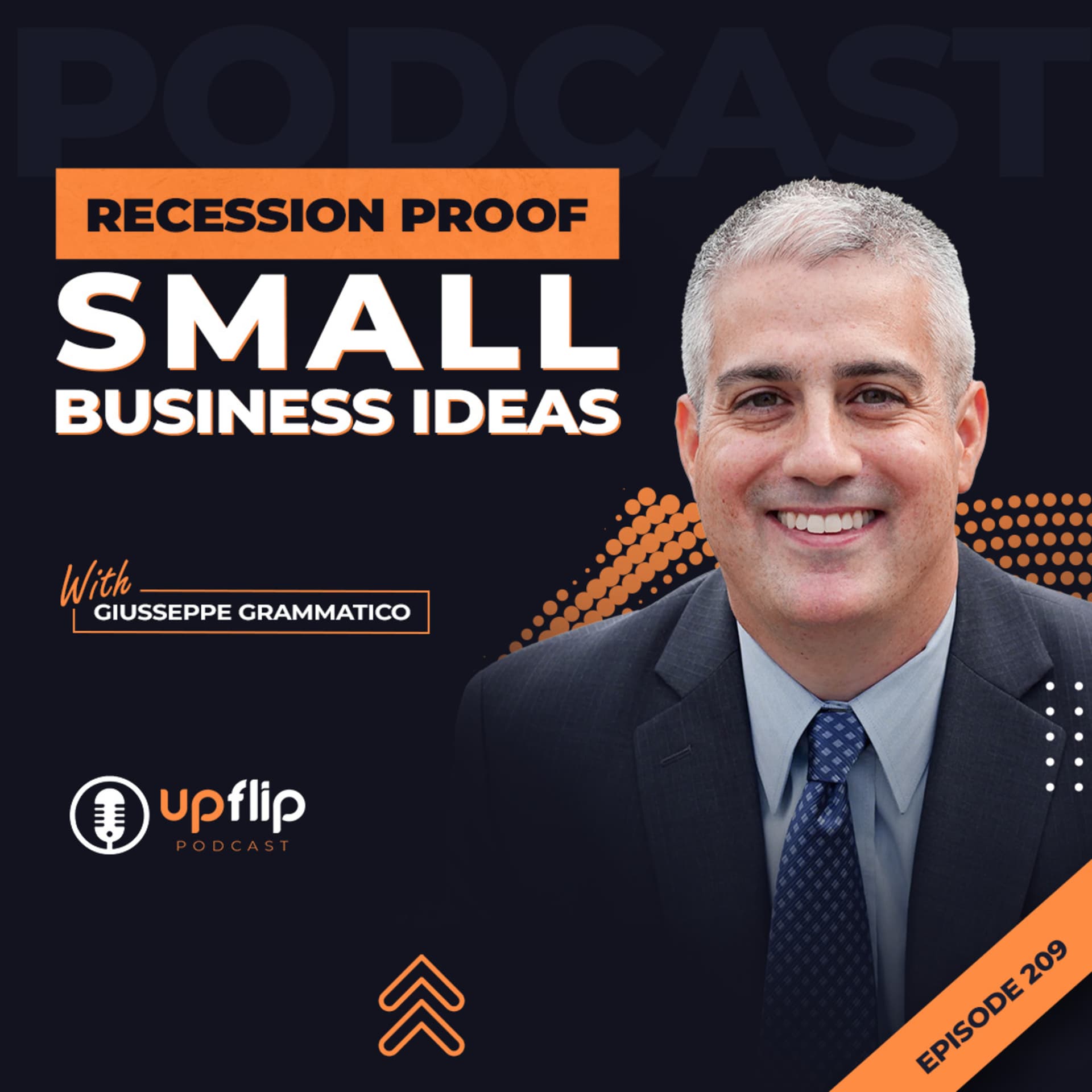
UpFlip Podcast Episode 209: Here are Recession Proof Small Business Ideas
Episode Overview In this episode of the UpFlip Podcast, host Ryan Atkinson interviews Giuseppe Grammatico, a franchise coach who shares his journey from a high-paying corporate job at JP Morgan to achieving time and financial freedom through franchising. Giuseppe provides insights on finding recession-resistant business opportunities, the importance of understanding one’s motivations (or “why”), and key metrics for evaluating franchises.
Key Themes
- Transition from Corporate to Entrepreneurship
- Importance of Time Freedom
- Franchising as a Viable Business Model
- Identifying Recession-Resistant Business Ideas
- Key Metrics for Evaluating Franchise Opportunities
- Understanding Your "Why"
Giuseppe’s Journey
- Corporate Life: Giuseppe had a six-figure salary at JP Morgan but faced a lengthy daily commute and limited family time.
- Decision to Leave: The birth of his son prompted him to seek a more fulfilling life. He left his corporate job despite having no concrete business plan.
- Discovery of Franchising: After extensive research, he found franchising offers various opportunities beyond fast food, which eventually led to his success as a franchisee and coach.
Recession-Proof Business Ideas Types of Franchises to Consider
- Business Coaching: Helping businesses reduce expenses.
- Home Services: Opportunities in water and smoke mitigation.
- Essential B2B Services: Offer consistent demand regardless of economic conditions.
Characteristics of Recession-Resistant Businesses
- They remain in demand during economic downturns.
- Often require low initial investment and staffing.
- Can be established quickly (2-3 months).
Evaluating Franchise Models Green Flags of a Healthy Franchise
- Mutual Fit: A franchise that prioritizes a good match rather than just making a sale.
- Transparency: Clear processes and openness about their systems.
- Validation: Encouraging potential franchisees to speak with current franchisees about their experiences.
Financial Metrics to Analyze
- Average Unit Volume (AUV): A crucial metric that highlights sales volume over profit margins.
- Initial Investment and Fees: Understand what you are paying for regarding franchise fees and royalty rates.
- Growth Indicators: Check for franchise growth and profitability in initial years.
Understanding Your "Why"
- Concept of "Why": Your "why" drives your entrepreneurship. For Giuseppe, it was about family time and freedom rather than wealth.
- Impact of Knowing Your "Why": It serves as a motivator during challenging times and helps to maintain focus on your business goals.
Lessons and Best Practices
- Be prepared for the hard work in the first year of business as you establish systems and processes.
- Track marketing expenses and analyze KPIs to avoid costly mistakes.
- Choose a business that aligns with your personal goals and desired lifestyle, rather than simply pursuing passion.
Resources for Listeners
- Website: [Giuseppe Grammatico’s Franchise Coaching](https://www.ggthefranchiseguide.com)
- Book: *Franchise Freedom* - Offers insights into finding the right franchise.
Conclusion Giuseppe emphasizes that the journey to entrepreneurship is uniquely personal and that understanding one's motivations can significantly enhance the chances of success. The episode is packed with actionable insights for aspiring entrepreneurs looking to explore franchising, particularly in recession-resistant industries.
---
Tags
- Franchise
- Entrepreneurship
- Business Buying
- Home Services
- Passive Income
- Recession-Proof Business
Takeaways
- Identify Recession-Resistant Businesses: Focus on sectors that thrive during economic downturns.
- Understand Financial Metrics: Look beyond profit margins; AUV can be a better indicator of potential success.
- Clarify Your "Why": Knowing your deeper motivations can guide your business decisions and keep you resilient in tough times.
Written by AI. May contain mistakes. Listen to the episode to check what was said.
Transcript
Automatic transcript. May contain errors.0:00Imagine this, you're on Wall Street working at a top firm like JP Morgan. You've got the MBA, the six-figure salary, the life everyone tells you that you should want, but you're miserable. The bureaucracy is crushing, your fate is in the hands of others, and you realize this isn't the American dream your immigrant parents worked so hard for. So you make a terrifying choice. You quit. With no business idea and a baby on the way, you and your wife decide to live off one income and bet everything on a future you haven't figured out yet, all for one reason, time. The freedom to be the parent of your own father busy running the family restaurant, never had the chance to be.
0:36This was a pivotal moment for Giuseppe. I'm Ryan Atkinson, and this is the Upflip Podcast, where we uncover the secrets of building and running successful businesses. Today, Giuseppe is a highly successful entrepreneur and franchise coach who has mastered the art of building businesses that serve your life, not the other way around. He's here to share his playbook for finding the right business and the unstoppable power of having a why that is bigger than any obstacle. Giuseppe, I'm so, so excited for this. So, so excited to have you on the podcast. Thank you so much for the opportunity. Oh, wow.
1:05Ryan, I'm excited. That intro gave me goosebumps. I'm like, who are we talking about there for a second? But I want a copy of that. That was so, that's probably the best intro I've ever had. And I've done over a hundred shows. So I appreciate that. Yeah, well, we appreciate you being here because you have a phenomenal story and where your story really starts out. Obviously we had younger Giuseppe, but let's jump to Wall Street. You're working six figures, JP Morgan. What made you like take the leap? Wind us back to that and like leaving such a secure job. Yeah. So five hour commute daily door to door to the office and back.
1:35We wanted to start a family, you know, baby on the way later that year, my son, who's now going to be 18 in November. And I go, if I continue at this path, number one, I don't like the job. Number two, I'm never going to be able to see the family because I'm leaving at 5 a.m. and getting home at nine or 10 o 'clock at night. So just felt like it wasn't for me, but gave it a shot. I interviewed, I looked at other firms. I knew that, you know, from growing up in the restaurant business, I had that entrepreneurial itch. I always had a side hustle like detailing cars, delivering flyers, but I knew that I wanted something more and I definitely didn't want a restaurant with all the moving parts and hours.
2:11It was more of refining what that business was. Money was great, but just felt deflated. I just felt like I didn't have a lot of upside. Finally, when I did get offered a promotion, I had to move halfway across the country. Being a family guy, having a lot of family nearby, I said there was no way. It didn't matter the amount of money. Was I going to move from the area? Well, let's talk about taking that leap. And what are you taking the leap into? Was this just a blind idea that you had that you wanted to free up your time? Talk to us that moment. What happens after you quit your Wall Street job?
2:43Yeah. So everyone thought I was crazy. My family, my friends, my colleagues, and said, what are you doing? You have such a great job. You work so hard for this. So I did a lot of research, different companies, what I can do, startups. I didn't have a ton of ideas, nor did I want to go through and spend years figuring that out. I did a little research around franchising. Subway was the big franchise in 2005, so two decades ago, and then stumbled across a franchise coach, which interestingly enough is what I do today. And he walked me through and said, you know, franchising isn't all about fast food.
3:16You don't have to invest millions of dollars to buy in. And was shocked to hear what was out there and that you needed zero experience, the franchise would help you, but you didn't need a transferable skillset like sales, like negotiation. So I worked with him for about a year or so, and we were able to narrow it down to a franchise, which I had for 13 years and sold back in 2020. So it was a great experience. I loved it so much that I became a franchise coach years ago. That's some great stuff there. And what I love about the tidbit that you said there is franchising goes just beyond your fast food restaurants.
3:50It goes beyond the McDonald's, the subways. Talk to us about like, what are some good franchises that people should consider that are listening to this show that aren't the fast food chains? Obviously your franchise coach, you can see this at a very high level. So talk to us about that. Yeah, absolutely. So, you know, we have our finger on the pulse. We get to speak with founders and CEOs and it really comes down to what the skillset is and what are your characteristics, investment range, where you're located, what does your staff look like? Are they W2? Are they contractors and things like that?
4:18But there's 4 ,000 franchises and 70 plus industries in the US alone. So that's kind of a baseline. From there, not all franchises are created equally. But as far as types of franchises, there's business coaching. One of my favorites that's a recession resistant type of business that's very unique is reducing expenses, expense reduction, helping small businesses in your area cut back on their expense. And very interesting in how the process looks and how they go about it. One of the key things that most people don't think about because they go right to fast food is I look for things that are recession resistant personally, and that's the businesses I always got into.
4:55So things like water and smoke mitigation, there's a natural disaster, a leaky pipe, a fire. Companies that come in, they tend to have a low number of staff. They'll clean the home out, restore it, and get you back in the home as fast as possible. Those are the types of businesses I like. They're not the sexiest of businesses, but we just had a stress test during COVID. We saw what worked, what was recession resistant, what was essential. We talked about essential industries and things like that. So those are the businesses, small footprint. You don't need a physical location up and running in two or three months.
5:29We've seen those businesses really kind of skyrocket going into any other type of home service space. What are some good low startup, low franchising fees, startup fees that you think are really good for recession resistant? And ideally, something under maybe 100K. If we can squeeze out under 50K, that'd be great. Obviously, this varies a lot. But talk to us about low startup costs, ones that are good to franchise with. Yeah. So if you get into something that doesn't require any staff models like business coaching, where you're helping businesses in all aspects, expense reduction, potentially you may be at that 100K, maybe a little bit less, a little bit more.
6:06These are rough, rough ranges. And you're always going to check in with a franchise company where you can get a loan, Maybe put an SBA loan and put 20 % to 30 % down and fund the rest. Once you're getting into things that have some equipment, as we mentioned, water and smoke mitigation, there's going to be a truck. There's going to be a truck mount system, fans, dehumidifiers, and things like that. You can get into that$200 ,000 to$300 ,000 range where now you have a lot more on the marketing end. You have some staff. You have the truck. Marketing is going to be big. Payroll is going to be big.
6:39The other businesses, as I mentioned, expense reduction and coaching, you may not have any employees. You're running it essentially from home. And those coaches that are going to work with you, those expense reduction specialists are going to be 1099. So for those listening in, this business, these types of businesses can be run full or part time, depending on what the brand allows. But you're essentially creating a safety net in the event of the next downsizing. downsizing, take advantage, get a business up and running so that you can leave either on your terms or have that backup in the event of the next downsizing.
7:11Most people spend months, sometimes years, just thinking about starting a business. But what if you could do it in just 10 days? That's exactly what the 10-day business launch plan is designed for. It's a step-by-step roadmap that takes you from idea to real operational business in just 10 days. Click the link in description below and get ready with your business. What about like the HVAC companies and like the power washing companies, the world, do you recommend someone for their first franchise to like do something like that? How would you like coach that to somebody? Everyone's situation is different, but our process is the same, if that makes sense.
7:46So we're going to look at number one, first off, where do you want to be? So it may be I'm in New Jersey. So what counties in New Jersey? So we're going to check on availability. So that HVAC may be the perfect fit, but not available in the space or maybe not registered in your state. So we're going to look for skill sets. What are you good at? Are you good at sales and networking? Great. This is something where the marketing is done for you and essentially you're going to be going on those sales appointments and eventually hiring other salespeople. So it could work for a lot of people. You don't need experience necessarily in the area, but you're going to be okay managing a small team.
8:20So leadership, management, are you maybe not, you don't want to do sales, but you want to do networking. And that means going to the chamber of commerce. The best part of the example, HVAC and things like that, is that a lot of these home service types of businesses have the similar setup, you know, five employees or less, one to 300K investment, you know, looking for someone that can network and essentially almost become like the mayor of the town is a term I stole from another brand. But that's really what you are, you know, mayor of the town. You're a cheerleader for the brand, letting everyone know what you do and getting some networking in.
8:52So lots of great fits. But as we get really crystal clear on staffing investment, we start to kind of narrow down does HVAC fall in there or that we need to look at a smaller investment like something in business coaching. And that's part of what we do. But absolutely, it could work for a lot of people. You know, we want to make sure it's available to in your market. So we have a good idea, like some ideas that people can like run with and everyone listeners like do your research on like what is best for you. Obviously, let's talk about like what a healthy franchise model looks like and what a bad franchise model looks like.
9:21So give me like, what are like three green flags that you look for in a franchise that others should also be looking for? When speaking with the franchise company, you want to make sure that there's a clear fit. The first call is a two-way interview. We're not looking for, I need HVAC experience. We're looking for, hey, can I follow a system? Am I the right avatar? And a good franchise company will let you know, hey, this may not be a good fit. Or if you were to move forward, if you were to decide and we approved you, you may need to hire a full-time salesperson. They'll make some proactive suggestions.
9:54But a good franchise will let you know early on that maybe this isn't the right fit. Typically, it may be a president or a founder is involved on a call or two in the very beginning, and then you're meeting them in person at the very end. You're not looking to be sold. You're looking for a conversation. You're looking for overall fit. And that comes with time. So that's initially. Then it leads to equally as important as a green flag is validation. Yes, the franchisor put their best foot forward. They're still making sure there's a mutual fit, right? Because you're also interviewing them. I want to be very clear there.
10:26You're also going to get to meet other franchisee, existing franchises to say the million dollar question, right? If you had one question to ask is knowing what you know today, would you do it all over again? And getting to speak. They're not getting paid to speak with you. You're doing this. They're taking time out of their day to do the calls. Maybe it's one-on-one, maybe it's a prerecorded call or a live call that they do every week, but they're basically giving you advice and saying, yes, I would do it. Or we did have issues, but those issues have been resolved. So these are all things that you're looking for.
10:56And then finally, third stage, green flag, meeting the franchise or in person or virtually where you're meeting the C-suite, the founders, presidents. And I call it meeting the captain steering the ship. If they have a great system, the past does not dictate the future. so it's kind of like a stock price whatever it's done in the past has nothing to do with the future so what's the future of this brand you created all this great stuff are you adding national accounts are you adding revenue streams what does support look like as a company goes from 50 to 100 franchisees no clear vision major red flag green flag would be i have a vision and saying okay yes we're going to move forward this is what to expect this is our five-year plan awesome no future insights and kind of what that looks, that to me is the red flag.
11:41The question I got asked here, financials, I mean, what are like the green flags, the red flags, like look for in financials? So that all like is great. I 100 % agree with what you're saying there. People are going to be like, okay, but what metrics do I look for for like financial health? What are you looking for? Well, first off, taking a step back, why are you getting into franchise ownership? What's the why and what you're doing is so financials was not the first, as you mentioned in the intro, for me, it was time. So which was the brand that I can, And, you know, using the first year as the builder year and I was running it full time, which is the brand that had the strong system so that I can back away and spend time.
12:16I will say from a success standpoint, I became a soccer coach when my son turned four his first year. He'll be 18 in November. I've never missed a soccer game. Now, I no longer coach because that's way above my pay grade. You know, the high school kids going into college now, but I've never missed a game, never missed my daughter's recitals and Girl Scouts and stuff like that. So time, you know, there's different things. There are going to be some companies that will scale faster than others in some membership models. It may take a little bit longer to gain that base, but now you're creating this annuity that you know that you're going to be billing every month.
12:50Some franchises like in the water and smoke restoration space, they're going to be bigger tickets. So maybe not necessarily reoccurring, but they're going to be big ticket. The reoccurring aspect is going to be where your referrals and leads are coming from. and that's usually your plumbers, your insurance companies. So it really depends on what the match is. The franchisor will share with you an item seven, an itemized investment range, and an item 19, which is a financial representation. They have to be very careful with that because there's no guarantee it's still a business. But you'll look for companies that have healthy margins.
13:23You're looking for franchise growth the first year. What does that look like? And were they able to take any money out? Not necessarily what the margins are. People get all caught up in the margins. oh, this is 30%, this is 10. That's all important. That's all great. But having the experience I have and the type of businesses I've run, the follow-up would be the AUV, the average unit volume. So a cleaning business may have a lower profit margin, but you're making it up in volume given the type of work that you're in. So it's really knowing what questions to ask, but the franchisees are very open and honest.
13:55So is it important to be profitable first year? I think it's important. I think having the systems in place is definitely from a priority standpoint and being able to back away from the business is important. But getting those numbers in order, you know, finding what the top guys are doing, the middle tier, the bottom tier, everyone will report a little bit differently, but you'll get a lot more insight as to what you can make per location and per territory from the franchisees. So you can figure out how many territories or locations you're looking to invest in. A question that I want to ask here is based off of that systems there.
14:26You gave us like two really good metrics to like look for here, but based off the systems, Like, how do you know if a franchise has good systems or not? Because a lot of people, when they're hearing, like, you were able to coach soccer games, like, go out on dates with your wife, I imagine. Like, they're like, oh, that sounds incredible. Like, I want to free up my time. That was one of my biggest drivers to be an entrepreneur. How do they know, like, what systems look for? Is that all detailed out? Like, what do they look for there? Part of my coaching, you know, if you're calling the franchise or directly, you may not know what to ask, right?
14:53You don't know what you don't know. So what's in place, right? What am I getting? you know, someone said to me, I have 50 ,000 sounds a lot for a franchise fee. I saw another franchise in the industry for 30 ,000. I said, and, and they looked at me and I go, well, what are you getting for each one? And they said, well, I don't know. I just looked at the amount. So look for the amounts, right? Look what you're getting for the franchise fee and what you're paying for, for the ongoing royalty, maybe three, five, up to 10%, maybe even more. What are you getting? And asking them, you know, they can't just hand you, this is our CRM.
15:23This is our marketing system for you to kind of log in and play with, but they'll log in. They'll have webinars. They'll have live trainings and say, maybe not trainings, but overviews. This is our system. So this is our CRM. This is our main system where all the contacts come in. This is the marketing tab where we're going to handle all the marketing and lead generation for you so that the call center books and that it shows up in the CRM. So you kind of, they kind of open the doors to see exactly what they get. And then what I really like is the brands that really break down and say, okay, this is everything we handle for you and this is exactly how you log in this is what it looks like this is the franchisee's role they're going to be going on some sales appointments initially they're going to go to one chamber a commerce event per week and they're going to review the key performance indicators the kpis taken from gino wickman's track book traction the entrepreneurial operating system you know every week looking at the metrics lots of leads low close ratio?
16:19Is it the salesperson? Is it the lead quality, right? Maybe it's a combination, but working with your coach at the franchisor side to figure out what the numbers are. So the average day in a life, figuring out what you're giving and then speaking with the franchisees to say, hey, we have all these systems. Are they following through? How easy is the tech stack to use in the company? Any recommendations, anything I should be aware of, and maybe some mistakes that they made. So it's really getting the answers to both sides of that coin and figuring out what you're getting and how well it's they're actually following through are is crucial i imagine for a lot of people that want to do this it's like they want to plug and play like obviously they're going to be hands-on with it but at the end of the day like people want systems to have to be able to actually run with i'm sure that was a big case for you as well when you're just getting started 100 and every industry is different right certain industries will not have plug and play marketing because they're more relationship referral based so yes they'll create some marketing assets for you to deploy, but they're not doing the SEO pay-per-click and call centers and all that kind of stuff.
17:21So what do you want? What do you truly need? But you want those systems in place. So you pay the franchise fee. You're literally booking training, getting access to the CRM, getting trained on that virtually. It's plug and play. You just want to know, what business am I in? HVAC, great. What happens as soon as I get a lead? What's the sales process? And you want to dive in and really recoup your investment as fast as possible. And the franchise or want to as profitable as possible. The goals are definitely aligned for your success. Nice. Absolutely. Let's talk about success. Cause obviously one part of your success was freeing up your time.
17:53Talks about discovering like your why and why is it important to have a why? I love like all of this concept. Yeah. Why is your why important, right? I mean, why is your why important? I didn't really get this whole why and you hear it more and more like what the heck, you know, I kind of thought it was like this overused term, but your why and it's the reason for doing what you're doing is crucial. Why? I've been self-employed 20 years. Sometimes things don't go as planned. Sometimes you hit that fork in the road. Should I continue? Should I sell? You know, whatever, you're just having a bad month and you need that reminder.
18:27Like I had left a good paying job. I left Wall Street in order to launch my business. Life is good. I just had a couple bad weeks. Maybe a deal fell through or we had in my last business a cancellation. So it's just a reminder. It's why you got into it. Business is cyclical. The stock market, the economy, everything is cyclical. It's just a reminder to say, this is why you got into it. We have a great life. We have time freedom. We have financial freedom. And then I got that reminder of why I did this. And that was to growing up in the family restaurant. We only saw dad if we were working at the restaurant because he worked so many hours.
19:01So it was basically to say, we appreciate all that. And we learned a ton from that. But we want to make sure that we're present for the kids. Like I'm leaving today at 345 to watch my son's varsity soccer game was put on my calendar about a month ago because that's what was important. That's the time freedom aspect. So really crucial. But the last piece on that is this time freedom, this financial freedom and all that. So the why is important, but all these freedoms that we talk about, and there's five freedoms I usually talk about from a book I read a while back is that they don't all come immediately.
19:32There's not this idea of time freedom. There was no time freedom my first year. If anything, I was working more hours, but I knew that that was a sacrifice I was willing to take in order to free up my time. Let me just get it out of the way, find the right team, had to rehire a few times, but it takes a little bit of time to see what this thing could turn into. And that's my life today, 20 years later. what i love about that is like knowing your why is so important like i have my own business you know we're this is my second i'm coming up on two full years of entrepreneurship i've learned a ton and when i say that i have been through like some deep deep valleys of entrepreneurship i have been to like some of the darkest places of my 26 years you're not the only one because of entrepreneurship but like truly what got me through it is like i knew my why why i started a business and it's my three w's work when i want with who i want where i want and like those three things are really like what propelled me for.
20:24Like when I'm asking this, like, how does someone like discover their why? Do they need to sit down with a journal and meditate on it? Or like, is it just understanding your personal values? Like, what is it? This was years in the making. You know, I'm trying to teach it in a way, you know, at first, my why was my passion. At the time in college, when I first started this exercise, I remember actually in grad school, I'm like, I love video games. And I worked in the video game industry for six months. That was the fastest path to killing my passion was working in that industry. I don't think I've played really video games since unless my son asked me to play FIFA.
20:56So it's like, well, that was the way I kind of got away from things. And to include that in the job, in my opinion, it kind of kills the passion. So I was like, all right, it's not passion. Well, we like soccer. We're huge soccer fans. I was looking in the soccer space, but in reality, the soccer space, in many cases, in the franchise, I was retail. And that was exactly what I was doing at the restaurant. I'm going to be stocking shells, nights, weekends, holidays. So someone, and I wish I remember who it was, broke it down and said, your why is deeper than the passion. And when they told me your why is to, like, they gave me examples of their why, and that really helped.
21:31So for them, it was family. And I'm like, well, my why is my family, time, freedom, spending time with them. And they said, great, that's your why. End of story. There's not more you have to add to it. With that time, freedom, you now have more time for your passions, which is soccer. So the business is that vehicle, right? To get me the time freedom, to get me the financial freedom, the income as well. So that if I wanted to leave at 345 or 330 today to go watch the game, I can, if we go to the Red Bulls game on the weekend, I can, because I have that time freedom to be able not to work on the weekends, to afford the tickets and things like that.
22:05So when he broke it that way, I'm like, you know what? I've been stuck on the passion piece. I don't know too many people that are passionate about water and smoke mitigation. Maybe there's a few out there listening. So really figuring out, you know, if it is a time freedom, sometimes the vehicle, especially in the franchise world, doesn't make that big of a difference as long as the demand and as long as it makes money, because ultimately you are not performing that work itself, roofing, cleaning, mosquito spraying. That's the vehicle to allow you to leave at 12 o 'clock every day and go fishing, go, you know, do whatever you want with the family.
22:38So maybe that was that example is an explanation. But after years and years of searching, that's how it kind of clicked for me. And I've been explaining it the same way ever since. It's so, so good. And like knowing your why and like the time piece, I know so many people listening right now are that's why they want to quit their jobs. That's why they want to go into franchise. That's why they want to start a business is like truly because that time piece, it's your most valuable asset. And I know for me, That is one of my W's of why I put myself through H-E double hockey sticks sometimes. Let's dive into our fan books question.
Read the full transcript
23:11This has been super, super good. We are unfortunately running out of time here. These are our last five questions submitted from our community. Listeners, if you want to join in on world-class entrepreneurs, go to www.youtube.com slash upflip and submit your questions there. But ready for our last five questions? Let's do it. Cool. Number one, what's your go-to book every entrepreneur should read? Traction by Gina Wickman talks about the entrepreneurial operating system. Really good. great book. I will double down on that. What's the best piece of advice you've ever received? You can't be the expert on all areas, hire staff, hire employees that are better than you.
23:44So that ultimately as an entrepreneur, you're managing staff that's much more talented and finding and recruiting that stuff. If you could go back and give your younger self, the one just leaving Wall Street, one sentence of advice, what would it be? Enjoy the ride. Destination is great. Many times I was not enjoying that ride. And you got to figure that out because if you wait until that destination, I think that's a huge mistake and I'm definitely trying to enjoy it much better. Two more here. What's the most expensive mistake you've made in business and what did you learn from it? That's a good question.
24:15Marketing. Didn't know how to really track marketing and didn't know how to put together a budget. So Profit First, another great book hooked up with a coach, Rocky Lalvani, was able to show me. I'm a finance major, MBA, all that. I didn't really know how to budget aside from throwing a number out there. So showed me how to break down the KPIs, basically traction and link it to a percentage of revenue when I anticipate bringing in. Made a lot of mistakes was kind of spending blindlessly and not tracking. And that helped with jumping over to go high level CRM and being able to track things better.
24:47So blindly investing in marketing and not really tracking it. Last fan blitz question. I'm actually going to create my own fan blitz question for you. If you could have dinner with one soccer player dead or alive, who would it be? where would you go and what would be the first question you ask them? A player, he passed away, I think it was last year. It's Salvatore Scalacci from Sicily, from near my parents' hometown, and was one of the biggest names in that area. So I would go right back to Palermo, to Sicily in the hometown and just talk to him about his experience. He put Sicily, part of Italy, obviously on the map, but really stood out.
25:23And I get goosebumps talking about it because that's when I really got into soccer in the 80s and 90s. He was one of the the few always on the Italian channel and always chanting his name. So yeah, that's a great question. Never been asked that. Love it. Well, Josepe, thank you so, so much for being here today. If someone's like, okay, I need to learn more about him. I need to check out what he's doing from a franchise coaching perspective. Where can they do so? Where can they find you at? Yeah. So right on the website, GG, the franchise guide, G-U-I-D-E. So GG, the franchise guide, number one, I have a copy here.
25:53We have our book, Franchise Freedom. It's my exact blueprint to figuring out and finding your franchise, my exact blueprint. There's a podcast also called Franchise Freedom, 250 plus episodes. You can search any keyword, exit strategy, planning, attorneys, and things like that. But I think the best advice is upper right-hand side of the website. You could book a call. It asks you a few questions. You put your contact info. We do a 20-minute call. Ask away questions. Am I a good fit for a franchise? If it's early on in life and it's something I want to plan on doing in the next five years, What do I need to do?
26:26It's a free call. We offer a free service. We get paid like a real estate agent. So take me up on that offer. I would love to help you and kind of accelerate the due diligence process. And if the franchise is the right fit, but the timing isn't right, we put together a proactive plan with follow-up. As we mentioned, KPIs, how do you track and what you need to do? And we'd love to help anyone listening in. I'm more than glad to set up a call. Listeners, that was a great episode. Three quick takeaways for you. Number one, one, you got to find something that is recession resistance. He gave a lot of great examples.
26:57So I would encourage you to go back to that part and hear what are these recession resistant companies that you can franchise from or start by yourself. Number two, go back to the metrics piece as well. I really like the metrics that he gave us there. Of course, you want to look at margins, but what's the quantity? Like how many like deals are they actually closing? How many jobs are they fulfilling? I think that's a really good piece there. Number three, we talked at the end of the episode, but what's your why? You have to know your why before you start even thinking about franchising. You have to know what your why is because that'll determine a lot of your choices to move forward with.
27:27Great episode. If you guys enjoyed this conversation, please give us a five star rating wherever you listen to your podcast. It helps us get more amazing entrepreneurs onto the show. And we'll see you next Monday. Josebe, thank you so, so much for being here today. Thank you so much for the great episode. Thanks, Ryan. Great meeting you.
From the publisher
Giuseppe Grammatico was living the life many dream of—a six-figure salary at JP Morgan. But with a five-hour daily commute and a baby on the way, he realized the "dream" was costing him the one thing that truly mattered: time with his family. He made the terrifying choice to quit his secure corporate job with no business idea, betting everything on a life of freedom. His search led him away from startups and into the world of franchising, where he discovered opportunities beyond just fast food.
After building his own successful franchise for 13 years, Giuseppe achieved the time freedom he craved and now works as a franchise coach helping others do the same. In this episode, he sits down with Ryan Atkinson to share his playbook for achieving financial and time freedom. You'll learn how to identify recession-resistant businesses, spot the green flags of a healthy franchise model, and analyze key financial metrics before investing. He also breaks down why strong business systems and discovering your "why" are the ultimate keys to entrepreneurial success.
Takeaways:
- Your "why" is the most critical driver for entrepreneurship; leaving a six-figure job was about gaining time freedom to be present with family, not just about money.
- Franchising extends far beyond fast food, with over 4,000 options in more than 70 industries, providing a viable path to business ownership without needing a unique startup idea.
- Prioritize recession-resistant franchise models, such as water and smoke mitigation or essential B2B services, that remain in demand regardless of the economic climate.
- A healthy franchise will vet you for a mutual fit rather than just giving you a sales pitch. They should have a clear vision for the future and be transparent about their systems.
- Thoroughly vet a franchise through "validation" by speaking directly with existing franchisees. Ask them, "Knowing what you know today, would you do it all over again?"
- When evaluating financials, look beyond profit margins and analyze the Average Unit Volume (AUV), as a high-volume business can be more profitable than a high-margin one.
- A franchise's value lies in its proven, plug-and-play systems. The franchisor should be able to demonstrate their CRM, marketing, and lead generation processes.
- The business is the vehicle to achieve your "why." Don't get stuck on finding a business you're "passionate" about; find one that enables the lifestyle you want.
- Time freedom isn't immediate. The first year of a new business often requires more work, but it's a necessary sacrifice to build the systems that enable flexibility later on.
- Avoid costly mistakes by tracking your marketing spend. Blindly investing without monitoring Key Performance Indicators (KPIs) and return on investment is a recipe for failure.
Tags: Franchise, Entrepreneurship, Business Buying, Home Services, Passive Income, Recession-Proof Business
Resources:
Grow your business today: https://links.upflip.com/the-business-startup-and-growth-blueprint-podcast Connect with Giuseppe: https://www.linkedin.com/in/giuseppe-grammatico


