
In short
The UpFlip Podcast: Episode 216 Summary
Episode Title
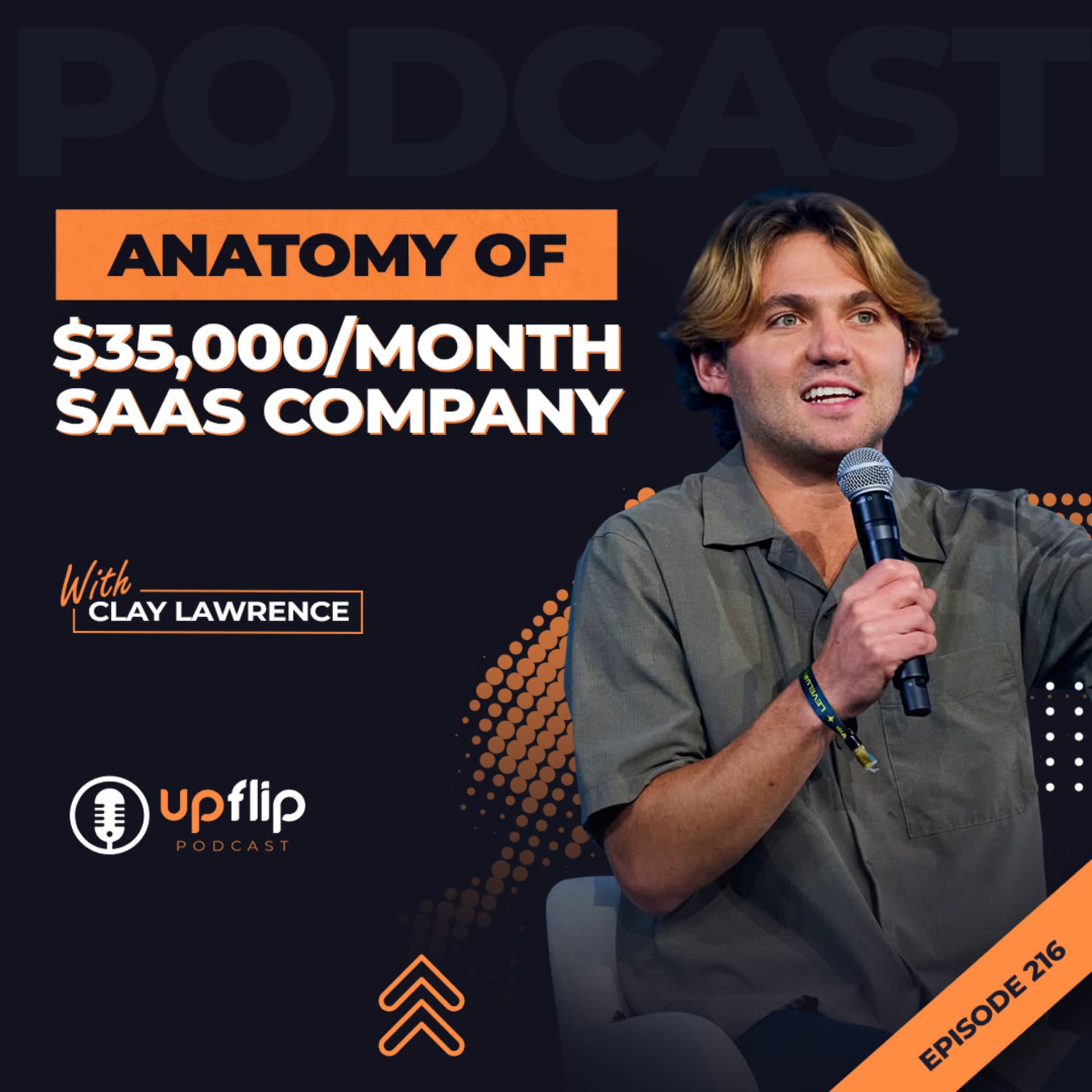
The Anatomy of a $35,000/month SaaS Company
Episode Description In this episode, Clay Lawrence discusses his journey from running a generalist digital marketing agency to building a successful low-ticket SaaS company, Review Harvest. He shares the critical decision to pivot his business model, focusing on automating Google reviews for home service businesses. Clay emphasizes the importance of specialization and how understanding customer needs can drive significant growth.
---
Key Points and Takeaways
Transition from Agency to SaaS
- Clay initially operated a generalist agency, reaching $17,000/month but felt trapped, overworked, and unable to scale.
- After a financial risk of firing clients, his revenue dropped to $4,500/month, leading to a concentrated effort on a single, scalable product.
- Review Harvest automates Google reviews, allowing for higher margins and less manual labor.
Importance of Niching Down
- Specialization: Focusing on home service businesses enabled Clay to tailor his offerings and marketing strategies.
- Trench Knowledge: Gaining in-depth knowledge of customers' pain points through over 1,000 sales calls helped build trust and authority.
Sales Strategies
- Sales Call Structure: Utilizing Alex Hormozi’s framework:
- Clarify the prospect's pain.
- Label their concerns.
- Paint a future vision (sell the vacation).
- Explain away objections.
- Follow-Up Strategy: Emphasizing the need for immediate action post-lead generation to ensure prospects remain excited.
Business Growth Insights
- Revenue Growth: After focusing on a specific niche, monthly recurring revenue grew to over $35,000.
- Customer Acquisition: Primarily through Facebook ads, leveraging testimonials from satisfied home service clients to scale.
- Emotional Selling: Low-ticket offers like reputation management rely heavily on emotional impulse, prompting quick engagement with leads.
Key Challenges
- Clay experienced significant anxiety when revenue dropped after pivoting but maintained perseverance through tough times.
- He highlights that business can be a roller coaster, and resilience is crucial for long-term success.
Unique Selling Proposition
- Clay branded himself as "The Google Review Guy," making it easy for potential clients to remember his services.
- Simplifying the value proposition to a clear message helped increase referrals and client acquisition.
---
Additional Insights
- Common Misconceptions: Clay addresses the difficulties of being a jack of all trades in the agency world, advocating for a focused service offering for better profitability.
- Customer Engagement: Regular communication and follow-ups with clients enhance retention and satisfaction, creating opportunities for upsells.
---
Conclusion Clay Lawrence’s journey illustrates the power of specialization, customer understanding, and strategic sales processes in scaling a SaaS business. His insights are particularly valuable for first-time entrepreneurs looking to navigate the complexities of building a sustainable and profitable business.
---
Resources
- Connect with Clay: [Instagram](https://www.instagram.com/claywlawrence/?hl=en)
- UpFlip Academy: [Join the Academy](https://links.upflip.com/the-business-startup-and-growth-blueprint-podcast) for more resources on business growth.
---
Tags
- SaaS
- Tech Ventures
- Digital Marketing
- Affiliate Marketing
- Home Services
- Business Scaling
- Business Growth
---
This summary serves as a comprehensive guide to the key discussions and takeaways from Episode 216 of The UpFlip Podcast, offering valuable insights for aspiring entrepreneurs.
Written by AI. May contain mistakes. Listen to the episode to check what was said.
Transcript
Automatic transcript. May contain errors.0:00Imagine being 16 years old and already building a digital marketing business. That was Clay. For years, he did what most agency owners do. He sold anything clients would pay for, websites, SEO, Google ads, and he scaled that generalist model to almost$17 ,000 a month. But behind the scenes, he was exhausted, constantly working and realizing he was building assets for everyone except himself. Then came one simple question from his wife, what's the one thing you do for everyone that actually works? His answer, Google reviews. And that became the spark for a full pivot. Clay Fired Clients rebuilt businesses as low ticket SaaS called Review Harvest and created a scalable system that no longer required trading time for money.
0:46And today we're breaking down the entire journey, the painful revenue drop, the 50 free review offer, the no longer in retention strategy and systems he built to scale. His SaaS is going to be really good for first time entrepreneurs that don't know what they want to get started with. We have an entrepreneur that has done it multiple, multiple times. So Clay, thank you so, so much for being here today. So excited to have you on. Dude, I'm stoked for it. Thanks for the intro. Yeah, it's gonna be good. And before we dive into, you know, that advice for first-time entrepreneurs getting started with validating ideas, scaling their businesses, we gotta rewind you back to 16-year-old Clay when you started experimenting with digital marketing and like turning that into a business.
1:21So like, truly, what was that like first spark for you to get started with business at like 16 years old? Yeah, no, for sure. It was honestly because I was the kid that was doing the landscaping, that was doing the pet sitting, that was doing everything in middle school or in high school or whatever to try and make some side money. And I would get into the school year and I was like, all right, well, I can't do landscaping all the time because I'm at school or it's getting cold. And so just watching YouTube videos, just like, oh, you can make money online. Great. And so watched some YouTube videos, cold called and then walked in like just cold pounding the pavement, talked to some business owners and kind of got like my first gig after a week or two, did it for free, hated it.
1:58And I was like, I don't think I'm ever going to do this again. but but kind of kept going from there what was that first like gig that you did in like i mean you're 16 years old was it scary doing cold i think cold calling even at like 25 26 is like still kind of scary i mean what take us to that yeah the cold calling i did not see much success with so i was like i just go face to face i'll just go face to face so i walked around our area and it was a just a little local chain of clothing brand like it's a clothing brand local to our area we're on the coast it's called coast tippy i was like i'm gonna run your facebook ads for you and you're going to get more sales.
2:29And they're like, okay, cool. And they're like, we don't have any content. I was like, I'll get content for you too. And like, what do you charge? And I was like, $500. And that's just like a number I could just come off the top of my head. And they're like, uh, I don't know. And I was like, how about this? I'll do it for free. And then after you can pay me$500. And I did it for free. It did not go good. They did not get any additional sales. I never got the$500. That's totally okay. I didn't, I didn't want it. I didn't do a good job. So every entrepreneur needs to have like a failed venture, maybe.
2:59And maybe that was a good first training wheels lesson. I'm curious, though, were your parents entrepreneurial at all? Or was this truly just like a mindset that was seeded in you, I guess? Yeah, my dad's kind of always been in and out of entrepreneurship and stuff like that. My mom, not so much. My mom's totally cool to punch a clock. And so, yeah, I don't know where it kind of sparked for me, probably my dad. And also, I think when you get into self-help, I got into self-help books and stuff like that pretty young, reading all the things, how to win friends and influence people. It just so naturally, entrepreneurship comes out of that because you're like, I'm going to own my future.
3:33I'm going to make it work. So yeah. Continue with entrepreneurship. So you had a generalist agency. Talk to us about that because it was doing around whatever,$17 ,000 a month, let's call it. Yeah. What were you doing and why did you stop doing that? $17 ,000 a month. A lot of agency or a lot of owners, first time entrepreneurs are like, Oh, man, that's kind of the dream. So tell us what it was. And why did you stop? Yeah, for sure. Well, I honestly, it was literally just me texting and calling as many people as I could that sort of knew me or that were in my area. And I would just try to sit down with them at a coffee shop.
4:04And then at a coffee shop, I would just be like, yo, what do you need? I would just I had like a list of questions I asked to say where their problems were. And literally, they would say anything from like I said, website ads, Facebook ads, content, drone footage. I even like created like an SOP program with an app for somebody's also my employees. So it was like anything and anything they needed, I would do. But I did that in college mainly. So like in college, I went to the University of Florida down in Gainesville and like college at UF was hard, like classes were hard and I was a business major.
4:32And I was like used to be in like top of my class in high school and like, you know, school's pretty easy. Just study a little bit and you'll be good. Then I go to UF like, dang, this is different beast. And so I was like, I'm going to be an entrepreneur anyway. I don't need to make good grades. So I like found what the minimum viable like passing grade was in every single class. I did the bare bones possible for all schoolwork. And I just met with as many business owners as possible. So the time I graduated college, I was probably already making seven or$8 ,000 a month just from doing that random stuff for people.
5:00And then eventually after doing that for like another year, like I said, got to like 17 K and six or seven months. and I just like took a long look in the mirror and I was like, I was working more than, than I am now. And I was making a lot less money too as well. But it felt, it's so frustrating because I felt like I spent so much time on client delivery, trying to deliver, you know, the promise that I had made for this person or this business. And then my other clients suffered because of it. Right. And so I was like, I definitely can't scale this. I don't get to spend time getting more customers myself because I can't handle it.
5:33And so, yeah, that's what my life was like, what do they all like that you do? And I was like, reviews. And so history from there. We're going to jump into that review part here because that was like really what got everything started here and based on our conversation today. So listeners, stay tuned for that. I want to ask, why doesn't that generalist model work? Because some people might have a skill set where they're like, oh, like kind of like a jack of all trades, like master of none. Like I know a lot about business. Like why can't I just do everything? Why doesn't that work? And then we're going to dive into someone starting their first company.
6:00I almost tell people who are interested in online business and marketing for local businesses and stuff, I almost tell people to do that for a bit because I learned so much about what I liked and what I didn't like. And it's honestly a much easier way to get money. If you have like, this is this one thing that I do, it's a lot harder sell because you have to go find the people that need this one little thing, right? But if you're just like, I will do whatever you want me to do, you can talk to anybody, anybody as a customer, right? And so it helped me get off the floor and start getting some cash.
6:27But yeah, once you get to that 10 or$15 ,000 per month mark, you're doing so many different things and I wasn't charging high enough prices to hire somebody, right? So I was like, like you said, jack of all trades. I was decent at a lot of different things. There's no way at all I could hire people to do Google ads, to do websites, to do content, to do drone footage and still be profitable at the prices I was charging. And so that's when I was like, all right, I just gotta find the thing that I'm the best at. And then once you kind of create that into just a process, then it's a lot easier to outsource because I couldn't afford to hire five different employees, right?
6:58There was not gonna be one person that had my skillset. So talk to us about reviews then, because your wife asked you, what's the one thing you do for everyone that works? Your response was reviews. So talk to us, like, what was that light bulb moment? Like, how did this turn into Review Harvest? Yeah, for sure. So it was one of the clients I was doing ads for and content for, and they had mentioned they were spending a decent amount of money on Google ads. And I knew enough to know that, you know, if you're spending a lot of money on Google ads, you could probably try and rank higher organically just through SEO and, you know, optimize your Google business profile and you have to spend less on ads.
7:30And so I was like, hey, let's try and spend less time on ads. Let's try and get y 'all some reviews. They had thousands of happy customers, but they only had 23 reviews. And so I was like, okay, well, let's just like send out a text and email to all their customers and let's like get them, try to see how many reviews we can get them. And so I remember vividly like the next day after we launched the campaign to text and email all their customers, just like my phone just blowing up. Because I still had notifications turned on when they got a review. And so I was just like, review, review, review.
7:56And they're like texting me like, I don't know what you're doing, but keep doing it. This is insane. And so I was like, whoa, this works. And so then I went to the next business owner I talked to. I was like, I'm going to sell them on this. This is like this. This works great. And I think I charged him like fifteen hundred dollars to do the same thing and set it all up and there's, you know, all the stuff. And so I was like, whoa. And he paid me and he got crazy results, too. And he loved me. And I was like, wow, this there might be something to this. Oh, man. So what is like that? What is that to it?
8:24Because, you know, I have two successful like clients to it. It's like the light bulb moments like, holy smokes. I have a legit like SaaS business here. And like, did you cut everything off from like everything else you were doing and just focus primarily on this? Talk to us about that. Yeah, for sure. It was a little bit of a slow thing. I think I had done it for three or four people before. I was like, all right, I think I need to go all in on this because really I was used to charging a thousand, two thousand, three thousand dollars a month or whatever to basically be their yes man to do whatever they wanted me to do.
8:50Like I had like no great definition of what the scope of that work was. And then I went to the reviews and I was like, hey, here's what I'm gonna do. I'm gonna get you reviews. We're going to upload your client list. We're going to text and email your customers. We'll respond to all those reviews for you. And we'll turn all those reviews into social media content for you. And it's going to be$1 ,500 and it's like$300 a month. And they're like, yes. And then literally I went home. I set up the account for them. I use a software called High Level to get started. Just white labeled it and put my logo on it.
9:17And it took me two and a half hours to do it. And I was like, he just paid me$1 ,500 and he's going to pay me$300 a month. And it's all set up. We're integrating a new system. It's just going to work in the background. totally automated. And so I was like, okay, yeah, there's definitely something to it. So I basically started peeling back my clients from who was paying me the least and the biggest headache. So I went all the way from$17 ,000 a month in recurring revenue from my agency to going down to$4 ,500 a month in recurring revenue in like six months. And that sucks. Like that was awful. But I knew that when I got back to$17 ,000 a month, it would be a totally different business.
9:53One that I could focus on growing the business, one that I could focus on hiring people to get myself out of the business. And so it's a lot more scalable. Are you ready to launch, grow and scale a business? Inside the Uplip Academy, you'll get a complete roadmap to shortcut your success with 25 plus step by step programs taught by active business owners, not gurus who share their step by step blueprints, plus ongoing live workshops, skills training, a business idea database, and community to share resources and celebrate your wins. Click the link in the description below to join the Elphab Academy today and start surrounding yourself with the people and tools that can change everything for your business.
10:34I'm curious, like what was that feeling like for you seeing the bank account go from$17 ,000 a month to like$4 ,500 a month? I mean, I'm sure there has to be some sense of like anxiety or like worry once you see something like that happen. For sure. No, it was so stressful. And like, luckily my wife was working a full-time job. We got married really young and she was working a full-time job. She was an assistant manager at Lululemon. And so my goal for like her and I goal expenses wise, like, Hey, we're going to live off of her salary. And like everything I'm doing is just kind of plus right now.
11:04And when your rent is half of her salary, it's like, Oh, things are really tight, you know? And so honestly, I think the hardest part was sticking to the fact that, Hey, I'm going all in on this. I'm going on this because saying yes, it was so easy. And I did it multiple times. It was so easy to say yes to one more agency client. I could use the cash, right? But I was taken away for the long term of all the things I needed to do to grow a review harvest. And so I just had to say no. And I'm a pretty risk averse person by nature. So I was like, yeah, it kind of sucked. I think just reading between the lines, just from what you did first of like that generalist, like I'll do anything to this of like, now I'm gonna like really focus on one thing.
11:40Talk about the benefit of that for like the growth for your own agency. Cause yeah, we've now switched it from generalist to focus on one thing. I want to talk to business owners here that need to hear this as well. Yeah, I think the number one thing for me that still helps us to this day is just the consistent messaging of, hey, we get people reviews. Like I have in my Instagram bio, I think for the longest time, it's just like Google review guy, because that was the biggest piece that was keeping me from growing the generalist agency and keeping a lot of agencies from growing. They just like, oh, they do marketing, right?
12:10It's like, oh, I don't need marketing, right? And nobody that your clients, people you talk to, people you have sales calls with, they can't, they don't remember your business. But if you just keep a very simple business and a very consistent message of, hey, we help people get more Google reviews, that's it. Really easy for people to remember. And it's really easy for our clients and people that know about us to spread the word. And so that was the craziest part about, you know, starting a review harvest was just kind of referrals, which is crazy. And then a large portion of our growth, but it's so easy for somebody to be like, oh, did you say something about reviews?
12:39Yeah, actually, I know a guy, like I went to high school with them. He's posted about reviews all the time. Like you should check them out. Like that happens like that happens every single week, you know? And so it's just consistent messaging. It really helps with growth. What I love about the reviews play as well is like every company needs them, especially like in the home service business. That's why like I love like this area you're in because I'm thinking for like my own business, Space Star Vatials is like reviews is like a lifeblood of a company. So like strategically being in that area, I think is like so smart because that is like every company, like who doesn't need your reviews?
13:08I think you're hitting on that like a ton right there. Yeah, no, for sure. And it's like, the cool thing is that the further we get down into the business, the more business owners out there are realizing that reviews are important. Like five years ago, a lot of business owners didn't know reviews are important. And now it's slowly getting to more and more business owners like, yes, I need reviews because that means I'm going to rank higher on Google means more people are going to call me, yada, yada. And so as the awareness gets out there, it's exciting. Another question that comes to mind here.
13:34So you guys work just like in your website, it's a lot of home service, like based companies, and you're not working with like, the software companies, or maybe you are, and I'm just missing it, but primarily home service based. Did you always work with that, like ICP when you're doing the generalist stuff? Or are you just like, I know home service based companies need this? I'm asking this question of like, knowing your ICP early on and making that successful. So talk to us about getting that one. Yeah, for sure. No, I really didn't. I mean, I'm here from the coast in Florida and the panhandle really close to the beach.
14:03And so actually, the first like 30 of our customers were all local, and they were all in like the tourism industry. So it's like bike rentals, golf cart rentals, vacation rentals, you know, boogie board rentals, paddleboard rentals. It was like a bunch of just tourism-based businesses. And obviously you had the seasonality with that. Like they wanted to cancel during the winter time because they're not busy. And so I knew that as I started to run ads, I just left broad targeting open. And I just noticed that home service business owners responded really well to it. We had the most amount of calls with home service business owners.
14:35And so over like the last year, honestly, we've transitioned to now I'd say 80 % of our business is home service business owners. And we've just kind of tried to keep the messaging consistent with that just to try and get the most juice out of the attention we have. I could have that consistent messaging. You've talked about that. Has it made a difference in like revenue of like really honing in on like an ICP? I'd love to talk about that as well. Cause like, I really want to hit for the listeners. And right now, like understanding your target market is so critical. Like if you can do it from day one, you're going to be steps ahead of like so many other companies and competitors.
15:08So has it made a difference like for your business? Yeah, for sure. When we really when I like about a year ago, so when I was like, all right, I think home services is the way to go. We hadn't even just our messaging yet. But just like in our head being like, all right, home services is who we deal with. We've over doubled since then. Like really, I think I sat around 13 to$14 ,000 a month for the longest time. It took me a while to get there. And then I just kind of flatlined there, but I was kind of growing slowly before it. And I think it was because I was serving, once again, a lot of different people and things were still good and I was still growing.
15:38But once I said, hey, we really work with home service business owners, what happened was I hopped on over a thousand calls with home service businesses. So when you do that, you learn how they talk, you learn what their problems are, you learn what their pain points are, you learn that they're normally in a truck, you learn that their technicians are supposed to ask for reviews, but they don't. You learn that they incentivize their employees for reviews. And so you learn all the nitty gritty trench knowledge that you just like, you just can't get taught. Like you can't just like copy and paste trench knowledge.
16:04Right. And so now I can use that in all my ads. I can use that in all my copy. Also for the onboarding fulfillment side of things, we learn what softwares they use. And so like, it's so funny when we hop on a call with a roofer and we're like, all right, what do you use for your system? Do you use AccuLynx, Jobber, I mean, JobNimbus, you know, what are you using? And they're like, oh yeah, we use JobNimbus. And then they share their screen to get them set up. And we know how to use the software better than they do. You know, and like, how do you know how to use my own CRM better than me? It's like, because we've done this a thousand times, right?
16:31And so just that sort of trench knowledge just helps smooth everything along and makes a better customer experience with leads to more referrals and more growth. I love the trench knowledge. I've never heard that actually. So I'm writing that down because I like it there. But it does speak to the value of like, essentially having that ICP, but the value of being in front of your customer and actually speaking with prospects or customers is so invaluable. because a lot of times for like space for visuals, I'll sit down with clients and they'll be like, oh, well now we're facing this challenge or this challenge or this challenge.
17:02And like, for me, I'm thinking in the back of my mind, okay, like how can we like serve those? So for again, those listeners, like have the consistent message, you know, your ICP, but also like the value of getting in front of a customer is like so invaluable. And even to what you're speaking there, Clay, as well. Yeah, for sure. I think I don't, I forget what book it is, but it's like no business problem cannot be solved by talking to your customers. If you talk to your customers, you can solve every single problem in your business if you talk to them enough. So you mentioned that you guys were kind of flatlining at that$13 ,000,$14 ,000,$15 ,000 range.
17:34I'd be curious, and I know the listeners are going to be curious here too, what are you guys doing today in revenue? Yeah, for sure. We did just over$35 ,000 last month in recurring revenue, and then we'll probably hit$40 ,000 in recurring revenue this month. It's been a really good month. And we kind of cracked something on ads in the last probably five or six months, and we've really been growing. And then just recently, I messed up something on our Facebook ad tracking. So the ads are not working like they were, but we're still growing from referrals and stuff. So yeah, it's been great. Well, talk to us about that acquisition strategy then because$35 ,000 in reoccurring revenue is like incredible.
18:09That is a very, very legit, healthy business right there. What are some of those levers you guys pulled to get there? Talk to us about client acquisition, how you guys are currently getting clients. Yeah, for sure. So the biggest way that we just like forced client acquisition has been Facebook ads. And so much of like, like we talked about with the consistent messaging, what's so valuable when you work with home service business owners, we're able to get lots of home service business owner testimonials, lots of content around home service businesses. And all of our ads are based around home services.
18:37And Facebook ads is so good nowadays with targeting, we don't even we just leave our targeting broad, Facebook knows from the messaging and the words in our ad copy and in the videos, who to target. And so we go Facebook ad to a landing page where we kind of qualify them, just make sure that they have a certain number of customers. That's been the biggest struggle of Facebook ads. When I was first getting started, it's like you get a lot of people who just like are just getting started in business and as a review company, like these are all real reviews, just so people know, like these are all real reviews from their customers.
19:06There's nothing fake here. And so if you don't have any customers, we can't get you any reviews. And so we basically send them through a little quiz funnel where we qualify how many customers they have. They have a verified Google business profile for the reviews and that they use some sort of software to collect their customer data. And then from there, we book a call, hop on a call and just get them set up on a 10-day trial. And we have lots of things with like, the tricky thing when you're selling to home service business owners is getting them to show up these calls because they're out in the field.
19:32They're in the truck, you know? They're busy, busy, busy. And so we've done a lot of unique things to try and increase that show up rate and make it easier for people to kind of get started with us. What are the unique things that you guys have like done with that then? Because I know from even my own experience of trying to get marketers on calls, it's almost impossible. So are you guys sending like 50 notifications before? Like what are some of these unique things? Yes, it's almost like a rite of passage now. Like we need to get at least one person to tell us we sent them too many messages and it's annoying a month.
20:00So we know we're doing it right, you know? But honestly, the biggest thing is getting people to book quickly. And so our calendar, you can book up to five or six days out. But if somebody books six days, five days out, we're calling them almost immediately and trying to get them to say, hey, we actually just had something open up today. Hey, we had something open tomorrow. That's the biggest factor for show up, right? Making it happen quick. Because when it comes to reviews specifically, and this applies to other industries as well, all of our marketing is supposed to get them really excited about us solving this problem, right?
Read the full transcript
20:31And the thing is, reviews isn't a big enough problem because we're a low ticket service,$100 to$300 a month, right? And so I know that in six days, they're not going to be excited about reviews anymore. And they're like, ah, it's fine. They're not all worked up about it. And so all of our marketing gets them worked up, we need to capitalize on that instantly. And so allowing them to book really early at night and really, I mean, really early in the morning and really late at night because they're home service business owners. They're out in the field from 8 a.m. to 5 p.m. So allowing them to book early to late and then also just trying to get them on the call that day or the next day is the number one thing to get people to show up.
21:04The way you're talking about this is I can 100 % believe that you've done over like a thousand of these calls because that is some like like in the weeds type of stuff. You wouldn't hear if you hadn't done this. Yeah, for sure. Like what goes in the anatomy of like a great, you know, sales call? So, you know, they get them on Facebook, you go through the quiz funnel, which I absolutely love. And then, you know, they get on a call with you. Like what's the anatomy of like a great call at the home service based owner? I absolutely love Alex Ramozzi. I mean, that thing I just told you about the demo calls and the increasing show up rate is all from Alex Ramozzi.
21:33And so we've done thousands of calls with the team, but I could just steal that from Alex Ramozzi. I didn't have to like, you know, I didn't have to like actually test all that stuff. We just stole it and like, oh, this works. Like, it's crazy. But when it comes to specifically kind of what makes a good sales call, once again, I love Alex Murphy. So we go to the closer framework. So clarify, label, clarify them with a concern. Hey, why'd you show up? Label them, you know, with their concern. Got it. So it sounds like you're struggling to get reviews because you guys are forgetting to ask. Overview what they tried in the past.
22:03Okay. So you've, um, you tried the software, uh, you tried sending out from your CRM. You tried putting a link at the bottom, invoice not working. And then sell a vacation. Very briefly, paint a picture for 60 to 90 seconds of what it looks like once they've started using Review Harvest. Hey, we do the review reactivation. We take that list of 1 ,000 previous happy customers and we can turn that into 100 to 200 new reviews here in the next month or two. And then now you and your techs just keep doing exactly what they're doing and you're just gonna see reviews rolling in every day because we're gonna integrate into your systems.
22:31We're gonna respond to the reviews, repurpose them on your social media, on your website, and you'll start ranking higher and your competitors will call you and be like, yo, what the heck are you doing? Because you're crushing me now. So paint a picture really vividly of what it could look like once they start using Review Harvest. And then E is just explain away their concerns. So they're like, oh, well, I've already asked people for reviews. And then you have to go through like, well, you're not asking the way we were asking. We asked with a personalized image. It gets their attention, et cetera.
22:55And then once they say yes, reinforce their decision, say, awesome, we'll get you started on a free trial. Best decision you made all year. And just basically getting them fired up about it and then booked the onboarding call. So you guys are really like trying to close this in like on the call, like, hey, here you go. Then here's the onboarding call. Yeah, for sure. I mean, we try to even onboard them on the first call as well, because like I said, home service business owners are busy. So if we get them in front of their computer, it's like, all right, sales and onboarding, boom, done. And the onboarding is pretty simple.
23:23I mean, we don't have this like robust software with 10 ,000 features that can do a bunch of different things, right? It's like we need to get connected to your profile. We need to get integration into your CRM to get your contacts, get some photos uploaded for your social media posts and for your request. And you're good to go. It takes 10, 15 minutes normally. So I'm like looking at you guys, you guys have our plans ranging from like 99 to like 279. Is there like, what's the friction point in like overcoming an objection? I'm assuming some people are like, oh, this is too expensive. Some are like, oh, this is a steal.
23:53Why is it so cheap? But the people that are like, this is too expensive. Like what are those like pricing objections that you commonly hear? Our best customers know how important reviews are. So we have had times where the ads were working. so well that I've told my wife, Carly, who does a lot of the sales calls, our sales guy and myself, I'm just like, honestly, don't worry about fist fighting somebody for 20 minutes over a free trial. Like if they don't get it, they don't get it. Move on to the next. We've got more leads to call. You have more calls to do. But in terms of like what we try to do is clarify why they're there.
24:25That's so important in the overview stage. It's so important to use that as ammunition later. So it's like when you clarify why they're there, they might tell you something like, hey yeah so what made you want to book the call and they're like well my competitor down the street they just like they have like 100 or 200 more views than me and they're getting more views than me every day and i'm getting less calls my business isn't isn't doing as well as it was before boom that's a lot of ammunition we can use later okay great how many jobs a month do you think that you're missing out on because sally down the street is doing better oh at least at least five awesome what's an average job look like to you uh you know 1500 or something like that in terms of revenue.
24:59Okay, got it. So now we get down to the bottom and they're on the$99 plan or$279. And like saying the pricing, he's like, totally get it. And I get it. I mean, you are the owner, you know, it makes sense. Your job is to make sure every dollar makes sense in the business, right? But it sounds like it's not a money problem. Cause I think you said that you're missing out on about five new jobs a month because Sally's stealing them. And with these reviews, cause we said we can get you to 200 reviews or whatever it is. You just told me, cause before we sell a vacation, when we kind of labeled them with a concern and overview their past pain, we basically future cast saying hey if we could get you to 300 reviews in the next like six months do you think that would help you get those jobs grow your business etc so we kind of have everything we need to close them after the fact but from there yeah like yeah i guess it doesn't sound like it's not a money issue because you said that it's going to get you this more job so are you just concerned it's not going to work and then we just deal with that i mean we have 10 day free trial and then a money-back guarantee and so like our job is to make this the i don't even know why we do sales calls it should be the easiest business decision every business owner makes because it's absolutely risk-free.
25:57At the very least, you'll get a whole bunch of reviews on your free trial and you can just cancel or you can just get a refund, you know? So. I do love what you said there is like getting this sales ammo early on. If you guys are new to like sales calls, you guys don't pitch slap them. Like you got to get information. What we do for my own agency is my first question basically is like why video? Why now? And we're like, oh, like we have a product launch in a month. Now, everything that I say like goes up to the product launch. Once the call is done, it's like, hey, if we're going to move forward, we got to move forward like pretty quick here.
26:25So it's just like, I'm trying to get stuff out of them that I can then use against them. We've got a few minutes left. I do want to ask you, because obviously like you're a sales winner, I'm getting that. I respect the sales game. I love the sales game. What are the sales metrics that you care about like weekly? Are you caring about like lead generated? Do you care about revenue weekly? What are like those three or four sales metrics that first time entrepreneurs should monitor weekly? Yeah, for sure. So the great thing about ReviewHorse right now is that our trial to conversion rate is super high.
26:50They might go down as we scale and stuff. But right now, like over 95 % of our free trials turn into a paying customer. So really what I'm looking at every week is I'm looking at show up rate. I'm looking at basically good fit to close rate. So we do track on the calls. Hey, if they're not a good fit, we make sure not to count that in the tracking. So show up rate, good fit to close. So we had 40 calls booked this week. We had 25 show up. Out of those 25, 15 of them were good fit. And then we closed 10. So I'm looking at show up rate, good fit rate to close, and then free trials every month. That's every week.
27:24that's kind of the numbers I look at. Are you simply doing this in like a Google sheet or like do you have a VA? Cause I think for me, like I would love to track like all of our sales metrics that we have here. Like I would love to literally track everything, but just like, I don't have the time to do that. So do you have like a VA that like helps you do that? Like, do you have the time to do it? Or I don't know. I'm assuming you don't have the time, but if you ask anybody, though, anybody like in our business, you know, like in review harvest, they'll know that like tracking is the bane of my existence.
27:48Cause I want it to be automated. It should be automated. it feels like it could be automated. But at the end of the month, you look at it and you're like, oh, this is not automated. So almost always, I have to go kind of check a couple of things manually. We have spreadsheets where we track stuff and then we have it in our CRM where we can see bookings and show-ups and all that sort of stuff. But we kind of still have to kind of merge them all together to get a good dashboard. That's fair. It's such a pain in the butt, honestly, to like track sales metrics. Honestly, I'm going to hop on Lovable after this and create something for that.
28:15So thanks for the business idea. But very last question for you before we dive into FanBlitz here. just advice for a first time entrepreneur that is listening right now that's trying to start their first business they may not know a whole lot about sales or anything about entrepreneurship for that matter one piece of advice you have and then we'll jump to fan blitz yeah for sure I mean I would recommend just if you're getting started really decide whether the goal is just to make money or whether you want to have this really cool shiny thing because if the goal of your business is to make money go choose something that's proven that people have already proven to make sense and make money with and then just like do an inordinate amount of work like just do an unbelievable amount of work.
28:50I think Alex Ramsey says, do so much work, it'd be unreasonable for you not to succeed. And so yeah, just keep showing up day in and day out. And the biggest thing there is that there is gonna be really hard times. Business sucks most of the time for me, like four or five days a week. I'm like, why am I even doing this, right? And the key is, it's just like, the key is like, go take a walk, you know, lay down, do whatever you gotta do for 15 minutes, but then get right back to it. Like wake up tomorrow and do the, wake up tomorrow and just do it again because we had a really hard time about two weeks ago, we had like probably the worst week we had in business in like three months.
29:21And I thought to myself vividly, I was like, honestly, three years ago, if I had all these bad things happen in one week, I would have quit. But now I've been through enough times like this to know that if you just keep showing up, good things start to happen again. And the ball starts rolling in your favor again. And it's just like, it's a roller coaster. And you just got to be along for the ride. And you got to hope that it ends up in the green up into the right. I get that is that's what I would say about entrepreneurship. It's like the hardest thing in the world is easily the hardest I've ever done.
29:48Then like last Q4 2024. So about a year ago, almost basically to the day hardest time in my life, I was in like the valleys of valleys, the lows of lows, like we closed like$6 ,500 in revenue in two months, which is for some companies just getting started good. Awesome for us. Like I was like, holy smokes, I'm not going to be able to hit payroll, but got through it thankfully. But now it's like, if I have a bad week, it's like, well, I got through that. I can get through this as well. So resilience builds good entrepreneurs. So cool, Clay. This has been really good. Let's jump into our fan blitz.
30:19So these questions are submitted from our community. Listeners, if you want to join in on World Class Entrepreneurs, go to www.youtube.com slash upflip and submit your questions there. But Clay, ready for our last five questions here? Let's do it. Number one, what's one tool inside high level that every beginner completely overlooks? Probably pipelines. Got to see where the leads are. I like it. What's the biggest red flag that a client will be high maintenance? Ooh, lots of questions on the sales and onboarding calls. There's like an inordinate amount of questions. The tricky thing is that sometimes people flip.
30:48Sometimes they flip and become just absolute loyal customers and never talk to you. But most of the time, if they ask a bunch of questions, they're going to be high maintenance. That's a good one. What's one automation you think every entrepreneur should set up on day one? Ooh, day one. Okay, day one, it's just got to be lead follow-up. If it's just day one, if you get a lead from the website or Facebook ad or something, you've got to send them a text, an email, something automatically or buzz your phone. That's the number one thing you've got to set up. What were you going to say otherwise? I was going to say an automation that people sleep on is a basically customer success automation that we just put in place where basically every month we check to see how many reviews they've gotten and what their number is.
31:24And then from that, we basically invite them to certain things. So like, we're working on like a trophy. So they get a certain trophy and that notification and stuff when they get a certain number of reviews. But if they get a certain amount of reviews, we invite them on our podcast. And so business owners love to be on podcasts. Obviously, I'm on this podcast right now. And so it is such a great opportunity for us to build trust with our businesses, get a bunch of video testimonials. for us. And we get them a bunch of content that then they go post on their social media with Review Harvest branding on it.
31:50So putting something in the customer success place, just to get content and deepen that relationship with the customers. That's really good. That's a good one. Two more for you. What's a business book or podcast that has changed the way like you operate or lead? The Game by Alex from RZ and all of his books, just the best. Last one for you. What's the one decision that has had the biggest impact on your income this year? This year, it was starting to post YouTube videos about what I do and how I do it in high level and stuff like that. So I basically just say, hey, I make this amount of money helping local business owners get reviews.
32:22Here's a software I use. If you want to sign up for it, here's my link. And I help people out with it and make a bunch of training videos. And high level gives like 40 % recurring commission to anybody that signs up with your link. So that's pretty much doubled. I make more profit from that than I do from Review Harvest, so. Oh my gosh. There's a million ways to make money in this world. So I appreciate that. But Clay, this has been so good. If someone's like, oh my gosh, I need to learn more about Clay and connect with him. Where can they do so? Give us your YouTube, give us your LinkedIn, give us Review Harvest, give us it all.
32:50Yeah, for sure. Just Clay Lawrence on YouTube. That's where I'm most active. That's where I'm most helpful. I deleted all social media off my phone recently. So sometimes I get on Instagram, but you just find me at Clay Lawrence there and we'll be good to go. Listen, that was a great episode with Clay. Three quick takeaways for you. Number one, you got to know your ICP. That is the best way to grow. So he grew from about$13 ,000 to$14 ,000 a month all the way up to$35 ,000,$40 ,000 a month by really honing in the ICP. Number two, once you have that ICP, have a consistent message across your branding, your website, in your sales messages.
33:25Make it consistent. It really hits home that ICP even more. Number three, trench messaging, trench knowledge. by being able to actually speak with your customers or your prospects, you're going to learn like how they talk, how they act, what their problems are. It's the best way to understand the problems that you can solve for your customers. So don't be afraid to get out in front of prospects and actually have some face time with them. That was a great episode with Clay. If you guys are enjoying this podcast, do us a favor and give us a five-star rating wherever you get your podcast. It helps us get more amazing entrepreneurs like Clay on the show.
33:55And you know what? We will see you next Monday. Clay, thank you so much for the time today. Of course. Thanks, Ryan. .
From the publisher
Clay Lawrence built a generalist digital marketing agency to $17,000 a month, but quickly realized he had created a trap: he was exhausted, overworking, and constantly trading time for money on services ranging from drone footage to SEO. Desperate for a change, he took a massive financial risk—firing his clients and watching his revenue plummet to $4,500—to bet everything on a single, scalable idea that didn't require him to be the bottleneck.
That bet was Review Harvest, a low-ticket SaaS focused entirely on automating Google reviews for home service businesses. By niching down and utilizing "trench knowledge" to understand his customers better than they understood themselves, Clay rebuilt his business from the ground up. Today, he generates over $35,000 in monthly recurring revenue (MRR) with a streamlined model that leverages software like HighLevel to do the heavy lifting, proving that a focused offer often beats a broad service.
In this interview, Clay sits down with Ryan Atkinson to reveal the exact blueprint behind his pivot. They dive deep into the anatomy of a high-converting sales call, borrowing frameworks from Alex Hormozi to close deals on the spot, and discuss why the "Jack of all trades" model is a killer for agency growth. Whether you are looking to launch your first SaaS, maximize your HighLevel affiliate income, or master client acquisition through Facebook ads, this episode breaks down the tactical steps to build a business that serves your life, not the other way around.
Takeaways:
- Scaling a generalist agency is nearly impossible because you cannot afford to hire experts for every service; narrowing down to a single service allows for process automation and higher margins
- Growth sometimes requires taking a financial step back; Clay intentionally dropped his revenue from $17k to $4.5k to rebuild a scalable model rather than remaining stuck in a service trap
- The most scalable offer is often the one that works for every client without custom labor; automating Google review requests provided high value with zero ongoing manual fulfillment
- Shifting focus specifically to home service businesses allowed the agency to double its growth because the messaging and operational knowledge became specialized and repeatable
- Conducting over 1,000 sales calls provides "trench knowledge"—such as knowing a client's CRM software better than they do—which builds instant trust and authority during the sales process
- A simple, singular value proposition (e.g., "The Google Review Guy") is significantly easier for networkers to remember and refer compared to a vague "full-service marketing" label
- Low-ticket offers like reputation management rely on emotional impulse, making it critical to get leads on a call within 24 hours before their excitement fades
- Sales calls should follow a structure of clarifying the prospect's pain, labeling the problem, and "selling the vacation" (painting a vivid picture of the future state) rather than just listing features
- Success is often just surviving the lows; Clay faced a period where he only closed $6,500 in two months but credits his recovery to simply showing up every day despite the anxiety
- Documenting the business journey on YouTube created a secondary income stream through HighLevel affiliate commissions, which now generates more profit than the agency itself.
Tags: SaaS, Tech Ventures, Digital marketing, Affiliate marketing, Home Services, Business scaling, Business growth
Resources:
Grow your business today: https://links.upflip.com/the-business-startup-and-growth-blueprint-podcast
Connect with Clay: https://www.instagram.com/claywlawrence/?hl=en


