
In short
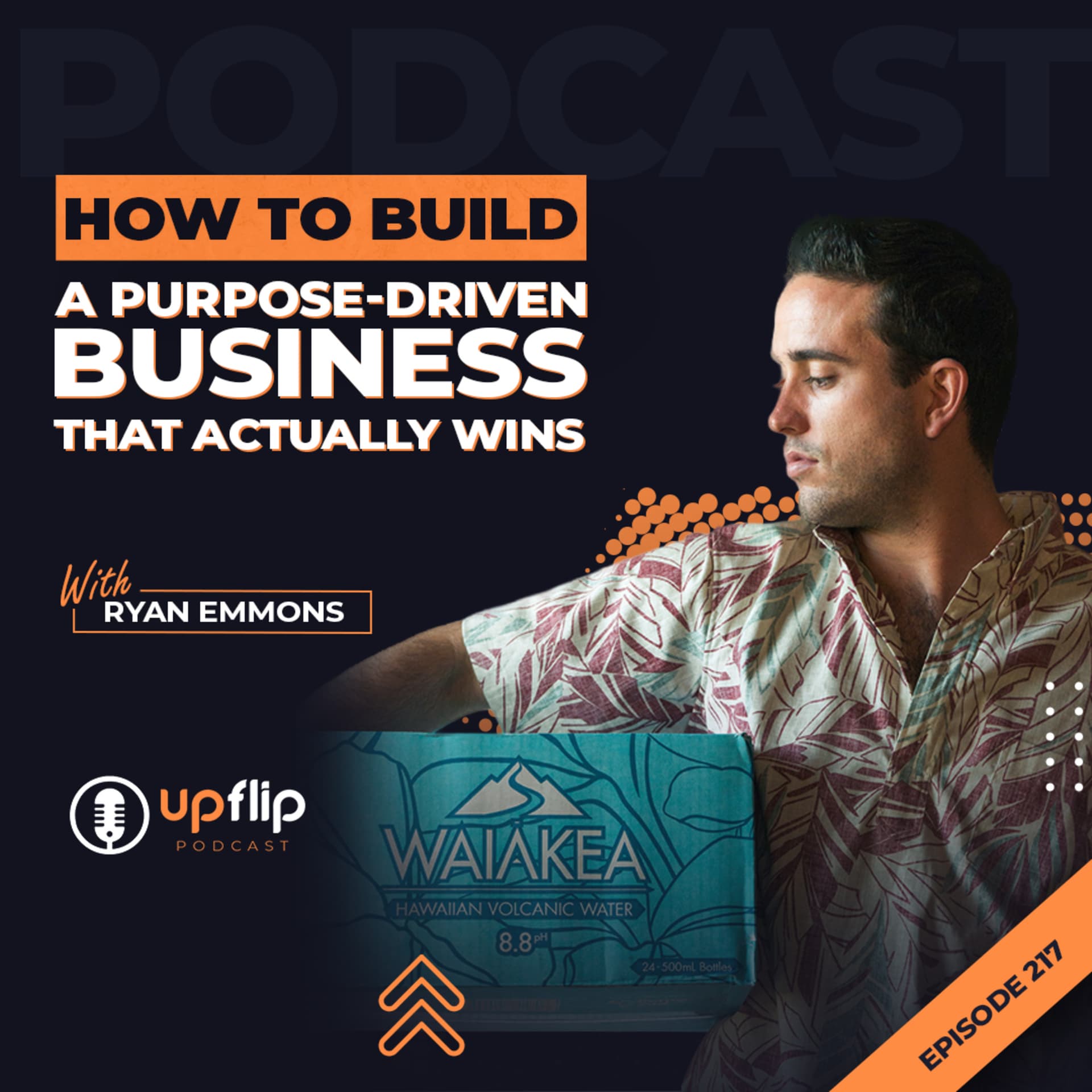
The UpFlip Podcast - Episode 217 Summary: How To Build a Purpose Driven Business That Actually Wins
Episode Overview In this episode of The UpFlip Podcast, host Ryan Atkinson interviews Ryan Emmons, the founder of Waiakea, a premium bottled water brand. Emmons discusses his journey in establishing a purpose-driven business within one of the most competitive industries—bottled water. He emphasizes the importance of a "triple bottom line" approach that prioritizes People, Planet, and Profit.
Key Concepts
Purpose-Driven Business
- Definition: A business that integrates social and environmental goals into its core operations alongside profit motives.
- Triple Bottom Line: Waiakea's philosophy focuses on:
- People: Employee retention and morale through meaningful work.
- Planet: Environmental sustainability, including upcycled packaging and water conservation.
- Profit: Long-term financial viability, emphasizing that social impact can coexist with profitability.
Market Positioning and Strategy
- Differentiation: Emmons discusses how Waiakea targets niche markets and smaller retailers to avoid direct competition with major corporations like Fiji and Smartwater.
- Scrappy Start: The brand leveraged a consignment model to gain initial shelf space without paying large slotting fees, which is typical in the beverage industry.
- Manual Self-Distribution: Emmons shares anecdotes about personally delivering products and managing logistics in the early days to maintain low overhead costs.
Employee Engagement and Customer Loyalty
- Impact on Employees: A purpose-driven mission increases employee loyalty and retention, as workers feel they contribute to a meaningful cause.
- Consumer Engagement: Customers are more inclined to support brands that align with their values, allowing for a premium pricing model that supports sustainability initiatives.
Scaling Without Losing Mission
- Public Benefit Corporation: Emmons discusses their legal incorporation as a Public Benefit Corporation, ensuring their mission is embedded in their corporate structure as they scale.
- Transparency and Accountability: Regular assessments and public disclosures about their impact ensure that they remain committed to their founding principles.
Key Takeaways
- Start with Purpose: Establish a mission-driven framework from the beginning to avoid the challenges of retrofitting purpose into an existing business model.
- Leverage Unique Strategies: Use innovative approaches, such as consignment sales and focused marketing, to compete in saturated markets.
- Embrace Naivety: Lack of industry experience can be advantageous, allowing entrepreneurs to pursue unconventional strategies without fear.
- Long-Term Focus: Build a business vision that prioritizes sustainability and resilience over quick profits or exits.
Resources
- Waiakea Website: [Waiakea](https://www.waiakea.com)
- Connect with Ryan Emmons: [LinkedIn](https://www.linkedin.com/in/ryan-emmons-8709871b)
- Learn More About Building Your Business: [UpFlip Academy](https://links.upflip.com/the-business-startup-and-growth-blueprint-podcast)
Conclusion This episode provides invaluable insights for aspiring entrepreneurs, particularly those entering competitive markets. Emmons’ commitment to a purpose-driven business model serves as a case study demonstrating that success can be achieved without compromising values.
Written by AI. May contain mistakes. Listen to the episode to check what was said.
Transcript
Automatic transcript. May contain errors.0:00Imagine this, you're entering one of the most hated industries on the planet, plastic water bottles. You're going up against billionaires like Fiji and Smartwater. You have no money, no distribution, and you're delivering a product out of a U-Haul. By all logical standards, this business should fail. But Ryan Emmons didn't just build a water company, he built a mission. He bid everything on a triple bottom line, people, planet, profit. Believing that in a crowded market, consumers would pay for something that actually stood for something. Today, why IKEA is one of the fastest growing premium water brands in the world.
0:34And I'm Ryan Atkinson and you're listening to the podcast where we uncover the secrets of building and running successful businesses. Ryan is here to prove that purpose isn't just charity. It's the ultimate competitive advantage that helps you grow faster and last longer. So from one Ryan to another Ryan, I am super excited to have you. So Ryan, thank you so much for coming on. Yeah, Ryan, appreciate you having me. By the way, really quickly, have you seen that they have like Ryan conventions now? Have you seen this? There was actually one in, so I'm based in Austin, Texas. There was one in Austin recently, and I really wanted to go with one of my friends that's also named Ryan.
1:05I haven't been yet. But yes, that is that is on top of what are they called again? The Ryan meetups or something. I don't know. I keep on getting sent by all my friends. I'm like, guys, like, OK, come on. But it is it is pretty hilarious. Thanks for having me, man. Yeah, thank you for coming on. And one of the important parts is, hey, if that's in California someday, we're going to be right in your backyard because you grew up between Santa Barbara and Hawaii. talk to us about growing up there like kind of going in between two obviously that's an interesting environment that you're in with the culture how'd that plant the first seeds of purpose and how you like see business yeah i mean so it's interesting because there's actually like it's not just me to have a lot of ties between both places there's a lot of people you know jack johnson is a perfect example but for some reason a lot of people you know kind of gravitate towards you know if you're in hawaii i think there's a lot of things to love obviously about Santa Barbara and vice versa.
1:57Surf culture is obviously a big sticking point, but, you know, the active lifestyle that both places really kind of embrace and promote healthy living, you know, on the environmental side, you know, Santa Barbara birthed the Earth Day movement, was one of the first cities to have, you know, industrial composting and recycling for the Hi-Fi program. You know, those are things that Hawaii still does not have, even though Hawaii brands itself is kind of the environmental leader. Realistically, we have to catch up, And that's some of the things that we're kind of working on across the spectrum. But yeah, I feel really, really blessed.
2:30I spent basically my entire life. I've been, you know, splitting my time, lived in Hawaii for many, many years, lived in California for many, many years and have family in both places. And those are both my homes. Give us like the high level overview for listeners that are tuning into the first time to you, Ryan, what exactly why Akea is and like what you guys are doing. I have a great visual on your website. You guys have a website. I love your website. But yeah, talk to us, like, give us like the 15, 20 second overview of like what you do. And we're gonna talk really about how you built this and how other people can as well.
2:59Waiakea is really kind of a brand that was designed to be a catalyst for beverage towards better environmental and social impact standards. But it first starts with like, you can't be a beverage unless you have like amazing contents within the bottle. And so, you know, our water is sourced at the base of the Mauna Loa volcano. So kind of the origination story of the water, it gets filtered to about 14 ,000 feet of porous volcanic rock and that kind of unique filtration process enriches it with all these trace minerals, makes it naturally alkaline, daily recommended intake of silica, which is great for your hair, skin, nails, and gives it kind of a really smooth mouthfeel.
3:33And so, you know, first and foremost, like, you know, we're really lucky we have access to this incredible source, but we also do so. And within our charter is a commitment to use, you know, very, very little of the sustainable yield. And, you know, that will continue through the lifecycle of our company. And then outside of that, we also were the first back in the day to use 100 % upcycled packaging for all of our product lines. We pioneered and commercialized the use of 100 % RPAT. And, you know, we've kind of continued to iterate on the way. We'll be announcing the launch of the world's first algae-based inks on our packaging.
4:09So carbon negative inks and Hawaii Ake is, you know, a founding partner in what will be hopefully Hawaii's first end-end recycling facility. So we've kind of continued to push that. And then we also founded a nonprofit called our Kukua Initiative. So we have a full-time impact team. And all they do is reach out and help those in need across a number of categories. Last year affected over 160 ,000 people in Hawaii alone across those programs. So we've tried to build a brand that obviously tastes great and is exciting on the shelf, but one that hopefully people can feel pretty good about drinking.
4:42If they choose that, I'm not throwing, like you don't have to drink bottled water. That's totally fine. But for those that they're seeking taste or seeking, you know, mineral composition, I want to be that kind of guilt-free option where they can feel really good about their purchase. And, you know, I think we've been able to stay true and really authentic over the last almost 13 years. It sounds like the story and like the purpose of like what you guys are doing here is, you know, kind of like your competitive advantage in a sense as well. Talk to us about the importance of building something that is purpose-driven compared to just a for-profit where you're chasing money right away.
5:17Why is it important as a foundational level for first-time entrepreneurs to have something that is purpose-driven? I encourage entrepreneurship in general because you're going to create jobs. I think that entrepreneurs are really important to the economy. I think there are a lot of advantages to being purpose-built outside of creating a lifestyle brand that sometimes like don't people don't talk about and like one of them is you know I think for like my employees and my team I think understanding and seeing consistently all the work that we do you know we elevate our impact KPIs are elevated my director Kukua is in a leadership position and we are looking at those KPIs as critical numbers every quarter and every year And so I think in terms of like reducing, you know, we don't really have people leave.
6:04And so the loyalty we get from our employees because they're able to not only get paid well and have good benefits, but also feel really good about what they do because of the impact work, pays dividends. Like that honestly alone. But yeah, I think ultimately, it just also allows obviously customer loyalty. So I think, you know, there's plenty of brands where, you know, if it's just taste or it's just design, but I think we stand out in terms of everything that we do. And that's why, you know, people typically that start with us, they stay with us. I think those are like two huge differentiators in a category that's super, super competitive.
6:39You have to have both of those things. You have to have the best team. You know, you have to have repeat purchase. So I think those are two ways for sure. Yeah, so that's what I wanted to ask as well because like CPG, like water bottles, like I could go to the grocery store right now and there's hundreds or I don't know if hundreds. There's a lot of options when it comes to water bottles. So like, you know, having like the good team and all that, it's like great. But like, how else do you like stand out really in like the CPG space when you're going against someone that's a Dasani? I think Dasani is owned by like the Cokes of the world or they have a billion dollar budget or whatever it is.
7:10Like, how do you like really stand out for a first time entrepreneur that's like wants to build some sort of like CPG brand? Yeah. Well, you're like not going to be able to stand out if you're just like at a dry shelf on a grocery store where there's thousands of other facings. facings, you're going to get crushed. So in like the early years, it was, you know, us going to mom and pop shops and selling it in and basically selling on consignment, setting up a display, like anywhere that we could differentiate in terms of like what we're merchandising. So you can really get like an outsized impression is what you need to do.
7:45And then you basically, you know, we got to a point where then we, we looked at, started looking at other channels And we actually looked at like, originally, we were focused a lot on natural specialty and hotels and stuff like that. But one of the other things that became kind of a surprise for us was, you know, we basically had an opportunity at Wawa, which is like a high end convenience store, a lot of loyalty in the mid Atlantic. It's like the Whole Foods of convenience, if you will. They give us a shot early on. And, you know, what we saw is that if we couldn't compete with the big guys in terms of money for facings and slotting and big promo dollars, if we just could focus on certain retailers where we had set space and every other brand also had a set amount of facings.
8:29So we were really like, it was more equal footing. That really became our case study of like, hey, if where we have the same amount of facings, we're doubling them in velocities per store per week. And so we kind of shifted and that kind of started to be the focus because we couldn't afford to spend the money that all the big brands were. You know, the little guy kind of gets shafted in the beverage world, you know, slotting fees and these things to get into retailers. oftentimes the big guys, that same amount of slotting that Waiakea would have to pay, the big brands are paying across all of their portfolio beverages.
8:59This is just like one example. So you kind of have to really pick and choose where you're going to focus on, where, again, there's a more even playing field where you're going to be able to have a more efficient use of allocation of resources. Are you working a nine to five but dream of entrepreneurial freedom? Look no further than the Uflip Academy, the number one entrepreneurial platform with 20 plus step-by-step courses taught by active business owners, live workshops, hands-on skill training, a business idea database, and a thriving entrepreneur community to keep you accountable. Click the link in the description below to join the Uplip Academy today and make this the year you stopped dreaming and started building your business without guesswork.
9:44Yeah, well, give us kind of like that master class as well there of like how like you know someone's gonna start a cpg brand and they're gonna go to the mom and pop shops or even the local convenience store whatever like how do you like do it well where you can approach them and say hey like you know we're just getting started out well like you put our like drinks in your store like is there like a what's a good tip for us uh right there on like how to do that effectively i think what we did is still rings true today which is like at first you're gonna have to prove it out so what we were doing is we were basically being like hey hey, can we just give you this on consignment?
10:18And we would set up a display. We'd have like a display at the cash register. And, you know, we'd basically come in, you know, once a week and see how that sold. And, you know, we might lose, you know, we might offer to give a couple cases free after they sold through just to like, you know, get going. But typically after the first week, it would sell. And then, you know, we'd establish that relationship, be consistent in our communication. And then we'd kind of continue to do that same thing, that same playbook in whatever area that you're trying to kind of target and set up distribution. And then eventually, hopefully you don't have to continue to use U-Hauls or whatever rental trucks you're doing.
10:55And you eventually kind of take that portfolio of accounts and you bring it to a distributor. And then that allows you to focus less on logistics and distribution and more on kind of, you know, everything else that is required of, you know, a young brand. because otherwise that's just, you know, it's definitely a big distraction. It's one that is potentially worthwhile. But I mean, you have to, the distribution game really only makes sense for beverage, which weighs a lot. If you're distributing a bunch of different products, you know, per each store drop off, it's tough. But yeah, I would say that still rings true.
11:30And then it becomes, you know, looking at what channels of trade, what types of retailers, where your margin is viable, and then figuring out, okay, well, maybe this, the margin isn't as good, but I can build a really important case study. I have a really good opportunity. And you're looking at it in the kind of a long term strategic mindset for those use cases, but you still got to be really mindful on margin. The important part to me that you smiled about is the U-Hauls. Tell us like about renting the U-Hauls and like delivering like bottoms yourself. Because what I love about this story here is like, this is truly like, you know, entrepreneurship, like 101, like hustle, like 101 that like everyone has to go through.
12:05So tell us more about like the u-hauls and like delivering them yourself we were basically self-distributing in helo where we're based and la was our first mainland market and we used someone else's filler that was like a contract manufacturer initially early on we were kind of outside of the helo operation we were kind of trying to ship water because we couldn't afford anything with the goal of eventually kind of having our own full-scale bottling facility you know in helo but we had a labeler that was like our own labeler. So we would put it through the labeler and then we would hand cap, you know, tape our own cases, palletize them by hand.
12:41And the way that it worked was we were only allowed to be in the facility in like off hours. So we'd come in from 12 to 4am to do our own basically case stacking and palletization. So we'd have like these pallets and then we'd put them on our U-Hauls. And when I say U-Hauls, we had one. And that was our game plan. And we had a bunch of friends that were kind of helping out and turning it as our kind of like sales reps. And that's how we got started. That's so, so good. I also want to bring up your triple bottom line philosophy. I talked about in the intro there, but I love companies that have something like this and yours, that triple bottom line is people, planet, profit.
13:17A lot of founders think they need to make a profit first before they can worry about like the people and like the planet. You're kind of doing it like the opposite way. Why did you guys want to have that in your DNA from like day one, And especially like, you know, you're just starting out when you're broke, you're trying to get into the mom and pop shops. Talk to us about that. It's way harder to do later when you are a bigger company and you have a board or you have investors to suddenly allocate a significant amount of your revenues towards impact, you know, or your time or your people. It's really not going to happen typically.
13:48So you got to do it from the get go and you got to have really clear benchmarks. And that's what we kind of have always done. I'm pretty stoked. We just got the highest grade in the history of bottled water and beverage for B Corp, Benefit Corporations. Let's go. That was like a month or two ago. And that was like full audit across all our different social impact kind of categories. But yeah, I think it's like you got to do it early. It's nice. We haven't changed our purpose statement, our mission statement, our brand promises since we started, you know, about 13 years ago. But yeah, I think it translates to a number of different things.
14:19Obviously, I talked about like employee retention and morale, but Yon and I talked about the brand loyalty. But, you know, it also like, you know, when we were kind of doing our feasibility, like people are willing to pay a slight premium. And, you know, for a tiny company, a super competitive category, our pricing has always been pretty competitive. But, you know, we're typically maybe a slight price premium to some of those other brands. And I think it really allows us to do that. And people feel again that they're kind of like, oh, yeah, this is like, it's such a negligible premium. them that's what i like because you said like a price point of like what is it like 249 to like 279 or so for like a drink or so and correct me if i'm wrong there yeah and that's for like a one liter so that's like a pretty big bottle so you know it's not like i mean these days inflation like some of these like smaller like seltzers and stuff are like the same price so we'd like to think that we held our price during you know covid to now it's just the retailers didn't which is sometimes annoying the supplier always kind of like puts the bill but anyway yeah but But so the reason I was asking this is because like a critic might be like, okay, like sustainable materials and like donation models can like kind of cut into margins too much.
15:27We've talked a little bit about margins already. Does having a mission allow you to charge like premium prices that can like cover some of these costs, like offset them? Like is that obviously that's not the mission behind it. But like, is that like a added benefit to it as well? When, you know, you are donating, you can charge a little bit more. People understand the purpose. Is that kind of like built into the marketing as well? Well, yeah, I think as long as it doesn't get to the point where I think Fiji got into a little bit of trouble because their price premium and a bunch of different beverages like kind of post COVID, they raised prices kind of past, I think, cost inflation.
15:59And, you know, I think it's within reason people are willing to support you. But when suddenly that starts like, you know, significantly, you know, impacting their lives. And the good thing is, you know, beverage in general is perceived as like an affordable luxury. It's like not, you know, it's not a car. So it's not going to make it that much of an impact. But I think like everything else, it really has to be within reason. If it's a pretty negligible premium, then I think it's a no brainer. And the reality is like it provides way more dividends than just the ability for us to have. I don't think that slight price premium is really covered by our kind of social impact spend.
16:35But we're okay with it because of all the other benefits that we feel like it's really given us that we weren't even expecting, you know, outside of us just, you know, it being kind of our missions. since day one. What are some of the others unexpected benefits that you've had? Well, when you're focused on like on the environmental side, okay, you know, there was this big movement towards, I forget what Wall Street was calling it, but you know, there was like a kind of sustainability stock picker where you were getting a lot of, you know, there's a lot of focus on these, you know, stocks that basically are meeting certain sustainability criteria under kind of ESG.
17:09And what we've kind of really found is ultimately a lot of the environmental initiatives that we have that are reducing, whether it's like reducing material, whether it's, you know, switching to renewables, you know, reducing our water waste or our water use, reducing our electricity by doing VFDs on our pumps at our site. A lot of these end up translating to efficiency gains, which are translating to margin gains or translating to, you know, reducing overhead. And so, you know, I think that people are like missing the, it doesn't have to just be perceived as an expense. I'd say like 60 % of the environmental gains are also going to result on an economic gain.
17:53But you just have to make the investment. You guys made an investment like early on and like your guys's brand and like what you want to be and that is like not changed from day one. But um, you guys have successfully transitioned from like a scrappy startup to a company closing like a$3 million raise, you'll have like your own manufacturing line, all that you guys are going to scale from whatever 100 employees to 1000 employees. How do you ensure that mission doesn't get like diluted as you grow bigger? Because obviously, more people, you got to kind of communicate it more, maybe I mean, how are you guys envision that?
18:21Because like you guys are so purpose driven. I do think that will stay the same. But as a CEO, like how do you ensure that stays? We reincorporated as a public benefit corporation. And so now in our bylaws, we have a certain commitment that aligns with our B Corp score. So kind of a lot of those standards in terms of our percentage use of our daily sustainable yield of our aquifer and aquifer system, our consistent commitment towards the use of recycled content across our packaging and looking at LCAs, if that means over time, there's randomly a packaging that ends up being a better solution in terms of life cycle assessments.
18:55We'll take a look at that. That's our management team, basically there's protections for our management team by staying to that commitment can't just get like fired over paying a slight premium to maintain those standards. And so I think that's, I feel pretty good about kind of what we've been able to do there with our bylaws. I think that's like pretty much the most that you can do. So yeah, I think us reincorporating and doing that and kind of we'll continue to publish this, you know, public B Corp score. So you can look into everything that we're doing. Anyone can right now. I think that transparency is what will enable us to be consistent.
19:32Well, you've been consistently good throughout this podcast. So one more before we dive into our FanBlitz questions. Just, you know, any last minute advice for someone that does want to start a CPG brand and also wants to be like sustainable and like have the messaging and the purpose that you have built. Any last advice for them before we jump into FanBlitz here? You got to know what you're getting into, but at the same, like CPG is a beast. But at the same time, if you're able to do a certain amount of feasibility where you feel like you understand the beast that you're about to be dealing with.
20:02That is the recommendation. I think a certain amount of naivete of not being in the industry. If you're in the industry for 10 years, a lot of people are like, hell no, I'm not going to launch a company in that industry because I know too much. But I think that a certain amount of naivete allows you to kind of be fearless and develop resilience over time as you're kind of learning these things for yourself. So, you know, I think that would be maybe some advice is it's not going to be a quick journey and make sure before you start the journey that you're really doing your research instead of just falling in love with your own concept.
20:36That's really, really good. Well, Ryan, let's wrap up with some rapid fire fan blitz questions. So you ready for our last five questions here? Sure. Let's do it. What's the biggest myth about sustainable business that you want to bust right now? Sustainable business means should mean two different things. That should mean, first and foremost, no business is typically fully sustainable. But we should look at it in terms of reducing our impact as much as possible, okay? And potentially offsetting that with positive impacts, which can be across multiple categories. So you need to design a business that is able to consistently generate impact while also stand on its own two feet and support its employees and its community, potentially for decades to come.
21:21That's what we should be designing businesses like that. Number two, if you had to start a new purpose driven brand tomorrow with$500, what problem would you solve? I'm already working on this. It's going to be more expensive than$500. But from a concept perspective, I think it's really hard. I don't want to say that you can start a business with$500. In terms of the things, just the categories that I'm at least exposed to, I think you can definitely do a lot of really good research. I think you can do a lot of things for free. You can raise money for free, but you're going to have to probably raise money, figure out loans or utilize your savings.
21:53$500 is tough. I remember back when I was doing an entrepreneur program, you know, we started with$20 and it was how much money can you make in two weeks? And we won that, but we won that by doing a fundraiser at the local bar. So, you know, so it's definitely tricky and I just want to be transparent there. One of the things that I am working on, which I'm excited about, which just I think requires a really good partnership with really talented individuals, is we are working on kind of these micro hydro turbines that basically are an alternative to traditional dams, which have much bigger environmental impacts.
22:27These are like three by four foot little turbines that can go in any perennial stream that's like three feet deep. That's something that realistically, you know, the prototype isn't that expensive. And the point, the reason why I bring that up is because there's a lot of things that you can do. There's a lot of great ideas, but$200 to$500, I think, is you can start potentially an econ business you can do, but it just depends. In my world, it's tough to be able to accomplish things with that. Number three, what is one sacrifice you had to make personally to keep the planet part of your mission alive?
22:56I've had a pretty great board, but like some of my investors on the board, I mean, it equates to a lot of money and resources that we spend. And so really having to fight as like, this is like an existential thing for our brand and our company is to, I don't get that as much, obviously, from retailers, but I definitely think there's been a handful of our partners that see how much effort we put in and they're like, oh, well, that could go towards, you know, sales or marketing. But I think at this point, I really don't have any sort of feedback like that. I think it was just kind of earlier days when we were trying to get some additional investors to try and support the brand.
23:33But I wasn't really willing to make that concession. Number four, who is a purpose-driven leader you look up to and why or does any leader you look up to? So my dad recently passed a few months ago and, you know, he was like my penultimate role model that kind of really focused on employee retention and engagement and give back in his own businesses. He was like a transformational leader. And then, you know, I think there's, you know, a handful of people that have been able to kind of be consistent. There's also some controversial people, but I think, you know, Tom's of Tom's shoes. I really love that model.
Read the full transcript
24:08That model was really important to me. You know, I think Elon Musk is very polarizing, but the reality is you can't necessarily deny him in terms of the results across multiple industries that are positively impacting the world. So take it for what it is. I like it. Last one. If you could put one message on a billboard that every young entrepreneur would seed, what would it say? It would probably be like some sort of a focus on resilience and just like resilience and then maybe some images of like entrepreneurs that didn't hit it big until they were in their like 50s and 60s. You know what I mean?
24:45Just like really like people get like, oh, I'm not having a quick hit. I haven't grown my business for 13 years. I think the goal needs to be building a business and being okay with like wanting to build a business that you want to lead and you want to like consistently iterate on. and grow for potentially decades, I'd like to see a transition towards that versus the quick hits. Well, Ryan, this was a quick hit of a great win for us. So thank you so much for hopping on the Uplit podcast today. If someone's like, oh my God, I need to learn more about Ryan and check you out, where can they learn so and do so at?
25:16Yeah, they can go to yakea.com or check out our Instagram, W-A-I-A-K-E-A and check out all the good stuff that we're doing. And yeah, thanks for the time, Ryan. Listeners, that was a great episode with Ryan. three quick takeaways for you. Number one, design a business to generate impact, but is able to stand on two feet. You want to be able to have a business that can make impact, but at the end of the day, you guys do need to have profit. You do need to have revenue. Number two, going off of that, make something that lasts, something that you're going to want to build for decades, not just two years, get a quick win, something that will actually last.
25:49Number three, through it all, if you're not reading the context of this interview, be purposeful, have a purposeful driven business. It's going to make your employees happy. It's going to make your customers happy. and there's a way that you can sustainably do it. So great episode with Ryan. If you guys are enjoying this podcast, make sure to give us a five-star rating wherever you get in your episodes. It helps us get more amazing entrepreneurs like Ryan out of the show. Thank you, Ryan. And I will see you at the next Ryan meetup. Thanks, sounds good.
From the publisher
Ryan Emmons entered one of the most competitive and criticized industries on the planet—bottled water—with little more than a U-Haul and a vision. Going up against billion-dollar giants like Fiji and Smartwater, Ryan didn't just build another beverage brand; he built a mission. By betting everything on a "triple bottom line" philosophy—People, Planet, Profit—he proved that a purpose-driven company could disrupt a saturated market and command consumer loyalty in a way the big corporations couldn't.
In this interview, Ryan Emmons sits down with Ryan Atkinson to reveal how he scaled Waiakea from a local hustle into one of the fastest-growing premium water brands in the world. You’ll learn his scrappy "consignment" strategy for getting onto shelves without paying massive slotting fees, how to turn environmental sustainability into an economic advantage that lowers overhead, and why he believes naivety is an entrepreneur’s greatest asset.
Whether you are launching a CPG product or trying to differentiate your service in a crowded industry, this episode offers a masterclass in resilience and branding. Ryan breaks down exactly how to build a business that stands for something, keeps employees loyal, and generates massive growth without sacrificing your values. Tune in to discover why playing the long game is the ultimate competitive advantage
Takeaways:
- Build your business on a "triple bottom line" philosophy—People, Planet, Profit—from day one, as it is nearly impossible to authentically integrate deep purpose into a company's DNA after investors are involved.
- Leverage a purpose-driven mission to increase employee retention, as high-performing talent is more likely to stay and work harder when they can see the tangible impact of the company's social initiatives.
- Prove your product's sales velocity by starting with "mom and pop" shops on a consignment model before attempting to pitch major distributors or large retail chains.
- Avoid direct competition with billion-dollar CPG conglomerates by targeting specific retailers where you can secure equal shelf space without paying exorbitant slotting fees.
- Embrace manual self-distribution in the early stages—even if it requires renting U-Hauls and working overnight shifts—to maintain control over logistics and keep overhead low.
- Reframe environmental initiatives as efficiency strategies rather than just expenses, as reducing material usage, water waste, and energy often leads to significant margin gains.
- Justify a slight price premium by positioning your product as an "affordable luxury" that allows consumers to support a cause they believe in without breaking the bank.
- Protect your company's mission during scaling by legally incorporating as a Public Benefit Corporation (PBC), which enshrines your social and environmental standards into the corporate bylaws.
- Use your lack of industry experience as a strategic asset, as naivety allows you to be fearless and attempt innovations that industry veterans might deem impossible.
- Focus on resilience and building a legacy business you want to lead for decades, rather than chasing a quick "exit" or overnight success in the volatile CPG market.
Tags: Product Development, Retail Goods, Bottled Water, Business Scaling, Startup, Business Growth
Resources:
Grow your business today: https://links.upflip.com/the-business-startup-and-growth-blueprint-podcast
Connect with Ryan: https://www.linkedin.com/in/ryan-emmons-8709871b


