
In short
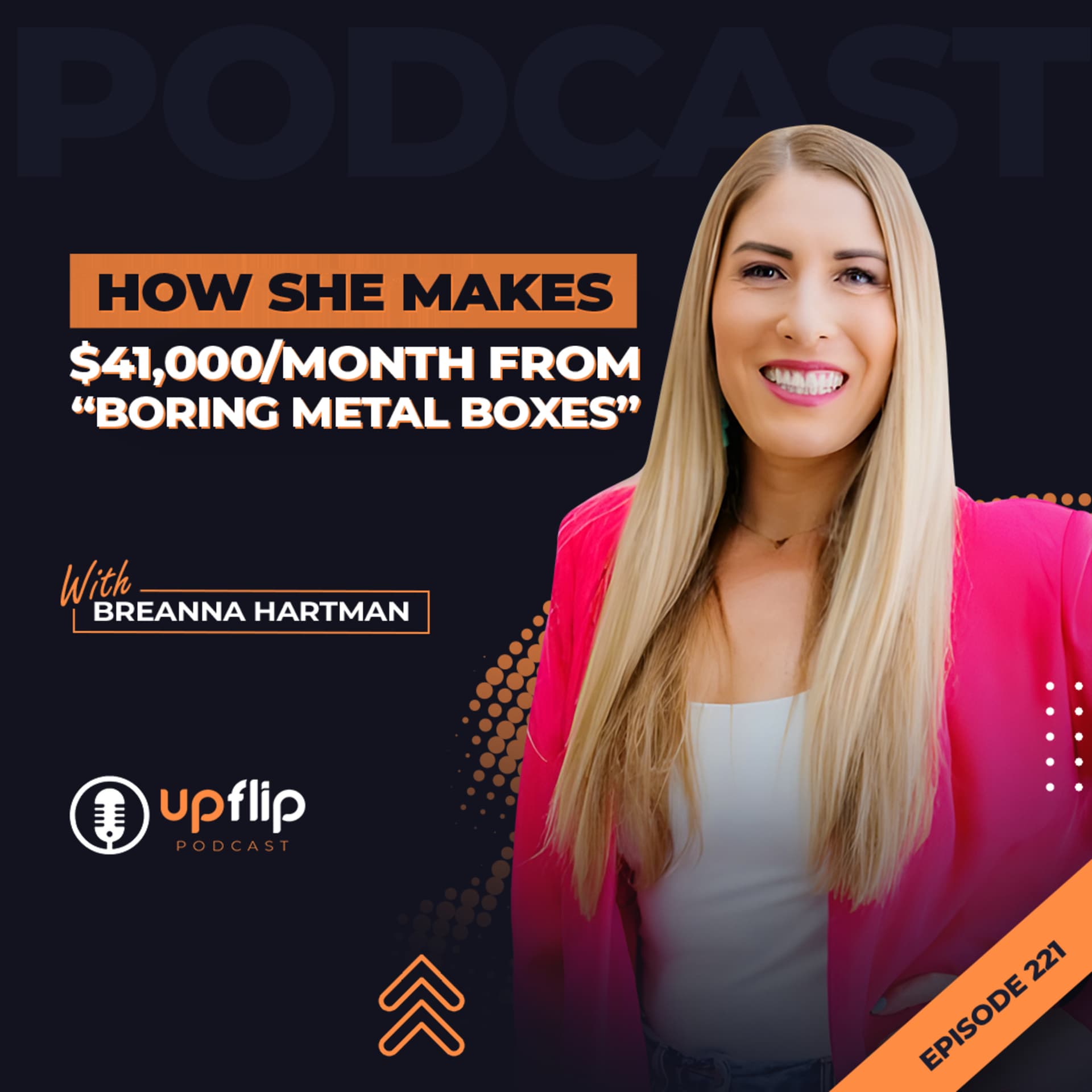
The UpFlip Podcast Episode 221: Self Storage Investing - How She Makes $41,000/Month From "Boring Metal Boxes"
Podcast Overview The UpFlip Podcast focuses on sharing insights into building and running successful businesses, highlighting the entrepreneurial spirit. This episode features Bree Hartman, a former personal trainer who transitioned to self-storage investing, revealing how she generates substantial passive income through this unique business model.
Key Takeaways
Introduction to Self-Storage Investing
- Bree Hartman's transition from personal trainer to self-storage investor.
- Owns over 100,000 sq ft of storage space across Louisiana, South Carolina, and Washington.
- Highlights the appeal of self-storage: "No Toilets, No Tenants, No Employees."
Financial Insights
- Revenue Generation: Bree's facilities generate approximately $41,000 gross per month.
- Expense Ratios: Self-storage has a 35% expense ratio compared to 55%+ for multifamily real estate, offering higher margins.
- Cash Flow: Bree emphasizes the low maintenance and operational costs associated with self-storage, making it a lucrative venture.
Market Analysis and Location Selection
- Market Rule of Fives:
- Population: Focus on areas with 5,000 to 120,000 residents.
- Income Levels: Target locations with a median income of $50,000+.
- Growth Potential: Look for areas with population growth.
- Crime Rate: Ensure low crime rates to secure assets.
- Mom & Pop Ownership: Target unsophisticated operators who manage facilities with outdated methods.
Deal Acquisition Strategies
- Google Maps Sourcing: Use Google Maps to find facilities without websites for potential off-market deals.
- Cold Call Strategy: Bree provides her cold call script for reaching out to facility owners to discuss potential sales.
- Seller Financing: Bree shares her experience of acquiring facilities with minimal down payments through seller financing arrangements.
Operational Efficiency
- Tech Integration: Implementing remote management technologies to automate operations without onsite staff.
- Occupancy Management: Ideal occupancy is around 92%, as being fully occupied may indicate undercharging for storage units.
Actionable Advice for Aspiring Investors
- Networking: Join a community of entrepreneurs to share knowledge and opportunities.
- Take Action: Stress on the importance of executing plans rather than just researching.
Episode Highlights
- Mindset Shift: Bree encourages viewers to view self-storage as a business opportunity and not just a passive income source.
- Occupancy Insights: Discusses the importance of pricing strategy and demand management.
- Creative Financing: Potential for using seller financing to minimize initial investment costs.
Podcast Details
- Host: Ryan Atkinson
- Guest: Bree Hartman, self-storage owner and investor.
- Episode Length: Approximately 60 minutes
Additional Resources
- Self Storage School: For individuals interested in learning more about self-storage investments.
- Contact Bree: For personalized advice or resources, text "storage" to 916-579-7209.
Conclusion This episode of The UpFlip Podcast presents a compelling case for self-storage investing as a viable and lucrative business model. Bree Hartman's practical insights, actionable strategies, and personal success stories provide listeners with a roadmap to explore opportunities in this niche market.
Written by AI. May contain mistakes. Listen to the episode to check what was said.
Chapters
Tap a time to open that second in VOMeet Brie Hartman
0:45 to 1:42
Brie Hartman introduces her background in self-storage and the appeal of the business model.
“So Brie, thank you so much for being here today.”
Revenue Insights from Self-Storage
1:42 to 2:36
Brie explains how much revenue can be generated from self-storage facilities.
“So, I mean, there's two different, I mean, you can have a smaller facility, which one of our facilities around is 83 units.”
Transitioning to Self-Storage
2:36 to 3:41
Brie shares her journey from personal training to investing in self-storage.
“The big thing is coming into self-storage, I had one accidental rental.”
Self-Storage vs. Traditional Real Estate
3:41 to 4:28
Discussion on why self-storage is preferable to residential real estate.
“That's what I always hear the problem with the real estate is.”
Finding Your First Storage Facility
4:28 to 6:02
Brie talks about identifying opportunities in self-storage and the importance of market selection.
“How would you advise someone to get started in this space, in the self-storage space?”
The Mom-and-Pop Storage Market
6:02 to 7:23
Brie explains the potential in buying mom-and-pop storage facilities and their operations.
“So we don't want to compete with like CubeSmart or public, you know, storage.”
Occupancy Rates and Price Increases
7:23 to 9:11
Insights on managing occupancy rates and the strategy of price increases in self-storage.
“Like Amazon delivers every two days to my house.”
Valuation Metrics in Self-Storage
9:11 to 12:10
Brie elaborates on the valuation metrics like cap rates versus multiples in self-storage.
“So now your purchase price to go to sell is$3.8 million.”
Market Rule of Fives
12:10 to 14:00
Brie outlines the 'Market Rule of Fives' for selecting the right self-storage market.
“different from like a normal, you know, multiple of a business.”
Understanding Self-Storage Market Dynamics
14:00 to 16:21
Learn about the key factors influencing the self-storage market.
“Because then you're chasing people and that's not the goal in storage.”
Show all 15 chapters
Tech Integration in Self-Storage Operations
16:21 to 20:41
Discover how technology simplifies self-storage management.
“But people's need of storage and businesses using storage into the future.”
Cold Calling Strategies for Acquiring Storage Facilities
20:41 to 25:26
Explore effective cold calling techniques to acquire storage facilities.
“Okay, so cold call, that's how you find it.”
Creative Financing in Self-Storage Investments
25:26 to 28:01
Understand creative financing options for purchasing storage facilities.
“Let's dive into our fan blitz questions.”
The Power of Skills in Entrepreneurship
28:01 to 29:16
Learn the importance of negotiation and sales skills for entrepreneurial success.
“that you have is only going to reap the benefit of it, right?”
Key Takeaways from the Episode
29:45 to 30:54
Recap of essential insights on self-storage investing and market strategies.
“your listeners, especially for people who want to learn more about like how to find off-market deals and then how to actually analyze a deal.”
Transcript
Automatic transcript. May contain errors.0:00Imagine this, you're back from a trip to Greece and Croatia. You spent weeks relaxing, eating great food, and barely checking your email. While you were there, your bank account grew. Not because you have a fancy tech startup and not because you're a crypto genius. It grew because you own a boring metal boxes sitting on a dirt lot in a town you barely visit. Brie Hartman used to be a personal trainer. She spent her days trading hours for dollars, dealing with employees and overhead. She wanted out. She wanted a business that didn't need her to survive. She found it in self-storage. I'm Ryan Atkinson and you're listening to Help The Podcast, where we uncover the secrets of building and running successful businesses.
0:38Today, Brie Hartman is here to break down exactly why storage beats residential real estate, how you can get started in storage, and how you can find a deal in a boring town. So Brie, thank you so much for being here today. So excited to have you on. I love the storage concept. So thank you so much for being here. I'm so excited. It's gonna be a lot of fun. It's gonna be so good. First two questions before we get going, just to paint for the audience what you do. Number one, what do you do? Yeah. So I was like, I'm a self-storage owner and investor. And so I actually buy self-storage facilities throughout the whole US.
1:07So we own right now about 100 ,000 square feet of self-storage in Louisiana and then South Carolina and then Washington. And so never in my life thought I'd be a self-storage owner, but the whole concept of no toilets, no tenants, no employees, less issues, more cashflow was really something that was like, okay, I can do this and have a family life. And And that was something that really meant a lot to me. I like it. And then tell us, what do you typically do in revenue for like a storage unit? Paint us like a high level picture because I want to speak to the audience here that, okay, I'm interested.
1:40What do I, what am I actually going to get from this? Paint us a picture of a facility or something. Yeah, yeah. So, I mean, there's two different, I mean, you can have a smaller facility, which one of our facilities around is 83 units. And then another facility is around 400 units. And so we've got our one that's about, you know, 60 ,000 square feet. So we make about$41 ,000 gross in revenue each month, each month. So time's up by 12. So we're around, you know,$492 ,000 a year in that facility. And then we have, and the best part about this is that our expense ratio in storage, because we rent space, is 35%.
2:13In a smaller facility, just so that you guys have context of this, really great starter facilities are around 10 ,000 square feet, 83 units. And then we make about$8 ,000 gross in revenue a month in that one. Super, super good. And we're going to talk about how our listeners can do the same as you here. But how did you get into self-storage? I mean, you were owning a business. How did you make that transition to self-storage? Why did you want to take a transition? Give us that backstory as well. The big thing is coming into self-storage, I had one accidental rental. I was like, I'm going to go out there and I'm going to get a residential rental in California.
2:46And that's going to be my portfolio. And I get to live this cash-free freedom lifestyle. And really quickly, I learned that there was toilets. There was mildew. and service dogs. And then you're all praying to hope that you get$400 of cashflow, if that even, right, if nothing breaks. And so I think just being, you know, in my late thirties and, you know, getting pregnant and being like, how do I envision my life? And so that's really how I found storage on actually a podcast. And they said, no toilets, no tenants, no employees, less issues. And I was like, um, yes, I was like, sign me up from personal training and gym ownership to, you know, a business is that actually you can actually literally remotely manage from like the seat of your home, right?
3:27So we can, the goal is to own, you know, 15 to 20 of these self-storage facilities that cashflow each month with a boots on the ground and a call center and now AI that's coming into it. So very much less problems and cashflow is still flowing, you know, into your bank account. That's what I always hear the problem with the real estate is. Real estate's great, but like the cashflow's probably not great, but it sounds like you found the opportunity of self-storage and the cashflow is much better. Oh my gosh, yeah. So I have self-storage and that's the big thing is it's a business. It's commercial real estate and it's a business.
3:56So you get the best of both worlds. Like a lot of people come to me and they're like laundry mats and, you know, they talk about these boring businesses and you're, or like hotels. And I'm like, yeah, but there's a lot of things that you guys have. There's a lot of turnover that you have to do cleaning. And then actually in laundry mats, you don't own the property. So in self-storage, which is very unique is that you actually own the property, commercial real estate, and you own that business. So you get the best of both worlds in that regard. That is amazing. Okay, so you identify this opportunity.
4:24Okay, like no toilets, no tenants. I love that saying right there. What do you do next and what you know now? How would you advise someone to get started in this space, in the self-storage space? So I guess like, I think after buying like our fourth storage facility, people just kept coming to me and they're like, hey, Bri, like, can I use your deal analyzer? Like, how are you getting these seller financing deals? And so, you know, we actually opened up the self-storage school, which is like one of a kind. So we actually help people find and operate their first storage facility in less than six to 12 months with like no prior experience.
4:54But I think the biggest thing when I see someone that's like, hey, I want to buy storage. Like I hear this all the time. I get DMs. I get calls. Marie, I've been wanting to buy storage for years. Like I spend$210 a month, you know, and then they don't do anything about it. Right. But the biggest thing to do is it's really like looking at where you live and it's figuring out a market. Right. So we don't want to be in big metropolitan areas. We want to be in like these rural areas that are third or fourth tier markets that might have a population of like 5 ,000 to maybe 120 ,000 people. Then those are mom and pop.
5:28Those are true mom and pop. And there's about 68 % of mom and pop owners are still self storage and they have no website. They have like no marketing plan and they literally run their business from a yellow piece of paper. And so it's wild. Like literally in 2025, you know, you would think that they had to go through COVID. They had to get a website. But a lot of these mom and pops still like have no website and are doing it like the old fashioned way. Are you going after those like do whatever tier three, tier four markets of that population size because they are mom and pop and then you're buying those out or talk to us a little bit more about that?
6:01The biggest thing is like we want to find, you know, value add storage facilities that are mom and pop that are not sophisticated. So we don't want to compete with like CubeSmart or public, you know, storage. And so those are the ones that we are on the outskirts. And so big metropolitan areas, everyone's like, oh, I see, you know, an extra space on every single corner. I'm like, yeah, but you're not looking in these like secret markets. Right. So a lot of these are the mom and pop. I have two students right now buying a mom and pop business. literally they've owned it for 15 years on a yellow pad piece of paper is how they've done their unit mix.
6:33Every piece of paper is one month, right? And so they have a cash box. So every month they just, the tenants come and they put their cash in that box and that's how they run this business. And so they're buying this great opportunity, right? So now you're buying this opportunity. They've never increased prices in over like 10 years. And then number two, they get to come and put a tech stack and then their, their tenants are like, wow, that's so much easier because everything gets to be automated and it just becomes a subscription-based business. And that's what's so simple as a lot of people don't understand is self-storage is a very simple business.
7:05Like we are in the business to rent space. Like think about it. It's so crazy. We rent space with a cinder block building, concrete floor, and a roll-up door and no lights. And that's it. That's why it's 35 % expense ratio, right? There is very little problems. And, you And so that's something that's really important to people to know. And they get sticky. Like Amazon delivers every two days to my house. People in America love stuff. And they're going to continually collect stuff. And so their easy button is to go to their nearest storage facility to go put all their holiday decorations and all their things that are collectibles in storage.
7:41And then they're going to continue to pay$210 every single month for years. Like years. We've got a guy 12 years that's rented from us. Isn't that wild? It's insane. A question that comes to mind. So I grew up in a town of like 7 ,500 or so. So like it's a small town. And these smaller populations are like people actually renting these out. Like give us that. Like what is a typical occupancy rate in like a smaller, like less than 20 ,000 person town? Yeah, no. And this is very interesting. So I would say like even the one that my students are buying, they're buying actually a$2 million storage facility right now in Texas.
8:13And it's 100 % full. And the reason why we drool when we hear that in business, if you're in business, if you're 100 % full, you have no product to sell. And so that's bad. That's real bad. So that's a great thing for us as a buyer, but we never want to be 100 % full. And once we hit our like 92 % in our storage facilities, we're like, wow, we need to increase prices. And that's something that's really beautiful about storage is that it's not a year lease. It's month to month. And so every month we hold a 7-11. At month seven, you increase rates by six to eight percent. At month 11, you also increase rates.
8:48And so you're constantly increasing the price, forcing appreciation of that storage facility. So the goal is, right, you buy it for$2 million. And now in the matter of three to five years, you force that appreciation over to$3.8 million. And so that is what's so special about commercial real estate is that you've got a three to five year period and that you're increasing your cash flow every single month, every single year. So now your purchase price to go to sell is$3.8 million. So would you do that deal? If you bought a facility for$2 million, like my students are doing and they're going to push it to 3.8, that's incredible.
9:22That will change people's life. Like, you know, one facility can change people's lives. Are you ready to launch, grow, and scale a business? Inside the Uplip Academy, you'll get a complete roadmap to shortcut your success with 25 plus step-by-step programs taught by active business owners, not gurus, who share their step-by-step blueprints, plus ongoing live workshops, skills training, a business idea database and community to share resources and celebrate your wins. Click the link in the description below to join the Elphab Academy today and start surrounding yourself with the people and tools that can change everything for your business.
10:01Yeah. So what is that goal of like occupancy rate? Because what I heard there is like, you have to increase prices to not have 100 % occupancy. And I 100 % agree with that. So I do want to say that. But like, what is your goal of like an occupancy rate? Is it like 75 %? I generally don't know it, but I want the listeners to know. I love this because it's kind of, it's very fascinating. The goal, you know, is of course to be like at your 90%, 85 to 90 is like the nice sweet spot, but it's actually, it's less about occupancy. It's more about the cashflow that's actually influxed in the storage facility.
10:31And so a lot of people, you know, you might be physically occupied. So there's two terms of physical occupancy and economic. So physically means you might have stuff in there, but people aren't paying. And so you have to make sure people are paying and then they're also being increased in price over time. So there's a lot of, you know, you look at it just like you're going to go get a hotel or a plane, you know, air ticket, you can actually increase your prices based on demand. And so as soon as you hit a certain caliber, your prices increase or, hey, if it's closest to the entrance, those are also premier units.
11:06So you can actually have that as an increase. So there's a lot of opportunity to play with revenue versus just occupancy. That's really good. I'm curious, what is like the multiple in this industry? You know, you have students that are about to buy it for like 2 million. What is that like currently doing? Obviously, this varies depending where you're at. But like, what is a typical multiple in storage units? And it's funny. So we actually don't go buy multiple because it's I know it's commercial real estate. But you know, and that's businesses like they go based on the multiple because they don't own the real estate.
11:33But because storage is real estate and business, they actually go buy a cap rate. And so that is a completely different based on the market. And so what's fascinating with a cap rate is like, and that's why you can force appreciation is it's your net operating income, you know, divided by your cap rate gives you your purchase price of that facility. So it's NOI net operating income divided by the cap rate of that market can give you. And so just like a comp in residential, cap rates really help commercial real estate brokers understand the value really fast. And so we don't only go on cap rates, but we also like look at it a little bit different from like a normal, you know, multiple of a business.
12:16This has been really actual so far. I want to keep that similar thread here. So Bri, obviously I've asked some questions. I don't know anything about self-storage, so I'm happy to have you on here. Take me as like a novice that's like, okay, I'm going to go like identify a market. I've heard the population, mom and pop. What are step, you know, three, four or five to like identify the good markets. I want the listeners like really take notes on this because like this is how you're going to go identify your opportunity. So kind of give me step three, four or five or whatever that is. I think if I was going to talk about markets, I call it the market rule of fives.
12:45And so we're really looking for the market rule of fives is okay, hey, where is the population of 5000 all the way up to 120 ,000 people. So we're looking in third, fourth tier markets. And then number two is we don't want to compete with rates. So we don't want CubeSmart, extra space, you know, life storage. We want to be on the outskirts. And then the third thing is we want to make sure we have also the growth. The population is growing, right? At least by 0.01%, just a little bit. And that doesn't mean, you know, set in stone, but it's also like, hey, if we're going to own this for three to five years, movement and storage is actually really helpful for its success.
13:20So making sure you invest in a business where a population isn't declining. So where are data centers being put in? Where are military bases, where like colleges, like these are things that people use storage and it's insane. Right. And then the fourth thing that I kind of like to look at is medium household income. So that's something that's important. And the reason why we like to look at it, anything over, you know, about a medium household income of 50 ,000 is helpful because that shows that they can actually pay their bills. Right. And that's just pretty much like, you know, if you've got like extreme poverty and I've seen a lot of colleagues buy storage facilities in like Mississippi and bad markets of Mississippi, right?
13:56Or, you know, where they're 35 ,000 and so they just can't afford it. And so that actually becomes a harder way of owning storage, right? Because then you're chasing people and that's not the goal in storage. The goal in storage is to have reoccurring income on a subscription-based business. So that is really important as well. And then the fifth part is just your crime rate, right? Like your crime rate, making sure that you're in a good area that isn't going to be broken into over and over again. So those are, I would say, the five things that I look for, just like from like a market rule of fives to pick a good market.
14:26And then we obviously want to look at supply and demand, like how much storage is in a five mile radius. And that's important based on a supply and demand index of, you know, just how much demand and storage. But I think a big piece to this is I want to walk you guys as a podcast, like through this. And so how I teach my students is actually, you can go on Google Maps, Google Maps. It's free. Go to the Googles, right? All the millennials, everyone, right? It's like, How do you rent online? And it's going to Google Maps, putting in, hey, self-storage, finding your local self-storage facility. You literally click it, opens up the website.
14:59On the website, you find, actually ours has a chatbot now that says, hey, well, what unit size do you need? And so you can actually put in the unit size and then you pay for it. As soon as you pay for it, this is how easy it gets to be, is that it will send you a lease that you sign on your phone. And you also upload your driver's license. And immediately two workflows happen. You get a text, you know, to your phone with your gate code. And then you also get a text and email with your personalized digital lock. And so as soon as you drive up to that storage facility, you put in your code. Then you could drive to that unit and you put in that code.
15:33You literally open it up. You put your stuff in. You take our lock off. You drop it off. And then you put your lock on. And no one has had to help you the whole entire time. And so and if you do need help, right, there's QR codes along the whole entire premise with a call center. But I just wanted to show your listeners that like, you know, we really don't need anyone there. We had no employees. Like we don't need someone there to walk them through this process. Of course, we have someone they can make appointments with. But, you know, it's a very easy process to move in and move out. And people want immediacy.
16:04Like they don't want to necessarily always talk to people like Amazon. They want it dropped off at their house and they want to pick it up and they want to go about their lifestyle. And so that is what I think storage is, A, going to be. A, it's only becoming better and better every single year with higher revenue streams and more storage facilities. But people's need of storage and businesses using storage into the future. That's a really nice breakdown there. And I always love interviewing people that are in the boring businesses. Obviously, you know that term. But you're just applying tech to it to make it super easy.
16:35Everyone's so much more happy. And that's when the reoccurring revenue really hits. It's so cool. And then think about it. So in AI too, like we're having AI step in. And so we're using AI in our call centers and our sales calls to monitor customer service and making sure that the customers are being taken care of. And so every month, if you're a good business owner, the two things that you need to be doing is making sure that, I mean, your boots on the ground and your people and your employees are doing well as a leader. But number two is like, you know, your revenue must be going up always. And then you're, you must be decreasing your expenses.
17:09And so as a business owner, I feel very grateful and blessed to have AI come in because we get to use it to our advantage to decrease expenses, especially in a boring business where we actually get to utilize that more than a McDonald's or a franchise or a hotel. Right. So that's something, you know, we're really looking at and making sure, right, that you still do it with the customer in mind. You know, that's important, too. super important okay so we've talked about how to like find it in like a good market a little bit about like the workflow and like tech right there that we just hit on okay you identify like a storage facility are you just cold calling them saying hey i want to buy your storage facility give it to me i'm going to pay you like what obviously you're not doing that but like but like what do you do yeah okay maybe you are okay so yeah what are you doing actually i teach my my storage school students like we actually we have a whole virtual assistant team and acquisition manager and we give our storage school students off-market storage deals into the pipeline.
18:05Every single, we get three to five every single day, Monday through Friday, so that they get first opportunity and stab at that. But what's beautiful about this is that you can call owners. And so I show my students on Google Maps and I actually spend two hours cold calling and they get to watch me. And so I call, yeah, I call owners all the time and I just open up Google Maps. I put in self-storage. We have the Google Map pack, all the red dots pop up. I literally click one of them and I have the facility number and I'll call the facility number that has no website first. And so when I call them, this is literally what I say to them.
18:37It's nothing beautifully special, but it's, Hey, Hey Ryan, you know, are you the owner of XYZ main street? He's like, yeah, who is this? Right. Oh, Hey, my name's Bree. You know, I know this call might just be out of the blue, but you know, my husband and I, we live nearby and we've been looking to buy a facility this year. And I just wanted to see if you would ever consider an offer on your storage facility silence. Let him respond. And it's wild because you will literally hear people say no. And then there's lots of rebuttals or you'll have someone say, you know what? I've been thinking about selling forever and I don't want to sell it, you know, with a broker because I take my money.
19:10You know what? How about you come over? Like I literally had a student, he's a firefighter, 45 years old, do this. And now he owns two facilities in a matter of an hour from him, all from calling an owner, building a relationship and saying, Hey, the guy, he literally on his fifth call, he said, Oh yeah, yeah. I consider an offer. And he was like, Oh gosh, what do I do now? You know? Um, and so I was like, go meet him for breakfast and, you know, punch it into the offer calculator and bring him the offer. And that's exactly what he did. He met him for breakfast and he got a facility tour. He built that relationship and, and then he's like, Hey, I'm going to buy your business.
19:44And so it's, you know, and that's the stuff that changes your life is if you bet on yourself and a cold call, you're not like selling Cutco. You're saying, hey, I want to buy your business. I'm going to give you money, right? I'm going to give you money. Do you want to listen to me? And so it's actually, it's actually, we're in a better position, right? We're like, hey, I have money. I want to buy your business. And hey, do you want to do the dance, right? So I teach it in a mindset way because I think there's two things people are scared of in life. And it's number one, public speaking, doing what we're doing right now, you know?
20:16And number two, it's going on a blind date that you have no idea who that person is. And then the third, I would say is cold calling. Cold calling? You know, it's like cold calling. Yeah, it's cold calling to buy a business. So anyways, I just wanted to share with you, you know, just some tactical things that you can use to buy a business. And it really does work. And you'd be surprised that one call would make a difference to become a multimillionaire. That is a great soundbite right there for you. Okay, so cold call, that's how you find it. And so how should someone like structure this deal slash like how should you get the financing for?
20:46I'm sure you could talk for another hour about that. but like best tips of like what you know now and like what listeners could take away. One big mindset block that keeps people stuck and they don't even go for it is that, oh, storage, you have to have millions of dollars to buy a storage facility. And I want to tell you like that's not true. And the reason for this is like there's a lot of creative financing opportunities, which simply just means like, hey, this owner owns the facility outright. I'm going to come in and hey, Mr. Owner, I'd love to buy your facility. Would you be the bank? And the owner says, yeah, I'll be the bank because now they get interest.
21:19They get to accure interest over time and decrease their taxes and capital gains. And so what's beautiful, we bought an 83-unit facility for$500 ,000. We put 15 % down,$75 ,000 down. That's it. And so every month we pay him$2 ,200 a month, literally out of our ACH into his bank account. And so over the time of seven years, it's a seven-year balloon. he's going to make over$685 ,000 versus just 500 ,000. So he's going to make money over time. And guess what? What's beautiful about this is that we make$8 ,000 gross a month. We pay him 2 ,200, take 35 % of that. We're cash flowing 2 ,000 to$4 ,000 a month, depending on the month and the season.
22:01So for one deal, I bought a house that is$300,$400 a month. If that, this one storage facility for 75k, which is the same amount is cash flowing 2000 to$4 ,000 more. Like think of the difference. And it's not even I spend one to three hours a week on this property. Oh, man. So I'm curious, do you have like a percentage of like, okay, if we're gonna, we have$100 in cash flow, I'm doing this for simple numbers, obviously, it's way more than that. Is it like, okay, you know, 50 % is going to go to like maintenance or operations 50 % we're going to take to like ourselves? Like, do you have a specific breakdown for that?
Read the full transcript
22:37I just want to make this super simple. So in business, you've got your gross revenue that you have come in. So money coming in from different, you know, self-storage revenue mixes. Then you have your business expenses. And so that business expense could be your website, your lawn, your maintenance, your call center. That's, think of that, 35 % of that right there, right? And that gives you your net operating income. And then you minus your debt. So our debt on that facility is$2 ,200 a month straight to him. And then that gives you your pure cash flow. And so it's very much broken down. And guess what?
23:0935%. Isn't that wild? It's just 35%. Versus, I want to give you a reference. So multifamily is 55%, right? And then you've got also boutique hotels, which are 68%. And so there is a lot of why people like storage is because it's a concrete floor and a roll-up door. There's not very much there for maintenance. And so it's 35%. Like it's lean. Like it is a lean, mean machine that obviously you still have to take care of. But it's also a lot more gracious for, I call it any business stupidity. It's a great first business to jump into in commercial real estate because it has, it's so lenient, right?
23:49There's no urgency. Like if someone can't get to their stuff for heavens for 24 hours, it's going to be okay versus someone living right there and you have to fix it immediately at 2am. And so I call success. There's two things in success. For me, it's laying my head down at night and not stressing and being able to sleep a good eight hours of sleep. And then number two, it's being able to have time freedom and being able to remotely manage something. And that is with my three-year-old daughter, I get to have an easy morning. I get to bring her to daycare or just hang out with her as much as I want because there's no immediacy, right?
24:22So that's my two ways. And that's why I picked storage because I get to have the best of both worlds. Super, super good. Brie, you have been amazing on this podcast so far. I want to dive to like our last question, just advice for someone to get started because you've said 95 % of people won't close a deal this year because they are quote, scrolling, not sourcing. What's that one advice to give to someone to actually like take action on something like this? It's finding a group of community. It's finding people that are actually doing it and that are just five steps above you because you are the five people that you surround yourself by.
24:53And it's honestly very true. And so that was a big thing that I opened up self-storage goal was being like, hey, you know, I have tons of deals. I have too many deals where I can't even do them all. And so I wanted people in my community to do deals together as well as do deals with one another and myself. And so it's having a group of people that are actually doing that so that you can avoid the risk and that you just don't know what you don't know. And so that's my goal is like being able to walk people through that. So just find a group of people that actually are authentic and honest and aren't just talking about education.
25:23They're actually doing the thing, right? They're taking their urgency, they're doing it, and they're showing you exactly how they do it. And they give you those reins. Brie, this has been amazing. Let's dive into our fan blitz questions. So these are questions submitted from our community. Listeners, if you want to join in on world-class conversations, get your answers question on this podcast, email us at podcast at upflip.com and we will get all your questions answered. But be ready for our last five questions here. Yes. Number one, what is the number one red flag that makes you run away from a deal instantly?
25:52A storage owner won't give me their taxes or financial returns. That's a good one. What software runs your entire storage empire from your laptop? We use, it's like Easy Storage Solution, which is like a CRM for self-storage and all the accounting. And then another one for acquisitions is we use GoHighLevel for anything with commercial real estate and acquisitions. If you had to start over with$5 ,000 and no credit, what exactly would you do Monday morning? Oh my gosh. I mean, I'm doing it for$0 is I would, if I got dropped off in the middle of the city, I would go to the title agency and I'd have them pull like for five, maybe$5.
26:31Hey, will you pull a list of a hundred storage owners? And I'd ask to use their phone for$20 an hour. And I literally would call all a hundred of those owners until one said, yeah, I'd consider an offer. I'd go put that facility under contract. And then I would wholesale that facility for, guess what? I've made$100 ,000 in a few of my wholesale deals. And I use that wholesale money to then go buy my real storage facility that then I can buy and hold forever. Free, you're such a hustler. I love that answer. I'm like, you know what? Let's make money and let's buy and hold too. You know, so yeah.
27:02Free, you're awesome. That was a phenomenal answer. Two more for you. What is the biggest lie about passive income that people need to stop believing? So in storage, people are like, it's like cash cow, you know, all these things. Absolutely. but it's a business too. And you have to treat a business like a business with customer service and systems. So making sure that you know that anything that you're going to run, it's going to have grit as a business owner. And you have to run it like a business and give it that attention, or you're just going to be this absentee owner that normally people buy from.
27:31And so I'm very passionate about creating really good systems and also delegating and automating things so that you can have that time freedom that people talk about. If you could put one message on a billboard for every aspiring entrepreneur, what would it be? No toilets, no tenants, no employees, less issues. But no, that's just because I love storage. But I would say, gosh, I think it's if you didn't bet on yourself now, you know, what would it feel like? For me, this was one that really pushed me is that is being able to bet on yourself and know that the skill sets that you learn and the tenacity that you have is only going to reap the benefit of it, right?
28:09It's not about success in these certain categories of wealth and net worth. It's like, if I have these skills, I'm going to be able to do X. So I always think about every year, like I know, you know, New Year's is coming up, New Year's, New Year, everyone talks about, but it's like, what are the skill sets that I can acquire this year? And what have I acquired this past year? And the two things that I've specialized in this year was negotiation and sales. And if you can crush negotiation and sales, you'll never go hungry and it's so true so think about skill sets less about the numbers and i think you will be you know worth your weight in gold and i think you'll be setting yourself free and setting yourself up for success super super good i've always said like number one skill you can have as an entrepreneur is just be a killer salesperson like you will you'll never go hungry as never go hungry ever and negotiation too because in the american culture like we don't negotiate enough.
29:02We just take it. We just are like, yeah. So I teaching, you know, my kiddos and some of their friends to go on Facebook marketplace and to negotiate on Facebook marketplace for toys that they need. They don't want to buy it new. They can negotiate it. Right. Really good. Super good there. But Brie, this has been amazing. If someone's like, oh my gosh, I need to learn more about Brie. I need to check out her self-storage school. Where can they connect with you and do so at? Absolutely. So if you go to selfstorage school.com, We actually have our applications open right now. We're in open enrollment right now to take on about 10 storage school students.
29:34So definitely if you are interested in wanting to buy your first storage facility, go over there, apply, you'll book a call with me or one of my business partners, and we'll see if it's a good fit. And then another really good option I wanted to give your listeners, especially for people who want to learn more about like how to find off-market deals and then how to actually analyze a deal. I have this awesome storage offer calculator that I actually walk people through and you can actually see what a storage facility is worth. So I'd love to give that to you guys to check out. So if you guys do want that, just send me a text message to my business phone number.
30:05Just send me a text message with storage to 916-579-7209 and I'll send that over your way. That was an awesome episode with Bree. I have been waiting to get a self-storage person on here and she was the person for it. So three quick takeaways for you. Why would you do this? Well, no toilets, no tenants, no employees. You can do this remotely. You don't have to have employees. A lot of it can be ran through tech. It's a really good opportunity for that if you're looking for a low friction business. Number two, finding a market. If you want just population, 5 ,000 to 125 ,000. You want to find those tier three, tier four cities.
30:39Really good takeaway there to actually identify that. And then number three, once you do identify your market, give them a cold call. Just say, hey, you're looking to sell. You actually have more power in this because you're offering them money and potentially a lot of money. And then definitely rewind and hear how to structure that deal. Phenomenal episode with Brie. If you guys are enjoying this podcast, please give us a five-star rating wherever you listen to us. It helps us get more amazing entrepreneurs like Brie on the show. We will see you next Monday. Brie, you're the absolute best. Thank you so much.
31:05This was super actual, super good. So thank you so much. Absolutely. This is awesome. Thank you.
From the publisher
Imagine making money while relaxing on a beach in Greece, not because you’re a crypto genius, but because you own metal boxes on a dirt lot. That is the reality for Bree Hartman, a former personal trainer who traded "trading time for dollars" for the high-margin world of Self-Storage Investing.
In this episode of UpFlip, Bree breaks down how she built a portfolio of over 100,000 sq ft of storage space. She explains why self-storage crushes residential real estate (lower expenses, no evicting families) and how to find "Mom and Pop" owners who still run their multi-million dollar businesses on yellow notepads.
In this episode, you’ll learn:
The Golden Mantra: Why "No Toilets, No Tenants, No Employees" makes storage the ultimate lifestyle business.
The 35% Rule: Understanding why storage has a 35% expense ratio compared to 55%+ for multifamily real estate.
The "Market Rule of Fives": Bree’s exact criteria for picking a winning location (Population 5k-120k, median income $50k+, etc.).
Google Maps Sourcing: How to find off-market deals for free by simply scrolling through Maps and looking for facilities with no websites.
The "Yellow Pad" Opportunity: Why targeting unsophisticated Mom & Pop owners allows you to force appreciation instantly by adding basic tech.
The Cold Call Script: The exact, non-salesy lines Bree uses to get owners to say "Yes" to selling their business.
Seller Financing Structure: How Bree bought a $500k facility with only 15% down and pays the owner monthly—skipping the bank entirely.
Remote Management Tech: The software stack (Easy Storage Solutions, Gate Codes) that allows full automation without onsite employees.
The 92% Occupancy Sweet Spot: Why being 100% full is actually a bad thing and a sign you are undercharging.
Wholesaling for Cash: How to start with $0 by putting a facility under contract and selling the rights for a $100k fee.
Tags: Business Buying, Entrepreneurship, Real Estate, Passive Income, Breanne Hartman, Seller Financing, Self Storage Business
Timestamps
(00:00) Intro: From Personal Trainer to Storage Empire
(02:40) The Numbers: $41k/Month & Profit Margins
(04:30) Why Storage Beats Residential Rentals
(08:20) Targeting "Yellow Pad" Mom & Pop Owners(14:15) The "Market Rule of Fives" (Location Scouting)
(17:50) Automating the Business with Tech
(20:45) The Exact Cold Call Script to Buy Businesses
(23:30) How to Structure Seller Financing Deals
(28:30) The Fan Blitz: Red Flags & Best Advice
Resources:
Grow your mid-term rental business today: https://www.upflip.com/course/the-mid-term-rental-blueprint
Connect with Breanna: https://www.instagram.com/bree.theinvestor/?hl=en


