
In short
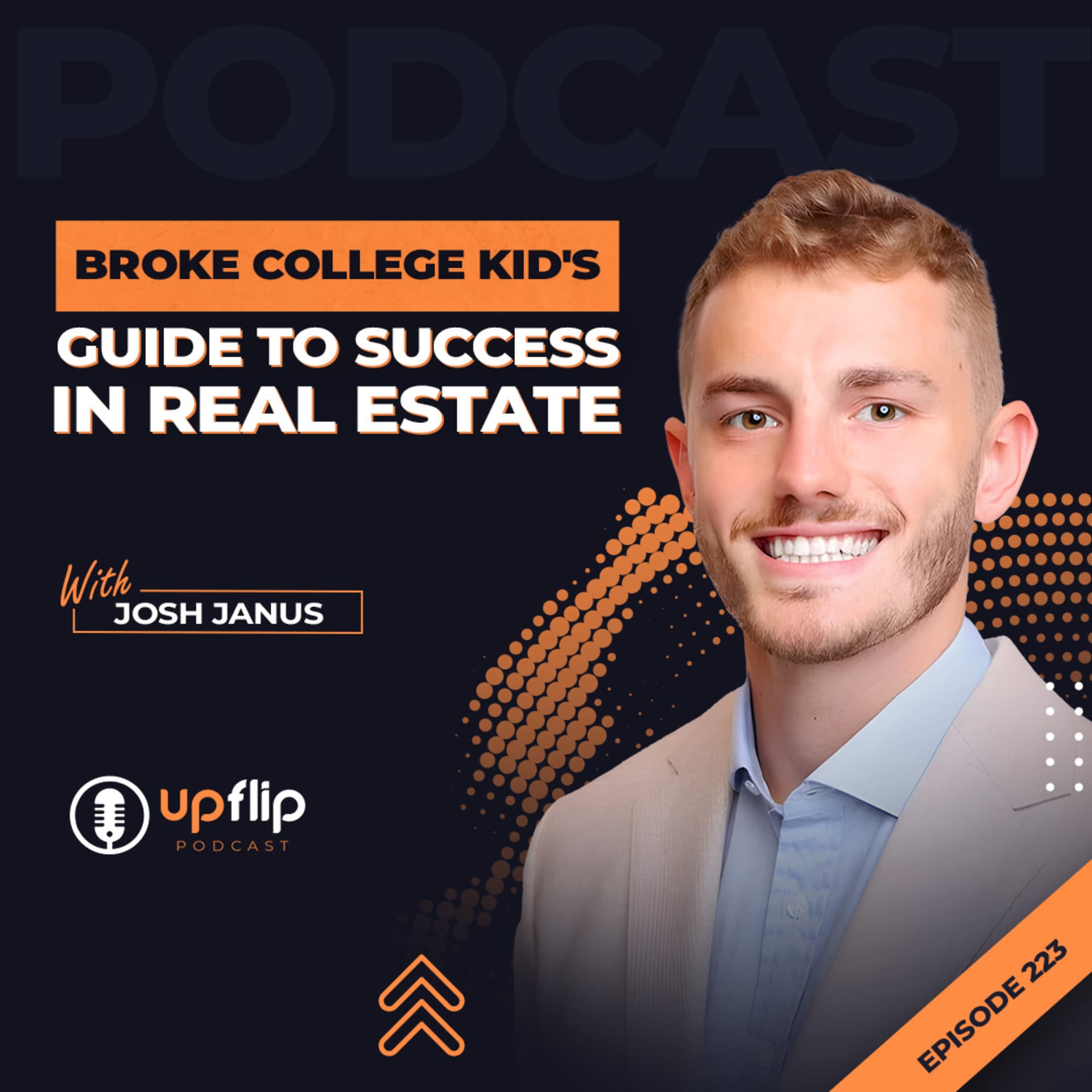
UpFlip Podcast Episode 223: How a Broke College Kid Built a Business That Scales in Real Estate
Episode Overview In this episode, host Ryan Atkinson interviews Josh Janus, who went from being a broke college student delivering DoorDash to building a $15 million real estate portfolio in just three years. Josh shares key insights on his journey, including critical strategies, lessons learned, and practical advice for aspiring real estate entrepreneurs.
Key Concepts and Takeaways
- The DoorDash Mindset
- Efficiency in Delivery: Josh learned the importance of efficiency while working as a DoorDash driver. He optimized his routes and schedules for better earnings.
- Application to Real Estate: He applied this mindset to real estate by focusing on motivated sellers and buyers, which helped him close deals effectively.
- Real Estate Entry Strategies
- Initial Motivation: Started with a goal to "house hack" by buying a duplex.
- Wholesaling: Earned his first $3,000 by selling information on a property he couldn't afford. This exemplifies the potential of starting in real estate without significant capital.
- The 3-Pillar Strategy for Real Estate Success
- Financing: Understand financing options available.
- Deal Flow: Focus on finding off-market properties through various methods (cold calling, networking).
- Network: Build relationships with other investors and professionals in the field.
- Identifying Hidden Equity
- Search Criteria: Look for properties owned for over 5 years and valued under $140k to target motivated sellers with equity.
- Cold Calling Strategy: Build rapport by asking about the seller's real estate story instead of directly asking if they want to sell.
- The BRRRR Method
- Buying, Rehabilitating, Renting, Refinancing, and Repeat: Essential for building wealth through real estate.
- Rule of Thumb: Aim for all-in costs to be 70-80% of the After Repair Value (ARV).
- Contractor Management
- Learning from Mistakes: Josh shared experiences of losing $250k due to unreliable contractors, highlighting the importance of vetting and monitoring.
- Contractor Vetting: Emphasizes the "Quality, Speed, Price" triangle—prioritize quality first when starting.
- The Notebook Rule
- Daily Audit: Write down tasks performed each day to identify what can be delegated, automated, or eliminated.
- Delegation: Critical for freeing up time and scaling the business.
- Standard Operating Procedures (SOPs)
- Creating SOPs: Write in simple, clear terms for tasks so that anyone can follow them.
- Flow Charts for Clarity: Use flow charts to help visualize processes for virtual assistants.
Learning Through Challenges
- Continuous Improvement: Josh believes in constant self-improvement and emphasizes the importance of identifying high-value tasks to focus on.
- Leadership Growth: He shared insights on managing relationships with contractors and maintaining high standards.
Episode Timestamps
- 00:00 - Intro: DoorDash to Real Estate Empire
- 01:20 - The Efficiency Mindset
- 05:45 - How to Land Your First Wholesale Deal
- 07:30 - The 3 Pillars of Real Estate Success
- 10:45 - Finding Off-Market Deals & Hidden Equity
- 12:45 - The BRRRR Method Explained
- 15:30 - Losing $250k: Contractor Horror Stories
- 17:50 - How to Vet & Manage Contractors
- 21:00 - The Notebook Rule for Delegation
- 25:10 - The Fan Blitz: Best Purchases & Rejections
Conclusion Josh Janus's journey from a college student to a successful real estate entrepreneur provides a blueprint for aspiring investors. His focus on efficiency, relationship building, and strategic thinking highlights essential skills for anyone looking to succeed in real estate.
Resources
- Learn More: [UpFlip Academy](https://www.upflip.com/course/how-to-buy-a-house)
- Connect with Josh: [Josh Janus on LinkedIn](https://www.linkedin.com/in/joshjanus)
Tags
- Real Estate
- Business Scaling
- Passive Income
- Contractor Management
---
If you enjoyed this episode, consider rating it five stars on your preferred podcast platform to help us reach more aspiring entrepreneurs like Josh!
Written by AI. May contain mistakes. Listen to the episode to check what was said.
Chapters
Tap a time to open that second in VOThe Journey from Door Dash to Real Estate
0:45 to 1:49
Josh discusses his transition from being a door dash driver to building a real estate portfolio.
“I know you're on the YouTube channel, which is awesome.”
Motivation Behind Real Estate
1:49 to 2:26
Exploring Josh's motivations for entering real estate and his initial experiences.
“I kind of want to jump to that because viewers write or listeners, whatever, right now could be listening like, okay, like I've heard of real estate.”
The Impact of Growing Up in a Small Town
2:26 to 3:26
Josh reflects on how his upbringing in a small school influenced his entrepreneurial mindset.
“You said you had like small businesses in like high school and stuff.”
Finding and Selling Real Estate Deals
3:26 to 4:24
Josh shares a story of how he found a property and made a profit through a phone call.
“Yeah, I think you have to be careful with it because it's a small population.”
Steps to Enter Real Estate
4:24 to 6:23
Josh outlines the essential steps for beginners to get started in real estate.
“And my goal is to reach everybody on the phone and figure out why they bought it, how they bought it, would they sell it?”
The BRRRR Method Explained
6:23 to 8:54
Josh explains the BRRRR method and shares insights on how to successfully apply it.
“And then I just started calling to find deals, but I didn't actually need the 40 grand.”
Learning from Mistakes in Real Estate
8:54 to 10:10
Josh discusses early mistakes in his real estate journey and how to avoid them.
“Click the link in the description below to join the Elphab Academy today and start surrounding yourself with the people and tools that can change everything for your business.”
Identifying Good Real Estate Deals
10:10 to 11:28
Josh provides strategies for finding deals with hidden equity in real estate.
“Let's define like what that core engine is.”
Navigating Contractor Challenges
14:02 to 15:10
Learn about the challenges of hiring and managing contractors in real estate.
“I gave him like four houses at once to do and it was just a nightmare.”
Effective Project Management in Real Estate
15:10 to 17:51
Explore key strategies for managing real estate projects effectively.
“So like, how do you identify like what a good contractor is?”
Show all 14 chapters
Building Partnerships with Contractors
17:51 to 19:57
Understand the importance of partnerships and respect in contractor relationships.
“I love the train track piece because like it's an interesting place to be as someone like who runs their own business is like, of course, you have to manage like everybody.”
The Importance of Delegation
19:57 to 23:09
Discover how delegation can enhance efficiency and business growth.
“Can you like pay like a month upfront salary?”
Continuous Improvement for Entrepreneurs
23:09 to 24:12
Learn how small daily improvements can lead to significant success.
“So some procedures are like 40 pages long, and then I'll record a video for the more complicated things going through it and explaining it.”
Fan Blitz Questions with Josh
24:12 to 26:36
Engage with rapid-fire questions to gain insights into Josh's experiences.
“But Josh, ready for our five fan blitz questions?”
Transcript
Automatic transcript. May contain errors.0:00Imagine this, you're 21 years old, you're a broke college kid and working as a door dash driver just to make rent. Your daily ambition is figuring out how to deliver burgers 1 % faster to maximize tips. Fast forward three years, you've taken that obsession with efficiency and applied it to real estate, building a$15 million portfolio with hundreds of units. I'm Ryan Atkinson, and you're listening to Helpful Podcast, where we uncover the secrets of building and running successful businesses. And today we're learning how to build a real estate empire without using any of your own cash. And Josh Janis is here to break down the Burr method, the notebook rule that fuels his growth and how anyone can replicate his success.
0:41Joss, thank you so, so much for being here. So, so excited to have you on. Thanks for having me. I know you're on the YouTube channel, which is awesome. So I'm going to encourage the viewers to go check that out as well after this podcast. But I want to start with your mentality. I alluded to in the intro here because you got obsessed with like time and money while door dashing. Like how did that mindset like help build what you're building now? For sure. When I was door dashing, I figured out pretty quickly that anyone would that if you drive less miles and you deliver bigger orders, in combination, you can make more money per hour.
1:13That's really what it is. And then you pay attention to areas that are busy during certain hours and areas that aren't in the other. And you just build your schedule around that. and immediately when I was getting into real estate, I tried to use that same mindset. So what I would say is I would try to only work with sellers or buyers that I thought were going to actually make a move and actually get a deal done, whether they were motivated. And as I accumulated more data and did more deals, I was able to understand different characteristics of buyers and sellers that would actually complete a transaction, which helps my realtor business grow in the beginning.
1:48Why real estate? I kind of want to jump to that because viewers write or listeners, whatever, right now could be listening like, okay, like I've heard of real estate. I don't know if I really want to do it. I know there's opportunity there for you. Like, what was the motivation to get into real estate and what should listeners know if they're also interested in getting into real estate? Definitely. I wanted a house hack. So I did a bunch of small businesses in high school and a little bit in early college and I had money saved up. So I wanted to buy a duplex, let me one unit, rent out the other.
2:16And through beginning that process, I saw how real estate could change your life if you were good at it and you put your mind to it. So I found people that were doing it well. And I just tried to do exactly what they were doing. You said you had like small businesses in like high school and stuff. And like, obviously this interested you was like your parents entrepreneurial. Like where does like this mindset like come from to like start your own thing, like do your own thing. I'd love to hear that. I don't think it came from my parents. They were never married. They get along. I live two miles away from each other.
2:44So, you know, it was a friendly situation, but as a only child in a scenario like that, you're forced to be an individual in many cases and force yourself to do things like that. So I always felt like I was outside of the box, right? Like I went to really small school and everybody had parents that were married, maybe one person that somebody that was divorced, but I was immediately outside of the normal box that way. And I kind of just leaned into that. It was kind of fun. Do you think growing up in like a small school, like impacted you to like want to like do entrepreneurship. I'm asking this because I grew up in a town of like 7000 or so my graduating class was like 53.
3:18So it was like super, super small. I think like there's like a little fun like edge of like being in like a small class like wanting to do well. I'm curious to like that's part of like your mindset as well. Yeah, I think you have to be careful with it because it's a small population. So if you get stuck with the wrong people, that's all that you have. I had, you know, good people around me. So I kind of enjoyed it. Like I was good at basketball as a kid. So I was like the king of sports and someone else was good at this other thing. Right. So the competitiveness kicks in right away when it's, when it's smaller, I think.
3:51Yeah, no, I definitely agree with that. It gives you more of an opportunity from a younger age to like be a captain of a basketball team or like a football team. I do want to stick with real estate here, but a story that I love is like, you found a$500 ,000 property. Like you couldn't afford essentially. I mean, decide to sell the deal information and you earned a$3 ,000 fee for just like one phone call. What is like the fastest way beginner with no money can execute like a successful like wholesale deal and like kind of tell us that story a little bit more. Yeah, I was living in an area called Grandview Heights in Columbus.
4:22I pulled a list of everybody that owned two to four unit buildings in the area. It was only a few hundred. And my goal is to reach everybody on the phone and figure out why they bought it, how they bought it, would they sell it? Do they want more? What's the real estate story? And I lived right there. So I knew the area. So somebody is listening and wants to start, like start where you're standing or start close to you, an area you're comfortable with and try to build rapport and relationships with the people. Don't just be like, do you want to sell? Develop something there and lean on the fact that you can relate to them in many ways because you're in the same area.
4:54You can develop that comfortability pretty quickly. If someone's listening and again, they are interested in like the real estate portion of it, but obviously real estate has so many like different like ways you can like get started for you. Like what did you know now? Like what is the easiest way to get started? And then like real estate, I'm curious myself as well, because I want to get into real estate someday, but like it's so daunting. Like I don't know like where what I don't know. I don't know what to get started, but like what would be the most simple like way that someone could get into real estate?
5:20I kind of think of it in three pillars like financing. If you already have a bunch of money, great. You just go buy a bunch of turnkey deals and you make money. Number two is kind of like deal flow which is what i was talking about in terms of immediately start trying to find off market properties through cold calling texting emailing there's tons of meetups places on like facebook meetup.com in your area and most major areas there's tons of them you can beat investors and sellers and then the third pillar would kind of be like building the network which is similar to the other one but if you've learned how to fix houses in the past your uncle or somebody has experience, you know, that network that you can build can be useful for somebody who has number one and number two, you could bring number three in for the partnership.
6:05Hey, you bring the money, you found the deal, I'll manage the job, I'll do the construction, might not be a 50-50 split in that scenario, but that's a pretty quick way to get your foot in the door. Which one like did you start out with? Tell us more like that. Yeah, mine was a combination of one and two. I had like 40 grand saved up from eight years of doing small stuff as a kid. And then I just started calling to find deals, but I didn't actually need the 40 grand. I never spent it. That was just reserves that I had in case something went wrong. I just stacked the money on top of that, that I made from marketing.
6:38So finding deals takes, you know, a good three months, two months or longer of just consistent grinding, getting yourself in the groove and understanding how to execute and building those relationships because you're never going to close somebody in your first call. It's going going to take five, six, seven, 10 calls. But if you build out a pipeline, that's how you, you know, you call a hundred people in this month that are somewhat, you know, reasonably motivated. 10 of them will sell in two months. Another 20 will sell in six months. The whole thing starts snowballing when you stay consistent with it.
7:09I know you just said like, how do you actually find deals? It takes a while to do that. Like what you know now for beginner getting started, like finding deals, like speed it up for them. Like how, how, how do they find like good deals? Like, what are you looking at? Go to an area where there's some distressed homes. Not everything's distressed because no one wants to buy it. And not everything fully renovated because there's no opportunities. And just maybe go on like the auditor website or there's tons of websites like propstream.com where you can pull properties where it's somebody's owned the building for five years and they had at least 30 % equity in it from the average sale price.
7:44An example would be if single families are selling for 200K, if they're three-bed, one-bath, you want to pull a list of everybody that's owned it for five years that paid about 140 or less. This way, if you buy it or sell it, they're going to make money because they have equity versus talking to owners that paid 190 or they just bought over 200. That's interesting. And so then are you like cold calling these people saying like, hey, are you interested in like actually like selling or like where does like the cold calling like aspect like go into this on something like that? Yeah, the typical thing is, hey, hey, are you the owner of Voyager 3 Main Street?
8:19Would you consider selling? I do some of that, but when I'm skip tracing and I notice that people own more than a handful of houses, I take a different approach. In the beginning, I was like, hey, I'm Josh. There's a random call. I'm in college. I'm interested in real estate. I figured out you own this house and these three. I'm just curious. How did you get there? If somebody's driving home from work or whatever they're doing, it throws them off completely because we're used to people just saying how much for your house. And I kind of take a step back and build the relationship portion first.
8:50It's a much longer term strategy, but it can really pay off. Are you ready to launch, grow, and scale a business? Inside the Uplip Academy, you'll get a complete roadmap to shortcut your success with 25 plus step-by-step programs taught by active business owners, not gurus, who share their step-by-step blueprints, plus ongoing live workshops, skills training, a business idea database, and community to share resources and celebrate your wins. Click the link in the description below to join the Elphab Academy today and start surrounding yourself with the people and tools that can change everything for your business.
9:27What I love about that is that you leaned into like being a college kid. I remember when I was just like getting started with like podcasting in college, every time I'd reach out to someone that had no business talking to me, I would be like, hey, I'm a college student. Like, will you help on this podcast? I feel like the success rate of that like goes like so much more higher because like you're leaning into that. Yeah. Like even when investors reach out to me now, like I'm an experience. If somebody says, hey, I'm brand new, I want to learn. That's such a better framework to present yourself versus like, I know a little bit, but I have this big ego and like I have all these expectations.
9:59So it's like if you go in there, you give the person attention, you want to learn from them, it could pay off. What I do want to pay attention to you with your story is the Burr engine, find financing and scaling. Let's define like what that core engine is. What is like actually Burr stand for? Some people might be familiar, some might not be. Can you explain like what those five letters mean? Like a super high level here, people can do their own research if they need to dig into more, but high level Weber means. Yeah, basically buying a house, putting money into it. So it's now at the standard of what, you know, the 90th to 100th percentile of homes are selling the area for.
10:32And then instead of selling it, you just refinance, pay off your old loan, and now you rent it out. The strategy works if you're all in, meaning your price plus rehab is about 70 to 80 % of what it's worth when it's done. So if it's worth 100K when it's done, you pay 50. You don't really want to put more than 30 grand into it. This way you have some profit. I mean, that's like the dead simple way to do that. Let's talk about like when you were just first doing the BRRRR method, what were like some mistakes that you made? I'm going to do that. I want to ask this question just for, again, like entrepreneurs that are interested in real estate, they might not know everything.
11:07So let's have Josh kind of fill some mistakes that he made that other people don't have to make. Yeah. The first deal I bought was a duplex for 80 grand. It wasn't livable and it wasn't a great area. And my quote from my contractor was like 35, 40 ,000. And it was going to be worth about 160 ish when it was done. And some of the mistakes I made was I didn't understand construction costs in the beginning. I just relied on this person immediately. I didn't realize that the roof was old. I didn't realize that the attic, the third floor of the house had live electrical wires running on top of the wood frame and the whole thing should have burnt down.
11:39For some reason it didn't. Those little things that are big things that you don't necessarily pay attention to when you're sitting at your desk, cold calling, just running numbers. You have to pay attention like, hey, I'm running numbers, but this is actually a house and there's like 500 components on it. And you start with the most expensive items and you work your way down you know pay touch to siding driveway roof windows and then that's what i also want to ask about it like more of like finding like the actual deals for like something like that where you like you can identify a good opportunity and be like okay like i know i can make like a profit out of that what is like the single best resource or method for finding deals that have like kind of like hidden equity and is it straight cold calling is it cold email is it walking and knocking on someone's house like what's the best way to actually like sourced these once you do identify them.
12:28I'll tell you today I buy like a hundred deals a year, right? So I have good data and I've been doing it for a couple of years. My deals don't come from the same place. They're extremely spread out. So some of them call calling slash cold texting slash emailing. Some of them from reaching out to other realtors in the area, right? That are selling older homes or they have a network of sellers they've worked with in the past. Another one's just wholesalers going on Facebook groups, bigger pockets, whatever the case may be. And another one is going to be expanding the network you currently built.
12:59So if you buy a deal from somebody, figure out who they know and execute your contracts correctly, do what you say you're going to do, and they might be able to bring you more opportunities. Interesting. It sounds like a lot of like real estate, as with every business, like it does come down to like networking to have like a good network. That does sound like it could be a vertical for like actually being able to source these deals. Definitely. Yep. I try to improve everything a little bit across the board all the time. So we've talked about like finding deals. We've talked a little bit about the BRRRR method as well, but obviously an important part of a lot of this is like the rehab portion of it and like building up the houses or whatnot.
13:33One of the biggest hurdles you faced early on was losing like a quarter of a million dollars due to like unreliable like contractors here. Can you walk us through like that period? What was like that most expensive lesson that like you had to learn that forced you to change? Yeah, at this point, I didn't really understand in prices. I didn't understand full scopes of work. I had bought some deals and they got refinanced and I threw some tenants in there and it was kind of going well. I was doing one to two deals at a time and I bought like five houses at once. The guy that did two jobs, now I know he did them terribly.
14:05They just looked okay from pictures. I gave him like four houses at once to do and it was just a nightmare. Mechanicals got stolen, fake pictures of flooring, a third of the flooring would be done. So we take a picture of like the corner of the house. So I would send them more money. You name it, it happened. There are some not good substances being taken by some of the crews that cause things to derail. The issues with some contractors is they're not really business people. Some of them are. This isn't a broad brush, but you might run into someone who's a contractor because they can't hold a job.
14:37So they work when they want. And if you give them a boat load of money and try to build a job around them, it's probably not going to go well. So you got to be slow. That's what I had to learn. Go slow and pay attention. That's interesting. So how do you identify good contractors now or good people to work with? And what's so funny about this is I'm thinking about my stepdad's business. He owns a flooring company up in Minnesota, and he only works with contractors. And some of the stories he has with contractors is a complete nightmare. Some of these people are just similar to what you were saying on that.
15:09That's what I'll leave it at. They're not good people. They're not great workers. So like, how do you identify like what a good contractor is? Because hiring is one of the most important things in any business. Yeah, there's three pillars, right? There's speed, quality and price. And I think in the beginning, you should go for quality first, speed next. And then with volume, you can work on the price. Because if I'm giving somebody four furnaces a year, 4000 bucks, but then the next year, I'm like, hey, man, I'll give you 20 furnaces this year, we can reduce it to 3200. What do think he's going to say?
15:38He's probably going to take it. And then with the ability to scale, you could reduce the price because they'll be making more money still, even with the reduced price. And some really niche pocket ways to actually find them is look at who's pulling permits in your city. Go to Home Depot or Lowe's at six in the morning, seven in the morning. Who's buying materials that early? Who's getting after it? Look at flipped homes on the MLS. Look at the owner. They're doing a bunch of volume. Look at a project they just bought. go to the job site i found my roofer at a job site i just walked up i walked down a street and i was like yo how's it going man he's done all of my roofs since then wait that's incredible it's fine yeah so do you now only use contractors you have like an in-person like team i have a couple gc's and then right now i'm my own project manager i kind of have one but we're both doing the job but it's like 50 60 people so i've scaled it okay yeah that's what i wanted to ask is um as well.
16:34And you said your project managing it, like what goes into like the project management like a project like this? I know this is a huge question. There's so many different like variables, but like if someone's going to sign up for real estate for like the BRRRR method, like build this out, like they need to have expectations on like what they're actually going to be doing from a project management perspective. You can hire it out, but what do you guys do? You know, when you're doing one, two jobs at a time, right? Like you're fully in it and it's pretty self-explanatory your risks of what that is.
17:00And then when you scale it at five, 10 or more at once, it's like liquidity management, right? Like I'm spending well over a hundred grand a week. So it's like, I have to have that money. Where's it coming from? I got to have it every single week forever. So making sure the ingo and outgo of cash, that's one, two is just quality control. So every job tends to have, you know, two to six draws in place. And I need to make sure that every draw all the work's done correctly. The expectation has been met. I can pay them on Friday. We can move on to the next week. And the number three, it's just when you get this train going, it's a moving train and you have to keep putting tracks on it.
17:38So tracks are future deals. So I have to keep finding 10 deals a month or whatever to feed these guys or else they're going to come banging at my door looking for work. And I've already built up all the leverage and the relationships. You don't want to lose that. That's your business. I love the train track piece because like it's an interesting place to be as someone like who runs their own business is like, of course, you have to manage like everybody. But like, you also have to be thinking about like the future. And like, how do you like, keep the train rolling on the train tracks here? For you?
18:05Like, how have you developed as a leader over however many years? And like, what have you like, really seen as you just like reflect on that? I think entrepreneurship, the personal development you will go on is just like incredible. Like, I think it's just like so much fun. But I'm curious for like you, Josh, like, what have you seen from yourself? I'm very difficult to myself. And I'm sometimes as a perfectionist in a way, personally. And then I would hold no standards for people that I would hire or work with me. And as a result, I kept getting burnt and getting stepped over. So I've learned to toe the line to hold standards.
18:35That's been something that has been a challenge for me is especially I have good friendships with these people. We've been working together for years. And like an example would be today, like the bid for this house included appliances and he was telling me it didn't. And I just wanted to say, whatever. I'll just pay out of pocket. It's$2 ,500, not the end of the world. at this scale. But I was like, nope, I have to hold my toe to the line because I don't want this to happen every time in the future. And that was uncomfortable, but it was a decision I had to make. When something goes bad, a leader needs to be able to say, no, that is not the standard.
19:04And that needs to be bad. I mean, you're probably like, when I think of a general contractor, like contractors in general, these people are probably much older than you, Josh, much older than me as well. We're probably the same age. I mean, have you had to earn the respect or is it just like, yeah, I'd be curious there. That's an interesting dynamic. Mike. Well, another thing is this is basically a remote job for me. Yes, they're all 20, 30 minutes away from my house, but like I'm still an active realtor, not as much anymore. But I was so focused on that that I didn't really go to the houses very much.
19:32And as a result, I didn't see how much built up leverage I had as an owner. I just saw myself wiring money and just sitting here and praying that things were going to happen. And like, as I got out there and went to more job sites and talked and had more face to face conversations, I realized like these people depend on me and we have a true partnership and that kind of helped that part grow yeah for sure i feel like it is like you don't realize how much like power you have as a business owner until like it hits you one day like holy smokes i have a lot of power to just kind of like decide what happens but like as you said like it is a partnership like they depend on you that's why i think like the pressure of entrepreneurship is like it's so great because generally like these people like rely on you for like their paychecks and stuff and i just had an employee come to me asking like Like, hey, like my dad's having surgery.
20:14Can you like pay like a month upfront salary? I'm like, well, I guess we can. So I don't know. It's just like super interesting. But like earning the respect to people is like, you have to be able to do that as a leader at some point. You do. Most of the people didn't know how old I was either. I kind of hit it. And then I would show up at jobs and they're like, you're Josh. Like, are you sure you're Josh? I thought Josh was like a 50 year old man. No, but if you do what you say you're going to do, there's a lot of investors out there that take advantage of contractors. They don't pay on time.
20:42they change scopes of work, they do a bunch of stuff. So like if you are who you say you are, you consistently show up like a lot of them are blue collar workers, like they love that they've derived on consistency. And somebody that's like there for them, like dig into that. Yeah, I like that. That's really good. I want to talk about one like habit, I guess you have or like the method you have because this is called the notebook method where you write down every task and then you will delegate, delegate, delegate, automate it, eliminate it talks about the importance of that and like delegation as a business owner and why it's like so important, especially when you're dealing with so much going on?
21:14For sure. So I'll start today. Like my day doing 20 jobs at once to 30 jobs at once is not that much different than when I was doing two to four. And that kind of sounds nuts, but that's really because of delegation. So I have like a notebook in front of me. I write down everything I do in a day. In the beginning, it would be like 200 items. It's like little stuff. I sent an email for this. I called this person for this. And at the end of the day, I'd look at it and figure out, is this thing making me money? Can I do this once a week, once a month? Do I have to do it? Can I have a virtual assistant to it?
21:46Can I automate it in some other process? I try to get it away from my time, right? And by constantly doing that, you build up leverage with the team around you and your systems and processes. And eventually your day is much more limited in terms of like keeping your business alive. Most of your day actually becomes trying to grow the business or dealing with issues. What was the biggest thing that you had to delegate that was like a time suck for you? I would love to hear that. The biggest time suck is writing offers. So writing an offer takes like 30 minutes or longer or 15 minutes if you're quick.
Read the full transcript
22:21And I'm writing multiple client offers a day and multiple personal offers a day. I mean, sometimes it's 50 offers a week. I delegate this very quickly in my business, but the power of explaining it is there is I wrote a procedure that took an hour for my virtual assistant to do. And now they've written every offer since then. I review them because I have to as a real estate agent and my own offers, but it takes two minutes to review or less versus 15 to 30 to write them. That is the power of love. You're in that is a phenomenal example. That is really, really good. When you're doing these SOPs, a little bit more of a technical question here.
22:55Are you just hopping on a Zoom and recording or how did you do it? Because I'm personally writing SOPs for my own company. I'm just hopping on Zoom and recording. It's definitely not the best way to do it. So how are you doing it? I try to just write it out so that a third grader could understand it in steps. So some procedures are like 40 pages long, and then I'll record a video for the more complicated things going through it and explaining it. And then basically I take those processes and create flow charts. That's been pretty helpful for the VAs to follow. Last question before we get into fan blitz here, a lot of your success is about like continuous improvement, just getting like 1 % better every day.
23:29The James Clear quote comes to mind. If you get 1 % better every day, it's like 36 % better, like over a year. If you had to distill that philosophy down to like one sentence for the aspiring entrepreneur stuck in like their nine to five, like, what would it be? Like, how do people get 1 % better? Identify the tasks you're doing every day, put a dollar amount to what it's creating or preventing loss, and just focus on the things that are the most effective. So an example of my business would be, if I call a seller that I've closed three houses with, and we're talking about a fourth one, that's so worth my time.
24:01That's going to be a quick phone call. We're going to get the deal done versus writing an email explaining how much does a water bill cost on a duplex. Let's go into our fan blitz questions here. So listeners, you want to join in on world-class conversations with people like Josh and the other entrepreneurs we have on here, write to us at podcast at upflip.com and get your questions there for future episodes of something that you want to hear on here. But Josh, ready for our five fan blitz questions? Let's do it. Going back to your early days, what's the weirdest or craziest door dash delivery you've made?
24:33I delivered$400 of catering food an hour and a half, I believe straight east from Columbus straight. So it's a ton of miles and there was no tip of the app. And I got there and they didn't tip me in person either. And I set it on their table and I had to drive all the way back. No, that's awful. I'm sorry to hear that. What was the worst rejection you've ever gotten from a cold call? This was someone in my office just because it's hilarious, I'll say it. They cold called a duplex, like two miles away from the building. And the guy said, I'm going to come to the office and do something bad. Oh God.
25:07What was the first ridiculous, like I made a purchase you bought for yourself? A G wagon. Nice. That's a fun purchase though. Iris, that's a great purchase. Similar thread. What's the best purchase you made under a hundred dollars and why? Notebook. What's the best no you've ever gotten that led to a great opportunity? this seller in Cleveland named James that has 50 houses he wants to sell. And I was going to buy all of them and got tons of no's and we're punching through them about a third of the way through. Wow. Let's go. Good for you. Well, Josh, thank you so, so much for hopping on the podcast today.
25:40I know you're on the YouTube channel. So now that this episode is done, listeners, go check out the YouTube channel. But if someone's like, oh my gosh, I need to learn more about Josh, connect with them. Where can they do so at? BiggerPockets, Josh Janis, or my Instagram, Josh Janis, DM me, I'll answer. Three quick takeaways with Josh. Number one, And small obsessions compound into massive business success. Josh embraced efficiency and obsessed over efficiency, which led him to evaluate the real estate market. And that led him to where he is today. Number two, real estate growth is built on relationships, consistency, and long-term pipelines.
26:10Josh has built some incredible relationships through the year. We talked about the pipeline and like managing pipeline, really important part of this business as well. And then three, what I love about this is delegation. Josh gave some great examples of like delegating. He gave us that example at the end with like contracts, writing contracts, and how you need to delegate stuff that does not add to the business. Great episode here with Josh. If you guys are enjoying this podcast, please give us a five-star rating wherever you get to your podcast. Helps us get more amazing entrepreneurs like Josh onto the show.
26:36We'll see you next week. Thank you so much for your time today, Josh. Thanks, Ryan.
From the publisher
Imagine being a broke college student delivering DoorDash orders just to pay rent. Now, imagine taking that same obsession with efficiency—shaving seconds off delivery times—and applying it to real estate. That is exactly how Josh Janus built a $15 million portfolio with hundreds of units in just three years.
In this episode of UpFlip, Josh breaks down how he went from a $3,000 wholesale fee to managing 50+ rehab projects at once. He reveals the "Notebook Rule" that allowed him to scale, the hard lessons learned from losing $250k to bad contractors, and the exact criteria he uses to find off-market deals that no one else is looking for.
In this episode, you’ll learn:
The DoorDash Mindset: How optimizing burger deliveries for tips taught Josh to identify the most motivated sellers in real estate.
The 3-Pillar Strategy: The simplified framework (Financing, Deal Flow, Network) for starting in real estate with $0.
Wholesaling 101: How Josh made his first $3,000 by selling information on a property he couldn't afford to buy.
Finding "Hidden Equity": The specific search criteria (5+ years ownership, <$140k purchase price) Josh uses to find profitable off-market leads.
The Cold Call Shift: Why asking "What’s your real estate story?" works better than "Do you want to sell?"
The BRRRR Method: Josh’s rule of thumb for buying, rehabbing, and refinancing (aiming for 70-80% of ARV).
Contractor Nightmares: How he lost $250k to drug-using contractors and the red flags you must avoid.
Vetting Contractors: The "Quality, Speed, Price" triangle—and why you should never prioritize price in the beginning.
The Notebook Rule: A daily audit habit that forces you to delegate, automate, or eliminate tasks to free up your time.
SOPs for Scale: How to write a "3rd Grade Level" Standard Operating Procedure to automate tasks like writing offers.
Timestamps:(00:00) Intro: DoorDash to Real Estate Empire(01:20) The Efficiency Mindset(05:45) How to Land Your First Wholesale Deal(07:30) The 3 Pillars of Real Estate Success(10:45) Finding Off-Market Deals & "Hidden Equity"(12:45) The BRRRR Method Explained(15:30) Losing $250k: Contractor Horror Stories(17:50) How to Vet & Manage Contractors(21:00) The "Notebook Rule" for Delegation(25:10) The Fan Blitz: Best Purchases & Rejections
Tags: Real estate, Retail Goods, Property management, Business scaling, Passive income, Refinancing, Side hustle
Resources
Grow your real estate business today:
https://www.upflip.com/course/how-to-buy-a-house
Connect with Josh: https://www.linkedin.com/in/joshjanus


