
In short
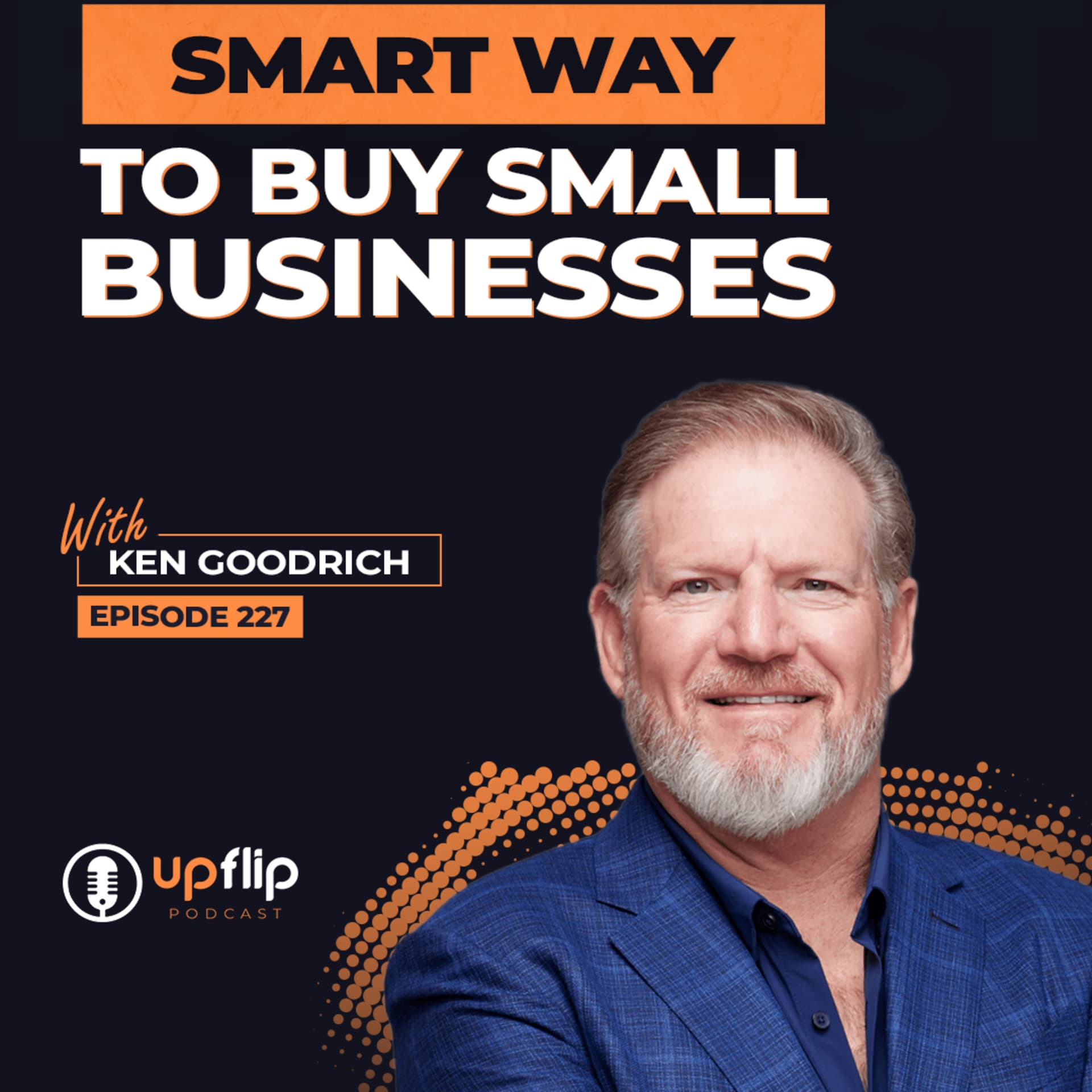
The UpFlip Podcast Episode 227: How to Buy Small Businesses the Smart Way
Episode Summary In this episode of The UpFlip Podcast, host Ryan Atkinson interviews Ken Goodrich, an accomplished entrepreneur who has bought and sold over 250 companies, including a notable high nine-figure exit. Goodrich shares his journey from purchasing his father’s struggling HVAC business to developing a successful strategy for acquiring small businesses, particularly those affected by the "Silver Tsunami" — the retirement of baby boomers.
Key Concepts and Discussions
Ken Goodrich's Background
- Early Experience: Started in HVAC as a child, assisting his father.
- First Acquisition: Bought his father’s business posthumously, faced immediate challenges including lost employees and IRS issues.
- Learning Business: Initially lacked business knowledge; turned to Michael E. Gerber's "The E-Myth" for guidance.
The "Silver Tsunami"
- Definition: A phenomenon where many small businesses are owned by retiring baby boomers who lack successors.
- Opportunity: These businesses often have established brand equity and customer bases, presenting a unique acquisition opportunity.
Types of Businesses to Target
- Boring, Service-Based Companies: Focus on trades like HVAC, plumbing, and electrical services which are stable and have recurring revenue models.
- Avoid Flashy Startups: The real money, according to Goodrich, is in “boring” businesses rather than trendy tech startups.
Evaluation and Acquisition Strategy
- Initial Evaluation:
- Assess the company’s historical customer base; halve it to account for attrition post-sale.
- Look for companies priced accurately or above market; underpriced businesses attract budget-conscious customers and may struggle post-acquisition.
- Mathematical Formula: Evaluate potential revenues by applying proper pricing strategies to half of the existing customer calls.
The Importance of Planning
- 1,000-Day Plan:
- A structured approach that includes a budget and a schedule for growth.
- Essential during transitions to ensure smooth operations and profitability.
Post-Acquisition Strategy
- Initial Changes: Often implement changes quickly with a new team rather than inheriting existing staff to ensure the right culture and skills.
- Key Metrics: Focus on cash flow, revenue, and customer retention during the first 30 days to track performance against the established plan.
Key Takeaways
- Brand Equity and Pricing: When evaluating a business, prioritize those with strong brand history and appropriate pricing. Avoid those drastically underpriced.
- Customer Retention: Expect to lose approximately half of the customers after acquisition; plan accordingly.
- Phone Number Strategy: Acquiring dormant phone numbers from closed businesses can quickly generate leads and revenue.
Resources
- Connect with Ken Goodrich: [LinkedIn](https://www.linkedin.com/in/kenneth-d-goodrich-ba580427)
- UpFlip Academy: An entrepreneurial platform offering courses and community support ([UpFlip Academy](https://links.upflip.com/the-business-startup-and-growth-blueprint-podcast)).
Conclusion Ken Goodrich shares invaluable insights on buying small businesses strategically, highlighting a practical approach to overcoming challenges and capitalizing on opportunities in the market. By focusing on established service-based businesses and leveraging planning tools, entrepreneurs can successfully navigate the complexities of business acquisitions.
Written by AI. May contain mistakes. Listen to the episode to check what was said.
Chapters
Tap a time to open that second in VOKen's Journey from Struggles to Success
0:45 to 3:30
Ken shares his personal story of how he acquired and turned around his father's HVAC business.
“I'm Ryan Atkinson and you're listening to the podcast where we uncover the secrets of building and running successful businesses.”
Defining Boring Businesses for Acquisition
3:30 to 5:50
Ken explains what qualifies as a 'boring business' and why they are valuable.
“And we're going to talk more about that starting, especially buying and selling businesses here.”
Identifying Attractive Trade Services
5:50 to 7:50
Discussion on which trade services are attractive for acquisition and why.
“I heard the HVAC, but what are some other like trade services people like should be considering just to help them filter in and out?”
Understanding the Silver Tsunami
7:50 to 9:30
Ken introduces the concept of the 'silver tsunami' and its impact on small business opportunities.
“you know, you start day one and you have revenue coming in and then you can start tweaking and improving the business.”
Key Metrics for Evaluating Business Acquisition
9:50 to 14:00
Ken discusses critical metrics and strategies for assessing potential business acquisitions.
“And usually cheap means not a lot of profit.”
Understanding Revenue Assessment in Business Purchases
14:00 to 15:48
Learn how to evaluate revenue profiles by adjusting customer calls and pricing methodologies.
“That is like expert level type of stuff right there.”
Identifying Target Companies for First-Time Buyers
15:49 to 20:39
Discover the price ranges and profit expectations for first-time business buyers.
“Now that said, let me tell you this quick story.”
Post-Acquisition Strategies and the Importance of Metrics
20:40 to 27:34
Learn about initial actions and metrics to monitor after acquiring a business.
“You know, they were a sleepy old business and they had their routines and, and they just didn't want to grow.”
The Thousand Day Plan for Business Growth
27:35 to 28:01
Understand how to create and implement a strategic plan for exponential business growth.
“If someone's like, oh my gosh, I need to learn more about Ken and connect with you.”
Key Considerations When Buying a Business
28:01 to 28:19
Learn essential factors to evaluate when acquiring a small business.
“You want to find something that's at market or above market, just so you have a strong customer base.”
Transcript
Automatic transcript. May contain errors.0:00Ken Goodrich:When Ken Goodrich was 10 years old, he wasn't playing video games at night. No, he was standing in the dark, holding a flashlight for his dad in HVAC tech, while his father fixed broken systems for people who needed help right now. Years later, after his father passed away, Ken bought that same business. One van, two employees, no playbook. Then the IRS showed up. They seized everything, froze every account, 30 employees quit overnight. Ken was left with$3 ,000, two employees, and a decision. Quit or learn how business actually works. Today, Ken has bought and sold over 200 companies, turned bankrupt businesses into market leaders, exited one for high nine figures, and now spends his time doing one thing better than almost anyone alive, buying boring businesses and turning them into cash machines.
0:46Ken Goodrich:I'm Ryan Atkinson and you're listening to the podcast where we uncover the secrets of building and running successful businesses. I am so excited to welcome Ken Goodrich to the podcast. He's got such a great background. It's a topic that a lot of our audience loves. So Ken, thank you so much for being here. So excited for today. Hey, really appreciate you having me on, Ryan. I'm very excited about sharing my story. Yeah, it's going to be so good. And for someone that's like tuning in for the first time saying, all right, who is this Ken? You're a great intro. It sounds like a great background.
1:11Ken Goodrich:Give us a quick background of who you are just so the listener can connect with you. Well, I think you hit the nail on the head with my basic background. You know, I started as a kid holding a flashlight for my dad, working on an air conditioner. And over the years, I certainly learned the trade. I was good at it. By the time I was 16, I was running service calls when I got my driver's license and things like that. And then my, unfortunately, my dad fell ill when I was 25. And so I did my first acquisition and I acquired my dad's business from my mom, which was really me in a van. I was, was devoted to it.
1:45And she answered the phone and she did the books. And, you know, and I started off trying to grow my business. And I knew the trade very well. I was very good at the trade and I could sell the work, but I didn't know the business of the business. So my dad was not very interested in hiring employees, but I had a different vision. I wanted to be an entrepreneur and get out of the service truck and such. So I started hiring people and selling more work and getting more projects. And it didn't take long, maybe a year and a half before I really hit the wall. And I figured out I've got myself a big hole dug and I don't know where to go.
2:21So you touched on the IRS and the 30 employees quitting and such.
2:26Ken Goodrich:And I started over these two guys and they weren't the pick of the litter by any chance. I had to get what I got. And so I worked my way out of the trouble every single day, going out, selling jobs, getting them put in. And then I had found this book called The E-Myth. The E-Myth Revisited by Michael E. Gerber. and it's a staple business book. I think actually he's the number one bestselling business author of all times. And so I got this book and what attracted me to it was, it said, The E-Myth, Why Most Small Businesses Don't Work and What to Do About It. I said, well, this really speaks to me.
3:04And so I get the book and I start reading it. I'm like, wow, this guy must have followed me around, watched me in the bushes because he knew every stupid thing I was doing. And so I took the book. This was before the internet and I applied as principles and I built my business system. And then I went off to the races and I started acquiring struggling and broke companies because they were cheap and I started growing them.
3:28Ken Goodrich:And that was my start. So, so good. And we're going to talk more about that starting, especially buying and selling businesses here. So that is so good. So over 250, you've also have done like a high nine figure exit, which is incredible. I got to ask you, is there one that you are more proud of? Is it the 250 businesses you bought and acquired or the high nine figure X's? Well, you know, the nine figure wasn't bad. That wasn't a bad day. But I've actually built and sold six of these companies. And so the acquisition of these 250, you know, were the culmination of me buying small mom and pop businesses and putting those customer bases together and some of the people to build these six exits.
4:09And now I'm number seven, where I'm rolling up the standby power business generators in throughout Hurricane Alley.
4:17Ken Goodrich:So let's talk about how someone can do something similar. If they're like, holy smokes, this guy sounds awesome. And he obviously has the experience. I'm ready to listen. Let's give him something they want to listen to. Let's first define a boring business. What types of businesses should listeners be on the lookout for if they're looking to acquire businesses and which one should they be ignoring? Well, look, all the money is in the boring kind of dirty businesses, I would say, right? The trades businesses are very valued, mostly the trade services like HVAC, like plumbing, like electrical, like gutter service, like, you know, those sorts of service kind of based businesses are very durable.
4:56Ken Goodrich:They grow every year, expanding customer base. And the best thing about it is private equity has got their eye on it now, maybe over the last 15 years, and they've really been buying them up. So you have a great exit opportunity. As a matter of fact, I exited, like I said, six different times in my career in big exits. But the last one with our business, we drove over a 20 multiple of earnings. Oh, wow. And it's just because the fervor of home services for the PE has, because they look at it as kind of a reoccurring revenue model. They look at it as unsophisticated operators, low use of technology, low use of sophisticated business practices, this and that, these kind of things where they could make a huge impact in their investment.
5:43So I would say the trades businesses right now, trade service businesses is a good place to start.
5:48Ken Goodrich:Give me, expand on that a little bit. I heard the HVAC, but what are some other like trade services people like should be considering just to help them filter in and out? Like what exactly is trade services? this garage door repair replacement you know those kind of businesses where you're working on things in the house home improvement stuff painting and bathroom remodels those are good but me personally i kind of like that the service lead-in where you're having a constant relationship with a customer over time routinely be in their house and then when the opportunity presents itself to upgrade something in the house you're the first guy they talk to and you're likely to get the job So I like that stickiness of the customer there.
6:26But the whole acquisition of business things that I've done is when I first got out of my trouble and I implemented the e-myth book, like I said, I started looking for troubled businesses because I knew how to fix a troubled business because I had just fixed mine. So I implemented the system, the email system, and I went out and started building those businesses. But I bought all kinds of stuff, bankrupt businesses, phone numbers, ESOPs, family disputes, all kinds of interesting stuff because they were the least expensive. But right now, let me tell you this. Right now, anyone looking for a boring business, they need to understand or look up the term silver tsunami.
7:09Have you heard of that? I actually have not heard of that. Tell me what that is. So silver tsunami is a term that's recently come out and it talks about that how, you know, the majority of small businesses are owned by boomers, right? Baby boomers, right? And so us baby boomers are retiring and moving on. And the majority of us don't have anywhere to leave the business, right? They don't have a family member who wants it. It's probably been treated like a lifestyle business. So it's probably not as valuable as they would want it to be. and most people don't know how to go ahead and exit the business.
7:43So the majority of them are just getting shut down. So all these opportunities, these businesses with a rich brand history, a customer base, you know, you start day one and you have revenue coming in and then you can start tweaking and improving the business. They're out there with some very attractive terms if you know how to handle them. So the service tsunami is what everyone needs to be focusing on right now.
8:05Ken Goodrich:I like it. It's a great term. Are you working a nine to five, but dream of entrepreneurial freedom? Look no further than the Uflip Academy, the number one entrepreneurial platform with 20 plus step-by-step courses taught by active business owners, live workshops, hands-on skill training, a business idea database, and a thriving entrepreneur community to keep you accountable. Click the link in the description below to join the Uflip Academy today and make this the year you stopped dreaming and started building your business without guesswork. I want to ask, so if you're going out right now and you're going to evaluate a business to buy, what are like the first two things that you're looking for?
8:46So longevity, you know, if they have a long history of being in town, so do they have brand equity? Can you leverage that brand with some modern day lead generation techniques, right? They're probably not capitalized on that. They're just kind of keeping it mom and pop, but can you leverage the brand. The last company that I built that had the nine figure exit, this company was built in 1939 and they invented the residential air conditioner. And so while the business was essentially bankrupt when I bought it, I'm thinking, Hey, they invented the residential air conditioner and they've been around since 1939.
9:23All I got to do is leverage the brand. And that was the strategy that really drove us up in value. So good.
9:29Ken Goodrich:So brand equity, What's the second part to that then? Brand equity and what's one other thing that you look for? Then we're going to talk about deal evaluation and like post acquisition, but brand equity and one more. So brand equity tied with length of time. So that's synonymous, right? And then you need to look at kind of their pricing profile in the marketplace. So if you run across a business where a mom and pop business, let's say, and they're really underpriced, they're underpriced compared to the market or underpriced based on the math that you've learned from your research, that's a very difficult business to turn because the customer base is typically there because they get to buy it cheap.
10:10And usually cheap means not a lot of profit. And so you got to be careful that they're priced reasonably. The majority of businesses I've ever bought, one thing that really has turned them around is I know the math behind the business. I priced them correctly the day one and I started to make money immediately. But the majority of businesses are way underpriced. So if you're too far down though, like an HVAC company that's charging$78 an hour, for instance, way under market, that's tough to turn the customer base. So you might end up with nothing.
10:42Ken Goodrich:That is a phenomenal point. That is a very, very good there. Okay. Well, so let's just assume the listener right now, they have identified a company that has good brand equity, good length of time, their price pretty good, deal evaluation. What are like some of the first numbers you're looking for when you're open up their book? What are you looking for to see if it's actually a good business or not to buy? So what I always do is I go back, depending on what type of business. So let's say you're going to a service based business. So I go back and I look two to three years, depending on what the last two, if the last two years were declining, I'll look back a three year period and I'll say how many customer contacts or how many jobs did they do by month of job type for 30 months, right?
11:26And I'll look at the trend because look, I look at it like this. You're buying a brand name, you're buying a telephone number, you're buying a URL, you're buying the relationship between the brand name and the customer, right? So really all you're looking for is customers because most of these businesses, they're not going to have people to inherit. You're going to have to probably restaff it or retool it some way. So I wouldn't count on it. Sometimes you can, but rarely, rarely in the smaller ones, you can, you count on bringing many people with you. So you're buying that customer relationship.
11:59And so that's what you look at. And then you say, okay, if I'm coming in and I'm buying these customer relationships and average over three years, a 12 month period, this is how many customer contacts or jobs they have. Then I cut it in half. I just suppose I'm going to lose half these customers. And the reason why is, and I've experienced this many times, when you go buy a new business and you start talking about, you know, there's a new sheriff in town or the old owner isn't there and we sold the company, people run for the hills. Customers, I think they feel slighted. And, you know, I've had situations where, you know, I would talk to the customer and say, look, we're going to take off where Joe left off and we're going to provide better service, blah, blah, blah.
12:45I'm going to give you a free service on our first visits, how to incent them to go ahead and work with us. And a lot of times they'll say, no, they're just scorn. So I cut half out. Then I take a look at the pricing model. So it's certainly a lot easier now with AI, where you can go on chat or whatever and start saying, give me a market price for this kind of company, or give me the mathematics behind how to figure out the pricing methodology for this type of business. And, you know, we've looked at it several times, so usually it's pretty accurate information. Or in the case of home services, there's these things called best practice groups.
13:25So usually before you even buy a business, my suggestion is you go into a best practice group, that HVAC, plumbing, garage doors, electrical, whatever the groups are and get the methodology of pricing and understand the fundamental processes of running the business. So then now you have it. Now you have the math. So then I'm looking at my 50 % of customer contacts and would say, okay, if I apply the correct math on top of 50 % of the same amount of calls, what's the revenue profile look like? And when you do that, usually you actually create more revenue than the old owner did with 100 % of the calls because they were grossly underpriced.
14:02Ken Goodrich:That is like a phenomenal breakdown. That is like expert level type of stuff right there. So listeners, rewind that, take notes on that. Obviously you're looking at revenue numbers in some sense. Some sense you're looking at revenue numbers of like historical trends and then also cutting in half. Is that kind of what I'm hearing there? Clarify that a little bit. Well, I cut the number of calls down in half. Then I apply the new pricing methodology on average tickets for those types of jobs. And I would come up with, I had a half this customer base and charge the proper price, what would my revenue profile be?
14:33So I don't really pay a lot of attention to what they did in the past. Interesting. Because I know it's wrong. And I know that most people aren't making much money in these businesses. They're just making a living, but that's not how you want to run a business. A business should have a healthy return on
14:51Ken Goodrich:investment. For first-time buyers, is there a price range of what you're charging? Is there price range of like exit valuation that a first time buyer should like play in first because it's the easiest or is it all dependent on like obviously income risk all of that but like you recommend like a starting point like look for companies that are valued in the$150 ,000 range those are really tough but I've done all kinds of deals I would say you know if you're going to target something you know target something with at least advertise that's running$250 ,000 to$300 ,000 in profit, adjusted profit.
15:30You go to a business broker, they always exaggerate that. So be careful with that. We can talk all day about my experience with that, but be careful with that. If a business broker has it, just cut it in half. It's a good practice, right? So I'd start looking a minimum three because at least you have something to work with.
15:50Ken Goodrich:Now that said, let me tell you this quick story. There's opportunities everywhere you look, but here's a quick story. So when I first got in business after I bought it from my mother, a key competitor here in Las Vegas passed away, right? He had like six trucks on the road, which that was the big guy in Vegas at the time. And so he passed away and I'm driving my van one day. I was thinking, how am I going to get that? How would I get that guy's business or his customer base? And I said, I know I'm going to get his phone number. So I drive to the phone company and I say, Hey, I'd like to get this phone number.
16:21And they said, well, it's a business phone number. So we have to keep it dormant for one year and allow the old owner the ability to come turn it back on. That's the law. And I said, well, I assure you he's not going to be back because he's passed away. Right. And they said, okay, well, if you can prove that he passed away, we'll give you the number. No way. So I'm 25, right? I'm 25. I don't know how to prove someone died. I'm thinking, do I get my Polaroid camera out and take a picture of who's done or something? I asked a guy, he said, no, go to the health
16:53Ken Goodrich:department and get the death certificate. So I go down there, six bucks, get the death certificate, go back to the phone company, give it to the lady. She says, okay. Then she keys in the computer, charged me$7. So now I'm in at 13 bucks and says, okay, the phone is ringing at your office. So I drive back to my office and my receptionist is not there or she's not sitting at her desk and the phone's ringing. So I pick up the phone and lady said, is this day and night air? I said, oh no, Joe had passed away and we're taking over as customers, but we're an air conditioning company and we're happy to help.
17:28How can I help you? And she's like, oh no. She says, I have a$7 ,000 bid from him on this job. Is it still good? Oh, no way. Absolutely. It's absolutely good. I didn't know what it was, but I'm taking the seven grand, right? I'm getting this thing going. And so I said, why don't I come by the house and meet you and get you signed up get ready for the job. So I went by and signed it up and got it done. And luckily it was a profitable job. And from that one phone number, this is like, remember the story, I got in business, I got ahead of myself, I got in trouble with the IRS, I fixed that. This is when I kind of got out of trouble.
18:06That phone number brought me a million dollars the first year.
18:10Ken Goodrich:I was going to say that has to be a crazy return. I probably acquired 1 ,100 different phone numbers over the years. I used to have people in every market we were in just dialing the internet every single month. By the way, this is a good lesson for anyone. Any of these kind of service-related businesses, just start poking around and finding these old companies that go out of business, get their phone number. And worst cases, you can sell the leads. In one particular case, I bought this phone number for a residential HVAC and plumbing contractor, and he went bankrupt. So I had the number and then the phone started ringing and the customers were saying, well, your sticker is on the water heater.
18:54Your sticker is on the garbage disposal. Your sticker is on the air conditioner. And so I had a non-compete with a business I sold at times. So I started selling the leads. And so I had some friendly competitors and I was selling the leads. I would make them put a thousand bucks each in the till first. So I would work off their money and they were in a round robin. I give them the leads and I was making 40 ,000 a month selling leads off the phone number.
19:19Ken Goodrich:Oh my gosh. I think one of my takeaways here is like get the phone number. I think that's gonna be one of my takeaways for the listener. So stay tuned more for that. There's value in the phone number. You don't have to go buy a big business if you can find the magic phone number. The magic phone number. I love that. That's a great takeaway. Okay, let's just say here we've gone over what's a good company to buy. What are some metrics you look for? obviously after you buy a company is an important phase or process into especially like the first 30 days is there anything that you change in the first 30 days or do you leave it untouched what's your approach to that post acquisition strategy well it all depends on the situation but i would say for the most part and i think for the most part i think you one let me let's go back to something i said earlier you got to decide what business you're going to be in and you got to get some training on that specific business, the business of the business, not the trade of the business, right?
20:14So you understand what the business model is you're going to do. So when you walk in, you're prepared to execute. You can't go in there and try to learn on the fly. It's almost impossible, right? And so most of the time, like I said, I was buying phone numbers, I was buying broken companies, and I didn't inherit most of the people. And generally, most of the people that I could have inherited, they just weren't of the caliber that I needed to grow. You know, they were a sleepy old business and they had their routines and, and they just didn't want to grow. And so I, I, for the most part, I would say in the small business that I've done, we haven't brought a lot of people along.
20:52So what I did before I closed though, is I kind of put my straw team together first. So I closed with a new team. Oh, interesting. Okay. And so here's our news price book. here's our script for answering the phone here's our sales script you know here's our accounting system all ready to go and get it started and the accounting system doesn't have to be you either you can line up with a bookkeeper that does your books but just make sure you got somebody hawking the numbers for you every single day and making sure you're on track yeah the thing is the phone
Read the full transcript
21:26Ken Goodrich:numbers and getting it on track and so how do you measure if you're like on track like what are the metrics you're looking for in those like first 30 days? Is it like cashflow? Is it revenue? Is it like repeat customers? What are some of those metrics you track within the first 30 days to set people up for success? Well, I would say all the above, but I guess it goes like this. Before you step foot as the owner leader of that business, you need a plan, a budget and a schedule. Okay. You got to have a plan to follow. You have to have a budget and you have to have a schedule for all the things that you need to implement in the business for it to grow.
22:02Ken Goodrich:But the budget is where you start tracking your main metrics, right? So you understand you build your budget on numbers, but also conversion rates or sales. So you understand your marketing costs, conversion rates on your gross margin, things like that. And so you'll understand this once you get the tools you need by being a best practice group, for instance, and then you come in with a day with a plan. I've coached so many guys around the country or so many entrepreneurs around the country. And I've given this advice before you start, go get in a group and learn the business, the business and your chances of success are 100x better.
22:42And only a few have done it. But the few that have taken my advice have gone on to build some incredibly successful businesses. And most of them who don't end up in tragedy.
22:53Ken Goodrich:I like it. a few more questions for you here. Speaking of plan, budget schedule, I want to ask about the thousand day plan. Can you kind of give us what that is and like how that works in practice? The last business I built, Gettle Air Conditioning, I had in 2018, I had taken on a midterm sponsor, PE sponsor, right? And so to get some capital together and they had valued the business at 50 million. To give you some relativity, I bought the business for 500 ,000 five years earlier. Oh my gosh. That was worth 50 million. So then I brought my team together and whenever we're headed towards an exit, I bring my management team together and I dole out some phantom equity to each of the key players and say, this is what you get.
23:37If we get here, this is what you get. And everyone's on the team and I allow my key people to participate in the wealth game. And so on this particular one, I said, by the way, every exit I've done, I've had a theme, the 2020 plan, this plan, the thousand day plan, right? So the thousand day plan was because we were really had great momentum with this business and the industry was such on fire with PE investments. I knew that if we did things right, we could really just knock it out of the park and hit a home run. And so we said, we're going to 10x the value of this business in 1 ,000 days. Okay.
24:15I love it. And so it was valued at$50 million mid-18. And I said, and 1 ,000 days later, we're going to sell it for$500. Okay. And so people believed in me. No one asked how are we going to do that. And then we locked ourselves in a room for, you know, three, four days. and we just created what we call the thousand day plan. And really it's a plan, a budget and a schedule on, okay, here's where we're at today. Here's where we need to be. What is the roadmap on each of the fundamental pieces of the business that we need to pay attention to to get to that outcome, right? Obviously it's increased revenue and profitability, but what are the mechanics of getting there?
24:54How many people are new? How many trucks do I need? What's my marketing spend? What markets do I need to be? and all this stuff that you kind of brainstorm. We created this plan in a Gantt chart style, and then we revisited it every week. I put those countdown clocks on everybody's computers. It's counting down by the 10th of a second for 1 ,000 days. It creates some urgency, and my team was brilliant. They executed so well, and they stayed up with the meetings, and we adjusted the plan as we went. We exited the business in day 996 for over a 10x value increase. So now we started buying up standby generator companies, right?
25:35That's a very fragmented mom and pop business, very low sophistication. The trade part is a little more complicated or it's complicated, but the business part, it's really has the opportunity to clean it up, tech it out and move faster and more profitable, right? We started in 24. We acquired four locations. And so we have year two last year, we three X'd the four locations, same locations. We three X'd the same. And then we're headed up to double again this year. But we are building a brand that is, we're going to be the leaders of standby power in a hurricane alley. And the business is called Kennerator Generator.
26:16Ken Goodrich:Kennerator Generator. I like it. Well, Ken, you have been so good on this podcast. And I wanted to hit on that question just about thinking about future state for everyone that is listening here. I want to jump to our fan blitz questions. And these are questions submitted from our community listeners. If you want to join on world-class entrepreneurs who have exited their companies for high nine figures, email us at podcast at upflip.com. We'll get all your questions answered by Ken ready for our last five questions here. Yep. Buy or build. Why is build usually a trap? It takes longer. You can buy a lot cheaper than you can build.
26:47You can also acquire some fundamental processes that you didn't know exist by buy.
26:53Ken Goodrich:What's more dangerous in an acquisition, bad numbers or bad leadership? Bad numbers because you're probably not going to acquire much leadership anyway. If the phone isn't ringing, is the business dead? Yes or no? No, not necessarily. But I will say when people like all these businesses I bought, people say, why'd you buy that? That's a crappy business. I say, if the phone's ringing, it's a great business because all I got to do is make the next call a great call. Ah, that's, that's a good mindset right there. What's the fastest way to ruin a boring business after you buy it? Act slow. I have a thousand paper cuts.
27:30Ken Goodrich:What matters more early on systems or people? Last one for you. Systems. Well, Ken, this was a great episode. Thank you so much for joining us here. If someone's like, oh my gosh, I need to learn more about Ken and connect with you. Where can they do so at? You can find me at Ken at kengoodrich.com. Also the various social media outlets I'm on everywhere. Everyone, that was a great episode with Ken. Three quick takeaways for you. Number one, when you're evaluating a company to buy, two things to look out for is brand equity slash length of time. And then also look at pricing. Are they under market?
28:02Ken Goodrich:Are they above market? You want to find something that's at market or above market, just so you have a strong customer base. Speaking of customers, number two, once you acquire the company, half of your customers will leave. That is something that you need to take note of when you're buying a company. Half of your customers are going to leave. Then number three, if it's not obvious, get the phone number, get the phone number, get the phone number. I want to hammer that in your head. Got to get the phone number if you're going to acquire a business. If you guys are enjoying conversations with world class entrepreneurs, why don't you do us a favor and go to a five star review wherever you get your podcast.
28:29Ken Goodrich:It helps us get more amazing entrepreneurs. And if you guys have any feedback for us, write to us at podcast at upflip.com or email me directly at ryan at upflip.com and we'll take all your feedback very seriously. Great episode, everyone. We'll see you next week. Thank you so much, Ken. Thanks for having me.
From the publisher
Ken Goodrich bought his father's struggling HVAC company, only to have the IRS seize everything and 30 employees quit overnight. Left with just $3,000 and two technicians, Ken had to learn how a company actually works. Today, he has bought and sold over 250 companies and achieved a high nine-figure exit. In this episode, Ken shares his ultimate playbook for Business buying and capitalizing on the "Silver Tsunami" of retiring baby boomers.
He breaks down exactly why the real money is in "boring" Home Services rather than flashy tech startups. You will learn his exact mathematical formula for evaluating a company's worth, why Service & Consulting businesses are prime targets for private equity, and how to execute a 1,000-day plan to 10x your company's value. Ken also reveals his unusual Entrepreneurship strategy of buying up phone numbers from dead businesses to generate millions in leads.
The "Silver Tsunami" is creating a massive opportunity to buy retiring baby boomers' businesses with established brand equity.
Cut a target company's historical customer base in half during your evaluation because you will lose customers during the transition.
Target companies priced accurately or above market, as underpriced businesses attract budget-conscious customers who flee when prices are corrected.
Buying a bankrupt competitor's dormant phone number can instantly generate revenue through existing service call volume.
Build a strict 1,000-day plan with a budget and schedule before acquiring a company to ensure a highly profitable exit.
Tags: Business buying, Entrepreneurship, Home Services, HVAC, Goettl, Business scaling.
Resources:
Grow your business today: https://links.upflip.com/the-business-startup-and-growth-blueprint-podcast
Connect with Ken: https://www.linkedin.com/in/kenneth-d-goodrich-ba580427


