
In short
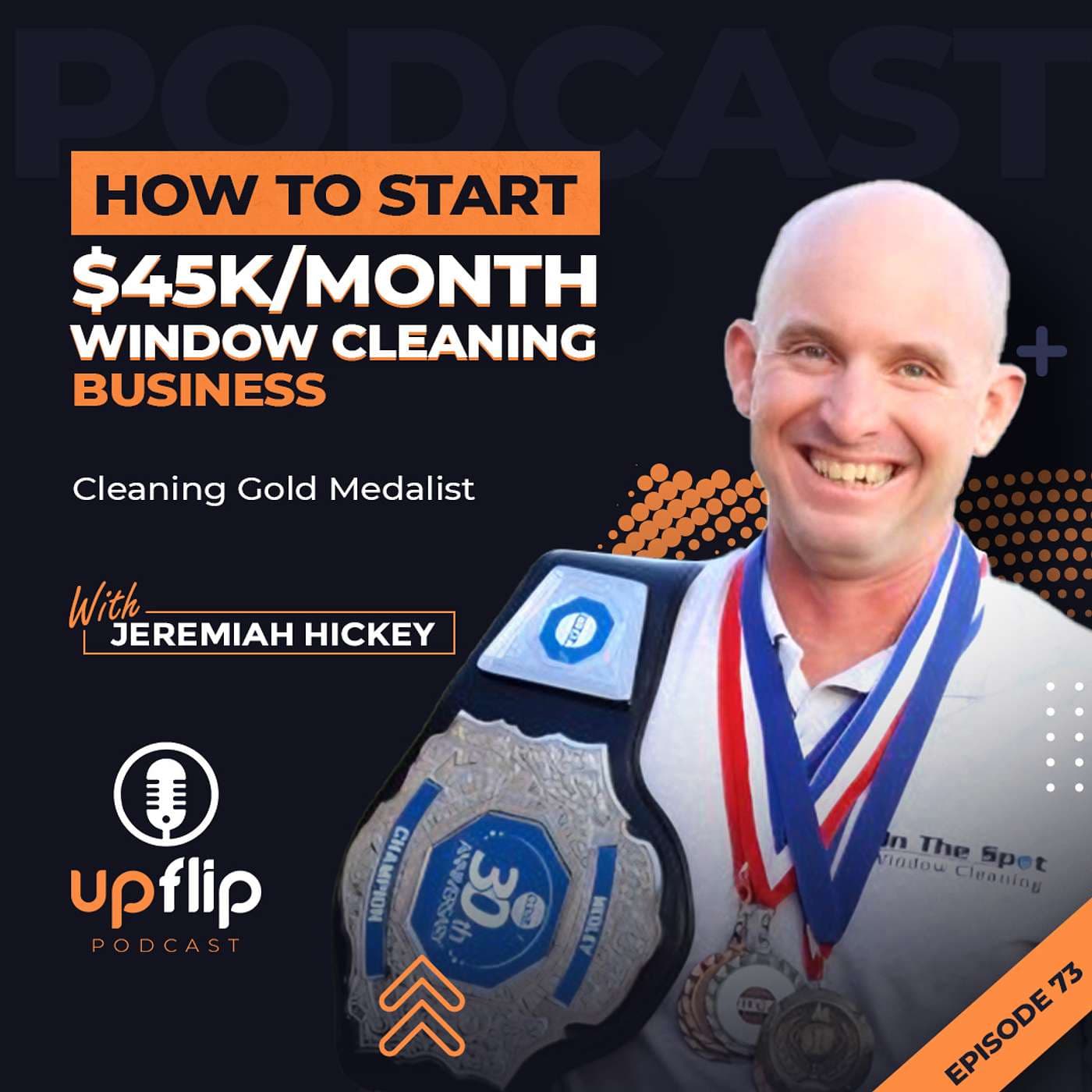
UpFlip Podcast Episode 73: How to Start a $45K/Month Window Cleaning Business - Gold Medalist's Guide
Episode Overview In this episode, Jeremiah Hickey, co-founder of On the Spot Window Cleaning, shares his journey from a full-time job with no advancement opportunities to building a successful window cleaning business that generates $45,000 a month. The discussion highlights strategies for starting and growing a window cleaning company, key lessons learned, and insights into maintaining high levels of service.
Key Points Discussed
Origin of On the Spot Window Cleaning
- Started in 1998: Jeremiah was inspired by his wife's family background in window cleaning and the limited career growth in his previous job.
- Initial Setup: He began by hustling for work, leveraging door-to-door marketing and existing contacts.
Essential Skills and Knowledge
- Tax Planning: Importance of saving for taxes as a self-employed individual.
- Basic Tools: Learning from his father-in-law about necessary equipment and techniques for window cleaning.
Business Name and Branding
- The name “On the Spot” was chosen by his mother-in-law, emphasizing a local, approachable brand.
- Importance of Google Rankings: Ensuring the business name reflects the service for better online visibility.
Early Mistakes and Lessons Learned
- Recurring Services: Initially focused more on commercial work; later realized the value of establishing recurring residential services.
- Safety Awareness: Learned the hard way about safety protocols after a severe accident, leading to a shift towards safer practices.
Key Advice for Aspiring Window Cleaners
- Educate Yourself: Use available resources like YouTube and business podcasts to learn from others' successes and failures.
- Public Presence: Building a reputation through personal interactions and community presence is vital for attracting initial customers.
Daily Operations and Growth Strategies
- Systems and Software: Utilizing sales software (ResponseBid) to automate quotes and customer follow-ups.
- Expansion Challenges: Difficulties in transitioning from a small team to larger operations, focusing on training and maintaining motivation among employees.
Revenue Insights
- Monthly Revenue: Averages between $45,000 and $55,000 in peak months, with around 10% profit margins typical in the industry.
- Recurring Revenue Model: Emphasis on setting customers up for recurring services to stabilize income throughout the year.
Target Market Breakdown
- Residential vs. Commercial: Currently, about two-thirds of business comes from residential clients, focusing on building trust and rapport with homeowners.
- Diverse Offerings: Engaging in both residential and commercial cleaning helps to fill the calendar and meet various customer needs.
Marketing and Customer Engagement
- Branding vs. Advertising: Long-term brand recognition is more beneficial than short-term paid ads. Positive customer experiences and referrals are crucial.
- Customer Interaction: Ensuring technicians are trained to build rapport with clients and provide excellent service enhances customer loyalty.
Closing Thoughts
- Focus on Branding: Long-term success is significantly influenced by how well a business is branded and recognized within the community.
- Recommended Reading: "Guerrilla Marketing Handbook" by J. Conrad Levinson for learning about publicity as a marketing tool.
Additional Resources
- [On the Spot Window Cleaning Website](https://supersqueegee.com/)
- [UpFlip YouTube Channel](https://www.youtube.com/@TheUpFlipPodcast/)
- [500 Free Business Ideas](https://bit.ly/4hg4Ip7)
- [Franchise Guide](https://bit.ly/4aWuGvc)
Conclusion This episode of the UpFlip Podcast provides an in-depth look at the journey of Jeremiah Hickey and the strategies he employed to build his window cleaning business successfully. Entrepreneurs can learn valuable lessons on planning, customer engagement, and the importance of branding in establishing a sustainable business model.
Written by AI. May contain mistakes. Listen to the episode to check what was said.
Transcript
Automatic transcript. May contain errors.0:00From doing work for Oprah and well-known business executives to winning the window cleaning world cup, it's safe to say that on the spot window cleaning is like the Olympic gold medalist of the industry. We come up so often as the professional window cleaners to hire. Even other professional window cleaners tell us about how customers are asking about our company through them. Yeah, so like this month, we have$55 ,000 on the books. The margins you might have at one level aren't going to be the margins you have when you try to expand. Really focusing on that recurring residential service helps our business grow.
0:36It's stabilized us through the hard times. I wish I had known that early on. So, as long as people are talking about you in a favorable way, wherever that platform is, capitalize on it. I'm your host, Alex Freeman, and today we're decoding the lucrative world of window cleaning. I'm joined by Jeremiah Hickey to learn how he built his half a million dollar business while working a full-time job. Jeremiah, welcome to the show. Well, thanks for having me. Let's start with your story. When did you start on-the-spot window cleaning and what attracted you to this industry? Well, I'm an old schooler, so I've been around for a little bit.
1:09I'm 46 right now. My lifetime, I've been around the cleaning industry. My parents had a side hustle, really small janitorial type hustle. So I did that kind of stuff when I was a teenager. But then I got a regular job, got married. My wife's father-in-law is and was a window cleaner. So as I was in the job that I was at, a couple of years into it, there was just no more room for me to go anywhere. The boss even told me there's no room for advancement. And so my wife was like, you know what? Why don't you try window cleaning? It's always worked for her dad. So I took a couple of weeks off from my regular job, went out, started hustling up work where I could.
1:42And in two weeks, I had gotten enough work to keep me going in the industry. And so I turned in my notice, said, hey, I'm going to give you a couple of months left at this job. I'm going to start my window cleaning business. And so that was in the fall of 1998. Wow. So you had some kind of family knowledge to fall back on in terms of getting off the ground. but what are some of those skills or pieces of knowledge that someone might need to get started and then grow a profitable window cleaning company? Yeah, I wouldn't say that my history in the janitorial sector had any real influence. I didn't run a company.
2:14It was just really small jobs that I inherited from my parents and they weren't really profitable. It was just enough to make a little bit. When I really focused on starting the window cleaning side of things, my wife was a tax preparer and she was like, just make sure you prepare for the taxes. So knowing that in advance, understand how the taxes work, especially for a self-employed person, is critical. So we saved like 20 % of our gross that first year. And we always save for taxes, which was a big deal. I recommend that for any startup company. Really understand that. As far as the work itself, the basic tools and things, I learned that from my father-in-law.
2:46He had a successful business at the time. So I was able to kind of gain some information from him, the simple tools. But also just as I started, I had to understand the difference between the money you earn versus the money that is available for profits or for growth. It's really easy to get kind of caught in the trap of like, oh, I'm earning X amount of dollars an hour and it feels like so much. But when you're running a business, it turns out to be a lot less than what you think. Yeah, kind of leaning into that. One of the things you mentioned, you know, planning for taxes, which is an important thing that a lot of entrepreneurs don't realize when they get started.
3:17What other planning went into pre-first day of the business? Yeah. So before that, it was just, like I said, I had tried to buy out the time. So I needed to get that two weeks off. And really the plan was to just go out and sell door-to-door at storefronts and just find where the work was. So once I went out and got the jobs, I'd do the job and I'd go to the next one. And that was the plan just to see where it would take us. And focusing on that direct marketing that way kept us going through the whole first year. Now, what were the startup costs? Is this a business that somebody can start with no money or what's kind of the minimum budget that they should plan to have available to them when they get the window cleaning company started?
3:59I look at it from a couple of different perspectives. If you have some resources already and you're looking to kind of go into this as a real business, I would say you probably need a good$5 ,000 to start a professional company. And that's if you already have a vehicle. If you have no money at all, you could literally borrow a squeegee and a scrubber and some towels and soap, and you can go out there and start making money with literally no money to your name as long as you had those supplies. When I started, I probably in today's value, I did about$200 just to get the supplies up front. That got me off the ground.
4:31And then I reinvested throughout the year, whatever extra supplies and materials I needed. Probably spent about$1 ,000 that first year on basic supplies and equipment. How did you end up coming up with the name? on-the-spot window cleaning. How did you come up with that name? And then what are some things that people should consider when deciding on a business name? Yeah. You know, trust your mother-in-law. That's what I got to say about that one. No. Smart advice in many areas of life. Right. We were starting the business. So my family's company had a name that we didn't want to use. And so she went out and she went to the library, you know, back in the days when people went to the library and she looked at all the phone books, all these things are old school stuff.
5:09So 1998, remember, but she was looking at all the phone books in different cities for cleaning companies. And she found that name on the spot. My mother-in-law found that name and along with other ones. But as we were kicking the names around, that's the one that we liked. We stuck with it and we went with it on the spot window cleaning. How does the name impact the future success of the business? Well, nowadays you really, in my opinion, and it's proved true. If you want Google rankings, the name is really important. So if you want people to find you for window cleaning, window cleaning has to be in the name.
5:40If you want to focus on a specific city, that can help as well. The other side of it is what kind of market are you going into? Do you want to sound corporate or do you want to sound local? We really focus on the local. So we actually have a corporate name and we used to carry that name on the Spot Cleaning Services Inc. That was always what we branded with because we thought it was more important to kind of look higher and more polished than the local feel. But as we grew the business, we realized it was the local feel that actually sold more things. So we rebranded and focused on that local flavor and kept the name a little bit more simple.
6:10That's really interesting. You know, I don't want to necessarily call that a mistake necessarily, but just a pivot with knowledge. But what might you characterize as a mistake you made early on in the business? And what did you learn from it? A big mistake. And I think a lot of window cleaners I know kind of fall into this trap where you have kind of preconceived ideas of what's going to earn you money. So you have different avenues that you follow. The mistake that I made was I did not capitalize on the opportunities for recurring residential window cleaning services. For recurring work, it was almost always commercial.
6:42And then residential was when it comes, it comes. I didn't even realize that was a real mistake until the pandemic. And a lot of our recurring commercial stopped. They closed down or they were having hard times. We still had some that were going on, but to get that recurring work, I just really started pitching it to our residential customers. And since we pivoted then, that side of our market has grown incredibly. So really focusing on that recurring residential service helps our business grow. It's stabilized us through the hard times. I wish I had known that early on. Kind of staying in that same vein, tell me about a big failure as a business owner.
7:17How did you recover from it and what did you learn from it? So I had a really bad ladder fall about a decade ago. It could have killed me. I ended up with a concussion and some stitches in my head. And we didn't respect safety the way we should have. It was my fault that I fell off the ladder. And so when we thought about growing and promoting that safety, we learned from that mistake, that biggest failure right there. And so we are like 99 % ladder free, which is highly unusual for the window cleaning industry. But we've really focused on for exterior services, focused on what's called water fed pole or purified water technology.
7:50so we can do all of our cleaning with our feet on the ground, especially on the exterior. And then even on the interior, we train all of our techs to use extension poles with the standard equipment, squeegees and scrubbers, and even detailing, things like that. So we really focus on the safety. And that was something I had to learn the hard way, but I wish I had not had to have had that failure. Wow. Yeah. I mean, that's a very real and scary lesson to learn. If someone came to you and said, you know, I want to get into the window cleaning industry, but no prior experience. They've never worked as a window cleaner.
8:20What is the number one piece of advice that you would give them? Yeah, educate yourself. There's so many ways to do it these days. There's YouTube, there's business podcasts like this one, there's books, and also just talking to other window cleaners, other people in business or in the service industry in general. Educate yourself, learn the mistakes, learn the successes, and try to implement those early on because that's where I would start before I did anything else. Now, shifting towards a little bit of the day-to-day operation of the company. What strategies or systems are you using to keep yourself and the business organized?
8:53And then sort of the follow-up there is how did you develop or implement those strategies? Yeah, I really like the advancement in softwares. And software is really how we systemize and focus our efforts on the administrative side and everything else. One in particular is our sales system. We use ResponseBid, the software ResponseBid as our sales system. So it used to be that I would just know how to do the sales. I would go out to the jobs. I would look at them all and calculate what I needed to do. But with Responsibit, I had to do all of that like a third-party person and figure out the inputs that I needed to put in.
9:28And then after I did that, the algorithm in Responsibit generates a profitable bid every time something comes through. So that software in particular really helps us focus on our sales strategy. Then it also has follow-ups to not only capture new customers, but also to go back and get those returning, recurring residential clients in particular. What's the biggest challenge facing you as a business owner today? And what steps are you taking to overcome it? For us, the biggest challenge is the current expansion that we're doing. Just a few years ago, as I was getting older, we really focused on growing the business.
10:02Before that, I would have a guy or two working alongside me and that was about it. So that expansion is difficult. There's a lot of transitions. Again, there's a lot of things I don't know. And there's a lot of things I don't know that I don't know. And that's difficult. So training to get people to do things that I'm doing now becomes critical. One of the other things that's really been complicated throughout the history of our business is just staying motivated. Sometimes things can just get mundane or they get, you know, you're just tired of doing the same thing over and over again. And it's hard to kind of focus on what you need to do next to keep the business growing or keep it moving forward.
10:34And so that motivation, I think a lot of entrepreneurs face that even early on, but staying motivated is really key. Now, taking you from today, going back to the beginning one last time here, what's the most difficult part of opening a new window cleaning business and how did you overcome that? I think for anybody, the most difficult part is just attracting the customers. If you know the basics of window cleaning, for some, the skills are a little harder to come by, but if you can get the basics down, it really comes to attracting customers. What I did in the beginning is I went door to door at the storefronts.
11:04I'd go in, I'd say, hey, you know, you want your windows clean X amount of dollars or whatever. But from that point, a lot of times I would be in a store and then customers inside the store would hear me and go, oh, you do window cleaning. And then they get my contact information. So that's how I attracted customers to begin with, was just that public presence in person wherever I could be. And I used those opportunities to capitalize on that initial growth. So this is going to bring us to a section of the show that we call our Fan Blitz questions. These come from our YouTube community. Listeners, you can go to youtube.com slash upflip, join the community and post questions to future podcast guests.
11:40Jeremiah, we've got five questions. We're going to try and do them in about a minute. Are you ready? Okay. All right. First, would you do business with yourself if you were a customer? No, I'm a classic do-it-yourselfer, but my wife would hire us and she's more of our target customer. Fantastic. If you could have anyone in this world endorse your business, who would it be and why? From a marketing perspective, I would do Martha Stewart just because I think the branding advancement using her name would be great. What or who would you like to have as a mascot for your brand? My golden retriever, Sadie, because she's the best.
12:11Oh, that sounds fantastic. Can you tell us about your most bizarre business encounter? Okay. So I was cleaning windows at this house and they had all these detailed schematics of military equipment. I mentioned it to the customer like, oh, that's interesting. And he went on to tell me and then finally he's like, well, you know, I used to be a spy. And I was like, okay, this guy's either delusional or crazy. And then I went into his garage and he had a classic Ford GT40 in his garage. And I thought, I don't know, is this guy like the retired James Bond or what? Amazing. And finally, if there was a movie made about your journey, what would the title be?
12:40Window Wars and the Squeegee Strikes Back. Oh, I'm there opening weekend for that movie. That's going to do it for our Fan Blitz questions. Listeners, let us know what you think of this episode by reviewing it on Apple, Spotify, or wherever you are listening now. Jeremiah, just a few more questions from me here. Talk to me about supplies and equipment. What are you using in your business and why slash what advice can you offer for choosing the best both products and suppliers for those products? Yeah. So the window cleaning industry has two styles of cleaning. We call it traditional or trad work, which is your squeegee and your scrubber.
13:19And then we call it water fed, which is the purified water technology with extension poles. For those extension poles, that's really been key for our company, that water fed technology. So we focus on really high-end carbon fiber poles. We like the company Simpole, S-I-M-P-O-L-E, as well as Gardener. Those are very good poles to go by. As far as going to different distributors, there's a big difference between what you can buy at your local hardware store and the professional line. So I would find a distributor. We go to Detroit Sponge. They've always treated us well. They are always there when we need them and they have the supplies we need.
13:52So any of the traditional stuff or adapters that we need for the different water fed poles, I like going through them. But just knowing that the main established companies like Unger, Tori, those companies have good quality professional products that you can only find through the suppliers. So when you know that, it's better to make the investment in the professional lines as opposed to just buying what you can at the hardware store. So you mentioned when you were first kind of finding those first few customers for your business, you were going door to door and kind of being present publicly as much as you can and having those conversations with potential first customers.
14:27Is that still the advice you would give for someone to find their first few customers for their company? Or what strategies might you recommend for someone opening a company today? It all depends on what you're coming in with. If you're coming in with no money, yeah, just get out in front of people. Get out there, shake hands, say hi, let people know that you're out there. If you've got some money to start with, like if I was going to start in a different area, I would put money into some ads up front. I'd do Google ads, Facebook ads. I'd educate myself more, especially for a new person. Make sure that you're not just throwing money away, but that would get your name out there before you could have the chance to get your website to get SEO and all that kind of thing.
15:02So the initial ads would be how I would start to get those first few customers. Are those Google ads, Facebook ads, are those your primary method of finding customers today? Or how are most of your customers coming to the company today? No, actually, we've done very little paid advertisement over the years. We have done Google ads in the past just briefly, and it had some success. But our main focus has been branding. So we really focus on the things that have the longevity. So our online presence is super key. We rank really high for our main areas that we work in for window cleaning. The Google three pack, you know, we rank up there with the reviews.
15:37Our website has great organic listing when you search different areas that we service. Places like the Nextdoor app, we don't advertise there, but you got to have that presence there. You got to have some sort of listing there. And then people talk about you. We get a lot of referrals through Nextdoor. So it's really that branding that we've done over the years. to help us get that branding established. We've really focused on capitalizing on using media before there were social media and even currently. So we try to get free publicity. You mentioned up front that I've won the World Cup of Window Cleaning.
16:08I do speed competitions. I've been all over the country and over to England as well to do them. And then I get news outlets to cover the story. And that's really brought in a lot of interest to our company and it helps to establish us as the local professionals that people know about, even if they don't use us. Can you talk a little bit about the, I guess, thinking in broader terms about kind of branding and what might be categorized as an expense? Like what kind of sweat equity is going into building up that branding and hustling for news stories to kind of build up the brand in that way? Yeah.
16:41So as far as the events go, you know, you just got to be aware of them. So we capitalize on those things, but you can come up with any kind of events or ways to get the media's attention. Nowadays, self-promoting is also a viable option. YouTube, Instagram, Facebook, whatever. But what we do to really capitalize, not just to get the initial interest is the follow up. So like I said, when we pivoted and really focused on getting the returning residential customers, we realized that we had to always be front of mind of those customers. So I'm going to go back to our software response a bit. You can build into it, whatever kind of email or text campaign after the initial service that you want.
17:14So we remarket to those people on a regular basis that we don't have to think about. And then they come back. So as it is, you know, we have like three quarters of our year is pre-booked because we are constantly reaching out and trying to get people on automatically recurring services. So after that initial interest, we really focus on email campaigns and things like that, that are dripped out and automated. So we don't have to think about it. You mentioned social media briefly. You mentioned Nextdoor. Obviously, a website is important because that's really how you rank on Google. What are the important aspects of an online presence for a window cleaning business in 2023?
17:47Like, should somebody really invest time in TikTok? Like, where should they be? I've seen a lot of window cleaners on TikTok and I know that that gets a lot of attention. I just don't know that it targets the customer base of a local area. I haven't seen the numbers on that, so I couldn't tell you I'm not on TikTok, but I guess I'm a little behind the times. I am on Instagram and Facebook, but for us, the website, absolutely super key. Make sure it's SEO friendly, optimized and all that stuff. The Google reviews, that's the next thing because those two things combined, once people will start looking for you or even if they initially want to find somebody in your area, Those Google reviews, hands down, help us out so much.
18:23And then the other apps, Facebook, Instagram, Nextdoor, wherever people can verify that you're a good professional company and that other people like you, that's where your effort should be. So as long as people are talking about you in a favorable way, wherever that platform is, capitalize on it. Can you talk me through the whole customer process and experience from requesting a quote through to finishing the job? Give us the key steps and how you as a company are managing that process. Yeah. So for a long time, you know, sales takes up a lot of time, especially if you're doing one job, one sale at a time.
18:58So with our processes now, it's all systemized. If a customer gets funneled to our website, there's a link there for an instant quote. Then go on there. They can fill out a few questions about their property and it'll generate a quote right there. That goes from our software from Responsive. If they call us, it goes to our virtual receptionist. We use Jill's office and they also know how to use responsive bids. So they can ask the same questions. They have access to our account to generate those bids and that goes out. So a customer does that initial contact either through our website or through a phone call.
19:27They get a bid within minutes. And then once they select one of our packages, we offer very specific packages that are well spelled out. And so it's easy for our techs and our customers to understand. Then we go out, we notify the customer, we get them on the schedule, make sure everything's set up front. We get to the job, introduce ourselves, explain to the customer what each team member is doing. Most of our teams go out in teams of two. So one person is usually doing the inside, one person is doing the outside. And then we explain that up front. We make sure that at the end, we ask them if everything went well, if there's anything we can do to help out.
20:02And we just focus on that customer interaction. So besides doing that quality job, this is one of the best practices we really try to implement. So our customer experience is top-notch is that we want our techs to be confident, to talk to the customer, to be able to build that trust and rapport with the customer. Even if they identify a problem that isn't window cleaning related and they can offer a solution that builds so much rapport. So our customers, they have a lot of pride in our company. I have a lot of feedback that says, you know, your team was so helpful. And so focusing on helping the customer while they're there in any way we can is a great part of our customer experience.
20:35And then once the jobs get done, we get paid. Then our drip campaign follows up. We ask for the Google reviews. It also has a Facebook and Nextdoor link as well. So to get those reviews going. And then later on it asks, you know, would you like a recurring maintenance service? We offer, even for residential, we do summer every other week, summer monthly. And we really focus on those. And then sometimes it's farther out, but either way they get reminders. They get a monthly reminder, quarterly reminder, six months and annual. And then that always keeps the customer coming back. Now, you mentioned the team members there and kind of the importance of what they're doing on site, how they're interacting with the customer as being central to providing an excellent customer service experience.
21:14Is that something that you're hiring for or training for or a mix of both? For both, our core values, the basic one is bring joy, bring joy to the customer, make them happy that we're there. And we do that through four basic training processes. One, be safe from experience. I know customers don't like it when you fall off ladders at their house. So be safe, be safe about yourself, properties, be safe about the other people that are there, whatever can be there as far as safety is concerned. As far as being the next level, we want to always be professional. So we train for being professional. However we present ourselves, we are the experts.
21:47We are the people that look the part. We don't look like the guy that came off the street with a bucket and say, hey, can I clean your windows, which is how I started. But now we focus on that professionalism. So we train for that. In the meantime, we train for efficiency. So even if our new guys, they aren't experts, they're getting trained for efficiency. They're accompanied by somebody that has the experience to make sure everything goes smooth so that they learn those processes. And that really is how we present ourselves and get that customer service experience that they want. Now, I want to dive into some of the numbers of the business a little bit further.
Read the full transcript
22:18Can we talk about revenue in a typical month and profit margins and then how that maybe compares to the window cleaning industry more broadly? Yeah. So like this month, we have$55 ,000 on the books, which we should be able to complete no problem. Typical busy season month, our busy season is we're here in California. So it runs anywhere from as early as March to as late as December. And our typical busy season month is between 45 and$55 ,000. Our slower months, it just depends on how much rain is coming in. This last winter, we had a ton of rain. So our slow months hit us pretty hard, but even then, we averaged between 25 and 30 ,000 a month.
22:54The profit margin side of things, we're about 10 % profit margin on a typical year by the end of the year, but that's paying everything, including our own salaries. As 10%, I think for a company our size is probably pretty common. Our goal is always trying to get to 20%. And again, it all depends on how efficient we are and productive we are on our slow seasons. We make the money in our busy season. I think industry-wide, a company our size is probably in a similar position at 10%. But a smaller company, a lot of times I've found that the smaller solo guys, they don't even charge enough to grow.
23:25So there's not really a lot of profit left over for them. It's just covering their livelihood, which is fine if that's what they want. But if you want to grow the business, I think a 10 % is absolutely achievable. And I think 20 % is something that people should shoot for. What are some of those ongoing expenses for a window cleaning business? And what advice can you offer on minimizing those so that you can get that margin, not just a 10%, but approaching that 20 %? Our biggest cost is payroll. Now we offer a really good benefit package and we start those benefits at 20 hours a week. So that's how we attract and keep good employees.
23:56But with that comes really high cost for those employees. So focusing on efficiencies is critical. Once they get trained in, they got to be productive. They've got to be efficient. Our costs on that payroll is the highest thing. Also, we've found over time that it's critical that when an employee isn't performing, they either move up or we at times have had to let people go because they just weren't performing what we needed them to do. I don't like that side of it. I don't like letting people go, but at the same time, that's definitely where you find areas that you can cut those costs. Payroll is the biggest one.
24:28Other things like shop rent, office rent, you know, vehicles are expensive. With vehicles, as long as you maintain them and keep them longer than their payments, I think that's a great way to keep that expense as low as possible. We use a lot of software, so that expense is there, but we capitalize on that software. So it always makes us money in the end or makes us more efficient, which in turn makes us have better profit margins. How then do you scale revenue as a window cleaning business? So I'm going to go back to that recurring thing. Window cleaning in the beginning to me, I mean, I've been in this for 25 years, almost a lot of window cleaners focus on the initial sell and then they hope for a returning customer.
25:05But focusing on really capitalizing on that recurring revenue, getting them set up automatically, even if they say, oh, I want it done spring and fall, automatically have it set up that they're scheduled for that six month service. Your calendar fills up easier that way. Then you can find where the gaps are and then you can fill those gaps even easier. So our other software that does our scheduling, its name is KickServe. And it has an easy button, recurring service, if you want it monthly or every six months, if you want it weekly, however that works for your company. That's what we do. So once the customer says, yes, I want to be set up on this automatic recurring service, we set it up, we notify them when their next service is going to be.
25:43And that's how we've been able to grow the most in the last few years. Listeners, you can learn how to start a cleaning business from scratch step by step in the seven figure cleaning business blueprint course taught by Chris Mondragon of Queen Bee Cleaning Services available on the Upflip Hub. And we are so confident in this course. We're offering a 90 day money back guarantee if you don't make 10K a month within 90 days. Jeremiah, talk to me about the differences between residential window cleaning and commercial. And I guess to start, how does that break down in your business? What percentage is residential?
26:15What percentage is commercial? Right now, we're about two-thirds residential, about a third commercial. The biggest difference is the customers themselves. So commercial work, I find, is easier. I think a lot of window cleaners kind of gravitate to that up front because the customers aren't as demanding. They want just regular professional-looking service to come out and get things done on a consistent basis. As long as you have your legal stuff in place, you have your liability insurance, you have your business license, all the things needed, they're happy. you show up, you do it. Great. The residential side, it's much more about that personal interaction.
26:49So not only are they looking for the quality because they're looking at it every day and they're looking at it as a premium, they also want to know that they can trust us. So not that commercial doesn't want to trust us, but it's just not the same. When you're in a person's house, you got to be the kind of person that they would sit down and have a cup of coffee with, or else you're not going to get those callbacks. If they don't trust us in any way, shape, or form, we're not going to get a return customer on that. So that's a big difference with a residential. Much more personal. I think the quality has to be higher in the residential market, but the margins can be a lot better as well than your standard day-to-day storefront type commercial cleanings.
27:23Are there niches beyond residential versus commercial in window cleaning? And do you think it is better to offer a range of services or to focus on one specific niche? For window cleaning specifically, our industry has basically four areas. We call it residential, storefronts, which probably includes restaurants. Then you have low-rise commercial and high-rise commercial. So we don't have any high-rise in our area. So I don't have any experience in that, but I imagine the high-rise guys are focused specifically on high-rise. The other thing is they're really interchangeable as far as the skill sets.
27:54The way you get the customers is completely different though. So I like having the variety myself of both residential and storefronts. We also do some low-rise commercial or larger commercial projects, but being able to have those different things going helps us to kind of fill out our customer base. Window cleaning isn't a very high ticket item typically. So especially if you're dealing with one-stop set residentials or what have you, relative to other industries, it's not that high of a ticket. So you have to have a lot of customers. So by having different niches that we go into, we can expand our customer base and fill up the calendar a little easier.
28:26Can you talk to me about your pricing system? How do you arrive at understanding how much to charge and what are the things that someone who's just starting a window cleaning business should take into consideration when setting those prices. Yeah, prices are interesting. I figured out early on that I really wanted to know what it would take to clean X amount of windows in X amount of time. So I focused on exactly what it meant to have one pane of glass cleaned and I would go around and count window panes on a house. So if you're in person, that's the most accurate way to do it is just count the number of panes on a house, individual panes and any other complications.
29:00At this point, because we have our software doing all of it for us. I had to kind of calculate what the average would be based on square footage. So if a house is, you know, 3000 square foot, took some time to focus on what the average number of windows would be in a house like that. And so we price based on the square footage. Then we have things that add cost to it. Things like how high is it? Is it two or three story house? Is it something that hasn't been cleaned in a long time? So we add cost to that overall. Also the type of windows, if it's a bunch of little, small, detailed French windows or true divides, takes a lot of time to detail those out.
29:35So that adds a lot of cost to it. So we ask those questions through our software process. Like I said, I focused on figuring out what the best inputs were for the algorithm to come up with a really profitable margin at the end. And then even then as the calendar filled and we have been profitable. So we have a lot of the calendar filled. Most of our newer customers are getting an even higher price point so that they're a lot more profitable and then keep moving that profit margin where we can. And so we focus on the square footage. That's the simplest way for us to do it through our responsive software.
30:05What's your role in the business today? What are you doing day to day? And how do you decide what you should be handling as the owner and what you are delegating to your team? Yeah, it's the classic wearing all the hats type situation. At this point, because of our size, we have had to delegate. So my wife, she does a lot of the backend operations. I am focusing more on building the systems, implementing the softwares, training other people. So we hire for mostly the labor stuff, getting the windows cleaned and everything. I'm still in the field, but I plug myself in where I'm needed as opposed to just having to be there all the time.
30:40In the meantime, I'm training one of our techs. He's a team supervisor. So he's taking on more of the scheduling role, more of the follow-up of new customers, making sure the invoices get out and get paid and things like that. So I've been delegating more of that. I'm not where I want to be, but I think we're in that mid-range, that transition where I've been able to let go of a lot of things, but I don't have all the systems in place to get to where I can just let go to another department. So to really help us get to those areas though, and I think this is key for any business, is the margins you might have at one level aren't going to be the margins you have when you try to expand.
31:15So it costs a lot of money to try to grow the business. When I take myself out of the field, that's all that money that's not being earned. I got to pay somebody else to do it, but it helps me to grow the business. So if those margins aren't in place, then there's no free time to focus on the things that need to happen to keep the business growing. What is a mistake that you see new window cleaning businesses make that ultimately causes them to fail? And how can other entrepreneurs avoid that mistake? I'm going to go back to the taxes. I've known so many startup companies that don't understand how much they're going to owe at the end of the year.
31:48And they think they've earned a decent living. and then all of a sudden the tax man comes and they don't have any money left over or they have to borrow to pay their taxes. So that's a huge mistake up front. The other thing is not knowing that$100 earned isn't$100 that goes into your pocket if you wanna grow. It takes a lot to grow. So planning for growth, planning to have those margins in the early stages, not focusing so much on the earnings of the day, but the overall growth and expansion of the business, that really stops a lot of people. Most of the window cleaners I know, they don't make enough to grow.
32:19like I said earlier. And I think that just comes down to the fact that they aren't looking at the margins of a business. They're just looking at earnings for their lifestyle. If you could pick the one thing that people take from this interview, what would it be? Well, I hope people take branding seriously. I know advertising is a great way to expand a business rapidly. I've watched it in other companies. I know it can be done. But branding is what has kept us in the business long-term. It's what helps us to grow right now. And in our area. We come up so often as the professional window cleaners to hire.
32:52Even other professional window cleaners tell us about how customers are asking about our company through them. So that branding goes so far. So even if there's a great window cleaner that is doing work for somebody and for whatever reason they can't get to them or they can't get it done or the customer is just not satisfied, the next person they think of is us. And that branding is what gets us there. So the advertising is one thing, but branding is really about long-term and helping us to have that established consistency that we really thrive on. What's your favorite business book and why? My favorite business book, I'm going to go back old school for anybody that's been around for a while, Guerrilla Marketing Handbook by J.
33:28Conrad Levinson. And the reason why is that book introduced me to the idea of using publicity as a marketing tool. And we've capitalized on that from the early days. Our competition started in the early 2000s. The International Window Cleaning Association is the ones that we went to in the beginning. We networked through them And we really capitalized on those events and our successes to get our branding established through publicity, through the local media. So if people can brand their company and learn from a book like Guerrilla Marketing or anything else that's talking about branding these days, that's what I'd recommend.
34:01Where can people find out more about you and on-the-spot window cleaning and what you're up to? Well, if they want to be local, find us on our website. It's supersqueegee.com. If they want to see how we do things, visit our YouTube channel. You just type in on the spot window cleaning and find the guy that does the fast window cleaning. That's me. Otherwise, other platforms at on the spot Inc is usually our handle for places like Facebook and Instagram. So we're out there. But if you Google on the spot window cleaning for San Luis Obispo, California, you'll find us. Listeners, you can find more advice about how to start a business the right way on the Upflip Hub or watch our YouTube interview with Northwest Pro Wash founder Spencer Clays to find out how he started an$8 ,000 a month cleaning business with just$500.
34:42dollars. That's going to do it for this episode of the UpFlip podcast. Jeremiah Hickey, On the Spot Window Cleaning. Thanks so much for joining us. Oh, my pleasure. Thank you, Alex.
From the publisher
What does it take to start a window cleaning business–and grow it to a revenue of $45,000 a month? Jeremiah Hickey of On the Spot Window Cleaning shares his advice in this interview.
Jeremiah and his wife started On the Spot in 1998. He wanted to get out of a job with overwhelming hours and no advancement opportunity, and her business education gave her the knowledge they needed to start their own venture. On the Spot quickly grew into the top window cleaning service on the central coast, known for both the speed and quality of their service. They’ve proven their skill in international competition, winning the World Cup of Window Cleaning and multiple awards as the IWCA’s Fastest American Window Cleaner.
Of course, this level of excellence doesn’t happen overnight. In this episode, Jeremiah explains how they built On the Spot from scratch and established their reputation when they were first starting out. He’ll also share the mistakes they made along the way (and what they learned from making them) and the systems they have in place to ensure consistently high levels of service. If you want to know how to start a window cleaning business with sustainable growth potential, this interview will answer all of your questions.
Resources:
- https://bit.ly/4hg4Ip7 500 free business ideas you can use to start your next side hustle or business venture
- On the Spot Window Cleaning - Learn more about the On the Spot at their website
Ready to be your own boss without starting from scratch? Grab our FREE Franchise Guide and unlock the secrets of proven business models that have already created thousands of success stories.
Connect with UpFlip:
- On Youtube
- On Instagram
- On Facebook
- @UpFlipOfficial on Twitter
For more insights to start, build, or grow a business, check out the resources on UpFlip.com or head to the UpFlip YouTube channel to see more interviews with business owners and experts.
Thanks for listening!


