
In short
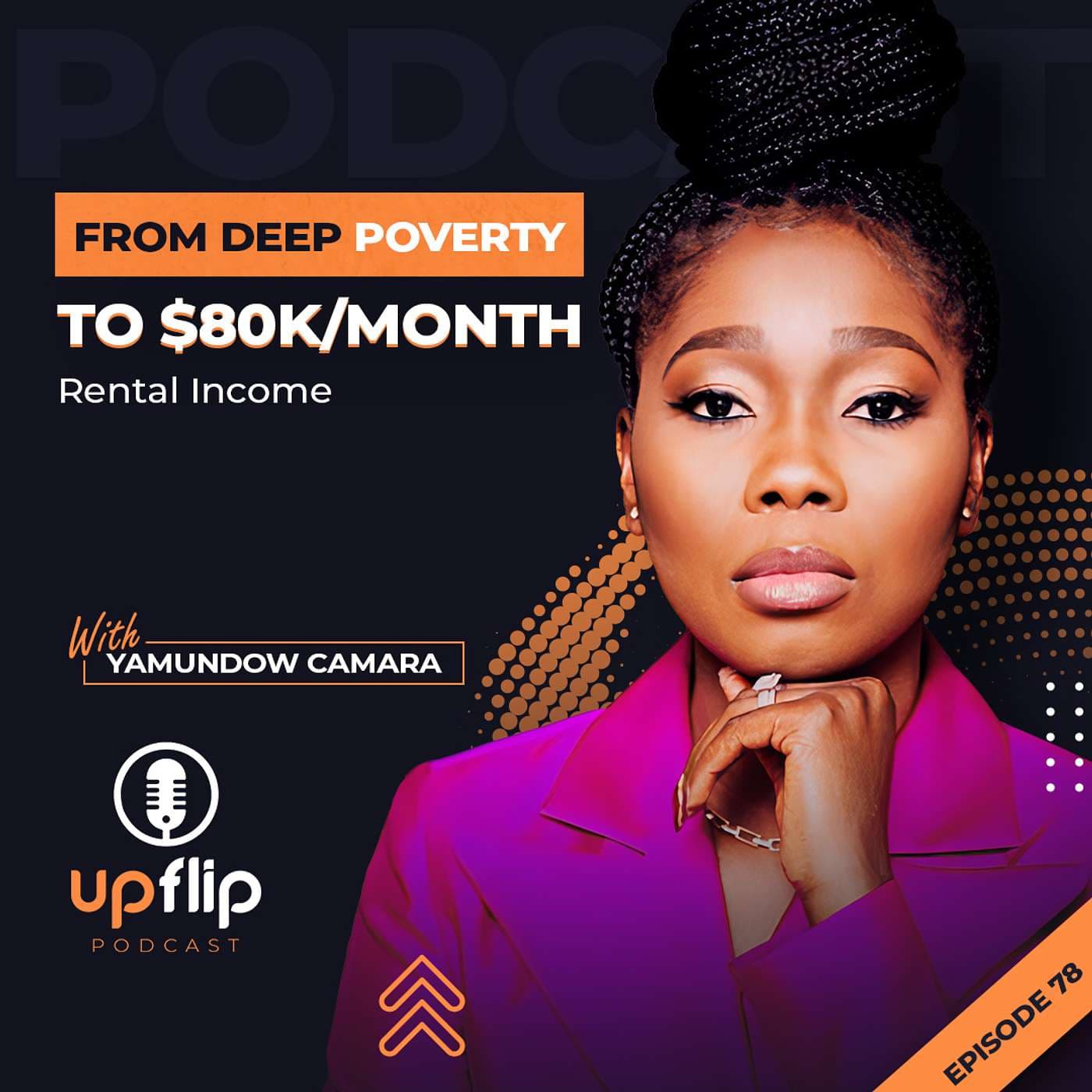
UpFlip Podcast Episode 78 Summary
Episode Overview
- Title: From Deep Poverty to $80K/Month Rental Income
- Guest: Yamundow Camara
- Host: Alex Freeman
- Duration: Approximately 1 hour
- Description: Yamundow Camara shares her inspiring journey from growing up in poverty in Gambia to building a successful rental property portfolio that generates $80,000 a month from an initial investment of just $8,000.
Key Themes Background of Yamundow Camara
- Early Life: Orphaned at a young age, faced challenging living conditions in Gambia.
- Education: Moved to the U.S. on a scholarship to study data science, which opened doors for her future.
Transition to Real Estate
- Initial Interest: Captivated by home ownership from a young age, driven by her desire for stability and security.
- First Investment: After gaining work experience and saving money, Yamundow invested in her first property, a triplex, despite having no prior real estate experience.
Building the Rental Empire
- Revenue Generation: Focus on cash flow through Section 8 rentals and short-term rentals, including Airbnb.
- Investment Strategy: Emphasizes the importance of analyzing properties based on intended use (buy and hold vs. fix and flip).
Key Concepts and Strategies Property Management
- Out-of-State Investing: Successfully manages properties in multiple states by building a reliable team of contractors and property managers.
- Cash Flow Management: Prioritizes cash flow by utilizing Section 8 rental programs which ensure monthly government-backed payments.
Financial Insights
- Leveraging Credit: Yamundow navigated the complexities of credit building and secured loans to fund her investments.
- Reinvestment Strategy: Uses profits from existing properties to fund the acquisition of new ones.
Advice for Aspiring Investors
- Mindset: Stay focused on cash flow and investment goals rather than market fluctuations.
- Networking: Surround yourself with knowledgeable individuals who have experience in real estate investing.
Lessons Learned
- Overcoming Challenges: Yamundow discusses the importance of resilience and adaptability in the face of economic and personal obstacles.
- Avoiding Detractors: Encourages investors to seek advice from experienced individuals rather than those who haven't succeeded in real estate.
Conclusion Yamundow Camara's story is a testament to how determination and strategic planning can lead to financial success, regardless of one's starting point. Her journey emphasizes the significance of education, financial literacy, and an entrepreneurial mindset in achieving the American Dream.
Resources
- Connect with Yamundow: [Instagram: @buildingwealthfromrentals](https://www.instagram.com/buildingwealthfromrentals/)
- Join UpFlip Academy: [UpFlip Academy](https://bit.ly/3NJhjn6)
- Franchise Guide: [Grab our FREE Franchise Guide](https://bit.ly/4aWuGvc)
Final Thoughts Listeners are encouraged to take action on their real estate aspirations, leveraging the insights and experiences shared by Yamundow to carve their own paths in the investment landscape.
Written by AI. May contain mistakes. Listen to the episode to check what was said.
Transcript
Automatic transcript. May contain errors.0:00Lost her mother at two and her father at eleven, slept on literal dirt floors in West Africa and immigrated to the US on scholarship. All it took was three years for this ambitious entrepreneur to build a 32-unit rental empire with no money, experience, or connections to rely on. Fix and flips gets you rich. Buy and hold gets you wealthy. Within a few months, I was able to actually get along when I turned around the first property and fixed it up to rent it on Section 8. Imagine getting one property to give you$1 ,000,$1 ,500, and you get a second one giving you$2 ,000, and that's how I was able to scale.
0:36So for a Section 8 property, I want to get at least$1 ,000 or more because in Section 8 properties, mostly they're not very expensive houses. If I put money on something, how long would it take for me to get it back? If the numbers make sense, I'm going to do it. My cash flow was just blowing up. I never stopped. I just went all in. I'm your host, Alex Freeman, and today we're uncovering the incredible story of Yamu Kamara. from how she did it with no money to her shockingly impressive profits. Welcome to the show. Thank you so much, Alex. Thank you for having me. I'm so excited to have you here.
1:12And I know our listeners are also excited to have you on the show. So as a note there, we're doing things a little differently this episode, because we got so many questions for you from our YouTube community that most of these interview questions are coming from them. So a reminder to our listeners, go join the UpFlip YouTube community, youtube.com slash UpFlip, and you can pose questions to future podcast guests and sometimes completely write the script of the show. So Yamu, again, these are mostly coming from the community to you. I'm excited to dive in. Let's start with our story for those that are listening that might not be familiar with your story.
1:46How did you get started? This feels so simple, what I know of your story, but how did you get into investing in real estate? And feel free to take that as far back as you'd like. Sure, of course, I would love that. So from my, actually, you could tell from West Africa, I grew up as an orphan in a small village. My mom passed when I was two and my dad passed when I was 11. So when my mom passed, my dad was really old and he was sick. So my sister has to be forced to get married so she can take care of me and my brother, who's like five years older than me. So we have to move to her husband's extended family.
2:20So in Africa, we live in villages. In the village, we live in like extended homes. So like a whole family, cousins, brothers, all built houses around and everybody has the same last name because it's the same family. So me and my brother being raised in a household that it was evident that we don't belong there. There was a lot of abuse, you know, emotional abuse, physical abuse. And it was very hard growing up in that environment. And my brother used to act out a lot because he's a teenager, especially when he was a teenager. For me, I was so into school because that's where I find my comfort zone.
2:51I was really male child to make it up to grade six, that's like primary school, it's like a huge achievement. That's where you stop and then you get married. For me, because I was really good in school, the teachers and the principal of the school and my aunt who was alive then would help me force the family because the decisions were made by male counterparts in the family for who goes to school, who doesn't go to school, every decision basically. So for me to even be able to go from high school to university. It has to be like a begging process. So my aunt used to beg, my uncles, my teachers, the principal used to say, well, she's really good at this and you guys are not paying any money.
3:34It's like she's getting scholarships to just let her finish. So it was always like a milestone when I get from one grade to another. So I made it to university and in my university, of course, I'm the only one. My village that made it to college are my friends that I grew but we already married two or three kids at a time. So I had to like compete. If you made it to university without scholarship, that's because your family has a connection to the government or you have someone up there. It's a huge corruption scheme going up there. So for you to make it to university, to your family, that means you have to come from money or your family has to have connections.
4:08So for me making it there, I'm not supposed to be. By statistics, I'm not even supposed to make it to college, talk less of being in a computer science class. So I studied computer science in my bachelor's degree. They wanted me to become a doctor, but I hate chemistry and I don't like blood. So I was like, computer science works for me. So I did computer science and I have a minor in mathematics. So I was doing really great in my computer science class. Of course, in any IT, usually they're always less female in the class. So, of course, that was the situation. And the few females that I started with kind of dropped off and went in turn of the direction.
4:42It was just me and another girl. I don't know if she ended up completing, but I was like, what can I do to change the situation? So I started a nonprofit organization that teaches girls how to write computer codes in my final semester. So I got an internship. And in that internship, my boss was able to give me the used computers. And I used that to go around different villages with my colleagues that are in the nonprofit organization to teach girls how to code. So that kind of blew up. Other cities in Africa were taking over that nonprofit work. and it's called Girls in ICT. So it kind of blew up.
5:16And there's this fellowship program that the U.S. government has created, President Obama in 2015, I believe. And it's named after Nelson Mandela of South Africa, late Nelson Mandela. So it's a nonprofit. It's a fellowship for young African leaders that are doing something great in their community. So a lot of people will send me, it's just at work, they will send me, they'll say, you need to apply for this. I was like, these are people that are doing really amazing things all over Africa. Like they're fighting, you know, war. They're doing fighting poverty, like domestic violence, all that stuff.
5:48Those are important stuff. I don't think what I'm doing is asthma. They will just apply. So I was like, you know what? What am I going to lose? It's free. So I applied and it's 40 ,000 applicants every year when it started all over Africa. So you're competing against the whole continent, right? So I applied the first stage. I got an email saying I made it to the second. I was like, oh my God, maybe the second one. That's it. I don't think I will go any further. So U.S. embassy again, another interview. I went again, I got an email and I was like, whoa. So I went through the whole process of the interview and I kept going.
6:19I was like, at the beginning, I didn't even tell anyone at home because I was like, I don't think it's going to get, but it's going to be a great experience. Let me just do it. So at the end, I got it. I got an email from the U.S. Embassy that I was selected to come to the U.S. to meet President Obama. So I was placed at Northwestern University in Evanston, Illinois, Chicago. And then I was flown to D.C. to meet President Obama in 2016. so during that time I was like I can't make it up here and go back to what I came from I have to like so I was like okay before when I saw that I might make this I started applying for university master's degrees I was like if I come here I don't know if they will even let me so my aunt again and my sister have to beg my uncles to see if I can come they were like this is free the U.S.
7:03embassy is paying for everything the U.S. government is paying for everything she doesn't have to do so why can't she just go? So they're like, when she gets back, then she can get married. I was already bit trotted. So when you're born as a female child in my culture, they already know who you're going to get married. So even when I was a child, I knew I was going to be married with one of my cousins. Whether you like it or not, that's what was this for you. And I didn't want that. I wanted something better for me. So I was like, I made it here. If I made it to this place, I'll try to see what I could do.
7:29But because it's a step by step, right? Before I came, I applied for another university to get a master's degree. And I got a full scholarship to work as a data analyst. So I analyzed the data for the university and they waived my tuition fees. So what I did is we didn't tell them about the second scholarship. They just told them that the US government is paying for the first one. She's going to come and then she's going to come back and get mad and do whatever you guys want her to do. But they didn't tell them about the second one. So what I did was just leave, get back to the country. The next day I was back again to study for my master's and I never left serving here.
8:01So just to go back a little bit, growing up as an orphan, I know a lot of people ask me this question, like why real estate? Like I used to, and anybody who understands abuse knows that a child that's abused a lot does pee in bed. So I used to pee in bed a lot. So they would not let me sleep on the beds that are there. So I would sleep on the dirt floor. And when I say dirt floor, it's like the sand, like basically. So sometimes it would be raining and the worms will go, I'll get up and kill the worms. Of course, bed box everywhere. The wall that I sleep beside on has like bed box, my bed sheets, the sheets that I use.
8:37I actually wash the sheets myself. Let's say an eight year old has to wash. And when I say wash, you guys have like in America, you have the laundry, right? The wash and dryer. We don't have that. You wash with your hands. So I wash my own bed sheets and I hang them. And sometimes I go and play with my friends and then because they will not let me hang my bed sheets on the liner. So you have liners like threads, I don't know if it's ropes. So because it's in the house, when people come, they will see dirty ones and it's smelly. So they will not let me hang it on the ropes that everyone would use.
9:06They will make me put it on the fence. So I will hang my bedsheet on the fence. And as a child, sometimes it's so heavy, I can't put it on and it will fall off. And I'll just throw it on there. And I was like, I'll figure it out after. Because I'm ready to go play or go do whatever chores I had to do. And then it's nighttime and I have to go sleep. And my bedsheets are wet because they're not dry. It's just like a rainy season. So I'll just sleep on that. So that with warmth and bugs, sometimes I wake up in the morning and my shirt is all bloody in the back because it has so many beds. At night, I would just press on it and kill it on my skin.
9:36So it was really bad. There are other things that my husband's like, don't say that. You're intelligent. Those things don't mention that in the interviews. But yeah, that's just the tip of the ice. A lot of things happen. But as a child growing up on that, I always wish I had a bed. I always wish I have a house that I could say I own this. Like this is my home because my dad's house was like the poorest, like my dad had nothing. So even when we do something or my brother does something and he's bitten, they will say, oh, return these kids, return them to their dad. Or if I do something, it's like a threat.
10:09We're going to return you to your house. So you knew you don't belong. Plus your father's house is like, oh, that's the worst of worst. It's like a threat. You wouldn't want to leave there. Basically, it's what that means. Like, oh, we're going to return you. So that means you're not going to be having the privileges that you have here. because my dad's house is really bad. Sometimes when I visit on holidays before he passed, when I was a kid, it would rain and night we'll just sit and wait for the rain to go. Like it's literally raining into the house. It was really bad. If you check African villages, like just Google, you will see like how the houses are built with modern stuff.
10:41So you will see how bad, like somebody that's from Africa would totally get it. And it was like, oh, I know exactly what she means. And like, I used to fetch water using buckets until like I have hair, But the middle of my head doesn't have, the growth is shorter than the other sides because of fetching water in a long distance. Like fetching water and I have to put the bucket on my head as a child. Yeah. So it's a rough childhood compared to what my situation now is. That's how it started of me, you know, wanting real estate, seeing other students. Like, I mean, at school, I'm like, ooh, the favorite kid, right?
11:14The smartest kid in school. But the kids are looking at me. Oh, wow. She's smart. I'm looking at them. Wow. She has a parent. Wow. she has a dad. Well, look, she has a bed. Well, we go to their house to study. Well, look, they have a house. So I always like, one day I'm going to buy a house. I didn't think it was going to be multiple houses, but I knew I was going to work very hard one day to have something, a house that I call my, a house that I call my own home. Because I knew my dad's house wasn't our house. It was, I know, I think I'm talking too much. No, no, no, no. It's all very interesting and important.
11:44I think for the background, I'm very curious. There are plenty of university students in the United States who were born in the United States who grew up here that would not have the first clue of how to start investing in real estate and building a real estate empire. So how did you make that transition? Obviously, there certainly must have been some semblance of culture shock when you arrived. But then how do you take your full life experience and then learn this new area? Yeah. There's a lot of culture sucks, to be honest. The first one is when I came to the U.S., a lot of people just speak one language and well, I speak multiple and I'm like, just one language.
12:24And some of them like, oh, I speak Spanish. And I'm like, that's it. I always speak like five, six languages total. So that was one culture suck. But the real estate part started. So because my master's degree was a scholarship where I work for the university and they waive my tuition fee and I get a thousand dollars stipend with a thousand dollars, I pay a student insurance. international students insurance which is very expensive probably like 480 or something let's say 500 all of that goes there the other 500 have to pay other student bills like library and textbooks and stuff and the rest i will use for boss fare because i i didn't know how to drive then actually so i used the bus to go around the school back to school and the apartment and of course the rent i was like 300 or something so where it all began was because i had to get a roommates.
13:12So the roommate, one of the roommates, their parents, what they did was buy a property and then sub-rent it to other students. So for a three-bedroom home, their kids, which are my colleagues, were renting each, like as every student that they're renting will only bring a mattress. So the three-bedroom, each room has three mattresses. So they're collecting$300 for each student per room. So that's 900 times three, for example. So that's how much they were making. So the mortgage is already being paid and the parents, they own the properties. So I was like, this is a great model. This is something I would want to do eventually.
13:48At that time, because I never thought of like investing. I thought of buying a home because of how my childhood was. And I always wanted to always be fascinated with homes, having friends that have homes and I didn't have, I was always fascinated by that. But I never, my rental journey started from there. It kind of opened my mind. I was like, this is insane. I wanted to know what the bills where how much the mortgage where so i'll ask questions like well how much are your parents did they how much did they buy the house for but how much is their mortgage like how much were they paying expense wise and i was like this is insane like one room is actually paying for the whole mortgage because the mortgage was less than a thousand dollars and one room was bringing in 900 because each student has mattress in the room so that was like insane to me so that's how it all started i was like i have to do this so i knew when i start working i would do that but when I graduated, I got a job with CDC.
14:41I worked as a data scientist in Atlanta and I was in Illinois. So in Atlanta here, I couldn't afford any properties around me. And I was already doing research already with real estate. At that point, I'm intrigued. Like I want to know more. I'm learning. I'm doing everything. So I, like YouTube University, I didn't pay for any course because I didn't have any money. So fast forward, I got my job as a data scientist at CDC. And IT, when you start work, they give you like a six month grace period where you say, see if they're going to keep you or not. So they usually have you like a six month contract.
15:14If it works out, then they hire you full time. So in that six months, your pay is not that high because they're not committing a hundred percent. So with that amount of money that I was able to save for that three months, so I graduated August, 2018, and I got my job in September, 2018. I think it was 2019. I'm forgetting the dates. But anyways, the amount of money that I was able to save up from September to December was 8 ,000 after all my expenses and after taxes and everything. So by that time, I've already been researching about real estate, going to networking events around me, especially YouTube.
15:47I will listen to podcasts. I downloaded different podcasts that I'll listen to when I'm cooking, when I'm walking, I'm coding, I'm doing everything. I'm listening to podcasts. So I've got like so much theoretical knowledge, but I haven't applied it. Now, mind you, I'm from Africa. I don't know anything about credit or how it works, like that you need credit, right? I do have a social security that then, because I was working for the university part-time, right? So I have the social security and the university scholarship basically created a bank account for me. So that's where the money goes. And I have a debit card.
16:19I didn't know anything about credit or anything. It didn't make sense to me. And I didn't understand it. I was around only students and professors. So there was nobody to tell me what credit is or how it works. So I didn't know anything about credit. So from my research, a lot of people, a lot of podcasts, the guests that they interview will say, oh, you need to get your credit. This is bank requires this much credit, blah, blah, blah. I never knew all of that. And they also, one important thing that I learned was try to work with local banks in the city that you're going to be investing in. So I was like, okay, I can't afford Atlanta.
16:49The only place I know from Africa is Illinois and here, Atlanta. So I was like, okay, let me go back to where I started. That's my roots basically in America. So I was like, okay, those properties were cheaper than properties here. So I was like, let me look there. By the time I've read this book about investing out of state, right? So I went and Googled all the local banks in the cities around and I just called them. I just called them and said, of course, they all said, no, no, no, no, no. But at least they get to listen. But I was able to get one bank that actually listened. and the lady I work with her now at that time she wasn't the vice president of the bank but now she is so she was able to tell me that hey you don't have any credit history at all it's like you were just born just now so you don't have any history you have to build up your history get a credit card get a discover credit card capital one credit card and you you say you work for the CDC right I say yes I go and ask about their unsecured loan from their credit union secure or unsecured, something like that.
17:47I was like, okay, I'll do all of that. So when I did all of that, what she's recommended and she was like, then you can come back in six months or next year, whatever. I was like, okay, I'll do that. So when I opened the credit cards that he said, open an unsecured or secured credit card, it was$300 with the CDC Federal Credit Union to build my credit. That was it. So I was like, okay, fine. I did that. But at the time I was so intrigued. I was still analyzing properties every day, basically almost every day. So I found this property that was like$52 ,000 and it's in Illinois, a small town. And it's a triplex.
18:20The person who was selling it, the seller was going through a bit of divorce. So they just wanted to sell, even if they break even to just settle everything and divorce. So I got the property on the contract, then called them and told them, well, before I call them, I make sure I get all the paperwork. Like, okay, try to convince them. These are the rent roll. This is how much a property has been listed. I only have to put this person down. And you already I didn't know I have this much saved up and my work is new, but I can pay this$300 mortgage that it would be. So I presented that to them. The lady was like, huh, OK, we'll get back to you.
18:53We'll look at it. I'm not promising, but we'll give it to the underwriting team to see if, you know, this is something that they will even entertain. And she get back to me and say, we'll do it. Worst case scenario, I told them, even if the tenants don't pay, even just one tenant paying, I'll be able to cover the mortgage with just$300 something,$350 something. I think that kind of pushed the button for them to like make it possible. So that's how I got it. But I later found out that everything in the sheet that I was giving the financial on the property was wrong. The tenant were leaving. One of the tenants was not paying.
19:23It was COVID 2020. It was just bad. So everything just went left. I think we can get into that later on. Definitely want to follow up on that. I want to also just give a shout out to PNW Max, Yoila Chara and Savant Moore from our YouTube community who asked questions about how you got credit to make that first purchase and how you got into rentals and also what strategies you kind of came up with to get that first rental, which you just talked about. So I just want to give them a little shout out for posing those questions to us as well. And also just a reminder to our listeners that there are multiple ways to start a property rental business.
19:56And if you want more insights, you can check out the Upflip blog post on how to invest in real estate, seven steps to 100K a month to see Thack Real Estate Group founder Thack Wins advice on how to develop an investment strategy. Yamu, I'm curious, you just kind of talked about how you discovered the world of credit and Ready Steady also poses the question about loan structure, details like deposit percentage, P &I, IO, gearing structure, all of those kind of like vocabulary words of these loans. how did you go about learning what those were and what those should look like in a deal that is favorable to you?
20:37So for me, when I was starting off, all these jargons, the big words, they're just jargons to me as well, right? After I started investing, I actually took the risk is when I started actually learning them in practical. So don't be stuck in analysis for us this way, just analyzing you don't know. And this jargons just confuse you, just get started. Now, for me, most of my deals, the way I structured, because I was a high risk, it's not like my credit is bad. It's just don't have history. It's like a newborn, basically. So if your credit is not that great, that's something to work on. You have the option to work on.
21:09For me, I didn't even know where to get started at all when it comes to credit. So my first deal, I had to put a conventional loan. You put 20 % down, 15 to 20 % down, in some cases up to 25 % down, depending on your profile as if you're high risk or not. So I didn't have any student loans, but my credit wasn't good, but I don't have any loans. Like I don't have a car loan. I didn't even have a car then. So even though my credit was bad, I wasn't a high risk per se. My credit was just no history. So they look at the different things. Your credit score and your credit profile is different. Your profile might still be impressive, but your score might be down.
21:47So let's say your credit score is like 650 or 620 or something like that, but you don't have any student loans. your debt to income ratio is great, then you can get loans so that some finance lenders will say, okay, we can do 15 % down. Some can say 10 % down. So when I was starting off, I had to do 20 % down because of how my profile was set up. But now I get to put at least even sometimes zero money down and sometimes five to 10 % down. So also depends on the property as well. If the property, the numbers look really great. Like you buy property for really cheap ARV value, which is the after the repair value is super high.
22:22Lenders will be so impressed because they know how much money is in the property. So you might get to put zero to 5 % or 10 % down. I hope that answers that question. That was great. You also mentioned kind of amount of research you had been doing like before you bought that first property. And Darren Chow posed the question, how do you identify and evaluate a property that you're considering buying? And I definitely want to hear, particularly about how you kind of, you know, ultimately made the decision that this first property was the right property for you to start? So there are different ways to analyze depending on the exit strategy.
22:58So exit strategy is basically like who are going to be your renters? What are you going to do after the property is done? Are you going to be flipping it, meaning you're going to sell it? Are you going to be renting it long term, like section eight or like a market rent or 12 month leases? Or are you going to do short term or midterm? So my strategy is section eight and also short-term and mid-term rentals. So the way I would analyze a Section 8 property and the way I would analyze a short-term or mid-term rental property is different. So for a Section 8 property, I want to get at least$1 ,000 or more because in Section 8 properties, mostly they're not very expensive houses.
Read the full transcript
23:34So for a mid-term rental, I can look at a property that's like at least$100 ,000 or more. For Section 8 properties, I want to look houses around$80 ,000 and above. So when I'm analyzing a Section 8 property, So when you're looking to invest, first of all, before you start looking to invest in property, you want to focus on what you're looking for. So are you investing in a property for cash flow or are you investing in a property for appreciation? Meaning, well, in five years, the house is going to be one million or it's going to be what so and so much. Or are you invest on getting cash flow now?
24:05So for me, it's both. Right. If I'm investing on Section 8, I'm investing for cash flow. If I'm investing for short time rentals, cash flow plus appreciation. So a market that's like an AB area, I get appreciation and cash flow as well. And on those areas, I will do short-term or mid-term rental. So what I'm analyzing is based on where the property is located. So that will determine what my exit strategy is. Why did you choose Section 8 and short-term mid-term rentals as kind of your primary focus? That's a good question. Because when I started investing, it was COVID time. And a lot of landlords were not having rent and you cannot evict any tenant at that time.
24:44And that's the time I started. So I was like, okay, for me to navigate that and make sure I get my money, because the bank is taking a chance on me to invest, I have to cash flow, right? So in that situation, I was like, what is going to work for me? And that was Section 8 for me, because I get a rent paid by the government and I get it on the first of the month. So even if I have maintenance issues, right? Every landlord, of course, you're going to have me, even if you fix up the house really great, still might have a toilet clock here and there or light bulbs you need to fix or tiny things. There's always going to be maintenance.
25:14But I know even though I would have some maintenance issues, I will still have my money in the first of the month and I can take that money and invest again. And again, the bank will trust and say, well, she's cash flowing. Looking at my profile, I will look great to be able to get another loan to invest on another property. So within a few months, I was able to actually get a loan when I turned around the first property and fixed it up to rent it on Section 8 because I was cash flowing. And then I took that money to put it down towards the down payment for the second property. And that's how I scale.
25:43Now, the reason why I also love short-term and mid-term rentals, why I invest in them heavily is because I like to get my money first. Like I like to get my money before any problems come in. Like if any problems come, I can take the money and fix it. But at least I like to get paid. So getting paid first of the month by Section 8 with travel nurses and Airbnb short-term rentals, I get my money before the guest check-in. I know Airbnb has collected the money. For travel nurses that book directly with me, I get the security deposit and the first month's rent before they even get the check-in instructions, right?
26:14So in that case, I know the money is in my hands and I could go do something with it. Yeah, that was perfect. That was a beautiful answer to that question. And in it, you kind of ceded to the next question from Alex Arazzo, who wants to know about how you continue funding your new units. When do you know, like, okay, now is the time to add another unit into the fold? I'm always looking. So with those strategies, excuse me, getting your money in the first of the month, you know for sure for 12 months, your money is guaranteed, right? You just have to put some money aside for maintenance and other expenses.
26:46But you know, if your cash flow is 700, you know, every month you're going to get 700. If your cash flow is a thousand, you know, for sure. It's not like, oh, can I pay rent under 15 of the month? Or can I skip this month? I'll pay you in two months or something. No, the government always pays, right? So I always get that cash flow. So imagine getting one property to give you a thousand, thousand five, and you get a second one, giving you 2000. And if that one give you in one year or few months, imagine that coming every month. And then you have the short term rentals as well, where a guest is a normal market rent in the area is$750 for a two-bedroom, but you are getting $3 ,000 because you renovated it, you furnished it, and you rented to travel professionals that are just there, like travel nurses or doctors.
27:27They're just there to sleep, go to work, and come back. So your expenses are low, and the rent that you're getting is high. Those people probably do not even live in the city. They travel there. So their contract pays for their living, not them per se. So for a two bedroom, I probably cash flow in$3 ,000, whereas a market rent in the area for that two bedroom is$750. So imagine getting apartment complex, like eight units, five units, six units, and all of that grossing each door,$3 ,000,$2 ,005. And you make your numbers as the demand goes. So for a month, let's say this month, the demand is high.
28:01And for an eight bedroom apartment, I'm getting separate apartments. So when I say eight apartment complex, I mean like it's an eight unit apartment company with two bedroom, three bedroom mixtures, right? So imagine, for example, for an eight unit apartment, I'm getting 15, 20 applications for that apartment. So I can up my numbers. So if I'm renting a two bedroom for 3000, for that month, it's getting higher. I'm getting so much demand. I can increase it extra 200, extra 300. So it's like the fact that I can play with the numbers and get as much as I can get, because it's not coming out of their pocket is coming from whoever hired them.
28:37So imagine getting that cashflow plus the section eight cashflow, I'm able to save like 30 ,000 a month, 40 ,000. Then it kept increasing as I buy more property. So if my cashflow, for example, when I started is 20 ,000 this month, all I had to do is wait two more months or three more months to get 60 ,000 to put on a down payment for another house. So for me, because I was buying cheap properties, I don't have to wait that long. So every month, basically, I was buying. And then I got a second job and I take all the cash flow from the second job and pump it into buying more houses. So at some point, my contractors were just fixing, fixing, and I had to hire another set of contractors to help in the fixing.
29:15So I looked up and my cash flow was just blowing up. I never stopped. I just went all in. So that's how I was able to scale. Yeah, I mean, that's incredible. I want to ask a little bit about managing that cash flow. You've mentioned setting aside a percentage for maintenance. Like what are kind of those ongoing expenses that if somebody is starting to get into real estate investing that they should be planning for and making sure that they have X percentage of cash on hand every month to make sure that they're prepared in case, you know, something major needs a repair in the property? Some expenses are obvious and some are hidden.
29:49So the obvious ones are like your mortgage. If you have a mortgage on the property, that's your number one expense, right? Number two, insurance, which is important because God forbid there's a fire or flood or, again, where I invest in is cold. In the Midwest, it's cold. So the pipe might burst in the winter. So you have to get the house insured. So insurance, mortgage, of course, and the one that I always, that's always going to happen. Even if the house is a brand new home, it's still going to have some maintenance issues. Some people put 5 % down, but it depends on how much you want to put down, but at least put some percentage down that you set aside to say, this is going to put aside every month from the cash flow.
30:24So for example, if your cash flow in 2000 a month on a property, right? When you pay your mortgage, when you say, of course, you're going to know, okay, my mortgage is 400 or 500. Okay. That's put aside. How much is my insurance? $100. Okay. Let me put$100 every month, whether I have maintenance issue or I don't, the$100 is going to go towards maintenance. If you don't do that, you might cash flow the whole nine months and then a 10 month, you have to put a$2 ,000 worth of maintenance towards the house. But you never catered for that as well. So now you have to take it from the rent for that month and everything goes back there.
30:57So that's why it's always good to be safe and put that aside. There are other expenses that I might forget, but those are the main ones. And if you have to, CapEx is one of them that is like main maintenance issues that has to happen maybe every few years, like the roof and all that stuff. but those are some expenses like lawn care. If you're doing short-term rentals, you have to pay for the utilities. They're going to be under your name because those are guests that are coming out of state. You don't know them. If it's long-term like section eight, I always make sure my tenants are in charge of all the utilities.
31:25Now the sewer bill, when it comes to utilities, the sewer part is always billed to the landlord and every city or county has their own way of doing it, but it's usually paid every three months. So that's billed to the owner of the deed, which is you. So you have to put that aside as well. It's going to come every three months. However, for me, what I do is with sewer bill, I still have the tenant pay for it. So what I do is I say, if the sewer bill is more than$30 or$100 every three months, then you're going to pay for it. If it's under$100, then I'll pay for it, for example. But usually it's$30,$40,$50.
31:56So you put that set aside, you put it in your lease. That means if the sewer bill comes and it's way more than what you targeted for, they will cover for it. So you can still pay for it and then send them a bill. Loan care, If you're investing in the Midwest where it snows, you have to also include snow removal. Those are some expenses that some people forget and that you have to include that as a landlord. So you cannot just say, oh, my cash flow is the income minus expenses, which is income, which is$2 ,000 minus your mortgage,$500 and$1 ,500 is your profit. No, there are other expenses that you need to take care of as well.
32:30Shout out to Jonan and Vaishnavi, who submitted some questions about revenue and financials that we just touched on. I'm curious, how passive is your income? How many hours are you spending working on the business or in the business on an average week? That's a great question. When I started, I was excited, you know, doing everything myself because when I first started, the first year and a half was mostly just Section 8. And then when Short Time Rental happened in 2021, I mean, when the blow up happened, everybody was talking about Airbnb because people were tired just being endorsed the whole of 2020.
32:59Airbnb kind of blew up. So that's when I started doing Short Time Rentals and Midtown Rentals. When I first started the short-term rental part, with Section 8, it's easy because I get the rent every month. If there's an issue, just have the tenant contact my contractor in that city or in that town to fix it. Now, that was easy management because I manage it and I will have issues here and there. And I can just fix those in like 30 minutes a week or so. When it comes to mid-term, mid-term rentals, it's more involved because you have to be talking to the guests. You have to send inquiries, you have to respond and all of that.
33:29At the beginning, it was exciting, but then I got born out because I have multiple properties. And sometimes I couldn't even remember what unit is what. So that's when I had property managers help me manage. But for just long-term rentals, like Section 8, probably like 30 minutes a week. If sometimes I would go weeks without anything, except tax season, of course. And for short-term and mid-term rentals, I would say like an hour, an hour and a half per week because I have to sign these leases. There's also sometimes the negotiations, I will say, OK, we want to stay more than 90 days. We want to extend.
34:03Could I extend? Can I have a discount since I'm extending? Something like that. So with that, my property manager do not make that decision. I do. And I get to talk to the guest or the nurse or the doctor at that point. So I'll probably say maximum two hours a week. This is going to be kind of an amalgamation of questions that came from Molly Ingram, Ms. Loquatius and others. I'm curious about being out of state and being distant from these properties. and how you have gone about hiring contractors and property managers and making sure that you have the right people on the ground to deal with the properties for you?
34:38That's a great question. I get that question a lot. And a lot of people are holding back and not investing because of that, because they cannot invest in the cities that they live in because it's either expensive or it's just priced out or they're not finding any properties. That should not stop you from investing. This is how I look at it. If you live in Atlanta,$1 ,000, in Atlanta, what$1 ,000 will buy you in Atlanta. Like Alex, you live in New York, let's face it, for example, and I live in Atlanta. If you have$1 ,000, what your$1 ,000 is worth is what my $1 ,000 is worth. That's how I look at it.
35:09So having a rental income in Atlanta that would bring me$1 ,000 and a one in Chicago that would bring me$1 ,000 is the same to me. And when you're an investor, if you're looking to be an entrepreneur, you should not be emotionally attached to your investment, right? I'm looking at it as an investment. I'm not looking at it as, or I can't see my house, then I'm not going to invest in it. I'm looking at the income, the numbers. Do they make sense? That's what I'm, I'm never going to be living in those rental properties or I'm not buying to live in those properties. So I'm buying them as an investment.
35:37So I'm not emotionally attached to it. And a lot of people, that's what they look at. Well, I can't even see my property. Yeah. Some of my properties, I've never set foot on them. My contactors fix them up and my managers manage it and I just make the money out of it. But I have tripled the amount of money I've put in that property. For me is if I put money on something, how long would it take for me to get it back? If the numbers make sense, I'm going to do it. The part with contractors. So in real estate, you always hear a contractor will make or break your business. Every investor is always going to have, a real estate investor is always going to tell you a horrible story or how they got cheated by a contractor.
36:12That's always going to happen. It's hardly where somebody starts and they never get cheated. So managing contractors, you have to be able to know how to vet them, how to find them, to how to negotiate, how to know how to pay them. So all those are important things. Like for me, when I find a contractor, so when I'm looking at a property to buy a distressed property, meaning it needs work, I want a contractor to go look at it. So let's say this is a new contractor that I've never worked with before. I want to build a relationship with you. First of all, I tell you I'm an investor and I'm looking to be buying multiple property.
36:44It's not a one-time wonder. So I'm looking to work with you long-term. If that's what you want, this is what I want. And also everything is documented, like the scope of work, what kind of work I need, how much we're going to be paying, how long the work is going to be. And we need to sign all of these, right? So when I'm buying the property, when my agent is looking at the property to show me around on FaceTime or video call, my contractor is looking at other things that are important, like structure-wise, foundation, the roof, all the things that needs to be done, for example. So once they're both done, the agent's there to give me information about, you know, the location is great, it's close to the hospital, it's this, this, that, right?
37:21Or it's good for section eight. The contractor is there to tell me how much work it needs, how much it's going to cost to fix it, all that stuff. So based on that, I go and run my numbers and say, okay, yes, this is going to work. And then I tell the contractor, here's the contract. This is what I want done. How much is your bid? They give me the bid. We negotiate. We also negotiate how the payment will be done the installment. Do not go and pay a contractor full or half. Do it quarterly. Buy material, they do the work, and then you pay them that quarter. So if, for example, if you're going to be doing the bathroom and the kitchen, for example, for that renovation, and they charge you$5 ,000, I want to pay you$1 ,000.
37:59I want to buy the material for$1 ,000 something, or whatever the material is for the first phase. Do that renovation. Once they're done, I check. My property manager goes and check, or I fly down there. I arrange a flight, go see it, make sure that what we said what's going to be done is done. And then I pay you for the next one. And then we continue. I'm never going to pay you. So even if you decide to cheat and run away with my money, you only run away with a quarter, not half or full. So there are different ways. I don't think we'll be able to discuss all of that in the podcast, but there are different ways to manage contractors out of state.
38:30And once you build your team, now you have your agent, your agent know what kind of things you're looking for. You have your wholesaler who knows what kind of properties you're looking for, because you're looking for something close to the hospital or something that could go for section eight. So your wholesalers are sending you deals and you're analyzing because they know exactly what you want. So all of that is part of your team. Plus, of course, the bank as well, because they know what kind of strategies you're using. And your contractor also knows what kind of renovations that you do. If it's a short-term rental, these are the things that Yamo likes.
38:57If it's section eight, these are the things that she goes for. So at some point, it's just a smooth process because now you have built out your team. And once you get that role, you just keep scaling And then you can take that mechanism, that strategy and implement it in another city. So I would implement it in all different cities. And each city I will have my contractors there. Delaney Smith also wanted to ask about acquiring property in the current state of the economic market. And I think that is something that also frequently gives potential real estate investors pause is that they never want to feel like they're buying at the quote unquote top of the market.
39:30But obviously you have built your business in what has been one of the hottest housing markets in history through the COVID pandemic. So can you talk about kind of how you navigate either those fears or just not having those worries or your thoughts on that? So this is the thing, like always as the saying goes, the best time to buy real estate is yesterday. So if you're thinking about it, buying it, you should have bought it yesterday. If you're thinking about if it's tomorrow and you're thinking about buying tomorrow, it should be today. So do not wait to buy. If the numbers make sense, then you have to buy.
40:02This is the thing. A lot of people would just assume. So you all remember during COVID time, how people were bidding 50 ,000, 60 ,000 more than asking, in some cases, 100 ,000 more because the numbers make sense of the property. This is the thing with real estate, whether it goes up or down, either way is going to go up against time. So it will go down today, go up tomorrow, but it's going up in a slope, going up, not down. And the kind of investment I do is not fix and flip. So if you're fixing and flipping, you buy a property, fix it up, you're ready to sell, but the market is down. You put in so much money, you cannot recoup that money back.
40:37That's not my strategy. I'm not a fix and flipper. Fix and flips gets you rich. Buy and hold gets you wealthy. So with buy and hold, that's what I do. So I own the property. I'm not looking to sell it in the next 10 years or next five years, right? If the property values go down, something happened, property value, I know it's going to come up again. I don't care because I'm looking at the cashflow. Of course I care though. I'm not that I don't care, but I'm not that worried because I know I bought it long term. So I'm only focusing on getting the cash flow now and the equity will come. So if I'm looking to sell it, I will wait until the market goes back up.
41:11Then I will sell it to get a higher profit. But I'm not looking to sell. But that in case you're looking to sell, that's how you wait. Because the property's values, if they go down, they surely come up. If they go up, they surely come down. It's a slope. It goes like that. So if you're fixed and flipping, that's when you're supposed to be watered. if your property is going to sell once the property values go down. But if you're buying whole and you're looking into cash flow and appreciation at the same time, then you shouldn't worry because you're a buy and hold investor. If the property values goes up and it's really up, you're like, you know what?
41:40It's a lot of money in this house. Let me just sell it. You can do that. You have that option as well. So there are different strategies, exit strategy. You can be a fix and flipper. You can have buy and hold investor. That's where you build the wealth if you hold the property. And then there's also if the property values go up, you can refinance and pull out some money and equity from your property and put it in another property. So that way you're not selling it, but you also are able to pull money out. So there's different ways. It's exciting when I start talking in real estate, I just go to detail.
42:09But I hope that answered their question. So don't wait to buy real estate. Buy real estate and wait. Yama, if you could pick the one thing that people take away from this interview, what would it be? So one of the biggest mistakes I did when I was thinking of starting, I used to tell my co-workers, hey, I was looking to buy properties and fix them up and do that. I'm excited. So I'm telling the wrong people. They're like, you don't know America. You just got here. You don't want to be a landlord and America's racist. They're going to be mean to you. There's this. And buying these cheap properties, it's not going to work out.
42:38You live here, you can't invest out of state. It's not going to do this. Because I was looking for validation from the wrong people because they've never bought a property. They have properties where they live in, there's a primary home, but not as investors. So do not listen to people that have never done anything before, like bought real estate before as an investor. So even a first-time home buyer who lives in their primary home doesn't mean that person is an investor. So there are two differences. There are differences between. So make sure you're not taking advice from someone who's never done it before.
43:09Surround yourself with like-minded people that want to go to places that you want to go to or who are at places that you want to be at. What's your favorite business book and why? I have multiple business books, but I don't know if that's a business book. It's like compound interest. So it's basically like business book and a mindset book. It's basically to teach you how to compound your profits. Like, hmm, I don't even know if that's a business book. I think it's a like, I don't. No, that counts. Yeah. So it just sends you how to change your mindset to be in the right space and how to exponential growth.
43:42Yamu, where can people connect with you or learn more about you and your story? I am on Instagram and TikTok, but I'm mostly active on Instagram. My Instagram handle is buildingwealthfromrentals. And I'm about to start a YouTube channel. Everyone has been asking me to put a YouTube channel. So I'll be starting that as well. The same handle, buildingwealthfromrentals. That is going to do it for this episode of the Upflip podcast. Listeners, you can find more advice for how to start or grow a business the right way on the Upflip Hub. And if you like this episode, make sure you let us know by leaving a review on Apple Podcasts or wherever you are listening right now.
44:18Yamu Kimera, thank you so much for joining us. Thank you, Alex. Thank you so much for having me.
From the publisher
In three years, Yamundow Camara has built a rental property portfolio that generates $80,000 a month in revenue – and it all started from an investment of just $8,000.
Yamu didn’t plan to start a property business when she moved to the United States. Growing up orphaned in a small village in Gambia, Yamu’s dream was to have a house of her own. She came to the US to study data science. It was after graduation that she saw the opportunity to build wealth through real estate, investing all the savings she had to purchase her first property.
Today, Yamu has properties in multiple states, with a mix of section 8 rentals and direct bookings. She shares her property management strategy for these long-distance investments and how she finds and chooses the properties she adds to her portfolio. We’ll also hear how she bought that first property with limited financial resources and how she uses her cash flow to keep growing the business.
Yamu’s story is proof that you don’t need to be wealthy to invest in real estate. Her insights in this interview can help you follow her model to start growing a property business however much you have (or don’t have) in your savings account.
Resources:
- https://bit.ly/3NJhjn6 Join UpFlip Academy
- Building Wealth from Rentals - Connect with Yamundow on Instagram
Ready to be your own boss without starting from scratch? Grab our FREE Franchise Guide and unlock the secrets of proven business models that have already created thousands of success stories.
Connect with UpFlip:
- On Youtube
- On Instagram
- On Facebook
- @UpFlipOfficial on Twitter
For more insights to start, build, or grow a business, check out the resources on UpFlip.com or head to the UpFlip YouTube channel to see more interviews with business owners and experts.
Thanks for listening!


