
In short
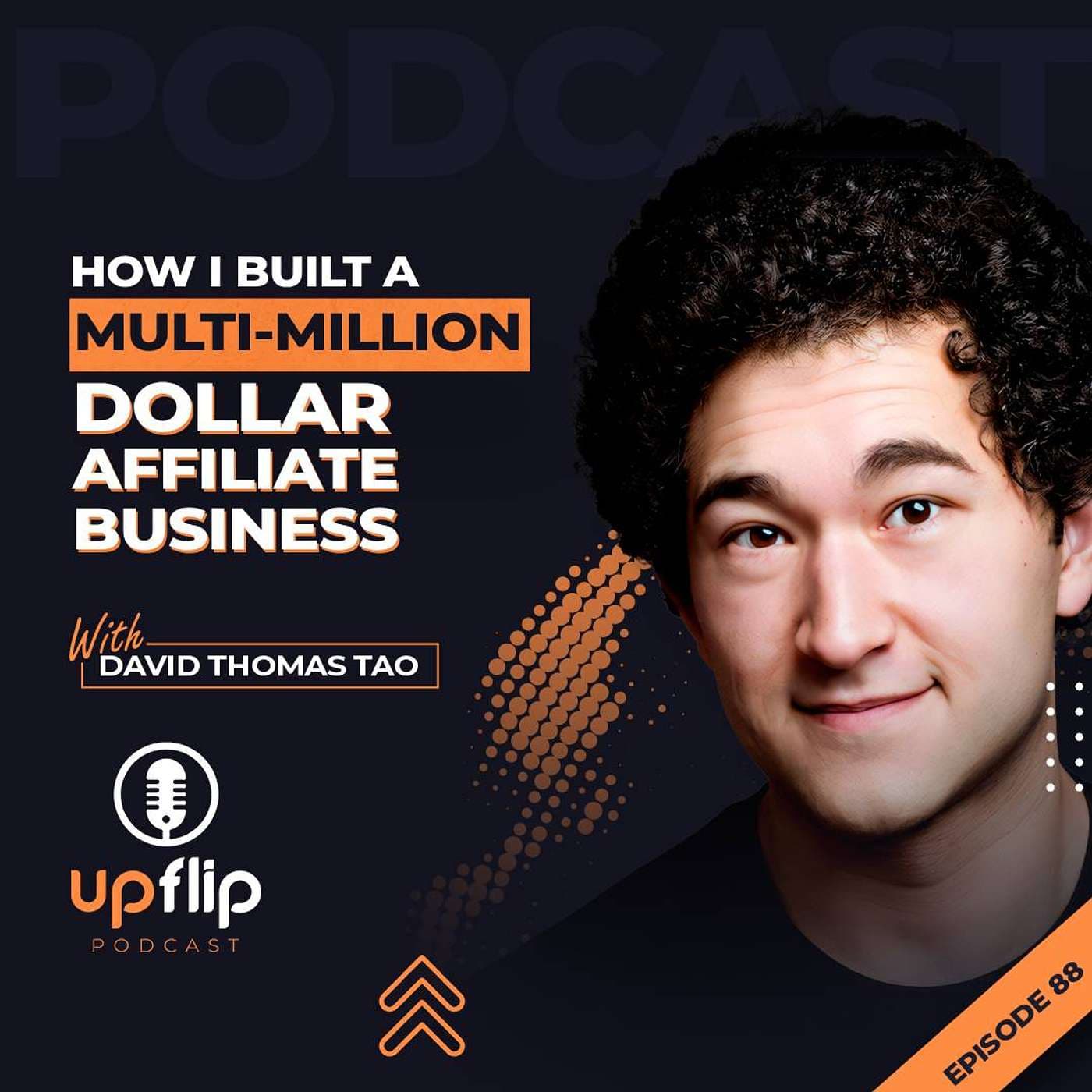
The UpFlip Podcast - Episode 88 Summary
Episode Overview Title: How I Built a Multi-Million Dollar Affiliate Business Host: Alex Freeman Guest: David Thomas Tao, Co-founder of BarBend Release Date: [Insert Release Date Here] Podcast Description: The UpFlip podcast showcases how successful businesses are built and operated, providing practical advice and insights to aspiring entrepreneurs.
---
Key Takeaways
Background
- David Thomas Tao co-founded BarBend in 2016, aiming to create a leading platform for strength training enthusiasts.
- The site reached 31 million users and generated nearly $19 million in gross merchandise volume (GMV) by 2022.
- Tao's passion for weightlifting began after he lost 100 pounds in high school, motivating him to fill the information gap in the strength training community.
Key Concepts Discussed
Starting BarBend
- Initial Strategy: Started as a blog to test organic traction through SEO rather than paid advertising.
- Growth Indicators: Achieved over 20,000 organic visitors daily within the first year, leading to partnerships and increased revenue through affiliate marketing.
Importance of Passion and Authenticity
- While passion for the niche is not strictly necessary, authenticity is crucial for building trust and credibility in content creation.
- Having co-founders with shared interests can enhance content quality and audience connection.
Identifying Market Gaps
- Testing the Market: Tao emphasizes the importance of testing content ideas and measuring traction through organic growth.
- Complaints about underproduction from readers can signal a demand for more content.
Startup Costs and Funding
- BarBend's initial investment was approximately $200,000 from personal capital, followed by $800,000 in seed funding primarily from strategic investors within the fitness industry.
- Tao faced challenges in raising venture capital due to the niche nature of the business, which was less appealing to traditional VC firms looking for tech-sized returns.
Overcoming Challenges
- Tao discusses coping with self-doubt and imposter syndrome, emphasizing the importance of a supportive team and community.
- He urges entrepreneurs to stay connected with peers for guidance and encouragement.
Content Strategy and SEO
- Focused on news-based content during the early stages, leveraging events such as the Olympics for increased visibility.
- Tao asserts that SEO should be viewed as ensuring content is findable, accessible, and useful, rather than a series of tricks.
Achieving Profitability and Growth
- BarBend became profitable in 2020, with growth driven by consistent content creation and strategic hiring.
- Tao reflects on the gradual growth process rather than rapid scaling, focusing on quality and audience demands.
The Role of Partnerships
- Formed a significant partnership with USA Weightlifting, which provided legitimacy and helped drive traffic. This partnership continues to evolve.
Future of Media and Content
- Tao encourages aspiring entrepreneurs that opportunities still exist in the media space, especially within niche markets.
- He warns against relying solely on a single revenue source and emphasizes the importance of diversification.
Final Thoughts
- The podcast concludes with Tao stressing that the content game is not solved. There's still potential for growth and innovation in media startups.
---
Resources Mentioned
- [Join UpFlip Academy](https://bit.ly/4hndySi) - Start your affiliate journey
- [BarBend](https://barbend.com) - Explore strength training content
- [Franchise Guide](https://bit.ly/4aWuGvc) - Unlock proven business models
---
Connect with UpFlip
- [YouTube](https://www.youtube.com/@TheUpFlipPodcast/)
- [Instagram](https://www.instagram.com/upflip/)
- [Facebook](https://www.facebook.com/upflipofficial)
- [Twitter](https://twitter.com/upflipofficial)
For more insights and resources, visit [UpFlip.com](https://www.upflip.com).
---
This episode provides valuable insights into building a successful affiliate business and the importance of passion, authenticity, and strategic growth in entrepreneurship.
Written by AI. May contain mistakes. Listen to the episode to check what was said.
Transcript
Automatic transcript. May contain errors.0:00Seven years ago, three co-founders set out to build the ultimate platform for strength training enthusiasts. In 2022 alone, they had 31 million readers and$19 million of affiliate transactions. I think we need to see SEO less as this black box of tips and tricks and more of a school of thought in making sure your content is findable, accessible, and useful. Don't be afraid to go back with new tools, new expertise, and new perspective and make existing content better. One month of good numbers is not going to convince someone that you're worth a lot of money. But if you show trajectory and growth over years, it will.
0:40Make sure that your business is diversified, right? If all your revenue is coming from a single source, well, that's going to be a little bit less appealing. I'm your host, Alex Freeman, and I'm here with the co-founder of Barbed, undoubtedly the greatest affiliate marketer of our time, David Thomas Tao. David, thanks so much for joining us. I appreciate you having me, Alex. I don't know if I'd say greatest, but I'm very proud of what our team has accomplished in that end. So I'm really happy to be here. Well, I love it. I love the bit of humility there. To get us started, can you tell us how and when you started BarBend?
1:12For sure. Thank you for asking. We started in March 2016. I remember when it went live. And at the time, my co-founders and I, all three of us, were doing a lot of SEO consulting work for clients. And we wanted to shift a strategy toward running and operating sites that we owned. And affiliate marketing was a big part of that strategy and was a big part of our revenue trajectory in that strategy. I am someone who's always been interested in working out. I've had a longstanding relationship with strength sports. I was a competitive weightlifter. I knew the community well. And I thought there was a gap in the market between the information that was available and the information people wanted.
1:49So Barbin started as a blog, really just a small test to see if we could build organic traction. That's really important. Organic traction, not paid. And we basically proved our thesis year one, then decided to go out and raise a small amount of money, which is an interesting story in and of itself. And our team grew from there. And then seven years, roughly seven years later, we were actually acquired. I'm still with the company, not because I need to be. There's no earn out, but because I'm just having a blast. I think we could be the biggest fitness site in the world. I love it. So I'm curious about, you obviously had a passion for weightlifting.
2:20Do you think that's important as somebody kind of looks at this style of business and considers starting it? Should they be passionate about the niche that they choose? I don't think it's necessary, but I think authenticity is very important. And I think the more niche you get, the closer to people's hearts, so to speak, or they're closer to their wallets or their passions, the more authenticity is important and the more it shines through in really great content. So yes, in our instance, it really helped. My co-founders also have interests in physical culture and fitness. For me, strength training was a particular focus and interest.
2:54It was really helpful for us because we were able to position ourselves as the publisher for strength athletes by strength athletes that built a lot of word of mouth credibility. And it really helped us become the publication of record for so much of that space relatively quickly. Now, I think if you don't have a natural passion for a particular subject, but you spot a content opportunity or a gap in the market, I don't think it means you can't go after that. But you do have to find ways or partners or co-founders who are truly passionate about that as a check to build authenticity because that will result in better content.
3:25Now, how do you go about verifying that the gap you're seeing is actually a gap and that there's, you know, demand for that gap to be filled? There are two ways. I'll give the real way and then I'll give the funny answer in a second. The real way is to see if it's a test and see if you can build traction. Now, some people like to test through small paid campaigns. That's completely valid. Some people like to test through organic means, which is more of the focus we had. We were able to see almost immediate traction as soon as we went live. And I simply told some friends I had in the strength industry about it and pushed it out to my social following, which was nothing.
3:58My personal social following is still very small. But we noticed within the first few months, there were certain events that we were reporting on, and that would create a spike in the tens of thousands of readers a day completely organically. And for a brand new site, that's a really good sign. So don't be afraid to test. Don't be afraid to kill your darlings. But I think testing in small scale is something that people can still get a lot of benefit out us. The other marker that I noticed fairly early on is most of the complaints we would get from readers were about us not covering certain things.
4:28Now, we're still not the biggest team in the world. And at the time, we were a very small team. There was a point where I was writing almost all the content that appeared on the site and we would get complaints from folks saying, well, why didn't you cover this event? Why did you cover this event? You know, we can only cover so much. We only had so much bandwidth. But when the main form of complaint you're getting is that you're not producing enough content, that's maybe a good sign. Yeah, I love that. Can you talk about your total startup cost for Bar Bend and what if somebody is interested in kind of going the same organic growth route that you went, what are some of those expenses that they should maybe be planning for and prepared to invest in?
5:01It varies, obviously, for each type of business, even in the content realm, it'll vary from one niche to the next. All in back in 2016, My co-founders and I put up probably around$200 ,000 in personal capital before we went out and raised$800 ,000 roughly in seed capital. I think a lot of it depends on what your initial team is. You know, we had a built-in editorial team. I like to joke when we started because I was it. I was writing sometimes 35 articles a week, really long hours, a real slog, in order to truly test if we could gain traction. My co-founders were taking care of the technical end.
5:34They were taking care of early affiliate integrations as I just started really producing content. And then obviously, as we hired, we were able to spread out that capacity and increase that capacity. So see what resources you have. And then, you know, understand that some tests will truly not get off the ground, at least in the content space, unless you have someone producing content full time. If you don't have that person, that might be your first hire. And that might be necessary to actually see if you have a shot at filling a market gap. Now, I do also want to ask you about that funding that you were able to secure.
6:05But initially, there was a look at venture capital that didn't ultimately come to fruition. Can you talk about that process before we kind of get to the funding that you did actually secure? I appreciate you saying, asking that. You said it in such a nice way. It did not come to fruition. We just failed. We just failed to raise venture capital. We just a big swing and a miss. I think at the time, the climate for venture was a little bit different. We were in a bit of a early web 2.0 boom, I guess you could call it. when people were raising money for content ventures, they were places like BuzzFeed.
6:35They were places like Vice Media. Spoiler alert, a lot of those places are worth less than the money they raised because venture capitalists at the time were looking for tech-sized returns in their content investments. And that's a bit of a rough thesis, right? It's a bit of a rough thesis to think that everything that you start, the content platform you start, is going to be appealing for everyone and it's going to be the size of the New York Times, which is really what a lot of these venture capitalists were hoping. Did not turn out to be the case. And so we were simply too focused, too niche for these venture capital firms and had a lot of very bad meetings and had a lot of very polite and some not so polite rejections along the way.
7:13I imagine that focus and being niche is what ultimately did help you secure the funding that you did secure from other individuals in the fitness space. We did. Now, our seed round was a mix of strategic investors from the fitness space who could see the market opportunity maybe a little better than someone outside of that space. Maybe they were biased or maybe they could see more clearly. It's tough to say which. And it was also friends and family. We really had to, we worked hard to scrounge together that money. And I'm very thankful we were able to. You know, I say scrounge together$800 ,000 or just a little bit over.
7:42That's not chump change. That's a lot of money we were able to secure. That's a pretty big couch if you had$800 ,000 in those cushions. Exactly. That's a lot of money we were able to secure from people who truly believed in us, from contacts and people who had followed me and my co-founders' respective careers, some family members, some college acquaintances. We were taking small checks generally, and we, you know, we worked hard to put that together. At the same time, I'm very grateful because of our personal networks, we were able to secure that funding. And it's not a luxury that every entrepreneur has.
8:11So I do try and retain some perspective there, even though we, you know, failed to raise the institutional cap.
8:44Activision, StartEngine has raised over$1.1 billion for startups of all sizes. They've even raised over$71 million for themselves. Upflip viewers like you and me can now begin investing in startups with as little as$100. Or join StartEngine's own offering with a minimum investment of just$500. Click the link in the description or visit invest.startengine.com. Seize the opportunity and own a piece of tomorrow's revolutionary companies. David, we just kind of touched on failure with the venture capital firms, but obviously there are setbacks of all shapes and sizes as a business owner. How do you get through those moments?
9:19You lean on your team and you lean on your co-founders. That's what I've always done. I'm someone who had a lot of dark moments on the entrepreneurial journey, and some of them were based on self-doubt, imposter syndrome. This scale and scope of barbend got to the point where it was a lot of pressure. We had 31 million readers, over 31 million readers last year. That's a lot of eyeballs. That's a lot of people we're impacting with content. And I constantly question how could we have done better? Are we doing them a disservice because our content is never perfect, even though I do truly believe we are best in class and getting better?
9:50Working hard is unforgiving and it can be bittersweet because there's a lot of payoff, but you will make mistakes along the way and you will have regrets. You will have perspective and say, oh, I could have done this so much differently. I've been leaning on my co-founders. I've also been leaning on friends who I've made along their own respective entrepreneurial journeys. I'm not necessarily anyone who thinks that you have to become part of a mastermind or necessarily, I'm not saying it's bad. I'm not saying it's a bad idea, but I don't think you necessarily have to pay a lot of money to get access to a group of like-minded individuals or for business coaching or anything like that.
10:23Maybe it's useful for some people. It's not something I've done, but I really try not to lose a contact. And I try and stay in touch with folks when I meet people who are on similar entrepreneurial journeys, because even touching base with them and talking about some of these issues that arise and some of the self-doubt that arises makes me feel a lot less alone. And it makes me think that, hey, you know, it has helped me think many times along the way. Maybe we are on the right track, even when that self-doubt wrapped in. I love that. And now I want to kind of shift us out of the failure conversation and the hard time conversation to get to the really great things that you achieved with Barbend and are continuing to achieve.
10:57You know, end of the first year, 1.4 million users. What's the secret? How do we all do that? I couldn't tell you exactly where those 1.4 million came from. And I will say that they were very much backloaded, right? We had many more readers in the second half of that first year than in the first half. So it's not like we started and had 100 ,000 readers in the first month. What I will say is that our timing was fortunate and we learned to capitalize on events. We decided early on that our initial content strategy with Barbed was going to be news based. Now, these days, we write a lot more evergreen content on training, nutrition, reviews as part of our affiliate strategy, all sorts of stuff.
11:33Early on, when I was producing most of the content, we focused on news. We focused on event results. We focused on the sorts of things that I always wanted to get in close to real time, but as a fan of these sports, really didn't have a place to turn to. It just so happened that in 2016, there were a lot of impactful events in the strength sports calendar. That included the World's Strongest Man competition, that included lacrosse games, and that included the 2016 Rio Olympics. I wrote, personally, weightlifting session recaps for every session. I believe there were 16 that year of the Rio Olympics.
12:02Didn't matter what time they occurred. Fortunately, Rio was in a similar time zone to me at the time, so it wasn't so bad. And we wrote recaps and we had the recaps up and ready to go within minutes of the sessions and every single one. And we started getting links because we were putting up these accurate, contextualized event results before everyone else. Before you could get the results on olympics.org, they were on barbed. So we started getting Wikipedia links. We started getting links from other mainstream sports outlets. It made a huge difference. And we learned that we were only going to get so many opportunities in the calendar year to capitalize on that.
12:35And we shot our shot at every one of them. Now I'm going to ask you to kind of take that to somebody who's maybe working in a niche that doesn't have that same kind of built in event kind of momentum that you were able to capitalize on there. What should they be doing to kind of go from that first zero to 10 ,000 kind of phase? I think highlighting stories and content of people who do have followings in the space. I think, you know, you say that they don't necessarily have that new strategy. I think any interest or niche that has personalities, that has people who are either influencers or doing things in the space or making change or pushing a space or hobby or interest forward, there's news in that.
13:15When I first started strength training and lifting weights competitively many years ago, I won't say exactly how many. If you ask people, oh, where do you go for strength sports news? The answer was what? What are you talking about? We tried to define that category and there were some small blogs and there were some forums that where people would post event results. But StrengthsBoard's news was not really a term people were throwing around a lot before 2016 and before Barbin came along, at least not to my knowledge. So when you say, oh, maybe that news opportunity isn't there, maybe double check.
13:47Maybe that's the gap in the field that's missing. Maybe that's the gap. Yeah. Great, great. Obviously, like SEO factors huge into these content based businesses and not to turn this into an SEO seminar. But I guess the question I would ask is what level of expertise should someone aim to achieve in SEO if they want to get into a content based business? I don't know if there's a specific level of expertise. I don't know if there's like a marker that says you are this good at SEO. Feel free to proceed, you know, get out of jail, get out of content jail or something like that. I don't know. That was maybe a terrible example.
14:20But I think that SEO is becoming more accessible. And I think it's something where we can constantly educate ourselves on best practices. And the thing I do like about SEO. So I've been in digital content for well over a decade. And when I got in, SEO was a bit of a dirty word. It was like a lot of stuff that people thought, you know, black hat and gray hat were terms that were thrown around. You know, SEO was something that seemed like it was taking a shortcut. It seemed like it was cheating. But principles of search engine optimization these days, I think, are based around producing quality content for an accessible reader experience.
14:53Is your site loading well on mobile? Is the content readable? Is it informative and actionable? These are all the basic principles of SEO these days. And that's really great. So I think we need to see SEO less as this black box of tips and tricks and more of a school of thought in making sure your content is findable, accessible and useful. And as search engines have gotten smarter, I think that's gotten to be more of the case. And it really excites me, to be honest. So with that in mind, with the idea that the best practices of SEO are create great content, what is great content? How do you create great content?
15:28What are those do's and don'ts for creating content that people want to read and then search engines want to load? Don't lie to people, first and foremost. Write accurately. Write from, if you can get it, from an expert's point of view. Don't misrepresent something or a piece of content as something it isn't, right? If you're writing the ultimate guide to something, you're probably going to have to write more than 300 words. If something needs to go in-depth, work to make it in-depth. And the one answer I love to give to this question is don't be afraid to update your content. Don't be afraid to go back with new tools, new expertise and new perspective and make existing content better, especially if it's evergreen.
16:08That's a huge part of our strategy. We publish a lot of new content, but for a lot of our evergreen content, it's about making sure it's a little bit better every year, getting new expert eyes on it, updating information regarding the latest research because we do write about health, fitness and nutrition. Research is relevant. And the affiliate side, making sure that your products are retested, re-reviewed, reassessed on a somewhat regular basis. All important principles. I just want to ask about the name, Barbend. How did you come up with it? And how important is the name and the brand identity in the building of the audience?
16:44For us, it was crucial. And I wish I had a very glamorous Eureka moment story. But what happened was my co-founder, Kenny, and I had decided that this was a market gap and that we wanted to pursue a site in this space. And we were talking about that on the email thread. And so I started a Google Doc and I just popped some idea names in there as they came to me. And Barbend was the clear winner. I think it was the second or third idea that kind of popped into my head. And the great thing was the URL was available. I think it costs$7. So we kind of had an instant winner on our hands. And in fact, I've looked back at that email thread and I found the first instance of the term barbend to reference what we are.
17:26And that was kind of cool. I think branding is important. And I think that people should often spend a little more time on it because it is very difficult to change a brand mid stride. I think we're seeing Twitter. I mean, sorry, X apparently struggle through that right now. I will say there is no such thing as a perfect brand name. There's no such thing as a perfect brand name. If your brand name is something new, you can do a lot of work to build and shape the perception of your brand. I give the example sometimes Nike conjures an image now, right? It conjures a vibe. It didn't conjure a vibe in the 70s, right?
18:02Yeah. Nike, what's that? People were probably pronouncing it left or right. Nike, what does that mean? It didn't bring the swoosh to mind or anything like that. That company did an immense amount of work over the decades to inform perception of the brand and to change perception of the brand, which is something that can also be done. So branding is important, but it's also something that can be modified and perceptions can be shifted over time. 2017, you became the official media partner of USA Weightlifting. How did you accomplish that partnership? And then ultimately, how did it help Bar Bend grow?
18:33I had a lot of existing contacts in the weightlifting space from my days as a competitive weightlifter. And what was useful was that that helped me get eyes on to Barb End's content very early on within the weightlifting community, which by the way, is still one of these smaller strength sports communities. But within four or five months, we knew that decision makers at USA Weightlifting, at weightlifting equipment companies, impactful and relevant coaches and athletes in the space were reading our content. And so I got a message from Phil Andrews, who at the time was CEO of USA Weightlifting.
19:09Fun fact, he's actually CEO of USA Fencing now, and I consider him a dear friend and it's neat to see him grow so many of these sports in the United States. He reached out one day and said, hey, really loving your content. Good work. I think he even said it, you know, we had a live broadcast or something and he even said it popped in the comments. And I was like, oh, OK, we have something here. And I remember it was over the holidays in late 2016. We were going back and forth and trying to make something work. And I think it was actually Phil who first proposed it because he saw the work we were doing and trying to bring a journalist perspective and a legitimacy to coverage.
19:39And no one had really done anything like this before. So I tapped my business, you know, my co-founder, Kenny, and I was like, Kenny, I know you're with the family for the holidays, but we got to figure something out. And Kenny had some really clever, creative ideas about how to make this partnership work. And by the way, that's a partnership that we've had since then. We've actually re-upped it. So they do partnerships because it's an Olympic sport, most often in four-year cycles. And this is our second four-year cycle with USA Weightlifting. Congratulations. Thank you. And when we started, it lent us legitimacy and we did a lot of content work, a lot of color commentary at events.
20:10a lot of grassroots and ground level work to help bolster USA Weightlifting's media capabilities, that was when USA Weightlifting had more traffic than Bar Bend. Now Bar Bend gets significantly more traffic than USA Weightlifting. And so we're able to support them in a different way by driving traffic and eyeballs to what they're doing while that partnership continues to lend us legitimacy. So this is going to bring us to a section of the show that we call our Fan Blitz Questions. These questions come from our YouTube community. Listeners, you can join us over there at youtube.com slash upflip and post questions to future podcast guests.
20:42David, I've got five questions for you. We're going to try and knock out in about a minute. Are you ready? I'm so excited about this. All right. First question comes from Awesome Profit. How do you continue to innovate to make new content in an extremely competitive space like fitness? We constantly look to other spaces. We constantly look at niches and high performers and niches outside of our own to see what they're doing to try and get a jumpstart on what will be relevant in the fitness community. Kai Shore wants to know, how do you start a content creating publisher company? You're going to probably have to start writing some of it yourself.
21:14So if you're starting one of these, don't be afraid to be a content creator from the get-go. It's what we had to do. And while it isn't a perfect strategy, it worked for us and helped us get to the point where we could hire a full-time team of full-time content creators. How would you feel about working for someone who knows less than you? I'd probably feel pretty good about it because when I was CEO of Bar Bend, I knew less than most of our team members. It was my job to be an intermediary and a communicator. I was not necessarily the subject matter expert. So if it's someone I'm working for who has an open mind and they're good at communicating and they're easy to talk to and they're understanding and empathetic, I think I could really enjoy that, even if I knew more about a particular subject than they did.
21:56What's the most outlandish purchase you have made? I have purchased some very expensive bottles of whiskey. I am on the side of second career. I am a whiskey reviewer and spirits writer for a number of notable publications, which I'm very proud of. And I have spent some amounts on certain bottles of American whiskey that I told myself I never would. So not really holding myself accountable there. What's one sentence you'd like to hear from your employees, people you work with? I'm really glad you started this company. I love it. And that's going to do it for our Fan Blitz questions. Shout out to Jen Chun for leaving us a review on Apple Podcasts saying the guests are really interesting and there's so much to learn from everyone.
Read the full transcript
22:34Thank you, Jen. We're doing our best to keep bringing brilliant entrepreneurs and business owners to share nuggets of gold with you by making knowledge more accessible. David, let's get into the growth phase of the business. You know, you mentioned at the beginning, you're going to end up creating a lot of the content yourself. What were the signs to you and your co-founders that it was time to grow the team at Barbent? When I was completely tapped out and could not produce any more content as kind of a one-person editorial node, that's when we knew it was time to grow the team. And that's really what triggered our fundraising process.
23:06And then as you brought in those people, how did you determine what roles to hire into first? It was all content creators first. We knew, we knew we needed writers and editors. Ultimately, we had basically a car chassis built or an engine built as a much better example. And we just needed fuel to put in that. We needed to see how more content would grow our business. We, by the way, still have not reached the threshold where we write too much content or we write as much content as there is demand. We're still catching up to that seven years later. And then as you brought in those writers and editors, did you bring them in as freelancers, employees?
23:42What are kind of the pros and cons of each model? We had some freelancers early on where I was still the primary writer, but was also editing because we were looking for their perspectives, their expertise. and then we brought on full-time editors and writers in various mixes over the course of Barbin's history. We have full-time writers and full-time editors in-house. We do work with a lot of freelancers. For us, it's really useful to work with freelancers because many of them are researchers, coaches, athletes. They're people who have these niche within a niche levels of expertise and they help us produce the best content.
24:14There's no way we could bring in every single person with every little esoteric bit of strength and fitness knowledge from around the world and hire them full time. We are able to find a lot of those people and work with them on a freelancing contributor basis. So for us, it's a bit of a hybrid model of in-house content production, as well as freelancers who go through our in-house editors. Incredible. That was a fantastic answer. I really appreciated the way in which you went about that. Thank you. I want to ask about the growth period that you've described as the building blocks phase of the business, which is 2017 to 2020.
24:44Can you unpack that a little bit and how you set yourselves up for the growth during that phase? It's tough for me to unpack that only because that period of time kind of blurs together for me. And that's not necessarily a bad thing, but we had figured out our general formula. And for us, it was all about incremental slow growth while doubling down on the same strategy. So we did not hire quickly. We did not dramatically shift our focus or strategy. We just did what we did and we tried to grow and get a little bit better at it, produce a little more content at a higher quality every single month.
25:14Barbend was not profitable until 2020. But in 2017, we started seeing enough revenue such that we knew there was a past profitability. And it was a slow, deliberate march, doubling down on what worked and the strategy we had come across that we thought would help us get there. And so it's difficult for me to unpack certain things. You know, right after we were acquired, I wrote this Medium post, which I know you're referencing, and I created a timeline, a chronology of Barbend. And that was really useful for me because it helped me pick apart certain events during that time period. Because otherwise, it was a bit of a blur to me because we weren't doing anything dramatically different from one month to the next.
25:50We were just putting in the work. We're down in the content minds, as I always like to joke. And we grew bit by bit by bit. once we hit profitability and once we hit 2020, our growth hit a new pace and sped up. And that allowed us to bring on more people to hire for more diverse roles and to really accelerate our strategy. When you're down in those content minds, so to speak, how do you also maintain a long-term vision and not get lost in the weeds of the day-to-day? That's the number one challenge. you know i wish i had the answer to that because i don't because i got lost in the weeds of the day-to-day i had personal relationships suffer significantly during that time period i really did for me covid one blessing during covid covid was a very difficult time for so many people i'm not saying covid was a good time but one blessing was that it gave me a little bit more perspective and being stuck at home i went on a tear in reaching out and trying to reconnect with friends virtually.
26:49I was one of those people trying to organize as many Zoom calls and catch-ups as possible. And it took a world event like that to kind of shake me out of a little bit of a founder's funk that I had fallen into. And I think bringing on and hiring new folks in 2020 to help supercharge our growth, which was picking up at the time, was also really helpful because new perspectives on the team helped give me new perspective and new energy as I tried to become a better CEO. How now have you been developing that long-term vision and how important is it to maintain that long-term perspective? So the cool thing now is that post-acquisition, we have more smart minds than ever doing work on Barbend's long-term strategy.
27:27As a part of Pillar 4, it's all about strategy and execution and a one-two punch. Having really smart folks who have built great brands in the digital media space, there's no better tool to figure out where Barbend can grow, how we can optimize our growth trajectory, and how we can add more fuel to that engine. As far as perspective goes, I think understanding why we've gotten to where we've gotten is also important because our niche has not stopped growing. We have not reached everyone who is a self-identifying member of the strength community. We have a lot of growth to go in niche, even though we are the biggest player in our niche.
28:06And I think that's really important for us to remember. And a lot of the principles that we built our brand on are still in play and still important to capture those eyeballs. Obviously, Barbend operates with sponsors and affiliates as kind of the monetizing model. One of the things that you mentioned earlier as kind of a core tenant of creating great content is don't lie to people. Sometimes those things can feel at odds. So I'm just curious how Barbend looks for sponsors and what is a good match business wise to bring into the fold in some kind of sponsorship relationship. In every industry, there are a lot of lower quality sponsors and potential partners.
28:43That is certainly also true in the fitness industry. So we have to be a little discriminating when it comes to who we work with. So that's just something we have to keep in mind. That's a burden we have to keep in mind. And that just means not being afraid to say no to sponsor partners and potential sponsor partners. And we usually say no more than we say yes. It can be easy to become complacent as a business grows. How do you avoid complacency in what you're doing? That is a fantastic question. And for me, it's often getting back into the strength community and seeing firsthand the impact our content has on people.
29:16So it's going to gyms, going to events, going to competitions, seeing the impact our content has on people, meeting people who got into strength sports or started strength training as a part of a healthier lifestyle because they came across barbend content. For me, that's the number one motivator. And now I want to ask about achieving profitability, which Barben did in 2020. What advice do you have for, I guess, both reaching profitability as a company, but also maintaining the growth prior to that point? Because obviously it can be scary and stressful to be operating a not yet profitable business.
29:48Yeah. Understanding a burn rate and even though not being profitable and being in a deficit month over month isn't the most fun thing. seeing your burn rate go down over time, you can generally guess when you're going to cross the plane into profitability. And that was a motivator, getting that gap smaller and smaller and smaller and smaller, right? Getting the negative number smaller and smaller and smaller and smaller until it's a positive number, that became an obsession for me and my co-founders. And it was a good motivator. And then obviously post-profitability earlier this year, so a few years post-profitability, you sold barbend.
30:20You've made reference to that a few times. What was the kind of deciding factor that that was the right move for you and the business? You know, I think we were getting close to how big we could grow with our existing resources. We were a single company. Profitability could swing significantly based on a single change in a search engine algorithm. Being part of a company like Pillar 4 helps us hedge a little bit. It helps us share resources, share best practices, get a lot of smart minds on barbent. It's immediately helped us grow our team and bring new folks on at a more rapid pace so that we could work to become not only the biggest content producer in strength, but the biggest content producer in fitness in general.
30:58Pillar 4 is a company we had an existing relationship with, my co-founders and I. I've always admired how they do business. I've always admired how they treated folks. And they have certainly put their money where their mouth is, and they have put their actions where their mouth is since our acquisition. I really enjoy being a Pillar 4 employee. And I enjoy how we're treated. I enjoy the attention as given to our team. And they really wanted us not only for our assets, for barbend.com, but for our team, for our institutional knowledge. And treating us like a part and a growing part of their team was really important.
31:28There are a lot of content acquisitions where someone buys a site and they scrap it for parts. People make a lot of money doing that. That's not what we wanted to do with Barbend. We wanted to continue to grow and build this team into the best in fitness. And Pillar 4 was a great home for that. For someone who is either, you know, beginning to kind of look towards an exit for their company, or who is perhaps trying to build a business specifically to ultimately make a sale as their exit strategy, what should they be doing to attract a buyer to the company? Profitability is king, king, queen, everything in between.
31:58Make sure you're built on good business principles, right? Make sure you're built on repeatable business principles. One month of good numbers is not going to convince someone that you're worth a lot of money. But if you show trajectory and growth over years, it will. Make sure that your business is diversified, right? If all your revenue is coming from a single source, well, that's going to be a little bit less appealing than if you've diversified your revenue sources and the ways you can potentially make money as a business. So those are two principles that immediately come to mind. David, if you could pick the one thing that people take away from this interview, what would it be?
32:28It would be that the content game is not solved and the media game is not solved. There's a lot of doom and gloom when it comes to the media business, consolidation, bankruptcies, layoffs. And some of that's very true. I'm not saying that's not true and I'm not saying ignore those things. But I think there are a lot of media and content opportunities still out there. And I think they are in the more niche areas in the digital space. So I am bullish on the potential for media startups. I don't think that they're going to get tech size exits. I don't think you're going to necessarily start a media company and it's going to become a$10 billion company within a few years.
33:02But I think there's a lot of potential, especially for niche audiences and communities. What's your favorite business book and why? My favorite business book and why, there's a book called, and I had it pulled up before here, Radical Candor. And it's actually a book that was sent to me by the CEO of Pillar Fork, Todd, and actually our entire team at Bar of N received a copy of this book post-acquisition. It's by Kim Malone Scott, and it's a book about the way I put it, and this might not be the tagline of the book, it's a book about ideas and how they're presented. Radical candor. You can be critical of something.
33:35You can praise something. What's the right balance there? How do you push a business forward with both of those things with that communication and with that feedback? I've really enjoyed it. I'm thinking about going back and reading it a second time. It might actually be my third time. And it's something that, you know, I'm really glad was sent to me and I'm really glad that everyone on our team has access to. David, where can people connect with you, learn more about you and what you're up to? Well, obviously, please follow barbend.com or breakingmuscle.com It's another site in our portfolio.
34:02People can find me on Twitter. I mean, X, as we've referenced, D underscore Tao. That's D underscore T-A-O. And you can find me on Instagram at David Thomas Tao. Listeners, that's going to do it for this episode of the Upflip podcast. You can find more advice for how to start or grow a business the right way on upflip.com. And if you like this episode, make sure to let us know by leaving a review on Apple Podcasts, David Thomas Tao, barbend.com. Thank you so much for joining us. Thank you for having me. I had a blast. Thank you.
From the publisher
David Thomas Tao co-funded BarBend in 2016 with the goal of becoming the go-to destination for strength training content on the internet. Seven years later, the site had grown to over 31 million users and a GMV of nearly $19 million. He’ll explain how to start a digital media company with this kind of growth potential in this episode.
David fell in love with weight lifting after losing 100 pounds in high school. He had to dig deep through internet forums, social media, and print magazines to find resources and information on the sport, and decided to create an online home for other strength training and weight lifting lovers.
Within the first year, BarBend was being cited by mainstream sports sites and getting more than 20,000 organic visitors every day. This led to a partnership with USA Weightlifting and a huge increase in revenue from affiliate marketing that spurred them on to more growth and, eventually, the company’s sale to Pillar4 Media.
If you’ve wondered how to start an affiliate marketing business that’s actually profitable, or what it takes to launch a new digital media brand, you’ll definitely want to listen to this interview!
Resources:
- https://bit.ly/4hndySi Join UpFlip Academy and start your affiliate journey
- BarBend - Learn more about BarBend and see the content they post on their blog
Ready to be your own boss without starting from scratch? Grab our FREE Franchise Guide and unlock the secrets of proven business models that have already created thousands of success stories.
Connect with UpFlip:
- On Youtube
- On Instagram
- On Facebook
- @UpFlipOfficial on Twitter
For more insights to start, build, or grow a business, check out the resources on UpFlip.com or head to the UpFlip YouTube channel to see more interviews with business owners and experts.
Thanks for listening!


