
In short
UpFlip Podcast Episode Notes
Episode Title
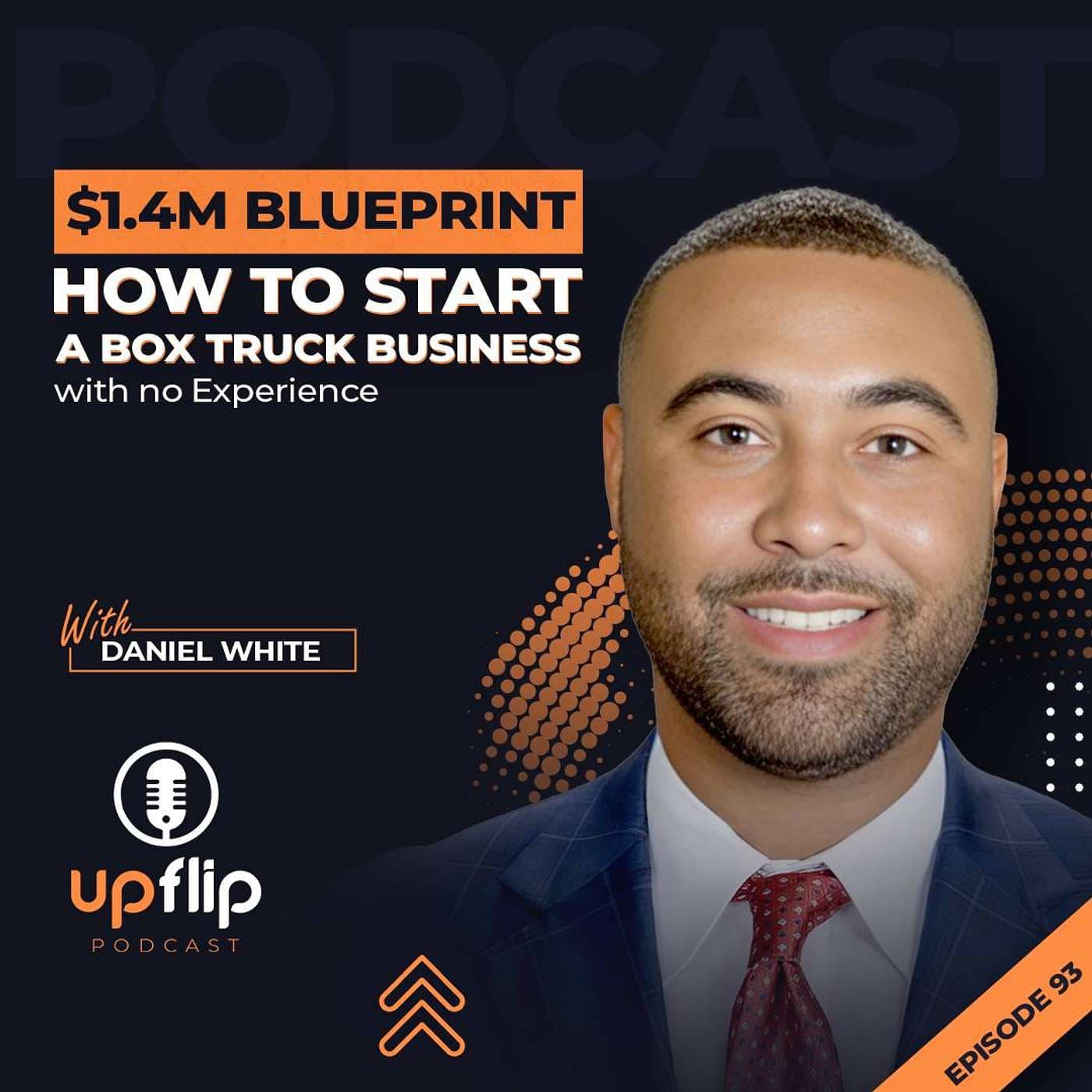
93. Zero to $120K: How to Start a Box Truck Business
Podcast Description
The UpFlip podcast explores how successful businesses are built and managed, providing insights and advice to inspire entrepreneurship.
Episode Overview
In this episode, Daniel White, founder of Bigger Better Movers, shares his journey from running a tech company to establishing a thriving moving business that generates over $120,000 in monthly revenue. He discusses critical lessons learned from his entrepreneurial experiences, especially focusing on customer acquisition costs, niche selection, and effective marketing strategies.
---
Key Themes and Discussions
- Background and Business Evolution
- Previous Ventures:
- Started with an insurance agency, sold it to launch a tech company, which ultimately failed.
- Transitioned to the moving industry in 2017 due to pressing cash flow needs.
- Bigger Better Movers:
- Founded to fill a gap in the moving services market, based on personal interests and industry knowledge.
- Lessons from Failure
- Customer Acquisition Costs:
- Importance of understanding costs in the tech space vs. moving industry.
- Miscalculation of customer acquisition costs in the tech sector highlighted the need for meticulous financial planning.
- Insurance and Compliance:
- Early mistakes included lack of proper insurance, leading to significant fines.
- Emphasized the importance of being compliant in highly regulated industries.
- Niche Selection
- Importance of selecting a profitable niche within the moving industry (e.g., moving hot tubs, pool tables).
- Recommendations for expanding service offerings without compromising quality.
- Operational Strategies
- Hiring Practices:
- Utilizes group interviews and automated responses to streamline recruitment.
- Focus on reliability and the willingness to go above and beyond as key indicators for long-term employees.
- Team Structure:
- Emphasized the need for a sales team, operational manager, and skilled movers.
- Marketing and Customer Acquisition
- Effective Marketing Channels:
- Utilizes Google AdWords and YouTube ads, with a focus on high-quality video content.
- Online booking systems and public pricing to simplify the customer experience.
- Customer Reviews:
- Encouraging reviews through automation and incentivizing staff to ask for feedback.
- Financial Insights
- Monthly revenue averages around $100,000 with profit margins around 17%.
- Discussed startup costs such as trucks, insurance, and legal fees, suggesting that entry into the business could be feasible with as little as $12,000.
- Company Culture and Employee Relations
- Importance of a respectful and accountable work environment.
- Strategies for maintaining low employee turnover by fostering trust and support.
- Future Goals and Expansion
- Plans to expand into Dallas while ensuring the current operations in Oklahoma are solidified.
- Emphasized the necessity of careful, measured growth.
---
Key Takeaways
- Customer Focus: Understanding and anticipating customer needs is critical for any service-based business.
- Technology Utilization: Implementing technology can streamline operations and improve customer interactions.
- Financial Acumen: Knowing your numbers, especially around customer acquisition, is crucial for sustainable growth.
- Team Building: Building a strong and reliable team is fundamental to the success of a service-based business.
---
Resources & Links
- [Bigger Better Movers Website](https://www.biggerbettermovers.com/)
- [Start a Business with UpFlip Academy](https://bit.ly/4fhBp3P)
- [Free Franchise Guide](https://bit.ly/4aWuGvc)
- [UpFlip YouTube Channel](https://www.youtube.com/@TheUpFlipPodcast)
---
Connect with Daniel White
- Instagram: [dwight_405](https://www.instagram.com/dwight_405)
- LinkedIn: Search for Daniel White
Closing Note Listeners are encouraged to leave reviews and feedback to help others discover the UpFlip podcast and to continue exploring resources for entrepreneurs.
---
Thank you for tuning in! Be sure to check out previous episodes for more insights into building and growing a successful business.
Written by AI. May contain mistakes. Listen to the episode to check what was said.
Transcript
Automatic transcript. May contain errors.0:00Imagine you spend two years building a tech company, only to be forced to pull the plug and start over in a completely new industry. That's our guest today, Daniel White, who turned an unexpected pivot into a$120 ,000 a month moving business. Last year, we made about a little over$300 ,000 alone just on online bookings. Google AdWords, what I enjoy about those, it's almost like a toggle, right? If it's a slow month and you need more leads, you just increase your ad spend and the phone will ring a little bit more. If it's busy and it's big season, you turn it down and the phone will ring a little bit less.
0:32So offer as many services as you can to the largest geographic territory without jeopardizing quality. And then I'd also recommend that you find a niche in the moving industry. For example, like hot tubs, pool tables, workout equipment. You know, you can move one hot tub for$500 to$1 ,000 and you can get really, really good at those. I'm your host, Alex Freeman, and this is how you start a box truck business with no prior experience. Daniel, welcome to the show. Thanks for joining us. Thanks for having me on, Alex. Look forward to it. Let's start out with the background. When and how did you start Bigger Better Movers?
1:06So I started Bigger Better Movers in 2017. I started it after I lost, like you said, kind of big on a tech company, serial entrepreneur at heart. And so I've had five different businesses and five different verticals. And I started in 2017 after I lost big on my tech company. And honestly, my back was against the wall. I needed to find a way to create cash flow. And I sat back one day, I was with my buddy at a restaurant and trying of figured out a way of what kind of businesses that I did like. And I knew that I did like service-based businesses over product-based businesses and the type of people I knew.
1:35I used to be in the insurance space as well. And I knew a lot of insurance agents, mortgage loan officers, everybody that was involved in a real estate transaction. And we're just trying to think about where I could possibly fit into that. And also what people did not like to do that also wasn't oversaturated. And I came up with bigger, better movers. I love it. I don't want to dwell too much on the tech company, but I do want to ask what lessons you learned in that failure that helped you succeed with Bigger Better Movers. It was a lot. The main one that I learned that's, I think, applicable to any business is you have to know your customer acquisition costs.
2:07And so something as small as that, I'm miscalculated. And when you're in the tech space, you compete with the same keywords, even though I'm not selling insurance, as State Farm and Liberty Mutual. And those keywords are about$150 a click. As you know, generally 10 to 1, I might convert after every 10 of them. And so it was$1 ,500 to potentially get one customer and just didn't calculate it right. So I learned that moving forward to make sure that I do know what it costs to obtain a customer in the moving space. And it's a lot less than that. And obviously, I'm sure getting bigger, better movers off the ground was not without its own mistakes, but what were some of those early mistakes as you moved into a new vertical?
2:44One of my biggest mistakes in this one, and I knew better, but I didn't have the right insurance in place. And so the reality is my work comp, I didn't have it in place and we were hiring a bunch of people, you know, just going about day-to-day business. And if you don't have a, as old saying, it says, if you fail to plan, you plan to fail. And so we went into this business and I didn't have the right insurance in place, like I mentioned. And work comp in the state of Oklahoma actually carries a thousand dollar a day fine for every day that you don't have it. And so I ended up going 415 days without it.
3:15And the state came with a$415 ,000 fine. I was having them to pay. They end up selling for about 11 ,000 of those dollars rather than 415 ,000. But it was a big mistake that I learned early on that, you know, and especially to play like in the space that we do now with a lot of commercial accounts and interstate commerce and things like that, you have to have everything by the book above board and you have to be licensed and bonded and everything like that. So it's a mistake that I don't make ever again. So I guess the question that I want to ask is because obviously, you know, if somebody's moving into a new vertical for them, they're moving into a new industry, they might not know all of the ins and outs.
3:47And some of those things come with massive expenses. How would you recommend kind of navigating that not wanting to overspend in a startup with, you know, making sure that you're doing everything that you need to be doing by the book? How does somebody kind of walk that line? I think priorities and how do you prioritize things, but there has to be a level of priority, right? And so what I mean by that is like insurance is definitely a priority. Gas is definitely a priority. However, maybe having the fanciest best website and professional photos may not be on as high on the priority scale. And so everybody, no matter who you are, only has so many dollars to allocate towards any venture.
4:24Whether you got a$10 ,000 investment or a$100 million investment, you still only have so many of those. And so prioritizing things and putting them in the right place to really make sure that you're putting yourself in the best position for long-term success is going to be the best way to be able to do so. Why the moving company niche? Why did you move into that niche after the tech company? So I used to be in the beer business and it was a product-based business. And so I kind of got my first taste of logistics, meaning even pre-COVID, right? There was supply chain issues. So you get hops from Oregon or Colorado or California, and then you got PacTech lids and this stuff will come in from all over the country to make one can of beer.
4:59And so with the product-based business, I wasn't a huge fan of it. Service-based business from my insurance days, I enjoyed the space of which I could essentially sign a contract or get you to agree to a service over the phone. We provide that service. And after that, there's little follow-up or service that's actually needed, right? It's a long-term relationship in the sense of the actual transaction. It's relatively quick in the grand scheme of things. And so it was something that was low overhead. It was slow barriers to entry, something that nobody really likes to do. Even my guys don't like moving sometimes and people are willing to pay for that service.
5:30From the research I did, it was also recession proof. And it kind of proved that as well through COVID, that is still a necessity for what we do in the business. And so I tried it. I figured that if it did not work, I'd be able to recoup about 80 % of my investment, unlike my tech company. And so, you know, the truck was about 80 % of my initial investment. If it didn't work, again, it was low risk. I'd be able to get back out of it and try something different. So obviously the truck being the major initial expense, what are some of those other costs to get started in a box truck business? Yeah, some of the main ones are going to be, of course, your insurance.
6:01It's going to be your truck as well. And then licensing and legality. So essentially incorporating the LLC, paying for any interstate license if you choose to do so. Your insurance is pretty expensive. It's generally about even work comp itself is about 10 % of payroll and you need to have that from the first day that you have an employee as well. So insurance is your big one. And whatever you tend to do on where you're going to park the truck, especially where you live. Maybe if they have an HOA or something a lot of neighborhoods frown upon, you having a big old box truck sitting outside of your house, right?
6:30So you probably got to secure a facility or a yard up front to make sure that you do have a place to put that as well. Now, what advice might you offer for somebody who's looking at their finances, wants to get into the moving industry, but maybe doesn't have the cash together to go buy a truck, what advice might you give them to get started in the industry with kind of a low upfront cash investment? Yes. On a positive standpoint, I mean, a lot of people, like for myself, I started Bigger Better Movers around$12 ,000. I spent about 8 ,500 on my first truck and the other 3 ,500 or so was about on legal fees.
6:58But for sure, with less than 50 grand, you're in, you're rocking and rolling. That's more than enough capital. Most small businesses, not just in this space, they're going to be started either by some form of credit card or personal loan, especially if you have decent credit, it might be easier than you think to get a loan on a box truck. And again, that's majority of your capital expense. The other$3 ,000,$4 ,000 you need for legality and licensing, hopefully, and again, depending on your financial situation, credit cards might be an option for you. It's worked for me for several businesses that I've started myself.
7:26The other options might be Penske, Ryder, some of these large fleet corporations. They do have weekly and monthly rental or lease agreements that you can opt into with them. I would caution anybody to do that. They are pretty expensive. They do have mileage and a lot of hidden fees as well, but it is an option. If you are really directed towards the box truck or transportation industry, that might be a valid option for you also. One last little quick look at the numbers here before we move forward in the interview. What's the revenue looking like in an average month now, and what kind of are the margins on that?
7:59With the current economy, the moving business is very related to macro and micro economic events, meaning it's responsive to COVID, it's responsive to inflation, it's responsive to interest rates, especially on homes right now. And so there's not a lot of homes being built and there's also not a lot of people buying new homes. And so right now, average, we're about a hundred grand a month in Oklahoma City area. The profit on that's about 17%. I actually just looked our year to day profits about 17 % on what we're making on our dollars. Listeners, you can find more actionable advice on the Upflip blog, including our 2023 ultimate guide to how to start a business.
8:34Go to upflip.com slash blog. Daniel, how many employees does Bigger Better Movers have? What are some of those crucial roles in a moving company's team? Yeah, so we've got about 20 to 25 employees, just depends on the week and what happened last week before. But sales, operations, you need drivers, and then you need lumpers or household good movers. There's really only four things that you need in the business. And so for me, I value my time very, very highly. So I do not do any sales or operational endeavors. So I have a full-time sales guy. He handles all sales, pricing, logistics, my operational manager.
9:08He deals with everything from firing, hiring, training, customer service, complaints, dispatching, go down the list. And then you got to have somebody to move your trucks, right? Safely to the customer's house and also be able to load and stack those trucks to oversee everything going on in the field and make sure everything is padded and wrapped for company policy. So my team leading drivers will be responsible for that function. And they're the highest ranking infield manager on site. And then they'll oversee my household good movers. Those guys will actually be the ones padding it, wrapping it, taking it out to the truck, doing a lot of the heavy lifting for us to make sure we get all those items safe and secure in the trucks.
9:43Hiring has been a big challenge for a lot of businesses the past few years. What's been your best strategy to find and hire great employees? For us, I really enjoy Indeed. There's a lot of hiring apps out there that you can utilize. But for us, Indeed's been great. I actually do something called group interviews. And so what we do is every Wednesday at 10 a.m., we invite everybody in. That's the only day, that's the only time that we conduct new interviews for team leads and household good movers. We have automation that we have implemented on Indeed where it's literally click to respond. And so when somebody applies for our job, instead of typing out very long, lengthy responses, we're clicking it and we're sending it back out to them.
10:22And then we invite them into our facility. and it's Wednesday at 10, Wednesday at 10, and we go down the list, we'll invite 30 people in knowing 10 to 12 might show up and we'll hire three to five of them. And then every week we have three to five fresh new bodies ready to work and excited about the opportunity. But it's really cut down the amount of time that has taken us in the recruiting process and the hiring process and it's been really effective for us. That's a really interesting strategy with what sounds like fairly high turnover at the entry-level jobs. How did you arrive at that system?
10:53Good question. So actually during COVID, they were doing like hiring fairs, right? Because nobody wanted to work during COVID. And I personally went to this hiring event. I sat next to a lady at the booth who was in HR for 20 plus years. And she kind of told me about these group interviews and how she does it. And she told me, hey, instead of using all your time and resources to meet people on their time, make people meet you on their time. And so they meet me every Wednesday at 10 a.m. And again, just it's a numbers game, right? It's just like sales. You You get so many leads, they convert to prospects and you just take them down this funnel.
11:26And then with the people that we do hire on Wednesday, we do group training on Thursday. So instead of something that used to take 10 plus hours a week, it literally takes an hour and a half of my time on Wednesday and two hours on Thursday. And we've got three new people hired, ready to go and train for every Friday to get back out in the field. And then what are the signs that somebody has long-term potential with the business? Obviously, you know, they keep showing up, they keep sticking around, but what are some of those things that you're looking for and you're going, oh, this is a great, this is like the top talent.
11:54We got to keep them in the company. It sounds so simple, but literally showing up and being on time. The guys that are self-sufficient and willing to do more than we ask, it's so rare. I mean, talent to me, the most skill for people mean absolutely nothing. If at the end of the day, you can't come in and there's always an excuse. And every time we give you a job, you always have something to complain about. I see a lot of value in people who are less talented because just like with anything, whether it's sports or insurance or moving, I can teach anybody any skill in any of those industries. But what you can't train or what you can't replace is the reliability to showing up on time and the fact that they want more for themselves and where they're at today.
12:35So how would you describe the culture at Bigger Better Movers? And is that something that you built intentionally? And how'd you go about doing that? I'd like to think that I did. And it has been intentional, at least on my part, but I'd say it's fair, it's accountable, and we're very respectful. I actually had meetings this week And just a little bit about me and my background. He's played basketball in college. And I had a coach who every day he'd come in the gym before he would even acknowledge us as human beings. He would simply blow the whistle and tell us to get on the line. Right. And so even though I was on a four-hour scholarship, I always felt so disrespected at the fact that like we were here.
13:07I'm in front of you. I'm a person I'd like to, you know, at least be acknowledged before being told what to do. And so every day in my business, if I'm there in the morning for dispatch, I physically look my guys in the eye. I tell them good morning and I give them a quick look fist bump, you know, and just acknowledge them, tell them thanks for what they're doing and things like that. And we've got very low turnover, especially since the pandemic. It's been our lowest turnover since we've implemented a new manager, but we treat everybody with respect and also like adults. And so we do hold people accountable, but we do give a little bit of leniency at the same time.
13:37I want to talk about some of that lead generation and marketing aspect of the company. What are your go-to tools or strategies for marketing the business? And how are those helping you reach more customers? Probably like a lot of people, most people are familiar with Google AdWords and SEO. We utilize both of those. What I'm relatively new to is YouTube ads. And so we have professional videos that are actually like on TV and we've utilized those and also posted those on YouTube. I've been very, very surprised. They've been running about six months. I pulled some numbers before this show today and our interaction rate with YouTube ads is at 72%.
14:11Whoa. To put that in perspective, my best Google ad interaction is at 34 and that's my brand Google ad. If someone's physically searching Bigger Better Movers and a Bigger Better Movers ad pops up on top of it after you already searched it, that interaction is still only 34%. My YouTube's at 72. It's one cent per view of what I'm paying. And then we also offer free online booking. So of course it has a call to action on the ad. If you click it, I mean, they go straight to it. Last year we made about a little over$300 ,000 alone just on online booking. So people finding us online, feeling comfortable enough with the information we provided and the prices that we've shown that they're able to make a buying decision without ever talking to a person in the moving business.
14:52I think that's a win. So, I mean, it may be still a little early to kind of have the fully formed answer here. Yeah, that interaction rate is incredible on the YouTube ads. What do you think you're doing that is helping you achieve that rate? It's a great question. I give credit to the company that shot the video. Like I said, it's literally a TV rated commercial. It's not spammy. It's not clickbait. It looks good. I think everything about it is screams professionalism, especially in moving, right? Like I know that we're in the blue collar industry and there's not a lot of professionalism. So if you ever see the ad or I'm happy to send it to you later, it doesn't look like a movers commercial.
15:26It looks like a nationwide high-level commercial that if you were thinking about moving, you'd probably be interested in at least learning more about our product or service. What is the typical ad spend in any given month? I mean, obviously, YouTube seems like a very excellent return on investment there, but what are kind of the best returns on your investment? So YouTube, we spend about$500 a month in YouTube ads and about$2 ,500 for Google AdWords. Angie Leads, when I was actually doing sales before my sales guy in, I really enjoy Angie Leads or what used to be Home Advisor. When I was selling them, my return on investment was 900 to 1100%, meaning every$100 I'd spend, I'd make$1 ,000.
16:05Those are my absolute favorite. But right now, Google AdWords, what I enjoy about those, it's almost like a toggle, right? If it's a slow month and you need more leads, you just increase your ad spend and the phone will ring a little bit more. And if it's busy and it's big season, you turn it down and the phone will ring a little bit less. But you're able to adjust in real time. And again, like I say, real time, 24, 48 hours, you already see the effects of what that adjustment looks like. You've also been able to get more than a thousand reviews from customers. What's your advice on encouraging more customer reviews as a service based business?
16:35Yeah. So I think there's like 75 percent of people surveyed actually said that they'd be willing to leave a business a review. And the one differentiating factor, the stipulation was if you asked. Right. And the thing is, businesses don't ask. And I think also business owners think that you have to ask in person or face to face. And that's simply not true. You can ask a variety of different ways, just like we do. And so we ask via email, via text message, and then our guys get compensated in our field. So we talked about the four different type of people it takes to run a moving business. And so our drivers get compensated$20 for every review that they ask, which also incentivizes them to provide better service, which probably also increases the amount of tips that they get.
17:16Right. So you're getting paid twice over again from me and then from the customer, because if they probably left you a five star review, they also tipped you for your well done service. And then we use a company called Nice Job. And so Nice Job integrates with our CRM via an API. And so that API connects to where when the guys hit finish on the job, it automatically enters that customer into a drip campaign. And it's a five step drip campaign. And again, it's a variation of text and emails. And it will literally continue to ask you until the fifth one is exhausted or until you actually leave the review through the CRM.
17:49So this is going to bring us to a section of the show that we call our Fan Blitz questions. These questions come from our YouTube community. Listeners, you can go join that community by going to youtube.com slash upflip, and you can post questions to future podcast guests. Daniel, we're going to try and get through these six questions here in about a minute to 90 seconds. Are you ready? I am. All right. First question here from Cold Lunch. How do you get over the fear of jumping into a completely different industry on your own? You know, the first thing that comes to mind is a quote, and it says, you know, a bird that sitting on a tree is never afraid of the branch breaking because the trust is not on the branch, but it's rather in its own wings.
18:25And I think getting into any industry for the first time will be difficult, but your fears are minimized by your ability to just make things happen. And if you've been there before, then you're familiar with any scenario. Gregory Marsh asks, have you entered the moving business space trying to do something completely new and revolutionary, or have you taken the approach of simply being better than the competition in various ways to survive and thrive. Yeah, so I definitely acknowledge that the moving industry is old and it's outdated. We've tried to implement technology to reduce friction and improve the buying process when moving.
18:56And so we do have publicly posted rates, free online booking, text and email confirmations. Those are some ways that we just try to differentiate ourself in the industry. James Hedini is asking, with the moving industry supposedly taking a loss in the future, how will you adapt? Yeah, I mean, the moving industry has already showed comparatively slower from the last five years with interest rates and inflations, but we will continue to be creative and utilize technology to increase efficiency and improve on old industry practices. And the good thing is whatever I have to deal with, so do my competition.
19:25So we will adapt accordingly. Mango Sticky Rye is asking, where can you find the best dispatchers and brokers who are fair, who aren't trying to take all your money? Dispatchers and brokers really aren't related to the actual moving industry, but rather like freight. But I know on the DAT load board, you are able to have reviews on brokers and dispatchers, and maybe you could look at their reviews there before actually deciding to do business with them. Josh Lopez is asking, what's the best way to find success, especially for teens, say like 17 to 19, who have no idea how to start or how to manage time and money efficiently?
19:59How does somebody get to where you are when they're 17? Especially at that age, you know, I utilize Google and YouTube to increase your knowledge in the industry, follow podcasts, literally just like the one that we're on today. And some of the best lessons in your life you just got to remember are the ones that you learn yourself. So sometimes it's hard to forget those and find a mentor. I had one that told me you can get it wrong like a hundred times, but you just got to keep trying. If you get it right once, you'll retire it. So like don't give up, keep trying and try to learn as much as possible at that age.
20:26Last one here from Jump to the Moon says, the revenue is good, but what's the actual monthly profit after overhead and general expenses? Yeah, for us, like I mentioned earlier, It's about 17 % right now on average in the industry, 15 to 20 % usually what's seen as good. That's going to do it for the FanBlitz questions. Listeners, you can help other aspiring entrepreneurs discover the Upflip podcast and learn how to start and grow a business from our guests by leaving a review on Apple Podcasts or rating our show in the Spotify app. Daniel, I want to kind of follow up what we were talking about before the FanBlitz questions of the customer reviews and kind of ask about customer service.
21:00But first, can you kind of talk us through the different types of services that you offer and what are the most popular and what might be the most profitable? Sure. So we offer moving, packing, storage, including overnight storage. If you don't close on a house the same day, we're able to store it overnight. We also do furniture assembly and then intra and interstate moving. So anything locally within the state of Oklahoma, in either Tulsa or Oklahoma City Metro. And then we offer interstate moving, just meaning you're moving across state lines. The most popular is our local moving services. So generally no packing, just moving and somewhere around the general metro.
21:35And then our favorite and also our most profitable would be interstate moving. And so it is the most profitable. It's also the highest risk, but the guys enjoy it the most. And so do we. What are the pros and cons of kind of offering that range of services as a moving company? One of the main ones is you could definitely spread yourself too thin. And if you spread yourself too thin with limited knowledge and limited resources, you could definitely create a lot of negative experiences that will be reflected online in your reviews. You know, I think on a positive note, it does give you the ability to reach a lot of new customers.
Read the full transcript
22:03And what I mean by that is, you know, maybe do a small furniture assembly job for$200 to somebody that just had some type of Bowflex or something delivered in their home. But in a year, they're moving at a 5 ,000 square foot house. And so, you know, on a positive note, you can do a low hanging fruit service, but then it might translate to something better. better for you in the future. What is the differentiator for bigger, better movers from other moving companies? And why is that giving you a competitive advantage? It sounds simple, but again, we utilize technology just to reduce friction in the buying process.
22:31So we offer publicly posted rates online. We have free online booking. People are able to find our website, have enough information and select a date, time that they like services done and do everything online without ever having to talk to a person. And how are you maintaining excellent customer service? Once they have booked? What are the main things that you're doing to make sure that every customer leaves happy and satisfied? Yeah. So like I said earlier, we always ask people for their feedback in the form of a review. They get into a drip campaign. We ask using technology. We don't physically follow up with a phone call.
23:03If you can imagine, like every time, let's say you checked out of Amazon and you went to Trader Joe's and went grocery shopping and they called you the next day to see how well it was at your grocery shopping experience. It would be annoying. Nobody wants phone calls. But it is important that you ask and it is important that you have a platform for your customers to vent or be able to reach out to your company whenever they do have an issue. And so we utilize, again, automation to be able to enter them into the trip campaigns, ask them how their experience was. If they want to do it publicly, they can do it on Google.
23:31If they want to do it privately, there's also platforms on our website that they can leave feedback. And then we also have a claims form online as well that they have access to if there is any damage that occurs. If something is damaged or if a customer is just kind of unhappy for other reasons, what then do you do as a company to follow up with them? Yeah. So we always follow up with our customers to the best of our ability. We always explain we have a repair-replace policy. So like anybody, we're going to take the most cost-effective way for us to be able to do that. We have a policy, a contractual agreement in place.
23:58Again, it's kind of a CYA. Just in America, you got to have something to make sure that you dot your I's and cross your T's. But regarding the policy, we also use the human factor. And so if something makes sense or doesn't make sense, we work with our customers to satisfy them to the best of our ability to make sure that we meet their expectations and replace whatever items we broke to the best that we can. Looking towards growth, let's say someone listening to this just started their own moving company. They want to hit six-figure monthly revenue as quickly as possible. What steps should they be taking?
24:26I definitely recommend opening up your service offerings. So offer as many services as you can to the largest geographic territory without jeopardizing quality. And that's the big one. Like don't jeopardize quality or service trying to offer too many services. But if you have a good team, if it's within your wheelhouse and you're able to service those people effectively, definitely open it up services and geographic territory. And then I'd also recommend that you find a niche in the moving industry, for example, like hot tubs, pool tables, workout equipment. You know, you can move one hot tub for five hundred to a thousand dollars and you can get really, really good at those.
24:59Same with pool tables. And you don't have to compete with everybody else, just moving general household goods. But you can specialize in specific items as well. What is the biggest challenge of growing a service-based business? And what advice can you offer to overcome that? The most difficult that I found is going to be the people, having a good team. My team, just like any other mover, is full of blue-collar workers. And a lot of those guys live paycheck to paycheck. They have either no or limited higher education. And many of them are more concerned about making sure that their rent is paid or their phone doesn't cut off on Friday.
25:31And so it's hard for them to focus on exceeding customer expectations. when they have other real life issues that they have to tend to at home later on. Right. And so just making sure that they buy in not only to your vision, but making sure that they know that you're in it and you see their vision as well. I like to be their partner. I've helped countless guys on my team, whether it's like with a cash advance or being there when a family member dies or making sure that they know that not only myself, but also Bigger Better Movers does have their back. They get into any type of issues financially, anything like that.
26:00We got their back just like we want them to have ours. And in turn, our customers feel that effect as well. As you mentioned earlier, you operate in two cities, Tulsa and Oklahoma City. Why first? Why did you choose those two spots? And what are the main factors that someone should consider when choosing a location for their business? So Oklahoma City's home for me. I've been here my whole life. I'm 33 years old. So that was obviously the first place that I'm going to go. I have a pretty good natural market here and a lot of referral-based business. Tulsa was my second option. I was going to do Dallas, which is about three hours south or 180 miles.
26:31But if something happens, figuratively, if there's a fire I got to put out, I'm not able to get to Dallas and back in any relatively short amount of time. Tulsa's close enough. I can get there and back the same day. It's easy for me to oversee it. And it gives us a chance to actually work out and make sure that our systems and processes that we've created in Oklahoma City are actually as effective as we think they are with the new location. And so Tulsa is kind of that second one for us outside of Oklahoma City. Any plans or eyes toward future expansion? Dallas will be our next one. And kind of like I mentioned before, I'm big about level of service and quality.
27:05And so I don't want to go too fast. Entrepreneurs get in trouble for trying to move too fast and expand. So I want to make sure Tulsa's right. Probably within 18 to 24 months, we'll start putting our eyes on Dallas, but I got to get Tulsa up and going first. What's been your lowest point as a business owner and how'd you get through it? Man, when I lost my tech company. And so I lost well over six figures developing this technology. I put my life in it. I put eight months doing the website and a lot of money in it. And I literally had to restart. So when I sold my first business in my insurance company, I had to sell my Mercedes, I sold all my motorcycles, I sold my investment properties, and I literally went back and I bought a Honda for$6 ,000 in cash.
27:42I still got the Honda today. I got three months behind on my mortgage. It's an FHA loan. So if you know anything about those, if you miss a payment, you can't make a partial. They make you make every single payment plus the current one. so they don't go to foreclosure. My credit score dropped by a couple hundred points. I defaulted on the business cards that I was a guarantor on, all of that. And I knew I would make it through the valley, but it was deep and it was dark. And I told myself moving forward that whenever I started Bigger Better Movers, I didn't want to be a serial entrepreneur anymore.
28:12Meaning sometimes people think that when you have all these different businesses or titles that it sounds sexy, but at the end of the day, what's sexy is making money. And so if you're not making money, there's no reason to have all the titles. And so with this new venture, I just went one inch wide and a mile deep and I hyper-focused on one thing and I'm coming out on the other side. So you're still driving the same car, but how else has your life changed since you started Bigger Better Movers? It's changed a lot. And I still have the car, but I got a newer one and a better one. But I keep that car just as a reminder of why I bought it initially.
28:41It's changed a lot over the last five or six years. And so as I've gotten older, I see a lot more value in time than not doing dollars. And so I've been able to get substantial amounts of my time back. I've strategically built Bigger Better Movers to remove myself from any day-to-day operations. And I only have to work on the business and rather than in it. So again, I built a really good team. I'm able to travel. I work out often. And those are two of my favorite things. So right now, life is good. I'm very appreciative for the opportunity to have in front of me. Knowing what you know now, is there anything you would do differently if you could go back and start Bigger Better Movers again?
29:14I don't have any regrets. Like I said, I'm thankful for the opportunity I have in front of me and what the future holds. I'm excited about continuing to grow and open new locations and building a team. You know, it's all about investing in people and giving people the opportunity to do better for themselves and for their family. And so it's been really good. We service people again, internally on my team and externally to customers. And I've really enjoyed it. You mentioned that you've been working to kind of build the business in a way that you're able to kind of be, you know, you're not in the business every single day there, but obviously it's still a lot of things competing for your attention.
29:44You've got Tulsa getting up and running. any number of daily fires, how do you stay motivated and focused on the right things? I learned several years ago that no is my safe word. You have to get comfortable with saying no. If you say yes to one thing, you essentially are saying no to another. And what I mean by that is if I agree to meet for a beer after work, I simultaneously just said no to going to the gym or getting a head start on tomorrow's to-do list or any other list of items that I may have on my agenda to complete. And so I protect myself and my level of focus by literally implementing that word no.
30:17And people either agree with it or not or be upset, but that's their problem. That doesn't have anything to do with me. And I focus on what I need to focus on most. If you could pick the one thing that our listeners take from this interview, what would it be? I'd tell them if you think you can or you can't, you're right. Just remember that no one believes in you until you believe in yourself. I'd tell everybody to keep trying. And like I said earlier, You can fail 100 times. You just have to get it right once to retire rich. The only difference between myself or anybody else that may be of perceived levels of success is that they just didn't quit.
30:47Everybody failed if they said they didn't. They're lying. But just keep trying. And at some point, something will work out for you. What's your favorite business book and why? My favorite? I didn't want to recommend one that everybody else usually says. So I have a great one. It's called Exit Rich by Michelle Seeler. It basically begins with the end in mind. So it talks about building a business to then pivot out at the end. Most of us entrepreneurs, our business is our retirement plan. And so you want to build a business that a one day would, of course, be of monetary value to somebody else to come in and purchase it.
31:19And you can sell off happily ever after. That book really teaches you the foundation of building a business that somebody else would eventually come in and be willing to purchase. Daniel, where can our listeners connect with you and learn more about Bigger Better Movers? You can find me on Instagram. it's dwight underscore 405. You can find me on there. And then LinkedIn or Facebook is just Daniel White. That is going to do it for this episode of the Upflip Podcast. Listeners, if you like this episode, make sure to check out the show notes for the link to episode 28 featuring a 19-year-old who started a 75K a month trucking business and shares how he did it.
31:53And don't forget to leave us a review on Apple Podcasts, and we will see you next week. Daniel White of Bigger Better Movers, thanks for joining us. Thanks, Alex. I appreciate the time, sir. .
From the publisher
Since it started in 2017, Bigger Better Movers has grown to more than $120,000 in monthly revenue. Founder Daniel White explains how to start a box truck business with huge growth potential in this episode.
A moving company wasn’t the first business Daniel founded. He started with an insurance agency, which he sold to start a tech company. Two years later, he had to close the doors of his online business. He’ll share the mistakes that led to his tech business’ failure, how he recovered from it, and what he learned in the process that helped him find success with Bigger Better Movers without having prior experience in the moving business.
Finding the right niche is critical to success in any industry. We’ll get Daniel’s advice on choosing the right niche for a box truck company, as well as how he uses Google Ads and other marketing to connect with his target customers. Systems are a big piece of the puzzle for this moving company, too, and you’ll hear how they keep their operations running smoothly so they can provide the exceptional service that keeps their customers coming back.
Resources:
- https://bit.ly/4fhBp3P - Start a business with UpFlip Academy
- Bigger Better Movers - Learn more about the company on their website
Ready to be your own boss without starting from scratch? Grab our FREE Franchise Guide and unlock the secrets of proven business models that have already created thousands of success stories.
Connect with UpFlip:
- On Youtube
- On Instagram
- On Facebook
- @UpFlipOfficial on Twitter
For more insights to start, build, or grow a business, check out the resources on UpFlip.com or head to the UpFlip YouTube channel to see more interviews with business owners and experts.
Thanks for listening!


