
In short
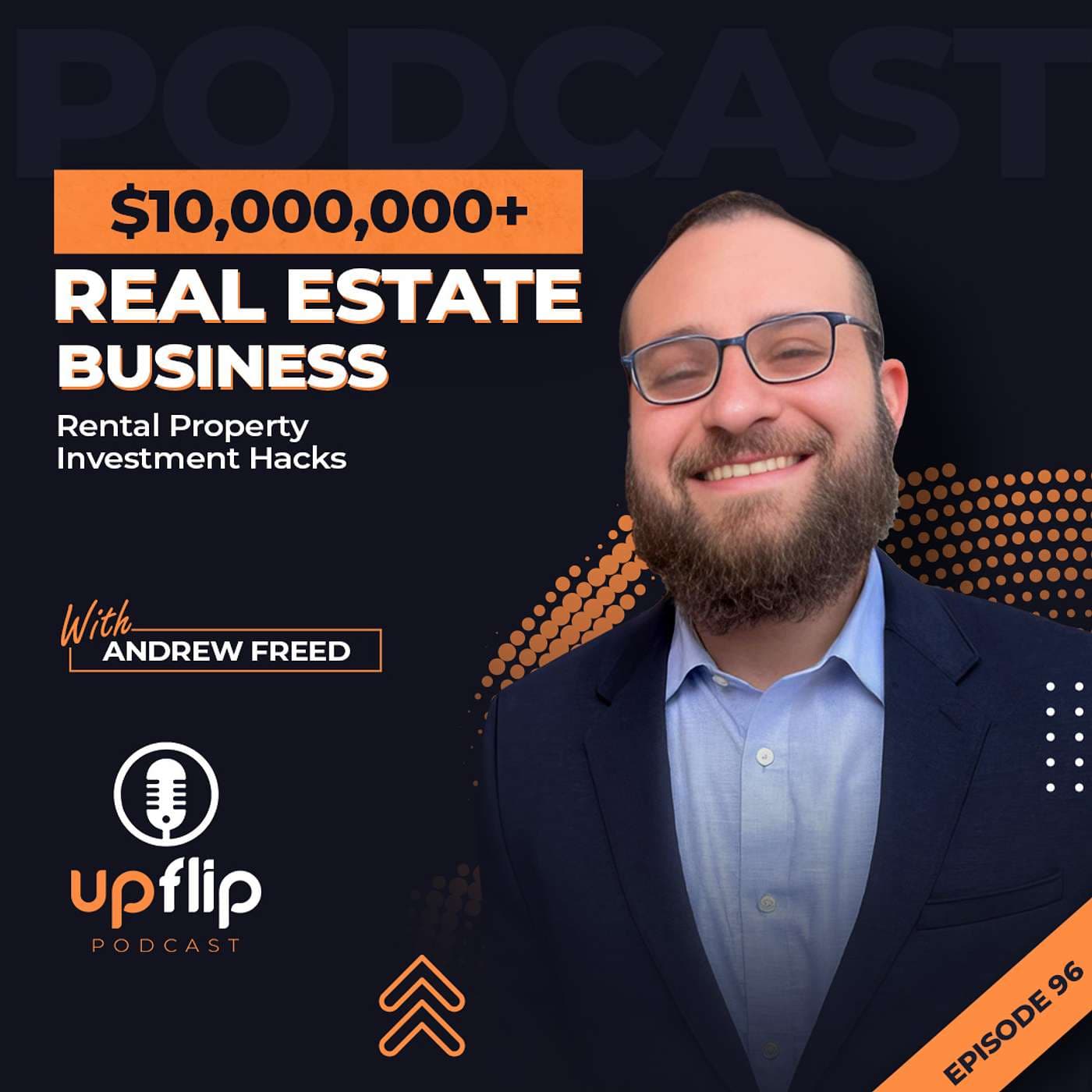
UpFlip Podcast Episode 96 Summary: How He Built a $10M Real Estate Business (while working full time)
Episode Overview In this episode of the UpFlip Podcast, host Alex Freeman interviews Andrew Freed, a multifamily investor and project manager who has successfully built a real estate portfolio of 95 properties valued at over $10 million in just two years. Andrew shares insights on starting a rental property business, overcoming challenges, and the importance of mentorship in achieving financial independence.
Key Topics Discussed
- The Journey into Real Estate
- Awakening: Andrew's journey into real estate began during the COVID-19 pandemic when he read *Rich Dad Poor Dad*, which inspired him to seek financial independence through real estate rather than traditional employment.
- Entrepreneurial Drive: His desire for self-reliance stemmed from his childhood experiences and the absence of a traditional role model.
- Overcoming Fear and Perfectionism
- Andrew emphasizes that success in entrepreneurship comes from taking action and learning from failures rather than striving for perfection.
- He discusses how embracing imperfections and being coachable has accelerated his success in real estate.
- Project Management Skills
- Andrew leverages his background in project management to set clear, achievable goals and break down large tasks into manageable steps, which has enhanced his ability to scale his business.
- Daily Routine and Personal Development
- Morning Routine: He follows "The Miracle Morning" routine, which includes meditation, affirmations, visualization, exercise, reading, and journaling to ensure he starts each day with clarity and purpose.
- The importance of mindset: Andrew highlights that enjoying the journey is crucial for long-term satisfaction and success.
- The Importance of Education and Research
- Andrew dedicated a significant amount of time (3-5 hours daily) to self-education, including reading books, listening to podcasts, and attending meetups before making his first investment.
- He stresses the value of thorough research and due diligence when considering a property.
Practical Strategies for Real Estate Investing
- House Hacking
- Andrew recommends starting with house hacking — moving into a multifamily property to minimize initial investment costs while generating rental income.
- Finding Properties
- He advises targeting markets with a high concentration of multifamily properties, such as Worcester, Massachusetts, to increase the chances of finding suitable investments.
- Due Diligence
- Key steps include conducting inspections, requesting public records for property history, and assessing tenant backgrounds to avoid future complications.
- Financing Strategies
- Suggestions include utilizing HELOCs (Home Equity Lines of Credit) or borrowing against 401(k) plans as alternative funding sources for property purchases.
- Building Strong Tenant Relationships
- Andrew’s approach involves setting clear expectations with tenants, utilizing strategies like the binder strategy to negotiate rent increases, and ensuring open lines of communication to foster good relationships.
Building a Network and Mentorship
- Andrew emphasizes the importance of networking through meetups and the value of leading with generosity to build lasting relationships and find mentors.
- His own mentor, who owns 500 units, played a crucial role in his journey, providing guidance and resources.
Key Takeaways
- Success in real estate requires a combination of education, action, persistence, and the ability to adapt to failures.
- Establishing a solid daily routine, leveraging project management skills, and maintaining a growth mindset are vital for entrepreneurs.
- Building a supportive network through mentorship and collaboration is essential for long-term success.
Resources Mentioned
- [UpFlip Academy](https://bit.ly/3A92es5)
- [Andrew Freed on Instagram](https://www.instagram.com/investorfreed/)
Conclusion Andrew Freed's story illustrates the power of determination, education, and mentorship in achieving significant financial success through real estate, even while maintaining a full-time job. His insights offer valuable guidance for aspiring investors looking to navigate the complexities of the real estate market.
Listeners are encouraged to apply the strategies discussed in the episode to start or expand their own real estate careers.
Written by AI. May contain mistakes. Listen to the episode to check what was said.
Transcript
Automatic transcript. May contain errors.0:00I'm Alex Freeman, and on the show today I have Andrew Freed, a current W2 employee turned multifamily investor. If you find somebody doing what you want to do at a large scale, go out of your way to try to help them in any way you possibly can to take stuff off of their plate. And if you do it enough, they're going to feel a need to help you. It's just a simple concept, reciprocity. If you put one hour into something every single day, in 10 years, you have 10 ,000 hours under your belt. You'll be considered an international expert. So why not amplify that? Everybody is born with strengths and weaknesses.
0:32Everybody is born with advantageous things in their lives and not advantageous things in their lives. You have to figure out where your strengths are, where you're advantageous, and utilize those strengths to enhance your business. The way people really get ahead in this life is they do more deals with more people that want to work with them, right? And more people want to work with you when you create win-win scenarios. All it took was a little over two years for Andrew to accumulate 95 rental units, and he credits it all to what he likes to call the purple pill. Andrew, welcome to the show. Thank you, Alex.
1:04I really appreciate the opportunity to educate your community on real estate investing. I love it. So let's start with your story. When did you start investing in rental properties? And why did you decide that that was the way you wanted to go? So like many, Alex, you know, during COVID, I had very much of an awakening where I read Rich Dad, Poor Dad. That's a purple book. That's where I refer to, you know, having the purple pill. But I read Rich Dad, Poor Dad, and that awakened my mind to the power of real estate and achieving financial independence. and the fact that I could achieve financial dependence in, you know, five, 10 years, as opposed to going the traditional route of, you know, saving for 40 years, having a 401k and retiring at 65.
1:41So, you know, when I read that book, that really opened my mind to the possibility of actually reaching financial dependence in my 30s, which I'm currently on that journey right now. And it's been a whole ton of fun. Did that entrepreneurial drive exist before you encountered the book or was that kind of awakened in you as you read Rich Dad Bordet? You know, that's a really good question. You know, I've always been an entrepreneur at heart. I mean, at the end of the day, when I was a child, my father left real early and I didn't really have much of a male role model. So I really had to rely on myself.
2:14And I really internalized that even from like from a sustainability standpoint or from a financial dependency. But I always want to rely on myself for my financial stability. And that was really ingrained in me when I was really young. That helped me kind of with the drive to go after my own dreams. and kind of not be scared of the repercussions. I mean, at the end of the day, I could always just go back to get a W-2 job and retire at 65 like everybody else. So it came in early for me at a very young age. I want to ask about that kind of like the fear of the repercussions aspect of it. You know, for a lot of people, it can be scary to actually like step out and take the plunge and putting your money into things that feel non-traditional and scary.
2:52How did you overcome that fear of failure? It was less overcoming the fear of failure for me and it was more overcoming the need to be a perfectionist. You know, growing up, I mean, especially in our school system, everybody gets in, you know, you either get an A, a B, a C, a D, you have a 4.0 GPA, you have a 3.0. We're all fighting for perfection. And we're taught that at a very young age. You can talk to any entrepreneur out there. To achieve success, there is absolutely no perfection. You just take action. You go, you course correct as you go, right? So once I got over that need to be a know-it-all and kind of just understood that, you know, there is going to be failure in life, in real estate, in journeys, and just accept that and use that as learning lessons.
3:32That really kind of brought me to the next level. And I was able to scale very quickly, essentially just being coachable, right? So that really helped me. That really helped me achieve a certain level of success. In the other W2 life, you're a project manager. So how has that helped you in the real estate business? That's a great question. I mean, project management, I really view it as task architecture, right? So what's great about project management, you take a large goal, right? And you break it down into small bites that are chewable, right? So in project management, I really use that expertise in scaling my business.
4:04Every single morning, I go over kind of my 10-year vision, my five-year vision, my one-year vision. And then in my one-year vision, my original goal was to get to 20 units this year. I'm already at about 80. But my original goal was like to get to 20 units, what do I have to do every single day to get that goal achieved, right? So what's that mean? That just means like, you know, underwriting five deals a day, putting two offers on a property a week, walking two properties a week, right? So just figuring out the overarching task and small, doable steps to get me to that task is really project management in a nutshell, in my opinion, just getting everybody on the same page, keeping everybody accountable and having everybody view the big picture.
4:42So that's kind of how I've used it in real estate investing and it's helped me tremendously. Now, the other part of your bio I want to ask about is being big into video games. how has your gamer past helped you in real estate investing? So gaming early on was, it was an escape. It was an escape from reality that I didn't want to live. And I wanted to create the reality that I did want to live in a box, right? So how video games helped me was it showed me that I can create the avatar when I can't create the skills I want if I put enough work into it. And when I read Rich Dad, Poor Dad, and I realized that, you know, why put all of my effort in this video game in creating this fake avatar when I can create the true avatar that I want in this real life and create the best version of myself every single day.
5:24And that's where video games really taught me is when you have to put enough skill, enough effort, enough drive into anything, you can create any avatar, any skill that you want and be successful in this world. Now, how did you go about changing those habits? Because that can be quite the insurmountable challenge for a lot of people. I would say the way I went about changing those habits is really focusing on positivity, focusing on gratitude, practicing gratitude every single day, focusing on time management, right? So I don't know if you ever read Stephen Covey's Seven Habits of Highly Effective People.
5:56Great book. Yeah, amazing book. It's not only a good book on how to be effective, it's a really good book on how to live your life in a really good manner, in my opinion. But on that book, he has a time matrix, right? And on that time matrix, it's separated into four quadrants, urgent and important, not urgent and important, not important, urgent, and not important and not urgent. So when I realized kind of how I was using my time, which a majority of my time was spent in not urgent, non-important tasks, aka video games, movies, I really focused on how can I spend my time to get my time in the important and the urgent categories and the not urgent and the important categories.
6:34And the entire goal is to eventually work on creating systems that make those urgent and important tasks move into the non-urgent and non-important tasks. by hiring people, by creating systems, by automating things, right? So once I realized where I was spending my time in inefficient ways, that really opened my eyes to how I can use my time in more efficient ways. Listeners, make sure you check out upflip.com for more actionable advice from real world entrepreneurs and business experts that can help you start and grow a business in any industry. Now, Andrew, with that in mind, I'd love to kind of hear about your daily routine and habits.
7:08What are kind of some of those specific things that you make sure that you do every day and why are those valuable? The thing about being successful in business, it's not about the actual business. It's about how you develop yourself every single day. So every single morning, I wake up around 5 a.m. and I spend the first three to four hours all on personal development. So I utilize the Miracle Morning. I don't know if your audience are familiar with that, but it's a morning ritual that incorporated this acronym called Sabers, which is silence for meditation, A for affirmation, B for visualization, E for exercise, R for reading, S for scribing, right?
7:44So I do that every single morning and I actually go to nature. I go into a park, I meditate, I ruminate about kind of my goals, where I wanna be. And then by nine, I am ready to go. I educate myself from a reading perspective. I exercise my body's in great shape. I meditate it so I'm good from an emotional standpoint. I scribe or I journal so I write about my goals and how I'm gonna get to my goals and what I'm gonna do that day to get to my one-year goal. five-year goal, 10-year goal. And when I do that, I feel like my path is clear as day. And when I miss that, I feel like I'm wandering aimlessly in a desert, like fires happening left and right.
8:19So to be successful in business, in my opinion, it all starts with the morning and all starts aligning yourself as early as possible with self-development and focusing on yourself first before you focus on your business. And how important is getting the mindset right for an entrepreneur? It's incredibly important. It's incredibly important. I mean, you know, I think they say all the time money doesn't buy happiness. I mean, you can see that for yourself. Somebody who's uber successful has hundreds of millions of dollars and they keep chasing more and more and more money and they're never fulfilled, right?
8:48So it's really important to have a good mindset so you can actually enjoy the journey along the way. Because I mean, at the end of the day, it's like, you know, whenever you say, for example, you watch an adventure movie, it's never the end goal. That's the exciting part. It's always the adventure and the journey along the way, right? So that's why mindset's incredibly important because you have to value and appreciate the journey and love the journey along the way, or it's just going to be a grind and you're eventually going to burn out. I could spend all day in this mindset conversation, but I want to get to some kind of nuts and bolts stuff for our listeners about real estate investing here.
9:18I want to take you back to before you got into your first property, what kind of research and learning did you do before you actually started investing your money? So I poured into education as much as possible. So I made it the point to read 10 to 15 pages a day on real estate investing topics. I made sure to listen to a real estate podcast every single day, attend meetups, underwrite properties, and essentially do those daily routines. I mean, more or less, I poured into education for a good three, four months, five months, and put a good three, four, five hours into education every single day.
9:53And surprisingly, most people aren't willing to do that. Most people aren't willing to put three, four, five hours into something every single day. I mean, if you put one hour into something every single day in 10 years, you have 10 ,000 hours under your belt. You'll be considered an international expert. So why not amplify that, that ability to learn? If you do three, four, five hours of learning in a single day, you can become an international expert in two to three years, right? So I really went hard at that. And I went completely dove into self-education and anything that did not get me towards my goals was eliminated.
10:24That could be, you know, friends that didn't get me towards my goals. That could be relationships. That could be, you know, time commitments or job commitments. Whatever didn't get me to my goal, eliminated. So that's kind of how I got started. And probably a good three, four, five months after putting that amount of education. And I probably knew more than about 80 to 90 % of real estate investors. So just serious self-education got me there. As you've done that self-education, then you get to actually making that first purchase. Where did you find that first property? and where would you recommend that first-time investors look for a property to invest in?
10:58Just like many people here, I got started in what's referred to as house hacking, where you move into a multifamily, a two to four unit property with a low down payment at three to 5 % down, sometimes as little as 0 % down. And what's great about that is you can get into, if you do that, you can house hack a property every single year. So I got into six units with those little as$50 ,000 because I house hacked two properties back to back. So house hacking is a fantastic way to get started for new investors. And I highly recommend that. So I actually ran into this dilemma myself. I own a condo in Boston.
11:30I have a six figure job in Boston, swanky little condo. I was looking for a multi in Boston, right? However, supply is so sparse in Boston. The amount of multis in Boston is sparse compared to other markets. So what I recommend for other investors who are looking to do multifamily, and that's exactly what I did, was I specifically targeted markets with a lot of multi. Worcester, Massachusetts, specifically the market I invest in, I own about 29 units in Worcester, that has the highest concentration of multis at any city in all of Massachusetts. 30 to 40 % of the housing stock are multifamily properties.
12:04So my advice to new investors would be, first of all, house hack. You can get into a three, four unit property, a five,$600 ,000 property with as little as three to 5 % down. Additionally, choose a market where there's a lot of supply. These assets are in high demand, right? So if you can get into a market with a lot of supply of these multis, that's going to increase the likelihood of you finding them, right? So in my example, I put offers in in Boston. I put probably 30 offers in Boston. I never want a property because, you know, it was just, there wasn't enough supply. Went out to Worcester, got a property probably like six or seven off, just because there was just an immense amount of supply in Worcester.
12:40And what kind of information should somebody be gathering about a property before they buy it? And any sources of that information that you might recommend somebody checks out? There's a plethora of information you should be finding out while you have a property under contract. Obviously, always get an inspection, especially if you're a new investor. I mean, you can make your inspection informational only, meaning you're not going to ask for cost reductions, but you still have the ability to walk away. So incredibly important, always have an inspection clause. My second piece of information, which is really important, is put a public record request in with the city or the town on that particular property and ask about the inspection information, ask about housing violations, ask about any outstanding issues.
13:20You can put public record requests in the properties and find out all the history of the property. Then you can find out maybe there's a rough tenant base. Maybe they didn't file permits to put another unit in. Maybe this is a legal three when you're buying a four, right? Like you probably want to know that. So it's really important to communicate and touch base with the city, specifically inspection department to ensure you're getting what you are getting. And the other thing is if in a multifamily, your success is largely dependent on your tenant base. So it's really important to do due diligence on those tenants, find out who they are, get their leases, make sure they're paid up to date, you know, make sure that these people don't have any evictions on their record, are upstanding citizens, would be good renters, right?
13:59Because if they aren't, especially in my state, which is a tenant friendly state, evictions can cost as much as five to$10 ,000, right? I mean, it's okay to accepted eviction, but you have to budget that in your numbers, right? So, I mean, those are just a few I can probably go on for a very long time on this topic, but I'll just leave it at that. I love it. That was all really useful information to have. And I'm curious if you made any mistakes during that first deal that maybe you learned from and you could share that experience with our listeners. So my first deal was a three family in Worcester, Massachusetts.
14:29I bought for$560 ,000 and comps around that area for similar properties were$500 ,000. So I completely overpaid$60 ,000 for this property. So that was number one mistake, right? Thankfully, this was during COVID. Interest rates were really low. Two of the units rented for$3 ,200 total between both of them and my mortgage was$3 ,200. So from that standpoint, it made sense. But from a comp standpoint, I definitely overpaid for the property. However, thanks to COVID, thanks to rising rents, the property is probably appreciated to about$700 ,000 right now. But that was probably the biggest mistake was overpaying.
15:03But what I will say is when your house hack, when you're utilizing these low down payment owner occupied loans, sometimes price is all you have, right? So I get it. I probably shouldn't have paid that much for it. In the end, I'm happy I got the asset. In the end, I'm happy I moved forward with it, but I probably overpaid for that property. On that property, how did you finance that first real estate investment? This is actually how I got started in real estate. You know, when I reached that poor dad and I looked at my Mint app and that's how I actually track my net worth, I realized like, oh crap, 80 % of my net worth is deriving from this real estate thing.
15:35Maybe there's something to this, right? I had a one bedroom condo in Boston at that time. And at that point, I decided to take out a 200K line of credit, a HELOC on my property and use that as a battle chest to buy property, right? So I actually, for my first house hack, I moved from my condo to my three family in Worcester and I took about$40 ,000 out of that 200K line of credit and use that to buy the property. So essentially, I didn't pay any money. I mean, it was bank money. I borrowed bank money to buy another property. So that's kind of how I funded my first project. And any other advice you might want to offer for somebody who's looking to finance their first real estate investment, perhaps if maybe the HELOC option doesn't exist for them, where might they turn?
16:12Many people think they don't have money when they actually do. And what do I mean by that? So a ton of people have 401ks. You can actually borrow against your 401k alone to buy property, right? Or maybe your parents would be willing to offer you a loan. Give them a decent interest rate. You know, it is what it is, but you got to look at resources outside of what you normally think are available, right? So everybody is born with strengths and weaknesses. Everybody is born with advantageous things in their lives and not advantageous things in their lives. And you have to figure out where your strengths are, where you're advantageous, and utilize those strengths to enhance your business, right?
16:46So that would probably be my biggest tip is I utilize 401ks to buy real estate. I utilize lines of credit to buy real estate. I've utilized stock. I've utilized other people's money. So there's an array of possibilities to buy real estate outside just having cash in your bank. So this is going to bring us to a section of the show that we call our Fan Blitz questions. These questions come from our YouTube community. Listeners, you can join that YouTube community by going to youtube.com slash upflip and you can pose questions to future podcast guests. Andrew, I've got five questions here. We're going to do of about a minute.
17:17Are you ready? Let's do it. Right. First one up. Here we go. If something happens to you, what happens to the business? I'll be honest with you. I'll probably just give it to my family, you know, and let them achieve a certain level of financial independence and let them live the life that they truly want. They love travel. They love experience. I would love to pass on that benefit to them if I ever passed away. And I mean, at the end of the day, if I passed away, completely cool. I lived a happy life. I've done everything I wanted. I have no regrets. So please don't mourn for me. If there was a movie made about your journey, what would the title be?
17:45Create the Avatar of Tomorrow. Ooh, seeing that movie opening day. Can you tell us about your most bizarre business encounter? My most bizarre business encounter was when I probably hired one of my tenants to, he was a plumber, to fix another tenant's clubbing. And they were told not to go to the bathroom and they ended up doing it. And one of my tenants ended up going to the bathroom on another tenant. And that was not a fun experience. So yeah, that was my most bizarre What negative thing would your last boss say about you? I think I alluded to this, but I think they'd probably say that in the past, and I completely admit this, that I was a know-it-all.
18:21Completely know-it-all, completely unculturable. I thought I knew the answer before they spoke, right? And I've learned in business and in life, you have to be a constant learner. There's too much knowledge in this world. There's too many mentors. There's too much out there to think you know everything because you absolutely do not. What's the secret of business that makes me a billionaire? Every decision you make, think of it with a 100-year time horizon. Win-lose scenarios work in the short term, but they never work in the long term. I mean, the way people really get ahead in this life is they do more deals with more people that want to work with them, right?
18:52And more people want to work with you when you create win-win scenarios. So sometimes it's better to lose in the short term so you win in the long term. That's going to do it for the Fan Blitz questions. Listeners, you can find more advice for how to start a business the right way on the UpFlip hub at upflip.com slash learn. Andrew, I want to ask about investment partners. What are the pros and cons of investing with a partner? So the great thing about partners is it allows you to scale very easily. Like if I want to go after a six, 10, 12, 15 plex, right? I can cobble together four or five, six people's money, buy that asset together.
19:27And the great thing about that is when you're buying those larger assets, it's actually more profitable. They're cheaper per unit as opposed to residential properties, one through four unit properties tend to be more per unit. So it allows you to scale quicker. It also allows you to designate responsibilities based off strengths and weaknesses. Like I have certain strengths as a project manager and I have certain weaknesses, like I'm not the greatest salesperson. So it allows me to sub out the things that I don't like to do and take on the things that I'm superhuman at, right? So that's really, really key for partners.
19:59And lastly, lowers risk due to liability being spread among many people, right? So say, for example, you're in a 10plex and a$20 ,000 charge comes up and you have three partners. That's split three ways as opposed to one way. It lowers the risk and the liability across you. So when it comes to con, less control. You know, usually if you have a big decision, you have to run up by all of your partners, right? You're reliant on your partners to do jobs effectively. As I mentioned earlier, you know, it's really good to get people who complement your weaknesses so you can focus on your strengths and they can focus on their strengths.
20:31But sometimes they're unreliable. and they don't do their job and you got to pick up the slack for them, right? So that's a con. And then the last con would be the slow decision-making process. What are some of those kind of red flags that you look for when you're assessing whether or not you should get into a relationship with a potential business partner? Does your actions equal your words? When you say you're going to do something, do you actually do it? At least do you do it 80, 90, 100 % of the time, right? So as a partner, it's incredibly important to designate responsibilities to other people and let them stay in their lane, right?
21:07But if somebody's not doing their job in their lane, you gotta pick up the slack, right? It's really important upfront to see, do they do what they say they're gonna do? If they tell you they're gonna send you a vendor, if they tell you they're gonna take care of that contract, if they tell you they're gonna underwrite that deal, do they do it without having you to follow up or not? If you have to follow up multiple times, I guarantee you're gonna get frustrated with that partnership really quickly and it's gonna cause a lot of tension as opposed to the alternative, where if they do everything on time, you know, in a good manner, the partnership's got to feel light.
21:36So that'd be my biggest takeaway when it comes to finding good partners. And when you do kind of form that partnership, what kind of legal framework do you need to put into place? Is it like a partnership contract? What should be in that? Can you help us understand that? Absolutely. So normally when you purchase real estate, you create an LLC for that specific property. And within that LLC, you're required to have an operating agreement. So in that operating agreement, that's where you designate roles and responsibilities. That's where you designate if somebody dies, what's going to happen to that person's equity?
22:05Like that's who does it. All the things that are going to happen at the end of the day, just like a marriage, a partnership is a marriage. And it's incredibly important to maintain good relationships and to keep building that relationship as you go on, because the only time you're really going to reference that operating agreement is when you're going through a dispute, right? If me and you are in agreement on something, we're not going to go to an operating agreement to determine if something is going to happen a certain way, right? So keeping good relationships with partners is probably the utmost importance, in my opinion.
Read the full transcript
22:33On the relationship front, I want to ask also about meetups and how those can be useful to building a career in real estate. Can you tell us about your experience with meetups and where you have found them in the past and how you make the most of them? I've been hosting a local real estate meetup in Worcester, Massachusetts for over two years at this point, and it's been incredibly helpful with finding partners. Most of my partners have come from this real estate meetup, finding deals. I found a couple of different deals at these meetups, talking with vendors, finding contractors. These are all incredibly important when it comes to meetups, because all the people who have meetups a lot of times have done this before.
23:07Our experience, know the game, right? So if you're trying to do the game, it's better to surround yourself around people who are successful in that game, right? So meetups are really important for that, as well as just networking. I mean, you know, I can learn as much as I want, but I would be nowhere close if I didn't have the network to support me and to partner with me along the way. So that's been incredibly powerful with scaling for sure. And how have you built that network outside of the meetups? Lead with value. Whenever somebody needs help, needs advice, needs a contractor, needs a lender, I am first to lend my hand out because I learned early on in entrepreneurship, the more value you give to the world, the more the world gives value back to you.
23:46If I provide value to you, I don't expect anything in return whatsoever, but I do know that the world will return that to me in one form or another. Maybe not from you, but in one form or another, I know that value will be given back to me. And that would be my biggest tip is lead with value, expect nothing in return. Do you have a mentor? I do have a mentor. I have a mentor. He owns about 500 units. And I actually just closed on a 65 unit syndication right now, where he actually came in and helped us raise the remaining money. So having mentors is really powerful. And he coached me along the whole way of syndications.
24:19He gave me the syndication attorney. He gave me the lender, right? He coached me through certain negotiation situations. He coached me through negotiating. There was a number of illegal units. He helped me negotiate how to have that conversation with the seller. So he's done this before, right? So having mentors along the way probably saved me immeasurable mistakes. And I probably don't even know I would have made those mistakes because he saved me from them. And to be honest with you, I haven't made that many mistakes in real estate, but it's primarily because I surround myself with people who already own a ton of units and who have already faced a lot of these dilemmas.
24:49And how did you kind of build that relationship with your mentor to have them be there coaching you along the way? Like I said, lead with value. Don't expect anything in return. And the way I went about doing that was I attended as many meetups as possible. My mentor hosted a local virtual meetup and he was telling me, he was like, oh, you know, he was talking to the audience, actually. He's like, I'm trying to start a meetup in Worcester. If anybody knows any good venues, let me know. Right. And he said this probably about 20, 30 people. So I actually took the initiative to go out that weekend, go to about four or five different places, take videos, get pricing, get the manager's information, put it in a nice little package and send it to him.
25:24And when I sent it to him, he's like, wow, I've been asking if somebody do this for eight months. Nobody did it. Do you want to be our first guest speaker at our meetup? I'm like, fantastic. I would love to be your first guest speaker. And then at that point, after I actually spoke, he actually asked me to be a guest speaker at that point. And that's how I kind of started the relationship. And from there, he owns a brokerage. I have a W-2. I technically don't need agent money, but I decided, you know, I want to learn under him. I want to provide him value. So I decided to become an agent just so I could learn under him under the auspices of providing him, you know, commissions, right?
25:54So that was like another way I provided value to him. So if you find somebody doing what you want to do at a large scale, go out of your way to try to help them in any way you possibly can to take stuff off of their plate. And if you do it enough, they're going to feel a need to help you. It's just a simple concept of reciprocity. They're going to feel a need to help you and a need to guide you to be a success in that realm. Now, I want to ask you a few more questions about kind of the day-to-day operation of the business. But to kind of set us up for that, can you kind of give us the overview?
26:20How many properties you got in the portfolio? How long it took to build it? And what the cash flow looks like in a typical month? So I did just close on 72 units this past week. So congratulations. Nicely done. It's a little skewed. So I have about 19 properties, 12 of which are part of a syndication. 95 units total is about 65 in a syndication. I own about 30 myself. though. I cashflow probably about five to six thousand dollars per month. But what I will say is I don't take any of that money. I let that compound. I use that to buy more and more and more real estate. Right. I live off my W-2 and I continuously let my cashflow compound until I get to the point where I truly don't even need it.
26:59Right. So cashflow is a great word and all, but you know, it's like a phantom income. One month is here. Next month, your furnace goes and it's gone. So it's very hard to predict where your cashflow is going to land every single month. Is your whole portfolio residential? Do you have any commercial properties? I do have commercial. I own about, so just so your audience know, commercial is considered five plus unit properties. Half of my units I own are residential, the other half are commercial. I actually started moving into the commercial space because commercial properties are way easier to burn than residential properties.
27:29It's way easier to get your cash out of the property because commercial properties, five plus unit properties, are very much based on how much money it makes, the income it produces, versus residential properties, one through four properties, which is based on the sales contract. Everything else is selling for it, right? So it doesn't even matter what it's cashflow. It matters what this person down the road is willing to pay for this unit. As opposed to commercial, it's 100 % based off, not 100%, but a majority of it's based off the income of the property. So as a result, with a commercial, I can just go in there and raise the rent on everybody 50%.
27:59And if I do that, the value of the property is going to be going up by a similar percentage. Compared to residential, the only way I can really go in there and raise the value is really do like a deep value add, like unit renovations or redo the roof or add square footage. So that's why I'm kind of stuck in commercial lately. It's just way easier to optimize and get your money out to recycle that cash so you can buy more and more real estate. Now, is that also an easier spot for somebody to start their journey with real estate or would you recommend they start at residential? I would absolutely recommend they start at residential because with residential, you can do, as I mentioned previously, a house hack.
28:32where you can get into a property with as little as three to 5 % down, which could equate to$20 ,000 to$30 ,000. That's way more achievable to get into a property early on than some of these commercial properties where you have to make 25 % down. I mean, even if you're splitting it with three, four, five people, that's still a significant amount of money on like a million dollar asset, right? So I recommend starting on residential with house hacks, right? Build up your cash, build up your reserves, build up your passive revenue, and then in advance to some of the larger multis would be buy advice.
29:00And that's how I started as well. Now, with your numerous properties and tenants and overall business, what systems are you using to manage all of that? And what are those crucial systems that every real estate investor should make sure that they have in place? Number one, automate your rent collection. Get them set up. Like personally, I use apartments.com and right when I take ownership of a building, I tell these people, hey, you know, apartments.com is where I was collector and I expect you to put in your bank account information on the first of the month or the third of the month it just grabs automatically.
29:27That saves me hours and hours of rent collection. For every single property, it probably takes about five minutes every single month to reconcile whether somebody paid me, whether the buildings paid me or not. And it's as simple as just shooting them a quick text if it didn't. So that's definitely number one. Number two would be develop a electronic Rolodex for contractors. Have a shared contractor list for plumbers, for electricians, for masons, for anything you need, right? And then if the issue does arise, you got vetted contractors ready to go. We just go down the list, call them, see if they're available, get them out there.
29:55And then lastly, one of the really important tips that I recommend for all new investors is make sure day one to set up electronic locks in the front and the back of the property and have a lockbox on site. And this is really critical for time management. So you literally don't have to be at the property for a fix to occur, which I'm sure a lot of investors can relate. You know, a lot of your time is spent on meeting contractors at properties, at going back and forth, things like that. So if you can eliminate that travel time, that's going to save you a ton of time in managing your properties.
30:24And what kind of metrics are you tracking? And what are those telling you about your business? Really good question. And I would like to admit that I have way better KPIs than I do. But the simple fact of the matter is just like compound interest, you know, I compound all of my money back into buying more and more and more property. I would say the biggest KPI that concerns me is vacancy. I want to make sure all my units are rented. I want to make sure I'm getting the maximum income possible. That's probably one of the most important things. The other metric that I really like to look at is a return on equity.
30:54So how much money am I making on a property based off how much equity I have in it. I mean, if I have$100 ,000 of equity in a property and I'm making$1 ,000 a year in cash flow, that's a 1 % return on equity compared to if I made$12 ,000 on that property and I had 100K in equity, that's a 12 % return on equity. So I try to keep that in mind because if my return on equity falls too low, then at that point, it might make sense for me to either sell or 1031 into an asset that's going to provide me a better cash-on-cash return, which personally, I like to be at least eight, you know, nine, 10-plus cash-on-cash return.
31:26I do want to ask about tenants here now. I guess we'll start with when you've purchased a property and you inherit tenants along with that property, how do you build rapport with those tenants and how do you make sure that it's going to be a good situation moving forward? Throughout a majority of my properties, I actually have inherited tenants. So I'm very conscientious of tenant-landlord relationships. And what I normally do is I normally utilize the binder strategy initially. It was made famous by Dion Talk Financial Freedom. But more or less with the binder strategy, you just have a conversation with a tenant on where their rent is versus what market rent is.
32:01And you just have a conversation on what do you think makes sense, right? And a lot of times it's just human nature to choose the 50 % mark. So say market rents two grand, they're paying a grand. Usually it's human nature to choose the 50 % mark, which would be$1 ,500. So day one, I normally meet with a tenant. I go over any outstanding issues that they have in their place, maybe like a broken window or a leaky faucet, anything I can fix to make their experience better. And then at that point, you know, I establish expectations up front. I'm like, you know, my expectation is you pay on time, you treat you to write, and your expectation is I treat you with respect and I address your issues in a timely manner.
32:34And as long as those expectations are met, we're going to have a fantastic relationship, right? So I establish expectations up front, and I usually end with that binder strategy, where my goal is for me not to propose the rent increase, but for them to propose it, right? So I tell them, here's what you pay. What do you think makes sense? They're going to tell me I'm willing to pay$1 ,500. If you tell me you're willing to pay$1 ,500, nine times out of 10, you're going to pay me. You're the one that proposed it, you know? So I try to get their buy-in by having them propose a solution and not me.
33:02Now, when you do have a problem with a tenant, how do you address that? I'm in a tenant-friendly state, so I can't get people out very easily. It takes, you know, three, four, five months of getting an attorney and going through the eviction process to get somebody out. So a lot of times it makes sense to work with the tenant from an emotional intelligence standpoint than they just to take a hard stand on them. Right. So a lot of times I'll have a conversation with them. Be like, OK, you know, what do you need? Do you need an extra couple months to get out? OK, you know, we keep you ready a couple of months to get out that way.
33:29You know, maybe maybe offer them cash for keys, maybe offer them rent. I'll give you two thousand dollars to get out by the end of this month, you know. And then last resort is always the eviction. I mean, I don't want to go there. But at the end of the day, if you don't, you know, match my expectations in regards to paying rent on time between the unit right, unfortunately, I have to ask you to leave. You know, it's a scale, eviction being the last, but it's by no means, I'm not going to eliminate that. I mean, if they're not doing their requirements as a tenant, then, you know, unfortunately, I'm going to have to ask you to leave.
33:55The last kind of tenant related question I have here is what strategies can you recommend for finding high quality tenants and making sure that you get great people into your units? I would say the utmost important thing that people can do for finding a good tenant is having patience. And what do I mean by that? When I say have patience, I mean, have a rental criteria and stick with it. So like if, say, for example, you have a 650 credit score, you want them to make three times the income. You want them to have no evictions, right? And you start getting applications in, in two weeks, you got somebody like, oh, they don't really cut it.
34:28Like, don't go with that person. Like, be cool with having a vacancy for one to two months to find the perfect tenant. Because you got to think, what's the alternative. You rush the tenant, you rush the screening, you get somebody in there that doesn't pay rent, then you have to go through a three, four, five month eviction process. Like that lost rent alone is way more than the month or two vacancy costs that you would have had, right? So that's definitely number one. Number two would be pricing the unit right up front. And what do I mean by that? Most people, newer investors, they'll price the unit based off what everything is listing for in the area.
34:58That's completely the wrong approach. Anybody can list anything that they want. I mean, just go to a car dealership and walk by any car. They can tell you any price they want for a car. That doesn't mean that's what it's worth. You're going to negotiate that. So when you're listing a unit, base it off of rented costs, base it off of what things are renting for in the area. And that's going to save you a ton of time and a ton of money and vacancy costs. If you overpriced a unit, you might cause an additional month or two of vacancy because you overpriced it, which, you know, maybe you overpriced by a hundred or$200.
35:27You're going to lose that additional difference, but just by that one month vacancy. So pricing a unit up front is extremely important for finding the perfect tenant, in my opinion. What's been your lowest point or biggest failure as an investor so far? And how did you recover from it? And what was your takeaway? My biggest failure as an investor, I would say, was about a year ago, I acquired a three family with a partner. Me and the partner didn't mesh initially, but it was a good deal. I was like, butt heads throughout the process where we just have different expectations of the property. Additionally, the property has been riddled with repairs.
36:03It was very turnkey. It was very in great shape, but the property has been riddled and riddled with repairs. So the property hasn't been profitable. Additionally, me and the partner have been butting heads. But at the end of the day, I mean, the property is a great asset. We could sell it tomorrow and make money. It has equity in it. But I think this just goes back to my original point of be extremely careful about who you partner with. Like I said, you're going to partner with somebody, make sure they do what they say they're going to do, right? That's where me and my partner butt heads is, you know, I have to follow up with him for his task three, four or five times, which gets real old real quick.
36:32And that causes frustration among our relationship, right? So that would probably be my biggest mistake in real estate, probably not being more conscientious of who I'm partnering with. Andrew, where can people learn more about you and what you're up to? So you can find me at Investor Freed on Instagram, and you could also find me on Facebook or LinkedIn at Andrew Freed. Always happy to help others in guiding them towards financial independence. One One of my goals is to help a thousand people reach financial independence. So please help me achieve my goal and help me help you in achieving your real estate dreams.
37:02That is going to do it for this episode of the Upflip podcast. Listeners, if you like what you heard in this episode, send it to someone who wants to start their own business and let us know what you think of the Upflip podcast by leaving a review on Apple podcasts or rating it on Spotify. It really helps other people find the show and unravel how great businesses are built. Andrew Freed, thank you so much for joining us today. Thank you for the opportunity. and I wish your audience the best.
From the publisher
Like many people, Andrew Freed wanted to break free from his 9-to-5–and rental property investing proved the answer. In 2 years, he’s built a portfolio of 95 properties, with a total value of more than $10 million, and he explains how to start a rental property business in this episode.
Andrew used a few popular strategies to start his real estate business, including the house hacking approach. He’ll give his advice on how to start investing in properties without a ton of cash on hand and how he built on that foundation to grow his portfolio quickly.
Andrew’s mentor also played a huge part in his rental property investment success. We’ll learn how he connected with his mentor and the most valuable things he learned from him. Today, Andrew gives coaching to mentees of his own, and he’ll reveal some of the key advice he gives in these coaching sessions with our listeners in this episode.
Resources:
- https://bit.ly/3A92es5 Join UpFlip Academy and start your business today
- Andrew Freed - Connect with Andrew on Instagram
Ready to be your own boss without starting from scratch? Grab our FREE Franchise Guide and unlock the secrets of proven business models that have already created thousands of success stories.
Connect with UpFlip:
- On Youtube
- On Instagram
- On Facebook
- @UpFlipOfficial on Twitter
For more insights to start, build, or grow a business, check out the resources on UpFlip.com or head to the UpFlip YouTube channel to see more interviews with business owners and experts.
Thanks for listening!


